The Cafeteria Worker Kept Pouring Coffee By The Airfield Until Her Old Navy File Was Opened
Chapter 1: The Coffee Pot Was Not Supposed To Be There
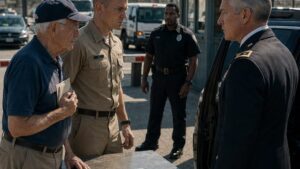
The coffee pot was already in Catherine Martinez’s hand when Jack Brown stepped into her path and said, loud enough for three tables to hear, “That does not go over there.”
Catherine stopped without spilling a drop.
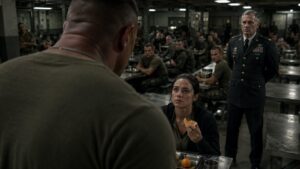
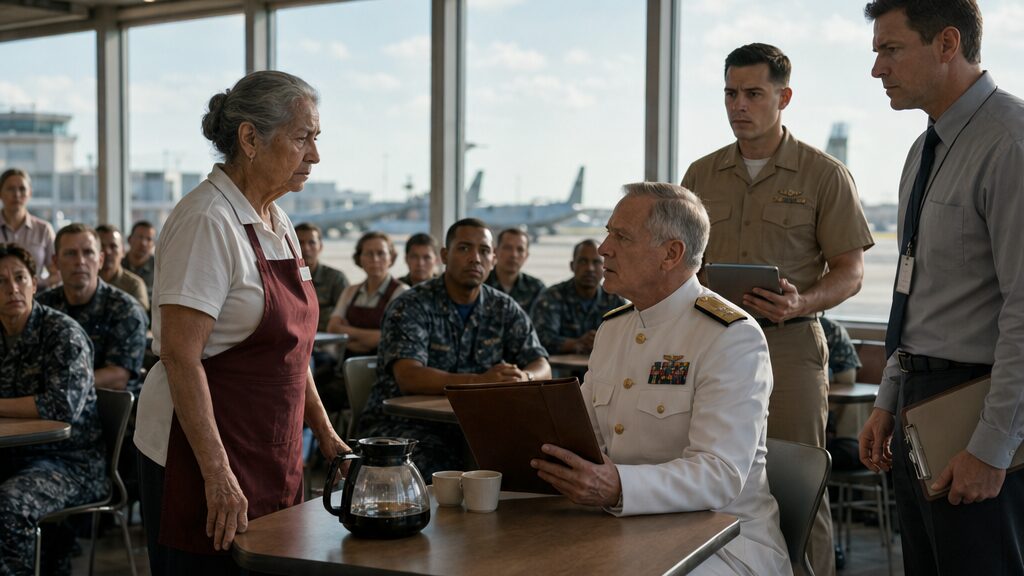
Behind Jack, the cafeteria was shifting into inspection posture. Chairs had been pushed neatly under tables. Condiment trays were squared to the corners. The stainless-steel counter had been wiped so many times the overhead lights floated in it like thin white bars. Beyond the long windows, the airfield lay in a bright wash of late morning sun, runway lines shimmering through heat. A gray aircraft rolled slowly past a hangar, its engines sending a low vibration through the glass.
Catherine held the pot by its black handle. The coffee inside rocked once, then settled.
“It’s fresh,” she said.
“That’s not the point.” Jack’s tie was tucked too tightly beneath his dining services badge. He had a clipboard under one arm and a pen in his hand, though he had stopped pretending to write. “The point is we have visiting staff in less than thirty minutes, and I need this floor clean. No wandering. No special favors. No side routines.”
A young sailor at the nearest table glanced up from his tray, then looked down quickly when Catherine’s eyes moved in his direction.
Catherine was used to people looking away.
She wore the white polo issued by the contractor, the burgundy apron that never sat straight on her shoulders anymore, and a rectangular name tag that read CATHERINE in black block letters. The name tag did not include her last name. It did not include anything she had been before she learned the fastest way to refill twenty cups without breaking stride. It did not include the number of years she had watched aircraft lift off from those windows and knew, by sound alone, when a pilot was easing into the morning or fighting crosswind.
The table Jack meant stood beside the far window. Round, plain, usually ignored until the lunch crowd filled every other place. Catherine had already set two cups there. Empty. Turned upright. Handles facing the runway.
Jack pointed with his pen. “Those cups need to go back to the station.”
Catherine looked past him. On the airfield, ground crew moved in bright vests near the edge of a taxiway. A maintenance cart flashed amber. The hour was not quite right yet, but it was close enough that her fingers had begun to remember.
“I’ll bring them back after,” she said.
“After what?”
She did not answer.
Jack exhaled through his nose. He was not a cruel man. Catherine had decided that months ago. Cruel men enjoyed making people small. Jack only believed smallness was necessary if it fit a schedule. He liked labels that matched their shelves, people who stayed in their lanes, and morning routines that could be explained in a staff meeting. Anything else made him feel that the whole operation might slide beyond his control.
“Catherine,” he said, lowering his voice without softening it, “I’ve told you twice this week. Officers’ tables are not part of your station.”
“They’re tables,” she said.
“They’re reserved today.”
“For whom?”
“For command staff and visiting inspection personnel. Which is exactly why I don’t need you crossing the room with a coffee pot like you’re hosting company.”
Catherine’s hand tightened on the handle. The plastic had worn smooth where her thumb rested. She had carried dozens of pots over years in this dining hall, some full, some half-empty, some so hot the lid fogged her glasses. This one felt heavier only because people were watching.
Lisa Johnson paused behind the serving counter, a stack of plates in her hands. Her face showed the helpless concern of someone too young to know when stepping in would make things worse.
Catherine gave her the smallest shake of her head.
Jack saw it anyway. “And don’t make this a staff thing. Nobody is picking on you. I’m trying to pass a base inspection without explaining why my senior cafeteria attendant keeps abandoning her post.”
Senior cafeteria attendant. Catherine almost smiled at that. They called her senior only when it meant old.
A burst of laughter rose from a group of aircrew trainees near the center aisle. It died quickly, not because they understood anything, but because tension made even careless people cautious.
Jack stepped closer. “Put the coffee back.”
Catherine looked at the window table. The cups waited in their exact places. The left cup closer to the glass. The right one set back half an inch, because the table leg wobbled and anything closer would tremble when heavy boots passed. No one had taught her that. Tables told you things if you paid attention long enough.
She could have put the pot back. She could have waited until Jack turned away, then carried it again. She could have told him that the flight-line crews came in rattled sometimes, hands still smelling of fuel and metal, eyes fixed on nothing. She could have said there were mornings when a person needed coffee before words. She could have said she had learned that long before Jack had learned to sharpen pencils for a clipboard.
Instead, she asked, “May I finish pouring?”
Jack looked as though she had requested permission to repaint the walls.
“No.”
The answer struck the air harder than it should have. Catherine nodded once. Not submission. Acknowledgment. She turned toward the counter with the pot still in her hand.
Then an engine outside rose suddenly into a deeper pitch. Not loud enough to alarm anyone. Not unusual enough to stop lunch preparation. But Catherine’s foot paused before her mind could catch it. The sound slipped under the floor and up through her bones, a shape from another year, another morning, another room that smelled of burned insulation and wet canvas.
The coffee in the pot trembled.
Jack said, “Catherine.”
She moved again.
At the counter, Lisa took the plates to the warmer, set them down too carefully, and whispered, “You okay?”
“I’m working,” Catherine said.
“That’s not what I asked.”
Catherine set the coffee pot on the warmer. “It’s the answer I have.”
Lisa’s mouth tightened. She looked toward Jack, who had turned away to adjust a row of chairs that were already straight.
“He shouldn’t talk to you like that,” Lisa said.
“He talks to everyone like that when he’s scared.”
“Scared of what? Napkins being diagonal?”
“Of someone noticing he can’t control everything.”
Lisa looked at her as though that answer belonged to a different conversation.
Catherine wiped a ring of coffee from the warmer with a folded towel. Her hands were steady now. That had been useful once, and inconvenient ever since. People trusted steady hands. They gave them things. Cups, forms, trays, wounds, secrets. Then they assumed steadiness meant the person carrying them did not feel weight.
At 11:27, the first visiting uniforms entered through the east doors. The dining hall changed shape around them. Voices dropped. Backs straightened. Jack became brisker, brighter, nearly cheerful. He moved from table to table, checking angles, smiling as though every chair had been born in its correct position.
Catherine remained behind the serving line, refilling cups when asked, replacing trays, wiping spills before anyone complained. She knew where the young sailors would gather, which officers preferred the window, which maintenance crew members came in late because they finished jobs before eating. She knew the airfield’s daily pulse better than the inspection staff would ever know from a binder.
At 11:36, one of the cups at the window table disappeared.
Catherine saw it from across the room: Jack had taken the two cups and stacked them on his tray with other strays. The table stood bare. Clean. Empty. Ready for someone important.
Her chest tightened. Not sharply. Not dramatically. Just enough to make breathing something she had to choose.
She reached for the coffee pot.
Lisa noticed. “Catherine.”
“I’m only setting it down.”
“He’ll write you up.”
“He already has the sentence in his head.”
“Please don’t make it easy for him.”
Catherine picked up the pot. The glass was warm against the towel wrapped around it. She stepped out from behind the counter before Lisa could say anything else.
Halfway across the cafeteria, a young man in flight gear turned too quickly and nearly backed into her. Catherine shifted the pot away from his elbow before he knew there was danger.
“Sorry,” he said, barely looking at her.
“You’re clear,” she replied.
He moved on.
She reached the window table and set the pot down in the center. No cups. Just the pot, steam ghosting faintly against the glass. Outside, the aircraft had stopped near the far end of the taxiway. A ground crew member raised one arm, signaling.
Catherine stood still for one breath.
Then Jack saw her.
His face did not redden. It emptied. That was worse. He crossed the dining hall with controlled steps, clipboard flat against his side.
“What are you doing?” he asked.
Catherine turned. “The coffee is fresh.”
“I told you not to bring it here.”
“Yes.”
“And you did it anyway.”
“Yes.”
Around them, the room thinned into silence. Forks moved more quietly. A chair leg scraped, then stopped. Catherine could feel the attention without meeting it. She had stood in worse rooms. She had stood in rooms where silence meant men were listening for rotor blades, for alarms, for breath. This was only a cafeteria.
Jack’s voice sharpened. “You are not assigned to this side of the room today. You are not to service command staff unless requested. You are not to create personal rituals on a government installation because you don’t like being corrected.”
Catherine looked at the coffee pot. Steam had begun to fade.
“I heard you,” she said.
“Then why?”
Her fingers touched the edge of the table. “Because sometimes coffee should be waiting.”
Jack stared. “That doesn’t mean anything.”
No, Catherine thought. Not to you.
The east doors opened again.
The change in the room was immediate. Chairs shifted. A few diners straightened. Jack turned as a tall older officer in a formal white Navy-style uniform entered with the measured pace of a man accustomed to being noticed but not hurried. Beside him walked a younger man in khaki, tablet tucked under one arm, and against his other side he carried a brown folder.
The officer’s eyes moved across the dining hall, paused on Jack, then on Catherine.
Jack drew himself up. “Commander King, sir.”
Thomas King did not answer at once. His gaze had dropped to the table by the window, to the coffee pot standing alone where no cup had been allowed to remain.
The younger man opened the folder just enough to check the tab.
Catherine saw her own last name written there in dark ink.
Martinez.
Chapter 2: The Name Tag Beside The Airfield Window
By the time Thomas King reached the window table, Jack had arranged his face into professionalism.
“Sir,” Jack said, “I apologize for the disruption. We were just correcting a staff compliance issue.”
Catherine stood on the far side of the table with the coffee pot between herself and the officer. The glass reflected the room in a curved, broken way: white uniforms, khaki, burgundy apron, silver trays, the pale shape of her own name tag. For a moment, CATHERINE appeared backward on the side of the pot, floating over the dark coffee like a label that did not know where to settle.
Thomas King looked older up close than he had from across the room. His hair was white at the temples, his jaw clean-shaven, his posture precise without being stiff. The ribbons on his chest were straight. His eyes were not unkind, but they were trained in the habit of asking questions and expecting answers.
Michael Adams stopped just behind his right shoulder. He held the tablet close now, brown folder pressed beneath it. He was young enough that his uniform still looked like something he thought about wearing correctly.
Thomas glanced at Catherine’s name tag.
“Ms. Catherine,” he said.
Jack leaned in slightly. “Catherine Martinez, sir. Dining services.”
Catherine heard the correction and felt the small erasure inside it. Not because Jack had used her last name. Because of the way he had added dining services, as if placing her back on the proper shelf before she could be mistaken for anything more complicated.
Thomas’s eyes moved from Jack to Catherine. “Ms. Martinez.”
The use of the full name landed differently. Catherine kept her hands folded in front of her apron.
“Yes, sir.”
“I’m told there was a disagreement about this table.”
“No disagreement,” Jack said before Catherine could answer. “I issued an instruction. It was disregarded.”
Thomas did not look away from Catherine. “Is that accurate?”
Catherine could have said many things. That Jack had ordered her to remove the cups. That the table was empty most days until the lunch crowd spilled over. That she had poured coffee here for years before anyone decided it looked improper. That no inspection had ever failed because a warm pot waited by a window.
“Yes,” she said.
Jack made a small sound of satisfaction.
Thomas’s expression did not change. “Why?”
The question was quiet, but the room seemed to lean toward it. Catherine felt the eyes at the nearby tables. Young aircrew trainees. A maintenance chief with a paper cup paused halfway to his mouth. Visiting staff pretending not to listen. Lisa at the counter with one hand pressed flat beside the napkin dispenser.
Catherine looked through the glass. The runway shimmered. The aircraft outside had gone still.
“It belongs here at this hour,” she said.
Jack’s shoulders rose. “Sir, that’s what I mean. She has these habits. We accommodate what we can, but today is not the day for personal—”
Thomas lifted one hand slightly.
Jack stopped.
The gesture was not sharp. It did not embarrass him. It simply made silence the next correct thing.
Thomas pulled out the chair at the window table and sat. The movement startled Catherine more than if he had raised his voice. Officers usually passed through, accepted trays, nodded at the staff, and carried their conversations elsewhere. They did not sit at a bare table with an aging cafeteria worker standing over a lonely coffee pot.
“Ms. Martinez,” Thomas said, “this table is reserved for inspection personnel today. Did anyone ask you to place coffee here?”
“No, sir.”
“Did you intend to serve someone specific?”
Catherine’s throat moved once. “No, sir.”
“Then help me understand.”
Jack’s pen tapped once against his clipboard. He caught himself and stopped.
Catherine’s gaze fell to the coffee pot. A skin of condensation clung beneath the lid. She could see the line where the coffee level sat, just below half. She counted, without meaning to, how many cups it could still fill. Four full. Five if someone only needed warmth.
“It’s not about inspection,” she said.
Thomas waited.
That waiting was worse than interruption.
Catherine could feel the past pressing from behind the window, but she had spent years teaching it to remain on the other side of glass. She would not let it walk in now because a commander wanted an explanation.
“It’s only coffee,” she said.
Jack exhaled. “Sir, this is exactly the problem.”
Michael shifted behind Thomas. The tablet brightened in his hand as his thumb brushed the screen. Catherine noticed him glance from her name tag to the folder, then back again.
Thomas noticed too.
“Lieutenant Adams,” he said, without turning.
Michael straightened. “Sir.”
“You had a note for me before lunch.”
“Yes, sir.” Michael looked uncomfortable now. “It may not be related.”
“Let me decide that.”
Michael opened the brown folder.
Catherine’s eyes went to it despite herself. The leather corners were scuffed. It was not new. Not one of the clean inspection packets stacked in the manager’s office that morning. This folder had been handled before, stored poorly, pulled from somewhere that still used metal filing cabinets.
Michael glanced at Jack, then at Catherine, as though wondering whether to speak in front of them.
Thomas said, “Go ahead.”
Michael opened the folder a little wider. “During the records review, we were asked to cross-check civilian staff access against older base personnel archives. Mostly because of badge renewals and legacy records. Ms. Martinez’s contractor file triggered a possible match.”
Jack frowned. “A match to what?”
Michael did not answer him directly. “The dates are old. Some records were digitized from paper. There could be a clerical overlap.”
Catherine felt her palms grow cold.
Thomas extended his hand. Michael placed the folder in it.
The room had not gone silent this time. It had become careful. There was still the hum of refrigeration, the distant thud of a tray, the soft rush of air from the vents, but conversation had thinned until every ordinary sound seemed guilty.
Thomas rested the folder on his knee but did not open it yet.
“Ms. Martinez,” he said, “were you ever employed by the Navy before your current contractor position?”
Jack looked at her.
So did Michael.
So did Lisa.
Catherine did not look at any of them.
“Employed,” she repeated.
Thomas heard the edge in the word. His face shifted almost imperceptibly, as though he had stepped wrong and felt the ground change beneath him.
“Did you serve?” he asked.
There it was. Small as a cup set down too hard. Large as a door opening onto weather.
Catherine could have denied nothing. The past was paper now, and paper had a way of outliving people. But she had not carried it into the cafeteria. She had not asked anyone to open it over lunch.
“A long time ago,” she said.
Jack blinked.
Michael’s fingers tightened on the tablet.
Thomas looked at the brown folder, then at the coffee pot, then at Catherine’s name tag. Something in his posture altered—not a collapse, not a salute, not drama. Only a quiet removal of assumption. He was still seated, still commander, still surrounded by witnesses, but his voice changed when he spoke again.
“What branch?”
Catherine looked at him then. “You know what branch, or he wouldn’t be holding that folder.”
Michael lowered his eyes.
Jack’s mouth opened slightly, then closed. He seemed to understand that the conversation had moved somewhere he had not been invited to follow.
Thomas nodded once, accepting the correction. “Fair enough.”
His fingers slid under the folder flap.
Catherine felt the old reflex rise in her hand, the one that once reached to stop bleeding, catch falling instruments, hold down loose canvas, push open a door. Her fingers moved an inch toward the table, then stilled.
“Sir,” Michael said quietly, “the first page is the service confirmation. The second is the incident reference.”
Incident.
Catherine heard the word as if it had been dropped onto metal.
Thomas opened the folder.
For one strange second, Catherine did not see the cafeteria at all. She saw only the white edge of the top page and the shadow of typed lines beneath it. The coffee pot gave off the last of its steam. Outside, someone on the flight line raised an arm, and sunlight flashed from the glass.
Thomas looked down.
His face stopped.
Not hardened. Not softened. Stopped, as if every practiced expression had been set aside because none of them fit.
Michael saw it and stood straighter.
Jack looked from Thomas to Catherine with confusion sharpening into unease.
Catherine kept her eyes on the officer’s hands. They held the folder carefully now, no longer as paperwork for a lunch interruption but as something that might bruise if handled wrong.
Thomas lifted his gaze to her.
“Ms. Martinez,” he said, very quietly, “may I ask permission before I continue?”
Catherine’s breath caught, but she did not let it show.
The cafeteria waited.
Chapter 3: The Brown Folder Opened At Lunch
Catherine had not heard that kind of question in years.
Permission.
Not demand. Not curiosity dressed as concern. Not the cheerful pressure of people who wanted a story because it would make them feel something clean. Permission asked for a door and accepted that it might stay closed.
Thomas King held the folder open on his knee, one hand resting lightly against the top page. His voice had dropped low enough that the nearest tables leaned in without meaning to. Michael stood behind him with his shoulders squared now, tablet pressed flat against his side. Jack remained near the table, clipboard lowered, as though the thing had grown too heavy.
Catherine looked at the coffee pot.
The pot did not ask anything. It waited.
“You may read what confirms the record,” she said.
Thomas absorbed the boundary. “Nothing more?”
“Nothing more unless I say.”
Jack’s head turned toward her at the firmness in her voice. It was the first time that morning he had looked uncertain whether he was still her supervisor.
Thomas nodded. “Understood.”
He looked down at the page again. When he spoke, he did not project. He did not perform for the room.
“Catherine Martinez,” he said, “United States Navy. Hospital corpsman.”
The words entered the cafeteria quietly and still moved through it like wind under a door.
At the center tables, one of the young aircrew trainees stopped chewing. The maintenance chief lowered his paper cup. Lisa’s hand rose to her mouth, then fell again, as though she did not want Catherine to see pity there.
Jack stared at the name tag pinned to Catherine’s polo. CATHERINE. Not enough information. Not nearly enough.
Thomas read only a little further. “Attached to medical response support during airfield operations. Service record confirms active duty, overseas deployment support, and emergency response commendation.”
Catherine’s jaw tightened.
Commendation. People liked words like that. They sat neatly on pages. They turned smoke into sentences.
Thomas stopped before the next line. His eyes shifted once, left to right, and something in his face changed again.
Michael noticed. “Sir?”
Thomas did not answer him. He kept his attention on Catherine.
“You were stationed here,” he said.
“Briefly.”
“During the runway twelve emergency.”
A fork slipped against a plate somewhere behind Catherine. The sound was small, but in the silence it rang too brightly.
Catherine saw Jack’s confusion deepen. He was too new to the base to know old runway numbers, and the younger personnel would not have been born when the names changed. Even some of the senior staff knew the incident only as an archived safety review, a paragraph in training history no one read unless assigned.
Catherine looked out the window. The airfield had been repainted, repaired, renamed in places. Concrete remembered anyway.
“Briefly,” she repeated.
Thomas’s hand rested near the second page. “This says—”
“No,” Catherine said.
The word came out softly, but it stopped him.
Thomas lifted his fingers from the page.
Catherine felt every eye in the dining hall. She had endured being watched before. Watched for orders. Watched for signs of panic. Watched because someone was afraid she would say there was nothing more to be done. This watching was different. It wanted to know what shape to make of her.
She kept her voice even. “The service confirmation is enough.”
Jack swallowed. “Catherine, I didn’t—”
She turned toward him.
He stopped speaking.
Not because she glared. She did not. She only looked at him fully, and in that look was the distance between what he had thought he was correcting and what he had actually touched.
Thomas closed the folder halfway. “Mr. Brown.”
Jack straightened by reflex. “Sir.”
“Step back from this table.”
Jack’s face flushed then, not bright red, but enough to show. “Yes, sir.”
He moved back two paces.
Catherine did not enjoy it. That surprised her a little. She had imagined, in some tired corner of herself, that one day someone would make a man like Jack stop talking and she would feel satisfaction. Instead she felt the old ache of a room where everyone realized too late that gentleness would have cost less.
Thomas rose from his chair.
A few people in the cafeteria moved as though they might stand too, but he did not invite it. He did not raise his hand. He did not make a ceremony of her.
He faced Catherine, not the room.
“Ms. Martinez,” he said, “I owe you an apology for the manner in which this was brought to you.”
“You didn’t bring it,” she said.
“No. But I opened it.”
Catherine looked at the folder. “Files open whether people are ready or not.”
Thomas heard that. She could tell by the way his eyes lowered briefly, not in shame alone but in recognition of a rule he could not outrank.
Michael stepped closer by half a pace. “Ma’am,” he said, then stopped, caught between military habit and civilian uncertainty.
Catherine almost helped him. Almost told him Catherine was fine, or Ms. Martinez if he needed something to hold. But he was young, and discomfort could teach if no one rushed to cover it.
He tried again. “Ms. Martinez. I’m sorry. I should have checked the match before bringing the folder here.”
“It was your job,” she said.
“Yes, ma’am, but it wasn’t just a record.”
“No,” she said. “It wasn’t.”
The coffee pot sat untouched between them. Its steam was gone now, leaving only warmth trapped under glass.
At the nearest table, a young sailor rose halfway from his chair. His face was open and uncertain, moved by the word Navy and the sudden knowledge that the woman who had refilled his cup for months had once worn a uniform of her own.
Thomas noticed him.
“Remain seated,” Thomas said quietly, without looking away from Catherine.
The sailor sat.
Catherine was grateful for that.
Respect, when it rushed, could knock a person down as surely as disrespect. People wanted gestures because gestures gave them something to do with discomfort. Stand. Salute. Apologize. Clap. Ask where she served. Ask what happened. Ask whether she knew someone’s grandfather. Ask for a story she had spent half a lifetime refusing to polish for strangers.
Thomas did none of those things.
He placed the folder on the table, closed but not pushed toward her. “What would you like done with this?”
Catherine looked at it for a long moment.
The brown cover was worn along the spine. Someone had written her last name in dark ink on a white tab. Martinez. A name she had signed on forms, stitched once inside a uniform jacket, printed across contractor paperwork, spoken into phones when people did not listen the first time. A name that had belonged to a young woman running across wet concrete with a medical bag banging against her hip.
“Put it away,” she said.
Thomas nodded. “For now?”
“For now.”
Jack shifted behind her. “Catherine, about the coffee—”
Thomas turned his head. Only slightly.
Jack fell silent again.
Catherine picked up the pot before anyone could decide what it meant. The handle had cooled. She lifted it with both hands, not because it was heavy, but because she suddenly did not trust one hand to do all the work.
“Would you like a cup?” she asked Thomas.
The question startled him.
Then he understood something she had not said: she was not asking as a server under correction. She was asking because the pot was there, because coffee was what she had brought, because some part of the morning could still remain ordinary if he had the sense to let it.
“Yes,” he said. “If you’re willing.”
She glanced at the table. “There are no cups.”
A silence followed.
Lisa moved first. She crossed from the serving counter with two cups held carefully in both hands. She did not hurry, did not look around for approval. She set them on the table with their handles facing outward, though not quite in the right places.
Catherine adjusted the left cup half an inch closer to the window.
Lisa saw the movement and said nothing.
Catherine poured. Dark coffee filled the cup, releasing a thin breath of warmth into the air. She poured the second cup as well, though no one had asked.
Thomas accepted his cup with both hands.
“Thank you, Ms. Martinez.”
Jack watched that simple exchange as if it were harder to understand than the folder.
Michael remained straight-backed behind Thomas, but his eyes had changed. Before, he had looked at Catherine the way young officers sometimes looked at older civilian staff: politely, briefly, already moving to the next task. Now he looked as though he had discovered that the room had a floor beneath the floor.
Thomas picked up the brown folder again. “I’ll secure this in my office until we determine the proper handling.”
Catherine’s fingers tightened on the coffee pot. “There’s a last page.”
Thomas paused.
“I saw it,” he said.
“You didn’t read it all.”
“No.”
“Don’t.”
The word was not afraid. It was tired.
Michael glanced at the folder, then at Catherine.
Thomas held the folder against his side, careful now, almost too careful. “May I ask why?”
Catherine looked past him to the airfield. A small ground vehicle moved along the runway edge, amber light turning slowly. In the reflection of the window she could see herself in the apron, the officer in white, the young man in khaki, Jack with his clipboard, Lisa near the table, all of them layered over concrete and sky.
“Because that page still has someone breathing on it,” she said.
No one spoke.
Catherine set the pot back at the center of the table.
“Not the last page,” she said.
Chapter 4: The Coffee Hour No One Understood
By midafternoon, the coffee pot had been washed three times and still smelled faintly of the table by the window.
Catherine stood at the deep sink in the back room, sleeves pushed to her elbows, letting hot water run over the glass. The lunch rush had ended. The visiting staff had been guided away toward conference rooms. The dining hall beyond the swinging door had returned to the dull clatter of trays, mop buckets, and chairs being dragged back into rows. Ordinary sounds. Safe sounds, if a person did not listen too hard.
Lisa came in carrying a gray bus tub against her hip. “You’ve cleaned that already.”
Catherine turned the pot beneath the faucet. “Then it’ll be clean enough.”
Lisa set the tub down. Plates knocked together, one after another, too loud in the small room. She winced. “Sorry.”
“You didn’t break anything.”
“No, but everyone’s walking like they might.” Lisa leaned against the prep table, watching Catherine’s hands. “Jack’s been in the manager’s office for twenty minutes. Door shut.”
“That’s where doors usually are when people want to talk about someone without seeing them.”
Lisa’s mouth twitched, but worry stayed in her eyes. “Are you in trouble?”
Catherine set the pot upside down on a rack. Water slid down the sides in clear lines. “I was in trouble before they opened the folder.”
“That’s not an answer.”
“It’s the one I have.”
Lisa folded her arms. “You were Navy.”
Catherine picked up a towel and dried the handle carefully.
“You never said.”
“No one asked that question.”
“I asked where you learned to move around the kitchen like you know where everyone’s going before they do.”
“That’s not the same question.”
Lisa looked down. “I guess not.”
Catherine softened enough to place the towel aside instead of snapping it over the counter. Lisa had defended her in small ways for months: switching heavy bins without making a point of it, warning her when Jack was checking timesheets, sliding a chair near the prep table without saying Catherine looked tired. It was easier to accept kindness when the person offering it did not ask for history as payment.
The swinging door opened. Michael Adams stepped in and stopped as if he had crossed a line he could not see.
“Ms. Martinez?”
Catherine did not turn at once. “This is a staff area.”
“Yes, ma’am. I’m sorry. The counter staff said you were back here.”
Lisa’s face closed. “She’s working.”
Michael accepted the rebuke with a small nod. “I can wait.”
Catherine reached for the pot. It was still warm. She set it on a clean towel and faced him.
He looked different away from Thomas King’s shoulder. Younger, mostly. Without the commander’s white uniform beside him, Michael seemed less like authority and more like someone holding too many instructions at once.
“What do you need, Lieutenant Adams?”
He held no tablet now. His hands were empty, which Catherine noticed and did not thank him for.
“I wanted to apologize again,” he said. “For bringing that folder into the dining room.”
“You apologized.”
“I did. But I said it while everyone was looking.”
“That happens on a base.”
He glanced toward Lisa, then back. “I didn’t understand what it was. The record match came through while we were preparing the inspection packet. Your contractor file listed a badge renewal, but the old archive had the same full name and birth date attached to a service file. Commander King asked me to bring it because there was a discrepancy.”
“A discrepancy,” Catherine repeated.
His jaw tightened. “That was the word on the tasking sheet.”
“Paper likes clean words.”
“Yes, ma’am.”
Lisa shifted, but did not leave.
Michael’s gaze moved to the coffee pot on the towel. “May I ask something?”
“You may ask.”
“You don’t have to answer.”
“That is usually true even when people forget it.”
He took that in. “Why the coffee at that table?”
Catherine looked at the pot, then at the drainboard, then at the floor. The question was not rude. That made it harder. Rude questions could be dismissed. Gentle ones found seams.
“It cools too fast at the counter,” she said.
Michael waited.
Catherine almost smiled. “That is also true.”
“Commander King secured the file in his office,” he said. “He told me no one is to open it without your permission.”
“He tell you to tell me that?”
“No. I thought you should know.”
The back room hummed with the refrigerator motor. From the dining hall came the squeak of a mop and a burst of distant laughter quickly swallowed.
Catherine picked up the pot and carried it to the shelf where clean service items waited. She placed it on the lower shelf, not the higher one where Jack wanted the pots stored. Her shoulder had never liked the higher shelf after winter rains made old injuries complain.
“Every day,” Michael said quietly, “you put coffee there?”
“Not every day.”
“At a certain hour?”
Catherine’s fingers remained on the shelf edge.
Lisa looked between them. “Michael.”
He stepped back. “I’m sorry.”
Catherine closed her eyes for one second. Behind them came sunlight on wet concrete, a siren that had not sounded like drills, a young man’s hand closing around her sleeve with surprising strength. Not yet. Don’t leave yet. Coffee? Did they get coffee? A question that had made no sense until it made too much.
She opened her eyes.
“When the engines run before noon,” she said, “and when the weather is clear enough that the window throws light on that table.”
Michael did not interrupt.
“There used to be a hallway past that side of the field,” she said. “Long before the dining hall looked like this. People waited there sometimes. Crews. Medical. Maintenance. Whoever wasn’t allowed closer and couldn’t make themselves walk away.”
Lisa’s eyes glistened, but she kept still.
Catherine touched the coffee pot again. “Coffee gave people something to hold. That was all.”
Michael’s face showed the danger of youth: the wish to make meaning too quickly.
“That was not all,” he said.
Catherine looked at him.
He lowered his eyes at once. “I’m sorry.”
“You read a line in a file, Lieutenant. Do not rush to improve it.”
The words struck him, but he accepted them. “Yes, ma’am.”
The swinging door opened again before Catherine could say anything else. Jack stood there, one hand on the frame. His clipboard was gone. Without it he looked less certain where to put his arms.
“Commander King wants to see you,” he said.
Catherine’s first thought was that the folder had already failed to stay closed.
Lisa stepped forward. “Now?”
Jack looked at Catherine, not Lisa. “He said when you’re ready.”
That surprised Catherine more than the message itself.
She dried her hands slowly. “Where?”
“His office.” Jack hesitated. “And Catherine?”
She waited.
“I didn’t know.”
“No,” she said. “You didn’t.”
His face tightened as if he had hoped ignorance would weigh less when spoken aloud. It did not. He stepped back from the doorway.
Michael walked with Catherine through the hallway, though she had not asked him to. He kept half a pace behind, not beside her, and she noticed that too. In the corridor, young personnel moved past with lunch trays and phones, returning to the speed of ordinary life. A few glanced at her and looked away differently than before. Not dismissing. Not knowing what to do.
Thomas King’s office door stood open.
The brown folder lay closed on his desk.
Thomas rose when Catherine entered. She wished he had not. Then she saw that he had risen before she crossed the threshold, not after, and the difference made her stop just inside.
“Ms. Martinez,” he said. “Thank you for coming.”
“You asked.”
“I did.” He gestured to a chair, then paused. “Would you prefer to stand?”
Catherine looked at the chair. Then at the folder.
“I’ll stand.”
Thomas accepted it. Michael remained near the doorway.
Thomas folded his hands behind his back. “I received a call from headquarters after lunch. Someone from the inspection team heard enough to ask questions.”
Catherine felt the room narrow. “Questions about me.”
“Yes.”
“The file.”
“Yes.”
“And the last page.”
Thomas’s silence answered before he did.
Catherine looked toward the window behind his desk. From here, the airfield was only a strip of brightness between buildings.
Thomas said, “They want to include you in tomorrow’s inspection presentation.”
The words were orderly. Respectful. Polished smooth by people who had not stood in a back room drying a coffee pot with shaking hands.
Catherine turned toward the closed folder.
Recognition, she realized, could be another kind of door opening before she was ready.
Chapter 5: The Window Facing Runway Twelve
After closing, Catherine returned to the cafeteria alone.
The lights had been dimmed to half. The long windows held the night airfield like a dark photograph. Red and green points blinked beyond the glass, and the runway markers lay in straight lines, obedient and distant. In the kitchen, the refrigerators clicked on and off. Somewhere deep in the building a pipe knocked once, then went quiet.
Catherine carried the coffee pot in both hands.
She had told herself she was checking the warmer. Then she had told herself she was making sure the morning supplies were ready. By the time she reached the window table, she stopped telling herself anything.
The table was bare except for one cup Lisa must have left there. White ceramic. Handle turned toward the chair closest to the glass. Not exact, but close enough that Catherine had to look away.
She set the pot down.
Outside, the runway that everyone now called by a newer designation stretched beyond the glass. But in Catherine’s mind it still had its old number. Runway twelve. People said numbers changed because maps changed, because taxiways were extended, because systems improved. They said it simply. They never understood that old numbers stayed lodged in the bodies of people who had once run toward them.
She pulled out the chair and sat.
The first time she had brought coffee to a waiting room near this airfield, she had been twenty-two and angry at how little comfort fit inside a paper cup. The men had been too young to look as frightened as they did. Some joked too loudly. Some stared at the doors. One maintenance chief kept asking for updates no one had. Catherine had poured coffee because she had already checked bandage rolls twice and could not stand empty hands.
Later, during the emergency, coffee had been absurd. There had been alarms and smoke beyond the hangar line, rain blowing sideways, boots slipping on wet concrete. A transport vehicle had jolted over uneven ground with medical bags piled under Catherine’s knees. Someone shouted for more light. Someone else shouted not to move a man whose leg was pinned. Catherine remembered details no report had room for: the smell of scorched rubber, the taste of metal in rainwater, a watch face cracked at 11:43 though she knew that could not have been when it stopped.
And one voice.
Not the loudest. Not the most injured. Just closest.
“Don’t leave yet.”
Catherine had been crouched beside him, one hand pressed where pressure had to stay, the other holding his wrist because his pulse kept trying to run away from her. He could not have been much older than Michael was now. He kept turning his head toward the field as though trying to see someone past the rain.
“You’re not alone,” she had told him.
“Coffee,” he had whispered, and then laughed once like he knew it made no sense. “They get coffee in the waiting room?”
Catherine had looked at him, startled by the question.
“Yes,” she had lied. “Hot coffee.”
“Good,” he said. “Nobody should just sit there.”
She had held his wrist until other hands reached in, until she was ordered back, until someone with more rank and less blood on him told her she was nonessential past that point. She had not let go until the hand in hers opened by itself.
Afterward, there were forms. Statements. A commendation written by someone who had not heard his voice break around the word coffee. A line about remaining with injured personnel beyond ordered evacuation boundaries. A line about composure under hazardous conditions. A line about service.
Paper took the weight it could hold and left the rest inside people.
Catherine lifted the cup Lisa had left and poured coffee into it though she did not drink at night. Steam rose toward the window and blurred the red lights outside. For a moment the glass reflected her younger face over her older one, not clearly, not kindly.
“You’d think,” she murmured, “after all this time.”
The room did not answer.
She sat until the coffee cooled.
In the morning, the cafeteria came alive around her as if the night had left no trace. Deliveries rolled in before sunrise. Lisa arranged fruit bowls. Jack moved through the dining hall with a printed schedule in one hand, speaking softly into his phone. He did not meet Catherine’s eyes at first.
At 8:10, two members of the visiting inspection staff entered with a base security clerk. They pointed toward the window area. Jack nodded, listened, and began directing kitchen staff to shift tables.
Catherine was filling the first urn when she heard the scrape.
She knew the sound before she turned.
The window table was being moved.
Not bumped. Not cleaned around. Moved.
A young staff member lifted one side while Jack held the other. The table wobbled as they carried it away from the glass toward the center of the dining hall. The chair Lisa had left there the night before was stacked with three others against the wall.
Catherine set the urn down too hard. Hot coffee jumped against the lid.
Lisa turned. “Catherine?”
Catherine walked out from behind the counter.
Jack saw her coming and froze with one hand still on the table edge. “We’re adjusting the layout.”
“Put it back.”
The young staff member looked at Jack, then at the floor.
Jack’s voice lowered. “Catherine, please. This isn’t what you think.”
“What do I think?”
He swallowed. “Commander King’s presentation needs a clean sightline. Headquarters wants the table centered so everyone can see.”
“So everyone can see what?”
Jack did not answer quickly enough.
Catherine looked toward the wall where chairs were stacked. Her hands, empty now, felt too light. “You moved it so they can look at me.”
“Not like that.”
“How?”
Jack rubbed his thumb along the edge of his paper schedule. “They want to recognize you properly.”
Properly.
The word entered her with a small, cold click.
From the corridor, footsteps approached with the clipped rhythm of command staff. Thomas King appeared in his white uniform, Michael at his shoulder, tablet in hand. Thomas took in the table’s new position, Catherine’s face, and Jack’s grip on the schedule.
No one spoke.
Catherine walked to the place where the table had been. The floor beneath it was slightly duller, a round ghost in the polished tile. Beyond the window, the morning sun touched the runway.
She pointed to the empty space.
“That,” she said, “is not yours to arrange.”
Thomas looked at the table in the center of the room, then back at her. His jaw set, not in anger at her, but at something he had allowed to move too far without asking.
“Ms. Martinez,” he said quietly.
“No,” she said. “Not this time.”
Michael lowered the tablet.
Jack let go of the table.
Catherine kept her eyes on Thomas. “If respect needs a better sightline, it is already looking the wrong way.”
Chapter 6: When Respect Had To Become Policy
Thomas King did not answer Catherine in the dining hall.
He turned instead to the young staff member still holding one side of the table and said, “Set it down.”
The staff member obeyed at once. The table landed with a soft scrape that made Catherine’s teeth tighten.
“Mr. Brown,” Thomas said, “my office. Ms. Martinez, if you are willing, I’d like you there as well.”
Catherine looked at the empty circle near the window where the table belonged.
“I’m working.”
“I understand.”
“No,” she said, still looking at the floor. “You are beginning to.”
The words left a mark. Thomas accepted it without correction. He waited.
Lisa came from behind the counter and stood beside Catherine, not touching her. “I can cover the urns.”
Jack’s face had lost its inspection polish. He looked as though he had followed instructions into a place where instructions no longer protected him.
Catherine walked to the manager’s office because refusing to enter would make the hallway whisper all morning. She did not sit when they arrived. Jack stood near the file cabinet. Michael remained just inside the door with the tablet held at his side. Thomas closed the door but left the blinds open to the corridor.
The office smelled of paper, printer heat, and the lemon cleaner Jack used before inspections.
Thomas placed the brown folder on the desk, but his hand stayed on top of it. “I owe you a clearer explanation.”
“You owe me a question before an explanation.”
He took that in. “You’re right.”
Jack shifted. “Commander, the layout came from the inspection team’s request. I didn’t mean to—”
Thomas looked at him. “Mr. Brown, intention is not the only measure of harm.”
Jack went quiet.
Catherine did not want Thomas to fight her battle for her. That was another version of being handled. She looked at Jack herself.
“Why did you move the table?”
Jack’s lips pressed together. “Because I was told the presentation would happen near the windows.”
“Why?”
“Because that’s where the incident connects.”
“The incident,” Catherine said.
Jack flinched.
Catherine turned to Thomas. “That word travels fast.”
Thomas’s fingers flexed once over the folder. “Too fast.”
Michael spoke carefully. “Headquarters saw the incident reference in the inspection summary.”
Catherine looked at him.
His face reddened. “I summarized the record match before lunch yesterday. I didn’t include the last page. I didn’t know what the rest meant.”
“You put enough.”
“Yes, ma’am.”
“And now they want a presentation.”
Thomas answered. “They want a recognition moment.”
Catherine almost laughed. It would have been a dry, ugly sound, so she kept it behind her teeth.
“A moment,” she said. “That is what they know how to make.”
Thomas did not defend it.
Jack looked confused again, but differently now. Not annoyed. Lost. “I thought recognition was what people were supposed to do. After yesterday, I thought—” He stopped, searching for safer words and finding none. “I thought this was fixing it.”
Catherine looked at him for a long time.
“You thought moving the table and reading my file would fix how you talked to me?”
Jack’s face tightened. “No.”
“Then what would it fix?”
He did not answer.
Outside the office, trays clattered. A morning crowd was building. The cafeteria did not pause because Catherine had found the exact place where anger and weariness met.
Thomas said, “What would you have us do?”
Catherine turned to him sharply. “Do not put that on me so you can make my answer your permission.”
Thomas nodded once, accepting the strike. “Fair.”
The room breathed around them.
Catherine looked at the brown folder under his hand. “You all keep thinking the problem is who I was.”
No one spoke.
“The problem is how easily you decided who I was this week.”
Jack lowered his eyes.
Catherine gestured toward the dining hall. “You have people out there whose names you do not use unless there is a mistake. Kitchen staff whose schedules change with less notice than the inspection team gives for coffee preference. Young sailors who come in shaking after their first hard landing and get told to clear the table faster. Maintenance crews who eat standing because someone decided a clean room matters more than a rested person.”
Michael’s gaze shifted as if he had seen those things and filed them under normal.
Catherine’s voice stayed even. “If you want to recognize service, start there.”
Thomas’s hand moved off the folder.
Jack looked up. “The contract sets staffing and break windows. I don’t control all of that.”
“No,” Catherine said. “But you control whether you speak to people like interruptions.”
The words hit him harder than Thomas’s reprimand had. Jack looked down at his schedule. His thumb had creased the paper until the ink smeared.
Thomas turned to Michael. “Pull up the dining services coordination notes.”
Michael opened the tablet.
Catherine felt irritation rise. “I didn’t come here to watch you make a checklist.”
Thomas looked at her. “Neither did I.”
He took the tablet from Michael, glanced at the screen, then set it face down on the desk.
“All right,” he said. “No presentation without your permission. No last page read aloud. No table moved unless you ask for it moved. That is immediate.” He looked toward Jack. “The window table goes back now.”
Jack nodded. “Yes, sir.”
Thomas continued, but now his voice changed from apology to decision. “Staff names will be used on schedules and in briefings, not just employee numbers. Break rotations will be reviewed today with the contractor representative. Dining staff will not be corrected in public except for immediate safety concerns. If command staff want service at reserved tables, they request it properly.”
Jack absorbed each sentence like a man realizing policy could be personal before it became paperwork.
Catherine did not thank Thomas. Not yet.
Michael said, “Sir, I can draft the memo.”
“No,” Thomas said. “You can draft the questions first.”
Michael paused. “Questions, sir?”
“For the staff. Before we write rules about their work, we ask what we’ve been missing.”
Catherine looked at Thomas then.
It was not enough. Of course it was not enough. One morning could not repair years of being unseen in corners of rooms designed for uniforms. But it was the first thing he had said that did not try to turn her past into decoration.
Jack looked at her. “Catherine, I—”
She held up one hand.
He stopped.
“Not here,” she said.
He nodded slowly. “Not here.”
The office door opened, and the cafeteria noise rushed in. Catherine stepped into the corridor first. The window table still sat stranded near the center of the dining hall. Two visiting staff members stood beside it, confused. Lisa watched from the counter, both hands on a tray.
Thomas came up beside Catherine but did not pass her.
“You asked what I want done,” Catherine said.
“I did.”
She pointed across the room to the pale circle on the tile by the glass.
“Put the table back where it was.”
Thomas followed her hand to the empty place by the airfield window.
Then he looked at Jack.
Jack set down his schedule, crossed the dining hall, and took hold of one side of the table himsel
Chapter 7: The Last Page Was Not For Applause
By noon, the table was back by the window.
Not centered. Not angled for photographs. Not arranged where visiting staff could see Catherine from the best side. It sat where it had always sat, close enough to the glass that morning light touched half its surface and left the other half in shade.
Catherine placed two cups on it.
The left cup went nearer the window. The right sat back half an inch.
Then she set down the coffee pot.
No one spoke behind her.
The cafeteria had filled with the strange quiet of a room pretending to be ordinary. Trays moved. Chairs scraped. Young sailors and aircrew trainees passed through the serving line with careful voices. Visiting inspection staff gathered at reserved tables, their folders and badges arranged beside their plates. Jack stood near the beverage station, not directing anyone for once. Lisa watched from behind the counter, her hands wrapped around a clean towel she did not seem to know she was holding.
Thomas King entered last.
He wore the same formal white uniform, but today he carried the brown folder himself. Michael Adams followed with no tablet visible. His hands were folded behind his back, and he kept his eyes on the floor until he reached the window table.
Catherine stood beside the coffee pot. She could feel the file before Thomas set it down.
The folder made a soft sound against the tabletop.
Thomas did not sit.
“Ms. Martinez,” he said, “before anything is said in this room, I want to ask again. What may I read?”
Catherine looked at the folder, then at the cup nearest the window. The coffee inside the pot was fresh enough to steam. The glass had begun to fog in a small crescent near the lid.
“You may read my name,” she said. “My service branch. My role. Dates if you must.”
Thomas nodded.
“Not the last page.”
“No.”
“Not the names of those who were hurt.”
“No.”
“Not the line that says I stayed.”
Thomas’s face changed slightly. He had read more than she wanted, then. Or enough to know what he was being asked not to use.
“Understood,” he said.
Michael looked up at her. Not with curiosity now. With the difficult restraint of someone who had learned that care sometimes meant remaining silent.
Thomas turned toward the room.
The cafeteria did not go fully quiet at once. People quieted in layers, first the tables nearest the windows, then the serving line, then the officers at the reserved tables. A spoon touched a tray, rang once, and stilled.
Thomas held the closed folder in both hands.
“There was an error made yesterday,” he said.
Catherine kept her eyes on the coffee pot.
“A member of our dining services staff was corrected publicly for a routine that some of us did not understand. That correction was handled without the patience, context, or respect she deserved.”
Jack lowered his head.
Thomas continued, “In reviewing the matter, we confirmed that Ms. Catherine Martinez served in the United States Navy as a hospital corpsman. Her service record includes emergency medical response connected to this airfield many years ago.”
A stir moved through the room. Catherine felt it rather than heard it. The shift of backs straightening. The quiet surprise. The sudden hunger for a fuller story.
Thomas did not feed it.
“That is all from the record that will be shared today,” he said.
One of the visiting staff members looked as though he expected more. Thomas closed one hand over the folder’s edge.
“Because a service record is not public property simply because it inspires us.”
The words landed more firmly than Catherine expected.
She looked at him then.
Thomas glanced back, briefly, not for permission exactly, but to make sure he had not crossed a line he had promised to hold. Catherine gave no nod. She simply did not stop him.
Thomas faced the room again. “What we will discuss is not a past incident. It is present conduct. From today forward, staff in this dining facility will be addressed by name when names are known. Corrections will not be made publicly unless immediate safety requires it. Reserved seating does not erase common courtesy. Contractor staff are not furniture that moves around uniformed personnel. They are people working in the same mission space we claim to respect.”
Jack’s face had gone pale. Not humiliated. Struck.
Thomas looked toward him. “Mr. Brown.”
Jack straightened. “Sir.”
“You have something to say.”
Catherine’s fingers tightened around the handle of the coffee pot.
Jack stepped forward, but not far. He did not come to her side as if they were performing reconciliation. He stopped where he was, between the serving line and the dining room, where everyone could see him and no one had to pretend he was comfortable.
“Ms. Martinez,” he said.
The title was careful. The name was complete.
“I spoke to you like the rule mattered more than the person in front of me. I did that before I knew your service record, and that is the part I have been thinking about.” He swallowed. “It should not have taken a file.”
Catherine watched him. His apology was not graceful. That helped.
“I can’t undo how I talked to you,” Jack said. “I can change what happens on my floor.”
My floor, Catherine thought. Then saw him catch himself.
“Our floor,” he added.
No one applauded.
That helped too.
Thomas opened the brown folder then, only a few inches, as if checking where his boundary lay. Catherine saw the top page. Her name. United States Navy. Hospital corpsman. Typed lines that had once seemed impossible to survive.
Then, beneath it, she saw the edge of the last page.
A thin sheet, slightly different in color. The witness statement. The words someone else had written about a moment Catherine had never been able to place properly in language.
Thomas’s thumb shifted, and the page moved.
Catherine’s hand crossed the table before she thought.
She pressed the folder closed.
The sound was small.
The room stopped breathing.
Thomas did not resist. His hand withdrew immediately.
Catherine kept her palm on the folder. The paper beneath seemed warm, though she knew it was not.
“Not that,” she said.
Thomas bowed his head once. “Not that.”
A younger sailor near the window stood halfway, then froze, unsure whether he should salute, apologize, or sit back down. Catherine turned toward him.
“Eat your lunch,” she said.
His face flushed. He sat.
A few people looked startled. Michael did not. A faint change touched his mouth, almost a smile, then disappeared.
Catherine lifted her hand from the folder.
“There were people in that record,” she said. Her voice did not carry like Thomas’s, but the room listened harder for that reason. “Not examples. Not lessons. People. Some went home. Some didn’t. None of them asked to become a presentation.”
She stopped before the room could take more than she offered.
Thomas picked up the folder and held it closed against his side.
“Then that is the end of that part,” he said.
It was not the end. Catherine knew that. But it was the first time someone with authority had allowed an ending to belong to her.
Jack moved then. He approached the window table slowly, eyes not on the folder, not on Thomas, but on the coffee pot.
Catherine’s hand went to the handle by instinct.
Jack stopped. “May I?”
The question was quiet enough that only those closest heard it.
Catherine looked at him. The first answer in her chest was no, sharpened by every time he had told her where she belonged. But his hand was not reaching to take the pot away. It hovered at his side, waiting.
“For what?” she asked.
“To pour.”
Catherine studied his face. He was not trying to fix everything with one gesture. He looked too uneasy for that. Too aware of how much a gesture could get wrong.
“Where would you pour it?” she asked.
Jack looked at the two cups. The left near the window. The right set back half an inch.
He understood he did not know.
So he asked, “Where should the first cup go?”
Catherine let the question sit between them.
Then she moved the left cup a fraction closer to the glass.
“There,” she said.
Jack picked up the pot with both hands.
He poured carefully, as though the coffee might remember how it had been handled before.
Chapter 8: A Chair Left Open By The Window
Several days later, the cafeteria sounded ordinary again.
That was what Catherine noticed first.
Not reverent. Not tense. Not waiting for her to become something people could point to. The room had returned to its own weather: trays sliding along rails, coffee urns clicking empty, young voices rising and falling, chairs scraping, engines trembling faintly through the long windows.
But ordinary had changed its shape.
The staff schedule on the wall no longer listed badge numbers in the first column. It had names. Full names where people wanted them, first names where they did not. Someone had printed the sheet too large, and the bottom edge curled away from the bulletin board, but Catherine had seen Lisa stop in front of it that morning and touch her own name once with the side of her finger.
Jack had stopped calling corrections across the room.
He still corrected. He was still Jack. He still noticed trays out of line and napkin dispensers turned the wrong way. But he walked closer now. Lowered his voice. Asked before changing a station someone else had set. Twice that week Catherine had seen him pause before speaking, as if the old sentence had reached his tongue and met a door.
That morning he carried the coffee pot himself.
Catherine watched from the serving counter while he crossed the dining room. He did not look around to see who noticed. He reached the window table, set the pot down, and adjusted it so the handle faced outward.
Wrong angle.
Catherine almost went to fix it.
Lisa saw her hand move and smiled without teasing. “Let him learn.”
“He’ll leave fingerprints on the glass.”
“He washed his hands.”
“That doesn’t prevent fingerprints.”
“No,” Lisa said. “But it’s a start.”
Catherine looked at her. Lisa’s face was lighter today, though not careless. Some people had treated Catherine strangely after the folder closed. A maintenance chief had removed his cap when passing her, then looked embarrassed by his own gesture. A young sailor had said “ma’am” so many times in one sentence that Catherine finally told him she charged extra for every third one. Michael had corrected two trainees who called the staff “the food people,” doing it quietly, with no glance toward Catherine for approval.
People were clumsy with new respect. Catherine preferred clumsy to empty.
The brown folder came back just after breakfast.
Thomas King brought it himself, this time in a plain sealed envelope. No aide, no inspection staff, no witnesses gathered on purpose. He waited at the end of the counter until Catherine finished refilling an urn.
“Ms. Martinez,” he said.
She wiped her hands on a towel. “Commander.”
He held out the envelope. “Your service file copy. Sealed. The original has been returned to restricted storage. Access notes were updated. No one opens the last page without written authorization from you.”
Catherine took the envelope.
It weighed less than she expected.
“Thank you,” she said.
Thomas nodded. “The staff questions went out yesterday. We received more answers than command expected.”
“That happen often?”
“More often than command admits.”
She allowed herself the smallest smile.
He looked toward the window table. Jack was placing two cups there now, studying them with great seriousness.
“He asked me this morning whether the left cup should always be closer to the glass,” Thomas said.
“What did you tell him?”
“That I was not the person to ask.”
Catherine held the envelope against her apron. The sealed edge pressed beneath her thumb.
Thomas’s voice lowered. “Headquarters still wants a written summary.”
“I expected they would.”
“I intend to write about the policy changes.”
“Good.”
“Not the emergency.”
“Good.”
He paused. “May I write that the change began because someone was willing to tell us we were looking the wrong way?”
Catherine looked past him, past the tables, to the airfield.
A small aircraft moved slowly under morning light. Its shape drifted across the window and through her reflection. For years, she had seen herself there as something leftover, a woman with a pot of coffee and a name tag that told too little. Now the reflection held more, but not because everyone knew. Because she had chosen what they did not get to take.
“You may write,” she said, “that someone moved a table without asking.”
Thomas absorbed that, then nodded. “That will be clearer.”
After he left, Catherine carried the sealed envelope to her locker. She did not open it. She placed it beneath her folded sweater and shut the door.
At 11:30, the engines outside rose into their familiar pitch.
Catherine stood still by the coffee station.
Jack was already at the window table with the pot. He glanced back, not calling attention, only checking. Lisa brought two cups, looked at Catherine, and waited.
For the first time in years, Catherine did not reach for the pot.
Her hands felt strange empty.
She walked across the cafeteria without carrying anything. A few people glanced up, then returned to their meals. That was a kindness too. At the window table, Jack stepped back.
“I put the left one closer,” he said.
Catherine looked.
“Too close,” she said.
Jack winced. “Half an inch?”
“Quarter.”
He adjusted it.
Lisa set the second cup down. “And this one?”
Catherine moved it herself, not because they had failed, but because some things still belonged to her hands.
Then she pulled out the chair nearest the window and sat.
The room did not stop. No one stood. No one saluted. A trainee laughed too loudly at the far table and was shushed by a friend. The coffee pot gave off a thin thread of steam. Outside, the runway brightened under the noon sun.
Jack picked up the pot. “First cup?”
Catherine looked at the chair across from her, left open.
“For the table,” she said.
He poured.
The coffee rose dark and steady. Steam blurred the glass, softening the hard lines of the airfield beyond it. Catherine wrapped both hands around the warm cup but did not drink yet.
Lisa took the pot from Jack.
“I can get the next one,” she said.
Jack let her.
Catherine watched Lisa pour the second cup, careful now, not ceremonial, not frightened. Just careful.
For a moment, Catherine heard rain on concrete. Then engines. Then a young voice asking whether there was coffee for those waiting. The memory came, but it did not take the chair from under her. It stood at the window, where it had always stood, and let the morning continue.
Catherine lifted her cup.
Across the table, the second cup waited in its place, steam rising into the light.
The story has ended.