The Old Man at the Bar Let Them Touch His Shoulder Before He Spoke
Chapter 1: The Red Scanner Said He Did Not Belong
The scanner flashed red before William Moore had finished climbing onto the third stool.
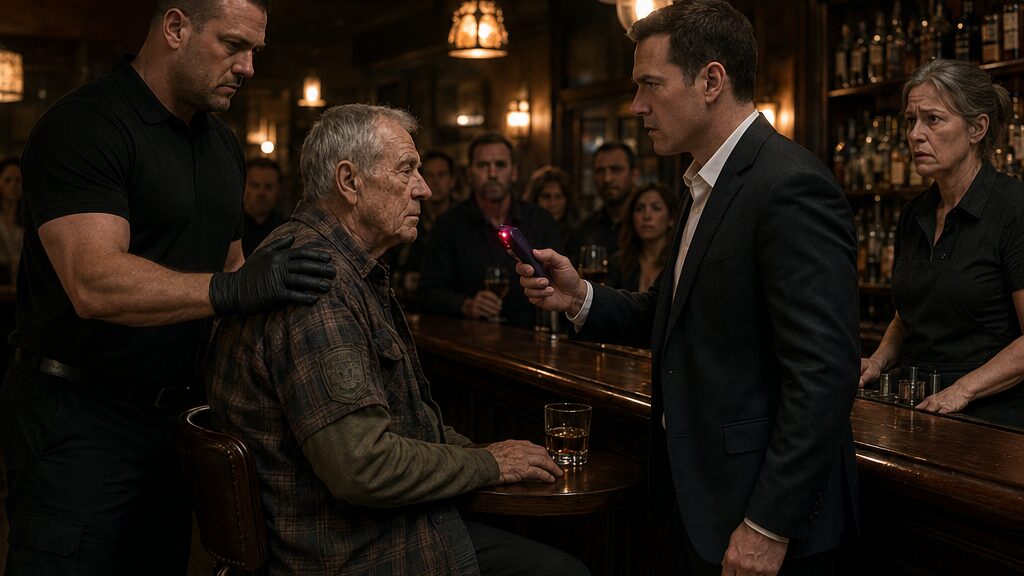
It was a small sound, hardly more than a clipped electronic chirp, but it cut through the low music and the clatter of glasses as if someone had tapped a knife against the bar. The young man in the fitted black suit looked down at the glowing screen in his hand, then at William’s shoes, then at the worn plaid shirt hanging loose over his shoulders.
“I’m sorry, sir,” James King said, in the tone of someone who had already decided he was not sorry. “This is a private preview tonight.”
William set both hands on the polished edge of the bar. The wood felt too smooth. The old Lantern Rail had been scarred with rings and cigarette burns and one deep gouge near the register where a delivery driver had dropped a crate in 1989. Now the bar shone under amber lights, sealed and dark, reflecting the rows of expensive bottles behind it.
He looked at the mirror. It looked back with a tired old man in it.
“Just the usual,” William said.
The bartender at the far end paused with a glass in her hand. Amy Davis had more silver in her hair than the last time he had noticed, but she knew him. He saw recognition move across her face, then worry, then caution as she glanced toward James.
James tapped the scanner with his thumb. Purple light washed over his cuff. “I don’t have you on the guest list.”
“I’m not a guest.”
“That’s right,” someone near the lounge ropes muttered, and a few people laughed softly.
William did not turn. The Lantern Rail had more people than it used to, but less noise. In the old days, noise had lived here. Pool balls, arguments, work boots, jukebox songs with scratched choruses. Tonight the noise was careful. People spoke the way they did in places that charged too much for a drink.
“I sit here every year,” William said.
James blinked once. “Sir, we renovated six months ago. This section is reserved.”
“It was reserved before that.”
A woman in a bright jacket shifted on her high heels. A man behind her lifted his phone halfway, not high enough to be obvious. William saw it in the mirror. He had become something to look at.
James’s mouth tightened. He was not a cruel-looking man. That made it worse. He had the clean, tense face of someone trying to hold a room together by force of rules.
“Thomas,” he said.
The man behind William moved before William could see him fully. Black tactical shirt. Black gloves. Thick forearms. The kind of stance men used when they wanted everyone to know they were trained for trouble.
“Sir,” Thomas Green said, close to William’s ear, “let’s step outside.”
William kept his hands on the bar.
Amy came over then, wiping her palms on a towel. “James, he’s been coming in a long time.”
James did not look at her. “Amy, not now.”
“It’s just one drink.”
“It’s not about one drink.” James held up the scanner as if it were proof in a courtroom. “We are at capacity for a licensed private event. If he falls, if he causes a scene, if anyone says we let walk-ins past the rope—”
“I walked through the front door,” William said.
“Yes,” James replied, too quickly. “And now I’m asking you to walk back through it.”
The music kept playing. A soft bass note moved under the floor. William could feel it in his knees. He could also feel the old ache above his left shoulder where weather settled first, where age spoke before he did.
Then Thomas’s gloved hand came down on that shoulder.
Not hard. Not at first.
But enough.
The pressure lowered through William’s shirt, through the faded olive sleeve beneath it, through the patch sewn there by fingers that had once been steadier. The patch was old and no longer regulation for anything. Its edges had curled. The thread did not match. It had been taken off one jacket and placed on another, then another, until it belonged less to a uniform than to memory.
Thomas’s glove covered half of it.
“Come on,” Thomas said. “Don’t make this harder.”
William looked at the hand.
A hot, bright memory passed through him so fast his body almost mistook it for the present: metal screaming, smoke turning daylight brown, Stephen Wright laughing once because laughing was better than shouting, then telling William with grease on his cheek, Save me a seat if I’m late.
William breathed through his nose.
He could have stood quickly once. He could have turned a man’s wrist without breaking it. He could have done many things that now belonged to the younger body he no longer owned. None of those things mattered here.
He lifted his eyes to the mirror again. People were watching. A couple near the wall whispered. The man with the phone had raised it another inch.
James stepped closer, pointing one finger toward the door. “Sir, this is your last warning. I’m trying to handle this respectfully.”
William’s laugh was almost silent.
“Respectfully,” he repeated.
Amy’s face changed. Thomas’s grip tightened a fraction, perhaps from embarrassment.
William turned his head just enough for Thomas to hear him clearly.
“That shoulder already carried enough weight tonight.”
Thomas’s hand did not leave at once. But it became uncertain. William felt the difference. Men always thought strength left all at once. It did not. Sometimes it drained out through a glove when the hand realized what it had touched.
James frowned. “What is that supposed to mean?”
William looked at him then. Really looked. Young enough to be Stephen’s grandson, old enough to think a room obeyed him because the room had lights and a list and a scanner.
“Before you touch me again,” William said, “look under the third stool.”
James glanced down at the stool as if it had insulted him.
“There’s nothing under the stool.”
“Then look.”
“We are not doing this.”
William did not move. “You asked me to prove I belong here. I’m telling you where to start.”
The private guests were no longer pretending not to listen. The music, still playing, seemed embarrassed by itself. Amy set the towel down.
James’s face reddened. He held the scanner higher. Its red light blinked again, reflecting off his jaw. “This device says you are not registered for tonight.”
William nodded once. “I believe it.”
Something in that answer unsettled James more than resistance would have. He looked from William to Amy.
Amy spoke quietly. “James. Just check.”
“I’m not crawling under a stool because—”
“Then I will.”
She started around the bar, but James stopped her with a sharp look. Pride, William thought. Not cruelty. Pride was a smaller thing, but it bruised deeper because people kept defending it.
James bent down quickly, angrily, one hand on the seat of the stool as if steadying himself against humiliation. Thomas stepped back half a pace. William felt the air cool where the glove had been.
The patch showed fully now.
A nearby older regular leaned forward, squinting at it, but said nothing.
James’s head disappeared below the bar line. For a moment all William could see of him was the back of his suit jacket and the scanner still glowing in his hand. The red light dragged across the underside of the stool, across the foot rail, across dust missed by the renovation crew.
“There,” William said.
James stopped.
Under the third stool, near the old bolt hole in the floor, the new finish had not quite hidden a small, round scar in the wood. Beside it, tucked back where no one standing would notice, was a dark brass screw hole with a green rim of age around it. Something had been mounted there once.
James rose slowly.
He looked less angry now, but not kinder. Confusion had not yet become understanding. It had only interrupted him.
“What was there?” he asked.
William slid one hand toward the drink Amy had set down without James noticing. Amber liquid. One cube of ice. The usual, though he had never liked the taste.
He did not pick it up.
“A reminder,” William said.
James waited. The room waited with him.
William took a folded bill from his shirt pocket and placed it beside the glass.
“I’ll come back when the room remembers itself.”
He stood carefully. His knees made it slow. No one helped him. That was all right. He did not need help standing. What he had needed had been simpler, and somehow harder for the room to give.
As he turned toward the door, the scanner in James’s hand flashed red once more, though no one had asked it anything.
Chapter 2: Amy Remembered the Drink He Never Finished
Amy found the glass exactly where William had left it, the ice thinned to a clear oval, the amber line barely lowered.
One sip. Maybe not even that.
She lifted it and carried it to the service sink, then stopped with her wrist above the drain. For years she had poured out drinks without thinking. Beer gone warm. Cocktails abandoned for better conversations. Half-finished shots from men who claimed they were celebrating, then sat silent until closing. But William’s drink sat heavy in her hand.
James was in the office with the door half-closed, talking too loudly to someone on the phone.
“No, it’s handled,” he said. “Just an old walk-in. No, nothing happened. We kept the room under control.”
Amy looked down at the glass.
Nothing happened.
She had worked at the Lantern Rail long enough to know the difference between a scene and a wound. A scene made noise. A wound made quiet.
She poured the drink into the sink and watched it disappear.
When she came back to the bar, Thomas stood near the side hallway, arms crossed, eyes fixed somewhere above the bottles. He had taken off one glove. The other still hung from his hand.
“You know him?” Thomas asked.
Amy wiped the counter, though it was already clean. “I know he comes in.”
“That’s not what I asked.”
She looked at him then. Thomas had a hard face built for not being questioned, but there was a crease between his brows that had not been there earlier.
“He comes in once a year,” she said. “Same date. Same stool. Same drink.”
Thomas glanced toward the third stool. “Why?”
“I never asked.”
He frowned. “You never asked?”
“He never invited it.”
That answer seemed to bother him. He flexed the hand that had been on William’s shoulder, then looked down at his glove.
The private preview recovered badly. People laughed too loud. The man who had recorded part of the confrontation kept checking his phone, disappointed perhaps that the old man had not shouted or fallen or done something useful for strangers. James returned from the office with his manager face restored and told the cook to push appetizers faster.
Amy moved through it all with the old rhythm: glass, pour, smile, wipe, nod, forget. Only she did not forget.
Near the end of the night, she slipped into the service hallway and opened the side door.
William was outside.
He sat on the low brick ledge near the alley, one hand resting on his left shoulder. The streetlight above him hummed. His plaid shirt looked thinner outdoors. The patch on his sleeve had a dark stain across one edge where someone had sloshed beer during the crowding.
“Mr. Moore,” Amy said.
He lowered his hand. “Evening, Amy.”
“You remembered my name.”
“You served me the wrong drink three years ago and apologized like you’d broken a window.”
Despite herself, she smiled. “I still think about that.”
“No need. I drank it.”
“No, you didn’t.”
He looked at her, and she wished she had not said it that quickly.
The alley smelled of rainwater and old grease. From inside, bass and laughter pulsed through the wall. William glanced toward the door, not with anger, but with the tired patience of someone waiting for weather to pass.
“I’m sorry,” Amy said.
He shook his head.
“James shouldn’t have handled it that way.”
“He handled what he saw.”
“He saw wrong.”
“That happens.”
The simplicity of it made her throat tighten. “Thomas shouldn’t have touched you.”
William’s eyes lowered to the patch. With his right hand, he rubbed at the damp stain using his thumb, careful and useless.
“It’s just cloth,” he said.
Amy did not believe him. She had watched him say it like people said just rain at a funeral.
“Can I get you something? Coffee? Water? I can call Jessica.”
That made him look at her sharply.
“I know she’s your daughter,” Amy said. “Your emergency contact was still in the old binder from before James put everything on the tablet.”
“Don’t call her.”
“She might want to know.”
“She worries first and listens second.”
Amy leaned against the doorframe. “Most daughters do.”
William almost smiled, but it passed.
“Are you all right to get home?”
“I got here.”
“That wasn’t my question.”
“No,” he said. “It wasn’t.”
For a moment she thought he would tell her. About the stool, the date, the patch, the drink. Instead he reached into his pocket and took out a folded napkin. He smoothed it once on his knee, though there was nothing written on it.
“Your mother ever save a seat for someone?” he asked.
“My mother? No.”
“Then you’d remember if she had.”
Amy understood he was speaking of Debra King without saying her name. James’s mother had owned the Lantern Rail for thirty years, fierce and small and impossible to hurry. She had hired Amy when Amy was twenty-one and crying in the bathroom because she had dropped a tray on her first shift. Debra had told her, “If no one bled, keep walking.”
“Debra saved everything,” Amy said. “Receipts, birthday cards, broken corkscrews.”
William folded the napkin again. “Then maybe she saved that too.”
“What?”
But he had already pushed himself up from the ledge. It took effort. Not a dramatic kind, not the kind that asked to be noticed. Just the ordinary negotiation of age and pain.
Amy stepped forward, then stopped before touching him.
William noticed. He gave the smallest nod.
“Good night, Amy.”
“Mr. Moore.”
He paused.
“Why June fourteenth?”
His face changed so briefly she might have imagined it. The wall light deepened the lines around his mouth. Inside, someone cheered over something that did not matter.
“Because some men are late longer than others,” he said.
Then he walked toward the bus stop, shoulders slightly bent, patch darkened on his sleeve.
After closing, Amy stayed behind while James counted receipts with a jaw clenched too tight for simple arithmetic. Thomas had left without saying goodbye. The private guests were gone. The floor glittered with salt and broken crumbs.
James put the scanner on the bar. “We did well tonight, considering.”
Amy said nothing.
He looked up. “What?”
“You know your mother kept old binders under the register?”
“Amy, not now.”
“She wrote everything down.”
“My mother wrote down which spoons went missing.”
Amy crouched and pulled open the low cabinet beneath the service station. The new POS system had been installed above it, all glass and blue light, but the cabinet still stuck when pulled from the left. Inside were two plastic bins of charging cords, a stack of menus, and behind them, a warped black binder with a cracked spine.
James sighed. “What are you doing?”
“Checking under the stool wasn’t enough.”
“Amy.”
She opened the binder on the bar. Old pages sighed loose. Receipts, vendor numbers, notes in Debra’s blocky handwriting. James came closer despite himself.
Amy turned past beer orders, plumbing repairs, holiday schedules. Near the back, tucked into a plastic sleeve, was a yellowed index card.
The handwriting was faded but clear.
Third stool stays open on June 14.
Amy read it twice.
Below it, in smaller letters, Debra had written: W.M. comes at seven. One pour. Don’t ask unless he offers.
James reached for the card but did not touch it.
Amy looked at him.
This time, he had no scanner in his hand.
Chapter 3: His Daughter Thought the Bar Was Taking Him Away
Jessica Moore noticed the bruise before her father did.
It sat above the faded patch, a thumb-shaped shadow just beyond the sleeve seam where the plaid shirt had slipped while he reached for the coffee tin. She was standing in his kitchen with a bag of groceries on one hip, watching him pretend he did not need the lower cabinet reorganized.
“Dad,” she said.
William kept measuring coffee. “What?”
“What happened to your shoulder?”
“Doorframe.”
“You don’t bruise like that from a doorframe.”
“At my age, you bruise from thinking about a doorframe.”
She set the groceries down harder than she meant to. A tomato rolled against the toaster. The kitchen was small and smelled of coffee, dish soap, and the lemon oil she used on his table because he always forgot. Morning light came through the blinds in thin bars across the floor.
William turned away to fill the coffeemaker.
Jessica stepped closer and touched the edge of his sleeve. “Let me see.”
“No need.”
“Dad.”
He let the sleeve go, but not because she had won. Because resisting would have taken more energy than the inspection.
She rolled the fabric gently. The patch came fully into view, damp at one corner. It had been washed recently by hand, she could tell. The stitching was uneven, repaired in dark green thread that did not match. Beneath the cloth, the bruise spread purple and brown.
Her mouth tightened. “Who grabbed you?”
“No one grabbed me.”
“Then who put fingers on you?”
He poured water into the machine with slow precision. “A man doing his job poorly.”
“Where?”
Silence.
Jessica closed her eyes. “The bar.”
He pressed the coffee switch. It clicked, then began its tired morning hiss.
“You went again,” she said.
William took two mugs from the cabinet. One had a chip near the rim. He gave that one to himself.
“I go every year.”
“I know. That’s the problem.”
He set the mugs down with care. “A tradition isn’t a problem because someone else doesn’t understand it.”
“A tradition doesn’t leave bruises.”
He looked at her then, and for a second she saw something hard and young behind his eyes, not anger exactly, but a door closing.
Jessica softened her voice. “I’m not trying to fight with you.”
“You brought groceries like a peace offering and started with my shoulder.”
“I started with your shoulder because someone hurt you.”
“I’ve been hurt before.”
“That doesn’t make it fine.”
The coffeemaker gurgled. Outside, a neighbor’s mower started up, droning over the quiet street. Jessica began putting groceries away because her hands needed a task. Eggs, bread, milk, soup he would claim he did not need. She opened his refrigerator and found three identical containers of leftovers she had brought earlier in the week, untouched.
“Have you eaten?”
“Yes.”
“What?”
“Food.”
“Dad.”
He sat at the table.
She turned with a jar in her hand. “You can’t keep doing this.”
“Drinking coffee?”
“Going there. Sitting alone in that place like it owes you something.”
His fingers curled around the chipped mug. “It does.”
The answer stopped her.
He did not expand. That was how he punished both of them, Jessica thought. Not with shouting. With stone walls built one quiet sentence at a time.
When she was young, she had believed her father’s silence meant strength. He came home from work with grease on his hands and never complained. He fixed school projects at midnight. He taught her how to check tire pressure and how to stand still when afraid. After her mother died, the silence changed. It became a room he lived in and she visited from the doorway.
“Mom used to worry about June,” Jessica said.
William looked at his coffee.
“She did,” Jessica insisted. “She’d circle the date and get quiet three days before. She never told me why. You never told me why. And now every year you go to that bar and come home looking like you left part of yourself there.”
“That’s not your burden.”
“You don’t get to decide that for me.”
He rubbed one thumb along the mug handle. The patch on his sleeve faced her like an old eye.
“I’m asking you to stop,” she said. “Just this year. Just don’t go back there.”
“It was last night.”
“I mean don’t go back tonight, tomorrow, next year. Let it end.”
His mouth moved, but no answer came.
Jessica sat across from him. “Are you afraid if you stop, you’ll forget someone?”
He looked up sharply.
She had guessed near something. Not the center, maybe, but close enough to make him pull back.
“I don’t know who he was,” she said. “I don’t know what happened. But I know it’s been eating at you longer than I’ve been alive.”
William stood too quickly for his knees. Coffee trembled in the mug.
“You know I served,” he said. “You know enough.”
“No, I know the shape of it. I don’t know the weight.”
He turned toward the sink. “Weight isn’t passed around just because people are curious.”
“I’m not curious. I’m your daughter.”
The words stayed in the kitchen longer than either of them expected.
William rinsed a spoon that was already clean.
Jessica regretted pushing him, then resented having to regret it. He could make care feel like trespassing. He could make love stand outside and knock.
“I saw a video once,” she said quietly. “A man at a diner. Old veteran. Young people laughing at him. Everyone online was furious. They all said they would have stood up for him.” She swallowed. “But in real life people just watch, don’t they?”
William shut off the faucet.
“I don’t want them watching you,” she said.
He turned, and this time the hardness was gone. What remained was worse: weariness without defense.
“They already did,” he said.
Jessica did not know what to do with that.
After breakfast, she cleaned more than necessary. William let her. He sat on the porch while she changed the sheets, checked the bathroom cabinet, threw away expired mustard, and left a list of meals taped to the refrigerator. When she came out, he was holding the patch between two fingers, rubbing at the stained corner with a damp cloth.
“You’ll wear it out,” she said from the doorway.
“It wore out a long time ago.”
“Then replace it.”
His hand stilled.
She knew at once she had said the wrong thing.
“I’m sorry,” she said.
He folded the cloth carefully. “Some things don’t get replaced.”
Jessica wanted to ask whose it had been. She wanted to demand the name. Instead she picked up her purse.
“I’ll come by tomorrow.”
“No need.”
“I will anyway.”
That almost drew a smile from him. Almost.
She kissed the top of his head. He smelled faintly of coffee and old soap. At the porch steps, she turned back.
“Promise me you won’t go back to that bar today.”
William looked past her toward the street.
“Dad.”
He did not lie. That was one of the inconvenient things about him.
“I’ll be careful,” he said.
Jessica’s face tightened. “That’s not a promise.”
“No.”
She left with anger in her shoulders and fear in her chest.
William stayed on the porch until her car turned the corner. Then he went inside, locked the door, and stood for a while in the quiet kitchen.
At last he crossed to the hallway closet and took down a small cigar box from the top shelf. The lid had warped with age. Inside were things no one would steal because no one would know their worth: an old bus token, a photograph folded face inward, two shirt buttons, and a brass plate wrapped in a handkerchief.
He unwrapped it slowly.
The plate was scratched dull, its screw holes darkened at the edges. Two names had been engraved there, the letters shallow from years of polishing.
Moore / Wright — keep one seat.
William ran his thumb over Stephen’s name.
The front door key turned.
He folded the handkerchief over the plate in one motion and slid the cigar box behind a stack of towels just as Jessica stepped back in.
“I forgot the receipt,” she said, looking at him in the hallway.
William rested one hand against the closet door.
For one breath, neither of them moved.
Chapter 4: James King Found His Mother’s Promise Too Late
James waited until Amy went home before he opened the binder again.
He told himself he was only checking the old records because private events required clean documentation. He told himself any handwritten note from his mother belonged in storage, not under an active service station where health inspectors could see warped plastic sleeves and paper dust. He told himself many things as he sat in the back office with the scanner charging beside his laptop, its small light pulsing red against the wall.
The office had once smelled like his mother’s cigarettes and peppermint gum. Now it smelled like paint, printer toner, and the new leather chair he had ordered to make the room feel less like a closet. Still, there were corners renovation had missed. A rust mark beneath the filing cabinet. A strip of old wallpaper behind the safe. A pencil line on the doorframe where Debra King had measured his height when he was eight, twelve, and fifteen, before he decided being measured by his mother was childish.
He opened the binder.
Third stool stays open on June 14.
W.M. comes at seven. One pour. Don’t ask unless he offers.
James stared at the card until the letters seemed less like information than accusation.
He remembered William Moore now, or thought he did. Not as a person, not really. More as a shape from childhood: an old-looking man who had not been so old then, sitting near the end of the bar while Debra worked the register. James had seen many men like that in the Lantern Rail. Work jackets. Baseball caps. Quiet faces. Men his mother fed when they had no money and scolded when they had too much to drink. To a child, they had all blended into the furniture of the place.
He turned the page.
Debra’s records were not orderly, but they were stubborn. Vendor invoices sat beside notes about leaky pipes. Phone numbers were written over crossed-out prices. He found an envelope labeled STOOLS / OLD HARDWARE in his mother’s blocky handwriting. Inside were two brass screws, one washer, and a corner of paper torn from a receipt.
Plate removed for refinishing. Give back to W.M. if he asks. Do not throw away.
James rubbed his forehead.
The brass plate. The missing plate. The mark under the stool.
He reached for the scanner without thinking, woke it, and opened the guest system. William Moore was not there. Of course he was not there. No profile, no membership, no reservation, no card on file. The software had done exactly what he had paid it to do. It had divided the room into approved and unapproved.
He set it down too hard.
The screen glowed red again.
On his laptop, spreadsheets waited: event revenue, vendor debt, insurance renewal, payroll. The Lantern Rail was not the neighborhood anchor his mother had run by instinct and memory. It was a failing business in a block being bought and polished by people with money James did not have. He had renovated because he had to. He had added the private lounge because liquor sales alone no longer paid taxes. He had hired Thomas because one bad incident could sink the license.
He could explain every choice.
That did not make last night smaller.
James pushed back from the desk and went into the main room. Afternoon light made the bar look different, less forgiving. Without music and bodies, the renovations seemed almost nervous. The new brass rail shone. The black leather stools lined up evenly. The third stool sat where it had stood the night before, wiped clean, ordinary, waiting.
James crouched.
From this angle, the underside of the bar looked unfinished, practical, unglamorous. He ran his fingers over the small dark screw hole near the floor. He had walked past it a hundred times during renovation and never seen it. Contractors had sanded around it. Cleaners had mopped around it. He had stood above it with architects and lighting designers and never once asked what had been mounted there.
“You look like you lost something.”
Amy stood near the service entrance with her coat still on. James rose too quickly.
“I thought you were off today.”
“I came for my tips. And because you were going to pretend that note didn’t bother you.”
“It doesn’t bother me.”
“Then your face is doing a poor job.”
James looked toward the office. “Did my mother ever tell you about him?”
“Not directly.”
“That means no.”
“That means Debra told things sideways.” Amy came closer, running one hand along the bar’s edge. “She used to say the third stool had better manners than most men because it knew when to stay empty.”
James did not want to smile, but the line was painfully his mother.
“She made it sound like superstition,” Amy said. “I didn’t know there was a date attached.”
James crouched again, touched the screw hole. “Why wouldn’t she tell me?”
Amy’s face softened. “You didn’t always listen to this place.”
He looked up.
She did not apologize.
Outside, a delivery truck groaned to a stop. The cook came through carrying boxes, complained about blocked parking, and vanished into the kitchen. The ordinary business of the day moved around James while he remained near the third stool with the old binder open on the bar.
“I have another private event tonight,” he said. “Bigger than last night. Local investors. Press from the neighborhood site. If something goes wrong—”
“Something already did.”
James closed his eyes.
“I can’t run a business on sentimental exceptions,” he said.
Amy lifted the index card from the binder, holding it carefully by the edges. “Your mother did.”
“My mother ran this place into debt.”
“She also kept it alive long enough for you to inherit something.”
That landed harder than he expected. He looked away.
He had loved Debra. He had also spent years embarrassed by the way she ran things. Tabs extended for men who never paid. Meals handed out to people who came in cold. Seats saved for ghosts. James had left for school promising himself he would never run a room on favors and feelings.
Then Debra got sick, the hospital bills came, and the Lantern Rail became not an embarrassment but a problem with his name on the paperwork.
The front door opened. Thomas Green stepped inside wearing jeans instead of black tactical gear, though the posture remained. He held his gloves in one hand.
“We need to talk,” Thomas said.
James straightened. “I was going to call you.”
Thomas’s eyes went to Amy, then to the stool. “About last night.”
“If this is about procedure, I—”
“It’s about his shoulder.”
The room seemed to narrow.
Amy looked at Thomas. “What about it?”
Thomas swallowed. It was the first uncertain movement James had seen from him. “I didn’t think I grabbed him hard. But he was old. Older than I let myself notice. I put my hand right here.” He touched his own shoulder. “When he left, I saw him reach for it outside.”
James felt a prickle of heat at the back of his neck. “You bruised him?”
“I don’t know.” Thomas looked at the glove in his hand. “Maybe.”
Amy’s jaw tightened.
James wanted to say something managerial, something about reports and liability. Instead he looked at the scanner lying on the bar beside his mother’s card.
The red light blinked.
For the first time since he had bought it, the device looked small.
Chapter 5: The Patch Was Not There to Impress Anyone
William waited until the house settled before he took the patch off the sleeve.
It was not necessary. He had washed it that morning, rubbed the stain until his thumb ached, and hung the shirt on the back porch where the late sun could reach it. The cloth was dry now. The patch still held a shadow at the corner, a faint mark no one else would notice unless they knew where the beer had fallen and where the glove had pressed.
William noticed.
He sat at the kitchen table with a needle, a spool of dark green thread, the brass plate wrapped beside his elbow, and the shirt spread across his lap. The patch had been removed and reattached so many times that the sleeve beneath it was puckered with old holes. A sensible man would have placed it in a drawer years ago. A sensible man would have let cloth be cloth.
Stephen Wright had not been sensible either.
“Crooked,” Stephen had said the first time William sewed the patch on for him, leaning against a workbench with a grin that made everything seem less dangerous than it was.
“It’ll fly straighter than you do,” William had answered.
Stephen had laughed, then slapped his shoulder. “Save me a seat if I’m late.”
He said things like that often. Save me a seat. Save me the last biscuit. Save me a decent wrench. Always as if lateness were a joke and tomorrow were only waiting to be reached.
William pushed the needle through the fabric.
His fingers were not what they had been. The needle slipped once and nicked him. He watched a small bead of blood rise on his thumb, bright and ordinary. He wiped it on a napkin and continued.
He did not let himself pull the whole memory forward. Not yet. Memory had to be handled like old wiring. Touch the wrong exposed place, and the whole body lit up with pain. He allowed only pieces: heat, smoke, a tool dropped in mud, Stephen’s voice strained but still trying to sound amused. William under a machine that refused to answer his hands fast enough. Men shouting for time no one had.
The thread knotted.
William cut it with his teeth.
On the counter, the phone rang once. Jessica, probably. Then it stopped. A message would come later. She had always hated leaving things unresolved. Even as a child, she would reopen a door to finish an argument properly.
He looked toward the hallway where she had almost caught him with the brass plate. She had seen enough to know he was hiding something. Not enough to understand why.
Maybe that was his fault.
Maybe not every silence was dignity. Maybe some of it was fear dressed neatly so no one would question it.
William folded the shirt and carried it to the bedroom. He dressed slowly: undershirt, olive long sleeve, plaid shirt over it, patch visible only when the cuff shifted. He buttoned the sleeve with care. Then he unwrapped the brass plate.
Moore / Wright — keep one seat.
He had taken it down three years ago when Debra’s hands had become too swollen to polish it. She had told him to hold onto it until James figured out what kind of man he wanted to be.
“He’ll make mistakes,” Debra had said from the stool beside him, her voice thin but still edged. “Children do, even when they’re forty.”
“I’m not his test,” William had replied.
“No. You’re mine.”
He had not understood then. Or had pretended not to.
William slid the brass plate into his inside pocket.
At the bus stop, evening gathered in the gutters. A teenager on a bicycle rolled past with music buzzing from a speaker. Two women crossed the street carrying grocery bags. The world went on doing small things, which had always seemed both comforting and cruel.
The bus was late.
William stood because the bench had a cracked board that caught the back of his coat. His shoulder ached where Thomas had gripped him. He moved it once and stopped. Pain was information. It did not always require complaint.
When the bus arrived, the driver lowered the step without being asked. William nodded thanks and took a seat near the front. His reflection in the dark window rode beside him: old man, plaid shirt, steady eyes that looked less steady when only he could see them.
His phone buzzed.
Jessica: Please call me. I’m not trying to control you.
A second later: I just need to know you’re safe.
William typed with one finger.
I’m safe.
He stared at it, then added:
I will tell you something soon.
He did not send it right away. The bus pulled from the curb. Streetlights dragged gold lines across the window. At the next stop, a man with a cane climbed aboard, and a young woman moved her bag so he could sit. No drama. No speech. Just a small correction in the world.
William sent the message.
The Lantern Rail appeared two blocks later, its new sign glowing warm against the dark. Through the front window he could see bodies moving in dressed-up clusters, the private evening already underway. The place looked handsome. He could admit that. Debra would have mocked the hanging bulbs and then secretly liked them.
He stepped off the bus and stood across the street.
For a moment he considered turning around.
No one had asked him to come. Jessica had asked him not to. James would prefer he disappear. Thomas might stand at the door again with his gloves and practiced voice. There were easier ways to remember a dead man. A photograph at home. A church candle. A name spoken in an empty kitchen.
But Stephen had not asked for a monument.
Save me a seat if I’m late.
The words had been a joke until they were not. William had heard them later in every waiting room, every bus depot, every bar where men came home and other men did not. The promise had become smaller over the years, not because it mattered less, but because he had learned what he could carry. One stool. One drink. One name beside his own.
He crossed the street.
At the door, a role-only host looked down at a tablet. “Name?”
William gave it.
The host scrolled. “I don’t see you.”
“I know.”
“Sir, this is—”
“I know that too.”
The host hesitated, perhaps warned by something in William’s voice, perhaps only confused by the fact that the old man did not argue.
From inside, James appeared near the bar, speaking to a group of guests. His suit was different tonight, darker, sharper. He looked up and saw William.
The distance between them filled with last night.
James excused himself and came over. Thomas stood near the lounge ropes, gloves clipped to his belt instead of on his hands. He saw William too. His posture changed, almost imperceptibly.
“Mr. Moore,” James said.
William rested one hand inside his coat, touching the wrapped brass plate.
“I came for the third stool,” he said.
James’s eyes flicked toward the bar.
William followed his gaze.
The third stool was gone.
Not occupied. Not reserved. Gone.
In its place was an empty circle on the floor where the legs had protected the finish from wear, a pale mark under the amber light like a missing tooth.
William stood just inside the doorway, and for the first time that evening his hand tightened around the brass plate hard enough for its edge to bite.
Chapter 6: The Empty Space Where the Third Stool Stood
James had not meant the missing stool to mean anything.
That was what he told himself the moment he saw William looking at the empty space. It had been moved for the event layout. All three end stools had been removed to widen the walkway between the bar and the lounge rope. Fire code, crowd flow, service efficiency. The kind of decision a manager made with a tape measure in hand, not a memory.
But only the third stool mattered now.
William did not step farther into the room. Guests turned gradually, sensing the small disturbance near the entrance. The host held the tablet against his chest. Thomas stood near the ropes, still as a doorframe.
James lowered his voice. “Mr. Moore, could we speak in the office?”
“No.”
The answer was quiet enough that only the nearest people heard it. Somehow it traveled.
James felt Amy watching from behind the bar. He had told her he would handle it differently. He had meant it. He had even set the scanner aside when William entered, refusing the comfort of its red answer. But the room was full, the investors were here, and the neighborhood writer had already taken photos of the cocktail menu. The Lantern Rail could not become a shrine to an old misunderstanding in the middle of a Saturday night event.
He stepped closer. “I owe you an apology for last night.”
William looked at the empty floor mark. “You moved the stool.”
“We moved several stools.”
“I didn’t ask for several.”
The words were not sharp. James wished they had been. Sharp words could be answered. This was worse: plain words, placed exactly where they belonged.
“I can get you a better seat,” James said. “A private table in the back. Quiet. No charge. Whatever you want tonight.”
Amy’s hand stopped moving on a glass.
William looked at James then. “A better seat?”
James heard it as soon as the words came back at him. Better. Private. Hidden.
He tried again. “I mean more comfortable.”
“I didn’t come for comfort.”
A complaining customer near the bar muttered, “Then what did he come for?”
Thomas looked toward the voice but did not move.
William did not answer the customer. He walked slowly to the empty space. People shifted out of his path, not respectfully exactly, but cautiously, as if age itself were a fragile object being carried through the room.
The floor mark waited under the light. Three round shadows from the stool legs, a faint crescent where shoes had rested over years. William stood above it and lowered his gaze.
James followed, feeling every pair of eyes in the room.
“Mr. Moore,” he said, “I found my mother’s note.”
William’s face changed, but only a little.
“She wrote that the third stool stayed open on June fourteenth,” James continued. “She wrote your initials.”
“That was like Debra.”
“She didn’t write why.”
“No.”
James swallowed. “I’m asking now.”
William reached inside his coat.
Thomas took one instinctive step forward, then stopped himself. James saw it. William saw it too.
The old man’s hand came out slowly, holding a folded handkerchief. He placed it on the bar, not in front of James, but in the empty place where the third stool should have met the rail. His fingers unfolded the cloth.
The brass plate caught the amber light.
Moore / Wright — keep one seat.
A woman at the bar leaned closer. The complaining customer stopped with his drink halfway to his mouth. Amy covered her lips with one hand, then lowered it quickly.
James read the names twice.
“Wright,” he said.
William touched the second name with one finger. “Stephen.”
The room seemed to wait for more. William gave it nothing yet.
James looked toward the office hallway, where the old binder sat open on his desk. “My mother removed this?”
“She told me the wood needed refinishing.”
“That was years ago.”
“Yes.”
“And you kept it?”
William wrapped the handkerchief edge back under the plate, but did not cover the names. “It wasn’t hers to throw away.”
James felt a small, defensive heat rise. “I didn’t throw anything away.”
“You threw away the seat before you knew why it was there.”
That silenced him.
The sentence had no anger in it. That made it impossible to reject.
From the lounge side, the neighborhood writer lifted a phone, then seemed to think better of it when Amy stared across the bar. Thomas moved closer, but this time his hands stayed open and visible.
“Mr. Moore,” Thomas said.
William turned slightly.
Thomas looked at the shoulder he had grabbed the night before. “I shouldn’t have touched you.”
The room tightened around the apology. James was suddenly aware of how public it was, how easily it could become performance, how quickly a room could turn a man’s regret into entertainment.
William seemed aware too.
“No,” he said.
Thomas’s face lowered.
“But you stopped when you understood your hand was wrong,” William added. “That matters if you let it.”
Thomas looked up.
James breathed out slowly. He had expected accusation. Perhaps he had deserved it. Instead William had handed Thomas responsibility without spectacle.
A guest near the lounge whispered, “Is this about some military thing?”
William’s fingers rested on the patch beneath his plaid sleeve. He did not pull the shirt aside. He did not display it.
James saw that restraint and felt ashamed of how badly he wanted some clean explanation. If William announced himself as something impressive, James would know what shape his remorse should take. If the story was large enough, James could become small in it and be forgiven for not seeing. But William did not offer that escape.
“I can reinstall the plate,” James said. “Tonight. After closing.”
William shook his head. “It doesn’t go under the bar without the stool.”
“We can bring it back.”
“You can.”
James turned to the cook near the kitchen door. “Bring the stool from storage.”
The cook looked uncertain. “The black one?”
“The third one.”
“There were three moved.”
James glanced at William.
William looked toward the hallway leading to storage. “It had a nick on the right side of the foot rail.”
The cook nodded slowly and disappeared.
The room began breathing again, though softly. Someone coughed. Ice settled in a glass. The music still played, but no one seemed to trust it.
James leaned closer to William. “The private table offer wasn’t meant to insult you.”
“I know.”
“But it did.”
“Yes.”
James nodded. He accepted it because there was nothing else useful to do.
“You could have told me last night,” he said.
William’s eyes moved to the scanner resting beside the register, dark now but still there. “You already had the answer you wanted.”
James followed his gaze.
The device had cost twelve hundred dollars. It organized names, payments, access, preferences. It could tell him who had the right to enter a room. It could not tell him who had been keeping faith with it longer than he had owned the building.
Amy came around the bar carrying a glass of water. She set it beside William. Not a drink. Not the usual. Just water.
William took it with a small nod.
The cook returned with a stool held awkwardly against his hip. Its leather seat matched the others, but the right side of the foot rail bore a small nick, pale under the stain.
William saw it.
Something in his face loosened and hurt at the same time.
James helped carry it the last few feet. Together, he and the cook set it over the floor marks. One leg scraped softly, finding its old place.
“Here?” James asked.
William lowered his hand to the seat. He did not sit.
“Almost.”
James waited.
William moved it an inch to the left.
“There.”
It was such a small correction that several guests looked confused. James did not. He had spent the last twenty-four hours learning that small things could carry years.
William took the brass plate in both hands. “This was never decoration.”
“No,” James said.
“Your mother knew that.”
“I’m starting to.”
The complaining customer, who had been shifting impatiently through the entire exchange, finally set his glass down too loudly.
“Are we really stopping the whole room for one old man?”
The words hit the bar and stayed there.
James turned, but William raised one hand slightly.
Not to silence the customer.
To keep James from answering for him.
Chapter 7: He Chose Not to Shame the Men Who Shamed Him
William kept his hand raised until James stopped moving.
The complaining customer had spoken loudly enough for the whole room to hear, but not loudly enough to feel brave afterward. His eyes shifted from William to the brass plate, then toward the people beside him, searching for agreement that did not come quickly enough.
William looked at him.
No anger. That was the first thing the room seemed to notice. Anger would have given everyone a place to stand. They could have chosen sides, repeated lines, told the story later with themselves improved by it. But William only looked tired, and the tiredness made the words smaller than the man who had said them.
“No,” William said. “You’re not stopping the room for one old man.”
The customer’s mouth tightened, prepared for victory.
William touched the brass plate with two fingers. “You’re stopping it because a promise got misplaced.”
No one laughed.
Amy stood behind the bar with one hand wrapped around the neck of an unopened bottle. Thomas remained near William, close enough to help if the old man swayed, far enough not to crowd him. James stood at the edge of the empty space with the expression of a man who had found a door in a wall he had painted himself.
William picked up the brass plate.
His hands were steady, but only because he made them be. The room had become too warm. The lights too golden. The smell of citrus peels and polished wood mixed with something older beneath it, something the renovation had not fully sealed away.
“This was never for customers,” he said.
James lowered his eyes.
“It wasn’t for business. Wasn’t for decoration. Wasn’t meant to make anyone feel patriotic while they drank.”
The word patriotic made a few people shift, as if they had expected a different kind of story and were adjusting their faces in advance.
William saw it and almost stopped.
He did not owe them Stephen.
He did not owe the man with the complaint, or the woman near the rope with her phone in her hand, or James, or Thomas, or even Amy, who had been kinder than she had been brave the night before. He could take the plate, leave the room, and keep the promise somewhere people knew better than to put hands on an old man’s shoulder.
But then the plate would remain only his burden.
Stephen had deserved more than being carried like punishment.
William turned the plate so James could see both names.
“Stephen Wright served with me,” he said. “Long time ago. Long enough that most people hear the year and start doing math instead of listening.”
Amy’s eyes lowered. Thomas’s face tightened.
“He was younger than me,” William continued. “Louder. Better at making people believe a bad day was just an inconvenient morning. We fixed what other men needed working. Engines. panels. lines. Small things, until they weren’t small.”
He paused. His thumb moved once over Stephen’s name.
“There was an accident.”
The room held still.
William did not describe the full sound of it. He did not tell them about heat curling the hair on his forearms, or the taste of smoke, or the way daylight vanished in brown gusts. Some truths became false when arranged for strangers.
“Men were trapped,” he said. “Stephen went where he was told not to go and got two of them out. Then he went back because there was a third.”
A glass shifted against the bar. No one drank from it.
“I was working on a release that should have opened faster.” William kept his eyes on the plate. “It didn’t.”
The silence changed shape.
Thomas looked at William’s shoulder, at the patch he had covered with his glove the night before.
“This patch was his,” William said. “He handed it to me earlier that week because the stitching had come loose. Told me I sewed like a blind man but at least I finished what I started.”
A breath moved through the room, not quite laughter, not quite grief.
“The last thing he said to me before that day was, ‘Save me a seat if I’m late.’ He said foolish things like that. He was good at making death sound like a schedule problem.”
William swallowed once. He did not hide it.
“When I came home, I carried that sentence around like a tool I didn’t know where to put. Debra King saw me sitting here one June night, before this room had fancy lights and before James was tall enough to reach the register. She asked if the empty stool was for somebody.”
James’s jaw moved, but no words came.
“I said yes. She asked if he was coming.”
William looked toward the third stool, newly returned, its nicked foot rail turned toward him.
“I said he was late.”
Amy pressed her fingertips to the bar.
“Debra didn’t ask more than that. She poured two drinks. I drank part of one and left the other alone. Next year, the stool was empty when I came in. Year after that, too. Then one day there was a small plate under the bar. Not where people would salute it. Not where anyone would make a show of it. Just where the promise lived.”
James looked down. “She never told me.”
“Maybe she thought you’d ask when you were ready.”
The sentence struck him harder than blame. William saw it land and almost regretted it.
The complaining customer cleared his throat, smaller now. “I didn’t know.”
“No,” William said. “You didn’t.”
That was all. No punishment followed.
James stepped toward the register and picked up the scanner. For a second William thought he meant to use it again, to make some official correction, to find a button that would turn memory into policy. Instead James held it in both hands, looked at the red standby light, and placed it face down beneath the counter.
“I’m sorry,” James said.
William nodded.
“No,” James said, voice rougher. “Not just for the stool. Last night. I let a machine tell me you weren’t part of a room my mother trusted you with. And when you didn’t explain fast enough for me, I treated your silence like trouble.”
Thomas stepped forward, then stopped. “And I put my hand on you.”
William looked at him.
Thomas took off the gloves clipped to his belt and set them on the bar. “I’m sorry, Mr. Moore.”
William studied the gloves. Black, empty, harmless without the certainty that had filled them.
“I believe you,” he said.
The room seemed surprised by the mercy of it.
James looked up. “What can I do?”
William almost answered, Put it back. Keep the stool. Leave me alone. But those were instructions for furniture, not men.
He looked at the brass plate, then at James.
“You can stop making people earn being seen.”
James took that in quietly.
Amy came around the bar with a small screwdriver from the utility drawer. She held it out, then hesitated, as if unsure whose hand deserved it.
William took it.
Kneeling would be difficult. Everyone knew it. That made the moment dangerous. Help could become spectacle. Respect could become performance.
Thomas moved a half step closer. “May I?”
William turned to him.
Thomas did not reach. He waited.
That waiting did more than any apology had. William gave one small nod.
Thomas lowered himself beside the stool, not touching William, only steadying the plate where William indicated. James crouched on the other side, holding the old screws Amy had found in Debra’s envelope. Together, awkwardly, without ceremony, they fixed the plate beneath the bar where it belonged.
William drove the last screw himself.
His hand trembled at the end. Thomas saw it and said nothing. James saw it and did not look away.
When the plate was secure, William stood. Slowly. The room did not clap. Amy made sure of that with one look before anyone could misunderstand what was needed.
James touched the back of the third stool. “Where should it stand?”
William looked at the floor mark, then at the rail, then at the narrow space between the present and what had been saved from it.
“One inch left,” he said.
James moved it.
William checked the angle.
“There,” he said.
Chapter 8: One Ordinary Seat Left Open Without a Sign
One week later, the scanner was turned away from the third stool.
It still sat near the register, black glass polished, red light asleep. James had not thrown it away. William noticed that first. It mattered, somehow, that James had not pretended the room no longer needed rules. Rules had their uses. Doors needed locks. Businesses needed lists. The mistake had been letting the list become the whole measure of a person.
The Lantern Rail was quieter that evening. Early light came through the front windows, softening the new brass rail and the bottles on the shelves. The music was low enough that William could hear ice settle in a glass. No rope blocked the lounge. No guests hovered with phones raised. No one seemed to know exactly what had happened the week before, though people in neighborhood places always knew enough to look twice.
William stood just inside the door.
Thomas saw him first.
He was not wearing gloves. His black shirt was the same, his posture still straight, but when he stepped toward William, he stopped at arm’s length.
“Good evening, Mr. Moore,” Thomas said.
“Evening.”
“May I pass behind you? The delivery driver left boxes near the walkway.”
William glanced over his shoulder. Two crates sat near the wall.
“Yes,” he said.
Thomas moved behind him with care, leaving space, carrying the crates as if they weighed more than they did. It was a small thing. Almost nothing. William felt it anyway.
James came from the office holding a folded cloth. He had taken off his suit jacket and rolled his sleeves. He looked less polished that way, more like someone who worked in the place rather than managed it from above.
“Mr. Moore,” he said.
William nodded.
The third stool stood where it should. One inch left of where James had first set it. The nick in the foot rail faced outward. Beneath the bar, hidden unless a person knew to look, the brass plate was fixed back into the wood. It was not under a light. There was no framed explanation, no patriotic sign, no new menu item named after Stephen Wright. James had asked about a small plaque on the wall. William had said no. To his credit, James had listened.
Amy stood behind the bar. “Usual?”
William looked at the stool.
Then he looked at her. “Yes.”
She poured without flourish. One glass, one cube, the amber line at the same height it had always been. She set it before him, then placed a second empty coaster beside it.
Not a glass. Not a performance.
Just room.
William sat.
His knees complained less than he had expected. Or maybe he minded them less. He rested one hand near the drink and let the other fall to his sleeve. Jessica had mended the patch two nights earlier at his kitchen table. She had done a neater job than he ever had, though she had used the same mismatched dark green thread because he asked her to.
She had not asked many questions. Not after he told her Stephen’s name.
At first, she had cried in the controlled, angry way adults cry when they wish someone had trusted them sooner. Then she had sat beside him and held the patch as if holding it too tightly might harm the dead.
“You don’t have to go alone,” she had said.
“No,” William had answered. “I don’t.”
Now the door opened behind him.
Jessica stepped inside with the uncertainty of someone entering a room she had blamed without knowing its shape. She wore a blue sweater and carried no purse, only her keys in one hand. Her eyes went first to William’s shoulder, then to the stool, then to the space beside him.
James approached before she had to ask. “Jessica Moore?”
She looked guarded. “Yes.”
“I’m James King.” He did not offer his hand too quickly. “I owe you an apology too.”
“For what?”
“For giving your father a reason to come home bruised.”
Jessica’s face changed. William felt her look at him, but he kept his eyes on the glass.
James continued, “It won’t happen again.”
“No,” Jessica said quietly. “It won’t.”
For a second, William heard his own stubbornness in her voice and almost smiled.
Amy placed a glass of water near the next stool. Jessica sat beside him, not on the empty coaster side, but on his other side. She understood. Or was beginning to.
The room moved around them. A delivery driver laughed with the cook near the kitchen. Someone at a table argued gently about a bill. Thomas opened the door for an older regular without touching his elbow. James wiped the bar near the register and did not check the scanner when William shifted on the stool.
Jessica looked beneath the bar. “Can I see it?”
William nodded.
She leaned down. The brass plate was hard to read in the shadow, but she stayed until she made out the names.
Moore / Wright — keep one seat.
When she sat back up, her eyes were wet but steady. “He was late,” she said.
William’s throat tightened.
“Yes.”
She placed her hand on the bar, close to his but not covering it. “I’m sorry I asked you to stop.”
“You were trying to bring me home.”
“I didn’t know this was part of home.”
William looked at the mirror behind the bar. He saw himself there, smaller than memory had made him and larger than shame had allowed. He saw Jessica beside him. Amy polishing a glass. Thomas checking the walkway before moving through it. James setting the scanner farther from the third stool, not dramatically, just enough.
Respect, William thought, was rarely as loud as disrespect. Maybe that was why people missed it.
Amy came by and glanced at the untouched drink. “Too strong?”
“It always was.”
She smiled softly. “Want something else?”
William lifted the glass and took one careful sip. The old burn moved across his tongue and settled in his chest. He placed the glass back on the coaster.
“No,” he said. “That’s enough.”
For years, the second sip had been the hardest. The first belonged to arrival. The second belonged to accepting that Stephen would not.
William looked at the empty coaster.
Then he slid the drink slightly toward it, not far, not as an offering for display, just enough to make room between grief and himself.
Jessica watched without speaking.
After a while, James came over. “Anything you need, Mr. Moore?”
William looked around the Lantern Rail: the new lights, the old shadows, the stool returned not as a relic but as a seat.
“No,” he said. “This is fine.”
When he left later, the glass still held most of its drink. The second sip remained untaken.
But this time, it did not feel like failure.
At the door, Thomas stepped aside before William reached him.
“Good night, Mr. Moore.”
William paused. “Good night, Thomas.”
Outside, evening had cooled the sidewalk. Jessica walked beside him, matching his pace without making a show of slowing down. Behind them, through the window, the third stool waited under ordinary light, with no sign above it and no explanation offered to strangers.
For the first time in many years, William did not feel that he was leaving Stephen behind.
He was simply trusting the seat to hold.
The story has ended.