They Left the Old Veteran in the Rain Until One Folded Page Changed the Building
Chapter 1: The Papers Nicole Would Not Touch
“Mr. Walker, sitting there all morning will not turn damaged paper into an appointment.”
Nicole Rivera said it loudly enough for the people under the entrance canopy to hear.
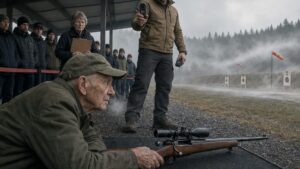
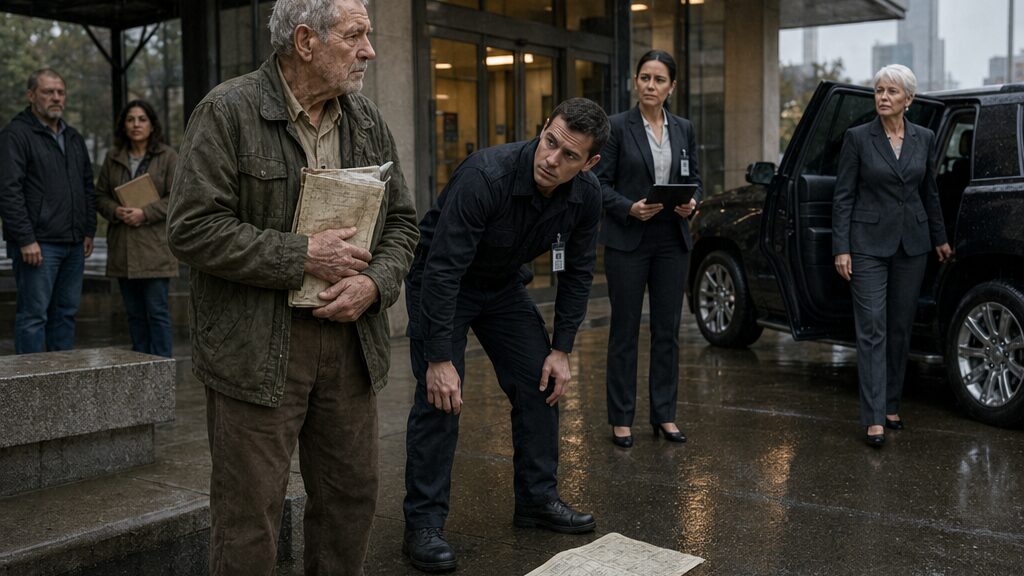
Raymond Walker looked up from the low stone bench. Rain had darkened the shoulders of his olive jacket and gathered in the cracks of his old brown shoes. He had arrived before seven, when the glass doors reflected only the gray street and the building’s brass seal. Now a line had formed behind the security posts, and nearly every face had turned toward him.
He kept both hands around the packet on his knees.
The pages had softened at the edges during his walk from the bus stop. He had wrapped them in a grocery bag, but the bottom seam had split. Water had reached the outer petition and the copy of the casualty report. The oldest page remained inside, folded into quarters along a crease gone almost white with age.
“I’m not asking the bench for an appointment,” Raymond said.
Nicole’s mouth tightened. She wore a dark blazer and an identification badge clipped precisely above her left pocket. A tablet rested against one forearm. She had the posture of someone who had already explained the same rule too many times that morning.
“You were given the resubmission instructions in March.”
“They sent those back.”
“Because your packet was incomplete.”
“That is why I brought the original.”
Nicole glanced at the bundle without reaching for it.
Behind her, a front-desk clerk opened another lane. The line shifted, shoes squeaking over the wet entry tiles. One of the waiting petitioners looked away. The other continued watching with the uneasy interest people showed when someone else was being corrected in public.
Nicole lowered her voice, though not enough to make the exchange private.
“Original documents are not accepted at the exterior entrance. You need a scheduled legacy-record review. You do not have one.”
“I had one.”
“It was closed after you failed to provide supporting testimony.”
Raymond’s thumb pressed the old fold beneath the damp outer pages.
That was seventeen years ago. Nicole could not have been old enough to work here then. Yet the sentence came out of her as if she had watched him leave that earlier room with the unanswered question still lying on the table.
“I was told the file had been transferred,” he said.
“It was closed.”
He looked toward the glass doors. Beyond them were metal detectors, pale walls, rows of molded chairs, and the elevators that led to the records floors. He had traveled four hours to reach the building. Ruth’s hospital aide had called Friday evening and said Ruth was weaker, though still alert, still asking whether anything had changed.
Raymond had told her he would try once more.
He had not told her he had already promised himself this would be the last time.
Nicole tapped her tablet.
“I can print the standard form again. You can mail copies through the verification address.”
“I did.”
“Then wait for the written response.”
“I did that too.”
“Mr. Walker—”
“The woman this concerns may not have another six months.”
For the first time, Nicole’s expression shifted. Not softened. Only recalculated.
“Is this a benefits claim?”
“No.”
“Financial correction?”
“No.”
“Then there is no medical-expedite category.”
“It is her brother’s record.”
Nicole let out a controlled breath. “An old casualty record.”
Raymond’s fingers stopped on the fold.
“Yes.”
“We cannot make exceptions because a family member is ill.”
“I didn’t ask you to.”
“You are asking to enter without an appointment and submit unverified papers directly to staff.”
“I’m asking for a receipt showing I brought them.”
Her eyes moved from his worn jacket to the damp packet and back to his face.
“And I’m telling you that old war papers do not create an appointment.”
The words landed with less force than the way she turned away after saying them.
Raymond had spent most of his life around engines. City buses came into the maintenance bay making noises other men called mysterious, but no machine was mysterious once a person listened long enough. A knock under load meant one thing. A hiss after shutdown meant another. Silence where a sound should have been could be the most important clue of all.
Buildings had sounds too. This one hummed with scanners, elevators, polished shoes, and voices trained to become neutral at the first sign of trouble.
Nicole spoke to the uniformed security officer near the door.
“Tyler, please move him away from the entrance before the director arrives.”
The officer hesitated only a moment.
He was in his thirties, broad across the shoulders, with a contract-security patch on his sleeve. Raymond had noticed him earlier adjusting the rope barrier so an older woman using a cane would not have to turn sharply. That did not mean much. Kindness performed when no rule resisted it was easy.
Tyler approached.
“Sir, I need you to clear the entry area.”
Raymond looked at the stone bench. It stood several yards from the doors and did not block the line.
“I’m outside.”
“The vehicle lane has to remain clear.”
“I’m not in the lane.”
Tyler glanced toward Nicole. She was already speaking to the clerk, but the angle of her head showed she was listening.
“There’s another covered area around the east side,” Tyler said. “I can show you.”
“My bus leaves from this side.”
“You can come back around.”
Raymond rose carefully. His right knee resisted until he shifted his weight. The packet slipped against his jacket, and he caught it with both hands.
No one in the line spoke.
He stepped away from the bench. A gust tunneled between the federal buildings and lifted the wet corner of the grocery bag. Raymond tightened his grip, but the outer petition peeled free. Then the casualty report twisted out, and the old quarter-folded page opened in the wind like a pale, wounded bird.
It struck Tyler’s boot.
The officer bent automatically.
“Leave it flat,” Raymond said.
Tyler stopped with one hand extended.
Rain dotted the page. Pencil marks ran along the margin beside a hand-drawn grid. Medical evacuation abbreviations crowded the lower half, compressed into the disciplined shorthand of a man writing in poor light with no space to waste. Near the bottom, above the broken fold, was a signature block.
Tyler’s face changed.
Not dramatically. His chin lifted first. Then his shoulders settled backward under the uniform shirt.
He did not pick up the page.
“May I?” he asked.
Raymond looked at him.
Tyler waited.
“By the dry edge,” Raymond said.
Tyler crouched, slid two fingers beneath the upper corner, and raised the paper without pressing the crease. His eyes moved over the grid reference, then the notation beside it.
“Dustoff corridor,” he said quietly.
Raymond took the page from him.
Nicole returned. “Is there a problem?”
Tyler did not answer at once. His attention remained on the signature block, where the faded type identified the writer as Sergeant Raymond Walker, squad medic.
“Sergeant Walker,” he said.
The title moved through the waiting line. A few heads turned again.
Raymond folded the page once, but the wet corner resisted.
“Not anymore.”
Tyler’s voice lowered. “You wrote this in the field?”
Raymond tucked the page inside his jacket.
“That is what I came to establish.”
Nicole looked from Tyler to Raymond. “Military service does not change the intake requirements.”
“No, ma’am,” Tyler said.
But he no longer stood between Raymond and the doors.
Nicole noticed.
Her fingers tightened around the tablet. “Then complete the relocation request.”
Tyler looked at the place where the rain had darkened the paper. “This document shouldn’t be outside.”
“That is not our determination to make at security.”
Raymond stepped off the entry mat. He had no wish to make Tyler choose between a job and an old man’s papers. He had seen enough young men ordered into choices by people who would never carry the weight of them.
The loosened corner bent against his jacket.
“Don’t bend that corner again,” he said.
Tyler’s eyes went to the packet.
“That part was written before he died.”
The officer’s mouth opened, then closed.
Nicole’s expression lost its impatience for half a second. In its place came uncertainty, quickly covered by procedure.
“Who died?” Tyler asked.
Raymond looked through the glass doors at the building that had kept the answer for forty-seven years.
“Dennis Lopez.”
A dark vehicle turned into the curb lane.
The black SUV stopped beside the entrance with its headlights glowing against the wet pavement. The driver stepped out and opened the rear door. An older woman in a charcoal suit leaned forward, one hand braced against the leather seat.
Nicole straightened.
Tyler moved toward the curb, but the woman did not look at him. She looked past the security post, past Nicole, and directly at Raymond.
For one long second, she remained half inside the vehicle.
Then Carolyn Adams stepped into the rain.
Chapter 2: The Director Knew His Name
“Mr. Walker,” Carolyn Adams said, “I hoped I was wrong about who was sitting out here.”
The SUV driver lifted an umbrella, but Carolyn waved it away. Fine drops settled in her short white hair as she crossed the wet pavement. Her eyes stayed on Raymond, not on the building staff assembling around her.
Nicole moved to intercept her.
“Director Adams, we have an unscheduled petitioner. Security was relocating him.”
Carolyn stopped beside the stone bench.
“I can see that.”
Her voice was neither sharp nor warm. It carried the controlled precision of someone accustomed to being obeyed without raising it.
Raymond remembered that voice.
Seventeen years had roughened it, but not changed its rhythm. It had asked him questions in a hearing room with no windows. Each one had been plain. Each one had required an answer he could not make himself give.
Carolyn looked at the packet inside his jacket.
“You brought the original statement.”
He said nothing.
“May I see it?”
The request unsettled him more than an order would have.
He removed the packet and held it out, but did not release it when her hand reached for the pages.
“I want it entered at intake.”
Carolyn paused.
“Of course.”
“Not carried upstairs as a favor.”
Nicole’s eyes shifted toward the waiting line.
Carolyn nodded once. “Then we will process it at intake.”
“There is no appointment,” Nicole said. “The legacy petition was closed, and the current packet does not meet chain-of-custody requirements.”
Carolyn turned to her. “Has anyone examined the original?”
“No. Originals are not reviewed at exterior security.”
“Has it been assigned a temporary control number?”
“No, because—”
“Then we know it is unprocessed. We do not yet know what it does or does not meet.”
Nicole’s face colored, but she kept her voice level. “We are under instructions not to create exceptions without documented cause.”
Raymond watched Carolyn. This was the moment authority usually became theater. The senior official corrected the junior one, the old man was ushered inside, and everyone pretended the system had worked because someone important had interrupted it.
He tightened his hold on the packet.
“I don’t want an exception.”
Carolyn looked back at him.
“I want what the next person gets,” he said. “A number. A receipt. A written reason if you turn it down.”
The waiting petitioner closest to the door lowered his gaze. Tyler stood beside the security post, hands clasped behind him, his posture still changed from the moment he had read the field notation.
Carolyn extended her hand again.
“Then that is what you will receive.”
Raymond let go.
She did not fold the packet. She balanced the pages across both palms and carried them through the glass doors as though the paper might bruise.
Inside, the building smelled of wet coats, disinfectant, and warmed electronics. Raymond emptied his pockets into a gray security tray. Keys. Bus pass. Two peppermints. The small plastic vial for his heart pills.
Tyler operated the scanner.
“Jacket can stay on,” he said.
Nicole glanced at him. “Standard screening requires outerwear removal.”
Tyler’s jaw shifted. “Then it comes off.”
Raymond removed it before the disagreement could grow. Tyler took the jacket without searching its pockets until Raymond nodded permission. Respect could become another kind of handling if a person was not careful.
At the front desk, the clerk stared at Carolyn standing beside Raymond.
Nicole entered the information herself.
“Petitioner name?”
She already knew it, but the form required the question.
“Raymond Walker.”
“Subject of requested correction?”
“Dennis Lopez.”
“Relationship?”
“Former squad leader.”
Nicole’s fingers paused above the tablet.
“Nature of correction?”
Raymond looked at the old casualty report beneath Carolyn’s hands.
“Unauthorized separation from assigned position.”
Nicole read from the existing record. “You are challenging that designation?”
“I am asking the office to state what he was doing when he died.”
“That is not the same question.”
“No,” Raymond said. “It is the question they should have asked.”
Carolyn’s eyes rested on him.
Nicole printed a temporary control label and attached it to a clear protective sleeve. The small adhesive strip looked absurdly new against the yellowed paper.
She slid a receipt across the counter.
Raymond picked it up and read every line.
Date. Time. Petitioner. Number of pages received. Condition upon receipt: water exposure, edge wear, preexisting folds.
He looked at the blank marked Staff Observations.
“The handwritten field statement was seen outside by Officer Brown.”
Nicole’s lips compressed. “Security observations are not normally included in intake condition notes.”
“He saw it open.”
“I can add that a security officer witnessed the document before submission.”
“And the grid.”
Nicole looked at Tyler. “Did you identify a grid notation?”
“Yes.”
“Are you qualified to authenticate it?”
“No.”
“Then I cannot record it as authenticated.”
Raymond placed the receipt back on the counter.
“Write that he observed it. Not that he proved it.”
Carolyn said, “That is accurate.”
Nicole added the sentence.
The receipt came back warm from the printer. Raymond folded it once, then stopped. He clipped it to the protective sleeve instead.
A small thing. A number and a timestamp. Yet for the first time, the building had admitted the pages were inside.
Carolyn led him to a private intake room beyond the public chairs. Nicole followed, carrying her tablet. Tyler remained at the door until Carolyn asked him to join them as a witness to the document’s condition.
The room held a table, four chairs, and a wall clock that ticked too loudly.
Carolyn laid the packet flat.
“Mr. Walker, before we proceed, I need to explain something.”
He took the chair nearest the door.
“You remember me,” he said.
“Yes.”
Nicole looked between them.
Carolyn sat opposite Raymond. “I was a legal review officer when your previous petition reached the regional board.”
“You told me the records had been transferred.”
“I told you portions of the unit archive had been transferred for consolidation. That was true.”
“You did not tell me the petition was closed.”
“You received a written determination.”
“I received three pages explaining evidence standards.”
“The final page stated the disposition.”
“The final page called Dennis’s status administratively supportable.”
Carolyn’s hands rested on either side of the old statement. “Because the board rejected the correction.”
The clock clicked once.
Raymond had imagined many reasons for the silence that followed his last petition. A missing file. A delayed transfer. A clerk who had entered the wrong number. He had kept every envelope because a mistake could be found and corrected if a person preserved enough paper.
“You knew it was rejected,” he said.
“Yes.”
“And when you saw me outside, you knew why I was here.”
“I suspected.”
Nicole shifted her tablet against the table. “Director, if this is a prior adjudicated matter, reopening requires new material evidence.”
Carolyn did not look away from Raymond. “He has presented an original field statement not included in the digitized case file.”
“I brought it before.”
“You brought a copy.”
“I held this page in that room.”
“You would not surrender it for examination.”
Raymond remembered the long table. Carolyn had been younger, her dark hair tied at the nape of her neck. Two officers had asked to retain the original. He had refused because Dennis’s mother was still alive then, and Raymond had promised the page would not vanish into another box.
“You wanted to cut it apart for testing,” he said.
“We wanted to examine the pressure marks beneath the damaged section.”
“You wanted custody.”
“Yes.”
“And I did not trust you.”
Carolyn accepted that without defense.
Nicole said, “The standard now allows supervised examination without destructive testing.”
Raymond looked at her. The earlier impatience remained, but it had narrowed into professional caution. She was not ashamed of the rules. She believed the rules were the only stable thing in the room.
Carolyn opened a slim folder her driver had carried in from the SUV.
“I reviewed your case summary on Friday after your congressional inquiry was routed back to this office.”
“I did not send a congressional inquiry.”
“Ruth Carter’s hospital social worker did.”
Raymond sat back.
Ruth had said nothing about that.
Carolyn removed a letter from the folder.
“You should understand that the original petition was not misplaced, Mr. Walker. It was reviewed. Your service was verified. Sergeant Lopez’s assignment was verified. Your presence at the evacuation site was verified.”
“Then you knew enough.”
“We knew you submitted an account that stopped before the decisive sequence.”
The old page lay between them, its whitened fold cutting across the final lines.
Carolyn placed another document beside it.
The paper was newer than Raymond’s statement but old enough for the edges to have yellowed. He recognized the heading before he read the date.
Regional Military Records Review Board.
Seventeen years earlier.
His eyes moved down the findings, past the language he remembered, to the final page he had trained himself not to remember clearly.
Petition denied for insufficient evidence and unresolved material inconsistency.
At the bottom was a signature.
Carolyn M. Adams, Legal Review Officer.
Raymond looked up.
“What inconsistency?”
Carolyn’s face remained composed, but her right hand had closed around the cap of her pen.
“The one you would not answer under oath.”
Chapter 3: The Soldier Behind the Missing Paragraph
“I ordered Lopez to remain with the radio until—”
The records archivist stopped reading.
The sentence ended at the fold.
Under the white examination lights, the paper looked more fragile than it had in Raymond’s hands. It rested inside a transparent sleeve on a padded gray surface. Two small weights held the sleeve flat without touching the page itself.
The archivist leaned closer. “There is no surviving continuation on this sheet.”
“There was,” Raymond said.
The review attorney sat at the opposite end of the table with Carolyn and Nicole. Tyler had returned to the entrance after giving a written description of the document’s condition. Without him, the room felt more official and less honest.
The archivist adjusted a magnifying lens.
“The lower section has fiber loss, water staining, and abrasion along the quarter fold. We may be able to determine whether additional pressure marks exist. We cannot assume what those marks contained.”
“I know what they contained.”
The review attorney folded her hands. “Then your testimony may be relevant.”
Raymond kept his eyes on the page. “The paper is the testimony.”
“No, Mr. Walker. The paper is an exhibit.”
“That page was there.”
“And it currently ends in the middle of your order.”
The attorney’s tone held no accusation, which made the words harder to resist.
Carolyn had arranged the preliminary review within an hour of intake. She had also made clear that speed did not mean acceptance. The office would establish whether the page was original, whether its annotations matched the known operation, and whether any new evidence justified reopening the case.
Nicole had insisted on attending because the matter entered through her unit. She sat straight-backed with a legal pad beside her tablet, recording each procedural step.
The archivist turned to the casualty report.
“Sergeant Dennis Lopez. Communications specialist. Status at time of injury listed as separated from assigned position during emergency unit displacement.”
“Read the next line,” Raymond said.
“Circumstances unresolved.”
“The next one.”
“Possible unauthorized abandonment of primary duty location.”
Raymond’s jaw tightened.
Dennis had not abandoned anything. He had remained beside the damaged radio until the battery housing grew hot enough to burn through cloth. He had kept a corridor open with his voice while men he could not see carried other men he would never meet.
But that was not written here.
The review attorney said, “The record does not formally classify him as a deserter.”
“It let everyone think the word.”
“It records uncertainty.”
“It gave uncertainty to a dead man and certainty to everyone reading it.”
Nicole spoke for the first time in several minutes. “A correction requires evidence of what occurred, not only evidence that the language caused harm.”
Raymond turned toward her.
She did not flinch.
He disliked her more when she was cruel. He disliked her differently when she was correct.
The archivist examined the reverse side of the field statement.
“This stock is consistent with military administrative paper used during the period. The typewritten header appears original. The handwritten notations show oxidation and graphite aging consistent with long-term storage.”
“So it is real,” Raymond said.
“It appears period-original. That is not the same as proving every entry was made at the scene.”
“The grid matches the evacuation site.”
Carolyn said, “Preliminary comparison suggests that it does.”
The archivist pointed through the sleeve. “These abbreviations also correspond with field medical notation. LZ obstruction. Two litter patients. Delayed rotary extraction. The margin reference appears to identify a communications relay point.”
Raymond knew the point without looking. A shallow cut in the ground below a tree line. Mud over his boot tops. Dennis kneeling beside the radio with one headphone pressed to his ear because the other side had cracked.
The room receded for half a breath.
Then Nicole’s pen touched paper, and the present returned.
The review attorney slid the casualty report toward Raymond.
“Sergeant Lopez’s family submitted two informal inquiries and one formal request over the years. All failed for the same reason. The surviving official accounts placed him away from the unit’s movement route without documented authorization.”
“He had authorization.”
“From whom?”
Raymond’s thumb found the edge of the table.
The attorney waited.
Carolyn looked down.
That was the question beneath all the other questions. It had been there seventeen years ago, plain and unavoidable.
Raymond said, “The missing paragraph explains the position.”
“That is not what I asked.”
“The paragraph was damaged.”
“Who authorized him to remain?”
Raymond looked at the old page. The fold crossed the unfinished sentence as cleanly as a closed door.
“I want the paper tested.”
The attorney watched him for another moment, then made a note.
“We can begin nondestructive imaging tomorrow. Before a formal reopening, we also need cooperation from the next of kin.”
“Ruth will cooperate.”
Carolyn said, “Has she agreed to provide a new statement?”
“She wants the record corrected.”
“That is not the same as agreeing with your account.”
Raymond reached for the receipt clipped to the sleeve. The paper was smooth and new under his fingers.
“She knows Dennis did not leave his post.”
“Does she know why he was alone?”
The question came from Carolyn, but it carried Ruth’s voice inside it.
Raymond stood.
His knee struck the table lightly. The archivist placed a protective hand near the sleeve without touching it.
“I need to call her.”
The telephone alcove was outside the review room, separated from the corridor by frosted glass. Raymond closed the door and dialed the number the hospital aide had given him.
Ruth answered on the sixth ring.
“You got in,” she said.
It was not a question.
“How did you know?”
“The social worker called the director’s office Friday. I told her not to tell you.”
“You had no business doing that.”
“I had every business. It is my brother’s name.”
Raymond leaned against the narrow counter. Beyond the frosted glass, figures passed as softened shadows.
“They authenticated the paper.”
Silence.
“Ruth?”
“I heard you.”
“They will test the fold tomorrow.”
“Will that clear him?”
“It can show the page had more writing.”
“That isn’t what I asked.”
Everyone had learned to ask him the same question in different words.
“They need a family statement to reopen the case.”
“And you called because you want mine.”
“Yes.”
“What do you want me to say?”
“That Dennis did not abandon his position.”
“I know that.”
“That the wording harmed your family.”
“It did.”
“That your mother died believing people thought he ran.”
Ruth’s breathing changed. Not a sob. Something more controlled and more tired.
“You stopped coming to see her,” she said.
Raymond closed his eyes.
“That has nothing to do with the record.”
“It has everything to do with it.”
“I came after the funeral.”
“Twice. Then you sent Christmas cards without return addresses.”
“I moved.”
“You lived in the same city for twenty-three years.”
He looked at his reflection in the frosted glass. The shape was gray and indistinct, like an old photograph handled too often.
Ruth said, “Tell me why you stopped coming.”
“This is about Dennis.”
“No. This is about you asking me to put my name beside your version of Dennis.”
“It is not my version.”
“Then why have you spent forty-seven years refusing to say why he was alone?”
Raymond lowered his voice. “The statement says what happened.”
“The statement ends.”
“They are examining it.”
“And if they find nothing?”
He had no answer that would satisfy either of them.
Ruth coughed, then turned away from the receiver. He heard the hospital aide murmur something in the background and a cup set down on a hard surface.
When Ruth returned, her voice was thinner.
“I will not sign anything until you come here.”
“The review is moving now.”
“Then move with it.”
“They may close it again.”
“They should, if you are still telling half of it.”
Raymond’s grip tightened around the telephone.
“I never lied about your brother.”
“You let other people lie while you held the rest in your pocket.”
The words struck closer than accusation should have been able to reach.
Through the glass, Carolyn appeared in the corridor but did not approach. She stood several feet away, waiting.
Ruth said, “Dennis wrote me before that operation.”
Raymond’s breath stopped.
“What letter?”
“Three days before. He said the radio had been failing. He said they might have to hold a relay point if the weather turned.”
“You never gave that to the board.”
“You never asked me for anything except a signature.”
“Do you still have it?”
“Yes.”
“Why didn’t you tell me?”
“Because you came to my house with forms already marked where I should sign. You did not come to tell me what happened.”
Raymond pressed his fingertips to the counter.
“What did Dennis write?”
Ruth was quiet long enough that he heard a cart roll down her hospital corridor.
“He wrote your name.”
Raymond stared at Carolyn’s blurred shape beyond the glass.
“What did he say?”
“Come tomorrow morning,” Ruth answered. “Then I will decide whether you deserve to read it.”
Chapter 4: Ruth Would Not Clear Him
“You had forty-seven years to tell me why my brother was alone.”
Ruth Carter did not offer Raymond a chair.
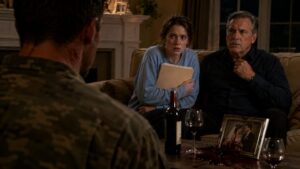
She sat beside the rehabilitation hospital window with a blanket across her knees and a clear oxygen tube beneath her nose. Morning light sharpened the hollows in her face. On the table beside her stood a paper cup of water, two pill bottles, and a sealed envelope yellowed almost to the color of Raymond’s field statement.
A hospital aide waited near the door.
Raymond remained standing in his damp olive jacket. “You said you had a letter.”
“I said Dennis wrote one.”
“And that it named me.”
“It does.”
Ruth laid one hand over the envelope.
Raymond had prepared for anger during the bus ride. He had not prepared for how much of Dennis remained in her face. The same narrow eyes. The same habit of pressing the lips together before saying something difficult.
“I came because the review board needs family cooperation,” he said.
“No. You came for the letter.”
“Both.”
“At least that answer was honest.”
The chair opposite her was close enough that Raymond could have reached the envelope without rising. He sat but kept his hands on his knees.
Ruth studied him.
“You look older than I expected.”
“So do you.”
A faint sound escaped her, not quite laughter. “Dennis would have said that was a poor way to begin.”
“He was better at beginnings.”
“He was better at staying in touch.”
The aide shifted near the door. Ruth glanced at her.
“I’ll call if I need you.”
After the aide left, Ruth removed the letter from the envelope. The paper had been kept flat. No creases crossed the handwriting. The edges were soft, but every line remained intact.
Raymond reached for it.
Ruth pulled it back.
“Not yet.”
“I won’t damage it.”
“That is not what worries me.”
She read the first lines silently, as if checking whether they had changed overnight.
“He wrote this three days before the operation,” she said. “He complained about the rain. He said the radio had begun cutting out whenever the battery warmed. He said you had made him clean the contacts twice.”
“He did it badly the first time.”
“He said you would say that.”
Raymond looked toward the window.
Below, an ambulance backed into a covered bay. Its warning signal repeated in slow, measured beeps.
Ruth continued. “He wrote that the roads were washing out and that the helicopter crews might need a relay point if the valley closed.”
Raymond’s fingers curled against his trousers.
“He understood what the radio was for.”
“I know.”
“Then you know he did not abandon his position.”
“I know my brother did not run.” Ruth’s voice hardened. “That does not tell me why he was separated from everyone else.”
“He was maintaining communications.”
“Alone?”
“The position could only hold two men without being seen.”
“Who was the second?”
Raymond said nothing.
Ruth watched the answer form in his silence.
“There was no second.”
“The squad had wounded.”
“So Dennis stayed.”
“Yes.”
“Because he chose to?”
Raymond looked at the letter.
Ruth turned it facedown.
“You keep looking at the paper as if it can answer for you.”
“It was written before the operation. It matters.”
“It matters because Dennis wrote it. It does not replace what you know.”
Raymond’s voice dropped. “What do you want from me?”
“The truth without a form attached.”
He leaned back, his right knee aching from the bus station stairs. “The record says unauthorized abandonment. Your letter shows he expected the relay point might be needed. That is enough to reopen the case.”
“Enough for you, maybe.”
“It clears him.”
“It may clear one sentence in a file.”
“That sentence followed your family for decades.”
“Yes.” Ruth’s hand pressed harder against the letter. “And so did your silence.”
Raymond looked down.
He remembered Dennis’s mother opening the door after the funeral, still wearing the black dress she had worn to the cemetery. She had asked him whether Dennis had been afraid. Raymond had said no.
It was the one answer he had given without hesitation.
Ruth slid the letter across the table but kept two fingers on its edge.
“Read the third paragraph.”
Raymond lifted the page carefully. Dennis’s handwriting leaned forward, hurried but even.
The radio is acting like it wants to retire before I do. Walker says we may have to hold a point above the south trail if evacuation starts. He acts like he can carry every wounded man himself. If it gets bad, he will come back. That is the one thing about him I trust even when he is impossible to stand.
Raymond stopped.
The words blurred. He lowered the letter until the lines sharpened again.
Ruth said, “He believed you would return.”
“I did.”
“Then why was he alone when they found him?”
Raymond read the paragraph a second time.
There were other lines beneath it. Dennis asked Ruth to send better coffee. He joked about a sergeant who could repair a field dressing with one hand but could not cook rice without burning it. Nothing in the letter sounded like farewell.
“He knew the risk,” Raymond said.
“That is not an answer.”
“It means no one tricked him.”
“Did you order him to stay?”
Raymond placed the letter on the table.
Without thinking, he began to fold it along the center.
Ruth caught his wrist.
“No.”
Her grip was weak, but he stopped.
She pulled the letter away and smoothed it flat with both palms.
“You do that every time,” she said.
“Do what?”
“Make something smaller until it fits where you want to carry it.”
Raymond withdrew his hand.
Ruth’s breathing had quickened. She adjusted the oxygen tube and waited before speaking again.
“I will give the office a copy. I will state that Dennis anticipated the relay duty and did not intend to abandon his post.”
Relief entered Raymond so quickly it felt like pain.
“Thank you.”
“I am not finished.”
He waited.
“I will not state that you bear no responsibility. I will not sign a version that turns you into another victim of bad paperwork.”
“I never asked for that.”
“You came with the words already chosen.”
“The board needs precise language.”
“I need an answer.”
Raymond looked toward the door. He could leave with the useful part. Ruth had agreed to provide the letter. The case could move forward without the rest of this conversation.
But he had made that kind of departure before.
Ruth turned the letter toward him again, tapping Dennis’s sentence with one finger.
He will come back.
Her eyes lifted to Raymond’s.
“Did he stay because he chose it,” she asked, “or because you ordered him?”
Chapter 5: The Review That Proved Too Little
Under the laboratory light, letters rose from the paper.
Raymond leaned toward the monitor as the records archivist adjusted the angle of illumination. Pale ridges crossed the damaged section beneath the old fold. For a moment, they resembled handwriting surfacing through water.
“There,” Raymond said. “Increase the contrast.”
The archivist moved a control. Shadows deepened inside the pressure grooves.
A vertical stroke appeared. Then part of a curve. Farther down, three shallow marks ran together and disappeared where the paper fibers had worn away.
The review attorney stood behind Raymond’s chair. Carolyn watched from the other side of the glass partition. Nicole had arrived with a binder of intake rules tucked beneath one arm.
“Can you read it?” Raymond asked.
The archivist did not answer immediately.
She changed wavelengths, captured another image, and placed it beside the first. The marks shifted but did not resolve.
“We can confirm that additional writing once existed beneath the surviving text.”
Raymond waited.
“We cannot reliably reconstruct the wording.”
“You have the impressions.”
“Fragments of impressions.”
“The first word begins with an I.”
“It may.”
“I wrote it.”
“That cannot be established from the pressure pattern.”
Raymond pointed toward the screen. “That curve is an o.”
“It could be.”
“Then the next word was ordered.”
The archivist turned from the monitor. Her expression was patient rather than doubtful, which made him feel older than Nicole’s impatience ever had.
“Mr. Walker, once we decide what we expect to see, incomplete marks often appear to confirm it. Another examiner must be able to reach the same reading independently.”
“You know there was a paragraph.”
“We know there was additional writing.”
“That should be enough to reopen the record.”
The review attorney said, “Enough to consider reopening. Not enough to establish what happened.”
Raymond sat back.
The clean laboratory air carried no smell of wet paper, mud, hot radio casing, or blood. The page had been stripped of everything except what could be measured, and still it refused to carry the whole burden.
Carolyn entered through the side door.
“We have authenticated the paper stock and verified that several field notations correspond to known evacuation records,” she said. “That is meaningful.”
“But not decisive.”
“No.”
Nicole set her binder on the table. “Which is why intake staff cannot treat service indicators as proof of a claim.”
Raymond looked at her.
She had not raised her voice. She did not sound pleased by the failure. She sounded prepared.
“The field notation proved I was there,” he said.
“It supported that fact, along with existing records. It did not prove the missing account.”
“You told everyone outside they were old war papers.”
“I said they did not create an appointment.”
“You would not touch them.”
“Because intake employees are instructed not to handle unlogged originals at the entrance.”
“You ordered security to move me.”
“The director’s motorcade was arriving, and you had already refused redirection.”
Carolyn said, “Nicole.”
“No.” Nicole opened the binder. “If this review is examining the entrance incident, then the rules need to be part of it. We had fraudulent legacy submissions last quarter. One contained fabricated casualty pages treated with chemicals to simulate age. Another employee is under investigation for accepting originals without logging them. My unit has been told that another chain-of-custody failure may affect staffing.”
Her fingers rested on the open policy.
“I handled Mr. Walker badly,” she said. “But recognizing that he served would not have made his claim true.”
The words entered the room and stayed there.
Raymond disliked the steadiness with which she said them because he could not dismiss them.
Tyler appeared at the laboratory door.
“Director Adams asked for my statement.”
Carolyn nodded for him to enter.
He remained standing. “I reviewed the incident summary before signing it.”
Nicole’s eyes narrowed. “And?”
“It says I observed aged military-style documents after Mr. Walker dropped them.”
“That is accurate.”
“It leaves out the casualty grid, the evacuation shorthand, and the signature block.”
“You are not an archivist.”
“I did not authenticate them. I recognized them.”
“The report is about security conduct, not records evaluation.”
“It is about why my conduct changed.”
Nicole closed the binder.
Tyler continued. “It also says Mr. Walker was moved from the entrance.”
“He was.”
“No. He stepped off the mat himself after I asked. I did not complete the relocation.”
Nicole’s face remained controlled, but a small pulse moved at her temple.
Carolyn said, “Preserve the entrance footage and all versions of the intake report.”
Nicole turned. “Are you suggesting I falsified it?”
“I am directing that the full record be retained.”
“For a case that has not yet been reopened?”
“For an incident that occurred in this building.”
Nicole looked at Raymond as though he had become a problem larger than the papers. Then she looked back at Carolyn.
“My notes will also show that Mr. Walker requested standard intake, not preferential review.”
Raymond had not expected help from her.
Nicole saw his surprise.
“I am not doing it for you,” she said. “If this office examines what happened, it will examine all of it.”
She gathered her binder and left.
Tyler remained near the door. “I should have questioned the relocation order sooner.”
Raymond looked at the magnified crease on the monitor.
“You questioned it when you had a reason.”
“I had a reason before I saw the page.”
The admission was quiet.
Raymond turned toward him.
Tyler stood with his hands at his sides, not at attention, not performing anything. He looked like a man discovering that obedience had cost him more than discomfort.
Carolyn dismissed him after confirming his written statement would be added to the record.
When the door closed, the review attorney placed a form before Raymond.
“The new material is sufficient to request a sworn administrative hearing.”
Raymond read the heading.
His own name appeared above Dennis’s.
“What happens at the hearing?”
“You testify to the circumstances surrounding Sergeant Lopez’s separation from the unit. Ruth Carter’s letter may be submitted. The laboratory findings will be included.”
“And if I state what the missing paragraph said?”
“You will be questioned about its contents.”
“I already told you I wrote it.”
“You have also avoided answering who authorized Sergeant Lopez to remain.”
Raymond’s eyes stayed on the form.
The attorney slid a second page toward him. It described penalties for materially false or incomplete sworn testimony. Any new statement would become part of Raymond’s permanent service-related record.
“What if the document is enough?” he asked.
“It is not.”
“What if Ruth’s letter establishes Dennis understood the relay assignment?”
“It helps establish anticipation and intent. It does not establish the order, the duration, or what occurred afterward.”
Carolyn stood by the monitor. The pressure marks floated behind her like writing trapped beneath ice.
Raymond said, “You are asking me to replace evidence with memory.”
“No,” the attorney said. “We are asking whether you are willing to submit your memory to examination.”
He picked up the pen.
The line for his signature waited at the bottom of the hearing request.
He thought of Ruth flattening Dennis’s letter beneath both hands. He thought of Nicole saying service did not make a claim true. He thought of Tyler admitting he should have seen an old man before he saw a sergeant.
Raymond set the pen down.
“I need until morning.”
The attorney collected the form but left him a copy.
“If you proceed,” she said, “understand this clearly. A false statement can damage your record. An incomplete statement may be treated the same way if the omission is material.”
Raymond looked once more at the glowing fragments beneath the fold.
The paper had proved that words were missing.
It had not proved why he had spent forty-seven years needing them to speak instead of him.
Chapter 6: What Raymond Ordered That Night
Raymond tore up every version that avoided the word ordered.
The motel wastebasket filled with narrow strips of paper.
In the first version, Dennis had remained at the relay point.
In the second, Dennis had volunteered to maintain communications.
In the third, circumstances had required temporary separation.
All three statements were true.
None of them told the truth.
Raymond sat at the small desk beneath a lamp bolted to the wall. Trucks moved along the highway outside, their tires hissing over wet pavement. His field statement lay open beside the hearing form, no longer quarter-folded.
He had unfolded it completely after returning from the records office.
Inside the deepest crease, protected for decades from light and rain, ran a narrow strip of paper almost clean enough to show its original color. The contrast made the stained edges look darker. He ran one finger beside the fold without touching the damaged section.
The room around him gave way to a slope below a tree line.
Dennis crouched over the radio. One side of his headset was held together with medical tape. Farther down the trail, two wounded soldiers waited on improvised litters while rain loosened the ground beneath them.
The evacuation aircraft could not see the landing zone through the low cloud. Dennis’s relay was the only stable connection between the ground team and the flight controller beyond the ridge.
Raymond had checked his watch.
“Twelve minutes,” he had said.
Dennis looked up. “You always say twelve when you mean twenty.”
“I mean twelve.”
“You taking both litter teams?”
“I’m taking the first two. The others move when I return.”
“And if the battery dies?”
“Switch to the reserve.”
“The reserve is worse.”
“Then keep it alive.”
Dennis had smiled without humor. “That an order?”
Raymond had looked toward the wounded men.
“Yes.”
He returned to the motel room with his hand pressed flat against the desk.
For decades, he had remembered the promise more clearly than the command.
I will come back.
But the promise had followed the order, and the order came first.
At eight the next morning, Carolyn called his room.
“Before you submit the hearing request,” she said, “I would like to discuss an alternative.”
Raymond found her office forty minutes later.
There was no motorcade outside. The rain had stopped, leaving the stone bench streaked with water. Tyler opened the glass door but did not address him by rank. He simply said, “She is expecting you.”
Carolyn’s office overlooked the same entrance where Raymond had waited. From the window, the bench looked smaller.
She had placed two draft documents on her conference table.
“The review attorney believes Dennis’s record may qualify for a limited administrative clarification,” she said.
Raymond remained standing. “Without a hearing?”
“With Ruth’s letter, the verified field annotations, and the operational records, we can amend the language stating possible unauthorized abandonment.”
“To say what?”
“That his separation occurred during communications support associated with a medical evacuation.”
“Associated.”
“It is accurate.”
“It does not say he stayed to protect the corridor.”
“We cannot establish that without further testimony.”
Raymond looked at the second document.
“What is that?”
“A statement confirming that the original board lacked access to Ruth’s letter and the now-authenticated field page.”
“You had the page.”
“We had a copy of part of it.”
“You saw the original.”
“Yes.”
Carolyn removed her glasses and set them beside the drafts.
“I remember you holding it exactly as you held it outside. You would not place it on the table. You would not permit examination. When the board asked who directed Dennis to remain, you said the answer was contained in the damaged section.”
“It was.”
“Then we asked you under oath.”
Raymond pulled out a chair but did not sit.
“What did I say?”
“You asked for a recess. When you returned, you withdrew the petition.”
He had remembered leaving. He had remembered the envelope in his coat and the elevator stopping at every floor. He had not allowed himself to remember the withdrawal form.
Carolyn folded her hands.
“I rejected the petition because the available evidence did not support correction and the principal witness would not answer a material question.”
“You could have written that plainly.”
“It is in the record.”
“Buried beneath legal language.”
“Yes.”
The answer surprised him.
Carolyn looked toward the window.
“I believed then that the board had acted correctly. I still believe the evidentiary decision was legally supportable. I no longer believe that was the only obligation we had.”
Raymond sat.
She pushed the limited correction toward him.
“This would remove the implication that Dennis left his position without purpose. It could be approved quickly. Ruth could receive it within days.”
“And my order?”
“Would not need to be examined.”
“My failure to return?”
“Would not be part of the determination.”
Raymond stared at her.
There it was: respect shaped like protection. A private path around the worst question. The kind of solution offered to a man whose age and service made everyone eager to spare him further pain.
Ruth would get the correction.
Dennis’s name would be cleaner.
Raymond could return home with his own record untouched.
“Why are you offering this?”
“Because the evidence supports a limited change.”
“That is the official reason.”
Carolyn’s gaze held his.
“The other reason is that I remember your face when the board asked the question. I believed pressing harder would serve no useful purpose.”
“You thought I was protecting Dennis.”
“I thought you might be protecting yourself.”
The words were not cruel.
Raymond wished they had been.
He opened the old packet. Instead of refolding it, he laid the field statement flat beside Carolyn’s draft.
“Dennis operated the radio while I moved two wounded soldiers toward the extraction route,” he said.
Carolyn did not reach for a pen.
“I told him to hold the relay point.”
“For how long?”
“Twelve minutes.”
“Was that realistic?”
“At the time, I believed it was.”
“And now?”
“No.”
Carolyn waited.
Raymond looked down at the clean strip inside the fold.
“I promised I would return.”
“Did you?”
His mouth went dry.
“I returned to the position.”
“That is not what I asked.”
The same precision. The same question beneath the question.
Raymond took the hearing request from inside his jacket.
“If I accept your correction, Dennis’s record changes.”
“Yes.”
“But the reason it remained wrong stays hidden.”
Carolyn said nothing.
“You get to say the board lacked evidence. I get to say the paper was damaged. Everyone gets a sentence that is true.”
“And incomplete.”
Raymond looked at her.
She did not look away.
He picked up her pen.
The hearing form required a brief statement explaining why sworn testimony was necessary. Raymond wrote slowly, his hand unsteady only once.
The surviving documents do not contain the full account of my command decision.
He signed his name.
Below it, in the space meant for supporting details, he added four words.
I gave the order.
Chapter 7: The Truth He Could Not Fold
“It said less than what happened.”
The review attorney’s pen stopped above her notes.
Raymond sat alone at one end of the closed hearing table. The old field statement lay before him inside its clear sleeve, folded along the same whitened lines it had carried for forty-seven years. He had not opened it.
Across from him sat the review attorney, the records archivist, and Carolyn Adams. Nicole occupied a chair near the wall with her intake binder on her lap. Tyler stood outside the glass panel, visible only when someone passed through the corridor behind him.
Ruth’s letter rested in a separate evidence sleeve.
The attorney looked toward the recording device, confirmed that its green light remained on, and then returned her attention to Raymond.
“For clarity, Mr. Walker, you were asked what the missing paragraph of your field statement said.”
“I understood the question.”
“And your answer is that it said less than what happened.”
“Yes.”
“Then tell us what happened.”
Raymond’s hand rested beside the folded page. The paper had become a border he had spent decades refusing to cross. He moved his hand away from it.
“There were four wounded men below the relay position,” he said. “Two could still walk with help. Two required litters. The weather had closed the direct extraction route. Our radio could reach the aircraft controller only from higher ground.”
“Who operated the radio?”
“Sergeant Dennis Lopez.”
“Who assigned him to the relay position?”
“I did.”
The words entered the record without resistance.
Raymond continued before anyone could soften them.
“I ordered him to maintain contact while I moved the first two litter patients toward the south trail. I told him I would return in twelve minutes.”
“Was twelve minutes sufficient?”
“No.”
“Did you know that at the time?”
“I knew it was the fastest I could make the trip if nothing changed.”
“What changed?”
“One of the walking wounded collapsed. We had to convert a poncho into another litter. The trail gave way near the lower bend.”
“How long were you gone?”
Raymond looked at the clock on the wall. Its second hand moved in small, exact steps.
“Twenty-six minutes before I reached the point where I could have turned back.”
The attorney waited.
“What did you do then?”
“There was another wounded soldier farther down the trail. His bandage had failed.”
“Did you return to Sergeant Lopez?”
“Not then.”
Nicole’s head lifted.
Carolyn remained still.
Raymond felt the old instinct to explain before the judgment arrived. Dennis had been transmitting. The corridor was still open. The aircraft were coming. A man bleeding below the trail could not wait.
All of that was true.
He did not offer it yet.
“I made another trip,” Raymond said. “I carried the wounded soldier to the extraction route.”
“How much additional time passed?”
“Fourteen minutes.”
“So you returned to the relay position approximately forty minutes after giving a twelve-minute order.”
“Yes.”
The word left no shelter behind it.
The review attorney glanced toward Ruth’s letter.
“Did Sergeant Lopez remain because your order was still in effect?”
“At first.”
“What changed?”
Raymond looked at the handwriting visible through the protective sleeve. Dennis had written that Raymond would come back. He had written it as casually as he had asked for coffee.
“The radio battery began failing. Dennis contacted the aircraft controller and learned there was movement near the evacuation corridor. If the relay stopped, the aircraft would lose updates from the ground teams.”
“Did he have authority to leave?”
“Yes. My original order was to hold until I returned or until the route became unusable. After the twelve minutes passed, he could have withdrawn.”
“Did he?”
“No.”
“How do you know that was his choice rather than continued obedience?”
Raymond drew a breath.
“When I returned, the reserve battery was connected. My order had been for him to preserve the primary battery as long as possible. He had changed the setup. He had moved the antenna higher and exposed his position to keep the signal clear.”
The archivist made a note.
Raymond could see the slope again. The radio against Dennis’s chest. One gloved hand holding the transmitter. The other pressed beneath his ribs.
“He was still speaking when I found him,” Raymond said.
The room remained silent.
“What did he say?” the attorney asked.
“He gave me the aircraft call sign. He said the last litter team had crossed the bend. Then he told me the radio had finally started behaving.”
A small sound came from Carolyn’s side of the table. She lowered her eyes.
Raymond continued.
“He did not ask why I was late. That made it worse.”
The attorney allowed several seconds to pass.
“Was Sergeant Lopez mortally wounded at that time?”
“Yes.”
“Could you have saved him?”
Raymond looked toward the folded statement.
“I treated him.”
“That was not the question.”
“No,” he said. “Not with what I had.”
“Did your delay contribute to his death?”
“I do not know.”
“Do you believe it did?”
Raymond’s throat tightened.
“Yes.”
The answer was not medical evidence. It was not an official finding. It was the sentence he had used to punish himself when no other court had been available.
The review attorney leaned back.
“Why did you omit this account from the original inquiry?”
“I did not omit all of it. I wrote that I ordered him to remain and that I returned.”
“The surviving statement does not contain the return.”
“It was below the fold.”
“Why did you later refuse to testify?”
Raymond’s fingers closed against the table edge.
“Because the inquiry was already treating Dennis as a man who left his assigned position. If I said I ordered him there, I believed they would blame me and still call him unauthorized.”
“That explains caution. It does not explain seventeen years ago.”
“No.”
Raymond looked at Carolyn.
She held his gaze.
“Seventeen years ago,” he said, “I understood that telling the whole truth might clear Dennis. I also understood it would place my second trip in the record.”
“You feared disciplinary action?”
“I had been retired for years.”
“Loss of reputation?”
“Yes.”
The admission felt smaller than the shame it named.
“I wanted Dennis’s record corrected,” Raymond said, “but I wanted the correction to leave me as the man who came back for him. I did not want it to show that I chose another wounded soldier before I returned.”
No one wrote for several moments.
Then the attorney opened Ruth’s evidence sleeve.
“Mrs. Carter’s letter states that Sergeant Lopez anticipated the possibility of maintaining a relay point. It also states that he trusted you to return.”
“Yes.”
“Does that letter excuse your delay?”
“No.”
“Does your delay convert his continued transmission into unauthorized abandonment?”
“No.”
“Why not?”
“Because after my order expired, he stayed for the men on the trail. He understood the corridor better than anyone. He chose to keep it open.”
Raymond finally looked down at the field statement.
“I spent years saying the damaged paragraph contained the truth. It contained facts. Not the truth.”
The hearing paused while the review panel examined the operational map, Ruth’s letter, the authenticated notations, and Raymond’s sworn account.
During the recess, Nicole approached the table.
She placed a printed intake log beside Carolyn.
“This is the complete activity record from Monday,” she said.
Carolyn scanned it. “This differs from the incident summary.”
“The summary compressed several entries.”
“You wrote both.”
“Yes.”
Nicole’s face was pale but steady.
The log showed every request Raymond had made at the entrance. Standard receipt. Written rejection if necessary. No executive meeting. No service-based exception.
Nicole tapped the final line.
“He never asked to be treated differently because he served.”
Raymond looked at her.
She did not apologize.
“The record should not imply that he did,” she said.
Carolyn added the log to the hearing file.
When the panel returned, two documents lay inside separate blue folders.
The review attorney placed them before Raymond.
“One concerns Sergeant Dennis Lopez,” she said. “The other concerns you.”
Chapter 8: The Door Opened Without a Motorcade
Raymond read the amendment to his own record before he opened Dennis’s.
Three weeks had passed since the hearing. The correction meeting took place in the same private intake room where Carolyn had placed her old rejection letter beside his rain-softened packet.
His amendment was two pages long.
It recorded that Raymond had ordered Dennis to maintain the communications relay while wounded personnel were moved. It recorded Raymond’s delayed return, his decision to assist an additional casualty, and his failure to provide a complete sworn account during two earlier reviews.
It also recorded that he had returned to Dennis, provided treatment, recovered the field statement, and voluntarily supplied the missing account decades later despite potential damage to his own record.
There was no word heroic.
There was no word blameless.
Raymond placed the pages flat on the table.
Carolyn sat across from him. Nicole stood beside a filing cabinet with a new intake manual under one arm. The review attorney had already left after obtaining his acknowledgment of receipt.
“You may submit a written objection to the amendment,” Carolyn said.
“It is accurate.”
“The wording concerning delayed disclosure could be narrowed.”
“It should stay.”
Carolyn nodded but did not look relieved.
Raymond opened the second folder.
The heading identified Dennis Lopez by full name and service number. Beneath it, the old designation had been struck from the controlling summary.
The new finding stated that Dennis had remained at an elevated communications relay during an emergency medical evacuation; that his original assigned period had been extended by operational necessity; and that after direct supervision was interrupted, he voluntarily continued communications to protect the evacuation corridor until he was mortally wounded.
Raymond read the paragraph twice.
The language was dry. It did not contain the sound of Dennis’s voice or the heat of the damaged battery. It did not say that Dennis could make a complaint sound like a joke. It could not restore what his mother had believed or remove the years Ruth had spent defending him.
But it no longer left an empty space where suspicion could live.
“Ruth received her copy this morning,” Carolyn said.
Raymond closed the folder.
“I’m taking another one to her.”
Carolyn slid a clear archival sleeve toward him.
Inside lay the original field statement, fully opened and preserved flat. The paper’s old quarter-fold remained visible as pale crossing lines. The damaged lower corner had been stabilized with a transparent support so thin it was nearly invisible.
“We have attached a certified digital image to the corrected file,” she said. “The original remains yours unless you choose to donate it to the archive.”
Raymond placed his palm near the sleeve without touching it.
For years, the page had fit inside his jacket because he made it fit. He had opened only the sections he needed and closed it again before the rest could demand an answer.
Now it occupied most of the table.
“I’ll keep it,” he said.
Carolyn handed him a rigid document case.
Nicole shifted the manual beneath her arm.
“There is another matter,” she said.
Raymond looked at her.
She opened the manual to a marked page. The new protocol required front-line staff to request supervisory review before removing or redirecting elderly petitioners carrying legacy documents when communication, mobility, or appointment issues might prevent ordinary intake. It required written logging of original materials observed at the entrance. It also required staff to explain the difference between evidentiary recognition and respectful handling.
“No one gets admitted because of a uniform notation,” Nicole said. “No one gets moved simply because their paperwork takes longer to understand.”
Raymond read the page.
“Did you write this?”
“Parts of it.”
Carolyn said, “It applies to all regional intake units after a ninety-day review.”
Nicole’s expression remained guarded. She had not become kind in three weeks. She had become more exact about where procedure ended and choice began.
“What happens to you?” Raymond asked.
Nicole closed the manual.
“I remain intake supervisor under corrective oversight.”
Carolyn watched her. “That was my decision.”
“I agreed to it,” Nicole said.
“You could have blamed the incident on security,” Raymond said.
“I could have.”
“Or on the old policy.”
“That too.”
“Why didn’t you?”
Nicole’s fingers tightened against the manual’s spine.
“Because I wrote that you were relocated when you were not. Because I left out why Officer Brown stopped. And because being right about evidence did not make me right about how I treated you.”
She did not ask him to forgive her.
Raymond was grateful for that.
“Then make the next report complete,” he said.
“I intend to.”
A hospital aide connected Ruth’s call to the conference-room telephone before Raymond left. Her voice came through faint but clear.
“I read it,” she said.
“So did I.”
“They changed the words.”
“Yes.”
“They should have changed them years ago.”
“Yes.”
Silence traveled over the line.
Raymond looked at Dennis’s folder.
“Ruth, I am sorry.”
“I know.”
“That is not the same as forgiveness.”
“No.”
He waited.
“I cannot tell you that you made the right choice,” she said. “I was not on that trail. I cannot tell you Dennis would have lived if you had returned in twelve minutes.”
Raymond’s hand rested on the document case.
“But I no longer believe you abandoned him,” she continued. “And I no longer believe he stayed because he was too afraid to leave.”
Raymond closed his eyes.
“What do you believe?”
“That he trusted you. Then he made his own choice when you were not there.”
The answer held neither absolution nor punishment.
It was enough room for both men to exist as they had been.
“I’ll bring your copy this afternoon,” Raymond said.
“Bring coffee too.”
“The hospital will not let you have it.”
“Then bring it for yourself and let me smell it.”
The line disconnected.
Carolyn accompanied Raymond to the public floor. There was no announcement. No employees gathered to watch him pass. The chairs were occupied by people holding folders, plastic bags, envelopes, and photographs. At the front desk, a clerk leaned toward an older petitioner and asked her to explain which document she was most afraid of losing.
Nicole heard the question and did not hurry the clerk.
Outside, rain had begun again.
It darkened the pavement and traced the edges of the stone bench where Raymond had waited. No black SUV stood at the curb. A city bus was due in nine minutes.
Tyler held the glass door open.
Raymond stepped beneath the entrance canopy with Dennis’s corrected record under one arm and the original statement lying flat inside its case.
“Mr. Walker.”
He turned.
Tyler stood just inside the doorway. He glanced toward the security desk, then back at Raymond. His posture straightened.
The salute was brief and private.
Raymond did not return it. He was not in uniform, and Tyler did not seem to expect him to be.
Tyler lowered his hand and opened the door wider.
“Where would you like to go, Mr. Walker?”
Raymond looked toward the bus stop, then at the hospital address clipped to Dennis’s folder.
“To see