The Manager Who Ordered the Chairman Away Before Learning Why He Wore That Broken Watch
Chapter 1: The Man Blocking His Own Name
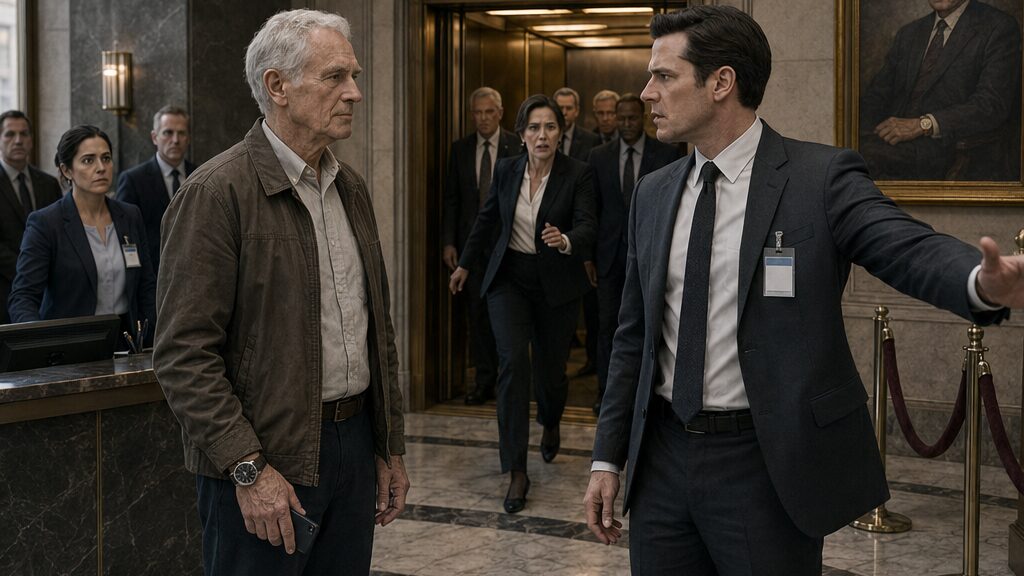
Brian Taylor stepped into the doorway before Samuel Mitchell’s second shoe crossed the brass threshold.
“You’ll need to use the public entrance,” Brian said. “We’re expecting the Chairman today. Clear the lobby immediately.”
Samuel stopped beneath the carved stone arch and looked past him.
The faculty lobby had changed since his last quiet visit. The old floor remained—gray marble veined like smoke—but waist-high barriers now divided the room into narrow lanes. White flowers stood beneath portraits of former university presidents. Temporary signs pointed toward REGISTRATION, EXECUTIVE ARRIVALS, and AUTHORIZED LEADERSHIP.
A young staff member hurried past carrying a stack of leather folders. Two men in dark suits glanced at Samuel, then quickly looked away.
Samuel lowered his eyes to Brian’s polished shoes.
“Immediately?” he asked.
Brian mistook the question for resistance. “This area is closed for a private summit.”
Samuel wore a faded brown jacket, a pale shirt without a tie, and shoes softened by years of use. At seventy-two, he had learned that expensive rooms changed their temperature around inexpensive clothing. He felt it happen now. Conversations shortened. Faces became politely blank.
“I’m attending the summit,” he said.
Brian gave him a professional smile that contained no warmth. He was perhaps thirty-five, broad-shouldered, sharply dressed, with an identification card clipped perfectly level to his jacket.
“Name?”
“Samuel Mitchell.”
The smile paused.
For a moment, Samuel thought recognition had arrived.
Then Brian’s eyes moved over him again—from the worn collar to the plain trousers, down to the scratched metal watch at his wrist.
“That isn’t funny.”
“I didn’t intend it to be.”
“The Chairman’s arrival is being managed separately.”
“I’m sure it is.”
Brian shifted closer, not touching him, but occupying enough space to make the command physical. “Mr. Mitchell is not entering through an unsecured faculty door without an escort.”
Samuel looked at the scanner mounted beside the entrance. Its indicator glowed green. “The door was open.”
“That doesn’t make you authorized.”
“No,” Samuel said. “It merely makes the door open.”
A few feet away, a woman at the registration table looked up from her laptop. Her badge identified her as Stephanie Torres, faculty liaison. She had heard the name. Samuel could see that much in the way her hands stopped over the keyboard.
Brian noticed her attention.
“Stephanie, please continue preparing the board packets.”
She glanced between them. “Should I check the guest directory?”
“I have the executive directory.”
Samuel turned slightly toward her. “The current one won’t help.”
Brian’s mouth tightened. “And why would that be?”
“Because I asked not to be listed.”
The answer produced exactly the wrong effect. Brian gave a short, humorless laugh.
“Of course you did.”
Samuel might have ended it there. One call would have done so. Amanda would answer before the second ring if she saw his name, and within minutes the marble lobby would fill with apologies.
Instead, he remained where he was.
Three months earlier, a handwritten letter had reached him through an old postal address the corporation no longer published. A retired laboratory assistant had described being turned away from this same entrance during a memorial lecture because her clothes did not fit “faculty presentation expectations.” Two scholarship applicants had reported being directed around the building to a service door while donors used the marble lobby.
Amanda’s office had called them isolated misunderstandings.
Samuel had decided to see the entrance himself.
He had not expected the test to begin so quickly.
“The eastern corridor still leads to the old faculty lift, doesn’t it?” he asked.
Stephanie looked up sharply.
Brian said, “That corridor has been sealed during renovation.”
“Only from this side. The interior door beside the archive stair still opens with the brass key kept in the registrar’s office.”
Silence held for half a second.
Stephanie’s expression changed. “How do you know that?”
Samuel looked beyond the velvet barrier toward a narrow paneled door nearly hidden behind a curtain. “I paid to keep the corridor from being demolished.”
Brian followed his gaze. Suspicion settled more firmly across his face.
“Anyone could learn building history.”
“Apparently not anyone.”
Stephanie covered a small reaction by lowering her eyes. Then she moved to a second computer behind the registration table.
“Mr. Taylor, the donor archive may have older records.”
Brian exhaled through his nose. “We are twenty-two minutes from executive arrival.”
“It will take less than one.”
He hesitated, calculating how refusal might look in front of the watching staff.
“Fine,” he said. “Verify the name only.”
Stephanie typed. The old database loaded slowly, its university seal turning on the screen. Samuel watched Brian check his watch twice in ten seconds.
Samuel’s own watch ticked against his wrist.
The metal case had no shine left. A deep scratch crossed the lower edge, and the narrow black face had faded almost gray. Brian noticed it again when Samuel adjusted his sleeve.
“There are benches outside the public entrance,” Brian said. “You may wait there while we resolve this.”
“I’m comfortable standing.”
“That was not an invitation.”
Stephanie leaned closer to the screen. “I found him.”
Brian turned.
She rotated the monitor. A donor index filled the display. Near the top appeared the name SAMUEL MITCHELL, followed by a list of contributions extending over four decades: restoration of the faculty wing, archive endowment, engineering laboratories, veteran scholarship fund.
Beside the record was an old photograph.
Samuel was perhaps thirty-eight in it, upright in a dark suit he had disliked, hair still black at the sides, one hand resting against the stone model of the renovated building.
Stephanie looked from the photograph to the man in front of her.
“The eyes are similar,” she said carefully.
Brian studied the image, then Samuel. Relief—not doubt—entered his face, as if the age of the photograph had rescued him.
“This proves someone named Samuel Mitchell donated to the university,” he said. “It does not prove this gentleman is that person.”
“He knew the archive corridor.”
“He could have researched it.”
Samuel almost smiled. “To gain access to a meeting I already arranged?”
Brian’s voice sharpened. “The summit was arranged by the President’s office.”
“At my request.”
A catering worker passed with a silver tray. Brian waited until the worker was gone before speaking again.
“Let me be direct. Important events attract people who want proximity to important names. Some claim old relationships. Some arrive with stories. Some choose clothes that make refusal look cruel.”
The lobby seemed to contract around the sentence.
Stephanie’s hand remained on the computer mouse. A junior executive near the elevators stared at the floor.
Samuel had been dismissed before. In military offices, he had once been too young to be believed. In boardrooms, later, he had been too plainly spoken to be feared until the numbers appeared. Those moments had rarely stayed with him.
This one did.
Not because Brian doubted him.
Because no one else spoke.
Samuel looked at the faces turned carefully away and felt his earlier amusement leave him.
“You believe kindness is a security weakness,” he said.
“I believe procedure exists for a reason.”
“So does judgment.”
Brian reached past Stephanie and closed the donor archive.
The click sounded louder than it should have.
“This conversation is over,” he said. “Leave through the public doors. If you contact anyone or attempt to move farther into the building, university security will escort you out.”
Samuel looked down at the dark screen where his younger face had been.
Then he lifted his eyes to Brian.
“You’re threatening to remove me if I make a phone call?”
“I’m telling you exactly what will happen.”
Samuel placed one hand in his jacket pocket but did not yet take out the phone.
Around them, the lobby prepared for a Chairman none of them recognized.
Chapter 2: A Cheap Watch Beneath the Portraits
Brian placed a temporary visitor badge on the registration desk, covered it with two fingers, and refused to slide it across.
“This would allow you into the public gallery,” he said. “But only after you produce identification.”
Samuel looked at the badge. VISITOR had been printed across it in red.
“My identification is in my wallet.”
“Then show it.”
“It won’t satisfy you.”
Brian’s fingers remained on the badge. “Try me.”
Samuel took out a worn leather wallet and handed him a driver’s license. Brian compared the name and photograph, then examined the expiration date.
The color rose slightly in his face.
Stephanie saw it. “The name matches.”
“The name was never the issue.”
“It was exactly the issue ten minutes ago,” Samuel said.
Brian returned the license. “A driver’s license does not establish corporate authorization.”
“No. It establishes that I did not borrow the name from a donor archive.”
“That still doesn’t place you on today’s list.”
Samuel slipped the wallet away. “Then call the President’s office.”
Brian’s jaw shifted.
The request was too reasonable to reject cleanly, yet something in him resisted it with growing force. Samuel understood why when Brian’s phone vibrated on the table. A message preview flashed across the screen before Brian turned it facedown.
FINAL REVIEW: ARRIVAL CONTROL WILL BE OBSERVED.
Brian noticed Samuel had seen it.
“There was an incident at another event,” he said. “An unlisted individual entered a restricted reception by claiming a personal connection to a board member.”
“And you admitted him?”
“A member of my team did.”
“Were they dangerous?”
“That is not the point.”
“What did they do?”
Brian’s voice lowered. “They interrupted a private conversation and embarrassed a senior executive.”
Samuel waited.
Brian seemed to hear the weakness of the answer only after saying it. His expression hardened to compensate.
“I was held responsible,” he continued. “Today, nobody enters because they know a name, resemble a photograph, or tell a convincing story.”
For the first time, Samuel saw something beneath the polish: not merely arrogance, but fear trained into posture. Brian was being watched. He believed one mistake would reduce him.
Samuel knew that kind of fear. He had built part of his company on demanding quick decisions from people who could not always possess complete information.
“Then verify me,” Samuel said quietly. “Uncertainty is not failure.”
Brian looked almost grateful for the opening.
Then he glanced toward two approaching executives and raised his voice.
“Attempting to pressure staff after being denied access is precisely why these controls exist.”
The gratitude vanished. Performance replaced it.
Samuel felt the watch tick against his wrist.
For an instant, the marble lobby gave way to heat and smoke. Metal groaned somewhere behind him. A man’s voice cut through the noise.
Not the officers. The youngest first.
Samuel pressed his thumb against the scratched case until the memory withdrew.
Brian noticed the movement. “That watch won’t pass any modern security synchronization either.”
Stephanie looked at Samuel’s wrist. “It’s unusual.”
“It keeps time,” Samuel said.
“It looks military,” she said.
Brian gave a dismissive glance. “It looks inexpensive.”
Samuel’s hand became still.
The insult itself meant little. The watch had been called ugly, outdated, even broken by people who had no reason to know better. He had never corrected them.
But beneath the university portraits, surrounded by polished replicas of institutional history, the word inexpensive carried another meaning. It reduced value to appearance, just as Brian had reduced him.
Stephanie stepped away from the desk and looked up at a bronze relief mounted between two oil portraits. It showed a younger Samuel beside the faculty wing after its restoration. The sculptor had made his shoulders broader and his face more certain than either had been.
Her gaze moved to the engraved wrist.
“Mr. Taylor,” she said, “the watch in the relief—”
Brian did not turn. “We are done researching wall decorations.”
“The shape is the same.”
Samuel looked at the bronze version. The artist had polished away the scratch.
“It is supposed to be mine,” he said.
Brian faced him slowly. “Supposed to be?”
“The portrait was inaccurate when they installed it.”
Stephanie stared at him. “You saw it installed?”
“I objected to the jaw.”
A nervous laugh escaped one of the staff members before he caught himself.
Brian’s face changed. The clues were accumulating, but instead of weakening his certainty, they threatened his control.
“You know the building,” he said. “You know the donor records. You know details about the artwork. That suggests preparation.”
“It could also suggest memory.”
“Or impersonation.”
Samuel looked toward the executive elevators. Above them, a digital display counted down the minutes until the summit. Fourteen remained.
He had removed his name from the schedule the previous evening. Amanda had argued, but he had told her he wanted no escort, no announcement, no procession through a lobby built partly with his money.
He had believed anonymity would let him see clearly.
Now he saw the cost of it.
Brian picked up the visitor badge and dropped it into a drawer.
“You won’t be needing this.”
Stephanie spoke more firmly. “We can call Amanda Garcia’s office. That would settle it.”
Brian turned on her. “And tell the President we delayed summit preparation because an unidentified visitor claimed to be the Chairman?”
“We have identification.”
“We have a matching name.”
“And a matching face.”
“A forty-year-old photograph is not verification.”
Stephanie’s contract badge hung from a blue cord around her neck. Samuel noticed how her hand closed around it when Brian’s tone sharpened. She looked ready to continue, then looked toward a university administrator arranging place cards near the elevators.
Her courage narrowed.
“I can send a discreet message,” she said.
“No.”
The word landed hard enough to end her attempt.
Brian faced Samuel again. “You need to leave.”
Samuel did not move.
Brian’s composure cracked at the edges. “Do you understand what is at stake for me today? The board is evaluating operational leadership. Every entrance, every credential, every delay will be reviewed. I will not lose this position because I allowed sentiment to override procedure.”
Samuel regarded him for several seconds.
There it was: the human reason, small and recognizable.
And then the choice.
Brian could still call upstairs. He could still admit uncertainty. He could still treat Samuel as a man rather than a threat to his career.
Instead, he leaned closer and said, “People like you count on others being too embarrassed to challenge you.”
Stephanie flinched.
Samuel felt no anger. That surprised him.
What came instead was disappointment—not only in Brian, but in the silence around him and in the architecture of authority Samuel had helped design. He had spent years removing himself from daily operations, believing his absence made room for younger leadership.
Perhaps he had merely left his portrait behind to do the work of a conscience.
He reached into his jacket.
Brian straightened. “I warned you about making calls.”
“Yes,” Samuel said.
He took out his phone.
Brian raised one hand toward the security desk but did not summon anyone yet. Perhaps he still feared making the scene larger.
Samuel found Amanda’s name and pressed it.
She answered before the second ring.
“Samuel?”
He looked at Brian, then at Stephanie, then at the bronze relief with its false strong jaw and polished watch.
“Hey, kid,” he said softly. “Your new security chief is threatening to toss me out. Thought you should know.”
Chapter 3: When Every Elevator Opened at Once
All four executive elevators opened together.
Amanda Garcia emerged from the center one at a run.
The board followed in a broken formation—dark suits, unfinished conversations, one folder dropped and abandoned near the doors. Several university officials hurried behind them, trying to understand why the corporation’s President had left the summit floor without explanation.
“Chairman Mitchell!”
Amanda’s voice crossed the marble lobby.
Brian turned toward it.
His face did not collapse at once. First came confusion, then calculation, then the slow destruction of both. He looked from Amanda to Samuel, as if another Chairman might still appear behind the elevators and rescue him.
None did.
Amanda reached Samuel breathing hard. At fifty-two, she was known for never appearing hurried, even during market shocks and emergency negotiations. Now a strand of hair had come loose near her cheek, and she did not notice.
“Are you all right?”
“I’m standing in a lobby.”
“I told you I would send a car.”
“And I told you I could manage a doorway.”
Her eyes moved to Brian. Whatever she saw in his face erased the last of her breathlessness.
“Who instructed you to block him?”
Brian’s mouth opened. “President Garcia, he wasn’t on the—”
“Who instructed you?”
“No one specifically. The arrival protocol—”
“You knew his name.”
“He had no executive credential.”
“He is the executive credential.”
The board had reached them now. No one spoke. Their silence differed from the earlier silence of the staff. This one was full of fear—legal fear, financial fear, reputational fear.
Samuel had spent a lifetime watching powerful people become suddenly attentive when the balance of risk changed.
He disliked the sight more each year.
Amanda turned to a senior administrator. “Suspend Mr. Taylor’s access and have him escorted from the building.”
Brian’s shoulders drew back as if struck by cold.
Samuel lifted one hand.
“No.”
Amanda stared at him. “Samuel.”
“No escort.”
“He threatened to have you removed.”
“He did not touch me.”
“That is not the standard.”
“It should not require touching to matter,” Samuel said. “But removing him now would teach everyone the wrong lesson.”
Brian looked at him, unable to decide whether the intervention was mercy or something worse.
Amanda lowered her voice. “This is not the place.”
“It became the place when everyone watched.”
Stephanie stood behind the registration desk, one hand still resting near the closed donor archive. Samuel saw relief in her face, mixed with shame.
One of the board members stepped forward. His gaze had fixed on Samuel’s wrist.
“Sir,” he said quietly, “you’re wearing it.”
Amanda looked down.
Her expression changed more deeply than it had at the phone call.
The scratched watch rested against Samuel’s cuff, dull beneath the lobby lights.
“You haven’t worn that publicly in thirty years,” she said.
Brian’s eyes moved from the watch to the bronze relief above the elevators. In the engraved portrait, the younger Samuel wore an object of the same narrow shape. Beneath the relief, a small inscription named him as principal benefactor and founding chairman.
Brian read it once.
Then again.
The color left his face.
Samuel adjusted the worn strap. “It was the only one running this morning.”
Amanda knew that was untrue. She had seen the drawer in his study where newer watches lay untouched.
She did not challenge him.
Brian swallowed. “Chairman Mitchell, I—”
“Not yet.”
The two words stopped him more effectively than anger would have.
Samuel looked around the lobby. Staff who had avoided his eyes earlier now watched him openly. Several seemed eager to appear appalled by Brian. One junior executive had stepped away from the velvet barrier, creating a visible distance between himself and the disgraced manager.
Samuel noticed every movement.
“Stephanie,” he said, “why did you close the archive?”
Her hand tightened on the desk.
“Mr. Taylor instructed me to.”
“And why did you obey?”
Brian looked at her. Amanda looked at her. The board waited.
Stephanie’s face reddened, but she answered.
“My contract renewal is next month.”
The honesty unsettled the room.
Samuel nodded once. “Thank you.”
Amanda’s voice sharpened. “Samuel, she attempted to help.”
“She did. Then she stopped.”
Stephanie lowered her eyes.
Samuel turned to Brian. “And you had enough information to make a call.”
Brian’s voice was barely steady. “I believed I was protecting the event.”
“You believed admitting uncertainty would damage your review.”
Brian said nothing.
Samuel looked toward the signs dividing the lobby. AUTHORIZED LEADERSHIP pointed toward the elevators. PUBLIC ACCESS pointed back through the doors.
“You were protecting something,” he said. “But it was not the event.”
Amanda folded her arms. “We can examine all of this after the summit.”
“Can we?”
“We have the entire university delegation waiting upstairs. The trust documents are prepared. Counsel is present. We can deal with personnel without derailing years of work.”
Samuel heard the appeal beneath her efficiency. Amanda had spent eighteen months negotiating the partnership. The planned trust would support students from military and working families across several countries. Delaying it carried real costs.
He also heard the familiar instinct to contain.
One mistake. One employee. One apology. Then return to the schedule.
A university official approached with a leather folder held against his chest.
“Chairman Mitchell, on behalf of the university, I want to express—”
“Please don’t.”
The man stopped.
Samuel was tired suddenly. Not physically. The lobby had become too full of people who knew his title and too empty of people willing to speak before knowing it.
He looked at Amanda.
“My name was removed from today’s arrival list because I asked for it to be removed.”
Brian’s eyes lifted.
Amanda’s expression warned him away from what came next. “Samuel.”
“I declined the car. I declined the escort. I chose this entrance.”
A murmur passed through the university officials.
Brian found enough voice to say, “Then this was a test?”
“Not of you specifically.”
“That makes no difference.”
“It should,” Samuel said. “A trap is designed for someone to fail. A door simply shows how people behave when they believe no one important is watching.”
The words moved through the lobby without force, yet no one escaped them.
Amanda looked toward the staff, the barriers, the public-access sign. “You received another complaint.”
“Three.”
Her face tightened.
She had known of two. Samuel saw that immediately.
“One came directly to me last week,” he said.
“Why didn’t you send it to my office?”
“Because your office answered the others.”
Amanda absorbed the rebuke without defending herself.
Brian stared at the floor. The certainty had gone out of him, leaving a younger man in an expensive suit.
Samuel felt no satisfaction.
That absence mattered.
He had imagined, during the walk from his hotel, that the complaints might prove exaggerated. He had wanted to sign the trust, endure the luncheon, and return home before anyone persuaded him to stand beside his own portrait.
Instead, the entrance had answered a question he had not wanted answered.
Amanda touched the leather folder held by the university official. “The final agreement is upstairs.”
“Has the university signed?”
“Yes.”
“The board?”
“Approved yesterday.”
“And you?”
“My signature is complete.”
Samuel held out his hand.
After a brief hesitation, the official gave him the folder.
Samuel opened it. The trust agreement lay beneath a ceremonial page bearing the university seal. A ribbon marked the line reserved for his signature.
Nearly half a billion dollars waited on that line.
Amanda watched him. “Everything now depends on you.”
“No,” Samuel said. “That may be part of the problem.”
He closed the folder.
The sound was softer than the donor archive closing had been.
Yet every person in the lobby understood that something far larger had just been denied entry.
Chapter 4: The Test Nobody Knew They Were Taking
Samuel laid three folded letters across the unsigned trust agreement.
The first was written on lined paper. The second had been printed from an email. The third was a photocopy of a formal complaint carrying two stamps and no evidence that anyone had answered it.
Amanda stood at the far end of the conference table, one hand gripping the back of a chair.
“What are these?”
“The reason I used the faculty entrance.”
Beyond the glass wall, the marble lobby remained visible below. Staff had removed the barriers, though no one had instructed them to do so. Brian sat alone near the registration desk, his access badge gone. Stephanie waited beside the conference-room door.
The board occupied both sides of the table. University officials had been asked to remain outside until Samuel decided whether the summit would proceed.
Amanda opened the first letter.
Samuel watched her reach the sentence that had brought him here.
The retired laboratory assistant had returned for a memorial lecture honoring the professor she had served for twenty-six years. A manager at the faculty entrance had redirected her to a delivery corridor because, in his words, “Guests associated with the public program should avoid the donor lobby.”
Amanda placed the page down.
“We reviewed this.”
“You classified it as a routing error.”
“That was the information I received.”
Samuel slid the second complaint toward her.
A scholarship applicant had arrived early for an interview. He had been carrying his father’s old canvas bag and wearing a borrowed jacket. Staff sent him around the building twice because no one believed he belonged at the executive entrance printed on his invitation. He arrived late and was marked unreliable.
The third letter came from a retired custodian denied access to a ceremony celebrating a building he had maintained for thirty-one years.
Amanda read in silence.
One board member cleared his throat. “These are serious, but they involve university personnel. Brian is corporate.”
“Brian was enforcing a joint event policy,” Samuel said. “The language came from somewhere.”
Amanda pressed a button on the conference table. “Bring in the summit access files.”
An assistant entered with a tablet and placed it before her. Amanda searched through several folders, moving faster with each screen.
Samuel removed his watch.
The pale band of skin beneath it looked strangely exposed. He set the watch beside the unsigned agreement. Its ticking was too faint for anyone else to hear, but he felt each second in the room.
Amanda found the document.
Her eyes stopped.
“What does it say?” Samuel asked.
She did not answer immediately.
A board member leaned toward the screen. Amanda turned it away before he could read.
“Read it,” Samuel said.
Her voice lost its executive smoothness.
“Maintain prestige continuity across visible guest areas. Redirect persons whose credentials, presentation, or institutional relevance cannot be immediately confirmed.”
Stephanie closed her eyes.
Samuel looked at Amanda. “Whose office approved it?”
“The President’s operations team.”
“Your team.”
“Yes.”
The word cost her something.
A board member shifted in his chair. “Presentation could refer to badges, not clothing.”
Stephanie spoke from the doorway. “It did not.”
Every face turned toward her.
She had gone pale, but she stepped into the room.
“I’ve seen the instruction used before,” she said. “Not in writing. Managers told us the faculty lobby had to look right during donor events.”
“What does ‘look right’ mean?” Samuel asked.
Stephanie glanced toward Amanda, then at the contract badge hanging from her neck.
“It means no one who might appear lost. No service workers unless they are carrying something. No older visitors without an escort. No applicants who look as though they came through the wrong door.”
“Why didn’t you report it?”
Her fingers closed around the badge as they had downstairs.
“I need this position.”
Amanda’s voice softened. “Stephanie, no one here will retaliate against you.”
Stephanie gave a small, strained smile. “That promise would have helped yesterday.”
The sentence silenced the room.
Samuel looked down through the glass wall. Brian remained in the lobby, sitting rigidly beneath Samuel’s portrait. He had behaved cruelly, but he had not invented the conditions that made cruelty look like competence.
Amanda moved the tablet away from herself.
“I should have seen this.”
“You saw the words,” Samuel said.
“I approved a standards document. I did not approve humiliating people.”
“No one writes humiliation into policy. They write a phrase that permits it.”
Her eyes sharpened. “And you believe delaying a scholarship trust will correct that?”
“I believe signing it today would reward an institution before we know what it has become.”
“This partnership took eighteen months. Students are waiting on funding. Research programs have hired staff based on the first transfer.”
“Then the people who built the schedule assumed my signature before earning it.”
“The complaints can be addressed without destroying the agreement.”
Samuel touched the edge of the nearest letter. “The applicant in this one lost his interview.”
“We can locate him.”
“That is not the point.”
Amanda’s jaw tightened at hearing her own instinct reflected back at her.
Samuel regretted the harshness almost at once. She had carried the corporation through years when he had refused not only public events but ordinary contact. She had protected his privacy because he had asked her to. She had signed documents he had skimmed and handled ceremonies he avoided.
He looked at the ticking watch beside the agreement.
“I left you to manage too much,” he said.
Amanda’s expression changed.
“That does not excuse what your office approved. But it means I don’t get to stand outside the failure and judge it cleanly.”
One of the board members leaned forward. “Then what are you proposing?”
“Nothing yet.”
“We have a university delegation upstairs expecting a decision.”
“They can expect honestly.”
Amanda walked to the glass and looked down at Brian. “His employment cannot continue.”
Samuel said nothing.
“He knew enough to call me,” she continued. “He refused. Whatever the policy said, that was his decision.”
“Yes.”
“Then why is he still in the building?”
“Because firing the visible offender before examining the system is another form of prestige continuity.”
Amanda turned. “He humiliated you.”
“That makes me a poor judge of punishment.”
A knock sounded at the door.
The assistant entered. “Mr. Taylor is asking permission to speak.”
Amanda’s answer came immediately. “No.”
Samuel looked at her.
“He has already had opportunities,” she said.
“Then perhaps he has finally found the one that costs him something.”
Amanda hesitated, then nodded to the assistant.
Brian entered without his jacket. Someone had removed his badge, leaving two small holes in his shirt where the clip had pressed. He stopped several feet from the table and looked at the letters, the tablet, and Samuel’s watch.
No one offered him a chair.
“I understand what the policy says,” Brian began.
Amanda folded her arms. “You understand that now?”
“I understood it before.”
Stephanie stared at him.
Brian’s throat moved. “The wording you found is not the version staff were using.”
Amanda’s voice became very still. “Explain.”
He looked toward the conference-room door as though part of him still measured the distance to escape.
Then he faced Samuel.
“I didn’t merely enforce the rule,” he said. “I made it stricter.”
Chapter 5: The Rule Brian Chose to Make Crueler
“The corporation trained me to treat uncertainty as failure.”
Brian stood at the end of the conference table, speaking into a silence that offered him no shelter.
Amanda’s eyes remained fixed on him. “That is not an explanation.”
“It’s the beginning of one.”
Samuel sat with his watch and the three complaints before him. Brian had lost the sharp posture he wore in the lobby, but not all of its habits. Each sentence sounded prepared until the last word, where fear entered.
“Six months ago,” Brian continued, “my team admitted an unlisted guest to a private reception. He knew a board member’s former assistant. He had photographs, old correspondence, enough details to sound legitimate.”
“What harm did he cause?” Samuel asked.
“He entered a closed conversation and confronted an executive about a dismissed relative.”
“Was the relative dismissed unfairly?”
“I don’t know.”
“That answer seems important.”
Brian looked down. “The executive was embarrassed in front of donors. My supervisor called it a security breach. I was told another lapse would end my leadership track.”
Amanda said, “So you rewrote the university procedure.”
“I added implementation standards.”
“You added appearance screening,” Stephanie said.
Brian looked at her. “I added immediate visual assessment when credentials were unclear.”
“You told staff to redirect anyone who looked out of place.”
“I told them to prevent disruption.”
“You told me old clothing suggested social-engineering risk.”
The board shifted at the phrase.
Brian’s face tightened. “I had seen people exploit sympathy.”
“And today,” Samuel said, “you saw evidence and called it exploitation because accepting it would have made you uncertain in public.”
Brian opened his mouth, then closed it.
Amanda lifted the tablet. “My office did not authorize your additions.”
“No. Your office praised the results.”
She went still.
Brian’s voice gained a trace of bitterness. “After the next event, your operations director wrote that access had been flawless. No delays. No unverified visitors. I received the highest performance rating in my division.”
“That did not authorize humiliation.”
“No,” he said. “It rewarded the absence of visible problems.”
Amanda set the tablet down harder than intended.
Samuel studied Brian. The younger man’s excuse was not false. That made it more dangerous. Institutions rarely trained people through explicit commands. They trained them by rewarding the outcome and refusing to inspect its cost.
Still, Brian had stood before a matching license, an archival record, a witness, and a phone.
Fear explained the narrowing of his judgment.
It did not make the narrowing involuntary.
“You could have called upstairs,” Samuel said.
Brian looked at him. “Yes.”
“You could have allowed Stephanie to send a message.”
“Yes.”
“You could have given me the visitor badge while checking.”
“Yes.”
“Why didn’t you?”
For several seconds, only the old watch answered.
Then Brian said, “Because she had questioned me in front of staff. You had corrected me twice. If I called and you were nobody, I would look weak. If I called and you were telling the truth, I would look worse.”
“So you chose the version in which only I paid.”
Brian’s eyes lowered. “Yes.”
The admission changed the room more than any defense could have. Stephanie released the cord of her badge. Amanda looked away.
Samuel felt the clean satisfaction of blame approach—and resisted it.
He remembered a conference room decades earlier, smaller than this one, where he had written three words across a whiteboard for his first regional managers: DECIDE. ACT. OWN.
At the time, the company had been near collapse. Contracts arrived by fax. Delayed decisions meant missed shipments and unpaid workers. Samuel had taught managers that hesitation passed costs downward.
Later, the doctrine became cleaner.
Speed is character. Certainty inspires trust. Visible control prevents disorder.
He had approved those phrases.
“I helped build the ladder you were climbing,” Samuel said.
Brian looked up.
Amanda frowned. “Samuel, you did not tell him to do this.”
“No. I taught generations of managers to confuse decisive action with good judgment.”
“That doctrine was written for operational emergencies.”
“And repeated at leadership seminars, promotions, and reviews until no one remembered the emergency.”
One board member said, “We cannot make you responsible for every misuse of a principle.”
Samuel looked at him. “That is a comforting standard for chairmen.”
No one replied.
Amanda closed the trust folder. “We should cancel today’s summit. We can issue a joint statement, suspend Brian, and commission an internal review.”
“Internal,” Samuel repeated.
“We can control the facts.”
“There it is again.”
Her expression hardened. “Do not confuse containment with dishonesty. There are students whose funding depends on this agreement.”
“And there are people already harmed by the culture funding it.”
“So what do you want? A public confession from everyone in this room?”
“No.”
Samuel put the watch back on. The clasp resisted his fingers before closing.
“I want no spectacle. No announcement about the Chairman being rejected at his own door. No heroic photographs of me forgiving anyone.”
Amanda’s shoulders eased slightly.
“But the summit will continue.”
“With what message?”
“The truth, once we understand enough of it.”
Brian gave a short, exhausted breath. “The truth is that I made a bad decision.”
“No,” Samuel said. “That is the smallest truth available.”
He rose and walked toward the door.
Amanda followed. “Where are you going?”
“To the memorial gallery.”
Samuel looked at Brian. “Come with me.”
Brian hesitated. “Why?”
“Because you called the watch cheap.”
A flicker of shame crossed his face. “I understand it’s valuable.”
“You understand powerful people recognize it. That is not the same thing.”
They entered the historical corridor. Portraits and display cases lined the paneled walls. The summit hall waited at the far end, its doors closed, muted voices behind them.
Stephanie remained near the conference room. Amanda and several board members followed at a distance.
Samuel walked slowly, aware of the pressure of the watch against his wrist. He had avoided the memorial gallery on every visit since the university installed it. Amanda knew that. Her silence behind him carried concern.
Brian matched Samuel’s pace.
“I wasn’t mocking military service,” he said.
“You didn’t know there was any.”
“I judged what I saw.”
“You judged what you believed it cost.”
Brian had no answer.
They reached a pair of glass doors. Beyond them, lit display cases held photographs, medals, corporate documents, and relics from the corporation’s founding years.
Samuel stopped with his hand on the brass handle.
For thirty years, he had allowed others to explain the watch because their version required less of him. It named him brave, named Andrew loyal, and ended before the part where Samuel had failed.
He opened the door.
“You mocked the watch,” he said. “You should know whose metal you were looking at.”
Chapter 6: The Metal That Came Home Without Andrew
The memorial plaque described Andrew Roberts as Samuel Mitchell’s subordinate.
Samuel read the sentence twice before opening the glass case.
A soft alarm sounded. Amanda silenced it with an access card, but Samuel had already lifted the plaque from its stand.
The metal plate was heavier than it appeared. Beneath Andrew’s name, the inscription praised his loyalty during the evacuation that established Samuel’s reputation for courageous leadership.
“Who approved this?” Samuel asked.
No one answered.
The gallery lights reflected in the cases surrounding them. One contained a polished replica of Samuel’s watch, mounted above a photograph of a military transport vehicle. Another displayed a leather ledger from the corporation’s first year. Along the wall, enlarged images traced a clean progression from service to sacrifice to commercial success.
Brian stood near the door, his hands at his sides.
Amanda approached the open case. “The university’s archival committee drafted the wording from corporate records.”
“Corporate records written by whom?”
“I don’t know.”
“I do.”
Samuel set the plaque on a display table.
“People who needed a founder’s story.”
Amanda glanced toward the closed summit hall. “We can correct it.”
“I was told that about the complaints.”
The words came more sharply than Samuel intended. Amanda accepted them without reaction.
He looked at the photograph beneath the polished replica. Smoke obscured most of the background. A younger Samuel stood near the vehicle, one sleeve dark with soot. The image had been taken after the survivors were counted.
Andrew was not in it.
“They made him your subordinate,” Brian said.
“He was my senior officer.”
Samuel unclasped the watch and placed it beside its replica.
The difference was immediate. The display version gleamed, its edges perfect, its face a rich black. Samuel’s watch looked burned beside it. The case carried a diagonal gouge. One side had been bent and repaired. The faded face held tiny marks where heat had blistered the finish.
“The replica looks expensive,” Samuel said. “Mine looks true.”
No one moved.
He had not spoken of the evacuation in years. Not fully. Interviews had been declined. Corporate anniversaries used approved summaries. When Amanda once asked what happened, he had told her that Andrew remained behind.
That was not a lie.
It was simply the part that allowed Samuel to keep breathing.
“We were moving civilians and junior personnel out of a damaged supply compound,” he began. “Fire had reached the vehicle bay. The senior officers were ordered onto the first transport because command continuity was considered essential.”
Brian looked at the plaque.
“Andrew refused,” Samuel continued. “He put two mechanics and a local interpreter in his place. Then he ordered the youngest personnel forward.”
The gallery faded around him.
Heat pressed through his uniform again. Smoke erased the far wall. The vehicle engine coughed while people climbed over bent metal and scattered crates.
Andrew’s hand struck Samuel’s shoulder.
Not the officers. The youngest first.
“We had room for one more group,” Samuel said. “Andrew sent them. He told me to organize the next departure.”
Amanda’s eyes remained on his face.
Samuel looked down at his hands.
“The roof support failed before the next vehicle reached us.”
A low metallic crack lived in his memory more clearly than voices. Dust had turned the air solid. Something struck Samuel’s helmet and knocked him to one knee.
“I froze.”
Brian’s gaze lifted.
Samuel forced himself to continue.
“I had a route. I had people waiting for instructions. I had been trained for damaged facilities and emergency movement. But when the support came down, I could not make my legs move.”
The founder’s gallery seemed to lean toward him, every polished account listening.
“Andrew came back for me.”
Amanda whispered, “You never said that.”
“No.”
Andrew had found him beside a collapsed loading frame. He had called Samuel useless in a voice rough with smoke, then dragged him upright by his vest.
“You don’t get to stop because you’re frightened,” Andrew had said. “Count who is left.”
Samuel had counted.
Counting restored the world. Seven people near the vehicle. Three behind the barrier. One injured driver. Andrew.
Eleven.
“We moved ten people out through a maintenance passage,” Samuel said. “Andrew stayed to release the driver’s harness after the frame trapped it.”
Brian’s voice was quiet. “And the watch?”
Samuel touched the damaged case.
“It was mounted inside the vehicle. A simple field clock. Afterward, the maintenance crew recovered part of the panel. They cut the clock down and fitted it to a wrist strap.”
He had received it in a plain box with no ceremony. The back carried eleven small marks.
Ten returned.
One did not.
“They called it an award,” Samuel said. “I did not.”
Amanda looked at the polished replica. “The company says it commemorates your leadership.”
“It commemorates the man who restored it when I lost it.”
The board members behind her avoided Samuel’s eyes, but this time their silence felt different. Not cowardice. Discomfort before a truth that refused to become inspirational.
Brian looked at the deep scratch across the watch.
“That happened in the collapse?”
“Yes.”
“And you never repaired it.”
“Repairing the mechanism was necessary. Removing the damage was not.”
Samuel picked up the plaque and turned it facedown.
Andrew had been difficult. Impatient. Sometimes needlessly severe. He did not believe kindness required softness, and he had little tolerance for ceremonies. Samuel had spent years trying to honor him by refusing ceremony too.
But avoidance had created its own lie.
The gallery called Andrew subordinate. The company called Samuel solitary hero. The university displayed a polished copy of damaged metal, making sacrifice easier to admire.
“I let this happen,” Samuel said.
Amanda shook her head. “You did not write the plaque.”
“I refused every request to review it.”
“You had reasons.”
“I had a wound. That is not the same as a reason forever.”
An assistant entered the gallery carrying a portfolio. “President Garcia, the university communications team needs approval on the revised summit materials.”
Amanda took the portfolio and opened it.
Her face tightened.
Samuel held out his hand.
Inside was a promotional campaign for the trust. The central image showed the polished replica watch against dark blue fabric. Beneath it, a slogan described Samuel as the lone officer whose courage brought everyone home.
Everyone.
Samuel read the word again.
Andrew’s absence had been erased so completely that it now served advertising.
Brian looked over his shoulder. “They turned it into a logo.”
“No,” Samuel said. “I allowed them to.”
Amanda closed the portfolio. “This will never be released.”
“Parts of it already have been. The banners are in the summit hall.”
She turned toward the assistant. “Remove them.”
Samuel stopped her.
“Leave one.”
“Why?”
“Because the room should see what we were prepared to celebrate.”
Amanda studied him. “What are you going to do?”
Samuel picked up the inaccurate plaque. With his other hand, he took the unsigned trust agreement from her.
He fastened the damaged watch around his wrist again.
The old clasp clicked shut.
Behind the summit doors, chairs shifted and voices rose as delegates learned of another delay. Samuel had spent decades avoiding rooms where people expected him to explain what the watch meant.
Now his silence had become part of the machinery that distorted it.
He walked toward the doors.
A staff member reached for the prepared keynote resting on a side table. Samuel left it there.
When the doors opened, the summit hall fell quiet. At the front of the room, the polished watch towered across a blue banner above the words COURAGE BUILDS THE FUTURE.
Samuel crossed the stage wearing the scratched original.
He placed the unsigned agreement on the lectern.
Then he set Andrew’s false plaque on top of it.
Chapter 7: The Chairman Refused the Easy Punishment
Samuel tore the ceremonial signature page from the agreement before anyone in the summit hall could rise.
The paper separated with a dry, uneven sound.
Several university officials stared at him. Behind the lectern, the polished image of the watch still filled the banner, its false perfection hanging above Samuel’s scratched original.
He placed the torn page beside Andrew’s plaque.
“This agreement will not be signed today,” he said.
A university administrator stood. “Chairman Mitchell, perhaps we should pause until counsel—”
“We have paused too often.”
The room settled again.
Amanda stood near the side of the stage, the board behind her. Brian remained at the rear under the supervision of a corporate officer. Stephanie had taken a chair close to the aisle, her temporary contract badge still visible against her blouse.
Samuel had once believed authority worked best when used sparingly. Now he saw how easily sparing use became absence, and how quickly absence invited others to speak in its name.
“The trust will remain funded,” he said. “But it will not be transferred under these terms.”
A murmur moved through the university delegation.
One board member leaned toward Amanda. “We need a private session.”
Samuel heard him. “Privacy helped create this.”
The board member sat back.
Samuel lifted the inaccurate plaque.
“This describes Andrew Roberts as my subordinate. He was my senior officer. It says my courage brought everyone home. Andrew did not come home.”
No one looked at the banner now.
“The error is not merely historical. It is convenient. It gives this institution a single hero, gives the corporation a marketable symbol, and gives everyone permission to celebrate sacrifice without asking what it required.”
He set the plaque down carefully.
“The scholarship trust was intended for people whose ability is often hidden by circumstance—veterans returning late to education, children of service workers, applicants who arrive without the right clothes or the right confidence. This morning, the systems surrounding that trust rejected exactly such people.”
The university administrator rose again. “The conduct at the entrance was unacceptable. We are prepared to dismiss everyone responsible.”
“Everyone?”
The man hesitated.
Samuel looked toward Stephanie. “Would that include the contract employee who tried to verify my identity and then became afraid for her job?”
“No, of course not.”
“Would it include the office that wrote the policy?”
“That requires review.”
“And the executives who approved it?”
Another pause.
“Then dismissal is being offered only where it is easiest.”
Amanda stepped forward. “The corporation shares responsibility.”
The admission drew every face toward her.
“My office approved the language that allowed presentation to become a measure of belonging,” she continued. “We rewarded access teams for producing clean events without asking whom they removed from view. Brian strengthened that system, but he did not build it alone.”
Brian lowered his head.
Samuel watched Amanda. There had been no discussion between them about what she would say. She had chosen responsibility without waiting to know whether it would protect her.
That mattered more to him than an apology.
He opened the trust folder to the remaining pages.
“The agreement will be rewritten under four conditions. First, oversight will include scholarship recipients, retired staff, service employees, and independent faculty—not only donors and executives.”
The university administrator began making notes.
“Second, every historical display connected to the trust will be reviewed for accuracy. Andrew Roberts’s record will be corrected before his name is used again.”
Samuel touched the watch.
“Third, entrances will be governed by security needs, not visual prestige. Verification must occur before humiliation, and uncertainty must be treated as a question, not an offense.”
Stephanie looked down, blinking quickly.
“Fourth, complaints will be reviewed outside the offices whose performance they may expose.”
A university counsel whispered urgently to the administrator. The man listened, then faced Samuel.
“Independent oversight of access and employment practices may conflict with our governance structure.”
“Then the trust may belong elsewhere.”
The sentence landed without drama.
Amanda looked at him, understanding the cost. Samuel had spent years building this partnership. The university housed Andrew’s military records, supported the engineering program Samuel valued, and had promised to extend the scholarships internationally.
Walking away would not punish only administrators.
But signing without reform would make the scholarships part of the same polished lie.
The administrator closed his notes. “You are willing to abandon the entire partnership?”
“I am willing to refuse ownership without stewardship.”
Silence stretched across the hall.
Then Stephanie stood.
Her chair scraped softly against the floor.
“I would serve on the review panel,” she said. “Even if my contract is not renewed.”
The administrator looked at her with visible discomfort.
Samuel said, “Your contract status will not be decided by anyone whose conduct you are asked to review.”
Amanda nodded. “The corporation will fund independent protection for all participants.”
One concession changed the next. A retired faculty representative asked for access records to be included. A board member proposed external auditing. The university counsel objected, revised, and finally began writing possible language instead of reasons it could not be written.
The partnership had not survived.
Not yet.
But it had stopped pretending survival was the same as success.
Amanda approached Brian at the rear of the hall.
“Stand up,” she said.
He obeyed.
She did not bring him to the stage. Samuel appreciated that. Accountability did not require display.
“There are two options,” she said. “You may resign today with a neutral reference limited to title and dates of service. Or you may accept demotion, lose managerial authority for one year, complete supervised access work, and participate in the policy review.”
Brian looked toward the exit.
The first option was cleaner. It would let him tell future employers the position had ended after a disagreement. The second would preserve employment but remove everything he had mistaken for worth.
“Would I return to management afterward?” he asked.
“No promise.”
“Would Chairman Mitchell approve my work?”
Samuel answered from the lectern. “Your work should not depend on my approval.”
Brian absorbed that.
Then he faced Stephanie. “I saw the record on your screen.”
She said nothing.
“I knew there was enough evidence to call upstairs. I stopped you because being wrong in front of everyone frightened me more than what I was doing to him.”
His voice did not ask forgiveness.
“I’ll take the demotion.”
Amanda nodded once. “Then you begin at the faculty entrance.”
The summit ended without a signing ceremony.
Staff removed the banner, but Samuel asked them to leave the scratched-watch image visible until the revised display could be installed. He wanted those rewriting the agreement to remember the difference between a symbol and its cost.
Before leaving the hall, he signed one document.
It was not the trust.
It was a statement placing his own continuation as chairman under review if the reforms were not completed within the year.
Amanda read it twice.
“You don’t need to do this.”
“Yes, I do.”
“You admitted your part.”
“Admission without consequence is another ceremony.”
Her mouth tightened. “You intend to make me enforce this.”
“I intend to stop leaving you alone to enforce everything.”
For the first time that morning, she smiled.
Weeks later, the memorial plaque was replaced.
Andrew Roberts was identified as Samuel’s senior officer, and the account stated plainly that he had returned for Samuel after Samuel froze. The polished replica disappeared from the center of the display.
Samuel placed his original watch beside Andrew’s corrected name.
He did not donate it permanently. Some mornings he still needed its ticking against his wrist. But he allowed the university to display it during the first week of each scholarship term, scratches uncovered, the eleven marks on the back explained accurately.
On the opening day of the revised program, Samuel arrived again through the faculty entrance.
This time he did not come alone.
Two scholarship applicants walked beside him, one carrying a faded canvas bag and the other wearing shoes polished so carefully the cracked leather showed through.
Brian stood inside the doorway in a plain staff jacket without a management badge.
He checked the first applicant’s invitation, found a mismatch in the digital record, and did not block the entrance.
“Give me a moment,” he said. “We’ll verify it.”
He brought over a chair while he called.
Then he held the door for the second applicant without glancing at the labels in her coat or the condition of her shoes.
Samuel approached last.
Brian recognized him immediately.
Neither man mentioned the morning when the Chairman had been ordered away.
Brian simply held the door.
Samuel paused beneath the carved stone arch. The repaired access sign no longer divided visitors into public and authorized leadership. It directed everyone to the same verification desk.
He looked at Brian, then at the applicants already crossing the marble lobby.
“Good morning,” Samuel said.
“Good morning, Mr. Mitchell.”
Samuel entered without displaying the watch.
This time, he did not need to disappear to learn what the doorway meant.
The story has ended.