They Told the Old Veteran Not to Touch the Plane Until the Photograph Changed Everything
Chapter 1: The Old Man Beyond the White Barrier
Paul Carter’s radio crackled before Charles Walker’s fingertips reached the aircraft.
“I have an elderly visitor inside the restricted line,” Paul said, moving quickly across the polished hangar floor. “Left side, aft fuselage.”
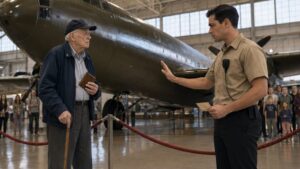
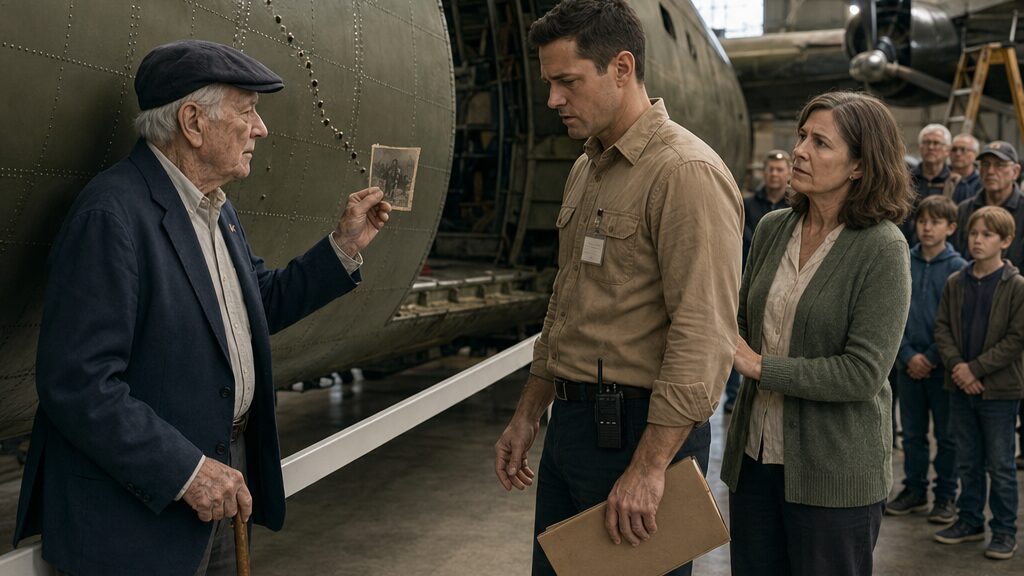
Charles stood with one brown shoe beyond the white barrier tape and the other planted behind it. His wooden cane rested against his thigh. Above him, the olive-drab C-47 rose on black tires and shadow, its dull metal skin broken by inspection panels, faded stenciling, and thousands of rivets catching the overhead lights.
Only one line mattered.
It ran unevenly below the rear cargo opening—nine rivets set too close, then three spaced farther apart, then another cluster that curved downward by half an inch.
Charles had known that crooked line before the paint was dry.
“Dad,” Kathleen said from behind him, breathless from crossing the gallery. “You can’t just walk through there.”
“I didn’t walk through.” Charles kept his eyes on the fuselage. “I stepped.”
Paul reached them with a folder tucked beneath one arm and his radio held near his mouth. He was young enough to move as though every delay were a personal failure. His tan museum shirt was sharply pressed, his identification badge perfectly level.
“Ma’am, I need you to bring him back behind the line.”
Charles turned his head.
“You can tell me.”
Paul looked at him, then immediately back to Kathleen. “The aircraft is in final preparation. We have preservation materials on the surface, exposed equipment, and a closed preview in less than two hours.”
“I heard you,” Charles said.
A school group had stopped near the gallery entrance. Two chaperones watched without speaking. Across the hangar, a restoration worker paused beside a rolling ladder.
Kathleen slipped a hand beneath Charles’s elbow. “Come on. We can look from here.”
He moved his arm away, not sharply, but enough.
The line of rivets sat less than four feet from him.
“I only need a minute.”
Paul’s expression tightened. “Sir, touching the aircraft is not permitted.”
Charles looked at the white line on the floor. Then at the barrier post. Then back at the metal.
“Wasn’t asking to climb aboard.”
“That isn’t the issue.”
Paul lifted the radio again.
Charles had spent most of his life around men who spoke louder when they were uncertain. The habit had never impressed him. He set the cane firmly, reached inside his navy jacket, and drew out a worn brown wallet.
Paul lowered his radio halfway. “There’s no additional ticket required for this gallery.”
Kathleen closed her eyes for a moment.
Charles worked a thumb beneath the wallet flap. The leather had softened over the years, except at one corner where it had cracked almost white. A faded photograph sat in the inner sleeve.
“I’m not paying you.”
“Dad,” Kathleen murmured.
The photograph caught against the seam. Charles pulled harder. It slid free too quickly and dropped between him and Paul, landing faceup on the polished floor.
Paul bent first.
“Please don’t—” Charles began.
But Paul had already picked it up by one edge.
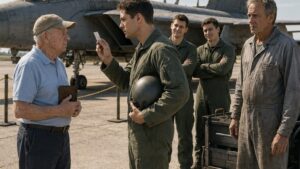
The picture showed six young men standing beneath the left side of a C-47. Their uniforms were creased, their sleeves rolled, their faces narrowed by sun. One man held a rag. Another rested both hands on a toolbox. Beneath them, written in fading blue ink, were names and duties.
The upper-right corner had been folded inward so many times that the paper fibers had split. Part of one man’s face disappeared beneath the fold.
Paul glanced at the image, then at Charles.
Charles extended his hand. “Give it back.”
Paul started to obey. Then his gaze stopped on the aircraft in the photograph.
Behind the six men, below the cargo door, ran a crooked line of rivets.
Paul looked over his shoulder at the restored plane.
The same line curved beneath the present fuselage.
He turned the photograph over. Grease-pencil marks, nearly rubbed away, crossed the back beside a date and a short maintenance notation. Paul brought the image closer, no longer holding it casually.
“Where did you get this?”
Charles’s hand remained out.
“You can read the bottom.”
Paul turned it again. His eyes moved from one handwritten label to the next until they reached the man standing second from the left.
C. WALKER—CREW CHIEF.
The younger Charles had been lean, dark-haired, and unsmiling. He held a wrench across one palm.
Paul looked at Charles’s face, then back at the photograph.
The radio in his hand hissed.
“Carter, confirm status.”
Paul pressed the button but did not look away. “Stand by.”
For the first time, he addressed Charles without raising his voice.
“Mr. Walker, did you serve with this aircraft?”
Charles’s fingers closed slowly.
“I kept her flying.”
The school group had gone quiet. Kathleen stared at the photograph as if it belonged to someone else’s family.
Paul returned it with both hands.
“I’m sorry. I shouldn’t have picked it up without asking.”
Charles slid it into his palm but did not put it away.
Paul stepped toward the barrier post. “The surface is still restricted. But if you stay with me, and if you touch only where I indicate—”
“I know where not to put my hand.”
Paul absorbed the correction. Then he unhooked the white strap and held it aside.
“Of course.”
Charles crossed without Kathleen’s help.
His cane made a small dry tap with every step. The aircraft seemed larger from beneath the wing, but not unfamiliar. He could see where restoration paint had filled shallow scratches, where new fasteners sat too bright against older metal, where someone had reproduced a warning stencil with letters a fraction too tall.
Paul followed at a respectful distance.
Charles stopped below the crooked line.
His hand trembled before he lifted it. Age had put that tremor there, but the metal steadied him. His fingertips settled over the first uneven rivet, then moved along the line one by one.
The aluminum was cool.
For an instant he smelled hydraulic fluid, damp canvas, and hot wiring. He heard boots slipping on a cargo floor tilted beneath them. Someone was shouting over an engine that would not hold a clean pitch.
His thumb stopped over the wider gap between the ninth and tenth rivet.
“Donald,” he said.
The name barely carried beyond the fuselage.
Paul heard it.
“So this was repaired while you had it?”
Charles removed his hand. “Not the way your people think.”
Footsteps struck the floor behind them with the sharpness of authority.
A woman in a dark suit approached from the gallery entrance, accompanied by a security officer and the restoration supervisor. She did not hurry, but everyone else seemed to become more careful as she drew near.
“Paul,” she said, looking at the opened barrier. “Why is a visitor inside the work zone?”
Paul straightened. “Cynthia, this is Charles Walker. He was crew chief on the aircraft.”
Cynthia Hall’s gaze shifted to Charles, then to the photograph in his hand.
“I see.”
The words contained neither disbelief nor welcome.
Paul gestured toward the rivets. “His photograph shows this repair before the date in our restoration file.”
Cynthia held out her hand. “May I?”
Charles did not move.
After a moment, she lowered her hand.
Paul said, “There’s another name connected to it. Donald Lewis.”
Something in Charles’s jaw tightened.
Cynthia turned to the restoration supervisor. “Do we have the service roster available?”
“Digitized copy in the office.”
“Bring it up.”
The supervisor crossed to a nearby computer terminal. Cynthia remained beside the barrier while names and dates appeared on the monitor.
Charles watched her read.
She scrolled once. Then again.
When she looked back at him, her voice was measured.
“Mr. Walker, your name and unit are in the aircraft’s records.”
Paul released a quiet breath.
Cynthia continued.
“But there is no Donald Lewis on the crew list.”
Chapter 2: The Name Missing from the Aircraft
“Your service number,” Cynthia said, “would help us establish which records apply.”
She had not yet asked Charles what he remembered.
Paul noticed that before Charles answered. They were in the small glass-walled office at the edge of the hangar, where the C-47 remained visible through blinds that never quite closed. A clock above the filing cabinets showed seventy-three minutes until the donor preview.
Charles sat with his cane between his knees. Kathleen occupied the chair beside him, holding her purse with both hands. Cynthia stood at the computer. Paul remained near the door with his clipboard.
Charles recited the number without hesitation.
Cynthia entered it.
The archive returned his name, rank, unit, and service dates. A scanned assignment sheet placed him with the transport group associated with the aircraft. Paul felt a small satisfaction, then disliked himself for needing the confirmation.
Cynthia read silently.
“Your assignment is documented,” she said. “That still doesn’t establish that this specific repair occurred when you say it did.”
Charles looked through the glass at the fuselage.
“I haven’t said when it occurred.”
Cynthia paused.
Paul glanced down at his notes. “You said our people thought about it wrong.”
“I said it wasn’t repaired the way they think.”
“Then tell us how.”
Charles’s fingers rested on the handle of his cane. “What do your records say?”
Cynthia opened another file. “A reinforcement was installed during scheduled depot maintenance eleven months after the aircraft left your unit. The work order describes stress damage near the aft cargo section.”
“Scheduled depot maintenance,” Charles repeated.
“That is the surviving documentation.”
“What compound did they find under the inner plate?”
The question seemed to irritate Cynthia, perhaps because she could not answer immediately.
Paul could.
“During restoration?”
Charles nodded.
“A dark sealant. Brittle. The lab identified traces of zinc chromate and rubber filler.”
“No.” Charles shook his head. “Not rubber.”
Paul opened his folder and found the materials report. “That’s what the preliminary analysis says.”
“Warm it, and it smells like burnt cloves.”
Cynthia glanced at Paul.
Charles went on. “It was electrical bedding compound. We had no proper structural sealant left. It stayed soft long enough to seat the patch, then hardened badly in cold air.”
Paul had read every restoration note connected to the aft section. None mentioned cloves. None identified the substance with confidence.
“What was beneath the exterior skin?” he asked.
Charles’s gaze moved to him.
“An oblong plate, cut from a cargo-track cover. Two corners rounded, two left square. Three bolts along the upper edge. One hole abandoned because the drill walked.”
Paul’s pencil stopped.
The restoration supervisor had shown him that plate three weeks earlier. It had been hidden beneath later reinforcement, undocumented and strange enough that they had photographed it before sealing the inspection opening.
Cynthia folded her arms. “That information could have circulated among restoration volunteers.”
“I met your volunteers this morning.”
Paul turned a clean page on his clipboard and sketched the aft fuselage. He marked the rivet line as he remembered it: nine close, a gap, then the downward curve.
Charles watched.
“You’ve got the middle wrong,” he said.
Paul held out the clipboard.
Charles did not take it. His right hand had begun to tremble again. Instead, he pointed.
“Not there. Move the abandoned hole below the plate. Half an inch left.”
Paul corrected the sketch.
“And the top bolt?”
“Offset from the others. We couldn’t get a wrench behind the frame.”
Paul drew the bolt.
Charles tapped the paper once. “That’s closer.”
The small payoff of being right did not soften him. If anything, his face seemed more closed.
Cynthia checked the clock. “I’m willing to authorize a limited review. Twenty minutes. We cannot delay the preview.”
“Twenty minutes for what?” Kathleen asked. “To decide whether my father knows his own airplane?”
Charles gave her a look.
Cynthia’s expression remained even. “To determine what we can responsibly say. Museums cannot replace records with certainty simply because a memory is detailed.”
“It isn’t his airplane,” Kathleen said, quieter now.
“No,” Charles replied. “It isn’t.”
Paul heard something beneath the words—not surrender, but correction.
They returned to the aircraft with the restoration supervisor. A portable work light was rolled beneath the aft section. Paul unlocked a narrow inspection panel that had not yet been sealed for the preview.
Cynthia crouched as far as her suit allowed. Paul directed the light inside.
The reinforcement plate appeared behind wiring and frame members, dull and irregular.
“Upper edge,” Charles said.
Paul angled the beam.
Three bolts emerged from shadow. The third sat higher than the rest.
“Lower left,” Charles said.
Paul shifted again.
Below the plate was an empty drilled hole.
No one spoke for several seconds.
Cynthia stood slowly.
The restoration supervisor rubbed a thumb over his chin. “That plate wasn’t installed at depot level. Not like that.”
“Could it have been a temporary field repair?” Paul asked.
“It could have been many things.”
Charles’s mouth bent without humor. “That means yes when a mechanic says it.”
The supervisor did not object.
Paul looked at Cynthia. He expected concession. Instead, her caution deepened.
“Specific knowledge establishes that Mr. Walker encountered this repair,” she said. “It does not establish the circumstances or the identity of anyone involved.”
Charles turned from the open panel.
“Close it before somebody catches a sleeve.”
The supervisor complied automatically.
In the archive office, Paul located the aircraft’s maintenance history. The record confirmed Charles’s unit and listed a later depot repair. No emergency field work appeared. No Donald Lewis appeared in the personnel attachments. The only death associated with the aircraft occurred years afterward during an unrelated training accident.
Paul printed the relevant pages.
When he returned, Charles was standing in the public gallery before the temporary exhibit panel prepared for the preview. Kathleen hovered behind him, uncertain whether to offer her arm.
The panel showed a clean profile image of the restored C-47 and a timeline beneath it.
Paul saw Charles’s eyes move down the text.
TRANSPORT AND EVACUATION SERVICE.
DEPOT REPAIR COMPLETED AFTER ROUTINE STRUCTURAL FATIGUE.
NO CREW LOSSES DURING OPERATIONAL ASSIGNMENT.
Charles read the final line twice.
Paul stopped beside him.
“The official file may be incomplete,” he said.
“Files are usually complete enough for the people who close them.”
“We can look further.”
Charles raised one finger toward the caption without touching it.
“Who wrote this?”
Chapter 3: A Courtesy That Changed Nothing
Cynthia slid the brass-colored plaque across the conference table with Charles’s name centered in black type.
CHARLES WALKER
CREW CHIEF
WITH GRATITUDE FOR HIS SERVICE
It was not yet engraved. The lettering had been printed and mounted behind a clear sample cover, but the intention was polished enough.
Charles did not pick it up.
Cynthia sat opposite him. The blinds behind her cut the hangar into narrow horizontal strips: wing, fuselage, floor, shadow.
“We can have the permanent version ready within two weeks,” she said. “It would be installed near the aircraft’s technical display.”
“Near which part?”
“The primary interpretation panel.”
“The one that says nobody was lost?”
Cynthia placed both hands on the table. “That language is based on the documentation currently available.”
Paul stood near the wall, his folder against his chest. Kathleen sat beside Charles, closer than before.
Cynthia continued. “I’m also prepared to arrange a private escorted visit after the preview. No guests, no restoration activity. You would have as much time as you need.”
Charles looked at the sample plaque again.
“My name’s already on something.”
Paul glanced at the photograph lying on the table between them.
The folded corner still covered part of Donald Lewis’s face.
Cynthia said, “This acknowledgment would give visitors important context.”
“What context?”
“That someone who maintained this aircraft is still able to speak about it.”
“You don’t want me to speak about it.”
“That is not what I said.”
“You want me to speak about bolts and sealant.”
Cynthia’s jaw shifted. “Those details can be supported by the physical evidence.”
“And Donald can’t.”
“We have not found him in the aircraft records.”
Charles leaned back. The chair creaked beneath him.
Cynthia’s voice softened, though not enough to surrender control. “Mr. Walker, I understand why this is personal.”
“No, you understand that it is personal. That isn’t the same thing.”
Kathleen reached for the photograph.
Charles put two fingers over it.
She stopped.
“What?” he asked.
“I’ve never seen it.”
“You’ve seen pictures.”
“Not this one.”
He could have put it back in the wallet. Instead he removed his hand.
Kathleen lifted the photograph carefully. Her eyes moved across the young faces. She found Charles second from the left and gave a brief, startled smile.
“You look like Grandpa.”
Charles said nothing.
She traced the names below the image without touching the surface. When she reached the folded corner, she eased it open.
The damaged paper resisted, then flattened.
A broad-faced young man appeared beside Charles, one sleeve rolled higher than the other. He stood with a hand on Charles’s shoulder and an expression too amused for the seriousness of the others.
DONALD LEWIS—LOADMASTER.
Kathleen looked at her father.
“You never mentioned him.”
Charles stared at the table.
“Was he your friend?”
Paul shifted his weight. Cynthia glanced toward the clock but did not interrupt.
Kathleen turned the picture over. “There’s writing back here.”
Charles reached for it.
She drew it closer, not to keep it from him, but to read.
“Dad, who wrote this?”
“Men wrote on things.”
“It says ‘Lewis inside aft bay.’”
Paul’s attention sharpened.
Charles took the photograph from her and folded the corner back over Donald’s face.
“That’s enough.”
Kathleen’s expression changed. Not wounded exactly. More like a door she had assumed was locked had opened just far enough for her to see that someone stood behind it.
“You brought me here,” she said. “You asked me to drive three hours because you said you wanted to see an airplane.”
“I did want to see it.”
“You wanted to touch one exact place. You had a picture of the crew. You knew there was a missing repair. And now there’s a man nobody has heard of.”
Charles slid the photograph toward his wallet.
Kathleen put her hand over the wallet first.
“Why didn’t Mom know?”
His eyes lifted.
“She knew what she needed to.”
The words came out colder than he intended. Kathleen withdrew her hand.
Cynthia looked down at the plaque. “Perhaps we should pause.”
“No,” Kathleen said. “Apparently pausing is how this family handles everything.”
Charles stood, using both hands on the cane. His knee resisted before straightening.
Paul moved forward. “Mr. Walker—”
“I don’t want the plaque.”
Cynthia rose as well. “You do not have to decide today.”
“I decided before you printed it.”
“It was meant as a courtesy.”
Charles tucked the wallet into his jacket. “Courtesy that leaves the wrong words on the wall is decoration.”
For the first time, Cynthia’s composure cracked.
“You are asking us to alter a historical claim based on a photograph, technical familiarity, and a name that does not appear in the record.”
“I did not ask you to claim anything.”
“You challenged the caption.”
“I asked who wrote it.”
“And if we remove it without evidence, we replace one unsupported certainty with another.”
Charles leaned on the cane, breathing harder than he wanted them to notice.
Cynthia saw it. Her voice lowered.
“This museum has responsibilities beyond making one visitor feel heard.”
Paul flinched before Charles did.
Kathleen rose. “He isn’t asking to feel heard.”
Charles turned toward the door.
“Dad.”
He kept moving.
Kathleen followed him into the public gallery, where visitors had begun gathering near the preview ropes. The temporary exhibit panel gleamed beneath its lights. The C-47 stood behind it, perfect from a distance.
Charles’s foot caught the edge of a floor mat.
His cane struck sideways. Paul reached him before he fell, catching his forearm.
The wallet slipped from Charles’s jacket.
It hit the floor and sprang open.
The photograph skated across the polished surface, unfolding as it went. Paul bent, but this time stopped before touching it.
Kathleen picked it up.
A date had been written along the lower edge of the reverse side, hidden until the photograph flattened completely.
She read it aloud.
Paul opened the maintenance file in his folder and checked the depot entry.
Cynthia had followed them from the conference room. “What is it?”
Paul looked from the date on the photograph to the date in the official record.
“The repair in this image,” he said, “predates the documented depot work by eleven months.”
Charles closed his eyes.
On the back of the photograph, beneath the earlier date, a faded grease-pencil arrow pointed directly toward the crooked line of rivets.
Chapter 4: The Page He Never Gave Them
Kathleen heard paper tear before she reached the kitchen doorway.
Her father sat at the table beneath the yellow light, his jacket draped over the chair beside him. The brown wallet lay open near his left hand. In his right, he held a narrow strip of folded paper and a pair of blunt kitchen scissors.
“What are you doing?”
Charles closed the scissors.
The sound was small, but final.
Kathleen crossed the room. “Give me that.”
“No.”
“You brought that paper all the way to the museum, and now you’re cutting it apart?”
“I’m trimming a bad edge.”
“You don’t trim records at midnight.”
“It isn’t midnight.”
The clock above the stove read 8:17.
She stopped across from him. During the drive home, he had answered every question with one of three phrases: It was a long time ago. The museum has its records. Leave it alone.
Now the photograph was gone from the wallet’s clear sleeve. Its folded corner rested open on the table, Donald Lewis’s face exposed beneath the kitchen light.
The narrow paper in Charles’s hand was older than the photograph. Its creases had gone dark with oil, and one edge carried a fresh white tear.
Kathleen reached for it.
Charles drew it against his chest.
The movement was too quick for a man who had needed both hands to rise from the museum chair.
“Dad.”
“It’s mine.”
“So was the picture, until it fell in front of half the gallery.”
“That doesn’t make it public property.”
“I didn’t say it did.”
“You’re looking at it like it belongs to them.”
She stared at him. “I’m looking at it like it belongs to whatever happened.”
His eyes hardened.
Kathleen pulled out the chair opposite him and sat. “You told me Mom knew what she needed to know.”
“She did.”
“What did she know?”
“That I served. That I worked aircraft. That some men didn’t come back.”
“Did she know about Donald?”
Charles folded the paper once more. The crease landed exactly where it had been folded before, practiced by years.
Kathleen saw three words before they disappeared.
TEMPORARY LOAD-BEARING REPAIR.
Below them, in faded pencil:
AUTHORIZATION C.W.
Her breath caught.
“You signed it.”
Charles slid the paper into the hidden compartment of the wallet.
She put her palm over the wallet before he could close it.
“Move your hand.”
“Was that repair made during the flight?”
His gaze shifted toward the dark window above the sink.
“That’s why the date is earlier, isn’t it?”
“Move your hand, Kathleen.”
“Did Donald make it?”
The chair legs scraped as Charles stood. Pain crossed his face before he masked it.
“You’ve decided you understand something because you read six words.”
“I understand that you let Cynthia Hall call your memory unreliable while the proof was in your pocket.”
“That page proves I wrote on a page.”
“It proves the repair wasn’t routine depot work.”
“It proves an old mechanic knew how to make a note look official.”
She removed her hand as if the wallet had become hot.
“You think they’ll accuse you of forging it?”
“I think museums know paper better than men. That’s what they’re built for.”
Kathleen rose too. “Then why carry it?”
Charles took his cane from the wall.
For a moment she thought he would walk out of his own kitchen rather than answer. Instead, he stood with his back to her, one hand gripping the cane, the other resting on the wallet.
“Because throwing it away would have been another decision,” he said.
“What happened on that plane?”
He said nothing.
“Was Donald hurt during the repair?”
Charles’s shoulders lifted with a careful breath.
“The repair happened during an evacuation flight.”
It was the first clear answer he had given her.
Kathleen waited.
He continued without turning. “We had damaged structure aft of the cargo door. The skin was opening under load. We used what we had.”
“And Donald?”
“He was loadmaster.”
“That isn’t an answer.”
“It’s the one you’re getting.”
Kathleen’s anger arrived cleanly now, without confusion.
“You asked me to drive you there. You crossed a barrier. You made a stranger look at a picture you never showed your own family. Then the second someone asks what it means, you decide silence is honorable.”
Charles turned.
“Do not tell me what honor is.”
“I’m telling you what this is doing.”
“To whom?”
“To you. To me. To a dead man whose face you folded out of sight.”
His hand tightened around the cane.
Kathleen regretted the last sentence before it finished leaving her mouth, but she did not take it back.
Charles opened the wallet, removed the photograph, and folded the damaged corner over Donald again.
“There,” he said. “Problem solved.”
“No. Hidden.”
“You want to take that page to the museum because you think truth is a thing you can place on a table and make everybody behave.”
“I want them to stop treating you like a confused visitor.”
“That is not worth what’s on that page.”
“What is?”
His face changed—not softened, not weakened. It emptied.
“My guilt is not an exhibit.”
The words silenced the room.
Kathleen looked at the wallet. “Then it was your decision.”
Charles tucked it into his shirt pocket.
“I authorized the repair.”
“And Donald paid for it?”
He picked up his jacket.
She stepped between him and the hall. “You’re tired. Sit down.”
“Don’t speak to me the way that employee did.”
The accusation struck because it was true. She had begun arranging him—chair, water, rest, departure—as if care gave her the right to decide what he could bear.
Kathleen moved aside.
Charles walked past her slowly, his cane tapping against the floorboards. At the hallway entrance he stopped without looking back.
“You wanted to know why I didn’t tell you.”
“Yes.”
“Because once people know half a thing, they start finishing it for you.”
His bedroom door closed.
The next morning, Kathleen drove him toward the museum in silence. The wallet sat inside his jacket. She knew because he checked the pocket each time the car turned.
They were fifteen minutes from the highway exit when her phone rang through the dashboard.
Paul Carter’s name appeared on the screen.
Charles looked out the passenger window. “Don’t answer while driving.”
She pressed the steering-wheel button.
“Paul?”
His voice filled the car. “Kathleen, I’m sorry to call this early. Is Mr. Walker with you?”
“He is.”
There was a pause.
“I need you both to know that Cynthia removed his handwritten account from the preview review packet.”
“What handwritten account?” Kathleen asked.
“The notes I made from what he told us yesterday. She says they weren’t a formal interview.”
Charles’s hand closed over his jacket pocket.
Paul continued. “She also placed a contact restriction on his visitor file. Security has been instructed not to admit him to restoration areas without director approval.”
Kathleen looked at her father.
Charles kept his eyes on the road ahead.
Paul lowered his voice. “I argued against it.”
“Did that help?” Charles asked.
Paul heard him. “No, sir.”
The highway sign for the museum exit appeared ahead.
Kathleen moved into the right lane.
Charles took the wallet from his pocket and pressed his thumb against the hidden compartment containing the page he feared more than being turned away.
Chapter 5: Proof That Was Not Enough
The restoration supervisor had called the crooked rivet line a mistake.
Paul found the mistake preserved in three layers of metal.
Before the museum opened, he stood on a low maintenance platform beneath the C-47’s aft fuselage while the supervisor held a work light inside the open inspection panel. The newer reinforcement plate covered most of the area, but beneath its edge were old holes—some filled, some abandoned, all misaligned with the official depot diagram.
“We followed the original pattern where we could,” the supervisor said. “Thought the wartime crew had drilled badly during some undocumented patch.”
“Not wartime,” Paul said. “Later.”
“Maybe.”
Paul placed a transparent copy of Charles’s photograph over the restoration diagram. The uneven rivets in the image aligned with the holes beneath the plate. The depot pattern did not.
The supervisor studied the overlay.
“So the old man knew about an earlier repair.”
“He didn’t just know about it. He told us the plate shape, the offset bolt, and the abandoned hole.”
“That establishes access.”
“It establishes more than access.”
“It does not establish a dead loadmaster.”
The words were not cruel. They were the words Cynthia would use, and they were accurate enough to be dangerous.
Paul climbed down.
On his desk waited the internal note Cynthia had circulated after closing.
VISITOR CHARLES WALKER—EMOTIONALLY INVESTED CLAIM REGARDING UNVERIFIED CREW LOSS. NO FURTHER ARTIFACT ACCESS WITHOUT DIRECTOR AUTHORIZATION.
Paul read the phrase again.
Emotionally invested visitor.
The previous morning, he had called Charles an elderly visitor over the radio without asking his name. Cynthia had given the error cleaner language.
He opened the loading-record database.
The aircraft’s files had been digitized from reels of microfilm, repair ledgers, transport manifests, and unit summaries. The search function returned names only when handwriting had been indexed correctly. Donald Lewis produced nothing.
Paul searched Lewis. Then D. Lewis. Then loadmaster. Then the date written on the photograph.
A transport manifest appeared, blurred at one edge. It listed medical supplies, field equipment, and twenty-three evacuees. The crew section had five typed names and one handwritten addition too faint to read.
Paul enlarged it.
The letters broke into gray squares.
He printed the page and carried it to the archive room.
The museum archivist adjusted a magnifying lamp over the original scan. “This is all we have. Source reel was damaged.”
“What about associated weight sheets?”
“Different series.”
“Can you find them?”
“Not before the preview.”
“The preview is tomorrow.”
“Exactly.”
Paul searched the cabinets himself. Forty minutes later, dust streaked his sleeves and his radio had sounded six times. Each call concerned ropes, lighting, catering access, or the revised sequence for donors entering the gallery.
Nothing concerned Donald Lewis.
At last he found a thin folder labeled WEIGHT AND BALANCE—SUPPLEMENTAL.
Inside were carbon copies with purple type and handwritten corrections. The date matched the photograph.
The first page listed the departure load.
The second showed an unexplained reduction in cargo weight during flight.
Four hundred and eighty pounds removed from the aft section.
Beside the correction, in pencil, were initials.
D.L.
Paul carried the page to the window for better light.
Below the initials, another note read: load shifted forward after structural warning.
He felt the shape of the story change. Donald had been aboard. Something had happened aft. The aircraft had landed early at a base not listed in the exhibit timeline.
It was still not proof of death.
But it was no longer only Charles’s memory.
Paul photographed the sheet and hurried back toward the restoration floor. Cynthia intercepted him outside the archive.
She wore no jacket today. Her sleeves were rolled, and a list of donor names was clipped beneath one arm.
“Why is the aft inspection panel open?”
“We needed to compare original holes with the depot diagram.”
“We?”
“The restoration supervisor and me.”
“Under whose authorization?”
Paul held out the photograph overlay and the weight sheet.
“Look at this first.”
Cynthia did not take them. “Paul.”
“The rivet pattern predates the depot work. The original holes match Mr. Walker’s photograph. And Donald Lewis’s initials appear on a weight adjustment from the same date.”
“Initials are not identification.”
“The sheet says cargo was moved after a structural warning.”
“It does not say who moved it.”
“It places someone with those initials aboard.”
“It may.”
“He was right about the repair.”
“He was right that a repair existed.”
Paul lowered the papers. “You described him as an emotionally invested visitor.”
“He is emotionally invested.”
“He was crew chief.”
“Those facts are not mutually exclusive.”
Her voice stayed level, but fatigue had sharpened it. Paul saw the donor list, the unanswered messages on her phone, the exhibit deadlines marked in red. He also saw that she had made a choice before the search was finished.
Cynthia stepped closer.
“Several years ago, this museum accepted a veteran’s account of an aircraft incident. We printed it. We honored him publicly. Six months later, records from another archive showed he had confused two assignments. His family was humiliated, the museum was accused of manufacturing history, and the board spent a year rebuilding trust.”
“This isn’t that.”
“You do not know that.”
“I know enough to keep looking.”
“And I know enough to require procedure.”
She took the weight sheet by its edge and examined it.
“This belongs in the file, not in tomorrow’s exhibit.”
“I didn’t say it should go in the exhibit tomorrow.”
“You have questioned restoration staff, used restricted archive material, and opened an inspection panel after I suspended the claim.”
“You restricted Charles, not the evidence.”
Cynthia’s eyes lifted from the page.
“That distinction will not protect you if you present speculation as fact.”
“Is that a threat?”
“It is an instruction. If you exceed it again, I will suspend you from collections work pending review.”
Paul’s radio crackled at his belt.
“Carter, donor panels arrived at receiving.”
He did not answer immediately.
Cynthia returned the weight sheet. “Do your job.”
She walked toward the gallery.
Paul stood beside the aircraft with the papers in his hands. The rivets above him no longer looked like a restoration defect. They looked like a sentence interrupted before its meaning was complete.
His phone vibrated.
A voicemail notification appeared from an unknown number.
He recognized Charles’s voice before the first full word.
“Mr. Carter. This is Charles Walker.”
There was a long pause in the recording. In the background, Paul heard a car engine and the faint click of a turn signal.
“You found enough to know I wasn’t lying,” Charles said. “You won’t find enough to know why.”
Another pause.
Then Charles’s voice became quieter.
“I signed the order. Donald paid for it.”
The message ended.
Paul stared up at the crooked line of rivets.
Chapter 6: What Silence Had Protected
Charles laid the missing page on Cynthia’s folder but kept two fingers over the final line.
“No interruptions,” he said. “No plaque. No promises about what you’ll put on a wall.”
The hangar had closed an hour earlier. Most of the overhead lights were off, leaving the C-47 illuminated from below by work lamps. Its shadow stretched across the polished floor toward the four folding chairs arranged beneath the left wing.
Cynthia sat opposite Charles. Paul stood until Charles looked at the empty chair beside her, then sat. Kathleen remained near her father but did not touch him.
Cynthia glanced at the page.
“May I read it?”
“When I’m finished.”
She nodded.
The radio on Paul’s belt gave a soft burst of static. He switched it off.
Charles looked toward the repair line. From this angle the rivets were difficult to see, but he knew every one of them.
“We were carrying wounded personnel out of a forward strip,” he began. “Weather had closed the safer route. We took the southern corridor because two of the men aboard wouldn’t survive another night without surgery.”
His voice was steady. His right hand was not. The fingers covering the final line trembled against the paper.
“Halfway through the climb, we took damage aft. Not enough to bring us down. Enough to start opening the skin around the cargo section.”
Paul leaned forward but said nothing.
“The pilot wanted to divert immediately. Closest field was behind us, but the approach crossed the same weather we’d just cleared. The other option was a maintenance base ahead. Longer flight. Better runway. Medical team waiting.”
Kathleen watched Charles’s profile.
“What was the order?” Cynthia asked, then caught herself. “I’m sorry.”
Charles did not punish her for it.
“My order was to keep going and reinforce the aft section in flight.”
He lifted his fingers from the page, except for the last one.
The visible lines were written in compressed block letters.
TEMPORARY LOAD-BEARING REPAIR. CARGO TRACK COVER USED AS INNER PLATE. ELECTRICAL BEDDING COMPOUND APPLIED. AUTHORIZATION C.W.
“The repair wasn’t in any manual,” Charles said. “It was what we could make from what was on the aircraft. We needed someone inside the aft bay to brace the plate while we drilled from the accessible side.”
Paul’s gaze moved to the crooked rivets.
“Donald volunteered,” Charles said.
The name altered the space beneath the wing.
“He was loadmaster. He knew the cargo frame better than anyone aboard. I told him no. He said I was wasting time because he was already halfway in.”
Charles’s mouth tightened briefly.
“He had a way of making disobedience sound practical.”
Kathleen looked down at her hands.
“The aircraft was moving badly. Every change in pitch shifted the load. Donald crawled behind the cargo lining with a wrench, a lamp, and a section of plate we’d cut from the track cover. We drilled. He held it. Some holes lined up. Some didn’t.”
“The abandoned hole,” Paul said softly.
Charles nodded.
“The drill walked when the aircraft dropped. Nearly caught his hand.”
He looked at the fuselage, but what he saw was not the restored surface.
“Then another structural failure threw him against the frame.”
Kathleen inhaled.
Charles went on before anyone could speak.
“He said he was all right. He finished bracing the plate. We moved cargo forward. That’s the weight adjustment you found. The skin stopped opening.”
“And the wounded men?” Cynthia asked.
“Reached the medical base alive.”
The answer carried no pride.
“What happened to Donald?” Kathleen said.
Charles’s finger remained over the last line.
“He walked off the aircraft.”
The others waited.
“Made three jokes on the way to the infirmary. Complained that the medics cut his sleeve. He died before morning. Internal injuries.”
Kathleen closed her eyes.
Paul looked toward the floor.
Cynthia’s posture had changed. Her shoulders were no longer squared against a claim. She sat still, hands open on her knees.
Charles moved his final finger.
The last line appeared.
LEWIS IN AFT BAY. IMPACT INJURY. REPAIR HELD.
Below it were Charles’s initials.
“You wrote that afterward?” Paul asked.
“Before the aircraft was turned over.”
“Why isn’t it in the official maintenance record?”
Charles folded his hands over the page.
“The report became a problem.”
Because the repair had been unauthorized, he explained, the continuation of the flight invited investigation. The pilot had followed Charles’s recommendation. The aircraft had carried wounded personnel beyond prescribed structural limits. Donald had entered a dangerous section while the plane was unstable.
“They wanted a clean account,” Charles said. “Damage discovered. Diversion completed. Routine repair performed later.”
“Who wanted that?” Cynthia asked.
“More than one man. Fewer than I blamed.”
Paul studied him. “Did they order you to remove Donald?”
Charles’s silence lasted too long.
Kathleen turned toward him.
“No,” Charles said. “Not exactly.”
He pressed the edge of the page flat.
“I asked that the emergency repair details stay out of the final maintenance summary.”
Paul’s face changed.
“Why?”
“Because the investigation would have centered on my authorization. On procedure. On whether continuing the flight had been justified.”
“That doesn’t explain Donald’s omission,” Kathleen said.
“It does.”
“No. It explains why you were afraid.”
Charles looked at her.
The accusation did not make him angry this time.
“I was afraid,” he said.
The admission seemed to cost more than the rest.
“If the full account had gone forward, Donald’s family would have heard that he died following an unauthorized order signed by me. I could not stand in front of them and explain that the wounded lived because I chose to keep flying and Donald died because he helped me do it.”
“Did Donald follow your order?” Cynthia asked.
Charles looked at the photograph beside the log page.
“No.”
Kathleen frowned.
“I ordered him not to enter the bay until we had another brace ready. He went anyway. He saw the skin separating and decided waiting was worse.”
“So he chose it,” Paul said.
“He chose to help. I chose the conditions that made help necessary.”
Charles’s voice roughened for the first time.
“I told myself silence protected him from becoming evidence in my defense. Then I told myself it protected his family. After enough years, I stopped checking which part was true.”
Kathleen reached toward him, then stopped before touching his sleeve.
“You didn’t keep this from me because you didn’t trust me.”
“No.”
“You kept it because saying it aloud made it yours again.”
Charles looked at her.
“Yes.”
The word rested between them without repair.
Cynthia finally lifted the log page after Charles gave a slight nod. She examined the paper, the initials, the grease stains, the torn edge.
“This matters,” she said. “But I need to be honest about what it can establish. It is a personal record kept outside the official archive. The physical evidence and weight sheet support parts of your account. They do not independently verify every detail.”
Charles’s expression closed a fraction.
Paul said, “We can call it oral history.”
“We can,” Cynthia replied. “But the wording must distinguish documented fact from recollection.”
“Recollection,” Charles repeated.
Cynthia did not retreat. “I am not calling you unreliable. I am saying the museum cannot present every part as independently proven.”
“What would you write?”
She looked down at the page.
“Charles Walker, former crew chief, provided an unverified recollection of an in-flight emergency repair involving loadmaster Donald Lewis.”
The aircraft seemed to loom above them.
Charles took the page back.
“No.”
Cynthia’s eyes lifted. “Mr. Walker—”
“You will not turn him into a story that may have happened because I finally admitted I was afraid.”
“We cannot claim certainty we do not possess.”
“Then don’t.”
Charles slid the page into the wallet beside the photograph.
“But I will not allow Donald to be displayed as either a myth or a footnote.”
Chapter 7: The Exhibit They Could Defend
The first preview guests entered the lobby while the aircraft caption still said no one had been lost.
Through the glass doors, Charles could see dark coats, polished shoes, and museum badges moving beneath the suspended fighters. A donor representative greeted each arrival beside a table of coffee and printed programs.
Inside the closed gallery, Cynthia stood before the C-47’s temporary panel with a screwdriver in one hand.
“We have twenty-three minutes,” she said.
Paul checked his radio. “Less. They’re already asking why the hangar doors are shut.”
The sentence NO CREW LOSSES DURING OPERATIONAL ASSIGNMENT remained fixed beneath the aircraft timeline.
Charles sat in a folding chair near the recording room. The brown wallet rested on his knee. Kathleen stood behind him, close enough to help but no longer reaching before he asked.
On the table beside Cynthia lay three things: the loading sheet bearing Donald’s initials, the enlarged photograph of the crooked rivets, and the transcript of Charles’s recorded statement.
The transcript was seventeen pages long.
Cynthia had listened to every word.
She crossed to Charles and placed a draft caption in front of him.
“Read this carefully.”
The paper trembled slightly in his hand.
During an operational evacuation flight, this aircraft sustained structural damage near the aft cargo section. Physical evidence confirms an improvised repair predating the later depot work. Former crew chief Charles Walker recalled that loadmaster Donald Lewis entered the damaged section and assisted with the repair. Surviving records do not fully document the event.
Charles reached the final sentence.
“Assisted,” he said.
Cynthia waited.
“He held the inner plate while the aircraft was moving. He shifted the cargo. He kept the skin from opening farther.”
“We cannot independently confirm each action.”
“Then say I testified to it.”
“That is what ‘recalled’ means.”
“No. Recalled sounds like I remembered where I left my coat.”
Paul looked down to hide a reaction.
Cynthia took the draft back. “What wording would you accept?”
Charles glanced toward the rivet line.
“Separate what you know from what I know.”
Cynthia’s brow tightened.
“You know the repair existed before the depot entry. You know the original holes match the photograph. You know Donald’s initials are on the load sheet. You know the cargo shifted after a structural warning.”
“And your account?”
“Say it is my account.”
“Without qualification?”
“With the right qualification.”
Charles leaned forward and pointed to the first paragraph.
“Write: Physical evidence and surviving records confirm an undocumented in-flight structural event and temporary repair. Then write: In recorded testimony, crew chief Charles Walker states that loadmaster Donald Lewis volunteered to work inside the damaged aft section and sustained injuries from which he later died.”
Cynthia studied him.
“That presents your testimony clearly,” she said. “But it still leaves the death unverified by the museum’s records.”
“Then add that.”
The donor representative appeared at the closed gallery door and knocked twice. Cynthia ignored him.
Charles continued.
“Do not say the museum knows what it does not know. Do not say nothing happened because the file is empty.”
Cynthia looked at the old caption.
Paul said, “We can defend that distinction.”
The donor representative knocked again, harder.
Cynthia crossed the gallery and opened the door only a few inches.
“We’re making a final interpretive correction.”
“You are holding forty guests in the lobby.”
“Then give them more coffee.”
“The board chair is here.”
“I know.”
The representative lowered his voice, but it carried through the gap. “This preview was sold as the completion of a clean restoration story. Introducing a disputed death at the last minute creates confusion.”
Cynthia’s hand remained on the door.
“It introduces accuracy.”
“It introduces uncertainty.”
Charles watched her face. Until that moment, she had treated uncertainty as a threat to be contained. Now someone else was using the same fear against her.
The representative continued. “Put the old caption back for today. Review the claim properly afterward.”
Cynthia looked across the gallery at Charles.
He did not appeal to her. He had already given her the truth he could give. The next choice belonged to her.
She closed the door.
“Paul, remove the panel.”
Paul went to work immediately. The screwdriver slipped once against the lower bracket, leaving a bright mark. He steadied his hand and tried again.
Cynthia carried the revised wording into the office. The printer started a moment later, its mechanical rhythm too ordinary for the decision it was recording.
Paul’s radio erupted.
“Carter, lobby requests entry status.”
He lifted it.
For a second Charles saw the young man from the first morning—the employee using a radio to turn an old visitor into a problem.
Paul pressed the button.
“Hold the hangar doors for fifteen minutes.”
“Repeat?”
“Keep them closed. Director’s authorization.”
Cynthia emerged with the new panel still warm from the printer.
“I did not authorize fifteen.”
Paul looked at her.
She checked the alignment of the text, then said, “Make it twenty.”
Kathleen let out a breath that was almost a laugh.
The old caption came down.
Its clean declaration—NO CREW LOSSES—lay faceup on the floor while Paul fitted the revised panel into place. Cynthia tightened one bracket herself.
The donor representative entered through the side door without permission.
“This is a mistake,” he said. “A polished exhibit should answer questions, not create them.”
Charles looked at the aircraft.
“A polished airplane still has seams.”
The representative glanced at him, uncertain whether he had been addressed.
Cynthia stood.
“The museum will not conceal uncertainty to make the exhibit easier to admire.”
“You are changing a major interpretation based on one man’s testimony.”
“No,” she said. “We are changing an unsupported claim of certainty because physical evidence, surviving records, and testimony show that claim cannot stand.”
The representative’s mouth tightened. “The board will review this.”
“They should.”
He left.
Paul fixed the last screw and stepped back.
The revised panel did not call Charles a hero. It did not claim Donald’s final hours had been independently verified. It stated what the museum knew, what Charles had testified, and where the record remained incomplete.
For the first time, the empty space in the archive was described as empty space rather than proof that nothing had occurred.
Cynthia placed the photograph beside the panel temporarily, protected beneath clear archival material.
Charles rose.
“Take it out.”
Paul froze. “The photograph?”
“The original.”
Cynthia said, “We can scan it and use a reproduction.”
Charles held out his hand. “You should have asked before displaying it.”
The correction landed without anger, which made it sharper.
Cynthia removed the photograph carefully and returned it to him.
“You’re right.”
Charles examined the worn edges.
“May we scan it?”
He looked at Donald’s uncovered face.
“Yes. One copy. No cropping.”
Cynthia nodded.
Paul opened the recording-room door. “The guests are asking to come in.”
“In a moment,” Cynthia said.
She turned to Charles.
“We need one final decision. The crew list is beside the aircraft identification panel. We can add Donald’s name there with a notation.”
Charles looked toward the list of official assignments. Donald’s name had never been on it. Adding him now might look like proof the museum did not possess.
“No.”
Cynthia followed his gaze. “Then where?”
Charles lifted his cane and pointed beneath the rear cargo opening.
Not to the painted insignia.
Not to the crew roster.
To the mismatched line of rivets.
“Put his name where his work remained.”
Chapter 8: The Hand Against the Rivets
Paul waited beside the white barrier with one hand resting on the clasp.
“Mr. Walker,” he said, “may I open this for you?”
The preview guests had entered the aircraft gallery in small groups. Their voices softened beneath the C-47’s wing. Some stopped first at the revised panel. Others followed the thin interpretive line that led from the text to the irregular rivets beneath the cargo section.
Beside them, a modest label read:
UNDOCUMENTED FIELD REPAIR
Physical evidence confirms that this temporary repair predates later depot work. In recorded testimony, crew chief Charles Walker stated that loadmaster Donald Lewis volunteered to work within the damaged aft section during an evacuation flight and later died from injuries sustained during the event. Surviving museum records remain incomplete.
Charles read it once.
Then he looked at Paul.
“Yes.”
Paul unhooked the barrier and stepped aside.
He did not take Charles’s elbow. He did not announce who Charles was. He simply left enough room.
Kathleen moved forward instinctively, her hand rising toward her father’s arm.
Charles saw it.
She let the hand fall.
He crossed the line alone.
The cane struck the floor in a slow rhythm. The guests nearest the aircraft noticed him, then noticed Paul’s attention, then looked again at the photograph reproduced beside the panel.
A man wearing a small veterans’ organization pin approached from the edge of the group.
“Mr. Walker?”
Charles stopped.
“I wanted to thank you,” the man said. “For saving this plane.”
Charles looked up at the C-47.
“The plane did what planes do when people keep them moving.”
The man waited, uncertain.
Charles pointed toward the rivets.
“It carried wounded men. Donald held it together.”
The correction was quiet enough that only those nearest heard it, but the words traveled through the group by repetition rather than announcement.
Donald held it together.
Paul stepped toward the next cluster of visitors gathering by the panel.
“The repair kept the aircraft flying,” he told them. “Mr. Walker has asked that we be precise. Donald Lewis worked inside the damaged section. The aircraft carried the people aboard.”
Charles heard him and continued walking.
Near the fuselage, a portable stanchion had been placed to protect the repaired area. Paul had left a narrow opening where a person could approach under supervision.
Cynthia stood beside it, speaking with the museum archivist. When Charles arrived, she stopped.
“We have added your full recorded interview to the collections file,” she said. “It will remain linked to the aircraft’s restoration record.”
Charles nodded.
“And we are drafting a new procedure,” she continued. “When a visitor identifies a direct connection to an artifact, staff will document the contact before deciding what the person may or may not know.”
Paul glanced at the radio on his belt.
Charles said, “That will slow your mornings down.”
“Yes.”
“Good.”
Cynthia almost smiled.
The archivist held a padded folder. Inside was the scanned reproduction of the photograph. The original remained in Charles’s wallet.
“Would you permit us to display the copy for the duration of the exhibit?” Cynthia asked.
“As long as you keep the whole picture.”
“We will.”
“No folding the corner.”
Cynthia’s eyes shifted briefly toward Donald’s face.
“No folding.”
Kathleen came to stand beside her father.
For years, she had imagined his silence as a wall built against her. Now she understood that some walls were built around a man, stone by stone, until he no longer knew which side he occupied.
She did not ask him to explain more.
“Was Donald always smiling like that?” she asked.
Charles removed the photograph from his wallet.
The young Donald stood with one hand on Charles’s shoulder, amused by something beyond the frame.
“Most of the time,” Charles said. “Usually when he shouldn’t have been.”
Kathleen looked at the picture, then handed it back without touching the folded edge.
Charles slipped it into his pocket.
The crowd shifted behind them as the donor representative entered with two board members. He stopped at the revised panel. His expression revealed nothing, but he read every line.
No one applauded.
No one called Charles to a platform.
A school-aged boy near the barrier raised his hand as though he were in class.
“Did the repair look ugly back then too?”
The child’s chaperone began to apologize.
Charles looked at the crooked rivets.
“Yes.”
The boy grinned.
“Did it matter?”
“It held.”
The answer seemed to satisfy him.
Paul opened the small protective stanchion near the fuselage.
Charles moved closer.
The restored aircraft smelled faintly of paint and preservation wax. It was cleaner than any working transport had a right to be. The floor beneath it held no oil stains. The metal bore no warmth from engines or sun.
Still, the mismatched rivets remained.
His hand rose.
The tremor was visible now. He no longer tried to hide it.
His fingertips settled on the first rivet. Then the second. He followed the line until he reached the wider gap where the drill had walked and Donald had laughed over the intercom that at least nobody could accuse them of factory work.
For years, Charles had remembered the sound that came afterward—the impact, the shouted report, the hard breathing from inside the bay.
This time, the laugh came first.
Kathleen stood several feet away. Paul remained by the barrier. Cynthia listened as the archivist explained to a visitor why the museum had preserved uncertainty in the caption.
Respect had become quieter than Charles expected.
It looked like space.
It sounded like people correcting their own words.
It felt like no one taking the photograph from his hand before asking.
Charles rested his palm over the rivets.
“Donald Lewis,” he said.
Not loudly.
Loud enough.
When he stepped back, Paul closed the stanchion but left the main barrier open until Charles had crossed at his own pace.
Kathleen joined him on the public side.
“Ready to go?” she asked.
“In a minute.”
He opened the brown wallet one last time.
The photograph had always been folded along the same damaged crease. His thumb found it automatically. For decades he had bent the corner inward until Donald’s face disappeared and only Charles, the aircraft, and the surviving men remained.
He began to fold it.
Then stopped.
Charles smoothed the corner flat against his palm.
Donald looked out from the photograph again, one hand still resting on his younger friend’s shoulder.
Charles placed the picture back inside the wallet without covering his face.
The story has ended.