The Young Sergeant Questioned an Old Shopper Until the Commissary Remembered Who He Had Commanded
Chapter 1: The Card That Would Not Clear His Name
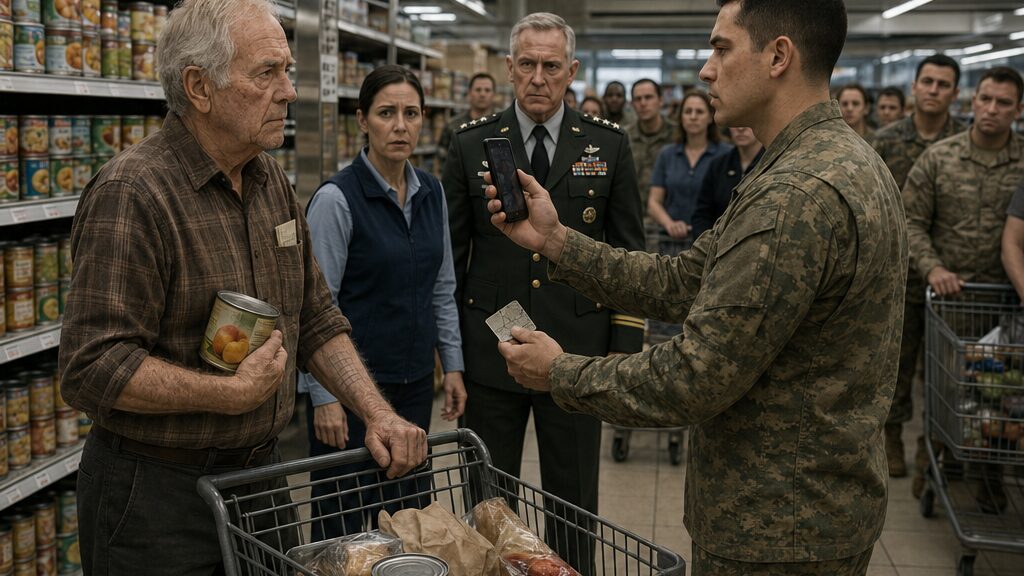
The phone flashed red just as Raymond Anderson lowered a dented can of peaches into his cart.
MANUAL REVIEW REQUIRED.
The message glowed between the fingers of the young staff sergeant standing beside the commissary entrance. Raymond saw it reflected in the polished edge of the canned-goods shelf before he saw the man’s expression change.
“Sir, hold on.”
Raymond kept one hand on the cart. The other rested over a folded sheet of paper in his shirt pocket. The faded brown plaid shirt had been washed so often that its darker lines had softened into the cloth. He had rolled the sleeves once, enough to keep the cuffs away from the cart wheels.
Behind him, Saturday traffic pressed through the commissary. Cart wheels clicked over tile seams. A cashier called for a price check. Somewhere near produce, a child complained about cereal. The ordinary sounds continued, but the space around Raymond narrowed.
The staff sergeant looked at the old plastic card again. Its edges were white with wear, and a crack ran through the corner of Raymond’s photograph.
“This card didn’t clear.”
“It asked for manual review,” Raymond said.
The young man’s eyes rose. “That means it didn’t clear.”
“It means what it says.”
There was no challenge in Raymond’s tone, which seemed to bother the sergeant more than anger would have.
The name strip over the young man’s pocket read MARTINEZ. His uniform was exact, his boots clean, his phone fitted with a thick black security case. He could not have been more than thirty. A junior military police officer stood several yards behind him near the entrance station, watching without approaching.
Raymond reached for his card.
Joshua Martinez did not return it.
“Do you have another form of identification?”
Raymond removed his state driver’s license and handed it over. Joshua compared the photograph, then looked at Raymond’s face for longer than the task required.
“You live off post.”
“I do.”
“This access category isn’t in the current system.”
“It predates the current system.”
Joshua turned the card beneath the fluorescent light. “Where did you get it?”
“It was issued to me.”
“By whom?”
“The Department of the Army.”
A woman maneuvering a cart around them slowed just enough to listen. Two uniformed service members behind her stopped pretending to compare soup labels.
Raymond glanced at the list in his pocket. Carolyn had written in blue ink, large enough for him to read without glasses.
Peaches had been circled twice.
He had already taken longer than he promised.
“Run the legacy number,” he said.
Joshua’s thumb paused above the phone. “What legacy number?”
“Lower right corner. Twelve digits. The old system separated the command authorization prefix from the beneficiary code.”
Joshua’s eyes moved to the card.
Raymond continued before he could stop himself. “You enter the first four under archived authority, not standard retiree access. If your interface was updated correctly, it will request secondary confirmation.”
The young sergeant studied him.
For an instant Raymond thought he had helped. Then Joshua’s expression closed.
“You seem very familiar with the verification process.”
“I remember it.”
“That process was discontinued.”
“Processes are discontinued. Records are not supposed to be.”
Joshua shifted the phone slightly, angling it toward Raymond’s chest. A small red indicator appeared near the top of the screen.
Raymond noticed it at once.
“You’re recording.”
“Documenting the contact.”
“Is that required?”
“It protects everyone.”
The watching woman moved on, but slowly. The two service members remained by the soup.
A customer-service supervisor approached from the registers. She wore a navy commissary vest and a badge reading EMMA ROBINSON. Her smile was controlled, the kind used to keep lines from becoming complaints.
“Staff Sergeant, we can take the gentleman into the office and call central access.”
Joshua did not look away from Raymond. “I’ve got it.”
“We have a terminal inside.”
“I said I’ve got it.”
Emma’s smile faded by one degree. “The aisle is backing up.”
Raymond looked behind him. Three carts were now waiting, though each had room to pass. Their owners had chosen not to.
“Take me to the office,” he said.
Joshua glanced toward the gathering customers, then at his phone. “Not until we establish ownership of the card and the items.”
Raymond’s fingers tightened around the cart handle.
“The items?”
“You entered under an invalid credential.”
“The credential has not been declared invalid.”
“It didn’t clear.”
“It requested review.”
Joshua’s jaw shifted. “Sir, whose card are you using?”
The question carried farther than it needed to.
A cashier stopped scanning for half a second. One of the uniformed shoppers looked down. The other kept watching Raymond as if waiting for him to confess.
Raymond had stood in command rooms where voices rose over maps marked with stranded units, failing fuel lines, and roads no longer held. He had delivered orders knowing that every available choice would cost someone something that could not be restored.
This was a grocery aisle.
That should have made the moment smaller.
It did not.
“The card is mine,” he said.
Joshua raised it beside the driver’s license. “The photograph is old.”
“So am I.”
A few people smiled uncertainly. Joshua did not.
“The database has no active record matching this authorization.”
“Then call archived personnel.”
“We don’t call restricted archives because someone knows old terminology.”
Emma stepped closer. “Staff Sergeant, the private office is available.”
Joshua’s attention flicked toward the crowd. Raymond saw the calculation: if he moved the matter out of sight and the card proved fraudulent, it might appear he had been too soft. If he held his ground publicly, every witness could confirm his decisiveness.
Raymond had seen younger officers make similar calculations under far greater pressure. Most learned before the habit hardened. Some did not.
He reached for the peaches in the cart.
Joshua’s free hand moved between Raymond and the basket. “Please don’t touch the merchandise.”
A silence opened around them.
Raymond looked at the hand, then at Joshua.
“These groceries have been in my cart for twelve minutes.”
“They haven’t been purchased.”
“They are milk, bread, canned fruit, and coffee. They are not evidence.”
“No one said they were.”
“You told me not to touch them.”
“I need you to step away from the cart until we confirm you’re authorized to shop here.”
Raymond lifted the can of peaches anyway. The metal was cool against his palm, the dent pressed inward near the label. Carolyn always chose the cheaper cans, even when someone else was paying. Anthony had liked peaches cold from the tin during deployment, she had once told Raymond, as though it were a fact too ordinary to carry grief.
Joshua brought the phone higher.
Raymond turned the dent toward his palm.
“You can verify the number,” he said. “You do not need to make a theater of the man carrying it.”
The words landed more sharply than he intended.
Joshua’s face colored. “I’m following procedure.”
“No. You are performing it.”
The junior military police officer took one step forward, then stopped when Joshua glanced back.
Emma lowered her voice. “Mr. Anderson, let me handle the groceries while we sort this out.”
Raymond looked at her. “There’s milk under the bread. It should not sit in the heat.”
Her expression changed. Not enough to become warmth, but enough to become attention.
“I’ll have it refrigerated,” she said.
“Thank you.”
Joshua tapped the phone several times. “Archived authority isn’t returning a confirmation.”
“Did you separate the prefix?”
“Yes.”
“Did it request the retired-service conversion key?”
Joshua stared at him.
“That field was removed years ago,” he said.
“It was hidden, not removed. Swipe left on the confirmation pane.”
Joshua did so before suspicion caught up with obedience. A gray field appeared beneath the red message.
His eyebrows moved.
Raymond felt no satisfaction. Only fatigue.
Joshua entered the first four digits again. The screen changed.
LEGACY COMMAND AUTHORIZATION FOUND. IDENTITY CONFIRMATION UNAVAILABLE. REFER TO SECURE ARCHIVE.
The two service members by the soup exchanged a look.
Emma read over Joshua’s shoulder. “That’s enough to move this private.”
Joshua locked the phone. “It proves somebody knows the number.”
Raymond watched him carefully.
There it was: the point at which uncertainty could have softened the young man, and instead made him harder. Joshua had committed himself in front of witnesses. New information no longer offered him a way out. It threatened to expose that he might have chosen the wrong road.
Raymond knew that trap too well.
He also knew he could end the matter.
Daniel Moore’s office was less than half a mile away. One call would bring an aide, a vehicle, perhaps Daniel himself. Raymond could say four words—Lieutenant General Raymond Anderson—and every posture in the aisle would change.
The thought filled him with something close to disgust.
Carolyn had not sent him here to be escorted through a grocery store.
He placed the peaches back in the cart.
“I will wait in the office,” he said.
Joshua kept the card. “You’ll wait here until security confirms the cart inventory.”
Emma exhaled through her nose.
Raymond’s hand went to his shirt pocket. The folded list had shifted. As he drew it out, one corner caught beneath the cloth. The paper slipped free and fell between the cart and Joshua’s boots.
Joshua bent first.
Raymond saw the blue handwriting open across the tile.
Coffee. Whole milk. White bread. Peaches, two cans.
At the bottom, beneath an address, Carolyn had written:
No ceremony. Just come by.
Then, in smaller letters:
Carolyn Williams — Northline, twenty years.
Joshua looked from the paper to Raymond.
“What is Northline?”
Chapter 2: The General Who Asked Only One Question
The two-star general stepped into the aisle, and the old man did not look relieved.
That unsettled Joshua more than the stars.
Major General Daniel Moore wore no cap indoors. Silver showed at his temples, and aviation insignia sat above rows of ribbons Joshua could identify only in part. Conversations behind him thinned as people recognized the installation commander.
Joshua lowered the paper but kept Raymond’s card in his other hand.
Daniel’s gaze moved across the scene: the halted carts, Emma beside customer service, the phone in Joshua’s grip, Raymond standing in a faded shirt with one hand resting on the grocery cart.
“What is happening here?” Daniel asked.
Joshua straightened. “Sir, we have an access credential that returned an unresolved archived-authority record. The individual entered the commissary and selected merchandise before verification.”
Daniel looked at Raymond.
Raymond looked back without expression.
Joshua expected recognition to pass between them. It did not. Not immediately.
Daniel’s attention dropped to the old man’s forearm, where the rolled sleeve exposed a faded tattoo: a square cut by angled lines, one corridor marked darker than the others. Joshua had assumed it was an old unit emblem.
Daniel stopped breathing for a moment.
It was slight, but Joshua saw it.
“Sir,” Daniel said, and the word was directed at Raymond.
The crowd heard only courtesy. Joshua heard something else. Daniel had not said mister.
Raymond’s shoulders seemed to grow heavier.
Daniel stepped closer. “Were you with Northline?”
Raymond held the dented can of peaches against his palm.
“I was there.”
Nothing more.
Daniel searched his face. Joshua watched the general’s uncertainty deepen rather than resolve. It was as though he recognized a map but not yet the territory.
“Your name?” Daniel asked.
“Raymond Anderson.”
The name struck somewhere behind Daniel’s eyes.
Before he could speak, Joshua said, “Sir, the card cannot be verified through the active database. He knew how to locate a hidden legacy field, but that doesn’t establish ownership. I’m documenting the contact.”
Daniel turned toward the phone.
“You’re recording him?”
“For accountability, sir.”
“Whose?”
Joshua hesitated.
Emma answered. “I offered to move the verification into the private office.”
Daniel’s gaze returned to Joshua. “Why are we still in the aisle?”
“We had not established whether the cart contents were being obtained under fraudulent access.”
The words sounded less reasonable with the installation commander standing there. Joshua heard that. He also heard the formal counseling from six weeks earlier as clearly as if the paper were being read aloud.
Failure to verify access.
Insufficient control at point of contact.
Further lapses may affect suitability for advancement.
The previous incident involved a civilian contractor using a retired relative’s credentials. Joshua had waved him through after the man became agitated. Two days later, investigators found months of unauthorized purchases.
His captain had not shouted. That had made it worse.
You wanted to avoid an uncomfortable scene, Martinez. So you transferred the cost to everybody else.
Joshua had decided he would never make that mistake again.
Now every face in the aisle suggested he had made a different one.
Daniel held out his hand. “The card.”
Joshua passed it over.
The general read the name, then the legacy number. He turned the cracked plastic beneath the fluorescent light. His thumb rested on the authorization prefix.
“This series was issued before the current retiree conversion,” he said.
“Yes, sir. That’s what he said.”
Daniel looked sharply at him. “He told you how to verify it?”
“He knew the archived process.”
“And that increased your suspicion?”
Joshua felt heat climb beneath his collar. “It suggested familiarity with a system that has been inactive for years.”
“So would having used it.”
No one moved.
Raymond placed the peaches back in the cart with care.
Daniel approached him by one step. “Mr. Anderson, I’m going to ask that we continue this in the office.”
Joshua heard the change. Daniel had chosen mister in public, either because he remained uncertain or because Raymond wanted him to.
Raymond glanced at the people blocking the aisle.
“First let them pass.”
Daniel turned. “Clear the aisle.”
The order was quiet. Carts moved at once. Uniformed shoppers looked away as they passed Raymond. A civilian woman whispered something to her husband. Joshua caught the word general, but he could not tell whether it referred to Daniel or speculation about the old man.
Emma took hold of Raymond’s cart.
“I’ll have the cold items stored,” she said.
“I would rather finish paying.”
“We still need central confirmation.”
“The card found the archive.”
“It did not confirm current eligibility.”
Raymond looked at her, not unkindly. “Then let me pay without the benefit.”
Emma blinked. “Civilian purchase isn’t permitted under our system.”
“I am not asking for a discount.”
“It isn’t about price.”
“That appears to be the problem.”
Daniel’s mouth tightened, though Joshua could not tell whether he was suppressing anger or agreement.
They moved to the customer-service office, a narrow room with two desks and a window overlooking the registers. Emma sat at the secure terminal. Daniel remained standing. Joshua took position near the door, still holding his phone.
Raymond sat only after Emma asked him twice.
On the monitor, the current access database displayed his name with no rank, no branch category, and no active photograph. Beneath it appeared a gray banner:
COMMAND AUTHORITY ARCHIVE — RESTRICTED MIGRATION RECORD.
Emma entered the legacy number manually.
“Date of birth?” she asked.
Raymond gave it.
“Last duty station?”
He paused.
Joshua noticed Daniel’s attention sharpen.
“Fort Halden,” Raymond said.
Emma typed. “The database says that installation designation was retired.”
“So was I.”
Daniel moved toward the desk. “Fort Halden was Northline command.”
Raymond said nothing.
Emma requested secondary authentication. The system produced a prompt asking for an archive conversion certificate that Raymond did not possess.
“Central access is closed until Monday,” she said. “Memorial-weekend schedule.”
Joshua felt a small return of certainty. Procedure had not cleared the man. Whatever Daniel suspected, the record remained unresolved.
“Then we cannot authorize the transaction,” he said.
Daniel turned slowly. “Staff Sergeant, no one asked you.”
Joshua straightened. “No, sir.”
Raymond’s gaze lifted. “He is correct.”
The room went still.
Joshua had expected Raymond to seize the protection Daniel offered. Instead the old man had supported the rule blocking him.
“The system has not verified me,” Raymond continued. “That is the fact. How he chose to handle the fact is another matter.”
Joshua felt the sentence more deeply than a public rebuke.
Daniel studied Raymond. “You could make this easier.”
“Yes.”
“Will you?”
“No.”
“Why?”
Raymond looked through the office window at the cart beside customer service. The folded list lay in its child seat.
“Because I came to purchase groceries,” he said. “Not to reopen a command.”
Daniel’s face changed.
Joshua saw recognition approach again, nearer this time, but still incomplete.
The general lowered his voice. “I was a captain when Northline was taught at the logistics school. We studied the corridor redirection.”
Raymond’s right hand closed over his left.
Daniel noticed.
“So you were there,” he said.
“I told you.”
“That is not what I’m asking.”
Raymond’s eyes rose to his. For the first time, Joshua saw authority in the old man—not volume, not threat, but the stillness of someone accustomed to making other people decide whether they were prepared to hear an answer.
Daniel did not repeat the question.
Emma’s terminal chimed.
A new search result had appeared, pulled from a deeper personnel index. Most fields were blacked out. One line remained visible.
ANDERSON, RAYMOND — COMMAND AUTHORITY ARCHIVE RESTRICTED.
Emma read it twice.
Daniel placed both hands on the desk.
Joshua looked at Raymond’s worn shirt, the cheap groceries beyond the glass, and the old card he had treated like a clumsy forgery.
“What level of command authority?” he asked.
No one answered.
Chapter 3: The Groceries Were Not for Him
Raymond refused to leave the commissary until the groceries were paid for, even though no one in the building could establish whether he was permitted to buy them.
Daniel offered to put the purchase on his own account.
Raymond declined.
Emma suggested holding the cart until Monday.
“The milk will not improve,” Raymond said.
“We can replace it.”
“That is waste.”
Joshua stood outside the office door, no longer recording. Raymond could feel the young man’s attention through the glass. Shame had altered his posture but not yet softened it. He held himself too straight, as though accepting discomfort required the same discipline as standing inspection.
Daniel leaned against the second desk. “There is another commissary off installation.”
“Twenty-eight miles away.”
“I’ll have someone drive you.”
“I drove myself.”
“I know.”
“Then we agree on something.”
Daniel exhaled. “You are making this difficult on purpose.”
Raymond looked at him. “No. I am refusing to make it simple for the wrong reason.”
Emma returned from speaking with the commissary director. “We can process the groceries as a temporary administrative sale. No retiree benefit, no tax exemption. It will be documented pending verification.”
Raymond stood. “Thank you.”
Daniel stared at Emma. “That was an option?”
“It became one after the director called legal.”
Raymond took out his wallet.
At the register, the crowd had thinned, but enough people remained to watch. The checkout clerk avoided looking directly at him. Joshua carried the milk from cold storage and placed it beside the bread without being asked.
Raymond paid the full amount.
When the receipt printed, Emma handed it to him with both hands.
“I’m sorry this was handled publicly,” she said.
Raymond folded the receipt and placed it behind Carolyn’s list. “I believe you are sorry it became public.”
Emma’s face tightened.
He regretted the line as soon as he spoke it. It was accurate, but accuracy was not always the same as fairness. She had offered the office before anyone else.
“Still,” he added, “you offered privacy. I should remember that.”
Her shoulders lowered slightly.
Outside, heat rose from the parking lot in pale waves. Daniel walked beside Raymond while Joshua followed with two grocery bags. No escort had been ordered, yet no one suggested that Joshua leave.
At Raymond’s old sedan, Joshua placed the bags in the trunk.
“The peaches go in front,” Raymond said.
Joshua looked at him.
“They dent more if the milk shifts.”
Joshua moved them.
When he straightened, he opened his mouth, but Raymond closed the trunk before the apology came.
Not here, he thought.
Perhaps not yet.
Daniel waited until Joshua stepped away. “You’re going to Carolyn Williams’s house.”
Raymond took the folded list from his pocket. “You read it.”
“I knew Anthony.”
“You knew his record.”
“I met him twice.”
“Then you did not know him.”
Daniel accepted the correction. “The remembrance gathering is this afternoon.”
“I am aware.”
“Your name is on the program.”
“It should not be.”
“It has been there for three weeks.”
Raymond turned toward the driver’s door. “Remove it.”
“I can’t.”
“You command the installation.”
“The programs are printed.”
Raymond looked back. “Then collect them.”
Daniel almost smiled, but the expression did not survive. “You still think orders can make memory behave.”
The words entered cleanly.
Raymond’s hand remained on the door handle.
Daniel came closer, lowering his voice. “I did not recognize you in the aisle. I knew the tattoo. I knew the cadence of your voice from archived briefings. But I looked at you and saw an old man with groceries.”
“That was what stood in front of you.”
“No. It was all I allowed myself to see.”
Raymond opened the door.
“Come this afternoon,” Daniel said.
“No.”
“Carolyn asked for you.”
“She asked for groceries.”
Daniel looked at the list. “Did she?”
Raymond drove without turning on the radio. At each stoplight the milk shifted softly in the trunk, followed by the tap of canned goods. The sound kept time with memories he had spent years reducing to paperwork.
Carolyn lived in a brick duplex beyond the old east gate, where retired families occupied houses built when the base employed twice as many civilians. Her porch rail had been repainted white. Two clay pots sat empty beside the steps.
Raymond carried all the bags at once.
Before he could knock, the door opened.
Carolyn Williams wore a gray sweater despite the heat. Her hair, once black, was cut close around her face. She looked first at Raymond, then at the bags, then past him toward the street.
“You came alone.”
“Daniel followed me as far as the gate.”
“That is not what I asked.”
Raymond lifted the bags slightly. “Whole milk. White bread. Coffee. Two cans of peaches.”
“I can see that.”
“The cheaper brand was dented.”
“Anthony never cared about dents.”
“I remember.”
The words changed the air between them.
Carolyn stepped aside.
Her kitchen was small and orderly. Raymond set the milk in the refrigerator and placed the coffee in the cupboard where it had always gone. He had delivered groceries before, usually when Carolyn was at a medical appointment or visiting her sister. A key waited beneath the third flowerpot. They had built an arrangement around not meeting.
Today there were no flowers and no hidden key.
Carolyn unfolded the list on the table.
“You took your time.”
“There was an access problem.”
“So I heard.”
Raymond looked at her.
“Daniel called.”
“Of course he did.”
“He said a staff sergeant accused you of using somebody else’s card.”
“He asked whose card it was.”
“In front of people.”
“Yes.”
“And you said nothing.”
“I told him it was mine.”
“You know what I mean.”
Raymond opened a cabinet though nothing needed putting away.
Carolyn touched the peaches. “I asked for your presence, not your money.”
“You needed groceries.”
“I needed you to walk onto that base.”
His hand stopped inside the cabinet.
She tapped the list. “Why do you think I wrote Northline at the bottom?”
“I assumed you wanted the memorial brands recorded for reimbursement.”
Carolyn gave a short, disbelieving laugh. “You commanded thousands of people and still lie badly when the room is quiet.”
Raymond closed the cabinet.
“You arranged this.”
“I wrote a grocery list.”
“You knew my card might fail.”
“I knew it was old. I did not know a young man would turn you into a public warning.”
“You wanted Daniel to find me.”
“I wanted you to stop disappearing.”
He pulled out a chair but did not sit.
Carolyn placed the dented can between them. “Anthony carried cans like this on the last convoy. He complained the peaches tasted like metal and ate every spoonful.”
Raymond’s gaze fixed on the label.
“He told me,” Carolyn continued, “that if Northline ever ended, he was going to plant a peach tree. Not because he liked peaches. Because he wanted fruit that had never been inside a military warehouse.”
Raymond heard Anthony’s voice across twenty years: amused, tired, speaking over a radio line that broke every few seconds.
Corridor’s holding, sir. Don’t make us heroes. Just send fuel.
Raymond’s fingers curled against the chair.
Carolyn saw it. “The gathering starts at three.”
“I will not attend.”
“Your name is already in the program.”
“Daniel told me.”
“I put it there.”
He looked up sharply.
“You had no right.”
“No?” Her voice remained low. “You have sent money through foundations. You paid tuition bills nobody asked you to pay. You replaced roofs and pretended the checks came from an old unit fund. But you have not sat in this kitchen with me for six years.”
“I did not want to impose.”
“You did not want to hear what I might say.”
Raymond’s throat tightened.
Carolyn moved to a sideboard and opened its lower drawer. “You think I blame you for sending him down that route.”
“Eleven people died after my order.”
“And hundreds came through the corridor.”
“That arithmetic does not belong in your kitchen.”
“No. But neither does your silence.”
She removed a large envelope and laid it on the table. Raymond recognized the archival seal before she opened it.
“I requested this from the base historian,” she said.
From the envelope she drew a photograph, its colors faded toward brown. Men and women stood before a wall-sized operations map. At the center was Raymond, twenty years younger, wearing three stars. One sleeve had been rolled above the elbow. The dark route-grid tattoo on his forearm was still sharp.
Anthony Williams stood two places behind him, grinning at someone outside the frame.
Carolyn placed the photograph beside the dented peaches.
Raymond could not look away from Anthony.
“I never blamed you for the order,” she said. “I blamed you for deciding that grief gave you permission to leave us.”
Outside, a car door closed. Daniel had not gone far after all.
Carolyn turned the photograph so Raymond faced his younger self.
“Now tell me,” she said, “what happened on that route that made a lieutenant general afraid to walk into a room where the dead are remembered?”
Chapter 4: The Route That Saved Hundreds and Took Eleven
The photograph proved Raymond’s rank before the ledger revealed its price.
By two that afternoon, it stood beneath glass in the base logistics archive, enlarged from Carolyn’s faded copy. Raymond’s younger face looked out from the center of an operations team gathered around a map. Three stars marked his shoulders. His rolled sleeve exposed the route-grid tattoo, dark and precise where age had not yet blurred its lines.
Beside the photograph lay a black casualty ledger.
Eleven names filled one page.
Daniel stood several feet away, watching Raymond look at the ledger instead of himself.
The archive occupied the end of a long memorial corridor behind the logistics headquarters. Display cases held ration tins, field radios, convoy placards, and maps from operations whose complexity had been reduced to neat captions. Technicians were preparing the room for that afternoon’s remembrance gathering. A temporary panel bore the title NORTHLINE: THE CORRIDOR THAT HELD.
Raymond read the title twice.
“Held for whom?” he asked.
Daniel glanced toward the base historian and the memorial-event coordinator. “Give us the room.”
They left without argument.
Raymond stepped closer to the panel. Beneath the title, a short paragraph described a successful evacuation sustained by an unprecedented logistics effort. It mentioned severe conditions, rapid command decisions, and hundreds of military and civilian lives saved.
It did not mention the eastern convoy.
“Where is Route Seven?” Raymond asked.
Daniel folded his arms. “The display is intended for the public.”
“So was the road.”
“The full operational history is available in the archive.”
“Behind a restricted terminal.”
“The dedication is not an after-action review.”
Raymond turned toward him. “Then do not put my photograph above it.”
Daniel’s jaw hardened. “This installation has spent months preparing to recognize Northline. Families are coming. Former personnel are coming. You have avoided every planning call, refused every invitation, and sent word through other people that you wanted no part of it. We built what we could.”
“You built a victory.”
“We built something people could stand in front of without being crushed by it.”
Raymond looked at the casualty ledger.
“Eleven families managed.”
Daniel’s expression shifted. The reply had struck where Raymond intended, and he disliked himself for the precision of it.
A technician had left the main archive terminal active. Daniel crossed to it and entered a command password. Folders appeared across the screen: convoy routes, medical records, fuel allocation, command communications, casualty review.
He opened the operational map.
A web of colored lines covered a mountainous region. The same geometry marked Raymond’s forearm: three supply corridors, two evacuation routes, and one angled passage cutting east through a narrow ridge.
Route Seven.
The tattoo had never been an official insignia. After Northline, surviving members of the logistics command had copied the map onto their skin. Raymond had refused at first. Six months later, after the final family notification, he had entered a small tattoo shop alone.
Daniel enlarged the eastern corridor.
“Intelligence assessed a thirty-percent chance the ridge would remain open,” he said.
“Twenty-eight.”
“The revised report said thirty.”
“The revised report was written after the road failed.”
Daniel looked at him. “You still remember the number.”
“I remember all of them.”
On the screen, hundreds of blue markers crowded the western evacuation route. A smaller string of amber markers followed Route Seven.
Anthony’s convoy.
Daniel opened an archived audio file.
Static filled the room, followed by a younger voice identifying the Northline command post. Raymond recognized himself before the first full sentence.
“Higher command directs withdrawal of all logistics elements from the eastern sector,” the recorded voice of an aide said.
Then Raymond’s own reply, measured and immediate:
“Withdrawal leaves the civilian assembly area without fuel or medical transport.”
“Sir, the main route cannot support both groups.”
“Then we keep the main route open.”
“With what?”
A pause crackled through the old recording.
“Redirect Convoy Seven east. They will draw traffic and carry reserve fuel through the ridge.”
Daniel stopped the file.
Raymond stared at the waveform on the screen.
“You should play the rest.”
“You know the rest.”
“The display does not.”
Daniel resumed it.
Another officer warned that the eastern corridor was unstable. Raymond asked for the number of people still trapped at the assembly area.
“Four hundred twelve confirmed. Possibly more.”
The next silence was longer.
Then Raymond’s recorded voice said, “We do not abandon them because the arithmetic is unpleasant.”
Daniel stopped the audio again.
The room seemed smaller.
“Convoy Seven reached the ridge,” he said. “Their diversion prevented congestion on the western route. The civilians were evacuated.”
“Seven vehicles did not return.”
“Three did.”
“Eleven people did not.”
“You made the decision with the information available.”
“I made it with people available.”
Daniel stepped away from the terminal. “That distinction has punished you for twenty years.”
“It should.”
“No. Responsibility should remain. Punishment is not the same thing.”
Raymond lowered his eyes to his tattoo. The dark corridor ended near his wrist, where the ink had spread beneath thin skin.
Anthony’s last transmission had come nineteen minutes after the convoy entered the ridge.
Corridor’s holding, sir. Don’t make us heroes. Just send fuel.
The fuel never reached them.
A mudslide took the rear vehicles first. The remaining convoy kept moving long enough to draw traffic away from the western road. By the time rescue teams entered, eleven personnel were dead.
Daniel opened another file. “The investigation found your decision operationally justified.”
“Investigations do not attend funerals.”
“No. Commanders do.”
Raymond looked at him.
Daniel did not retreat. “You attended all eleven.”
“I stood at the back.”
“You spoke to every family.”
“Once.”
“And then you replaced yourself with checks, foundations, and unsigned letters.”
Raymond turned away from the monitor. “Carolyn has been talking.”
“She did not need to. Your pattern is in the records.”
He crossed to the temporary display panel. “This sentence says Northline demonstrated decisive command. Remove it.”
“It is accurate.”
“It is clean.”
Daniel’s patience broke. “What do you want, Raymond? A wall that tells every visitor you sent eleven people into danger? A recording of every doubt? A sign under your photograph saying the general never forgave himself?”
“I want Route Seven on the map.”
“The families know what happened.”
“The young soldiers do not. Staff Sergeant Martinez did not even know what Northline was.”
“And you think a casualty ledger would have stopped him from humiliating you in the commissary?”
“No. But perhaps it would stop this institution from teaching people that authority is the same as certainty.”
Daniel went still.
Raymond pointed to the map. “I was not certain. I chose. Those are not the same.”
The distinction hung between them.
A knock sounded at the archive door. The base historian entered carrying a tablet.
“Sir, public affairs needs a decision.”
Daniel frowned. “On what?”
“The commissary recording.”
Raymond’s head lifted.
The historian hesitated. “Staff Sergeant Martinez’s video automatically synchronized with the installation incident server. Someone flagged it after identifying General Moore in the footage. Public affairs has reviewed the recording.”
“Has it been released?” Daniel asked.
“No, sir. But several shoppers posted descriptions online. They’re preparing a statement before the story spreads.”
Raymond looked at Daniel. “What statement?”
The historian glanced down at the tablet. “It says a security representative failed to follow customer-respect procedures while verifying a retired patron’s access. Staff Sergeant Martinez has been temporarily removed from public duties pending investigation.”
“Retired patron,” Raymond repeated.
“They have not confirmed how much of your identity should be disclosed.”
Daniel took the tablet. His eyes moved quickly.
Raymond saw the familiar shape of institutional defense forming: isolate the individual error, describe the system as sound, promise review, preserve the larger structure.
“What does it say about the database?” he asked.
The historian looked uncomfortable. “Nothing.”
“About the supervisor offering a private office?”
“No.”
“About other legacy records?”
“That is being assessed.”
Daniel finished reading. “They want approval within the hour.”
Raymond looked again at the photograph of his younger self, three stars bright on his shoulders. Then at the ledger beside it.
A clean hero on one side.
A convenient culprit on the other.
“Tell public affairs not to release it,” he said.
Daniel studied him. “Joshua made his choice.”
“Yes.”
“He humiliated you.”
“Yes.”
“And you intend to protect him?”
Raymond touched the edge of the casualty ledger.
“No,” he said. “I intend to prevent you from doing to him what he did to me.”
Chapter 5: The Apology They Tried to Stage
The phone that had been held inches from Raymond’s face now stood on a tripod at the end of a polished conference table.
Joshua sat opposite it in service uniform, hands flat on his knees.
A public-affairs officer adjusted the frame so the installation emblem appeared over his shoulder. Two printed statements lay on the table. One belonged to Joshua. The other announced his suspension from customer-facing duties and promised renewed training.
Raymond stopped inside the doorway.
“No.”
The room turned toward him.
Daniel stood near the windows with Emma and the commissary director. Joshua rose so quickly his chair struck the wall.
“Sir—”
“Sit down.”
Joshua obeyed.
The public-affairs officer approached Raymond. “General Anderson, this is only an internal recording unless you approve release. Staff Sergeant Martinez has agreed to make a formal apology.”
Raymond looked at the phone. “Whose phone is that?”
Joshua answered. “Mine.”
“The same one?”
“Yes, sir.”
Raymond crossed the room, lifted it from the tripod, and placed it face down on the table.
“We are not making another theater.”
The public-affairs officer glanced at Daniel.
Daniel said, “Give us a moment.”
No one moved.
“That means leave,” he added.
The officer and commissary director exited. Emma remained until Daniel nodded permission.
Joshua stared at the dark phone.
“I was prepared to apologize,” he said.
“Then do it without a camera.”
Joshua swallowed. “General Anderson, my conduct yesterday failed to reflect—”
Raymond raised a hand.
“That is the statement they wrote.”
“Yes, sir.”
“What would you say if your career were not sitting in this room?”
Joshua’s eyes moved toward Daniel, then Emma.
Raymond waited.
Finally Joshua said, “I thought you were lying.”
“That is established.”
“I thought you knew the old system because you had used it before to get around verification.”
“And when the archive recognized the number?”
“I thought you might have stolen the card from someone important.”
Emma shifted in her chair.
Joshua continued, each sentence more difficult than the last. “When General Moore arrived, I knew something was wrong. But people were watching. If I backed down before confirmation, it would look like I had lost control.”
“You had.”
Joshua looked up.
“You lost control when being seen as correct became more important than discovering what was true.”
“Yes, sir.”
Raymond sat across from him. “Why were you recording?”
“To document the contact.”
“That is the approved answer.”
Joshua’s fingers closed around his knees.
Six weeks earlier, he explained, he had allowed an agitated contractor through an access point after accepting a plausible explanation for a mismatched credential. Investigators later found the man had been using a deceased relative’s benefits. Joshua had received formal counseling. One more lapse could remove him from promotion consideration.
“I told myself the recording protected the process,” he said. “But I wanted proof that I was not being soft again.”
Raymond glanced at Daniel. “Was his training changed after the first incident?”
Daniel’s face remained neutral. “He was instructed to apply stricter verification.”
“Was he taught how to handle legacy records?”
Emma answered. “No. The commissary guidance says to refer unresolved credentials to central access.”
“Which was closed.”
“Yes.”
“How many unresolved legacy credentials have appeared this year?”
Emma looked at the folder in front of her. “We reviewed the incident logs this morning.”
She opened it.
Thirty-seven cases had generated manual-review failures. Twenty-nine involved patrons over sixty-five. Twelve shoppers left without completing their purchases. Four were escorted from checkout areas after becoming agitated. Most reports described them as confused, uncooperative, or unable to verify eligibility.
No follow-up had been recorded.
Raymond removed Carolyn’s folded list from his shirt pocket and placed it beside the reports.
The small paper looked fragile against the thick file.
“Thirty-seven Staff Sergeants Martinez,” he said.
Joshua flinched.
“No,” Raymond corrected. “That is too easy. Thirty-seven opportunities for this institution to decide inconvenience was evidence of guilt.”
Emma looked down. “We thought they were isolated cases.”
“Isolation is what paperwork calls a pattern before someone counts it.”
Daniel came to the table. “Joshua still made choices the system did not require.”
“Yes,” Raymond said. “He refused privacy. He raised his voice. He treated groceries as suspicious property and an old man as a public lesson.”
Joshua accepted each sentence without looking away.
“But,” Raymond continued, “the system gave him every incentive to appear decisive and none to admit uncertainty. Now public affairs wants to use his face to prove the institution has corrected itself.”
Daniel folded his arms. “What do you propose instead?”
“First, you investigate his conduct honestly.”
Joshua’s jaw tightened, but he nodded.
“Second, you investigate the other thirty-six cases with equal seriousness.”
Emma closed the folder slowly.
“Third, no recording leaves this room until the people visible in it consent. Not me. Everyone.”
Daniel considered that. “Public pressure may force a response.”
“Then respond with facts.”
“The facts include who you are.”
Raymond looked toward the window. Across the installation, the logistics hall was being arranged for the remembrance gathering. Chairs would be aligned. Programs would display his name. His photograph would wait behind a cloth.
“They include who I was,” he said.
Joshua spoke quietly. “I would not have treated you that way if I had known.”
Raymond turned back.
The young man seemed to understand the error before Raymond replied.
“That,” Raymond said, “is the part of your apology you need to examine.”
Joshua’s face reddened.
“You were wrong before you knew my rank. Learning it does not make the wrong larger. It only makes your assumption visible to you.”
“I understand.”
“No. You have heard it. Understanding will take longer.”
Silence settled over the table.
Daniel opened the public-affairs folder. “The gathering begins in three hours. The program identifies you as guest of honor.”
“I am not a guest of honor.”
“The event is built around Northline.”
“Then honor Northline.”
“You commanded it.”
“And eleven people died under that command.”
Joshua’s eyes shifted toward Raymond’s forearm, where the tattoo showed below his rolled sleeve.
Daniel said, “The display can be revised after the ceremony.”
“No.”
“Raymond—”
“The photograph comes down.”
Daniel stared at him.
“Or,” Raymond continued, “the casualty ledger goes beside it.”
Emma looked between them.
“The original ledger?” Daniel asked.
“Yes.”
“It contains operational notes and family information.”
“Cover what must remain private. Leave the names.”
“This was intended as a remembrance, not a command inquiry.”
“That is why the names belong there.”
Daniel walked to the window. His reflection hovered over the parade field outside.
“You have spent years refusing recognition,” he said. “Now you are dictating its terms.”
Raymond looked at Carolyn’s list beside the incident reports.
He had dictated routes, fuel priorities, evacuation sequences. Since retirement, he had mistaken refusing to direct anything for moral improvement. It had allowed other people to build clean versions of Northline while he mailed anonymous checks and called absence humility.
“Yes,” he said. “I am.”
Daniel turned.
Raymond slid the folded list across the table. At the bottom, Carolyn’s words remained visible.
No ceremony. Just come by.
“I will attend,” Raymond said. “I will stand beneath the photograph. I will allow my rank to be named.”
Joshua lifted his eyes.
“But the ledger stands beside me. Route Seven appears on the map. No statement blames one sergeant for a system that taught him to fear uncertainty. And no one calls Northline a victory without reading the names of the people who did not come home.”
Daniel held his gaze for a long moment.
Then he picked up the phone from the table and switched it off.
“I’ll have the ledger brought over,” he said.
Chapter 6: He Finally Spoke About the Men He Lost
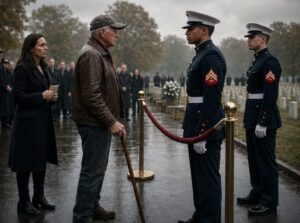
The cloth fell from the photograph while Raymond stood beneath it in the same faded plaid shirt he had worn to buy groceries.
A murmur moved through the remembrance hall.
The man in the photograph was broad-shouldered, unsmiling, and marked by three stars. Behind him, Northline’s operations map covered an entire wall. His rolled sleeve exposed a dark route-grid tattoo identical to the faded lines on the old man’s arm.
Raymond did not look up at his younger face.
He looked at the black ledger displayed on a stand beside the lectern.
Carolyn’s folded grocery list rested between its open pages.
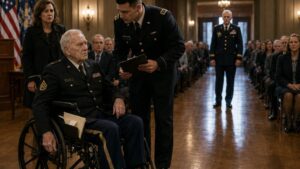
The hall was smaller than Daniel had planned. Raymond had refused the larger auditorium and the ceremonial escort. Former Northline personnel occupied the first rows with surviving family members. Active-duty logistics officers filled the back. Commissary employees sat along one side, including Emma. Joshua stood near the rear in uniform, no phone visible.
No one applauded when Raymond walked to the lectern.
He had asked them not to.
Daniel opened the gathering with a brief identification. “Lieutenant General Raymond Anderson, retired, commanded Operation Northline.”
The words changed the posture of the room. Younger service members straightened. Several older veterans lowered their heads. Joshua remained still, but the color left his face as the title settled fully into what had happened in the commissary aisle.
Raymond placed both hands on the lectern.
A prepared speech waited there.
He moved it aside.
Then he opened the casualty ledger.
He read the first name.
The hall became quiet enough for the ventilation system to sound loud.
He read all eleven.
Some names came easily. Others caught against memories: a voice over a radio, a joke in a briefing room, a spouse standing beside a grave. When he reached Anthony Williams, Carolyn did not look away.
Raymond finished the list and allowed the silence to remain.
“Northline is often described by numbers,” he said. “Four hundred twelve civilians moved from the eastern assembly area. More than six hundred military personnel cleared through the western corridor. Medical evacuation continued for nineteen hours after higher command ordered withdrawal.”
He looked toward the displayed map. Route Seven had been restored in amber, cutting through the ridge.
“Those numbers are true. They are not the whole truth.”
No one shifted.
“The western road could not carry both the evacuation traffic and the reserve-fuel convoy. If it blocked, hundreds would remain in an exposed area without transport. I redirected Convoy Seven through the eastern ridge.”
His voice did not rise.
“I knew the road was unstable. I knew communications were failing. I believed the convoy had a reasonable chance of passing through. I also knew that keeping it on the western road created a larger danger.”
He touched the ledger.
“I chose where the risk would go.”
Across the room, Joshua watched him with a new expression—not admiration, Raymond thought, but the first recognition that authority did not remove uncertainty. It concentrated it.
“The civilians came through,” Raymond continued. “The main corridor remained open. Seven vehicles on Route Seven were lost or disabled. Eleven service members died.”
He turned slightly toward the photograph.
“This image makes command look like a place where certainty lives. It does not. Command is often the place where incomplete knowledge arrives and still demands a decision.”
Daniel stood at the side of the stage, his face unreadable.
Raymond could have ended there. The room had his rank, the map, the official record, and the moral weight expected from a remembrance. He could feel the familiar instinct to retreat behind the dead, to let guilt serve as proof that he had not forgotten them.
Carolyn rose from the front row.
She did not approach the lectern.
“Tell them the rest,” she said.
Several heads turned toward her.
Raymond’s fingers tightened on the page.
Carolyn’s voice remained steady. “Tell them what you did after the funerals.”
He looked at her.
“I attended them.”
“Then what?”
The question was not hostile. That made it harder.
Raymond glanced at the folded grocery list. Her handwriting showed through the thin paper.
“I established assistance funds.”
“Without your name.”
“Yes.”
“You paid tuition.”
“Yes.”
“Medical bills.”
“When needed.”
“Roofs. Car repairs. Groceries.”
Raymond said nothing.
Carolyn faced the room. “He made certain nobody was abandoned. He also made certain nobody could reach him.”
The sentence opened something he had spent twenty years reinforcing.
A former Northline soldier in the first row looked down at his hands. Emma’s eyes moved from Carolyn to Raymond. Joshua stood motionless.
Carolyn continued. “His worst failure was not the order.”
Raymond felt the room change around him.
“It was deciding for all of us that we would rather have his money than his presence.”
He closed the ledger.
For years he had believed absence was the least selfish thing he could offer. Families would not have to comfort the commander. Survivors would not have to carry his need for forgiveness. He would fulfill his promise through practical help and leave grief unoccupied by his rank.
It had been a disciplined explanation.
It had also been a hiding place.
“You are right,” he said.
The words were quieter than anything before them, yet they traveled across the hall.
Carolyn sat down.
Raymond looked at the eleven names.
“I told myself silence was humility. Sometimes it was. Sometimes it was fear wearing better clothes.”
No one moved.
“I feared that if I entered your homes, you would ask whether I would give the same order again.”
He looked at Carolyn.
“I would.”
A breath passed through the room.
“Not because the eleven mattered less. Because the people trapped beyond the western road did not matter less either. That answer has never become easier to carry.”
Carolyn’s eyes filled, but she nodded once.
Raymond turned toward Joshua.
“Yesterday, a staff sergeant treated me as though uncertainty were proof of guilt. He was wrong. He made choices that caused harm, and he will answer for them.”
Joshua’s shoulders drew back.
“But this institution will not purchase a clean conscience with one young man’s career.”
Daniel lowered his eyes.
“The access system failed thirty-seven legacy patrons this year. Twelve left without their groceries. The record described several as confused or uncooperative. No one asked why the same confusion kept appearing in the same database.”
Emma clasped her hands together.
“Rank brought attention to my case. That does not make my case more deserving. It proves how many others were easy to ignore.”
Raymond let that settle before continuing.
“Staff Sergeant Martinez told me he would have acted differently if he had known who I was. I believe him. That is not a defense. It is the problem.”
Joshua met his eyes.
“Respect offered after recognition is courtesy to status. Respect offered before recognition is character.”
There was no applause. Raymond had forbidden that too, but he sensed the impulse moving through the room and passing unfulfilled. The withheld response left the words where they belonged—not as a performance, but as an obligation.
Daniel stepped toward the lectern. “The installation will begin an immediate review of legacy access procedures.”
Raymond turned slightly. “Private secondary verification.”
Daniel nodded. “Private secondary verification for elderly and disabled patrons, with a direct archive contact during operating hours.”
“And the previous cases.”
“They will be contacted individually.”
Emma spoke from her seat. “I will lead the commissary review.”
Raymond acknowledged her with a small nod.
The formal part of the gathering ended without music. People approached the ledger rather than Raymond. Several touched the edge of the glass over Route Seven. One former soldier stood before the photograph, then turned to study the old man beneath it as if trying to reconcile both versions.
In the reception kitchen, trays of sandwiches and canned peaches waited on folding tables. Carolyn had insisted on the peaches.
Raymond found her near the doorway.
“I should have come sooner,” he said.
“Yes.”
“I do not know how to repair twenty years.”
“You cannot.”
He accepted that.
Carolyn placed the folded grocery list in his hand. “You can stop adding to them.”
Across the hall, Joshua stood alone. His prepared apology remained folded in his pocket. When Raymond approached, he came to attention.
“At ease,” Raymond said.
Joshua relaxed only slightly. “Sir, I owe you an apology that is not about your rank.”
“Yes.”
“I don’t know how to give it yet.”
“That is the first useful thing you have said about it.”
Joshua absorbed the rebuke without flinching.
Raymond folded Carolyn’s list along its worn creases.
“Meet me at the commissary entrance tomorrow morning at seven.”
Joshua looked uncertain. “In uniform?”
“No.”
“Should I bring the incident file?”
“No.”
“My phone?”
Raymond placed the list in his shirt pocket.
“No uniform,” he said. “No phone.”
Then he walked back toward the ledger, leaving Joshua with the only question that mattered now: what action could possibly follow words.
Chapter 7: The Cart Returned Through the Same Door
Joshua arrived at seven in civilian clothes and found Raymond waiting beside an empty shopping cart.
No uniform. No phone. No visible sign that the young man had ever held authority over anyone.
He wore dark jeans and a plain gray shirt. Without the name strip, polished boots, and controlled posture of the previous morning, he looked younger than twenty-nine.
Raymond checked the clock above the commissary entrance.
“You are early.”
“Four minutes.”
“That is early.”
Joshua glanced at the cart. “Are we shopping?”
Raymond handed him Carolyn’s folded list.
The paper had softened at the creases. Beside several items, Carolyn had added notes in blue ink.
Not the instant coffee.
Bread without seeds.
Two peaches if they still have the dented ones.
Joshua read the last instruction twice.
“I thought we already delivered these.”
“She has neighbors.”
Raymond pushed the cart toward the entrance.
A temporary sign stood beside the card scanner:
LEGACY CREDENTIALS: PRIVATE VERIFICATION AVAILABLE AT CUSTOMER SERVICE.
Below it, a handwritten arrow pointed away from the main line.
Joshua noticed the sign but said nothing.
Raymond presented his damaged card to the clerk. The scanner returned the same red warning.
MANUAL REVIEW REQUIRED.
The clerk looked from the screen to Raymond, then toward the private desk.
“Sir, I can escort you over.”
“I know the way.”
No one raised a voice. No one blocked the cart. No one asked him whose card he had taken.
Emma waited at the private desk with a secure terminal and a paper form. She wore the same navy vest, but there were no customers gathered behind her.
“Central archive confirmed your record this morning,” she said. “The permanent replacement will take several days.”
Raymond signed the temporary authorization.
Emma placed a green verification slip beside his card. “This is valid until the new credential arrives.”
“Thank you.”
She looked at Joshua. “The first review meeting is Thursday.”
“I’ll be there.”
Emma hesitated. “We contacted the twelve patrons who left without purchases. Seven agreed to speak with us. Two asked never to be called again.”
Raymond folded the green slip into his wallet.
“Do not call the others twice,” he said. “An invitation becomes another demand if it is repeated.”
Emma nodded.
Joshua pushed the cart once they entered the store. Raymond did not ask him to. They moved through produce and bread while the building was still quiet enough to hear the refrigeration units cycling on and off.
At canned fruit, Joshua stopped.
Several peach cans sat in two rows. One had a deep dent near the bottom.
He reached for an undamaged can.
Raymond said, “Read the list.”
Joshua unfolded it.
“Why would she ask for a dented one?”
“You can ask her.”
Joshua placed the damaged can in the cart.
They completed the list without speaking much. Joshua compared coffee prices longer than necessary and chose the brand Carolyn had underlined. At checkout, he began removing the groceries from the cart.
The same clerk who had watched the confrontation two days earlier scanned the items. Her movements slowed when she recognized Raymond.
“General Anderson,” she said.
Raymond looked at her.
She lowered her voice. “I’m sorry I did not say anything Saturday.”
“You were working.”
“I was watching.”
“Yes.”
Her eyes fell to the register.
Raymond placed the bread on the belt. “Next time, ask whether the person wants help. Do not decide for them that silence is safer.”
She nodded.
Joshua carried the bags to Raymond’s sedan. This time he placed the peaches in front without instruction.
Carolyn opened her door before they reached the porch.
Her gaze moved from Raymond to Joshua and then to the grocery bags in his hands.
“So this is the young man.”
“Yes,” Raymond said.
Joshua stepped forward. “Mrs. Williams, I came to apologize for what I did to General Anderson.”
Carolyn did not take the bags.
“For what you did to a general?”
Joshua stopped.
Raymond said nothing.
Joshua looked down at the groceries, then back at Carolyn. “For treating an old man like he had to prove he deserved basic respect.”
“That is closer.”
“I was afraid of making another mistake. I made that fear his problem.”
Carolyn folded her arms. “And now you feel ashamed.”
“Yes, ma’am.”
“Your shame is not useful to me.”
Joshua’s face tightened.
“It tells me how you feel about yourself,” she continued. “It does not tell me what you understand about anyone else.”
He looked toward Raymond, but Raymond gave him no rescue.
Carolyn pointed at the bag. “What did you buy?”
“Coffee. Milk. Bread. Peaches.”
“Why peaches?”
Joshua glanced at the dented can visible through the plastic.
“I don’t know.”
“Then come inside.”
At the kitchen table, Carolyn removed each item and explained why it had been written down. The coffee was the brand Anthony had brewed too strong during deployment. The white bread was for an elderly neighbor whose hands shook too badly to cut hard crusts. The milk was for a woman caring for two grandchildren while her daughter recovered from surgery.
Then she lifted the dented peaches.
“Anthony ate these from the can on Convoy Seven,” she said. “He complained about the metal taste and saved the syrup for last.”
Joshua looked at Raymond.
Raymond stood near the sink, his attention fixed on the can.
“I thought the list was just groceries,” Joshua said.
“It was,” Carolyn replied. “That is what you missed. Ordinary things still belong to people. You do not need a heroic story before you handle them carefully.”
She set the can on the table.
Joshua’s apology did not receive forgiveness. Carolyn did not offer it, and he did not ask again. He carried the groceries to the cupboards, learned where each item belonged, and listened when she described Anthony without turning him into one of the eleven names from the ledger.
When they left, Raymond handed Joshua the empty bags.
“You expected punishment,” he said as they walked to the car.
“Yes.”
“You are under investigation. That is not my authority anymore.”
“I know.”
“This was not a substitute.”
Joshua looked back at Carolyn’s house. “I know that too.”
Several weeks later, the commissary review convened in a plain training room without cameras. Seven elderly patrons described being sent away, doubted, or spoken to as if slow movement meant confusion. Emma listened without defending the system. Joshua took notes and asked no one to excuse him.
The new procedure required a private desk, direct archive access during all operating hours, and written follow-up on every unresolved credential. Staff were trained to separate uncertainty from suspicion and verification from public display.
Daniel offered Raymond a permanent honorary entrance near the administrative offices.
Raymond declined before the sentence was finished.
On the morning his replacement card arrived, he returned in the same plaid shirt.
The scanner paused.
A clerk started toward the private desk, but the screen changed to green.
ACCESS CONFIRMED.
Raymond pushed an empty cart through the gate.
Joshua, back in uniform and assigned to supervised duty, stood near the entrance. He did not salute. Raymond had told him not to turn the commissary into another ceremony.
Instead Joshua nodded toward the cart.
“Need help with the list?”
Raymond removed the folded paper from his pocket. Carolyn had written three new items beneath the old creases.
He handed it over.
They walked through the same doorway where the cart had once been treated as evidence and an old man as a problem. No one announced Raymond’s rank. No photograph waited above him. The wheels rattled across the tile seam, ordinary and uneven.
For the first time in years, Raymond did not mistake being unnoticed for being absent.
The story has ended.