They Laughed When the Old Sailor Counted Rivets Beneath the Engine Room Floor
Chapter 1: The Knock Beneath the Test Noise
Lieutenant James Baker laughed before Richard Mitchell had finished speaking.
It was not a loud laugh. That would have been easier to answer. It was a quick breath through the nose, followed by a glance toward the watchstanders gathered beneath the cooling-water manifold, as if Richard had interrupted a serious briefing with a harmless old story.
“You’re saying something under the deck is moving?” James asked.
Richard kept his eyes on the pipe above them.
The lower engineering compartment of the USS Resolute was narrower than he remembered and brighter than it had any right to be. New white work lights cut every valve wheel and cable run into hard edges. Digital repeaters glowed beside pressure gauges installed before some of the sailors in the room had been born. The ship’s old steel remained underneath it all, painted and repainted until seams disappeared beneath gray layers.
The pump test filled the compartment with a steady mechanical roar.
Under that roar, Richard heard it again.
Knock.
A pause no longer than a heartbeat.
Knock.
He raised one hand.
“Stop the test.”
James folded his arms. He was tall enough that the overhead pipes seemed to frame him, his digital camouflage clean against the oily machinery space. “Mr. Perez brought you aboard to identify legacy fittings. You’re not part of the test team.”
“The line is loading against something that isn’t fixed.”
One of the watchstanders looked at another. The second man’s mouth tightened around a smile.
Stephen Perez stood near the access ladder with a tablet against his chest. He had been the one to call Richard three weeks earlier.
We found some old piping that doesn’t match the modernization package, Stephen had said. Nobody remembers the original arrangement like you do.
Richard had known what that meant. They wanted names for forgotten shapes. They wanted an old man to point and say, That used to feed the auxiliary cooler, and That bracket held a gauge board before the refit.
They had not expected him to contradict the schedule.
James turned toward the machinery-control technician at the console. “Rivera, pressure trend?”
Petty Officer Amy Rivera studied the display. “Within the test band, sir.”
“There.” James looked back at Richard. “The sensors are stable.”
“Stable isn’t the same as still.”
Richard stepped toward the cooling-water line. His right knee resisted the first movement. He ignored it and put two fingers against the pipe support, not touching the pipe itself. Vibration traveled through the bracket in a fine, regular pulse.
Then came the double knock.
He looked down.
The steel deck was different from the one in his memory. Drain channels had been altered. New non-skid coating covered the old paint. But the aft bulkhead remained where it had always been, and the line of rivet heads still crossed the deck beneath the coating.
His gaze moved along them automatically.
One.
Two.
Three.
“Chief,” James said, the title sharpened by impatience, “are you remembering the right ship?”
This time two sailors smiled openly.
Richard stopped counting.
For a moment he was not seventy-six years old in a faded brown jacket, standing among people who had to be told why he belonged below decks. He was thirty-one, drenched in sweat and smoke, shouting over a failing pump while George’s hands disappeared beneath a deck plate.
He closed the memory before it reached the sound that came after.
Stephen moved closer. “Richard, maybe we step out and compare the old arrangement against the plans.”
“The plans won’t show it.”
James’s arms remained folded. “Won’t show what?”
Richard looked toward the deck again. “A manual cross-connect. Emergency use. It ran beneath this section.”
“That system was removed during the first major overhaul.”
“No.”
James’s expression changed. The amusement thinned, leaving the officer underneath it. “The current configuration was verified against the conversion drawings.”
“Then the conversion drawings were made from an incomplete set.”
That brought silence, but not the kind Richard wanted.
Stephen’s grip tightened around the tablet. The readiness inspection had already slipped two days because of a software fault in the machinery-control network. Another discrepancy, especially an undocumented one, would stop the test and widen the inspection.
James glanced toward the watchstanders. “Resume pressure increase to the next hold point.”
Amy’s hand hovered over the control.
Richard heard himself say, “Don’t.”
The word came out harder than he intended.
Every face turned toward him.
James unfolded one arm and pointed toward the access ladder. “Mr. Mitchell, you are here as a shipyard guest. I cannot let an unqualified visitor direct an active engineering evolution.”
“You can stop for three minutes.”
“I can stop when my instruments indicate a hazard.”
“The ship is indicating one.”
James stared at him. Behind the officer’s irritation, Richard saw something less simple: calculation, the weight of the inspection, the knowledge that every delay would be attached to James’s department.
“Amy,” Richard said, without looking away from him, “when you hear the second knock, check the suction trace. Not the displayed average. The raw trace.”
James’s jaw tightened. “Petty Officer Rivera takes direction from me.”
Amy lowered her eyes to the console.
Richard felt heat rise beneath his collar. In earlier years he would have forced the issue by volume. He had once believed authority meant never leaving room for doubt. Age had taken the volume out of him and left the doubt.
Perhaps James was right. Perhaps memory had fitted an old sound to a new machine. The deck had changed. The piping had changed. Richard’s own mind sometimes misplaced ordinary things: his glasses beside the sink, a name he had known for twenty years.
But not that knock.
The pump tone climbed.
The gauges trembled almost imperceptibly.
Knock.
Richard looked at Amy.
Knock.
Her eyes shifted to a narrow diagnostic window below the main display. She leaned closer.
“Sir.”
James did not turn. “What?”
“I have a dip.”
“How much?”
“Point seven pounds. Less than a second.”
“Sensor noise.”
“It lines up with the sound.”
The watchstanders were no longer smiling.
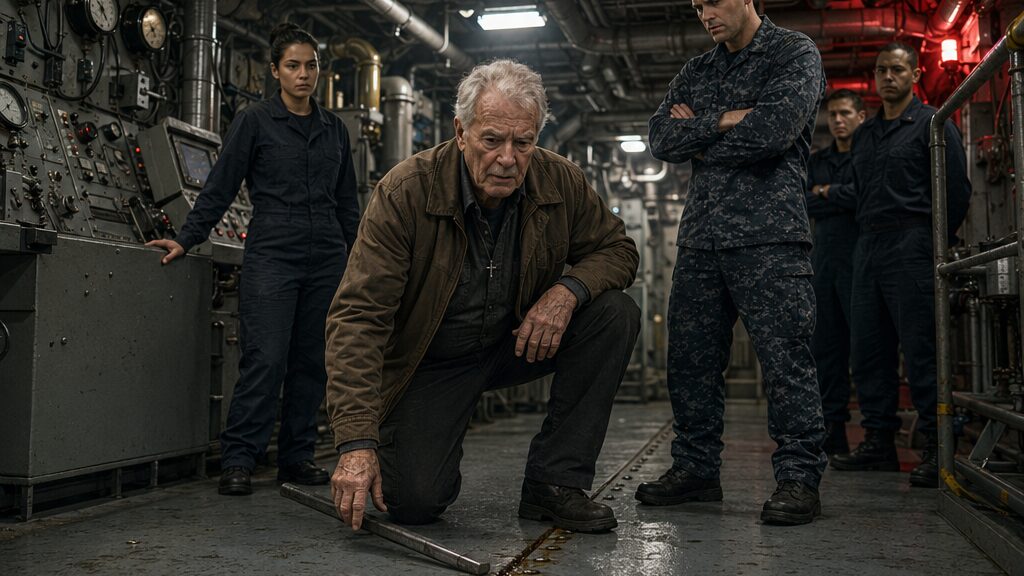
Richard crouched, slowly enough that the movement felt public. He touched the first rivet near the aft bulkhead with one finger. The metal was cool through the grime.
One.
He moved to the next.
Two.
James watched him. “What are you doing?”
Richard kept counting under his breath.
Three. Four. Five.
The old pattern returned through his fingertips more clearly than any diagram. George had measured from the bulkhead because the access seam vanished under dirt within weeks of installation. Eleven rivets, then half a handspan inboard.
Six. Seven.
Stephen came beside him. “Richard, what exactly do you think is under there?”
“Something that should have stayed disconnected.”
James heard him. “You just said it may be moving.”
“I said something is moving.”
“That’s not an answer.”
Eight. Nine.
Richard reached the tenth rivet. A long steel maintenance bar rested against a nearby cabinet, left there by a shipyard worker. Its flattened end was dark with old use.
Ten.
He touched the eleventh rivet and looked across the coating. No seam was visible.
His certainty weakened.
The deck seemed too smooth. The old access plate might truly have been removed. He might be kneeling before a room of younger professionals, tracing a memory that no longer existed.
James exhaled. “All right. We’re done here.”
Richard placed his palm flat against the deck.
The double knock came again.
This time he felt the second impact through the steel.
“There,” he said.
Amy looked at the raw trace. “Another dip. Same magnitude.”
James turned fully toward the console.
That was the first small victory, but it did not feel like one. Richard saw the officer’s face settle into concern, then resist it.
“Could be support movement,” James said. “Could be a loose hanger.”
“Not from there.”
James faced the watch team. “Continue to hold pressure. No increase.”
Then, to Richard, “You will remain clear of the controls and the piping. Stephen, take him to the engineering office. We’ll inspect the visible supports.”
Richard rose, using the edge of a cabinet. His knee burned. He hated that Amy noticed.
Stephen reached for his elbow, but Richard stepped away before the hand landed.
The crew began moving. Flashlights appeared. One watchstander climbed onto a low platform to examine a hanger. James bent over Amy’s display.
Richard looked down once more at the eleventh rivet.
A wet line had formed beside the toe of his worn shoe.
At first it was no wider than a thread. Then a bead pushed through the painted deck seam, brown with rust, and traveled toward the drain.
Richard did not move.
“Lieutenant,” he said.
James looked over.
The second bead emerged exactly where the plans showed solid steel.
Chapter 2: Eleven Rivets From the Aft Bulkhead
“Counting rivets is not a recognized maintenance method.”
James said it loudly enough for everyone in the compartment to hear.
The rust-colored water continued to gather along the seam at Richard’s feet. Amy had reduced the pump to minimum test pressure, but the machinery space still carried the heavy vibration of running equipment. The red warning lamp near the ladder flashed at regular intervals, washing the crew’s faces in color and taking it away again.
Richard looked at James. “Neither is pretending a leak isn’t there.”
A watchstander coughed into his fist.
James glanced toward him, and the compartment went still.
“I am not pretending anything,” James said. “I am controlling access to a pressurized system. We do not pry open unknown deck structures because a former crew member remembers something.”
“Then depressurize it.”
“That stops the inspection.”
“Yes.”
The single word landed harder than Richard intended.
James looked toward Stephen, who had begun searching the shipyard tablet for alteration records. “Do you have anything showing an access plate here?”
“Nothing yet.”
“Then nobody touches the deck.”
Richard watched another brown bead rise through the seam. “The plate is already being touched from below.”
James’s eyes narrowed. “By what?”
“That’s what we need to find out.”
“And if you are wrong?”
Richard looked around the compartment. The crew had formed a loose semicircle, leaving him and James in the center. He understood the scene from their side: an elderly man in civilian clothes insisting that a hidden mechanism existed beneath a floor their plans described as solid. His jacket was faded at the shoulders. His hands shook slightly even when he held them still. He had no current qualification card, no authority, and no proof beyond a sound and a leak.
“If I’m wrong,” he said, “you lose fifteen minutes and replace a deck seal.”
“And if your bar damages an active line?”
“It won’t.”
“You cannot know that from memory.”
“No,” Richard said. “I know it from where the lines run.”
James gave him a long look. “That distinction is not reassuring.”
Richard almost answered sharply. Instead he removed his jacket and laid it over a valve-guard rail. Beneath it he wore a dark work shirt, old but clean. A small cross hung from a chain at his chest. Margaret had given it to him after George’s funeral, though she had never known what he had failed to tell her.
He pointed at the aft bulkhead.
“First rivet.”
Nobody moved.
Richard lowered himself to one knee. The steel felt harder than it had twenty minutes earlier.
“One,” he said.
His finger moved.
“Two.”
The count sounded foolish in the machinery space, too small against pumps and fans. At four, one of the younger watchstanders glanced sideways at another. At six, the corner of someone’s mouth lifted.
James saw it and did not stop it.
“Seven,” Richard said.
He kept his voice even.
“Eight. Nine. Ten.”
At the eleventh rivet, he measured inward with the width of four fingers. He scraped at the non-skid coating with his thumbnail. A dark line appeared beneath the gray surface.
Stephen crouched on the other side. “That could be a weld.”
“It isn’t.”
Richard reached for the long maintenance bar.
James stepped between them. “No.”
“Then open it yourself.”
“With what authorization?”
“The kind that begins when water comes through the deck.”
James’s face hardened, but Amy spoke before he could answer.
“Sir, the leak rate is increasing.”
“How much?”
“Slow, but measurable. And the dip is still synchronized.”
James looked down at the seam. He was no longer amused. That mattered, though Richard took no satisfaction from it.
“Minimum pressure,” James ordered. “Establish a safety boundary. No one touches the exposed mechanism if there is one.”
The watch team moved quickly. Their efficiency made Richard feel the unfairness of his earlier judgment. They were not careless sailors. They were trained people working from the information they had been given.
Information he had helped withhold.
James took the bar from Richard and inspected its flattened end. “Show me the lift point.”
Richard indicated a spot no larger than a thumbnail.
James inserted the bar. It stopped after half an inch.
“Wrong angle,” Richard said.
James changed it.
“Lower.”
The officer tried again. The bar slipped and struck the deck with a sharp clang.
Richard held out his hand.
James hesitated, then returned it.
Richard set the flattened edge against the seam. He remembered the exact angle because George had complained about it the night they cut the plate: too shallow and the bar jumped; too steep and it caught the frame.
He leaned.
Pain ran from his wrist into his shoulder. The plate did not move.
Someone behind him shifted weight.
Richard reset the bar and pressed again. His arms trembled now, not lightly but visibly. The old humiliation rose hot in his face. He could locate the plate. He could remember the load path. But his body no longer answered a command simply because he gave it.
A hand closed around the bar below his.
Amy knelt beside him.
“Tell me where,” she said.
Richard did not thank her. Gratitude would have made the weakness larger than it was.
“Keep the edge seated. Pressure toward the bulkhead first. Then lift.”
She followed his direction. The seam opened with a faint crack as old paint broke.
“There,” Richard said. “Hold it.”
James crouched and shone a flashlight into the gap. “I see a frame.”
The smiles disappeared.
With Amy maintaining pressure, Richard shifted the bar another inch along the seam. James added his gloved hands to the plate’s recessed edge. Together they lifted.
Stale water spilled into the drain channel.
Beneath the deck lay a rectangular steel recess crowded with hardware painted a faded emergency red. Two isolation handles sat parallel to the ship’s centerline. Between them was a compact actuator housing connected to an old mechanical linkage.
For one second, Richard saw it as it had been: new paint, fresh cuts, George’s grease pencil marks, smoke pressing down from the overhead.
Then the present returned.
The operating socket was empty.
The key was gone.
Worse, the linkage arm had been disconnected and wired back against the frame.
James leaned closer. “Manual cross-connect.”
Richard caught his shoulder.
“Don’t touch it.”
James froze.
The whole room heard the fear in Richard’s voice.
He released the officer at once, ashamed of the grip. “No one moves either handle.”
James studied the mechanism without reaching into the recess. “You said this could be causing the pressure dip.”
“It could.”
“If the linkage is disconnected, how?”
Richard looked at the wear marks near the actuator shaft. A bright crescent showed through the corrosion. Something had moved recently. But the linkage was not arranged as he remembered. The retaining assembly sat at a different angle, and a securing bracket had been added after the original casualty.
His first explanation had been incomplete.
Amy aimed her light toward the actuator. “There’s no key.”
“It was removable,” Richard said.
“Where is it?”
“I don’t know.”
James turned toward him. “You knew this was here. You knew how to open it. You knew not to touch it. Start explaining.”
Richard’s gaze remained on the disconnected arm.
George had disconnected it himself after the casualty. Or Richard believed he had. The distinction had once seemed unimportant because neither of them expected the arrangement to survive the next overhaul.
Stephen’s tablet chimed. He looked down, then shook his head. “Still no alteration record. Nothing under cooling-water cross-connect, manual bypass, or auxiliary isolation.”
James’s voice became quieter. “Who installed this?”
Richard could have said the old crew. He could have said it was done during an emergency. Both statements would have been true, and neither would have answered the question.
The familiar refuge of partial truth opened before him.
He looked at the crew around the recess. Amy still held the steel bar. James had uncrossed his arms. No one was smiling now.
“We did,” Richard said.
James waited.
Richard looked at the red actuator and the empty socket where the key should have been.
“But not the way the record will say.”
Chapter 3: The Compartment Missing From Every Plan
The archive search returned zero results for a compartment that stood open beneath James Baker’s boots.
He ran the query again.
Manual cross-connect. Emergency cooling route. Auxiliary bypass. Deck access, lower engineering.
Each search produced the same clean answer: no matching alteration.
Across the engineering office, Richard sat beneath a ventilation grille that rattled every time the ship’s fans changed speed. His faded jacket rested over his knees. Stephen stood beside the records terminal, scrolling through scanned drawings while Amy waited near the door with a grease-smudged notebook in one hand.
James looked from the empty results to Richard.
“You said the record would be wrong.”
“I said it wouldn’t say how we did it.”
“That is not the same thing.”
“No.”
“Was the modification authorized?”
Richard rubbed one thumb over the worn edge of his jacket cuff. “At first.”
James leaned back. “At first?”
Stephen interrupted before Richard could answer. “The conversion drawings are consistent. Same arrangement across three revisions. Whoever digitized the plans copied the paper set accurately.”
“So the digital package isn’t missing a scan,” James said.
“No. If something was omitted, it was omitted before the conversion.”
James’s expression tightened. He had spent the morning defending the accuracy of the current configuration. Now accuracy itself had become the problem.
He turned to Richard. “What was the cross-connect for?”
“Emergency cooling.”
“To what?”
“The aft machinery zone.”
“From which source?”
Richard hesitated.
Amy noticed. So did James.
“The forward loop,” Richard said.
James rose. “That would create a common-mode failure path between zones that are supposed to remain isolated.”
“It wasn’t a permanent arrangement.”
“It has been under my deck for decades.”
“Disconnected.”
“We found fresh water around it.”
Richard’s hand stilled.
James came around the desk. His anger had changed since the machinery compartment. It no longer came from embarrassment. It came from understanding enough to fear what he did not know.
“You told us not to touch the handles,” he said. “Why?”
“Because the sequence matters.”
“What sequence?”
Richard looked toward Amy. “The upstream isolations.”
“How many?”
“Two.”
“Which two?”
The answer should have come immediately.
Richard saw the old system in fragments: a valve wheel near the purifier platform, a pressure gauge trembling against its stop, George bent into the recess. But the modern piping modifications interfered with the memory. Lines had been rerouted. Numbering had changed.
“I need to see the current diagram.”
James gave a humorless laugh. “The current diagram says the system does not exist.”
Stephen placed both hands on the desk. “Arguing won’t close the discrepancy. We need the old casualty files.”
James looked at him. “What casualty?”
Richard’s silence answered first.
Stephen turned slowly. “Richard?”
“There was a loss of cooling,” Richard said. “Long ago.”
“How long?”
“Forty-three years.”
“Personnel casualties?”
Richard looked down at the jacket across his knees. “One.”
No one spoke for several seconds.
James returned to the terminal and opened the inspection schedule. The next test window began at fourteen hundred. Delaying beyond that would push the entire readiness sequence into another day.
“We secure the compartment,” he said. “We inspect the visible hardware, determine whether the leak is from trapped water or an active source, and decide whether this is an abandoned cavity.”
“It isn’t abandoned,” Richard said.
“The linkage is disconnected, and there is no operating key.”
“Something inside it is moving.”
“You don’t know that.”
“I heard it.”
“You heard a knock in a running machinery space.”
Amy shifted near the door. “Sir.”
James looked at her.
“I marked the pressure events. All three dips occurred with the double impact.”
“That establishes correlation.”
“It establishes enough to inspect.”
James’s eyes rested on her for a moment. “We will inspect. We will not assume Mr. Mitchell’s explanation is complete.”
Richard accepted the rebuke because it was true.
They returned below decks with flashlights, mirrors, absorbent pads, and a small inspection camera. The pump remained at minimum pressure. A temporary barrier surrounded the open recess.
James knelt beside it, his sleeves rolled above the wrists. He had removed his camouflage blouse and worked in a dark undershirt, looking less like the officer who had laughed and more like an engineer who disliked unanswered systems.
Amy fed the camera behind the red actuator.
“Standing water in the bottom,” she said. “Corrosion on the aft frame. No visible active spray.”
“Trace the linkage,” James ordered.
She adjusted the camera. The image appeared on a handheld display: red-painted steel, a disconnected arm, a retaining bracket, and a dark cylindrical pin.
Richard leaned closer.
The pump tone shifted.
Knock.
Amy froze the image.
Knock.
On the display, the retaining assembly twitched.
James saw it.
His mouth flattened. “Again.”
Amy replayed the last few seconds. The movement was slight, but undeniable.
“Could be vibration transfer,” he said.
Richard pointed toward the linkage arm. “Look at the contact face.”
Amy cleaned the area with a swab attached to a flexible rod. Beneath the rust lay a fresh silver arc.
Metal had rubbed metal recently.
James sat back on his heels.
The anomaly was not a bad sensor. It was not trapped water. Something in the hidden compartment was responding to system pressure even though the operating linkage had been disconnected.
For the first time, James looked directly at Richard without impatience.
“What happens if that pin comes free?”
Richard studied the arrangement. “Depends what the later bracket is holding.”
“You don’t recognize it?”
“No.”
The admission surprised Amy.
Richard continued, “That bracket wasn’t there when we installed the cross-connect.”
James looked toward the two isolation handles. “Could movement transfer to either valve?”
“Possibly.”
“And if one opens?”
Richard answered carefully. “You could lose separation between cooling zones.”
James stood. “Secure the test.”
Amy began writing the discrepancy.
James watched her pen.
“Not formally yet,” he said.
She looked up. “Sir?”
“Record the observation in the local test notes. Do not enter it into the readiness discrepancy system until I review the classification.”
Stephen, standing outside the barrier, lowered his tablet. “James.”
“I am not hiding it.”
“You’re delaying it.”
“I am determining whether abandoned legacy hardware constitutes a readiness failure or a shipyard documentation issue. Those are not the same.”
Richard watched Amy close the discrepancy form.
He knew that motion.
He had made its equivalent with a typewriter page forty-three years earlier: set aside the complete account until the wording could be made precise; wait until the consequences were understood; protect the ship, the crew, the family from facts that might be misread.
Delay became omission more easily than anyone admitted.
The pump was reduced further. The double knock faded.
Richard knelt beside the recess after the others stepped back. He directed his flashlight across the actuator housing, searching for the old stamped number.
Instead, the beam caught a tiny triangular mark filed into the red paint near the operating socket.
His breath stopped.
George had marked emergency-only equipment that way when labels would not survive heat or water: three short cuts forming an uneven triangle. Richard had teased him for it. Said no official procedure recognized George’s private symbols.
George had answered, Official procedures don’t help when the lights go out.
Richard touched the edge of the recess but not the mark.
James noticed his face. “What is it?”
Richard did not answer immediately.
The triangle was not merely proof that George had worked on the mechanism. Its position beside the empty key socket carried a specific meaning between them.
Do not operate without me.
The key had not been lost.
George had taken it.
Richard looked into the dark cavity around the disconnected linkage, and the machinery space seemed to narrow around an old absence.
“That mark,” he said, “belonged to the man who made sure no one used this system by mistake.”
James followed the flashlight beam. “The casualty?”
Richard nodded.
“Why did he disconnect it?”
The question reached past the machinery, past the missing drawings, to the part Richard had spent forty-three years refusing to put into words.
He looked at the small triangle George had cut into the housing.
“Because the last time we used it,” Richard said, “he didn’t come back out.”
Chapter 4: The Name Richard Would Not Put in Writing
“The Navy is finally admitting what happened to George?”
Margaret’s voice came through Richard’s motel phone before he had finished saying the words red actuator.
He sat on the edge of the bed with the receiver pressed to his ear. His faded jacket hung from the back of the only chair. On the desk, beneath the yellow light, lay a photocopy of the current cooling-water diagram, the hidden compartment represented by nothing more than blank space between two documented lines.
“No one has admitted anything,” he said.
“Then why are you calling me?”
Richard looked at the narrow strip of paper he had taken from his wallet. It had been folded so many times the creases had become pale seams. Eleven short pencil marks crossed one edge. George had drawn them while they argued over where to cut the deck.
“I need his notebook.”
Margaret went silent.
The motel air conditioner clicked off, leaving Richard with the faint ringing that remained in his ears after a day below decks.
“Which notebook?” she asked.
“The maintenance book he kept at home. Brown cover. Loose pages tucked in the back.”
“I know what it looks like.”
“Do you still have it?”
“Why?”
Richard pressed his thumb over the eleven marks. “There may be a sequence in it.”
“A sequence for what?”
“The cross-connect.”
“Say it plainly.”
He closed his eyes.
She had always known when he was arranging words to avoid the center of them. George used to laugh about it. Richard can give you the truth in six pieces and make each one sound complete.
“There’s an old emergency cooling arrangement under the engineering deck,” Richard said. “The current crew didn’t know it was there.”
“But you did.”
“Yes.”
“And George did.”
“Yes.”
The answer sharpened her breathing.
“What has it got to do with his death?”
Richard stood and walked to the window. Beyond the glass, cranes rose over the shipyard in black outlines. The Resolute’s mast lights showed between two warehouse roofs.
“There was a casualty,” he said. “We were losing cooling aft.”
“I know that part. I have known that part for forty-three years.”
“We made an emergency route.”
“We?”
Richard watched a vehicle move along the pier, its amber light revolving without sound.
“The engineering crew.”
“That isn’t what I asked.”
He said nothing.
Margaret’s voice lowered. “You called me the morning after. You told me George stayed at his station so other men could get clear.”
“He did.”
“You told me the system failed faster than anyone could have predicted.”
“It did.”
“You told me there was nothing he could have done differently.”
“There wasn’t.”
“What did you do differently, Richard?”
The room seemed to contract around the question.
He returned to the desk and set the paper down. Eleven marks. A private map made before the steel had cooled.
“We needed another cooling path,” he said. “The installed one was blocked by damage. I found a way to connect the forward loop.”
“You found it?”
“Yes.”
“And George?”
“He helped install it.”
The pause that followed was worse than anger.
Richard heard Margaret open something—a drawer, perhaps, or a cabinet. Papers shifted.
“He mailed me a note three days before he died,” she said.
Richard’s hand tightened around the receiver.
“What note?”
“I thought it was one of his jokes about shipboard work. He wrote, ‘Richard found a path under the floor the plans forgot. Says we can make it behave if the ship ever gets stubborn.’”
Richard sat down slowly.
George had never told him about the note.
Margaret continued, “I kept it because it sounded like him. Proud of something nobody else would understand.”
“The arrangement was temporary.”
“You keep saying that as if temporary things cannot kill people.”
Richard looked at the blank place on the copied diagram.
“It saved the aft zone during the first failure.”
“And then?”
“The conditions changed.”
“What conditions?”
He could see the old compartment without trying: steam hanging in layers, emergency lamps turning every face red, George braced in the recess with both hands on the manual valve. Richard had ordered him to remain there until pressure stabilized.
He had believed it would take thirty seconds.
It took longer.
“I need the notebook,” he said.
“No.”
The refusal was quiet and immediate.
“Margaret—”
“You are asking me for the part George wrote down because you still will not give me the part you remember.”
“It may prevent another casualty.”
“Then tell the Navy what you know.”
“I have.”
“You told them a system exists. You told them George marked it. That is not the same as telling them what happened.”
Richard’s free hand closed over his knee. “There are things that should be said carefully.”
“You have had forty-three years to choose the words.”
He had no answer that did not sound like an excuse.
Margaret let the silence hold.
When she spoke again, the anger had changed shape.
“Do you know what your careful version did to me?”
Richard stared at the cross hanging against his shirt.
“It let everyone call George brave without telling me what he was asked to do. It gave me a clean story. Men were saved. George stayed behind. Equipment failed. Nobody made a decision.”
“He was brave.”
“I never said he wasn’t.”
“He chose to stay.”
“After whose order?”
Richard’s throat tightened.
The old instinct returned: protect her from the image, protect George from being reduced to a victim, protect himself from a sentence that could not be taken back.
He had called that restraint for most of his life.
Now, with the hidden plate open aboard the Resolute, it sounded like something else.
“My order,” he said.
Margaret did not respond.
Richard forced himself to continue.
“I told him to hold the manual valve while we shifted the cooling load. I believed the route was isolated. I believed we had time.”
“Did you design it?”
He looked at the eleven pencil marks.
“I laid out the path.”
“That is not what I asked.”
“Yes.”
The word left him with almost no sound.
On the other end of the line, paper rustled again.
Margaret said, “George wrote in the margins when he didn’t trust the official instructions. He said diagrams showed where things were supposed to be. Margins showed where they really were.”
Richard remembered the brown notebook in George’s back pocket, swollen with folded scraps and stained by oil.
“Will you bring it?” he asked.
“Not yet.”
“The ship may have an active fault.”
“Then you had better stop giving them the safe version.”
Richard closed his eyes.
Margaret’s next words came with no softness, but no cruelty either.
“You didn’t just know where it was, Richard. George wrote that you designed it.”
Chapter 5: The Safe Version of an Old Casualty
The hidden deck plate had been resealed when Richard returned to the Resolute on Tuesday morning.
A temporary strip of yellow sealant traced its edges. A placard wired to the nearby railing read: LIMITED PRESSURE TEST—1200 HOURS.
Richard stood over the eleven rivets while sailors moved around him preparing the machinery space. The steel bar had been returned to its rack. The red mechanism was again out of sight.
James approached carrying a folder.
“We cannot leave an open deck hazard during routine access,” he said.
“You should not be conducting routine access.”
“The leak was minimal at reduced pressure.”
“The linkage moved.”
“We are assessing whether it can affect an active valve.”
Richard looked at the placard. “At noon?”
“Under controlled conditions.”
“With the discrepancy still local?”
James’s gaze sharpened. “Stephen told you.”
“He didn’t need to.”
The officer shifted the folder under one arm. He looked tired. A dark shadow ran beneath his eyes, and the confidence he had worn the day before had become something more deliberate.
“I requested a limited-risk authorization,” James said. “Minimum operating range. Additional observers. Immediate abort criteria.”
“You requested it without reporting fresh wear on an undocumented assembly.”
“I reported an unidentified legacy cavity pending classification.”
Richard almost smiled, though nothing was amusing.
The phrasing was careful. Technically accurate. Incomplete.
It sounded like his own language.
Amy waited at the machinery-control station. When James moved away to speak with the chief engineer’s assistant, she came to Richard.
“Sir,” she said quietly.
“You don’t have to call me that.”
She glanced toward James. “Lieutenant Baker told me not to put the wear mark in the formal system until he reviewed it.”
“When?”
“Yesterday.”
“And you agreed.”
Her face tightened. “I entered it in the local notes.”
“That wasn’t my question.”
“No,” she said. “I didn’t submit the discrepancy.”
Richard looked at her for several seconds. She did not look away.
“I’m still working on my qualification,” she said. “If I accuse my division officer of suppressing evidence and I’m wrong—”
“You saw the metal move.”
“Yes.”
“Then you weren’t wrong about what you saw.”
“That doesn’t tell me what it means.”
“No.” Richard turned toward the resealed plate. “But delaying a fact until its meaning is convenient changes what the fact can protect.”
Amy heard the judgment in his voice.
“So why didn’t your fact make it into the plans?”
The question struck cleanly.
Richard looked at her.
She lowered her voice. “You said you installed it. There’s no record. You knew not to touch it. You knew someone died. Maybe Lieutenant Baker isn’t the only one who waited.”
Richard felt the old defense rise—that the casualty had been chaotic, that reports were consolidated, that senior officers decided what entered the permanent record. Every piece of it was true.
None of it answered her.
At nine hundred, James gathered the engineering watch team in the wardroom. Stephen sat near the bulkhead with a stack of archive printouts. The readiness-inspection chair appeared by secure video, impatient and grainy on the wall display.
James summarized the fault as an undocumented disconnected manual actuator with uncertain system interaction. He recommended limited testing to establish whether pressure changes produced meaningful movement.
Richard listened until James said, “Historical consultation suggests the assembly was an emergency modification, but the original configuration remains unverified.”
“Historical consultation designed it,” Richard said.
The room stopped.
James turned from the display. “What?”
Richard stood at the end of the table, hands resting on the back of an empty chair.
“I designed the cross-connect route.”
Stephen’s head lifted.
The inspection chair leaned toward the camera. “State your name and role at the time.”
“Richard Mitchell. Chief machinist’s mate. Aft engineering watch supervisor.”
James stared at him. “Yesterday you said your crew installed it.”
“They did.”
“You did not say it was your design.”
“No.”
“Why?”
Richard saw Amy near the doorway. Her expression remained still.
“Because I have spent a long time describing what happened without describing my part in it.”
The video display crackled.
The inspection chair asked, “Was the modification authorized?”
“The first configuration was approved as an emergency measure during a cooling casualty. We installed a temporary manual cross-connect beneath the deck. It let the forward loop supply the aft zone.”
“And the configuration now present?”
Richard shook his head. “The retaining bracket was added later. I don’t recognize it.”
“Was the system operated?”
“Yes.”
“Successfully?”
Richard looked down at his hands.
“At first.”
No one interrupted.
“The aft cooling line had failed,” he continued. “We had heat rising in the machinery zone and personnel still clearing equipment. The cross-connect gave us flow. When pressure shifted, an isolation did not seat as expected. George remained in the valve recess to hold the manual position.”
“On whose instruction?” the chair asked.
“Mine.”
James sat down slowly.
Richard kept speaking before silence could protect him again.
“I believed the upstream valves were isolated. I believed he would be there less than a minute. Smoke conditions changed. Access was lost before we could relieve him.”
The wardroom’s ventilation hummed.
“What happened to the modification record?” Stephen asked.
“I completed the technical portion.”
“And the casualty statement?”
Richard’s mouth went dry. “Not all of it.”
The inspection chair’s face hardened. “Are you saying the permanent file may be incomplete because you failed to submit a full statement?”
“Yes.”
James closed the folder in front of him. The sound was small but final.
Richard looked at him. “The test should stop.”
James’s expression held anger, but it was no longer the anger of a younger officer correcting an old visitor.
“You withheld relevant history while challenging my decision-making.”
“Yes.”
“You expected me to trust your warning without giving me the basis for it.”
“Yes.”
“And now you want me to stop a readiness evolution because you say the system is dangerous.”
“I want you to stop because the evidence says it is dangerous.”
James stood. “The evidence says a retaining assembly moved. We still do not know whether it can shift a valve.”
Richard’s voice remained low. “That is what I said to myself when I delayed the report. I knew part of the danger. I told myself I needed the rest before I made it official.”
James’s face changed.
The comparison landed where accusation would not have.
The inspection chair ordered the limited test suspended pending archive review. The video connection ended.
Stephen opened one of the printouts. “I searched the casualty index by date rather than equipment.”
He laid the page on the table.
Four statements were listed. Three had corresponding page ranges. Richard’s entry ended with a notation: continuation pending.
James read it twice.
“Where is the continuation?”
Stephen shook his head. “There isn’t one in the archive.”
Richard looked at the words.
He remembered the typewriter waiting outside the medical compartment, a blank page rolled beneath the ribbon. He remembered placing his fingers on the keys and stopping at the sentence that would have located George inside the recess.
James tapped the notation.
“Was this page lost,” he asked, “or did you never write it?”
Chapter 6: What George Left Inside the Margins
Margaret arrived at the shipyard carrying George’s notebook in a clear plastic bag.
She did not offer it to Richard.
“I’m not bringing this to save your reputation,” she said.
They stood inside the records office, where metal shelves held boxed drawings and casualty files under fluorescent lights. Stephen waited by the copying table. Amy had come from the ship with a laptop containing the current cooling-system model. James remained aboard preparing for a possible controlled shutdown.
Richard looked at the notebook through the plastic. The brown cover had darkened almost to black around the edges.
“I know,” he said.
Margaret studied his face. “Do you?”
“Yes.”
“Then answer the question you left hanging.”
Stephen moved toward the door. Margaret stopped him.
“You can stay. Somebody should hear it the first time.”
Richard rested both hands on the back of a chair.
“There was no missing page,” he said. “Not in the sense the index suggests.”
Margaret waited.
“I started it. I wrote through the pressure transfer and the first isolation failure. Then I reached the part where George remained in the recess.”
“And?”
“I stopped.”
“Why?”
Richard looked at the bag in her hands.
“Because the sentence had to say I left him there.”
“You ordered him there.”
“Yes.”
“Did you leave him?”
Richard saw the red emergency light, George’s shoulder beyond the hatch, steam turning the compartment white.
“I went back once,” he said. “He told me the valve would move if he released it. Men were still crossing the aft platform. I told him to hold another thirty seconds.”
Margaret’s fingers tightened around the notebook.
“The smoke boundary closed before thirty seconds passed.”
“You never told me you went back.”
“No.”
“Why not?”
“Because it made the choice mine twice.”
Margaret’s anger did not disappear. It settled.
She placed the notebook on the table but kept one hand on it.
“George made choices too,” she said. “Do not use guilt to take those away from him. But do not use his courage to hide yours.”
Richard nodded once.
She released the notebook.
The pages smelled faintly of oil and old paper. George’s handwriting crowded the margins, slanting around printed maintenance tables and parts lists. Near the center, Richard found a hand-drawn flow path with two heavy arrows and a red X beside the actuator symbol.
Along the bottom edge were eleven short marks.
Amy leaned over the table. “Those match the deck rivets.”
Richard traced them without touching the paper. “He wanted a reference that would survive repainting.”
Beside the sketch, George had written:
Never engage red actuator until forward suction and auxiliary return are both verified shut. No assumptions. Two people confirm.
Amy opened the current system model. “Which valves correspond to those now?”
Richard pointed first to the forward suction isolation, then to a return valve on the opposite side of the diagram.
Amy frowned. “That order would trap pressure in the cross-connect leg.”
“No. Return first, then suction.”
“You just pointed to suction first.”
Richard looked at the screen.
In his memory, George’s hand had been on the upper wheel. But the old drawing placed the upper wheel on the return side, while the modern diagram had inverted the layout for screen orientation.
He had reversed them.
Amy enlarged the pressure model. “If we shut suction first with the retaining assembly loaded, differential pressure could drive the loose pin farther out.”
Richard felt everyone waiting for him to defend himself.
He did not.
“You’re right,” he said.
Amy looked surprised.
“Mark it,” Richard continued. “Return isolation first. Verify zero differential. Then suction.”
Margaret watched him, and some small hardness left her face.
The notebook did not provide a complete solution. George’s sketch predated later piping changes, and the bracket beneath the deck appeared nowhere in his notes. For the next three hours, Richard and Amy worked line by line. He supplied the purpose of old branches and the logic behind emergency choices. She checked every memory against current valve positions, sensor locations, and pressure paths.
Whenever Richard said, “It should,” Amy made him replace it with a measurable condition.
By late afternoon, they had a provisional safe sequence.
Then Amy’s phone sounded.
She answered, listened, and went pale.
“What happened?” Stephen asked.
“The leak increased.”
They hurried to the machinery-control station. On the display, cooling-water pressure remained within operating limits, but the dips had deepened. The double knock now occurred every few minutes.
James stood over the console with the commanding officer beside him.
“We borescoped the retaining assembly again,” James said. “The pin has shifted another eighth of an inch.”
The commanding officer looked at Richard. “Can the system remain in service?”
“Not without knowing what the bracket is carrying.”
“How long to find out?”
Richard looked at Amy.
She brought up their sequence. “A controlled shutdown and inspection can be prepared in six hours.”
“Then you have six,” the commanding officer said. “After that, if the leak worsens, we secure the loop under emergency conditions.”
He left without waiting for agreement.
James read the sequence. His eyes paused at the changed valve order.
“You corrected this?”
“Amy did,” Richard said.
James looked at her. “You’re certain?”
“I modeled both sequences. This one unloads the cross-connect before the suction isolation.”
He nodded, accepting it without argument.
Stephen spread George’s sketch beside the current diagram. “What about physical access to the retaining pin?”
James pulled up the camera images. The bracket sat behind the red actuator, inside a narrow recess between the deck frame and an old pipe support.
Amy studied the dimensions. “A standard tool won’t reach from above.”
“There used to be side access,” Richard said.
James enlarged the image. “Here?”
A dark rectangular opening lay behind the actuator, barely wide enough for a person’s shoulders.
Richard knew it before the picture resolved.
The valve recess.
George’s recess.
The room around him seemed to lose air.
Amy followed his gaze. “Someone has to go inside to secure the assembly while it’s unloaded.”
James looked from the image to Richard. “Can it be done with a remote tool?”
“Not if the pin is already walking out.”
“Then we send one technician.”
Richard’s answer came before James finished.
“No.”
The word struck the room with the force the double knock no longer needed.
James’s eyes narrowed. “We may not have another option.”
Richard looked at the narrow opening on the display, the same space in which George had once been made indispensable.
“We find one,” he said. “No one enters that space alone again.”
Chapter 7: No One Enters That Space Alone Again
James received the order at 2110.
The inspection chair’s voice came through the machinery-control speaker, clipped by static and impatience.
“Isolate the affected branch, preserve the forward loop, and complete the readiness hold. We cannot lose the entire test window over an abandoned modification.”
James stood at the console with one hand braced beside the pressure display. The double knock had grown louder during the last hour. Each second impact now carried a faint metallic scrape.
Amy looked at him.
Richard stood behind her with George’s notebook open against a clipboard. Eleven pencil marks crossed the lower margin of the page.
“The branch isolation leaves pressure across the old cross-connect,” Amy said.
“The model shows it within tolerance,” the inspection chair replied.
“The model does not include the retaining bracket,” Richard said.
A pause followed.
“Mr. Mitchell is not part of the command decision,” the chair said.
Richard watched James’s shoulders tighten.
The younger officer had begun the day by trying to protect his inspection. Now the same system offered him a way to preserve it: accept the faster isolation, classify the hidden equipment later, and allow the schedule to continue.
James looked at the pressure trace. “What is the risk if we isolate only the branch?”
Richard answered carefully. “The pin remains loaded. If it shears, the bracket may transfer movement to the disconnected actuator.”
“May?”
“Yes.”
“And with the full shutdown?”
“We unload both sides before anyone enters the recess.”
The speaker crackled. “Lieutenant, you have an approved procedure. Execute it.”
James glanced toward Amy. “Does the approved procedure account for the cross-connect?”
“No, sir.”
He looked at Richard next.
Richard did not tell him what to do. Orders given from outside the consequences had shaped enough of the ship’s history.
James pressed the transmit switch.
“I cannot certify the partial isolation as safe.”
The compartment seemed to pause around him.
The inspection chair’s voice hardened. “Explain.”
James swallowed once. “I delayed entering observed linkage wear into the formal discrepancy system while I assessed its impact. That delay was an error. The system model is incomplete, and I will not use it to justify placing a technician inside an energized recess.”
Amy’s eyes shifted toward him.
“Are you refusing the directed evolution?” the chair asked.
“I am requesting full shutdown under casualty-prevention authority.”
“You understand the schedule consequences.”
“Yes.”
James released the switch and ordered the forward loop secured.
The machinery space changed as pumps slowed. The steady roar descended through several tones until individual valves, fans, and footsteps became audible. Gauge needles settled. Amy called out pressures while two watchstanders verified each position independently.
Richard stood over the aft bulkhead.
“One,” he said.
Amy, kneeling beside him with the field sketch, touched the first rivet.
“Verify, not repeat,” Richard told her.
She measured from the bulkhead with a steel rule.
“One confirmed.”
They continued to eleven.
No one smiled this time.
The deck plate was reopened using the same long steel bar. Richard set the angle but did not take the load. Amy held the bar while James lifted the plate with a second watchstander. The red actuator emerged beneath the work lights, its paint dulled by water and time.
The retaining pin had moved farther out.
A bright ring of metal showed around its base.
Amy positioned the inspection camera inside the recess. “The aft end is carrying against the bracket. If we pull it from above, the bracket may rotate.”
“We secure it from inside,” James said.
Two technicians prepared harnesses and communication leads.
Richard saw one set of equipment.
“Where is the second?”
James looked at him. “The recess only fits one person at the bracket.”
“Then one enters and one remains at the opening with a direct retrieval line.”
“That is not the same as two-person access.”
“It is what the space allows. But no one goes beyond reach, no one works without voice contact, and no one becomes the only person who can hold the system safe.”
James studied the narrow opening. “You know the internal clearances.”
“I knew them.”
Richard removed his jacket.
Amy watched him. “What are you doing?”
“Showing the approach.”
“No,” James said.
Richard looked at him.
“You are not entering that recess.”
“I’m the only one who knows where the old support bends.”
“You said no one should be indispensable inside it.”
“That was about the technician.”
“It applies to you too.”
The words struck Richard with unexpected force.
For forty-three years, he had imagined the old casualty ending differently only if he had gone back farther, stayed longer, taken George’s place. The fantasy had always disguised itself as responsibility.
He looked into the opening.
“No one enters alone,” he said.
“And no one enters because they need to repair the past,” James replied.
Richard put his jacket back on.
Amy directed the entry. One technician crawled into the recess with a low-profile brace while the second remained at the opening, one hand on the retrieval line and the other on a tool tether. James monitored pressure. Richard stood beside the current piping diagram and George’s notebook.
“Brace is against the bracket,” the technician reported.
Amy checked the camera. “Advance half an inch. Stop before the old weld.”
“Half an inch.”
The pin gave a dry metallic click.
Every gauge remained steady.
Then the outer edge fractured.
A silver crack ran across the exposed ring.
“It’s shearing,” Amy said.
The technician inside the recess stopped moving. “Bracket load increasing.”
James looked at Richard. “If it separates?”
Richard traced the old flow path in his mind. The actuator was disconnected, but the bracket had been added to restrain the shaft. If the pin failed, the shaft could rotate enough to unseat one isolation handle.
“Load path goes into the actuator frame,” he said. “Unless the lower guide is still intact.”
Amy moved the camera downward. “I can’t see it.”
Richard remembered George lying on his side beneath the piping, complaining that the lower guide sat where no hand could reach.
“Use the steel bar,” Richard said.
James stared at him. “Inside the recess?”
“From above. Through the access slot beside the actuator. Press the shaft toward the forward frame. Not down. Forward.”
Amy positioned the bar.
Richard placed two fingers against its upper surface, feeling the vibration.
“Another inch left,” he said. “Now forward.”
She applied pressure.
The shaft shifted. The technician’s voice came through the headset. “Bracket unloaded.”
“Secure it,” Amy ordered.
The brace locked into place.
James called for the pin to be cut and removed in sections. The technician worked slowly while the second watchstander maintained the retrieval line. Richard kept his fingers on the bar, not bearing its weight, only reading what passed through the steel.
The last section of the pin came free.
No valve moved.
No pressure changed.
For several seconds, nobody spoke.
Then Amy exhaled. “Assembly secure.”
James rested both hands against the edge of the open compartment. His head lowered, not in defeat but in release.
The removed pin lay on a cloth beside the eleven rivets. Its inner surface was polished into a crescent.
“The knock,” Amy said. “It wasn’t the valve.”
Richard nodded. “The pin walked under differential pressure. Second impact was the bracket returning.”
His warning had been right. His first explanation had not.
The distinction mattered more now than vindication.
James looked at the technicians emerging from the recess. “Medical check, then written statements. Both of you.”
He turned to Amy. “Enter the full discrepancy. Include the earlier wear observation and the time I delayed it.”
“Yes, sir.”
To Richard, he said, “We’ll need your statement too.”
Richard looked at George’s notebook.
The machinery space no longer sounded like the one in his memory. The pumps were quiet. No smoke pressed against the overhead. The person inside the recess had come out because the system had not depended on one pair of hands.
“Blank form,” Richard said.
James found one in the inspection binder and placed it on the workbench.
Richard sat. His fingers were stiff around the pen.
At the top of the page, the form asked for the reporting individual’s name.
He did not write his own.
He wrote George’s first.
Chapter 8: The Mark They Added to the Deck
One week later, Richard returned to the engineering compartment and found James kneeling where he had once stood with folded arms.
A measuring tape stretched from the aft bulkhead across the deck. Beside it lay a stencil, a paint marker, and Amy’s approved field-reference diagram.
James touched the first rivet, checked the measurement, and marked it on the form.
Richard stopped at the foot of the ladder.
James looked up. “You’re early.”
“You’re counting.”
“I’m verifying.”
Richard came closer. The access plate had been cleaned, inspected, and fitted with a proper recessed lifting point. A small identification label now named the manual emergency cross-connect and directed maintainers to the corrected technical package.
The red actuator beneath it remained disconnected, but no longer forgotten.
Amy emerged from behind the control console carrying a binder. “The procedure was approved this morning.”
“For this ship?” Richard asked.
“And a survey notice went to the sister ships built during the same period.”
She opened the binder. The first diagram showed the aft bulkhead, the access seam, and eleven rivets used as a field-verification reference. Beside the old measurement was a requirement to confirm position against current dimensions.
Richard ran one finger above the page without touching it.
Private memory had become something another person could challenge, test, and use.
James stood. “The commanding officer wants to see you before you leave.”
Richard’s shoulders tightened. “Why?”
“He has the final report.”
They met in the small engineering office. Margaret sat near the records cabinet with George’s notebook on her lap. Stephen stood beside a stack of scanned archive pages.
Richard looked at Margaret.
She gave no sign of how she had received the statement.
The commanding officer closed the office door.
“The technical review is complete,” he said. “The failed retaining pin caused the pressure anomaly. The undocumented cross-connect created an unmodeled risk. Corrective action is underway.”
Richard nodded.
“The report also addresses the original casualty and the incomplete historical record.”
James stood near the wall, hands at his sides rather than folded across his chest.
The commanding officer continued, “Lieutenant Baker has submitted a formal account of his delayed discrepancy entry. Petty Officer Rivera’s findings and revised isolation procedure are included. Mr. Perez has attached the archive-conversion history.”
He placed a document on the desk.
“The summary currently identifies you as the former crew member whose intervention prevented a serious engineering casualty.”
Richard read the first paragraph.
His name appeared twice. George’s appeared once, under historical background.
“Change it,” Richard said.
The commanding officer studied him. “The description is accurate.”
“It is incomplete.”
“In what way?”
“I found the compartment because George marked it. Amy proved the pressure relationship. James stopped the partial isolation. Two technicians secured the bracket. The watch team controlled the plant.”
“You initiated the discovery.”
“I also helped create the condition that was never properly recorded.”
Margaret watched him without expression.
The commanding officer leaned back. “You do not want recognition?”
“I don’t want a clean version.”
The room went quiet.
Richard turned the report toward himself and pointed to the sentence calling him the man who had saved the ship.
“That sentence teaches the wrong lesson. It makes the system safe because one old sailor happened to remember it. The ship should not need me. It should need a complete record and people willing to speak when the record is wrong.”
James looked down.
Richard continued, “Put George’s name with the modification. Put mine with the incomplete statement. Put Lieutenant Baker’s delay where it belongs. Put his shutdown decision there too. Put Petty Officer Rivera’s correction in the technical finding.”
The commanding officer considered the page.
“That will be a less flattering report for several people.”
“A more useful one.”
Stephen’s mouth moved in what was almost a smile.
The commanding officer picked up his pen. “Very well.”
Margaret rose after he left. She held Richard’s completed casualty statement in both hands. The final page contained the sentence he had avoided for forty-three years: Richard had returned to the recess, understood George remained exposed, and ordered him to hold the valve for another thirty seconds.
“I read it,” she said.
Richard waited.
“You were right that men still needed time to clear.”
“Yes.”
“You were wrong about how long George could safely remain.”
“Yes.”
“You should have told me.”
“Yes.”
Margaret looked toward the notebook.
“I don’t know whether I forgive you.”
Richard felt the old instinct to ease the moment, to say she did not need to decide, to offer some careful sentence that would ask nothing from either of them.
He let the silence remain honest.
Margaret placed the statement on the desk.
“Forgiveness isn’t the same as forgetting,” she said.
“No.”
“And remembering isn’t the same as making you the only man in the story.”
“No.”
She handed George’s notebook to Stephen for permanent scanning.
Richard watched it leave her hands.
Back in the machinery compartment, James aligned the stencil beside the access seam. Amy held the diagram while he painted a small inspection mark next to the eleventh rivet.
The steel bar rested in a newly labeled rack:
LEGACY ACCESS TOOL—USE PER APPROVED PROCEDURE.
James capped the paint marker. “I owe you an apology.”
Richard looked at the mark.
“You owe the next person a complete record.”
“I intend to give them one.”
“That will do.”
James hesitated. “For what it’s worth, my father used to hear things in his house that weren’t there. Near the end, I stopped checking.”
Richard turned toward him.
James kept his eyes on the deck. “When you started counting, I thought I knew what I was seeing.”
“You saw an old man.”
“Yes.”
“You weren’t wrong.”
James looked up.
“You were wrong about what that meant,” Richard said.
Amy closed the binder and placed it in its holder beside the console.
The cooling-water pump was running again. Richard listened.
The line carried a steady rush through the compartment. No delayed impact followed it. No metal struck and returned. Only one continuous mechanical sound, ordinary enough that the younger crew had already stopped noticing.
Richard put on his faded jacket.
At the ladder, he glanced back once at the new mark beside the eleven rivets. Then he climbed toward daylight, leaving the pipe to run without the second knock.
The story has ended.