They Ordered the Old Sailor Away Before the Submarine Gave Back His Forgotten Name
Chapter 1: The Card James Would Not Return
“Where did you buy this?”
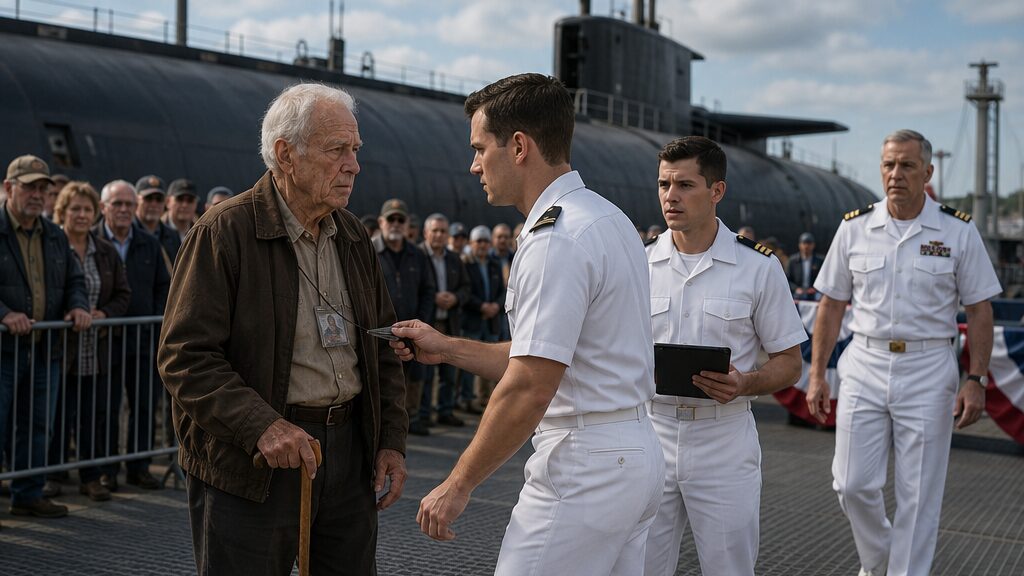
The young sailor held Richard Mitchell’s card between two fingers as if it had been found in a gutter.
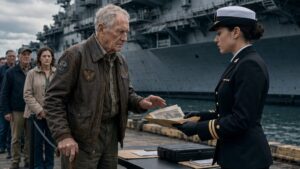
Richard’s cane stopped against the steel grating of the heritage pier. The tap carried farther than he expected, a small hard note beneath the chatter of visitors, the clink of temporary barriers, and the low mechanical hum coming from the preserved submarine moored alongside them.
The card hung from a cracked plastic sleeve clipped inside Richard’s worn brown jacket. James Young had caught it before Richard reached the checkpoint scanner. Now he pulled it forward until the faded cord tightened against Richard’s collar.
“I didn’t buy it,” Richard said.
James looked no older than twenty-eight. His white uniform was pressed sharply enough to hold its own shape, and a security badge sat square over his breast pocket. Behind him, another sailor checked names on a tablet while families and retired crewmen waited beneath a banner announcing the submarine’s reopening.
“This isn’t a visitor credential.” James turned the card toward the line. “This is some kind of old access pass.”
“It was an access card.”
“Was?”
Richard shifted his weight onto the cane. His right knee had begun to stiffen before he reached the pier, and the wind off the water made his hand tremble more visibly than usual.
James noticed the tremor. His expression changed, but not toward kindness. It became the look people used when they had already decided an older man was confused.
“The public entrance is back by the museum,” James said. “This checkpoint is for invited crew, staff, and ceremony guests.”
“My name should be on the list.”
“It isn’t.”
“You looked?”
“I looked before you reached the barrier.”
Several people behind Richard had fallen silent. A boy in a navy-blue cap leaned around his father to see. Two retired sailors farther back watched with the guarded interest of men who recognized the shape of trouble but not yet its cause.
Richard kept his eyes on James.
“Read the compartment number,” he said.
James glanced at the card. “Sir, I’m not going to play a guessing game.”
“Then don’t guess. Read it.”
The second sailor looked over from the tablet.
James exhaled through his nose. “E-Seventeen-B.”
The second sailor’s head lifted.
Richard heard it in the pause. Recognition, uncertain but real.
James turned. “What?”
The other sailor came closer. “That designation isn’t on the public deck plan.”
“Because it’s old,” James said.
“It’s not just old. E-Seventeen-B was sealed during conversion.”
James looked back at Richard.
The card’s face had faded to the color of old bone. A diagonal crack crossed the photograph, splitting the younger Richard’s left cheek from the rest of him. The compartment number remained legible because someone had once written over it in grease pencil and pressed too hard.
“What was in there?” the second sailor asked.
“Electrical distribution,” Richard said.
James’s grip tightened slightly on the sleeve. “That information is available in restoration documents.”
“Not the manual release.”
The other sailor glanced toward the submarine’s black hull.
James stepped closer. The polished toe of his shoe touched the rubber tip of Richard’s cane, pinning it against the grating.
The movement might have been accidental. Richard waited for him to move.
He did not.
“You need to go back to the museum entrance,” James said. His voice had risen enough for the people behind them to hear clearly. “You cannot use an invalid military card to enter a controlled area.”
Richard looked down at the shoe covering the end of his cane.
James followed his gaze and moved his foot, but the damage had already been done. The people in line shifted. Someone whispered. A phone lifted briefly above a shoulder.
Richard could have explained more. He could have named the year, the patrol, the smell of insulation burning behind the forward panel. He could have said which relay had failed and why the overhead light had gone red before the alarm sounded.
Instead he held out his hand.
“Give me the card.”
“I need to verify it.”
“You said it was invalid.”
“That’s why I need it.”
“You don’t need to keep what you’ve already dismissed.”
James’s jaw tightened. “Sir, you approached a restricted checkpoint with a credential that doesn’t scan, your name isn’t on the roster, and you’re claiming knowledge of a sealed compartment. I have a duty to investigate.”
The word duty landed badly between them.
Richard withdrew his hand.
The boy in the cap was still watching. So were the retired sailors. Richard knew what they saw: an old man in loose trousers and a faded jacket, medals too small and tarnished to mean anything from a distance, one hand shaking on a cane while a young sailor explained the rules.
He had once believed age would make certain things easier. Pride, for instance. Shame. The need to be understood.
It had only made them quieter.
The second sailor lowered his voice. “Maybe we should call collections.”
“I already called administration,” James said. “No match.”
“The card stock looks real.”
“Real old plastic doesn’t make the story real.”
Richard’s fingers closed around the cane handle.
James saw the movement and mistook it for anger. He squared his shoulders.
“Why are you trying to get aboard?”
Richard looked past him.
The submarine lay broad and dark against the water, its restored deck crowded with flowers, cables, flags, and folding chairs. Near the forward hatch, workers had mounted a new brass plaque. From where Richard stood, the lettering was too small to read.
But he already knew which name would not be there.
“I need to leave something inside,” he said.
“What?”
“A photograph.”
James gave a short, disbelieving laugh. “Inside a sealed electrical compartment?”
Richard said nothing.
“Whose photograph?”
The wind pressed Richard’s jacket against his chest. Beneath it, inside a brown document holder, the edge of the photograph rested against his ribs.
“Patrick’s.”
The second sailor frowned. “Patrick who?”
Richard looked again at the submarine.
“It was sealed after Patrick went back in.”
The line behind him went completely still.
For the first time, uncertainty reached James’s face. It stayed only a moment before discipline pushed it away.
“You need to step outside the barrier,” he said.
Richard did not move.
James gestured toward the museum building. “Now, sir.”
The cane tapped once as Richard shifted it forward.
A voice behind James stopped him.
“Richard Mitchell?”
The name crossed the checkpoint with the force of a command, though it had not been shouted.
James turned.
A senior officer in dress whites was approaching from the ceremony platform. His ribbons and shoulder boards drew the crowd’s attention before his face did. He moved past the barrier without looking at the waiting line.
Richard recognized the type of man before he recognized the man himself: careful posture, controlled expression, authority worn so long it no longer needed display.
The officer stopped beside James.
“Sir,” James said. “This individual presented an invalid credential and—”
“I heard enough.” The officer looked at Richard. “Richard Mitchell?”
“That’s my name.”
“I’m Ronald Harris. I oversee the restoration program.”
Richard waited.
Ronald studied him with an expression that was neither welcome nor disbelief. “I’ve seen your name before.”
James glanced at the card in his hand.
“Where?” Richard asked.
Ronald’s eyes moved toward the submarine, then back to Richard.
“That’s the problem,” he said. “I remember the name from an old technical reference. But according to every current crew record we have, Richard Mitchell never served aboard this boat.”
Chapter 2: A Private Apology Was Not Enough
Ronald Harris apologized before anyone returned Richard’s card.
They sat in a narrow administration room overlooking the pier. Through the window, Richard could see workers straightening chairs near the submarine while the ceremony coordinator moved between them with a clipboard pressed to her chest.
James stood beside the closed door. He had placed the card inside a clear evidence envelope and set it on the table, beyond Richard’s reach.
Ronald noticed Richard looking at it.
“We’ll return it as soon as collections finishes examining it.”
“You’ve already called me by name,” Richard said.
“I said I recognized the name.”
“That isn’t the same thing.”
“No.”
Ronald lowered himself into the chair opposite him. Without the distance of the checkpoint, he looked more tired than commanding. There were deep lines around his eyes and a faint patch of gray at each temple.
“What happened outside should have been handled privately,” he said.
Richard rested both hands on the top of his cane. “It didn’t happen privately.”
James shifted near the door.
Ronald glanced at him, then back to Richard. “The sailor was following security procedure.”
“He held my card up for a crowd.”
“He made an error in judgment.”
“He put his shoe on my cane.”
James’s face tightened. “That wasn’t intentional.”
Richard looked at him.
James started to add something, then stopped.
Ronald folded his hands on the table. “After the ceremony, I can arrange a private tour. No crowds. No checkpoints. If the compartment is accessible, we’ll allow you to place the photograph there.”
Richard looked through the window again. A worker uncovered the new brass memorial plaque. Sunlight flashed across it before a cloth was draped back over the face.
“After the ceremony,” Richard repeated.
“That would be the least disruptive solution.”
“To whom?”
Ronald did not answer immediately.
Richard reached inside his jacket and removed the worn brown document holder. He placed it on his lap but did not open it.
“I didn’t come for a tour.”
“You said you wanted access.”
“I said I needed to leave something.”
“Inside a sealed compartment.”
“Before you reopen the boat and tell people what happened there.”
Ronald’s expression became guarded. “The exhibit account was reviewed by naval historians and museum staff.”
“And none of them found Patrick.”
James looked toward the table.
Ronald leaned back. “Patrick Gonzalez?”
The name came out slowly, as though he were testing it against memory.
Richard’s grip tightened around the document holder.
“So you have seen it.”
“I’ve seen Gonzalez in a damage-control notation. No first name. No service number. It was attached to a technical memorandum, not a personnel file.”
“That was him.”
“We don’t know that.”
“You know enough to offer me a private entrance.”
Ronald’s mouth flattened.
A knock sounded. A woman entered carrying a portable document scanner and a museum tablet. She wore a navy blazer over a gray blouse, with an identification badge clipped neatly at the waist.
“Jessica Flores, collections,” she said. Her eyes moved from Ronald to Richard, then to the envelope. “Is that the credential?”
James handed it to her.
She did not open the envelope immediately. She examined the card through the plastic, angling it beneath the overhead light. Richard watched her attention settle on the faded stamp, the lamination, and the handwritten compartment number.
“Where was this stored?” she asked.
“With me,” Richard said.
“For how long?”
“Fifty-one years.”
Her eyes lifted. “The entire time?”
“Yes.”
“That makes authentication harder, not easier.”
Richard almost smiled. It was a strange talent of institutions, making survival sound suspicious.
Jessica put on thin gloves and removed the card. She scanned both sides, then magnified the image on her tablet. For several minutes, only the tapping of her stylus and the muffled ceremony preparations outside disturbed the room.
James remained rigid by the door.
Ronald checked his watch twice.
Finally Jessica said, “The laminate composition is consistent with access cards issued during the period. The stamp is naval, and the ink aging appears natural.”
James straightened. “So it’s real?”
“The card is real.”
The room changed by a degree. Not enough for apology. Enough for caution.
Ronald looked at Richard. “Then we have a records problem.”
Jessica continued scrolling. “The service number format is valid. The punched crew code is also period-correct.”
Richard looked at the card lying bare beneath her gloved fingers.
James said, “Can you connect it to him?”
“Not yet.”
“There should be a photograph.”
“The photograph has deteriorated along the crack. Facial comparison wouldn’t be reliable.”
Richard said, “It isn’t my card.”
Every face turned toward him.
He could feel the truth waiting behind his teeth, but he let only a piece of it through.
“It belonged to Patrick.”
James’s expression hardened at once. “So you did present someone else’s credential.”
“I presented the only surviving card with that compartment number.”
“That isn’t what I asked you outside.”
“You didn’t ask. You announced.”
Ronald raised one hand before James could respond.
Jessica studied Richard. “Why do you have Patrick Gonzalez’s access card?”
Richard opened the document holder.
Inside was a black-and-white photograph wrapped in tissue paper. He did not remove it. He only touched the edge.
“Because he gave it to me.”
“When?”
Richard looked at the clock above the door.
“Before the compartment was sealed.”
Jessica turned back to the tablet. “I’m searching the crew code now.”
Lines of data reflected in her glasses. Her fingers moved quickly, then stopped.
“That’s odd.”
Ronald stood. “What?”
“The code exists in the accession framework, but there’s no linked roster.”
“Corrupted file?”
“Possibly. Or the roster was never digitized.”
James stepped closer. “But there should be a paper source.”
“There should.”
Jessica opened another database, then another. Richard watched confidence leave her posture in small stages. The straightness of her shoulders remained, but her movements slowed.
“The code appears in three maintenance references,” she said. “All from the same deployment period. No crew names attached.”
Ronald looked through the window toward the submarine. “How long to locate the paper archive?”
“If it’s on-site, perhaps an hour. If it was transferred to regional storage, days.”
“The ceremony starts at one.”
“I know.”
Richard closed the document holder.
Ronald faced him. “Mr. Mitchell, we’ve established that the card is authentic. I’m prepared to have James escort you through the crew entrance after the public program.”
“Will Patrick’s name be in the program?”
Ronald’s silence answered.
“Then you’re offering me courtesy,” Richard said. “Not correction.”
“We cannot amend an official historical presentation based on an unauthenticated personal account.”
“And you cannot call it official while admitting part of the crew record is missing.”
Jessica lifted her tablet. “I may have something.”
She had opened a scanned incident index. The page was yellowed at the edges, each line typed in the compressed lettering of an old naval office machine.
“Electrical casualty,” she read. “Forward distribution compartment. One fatality.”
Richard felt the old room close around him: red light, bitter smoke, Patrick’s hand striking the bulkhead twice.
Jessica looked up.
“There is no name.”
Chapter 3: The Photograph Beneath the Cane
The database insisted that Richard Mitchell’s duty station had never existed.
Jessica ran the search three times before she said it aloud.
“There is no E-Seventeen watch assignment in the personnel structure.”
Richard sat on a bench outside the archive workroom, his cane angled between his knees. Beyond the glass wall, the submarine’s sail rose above the pier like a dark fin. Visitors had begun gathering near the ceremony stage.
“It existed,” he said.
“I’m not saying it didn’t.” Jessica held the tablet against her side. “I’m saying the database has no recognized duty station under that designation.”
James stood several feet away with his arms crossed. “Maybe because that designation was only used for maintenance access.”
“It was used by the men who had to enter it,” Richard said.
Jessica had brought them out of the administration room while staff searched cabinets for the paper accession files. Ronald had left to speak with the museum director, taking the ceremony schedule with him. Before going, he instructed James to remain nearby.
Richard understood what that meant. He was not under arrest. He was also not free to walk toward the submarine.
Jessica sat beside him, leaving one careful space between them.
“You said Patrick gave you the card,” she said. “Was he assigned to electrical division?”
“Yes.”
“What was his rate?”
Richard rubbed his thumb over a dent in the cane handle. “He worked wherever they needed someone who didn’t complain.”
“That isn’t a rate.”
“No.”
James let out a breath. “This is what I mean. Every direct question gets a half-answer.”
Richard turned his head. “You’ve already decided the other half.”
“I decided the card was invalid.”
“And now?”
James glanced toward the archive room. “Now I’ve decided the card is real and still not yours.”
Jessica looked between them. “Mr. Mitchell, records don’t become more accurate because we want them to. I need details I can verify.”
Richard knew she meant it as fairness. That made it harder to resist.
He opened the brown document holder and removed the tissue-wrapped photograph.
The paper had softened at the corners. Two young sailors stood in front of an open electrical panel, both wearing work shirts darkened by heat and labor. Richard was on the left, thinner than memory allowed, his hair cut nearly to the scalp. Patrick stood beside him with one hand resting on the panel frame and a crooked grin that made him look as though the photographer had just said something foolish.
Jessica took the photograph by its edges.
“Which one is Patrick?”
“The one who looks pleased with himself.”
Her mouth almost moved into a smile.
James came closer despite himself.
On the back, written in blue ink, were two names and a date. Beneath them, in a different hand, someone had added: Tell Gonzalez the new instructor still teaches his shortcut wrong.
James reached for the photograph, then stopped before touching it.
“What?” Jessica asked.
He pointed. “Gonzalez.”
“Yes.”
“My damage-control instructor was a Gonzalez. Retired chief. He used to say his father served submarines.”
Richard’s gaze settled on him. “What was his first name?”
James hesitated. “He never told us.”
Jessica turned the photograph over again. “This could give us a family connection.”
“Or it could be a borrowed photograph,” James said.
The softness vanished from the moment.
Jessica frowned. “The inscription supports his account.”
“It supports that someone named Patrick Gonzalez existed. It doesn’t prove Mr. Mitchell was authorized to enter today.”
Richard began wrapping the photograph again.
James’s voice sharpened. “You heard him admit the card wasn’t his.”
Jessica said, “And we confirmed the card is authentic.”
“Which makes using it more serious, not less.”
The cane shifted as Richard stood. The photograph slipped from the tissue and fluttered beneath the bench.
James moved first.
He crouched, reached beneath the seat, and retrieved it before the wind could push it through the pier railing. For a moment he held the image in both hands.
His thumb hovered near Patrick’s face.
Then his eyes moved beyond the two sailors to the open electrical panel behind them.
“What’s that writing?” he asked.
Richard extended his hand.
James did not return the photograph.
“On the panel,” he said. “There’s a mark.”
Jessica leaned closer. Near the upper corner of the equipment cabinet, a pale diagonal line crossed a stenciled circuit code. Beside it were three handwritten characters, blurred but visible.
Jessica enlarged a scan of the photograph on her tablet.
“R-seven-three,” she said.
Richard looked toward the submarine.
James noticed. “What does it mean?”
“Nothing to your database.”
“What does it mean to you?”
Richard held out his hand again. “The photograph.”
James gave it back, more carefully than Richard expected.
Jessica zoomed further. “It appears to be a handwritten wiring correction.”
“It is,” Richard said.
“Why would it be written directly on the panel?”
“Because the printed diagram was wrong.”
Jessica’s stylus stopped.
Richard continued wrapping the photograph. His fingers did not cooperate, and the tissue caught beneath one corner. He tried again.
James watched him struggle but did not offer help.
“Which circuit?” Jessica asked.
“The auxiliary feed to the forward ventilation controller.”
“Can you be more specific?”
Richard looked at her. “The original diagram routed the return through R-seventy-one. Under load, it heated the junction. We moved it through R-seventy-three during the second refit.”
Jessica searched the database.
James said, “That could be in a manual.”
“It wasn’t.”
“How do you know?”
“Because we never filed the correction.”
The answer silenced him.
Jessica found a digital wiring schematic and placed the tablet beside the photograph. The modern diagram showed the return routed through R-seventy-three.
“There’s no revision note,” she said.
“There wouldn’t be.”
“Why not?”
Richard slid the photograph back into the document holder.
“Because the correction was made three days before the fire.”
Jessica stared at the schematic, then at the old image.
“If the official diagram was wrong,” she said slowly, “the accident investigation should have documented the field modification.”
“It should have.”
James uncrossed his arms.
From inside the archive room came the scrape of a metal drawer, followed by someone calling Jessica’s name.
She stood at once.
A staff member held up a thick, unscanned maintenance ledger bound with a fraying canvas spine.
Jessica took it, turned several pages, and froze.
“What is it?” James asked.
She angled the ledger toward the light.
The entry was brief. Two lines, handwritten on the day of the electrical casualty. Beside the compartment designation E-Seventeen-B were two initials and a notation that both men had entered after the first alarm.
Jessica looked at Richard.
“The archive says two sailors went into that compartment,” she said.
Richard’s cane tapped once against the grating.
James stepped closer, his voice no longer loud enough for the crowd.
“You told us Patrick went back in,” he said. “You never said you were already inside.”
Chapter 4: Two Men Entered the Sealed Compartment
The restored hatch carried the wrong number.
Richard saw it before anyone else did.
A polished brass plate had been fastened above the narrow opening inside the submarine, its black lettering bright beneath the work lights: E-17-A. The old steel beneath it showed four empty screw holes and the pale rectangular shadow of something smaller that had once been there.
Richard stopped at the foot of the ladder.
“That isn’t the compartment,” he said.
Ronald, already halfway through the hatch, turned back. “This is the location indicated on the restoration plan.”
“The plan is wrong.”
James stood behind Richard on the temporary access platform. Since leaving the archive, he had kept his questions to himself, but his attention had become more exacting. He watched Richard’s face instead of the cane now.
Jessica held the maintenance ledger against her chest. “The entry says E-Seventeen-B.”
Ronald examined the brass plate. “The conversion drawings list only A.”
“They closed B and folded the space into A,” Richard said. “The designation disappeared. The compartment didn’t.”
The interior smelled of paint, cold metal, and the faint oily residue no restoration could remove. Richard had expected the smell to strike him harder. Instead it came in pieces: a memory of sweat trapped beneath a collar, a hot cable jacket, Patrick humming tunelessly while tightening a terminal.
He put one foot on the ladder.
His knee resisted.
James moved closer, then checked himself before touching Richard’s arm.
“There’s another way through the visitor route,” he said.
“No.”
“It’s wider.”
“This is how we went in.”
Richard climbed slowly. The cane had to be passed up separately, and Ronald took it without comment. By the time Richard reached the deck, his breath had shortened. He waited until it steadied before looking down the passageway.
Panels had been repainted. Labels were clean. Protective glass covered equipment that had once been hot enough to burn through gloves. The restored submarine looked more orderly than it ever had in service.
That disturbed him more than decay would have.
A maintenance worker led them toward the forward section. “The public route ends here,” he said, unlocking a temporary barrier. “Everything beyond has been cleared, but some panels are replicas.”
Richard passed beneath the low overhead without ducking. His body remembered the height.
At the end of the narrow passage stood the restored electrical compartment. The new brass plate shone above it.
Richard lifted his cane and pointed to the lower right side of the bulkhead.
“There.”
The maintenance worker crouched. “There’s nothing.”
“Paint over it.”
The worker ran his fingers along the metal. Beneath the fresh gray coating, a shallow line formed the top edge of an older plate. He looked toward Ronald.
“Strip a corner,” Ronald said.
Using a plastic scraper, the worker lifted a thin curl of paint. A stamped letter appeared, then the upper curve of a number.
Jessica leaned nearer. “B.”
No one spoke for a moment.
The small discovery should have satisfied Richard. It did not. The old designation emerging from beneath new paint felt less like recognition than accusation.
Ronald looked at him. “You were right about the compartment.”
Richard’s gaze remained on the hatch.
“Not yet.”
The maintenance worker tried the handle. It moved halfway and stopped.
“Restoration team said the latch was warped,” he said. “We planned to leave it closed for the ceremony.”
“It isn’t warped.”
He pulled again. Metal struck metal inside.
Richard handed his cane to Jessica and lowered himself carefully to one knee. Pain traveled up his thigh, sharp enough to whiten the edges of his vision. He waited, one hand on the deck, until it passed.
James crouched across from him.
“What are you looking for?”
“A release.”
“There’s no exterior release on the drawings.”
Richard slid his fingers beneath the edge of a replacement panel beside the hatch.
“They removed the visible one after a sailor caught his sleeve on it. Patrick moved it behind the panel.”
“You remember that after fifty years?” James asked.
Richard found the lower fastener, pressed inward, and lifted. The panel shifted by less than an inch.
“I remember Patrick complaining about it for three weeks.”
James held the panel while Richard reached behind it. His fingers searched through dust until they met a narrow steel lever.
He pulled.
Inside the hatch, something dropped with a heavy mechanical knock.
The maintenance worker opened the door.
A stale breath of enclosed air moved through the passage.
Jessica looked from the hidden release to Richard. Whatever doubt remained in her had changed shape. It no longer concerned whether he had served there. It concerned what he had not told them.
Ronald stepped inside first and switched on the temporary lighting. The compartment was narrow enough that four people filled it. One wall held reconstructed distribution equipment. The opposite side remained unfinished, exposing old mounting brackets and scorched paint beneath a clear protective coating.
Richard stood in the doorway.
The blackening climbed higher than he remembered.
James entered behind Ronald and looked at the damage. “This was the fire.”
“Yes.”
Jessica opened the ledger on a metal shelf. “The maintenance entry was written before the official casualty summary. It records two initials entering after the first alarm.”
She traced the lines.
“R.M. and P.G.”
Ronald looked at Richard. “Mitchell and Gonzalez.”
Richard said nothing.
“The next notation says ventilation failed six minutes later,” Jessica continued. “Emergency extraction team entered at fourteen twenty-three.”
James pointed to the lower line. “What does that say?”
Jessica angled the page beneath the light.
“One man removed at fourteen nineteen. Second man located at fourteen twenty-seven.”
Ronald’s expression tightened. “That means one of them came out before the extraction team went in.”
Richard looked at a section of preserved deck plating. Two shallow dents remained near the base of the panel. Patrick had made one of them with a dropped wrench. Richard had made the other afterward, though no one had known.
Jessica turned a page. “The casualty summary says the deceased sailor was found during initial response. It doesn’t mention anyone reentering.”
“Because that was not the summary they kept,” Richard said.
James moved between Richard and the hatch, not blocking him, but making it impossible to avoid his face.
“Which one came out at fourteen nineteen?”
Richard’s hand found the edge of the doorway.
The compartment seemed to narrow. He heard a relay chatter that was no longer there, then the scrape of Patrick’s boots through smoke.
Ronald spoke gently. “Richard?”
Richard looked at the ledger.
The initials were small, hurried, and undeniable.
“I came out first.”
James’s eyes hardened, though not in the same way they had at the checkpoint. This was no longer suspicion of an old man’s credentials. It was suspicion of the man himself.
“You said Patrick went back in.”
“He did.”
“But you were both already inside.”
Richard stepped backward into the passage.
Jessica closed the ledger partway. “There may be another report.”
“There is,” Richard said.
“Where?”
He looked toward the compartment.
“In the account I signed.”
Ronald’s voice lowered. “What did that account say?”
Richard took his cane from Jessica.
The tip struck the deck once before he steadied it.
James did not let him turn away.
“Did Patrick go back because of you?”
Chapter 5: The Report Richard Chose to Sign
“The card was never mine.”
Richard set the clear evidence envelope on the ledge beneath the dark screen of the visitor theater.
Rows of empty seats descended toward him. Beyond the closed doors, workers tested the ceremony sound system. A voice counted to five through the speakers, then started again.
Ronald stood near the aisle. Jessica had placed the ledger and scanned incident pages on a folding table. James remained by the rear door, close enough to hear and far enough to suggest he was no longer guarding Richard.
Richard opened the envelope and slid out the cracked card.
“It belonged to Patrick,” he said. “He put it in my hand before he went back.”
Ronald glanced toward the theater doors. “Start at the first alarm.”
Richard rested the card on his palm.
The photograph showed Patrick younger than James, his mouth set in the crooked grin that had survived every year Richard had tried not to look at it.
“We had been chasing heat in the forward junction for three days,” Richard said. “The printed diagram was wrong, but the change we made should have held. During the test, the insulation flashed behind the panel. Patrick cut the feed. I went for the ventilation control.”
Jessica said, “The auxiliary circuit marked in the photograph.”
Richard nodded.
“The handle jammed. Smoke filled the compartment faster than it should have. We had masks, but mine didn’t seal. Patrick shoved me toward the hatch.”
His fingers closed around the card.
“I told him the feed was still live. He said it could burn without us.”
The sound technician’s voice came through the wall again. One, two, three.
Richard looked at the blank theater screen.
“I reached the passage. Then the ventilation stopped.”
Ronald waited.
“I heard the alarm change. I knew what it meant. No extraction. No clear route. Patrick was still inside.”
James’s posture had gone rigid.
Richard continued before silence could harden around him.
“I should have called for the response team and stayed out. That was procedure. Instead I went back through the hatch.”
Jessica looked down at the ledger. “Both initials after the alarm.”
“Yes.”
“What happened?”
“The panel had arced again. Patrick was on the deck. I tried to move him, but the smoke came down. I couldn’t see the hatch.”
Richard rubbed his thumb along the crack in the c
Chapter 7: Richard Spoke Without Asking for Honor
“James was right about one thing.”
Richard’s voice reached the speakers before Ronald could decide whether to stop him.
The audience turned toward the side of the stage. Richard stood with one hand wrapped around his cane and the other resting on the lectern. The microphone had been lowered for the museum director, but it was still several inches too high. He did not adjust it. He leaned forward enough to be heard.
“The card I brought here was not issued to me.”
A murmur moved through the chairs.
James remained below the steps, his earpiece hanging loose against his uniform. The museum security worker had stopped beside him, waiting for an instruction that did not come.
Ronald approached from the center of the stage. His expression warned Richard that the microphone could be silenced at any moment.
Richard drew the cracked card from his jacket and placed it beside the microphone.
“It belonged to Patrick Gonzalez.”
The plastic sleeve caught the daylight. From a distance, it looked insignificant—an old piece of identification too damaged to scan and too faded to prove anything quickly.
Richard opened the brown document holder and set the photograph beside it.
A younger version of himself stood next to Patrick in front of the electrical panel. The crowd could not see their faces clearly, but the local reporter moved closer and raised her phone.
Ronald stopped several feet away.
Richard looked toward the covered brass plaque near the submarine.
“Patrick served aboard this boat. He worked in the forward electrical spaces. His name is not on the plaque, and it was not read today.”
The ceremony coordinator reached for the sound controls.
Ronald lifted one hand.
She stopped.
Richard felt every eye on him. At the checkpoint, those eyes had made his back stiffen and his words shorten. Now they carried a different pressure. They wanted a hero, a victim, or a villain. Something simple enough to take home.
He could not give them one.
“Fifty-one years ago, an electrical fire started in compartment E-Seventeen-B,” he said. “The records say one sailor was lost while attempting to shut down equipment. That account is incomplete.”
Jessica stood near the stage with the maintenance ledger held against her chest. She had not joined Richard at the microphone, but she had brought the record where others could see it existed.
Richard continued.
“I entered the compartment after the alarm. Patrick entered with me. The smoke cut visibility. My mask failed. I reached the passage, then went back because he had not come out.”
The audience had gone still.
Inside Richard’s jacket, the edge of the document holder pressed against his ribs. He no longer needed it there. The photograph lay in daylight now.
“When the ventilation stopped, I froze.”
The word moved through the speakers without weakening.
“I had training. I knew the compartment. Patrick was injured, and I should have found the hatch. Instead, I stopped moving.”
A retired sailor in the first row lowered his cap into his lap.
“Patrick got up. He found me. He gave me his access card and dragged its edge along the deck so I could follow the sound. He brought me to the hatch.”
Richard touched the crack crossing the card.
“A cable fell between us. I went through. He did not.”
Someone in the crowd inhaled sharply.
Richard did not look for sympathy. He looked at the submarine.
“Patrick was alive when the response team brought him out. He died before morning.”
Ronald’s face had changed. The concern for the ceremony remained, but it no longer controlled him.
Richard glanced toward Jessica.
“The report I signed did not say Patrick returned for me. It said he was overcome while securing equipment. An officer told me the softer account would spare his wife and protect the crew from questions that could not change what happened.”
He paused.
“I agreed.”
The public silence became heavier.
“I told myself I was protecting her. Then I told myself it was too late to correct anything. The report became a summary. The summary became an exhibit. Every year I kept quiet made the next year easier.”
He looked down at Patrick’s photograph.
“I came here today because the boat was reopening and Patrick was still missing from it.”
The reporter shifted closer. “Mr. Mitchell, are you saying the Navy deliberately erased him?”
Ronald turned toward her, but Richard answered first.
“No.”
The answer surprised several people.
“I am saying a frightened sailor signed a report because the truth shamed him. An officer chose language he believed would reduce pain. Other people copied what was already official. No one had to decide to erase Patrick. We only had to keep choosing what was easier.”
Jessica lowered her eyes to the ledger.
The reporter called again. “Should the sailor who stopped you today face disciplinary action?”
The question turned the crowd’s attention toward James.
He stood below the stage, exposed in white uniform against the dark hull. The boy in the navy-blue cap from the checkpoint was watching him again.
James did not look away.
Richard felt how easily the moment could reverse itself. The crowd that had watched an old man humiliated was ready to watch a young man receive the same treatment. It would feel like justice because the direction had changed.
Richard placed both hands on the lectern.
“What happened at the checkpoint was wrong,” he said.
James’s jaw tightened.
“My card was held up before strangers. My cane was blocked. I was spoken about as if I could not understand what was happening.”
The words did not rise. They did not need to.
“James Young made those choices. He should answer for them.”
Ronald looked at James, who gave the smallest nod.
“But do not remove him so everyone else can pretend the problem left with him.”
The reporter lowered her phone by an inch.
Richard looked across the sailors standing near the barriers.
“The first mistake was seeing an old man and deciding his confusion before hearing his words. The second would be seeing one young sailor and deciding no one else has ever done the same.”
James’s face shifted—not relief, but the pain of being denied an easier punishment.
Richard picked up the cracked card.
“This did not make Patrick important. It did not make me deserving of courtesy. A person should not need an old credential, a uniform, or a story of sacrifice before someone moves a shoe off his cane.”
No one applauded.
Richard was grateful for that.
The silence allowed the meaning to remain unfinished inside each person.
Ronald walked to the microphone. He did not take Richard’s place. He stood beside him.
“The historical dedication will be suspended,” he said. “The museum and Navy restoration office will issue a public correction after the records are reviewed. Patrick Gonzalez’s name will be added to the casualty account, along with the circumstances verified today.”
Richard turned slightly. “Not just Patrick.”
Ronald met his eyes.
“The report must include what I signed.”
“It will.”
“And why.”
Ronald hesitated only once. “Yes.”
Jessica climbed the stage steps carrying the ledger. She placed it beside the card and photograph.
“This maintenance entry confirms that Richard Mitchell and Patrick Gonzalez entered the compartment after the alarm,” she said. “The archived casualty summary omits that fact. We will document how the omission passed into the exhibit.”
The museum director moved toward the covered plaque, but Richard stopped him with a small motion.
“Not today.”
The director looked uncertain.
“Do it correctly,” Richard said. “Not quickly.”
The reporter spoke again. “Mr. Mitchell, why keep the card all these years?”
Richard looked at the cracked photograph beneath the plastic.
“Because giving it back meant admitting Patrick was gone.”
His voice nearly failed on the final word. He let the silence carry what remained.
A woman rose slowly from the third row.
She was small, with silver hair pinned neatly behind her head. One hand held the back of the chair in front of her. The ceremony staff moved as if to assist, but she shook them off.
Richard knew her before she reached the aisle.
Age had changed her face but not the way she held her chin when she was determined not to cry.
Patrick’s widow walked toward the stage.
Richard’s hand tightened on the cane.
He had prepared himself for accusation, disbelief, even refusal. He had not prepared for her to look first at the photograph instead of him.
She stopped below the stage.
“I knew he went back,” she said.
Richard could not answer.
“He told me before that patrol he would never leave one of his men behind.” Her gaze rose to his. “I did not know it was you.”
The crowd disappeared from Richard’s awareness. There was only the woman, the photograph, and the fifty-one years between the question she had once asked and the answer he had withheld.
“I should have told you.”
“Yes,” she said.
The word held no cruelty. That made it harder to bear.
Richard lowered his head.
After a moment, she looked toward the submarine.
“Is the compartment still there?”
“Yes.”
“Can people enter it?”
“Tomorrow,” Ronald said quietly. “After the preservation team clears the space.”
She considered this, then looked back at Richard.
“You carried his card long enough.”
Richard opened his hand.
The cracked card lay across his palm.
She did not take it.
Instead, she closed his fingers around it.
“Take me aboard,” she said.
Chapter 8: The Submarine Remembered Both of Them
Richard’s cane stopped at the compartment threshold.
The following morning, the submarine was closed to the public. No banners moved above the pier, no speakers counted down to a ceremony, and no crowd waited to decide what Richard was worth.
Inside, the restored passageway held only the quiet hum of temporary lights.
Patrick’s widow stood beside him. Jessica waited inside the compartment with a clear archival sleeve mounted beneath the corrected designation. Ronald remained farther back, giving them room.
James stood behind Richard.
The new brass plate had been removed overnight. Beneath it, preservation workers had exposed the older stamped marking: E-17-B. The letters were worn and uneven, but they belonged to the steel.
Richard looked through the hatch.
The preserved scorch marks climbed the wall behind the reconstructed panel. On a narrow shelf, Jessica had placed the photograph and the cracked access card. A printed archival label waited beneath them, bearing two names:
PATRICK GONZALEZ
RICHARD MITCHELL
Richard had approved the wording an hour earlier. Now it seemed impossible to cross the few feet required to make it permanent.
Patrick’s widow touched his sleeve.
“You do not have to go in first.”
“Yes,” Richard said. “I do.”
He moved the cane forward.
The rubber tip met the raised lip of the hatch and slipped.
James reached out, then stopped before making contact.
“May I help you?”
The question was quiet.
At the checkpoint, James had taken the card without permission and treated Richard’s cane as an obstacle. Now his hand remained open, waiting.
Richard looked at it.
Accepting help had always felt dangerously close to confirming what strangers already believed about him—that age had reduced him to dependence. He had refused hands on stairs, refused chairs offered too quickly, refused explanations spoken louder than necessary.
Silence and refusal had become habits long after they stopped protecting him.
He placed his hand on James’s forearm.
“Yes.”
James supported him across the threshold without pulling. Once Richard was steady, he released him immediately.
Patrick’s widow followed.
The compartment held four people tightly, but no one complained. Jessica removed the photograph from its temporary cover and offered it to Richard.
He took it by the edges.
Patrick’s young face looked unchanged. That had once angered Richard. He had aged for both of them while Patrick remained forever near the electrical panel, forever smiling at something outside the frame.
Richard lifted the photograph toward the clear sleeve.
His hand stopped.
The empty pocket beneath the label waited to receive it.
For fifty-one years, the photograph had lived against his chest, inside drawers, beneath folded shirts, and in the document holder he carried whenever he believed he might finally speak. Putting it into the exhibit felt like leaving Patrick behind a second time.
Patrick’s widow saw his hesitation.
“You think he belongs to you because you remember the worst day,” she said.
Richard lowered the photograph.
“I was there.”
“So was he.”
Her voice remained gentle.
“I had thirty-two years with him before that boat. His mother had more. His son remembers the sound of his laugh. You remember the compartment. None of us owns the whole man.”
Richard looked again at the photograph.
“What did you know?” he asked.
“About the fire?”
He nodded.
“I knew the official story did not fit him. Patrick would not have stayed with equipment if a sailor was missing. I asked questions. People answered carefully.”
“And you stopped asking.”
“No.” She looked at him. “People stopped answering.”
Richard absorbed that.
She had not been protected by the softened report. She had simply been left alone with its gaps.
“I told myself the truth would only hurt you.”
“It did hurt me.” Her gaze settled on the card. “So did not knowing.”
Jessica stood near the shelf, her eyes lowered to give them what privacy the small compartment allowed.
Richard slid the photograph into the clear sleeve.
For a moment it caught against the edge. His fingers trembled harder.
James did not reach for it.
Richard adjusted the paper himself and pushed until Patrick’s face rested beneath the corrected compartment number.
Jessica handed him the card.
“The archive label explains that it was issued to Patrick and carried out by you,” she said. “It also notes that you preserved it until the record was amended.”
Richard read the sentence.
“No,” he said.
Jessica looked concerned. “Which part?”
“Do not say I preserved it.”
“What should it say?”
Richard considered the card’s cracked surface.
“Say I kept it.”
Jessica understood. Preservation sounded noble. Keeping it had been grief, guilt, fear, and love tangled together.
She took out a pencil and amended the draft label.
Richard placed the card beside the photograph.
The old plastic no longer looked like proof of access. It looked like what it had always been: an object passed from one frightened hand to another in the dark.
Ronald entered the compartment after Jessica stepped aside.
“The museum will publish the revised incident account this afternoon,” he said. “The review will state that the earlier record omitted Gonzalez’s rescue attempt and Mitchell’s presence.”
Richard looked at the two names.
“And the signed report?”
“Included in full.”
“Good.”
Ronald hesitated. “There may be questions about responsibility.”
“There should be.”
“The investigating officers are gone.”
“Then the living answer for what the living did.”
Ronald nodded.
From the passage came the faint scrape of a tool. The maintenance worker was adjusting the removed brass plate for storage rather than remounting it. The old designation would remain visible.
James stood at the hatch.
“I submitted a statement about yesterday,” he said.
Richard turned.
“I included the card, the crowd, and the cane.”
Ronald’s expression suggested he had already read it.
“What happens now?” Richard asked.
“I don’t know,” James said. “But the checkpoint procedure is changing. Unverified veteran credentials will be handled away from the line unless there is an immediate threat. No public confiscation. A collections contact will be available during heritage events.”
Richard studied him.
“Procedures did not put your shoe on my cane.”
“No.”
“Fear did.”
James did not defend himself.
“Yes.”
Patrick’s widow moved toward the hatch. James offered his arm, but waited for her answer. She accepted.
The gesture was small enough that no one outside the compartment would have noticed. Richard noticed.
He looked once more at Patrick’s photograph.
For years, memory had returned as punishment: the jammed mask, the dark, the card scraping steel. Standing there now, Richard heard something else beneath it. Patrick’s instruction had never been to remain in the compartment with him.
Follow the sound.
Keep moving.
Richard stepped through the hatch. James waited on the other side but did not assume he was needed. Richard crossed the raised lip using his cane alone.
At the visitor ladder, Patrick’s widow went first with James behind her. Richard followed slowly. When they reached the main passage, daylight from the open hatch fell across the deck.
He paused beneath it.
The submarine had not absolved him. Steel could preserve damage, names, and fingerprints beneath paint, but it could not forgive. That belonged to people, and people were rarely complete enough to do it cleanly.
Patrick’s widow looked back.
“You coming?”
Richard raised his cane.
The tip struck the deck twice.
Tap. Tap.
The old signal traveled through the passage.
All clear.
Then Richard climbed toward the light, with Patrick’s widow ahead of him and James close enough to help, but waiting to be asked.
The story has ended.