The Old Sailor Heard the Third Knock Before Anyone in the Engine Room Believed Him
Chapter 1: The Old Man Below the White Uniform
The knock came through the hull before Gary Walker reached the gate.
It was faint, almost polite, buried under the morning clatter of forklifts, gulls, and diesel engines warming along the pier. Two clean taps traveled through the shipyard air, swallowed by steel and distance. Then came the third.
Late.
Gary stopped so suddenly that the man behind him bumped the canvas tool bag hanging from his left hand.
“Line’s moving, sir,” the gate security clerk called from inside the booth.
Gary did not answer at once. He turned his head toward the gray ship moored beyond the chain-link fence. The vessel sat high and still in the water, patched with primer in places, banners not yet hung for the next day’s memorial event. Morning light caught along the rails. To anyone else, she looked ready.
Gary pressed two fingers against the cold metal railing beside the visitor lane.
Nothing.
Then, under the wind and gull noise, he felt it.
Tap. Tap.
A hesitation.
Tap.
His throat tightened before he could stop it.
“Sir?” the clerk said again, louder this time. “I need your badge.”
Gary took his hand from the railing. His fingers had black grease in the creases from a pump seal he had repaired the night before at a marina three towns over. He wiped them on the side of his work pants, though the pants were already stained beyond saving, and stepped forward.
The clerk looked young enough to still believe every rule on a laminated sheet had been written by someone who understood the work. He took Gary’s old visitor badge between two fingers and held it near the scanner. The machine gave a flat, disapproving beep.
“This expired last month.”
“It gets renewed through maintenance,” Gary said.
“Not in my system.”
“I called yesterday.”
The clerk glanced over Gary’s cap, his patched jacket, the worn tool bag, and the shoes with salt dried into the seams. “Who are you here to see?”
“Engine-room watchstander. Or whoever’s got the auxiliary line open.”
The clerk blinked. “Do you have a contact name?”
Gary looked past him again toward the ship. “No.”
“You can’t just go aboard without a contact.”
“I’m not going sightseeing.”
“I didn’t say you were.”
But his eyes had said it. Old man. Wrong clothes. Wrong badge. Wrong morning.
Gary felt the familiar heat rise in his chest, not anger exactly, but the old shame of being made to explain himself to someone who had already decided the shape of him. He could have said retired Navy. He could have said machinist’s mate. He could have said he had stood watch in machinery spaces before the clerk’s father was shaving. But he had learned long ago that some words, once offered, turned into coins people could accept or reject.
So he only said, “There’s a sound in her.”
The clerk’s expression softened in the careful way people used around the confused.
“In the ship?”
“In the auxiliary feed. Maybe the clamp line. Maybe worse.”
The clerk looked toward the ship, then back at him. “Sir, today’s a readiness inspection. They have people for that.”
Gary nodded once. “I know.”
A second clerk stepped from the booth and spoke quietly into a radio. Gary heard only pieces: older male, expired badge, says maintenance, no contact. A few workers passed through the gate without looking at him. One of them carried coffee in a paper tray. Another dragged a coil of cable that rasped against the concrete. The world kept moving around Gary as if he were a misplaced crate.
He could leave. Nobody had asked him to come. Nobody had called him in. The shipyard had stopped needing him years ago, and the Navy had stopped needing him long before that.
He looked down at his tool bag. Inside were two wrenches, a folded rag, a small flashlight, and a notebook with cracked black covers. He had almost left the notebook at home. He had stood by the kitchen table that morning with his hand over it, telling himself a man had a right not to reopen rooms he had survived once already.
Then the memory of that third knock had returned in the dark before dawn, not loud, not dramatic. Just late.
The second clerk returned. “You’re cleared to go to the admin trailer first. Sandra Lewis wants to verify before anyone lets you below.”
Gary took back his badge.
The first clerk forced a thin smile. “They’ll sort it out.”
Gary nodded again and passed through.
The shipyard smelled the way it always had: brine, hot oil, cut metal, wet rope, stale coffee. New signs hung on old fences. New procedures covered old dangers. Men and women in clean hard hats moved between marked lanes, tablets in hand, safety vests bright against the morning gray. Gary passed a civilian photographer setting up near the gangway, angling for a clean shot of the ship’s bow.
Near the admin trailer, Sandra Lewis met him with a clipboard against her chest and a phone at her ear. She was neat, brisk, not unkind, with the expression of a person balancing three schedules and two emergencies before lunch.
“Mr. Walker?”
“Gary.”
“I understand you have a concern.”
“I heard something in the auxiliary line.”
She checked the clipboard. “You’re not on today’s inspection roster.”
“I’m not here for the roster.”
“That’s the difficulty.” She lowered her phone. “We have active Navy personnel aboard, a safety inspector due at eleven, and a memorial delegation tomorrow. I can’t have unassigned visitors entering engineering spaces because they think they heard something from outside the gate.”
He looked at her until she glanced away.
“I didn’t hear it from outside the gate,” he said quietly. “I felt it through the railing.”
Sandra paused, then looked past him to the ship. “You worked on this vessel?”
“A long time ago.”
“In what capacity?”
Gary’s fingers tightened around the handle of the tool bag. There it was again. The narrow door marked credentials. The request to shrink a life into one acceptable line.
“Machinery,” he said.
“That’s broad.”
“It usually is.”
For the first time, irritation touched her face. “Mr. Walker, I’m trying to help you get this handled properly.”
“I know.”
She studied him. Maybe she saw that he was not confused. Maybe she saw only an old man making her morning harder.
At last she pointed toward the gangway. “You’ll go with an escort. You won’t touch any controls. You won’t interrupt the inspection team unless asked. If the officer in charge tells you to leave, you leave.”
Gary nodded.
A younger maintenance worker waved him forward. They crossed the gangway in silence. The ship’s deck gave under Gary’s feet with the faint spring of something remembered by muscle before thought. He kept his eyes on the nonskid surface. He did not look toward the forward passage where the memorial plaque used to be. He did not look at the ladderwell where men had once climbed too fast in smoke.
Below, the air grew warmer. Paint, oil, and old steel pressed close. Pipes ran overhead like gray ribs. Every step down the ladder took him farther from the day and closer to the sound.
Tap. Tap.
A pause.
Tap.
Gary stopped at the bottom of the passageway and placed his palm flat against the bulkhead.
The maintenance worker glanced back. “You all right?”
Gary breathed through his nose. The third knock was softer here, but clearer. Not imagination. Not memory alone.
“I’m all right,” Gary said.
He was not.
The passage opened toward the engine-room entrance. Voices carried from inside: clipped, official, impatient. Someone called out readings. Someone else answered with numbers. A flashlight beam flickered across pipes.
Gary stepped into the doorway.
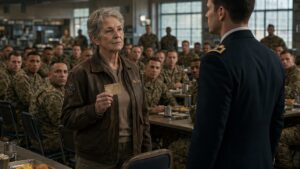
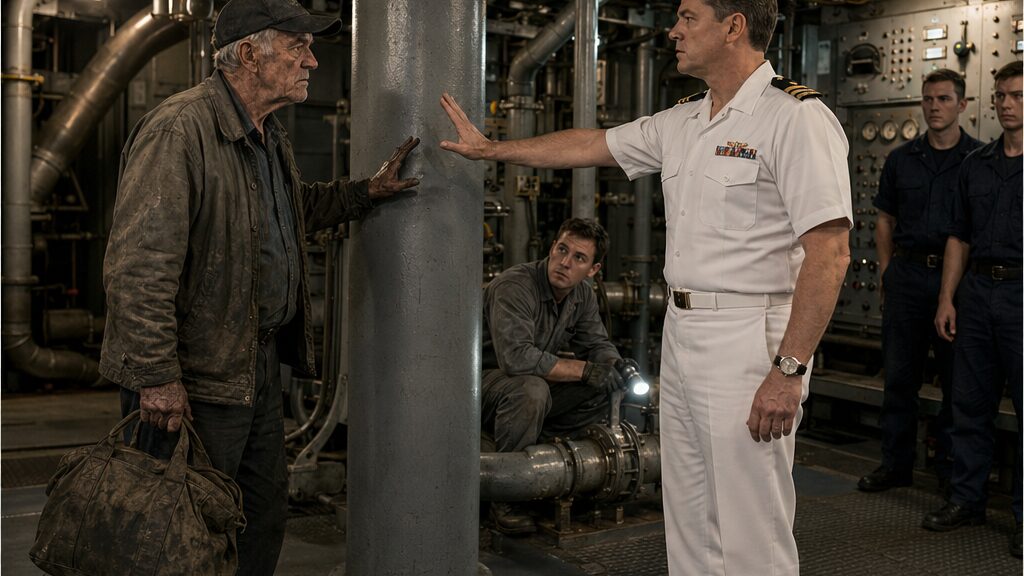
The engine room had changed and had not changed. New labels, newer insulation, brighter paint on the deck plates. But the same cramped steel, the same heat, the same sense that the ship was alive and waiting to be understood. Near the vertical support column, a clean naval officer in a white uniform stood blocking the machinery panel, shoulder boards sharp, ribbons aligned, shoes polished enough to catch the overhead light.
He turned when Gary entered.
The officer’s eyes moved from Gary’s cap to his stained jacket to the old tool bag in his hand.
Behind him, a younger technician in gray coveralls stood with a flashlight and a tablet, half-crouched near a pipe clamp.
Gary heard the sound again.
Tap. Tap.
Late.
Tap.
The officer stepped directly in front of the panel.
“I’m Anthony King,” he said. “And I need to know why you’re in my engine room.”
Chapter 2: Two Knocks and the One They Missed
For a moment, Gary looked past Anthony King and not at him.
The sound had moved through the column, into the deck beneath Gary’s shoes, then up through the bones of the room. It was not loud. That was part of the trouble. Loud failures got attention. Small ones waited for pride to pass over them.
“I asked you a question,” Anthony said.
Gary brought his eyes back to the officer. “I heard the line cycling wrong.”
Anthony’s mouth tightened, not much, but enough. He was younger than Gary had expected, perhaps early forties, with the clean bearing of a man who had been taught to stand still when rooms moved around him. His white uniform made the engine room seem dirtier by contrast.
“The inspection team has been aboard since oh-seven-hundred,” Anthony said. “We have readings.”
“Readings don’t always catch rhythm.”
The younger technician in gray shifted near the pipe. His flashlight beam jumped across a clamp, then steadied. Gary noticed his hands. Careful hands. Nervous, but not careless.
Anthony glanced toward him. “Eric, continue logging.”
“Yes, sir.”
Gary took one step closer to the column.
Anthony moved before Gary could take a second. “Do not touch the equipment.”
Gary stopped.
The words were not shouted. That made them worse. They were neat, professional, and hard enough for everyone in the room to hear. Two younger crew members near the aft panel went quiet. Somewhere above, a radio crackled. Sandra Lewis’s voice came faintly through a speaker near the doorway.
“Status in engineering?”
Anthony pressed the mic at his shoulder. “Engineering is secure. We have an unauthorized maintenance concern being handled.”
Unauthorized. Maintenance concern.
Gary lowered his hand.
“I was cleared below,” he said.
“You were allowed to observe.” Anthony looked at the tool bag. “Not interfere.”
“I haven’t interfered.”
“You walked into an active readiness inspection carrying tools and making claims about a system you have not been assigned to evaluate.”
Gary felt every eye in the room gather on his jacket, his cap, the grease on his fingers. He could sense the old story forming around him: retired man misses the work, old sailor wants to be needed, maybe he once knew something, maybe now he just wants people to listen.
“Sir,” Eric said softly, “he mentioned the auxiliary feed. That’s the line we—”
Anthony cut him off with a look.
Gary spared the young technician the cost of speaking again. “You’re hearing two knocks.”
Anthony stared at him.
Gary nodded toward the column. “And missing the third.”
The room held still.
Then one of the crew members looked down at the deck as if the sound might announce itself out of courtesy. Nothing came but the hum of ventilation and the low tremor of pumps.
Anthony’s expression changed from irritation to something cooler. “Mr. Walker, was it?”
“Yes.”
“I respect experience. I do. But this vessel is under inspection according to current procedure. We cannot chase every noise someone remembers from another decade.”
Gary took the sentence without flinching.
“I don’t remember it,” he said. “I hear it.”
Anthony’s jaw shifted. “You heard something from the pier.”
“I felt it at the gate. Heard it in the passage. It’s clearer here.”
“Because you expected to hear it.”
Gary looked at him then, fully. The officer’s uniform was spotless. Not because Anthony had never worked hard, Gary thought, but because his work now required spotless things. Authority. Certainty. Lines no one could mistake.
“Maybe,” Gary said.
That small word seemed to surprise Anthony more than an argument would have.
Gary turned slightly toward the vertical support column. “May I?”
“No.”
Sandra’s voice crackled again. “Officer King, is there a safety concern?”
Anthony kept his eyes on Gary. “Negative. We’re resolving access.”
Eric’s flashlight slipped against the pipe clamp. Metal kissed metal with a small bright tick.
Then the room answered.
Tap. Tap.
The flashlight trembled in Eric’s hand.
A pause.
Tap.
Gary saw Eric’s head lift.
Anthony did too.
“That,” Gary said quietly.
No one spoke.
The knock did not come again. The machinery returned to its ordinary layered hum, as if embarrassed by its own confession.
Eric looked from the pipe clamp to Anthony. “Sir, I felt that through the bracket.”
Anthony did not turn. “Continue logging.”
Gary raised two fingers slowly, not toward any control, only toward the column. “The old crew used to call this one the Preacher.”
One of the younger crew members frowned. “The what?”
“The Preacher,” Gary said. “Because everything wrong in this room used to come confessing through it sooner or later.”
Anthony’s eyes narrowed. “That name is not on any diagram.”
“No.”
“Then where did you hear it?”
Gary’s fingers hovered inches from the gray-painted steel. He could almost feel another hand there, younger than his, strong and burned across the knuckles, tapping twice as a joke after a twelve-hour watch. He let the memory pass through without naming it.
“From men who listened,” he said.
Anthony let out a short breath. Not quite a laugh. Not quite anger.
“That’s not a maintenance basis.”
“No.”
“You keep answering like that’s enough.”
Gary lowered his hand. “Sometimes it is. Sometimes it isn’t.”
Anthony looked toward Eric. “Do current readings show abnormal vibration?”
Eric checked the tablet too quickly. “Within range, sir.”
“Temperature?”
“Within range.”
“Pressure variance?”
“Nominal.”
Anthony turned back to Gary. “There it is.”
Gary nodded. “There what is?”
“The difference between a concern and a delay.” Anthony stepped closer. Not threatening, simply occupying space. “Tomorrow this ship hosts families of sailors who served aboard her. Today we certify she is ready and safe for visitors. I will not halt inspection because an unassigned former worker has a feeling about a pipe.”
Former worker.
Gary felt the words land. He did not correct them.
Behind Anthony, Eric’s flashlight remained pressed against the clamp, as if his hand had forgotten to move away.
Gary said, “Cycle the auxiliary again with the bleed valve half-open.”
Anthony’s face hardened. “Absolutely not.”
“You’ll hear it clearer.”
“I said no.”
“It won’t show in the first numbers.”
“Mr. Walker.”
Gary stopped. The room had gone too quiet around them.
Anthony spoke with official patience. “You need to step away from the panel and leave engineering.”
Gary looked past him to the gray column. The paint had chipped near waist height where years of belt buckles, tools, and tired bodies had leaned into it. The ship gave its low hum. Gary waited, not because he wanted to be right, but because if the sound came again while they were talking about removing him, perhaps the room itself would do what he could not.
Tap. Tap.
A long pause.
The third tap came under Anthony’s last word.
“Now,” Anthony said.
Eric’s flashlight shivered again.
Gary saw Anthony hear it this time. Not fully. Not enough to admit. But some small part of him heard.
Sandra’s voice came over the radio, tighter now. “Officer King, do you need security?”
Gary looked at Anthony.
Anthony looked back, his white uniform bright beneath pipes that had not cared about uniforms for longer than either of them had been alive.
“No,” Anthony said into the mic. “Not security. Escort only.”
Gary bent slowly and picked up the canvas tool bag he had set near his foot. His knees complained. The movement took longer than he wanted it to. No one helped him. He was glad of that.
As he straightened, Eric spoke in a low voice.
“Sir, should I mark the vibration note?”
Anthony did not answer at once.
Gary waited with his bag in hand.
“Mark current readings only,” Anthony said.
Eric looked down. “Yes, sir.”
Gary walked toward the doorway. He passed close enough to Anthony to see a single faint line of sweat under the officer’s collar.
At the threshold, Gary stopped and looked back at the column.
“The third one comes late for a reason,” he said.
Anthony’s eyes lifted.
Gary did not explain. He did not give them his years, his rate, his losses, or the names that still lived in the sound. He only stepped into the passage as Sandra’s authorization came through the speaker, calm and final.
“Escort Mr. Walker off the vessel.”
Behind him, just as the maintenance worker reached the doorway, the engine room knocked again.
Two clean taps.
A silence long enough for a man to deny what he had heard.
Then the third.
Chapter 3: The Inspection That Needed Silence
Anthony King did not write “third knock” in the inspection notes.
He wrote: transient vibration reported by visitor, no abnormal readings observed.
Then he stared at the line until the words began to look less like documentation and more like a decision he had already made.
Outside the shipyard office window, the gray vessel sat against the pier with work crews crawling over her like careful insects. A banner crew measured rail spacing for the memorial event. The civilian photographer who had been on deck earlier now stood by the bow, waiting for a clean shot without workers in it. Tomorrow, families would come aboard. Some would bring flowers. Some would bring children too young to understand why adults touched bulkheads and went quiet.
Anthony set the pen down.
Sandra Lewis stood near the filing cabinet with her phone pressed between shoulder and ear, listening to someone from the event office. Her clipboard was tucked under one arm. Every few seconds she looked at Anthony as if trying to decide whether to ask the question again.
When she ended the call, she did.
“Was he a real concern?”
Anthony capped the pen. “He was a distraction.”
“That’s not what I asked.”
He looked up.
Sandra’s expression was practical, not accusatory. In a way, that made him more defensive. “No current reading supports shutting down the inspection.”
“But you heard something?”
Anthony pushed the inspection notes into the folder. “Ships make noise.”
“Old men do too,” she said, then softened it with a sigh. “I’m not making light of it. I just need to know whether I have a safety issue or an access issue.”
“Access,” Anthony said.
The answer came too quickly. He heard it himself.
Sandra watched him for one second longer than courtesy required. “All right. I’ll log him as escorted off without incident.”
Without incident.
Anthony looked down at his hands. They were clean except for a faint smear of gray paint near the base of his thumb where he had brushed against the support column after Gary left. He had not meant to touch it. He had turned back to the panel, listened to Eric recite numbers, and placed his hand there without thinking.
Tap. Tap.
Pause.
Tap.
He had felt something. Or thought he had.
Procedure existed for exactly that reason. Men imagined patterns. Memory added weight to ordinary sounds. Pride cut both ways. He would not become the officer who delayed a readiness inspection because an elderly visitor spoke in riddles.
Yet the old man’s voice stayed with him.
You’re hearing two knocks and missing the third.
Anthony opened the folder again and crossed out nothing. He only added: No action required at this time.
Sandra gathered her papers. “The safety inspector arrives in thirty minutes. I need the engineering space clear and the tour path verified. Tomorrow’s memorial group includes press. Let’s avoid surprises.”
“I understand.”
“I’m not trying to rush you.”
“Yes, you are.”
A small smile touched her mouth. “I am. But professionally.”
He almost smiled back. Then the ship hummed through the office floor, low and distant.
Anthony glanced down.
Sandra noticed. “What?”
“Nothing.”
She left with the folder under her arm.
Anthony remained seated for another minute. He had learned early that command was often the art of not letting a room see you hesitate. His father had been a Navy man, though not an officer. He had come home from work with grease under his nails and silence in his mouth. Anthony remembered the smell of hydraulic fluid in the laundry room, the dark uniforms washed separately, the way his father could identify a car problem from the driveway by listening once.
He also remembered the drawers full of unfiled papers, the missed appointments, the arguments with clerks and offices that wanted forms his father no longer had. Service had taught the older man discipline, but age had made the world impatient with him anyway.
Anthony shut that thought down.
This was not about fathers. It was not about old workers with sharp ears. It was about a ship, an inspection, and responsibility.
He stood and adjusted his uniform jacket before heading back toward the engine-room corridor.
The passage was hotter now. Work lights had been added near the ladderwell, and a maintenance worker was taping down cable along the deck. Two younger crew members stood aside as Anthony passed. Their conversation stopped a beat too late. He wondered what they had said after Gary was escorted off.
Probably nothing. Probably enough.
In engineering, Eric Davis was crouched near the auxiliary feed with his tablet balanced on one knee. The flashlight lay on the deck beside him, beam aimed toward the pipe clamp. He looked up when Anthony entered.
“Readings?” Anthony asked.
“Still within range, sir.”
“Good.”
Eric hesitated. “There’s a minor variance during the cycle.”
“How minor?”
“Not reportable under current threshold.”
Anthony stepped closer. “Then don’t make it larger by tone.”
Eric looked down. “No, sir.”
Anthony regretted the sharpness as soon as he heard it. Eric was young but not sloppy. He had been thorough all morning, perhaps too thorough for a day built around staying on schedule.
Anthony scanned the machinery panel. Pressure steady. Temperature steady. Vibration meter below threshold. Everything visible agreed with him.
That should have settled it.
He turned toward the vertical support column. The gray paint was scuffed near the place Gary had nearly touched. Anthony imagined two fingers there, not grabbing, not claiming, just listening.
“What did he mean by Preacher?” Anthony asked.
Eric glanced up. “Sir?”
“The column. He called it the Preacher.”
“I don’t know.”
“It isn’t on the diagrams.”
“No, sir.”
Anthony waited.
Eric swallowed. “But old crews had names for things.”
Anthony’s eyes narrowed.
“I mean, not official names,” Eric added quickly. “Just… shop names. Things that don’t make it into drawings.”
“That doesn’t make them reliable.”
“No, sir.”
Anthony walked to the panel and checked the cycle log himself. Numbers. Time stamps. Clean entries. Proper order. A ship was safest when it could be understood by more than one man’s memory.
“Run the auxiliary cycle again,” he said.
Eric looked surprised. “Full?”
“Standard.”
Eric entered the command through the authorized sequence. A low shift passed through the line. Pumps adjusted. Somewhere behind the wall, metal accepted pressure.
Tap. Tap.
Anthony held still.
The third did not come.
Eric’s shoulders lowered slightly, whether in relief or disappointment Anthony could not tell.
“There,” Anthony said. “Standard cycle.”
“Yes, sir.”
Anthony turned away.
Then, from deeper in the line, delayed and dull, came the third tap.
Not loud. Not dramatic. Just late.
Eric did not move. Anthony did not either.
For three seconds the engine room seemed to wait for whichever one of them would lie first.
Anthony looked at the panel. The numbers remained clean.
Eric picked up the flashlight and held it against the pipe clamp. “Sir.”
“What?”
“It happens only when the auxiliary line cycles down, not up.”
Anthony said nothing.
Eric’s voice was careful, almost apologetic. “And only after the pressure settles.”
Anthony looked at him.
The young technician kept his eyes on the clamp. “Sir, I think he heard the part we weren’t measuring.”
Chapter 4: A Name Not Written on the Diagram
Eric Davis waited until Anthony King left engineering before he wrote anything down.
He did not enter it in the official inspection tablet. He knew better than that. Official notes had a way of becoming questions, and questions had a way of finding the youngest person in the room. Instead, he took a strip of blue painter’s tape from the side of the panel, stuck it to his glove, and marked three small lines with a grease pencil.
Two close together.
One farther away.
He folded the tape onto itself and slipped it into his pocket.
The engine room kept humming around him. The two younger crew members were checking gauges near the aft panel, speaking in low voices. The inspection had resumed its shape, neat and procedural, but the air inside the space had changed. Eric could feel it in the way people avoided looking at the support column.
The Preacher.
He looked at the gray-painted steel. Nothing about it seemed worth naming. It was a vertical support, one of dozens of parts that kept the ship stiff, aligned, and obedient to its own design. Yet the old man had spoken the name like he had heard it a thousand times in tired voices after midnight watches.
Eric pressed his flashlight against the pipe clamp again.
Nothing.
He waited through the next cycle.
Tap. Tap.
The third came late enough to make his neck tighten.
He did not write that down either.
By early afternoon, Sandra Lewis had moved the inspection team’s paperwork to a records room beside the admin trailer, away from the movement of crews preparing for the memorial event. Eric was sent there to pull an older auxiliary-feed diagram after he mentioned, carefully, that a prior repair might explain the variance.
“Prior repair?” Sandra asked, looking up from her laptop.
“Could be nothing,” Eric said.
She gave him the look of someone who knew those words usually meant the opposite. “Pull what you need. Don’t start a second inspection without Officer King’s approval.”
“No, ma’am.”
The records room smelled of toner, cardboard, and old dust baked by weak air-conditioning. Most current files were digital, but ships carried histories too awkward to fully convert. Rolled drawings lay in metal racks. Boxes marked with fading labels sat under tables. A copier blinked in sleep mode near the wall.
Eric found the current auxiliary-feed diagram first. It showed the support column by number only. No nickname. No mystery. Clean lines, clean labels, no room for a sound that arrived late.
He traced the line with one finger until he reached the clamp where his flashlight had trembled. The drawing showed a replaced bracket assembly installed during a refit. Nothing strange.
He looked for the refit record.
The first box gave him invoices, inspection stamps, pressure-test sheets. The second gave him old correspondence about parts availability. The third was heavier, its bottom soft with age. Eric lifted folders out carefully, afraid the papers might tear just from being asked to matter again.
He found the old diagram folded inside a brown envelope with a torn flap.
The paper had yellowed at the creases. Someone had marked sections in pencil, erased, marked again. The support column was there, drawn thicker than in the newer diagram, with a cluster of lines around the auxiliary feed. In the margin beside it, in handwriting so small he almost missed it, were three words.
watch third knock
Eric sat back.
Outside the records room, a cart rattled past. Someone laughed in the hallway. The ordinary shipyard noise made the note feel more private.
He leaned closer. The handwriting was not official. It had no date beside it, no initials he could make out, only a pressure mark where the pencil had dug too hard into the paper. Under the note, another hand had drawn two short vertical strokes and one farther away.
Eric touched his pocket, where the folded painter’s tape rested against his leg.
He took out his phone, then put it away. A photo would create a trail. A photo would require an explanation. He hated himself for thinking that before thinking of the ship.
He copied the diagram number onto a notepad instead.
A maintenance worker stepped into the records room carrying a stack of binders. “You looking for the old feed-line stuff?”
Eric turned too fast. “Maybe.”
The worker nodded toward the brown envelope. “That one’s ancient.”
“Do you know who wrote in the margins?”
“No idea. Half the old guys wrote on everything. Before the tablets, paper took all the blame.”
“Did you ever hear anyone call the support column the Preacher?”
The worker paused with a binder halfway onto a shelf. “Where’d you hear that?”
Eric kept his voice even. “Old note.”
“Not from a note.” The worker slid the binder into place. “That was shop talk. My first supervisor used to say it. If the Preacher started tapping, you listened before you prayed.”
Eric’s skin prickled. “Why?”
The worker shrugged, but his eyes went to the envelope. “Old story. Accident before my time. Something about a bad line they caught too late. Or didn’t catch. Depends who tells it.”
“What happened?”
“Records won’t say much.” The worker tapped the box with two fingers. “Records like clean endings.”
He left before Eric could ask more.
Eric stood alone with the old diagram spread beneath his hands. The current paperwork had turned the ship into systems, readings, thresholds, and signatures. The old margin mark did something else. It made the machinery feel inhabited.
He searched the box again.
Near the bottom, under a folder of heat-stress reports, he found a thin incident summary. Most of it was typed in stiff language. Auxiliary feed irregularity. Temporary pressure instability. Corrective maintenance performed. Personnel injury. One line had been copied badly, the toner faded at the edge.
No names appeared on the first page.
On the second page, a section listed repair personnel present after the incident. Some names were smudged. Some were struck through and rewritten. Eric moved to the window for better light, angling the paper until the afternoon sun caught the old ink.
One name was clearer than the rest.
Walker.
Not Gary, not yet. Just Walker.
Eric felt the room tilt, not physically, but in the way a fact could alter the size of everything around it.
He found the crew roster ten minutes later in a separate folder. The roster was faded, its staples rusted orange at the corners. It listed ratings, divisions, assigned spaces. He read down the page, slow enough to be sure he was not turning one old man into the answer because he wanted one.
There it was.
Gary Walker.
Machinist’s mate.
Engineering division.
Eric lowered the paper onto the table. He imagined Gary at twenty, thirty, forty, moving through the same narrow room without the stoop in his shoulders, without the careful pace, without people looking through him. He imagined him knowing where to place a hand in the dark.
Sandra appeared in the doorway. “Did you find what you needed?”
Eric covered the roster with the old diagram, not because he meant to hide it, but because the discovery felt unready for fluorescent light.
“I found a prior notation,” he said.
“Relevant?”
He thought of Anthony’s face when the third tap came late. He thought of Gary bending to pick up his tool bag while no one helped him. He thought of the old margin note, pressed hard into paper by a hand that had wanted someone, someday, to listen.
“Yes,” Eric said. “I think so.”
Sandra stepped inside. “Then bring it to Officer King.”
Eric gathered the papers, but the roster slipped free and fell to the floor between them.
Sandra bent first. She picked it up and read the line his finger had marked.
“Gary Walker,” she said quietly.
Eric did not answer.
Outside, from the direction of the ship, a low machinery cycle rolled through the pier.
Tap. Tap.
Even through the office wall, Eric imagined the silence before the third.
Chapter 5: The Room Gary Would Not Remember
Gary Walker’s apartment had one window that faced the parking lot and another that faced a brick wall close enough to touch with a broom handle.
He preferred the brick wall.
The parking lot held too many departures. Cars backing out. Doors shutting. People leaving with somewhere proper to go. The brick wall stayed where it was, plain and sun-warmed in the afternoon, asking nothing.
Gary set his tool bag on the kitchen chair and stood beside it for a while. The canvas had darkened at the bottom where years of oil had soaked in. One handle was wrapped in old tape. He had meant to replace it a dozen times, but a man could get used to carrying weight a certain way.
His cap came off last.
He placed it on the table, brim facing the door.
The room was small and orderly. A kettle on the stove. Two mugs in the cupboard, though only one was used. A stack of bills clipped under a magnet. On the counter, the black notebook sat where he had left it that morning, then taken it, then returned with it still unopened.
Gary washed his hands. The grease lightened but did not leave. It never fully did. Not from the cracks near his nails. Not from the lines of his palms. He dried them on a towel and looked at the skin as if it belonged to someone older than he had agreed to become.
He should have stayed home.
The thought came cleanly, without drama.
He had done what duty required. He had gone. He had spoken. They had removed him. The rest belonged to men in uniform, with current badges and current authority. A ship had a chain of command. An old man wandering back into it was not a command; he was weather.
Gary opened the cupboard and took down a mug. Then he put it back.
The third knock moved through him without sound.
He sat at the table.
For several minutes he did not touch the notebook. He listened to the refrigerator hum, the traffic beyond the parking lot, the faint tick of the kitchen clock. None of them landed late. None of them carried a room full of heat and shouting and burned insulation.
When he finally opened the notebook, the spine cracked.
The first pages held ordinary things: part numbers, measurements, names of suppliers that no longer existed. His handwriting changed over the years from firm to tight. Near the middle, between a bilge-pump sketch and a list of gasket sizes, one page had been folded twice.
He unfolded it.
Three pencil marks sat near the top.
Two together.
One apart.
Below them, in younger handwriting than he remembered having, he had written: don’t wait for numbers if the room is already speaking.
Gary closed his eyes.
The room came back, not all at once, but in pieces. Heat first. A watch that should have been routine. A tired voice joking about the Preacher confessing again. A pressure gauge that stayed close enough to normal to let men argue. The late third knock, small and stubborn. His own hand on the column, younger, stronger, certain enough to be uneasy but not certain enough to stop the line.
Then the sound became something else.
A rupture did not sound like people expected. It was not one great explosion in his memory. It was a hard metallic change, a scream of pressure, then men shouting over steam and alarms. A flashlight spinning on the deck. Someone calling for the valve. Someone else calling a name Gary had spent years refusing to say aloud in empty rooms.
He opened his eyes.
His hand had closed around the edge of the table.
Gary forced his fingers loose one at a time.
He had not caused it. Boards had said that. Reports had said that. Men with clean shirts and tired eyes had said that. A line had weakened where inspection did not show it. Procedure had been followed. Corrective maintenance had been performed.
Records liked clean endings.
But another man had looked at Gary from the deck plates, face pale under grime and pain, and gripped his sleeve with surprising strength.
Don’t let them call it noise again.
Gary had nodded because there was nothing else to give.
After that, the Navy had given him forms. The shipyard had given him work. Life had given him mornings, invoices, repairs, neighbors, winter coats, grocery lists. The promise stayed underneath all of it, quiet until a sound called it up.
He turned the notebook page and found older notes about the auxiliary feed. Nothing complete enough to solve a problem. Enough to remember where to look. Clamp assembly. Down-cycle vibration. Check bleed valve response before pressure equalization. Listen at Preacher.
He let out a breath that shook once.
The phone on the counter buzzed.
Gary did not move.
It buzzed again.
He rose slowly, joints stiff from the morning’s ladders and the longer climb through memory. The message came from an unknown number.
Sir, this is Eric Davis from engineering. I heard it too.
Gary read it three times.
The word sir made him uncomfortable. Not because he disliked respect, but because respect that arrived after disrespect often brought its own burden. People wanted the old man to become what they now needed him to be. Wise. Forgiving. Available.
He set the phone down.
Outside the window facing the parking lot, a car door shut. Somewhere a child laughed, unseen. The world remained ordinary, which had always seemed unfair after machinery tried to warn people.
The phone buzzed again.
We found an old diagram. It says watch third knock. Your name is in the roster.
Gary picked up the phone, then put it down. He took his cap from the table and held it by the brim.
His name in a roster. As if that was the part that mattered. As if being written down could make a warning easier to hear.
A third message arrived after a pause.
Officer King hasn’t called you. I don’t know if he will. But the knock is tied to the down cycle. I thought you should know.
Gary stood very still.
Down cycle.
The words reached past humiliation, past pride, past the gate clerk’s careful voice and Anthony King’s polished refusal. Down cycle was not nostalgia. It was not a feeling. It was where the line relaxed after pressure and revealed what strain had hidden.
He returned to the notebook. His finger moved over the page until it found the old note.
Check bleed valve response before pressure equalization.
He remembered the sound after the accident most of all. Not alarms. Not shouting. Silence. The terrible quiet after a room had spent too long trying to speak.
Gary took his jacket from the chair.
Halfway to the door, he stopped. He looked at the cap in his hand, then at the folded notebook on the table.
He did not want to go back.
That truth deserved its place. He stood there and let it be true.
He did not want to see Anthony King’s face. He did not want to step into the engine room and feel old grief waiting in the heat. He did not want to offer help to people who had watched him leave with his bag in his hand.
But wanting had never been the measure.
Gary put on his cap.
He took the notebook, slid it inside the tool bag, and locked the apartment door behind him.
The dockside air was cooling when he reached the shipyard fence again. The memorial banner hung half-finished along the rail, white cloth moving lightly in the evening wind. Beyond it, the ship sat gray and patient.
Gary’s phone buzzed once more before he reached the gate.
This time the message was shorter.
Please come back.
Chapter 6: The Officer Who Had to Ask Quietly
Anthony King held Eric Davis’s folded strip of blue painter’s tape between two fingers and wished it were easier to dismiss.
The tape lay on his desk under the office light, creased from Eric’s pocket. Three grease-pencil marks crossed it. Two close together. One farther away. Beside it lay the old diagram from the records room, the margin note angled beneath a paperweight Sandra had found in a drawer.
watch third knock
Anthony had read the words until they became less like evidence and more like an accusation.
Sandra stood near the door with her arms folded. Eric stood by the file cabinet, trying to look as if he had not just stepped across an invisible line.
“You should have brought this to me immediately,” Anthony said.
Eric’s face reddened. “Yes, sir.”
Sandra’s eyes sharpened. “He brought it as soon as he confirmed it existed.”
Anthony looked at her. “That wasn’t a request for defense.”
“No,” she said. “It was an unnecessary shot at the only person who kept looking.”
The room went quiet.
Anthony could have answered. He could have reminded both of them that responsibility did not belong to the most anxious person in the room, that old notes did not override current readings, that readiness inspections could not be steered by shipyard folklore.
Instead, he looked down at the tape again.
His father had kept notes on masking tape.
Notebooks too, but tape most of all. Strips stuck to toolboxes, jars, the washing machine, the inside of cabinet doors. bleed this first. listen cold. belt slips when wet. After his father died, Anthony had spent a weekend cleaning the garage and throwing away tape that had curled brown at the edges. At the time, it had felt like restoring order.
Now he could not remember what any of those notes had been trying to preserve.
“Run the cycle again,” Anthony said.
Eric straightened. “Sir?”
“Standard down cycle. I’ll be there.”
Sandra stepped aside as he passed.
The ship felt different in the evening. The memorial crews had gone. Work lights turned the passageways pale and narrow. The engine room held heat like a closed hand. Anthony removed his uniform jacket before descending the last ladder, then regretted how conscious he was of the gesture. He did not want to appear informal. He did not want to appear afraid of getting dirty.
Eric took position near the auxiliary feed. The flashlight beam shook once before he steadied it.
“Ready,” Eric said.
Anthony nodded.
The line cycled up first. Pumps adjusted, pressure settled, gauges responded in their proper ranges. Nothing unusual.
“Down cycle,” Anthony said.
Eric entered the command.
The machinery shifted.
Tap. Tap.
The pause came.
Anthony felt every person in the room wait through it.
Tap.
This time the third knock was not polite. It carried through the column with a dull weight that Anthony felt in his chest. One of the younger crew members looked up sharply from the aft panel.
“Again,” Anthony said.
Eric hesitated. “Sir, repeated cycling might—”
“Again, but log manually.”
They ran it once more.
Tap. Tap.
The late third came harder.
The readings still remained technically acceptable, but one needle quivered on the edge of its tolerance before settling back where it could pretend nothing had happened.
Anthony stared at the gauge.
He heard his own voice from the morning, clean and certain.
Former worker.
He turned away from the panel. “Stop cycling.”
Eric’s hand froze over the controls. “Stop, sir?”
“Stop.”
The engine room’s hum settled into a lower pitch.
Anthony reached for the nearest flashlight. It was Eric’s, lying on a tool tray. He picked it up before he could think better of it. The metal body was warm from the room and smudged with gray dust.
“Find Mr. Walker’s number,” he said.
Eric looked at him.
Anthony did not repeat himself.
Sandra had it from the visitor log. She called first from the office phone, but Gary did not answer. Then Eric sent a message, then another. Anthony stood in the passage outside engineering, flashlight in hand, listening to the ring tone die twice through Sandra’s speaker.
“You should call,” Sandra said.
“I am standing here.”
“That isn’t the same.”
Anthony looked toward the ladderwell. “He may not answer me.”
“He might not.”
There was no accusation in her voice. That was worse.
Anthony took the phone.
When Gary answered, there was no greeting. Only the faint sound of wind, as if he was already outside.
“Mr. Walker,” Anthony said.
A pause. “Officer King.”
Anthony closed his eyes once, briefly. “I need to ask you to return to the vessel.”
“Need?”
The word was flat. Not cruel. Exact.
Anthony looked at the flashlight in his hand. A smear of old grease had transferred onto his palm. “Yes.”
“Why?”
Because you were right would have been simple. Too simple. It would have made the call about Anthony’s admission instead of the ship’s danger.
“The knock is tied to the down cycle,” Anthony said. “The current readings aren’t catching the delay. We found an old diagram with a note.”
“I know.”
Of course he knew. Eric had messaged him. Anthony swallowed the small irritation that came from being behind the truth.
“I’m asking you to come back and listen to it in the space.”
Another pause.
“Are you asking because you need my name,” Gary said, “or because you need my ears?”
Anthony looked through the passageway into the engine room. The gray column stood under the lights, ordinary and waiting.
“My mistake this morning was thinking those were separate,” he said.
Silence held the line.
When Gary spoke again, his voice was quieter. “I’m at the gate.”
Anthony looked toward Sandra.
She took the access badge from the desk without being asked.
No one escorted Gary like a problem this time.
Anthony met him at the engine-room entrance, not at the bottom of the ladder, not from behind the panel. Gary came through the passage wearing the same stained jacket and dark cap, the same canvas bag hanging from his hand. He looked tired enough that Anthony felt a brief, unwelcome shame at having added to it.
Eric stood behind Anthony, flashlight absent from his hand.
Gary noticed the flashlight in Anthony’s grip. His eyes rested on it for a second, then moved to the column.
No one spoke about the morning.
Anthony stepped aside.
The movement cost him less than he expected and more than he liked.
Gary entered the engine room. The heat seemed to meet him as if recognizing a body it had known before. He set his tool bag down by the threshold, not near the machinery, and walked to the support column.
His pace was slow. Not weak. Measured. Each step had to cross years before it crossed the deck.
Eric began to say something, then stopped.
Gary removed his cap.
The room changed around that small act. Anthony did not understand why at first. Then he did. Gary was not performing respect for the ship, the Navy, or the people watching. He was making space for something private.
Gary placed two fingers against the gray-painted column.
“Cycle?” Anthony asked.
“Not yet.”
Gary closed his eyes.
The engine room hummed. Ventilation sighed overhead. Somewhere a pump clicked into readiness.
Gary moved his fingers lower by three inches. “This paint’s thicker than it used to be.”
No one answered.
He shifted again, to a scar in the paint near waist height. His fingers settled there.
“There,” he said.
Anthony nodded to Eric.
The auxiliary line cycled up. Nothing.
It cycled down.
Tap. Tap.
The pause stretched.
Gary’s face tightened before the third knock came.
Tap.
He opened his eyes.
“Shut down the line,” he said.
Anthony did not move. Not because he meant to refuse, but because the words had arrived with the weight of command from a man who held none.
Gary turned to him. “Before the next cycle.”
Anthony looked at Eric. “Secure the auxiliary feed.”
Eric moved fast.
A younger crew member started to speak about procedure, then saw Anthony’s face and went silent.
The machinery shifted as Eric entered the shutdown sequence. A gauge dropped. A pump wound down. The room’s layered hum thinned.
Gary kept his fingers on the column until the vibration faded.
Then he looked toward the pipe clamp under Eric’s light.
“It’s not the column,” Gary said. “It’s carrying the confession. The failure’s farther in.”
Chapter 7: What the Third Knock Was Trying to Say
Gary did not move his fingers from the column until the auxiliary feed had gone quiet.
Even then, he kept them there a moment longer, feeling for what remained after the machinery stopped pretending. The engine room’s usual hum had thinned into smaller sounds: ventilation, cooling metal, Eric’s breathing near the pipe clamp, the faint scratch of a pencil from one of the crew members logging the shutdown by hand.
Anthony King stood close enough to hear Gary’s low voice, but not close enough to crowd him now.
“Farther in,” Anthony repeated.
Gary nodded once. “Past the clamp. The clamp’s just where it talks.”
Eric shifted his flashlight beam along the pipe. “Toward the bleed valve?”
Gary looked at him. “Past it first. Then back to it.”
Eric frowned, trying to make the order fit a diagram in his head.
Gary saw the effort and respected it. The young man wanted the line to behave like paper. Most did, until the room taught them better.
“Pressure settles after the down cycle,” Gary said. “If the valve response is slow, the line relaxes uneven. Something loose takes the strain after the gauges decide everything’s fine.”
Anthony looked to the younger crew member at the panel. “Can we inspect the valve assembly with the line secured?”
“Yes, sir. Access panel’s tight, but we can open it.”
“Do it.”
The crew member moved, then stopped as his eyes flicked toward Gary. Not for permission exactly. For confidence.
Gary put his cap back on. The act steadied him more than he liked to admit. “Open it slow. If the fasteners bind, don’t force them.”
Anthony’s gaze moved to him.
Gary waited for correction. None came.
The panel came loose with a shriek of old screws. Heat breathed out from behind it, carrying the smell of warm paint and mineral oil. Eric crouched, flashlight angled under his chin, and looked inside. The beam caught braided line, bracket edges, a dull housing tucked deeper than a casual inspection would easily reach.
“I see the bleed valve housing,” Eric said. “No visible leak.”
“Touch the bracket behind it,” Gary said.
Eric glanced at Anthony.
Anthony said, “Do it.”
Eric reached in, careful. His fingertips found metal. He pushed lightly.
A small sound answered.
Tick.
Eric froze.
Gary looked at the support column.
“Again,” he said.
Eric pushed.
Tick.
Anthony stepped closer. “That’s not the same sound.”
“No,” Gary said. “That’s the first word of it.”
Eric shifted the flashlight deeper. “Sir, bracket looks intact from here, but there’s movement.”
“How much?” Anthony asked.
“Enough.”
Gary lowered himself slowly to one knee. Pain traveled up his leg, sharp and familiar. He ignored the way the younger crew member nearly reached to help and then stopped himself. Pride was a foolish thing, but there were moments when a man needed to finish the motion on his own.
“Light here,” Gary said.
Anthony moved before Eric could.
The officer crouched beside him, holding Eric’s flashlight low. The beam shook once, then steadied across the hidden bracket. Gray dust and old oil filmed the metal. Gary leaned close enough to feel heat on his cheek.
“There,” he said.
Anthony angled the light.
A hairline crack ran along the inside corner of the bracket where it met the mounting plate. It was almost invisible until the flashlight struck it sideways. Not dramatic. Not broken open. Just patient.
Eric swore under his breath, then caught himself. “Sorry.”
Gary did not look away from the crack. “It’s been moving under cycle load.”
Anthony’s voice was quiet. “Would it have failed tomorrow?”
Gary sat back on his heel. He knew what Anthony was asking. He also knew the mercy of not answering more than a man could honestly know.
“It was trying to tell you before it had to show you,” Gary said.
No one spoke.
The line, the room, the people in it—everything seemed to draw inward around the thin crack under the light. A defect small enough to be missed. A warning soft enough to be dismissed. An old man slow enough to be removed.
Anthony straightened. “Tag the assembly. No further cycling. We’ll hold the inspection until repair and verification.”
One of the crew members looked up sharply. “Sir, tomorrow’s event—”
“Can wait for a ship that is safe.”
The words landed without force, which made them stronger.
Gary looked at Anthony then. The officer’s face was still controlled, but the control had changed. It no longer tried to cover uncertainty. It held it in place so work could happen.
Eric began photographing the crack for the maintenance file. Sandra’s voice came through the radio asking for status. Anthony answered plainly.
“Inspection hold. Auxiliary feed bracket defect identified. Engineering secured pending repair.”
There was a pause on the radio. “Is this related to Mr. Walker’s concern?”
Anthony looked at Gary.
Gary looked at the open panel.
“Yes,” Anthony said. “It is.”
Gary closed his eyes briefly.
Not victory. Not relief. Something heavier and quieter. A door somewhere inside him had opened, and the air behind it was old.
The repair took less drama than the discovery. Most real saves did. A spare bracket had to be located. A safety inspector had to be woken and brought back. Sandra had to make calls that would disappoint people who liked schedules to behave like promises. Eric stayed near Gary, asking short questions and accepting short answers. Anthony remained close but did not hover.
At one point, as the damaged bracket was removed, Eric turned it under the light. The crack widened when pressure was applied by hand.
“Would the readings have caught it eventually?” he asked.
“Eventually catches a lot,” Gary said.
Eric absorbed that.
The younger crew member carried the cracked bracket to a tray. As he passed, Gary saw the man glance at him with a look that was not admiration exactly. It was attention. That was better.
Near midnight, after the replacement was fitted and the line checked cold, Anthony authorized a limited cycle. The engine room gathered itself again.
Gary stood by the column.
His knees ached from too much ladder and too much memory. His hands were steady.
“Ready?” Anthony asked.
Gary placed two fingers against the paint scar at waist height.
“Run it.”
Eric began the cycle.
The machinery shifted up, settled, and came down.
Tap. Tap.
Gary waited.
So did everyone else.
No third knock came.
The absence moved through the room more powerfully than the sound had. A clean quiet. Not empty. Earned.
Gary kept his fingers on the column until he was certain he was not filling the silence with what he wanted to hear. The ship hummed beneath him, ordinary again.
“All right,” he said.
Eric let out a breath. One of the crew members leaned back against a cabinet and looked at the deck. Anthony lowered the flashlight.
Sandra appeared at the doorway, her expression tired and relieved. “Confirmed?”
Anthony turned. “Confirmed.”
She looked at Gary. “Mr. Walker—”
Gary shook his head once, almost too small to see. Not yet.
Anthony understood before Sandra did. He stepped closer to Gary, not blocking him this time, not standing above him.
“Mr. Walker,” he said, voice carrying enough for the room to hear, “I owe you—”
Gary lifted his eyes.
That was all.
Anthony stopped.
The unfinished apology stayed between them, visible as steam, and then settled into the work still left to do. Gary did not need the room to watch a clean uniform make amends. He needed the room to remember what it had heard.
Anthony swallowed, then nodded once.
“Log the correction,” he said to Eric. “Include the initial report.”
Eric looked at Gary before he wrote.
Gary removed his fingers from the column.
For the first time all day, the Preacher had nothing more to say.
Chapter 8: The Silence After the Machinery Stopped
By morning, the engine room sounded like itself again.
Gary knew before anyone told him. He paused halfway down the ladder, one hand on the rail, and listened. Not for drama. Not for ghosts. Just for the shape of the machinery breathing under load.
The hum rose steady through the deck plates. A pump cycled. A valve answered. Pressure shifted and settled.
No late tap came hunting through the steel.
Gary descended the last steps.
The room had been cleaned during the night, though not enough to hide the work. The access panel remained open, tagged with a fresh inspection note. Tools lay in careful rows on a cloth near the pipe. The cracked bracket sat in a clear evidence bag on the tray, small and unimpressive under fluorescent light.
Eric Davis stood by the vertical support column with the flashlight in one hand and no tablet in the other. His head was slightly tilted.
Gary stopped in the doorway.
Eric did not notice him at first. He was listening.
Good, Gary thought.
Anthony King stood near the machinery panel in a working uniform now, sleeves rolled with care, white dress uniform gone from the room. He was speaking quietly with Sandra Lewis. When he saw Gary, he ended the conversation instead of making Gary wait at the edge of it.
“Morning,” Anthony said.
“Morning.”
Sandra held a folder against her chest. She looked as if she had slept badly and solved six problems anyway. “The memorial tour path has been adjusted. Engineering won’t be open to visitors until after final verification.”
Gary nodded.
“I also corrected the visitor access log,” she said. “Your badge has been reactivated under retired technical specialist. No escort requirement for approved maintenance consultation.”
Gary looked at her for a moment. “That a new box?”
“It is now.”
She did not smile as if offering a prize. She simply stated the change. Gary appreciated that.
Anthony handed Eric a clipboard. “Show him.”
Eric brought it to Gary with both hands, then seemed embarrassed by the formality and loosened his grip. “Sir—Gary. The maintenance entry.”
Gary took the clipboard.
The wording was plain. Initial concern reported by Gary Walker regarding delayed vibration during auxiliary down cycle. Follow-up inspection identified cracked bracket assembly beyond standard reading threshold. Line secured. Repair completed. Verification cycle normal.
No poetry. No grand correction. No one had turned him into a legend.
His name was where it belonged: attached to the warning, not used to decorate it.
Gary handed the clipboard back. “That’ll do.”
Eric seemed to want to say more. He did not. Instead he walked to the column and placed the flashlight against the pipe clamp the way he had the day before.
“I tried it through three cycles,” he said. “Nothing late.”
Gary joined him. “What did you hear?”
Eric listened again though the room was already quiet.
“Pump rise. Valve response. Normal settling.” He paused. “And I heard myself wanting to hear the third one because I knew about it.”
Gary glanced at him.
Eric looked embarrassed. “That matters, right?”
“It does.”
“How do you tell the difference?”
Gary set his tool bag on the deck. “You don’t, at first. That’s why you listen twice. Then you check. Then you ask somebody who knows what the room sounded like before you got there.”
Eric nodded slowly.
Anthony stood a few feet away, close enough to hear, far enough not to make the lesson his. That, too, Gary noticed.
The ship moved gently against the pier. Above them, faint footsteps crossed the deck as workers adjusted the memorial preparations. Families would still come. Speeches would still be made somewhere clean and visible. Most of them would never know that a cracked bracket had nearly turned a quiet warning into another line in a report.
Gary took off his cap.
He did not plan to. His hand simply rose, and by the time he noticed, the cap was in his fingers. He laid it on the workbench beside the open notebook he had brought from home.
The engine room held still.
Anthony looked at the cap, then at Gary, and said nothing.
Gary opened the notebook to the folded page. The three pencil marks looked smaller under the ship’s light. He took a pencil from Eric’s tray and wrote beneath the old line.
Bracket replaced. Down cycle clean. Someone listened.
His hand was not as steady as it had once been. The letters wavered. He did not correct them.
When he closed the notebook, Anthony stepped forward.
“I should not have spoken to you the way I did.”
Gary picked up his cap but did not put it on yet.
Anthony continued, quieter. “Not because you turned out to be right. Before that.”
The words had no audience except Sandra, Eric, and the machinery. No photographer. No crew gathered for a lesson. No performance trying to polish shame into virtue.
Gary looked at the officer for a long moment. He saw the man from yesterday in him still: proud, pressed, too certain of the visible order of things. He also saw a man tired enough to learn.
“That’s the part that matters,” Gary said.
Anthony nodded once. “I’ve updated the procedure. A verbal technical concern from retired personnel gets verified before dismissal, not after.”
Gary placed the cap back on his head. “Make sure it applies when the retired personnel don’t look useful.”
Anthony accepted that without defense. “I will.”
Sandra’s phone buzzed. She glanced at it, then looked toward the ladder. “They’re asking if we’re ready to reopen the forward deck.”
Anthony looked at Gary. “Are we?”
It was not a technical question only.
Gary placed two fingers against the support column one last time. The paint was cool now. Beneath it, the ship carried a clean, even vibration. No confession. No late warning. No old plea tugging him backward.
He took his hand away.
“She’s ready for people who know how to listen,” he said.
Eric smiled faintly at the floor.
Gary lifted his tool bag. It felt no lighter than before, but he carried it differently crossing the engine room. At the doorway, he paused and looked back once. The column stood among pipes and panels, ordinary again. That was the best thing a repaired thing could become.
On the dockside walkway, morning sun had burned through the gray. The memorial banner moved softly in the wind. A few families had begun gathering beyond the security line, holding programs and small flowers, waiting to be allowed aboard.
The gate security clerk saw Gary coming and straightened too quickly.
Gary spared him the discomfort. He nodded first.
The clerk nodded back. “Morning, Mr. Walker.”
Gary kept walking.
Behind him, aboard the ship, Eric remained in the engine room near the column. He held the flashlight against the clamp, not because he expected trouble, but because silence had become something worth learning.
Gary reached the end of the pier and stopped where the railing met the open water. For a moment he listened to gulls, lines creaking, a distant engine starting somewhere beyond the harbor.
No third knock followed him.
He rested one hand on the rail, then let it fall.
The ship did not need him to carry the room alone anymore.
The story has ended.