Nobody Asked About The Letter Until His Granddaughter Opened The Box Fifty Years Later
Chapter 1: The Box Above The Garage Nobody Was Supposed To Open
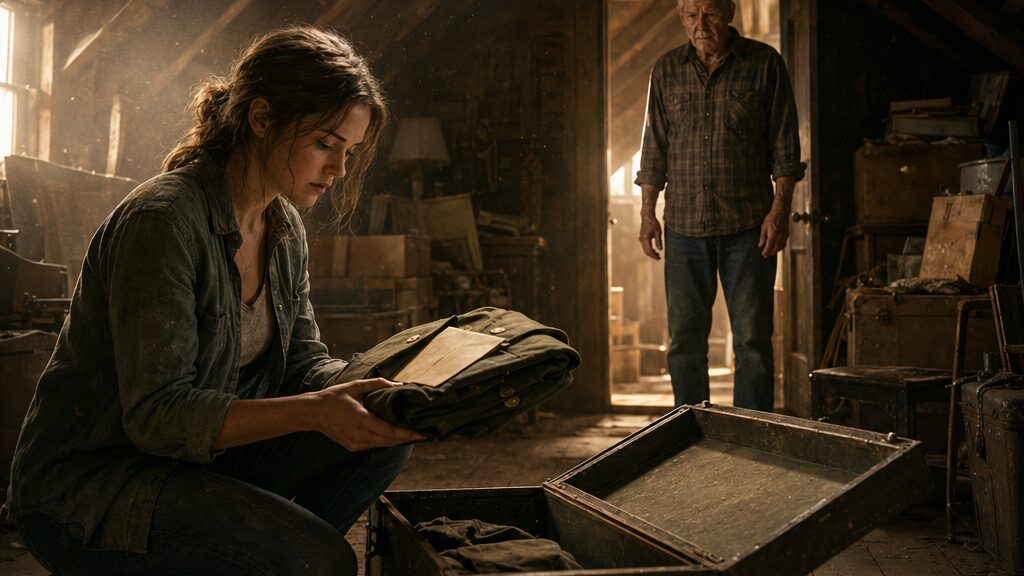
The lock snapped before Emily realized she had broken it.
She froze on the attic floor, one hand still gripping the rusted clasp.
Dust floated through the thin beam of sunlight coming from the small window above the garage. Around her sat old holiday decorations, cardboard boxes labeled in Margaret Hill’s careful handwriting, and furniture nobody had used in years.
The small military-green trunk had been shoved behind a stack of paint cans.
She hadn’t been looking for it.
She had been looking for Christmas lights.
Down below, she could hear her grandfather moving around the kitchen. A cabinet door opened. Closed. Opened again.
The sound was comforting.
Predictable.
Joseph Hill was predictable.
Every morning he drank coffee from the same mug. Every afternoon he watered the same tomato plants. Every evening he watched the local news and complained about the weather forecast.
Nothing about him suggested secrets.
Especially not a locked trunk hidden behind twenty years of forgotten storage.
Emily glanced toward the attic stairs.
“Grandpa?” she called.
No answer.
She looked back at the trunk.
The broken lock dangled uselessly.
Curiosity won.
It usually did.
Slowly she lifted the lid.
At first she thought she had opened the wrong box.
Inside lay folded clothing wrapped in yellowing plastic.
Beneath it sat several envelopes tied together with faded string.
There were photographs.
Documents.
A small metal object she couldn’t identify.
And beneath everything else, a carefully folded military uniform.
Emily stared.
Her grandfather had never mentioned military service.
Not once.
She reached down and lifted the uniform carefully.
The fabric crackled softly beneath the plastic.
A patch sat on one sleeve.
The colors were faded.
The stitching worn.
But it was unmistakably military.
Her heart began beating faster.
“What in the world…”
A photograph slipped free and floated onto the floor.
Emily picked it up.
The image showed several young men standing together.
One of them had Joseph’s eyes.
The same jaw.
The same stubborn expression.
Only younger.
Much younger.
He couldn’t have been more than twenty.
And he was wearing the uniform now resting in her lap.
She heard a step on the attic stairs.
Then another.
“Emily?”
Joseph’s voice.
She turned.
His head appeared above the stairs.
He started to smile.
Then he saw the uniform.
Everything stopped.
The smile vanished.
The color left his face.
For several long seconds neither of them spoke.
Emily had never seen him look like that.
Not sad.
Not angry.
Not frightened.
Something else.
Something deeper.
As though a door had opened somewhere he had spent years trying to keep shut.
“Grandpa?”
His eyes remained fixed on the uniform.
Then on the photographs.
Then on the open trunk.
Finally on Emily.
“You broke the lock.”
It wasn’t a question.
“I’m sorry. I didn’t mean to.”
Joseph climbed the remaining steps slowly.
His movements looked careful.
Measured.
Like every step required thought.
Emily held up the uniform.
“You were in the Army?”
No answer.
“Why didn’t you ever tell us?”
Joseph walked past her.
He knelt beside the trunk.
His hands hovered over the contents.
Not touching.
Just hovering.
Like a man standing beside a grave.
Emily had known him her entire life.
Yet at that moment he felt strangely unfamiliar.
“Grandpa?”
He finally reached inside.
His fingers brushed one of the envelopes.
Then quickly withdrew.
“Put those back.”
The words were quiet.
Not angry.
Not harsh.
Just final.
Emily blinked.
“What?”
“Put them back.”
She laughed nervously.
“You were really in the military?”
No response.
“You never told Mom.”
“Put them back.”
The same tone.
The same calmness.
But something underneath it made her stomach tighten.
Emily lowered the uniform.
“Why?”
Joseph stood.
For a second she thought he might leave.
Instead he looked directly at her.
The silence stretched.
Then he said, “Some things stay where they’re put.”
Emily frowned.
“That doesn’t answer anything.”
“No.”
“It doesn’t.”
Another silence.
Then she pointed toward the photograph.
“That’s you.”
Joseph nodded once.
“Yes.”
“So you were there.”
“There where?”
“In Vietnam?”
The question hung between them.
Joseph looked away first.
Toward the attic window.
Toward the sunlight.
Anywhere but her.
After several seconds he said quietly, “Put it back.”
Emily stared.
The answer had been small.
Yet somehow enormous.
Because he hadn’t denied it.
He had been there.
The realization settled heavily into the room.
Her grandfather.
The quiet man who spent his afternoons feeding birds.
The man who forgot where he left his glasses three times a day.
The man who always carried peppermints in his pocket.
Vietnam.
None of it fit together.
She crouched beside the trunk again.
Part of her wanted to keep asking.
Part of her knew she was already pushing too hard.
Then she noticed something beneath the uniform.
A folded letter.
Old.
Cream-colored.
Different from the other envelopes.
It looked handled.
Important.
She reached for it.
Joseph moved immediately.
Not fast.
But fast enough.
His hand closed over the letter before hers reached it.
Emily looked up.
The expression on his face changed again.
Not fear.
Not anger.
Recognition.
Like seeing a ghost.
For the first time since entering the attic, Joseph looked genuinely shaken.
His thumb rested against the folded paper.
He stared at it.
And Emily suddenly understood one thing with absolute certainty.
The uniform mattered.
But not as much as the letter.
Chapter 2: Nobody Asked
Joseph sat at the kitchen table staring at a cup of coffee he had no intention of drinking.
The letter rested in the drawer beside him.
Closed.
Hidden.
Exactly where it belonged.
Or where it had belonged until this morning.
Emily stood at the sink pretending to rinse dishes.
Neither of them had spoken for almost ten minutes.
Joseph knew what was coming.
He had seen that look before.
Curiosity mixed with determination.
Margaret used to wear it.
Now Emily did.
Finally she turned.
“You really served in Vietnam.”
Joseph rubbed his thumb against the edge of the table.
“Looks that way.”
“Grandpa.”
“What?”
“Stop doing that.”
“Doing what?”
“Answering without answering.”
Joseph almost smiled.
Almost.
Instead he looked out the window.
His tomatoes needed watering.
The grass needed cutting.
The garage door needed fixing.
There were a hundred things he would rather do than have this conversation.
Emily sat across from him.
“You never told anybody.”
“I told the Army.”
She sighed loudly.
“Seriously?”
He shrugged.
The movement felt easier than speaking.
Emily leaned forward.
“Why hide all of it?”
Joseph remained silent.
The question sounded simple.
It wasn’t.
How exactly did someone explain fifty years of silence?
How did you explain becoming one person overseas and another when you got home?
Most days he wasn’t sure he understood it himself.
Emily waited.
The silence lengthened.
Finally she said, “You should be proud.”
Joseph laughed.
The sound surprised both of them.
It wasn’t a happy laugh.
More like disbelief.
“Should I?”
“Yes.”
“According to who?”
“According to everybody.”
Joseph looked at her.
Really looked at her.
Young.
Smart.
Kind.
Raised in a different America.
An America that thanked veterans at airports.
An America that put flags on front porches.
An America that assumed things had always been that way.
“They didn’t exactly throw parades.”
Emily frowned.
“What does that mean?”
Joseph stared at the table.
The memory rose before he could stop it.
The airport terminal.
The crowd.
The exhaustion.
The uniform he never wore again.
He pushed the image away.
“Nothing.”
“That doesn’t sound like nothing.”
“It was a long time ago.”
Emily folded her arms.
“So that’s it?”
“What is?”
“You’re just going to act like none of this matters?”
Joseph’s expression hardened.
A little.
Not much.
Just enough.
“It matters because you found it.”
“Exactly.”
“No.”
His voice remained calm.
“Not exactly.”
Emily looked confused.
Joseph took a slow breath.
Then he said the words before he could reconsider them.
“Nobody asked.”
The kitchen fell quiet.
Emily blinked.
“What?”
“Nobody asked.”
Joseph stared out the window.
“Fifty years. Nobody asked.”
The words sounded strange once spoken aloud.
Almost childish.
Almost unfair.
But also true.
Emily opened her mouth.
Closed it.
Opened it again.
“You could have told us.”
“Why?”
“Because we’re family.”
Joseph nodded.
A reasonable answer.
Still not enough.
“You knew where I worked.”
She looked puzzled.
“You knew where I lived.”
“Grandpa—”
“You knew what car I drove.”
He looked back at her.
“You knew what I liked on my hamburgers.”
Emily remained silent.
Joseph continued quietly.
“But nobody ever asked what happened.”
The anger wasn’t directed at her.
That was what made it worse.
It wasn’t anger at all.
Just old disappointment.
Emily looked down.
For the first time all morning, she seemed uncertain.
Then the doorbell rang.
Both of them jumped slightly.
Emily stood and answered it.
A few moments later she returned with Steven Moore.
The young Army sergeant lived three houses down.
He often helped Joseph with yard work.
Joseph liked him.
Mostly because Steven never asked unnecessary questions.
Today, unfortunately, seemed destined to become an exception.
Steven noticed the atmosphere immediately.
“Bad time?”
“Maybe,” Emily said.
Joseph sighed.
Steven’s eyes landed on the patch sitting on the table.
Emily must have carried it downstairs.
The young sergeant froze.
He picked it up carefully.
His expression changed.
“You were with this unit?”
Joseph didn’t answer.
Steven looked from the patch to Joseph.
Then back again.
A different kind of silence filled the room now.
Not curiosity.
Recognition.
Real recognition.
The kind that comes from someone understanding exactly what they’re looking at.
And for the first time that day, Joseph felt genuinely uneasy.
Chapter 3: The Things Margaret Never Threw Away
The photograph fell from the old recipe book when Emily opened it.
She almost missed it.
The picture slid across the dining room table and landed face up beside a stack of unpaid utility bills.
Emily stared.
Joseph stood in uniform beside a young woman she immediately recognized.
Margaret.
Her grandmother.
Both were smiling.
Both looked impossibly young.
Written across the back were two words.
Before everything.
Emily turned the photograph over several times.
The words bothered her.
Before what?
She glanced toward the living room.
Joseph sat in his chair pretending to watch television.
The volume was low.
His eyes remained fixed on the screen.
Emily suspected he wasn’t seeing any of it.
Three days had passed since the attic.
Three days of half answers.
Three days of conversations that ended whenever they approached something important.
Steven had helped only a little.
The young sergeant had confirmed the patch belonged to a Vietnam-era unit.
After that, Joseph had shut down completely.
Now Emily sat surrounded by old family records Margaret had organized before her death.
She wasn’t snooping.
At least that was what she told herself.
She was trying to understand.
There was a difference.
Wasn’t there?
She opened another box.
Photographs.
Receipts.
Birthday cards.
A church bulletin.
Then a sealed envelope.
Margaret’s handwriting covered the front.
For Emily.
Only if you’re looking.
Emily’s breath caught.
Carefully she opened it.
Inside sat a single sheet of paper.
The handwriting was unmistakably Margaret’s.
If you’ve found this, you’re probably asking questions your grandfather doesn’t want to answer.
Be patient with him.
He’s been carrying something heavy for a very long time.
Not because he’s ashamed of serving.
Because he’s ashamed of coming home.
Emily read the sentence twice.
Then a third time.
Ashamed of coming home.
What did that even mean?
She continued reading.
I promised I would never force him to tell the story. That promise mattered to him.
But understanding matters too.
So if you’re reading this, remember something.
Silence isn’t always hiding.
Sometimes it’s surviving.
Emily lowered the paper.
A knot formed in her throat.
Margaret knew.
All of it.
Every question.
Every secret.
And she had chosen to protect it.
Not because she agreed with the silence.
Because she understood it.
The realization changed everything.
Until now Emily had assumed Joseph simply refused to talk.
Now she wondered how much it had cost him not to.
A small object slipped from the envelope.
A key.
Tiny.
Brass.
Attached to a faded tag.
Emily immediately recognized it.
The trunk.
She stared at the key.
The lock had broken.
But Margaret had kept the key anyway.
As though she knew one day somebody would need it.
Emily rose slowly.
Her pulse quickened.
The attic suddenly felt very close.
An hour later she sat cross-legged beside the open trunk again.
This time she moved carefully.
Respectfully.
Photographs.
Documents.
Service papers.
More pictures.
Then, beneath a stack of records, she found another envelope.
Different from the others.
Older.
Addressed in unfamiliar handwriting.
Joseph Hill.
Private.
The postmark was dated nearly fifty years earlier.
The envelope had never been opened.
Emily checked twice.
The seal remained intact.
Her stomach tightened.
An unopened letter.
Half a century old.
How was that possible?
She carried it downstairs.
Joseph noticed it immediately.
His entire body stiffened.
Neither spoke.
Emily held up the envelope.
“Who was Richard Adams?”
The color drained from Joseph’s face.
Not dramatically.
Not suddenly.
Just enough.
Enough to tell her she had finally found something important.
Something bigger than the uniform.
Bigger than the patch.
Maybe bigger than Vietnam itself.
Joseph stared at the envelope.
Then at the date.
Then away.
For several long seconds he seemed unable to speak.
When he finally did, his voice sounded distant.
“I haven’t seen that in a long time.”
Emily looked at the unbroken seal.
“You’ve never seen it.”
Joseph’s eyes remained fixed on the letter.
And for the first time since she opened the box, he didn’t tell her to put it back.
Instead he whispered something that frightened her far more.
“I thought Margaret threw that away.”
Chapter 4: The Airport He Never Forgot
“Who was Richard Adams?”
Emily’s question remained hanging in the room.
Joseph sat motionless in his chair.
The unopened envelope rested on the coffee table between them.
For years he had managed to avoid this moment.
Not by planning.
Not by lying.
Simply by refusing to open doors that led backward.
Now one of those doors sat in plain sight.
And his granddaughter was standing beside it.
“He was my friend,” Joseph finally said.
Emily waited.
Nothing else came.
“A friend from Vietnam?”
Joseph nodded.
The answer seemed to satisfy her for approximately two seconds.
Then she asked, “What happened to him?”
Joseph looked at the envelope.
The handwriting was instantly familiar.
Richard’s crooked letters always slanted slightly upward.
As if he expected good news before anybody else did.
“He came home.”
Emily frowned.
“Then why did he write you a letter you never opened?”
Joseph rubbed his jaw.
“Because I didn’t want to know what it said.”
The answer surprised even him.
It was the first completely honest thing he had said in days.
Emily sat down across from him.
“That doesn’t make sense.”
“No.”
“It doesn’t.”
She glanced at the envelope.
“You were friends.”
“We were.”
“So why not read it?”
Joseph looked away.
Because reading it would have required admitting the war was over.
Because reading it would have required admitting Richard was still trying.
Because reading it would have required confronting something Joseph had spent decades avoiding.
But explaining that felt impossible.
Instead he stood.
“I’m going outside.”
“Grandpa—”
“Not today.”
He walked toward the back door.
Emily followed.
Not physically.
With words.
“You’re still running from it.”
Joseph stopped.
His hand remained on the doorknob.
Slowly he turned around.
For a long moment neither spoke.
Then Emily said quietly, “What happened when you came home?”
The question landed differently.
Not because it was new.
Because it was direct.
No more asking about uniforms.
No more asking about photographs.
No more asking about documents.
The real question.
Joseph stared at her.
Then at the envelope.
Then at the floor.
Finally he sat back down.
The movement felt heavier than it should have.
Emily remained silent.
For once she didn’t rush to fill the space.
Joseph appreciated that.
More than she knew.
“When I got home,” he said slowly, “I landed in California.”
Emily said nothing.
“I hadn’t slept much.”
His eyes drifted somewhere far beyond the room.
“I remember thinking everything looked strange.”
“What do you mean?”
“The colors.”
He laughed softly.
“Sounds stupid now.”
“No.”
“It doesn’t.”
Joseph nodded.
“The colors looked brighter.”
He paused.
“I spent a year waiting to come home.”
Emily watched him carefully.
Joseph continued.
“I got off the plane carrying my duffel bag.”
The memory sharpened.
Not because he wanted it to.
Because it never really left.
“I wasn’t expecting a parade.”
His mouth twitched.
“I wasn’t expecting much of anything.”
Emily folded her hands.
Joseph stared at them.
Young hands.
Margaret used to do the same thing when she listened.
That realization almost made him stop talking.
Almost.
“I walked through the terminal.”
His voice lowered.
“And somebody spit on me.”
Emily blinked.
“What?”
Joseph remained expressionless.
“A stranger.”
The room became very still.
“A young guy.”
Joseph shrugged.
“He looked about twenty.”
Emily stared.
“Because you were in uniform?”
“Probably.”
“What did you do?”
Joseph laughed once.
Without humor.
“What was I supposed to do?”
Emily opened her mouth.
Closed it.
Joseph continued.
“He didn’t know me.”
“No.”
“He didn’t know where I’d been.”
“No.”
“He didn’t know anything.”
Joseph’s eyes fixed on a spot beyond the wall.
“He just saw the uniform.”
Silence settled over the room.
The story felt smaller than Emily expected.
And somehow worse.
No dramatic confrontation.
No elaborate humiliation.
Just one stranger.
One moment.
One act.
Yet something in Joseph’s voice made it clear that was enough.
“What happened after that?”
Joseph’s jaw tightened.
“I went home.”
“That’s it?”
“No.”
The answer came immediately.
Too quickly.
Emily noticed.
Joseph noticed she noticed.
And suddenly the conversation felt dangerous again.
There was more.
Much more.
He could see it in her eyes.
“What aren’t you telling me?”
Joseph stood abruptly.
The chair scraped across the floor.
“I’m done.”
“Grandpa.”
“I’m done.”
Emily rose too.
“One guy did that and you hid everything for fifty years?”
Joseph looked at her.
Really looked at her.
The question was reasonable.
Logical.
And completely wrong.
His expression hardened.
Not with anger.
With certainty.
“It wasn’t one guy.”
The room went silent.
Joseph glanced toward the unopened letter.
Then away.
Emily followed his gaze.
Whatever happened after the airport was somehow connected to Richard.
Connected to the letter.
Connected to fifty years of silence.
Joseph walked toward the hallway.
Before disappearing around the corner, he stopped.
Without looking back, he said quietly,
“The airport was just the beginning.”
The bedroom door closed.
Leaving Emily alone with a mystery that had suddenly become much larger.
And on the coffee table, the unopened letter waited.
Chapter 5: The Friend Who Knew He Would Go Silent
The envelope finally opened on a Tuesday afternoon.
Not because Emily persuaded Joseph.
Not because Steven encouraged him.
Not because curiosity became unbearable.
It opened because Joseph carried it into the kitchen, sat down, and stared at it for nearly an hour before realizing he was tired of being afraid of paper.
Emily entered halfway through the struggle.
She stopped immediately.
The envelope sat in front of him.
The seal broken.
The folded pages still untouched.
Neither spoke.
Joseph looked older than usual.
Not physically.
Emotionally.
Like a man standing beside a road he had avoided for half a century.
“You opened it.”
Joseph nodded.
“Are you going to read it?”
A faint smile appeared.
“Seems that’s the next step.”
Emily sat quietly.
No pressure.
No questions.
Just presence.
Joseph appreciated that too.
After several moments he unfolded the first page.
The paper crackled softly.
Richard’s handwriting filled every line.
For a second Joseph couldn’t breathe.
It felt impossible.
The man had been gone for decades.
Yet here he was.
Waiting.
Patient as ever.
Joseph began reading.
Hey Joe,
If you’re reading this, then one of two things happened.
Either you finally stopped being stubborn.
Or somebody forced you.
I’m betting on the second one.
A short laugh escaped Joseph before he could stop it.
Emily smiled.
“Sounds like he knew you.”
“He did.”
Joseph continued.
The letter wasn’t dramatic.
There were no grand declarations.
No speeches.
That sounded exactly like Richard.
Instead he wrote about ordinary things.
A bad cup of coffee they once drank overseas.
A baseball game they argued about.
A terrible joke Joseph never found funny.
By the second page Joseph realized something.
Richard hadn’t written the letter because he expected to die.
He had written it because he expected Joseph to disappear.
That realization hit harder than anything else.
Emily watched him carefully.
“What?”
Joseph swallowed.
“He knew.”
“Knew what?”
Joseph stared at the paper.
“He knew what I was becoming.”
The words felt uncomfortable.
Too honest.
Too close.
He continued reading.
You keep talking about going home like it’ll fix everything.
Maybe it will.
I hope it does.
But if it doesn’t, don’t spend the rest of your life carrying it alone.
You aren’t built for that.
The sentence lingered.
Joseph looked away.
Emily remained silent.
Richard had been wrong about many things.
Wrong about baseball.
Wrong about music.
Wrong about coffee.
But he had been right about this.
Joseph wasn’t built for isolation.
He had simply adapted to it.
The letter continued.
More memories.
More stories.
More observations.
Then came a paragraph that made Joseph stop.
If you ever decide the easiest thing is never talking about any of this again, remember that’s not the same thing as forgetting.
And it definitely isn’t the same thing as healing.
Joseph lowered the paper.
The kitchen felt smaller.
Emily waited.
Finally she asked,
“Did you?”
“Did I what?”
“Stop talking about it?”
Joseph laughed softly.
“Looks that way.”
Emily nodded.
Not judgmental.
Just factual.
And somehow that made it easier.
Joseph returned to the letter.
Near the end, Richard’s handwriting became less steady.
The sentences shorter.
More personal.
If you’re reading this, it means somebody finally got through all those walls.
Good.
Let them.
Joseph stared at those two words.
Let them.
A simple instruction.
One he had ignored for most of his life.
He turned the final page.
Then stopped.
His eyes locked onto the last paragraph.
Emily noticed immediately.
“What is it?”
Joseph didn’t answer.
The room disappeared.
The kitchen disappeared.
Everything disappeared except the words on the page.
His hand trembled slightly.
The first visible sign of emotion Emily had seen since this began.
Slowly Joseph folded the letter closed.
“Grandpa?”
Joseph looked at her.
His eyes seemed distant.
Full of memory.
And something else.
Recognition.
Not of the war.
Not of Richard.
Of himself.
The younger version.
The man he had packed away with the uniform.
“What did he say?”
Joseph carefully placed the letter on the table.
Then he stood.
For several seconds he appeared unable to speak.
When he finally did, his voice was barely above a whisper.
“I think it’s time I tell you the rest.”
Chapter 6: Tell Me All Of It
Emily was already sitting at the kitchen table when Joseph entered carrying the box.
Not part of it.
All of it.
The entire trunk.
For the first time since it had been opened, he wasn’t trying to hide it.
He placed it on the table between them.
Then sat down.
Neither spoke.
The silence felt different now.
Not defensive.
Expectant.
Joseph rested his hands on the lid.
“I should’ve done this years ago.”
Emily shook her head.
“You don’t owe me anything.”
Joseph smiled sadly.
“That’s part of the problem.”
He looked down at the contents.
The photographs.
The uniform.
The letters.
The pieces of a life nobody knew existed.
Then he started talking.
Not like someone giving a speech.
Like someone finally setting down a heavy bag.
He told her about Richard.
About the year overseas.
About boredom and fear and friendship.
About learning which people could be trusted.
About the strange intimacy created by shared uncertainty.
Emily listened.
Exactly as the blueprint of Joseph’s hopes had always required.
Quietly.
Without interruption.
Without trying to solve anything.
Hours passed.
The stories became harder.
Coming home.
The airport.
The silence afterward.
The neighbors who suddenly avoided certain conversations.
The people who asked where he’d been and then wished they hadn’t.
The job interview that ended the moment military service entered the discussion.
The comments disguised as jokes.
The assumptions.
The shame.
Not because he had served.
Because he learned very quickly that talking about it often made things worse.
“So I stopped.”
Emily nodded.
“Completely?”
“Mostly.”
“Why?”
Joseph looked at her.
The answer had changed over the years.
At first it was anger.
Then disappointment.
Eventually habit.
“I got tired.”
The simplicity of it hurt.
Emily swallowed.
Joseph continued.
“I told myself it didn’t matter.”
“But it did.”
“Yes.”
The admission came easily now.
Too easily.
As though it had been waiting.
“I just didn’t know what to do with it.”
Emily looked at the uniform.
“You thought hiding it would make it smaller.”
Joseph laughed softly.
“Something like that.”
Outside, a car passed.
The clock ticked.
The ordinary sounds of an ordinary day surrounded an extraordinary conversation.
Joseph found himself talking about Margaret.
That surprised him most.
How she discovered the truth.
How she never pushed.
How she listened.
How she quietly protected parts of him he didn’t know needed protecting.
Emily smiled.
“She left me a note.”
Joseph froze.
“What?”
Emily stood and retrieved it.
Margaret’s letter.
The one hidden among the boxes.
Joseph read it slowly.
Then again.
By the end his eyes had grown suspiciously bright.
“She kept everything.”
Emily nodded.
“Even the key.”
Joseph laughed.
A real laugh this time.
Brief.
But genuine.
“That sounds like Margaret.”
The room settled into comfortable silence.
Then Emily asked the question she had been carrying for days.
“What was the last thing Richard wrote?”
Joseph looked toward the folded letter.
For a moment he seemed uncertain.
Then he picked it up.
Carefully.
Like something fragile.
Like something alive.
“I’ll show you.”
He unfolded the final page.
And began to read.
Chapter 7: The Box Stayed Open
Joseph’s hand lingered on the final page.
The paper trembled slightly.
Not enough for anyone else to notice.
Enough for him.
Emily sat quietly across from him.
The kitchen had grown darker while they talked. Evening sunlight stretched across the table, turning the old photographs gold.
The box remained open between them.
For the first time in fifty years, nothing had been hidden away.
Joseph looked at the final paragraph.
Then he began reading.
“‘I know you, Joe.'”
His voice caught for a moment.
He cleared his throat and continued.
“‘You’re going to come home and pretend you’re fine.'”
A sad smile crossed his face.
“That sounds like him.”
Emily didn’t interrupt.
“‘You’ll tell yourself nobody wants to hear about it.'”
Joseph stared at the words.
Richard had written them decades ago.
Yet somehow they felt current.
As though his friend had been sitting in the room all afternoon.
“‘You’ll think staying quiet makes things easier for everybody else.'”
Joseph lowered the page.
He laughed softly.
Not because it was funny.
Because it was accurate.
Emily looked at him.
“He really knew you.”
“Better than I liked.”
Joseph resumed reading.
“‘If that happens, remember something.'”
The room felt smaller.
The years between then and now seemed to collapse.
“‘The people who matter won’t care where you’ve been. They’ll care what it cost you.'”
Joseph stopped again.
This time neither spoke.
The silence felt full.
Not empty.
Emily glanced at the old uniform.
At the photographs.
At the letter.
For most of her life those objects had been hidden in darkness.
Now they sat beneath the kitchen light.
Ordinary objects.
Extraordinary weight.
Joseph continued.
“‘And if you ever get the chance, let somebody carry part of it with you.'”
He swallowed.
The final lines waited below.
The words he had spent fifty years avoiding.
The reason the envelope had remained unopened.
The reason Margaret had kept it.
The reason Richard had written it.
Joseph looked at Emily.
Then back at the page.
And finally he read the last sentence aloud.
“‘One day you’ll think the people you lost are gone.'”
His voice softened.
“‘But that doesn’t mean I am.'”
The room became perfectly still.
Emily felt the sentence settle over everything she had learned.
The war.
The silence.
The years.
Margaret.
Richard.
Joseph himself.
The line wasn’t about death.
Not really.
It was about presence.
About the parts of people that remained.
The things carried forward.
The things left behind.
Joseph folded the letter carefully.
This time there was no urgency.
No fear.
No need to hide it.
He simply sat there holding it.
For a while neither spoke.
The quiet felt earned.
Eventually Emily reached across the table.
Not for the letter.
Not for the photographs.
For his hand.
Joseph looked down.
Then allowed her to take it.
The gesture felt strangely unfamiliar.
As though accepting comfort required a skill he hadn’t practiced.
“You carried all of this alone,” she said softly.
Joseph stared at the open box.
“Not completely.”
“No?”
He smiled faintly.
“Margaret knew.”
Emily nodded.
“She did.”
Joseph looked toward the hallway.
For a moment he could almost picture her there.
Organizing papers.
Straightening picture frames.
Keeping promises.
The realization no longer hurt in the same way.
It still hurt.
Just differently.
Less sharp.
More honest.
Emily squeezed his hand.
“What happens now?”
Joseph laughed quietly.
“I water tomatoes.”
She smiled.
“That’s your answer?”
“At my age?”
His eyes twinkled slightly.
“Most things lead back to tomatoes.”
Emily laughed.
The sound felt good.
Normal.
Human.
Joseph hadn’t realized how much he missed normal.
Not the routine.
The connection.
There was a difference.
The kitchen clock ticked softly.
Outside, a neighbor’s dog barked.
Life continued.
No ceremony.
No crowd.
No dramatic correction of history.
Just a grandfather and granddaughter sitting at a kitchen table.
Exactly as it should be.
Emily looked at the box.
“Are you going to put it back in the attic?”
Joseph followed her gaze.
The uniform.
The photographs.
The letters.
The evidence of a life he had hidden for far too long.
Slowly he shook his head.
“No.”
The answer surprised him.
Because he meant it.
Emily smiled.
Joseph stood and carried the box into the living room.
Not upstairs.
Not into storage.
He set it on the bookshelf beside Margaret’s photograph.
Then stepped back.
The placement felt right.
Not displayed.
Not hidden.
Simply present.
Like part of the house.
Part of the family.
Part of him.
Emily joined him.
For several seconds they stood together looking at the box.
Then she turned toward him.
There were tears in her eyes.
Not dramatic ones.
Quiet ones.
The kind people don’t hide.
Joseph waited.
Emily took a breath.
And said the words nobody had ever said when they should have.
“Welcome home, Grandpa.”
Joseph closed his eyes.
For a moment he couldn’t answer.
The airport returned.
The years returned.
The silence returned.
Then something else arrived.
Something he hadn’t expected.
Relief.
Small.
Incomplete.
But real.
When he opened his eyes again, the room looked the same.
Yet somehow different.
The burden wasn’t gone.
The past wasn’t fixed.
The wound hadn’t disappeared.
But it no longer belonged to him alone.
Joseph nodded once.
A simple acknowledgment.
The only one he could manage.
And for the first time in fifty years, that was enough.
The story has ended.