For Sixty Years He Returned To The Red-Lit Bunker Where Nobody Else Remembered The Soldier Who Never Came Home
Chapter 1: The Light Still Burns Beneath The Hill
The red light flickered once before holding steady.
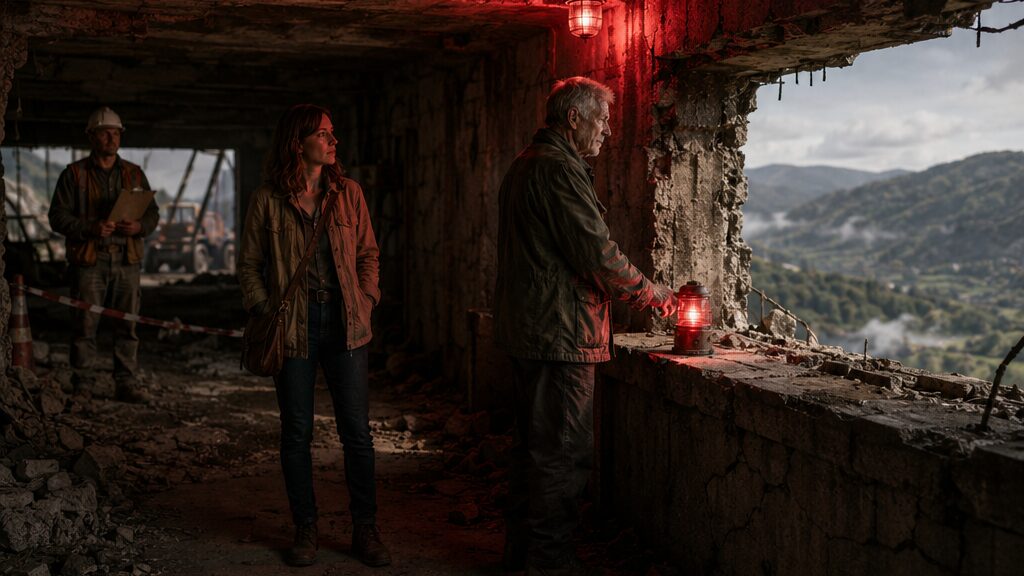
Gregory Walker stood in the center of the abandoned bunker, one hand resting against the rusted metal housing of the old emergency lamp. The battery he had carried up the hill was new. The lamp itself was not.
The bunker smelled of damp concrete and old earth. Water stains crawled down the walls. Paint had peeled away decades ago. A crack ran across the ceiling where roots had pushed through from above.
The red glow spread across the room anyway.
It always did.
Gregory adjusted the lamp until it pointed toward the narrow observation opening facing the valley.
Then he stepped back.
For several seconds he simply looked.
Not at the bunker.
Not at the lamp.
Beyond it.
Toward something nobody else could see.
A folded notice stuck out of his jacket pocket.
He ignored it.
Instead, he removed a small cloth from another pocket and carefully wiped dust from the metal casing.
The lamp hummed faintly.
“Still working,” he said.
His voice sounded strange in the empty room.
As though it belonged to someone else.
Someone younger.
Someone who had once stood watch here at two in the morning while rain hammered the hillside.
Someone who had believed the next hour might kill him.
A crunch of gravel outside broke the silence.
Gregory froze.
Not from fear.
Habit.
Some habits stayed longer than others.
He turned toward the entrance.
A young woman stood in the doorway.
She looked equally surprised to find someone inside.
“Sorry,” she said.
Gregory straightened.
The woman held a camera bag over one shoulder and a notebook under her arm.
“I didn’t know anyone was up here.”
Gregory nodded once.
“Most people don’t.”
The woman glanced around the bunker.
Her attention settled on the glowing red lamp.
“Is that thing actually working?”
“Apparently.”
“You got it running?”
“I changed the battery.”
The woman stared at him.
Then at the lamp.
Then back at him.
She looked too young to understand why an eighty-two-year-old man would climb a hill carrying batteries for a lamp inside a forgotten military bunker.
Most people didn’t.
“My name’s Rachel,” she said.
“Gregory.”
She stepped farther inside.
“I volunteer with the historical society.”
Gregory didn’t answer.
Rachel studied the room.
The bunker sat on land the town rarely discussed anymore.
A leftover piece of history nobody knew what to do with.
The old military training grounds had been abandoned decades ago.
Most residents drove past the hill without noticing it.
Rachel pointed toward the lamp.
“You come up here often?”
“Every year.”
She blinked.
“Every year?”
Gregory nodded.
The answer clearly created more questions than it solved.
Good.
Questions were easier than explanations.
Rachel looked toward the observation slit.
The valley stretched below them.
Roads.
Houses.
Shops.
An ordinary town.
Nothing about the view suggested why someone would spend sixty years returning here.
“You served here?” she asked.
“No.”
“Then why come back?”
Gregory folded the cloth and placed it carefully into his pocket.
Instead of answering, he walked to the opening and looked outside.
Rachel waited.
The silence stretched.
Finally she spoke again.
“Sorry. I don’t mean to pry.”
“You should.”
That surprised her.
Gregory kept watching the valley.
“You work for the historical society.”
Rachel nodded.
“We’re trying to document places before they’re lost.”
Gregory smiled faintly.
“Little late for that.”
She frowned.
“What does that mean?”
Without turning around, Gregory pulled the folded paper from his pocket and handed it to her.
Rachel opened it.
Her expression changed immediately.
DEMOLITION AUTHORIZATION.
The town intended to remove the bunker within two months.
Liability concerns.
Safety concerns.
Redevelopment plans.
She lowered the paper.
“Oh.”
Gregory nodded.
“They posted it last week.”
Rachel looked around the room again.
This time differently.
As though seeing something that might soon disappear.
“I didn’t know.”
“Most people don’t.”
She studied the signature at the bottom.
Alexander Baker.
Director of Municipal Development.
Rachel sighed.
“He’s been pushing several projects.”
Gregory said nothing.
The red light painted one side of his face.
For a moment he looked less like an old man and more like someone still standing watch.
Rachel noticed it.
The stillness.
The alertness.
The strange sense that he wasn’t visiting the bunker.
He belonged here.
A truck engine echoed from below the hill.
Workers.
Surveyors.
Someone preparing for demolition.
Gregory listened.
Rachel watched him listening.
The reaction lasted only a second.
But it felt practiced.
Automatic.
Like an old soldier recognizing distant movement.
“You really come here every year?” she asked.
“Same day.”
“Why?”
Gregory looked at the lamp.
His eyes lingered there.
Then on the observation opening.
Then somewhere beyond both.
“Because someone should.”
Rachel waited.
Nothing else came.
The answer felt unfinished.
As if most of it remained hidden.
She glanced toward the lamp again.
The object clearly mattered.
Not because it was valuable.
Because it meant something.
Something heavy.
Something old.
Something protected.
“You knew someone here.”
It wasn’t a question.
Gregory’s jaw tightened slightly.
Rachel saw it.
The first real reaction she’d gotten.
Not anger.
Not sadness.
Recognition.
He knew exactly what she was asking.
And exactly what he was refusing to answer.
Outside, voices drifted up the hill.
Workers.
Closer now.
Gregory walked toward the entrance.
Rachel followed.
Three men in safety vests were approaching from the access path.
One of them stopped when he saw Gregory.
“You can’t be in there, sir.”
Gregory remained calm.
“I’ve been in there longer than you’ve been alive.”
The worker glanced at the notice board nearby.
“We’ve got inspections scheduled.”
Gregory nodded.
The worker seemed unsure how to proceed.
Rachel stepped forward.
“He’s leaving.”
The worker looked relieved.
“Thank you.”
Gregory started down the hill.
Rachel walked beside him.
After several minutes she spoke.
“You don’t seem surprised about the demolition.”
“I’ve had sixty years to learn how things disappear.”
The answer stayed with her.
At the parking area, Gregory opened the door of an old pickup truck.
Rachel hesitated.
“Can I ask one more question?”
He waited.
“The lamp.”
Gregory looked back toward the hill.
Toward the bunker hidden among trees.
“When the power failed,” he said quietly, “that light stayed on.”
Rachel frowned.
“What power?”
Gregory opened the truck door.
For a moment she thought he wouldn’t answer.
Then he said:
“Someone stood watch under that light the night he never came back.”
Rachel stared at him.
He climbed into the truck.
The engine started.
Before she could ask another question, he drove away.
The red glow remained in her mind long after the truck disappeared.
Someone.
A he.
Someone who never came back.
That evening Rachel searched local military archives.
Old records.
Photographs.
Training rosters.
Incident reports.
She found almost nothing connected to the bunker.
The few references were brief.
Incomplete.
Forgotten.
Near midnight she closed her laptop.
Frustrated.
Then she remembered something.
The way Gregory had looked at the observation opening.
Not like a visitor.
Like a survivor.
The next morning she returned to the hill.
The bunker was empty.
The lamp was gone.
Only a faint circular mark remained where it had stood.
On the concrete beneath it, scratched into the floor so lightly she almost missed it, was a single name.
Michael.
Nothing else.
No last name.
No date.
Just Michael.
And for the first time, Rachel understood that Gregory had not been visiting a place.
He had been keeping watch.
For someone.
Someone whose name he still refused to let disappear.
Chapter 2: The Man Nobody Asked About
Rachel was already unlocking the historical society archives when her phone rang.
It was Gregory.
The fact that he had somehow found her number startled her.
“You’re looking for Michael,” he said.
No greeting.
No explanation.
Rachel sat down slowly.
“Yes.”
A pause.
Then:
“Be careful what records convince you.”
The line went dead.
She stared at the phone.
The conversation had lasted less than ten seconds.
Yet it felt like a warning.
By noon she had spread military records across an entire table.
Training reports.
Newspaper clippings.
Property maps.
Old photographs.
Most of the material came from decades ago.
Some pages were yellow enough to crumble at the edges.
A volunteer wandered past.
“What are you working on?”
Rachel held up a photograph.
An old training exercise.
Rows of young soldiers standing outside temporary field structures.
The volunteer squinted.
“Who are you looking for?”
“Michael.”
The volunteer shrugged.
“Michael who?”
That was the problem.
Rachel didn’t know.
By late afternoon she finally found Gregory again.
Not at the bunker.
At a diner near the highway.
He sat alone in a corner booth.
Coffee untouched.
Window seat.
Watching traffic.
Watching everything.
Rachel carried her tray over.
“You could’ve just told me his last name.”
Gregory looked mildly disappointed.
“Asking questions is part of the job.”
“Not when the person with the answers hangs up.”
A faint smile appeared.
Then disappeared.
Rachel slid into the booth.
“I found references to training accidents.”
Gregory said nothing.
“I found reports about facility closures.”
Nothing.
“I found a photograph.”
That got his attention.
Rachel placed the image on the table.
Twenty young soldiers.
Early twenties.
Dusty uniforms.
One damaged bunker in the background.
Gregory looked at it for a long time.
Then he pointed.
A young man stood near the edge of the group.
Thin face.
Crooked smile.
Arms folded.
“You found him.”
Rachel stared.
“That’s Michael?”
Gregory nodded.
The answer felt oddly important.
After all the searching, Michael finally existed as a real person.
Not just a name scratched into concrete.
Not just a ghost attached to a ritual.
A young man.
A face.
Someone who had laughed.
Someone who had stood in sunlight.
Rachel leaned closer.
“What happened to him?”
Gregory picked up the photograph.
Carefully.
Almost respectfully.
“He never got old.”
The answer landed harder than she expected.
Gregory returned the picture.
Rachel noticed his thumb lingering briefly on Michael’s image before letting go.
A small gesture.
Easy to miss.
Impossible to misunderstand.
“He died here?”
Gregory looked out the window.
Traffic moved past.
Families.
Workers.
Teenagers.
Entire lives continuing.
“He disappeared from conversations before he disappeared from records.”
Rachel frowned.
“What does that mean?”
“It means people forget in stages.”
The waitress arrived.
Neither touched their food.
Rachel opened a notebook.
“Tell me one thing.”
“No.”
She sighed.
“One useful thing.”
Gregory considered.
Then finally nodded.
“Check the memorial downtown.”
“The veterans memorial?”
“Yes.”
Rachel waited.
Gregory’s eyes settled on the photograph again.
“If you find his name there, I’ll answer your next question.”
That evening Rachel walked to the memorial plaza.
The stone monument stood near city hall.
Hundreds of names.
Conflicts spanning decades.
The kind of place people passed every day without reading.
She started searching.
Michael.
Michael.
Michael.
Nothing.
She checked again.
And again.
The names were organized carefully.
No Michael Harris.
No Michael matching the age.
No Michael connected to the training facility.
Rachel took photographs.
Made notes.
Returned home.
Then searched local casualty databases.
One result finally appeared.
Michael Harris.
Training incident.
Age twenty-three.
The record contained almost nothing else.
No story.
No details.
No memorial reference.
No explanation.
Just a name.
As if someone had reduced an entire life to a clerical entry.
Rachel sat back.
A soldier existed.
A soldier died.
A veteran spent sixty years returning to a bunker because of him.
Yet his name wasn’t even on the town memorial.
Why?
The next morning she called Gregory.
He answered immediately.
“You checked.”
“His name isn’t there.”
Silence.
Then:
“I know.”
Rachel gripped the phone.
“Why?”
The pause lasted longer this time.
When Gregory finally spoke, his voice sounded older than before.
“That’s the question nobody asked.”
And before she could stop him, he hung up again.
Chapter 3: The Name Missing From The Stone
The argument had already started before Gregory reached the memorial.
Rachel heard it from halfway across the plaza.
Workers stood beside temporary fencing.
A maintenance truck idled nearby.
Several town officials were reviewing redevelopment plans.
Alexander Baker stood in the center of them.
Confident.
Pressed shirt.
Tablet in hand.
The kind of man who measured everything in schedules and budgets.
Rachel hurried closer.
Gregory was already there.
Standing quietly in front of the memorial stone.
A folded photograph in one hand.
The workers seemed uncomfortable.
Alexander did not.
“Mr. Walker,” Alexander said patiently, “we have reviewed the site.”
Gregory remained facing the memorial.
“No.”
Alexander frowned.
“You reviewed a project.”
A few people exchanged glances.
Rachel stopped beside Gregory.
Alexander noticed her.
“Miss Adams.”
“Mr. Baker.”
The tension sharpened.
Alexander gestured toward the monument.
“We’re discussing improvements.”
Gregory finally turned.
“Removing names isn’t an improvement.”
The plaza fell silent.
Alexander sighed.
“We aren’t removing names.”
“You’re removing space.”
Alexander folded his arms.
“The expansion requires redesign.”
“Which removes space.”
“It’s a practical issue.”
Gregory looked back at the stone.
“Practical for who?”
A worker shifted uneasily.
Alexander’s patience thinned.
“This memorial already contains officially recognized names.”
Rachel saw Gregory’s jaw tighten.
Not dramatically.
Not angrily.
Just enough.
“What about the ones you missed?” Gregory asked.
Alexander shook his head.
“We’ve reviewed the records.”
“No.”
Gregory’s voice remained calm.
“You reviewed the records that survived.”
The distinction seemed to irritate Alexander.
“Mr. Walker, with respect, personal memories aren’t official documentation.”
The words landed heavily.
Rachel watched Gregory carefully.
Waiting for him to explode.
He didn’t.
Instead, he reached into his jacket.
The workers stiffened.
Alexander frowned.
Gregory withdrew a worn photograph.
Michael.
Young.
Smiling.
Alive.
He held it toward Alexander.
“This man existed.”
Alexander looked at it.
Then at Gregory.
“No one’s saying otherwise.”
“Then why isn’t his name here?”
Alexander hesitated.
For the first time.
Only briefly.
But Rachel saw it.
A crack.
Not guilt.
Uncertainty.
The discussion wasn’t as settled as he wanted everyone to believe.
“We can only work with records.”
Gregory nodded slowly.
“And if the records failed?”
Alexander had no immediate answer.
The crowd had grown.
A reporter appeared.
Several veterans stood nearby.
Listening.
Watching.
The photograph remained between them.
A simple object.
Yet suddenly it felt heavier than the stone itself.
Alexander finally spoke.
“If evidence exists, submit it.”
Gregory stared at him.
Then reached into another pocket.
Rachel noticed the object immediately.
Small.
Weathered.
Dark green cover.
A notebook.
Old enough that the edges had begun to fray.
Gregory looked down at it for several seconds.
As if deciding something.
As if opening it might change more than he wanted.
Then he lifted his eyes.
“This enough?”
Alexander’s confidence faded.
Rachel stared at the notebook.
The crowd stared too.
Because everyone understood the same thing at once.
Whatever was inside that notebook had been hidden for a very long time.
And Gregory had finally decided to bring it into the light.
Chapter 4: What Happened Before The Gunfire
The notebook sat between them like an unexploded shell.
No one in the plaza seemed willing to move first.
Alexander Baker stared at it.
Rachel stared at it.
Even the workers who had come to discuss construction plans watched in silence.
Gregory rested his hand on the cover.
Not possessively.
Protectively.
The notebook had once belonged to Michael Harris.
For sixty years it had stayed in a box beneath Gregory’s bed.
For sixty years he had opened it only on one day each year.
Now strangers were looking at it.
The realization unsettled him more than he expected.
Alexander finally cleared his throat.
“If that’s evidence, we can review it.”
Gregory looked at him.
“Reviewing isn’t the same as listening.”
Alexander’s expression tightened.
“Mr. Walker, I understand this is personal.”
“No.”
Gregory shook his head.
“That’s the problem. It isn’t personal anymore.”
Rachel noticed something change in him.
The resistance he usually carried was still there, but something else had joined it.
Fatigue.
Not physical exhaustion.
The exhaustion of carrying the same memory alone for decades.
One of the veterans stepped closer.
“Maybe we should hear him out.”
Others nodded.
Alexander glanced around and realized he had lost control of the conversation.
Not dramatically.
Just enough.
He looked at Gregory.
“Then tell us.”
Gregory stared at the notebook.
For several seconds he said nothing.
Then he picked it up.
“Not here.”
The crowd remained silent.
Rachel followed him as he walked away from the memorial.
No one stopped him.
No one called after him.
Only Alexander remained standing beside the stone, watching Gregory leave with the one thing that might answer everyone’s questions.
An hour later Rachel found Gregory sitting inside the abandoned bunker.
The red lamp glowed beside him.
The notebook rested on his knee.
The bunker looked smaller than before.
Or perhaps the story inside it made the room feel crowded.
Rachel sat on an overturned crate.
Neither spoke immediately.
Gregory opened the notebook.
Most pages were covered with faded handwriting.
Dates.
Names.
Supply lists.
Half-finished thoughts.
Nothing extraordinary.
At first.
“He carried this everywhere,” Gregory said.
Rachel waited.
“He wrote things down because he thought he’d forget them.”
A faint smile touched Gregory’s face.
“The funny thing was he never forgot anything.”
He turned several pages.
Rachel saw sketches.
Maps.
Observations.
Small pieces of a young man’s life.
Not a hero.
Not a legend.
Just a person.
For the first time Michael felt real.
Gregory stopped at one page.
His fingers remained there.
Motionless.
Rachel sensed he had arrived somewhere important.
“That night started quietly.”
His voice changed.
Not softer.
Further away.
“The bunker looked almost exactly like this.”
The red light reflected in the notebook pages.
Rachel remained silent.
Gregory’s eyes drifted toward the observation opening.
And suddenly he wasn’t eighty-two anymore.
The storm had arrived shortly after midnight.
Rain hammered the hillside.
The emergency generator had failed twice already.
The bunker glowed red.
Michael sat near the radio.
Young.
Restless.
Complaining about the coffee.
Gregory stood at the observation slit watching darkness beyond the hill.
“Anything out there?” Michael had asked.
“No.”
“Good.”
A pause.
Then:
“Maybe we’ll finally get some sleep.”
Gregory remembered laughing.
A small moment.
Meaningless at the time.
Precious now.
The radio crackled.
Voices.
Confusion.
Reports moving between positions.
Vehicles relocating.
Orders changing.
The storm had created problems across the training area.
Nothing unusual.
Nothing dramatic.
Nobody believed the night would become important.
Michael had stretched his legs and glanced toward the red lamp.
“That thing ever burn out?”
“No.”
“It should.”
“Why?”
“So maybe they’d replace it with something brighter.”
Gregory smiled despite himself.
Michael always found something to complain about.
The memory lingered.
Then darkened.
Because after that came the part Gregory had spent sixty years replaying.
The radio message.
The damaged access road.
The warning.
The evacuation order.
Rachel listened carefully.
The bunker around them seemed to absorb every word.
Gregory closed the notebook.
“Most people think Michael died during some heroic incident.”
“You said that’s not what happened.”
“No.”
His gaze fixed on the red lamp.
“The truth isn’t that clean.”
Rachel leaned forward.
“What happened?”
Gregory inhaled slowly.
The answer clearly hurt.
Not because of what happened.
Because he had never said it aloud.
“The storm damaged one of the routes leading off the hill.”
Rachel waited.
“Vehicles were moving out.”
Gregory continued.
“People needed direction. Radios were failing.”
The old veteran’s voice remained controlled.
Only his hands betrayed him.
“They needed someone at the observation position.”
Rachel looked toward the narrow opening.
The same place Gregory still stared every year.
The same place where the lamp still stood.
“Michael volunteered?”
Gregory shook his head.
The answer surprised her.
“No.”
“What then?”
For a long moment he didn’t answer.
Finally he said:
“We argued.”
The confession landed harder than expected.
Rachel blinked.
“You argued?”
Gregory nodded.
“He wanted me to leave.”
Silence filled the bunker.
The words changed everything.
Not because they explained Michael’s death.
Because they revealed something about Gregory.
The story wasn’t about a perfect survivor carrying grief.
It was about a man carrying guilt.
“He told me my transport was leaving.”
Gregory’s voice became quieter.
“I told him I wasn’t going.”
“What happened?”
The old man stared at the lamp.
“He ordered me to go.”
Rachel frowned.
“Ordered?”
“We were friends.”
Gregory smiled faintly.
“Michael only used that tone when he was serious.”
The smile vanished.
“He said somebody needed to get out.”
The bunker fell silent.
Only the faint electrical hum remained.
Rachel understood something then.
The memory Gregory carried wasn’t merely loss.
It was unfinished.
Something had happened between those two men that never stopped happening.
Every year he returned because the conversation had never ended.
“What did you do?” she asked.
Gregory closed the notebook.
His fingers tightened around the cover.
“I left.”
The words barely rose above a whisper.
Rachel froze.
Gregory looked toward the observation opening.
Toward the darkness beyond it.
Toward a night sixty years gone.
And for the first time he spoke the truth he had spent decades avoiding.
“I survived because Michael stayed.”
Chapter 5: The Promise Never Spoken Aloud
Rachel found Gregory outside his house before sunrise.
The notebook sat on the porch railing.
Untouched.
A letter lay beside it.
Not the hidden letter from the blueprint? Wait need continue story. Must be Deborah reveals. Let’s write.
Rachel stepped out of her car when she noticed another woman standing at the gate.
Gray-haired.
Older than Gregory but younger than him.
Holding an envelope with both hands.
Gregory looked uncomfortable.
Which immediately made Rachel curious.
The woman glanced toward her.
“You’re Rachel?”
“Yes.”
“I’m Deborah.”
Rachel stopped.
Michael’s sister.
The name carried weight now.
Deborah looked past Rachel toward Gregory.
“He finally started talking.”
Gregory sighed.
“You didn’t have to drive all the way here.”
“Yes, I did.”
Deborah held up the envelope.
“You’ve avoided this for long enough.”
The old veteran looked away.
Rachel suddenly felt like she had stepped into the middle of a conversation decades overdue.
Deborah walked onto the porch.
For a moment nobody spoke.
Then she placed the envelope beside the notebook.
“You kept your silence.”
Gregory remained quiet.
“I kept mine.”
Rachel watched both of them carefully.
The tension wasn’t anger.
It was accumulated time.
Years layered on top of years.
“What is it?” Rachel asked softly.
Deborah answered.
“A letter.”
Gregory closed his eyes briefly.
Not in surprise.
Recognition.
Rachel looked between them.
“From Michael?”
Deborah nodded.
“He wrote it before the accident.”
The word accident sounded insufficient.
Too small for what it had become.
Rachel stared at the envelope.
“Why hasn’t anyone seen it?”
Deborah laughed once.
A sad sound.
“Because nobody opened it.”
Rachel looked at Gregory.
He didn’t deny it.
“Sixty years?” she asked.
Deborah nodded.
“Sixty years.”
The number felt impossible.
Gregory finally spoke.
“It wasn’t mine.”
“No,” Deborah said quietly.
“It wasn’t.”
The silence stretched.
Then Deborah sat down.
“You know what always made me angry?”
Gregory looked at her.
She smiled without humor.
“Not that my brother died.”
Rachel blinked.
Deborah shook her head.
“I hated that everyone reduced him to the way he died.”
The words settled heavily.
“He had twenty-three years before that day.”
Her hand touched the envelope.
“Twenty-three years of jokes and mistakes and terrible singing.”
Gregory smiled despite himself.
Michael had indeed sung terribly.
Deborah noticed.
“There he is.”
“What?”
“The brother I remember.”
The smile disappeared.
The moment passed.
Deborah pushed the envelope across the porch.
“You’ve carried him long enough.”
Gregory stared at it.
Rachel could almost see the struggle.
Not whether to open it.
Whether to let someone else into the memory.
His entire life had been organized around keeping watch.
Keeping watch required standing alone.
Sharing required something else.
Trust.
The thing silence had prevented.
“You should read it,” Deborah said.
Gregory shook his head.
“No.”
The answer came too quickly.
Too automatically.
Rachel recognized the habit.
Avoidance disguised as loyalty.
Deborah recognized it too.
“That’s exactly why his name vanished.”
The statement struck like a blow.
Gregory looked up sharply.
Deborah didn’t back down.
“You think you protected him.”
Neither spoke.
“You didn’t.”
Rachel felt the tension immediately.
This was the argument Gregory feared.
Not about memorials.
Not about demolition.
About himself.
Deborah’s eyes filled with tears she refused to let fall.
“You never told anyone.”
Gregory looked away.
“You never told the town.”
Silence.
“You never told the veterans.”
More silence.
“You never told me what happened.”
The accusation hung between them.
Gregory’s hands tightened.
For years he had blamed forgotten records.
Bureaucracy.
Time.
But Deborah was exposing something harder.
Forgetting needed space.
His silence had provided it.
“I thought I was helping.”
The words sounded fragile.
Deborah nodded.
“I know.”
That made it worse.
If she had been angry, he could have defended himself.
Instead she understood.
And understanding left nowhere to hide.
The envelope remained on the railing.
A simple object.
Yet it seemed heavier than the notebook.
Rachel picked it up carefully.
The paper felt ancient.
Still sealed.
Michael’s handwriting remained visible across the front.
To Deborah.
Not Gregory.
Not anyone else.
His sister.
The person he expected would outlive the memory.
Instead Gregory had.
The irony seemed almost cruel.
Deborah stood.
“You don’t have to carry him alone anymore.”
Then she left.
No dramatic farewell.
No grand speech.
Just a woman walking back to her car.
Rachel watched her drive away.
The porch felt strangely empty.
Gregory stared at the unopened letter.
Minutes passed.
Finally Rachel spoke.
“She was right.”
Gregory smiled sadly.
“I know.”
The answer surprised her.
“You know?”
“I’ve known for years.”
“Then why didn’t you tell anyone?”
Gregory looked toward the road.
Toward a world that had continued moving.
“Because every time I tried, it felt like I was replacing him with a story.”
Rachel sat beside him.
The old man seemed smaller suddenly.
Not weaker.
Just tired.
“He deserved more than a story.”
Rachel considered that.
Then she looked at the notebook.
The letter.
The red lamp visible through the truck window where Gregory had placed it for safekeeping.
Three objects.
Three pieces of one life.
“You know what I think?” she asked.
Gregory glanced at her.
“I think he deserved the story too.”
For the first time, Gregory didn’t answer.
Because he wasn’t sure she was wrong.
At sunset Rachel returned to the historical society.
Waiting on her desk was an official notice.
Municipal redevelopment review.
Final demolition vote scheduled.
Two weeks.
The bunker had less time than anyone thought.
Chapter 6: Someone Else Must Carry His Name
The meeting room was nearly empty when Rachel arrived.
Gregory sat alone at the far end of the table.
The notebook rested before him.
The unopened letter beside it.
The demolition notice lay between them.
Two weeks.
That was all.
For the first time since Rachel had met him, Gregory looked uncertain.
Not about the bunker.
About what came after.
“What if it isn’t enough?” he asked.
Rachel sat down.
“The story?”
He nodded.
“People forget.”
“They do.”
The answer wasn’t comforting.
Rachel didn’t intend it to be.
“But sometimes they remember because someone bothers to tell them.”
Gregory looked at the notebook.
For sixty years he had protected memory by hiding it.
Now he had to protect it by releasing it.
The change felt unnatural.
Like abandoning a post.
Rachel opened a folder.
Inside were copies of records she had gathered.
Training reports.
Archived photographs.
Newspaper references.
Missing citations.
Not proof enough alone.
But together they formed a shape.
A life.
“We don’t need to convince everyone,” she said.
“We only need to make sure Michael doesn’t disappear again.”
Gregory stared at the papers.
Then at Rachel.
A realization slowly crossed his face.
She wasn’t investigating anymore.
She was carrying.
The burden had already begun to shift.
Rachel saw him understand.
Neither mentioned it.
The silence itself was enough.
After several moments Gregory pushed the notebook toward her.
Not all the way.
Just a few inches.
Rachel looked down.
Then back at him.
“Not yet,” she said.
His expression softened.
For the first time, the gesture felt less like refusal and more like acceptance.
Outside the meeting room, footsteps approached.
A clerk appeared.
“Mr. Walker?”
Gregory turned.
“Yes?”
“The redevelopment board moved the vote.”
Rachel felt her stomach tighten.
“When?”
The clerk checked a document.
“Three days from now.”
The room went silent.
The deadline had just become real.
And neither Gregory nor Rachel had enough time.
Yet for the first time since the story began, Gregory wasn’t facing it alone.
Chapter 7: The Last Watch Beneath The Red Light
The vote was scheduled for six o’clock.
At five-thirty, Gregory was nowhere near town hall.
He was inside the bunker.
The red lamp glowed beside him.
Rachel found him sitting at the observation position, exactly where she had first seen him months earlier.
The notebook rested in his lap.
The letter lay beside it.
Open now.
For the first time in sixty years.
Gregory looked older than he had when the story began.
Not weaker.
Simply closer to the truth.
Rachel sat beside him.
Neither spoke immediately.
The red light painted the concrete walls.
Outside, evening settled across the valley.
“You read it,” Rachel said.
Gregory nodded.
The letter remained folded open to the final page.
Rachel didn’t ask permission.
Gregory handed it to her.
Michael’s handwriting filled the paper.
Simple words.
No dramatic farewell.
No prediction of death.
No grand statement about sacrifice.
Mostly ordinary things.
A joke about terrible food.
A complaint about rain.
A reminder to call home.
Then a final paragraph.
If you’re reading this, it probably means somebody finally cleaned out my locker. If that somebody is Greg, tell him he’s still wrong about the coffee. And tell him not to spend his whole life standing in one place.
Rachel lowered the letter.
The bunker felt very quiet.
Gregory stared toward the observation opening.
“He always hated being serious.”
Rachel smiled.
“So even his letter sounds like him.”
“Exactly.”
Neither spoke for a while.
The words lingered in the room.
Not because they solved anything.
Because they didn’t.
The letter contained no hidden revelation.
No secret explanation.
Just evidence of a life interrupted.
Michael had remained stubbornly human.
That mattered more than heroics.
Eventually Gregory stood.
Slowly.
The notebook remained in one hand.
The letter in the other.
“I spent years waiting for the right time.”
Rachel looked up.
“For what?”
“To tell it properly.”
He laughed softly.
“Turns out there isn’t one.”
The answer felt like the end of something.
And the beginning of something else.
Gregory walked toward the lamp.
The red glow reflected in the worn metal housing.
He touched it gently.
The same gesture Rachel had witnessed on the first day.
Only now she understood it.
This had never been nostalgia.
Never obsession.
Never refusal to move on.
It had been a watch.
A duty.
A promise he had never spoken aloud.
Not to Michael.
To himself.
That someone would remember.
Rachel stood.
“You should get to the meeting.”
Gregory nodded.
For the first time, he didn’t look reluctant.
The burden had shifted enough for movement to become possible.
Together they left the bunker.
The lamp remained glowing behind them.
Town hall was crowded.
Not because of Gregory.
Not because of Michael.
Because people had finally become curious.
The historical society had shared records.
Veterans had spoken.
Old photographs had resurfaced.
Questions had spread.
The story had begun moving through other people.
Alexander Baker stood near the front of the room reviewing documents.
When he saw Gregory enter, he walked over immediately.
Rachel expected another argument.
Instead, Alexander held out a folder.
“I reviewed everything.”
Gregory accepted it.
Inside were copies of records.
Maps.
Witness statements.
Training reports.
Names.
Michael Harris appeared throughout them.
Not everywhere.
Not enough.
But enough.
Alexander looked tired.
More tired than defensive.
“I should’ve looked harder.”
Gregory studied him.
The admission seemed genuine.
Alexander glanced toward the crowd.
“I wasn’t trying to erase anybody.”
“I know.”
The answer surprised them both.
Alexander exhaled.
“The project still has to move forward.”
Gregory nodded.
“I know.”
Rachel watched the exchange carefully.
For the first time neither man was arguing about the same thing.
The bunker mattered.
The memory mattered more.
The meeting began.
Reports were presented.
Budgets discussed.
Plans reviewed.
The practical machinery of civic decisions moved forward.
Then Rachel stood.
Not as an investigator.
Not as a volunteer.
As a witness.
She told the story she had learned.
Not all of it.
Only enough.
The bunker.
The lamp.
The watch.
The missing name.
The man who had spent sixty years returning because nobody else did.
The room remained quiet.
Not emotional.
Attentive.
Exactly as it should be.
Then Gregory stood.
The old veteran disliked speaking publicly.
Rachel knew that.
Everyone could see it.
But he spoke anyway.
Not long.
Not dramatically.
Just the truth.
“Michael Harris wasn’t forgotten because people didn’t care.”
His voice remained steady.
“He was forgotten because I never told them who he was.”
The room listened.
Gregory looked down briefly.
Then continued.
“I thought keeping the memory to myself was loyalty.”
A pause.
“It wasn’t.”
The silence that followed felt earned.
No applause came.
Gregory seemed relieved.
Applause would’ve been the wrong response.
Understanding was enough.
The vote happened an hour later.
The bunker would not be preserved exactly as it stood.
Time had already taken too much.
The structure was unsafe.
The redevelopment project would continue.
Yet one condition had been added.
A permanent historical marker.
Michael Harris’s name.
The story of the observation post.
The records Rachel gathered.
The materials Gregory preserved.
The decision felt neither victorious nor tragic.
Simply honest.
Not everything could survive.
Some things could.
Afterward people drifted home.
The crowd disappeared.
The room emptied.
Only Gregory and Rachel remained near the entrance.
Rachel looked at him.
“Are you disappointed?”
Gregory considered.
Then shook his head.
“No.”
The answer surprised even him.
The bunker might eventually disappear.
But that wasn’t the fear that had brought him back every year.
The fear had always been something else.
That Michael would vanish with it.
Now that seemed less likely.
Outside, the evening air felt cooler.
Gregory opened the truck door.
Then stopped.
The notebook remained under his arm.
The red lamp sat on the passenger seat.
Rachel immediately recognized what was happening.
So did Gregory.
He looked at the lamp.
Then at her.
For a moment neither spoke.
The gesture felt larger than either wanted to acknowledge.
Finally Gregory lifted the lamp.
The metal housing reflected the fading sunlight.
He held it carefully.
Like something breakable.
Like something strong enough to survive.
Then he placed it in Rachel’s hands.
She didn’t move.
Didn’t speak.
The weight surprised her.
Not because of the lamp.
Because of what came with it.
Gregory smiled faintly.
“The battery compartment sticks sometimes.”
Rachel laughed despite herself.
The old man nodded toward the notebook.
“That too.”
She looked down.
Then back at him.
“You sure?”
“No.”
The honesty made them both smile.
Then he added:
“But somebody else should know how to turn it on.”
The words settled between them.
Simple.
Enough.
Rachel placed the lamp carefully in her car.
The notebook beside it.
For the first time since she met Gregory, she understood what the story had always been about.
Not grief.
Not even memory.
Transfer.
One person carrying something until another person arrived.
Later that night, long after town hall emptied, Rachel drove up the hill alone.
The bunker stood silent.
Dark.
Waiting.
She carried the lamp inside.
Set it in its place.
Installed a fresh battery.
The switch clicked.
Red light filled the room.
For a moment she stood exactly where Gregory had stood.
Facing the observation opening.
Watching the valley.
Listening.
Not for enemies.
Not for danger.
For understanding.
The room felt different now.
Not because the past had changed.
Because she knew the name.
Michael Harris.
Twenty-three years old.
Terrible singer.
Complained about coffee.
Stayed behind.
Never came home.
Outside, the town lights glimmered in the darkness.
Life continuing.
As it always had.
Rachel rested one hand on the lamp.
Then spoke the name aloud.
Not loudly.
Not ceremonially.
Just enough.
The way Gregory had done for sixty years.
The way someone else would someday do after her.
The red light burned steadily.
And for the first time in a very long time, Gregory Walker was no longer standing watch alone.
The story has ended.