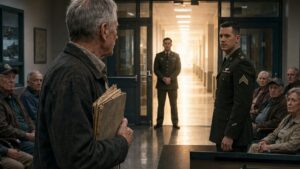
The Old Veteran Put His Black Watch Box On The Counter, But The Clerk Priced The Wrong Thing
Chapter 1: The Box He Would Not Let Katherine Touch
Michael Bennett could tell which floorboard Katherine had stepped on from the kitchen.
The third board outside the hallway closet gave a soft, tired click under weight, not loud enough for most people to notice, but loud enough for him. He had been listening to small sounds for most of his life—pipes settling, boots in passageways, a loose hinge, breath held behind a door. Age had taken plenty from him, but not that.
He closed the drawer before she reached the doorway.
Katherine stopped with one hand on the frame. She was dressed for work, though she had been moving slowly all week, one palm pressed now and then to the right side of her abdomen when she thought he wasn’t looking. The doctor had called it a routine surgery. Michael had lived long enough to distrust the word routine when it was attached to someone he loved.
“You’re up early,” she said.
“So are you.”
“You made coffee?”
“In the pot.”
She looked past him at the dresser. Michael kept his bedroom neat, too neat, Katherine always said. Blanket squared. Shoes aligned. Watch cap folded once on the chair. The habits stayed after the uniforms were gone. He had never been able to explain that order was not pride. It was a way of asking the world to leave him one corner he could manage.
Katherine’s gaze dropped to the drawer handle.
“Dad.”
He turned toward the window and pulled the curtain aside. Morning lay gray across the little house, turning the porch rails silver. The paint had started to peel again where the rain hit hardest. Beyond the yard, a contractor’s truck rolled past without stopping, its ladder clattering against the roof rack like loose bones.
“You shouldn’t be late,” he said.
“I called in.”
He let the curtain fall. “You didn’t need to do that.”
“Yes, I did.”
She stepped into the room, carrying the folder he had left on the kitchen table the night before. He did not need to see the red numbers clipped to the front. He had memorized them already. Repair estimate. Deposit required. Balance due on completion. Unsafe stair support. Water damage under porch. Recommend immediate correction.
“They called again,” Katherine said. “If the deposit isn’t paid by Friday, they move to another job. Six weeks before they can come back.”
Michael nodded once.
“Dad, I can’t recover here if the porch is unsafe. You know that.”
“I know.”
“And you cannot keep putting plywood over problems like that fixes them.”
He looked at her then. Not sharply. Just enough.
She softened. “I’m not trying to scold you.”
“No.”
“I’m trying to make you understand that this isn’t about pride.”
That almost made him smile. Pride was a word people used when they didn’t know what else to call the thing that kept a man from falling apart in public.
On the dresser sat an envelope of cash, thin enough to look embarrassed. Beside it was his checkbook, opened to a balance he had written down in pencil. He had already canceled the cable. Sold the second ladder. Let the newspaper stop coming. Delayed the dental appointment. He had never been careless with money, but careful did not make a roof younger or medicine cheaper.
Katherine laid the folder on the bed. “I can take out a small loan.”
“No.”
“You don’t even know the terms.”
“I know enough.”
“I’m forty-eight years old. You don’t get to forbid me from helping.”
“I’m not forbidding.”
“You’re making it impossible.”
He said nothing.
Her eyes moved again to the drawer. This time she reached for it.
Michael’s hand came down, not hard, but fast enough to stop her.
The room changed.
Katherine looked at his hand on the drawer front, the knuckles raised and pale. He felt the old shame of quick movement, of reacting before kindness could catch up.
She withdrew her fingers. “I’m sorry.”
He lifted his hand away. “No. I am.”
“What’s in there?”
“Nothing that fixes a porch.”
“Then why won’t you let me see it?”
He turned the wedding ring on his finger though it had been loose for years. Katherine saw that too. She saw too much when she was worried.
“I have a few things I can take downtown,” he said.
“To the appraisal event?”
“The bank’s running it. Antiques, watches, coins. Fair estimates.”
“Dad.”
“They pay same day for some items.”
“No.” Her voice broke on the word, then hardened to cover it. “Not that.”
“You don’t know what I’m taking.”
“I know you.”
For a moment, he saw her at ten years old, sitting at the kitchen table with her knees tucked under her, watching her mother polish a small black box with a flannel cloth. Shirley had let Katherine hold it once and only once, guiding both of her small hands. Careful, sweetheart. Some things don’t break because they’re fragile. They break because people forget what they are.
Katherine remembered enough. Maybe not all of it, but enough.
Michael moved to the closet and took his blue-gray jacket from the hanger. It had worn thin at the cuffs, and one pocket sagged from years of keys, receipts, and habit. He put it on slowly.
“You said you would never sell it,” Katherine said.
“I said a lot of things when your mother was alive.”
“That’s not fair.”
“No.”
He went to the dresser. Katherine did not stop him this time. He opened the drawer with his body angled between her and what was inside. The black box sat beneath folded handkerchiefs, rectangular, plain, worn soft at the corners. It was not fancy. A stranger might have mistaken it for a case that held cuff links or a pen. Michael rested his hand on the lid.
He did not open it.
The box had a weight beyond ounces. It held the warm tick of a watch he no longer wound every day. It held a photograph tucked under velvet. It held a name engraved so small that some eyes missed it. It held a promise made at a train platform when Shirley was younger than Katherine’s daughter would have been, if Katherine had ever had one.
He slipped the box into the inside pocket of his jacket.
Katherine’s face folded, but she did not cry. She had inherited that from him and resented it.
“I’ll drive you,” she said.
“I can take the bus.”
“You hate the bus.”
“I dislike the bus. Hate is for bigger things.”
She gave a short laugh that had no humor in it. “Please don’t do this alone.”
He picked up the folder from the bed and removed only the contractor’s estimate, folding it into quarters. “I’ve done things alone before.”
“That’s exactly what scares me.”
Michael paused near the doorway. On the wall hung a framed photograph of him and Shirley on the porch twenty years earlier, back when the railing was new and her hair had not yet gone fully white. She had one hand on his arm and the other lifted as if telling whoever held the camera to hurry up. He looked stiff in the picture. She looked alive enough to step out of it and correct his collar.
Katherine followed his gaze.
“She wouldn’t want you to sell it,” she said.
Michael touched the inside of his jacket, feeling the box against his ribs.
“No,” he said quietly. “But she wouldn’t want you climbing broken stairs after surgery either.”
He left before Katherine could answer.
Outside, the morning air smelled of wet leaves and old wood. The porch step dipped under his shoe with a soft give that sent a warning through his knee. He steadied himself on the rail, looked back once at the house, then walked carefully down the path.
At the end of the street, he reached into his jacket and held the black box through the cloth.
For one second, he almost turned around.
Then he kept walking.
Chapter 2: The Clerk Put A Price Tag On The Lid
The bank lobby was brighter than Michael remembered.
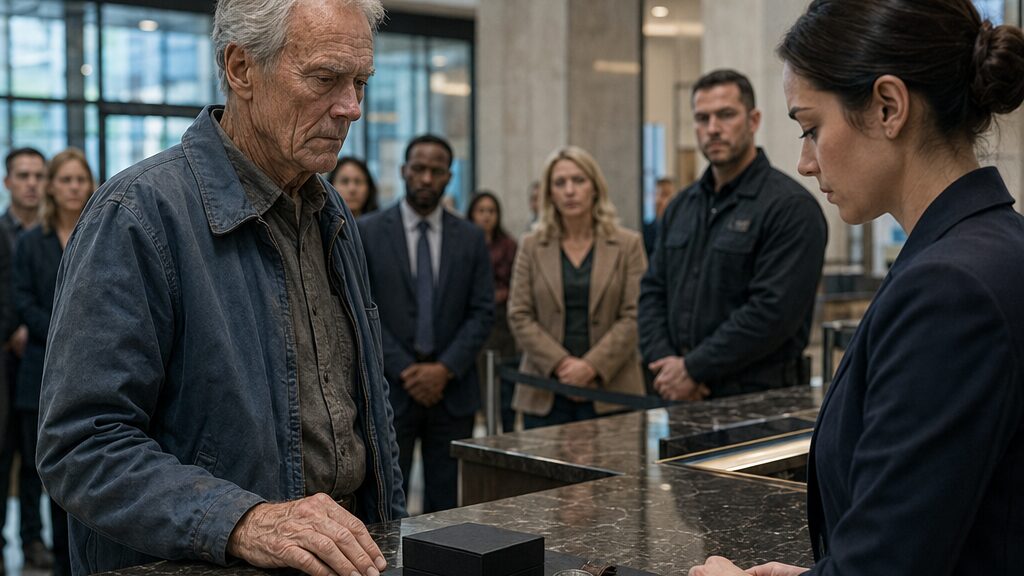
Everything in it reflected something else: the marble floor reflected ceiling lights; the glass partitions reflected customers shifting in line; the brass sign near the entrance reflected his own bent shape as he passed. He disliked places where surfaces shone too much. They made a man aware of his age from too many angles.
A banner stood beside the information desk.
COMMUNITY APPRAISAL DAY
Watches • Coins • Jewelry • Collectibles
Fast Review • Fair Offers • Same-Day Payment
The last three words were what had brought him there.
Same-day payment.
Michael adjusted his grip on the black box inside his jacket and joined the shorter line near the side counter. A few people stood ahead of him with velvet jewelry trays, coin sleeves, a porcelain dog wrapped in newspaper. The woman in front of him kept opening a small pouch and counting rings with red stones, as if one might disappear between breaths.
Behind the appraisal counter sat a young woman in a dark blazer. Her nameplate read Kimberly Carter. Her hair was pinned neatly at the back of her head, and a tablet lay near her right hand. She had the alert, polished look of someone trained to keep a lobby moving and emotions contained.
Michael watched her work.
She smiled when required. She typed quickly. She asked for identification, printed forms, slid objects across a dark inspection mat, and spoke in a voice that did not rise. Efficient, Katherine would have called her. Michael had no quarrel with efficiency until it forgot what it was handling.
When his turn came, Kimberly looked up and gave him a professional smile.
“Good morning, sir. Do you have an appointment?”
“No.”
“That’s all right. Walk-ins are fine, but we do need a photo ID.”
He set his license on the counter.
She glanced at it. “Michael Bennett?”
“Yes.”
“And what are we looking at today?”
He removed the black box from his jacket.
His fingers did not want to let go of it.
For a moment, he held it above the counter, feeling how light it would become once it was no longer his. Kimberly waited. A man behind him shifted impatiently, the paper around his porcelain dog crackling.
Michael placed the box on the marble.
Kimberly reached for it.
He put two fingers on the lid.
She paused.
“I can open it,” he said.
Her smile tightened slightly. “Of course.”
He lifted the lid.
Inside, on faded dark velvet, lay a watch with a brushed steel case and a cracked brown leather strap. The face had yellowed to the color of old paper. The hands were narrow, the numbers plain. It was not large. It did not glitter. It had been made for telling time, not attracting attention.
Kimberly leaned in. “Mechanical?”
“Yes.”
“Running?”
“When wound.”
“Any papers? Original receipt? Brand certificate?”
“No.”
“Box is original?”
“No.”
The question struck him harder than it should have. The box had come years later, after the original cardboard case fell apart. Shirley had bought the black one from a department store because, she said, some things deserved a place to rest.
Kimberly lifted the watch.
Michael’s jaw set.
She turned it over between thumb and forefinger with the care of someone not careless, but not careful enough. Her nail brushed the back where the tiny worn mark sat near the edge. She did not notice it.
“Some surface wear,” she said. “Crystal damage. Strap is not original, I assume.”
“No.”
“Any precious metal content?”
“Steel.”
She set it on the mat and typed.
The lobby hummed behind him: shoes on marble, printer clicks, a phone ringing twice before being answered. Michael looked at the watch and not at the people. A service member learned young that staring back at witnesses made a thing public. He did not want this public. He only wanted it done.
Kimberly picked up a small jeweler’s loupe and inspected the watch face. “We can offer based on resale potential and parts value. Without provenance paperwork, collectible value is limited.”
“Provenance,” Michael repeated.
“It means documented history of the item.”
“I know what it means.”
Her eyes flicked up. “I didn’t mean—”
“No.”
She looked back down. The line behind him had grown. A bank manager near the offices watched with mild concern, the way managers watched anything that slowed procedure.
Kimberly typed again and printed a small adhesive tag.
Michael saw the number before she spoke.
It was less than the contractor’s deposit. Much less.
She peeled the tag from its backing and pressed it onto the lid of the black box.
Something in Michael went still.
Not angry. Not yet. Still.
“There’s our preliminary offer,” Kimberly said. “I know people sometimes hope older watches will appraise higher, but condition matters. Sentimental value isn’t something we can calculate.”
She slid the box toward him with the tag on top.
The man behind Michael gave a quiet sigh. Someone farther back whispered, “That’s not bad for an old watch.”
Kimberly must have heard the whisper because she straightened and pointed—not quite at Michael, not quite at the watch, but close enough to feel like both.
“Sir, if you’re unsure, you don’t have to sell. But we can’t hold up the line while you decide whether the item means more to you than the offer.”
The lobby became too bright.
Michael looked at her finger. Then at the tag on the lid. Then at the watch lying beside its own priced box, exposed under bank lights.
He had endured shouted orders, bad news delivered in clipped sentences, hospital corridors, unpaid bills, and the thin sound of Shirley’s breathing near the end. He had learned that anger spent carelessly left you poorer.
So he did not raise his voice.
He reached out and placed two fingers on the paper tag.
Kimberly frowned. “Sir, please don’t remove—”
He peeled it slowly from the lid.
The adhesive gave with a soft, ugly rasp.
The people behind him went quiet.
Michael laid the tag on the marble between them, number facing up. His hand remained over it.
“Price the metal if you have to,” he said. “Don’t price her name.”
Kimberly’s mouth opened, then closed.
The manager took one step closer.
Michael picked up the watch. On the back, beneath scratches and years of skin-wear, a short inscription curved around the edge. The letters had gone faint, but he knew each one by touch.
Kimberly leaned forward despite herself. “There’s engraving?”
“Yes.”
“That affects intake records. I need to note it.”
“No,” Michael said.
The word was quiet, but it stopped her hand from reaching.
Her face tightened with embarrassment now, not authority. “Mr. Bennett, if the item is engraved, that can reduce resale value further. Personalized items are often difficult to—”
“Then you’ve got your number right.”
He returned the watch to the box, but he did not close the lid. The face looked up between them.
Kimberly glanced at the line behind him. “I’m trying to help you understand the process.”
“I understand process.”
“Then you understand we appraise objects, not stories.”
Michael’s fingers curled once against the counter.
A woman in line shifted. The manager stopped beside Kimberly, not interrupting yet.
Michael looked down at the watch.
For one second, he saw Shirley’s hand instead of his own. Younger fingers, quick and warm, fastening the strap around his wrist. The platform loud. Her mouth smiling because she refused to cry where anyone could see. If you come back late, she had said, this will still know what time it is.
He closed the box.
“I came for an offer,” he said. “You made one.”
Kimberly’s expression changed. Only a little. The sharpness went out of it, replaced by something uncertain.
“Mr. Bennett,” she said, lower now, “if the engraving is important, you may want to reconsider selling.”
He put the box back on the counter, but kept his hand on it. “Importance isn’t the question today.”
The manager cleared his throat. “Is there an issue here?”
“No,” Michael said.
Kimberly looked at him, then at the peeled tag under his hand. “We can hold the appraisal open for twenty-four hours if you want verification. Sometimes older watches require a second look.”
“I need same-day payment.”
“Our same-day offers apply when the intake is complete. If there’s engraving and possible service marking, I’m required to verify.”
He looked at her then.
She had seen something. Not enough. But something.
“Service marking?” he asked.
Her eyes dropped to the watch. “There’s a mark on the back. I didn’t catch it at first.”
He closed the lid fully now.
The click was small, but in the quiet around them, it sounded final.
“How long?” he asked.
“Until tomorrow morning.”
“I don’t have until tomorrow morning.”
“I’m sorry.”
He almost laughed at that. Sorry had become a word people used when they still intended to do the thing.
The manager slid a form onto the counter. “If you leave the item for verification, we’ll issue a pending receipt.”
Michael stared at the form. Behind his reflection in the marble, he could see the people in line watching without wanting to be caught watching.
Kimberly held out a pen.
He took it.
Before signing, he peeled the appraisal tag the rest of the way from the counter and folded it once. He placed it inside his jacket pocket, not because it had value, but because he did not want her throwing it away as if the mistake belonged to the trash.
Then he signed.
When Kimberly reached for the black box, she did so more slowly.
Michael let her take it.
His hand felt wrong without its weight.
Chapter 3: Ryan Saw The Mark Before The Manager Did
Ryan Parker had come to the bank to deposit a check and leave.
That was all.
He had finished an overnight security shift at a warehouse on the edge of town, slept three hours in his truck before the heat woke him, and still had the dull ache behind his right eye that came when he had gone too long on gas-station coffee. He did not want conversation. He did not want errands. He wanted the deposit receipt, a breakfast sandwich, and six uninterrupted hours behind a locked door.
Then the old man peeled the price tag off the black box.
Ryan saw the movement from beside the brochure stand.
It was not dramatic. That was what caught him. A younger man might have slapped the tag down or cursed. The old man moved like every motion cost him something and therefore had to matter. Two fingers. Slow pull. Adhesive giving up. A number turned faceup on polished stone.
Price the metal if you have to. Don’t price her name.
Ryan had not meant to hear the sentence, but it traveled through the lobby cleanly.
He looked over.
The old man stood at the appraisal counter in a worn blue-gray jacket, shoulders squared in a way Ryan recognized before he knew why. Not parade-square stiff. Not theatrical. Just controlled. The kind of stillness men got when they had spent years learning not to make other people nervous with what they felt.
The clerk—Kimberly, according to her nameplate—looked embarrassed and irritated all at once. The manager hovered with the expression of a man calculating whether a private problem had become a public one.
Ryan glanced at the black box.
The lid was open then. Just enough.
Inside lay an old watch.
Ryan took one step without meaning to.
The clerk lifted the watch, turned it, and for a fraction of a second the back caught the overhead light.
A small mark near the edge. Not engraving, not exactly. More like a service stamp worn almost smooth by time and skin.
Ryan’s chest tightened.
He had seen that kind of mark once on a field repair kit displayed at a veterans’ hall, and again on an old instrument clock brought in by a retired Navy machinist who used to sit three stools down from him at the diner. It was not proof of anything by itself. Marks could be copied. Stories could be borrowed. But the old man’s reaction to that watch being handled carelessly was not borrowed.
Ryan looked away.
Not your business.
He knew the rule. Men like that did not thank strangers for stepping into private humiliation. Sometimes intervention was another kind of theft. You took a man’s trouble and made it yours in front of witnesses, and afterward everyone called you kind while he had to stand there exposed.
So Ryan stayed near the brochure stand and pretended to read about home equity lines.
He heard fragments.
“Verification.”
“Twenty-four hours.”
“Pending receipt.”
“I need same-day payment.”
That last sentence made him look up again.
The old man did not say it like a request. He said it like a fact that had already beaten him before he entered the building.
Kimberly explained something about intake procedure. The manager pushed a form forward. The old man folded the peeled tag and put it in his jacket pocket. That detail struck Ryan more sharply than it should have. He kept the insult. Not to punish her. To remember the exact shape of what had happened.
Then he signed.
Ryan watched Kimberly take the box.
The old man’s hand stayed in the air half a second after the weight left it.
That was when Ryan moved.
He reached the counter as the old man stepped aside. Up close, Michael Bennett looked older than he had from across the lobby and less frail than anyone would assume. His face held deep lines, but his eyes were steady. The kind of steady that warned a man not to mistake age for softness.
“Sir,” Ryan said.
Michael turned.
Ryan immediately wished he had chosen another opening. Sir could sound like respect or intrusion depending on the room.
Michael waited.
Ryan lowered his voice. “That watch. Did it come through Norfolk?”
Something flickered in the old man’s eyes. Not surprise. Guardedness.
Kimberly paused behind the counter.
Michael said, “A lot of things came through Norfolk.”
Ryan nodded once. Fair answer.
“I saw the mark,” he said. “On the back.”
The manager frowned. “Mr. Parker, do you have business with the appraisal desk?”
Ryan glanced at him. “No.”
“Then I’ll ask you to let us finish with the customer.”
“He is finished,” Kimberly said, though her voice had changed.
Michael looked from Kimberly to Ryan. “You Navy?”
“Army,” Ryan said. “But I know enough to keep my thumb off an inscription when I turn something over.”
Kimberly’s face flushed.
Ryan regretted it as soon as he said it. Not because it was untrue. Because it made the old man’s private hurt bigger.
Michael’s expression cooled. “She was doing her job.”
“She was pricing it like scrap.”
Michael’s eyes sharpened.
Ryan closed his mouth.
There it was—the line he had crossed. He had turned concern into performance, even quietly. The old man did not need a defender who made him look defended.
Kimberly placed both hands flat on the counter. “The item is being held for verification. No final offer has been made.”
“Good,” Ryan said.
The manager’s patience thinned. “Mr. Parker.”
Ryan took a breath and stepped back. “Sorry.”
Michael studied him.
The lobby sounds returned in pieces: printer, shoes, low voices, the line reforming around the delay. Kimberly slid a yellow copy of the pending receipt across the counter to Michael.
He picked it up and read it.
Ryan saw the way his eyes stopped at the description.
Men’s watch, steel, worn strap, engraved.
That was all the paper knew.
Michael folded the receipt with military precision, edge to edge, then placed it in the same pocket as the appraisal tag.
Kimberly said, “We’ll call by ten tomorrow morning.”
“I may not be home.”
“We can call your cell.”
He hesitated.
Ryan guessed the old man either did not carry one or hated using it. Kimberly seemed to guess the same thing and softened her voice.
“Or you can come in.”
Michael nodded.
The manager moved away once it was clear no one intended to raise their voice.
Ryan should have let the old man leave.
Instead, he followed him toward the lobby doors, keeping enough distance not to crowd him. Michael’s gait was careful, not weak. At the threshold, he paused as if sunlight required preparation.
Ryan said, “Mr. Bennett.”
Michael stopped.
“I didn’t mean to make it worse.”
“No?”
“No.”
The old man looked through the glass doors toward the street. Cars passed in bright flashes. “People usually don’t.”
Ryan accepted that.
After a moment, Michael added, “You said you saw the mark.”
“Yes.”
“What did you think it meant?”
Ryan chose carefully this time. “That somebody wore it where watches got repaired because time mattered.”
Michael’s mouth moved almost into a smile, then stopped. “Time usually matters.”
“More in some places.”
The old man looked at him then, fully. For the first time, Ryan saw the tiredness behind the control. Not weakness. Cost.
“You collect?” Michael asked.
“No. I listen to men who do.”
“That’s rarer.”
Ryan looked down. “Maybe.”
Michael touched the pocket where the receipt and folded tag sat. “Whatever you think you saw, it doesn’t change the number.”
“No,” Ryan said. “But it may change who should be allowed to make one.”
Michael’s gaze hardened again. “I didn’t ask anyone to rescue it.”
“I know.”
“Or me.”
“I know that too.”
“Do you?”
Ryan had no answer that would not sound like a speech, so he gave none.
The old man seemed to respect that more than anything else he had said.
A bus groaned to a stop at the corner. Michael looked toward it, then back at the bank.
“Tomorrow morning,” he said, not quite to Ryan.
Then he walked out into the light.
Ryan remained by the doors until the bus pulled away with Michael inside. Only then did he turn back toward the counter.
Kimberly was watching him.
“You really recognized the mark?” she asked.
Ryan looked at the door through which Michael had gone.
“I recognized the way he looked when you took the box,” he said.
Chapter 4: Katherine Called It Necessary And Hated Herself For It
Katherine knew the drawer was empty before she opened it.
She stood in Michael’s bedroom with her work shoes still on and the house too quiet around her. The drawer handle felt cool beneath her fingers. She pulled it out slowly, giving herself one last chance to be wrong.
Folded handkerchiefs. A packet of old collar stays. A Navy tie clip in a small plastic sleeve. The place where the black box had rested was a neat rectangle in the dustless bottom of the drawer, as plain as an accusation.
She closed it.
For a while she did not move. Morning light had shifted across the wall, touching the framed photograph of her parents on the porch. Her mother looked amused in that picture, as if she had just caught Michael doing something stubborn and was deciding whether to correct him or love him through it. Katherine had spent half her life missing that look and the other half trying to imitate it.
She had failed often.
In the kitchen, the repair folder lay open on the table. Katherine sat down before her knees decided for her. The estimate had been printed in black and red, impersonal as a verdict. UNSAFE STAIR SUPPORT. WATER INTRUSION. RECOMMEND IMMEDIATE REPAIR. The porch had sagged for months, but Michael had kept saying it would hold. Then Katherine had come down the stairs last week and felt the second step dip under her like wet cardboard.
She had not screamed. She had grabbed the rail, steadied herself, and then seen Michael’s face.
That was what had made the contractor’s estimate unavoidable. Not the porch. Not the surgery. His face.
She reached for her phone and called him.
It rang six times before going to voicemail.
She did not leave a message.
The kitchen clock clicked. Her coffee had gone cold. On the counter sat two mugs, one rinsed and placed upside down on a towel, one still full from where he had left it. Michael never left coffee unfinished unless something had taken him away from himself.
Katherine pressed both palms against the table and breathed through the slow, sour twist of pain near her side. The doctor had told her not to lift, not to bend, not to ignore the warning signs. He had said recovery would be easier if she stayed somewhere with no stairs. She had laughed then. Her house had stairs. Michael’s house had three steps to the porch and pride in every wall.
She had not told Michael how frightened she was.
He had not told her how little money he had.
They were, she thought bitterly, a family tradition.
By noon she called the contractor’s office.
A clerk answered with chewing gum in her voice. Katherine asked whether the deposit deadline could be extended. The clerk put her on hold. A song played softly through the phone, thin and cheerful, while Katherine stared at the empty chair where Michael sat every morning to read bills he pretended were letters.
When the clerk returned, her tone had become apologetic without being useful.
“Friday would be the latest. We’re booked out after that.”
“My father is trying to arrange payment.”
“I understand.”
“He’s elderly.”
“I understand.”
Katherine closed her eyes. She hated that phrase today. “No, you don’t.”
The clerk went silent.
Katherine opened her eyes and rubbed the heel of her hand against her forehead. “I’m sorry. That wasn’t fair.”
“It’s okay.”
“It isn’t.”
After she hung up, she walked to the hallway closet and took down the small metal cash box Michael kept on the top shelf. She knew he would be angry if he saw her open it, so she opened it quickly, as if speed made it less of a betrayal.
Inside were rubber-banded receipts, old insurance cards, a spare key, and three envelopes labeled in his block handwriting: TAXES, MEDICAL, KATHERINE.
She touched the last envelope and felt her throat close.
It was not thick. There couldn’t have been much in it. Still, he had written her name as if it were a bill he owed the world and intended to pay before himself.
She put everything back exactly as she found it.
At two o’clock, she drove to his house though she had already been there that morning. She told herself she was checking the porch, but she knew she was waiting for him. The living room smelled faintly of lemon oil and dust. On the side table, beneath a lamp with a crooked shade, was an old photograph album. Katherine sat and opened it.
The first pages held pictures she knew. Michael in uniform, stiff beside men whose names she had heard but never met. Shirley in a blue dress on a sidewalk, one hand raised to block the sun. Katherine as a child with missing teeth and wild hair.
Then she found a picture of the watch.
Not close-up. Not posed. It was on Michael’s wrist as he held a fishing pole, Shirley laughing beside him on a pier. Katherine had never noticed it before because her mother’s laughter took over the picture. But there it was: brown strap, plain face, Michael’s hand wrapped around the pole while Shirley’s fingers touched his wrist.
Katherine closed the album.
She had called it necessary.
She had said the word like a hammer and then expected him not to bleed.
The front door opened just after three.
Michael stepped in, moving carefully as he always did after too much walking. His jacket hung slightly wrong, as if one side had lost its counterweight. Katherine saw the absence before she saw his face.
“You went,” she said.
He removed his cap. “Yes.”
“Did they buy it?”
“No.”
Relief hit first, sharp and shameful. Then fear followed. “No?”
“They’re holding it for verification.”
“What does that mean?”
“It means they’ll call tomorrow.”
She stood too quickly and pressed a hand to her side. Michael noticed and moved toward her. She waved him off, angry with herself for needing the gesture.
“Don’t,” she said.
He stopped.
The room held all the things they had not said that morning.
Katherine looked at the empty shape of his jacket pocket. “Did they give you anything?”
“A receipt.”
“Can I see it?”
He hesitated, then reached into his inside pocket and pulled out two folded papers. One was yellow. The other was smaller, folded so precisely it looked official until he opened it and revealed the appraisal tag.
The number sat there between them.
Katherine stared.
“That’s all?” she whispered.
“That was preliminary.”
“For Mom’s watch?”
“For a worn steel watch with no papers.”
“Don’t say it like that.”
His eyes lifted.
The anger drained out of her as fast as it had come. She sat again, because standing seemed too much like fighting.
“I’m sorry,” she said.
Michael folded the tag. “You didn’t print it.”
“No. I just made you think you had to let them.”
He placed the receipt and tag on the table, aligning their edges. “The porch did that.”
“I did that.”
“Katherine.”
“No.” She shook her head. “I kept talking about stairs and surgery and deposits, and I never once asked what it would cost you.”
He looked toward the framed porch photograph. “You knew what it was.”
“I knew it mattered. I didn’t know enough.”
“Enough wouldn’t change the bill.”
“That’s not the point.”
“It usually becomes the point.”
The phone rang before she could answer.
Michael looked at it without moving. The house phone rarely rang now. Most people used Katherine’s cell when they wanted him. On the third ring, he picked up.
“Bennett.”
Katherine watched his face.
“Yes.”
A pause.
“I was told tomorrow.”
Another pause. His jaw tightened slightly.
“No, I understand.”
He looked down at the receipt on the table.
“I can come in.”
Katherine stood again. “What is it?”
Michael held up one hand, not to silence her harshly, but because he was listening.
“Yes,” he said into the phone. “Tomorrow morning.”
He hung up.
Katherine waited.
“That was Kimberly Carter,” he said. “From the bank.”
“What did she want?”
“They can’t complete the offer today. The watch has to be held overnight.”
“Because of the engraving?”
His eyes sharpened, just a fraction.
“I didn’t say anything about engraving.”
“You didn’t have to.”
Michael folded the receipt once more and slipped it back into his pocket. “They found something they want to verify.”
“What?”
He picked up his cap from the chair.
“I expect I’ll find out when they tell me.”
But Katherine saw the way his fingers brushed the empty inside of his jacket, searching for the box that was no longer there.
Chapter 5: The Receipt Said Pending, But Michael Heard Goodbye
The house sounded different without the watch.
Michael had not expected that.
It was foolish. The watch had spent most of its recent years in the black box, unwound, quiet as a stone. It had not filled rooms with ticking. It had not called out from the drawer. Still, that evening the house held a hollow space, a small missing weight that seemed to alter every ordinary sound.
The refrigerator motor clicked on too loudly. The old clock above the stove scraped at each second. Rain began after supper, tapping the kitchen window with thin impatient fingers.
Katherine had gone home reluctantly after making him promise to eat. He had eaten half a bowl of soup because he had promised, then washed the bowl and set it upside down on the towel. Promises, once made, were not decorative.
He sat at the kitchen table with the yellow receipt in front of him.
Men’s watch, steel, worn strap, engraved. Verification pending.
He read the line until the words stopped being words.
The receipt did not mention the black box. It did not mention the velvet Shirley had glued back down herself after one corner lifted. It did not mention the small photograph tucked beneath the lining, because Michael had forgotten it was there until after he signed the form and watched Kimberly carry the box away.
That forgetting troubled him more than the sale.
A man had only so many memories left at his age, and sometimes they hid from him. Dates stayed clear. Numbers. Street names. The exact sound of boots on a ship’s ladder. But other things slipped behind doors and waited. He had forgotten the photograph beneath the velvet because for years he had not needed to lift the velvet. The watch had been enough.
Now the box sat in a bank back office under lights that never dimmed.
He folded the receipt and unfolded it again.
At the bank, Kimberly Carter stayed after closing.
She told herself it was because the intake log needed correcting. The appraisal desk had been busier than expected, and three jewelry forms still required signatures from the manager. The old watch could have waited until morning. Procedure allowed it.
But she kept seeing Michael Bennett’s fingers peeling the price tag off the black box.
Price the metal if you have to. Don’t price her name.
She had replayed the exchange all afternoon, each time hearing her own voice become colder than she had intended. Sentimental value isn’t something we can calculate. It was true. It was policy. It was also, she now understood, the kind of sentence that could bruise when spoken over the wrong object.
The manager had left at five-thirty after reminding her to place questionable items in the locked cabinet. “Don’t get personally involved,” he had said, not unkindly. “These events bring out stories.”
Kimberly had nodded.
Now she sat alone in the small appraisal room, the black box on the desk before her.
The room smelled of printer toner, hand sanitizer, and the faint metallic scent of old coins. A desk lamp cast a yellow circle over the box. Without the lobby around it, without the line and the marble and the pressure of waiting customers, the box looked smaller. More tired.
She put on cotton gloves.
That felt excessive for a low-value steel watch, but she did it anyway.
Inside, the watch lay where she had returned it after photographing the face and back. The strap was cracked near the buckle. The crystal had a diagonal scratch that crossed the ten like a scar. On the back, under magnification, the service mark was clearer: a tiny stamp near the rim, almost worn away. The engraving curved beneath it in shallow letters.
S.B.
Still keeping time.
June 14, 1969.
Kimberly wrote it down.
S.B. had to be the woman. Her name? Initials? Shirley Bennett, maybe. Kimberly checked the intake form. Emergency contact: Katherine Bennett. No spouse listed.
She should have stopped there.
Instead, she lifted the watch from the case and examined the interior lining. The velvet was old and not factory-set. One corner near the hinge sat slightly raised, the glue beneath it yellowed with age. Kimberly touched it with the tip of one gloved finger.
It lifted more easily than she expected.
A small photograph slid halfway out.
She froze.
For a moment she did nothing, as if the photograph were alive and might retreat if startled. Then she eased it free.
It was smaller than a playing card, its edges softened by years of being hidden. A young woman stood near a train platform, hair pinned back, one hand on the brim of a hat against the wind. Beside her stood a younger Michael Bennett in uniform, though Kimberly would not have known him if not for the eyes. He looked impossibly straight and impossibly young. The woman was looking at him instead of the camera.
On the back, written in faded blue ink, was a date.
June 14, 1969.
Below it, in a different hand, later and smaller:
He came home late. The watch didn’t.
Kimberly sat back.
The appraisal form on her screen looked suddenly obscene in its neatness. Case condition: fair. Strap: damaged. Resale category: limited. Offer range: low.
She set the photograph down beside the watch and pressed both hands against the desk edge.
She had not been cruel, she told herself.
Then she remembered pointing.
Not quite at him. Not quite at the watch. Enough.
The next morning at home, Michael woke before dawn with his right hand closed around nothing.
Rain had stopped. The house smelled damp. He dressed slowly and shaved with care, nicking himself once near the jaw because he looked too long at his own reflection. His face in the mirror seemed unfamiliar without the private reassurance that the box was in the drawer behind him.
He made coffee, forgot to drink it, and took out the contractor’s estimate.
The deposit number had not changed.
He wrote the number on a scrap of paper and placed it beside the yellow receipt. Then he added the bank’s preliminary offer below it. The difference sat there plain and unforgiving.
He had known it was not enough. Yet some stubborn part of him had hoped age might have made the watch rarer, that time might have added value the way it added ache. It had not. Time, at least according to the bank, had mostly added damage.
At eight-thirty, Katherine arrived without knocking.
She carried a paper bag from the bakery and wore the careful expression of a daughter trying not to take charge.
“You’re going,” she said.
“Yes.”
“I’m driving.”
“No.”
She set the bag down. “Dad.”
“I said no yesterday and ended up on the bus with three schoolboys arguing about a video game for twenty minutes. I’m reconsidering my position.”
Despite herself, she smiled. “So I’m driving.”
“So you’re driving.”
They ate in quiet. Katherine tore a roll in half but barely touched it. Michael drank his coffee. Neither mentioned the watch until she found the yellow receipt beneath his hand.
“Pending,” she read.
He watched her face as she saw the description. Men’s watch. Steel. Worn strap. Engraved.
She swallowed. “That’s all they wrote?”
“That’s what they saw.”
“What would you have written?”
He took the receipt back, folded it, and placed it in his pocket.
“Too much.”
At the bank, Kimberly arrived early enough to unlock the appraisal room before the lobby opened. She had slept poorly. The photograph had followed her into dreams, not dramatically, just persistently: the young woman looking at Michael, the date repeated twice, the sentence on the back.
He came home late. The watch didn’t.
She had placed the photo back under the velvet exactly where she found it, but exactness did not undo seeing.
At nine-fifteen, Ryan Parker appeared near the front entrance, though the appraisal event did not begin until ten. He carried a coffee he had not opened.
Kimberly saw him through the glass wall and looked away, then looked back.
He noticed.
When she stepped into the lobby, he said, “I’m not here to make trouble.”
“That seems to depend on your definition.”
“Fair.”
She held the black box against her tablet, not offering it. “You were right about the mark.”
“I didn’t want to be right.”
“That’s rare.”
He almost smiled. “Not as rare as you think.”
Kimberly looked toward the entrance. “Mr. Bennett is coming in this morning.”
“I figured.”
“There’s a photograph inside the case.”
Ryan’s expression changed.
“I wasn’t looking for it,” she said quickly. “The lining lifted. It’s tied to the engraving.”
“Does he know you saw it?”
“No.”
“Then be careful with that.”
The warning landed softly but heavily.
Before Kimberly could answer, the automatic doors opened.
Michael entered with Katherine beside him.
He had dressed in the same blue-gray jacket. His cap was in his left hand. His face carried the calm of a man who had already said goodbye in private and did not intend to do it again in public.
Kimberly felt the black box grow heavier in her hands.
Michael saw it at once.
He did not look at her first. He looked at the box, and for the briefest moment his face lost its guard.
Then he put it back.
“Mr. Bennett,” Kimberly said.
“Ms. Carter.”
Katherine’s eyes moved from Kimberly to Ryan, then to the box. “Is there a problem?”
Kimberly thought of the appraisal tag folded in Michael’s pocket. She thought of the photograph under the velvet. She thought of the word pending and what it had done to a night.
“No,” she said carefully. “But there is more here than I understood yesterday.”
Michael’s hand closed once around his cap.
“Most things are like that,” he said.
Chapter 6: The Watch Was Never About The Navy Alone
Kimberly offered to move them into a private office.
Michael almost refused.
He did not like private offices in public buildings. They suggested bad news, papers that needed signatures, choices already narrowed before a man sat down. But Katherine was standing beside him with one hand pressed discreetly to her side, and the lobby had begun to fill with people carrying jewelry boxes and coin folders and hopeful expressions.
“All right,” he said.
The office was small, with frosted glass walls and a round table meant to make difficult conversations feel less official. It did not work. Kimberly placed the black box in the center as if setting down a fragile instrument. Ryan remained near the door until Michael looked at him.
“You part of this?” Michael asked.
“No,” Ryan said.
“Then why are you here?”
Kimberly started to speak, but Ryan answered first. “Because I recognized enough yesterday to know I should either speak carefully today or leave.”
Michael studied him. “And which did you choose?”
“I’m still deciding.”
That earned the faintest movement at the corner of Michael’s mouth.
Katherine sat beside her father. Kimberly remained standing a moment too long, then took the chair across from them.
“I reviewed the watch,” she said. “The mark on the back appears to be consistent with a service repair stamp. I can’t authenticate it fully without outside evaluation, but it changes how we should document the piece.”
Michael looked at the box. “Documentation doesn’t fix the porch.”
Katherine’s head turned toward him.
Kimberly heard the sentence and understood, suddenly, at least the outline. “The porch?”
Michael’s jaw tightened. “That wasn’t part of the intake.”
“No,” Kimberly said. “It wasn’t.”
Katherine’s voice came low. “He needs the deposit for a repair. I need to recover at his house after surgery. The steps aren’t safe.”
Michael looked at her, not angry, but wounded by the exposure.
“I didn’t ask you to explain me,” he said.
“I’m not explaining you. I’m explaining the problem you keep trying to carry like nobody else lives in it.”
Silence followed.
Ryan looked at the floor.
Kimberly, for once, did not reach for her tablet.
Michael placed his cap on his knee and smoothed the brim with his thumb. “The problem is a number. Numbers don’t care what story gets attached.”
“No,” Katherine said. “But people do.”
He did not answer.
Kimberly opened the black box. The watch lay faceup. She had replaced the photograph beneath the lining, but Michael’s eyes went at once to the lifted corner.
He noticed.
His hand moved toward it and stopped.
Kimberly said quietly, “I’m sorry.”
Michael did not ask what for. That was how she knew he understood.
Katherine leaned forward. “What is it?”
Michael kept his gaze on the velvet. “Something I forgot was there.”
No one moved.
At last he lifted the corner himself and drew out the small photograph. His fingers, which had stayed steady through the appraisal tag and the receipt and the bus ride home, trembled now. Not much. Enough.
Katherine saw the picture and covered her mouth.
“I’ve never seen that one,” she said.
“No.”
“Is that Mom?”
“Yes.”
“She looks so young.”
“She was.”
He turned the photograph over before she asked.
Katherine read the writing silently. Her eyes filled, but she kept the tears from falling because he was watching and because grief in their family had always waited for permission.
“He came home late,” she whispered. “The watch didn’t.”
Michael looked toward the frosted glass. Outside, blurred shapes moved through the lobby, strangers carrying objects they hoped were worth more than they feared.
Ryan spoke softly. “May I ask what that means?”
Michael could have said no.
He nearly did.
The story had been his and Shirley’s for so long that speaking it aloud felt like giving away another part of the watch. But the box was already on the table. The inscription had already been seen. The sale had already crossed from private need into other people’s hands.
He turned the watch over.
On the back, the engraving caught a thin line of office light.
S.B.
Still keeping time.
June 14, 1969.
“Shirley gave it to me,” he said. “After I came home.”
Katherine looked at him. “From Vietnam?”
He nodded once.
“You never talk about that.”
“No.”
Ryan folded his hands in front of him, still standing. He did not look hungry for the story. That helped.
Michael touched the watch back with one fingertip. “I was due home earlier. Didn’t happen. Flights changed. Orders changed. Men got delayed for reasons nobody explained to the families waiting. Shirley went to the station the day I was supposed to arrive. Waited six hours before someone told her the transport had been rerouted.”
Katherine looked down at the photograph again.
“She went back the next day?” Kimberly asked before she could stop herself.
“And the day after.” Michael’s voice remained even. “By the fourth day, her mother told her she was making herself foolish.”
A faint warmth entered his eyes, not quite a smile. “Shirley said foolish was better than absent.”
Katherine pressed the photograph flat on the table with careful fingers.
“When I finally got there,” Michael said, “I was wearing this watch. Government issue style. Nothing special. It had stopped somewhere along the way. I don’t remember when. I didn’t notice until she took my wrist and said, ‘You’re late.’”
He paused.
Kimberly could hear the lobby through the glass, the faraway murmur of numbers being called.
“She took it from me,” Michael said. “Wouldn’t give it back until she had it repaired. Then she had the back engraved.”
Katherine looked up. “Still keeping time.”
“She said if I ever got lost in my own head, I should wind it and remember I came home. Not on time. But home.”
No one spoke.
Michael turned the watch faceup again. “It was never about the Navy alone.”
The sentence settled into the room.
Kimberly looked at the appraisal form on her tablet and felt its categories collapse. Brand. Metal. Condition. Resale. None of them were wrong. All of them were insufficient.
Katherine reached for her father’s hand, then stopped short of touching him. “Why didn’t you tell me?”
He looked at the photograph rather than at her. “Your mother was better at telling.”
“That’s not an answer.”
“It’s the one I have.”
Her eyes softened. “You were going to sell this for my surgery.”
“For the porch.”
“For me.”
“For the house,” he said.
“Dad.”
He met her eyes then. “You need a safe place to recover. Your mother would have said that comes before a watch.”
“She would have said we find another way.”
“She would have tried.”
“And you didn’t?”
He looked tired suddenly, truly tired. “I tried in the ways I know.”
Ryan shifted near the door. “Mr. Bennett.”
Michael turned.
“I know a buyer who handles military timepieces. Quietly. Fairly. Not resale-window fair. Real fair.”
Kimberly looked at him. “You?”
Ryan shook his head. “Not exactly.”
Michael’s expression closed. “I told you yesterday I didn’t ask anyone to rescue it.”
“This wouldn’t be rescue.”
“What would you call it?”
Ryan took a moment. “Putting it in the hands of someone who knows what he’s touching.”
“That sounds prettier than selling.”
“It is selling.”
“Then say that.”
Ryan nodded. “Selling. With respect.”
Michael looked back at the watch.
Katherine whispered, “You don’t have to.”
He almost laughed, but there was no humor in it. “That has been said too late by everyone in this room, including me.”
Kimberly swallowed. “The bank can update the offer after verification, but our purchase limits are still restricted. I can’t pretend policy changes because I feel badly.”
“I wouldn’t want you to,” Michael said.
She accepted the correction.
Ryan stepped closer to the table, not enough to crowd him. “If you’ll allow it, I can make a call. No promises beyond an honest number.”
Michael ran his thumb once along the cracked strap.
“How fast?”
“By noon.”
Katherine stared at him. “Dad.”
He did not look at her. “The contractor needs the deposit by Friday.”
“It’s Tuesday.”
“Contractors change schedules.”
“Don’t hide behind schedules.”
He looked at her then, and the pain in his face silenced her more completely than anger would have.
“I said goodbye to it last night,” he said.
Katherine’s mouth trembled.
Michael placed the watch back in the box, then laid the photograph on top of the velvet instead of hiding it beneath. That small change seemed to cost him more than the conversation.
“To answer your question,” he said to Ryan, “yes. Make the call.”
Ryan nodded.
Kimberly closed her tablet. “I’ll hold the item here until noon.”
“No,” Michael said.
Everyone looked at him.
He closed the black box himself and drew it closer.
“If it’s leaving me,” he said, “it can sit where I can see it until then.”
Chapter 7: Michael Refused The Higher Price Until They Changed The Terms
At noon, the black box sat in front of Michael as if it had been waiting there longer than anyone else in the room.
Kimberly had moved them into the same private office, though this time she left the frosted glass door partly open. Michael noticed. Yesterday she would have closed it because privacy was procedure. Today she left it open because he had not asked to be hidden.
Ryan came in carrying a folder and a face that gave nothing away.
Katherine sat beside Michael with both hands folded tightly in her lap. She had stopped arguing for the moment, which worried him more than if she had kept at it. Silence from Katherine was never surrender. It was calculation, or pain, or both.
Kimberly placed a fresh form on the table. The old appraisal tag lay beside it, the one Michael had peeled from the lid. He had not asked her to bring it. When he saw it there, he looked at her.
“I kept it out of the trash,” she said.
He nodded once.
Ryan sat across from him. “I spoke with someone who handles service timepieces and military personal effects. He reviewed the photographs, the mark, the inscription, and the condition.”
“Photographs,” Michael said.
Kimberly answered before Ryan could. “Only of the watch. Not the photo in the case.”
Michael looked at her for a long second. “Thank you.”
The words seemed to affect her more than blame would have. She lowered her eyes to the form.
Ryan slid a written offer across the table.
Michael did not pick it up immediately.
The number was visible.
It was enough for the deposit. Enough for the first materials payment too. Enough that Katherine inhaled sharply beside him and tried to hide it with a cough.
Michael looked at the number until it stopped being a number and became a door.
Then he pushed the offer back.
“No.”
Katherine turned. “Dad.”
Ryan did not reach for the paper. “May I ask why?”
“No.”
Ryan accepted that with a small nod. “All right.”
Kimberly’s hands tightened around her pen.
Katherine could not accept it as easily. “You said you needed the money by noon.”
“I did.”
“And now there’s money.”
“Yes.”
“Then what are we doing?”
Michael touched the black box with one finger, not opening it. “Listening for what it is.”
Her frustration broke through. “It’s a fair offer.”
“I didn’t say it wasn’t.”
“Then why refuse?”
“Because nobody makes that kind of jump for steel and a cracked strap.”
Ryan leaned back slightly. “No.”
“So what is it for?”
“The whole piece.”
“The watch?”
“The watch, the box, the inscription, the history.”
Michael’s mouth tightened. “History is a word people use when the person who lived it is no longer in the room.”
Ryan did not flinch. “Then you’re in the room. Define it.”
That quieted everyone.
Michael looked at Ryan differently then. Not warmly. More carefully.
Kimberly slid the fresh form closer to herself. “The bank’s original offer was based on limited resale criteria. This offer is private, not through the bank purchase program. I would only be witnessing documentation if you choose to proceed.”
“No,” Michael said again.
Katherine closed her eyes.
Ryan folded his hands on the table. “Mr. Bennett, I’m not trying to trap you. If the number is wrong, say so.”
“The number isn’t the problem.”
“What is?”
Michael opened the black box.
The watch lay against the velvet, the photograph beside it now instead of hidden below. He had put it there after breakfast, though doing so had felt like moving Shirley from one room of the house to another without asking.
He picked up the watch and held it in his palm.
“You said this man handles military personal effects.”
“Yes.”
“Does he collect them?”
“Some. Preserves others. Places some with families or small museums if that’s what the seller wants.”
“If the seller wants,” Michael repeated.
“Yes.”
“And what does he want this for?”
Ryan looked down at the folder. “He said the service mark makes it interesting. The inscription makes it personal. The story makes it worth protecting.”
Michael set the watch down gently. “There’s the problem.”
Katherine whispered, “Dad, that sounds respectful.”
“It sounds like pity dressed well.”
Ryan’s jaw moved, but he said nothing.
Kimberly leaned forward. “I don’t think it is.”
Michael turned to her. “You don’t know what it is.”
“No,” she said. “But I know what yesterday was. Yesterday I put a price tag on the box because I only saw an item. Today I’m trying not to make a different mistake by pretending I understand everything.”
He listened.
She placed the old tag beside the new form. The first number looked small and careless in comparison.
“I can’t undo that,” she said. “And I’m not asking you to let me. But there is a difference between a bad price and a fair one.”
“Fair to whom?”
“To the person giving something up.”
The room went still around that.
Michael looked at the old tag. He remembered peeling it from the lid. The sound of adhesive letting go. The eyes behind him. The way Kimberly’s finger had hung in the air as if he were an obstacle in a line.
Then he looked at the new offer.
Katherine’s chair creaked as she shifted toward him. “Dad, I don’t want you to sell it for me.”
“I’m not selling it for you.”
“You are.”
“No.” He picked up the photograph. Shirley’s young face looked back at him with the same directness that had undone him for fifty years. “I’m selling it because a house should not become dangerous just because I got old inside it.”
Katherine’s eyes filled. “That is not different.”
“It is to me.”
Ryan spoke carefully. “What terms would make it not pity?”
Michael turned the photograph over. June 14, 1969. He came home late. The watch didn’t.
He stared at Shirley’s handwriting until the room blurred slightly at the edges.
“First,” he said, “no story leaves this room without my say.”
Ryan nodded. “Agreed.”
“Second, the receipt says sale. Not donation. Not assistance. Not gift.”
Kimberly pulled the form toward her and began writing.
“Third,” Michael said, “the photograph stays with me.”
“Of course,” Ryan said.
“Fourth, whoever buys it does not polish away the scratches.”
Ryan paused. “I can request that.”
“No request. Condition.”
Kimberly looked up. “We can write that into the bill of sale as a preservation condition.”
Michael glanced at her, and she wrote faster.
“Fifth,” he said, and stopped.
This was the one he had not known until the words approached.
Katherine watched him.
Michael touched the cracked strap. “If it is ever displayed, loaned, resold, written about, or shown to anybody, it does not say decorated, heroic, rare, or any of that nonsense.”
Ryan’s expression shifted, nearly a smile but not quite. “What should it say?”
Michael looked at the watch, then at the photograph.
“It should say, ‘A man came home late, and a woman made sure time did not get the last word.’”
Katherine covered her mouth.
Kimberly stopped writing because her hand had begun to shake.
Ryan looked down for a moment. When he lifted his eyes, they were wet but steady.
“I can live with that,” he said.
Michael nodded. “Then change the terms.”
Kimberly rewrote the receipt. She crossed out phrasing that sounded like acquisition and replaced it with words that felt awkward but honest: preservation sale, seller retains photograph, no public use without written permission, original wear to remain.
When she finished, she turned the paper toward Michael.
He read every line.
Katherine did not interrupt. Ryan did not breathe loudly. Kimberly sat with her hands in her lap like a student awaiting correction.
Michael picked up the pen.
The first time he had signed, in the lobby, he had felt the transaction taking him. This time, the pen waited for him to decide.
He signed.
Then he placed the photograph in his jacket pocket, separate from the appraisal tag, and lifted the watch one last time.
He wound it gently.
The room heard it catch.
A small, stubborn ticking began beneath his thumb.
Katherine cried then, silently.
Michael laid the watch in the black box and closed the lid.
Ryan slid an envelope across the table. “The buyer asked me to bring cashier’s funds. Kimberly verified them.”
Michael did not touch it. “Who is the buyer?”
Ryan hesitated.
Michael’s eyes narrowed. “No hidden saints.”
“No,” Ryan said. “No saints.”
“Then who?”
Ryan reached into his folder and removed a second document. “Me.”
Katherine looked at him. Kimberly looked surprised too, though less than Michael expected.
Ryan kept his hands flat on the table. “I didn’t say it earlier because I didn’t want you thinking I was making an emotional offer in the hallway. I made calls to confirm value, history, and preservation standards. The number is supported. I can show you.”
Michael said nothing.
“I don’t collect,” Ryan continued. “I meant that. But I know a veterans’ room that keeps things badly because nobody has time to do it right, and I know men who talk more to objects than people when the chairs get quiet. I won’t put it in a case without your permission. I won’t sell it. If you want it unseen, it stays unseen.”
Michael looked at the black box.
“So you bought it to keep it from being bought wrong.”
Ryan accepted the judgment. “Maybe.”
“That’s close to rescue.”
“It’s close,” Ryan said. “But you set the terms.”
Michael studied him for a long time.
Then he picked up the envelope and counted the cashier’s checks, not because he distrusted Ryan, but because counting was respect for a transaction. When he finished, he returned them to the envelope.
He stood carefully.
Katherine rose too, but he put out a hand.
“I can stand.”
She stopped.
Michael slid the black box across the table to Ryan.
His fingers remained on the lid for one breath too long.
Ryan did not pull.
Finally Michael let go.
The box crossed the last inch by its own momentum and stopped beside the corrected receipt.
Ryan placed both hands around it, not on top of it.
Michael noticed.
“Good,” he said, though no one had asked him anything.
Chapter 8: The Counter Was Quiet When The Box Came Back
The porch was repaired in three days.
Not rebuilt, not transformed, not made new in the way contractors promised on television. Repaired. The rotten support came out. Fresh lumber went in. The steps stopped dipping under weight. The railing no longer trembled when Michael placed his hand on it.
That was enough.
On Friday afternoon, Katherine climbed the steps slowly, one hand on the rail, testing each board with the caution of someone learning to trust a floor again. Michael watched from the doorway and said nothing until she reached the top.
“Well?” he asked.
She pressed her palm flat on the new rail. “It holds.”
“Most things should.”
She looked at him.
The sentence had come out heavier than he intended, and they both knew it.
Inside, the house smelled of sawdust and coffee. A folded contractor’s receipt lay on the kitchen table, paid in full for the first phase, balance arranged. Not erased. Arranged. Michael preferred arranged. Erased sounded like magic, and magic always asked someone else to pay later.
Katherine had her surgery date confirmed. She would recover in the front room where morning light came in and the floorboards did not surprise anyone. She had brought over a stack of books, two blankets, and more concern than he had space for.
She had not mentioned the watch since the bank.
Neither had he.
The empty drawer remained empty.
Michael opened it once each morning anyway.
On the seventh day, a message came from Kimberly Carter.
She did not call the house phone. She sent a short note through Katherine because Michael still did not like carrying his cell.
Mr. Bennett, if you are willing, I have something to return to your attention. No obligation. No audience.
Michael read it twice.
Katherine watched him from the kitchen chair. “You don’t have to go.”
He folded the note. “People keep saying that.”
“Because it’s true.”
“It was true last time too.”
She looked down. “Last time I didn’t want it to be.”
He put the note in his pocket. “Do you want to come?”
“Yes.”
“I wasn’t inviting you to stop me.”
“I know.”
“Do you?”
She smiled a little. “I’m learning.”
The bank lobby looked the same when they entered, but Michael did not. That unsettled him. The marble still shone. The appraisal banner was gone. The counter had returned to ordinary business: deposits, account questions, forms. No line of people with jewelry pouches. No porcelain dogs wrapped in newspaper. No public weighing of private things.
Kimberly stood when she saw him.
She wore the same dark blazer, but no nameplate. Or perhaps he simply did not notice it first this time. Her hands were empty.
“Mr. Bennett,” she said.
“Ms. Carter.”
“Katherine.”
Katherine nodded. “Kimberly.”
Ryan appeared from the seating area near the windows. He held the black box.
Michael stopped.
For a second, the lobby narrowed to that object alone. The box looked no different. Same worn corners. Same plain lid. Same size. Yet it had crossed out of his life and returned changed by other hands, other intentions.
Ryan did not step forward immediately.
“I said no audience,” Kimberly said quietly. “The manager knows only that we’re completing paperwork.”
Michael looked around. Two customers stood at the teller line. A child turned a deposit slip into a paper fan while a parent filled out forms. No one watched him.
Good.
Bad.
He was not sure.
Kimberly led them to the same counter where she had first placed the tag. Not the private office. The counter. Michael understood the choice and did not object.
Ryan set the black box on the marble.
Gently.
Kimberly placed the old appraisal tag beside it, then the corrected receipt.
The first number. The second terms. Two versions of seeing.
Michael looked at the papers but did not touch them.
“What is this?” he asked.
Ryan answered. “The sale stands.”
Michael’s eyes moved to him.
“I’m not undoing it,” Ryan said. “You set terms. I accepted them. The money is yours. The repair is paid.”
“Then why is the box here?”
Kimberly drew a breath. “Because Ryan asked for a custody addendum.”
Michael’s face hardened slightly. “That sounds like a thing lawyers say before taking something twice.”
“It’s simpler than it sounds,” Ryan said.
“Most things aren’t.”
“No.” Ryan looked down at the box. “This one isn’t either.”
Kimberly slid a single page across the counter, stopping it well short of Michael’s hands.
“The watch remains legally purchased,” she said. “But Ryan is placing it in your care unless and until you choose otherwise. The document calls it a personal preservation loan.”
Michael did not pick up the page.
Katherine read over his shoulder, then looked at Ryan. “You bought it and you’re giving it back?”
“No,” Michael said before Ryan could answer.
They all looked at him.
He kept his eyes on the box. “Not giving. That would make the sale a trick.”
Ryan nodded slowly. “You’re right.”
“Then what?”
Ryan placed one hand beside the box, not touching it. “I bought the responsibility for it. I’m asking you to keep custody because I think I’m not the right room for it yet.”
Michael’s expression did not change, but something in his eyes shifted.
Ryan continued, “There’s a remembrance case at the veterans’ room. Right now it’s mostly plaques nobody reads and flags people dust badly. I’d like to fix that. Not with your watch first. Not unless you say. But someday, if you want, the watch could be there with your words. The exact words. No medals. No heroic nonsense.”
Kimberly looked at the appraisal tag. “And I asked to keep a copy of the first tag.”
Michael turned to her.
“Not to display,” she said quickly. “For me. In my desk. I train on intake sometimes. I want to remember that a form can be accurate and still incomplete.”
Michael considered that.
The first time he had stood at this counter, her finger had been raised and his box had been reduced to a number. Now her hands rested flat on the marble. No pointing. No hurrying.
“Did your manager approve this?” he asked.
Kimberly’s mouth tightened. “He approved the document. He does not need to approve what I learn from it.”
Katherine gave the smallest laugh.
Michael heard Shirley in it.
That nearly undid him.
He put one hand on the black box. The lid was warm from Ryan’s hands or the sun through the lobby glass. He opened it.
The watch lay inside. Unpolished. Scratched. The cracked strap still cracked. The face still yellowed. The back still held Shirley’s name in worn letters.
Beside it was not the photograph. That remained in Michael’s inside pocket.
In its place lay a folded slip of paper.
Michael looked at Ryan.
“Your wording,” Ryan said. “Only so you could see how it would look. Not final.”
Michael unfolded it.
A man came home late, and a woman made sure time did not get the last word.
He read it once. Then again.
The lobby moved around him in its ordinary way. A printer clicked. Someone laughed softly near the teller line. Coins rattled in a tray. Life continuing, careless and kind by turns.
Michael closed the paper and placed it back in the box.
“You left out her name,” he said.
Ryan straightened. “I didn’t want to assume.”
Michael touched the engraving. “Shirley Bennett.”
Kimberly reached for a pen, then stopped herself and waited.
Michael saw the restraint. It pleased him more than any apology could have.
“Yes,” he said.
She wrote the name carefully on a blank corner of the sample wording.
Shirley Bennett.
Katherine wiped her cheek with the back of one finger and pretended she had not.
Michael lifted the watch from the box. In the bank lights, it looked both diminished and stubborn. A little machine built to measure what no one could keep.
He wound it once.
The ticking started.
Small. Dry. Alive.
No one spoke over it.
Michael looked at Ryan. “You understand this does not make us even.”
Ryan’s brow furrowed. “Even?”
“You paid. I accepted. You brought it back under terms I can stand. That settles the business. It does not make grief tidy.”
“No,” Ryan said. “I didn’t think it would.”
“Good.”
He turned to Kimberly. “And you understand I was not kind yesterday.”
Her eyes softened. “You were kinder than I deserved.”
“No. Don’t do that.” His voice sharpened enough that the teller nearest them glanced over, then looked away. “Don’t make me better so you can feel worse. I was angry.”
Kimberly absorbed that, then nodded. “All right.”
“I had reason.”
“Yes.”
“So did you.”
She looked surprised.
“You were doing a job with rules written by people who never met my wife,” Michael said. “That doesn’t excuse everything. It explains enough.”
Kimberly blinked hard once.
Katherine reached for the custody document. “Dad?”
He took it from her and read it slowly. Every line. Ryan waited. Kimberly waited. Katherine shifted once but said nothing.
The document did not give him back ownership. It gave him custody. It stated that the watch had been sold under agreed terms and would remain in Michael Bennett’s care until he chose to transfer it for private preservation, family keeping, or public remembrance with written language approved by him.
Approved by him.
He liked that.
At the bottom, Ryan had already signed.
Michael took the pen.
His hand paused above the line.
He thought of the empty drawer. Of Katherine’s hand on the repaired rail. Of Shirley at the station, waiting four days while people called her foolish. Of a stopped watch repaired because she had refused to let lateness be the final word.
Then he signed.
Kimberly placed the old appraisal tag in a small clear sleeve. The low number remained visible. She did not hide it. That, too, mattered.
Ryan closed the black box and turned it toward Michael.
Michael put both hands around it.
The weight returned to him differently. Not as possession. Not exactly. More like a duty loaned back by the future.
When they left the bank, Katherine walked beside him, slower than usual though he knew she could move faster. Outside, afternoon light lay clean across the sidewalk.
At home, Michael climbed the repaired porch steps without looking down.
Inside his bedroom, he opened the drawer.
For the first time in a week, he placed the black box back in its rectangle among the handkerchiefs and the old tie clip. But he did not close the drawer immediately.
Katherine stood in the doorway.
“Can I see it?” she asked.
He looked at her.
The old answer rose first. No. Not because he wanted to deny her, but because protecting things had become so close to hiding them that he sometimes confused the two.
He lifted the box again and carried it to the kitchen table.
Katherine sat across from him.
He opened the lid and took out the watch. Then he reached into his jacket and removed the photograph of Shirley on the platform. He placed it beside the watch, faceup.
Katherine leaned over it, smiling through tears now because he had given permission.
“She was beautiful,” she said.
“She was impatient.”
“She waited four days.”
“Impatiently.”
Katherine laughed, and this time he let the sound stay in the room.
Michael wound the watch and set it between them.
The ticking filled no space a stranger would notice. It did not repair the roof, erase the bills, return youth to his hands, or bring Shirley back to the chair by the window.
But it kept time.
Michael rested his hand beside it, close enough to feel the faint vibration through the table.
“Now,” he said, “it can keep time for somebody else too.”
The story has ended.