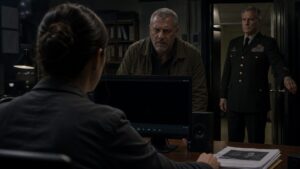
They Scanned An Elderly Woman In The Barracks, Then Found The General They Had Forgotten
Chapter 1: The Old Woman Beside The Lower Bunk
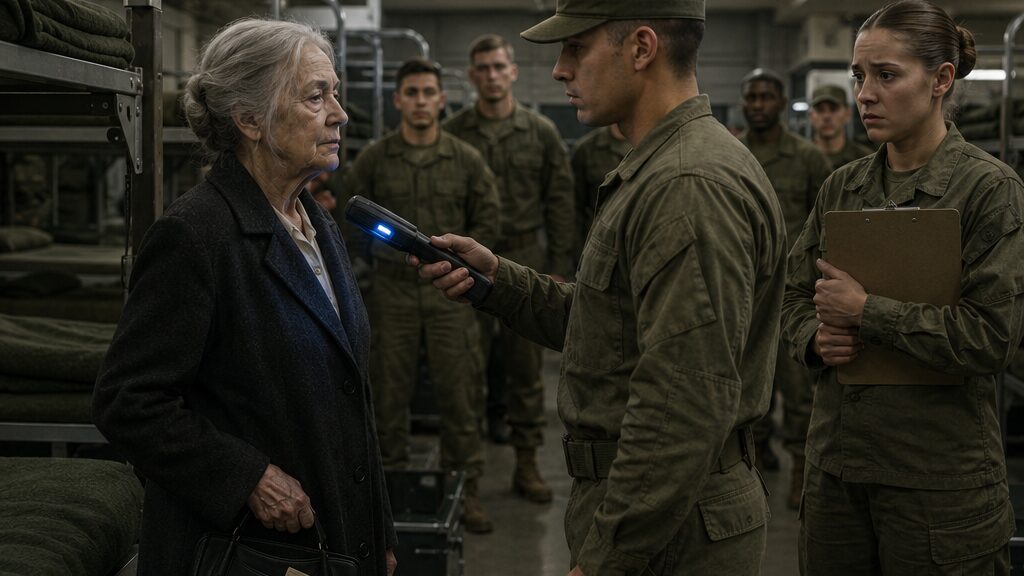
The scanner stopped inches from Kathleen Roberts’s chest, its black glass eye blinking blue against the front of her dark coat.
“Ma’am,” the young soldier said, not lowering it, “you need to stay exactly where you are.”
The barracks went still around her.
Rows of metal bunk beds stretched behind him, each one made with a folded green blanket squared so sharply it looked pressed into place by a ruler. Fluorescent lights hummed overhead. Boots lined the floor beneath the bunks in pairs. A dozen soldiers stood half-turned from their inspection positions, trying not to stare and failing.
Kathleen did not step back. At seventy-four, she had learned that sudden movement made young people nervous. She kept both hands visible, one resting lightly at her side, the other holding the worn strap of her plain black handbag.
“I am where I was asked to be,” she said.
The soldier’s name tape read TORRES. He had a clean face, a tight jaw, and the kind of posture that belonged to someone who had practiced authority in a mirror until it looked permanent. His eyes flicked over her gray hair, her old coat, her sensible shoes, the unadorned dress beneath.
“You were asked to be in the visitor reception area,” he said. “Not inside an active barracks during inspection.”
Behind him, a young female soldier stood near a row of footlockers with a clipboard hugged to her chest. Her name tape read ALLEN. She looked at Kathleen, then at Torres, then at the open doorway as if the right answer might walk through it and spare everyone.
Kathleen followed none of their eyes. Her attention had already found the lower bunk three rows in.
Second bay from the rear wall. Left side. Bottom rack.
Someone had folded the green blanket with excellent care. Someone had aligned the pillow so the seam faced the wall. Someone had tucked the sheet tight enough that a coin would have bounced off it.
And still, to Kathleen, it looked unfinished.
“Ma’am,” Torres said, sharper now.
Kathleen blinked once and returned to him. “Yes?”
“Are you listening?”
“Yes.”
“Then identify yourself.”
A few soldiers shifted. One cleared his throat and caught himself. The sound seemed too large in the bright room.
Kathleen had been standing in that barracks less than three minutes. She had signed in at the front desk. She had followed the posted arrows for the renovation dedication. She had paused only when she saw that the old west bay had been opened for guests before the ceremony.
No one had stopped her until Torres stepped into the aisle with the scanner raised.
“My name is Kathleen Roberts,” she said.
Torres looked down at a small tablet attached to his belt. He thumbed the screen, his mouth tightening.
“Roberts,” he repeated.
“Yes.”
“There is no Kathleen Roberts on the active visitor list.”
“There may be a separate list.”
“There is one list.”
Kathleen looked past his shoulder again, toward the lower bunk. “There used to be more than one.”
His expression hardened, not because he understood her but because he did not.
“Ma’am, this is not a museum tour. This is a controlled military area.” He lifted the scanner slightly. “I need your visitor badge.”
“I was not given one.”
“That’s a problem.”
“I agree.”
The answer confused him for half a second. Melissa Allen looked down at her clipboard, as though checking whether she had missed a step. Kathleen noticed her fingers press into the paper hard enough to bend the corner.
Torres noticed too.
“Allen,” he said without turning. “Did you clear this civilian into the barracks?”
Melissa’s face changed. “No, Sergeant. I mean—I saw her come through the corridor. I thought she was with the dedication group.”
“You thought?”
“She had paperwork.”
Torres’s eyes returned to Kathleen. “What paperwork?”
Kathleen opened her handbag slowly. She did not reach deep. She had put the card in the side pocket that morning because her fingers were not as quick as they used to be and because she had known, in a vague way, that the base might not remember her.
The card’s beige edge showed for a moment before she stopped.
Not yet.
Instead, she withdrew a folded printed invitation, creased at the corners from being read too many times. The base crest sat at the top. Beneath it, formal words welcomed former personnel, families, and invited guests to the rededication of the renovated barracks.
Torres took it between two fingers, as if paper could contaminate discipline.
“This does not authorize access to this room,” he said after a glance.
“It says the west bay will be open before the ceremony.”
“For cleared guests.”
“I was invited.”
“To the ceremony. Not to wander through sleeping quarters.”
Kathleen’s eyes moved again, against her will, to the lower bunk.
Torres followed her gaze.
“What are you looking at?”
For the first time, the room seemed to lean toward her. Not physically. Soldiers were trained better than that. But she felt the attention gather.
“A bed,” she said.
“There are forty beds in here.”
“That one.”
His jaw shifted. “Why?”
Kathleen walked before answering.
It was only four slow steps, but Torres reacted as if she had run. The scanner came up again. Two soldiers at the rear straightened. Melissa took a half-step forward, stopped, and looked at Torres for permission she did not receive.
Kathleen stopped beside the lower bunk. The metal frame had been repainted, but the shape was the same. Her left hand settled on the cold rail.
The touch went through her fingers and into a room that was not this room: smoke in the hallway, shouted counts, a blanket dragged loose, a young voice asking whether roll call had already happened.
She let go before memory could show on her face.
“This bed used to sit three inches closer to the wall,” she said.
Torres stared. “What?”
“It was moved after the renovation. The bolt pattern is different.”
A murmur flickered through the soldiers. Melissa looked down at the floor, then at the bed legs. Kathleen saw the moment the young woman noticed the patched marks beneath the new paint.
Torres did not look.
“Ma’am, I am trying to be respectful,” he said, though his voice carried little respect now. “But you are making this harder than it needs to be.”
“I have no wish to make your morning difficult.”
“Then answer the question. Who authorized you to enter?”
Kathleen’s hand slipped back to her handbag. Her thumb found the side pocket, brushed the old card, and stayed there.
She could have said the words.
She could have watched the aisle straighten, watched Torres’s shoulders change, watched the room rearrange itself around a rank she no longer wore. She had seen rooms do that for more than thirty years. She had commanded rooms larger than this one, colder than this one, louder than this one. She had watched officers twice Torres’s age forget their rehearsed arguments when her name reached them ahead of her.
But rank had never saved the one thing she had come to protect.
So she kept her voice plain.
“I came because something is missing.”
Torres’s patience broke into a short breath. “No, ma’am. What’s missing is your authorization.”
Melissa looked at Kathleen then, not with suspicion but with a worried question she did not dare ask.
Kathleen drew the card out at last, but only far enough that its beige corner showed against the black leather of the bag. Old plastic, worn dull along the edges. A photograph faded almost silver. A strip on the back that no ordinary visitor badge had carried in decades.
Torres saw it.
“What is that?”
“An old identification card.”
“Military?”
“Yes.”
“Active?”
“No.”
“Then it does not get you into an active barracks.”
“I did not use it to enter.”
“Then why bring it?”
Kathleen looked again at the lower bunk. “Because sometimes the old records are the only ones that remember correctly.”
The room held that sentence.
Torres did not.
He stepped closer and extended his hand. “Give it to me.”
Kathleen’s fingers closed around the card.
Not tightly. Just enough.
“Sergeant,” Melissa said softly.
Torres turned his head. “What?”
Melissa’s mouth opened, then closed. She looked at the bunk again. “Nothing.”
Torres faced Kathleen.
“Ma’am, I have an inspection team arriving, a dedication event in less than two hours, and a civilian inside a restricted bay with an expired credential. I am not going to guess my way through this.”
“Nor should you,” Kathleen said.
“Then produce valid proof.”
“The card is proof of something.”
“Of what?”
Kathleen looked at the young soldiers standing between the beds, all of them watching an old woman in a worn coat and a sergeant with a scanner. Some looked embarrassed. Some looked curious. One looked annoyed that inspection had been delayed.
None of them knew the room.
Not really.
“Of why I came,” she said.
Torres’s face tightened. He looked toward the doorway, then back at the soldiers. Public hesitation would cost him. Kathleen saw the calculation pass over him, quick and defensive. He could not appear uncertain in front of them.
He lifted his voice.
“Everyone hold position.”
Boots fixed themselves to the floor. Shoulders squared. Melissa went pale.
Torres held out the scanner, blue light blinking awake again. His other hand opened toward Kathleen.
“Ma’am,” he said, each word clipped and official, “put the card in my hand before this becomes a security incident.”
Chapter 2: The Blue Light On The Old Card
“That card looks older than half the soldiers in this room,” Torres said.
The line landed harder than he intended.
He heard it after it left his mouth, heard the faint intake of breath from someone near the third row of bunks, saw Allen’s eyes drop to the floor. But the old woman did not flinch. That bothered him more than if she had argued.
Kathleen Roberts placed the beige card in his palm.
It weighed almost nothing.
Torres had expected something laminated from a surplus shop, the kind of fake old military keepsake civilians carried when they wanted access to places that did not belong to them. But the card did not feel fake. It felt obsolete in the way old locks felt obsolete: not useless, just made for doors no one had opened in years.
The photograph on it showed a younger woman with dark hair pinned close, eyes level with the camera, expression controlled. Time had faded the face, but not the posture.
Torres looked from the photograph to Kathleen.
There was similarity, yes, but similarity did not equal access.
“Expiration date is long past,” he said.
“I know.”
“You know?”
“Yes.”
“Then why would you present it?”
“I did not present it. You asked for it.”
A couple of soldiers looked away. Torres felt heat rise under his collar.
He had been told twice that morning: no mistakes. The barracks renovation mattered. The visiting inspector had questions about how the base handled historical facilities. The commander wanted the dedication clean. A security breach, even a harmless one, would land on the person standing closest to it.
That person was him.
He positioned the card under the scanner.
The device was standard issue for temporary credentials, delivery permits, contractor badges, and legacy tags that had been converted into the new system. Most scans produced a green stripe or a red denial. Easy. Clean. A yes or no that could be explained in one sentence.
The scanner blinked blue.
No tone.
No stripe.
Torres frowned and angled the card again.
“Hold still,” he said.
Kathleen had not moved.
The scanner’s blue beam swept across the card, paused over the faded strip, and brightened. A thin bar of light spilled over Torres’s fingers and onto the front of Kathleen’s coat. The old woman’s face stayed calm, but her eyes lowered briefly to the card as if she were watching someone else be disturbed from sleep.
The screen flickered.
PROCESSING LEGACY FORMAT.
Torres’s thumb tightened on the device.
Legacy format did not mean valid. He told himself that. Old systems produced strange errors when they met new software. Bad strips, archived numbers, mismatched names, inactive permissions. He had seen enough contractor badges fail to know that.
The soldiers were all watching now.
“System’s reading something,” one of them muttered.
Torres snapped, “Quiet.”
Allen moved half a step closer, unable to help herself. Torres saw her reflection in the scanner glass, tense and curious.
The card’s name field pulsed.
ROBERTS, KATHLEEN.
Then the screen froze.
For one second, Torres saw nothing else. Just the last name. Roberts. The same plain name the old woman had given him. He waited for the red denial.
Instead, the device emitted a sound he had never heard from it before.
Not an alarm.
A low double tone.
The blue light deepened until the card looked illuminated from within.
Torres shifted his grip. “That’s not standard.”
“No,” Kathleen said.
He looked at her sharply. “You know what it is?”
“I know what the card was.”
“That isn’t what I asked.”
“No.”
She did not offer more.
His irritation returned because it had somewhere familiar to go. “Ma’am, if this is some kind of restricted credential, you need to explain why you have it.”
“I was issued it.”
“When?”
“A long time ago.”
The words should have sounded evasive. Instead, they sounded tired.
Torres glanced at the room. He wished the soldiers would stop looking at him. He wished Allen had not stepped close enough to see the screen. He wished the old woman had been louder, angrier, easier to classify as a problem.
The scanner flashed again.
The name remained.
Below it, for less than a heartbeat, another line appeared.
COMMAND—
Then the screen locked.
Allen saw it. Torres knew she saw it because her shoulders changed.
“Sergeant,” she whispered.
“I said quiet.”
The device asked for an authorization code. Torres did not have one. He pressed back, then scan again. The same double tone sounded.
Kathleen’s hand rested on the metal bed rail beside her. He noticed then that she was not leaning on it because she was weak, not entirely. Her fingertips sat precisely over an old weld under the new paint, as if she had known it would be there.
“What is your connection to this building?” Torres asked.
Kathleen’s gaze lifted from the card to him. “People.”
“That’s not an answer.”
“It is the only one that matters.”
“Not for security.”
“For security, you can check the name again.”
The phrase irritated him because it was calm. No demand. No threat. No claim of rank, no indignation, no “do you know who I am?” He knew how to handle those people. He could write those reports in his sleep.
He did not know how to handle an elderly woman who seemed almost disappointed that the system had remembered her at all.
Torres tried the scan a third time.
The blue beam struck the card. This time the screen brightened enough that the soldiers nearest him could see his face change before he controlled it.
COMMAND LEGACY FILE — REFER TO BASE ARCHIVE.
No rank. No clearance level. No photograph expansion. No simple explanation.
Just those words.
The room went so silent the fluorescent hum seemed louder.
Allen stared at the screen. Her mouth parted slightly.
Torres backed out of the message and tried to force a denial code. The scanner would not take it. The blue light continued to pulse.
“Is that valid?” a soldier near the rear asked before thinking better of it.
Torres lowered the device just enough to turn on him. “Did I ask for commentary?”
“No, Sergeant.”
Kathleen reached for the card.
“I will take that back now.”
Torres did not give it to her.
The decision happened in him before he fully thought it through. If he returned the card, he lost control of the only object in the room that made him uncertain. If he kept it, he could move the problem into a procedure. Evidence sleeve. Office. Archive verification. Chain of command. Words that looked safe in a report.
“This is being retained until verified,” he said.
Kathleen’s eyes moved to his hand. For the first time, something in her face tightened.
Not anger.
Pain, so brief he almost missed it.
“That card was not made for your convenience,” she said.
“It’s not active identification.”
“It is still mine.”
“And this is still a restricted area.”
Allen took a breath. “Sergeant, maybe we should call the archive before—”
Torres cut her off. “I will decide the next step.”
The old woman looked at Allen then. Not pleading. Not asking for rescue. Just seeing her. It made Allen stand straighter, though she looked frightened.
Torres slid the card into the clear sleeve tucked in his belt kit. The plastic swallowed it with a dry whisper. The beige edge remained visible, trapped beside a blank evidence label.
Kathleen watched him seal it.
“Young man,” she said quietly.
The words froze him more than if she had shouted.
He looked back.
“Every rule you are trying to follow,” she said, “was written because someone, somewhere, once failed to see clearly. Do not add yourself to that list.”
A flush crossed Torres’s face. There it was—the correction. The old-person lecture. The public scolding he could not allow in front of his soldiers.
He lifted his chin.
“Allen,” he said. “Escort her to the barracks office. No one touches that bunk. No one leaves this room until I clear it.”
Melissa looked at Kathleen, then at the sealed card, then at the lower bunk.
“Yes, Sergeant.”
Torres turned toward the office corridor with the scanner still glowing in his hand. The screen had dimmed, but not gone dark. As he stepped under the fluorescent light, the words appeared again, refusing to vanish.
COMMAND LEGACY FILE — REFER TO BASE ARCHIVE.
Chapter 3: The Name That Locked The Screen
“You understand this can become your write-up too,” Steven Torres said before the barracks office door had fully closed behind them.
Melissa Allen stood just inside the room with Kathleen Roberts beside her and felt the sentence strike exactly where he aimed it.
On the desk, the old beige card lay sealed in a clear plastic sleeve. The scanner sat beside it, screen dark now, blue reflection faint in the office window. Outside the glass, soldiers remained frozen between the bunks, pretending not to look toward the office.
Melissa kept her voice even. “Yes, Sergeant.”
“You saw an uncleared civilian enter an active barracks during inspection.”
“I saw an elderly guest come through the dedication corridor.”
“You assumed.”
“Yes, Sergeant.”
Torres turned from her to Kathleen. “And you let her assume.”
Kathleen stood near the wall, hands folded around the strap of her handbag. The office’s harsh light showed the fine lines beside her eyes and the loosened gray hair near her temple. She looked smaller in here than she had beside the bunk, but not less steady.
“I followed the signs,” she said.
“The signs do not override controlled access.”
“No.”
“Then we agree.”
“We agree the signs were insufficient.”
Melissa almost looked at her.
Torres did.
For a moment, he seemed ready to answer sharply. Instead, he picked up the printed dedication program from the desk and flipped it open.
“There is no Kathleen Roberts listed as speaker, honoree, family representative, donor, or command guest.” He held the program up. “If you were expected, you would be here.”
Kathleen looked at the program but did not reach for it.
“May I see the list of names on the barracks display?” she asked.
“This is not a tour desk.”
“I did not ask for a tour.”
“You are not in a position to request anything.”
The words sat in the room like a dropped tray.
Melissa felt her face grow warm. She had heard sergeants speak hard before. She had spoken hard herself when recruits made careless mistakes with gear or timing. But this was different. Kathleen Roberts had not raised her voice. She had not pushed through a gate. She had stood beside a bunk as if reporting to something only she could see.
Torres seemed to feel the shift too and stiffened against it.
“I’m contacting base records,” he said. “Until then, the card stays here.”
Kathleen’s gaze moved to the clear sleeve. “I would prefer it remain with me.”
“Preference noted.”
“It is not evidence of a crime.”
“That depends on what the archive says.”
“Does it?”
Torres opened the office door. “Allen, stay with her. If she tries to leave, call me.”
Kathleen turned her head slightly. “I will not run, Sergeant.”
He paused at the doorway.
“No,” he said. “I don’t imagine you will.”
Then he left.
The office felt smaller after him, not calmer. Melissa could hear soldiers shifting outside, the faint squeak of a boot sole, the hum of old lights, the distant clatter of ceremony equipment being moved down the corridor.
Kathleen stood in silence.
Melissa glanced at the program still open on the desk. There were polished words about heritage, readiness, renovation, sacrifice. A clean ceremony for a clean history. She had helped staple copies of it into folders before sunrise.
“Ma’am,” Melissa said, then stopped. The word felt inadequate.
Kathleen turned toward her.
“Are you all right?” Melissa asked.
That was not what she had meant to ask. She had meant: Who are you? What did the scanner see? Why did you touch that bed?
Kathleen answered the question she had been given.
“Yes.”
Melissa nodded. “Good.”
She looked stupid. She felt it.
Kathleen’s eyes softened a fraction. “You are not the one who raised the scanner.”
“No, ma’am, but I didn’t stop it.”
“You are young.”
“That’s not an excuse.”
“No,” Kathleen said. “It is a condition. Not a permanent one.”
The kindness in it made Melissa look away.
On the desk, the scanner woke by itself.
Both women turned.
The screen flashed once, blue light casting a pale bar across the office window. The message appeared and vanished so quickly Melissa might have doubted it if she had not already seen the first line in the barracks.
COMMAND LEGACY FILE.
Then the lock screen returned.
Melissa moved closer. She did not touch the card. She touched the edge of the desk instead, grounding herself.
“Ma’am,” she said. “When it scanned, I saw your name.”
Kathleen said nothing.
“And something else. Just the start of a word. Command.”
Still nothing.
Melissa took a breath. “Were you stationed here?”
Kathleen looked through the glass toward the barracks bay. Her eyes found the lower bunk without searching.
“Yes.”
“For how long?”
“Long enough to remember where things were before they were painted over.”
Melissa followed her gaze.
The patched marks beneath the bed legs. The bunk placed three inches from where it had once been. Kathleen had seen it immediately.
Melissa reached for her clipboard. The renovation checklist was clipped over the ceremony staging map. On the second page, each bunk in the west bay had a temporary display number for visiting families and command guests.
“What bunk were you looking at?” she asked.
Kathleen’s hand tightened around the handbag strap. “The one I touched.”
“West bay, row three, left lower?”
“Yes.”
Melissa found the line.
BUNK W-3L — DISPLAY READY.
No name beside it. Just the note: blanket folded, footlocker polished, historical tag pending.
Pending.
Melissa frowned and flipped to the archive reference sheet Christine Moore had sent with the staging packet. Most entries were ordinary: building year, renovation phases, old unit rotations, training photographs. But near the bottom, in tiny print beside a list of legacy bunk markers, she saw it.
W-3L: See archived personnel incident index.
Her stomach tightened.
“Ma’am,” she said slowly, “there’s an archive note for that bunk.”
Kathleen closed her eyes for half a breath. When she opened them, the calm was still there, but Melissa understood then that calm could be armor.
“What name is listed?” Kathleen asked.
“There isn’t one. It just says incident index.”
“Of course.”
Melissa looked up. “You expected that?”
“I hoped not.”
The office door opened before Melissa could ask more. Torres came back with a base phone in one hand and Christine Moore behind him. Christine wore a records badge on a blue lanyard and carried a tablet pressed to her chest like a shield.
“I was told there is a legacy credential issue,” Christine said, eyes already on the sealed card.
Torres pointed. “That card triggered a command file and locked my scanner.”
Christine’s expression sharpened. She put her tablet down, adjusted her glasses, and leaned over the plastic sleeve without opening it.
“This is old,” she murmured.
“We established that,” Torres said.
Christine ignored the tone. “Not ceremonial old. System old.”
“What does that mean?”
“It means if the scanner recognized it, the backend record was migrated intentionally.” She looked at Kathleen for the first time. “Your full name?”
“Kathleen Roberts.”
Christine typed. The room waited.
“No active visitor entry,” she said.
Torres spread one hand as if the case were closing.
Christine continued, “No current contractor badge. No dependent record. No current retiree clinic appointment.” Her fingers slowed. “There is an inactive command archive pointer.”
Torres’s hand dropped.
Melissa stepped closer before she could stop herself. “Can you open it?”
Christine tapped twice, then frowned. “Not from this access level.”
“Why not?” Torres demanded.
“Because it’s tagged restricted incident attachment. Commander approval required.”
Kathleen looked down at the card in its clear sleeve. Her face did not change, but Melissa saw her thumb move once over the empty place in her hand where the card had been.
Torres crossed his arms. “Read the heading.”
Christine hesitated.
“Read it,” he said.
Christine’s eyes flicked to Kathleen, then back to the tablet.
“Roberts, Kathleen,” she said, each word careful now. “Former commanding officer. Restricted incident attachment.”
The office went silent.
Outside the glass, beyond the frozen soldiers and the polished boots and the folded green blankets, the lower bunk waited without a name.
Chapter 4: The Missing Name On The Dedication List
The blank space on the dedication board was exactly where Stephanie Brown should have been.
Kathleen saw it before Christine Moore finished unlocking the archive room door, before Steven Torres finished telling the duty officer that the situation was contained, before Melissa Allen found the courage to step close enough to see what had stopped her.
The board stood on an easel near the open west bay, polished for the afternoon ceremony. Fresh brass strips had been mounted in neat lines beneath a heading about heritage and service. Most names had been engraved cleanly. Some were grouped by year. Some by unit. Some by renovation phase.
But where one name should have rested, there was only a narrow, bright rectangle of unmarked metal.
Someone had measured it. Someone had prepared the space. Then someone had left it empty.
Kathleen’s hand went to the pocket where her card should have been and found only fabric.
Melissa noticed. “Ma’am?”
Kathleen did not answer at once. Her eyes stayed on the blank strip.
“Who approved this board?” she asked.
Steven, standing just behind her, frowned. “That is not your concern right now.”
“It became my concern before you were born.”
He stiffened. “Ma’am, you need to be careful.”
Kathleen turned slowly. “So do you.”
The quietness of it made Melissa lower her eyes.
Christine came from the archive doorway with her tablet pressed against her chest, her face changed by the heading she had just read. She had not opened the restricted file. She had only found the edge of it, but sometimes the edge of a thing was enough to cut.
“The commander’s office is being contacted,” Christine said. “Until approval comes through, I can’t access the attachment.”
Steven seized on that. “Then nothing has been verified beyond an old pointer.”
Christine looked at him. “A migrated command archive pointer.”
“Still locked.”
“Yes,” Christine said. “Locked things usually have a reason.”
Kathleen had already stepped past them toward the board.
The west bay was no longer frozen in inspection posture. Soldiers had been moved to the far side while the dedication crew adjusted chairs in the center aisle. A base photographer crouched near the first row, checking angles. Someone had placed a folded green blanket on the lower bunk in row three, left side, smoothing its edge as if neatness could make it neutral.
Kathleen stopped at the board and lifted one finger, not touching the brass.
“Who removed the casualty record?” she asked.
The duty officer near the chairs glanced up. “Ma’am?”
“The incident record tied to west bay, row three, left lower. Who removed it from the display copy?”
The duty officer looked toward Steven as if procedure might answer.
Steven stepped between Kathleen and the board. “You are not authorized to challenge dedication materials.”
“I am asking a question.”
“And I am telling you this event has an approved program.”
Kathleen’s eyes moved past him to the printed program on a nearby table. She had seen it in the office. Clean language. Selective history. Service without loss. Sacrifice without names that might catch in the throat.
Melissa moved to the table and picked up one of the programs before Steven could stop her. She flipped through it quickly.
“No Stephanie Brown,” she said softly.
Kathleen closed her eyes.
Not long enough to seem broken. Long enough that the room she remembered entered the room she stood in.
A young woman sitting on that lower bunk, bootlaces half-tied, trying not to show homesickness. A folded letter tucked under a pillow. A laugh too quick, too bright. Then years later, a mother at a kitchen table in a black dress, one hand flat over a folded flag that had never been enough.
Promise me they will not turn her into a line in a report.
Kathleen had promised. She had done it without ceremony, without witnesses, without understanding how long a promise could keep breathing.
She opened her eyes.
“Her mother is dead now,” Kathleen said.
No one moved.
Steven’s expression altered, not into sympathy, but into discomfort at a truth too personal for his procedure. “Whose mother?”
Kathleen looked back at the blank brass strip. “Stephanie Brown’s.”
The duty officer shifted. “That name was in an early draft, I think. It was flagged for review.”
“By whom?”
A clipped voice answered from the far end of the bay. “By the ceremony office.”
A uniformed assistant stood with a folder in hand, jaw tight from being dragged into something unpleasant. “The casualty detail was removed from the public display because it changed the tone of the event.”
Kathleen looked at the assistant.
“Changed it how?”
The assistant swallowed. “It made the barracks history feel too heavy for a renovation dedication.”
The words moved through the west bay more quietly than an order, but every soldier heard them.
Too heavy.
Kathleen’s hand lowered to her side.
She could not stop herself from looking at the lower bunk. The folded green blanket looked newly issued. Clean. Empty. The tag holder at the bedframe had no name inside it. Just a temporary white slip with the bunk number.
W-3L.
A place without a person.
Melissa took one step toward Kathleen, then stopped. “Ma’am, was Stephanie assigned there?”
Kathleen nodded.
Steven looked from Melissa to Kathleen. “Allen, enough. We are not turning this into an oral history session.”
Christine’s voice stayed careful. “Sergeant, if the archive pointer connects Roberts to a restricted incident and the same incident index connects to that bunk, we should wait for command before continuing the dedication setup.”
Steven’s face tightened. He could hear risk in every word. Delay the dedication, and the inspection failed. Ignore the archive, and he might be caught dismissing something legitimate. Around him, soldiers watched with the same silent attention that had filled the room during the scan.
He chose the danger he understood.
“The event schedule stays,” he said. “The commander can review records after the dedication.”
Kathleen turned fully toward him. “No.”
It was one word, not loud, but it changed the shape of the aisle.
Steven stared at her. “Excuse me?”
“You will not dedicate a room after removing the reason it should be remembered carefully.”
“I don’t take instructions from unauthorized visitors.”
Christine inhaled sharply. Melissa looked at Kathleen as if asking her to say more, to finally say whatever sat behind the old card and the locked file.
Kathleen did not.
Her silence, which had protected her all morning, now pressed down on the wrong people.
Steven stepped back and keyed his radio. “Duty office, this is Torres. I have a disruptive civilian in west bay interfering with ceremony materials and refusing direction. Request command presence.”
Melissa’s face went pale. “Sergeant—”
He lifted a hand, cutting her off.
Kathleen looked at Melissa then, and a small regret passed through her. Not for herself. For the young woman whose instinct had begun to turn toward the truth and might now be punished for it.
“I should have asked for the commander first,” Kathleen said.
Steven lowered the radio. “You should have remained in reception.”
Kathleen looked at the sealed card still in the evidence sleeve on his belt.
“I should have spoken sooner.”
The admission did not feel like surrender. It felt like a door opening onto a room everyone had avoided.
Christine’s tablet chimed.
She looked down. Her face changed.
“What?” Steven demanded.
“Commander approval response is pending,” she said. “But the system just pulled a cross-reference from the public archive.”
She walked to the hallway wall outside the west bay, where framed photographs had been temporarily rehung after renovation. Most were unit pictures, inspection shots, formation images. The last frame held a faded black-and-white photograph of smoke-stained soldiers standing in front of the barracks decades earlier.
Christine pointed to a label under the frame.
“Incident response group,” she read. “West Bay emergency, year classified in public copy.”
Kathleen did not look at the photograph.
She knew where she was in it.
Steven moved closer despite himself. Melissa came beside him. The duty officer leaned in from the aisle.
The label listed only unit and date reference, not names. But one face in the center of the photograph belonged to a young officer standing without helmet or coat, eyes fixed beyond the camera, one hand on a stretcher rail.
Melissa looked from the photograph to Kathleen, then back again.
Before anyone could speak, a voice from the main entrance cut through the barracks.
“What is happening in my west bay?”
The soldiers straightened by reflex.
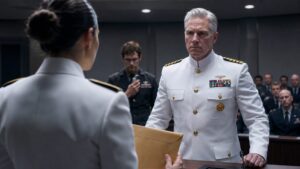
A man in command uniform entered with two staff members behind him. His hair had silver at the temples, but his stride was quick, irritated, practiced. Joshua King took in the dedication board, the clustered soldiers, Steven’s stiff posture, Melissa’s pale face, Christine’s tablet, and finally Kathleen Roberts standing beside the blank brass strip.
He stopped.
The irritation left him so completely that the room seemed to lose sound with it.
His eyes moved over Kathleen’s old coat, her gray hair, her steady hands. Then he looked at the sealed beige card at Steven’s belt.
Joshua’s voice came out lower than before.
“Where did you find her?”
Chapter 5: The Commander In The Faded Photograph
“General Roberts,” Joshua King said.
The title struck the west bay before anyone understood it.
Steven Torres did not move. Melissa Allen looked from Joshua to Kathleen as if the air between them had changed color. The duty officer’s mouth opened slightly, then shut. Christine Moore lowered her tablet one inch, her eyes fixed on the old woman in the dark coat.
Kathleen’s face tightened, almost imperceptibly.
“Joshua,” she said.
Not Commander. Not Colonel. Not sir.
Joshua heard his first name in her voice and for one instant he was twenty-seven again, standing in a briefing room with rainwater in his boots while then-General Kathleen Roberts told him that speed was not the same as haste and authority was not the same as volume.
He had not seen her in years.
He had known she was alive. The records said that much. Retirement notices, veteran health updates, occasional invitations returned with polite silence. But knowing someone remained alive somewhere in the country was not the same as finding her in a renovated barracks while one of his NCOs held her credential in a plastic sleeve.
Joshua’s eyes moved to Steven.
“Why is General Roberts’s card on your belt?”
Steven’s throat worked. “Sir, the credential triggered an unknown legacy message. It was expired. I retained it pending verification.”
“Did she give you her name?”
“Yes, sir.”
“Did you check it?”
“The active visitor list did not show—”
Joshua lifted one hand. Steven stopped.
Kathleen watched the exchange without satisfaction. That was what unsettled Joshua most. No anger. No demand. No triumph. Just the same controlled stillness she had carried through harder rooms.
He turned to Christine. “Can you access the command archive?”
“With your approval, sir.”
“You have it.”
Christine tapped quickly. “I’ll need the credential unsealed.”
Steven reached for the sleeve, then hesitated. Joshua saw the hesitation and understood too much about the morning.
“Return it,” Joshua said.
Steven removed the clear sleeve from his belt. His fingers were careful now, almost too careful. He broke the seal and slid the beige card out. The old plastic caught the fluorescent light. He offered it toward Kathleen.
Kathleen extended her hand.
For a brief second, Steven seemed to expect her to snatch it back or make him feel the weight of his mistake. She did neither. She took the card as though accepting something fragile from someone who did not yet know how to hold it.
“Thank you,” she said.
Steven looked down.
Joshua turned toward the wall photograph. “Bring it here.”
The duty officer removed the frame from its temporary hook and carried it to the dedication board. Dust clung to the edge. The photograph inside had faded to soft gray, but the central figure remained clear enough: a younger Kathleen, uniform darkened with smoke, one sleeve torn, one hand gripping a stretcher rail while soldiers moved behind her in controlled chaos.
Melissa whispered, “That’s her.”
No one corrected her.
Christine held the old card beside the photograph. The younger face on the card, the face in the photograph, and the elderly woman standing beside the blank brass strip aligned across time with a cruelty Joshua felt in his chest.
The archive opened on Christine’s tablet with a soft chime.
Her voice changed as she read the first lines. “Roberts, Kathleen. Lieutenant General, retired. Former commanding officer, Fort Westbridge training command. Emergency response lead, west barracks incident. Command legacy access retained by historical directive.”
Steven’s face lost color.
Joshua did not look at him yet. He kept his eyes on Kathleen.
“You should have been on the ceremony list,” he said.
“I did not ask to be.”
“That does not answer why you were not.”
“No.”
He heard the rebuke. It was not aimed at him alone, but it found him.
Joshua had approved the dedication packet after three long days of budget meetings, inspection briefings, renovation delays, and public affairs edits. He remembered seeing the language: honoring generations of service. Preserving readiness. Recognizing sacrifice. Smooth words. Words that could fit on a program without catching on anything sharp.
He had not asked whose sacrifice had been smoothed away.
Christine scrolled, then stopped.
“Sir,” she said carefully, “there is an incident attachment linked to west bay, row three, left lower. It references a recruit—Stephanie Brown.”
Kathleen looked at the blank strip again.
Joshua followed her gaze.
The missing name.
He understood then that the morning was worse than a security mistake. His command had cleaned history until it no longer resembled memory. And the woman who had once taught him never to confuse a clear report with a complete truth had walked into the middle of it wearing a worn coat and carrying the card he had forgotten existed.
Steven spoke, his voice controlled with effort. “Sir, I was following access protocol.”
Joshua turned to him at last. “Were you?”
Steven swallowed. “An elderly civilian entered a controlled bay during inspection. Her credential was expired. The scanner produced a restricted message. I retained the credential and requested verification.”
“That is the report version,” Joshua said. “I asked if you followed protocol.”
Steven’s jaw moved. “I believed I did.”
Kathleen looked at him then. “He followed the part he trusted.”
Joshua’s eyes narrowed slightly. He heard the old commander in it—the refusal to make even a wrong soldier simpler than he was.
“What part did he not trust?” Joshua asked.
Kathleen’s gaze remained on Steven. “The person standing in front of him.”
The words did not raise their volume. They did not need to.
A staff member appeared at the entrance, breath slightly short. “Sir, the visiting inspector is at reception. Public affairs is asking if the dedication will begin on schedule.”
Joshua looked toward the chairs set in the center aisle, the polished board, the blank strip, the bunk with its nameless tag. The base photographer stood frozen beside his camera. Soldiers watched with the tense stillness of people present for something that would be discussed later in lowered voices.
The event could still proceed. That was the terrible temptation. He could move Kathleen to a private office, issue apologies, delay the archive correction until after the inspector left. He could protect the schedule. Protect the command image. Protect everyone from the discomfort of saying that a cleaned-up ceremony had erased a dead recruit and failed to recognize the commander who remembered her.
He knew exactly how to do it.
That was what made him ashamed.
Kathleen saw the calculation. Of course she did.
“Joshua,” she said quietly. “Do not make a larger mess to spare me embarrassment.”
“This is not your embarrassment.”
“It will become about me if you let it.”
“It already is about you.”
“No.” Her eyes moved to the lower bunk. “That is the mistake.”
Joshua looked at the bunk. The folded green blanket was squared with near-perfect care. Beneath it, the white temporary tag still read only W-3L.
“Stephanie Brown,” he said.
Kathleen’s face changed at the name. Not much. Enough.
Joshua turned to Christine. “Can the display be corrected before the ceremony?”
Christine glanced toward the archive tablet. “If command approves the incident reference and public affairs stops trying to rewrite it.”
“Consider both done.”
The staff member at the entrance shifted. “Sir, public affairs will object to changing approved materials in front of the inspector.”
Joshua’s expression hardened. “Then public affairs can learn what inspection means.”
Steven flinched slightly, though the words were not aimed at him.
Melissa stepped forward with surprising suddenness. “Sir.”
Joshua looked at her.
“The temporary bunk tag,” she said. “I can replace it. I know where the blank inserts are.”
Steven turned his head toward her. There was warning in the look, but it lacked the force it had carried before.
Joshua nodded. “Do it.”
Melissa moved quickly, almost gratefully, toward the supply table.
Kathleen watched her go. “Do not make that young woman carry my failure.”
Joshua lowered his voice. “Your failure?”
“I saw the blank space and still waited for others to ask the right question.”
“General—”
“Kathleen,” she said.
He stopped.
She looked older in that moment than when he first saw her, not because she seemed weak, but because the burden in her had finally stepped close to the surface.
“I came to correct a name,” she said. “Not to be found.”
Joshua wanted to say she should have called. She should have let someone know. She should not have walked alone into a barracks during inspection with an obsolete credential and a grief older than half the soldiers in the room.
But he knew why she had not.
He knew how command trained people to carry damage privately, how it praised restraint until silence could disguise itself as honor.
The visiting inspector’s voice sounded faintly from the corridor, accompanied by the clipped movement of staff trying to delay without admitting delay.
Joshua looked at the dedication board, then at the photograph, then at Steven.
Steven stood rigid, eyes fixed somewhere between the old card in Kathleen’s hand and the floor. The punishment he expected hung in the air almost visibly. Maybe he deserved one. Maybe later he would receive one. But Kathleen had already named the deeper failure, and Joshua could not pretend the young NCO was the only person in the room who had trusted a process more than a person.
He stepped closer to Kathleen.
“The dedication cannot proceed as written,” he said.
“No,” she said.
“Do you want it stopped?”
Her fingers closed lightly around the beige card.
Joshua waited.
So did Steven, face pale, shoulders locked, bracing for the old woman in the worn coat to use the authority the room had finally returned to her.
Chapter 6: Do Not Apologize Because I Was A General
“General Roberts,” Steven Torres said, “I apologize.”
Kathleen turned from the blank dedication strip slowly enough that every soldier in the west bay had time to hear what he had called her.
General.
The word traveled across the rows of bunks and polished footlockers, past the folded green blankets and the temporary chairs, into the silence where suspicion had stood less than an hour earlier. Steven held himself at attention, eyes forward, jaw tight with shame and fear. The old beige card rested again in Kathleen’s hand. Its edges pressed into her palm like a small, stubborn piece of the past.
She looked at him for a long moment.
“No,” she said.
His face tightened. “Ma’am?”
“Do not apologize because I was a general.”
The room did not move.
Joshua King stood near the dedication board, still as if he had expected the correction but not the pain in it. Christine Moore held the archive tablet against her chest. Melissa Allen stood by the lower bunk with a blank name insert in one hand, waiting.
Kathleen stepped into the center aisle.
Her knees objected to the movement. Her fingers wanted to close around the card until it hurt. She did not let either thing show more than necessary. For decades she had believed restraint was the last clean thing left to people who had ordered others into danger. She had worn silence like a pressed uniform.
Now silence had nearly erased Stephanie Brown.
Steven swallowed. “I disrespected you, ma’am.”
“Yes.”
The honesty of the answer made several soldiers look down.
Kathleen kept her gaze on him. “But you did not know who I was when you did it.”
“No, ma’am.”
“That is the point.”
Steven’s eyes flicked to her for the first time.
“If this card had scanned red,” Kathleen said, lifting the beige credential slightly, “what would you have done?”
He hesitated.
She waited.
“I would have removed you from the barracks,” he said.
“How?”
His face tightened again. “By procedure.”
“Would procedure have required you to mock the card?”
A faint flush rose in his cheeks. “No, ma’am.”
“Would it have required you to keep it from me after I asked for it back?”
“No, ma’am.”
“Would it have required you to decide I was confused before you knew why I was standing beside that bunk?”
Steven’s eyes shifted toward W-3L.
Melissa stood beside it, motionless.
“No, ma’am,” he said.
Kathleen lowered the card. “Then your apology cannot begin with my rank. It has to begin before that.”
No one spoke.
The visiting inspector had entered quietly at the rear with two staff members, but Joshua had lifted a hand to keep them there. Even the photographer had lowered his camera. The ceremony that had been arranged to look polished now looked stripped down to what it had tried not to show: beds, names, young faces, old decisions.
Kathleen turned toward the lower bunk.
“Melissa,” she said, “may I see the insert?”
Melissa came forward and placed the blank strip in her hand. “Yes, ma’am.”
Kathleen looked at the empty white surface. The temporary insert weighed less than the old card. Strange, how little weight a missing name could have until someone tried to carry it.
“Her name was Stephanie Brown,” Kathleen said.
A few soldiers looked toward the dedication board, searching for a name that was not there.
“She was assigned to that lower bunk. She wrote letters on her blanket because the desk was always taken. She folded her socks badly and corrected everyone else’s grammar. She was nineteen years old and wanted to become a medic.”
A soldier near the back shifted. The senior medic who had come for the ceremony lowered his eyes.
Kathleen kept her voice steady.
“The incident report says a training system failed. That is true. It says emergency response was executed under command direction. That is true. It says multiple soldiers were evacuated and the barracks was cleared in time to prevent greater loss. That is also true.”
She looked at Joshua.
“But reports have a habit of making survival sound complete.”
Joshua’s face changed, and Kathleen knew he remembered. Not Stephanie herself; he had been too young then, not yet assigned to the base. But he remembered her lessons. Never let clean language hide unfinished duty. He had repeated those words once in a briefing, thinking they belonged to doctrine. They had belonged to this.
Kathleen turned back to the soldiers.
“I commanded the response that day. I gave the evacuation order. I ordered doors breached, windows cleared, medics pulled forward before the scene was fully safe. Those decisions saved lives.”
She paused. The barracks seemed to hold its breath.
“Stephanie Brown was not one of them.”
The words entered the room without drama, and that made them worse.
Kathleen looked down at the blank insert. “I wrote to her mother. Then I went to see her because a letter was not enough. She asked me for one thing. Not a medal. Not a ceremony. Not a speech.” Her thumb moved across the empty strip. “She asked that her daughter not disappear into phrasing.”
Melissa’s eyes filled, though she did not let tears fall.
Kathleen continued. “I promised her the barracks would remember Stephanie by name.”
Christine looked down at her tablet quickly. “The original incident plaque listed her. The renovation copy removed the casualty line.”
Joshua’s voice was low. “On my approval chain.”
Kathleen looked at him. “On the institution’s chain. Do not make it smaller to make it easier.”
The sentence landed on more than one person.
Steven’s shoulders had changed. He was still standing straight, but the rigid defensiveness had drained out of him, leaving something younger and more uncertain.
Kathleen faced him again.
“You wanted to protect this room,” she said.
“Yes, ma’am.”
“You thought suspicion was protection.”
He struggled with the answer. “I thought if I missed something, it would be on me.”
“That may be true.”
His eyes lifted.
“But fear does not become leadership because it wears a uniform.”
Steven absorbed that as if it hurt and helped at the same time.
Kathleen held out the blank insert to him.
He stared at it.
“Ma’am?”
“You raised the scanner. You held the card. You turned a person into a problem in front of this room.” Her voice remained even. “Now read the name in front of this room.”
Steven took the insert carefully, though there was nothing written on it yet.
Christine moved to the supply table and found a black permanent marker. She handed it to Kathleen first.
Kathleen did not take it.
“Melissa,” she said.
Melissa blinked. “Me?”
“You noticed the bunk.”
Melissa stepped forward. Her hand shook when she accepted the marker, but her lettering was clear.
STEPHANIE BROWN.
She gave the insert back to Steven.
He looked at the name.
For a moment Kathleen thought he might ask someone else to do it, not because he refused, but because the shame had finally reached a place where speech became difficult.
Then he turned toward the soldiers, the visiting inspector, the staff, the photographer, the commander, and the old woman he had misjudged.
“Stephanie Brown,” he said.
His voice cracked on the last name. He stopped, swallowed, and started again.
“Stephanie Brown. Assigned west bay, row three, left lower. Remembered by name.”
No one applauded.
Kathleen was grateful for that.
Melissa walked to the lower bunk and slid the insert into the tag holder. The white strip clicked into place against the metal frame. Such a small sound. Smaller than a salute. Smaller than a command. Smaller than grief.
But it stayed.
Joshua stepped beside Kathleen. “The dedication remarks will be changed.”
“They should be shortened,” Kathleen said.
He almost smiled, then did not. “Yes, ma’am.”
“Kathleen.”
“Yes,” he said quietly. “Kathleen.”
Steven still held the old scanner in one hand. Its blue light blinked once against his fingers, idle and pale. He looked at it as if it had become heavier.
Then he turned to Joshua.
“Sir,” he said, voice rough but controlled, “request permission to review barracks entry protocol after the ceremony. Visitor verification, legacy credentials, elder veteran access. And conduct at point of contact.”
Joshua studied him. “Why?”
Steven looked toward Kathleen, then toward the bunk where Stephanie Brown’s name now sat in plain view.
“Because the scanner worked before I did, sir.”
Chapter 7: The Same Coat Leaving The Barracks
“Before I make this permanent,” Christine Moore said, “I need you to approve the restored archive entry.”
The tablet in her hands glowed brighter than the evening light outside the barracks windows. On its screen, beneath the official header and the renovated building number, a new line waited for final confirmation.
STEPHANIE BROWN — ASSIGNED WEST BAY, ROW THREE, LEFT LOWER. REMEMBERED BY NAME.
Kathleen Roberts stood beside the archive desk that had been rolled into the west bay after the dedication ended. The chairs had been stacked. The visiting inspector had gone. The photographer had packed away his camera without asking for a posed image of her. The soldiers who remained moved quietly, as if the room itself had changed regulations.
Kathleen read the line twice.
Then she read it a third time because part of her did not trust corrected things. Errors could be smoothed over. Promises could be praised and then forgotten again. A name could return to a screen and still vanish from the way people behaved.
Christine waited with the patience of someone who now understood that this was not paperwork.
“May I?” Kathleen asked.
Christine handed her the tablet.
Kathleen’s fingers were slow on the glass. The old beige card lay beside the keyboard, no longer sealed in plastic. Its surface looked dull under the fluorescent light, harmless again. The black scanner sat next to it, idle.
Kathleen pressed approve.
The tablet chimed once.
Across the room, Melissa Allen slid the corrected physical tag into the holder on the lower bunk and pressed both ends until it clicked. She did not rush away after. She remained crouched beside the bed, reading the name at eye level.
Stephanie Brown.
The folded green blanket above the tag had been refolded after the ceremony. Not for inspection this time. Melissa had done it herself, carefully but not perfectly. One edge sat a little soft near the corner.
Kathleen found she preferred it that way.
Joshua King came to stand near the archive desk. He had removed his cap, and the absence of it made him look less like the commander of the room and more like the young officer she remembered beneath the years.
“The archive update is now part of the building record,” he said. “The dedication board will be remade by tomorrow morning. Not patched. Remade.”
Kathleen returned the tablet to Christine. “Good.”
“The ceremony remarks have also been entered into the command record.”
“That may be excessive.”
A faint, tired smile touched Joshua’s face. “I learned from someone that clean records are not always complete records.”
Kathleen looked at him then. The line could have been flattery if someone else had said it. From Joshua, it sounded like an apology he would not make loudly because he knew she would dislike that.
She let it pass.
Near the main aisle, Steven Torres stood with the scanner in both hands. He had not left after the ceremony. He had helped move chairs, replaced the temporary rope line, and carried the old dedication board to the records cart without being asked. No one had told him that chores could balance disrespect. He seemed to know they could not. He did them anyway.
Now he approached slowly.
“Ma’am,” he said.
Kathleen turned.
He held out the scanner, not toward her chest this time, but flat across both palms.
“I’m returning this to the duty station,” he said. “But before I do, I wanted to ask permission to use today in training.”
Joshua’s expression sharpened. “Use how?”
Steven looked at him, then back at Kathleen. “Not your name unless authorized. Not the restricted file. The mistake. Mine.” His fingers tightened slightly around the device. “The point of contact. How to verify without humiliating someone. How not to let procedure become an excuse for contempt.”
The word contempt cost him. Kathleen heard it.
She studied his face. Younger than he had seemed that morning. Still proud. Still frightened of failure. But the fear had shifted. It was no longer only fear of being seen as weak. It had become fear of becoming the kind of leader who mistook hardness for strength.
“That would be useful,” Kathleen said.
Steven exhaled, but did not relax.
“And incomplete,” she added.
His eyes lifted.
“If you train them only to avoid embarrassing a general, you will have missed the lesson.”
“Yes, ma’am.”
“What will you tell them?”
He looked toward the lower bunk.
“That the scanner confirmed what I refused to consider,” he said. “That I treated an old woman as a problem before I treated her as a person. That the rules gave me authority, but not permission to forget courtesy.”
Kathleen said nothing for a moment.
Then she nodded once.
Steven’s shoulders lowered, not in relief exactly, but in acceptance.
Joshua watched him. “Your request for protocol review is approved. You will work with records, access control, and the senior medic. You will include legacy credentials, elder veterans, family guests, and unclear visitor status. You will also include conduct standards.”
“Yes, sir.”
“And Torres.”
“Sir?”
“The purpose is correction. Not performance.”
Steven looked at Kathleen again, then back to Joshua. “Understood.”
Melissa rose from beside the bunk and came over, holding the old temporary white tag that had read only W-3L. She offered it to Kathleen.
“I thought you might want this removed,” Melissa said.
Kathleen looked at the blank tag.
For most of the day, it had angered her. Now, in Melissa’s hand, it looked small and guilty.
“No,” Kathleen said. “Keep it in the archive.”
Melissa blinked. “The blank one?”
“Yes. Someone should remember that a blank space once stood there.”
Christine reached for it. “I’ll attach it to the correction note.”
Melissa handed it over.
Joshua cleared his throat softly. “Kathleen, there is one more thing.”
She turned with faint suspicion. “Joshua.”
He almost smiled again. “It is not a ceremony.”
“That is what people say before ceremonies.”
“No speeches. No cameras.” He gestured toward the front row of chairs that had not yet been folded. One had been left in the center aisle, facing the lower bunk. “I wanted to offer you the honored seat before you leave.”
Kathleen looked at the chair.
It was a simple folding chair, but someone had placed it carefully. Not on a stage. Not behind a podium. In the aisle, where anyone sitting there would face the bunk with Stephanie Brown’s name.
The room waited.
Kathleen walked toward it slowly. Every step made the old card shift in her coat pocket. She reached the chair, set one hand on its back, and stood there long enough that Joshua seemed to think she might accept.
Then she moved the chair three feet to the side.
“Leave it empty,” she said.
Joshua’s eyes moved to the bunk. He understood.
Melissa lowered her head.
Steven did too.
Kathleen took the old beige card from her pocket and held it for a moment under the room’s fluorescent lights. The card had opened doors, locked screens, unsettled a room, and forced an institution to check what it had chosen not to see. But it had not brought Stephanie back. It had not made guilt noble. It had only helped an old promise reach the surface.
Christine approached with the scanner.
“One final scan,” she said gently. “To attach your approval to the archive correction.”
Kathleen placed the card beneath the black glass.
The blue light spread across the beige plastic, softer now, no longer accusatory. On the tablet, the updated entry appeared with a confirmation mark beside Stephanie’s name.
Kathleen removed the card and slipped it back into her handbag.
At the entrance, the evening corridor waited. The same corridor through which she had entered as an inconvenience. She buttoned her dark coat with fingers that took a little longer than they once had.
Joshua walked her to the doorway, but did not offer his arm. She was grateful. Steven and Melissa stood near the lower bunk. Christine remained at the archive desk, saving the correction twice.
At the threshold, Kathleen looked back.
The folded green blanket rested above Stephanie Brown’s restored name. The empty chair faced it from the aisle. The scanner’s blue light faded on the desk behind Christine, returning to black.
Kathleen stepped into the corridor wearing the same old coat she had worn when they stopped her.
No one saluted.
No one needed to.
The story has ended.