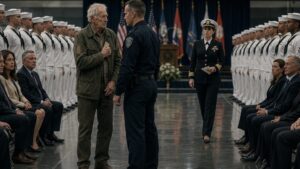
They Turned Away the Old Nurse Until One Stained Envelope Made the Room Stand Still
Chapter 1: The Woman at the Red Rope
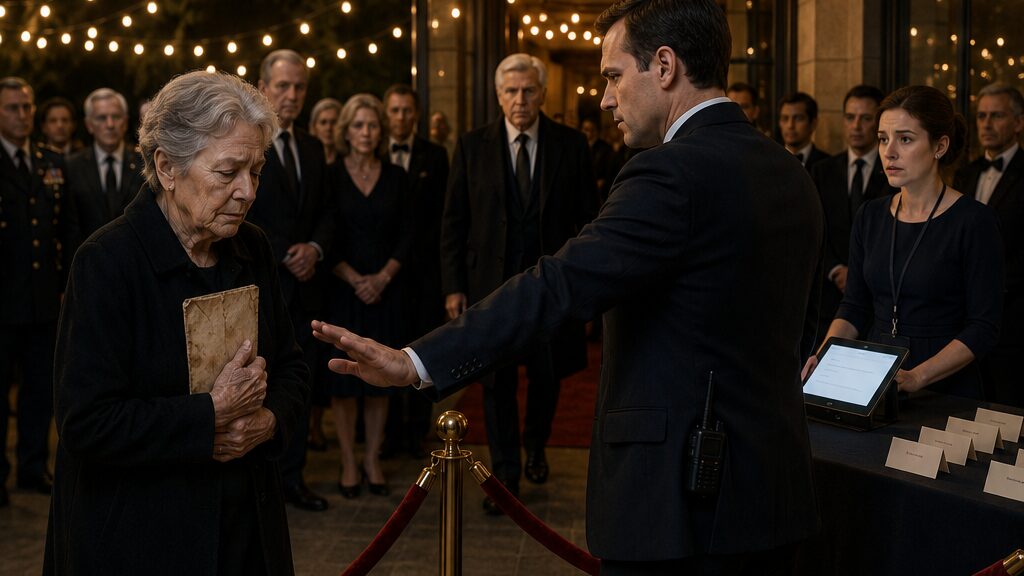
Gary Hall put one hand across the red velvet rope before Patricia Walker could step past the brass post.
“Ma’am, your name isn’t on the list.”
The words landed softly enough for manners, loudly enough for the couple behind her to hear. Patricia felt their conversation thin into silence. Beyond Gary’s shoulder, the Riverbend Veterans Memorial Foundation Dinner glowed in warm strings of light. Men in dark suits moved under the hotel canopy. Women in black dresses checked their coats and accepted glasses from passing trays. Somewhere inside the ballroom, a pianist was playing a careful version of a song Patricia had once heard through a radio with a cracked dial.
She kept both hands on the envelope.
It had gone soft at the corners after years in a dresser drawer, then a lockbox, then the inside pocket of her black coat. The paper was yellowed and faintly stained at one edge, the old seal no longer clean but still closed. She had placed it in her handbag that morning, taken it out before leaving the house, then carried it in her hands all the way from the parking lot as if hiding it again would make her turn around.
Gary glanced from her face to the envelope, then back to the tablet on the check-in stand. His tie was straight. His suit jacket fit tightly across his shoulders. A small radio clipped to his belt clicked with short bursts of other people’s problems.
“Patricia Walker,” she said.
“I searched Walker.” He angled the tablet slightly away from her. “Nothing under Patricia. Nothing under P. Walker.”
“It may not be listed that way.”
“Do you have a confirmation email?”
Patricia looked past him at the red rope. The brass hook had a polished shine where hundreds of hands had opened it for people who belonged. “No.”
“A printed ticket?”
She lowered her eyes to the envelope. “I have this.”
Gary’s hand came out, not quite grabbing, but ready to receive it as one more thing to process. Patricia did not let go. She turned the envelope just enough for him to see the front. The old handwriting had faded brown. A name had once been cleanly written there, though the years had blurred it at the edges.
Gary leaned forward. “This isn’t a ticket.”
“It’s what I was asked to bring.”
Behind Gary, a young woman with a lanyard around her neck looked up from a stack of name cards. Emily Davis, the badge said. Her hair was pinned neatly, her smile still fixed from greeting donors, but her eyes moved to the envelope and stayed there.
Gary’s voice remained level. “Ma’am, we have a lot of guests arriving, and I can’t admit anyone without current registration.”
“I understand.”
“If you’re looking for the hotel restaurant, it’s down the hall to the left.”
The couple behind her shifted. Patricia heard the woman’s bracelet click against a clutch. Not cruelly. Not even impatiently. Just the small sound of people waiting for an inconvenience to clear.
Patricia had been corrected by younger voices before. At the pharmacy. At the bank. At the grocery store self-checkout when the machine accused her of failing to place the item in the bagging area. She knew the expression that came with it: not hatred, only a practiced assumption that her confusion had arrived before she had.
“I’m not looking for the restaurant,” she said.
Gary pressed his lips together. His eyes went again to the tablet, as if the screen might rescue him from the old woman standing in front of him. “This event is closed.”
“I was told the Martinez family would be here.”
Emily’s head lifted a fraction.
Gary noticed that. Patricia saw him notice.
“What is your relationship to the Martinez family?” he asked.
Patricia’s thumbs tightened against the envelope’s crease. The paper gave a small dry whisper.
“I knew Richard Martinez.”
The name seemed to move through the air faster than her voice. Gary’s posture changed, but not in the way she had feared or hoped. He became more official.
“Sergeant Richard Martinez is one of the honorees tonight,” he said. “His family has asked us to keep the event private.”
“I know.”
“If you’re press, we have a media contact.”
“I’m not press.”
“If you’re with one of the veteran groups, there’s a separate check-in table for invited representatives.”
“I’m not with a group.”
Gary’s eyes dropped to her coat, her plain black dress, her old shoes. She knew what he saw: a woman too carefully dressed for an ordinary dinner and not polished enough for this one. A woman who had taken pains and still looked out of place.
Emily stepped closer, softly. “Mr. Hall, maybe we could check the old registry? Some of the earlier invitations were—”
Gary did not turn his head. “Emily, please keep the line moving.”
The girl stopped. Patricia did not blame her. A person could lose courage in small amounts and still look perfectly kind.
Gary held out his hand again. “Let me see the envelope.”
Patricia hesitated.
“It’s just to verify,” he said.
She gave it to him because refusing would make her look exactly like what he already suspected. Confused. Difficult. A problem dressed in black.
Gary took the envelope between two fingers, not roughly, but with the indifferent efficiency of someone handling an outdated coupon. He turned it over. The old return mark on the back faced Emily for one second before his thumb covered part of it.
Emily’s lips parted.
Patricia saw the mark in the girl’s eyes before she saw anything else. Recognition, almost. Not of Patricia. Of the shape. The faded block letters. The old military routing stamp pressed into the paper like a bruise the years had not erased.
Gary saw only the seal.
“This has no barcode, no printed invitation number, no current date.”
“It wasn’t meant for the list.”
“That’s the problem.”
Patricia reached for it. Gary returned it, but not with care. The corner bent slightly against her glove.
The sound was small.
She looked down at the envelope. For one sharp moment, the hotel canopy, the warm lights, the polished shoes, the murmur of the line, all of it slipped away. She was holding paper near a cot again, hearing a young man breathe through pain he was trying not to show. She blinked once and the canopy returned.
Gary lowered his voice, which somehow made the embarrassment worse. “Ma’am, I need you to step aside.”
“I can wait outside.”
“That won’t be necessary.”
“I don’t need a seat.”
“The family has a full evening planned. This isn’t the time.”
Patricia nodded. It was easier to nod. Nodding did not ask anyone to understand. It did not open old rooms or old sounds or the final weight of a hand reaching for hers.
She slid the envelope back against her chest.
Behind the rope, guests resumed moving. A photographer near the entrance lifted his camera, then lowered it when he realized there was no photograph to take. Emily stood beside the check-in table with one hand resting on the stack of cream-colored name cards. Her gaze returned to the envelope, then to Patricia’s face.
Patricia gave her a small nod too, because the girl looked as though she wanted forgiveness for something she had not yet done.
Then Patricia turned away.
The hotel doors reflected her dimly: gray hair brushed back, black coat buttoned wrong at the second button, shoulders straighter than she felt. She had practiced walking away from rooms. Some exits were cleaner when no one stopped you.
She had taken three steps toward the edge of the canopy when a man’s voice cut through the soft crowd noise behind her.
“Wait.”
It was not Gary’s voice.
Patricia stopped because something in the word had broken before it reached her. She turned halfway.
Across the entrance, beneath the string lights, Timothy Sanchez stood with one hand on the back of a chair as if he had needed it suddenly. Silver hair, dark suit, face gone still in the way faces went still when memory arrived faster than the body could bear. His eyes were not on Patricia’s face.
They were on the envelope.
Chapter 2: The Mark Beneath the Stain
“Don’t fold that.”
Emily Davis heard the command before she understood who had given it. Timothy Sanchez had crossed the entrance with a speed that made two donors step back from him. His hand was out, palm open, not toward Patricia exactly, but toward the envelope pressed against her coat.
Gary turned, irritation already prepared. “Mr. Sanchez, I have it handled.”
“No,” Timothy said.
The single word changed the space. Not loudly. Not dramatically. It landed with the weight of someone who had spent a lifetime not raising his voice because he had never needed to.
Emily felt her own fingers tighten around the name cards. She had seen Timothy earlier from across the lobby, greeting board members, shaking hands with older veterans, standing for photographs he clearly did not want taken. He was one of the foundation elders, the kind of man the hotel manager personally walked to his table. But now his attention had narrowed to the old woman in black and the stained envelope she held as if someone might take it from her again.
Patricia Walker did not move.
Gary took half a step toward Timothy, lowering his tone. “She isn’t registered. We have several high-profile donors inside, and the family requested privacy.”
Timothy did not look at him. “May I see the back of it?”
Patricia’s thumb shifted over the envelope’s edge.
Emily expected her to hand it over. Most guests did what Timothy asked. But Patricia only stood there, eyes lowered, her face drawn into something neither fear nor defiance could fully explain.
Timothy seemed to understand the hesitation. He straightened, then placed both hands at his sides.
“Only if you permit it,” he said.
That made Patricia look at him.
The change was almost invisible, but Emily saw it because she was already watching too hard. Patricia’s eyes sharpened, not with recognition, but with the memory of a language she had not expected to hear there. Permission. Not demand. Not process. Not step aside.
Patricia turned the envelope over in her own hands.
The old return mark appeared beneath the canopy lights.
Emily had noticed it before only in a flash: block letters faded to gray-green, the rectangular outline of a routing stamp, and part of a military hospital designation half-eaten by stain and age. Now, with Patricia holding it steady, Emily could read pieces of it. U.S. Army. Medical. APO. The rest was blurred where the paper had once gotten wet.
Timothy inhaled as if the air had changed temperature.
Gary leaned in, frowning. “It’s an old stamp. That doesn’t make it admission.”
Timothy finally turned to him. “Please lower your voice.”
Gary blinked.
Emily did too.
No one at the entrance was speaking now. The couple who had waited behind Patricia had already moved inside, but several guests near the rope had slowed. A caterer paused with a tray of champagne flutes. The photographer lifted his camera again and thought better of it.
Patricia’s face had gone pale beneath the warm lights.
Timothy looked back at the envelope. “Where did you get this?”
Patricia closed her fingers around it. “It was given to me.”
“When?”
“A long time ago.”
His eyes moved to her face then, searching. Emily saw the exact moment recognition passed through uncertainty and became something heavier. Timothy’s mouth opened slightly. He looked not at the gray hair or the black coat, but at the set of her shoulders, the way she stood still under attention she did not want.
“Lieutenant Walker,” he said.
Gary’s posture changed as if someone had touched a nerve in his back. Emily stopped breathing for a moment.
Patricia flinched.
It was small, but it hurt to see. Not pride. Not surprise. Pain. The title had found a place in her that was not ready.
“Please don’t,” she said.
Timothy lowered his head at once. “I’m sorry.”
Gary looked from Timothy to Patricia and then to Emily, as though hoping one of them would put the room back into the order he understood. “Lieutenant?”
Emily heard herself speak before she had decided to. “Mr. Hall, the mark on the envelope is from an Army medical unit.”
Gary’s jaw tightened. “I can see that.”
“You said it wasn’t valid.”
“It isn’t valid for entry.”
Timothy’s face closed. “That envelope may be older than half the names on your tablet.”
Gary kept his voice controlled, but a flush had started above his collar. “With respect, sir, the foundation hired my team because last year someone got into a donor reception without clearance and caused a scene. We have protocols. If I ignore them because someone brings old paper to the entrance, then I’m not doing the job you asked me to do.”
For the first time, Emily understood that Gary was afraid.
Not of Patricia. Not exactly. Afraid of the board member watching from inside. Afraid of the hotel manager at the far end of the lobby. Afraid of becoming the man who let the wrong person into a room full of donors, grieving families, and photographers.
Timothy seemed to understand too, but understanding did not soften his eyes.
“Your job,” Timothy said, “is not to humiliate an old soldier at the door.”
Patricia’s hand tightened. “I was a nurse.”
Timothy turned to her. “Yes, ma’am.”
Ma’am. Not Lieutenant. Emily heard the correction and felt her face warm. It was not the word itself; it was how quickly he had listened.
Gary looked at Patricia again. For the first time, his voice came out lower. “Were you invited tonight?”
Patricia looked at the envelope. “Not recently.”
“Then I still have a problem.”
“Gary,” Timothy said.
“No, sir, I mean that respectfully. If she isn’t on the current guest list, I need authorization. I can’t have someone walk in because we think an old envelope means something.”
Emily winced at the word think.
Patricia did not.
She only nodded, as though the resistance confirmed something she had already decided before arriving.
“I don’t need to walk in,” she said. “I asked if the Martinez family was here.”
Timothy went very still again.
Emily saw Gary’s eyes narrow. “You mentioned them before.”
Patricia turned the envelope so the front faced her again. Her thumb rested near the old handwriting. She did not read from it. She did not offer it as proof. She seemed to be asking the paper for permission.
Timothy’s voice dropped. “Richard Martinez?”
Patricia shut her eyes once.
Emily looked toward the ballroom. Inside, beyond the open doors, the name Martinez appeared on a large projection screen beside a black-and-white service photograph. She had placed the printed programs at every seat herself. Sergeant Richard Martinez was one of the evening’s honorees. His daughter was seated near the front table. Emily had checked her in twenty minutes ago.
Gary followed her glance.
The lobby seemed to tighten around all of them.
“Is his daughter inside?” Patricia asked.
Timothy did not answer immediately. His eyes were on her face now, not the envelope, and what he saw there made his own expression change from recognition to something like dread.
“Yes,” he said quietly. “Nicole is inside.”
Patricia’s breath trembled once, barely enough to disturb the collar of her coat.
“Then I’m not too late,” she said.
Chapter 3: A Name Missing From Two Lists
Gary Hall found P. Walker in an archive note marked declined all invitations, and for one brief, furious second, he wished the old file had stayed buried.
The tablet had not shown it. The current guest system had nothing under Patricia Walker, Walker Patricia, P. Walker, Army Nurse Corps, or any other variation Emily had tried while Gary stood behind the registration table feeling the eyes of the lobby collect on the back of his neck. It was Timothy who had told them to check the foundation’s old scanned correspondence. Timothy, who had said it in that calm board-member voice that made refusal look like disrespect.
Now the laptop on the side table displayed a grainy scan from years earlier.
P. Walker — invited annually. Declined all invitations. No forwarding address after third mailing.
No explanation. No current contact. No authorization note. Nothing Gary could turn into a clean decision.
He rubbed one hand across his mouth and glanced toward the vestibule, where Patricia Walker sat in a straight-backed chair beneath a framed hotel print of the river. She had refused coffee. Refused water. Refused Timothy’s offer to take her coat. The stained envelope rested on her lap under both hands.
She was not causing a scene.
That somehow made Gary’s job harder.
“If she was invited annually, she belongs here,” Emily said.
Gary kept his eyes on the screen. “She belonged on an old mailing list. That is not the same thing.”
Emily lowered her voice. “Mr. Sanchez called her Lieutenant Walker.”
“And she asked him not to.”
“That doesn’t erase it.”
“No, but it complicates it.”
Everything tonight was already complicated. The foundation had paid for controlled access because donors complained the previous year that a protester had entered through the side hall and shouted during a scholarship announcement. Gary’s contract had been renewed only after he promised there would be no “unmanaged emotional incidents,” the phrase one board member had used without seeming to hear herself.
He had repeated that phrase to his team because it sounded professional.
Now it sounded ugly.
From the ballroom came the muted rise of conversation. Dinner had not started, but guests were seated. A host in a black dress had already asked twice whether they could close the doors. The photographer hovered near the entry, hungry for any moment that looked official. Gary could see how fast this could become a story no one controlled: elderly woman turned away from veterans’ dinner, board elder intervenes, mystery envelope, grieving family blindsided.
He had not been hired to decide what was morally tender. He had been hired to prevent disorder.
Timothy stood beside the laptop, reading the archive note without touching the keyboard. “I remember her,” he said.
Gary looked up. “From service?”
“From a field hospital.”
Emily’s fingers stopped above the keys.
Gary felt the lobby grow quiet around that sentence, even though no one else seemed to hear it clearly.
Timothy’s face remained composed, but the skin around his eyes had tightened. “I was young enough to think anyone older than me knew how to survive what we were seeing. She was not much older than I was.”
“Do you know why she’s here?” Gary asked.
Timothy’s gaze moved toward Patricia. “No.”
That answer irritated Gary more than it should have. “Then you understand my position.”
“I understand that your list is incomplete.”
“My list is what I’m authorized to use.”
Timothy’s jaw worked once. “And if a list fails a person?”
Gary almost answered too quickly. He stopped himself. The hotel manager had drifted close enough to listen from behind a floral arrangement. A board member near the ballroom doors kept checking his watch. Emily looked as if she wanted Gary to become better than his instructions.
He hated that look.
He turned back to the screen. “The old note says she declined every invitation. That may mean she didn’t want contact.”
“Yet she came tonight.”
“With an old envelope and a request to see the family of one of the honorees. That could be deeply personal. It could also be disruptive.”
Emily’s face changed. “She asked quietly.”
“Quietly can still hurt people.”
He heard his own words and knew they were true. That was the part no one wanted to grant him. A grieving family did not need a stranger appearing at a memorial dinner with a sealed envelope from the past. A veteran’s title did not automatically make every action safe. He had seen enough events go wrong because people mistook emotion for permission.
Then Patricia looked up.
Not at Gary. Not at Timothy.
Toward the ballroom.
A woman had stepped out through the open doors. Mid-forties, dark dress, program folded tightly in one hand. Her eyes moved first to Timothy, then Gary, then the old woman sitting with the envelope.
Gary recognized her from check-in. Nicole Martinez. Front table. Daughter of the honoree.
He felt the situation leave his hands.
Nicole approached slowly, not with the softness people used around the elderly, but with the guarded stillness of someone who had learned that public events could take private grief and arrange it under lights.
“Is there a problem with my table?” she asked Timothy.
Timothy turned toward her. “Nicole.”
Her gaze sharpened. “I heard my father’s name.”
Gary closed the laptop halfway. “Ms. Martinez, we’re resolving a registration issue.”
Nicole looked past him. Patricia had stood. The envelope remained against her chest.
For several seconds no one spoke.
Gary saw Nicole notice the envelope. Not the military stamp. Not yet. Only the way Patricia held it. With both hands, carefully, as if it belonged to someone who was not in the room.
“Who are you?” Nicole asked.
Patricia’s face softened at the question and closed again before the softness could become an answer.
“My name is Patricia Walker.”
Nicole waited.
Patricia added nothing.
Gary felt the old frustration rise again. The woman’s silence was not neutral. It created space everyone else had to fill, and Gary had been filling it badly since she arrived.
Timothy stepped in. “Patricia served with—”
“Please,” Patricia said.
It was barely spoken, but Timothy stopped immediately.
Nicole’s eyes moved between them. “Served with who?”
The projection screen inside the ballroom changed slides. Gary caught a glimpse through the open doors: Richard Martinez in uniform, young and unsmiling, eyes fixed somewhere beyond the camera. Beneath the photograph, white letters announced his name.
Nicole saw Patricia see it.
Something defensive hardened in her face.
“Did the foundation invite you to speak?” she asked.
“No.”
“Are you from one of the groups that keeps contacting us?”
“No.”
“Then why are you asking about my family?”
Patricia’s fingers moved once over the envelope’s sealed edge. Gary suddenly wished he had not called it invalid. He wished, more sharply, that he had not bent the corner.
Emily stepped closer. “Ms. Martinez, maybe we should move to the side room—”
“No.” Nicole did not raise her voice, but it carried. A few guests near the doors turned. “People have used my father’s name for scholarships, speeches, plaques, fundraising dinners. I came tonight because they said this one would be respectful.”
“It is,” Timothy said quietly.
Nicole looked at Patricia. “Then tell me what this is.”
Patricia’s mouth opened. Nothing came.
Gary saw it then, not as defiance, but as fear. The old woman had walked into the room with a purpose and could not cross the final few feet of it. Whatever she had carried here was not just paper. It had weight enough to stop her voice.
And because she could not speak, Nicole reached the only conclusion the evening had prepared her to reach.
“What do you want from my father?”
Chapter 4: The Letter She Never Opened
“The foundation already has my father’s official story,” Nicole said.
Her voice followed Patricia into the coatroom before the door had fully closed. The room was narrow, lined with numbered brass hooks and dark coats wrapped in plastic sleeves. On the far wall, a small lamp threw a yellow circle over a bench meant for guests changing shoes or fixing hems. The music from the ballroom reached them as a muffled pulse through the wall, polite and distant.
Patricia stood beside the bench with the envelope in her hands.
“Not the part he asked me to carry,” she said.
Nicole stopped near the door. Timothy Sanchez remained behind her, one hand on the frame, as if entering too quickly would make the room smaller. Gary Hall had stayed outside after Timothy looked at him once and said, “Give us a minute.” Emily hovered somewhere beyond the door, silent but close enough that Patricia could see her shadow pass once beneath the gap.
Nicole’s face changed at the word carry. Not softened. Sharpened.
“What does that mean?”
Patricia looked down at the envelope. Under the coatroom lamp, the stains seemed darker. The old Army medical return mark on the back had nearly disappeared except where the paper had been protected by a fold. Richard’s name was not on the front. It never had been. That had been part of the trouble. Part of the mercy. Part of the cowardice.
“It means I should have found you years ago,” Patricia said.
Nicole gave a short breath that was not a laugh. “People have been saying things like that to my family my whole life. Men who served with him. Men who barely knew him. People who feel better after telling us one clean sentence about sacrifice.”
“This isn’t clean.”
“Then why bring it here?”
Patricia’s fingers found the center crease. She traced it once with her thumb and felt the old weakness in the paper. A crease was only paper remembering where it had been forced to bend. She had carried one inside herself so long she had mistaken it for posture.
“I was told you would be here tonight,” she said.
“By who?”
“The foundation sent a notice. I almost threw it away.”
Timothy’s gaze lifted. “You received one this year?”
Patricia nodded. “Forwarded from my old address. It came late.”
“I thought you were dead,” Timothy said.
The words were too blunt for the room. Nicole looked at him. Patricia did not. She had heard worse mistakes made by men who meant no harm.
Timothy swallowed. “I’m sorry. I tried to find you years ago, after the first memorial dinner. The letters came back. Someone told us you had passed.”
“No,” Patricia said. “I only got harder to reach.”
It was the closest she could come to explaining the house she had stopped inviting people into, the phone calls she let ring, the veterans’ newsletters that stacked unopened until she put them in a box and drove them to recycling. Service did not end for everyone on the date the papers said it ended. Sometimes it found quieter uniforms. A locked drawer. A dark kitchen. A name you did not say because if you said it once, more would follow.
Nicole folded the program tighter in her hand. Richard’s photograph was printed on the front beside the foundation seal. Patricia had not touched it. She did not know whether she could.
“You knew my father,” Nicole said.
“Yes.”
“How?”
Patricia turned the envelope over. “I was an Army nurse. Your father came through our hospital after the convoy attack. He was awake for part of the first night.”
Nicole’s eyes held still, but her hand moved against the paper program until it bent.
“The official record says he died in evacuation.”
“He died after evacuation.”
“That’s not what we were told.”
“I know.”
Nicole’s mouth tightened. “You know?”
Patricia nodded, and the shame of that nod settled low in her chest. “I knew the family did not receive the whole account.”
“And you had it?”
“Not the account. His words.”
Nicole looked at the envelope as if it had become dangerous.
Timothy moved at last, stepping fully into the coatroom and letting the door close behind him. “Patricia,” he said quietly, “was Richard under your care?”
Patricia closed her eyes for one second. In the dark behind them, there was the field hospital canvas shuddering in hot wind. A metal tray rattling. Someone asking for more plasma. Boots moving too fast. Richard Martinez trying to focus on the photograph someone had taped to the side of his cot because he could no longer hold it.
“Yes,” she said.
Nicole’s voice dropped. “Did he suffer?”
Timothy looked down. The question made the coatroom smaller.
Patricia did not lie.
“He was afraid,” she said. “And brave. Both. Most were both.”
Nicole turned away as if the answer had struck her in the side. For a moment the only sound was the ballroom applause beginning beyond the wall, generous and misplaced. Someone had said something inside worth clapping for. In the coatroom, no one moved.
Patricia continued before she could retreat again.
“He had a photograph of a baby girl tucked under his blanket. He kept asking if someone could see it. Not take it. Just see it, so he could know it had been seen.”
Nicole’s hand rose to her mouth.
“He said her name was Nicole,” Patricia said.
The program slipped slightly in Nicole’s grip. She caught it before it fell.
“I don’t remember him,” Nicole whispered.
“I know.”
“You don’t know that.”
Patricia accepted the correction. “No. I don’t.”
Timothy’s voice was rougher now. “Richard never said he had a child when we were out there. Or maybe he did and I don’t remember. There were so many—”
He stopped himself. Patricia understood. There were so many was a sentence that carried its own accusation. It could flatten a person. Turn Richard into one of many when the whole reason she had come was because he had not been one of many to the people who needed him.
Nicole looked at Timothy. “You served with him too?”
“For a while,” Timothy said. “Before he was transferred.”
“And neither of you came to us?”
The question opened like a wound that belonged to all three of them.
Timothy’s eyes went to Patricia, but she did not let him answer for her.
“I told myself the Army would notify you properly,” Patricia said. “Then I told myself your family had already received enough pain. Then I told myself a nurse had no right to appear at your door with words that would change how you mourned.”
Nicole’s voice hardened. “That sounds noble.”
“It wasn’t.”
The honesty silenced even Nicole.
Patricia sat on the bench because her legs had begun to tremble, and she refused to make anyone catch her. She placed the envelope across her knees. The paper looked smaller there. After all these years, she had expected it to become enormous when seen by someone else. Instead it looked like what it was: one old envelope, one sealed message, one promise delayed until delay had become a second harm.
“He gave this to me after he dictated a letter,” Patricia said. “He couldn’t write by then. I wrote what he asked. He made me read it back twice.”
Nicole’s face went pale. “You wrote my father’s last letter?”
“Yes.”
“And you never opened it?”
“No.”
“Why not?”
“Because it wasn’t mine.”
Nicole stared at her. “But you kept it.”
Patricia looked at the sealed edge. “Yes.”
The word deserved no defense.
Timothy sat slowly on the opposite end of the bench. He did not crowd her. His hands rested on his knees, fingers bent with age and old discipline. “Why did you think they blamed you?”
Patricia’s eyes went to him despite herself.
His face had changed again. Not the stunned recognition from the entrance. Something more painful. He already knew part of the answer. Maybe he had carried his own version of it.
“After Richard died,” Patricia said, “there was a call. Not to me. To the ward office. I heard pieces of it. His mother asking why he had been moved. Why he had not been sent sooner. Why someone had let him stay awake long enough to be afraid.”
Nicole’s expression shifted. “My grandmother.”
Patricia nodded. “She had every right to ask.”
“She was angry at everyone after he died.”
“She should have been.”
“But you thought that meant us.”
“I thought showing up would make me one more face for that anger to land on.” Patricia swallowed. “And some part of me thought I deserved it.”
Nicole looked from Patricia to the envelope. The hard line in her face trembled but did not break.
“You came tonight because my grandmother is gone,” she said.
Patricia shook her head. “I came because I am old enough now to know silence can be selfish even when it looks respectful.”
The applause beyond the wall swelled again, then faded. The dinner was moving on. Richard’s official photograph would appear soon, if it had not already. His name would be spoken in a ballroom while the letter he had left sat unopened in a coatroom.
Patricia lifted the envelope with both hands and held it toward Nicole.
Nicole stepped back.
“No.”
Patricia froze.
Nicole’s eyes filled, but her voice stayed steady. “You don’t get to hand me decades of silence like a donation at the door.”
Timothy bowed his head.
Patricia lowered the envelope slowly back to her lap.
Nicole looked at her father’s photograph on the folded program, then at the old seal. “If that is really from him, I need to know what happened first. Not the polished version. Not the plaque version. Not one careful sentence. I need you to tell me what you’re so afraid is inside it.”
Chapter 5: The Dinner That Remembered Him Wrong
The host announced Richard Martinez’s name while Patricia Walker was still seated outside the ballroom.
Timothy Sanchez stood just inside the banquet hall doors and heard the name travel across the room in a voice trained for donors. Warm. Measured. Certain. The kind of voice that turned grief into program order. The projection screen brightened, and Richard’s face appeared above the stage: young, unsmiling, formal in uniform, preserved at an age Timothy had outlived by more than fifty years.
The room quieted with practiced respect.
At the edge of Timothy’s vision, Patricia sat in the coatroom doorway with the envelope on her lap. Nicole stood near her but not beside her. There was a careful distance between them now, the distance between a question and an answer that might hurt.
“Sergeant Richard Martinez,” the host said, “served with courage, honor, and unwavering commitment. His sacrifice continues to inspire the foundation’s mission to support families who carry the cost of freedom.”
Timothy’s hand closed around the back of an empty chair.
There was nothing false in the sentence. That was the trouble. Falsehood was easier to correct. This was worse: polished truth. Smooth enough to pass over the rough places where people had actually lived.
A board member leaned toward him from the aisle. “Timothy, are we all right?”
Timothy did not answer at once.
On the screen, beneath Richard’s photograph, a paragraph appeared. Timothy had approved earlier versions of that paragraph years ago. He remembered sitting at a conference table with foundation staff, agreeing that the wording was dignified. Survived by his mother and infant daughter. Lost during medical evacuation following combat injuries. Remembered for devotion to duty.
No field hospital.
No final night.
No nurse who stayed.
No letter.
A small sound came from the hallway. Not a sob. A chair leg shifting. Timothy looked back. Patricia’s chin was lifted toward the screen, and the light from Richard’s photograph touched her face. She was not crying. Somehow that made it harder to watch.
Gary Hall came to Timothy’s side, speaking under the applause that followed the host’s introduction. “Sir, we need a decision.”
Timothy kept his eyes on Richard’s photograph. “About what?”
“About whether Ms. Walker is entering, whether Ms. Martinez is returning to her table, and whether this becomes part of tonight’s program.”
“This,” Timothy said, “is already part of tonight’s program. We simply failed to know it.”
Gary’s face tightened. “With respect, that’s not how events work.”
Timothy looked at him then.
Gary did not back down. His voice stayed low, almost urgent. “The board is nervous. The host is already onstage. Donors paid for tables. Families came prepared for a memorial, not an unscreened personal claim. If we interrupt with something no one has verified, and it harms Ms. Martinez, that is on us.”
Timothy wanted to dismiss him. He could have. A younger version of himself would have cut through the objection and called it cowardice.
But Gary was not entirely wrong.
The envelope had not been opened. Patricia had offered no proof beyond the mark, the title, Timothy’s memory, and the way her hand shook only when Richard’s name was spoken. Nicole’s grief was not an exhibit to be rearranged because Timothy felt ashamed.
“Do not use the word claim again,” Timothy said.
Gary absorbed the correction. “Then tell me what word to use.”
Timothy looked toward the coatroom. Patricia had lowered her gaze now. Nicole was speaking to her, but Timothy could not hear the words. He remembered Richard Martinez laughing once beside a transport truck because someone had packed the wrong size boots. He remembered the same young man weeks later under hospital canvas, his skin gray under sweat, asking Timothy whether the mail ever caught up to men who moved too often.
And Timothy remembered not staying.
That was the memory he had trained himself to leave out. He had been reassigned before Richard’s final night. He had told himself nurses were better suited to that work. Stronger in the ways that mattered beside cots and morphine and last words. He had let the women in those tents carry what the men outside later called sacrifice.
Then, years later, when the foundation began naming scholarships after the dead, he had signed off on Richard’s paragraph because it was respectful and safe.
Gary followed his gaze. “Sir, if there’s something real here, we can arrange a private meeting after dinner. That would protect everyone.”
The word protect turned in Timothy’s stomach.
“Protect whom?” he asked.
Gary did not answer.
A waiter slipped past them with a tray of untouched salads. The room smelled of coffee, polished silverware, and roses arranged too high in glass vases. At the front table, an empty chair waited beside Nicole’s place. Her napkin was folded like a white peak on the plate.
The host continued. “Tonight, we remember not only the fallen, but those who keep their stories alive.”
Timothy almost laughed, but it would have come out wrong.
Emily appeared beside Gary, breathless from the registration table. She held a thin folder and several printed sheets. “Mr. Sanchez.”
Gary turned sharply. “Emily, not now.”
She looked frightened, but she did not retreat. “I found something in the old correspondence scan.”
Timothy held out his hand.
She gave him a printed copy. It was a donor-era archive note from the foundation’s earliest memorial work, clipped to a handwritten transcription from a surviving field report. The page was incomplete, the edges dark from bad scanning, but Timothy saw enough.
Martinez, Richard. Personal effects transferred. Final message witnessed by Lt. P. Walker, ANC.
The letters blurred for a second.
ANC. Army Nurse Corps.
Emily spoke quickly, quietly. “There’s no address for Patricia Walker after the third invitation. But she was named in the old record. Someone knew she existed.”
Gary stared at the page. “Why wasn’t that in the current file?”
“Because the archive was scanned as correspondence, not family records,” Emily said. “It didn’t link to the guest system.”
Gary’s mouth tightened. He looked not angry at Emily now, but at the machine of small failures he had trusted because it gave him clean answers.
Timothy folded the page once, carefully. “Thank you.”
Emily’s eyes moved toward Patricia. “Should I tell her?”
“No,” Timothy said. “Not like evidence being presented against her.”
Inside the ballroom, Richard’s photograph faded from the screen, replaced by the foundation logo. Applause began again. This time it felt unbearable.
At the coatroom door, Nicole stepped back from Patricia. Her face was wet now, but her posture was rigid. Patricia rose slowly, one hand braced on the bench, the envelope held against her coat.
Timothy moved toward them. Gary followed, then stopped himself and stayed by the banquet doors.
“Patricia,” Timothy said.
She looked past him toward the stage. “They’ve already said his name.”
“Yes.”
“Did they say she was a baby?”
Timothy swallowed. “No.”
“Did they say he was awake?”
“No.”
“Did they say someone stayed?”
The answer would not come.
Patricia nodded once, as if that was what she had expected. Not accusation. Confirmation.
Behind Timothy, the host’s voice brightened for the next segment. “In a few moments, we will invite Ms. Nicole Martinez to join us as we present this year’s family remembrance award.”
Nicole flinched.
Timothy turned toward the ballroom, then back to Patricia. “We can pause the program.”
Patricia’s face changed. Alarm, then refusal. “No.”
“Nicole deserves—”
“Nicole deserves not to be pulled onto a stage while strangers watch her receive pain.”
The words were quiet, but they struck Timothy harder than any command.
Gary had come close enough to hear them. Something in his face shifted, not softened exactly, but unsettled.
“The host is about to call her,” he said. “If she doesn’t go up, they’ll improvise.”
Nicole pressed her fingers to her eyes. “I can’t stand up there right now.”
Timothy looked at Patricia. For years he had thought recognition meant finding the right name and saying it aloud. Now he saw the trap in that. The room would love Patricia if she became a moment for them. The old nurse with the envelope. The surprise witness. The patriotic turn nobody planned but everyone would remember.
Patricia saw it too.
She straightened, still small in her black coat, still holding the envelope that had been dismissed at the door and was now heavy enough to stop a banquet.
“I don’t want the microphone,” she said.
“Then what do you want?” Timothy asked.
Patricia looked at Nicole. Not at the stage. Not at the donors. Not at the board members waiting to see whether the evening would remain smooth.
“Her,” Patricia said. “Only her.”
Then she stepped into the back of the ballroom, visible now beneath the warm lights, and waited until Nicole turned toward her.
Chapter 6: Permission Before the Truth
“Did you watch my father die?”
Nicole asked it before the side-room door closed, before anyone sat, before Timothy could offer water or Gary could decide whether he was allowed to stand guard outside. The question came out flat, stripped of ceremony. It was the first honest thing that had happened all night, and it frightened her more than the speeches.
Patricia Walker stood across from her in the small room off the banquet hall. The room was meant for staff breaks or private phone calls, with a round table, four chairs, and a framed print of the hotel from some cleaner decade. The envelope lay between them on the table, still sealed.
Patricia did not reach for it.
“Yes,” she said.
Nicole’s hand closed around the back of a chair. She had imagined many versions of her father’s death because absence invited imagination. In some, he died instantly and mercifully. In others, he called for family. In the worst ones, he knew no one was coming. As a child she had been told he was brave. As a teenager she had hated the word because brave did not tuck you in, did not show up at school ceremonies, did not answer when other children asked what your father looked like.
“Was he alone before you got there?”
“No.”
Nicole’s eyes burned. “That isn’t an answer.”
Patricia accepted the rebuke with a small nod. She moved slowly into the chair opposite Nicole, not because anyone had invited her to sit, but because her knees seemed uncertain beneath her. Timothy remained near the wall, hands folded. Gary stood just outside the partly open door. Emily was a shadow beyond him, still holding the folder she had found.
Patricia looked at the envelope, then at Nicole. “There were many patients. Too many. The ward was canvas and noise and heat. But your father was never left alone for long. Not once we understood he was afraid of that.”
Nicole looked away.
Afraid. That word did not belong to the bronze version of Richard Martinez on plaques and programs. It belonged to a man with a body, a voice, a daughter in a photograph.
“He was afraid?” she asked.
“Yes.”
“Of dying?”
Patricia’s mouth trembled once before she steadied it. “Of being forgotten before you were old enough to remember him.”
Nicole sat down because the chair was there and because standing had become too much like pretending strength.
Patricia reached into the pocket of her coat, then paused. “May I show you something?”
The question almost undid Nicole. No one at the foundation had asked permission before showing her anything about her father. They had sent drafts, programs, invitations, framed images, scholarship descriptions. They had asked approval, sometimes, but not permission.
She nodded.
Patricia removed a small plastic sleeve, cloudy with age. Inside was a copy of a photograph. Not the formal uniform portrait from the screen. This one was smaller, unevenly cut, and faded at the edges. A baby lay wrapped in a pale blanket. On the back, in handwriting Nicole did not know but suddenly wanted to, one word showed faintly through the paper.
Nicky.
Nicole’s breath caught.
“He kept this near him,” Patricia said. “It was tucked by his cot. He asked me twice if I could see your face.”
Nicole took the sleeve with both hands. For one suspended moment she was looking not at evidence, not at military history, but at herself as a baby held inside her father’s last field of vision.
“I’ve never seen this copy,” she said.
“He had it folded inside a letter from your mother. The photo was damaged at the corner. I made a copy later from the personal-effects record before the packet was sealed. I should not have.”
Timothy shifted slightly against the wall, but said nothing.
Nicole looked up. “Why did you?”
“Because I was twenty-six years old and thought if I kept proof that you existed to him, then the night would not disappear.”
The admission hung there, plain and ashamed.
For the first time, Nicole saw Patricia not only as old, not only as a veteran, not only as the woman who had kept an envelope too long, but as a young nurse in a room of dying men, making one unauthorized copy because grief had demanded something unreasonable from her.
“What did he say?” Nicole asked.
Patricia’s eyes lowered to the sealed envelope. “He said to tell his little girl that he saw her. That he knew her eyes even from the picture. That if she ever wondered whether he had been thinking of duty or country or fear at the end, she should know he was thinking of her.”
Nicole pressed the photograph sleeve against the table. The plastic made a faint sound under her fingers.
“Is that in the letter?”
“Yes.”
“You read it?”
“I wrote it.”
Nicole stared.
Patricia did not protect herself from the look. “He dictated. I wrote. I read it back. He corrected one sentence.”
“What sentence?”
Patricia closed her eyes briefly. “I wrote, ‘Tell her I was brave.’ He told me to cross it out. He said, ‘Tell her I tried.’”
The room went silent.
From the banquet hall came a swell of polite laughter, shockingly distant from what sat between them. Nicole had heard her father described as brave for forty-five years. She had worn the word like an inherited coat that never fit. Tell her I tried reached some place beneath it.
Her anger did not vanish. It changed shape.
“Why didn’t you send it?” she asked.
Patricia’s fingers rested on the table but did not touch the envelope. “After he died, there was confusion with the personal effects. Some things were sealed. Some were returned. Some were delayed. I was told the letter should go through official channels. Then I was told it had not been included because it was unofficial. I said I would make sure it reached the family.”
“But you didn’t.”
“No.”
“Why?”
Timothy looked down. Patricia’s face remained still, but Nicole could see the effort in that stillness now.
“Your grandmother called the ward office,” Patricia said. “I heard part of it. She was asking why he had not been moved sooner. Why someone had let him stay in pain. Why no one saved him.”
Nicole’s throat tightened. “She was grieving.”
“Yes.”
“She was angry at everyone.”
“She had a right to be.”
“And you decided that meant my family didn’t deserve his letter?”
“No.” Patricia’s voice broke on the single word, then steadied. “I decided I was not strong enough to stand in front of that anger. I called it respect. I called it privacy. I told myself the letter would hurt more if it came through me. Then years passed, and every year made the silence harder to confess.”
Nicole wanted to hate her cleanly. It would have been easier if Patricia had been careless, selfish, hungry for attention. But the woman across from her looked as if the delayed truth had lived under her skin so long it had become part of her bones.
“That was my father,” Nicole said.
“I know.”
“No, you don’t get to say that softly like it fixes anything.”
“I know,” Patricia said again, and this time the words did not try to fix anything.
Nicole looked at the envelope. “You brought this tonight because you thought what? That you could hand it over and walk away before anyone asked you why?”
Patricia’s silence answered before she did.
“Yes,” she said.
The honesty struck Nicole harder than a defense would have. “That was cowardly.”
“Yes.”
Timothy lifted his head, pain flickering across his face. But Patricia did not look to him for rescue.
Nicole opened her hand over the table, palm up, not yet touching the envelope. “And now?”
Patricia took a breath. It trembled all the way through her. “Now I will tell you whatever you ask. And if you decide not to take it from me, I will leave it with Mr. Sanchez for you. But I won’t put it into your hands unless you choose that.”
Nicole looked at the photograph again. Her baby face stared upward from a past she had never been allowed to enter. Richard had seen her. Richard had tried. Richard had corrected the word brave.
She reached toward the envelope, then stopped just above it.
“If I open this,” she said, “you stay.”
Patricia’s eyes lifted.
Nicole’s voice shook, but she held it. “You don’t get to disappear again and leave me alone with it.”
Patricia looked at the sealed paper between them. For decades, it had been easier to imagine the envelope as belonging only to Richard. Then to Nicole. Never to herself. But suddenly she understood the final cruelty of her plan: she had meant to deliver the burden and escape before anyone could ask her to share its weight.
She nodded.
Nicole picked up the envelope with both hands.
“Then you will be here,” Nicole said, “when I open what he left.”
Chapter 7: When the Room Finally Made Space
“No stage,” Patricia said.
The host had appeared at the side-room door with a microphone already in one hand and a relieved smile arranged on her face, as if she had found a way to turn the evening’s fracture into something graceful. Behind her, the ballroom waited in a hush that was not quiet enough. Chairs had shifted. Silverware had stopped. Guests knew something had happened even if they did not yet know what kind of story they were being asked to witness.
Patricia remained seated beside Nicole at the small table. The opened envelope lay between them, its flap finally lifted after decades. Richard Martinez’s letter rested unfolded on the table, the paper thinner than Nicole had expected, the handwriting not his but the words unmistakably his by the time she reached the end.
Tell her I tried.
Nicole still had one hand over the last line.
The host’s smile faltered. “We don’t need a speech. Just a brief acknowledgment. The room would like to honor—”
“No,” Patricia said again, not sharply. “Not from a stage.”
Timothy Sanchez stepped in before the host could recover. “We’ll bring chairs near Ms. Martinez’s table.”
The host glanced toward the ballroom, where the board members sat beneath the warm lights, faces turned toward the interruption. “The program has already paused.”
“Then let it pause honestly,” Timothy said.
Gary Hall stood behind the host, his earpiece in one hand now instead of his ear. Without it, he looked less official and more like a man who had suddenly understood that the evening he had tried to protect had been damaged partly by his own hand. His gaze moved to the envelope, then to the bent corner he had made earlier.
Patricia saw it too.
He opened his mouth. “Mrs. Walker, I need to say—”
“Not here,” Patricia said.
Gary stopped.
“This night is not about your shame,” she said. “Don’t make it carry that too.”
His face tightened, but he nodded once. Not forgiven. Corrected.
Nicole looked at Patricia then, and something quiet passed between them: not agreement, not comfort, but the first fragile trust of two people refusing to let the room take more than it had been given.
She folded the letter along its old crease. Her hands shook. Patricia did not touch her. That restraint cost more than comfort would have, but Nicole had asked for the truth, not rescue.
“I can’t read it out there,” Nicole said.
“You don’t have to,” Patricia answered.
The host lowered the microphone. “What should I tell them?”
Nicole looked toward the ballroom doors. Her father’s photograph still glowed on the projection screen, too large and too far away. Under it, the foundation seal waited like punctuation.
“Tell them the family needs a moment,” Nicole said. “And tell them the printed program is incomplete.”
The host’s eyes widened.
Timothy nodded. “That is enough.”
They entered the ballroom without music.
The absence of sound changed the room more than any announcement could have. Guests turned in their chairs as Nicole walked first, Richard’s letter folded in her hand. Patricia came beside her, not behind her, one hand on the back of a chair for balance until Timothy quietly offered his arm. Patricia looked at his sleeve, then accepted only the lightest touch.
No one applauded. No one stood. That was Timothy’s doing; Patricia saw him lift one hand at the doorway, palm low, a silent instruction to let dignity remain quiet.
At Nicole’s table, a waiter had removed her untouched salad. The empty chair beside her looked staged until Emily appeared from the side aisle and moved it closer to Nicole, away from the center line of the room. Not under the screen. Not facing the crowd. Beside the daughter.
Patricia sat there.
The host returned to the front without the confident rhythm she had used earlier. Her voice was smaller now, and better for it.
“Ladies and gentlemen, Ms. Nicole Martinez has asked that we take a moment before continuing. The foundation has learned tonight that Sergeant Richard Martinez’s record, as we have presented it, is incomplete. We will be correcting our archive with care and with his family’s permission.”
A murmur moved through the room and died quickly.
Patricia looked at Richard’s photograph. The young face on the screen seemed untouched by the correction below it. He had remained twenty-four while everyone else aged around the hole he left.
Nicole leaned toward Patricia. “Do you want them to know your name?”
Patricia’s first instinct was no.
No had protected her for so many years that it almost sounded like wisdom. No stage. No speech. No title. No return address. No opened envelope. No one else needed to know the tremor in Richard’s voice when he corrected the word brave. No one else needed to know Patricia had failed him by waiting this long.
But Nicole was not asking the room’s question. She was asking her own.
“What would you want recorded?” Timothy asked quietly from behind her chair.
Patricia looked at the tablecloth, at the water glass no one had touched, at the letter folded under Nicole’s fingers. Records had failed tonight because they were neat where life had been jagged. She could refuse the neatness. But if she refused too completely, the same absence would remain.
“My name,” Patricia said. “Only my name. And that I was with him.”
Timothy bent his head, as though receiving an order he had no right to alter. “Nothing else?”
Patricia looked at Nicole.
Nicole’s lips trembled, but she nodded.
Patricia turned back toward Timothy. “And that he was not alone.”
Timothy’s eyes closed for a moment.
The host, waiting at the front, looked to him. Timothy stepped forward, not onto the stage, only to the edge of the nearest table.
“An omission will be corrected in the foundation’s record,” he said. “Sergeant Martinez’s final message was witnessed by Patricia Walker, U.S. Army Nurse Corps, who remained with him and has tonight returned that message to his family.”
The words entered the room without music under them.
For a second, no one moved.
Then one older veteran near the back stood—not with flourish, not dragging others into it, but because his body seemed to know no other way to receive the correction. He placed one hand lightly against the back of his chair and bowed his head. A few others followed, some standing, some simply lowering their eyes. No applause came. Patricia was grateful.
Gary moved along the wall, face drawn. When a board member whispered to him, he shook his head once and did not approach Patricia’s table. That, too, was a kind of apology.
Nicole unfolded the letter again but did not read it aloud. Instead she placed it beside the printed program where her father’s official photograph faced upward. Then she set the stained envelope next to it, the old Army medical mark visible under the ballroom lights.
There was Richard in polished ink.
There was Richard in old paper.
For the first time that evening, they occupied the same table.
The dinner resumed slowly, changed in texture. Voices came back lower. Plates were served with less clatter. People stopped trying to look without being seen. A donor who approached Nicole turned away when Timothy quietly shook his head. The host skipped the family remembrance award and moved to the scholarship announcement without forcing Nicole into the light.
Patricia sat beside Nicole and felt the strange ache of not fleeing.
Gary came once to the edge of the table, stopped, and lowered his voice. “Ms. Martinez. Mrs. Walker. If either of you need anything moved or cleared, I’ll take care of it.”
Patricia looked up at him. The title was wrong, but the tone was not.
“Thank you,” she said.
His eyes flicked to the envelope. “I should have handled that differently.”
“Yes,” Patricia said.
He nodded as if the single word was more useful than comfort.
When he left, Nicole let out a breath that almost became a laugh and almost became a sob. “You don’t soften things much, do you?”
“I softened them too long,” Patricia said.
Nicole looked at her, then back at the letter. “He really said he tried?”
“Yes.”
Nicole pressed two fingers to the line. “That sounds more like a father than all the brave words.”
Patricia had no answer that would not damage the moment, so she gave none.
Near the registration table, Emily was writing something by hand. Patricia noticed because the girl paused twice, checked the spelling against the archive page, then slipped a cream-colored card into a plastic holder. She approached the table with both hands around it, the way someone might carry a fragile dish.
“Mrs. Walker?” Emily said.
Patricia looked up.
Emily’s voice was unsteady but clear. “I corrected what I could tonight. The archive will take longer. But this shouldn’t have been missing at the door.”
She set the name card on the table in front of Patricia.
Patricia Walker, U.S. Army Nurse Corps.
Patricia stared at it until the letters blurred, and for the first time all evening, she did not push the card away.
Chapter 8: The Envelope Left With the Right Hands
Gary opened the red rope before Patricia reached it.
He did not make a display of it. The ballroom had thinned to low voices and half-empty tables, the string lights still warm above the hotel entrance. Caterers moved through with trays of coffee cups and folded napkins. The photographer had packed his camera away. The board members stood in small clusters, speaking carefully now, as if the wrong sentence might be remembered.
Patricia walked slowly beside Nicole, her coat over one arm. In Nicole’s hands were the letter, the baby photograph, and the stained envelope. She held them together, not pressed to her chest the way Patricia had, but carefully enough that no edge bent.
When Gary unhooked the rope, he stepped back.
No one had asked him to.
Patricia stopped before crossing through.
Gary held the brass hook in one hand. Earlier, that same hand had blocked her. Earlier, it had turned the envelope over like an outdated scrap, bent the corner, made the paper whisper in pain. Now he kept the rope open and his eyes lowered just enough to give her space without pretending he had disappeared.
“Mrs. Walker,” he said, then corrected himself. “Ms. Walker.”
Patricia looked at him.
“I don’t have a good way to repair what happened at the door,” he said.
“No,” she said. “You don’t.”
His face tightened, but he stayed still.
“That doesn’t mean you can’t do better with the next person,” she added.
Gary looked toward the check-in table. The tablet was dark now. Beside it sat a stack of unused name cards, square and blank, as if waiting to become mistakes or corrections.
“I will,” he said.
Patricia believed he meant it in that moment. Whether he would remember it under pressure later was a different question. Respect was rarely proven in the moment after shame, when everyone was watching. It was proven at the next closed rope, with the next inconvenient person, when no one had yet recognized the mark beneath the stain.
Emily stood nearby, lanyard crooked now, eyes red from a night of holding herself together. “I’ll make sure the archive note is attached to the family record,” she said to Nicole. “Not just correspondence.”
Nicole nodded. “Thank you.”
Emily turned to Patricia. “And I’m sorry I didn’t speak sooner.”
Patricia thought of the girl’s face when she first saw the mark, the way fear had stopped her voice. She could have said it was all right, but it had not been. She could have said the girl was young, but youth did not erase silence. She could also see that Emily had spent the rest of the night changing what her silence had allowed.
“You spoke eventually,” Patricia said. “Remember why it took effort.”
Emily nodded, accepting the weight of it.
Timothy Sanchez waited near the outer edge of the canopy, his dark overcoat folded over one arm. He looked older now than he had at the beginning of the evening. Not weaker. Less arranged. The official polish had come off him somewhere between Richard’s photograph and the side room.
“May I walk with you to the car?” he asked.
Patricia glanced toward Nicole.
“I’d like to come too,” Nicole said. “If that’s all right.”
Patricia almost said she could manage. The words rose out of old habit, automatic and useless. She had managed enough things alone to know that managing was not the same as healing.
“That’s all right,” she said.
Gary stepped forward. “I can bring the car around.”
“I parked close,” Patricia said.
“Then I’ll walk behind,” he said. “Not to hurry you.”
That answer made Timothy look at him. Gary did not look away.
They moved through the hotel doors into the covered drive. The night air was cool against Patricia’s face. Cars waited under the canopy, their headlights sliding across wet pavement left by an earlier cleaning. The red rope behind them remained unhooked, hanging in a loose curve between brass posts.
Patricia noticed it and almost smiled.
Timothy noticed her noticing. “They’ll put it back soon.”
“They should,” Patricia said. “Doors need order.”
“Yes,” Timothy said. “They also need people who know when to open them.”
They walked a few more steps.
Nicole held the envelope in both hands. “I don’t know what to do with it now.”
“You don’t have to know tonight,” Patricia said.
“I’m afraid to take it home.”
“So was I.”
Nicole looked at her. The admission settled between them differently now. Not excuse. Recognition.
“You kept it sealed because you thought it belonged to us,” Nicole said.
“Yes.”
“But you kept it close because part of him belonged to you too.”
Patricia stopped beside a concrete pillar. For years she had refused that thought. Richard had a mother, a daughter, a family, a name on records. Patricia had given herself only the role of witness, and then failed even at that. But Nicole’s words did not steal anything. They made room.
“Only the part no one else was there to hold,” Patricia said.
Nicole’s eyes filled again. “Would you meet me sometime? Not at a foundation dinner. Not with a program. Just coffee. I want to know what his voice sounded like when he wasn’t being remembered by strangers.”
Patricia’s throat tightened.
She thought of her quiet kitchen, the drawer now empty of its heaviest paper, the years she had trained herself not to answer invitations. She thought of Richard asking whether his baby’s picture could be seen. She thought of Nicole sitting across from her with that same face, older now, asking not for a speech but for a voice.
“Yes,” Patricia said.
Nicole breathed in as if she had been bracing for refusal. “Thank you.”
They reached Patricia’s car, an older sedan parked near the edge of the lot. Gary moved ahead and opened the passenger-side door before realizing she was driving. He looked embarrassed, then closed it gently and opened the driver’s door instead.
Patricia did not correct him. He was trying with his hands because words had failed him. That mattered more than a polished apology.
He held her coat while she settled into the seat, not draping it over her like she was helpless, only keeping it from touching the wet pavement. When she reached for it, he gave it back carefully.
“Good night, Ms. Walker,” he said.
“Good night, Mr. Hall.”
Timothy stood a few feet away, shoulders squared. There was something he had carried to this edge of the evening and not yet set down.
“Patricia,” he said.
She looked up from the car seat.
His right hand moved slightly, then stopped. “May I?”
For a moment she did not understand. Then she did, and every reflex in her tightened.
A salute could become theater so quickly. It could flatten a person into uniform and memory. It could say what others wanted to feel instead of what was true.
But Timothy had asked.
He had waited.
Patricia looked at Nicole, who stood beside the open rope in the distance, envelope held with both hands. Then Patricia looked back at Timothy.
“Yes,” she said.
Timothy raised his hand in a restrained salute. No one announced it. No one applauded. Gary lowered his gaze. Emily stood still by the entrance. The gesture lasted only a few seconds, quiet enough to belong to the two people who understood its limits.
Patricia did not return it. She placed one hand over her heart instead.
Timothy lowered his hand first.
“Thank you for staying with him,” he said.
Patricia’s fingers pressed once against her coat. “Thank you for asking before you said that.”
He nodded, and in that nod was an apology older than the evening.
Nicole came to the driver’s side window. Patricia rolled it down halfway.
“I’ll call the number you gave me,” Nicole said.
“I’ll answer.”
Nicole smiled faintly through tears. “You’d better.”
Patricia looked at the envelope one last time. Its stained corner was still bent where Gary had mishandled it, but Nicole’s fingers protected that place now. The paper had left Patricia’s keeping and survived.
“Keep it somewhere dry,” Patricia said.
Nicole gave a small, broken laugh. “I will.”
Patricia started the car. The engine turned over with a tired sound, then settled. As she pulled away, she saw the hotel entrance in the mirror: Timothy beneath the lights, Gary beside the open post, Emily holding the corrected name card against her folder, and Nicole standing with the envelope in both hands.
Behind them, the red rope remained open.
The story has ended.