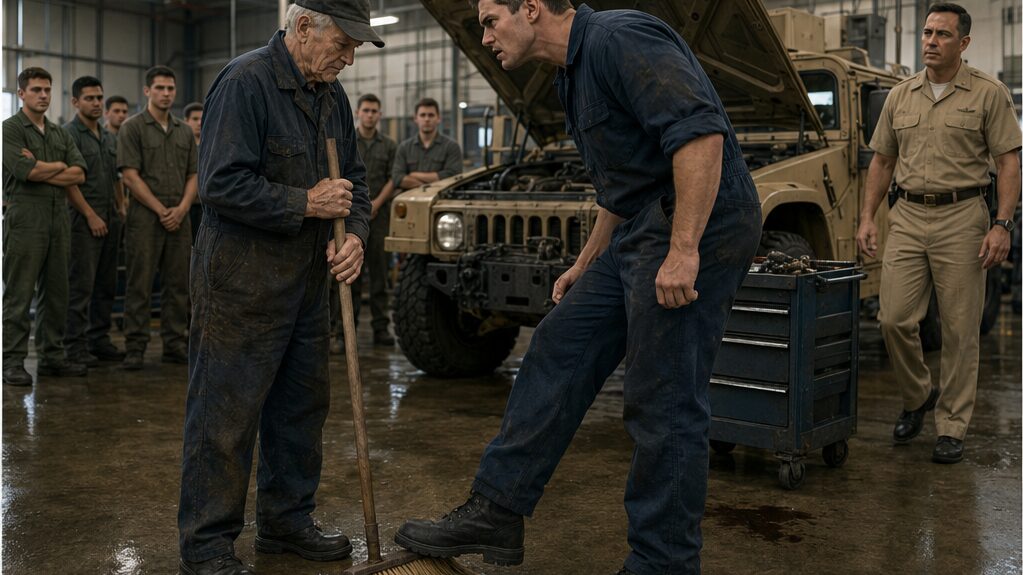
The Young Mechanic Put His Boot on the Old Veteran’s Broom Before Learning Why He Still Swept That Bay
Chapter 1: The Boot on the Broom in Bay Three
The boot came down on the broom before Robert Miller saw the face above it.
Rubber sole, black with a smear of tan mud at the edge, pressed the broom head flat against the wet concrete in Bay Three. The straw bristles bent sideways under the weight. Robert’s hands stayed where they were on the handle, one over the other, the knuckles swollen and pale beneath the thin skin.
Around him, the motor pool kept breathing.
A compressor coughed near the far wall. A socket wrench rattled inside a metal drawer. Fluorescent lights hummed over the line of tan vehicles waiting for inspection, their hoods raised like mouths opened for judgment. The concrete still held the morning’s rain, tracked in by boots and tires and the bay doors that never sealed right in bad weather.
Robert looked down at the boot.
Then he looked at the broom.
He did not pull.
“Where do you think you’re going with that?” Anthony King said.
Robert lifted his eyes slowly. Anthony stood close enough that Robert could smell coffee on him, sharp and over-sweet, mixed with shop grease. He wore dark blue coveralls with the sleeves rolled high, forearms young and solid, a red inspection tag clipped to his chest pocket. He had the restless shine of someone who had been moving too fast since sunrise and wanted the whole bay to know it.
Robert said nothing.
Behind Anthony, three younger mechanics had turned from the open hood of the truck. One held a rag. Another still had one hand on a torque wrench. Nobody spoke. They watched as people watch a small accident they have not decided whether to stop.
Anthony pressed harder. The broom head flattened another inch.
“I asked you a question,” he said. “You’re dragging water through my lane.”
Robert glanced behind him. The lane had already been wet when he arrived at 0600. Rainwater had collected under the left side of the vehicle, darkening the concrete in a long uneven patch. He had started from the bay doors and worked inward, as he always did, pushing grit away from the yellow lines, clearing the corners where washers and cotter pins liked to hide.
“My lane,” Anthony repeated, louder this time, for the others. “Inspection team comes Wednesday and we’ve got old-timer janitor hour in the middle of prep.”
A laugh came from somewhere near the tool cages. It died quickly.
Robert kept both hands on the broom handle. The wood had been sanded by years of palms until the grain felt almost soft. There was a shallow nick near his thumb where a floor bolt had caught it last winter. He knew it by touch.
He could have told Anthony that the lane had not been his before Monday. He could have told him Bay Three had swallowed better men’s pride long before Anthony learned to read a work order. He could have said the water was not from his broom.
He looked past the young man instead.
The tan vehicle sat at a slight angle beneath the raised hood, its left front tire turned a few degrees off center. The mechanic’s lamp clipped near the engine bay threw hard white light over belts, hoses, brackets, and the matte underside of the hood. Beneath the left tie rod, not far from the tire, a dark spot trembled at the edge of the wet concrete.
Robert watched it gather.
Not rain.
Anthony followed his gaze and snapped his fingers once, close to Robert’s chest. “Hey. Don’t stare at my truck like you know something. We’ve got actual mechanics on it.”
The younger men shifted. One looked down, embarrassed. Another smiled with only half his mouth.
Robert’s grip tightened, then loosened.
The first thing they taught you in recovery was not to fight the machine. Machines did not care who you were. They cared where weight settled, where pressure leaked, where metal had been asked too many times to forgive somebody’s hurry.
The second thing they taught you was not to waste breath on men who were trying to win a room.
Robert lowered his eyes again, not in surrender, but to follow the line of the floor. The droplet beneath the left assembly darkened, then slid into the larger rain smear. It would disappear by noon under boot prints and mop water. By Wednesday, someone might call it road grime. By Thursday, if the inspection schedule stayed tight, the vehicle might roll out.
Anthony leaned closer. “Pick another bay. Better yet, wait till real work is done.”
Robert’s shoulders ached. The old pull below his right rib had been there since before sunrise. He breathed through it. He had promised Linda he would call if the pain sharpened, but pain had many kinds, and most of them did not need an audience.
He moved his left hand a little lower on the broom handle. Anthony noticed and smirked.
“You gonna take it back?”
Robert looked at him then.
The boy was not a boy, not really. Late twenties, maybe early thirties. Strong jaw. Tired eyes under the swagger. A patch of grease along his neck he did not know was there. Somebody had put him in charge of inspection prep for Bay Three, and he was wearing that responsibility like a plate of armor too big for his chest.
Robert had seen that before.
“I need to finish this lane,” Robert said.
His voice was quiet enough that the bay seemed to lean in.
Anthony laughed once. “You need to finish this lane?”
Robert nodded.
“Because the floor’s dirty?”
Robert’s eyes returned to the tie rod.
“No,” he said. “Because you missed the wet mark under the left tie rod.”
The room changed in a way no one could have measured. No wrench dropped. No one gasped. But the silence grew edges.
Anthony turned his head toward the vehicle, then back at Robert. “What did you say?”
Robert did not repeat it.
Anthony lifted his boot from the broom head, not because he meant to, but because irritation had shifted his balance. The bristles sprang crookedly back, some bent, some broken. Robert drew the broom toward him with care.
One of the mechanics near the hood bent slightly, trying to see under the front end.
Anthony snapped, “Don’t touch anything.”
“I wasn’t,” the mechanic said.
Robert placed the broom upright beside his boot and rested both hands over the handle. His heart tapped unevenly in his chest. He kept his face still.
Anthony stepped sideways, blocking him from the truck. “You think you can walk in here with a broom and start diagnosing?”
“I think there’s fluid where there shouldn’t be.”
“You think.”
Robert heard the old tone in that phrase, the one men used when they had already decided your words were not worth weighing. He had heard it in motor pools and aid stations, in rain and dust and heat, from young officers and older fools. Sometimes the machine answered before the man did. Sometimes the machine answered too late.
At the far end of the bay, the side door opened.
Warrant Officer Michael Ramirez came in carrying a clipboard and a paper cup gone soft at the rim. He stopped before the door swung shut behind him. His eyes moved over the gathered mechanics, Anthony’s stance, Robert’s broom, the open hood.
“What’s the hold?” Michael asked.
Anthony straightened. “Nothing, sir. Just clearing the lane.”
Robert lowered his gaze to the floor.
Michael walked toward them. His boots made slow, deliberate sounds through the wet. He did not look at Anthony first. He looked at Robert’s hands on the broom, then at the bent bristles, then at the left front of the vehicle.
“Mr. Miller,” Michael said.
Anthony’s head turned slightly at the name.
Robert gave the smallest nod.
Michael stopped beside him, close enough that his sleeve brushed the shoulder of Robert’s coveralls. He did not salute. He did not raise his voice. He simply placed one hand lightly on Robert’s shoulder, as if steadying something the room had failed to see.
“What did you notice?” Michael asked.
Robert’s throat felt dry. He could feel everyone watching now, but the weight of it had changed. He looked again at the dark place beneath the vehicle.
“Left tie rod,” he said. “Wet mark under the boot. Could be nothing. Could be seal starting to go.”
Anthony made a sound under his breath. “We checked steering yesterday.”
Michael did not answer him. He crouched, careful with his clipboard, and angled his head beneath the assembly. A mechanic handed him a flashlight before being asked.
The beam found the spot.
For a moment, no one spoke.
Michael stood slowly. He looked at Robert, and something older than the inspection schedule passed across his face—recognition, or the beginning of it.
“Who put this vehicle on final clearance?” he asked.
Anthony’s jaw tightened. “I did.”
Michael kept his hand on Robert’s shoulder for one more second before letting it fall.
“Pull the tag,” he said.
Anthony stared at him. “Sir, we’re already behind.”
“Pull it.”
The young mechanic by the hood reached for the red tag before Anthony could stop him.
Robert picked up his broom. The bristles dragged unevenly now, one side bent from the boot. He turned slightly, meaning to continue down the lane, to put his hands back into the old rhythm and leave the men to the machine.
But Michael’s voice stopped him.
“Mr. Miller.”
Robert paused.
Michael looked at him with a question he did not ask in front of the others.
Robert did not answer it.
He only lowered the broom to the wet concrete and pushed the water away from the yellow line, slow and steady, as if nothing important had happened at all.
Chapter 2: The Man Nobody Listed on the Roster
By noon, the story had already changed shape twice.
The first version reached the parts counter as a joke: Anthony King got corrected by the old floor guy. The second version passed through the inspection office as a warning: Bay Three had a possible steering issue nobody wanted written up before Wednesday. By the time Michael Ramirez heard two mechanics murmuring near the vending machine, Robert Miller had become either a former chief mechanic, a retired inspector, or just an old man with lucky eyes.
Michael did not like any of those versions.
He sat in the depot office with Robert’s employment folder open on the desk and found almost nothing inside it.
Name: Robert Miller.
Position: part-time custodial support.
Shift: 0600 to 1100, Monday through Friday.
Emergency contact: Linda Miller.
No previous depot employment listed. No service record attached. No references beyond a cleaning contractor that had changed names three times in five years.
Gregory Moore stood at the filing cabinet behind him, tapping one finger against a folder.
“This is exactly why I don’t like informal arrangements,” Gregory said. “Nobody knows who approved him, nobody knows who he reports to, and now he’s interfering with inspection prep.”
Michael closed the folder halfway. “He noticed a leak.”
“He made a comment in the middle of a work lane. There’s a difference.”
“There was fluid under the steering assembly.”
Gregory turned. He wore a pressed shirt that always looked too clean for the building, sleeves buttoned at the wrist even when the bay was over eighty degrees. His badge hung perfectly centered. Michael had never seen him with grease on his hands, but he knew every form number by memory.
“The inspection team arrives Wednesday,” Gregory said. “I have two days to clean up loose ends. An elderly custodian stepping into maintenance decisions is a loose end.”
Michael leaned back. The office window looked down into the bay. From there, Bay Three appeared orderly: vehicles aligned, mechanics moving with purpose, yellow lane markings bright under the overhead lights. You could not see the small things from the office. That was the trouble with offices.
“He didn’t step into anything,” Michael said. “He was sweeping.”
“And speaking.”
“That’s still allowed.”
Gregory’s mouth tightened. “I’m not trying to be unkind. But if he gets hurt out there, or if one of the mechanics says he distracted them, that lands on this office. We can move him to admin halls until inspection is done.”
Michael pictured Robert’s hands on the broom, the way he had not pulled when Anthony’s boot pressed down. He pictured the old man looking at the tie rod before anyone else did.
“Leave him where he is for now,” Michael said.
Gregory shut the filing cabinet. “You’re assuming there’s something to find.”
“I’m assuming he saw what he saw.”
“That doesn’t make him qualified.”
Michael looked at the thin folder again. “No. But the vehicle still got pulled.”
Gregory stepped closer to the desk. “Warrant Officer, I need a clean week. If this becomes a personnel issue, I will make the safest administrative choice.”
“I understand.”
Gregory held his gaze a moment longer, then left with the soft, controlled frustration of a man who believed procedure could protect him from surprise.
Michael waited until the door closed.
Then he took Robert’s folder and went to the parts counter.
The parts clerk was counting filters against a manifest, lips moving without sound. Behind him, shelves of labeled bins stretched into shadow. The air smelled of cardboard, rubber, and old oil.
“You ever hear of Robert Miller?” Michael asked.
The clerk did not look up. “Cleaner?”
“Before cleaner.”
That made him pause. “I’ve only been here six years.”
“Any old records still kept off-system?”
The clerk gave him the look people gave when asked to find something that should have been destroyed, digitized, or forgotten. Then he jerked his chin toward the back. “Procedure binders. Nobody touches them except when the network dies.”
Michael found them on the lowest shelf under a gray film of dust. Binders with cracked spines. Handwritten labels. Recovery procedures. Vehicle lane safety. Pre-road release checks. Most had not been opened in years.
He carried three to an empty counter and began turning pages.
Printed forms. Revision dates. Initials in blue and black ink. Most names meant nothing to him. Some belonged to men long retired. Some had been crossed out so firmly the paper nearly tore.
Halfway through a binder labeled BAY WALKAROUNDS / RECOVERY NOTES, he found a page with a yellowed corner.
The heading read: Final Lane Check, Wet Conditions.
Under it, a list of small observations: fluid drift pattern, steering boot seam, brake-line shadow, tire angle after overnight rest, fresh drag marks beneath chassis. None of it was dramatic. None of it looked like the kind of thing inspectors photographed. It was the kind of knowledge learned by kneeling on concrete before sunrise.
At the bottom, written in pencil beside a revised paragraph, were three words.
Miller’s walkaround rule.
Michael ran his thumb lightly beneath the phrase without touching the graphite.
The clerk leaned over. “That what you’re looking for?”
“I don’t know yet.”
He turned another page. There were initials beside the revision: R.M. The date was old enough that some of the mechanics in Bay Three would have been in grade school.
From the bay came the sharp bark of Anthony’s voice, followed by a metallic clang. Michael looked through the open doorway. Robert was there again, near the far lane, sweeping around a drain. He moved carefully, never crossing under a raised hood, never turning his back to a vehicle being started. He paused once to nudge a washer out of a tire path with the broom tip, then swept it toward the wall.
A cleaner would have pushed it anywhere.
Robert put it where nobody would slip, kneel, or roll over it.
Michael closed the binder with one hand still inside to mark the page.
In the office, Gregory had called Robert a loose end. But old depots did not keep loose ends in pencil for twenty years. Somebody had written that phrase because it had mattered once.
Michael looked down at the page again.
Miller’s walkaround rule.
Then he heard Anthony laugh in the bay, sharp and dismissive, and saw Robert keep sweeping as if his own name had not just risen quietly from the dust.
Chapter 3: The Notebook with the Taped Spine
Robert put the broom by the back door before he took off his shoes.
He always did it in that order. Broom first, shoes second, keys in the small ceramic bowl Linda had bought him at a church sale, then wallet, then watch. The watch no longer kept perfect time, but it ticked steadily enough. He trusted steady things more than perfect ones.
His kitchen was small, with yellowed cabinets and a square table pushed against the wall. Rain tapped at the window over the sink. The house smelled faintly of coffee, floor polish, and the chicken soup Linda had left in the refrigerator on Sunday with a strip of masking tape across the lid.
EAT THIS, she had written.
He had eaten half.
Robert lowered himself into the chair slowly. His knees complained first, then his back, then the old place below his right ribs that knew the weather before the radio did. He sat still until the room settled around him.
On the table lay the notebook.
Black cover, corners softened, spine repaired with two strips of silver tape. The pages inside were swollen from years of pockets, rain, heat, and hands that had turned them with grease on the fingertips. He had not taken it to the depot that morning. He had almost taken it. At the last minute he had left it on the kitchen table, as if leaving it behind could keep the past from walking beside him.
It had not worked.
The phone rang at 6:12.
Robert looked at it. Linda’s name glowed on the screen.
He let it ring twice more, then answered.
“You home?” she asked.
“Yes.”
“You sound tired.”
“I’m sitting down.”
“That’s not an answer.”
“It’s the one I’ve got.”
A small silence passed between them, familiar and worn. Linda had her mother’s way of hearing what people did not say. It had made her a difficult child and a good nurse before she left nursing to manage appointments and insurance claims for people who had no patience for either.
“I stopped by at lunch,” she said. “You weren’t here.”
“I was at work.”
“That’s what I was afraid of.”
Robert looked at the broom by the back door. One side of the bristles still bent where Anthony’s boot had pinned it. He had rinsed them before leaving the depot, but straw remembered pressure.
“Inspection week,” he said.
“You clean floors, Dad. You don’t inspect vehicles.”
He said nothing.
Linda sighed, but there was more fear than anger in it. “Your doctor said less time on concrete. Not more.”
“My doctor hasn’t met Bay Three.”
“I have. It smells like diesel and old rain.”
“That’s accurate.”
“Dad.”
He closed his eyes. Her voice softened on the word, and that was harder to bear than scolding.
“I’m not trying to take something from you,” she said. “But you come home limping worse every month. You forget to eat. You pretend that pain is just weather. And now I hear from somebody at the depot that there was some kind of argument.”
Robert opened his eyes.
“Who called you?”
“Nobody called. I know people. That’s what happens when you live in the same county your whole life.”
“It wasn’t an argument.”
“What was it?”
He looked at the notebook.
“A young man was in a hurry.”
“And?”
“And I was in his way.”
Linda breathed out hard. “You see? That’s exactly what I mean. They don’t know you there anymore. They see an old man with a broom and think they can talk to you however they want.”
“They see what’s in front of them.”
“That doesn’t make it right.”
“No.”
“Then stop going.”
The rain ticked harder at the window.
Robert reached for the notebook and rested his hand on it, not opening it. The tape along the spine caught the kitchen light.
“I’m not done,” he said.
“With what?”
He did not answer.
Linda’s voice changed. It became quieter, the way it had after her mother died, when she learned not every question could be pushed through the door just because it was true.
“Is this about the accident?”
Robert’s hand stilled on the notebook.
The refrigerator hummed. A car passed outside, tires hissing on the wet street. Somewhere in the wall, the old pipes clicked as the house cooled.
“No,” he said.
It was not a lie exactly. It was too small a word for what lived behind it.
Linda did not challenge him. That was worse.
“I’m coming over,” she said.
“You don’t need to.”
“I know. I’m coming anyway.”
She hung up before he could object.
Robert remained at the table with his palm on the notebook. After a while, he opened it.
The first pages were lists. Tire pressures, bolt patterns, tow angles, weather checks. Later pages became denser, written in a smaller hand from years when paper was scarce and time was worse. Names appeared in the margins, not as memorials, not officially, just names tied to lessons: check the lower seam after standing water; do not trust a dry top hose; listen before starting; never rush a vehicle that sat overnight in rain.
Near the middle was a page he rarely opened.
The date sat at the top in block letters. Beneath it, a diagram of a left front assembly drawn from memory. A line of notes. A stain where rain or coffee or something else had blurred the ink long ago.
He closed the notebook before the rest of the page could catch him.
When Linda arrived twenty minutes later, she let herself in with her key. She found him at the sink washing a cup that was already clean.
“You ate?” she asked.
“Half.”
“That means no.”
She put her purse on the counter, saw the broom by the back door, and frowned. “What happened to it?”
“Bent.”
“How?”
He dried the cup. “Boot.”
Her face went still.
“Someone stepped on your broom?”
“Brooms get stepped on.”
“Don’t do that.”
He placed the cup in the cabinet.
Linda walked to the table. The notebook lay closed, but not where he usually kept it. Her eyes lowered to it. She had seen it before, of course. All her life it had moved with him from house to house, drawer to drawer, always present and never explained.
“You brought it out,” she said.
“I was putting it away.”
“No, you weren’t.”
He turned from the cabinet. “Linda.”
She did not touch it yet. Her anger had thinned into something more fragile.
“When Mom was alive, she used to say you kept half your heart in that thing.”
Robert looked toward the back door.
“She said a lot of things.”
“She said you wrote down what you couldn’t sleep through.”
He did not answer.
Linda reached toward the notebook, then stopped, asking permission without words. Robert should have said no. For years he had said no with a look, with a closed drawer, with silence. Tonight the bay still clung to him. Anthony’s boot on the broom. Michael’s hand on his shoulder. The wet mark spreading under the left tie rod.
He was tired of guarding every door at once.
Linda opened the notebook.
She turned pages carefully. Her face changed as she read, not because she understood the mechanical notes, but because she understood his handwriting. She knew the difference between the lines written calmly and the ones pressed so hard the pen had scarred the next page.
Then she reached the page near the middle.
The one with the date.
Robert looked away.
Linda did not speak at first. Her fingers rested beside the faded numbers, not covering them. When she finally looked up, her eyes were wet, but her voice stayed controlled.
“Dad,” she said, “what happened on this day?”
Robert held the edge of the counter until the old pain below his ribs became something he could name as weather.
Outside, the rain kept falling, steady as boots crossing a concrete bay.
Chapter 4: Inspection Week Makes Everyone Look Away
Anthony King arrived before sunrise on Tuesday and found the broom standing exactly where it had no business standing.
It leaned against the wall between Bay Three and the inspection lane, bristles down, handle straight, as if somebody had measured the spot. Not in the walkway. Not behind a tire. Not where a cart would clip it. Just outside the yellow paint, close enough to be useful and far enough to be out of the way.
Anthony stopped with his coffee in one hand and his tool bag in the other.
The broom’s bent side faced him.
He looked around the bay. No one else had arrived yet except the gate guard in the glass booth outside and the parts clerk unlocking cages at the far end. The overhead lights were still warming to their full white glare. Rain had passed in the night, but the concrete held its damp smell.
Anthony set his bag on the bench harder than he meant to.
He had thought about the old man longer than he wanted to admit.
Not because Robert Miller had embarrassed him. That was what he told himself on the drive home, through dinner, through half a night of bad sleep. The embarrassment was not the worst of it. Men got corrected in shops. You swallowed it, fixed what needed fixing, and found a way to make sure nobody mentioned it again.
The worst part was how Robert had said it.
You missed the wet mark under the left tie rod.
Not loud. Not smug. Not like a man trying to win.
Like a man noting weather.
Anthony pulled the vehicle record from the clipboard hook and flipped through yesterday’s checks. Steering assembly inspected. Linkage checked. No visible leak. Initials: A.K.
He stared at his own initials until the letters blurred.
At his last job, before this depot, he had signed off on a generator mount without noticing one bolt had been started wrong by the night crew. Nothing catastrophic happened. The generator rattled itself crooked during a training movement, cracked a bracket, and cost the shop two days. But the manager had said one sentence in front of everyone: King signs faster than he sees.
The sentence followed him here.
So he worked faster. Earlier. Harder. He checked things twice when nobody watched and acted like once was enough when they did. He kept his voice sharp because softness looked like doubt. He volunteered for inspection prep before anyone could decide he wasn’t ready.
Then an old man with a broom had found the one mark he missed.
At 0640, the bay began filling. Mechanics came through the side door with coffee, breakfast wrappers, jokes half-finished from the parking lot. Someone turned on the radio low, then shut it off when Michael Ramirez walked in. Anthony moved before anyone could talk to him.
“Bay Three vehicle gets a secondary check,” he said. “Left front steering. I want it clean, documented, and back in line by noon.”
One mechanic glanced at him. “Because of yesterday?”
“Because I said so.”
The mechanic looked away. “Got it.”
Anthony hated the sound of his own voice, but he did not soften it.
By 0700, Robert Miller came through the side door in the same dark coveralls, shoulders slightly rounded against the morning chill. He carried the broom in his right hand, though Anthony had left it by the wall.
That meant there were two brooms.
Anthony noticed the new one first. It was older, with a darker handle and straw bristles bound by wire. Robert must have brought it from home or from some forgotten supply closet. The bent broom remained by the wall, untouched.
Robert nodded once to the parts clerk. He did not look at Anthony. He began near the drains, the same slow method as before: push, pause, gather, lift small metal pieces before they became hazards. Not cleaning like a man filling hours. Cleaning like a man reading the floor.
Anthony rolled his shoulders and ducked beneath the left front side of the truck.
The leak was faint. Barely enough to darken a fingertip. It might have been leftover fluid from a sloppy service. It might have been a seal beginning to weep. It might have been nothing that would fail before inspection or after.
He wanted it to be nothing.
Michael came by at 0830. “Status?”
“Minor seep,” Anthony said. “Cleaning it, cycling steering, checking again.”
“Good.”
Anthony waited for him to mention Robert. He didn’t.
Across the lane, Robert swept around a tire chock and paused as a socket rolled from under a cart. He stopped it with the broom head, bent slowly, and placed it on the workbench. One of the younger mechanics said thanks without looking up. Robert nodded.
Anthony watched too long.
The mechanic beside him said, “You want me to pull the boot?”
“No. Not yet.”
“Ramirez said secondary check.”
“I know what he said.”
The mechanic withdrew his hand.
Anthony heard the tension in the silence that followed. He slid out from under the truck and stood too fast, clipping his shoulder against the wheel well. Pain flashed down his arm. He hid it by wiping his hands on a rag.
Robert had seen it. Of course he had. The old man saw everything except when to mind his business.
Anthony crossed the lane.
Robert was sweeping near the yellow line. The broom made a dry whisper against the concrete.
“Careful,” Anthony said. “Don’t diagnose the floor too hard.”
Robert stopped, then looked at him.
The bay quieted by one degree.
Anthony knew he should walk away. He could feel Michael somewhere behind him, could feel the mechanics listening while pretending not to.
Robert only said, “There’s a washer near your left boot.”
Anthony looked down. A flat washer sat half under the edge of his sole.
He kicked it aside.
It skittered across the concrete, spun twice, and disappeared near the drain.
Robert’s eyes followed it but his face did not change.
Anthony regretted the kick before the sound stopped.
“Don’t leave things in the lane,” Robert said.
That was all.
Not a reprimand. Not an old man’s lecture. Just the rule, spoken plain.
Anthony leaned in. “You really can’t help yourself, can you?”
Robert rested both hands on the broom.
Michael’s voice came from the end of the bay. “King.”
Anthony straightened.
Michael did not raise his voice. He did not need to. “Inspection lane. Now.”
Anthony turned away, heat rising under his collar. As he walked, he heard Robert’s broom resume its slow, steady sound behind him.
By late morning, the steering assembly was wiped clean and cycled twice. The wet mark did not return quickly. Anthony documented it as minor seepage under observation. Not ideal, not damning. The vehicle schedule was too tight to pull parts without certainty.
Gregory Moore came through just after lunch with a tablet in one hand and impatience in every step.
“Can this vehicle make road test tomorrow?” he asked.
Anthony looked at the cleaned assembly, the work order, the line of vehicles behind it, the men waiting for his answer. He thought of the sentence from his last shop. King signs faster than he sees.
He thought of Robert’s quiet voice.
He thought of the inspection team arriving Wednesday morning and Gregory wanting clean lanes, clean forms, clean answers.
“Yes,” Anthony said. “We’ll monitor it.”
Michael glanced toward him but did not interrupt.
Gregory tapped the tablet. “Then keep it moving.”
The red clearance tag went back onto the clipboard hook by late afternoon.
Robert was sweeping near the bay doors when Anthony passed him. For a moment, the old man looked at the tag. Then at the left front tire. Then at Anthony.
He said nothing.
Anthony wanted him to say something. He wanted the old man to make himself the problem so Anthony could push back.
Instead Robert bent slowly, picked up the washer Anthony had kicked earlier from beside the drain, and placed it on the workbench.
Anthony looked away first.
Chapter 5: The Wet Mark Under the Left Tie Rod
By Wednesday morning, the wet mark had returned.
Robert saw it before the first engine started.
It had gathered under the left side of the tan vehicle in Bay Three, darker than the rainwater around it, shaped like a thumbprint pressed into concrete. Small. Easy to miss. The sort of mark a busy man could explain away three different ways before breakfast.
Robert stopped six feet from it with the broom in both hands.
The bay doors were open to a pale gray morning. The inspection team had not yet arrived, but the depot was already tightened around their coming. Clipboards moved from hand to hand. Mechanics wiped tools before setting them down. Gregory Moore walked the center aisle with a tablet and a clean jaw, speaking in short sentences. Michael Ramirez stood near the office window, watching the lanes as if counting more than vehicles.
Robert looked at the wet mark and felt the old desert heat rise in his throat.
Not here, he told himself.
This was Virginia concrete, not a road cut through dust and rock. This was inspection week, not a convoy trying to move before weather closed the pass. The men here had coffee, radios, safety briefings, lift equipment, and forms with boxes for every kind of caution. No one was bleeding. No one was shouting for a tow cable. No young soldier was laughing too loudly to hide fear.
Still, the mark was there.
A mechanic climbed into the cab and turned the ignition enough to wake the dash. The vehicle answered with a low electric whine, then a heavier mechanical sound as systems came alive.
Robert moved.
Not fast. He could not move fast anymore. But he moved before the broom finished its last stroke.
Anthony stood near the driver’s door, speaking to the mechanic inside. He had a pencil tucked behind his ear and a clipboard under his arm. He looked tired. The crease between his eyes had deepened since Monday.
“Hold,” Robert said.
No one heard him over the engine.
He stepped closer to the yellow line.
“Hold.”
Anthony turned. His expression closed as soon as he saw Robert.
“Not now.”
Robert pointed the broom handle toward the left front assembly, keeping the tip well clear of the vehicle. “It’s back.”
Anthony’s jaw moved once. “We cleaned it. It’s residual.”
“No.”
The mechanic in the cab looked between them.
Anthony lowered his voice. “Do not do this in front of inspection.”
“They’re not here yet.”
“That’s not the point.”
Robert looked at the mark. A second bead formed at the lower edge of the boot and trembled there. He could see it clearly now. Too clearly.
The memory broke through without asking.
A road at dawn. Men rushing because the sky had turned the color that meant trouble. A young driver drumming fingers on the wheel. A lieutenant saying they had already lost an hour. Robert kneeling in grit, looking at a small dark stain beneath a linkage boot, hearing someone tell him they would check it at the next halt.
The next halt had come with smoke.
Robert blinked and the motor pool returned: fluorescent lights, wet concrete, Anthony’s blue coveralls, the broom handle in his hand.
“Shut it down,” Robert said.
Anthony stared at him. “You don’t give orders here.”
“No.”
“Then stop acting like you do.”
Robert’s fingers tightened around the broom, but his voice stayed low. “I’m asking you to look.”
“I looked yesterday.”
“Look again.”
The mechanic in the cab turned the engine off without being told. That small obedience, not even directed at Robert, changed the air.
Anthony looked up at him. “Did I tell you to shut it down?”
The mechanic swallowed. “No.”
“Then why did you?”
No one answered.
Gregory Moore came down the lane at once, drawn by the pause the way a man smells smoke. “What is happening?”
Anthony straightened. “Minor disagreement. We’re handling it.”
Gregory’s eyes moved to Robert. “Mr. Miller, why are you inside the active lane?”
Robert stepped back one pace. Not because Gregory was right, but because the rule was right.
“There’s fluid under the left tie rod,” Robert said.
Gregory glanced down but did not bend. “That concern was documented yesterday.”
“It’s returned.”
Anthony said, “It’s not enough to classify as a leak.”
Robert looked at him. “Enough to ask why.”
“That’s not your call.”
“No.”
The single word irritated Anthony more than argument would have.
Gregory’s face tightened. “Mr. Miller, you are custodial support. I appreciate vigilance, but this is not your lane of authority.”
Robert heard Linda’s voice from the night before: They see an old man with a broom.
He lowered the broom tip to the concrete.
“Then have someone with authority check it.”
Michael arrived before Gregory could answer. He said nothing at first. He crouched near the left front side, careful not to touch the fluid. His face shifted, not dramatically, but enough that Robert knew he saw it.
Anthony noticed too. “Sir, it could still be residual.”
“Could be,” Michael said.
Gregory’s patience thinned. “Can we make that determination without stopping the whole line?”
Michael stood. “We’re not stopping the whole line. We’re checking this vehicle.”
Anthony’s cheeks colored. “I’ll pull it in and inspect.”
Robert said, “Don’t cycle steering until you see the inner side.”
Anthony turned on him. “Stop.”
The word cracked across the bay.
Robert stopped.
The mechanics stopped too. Even Gregory paused.
Anthony stepped closer, voice lower now but more dangerous. “You don’t get to stand there with a broom and make me look like I don’t know my job.”
Robert looked at the young man’s face and saw the fear beneath the anger. He had no desire to expose it. He had spent a life watching men hide fear behind volume. Sometimes they survived long enough to outgrow it. Sometimes they did not.
“I’m not trying to make you look like anything,” Robert said.
“You did that Monday.”
“No.”
“You think everyone didn’t hear you?”
“I hoped they heard the truck.”
For a moment, Anthony had no answer.
Gregory looked between them, and Robert could almost see the administrative conclusion forming. Old cleaner. Public scene. Inspection disruption. Liability.
“That’s enough,” Gregory said. “Mr. Miller, step out of the bay.”
Michael turned. “Gregory—”
“No,” Gregory said, sharper than before. “This is exactly the kind of confusion we cannot have today. If maintenance has an issue, maintenance will handle it. Mr. Miller is not maintenance.”
Robert felt the words land. Not hard. He had been hit by worse. But they found the tired places.
He nodded once.
Then he turned the broom in his hands, extended the handle—not toward the men, not touching the vehicle—and used the wooden tip to indicate the shadowed inner edge behind the boot.
“There,” he said. “If it’s dry, I’ll go.”
Anthony stared at the spot despite himself.
Michael crouched again, this time farther in. A mechanic handed him a mirror on an extendable handle. The bay watched in silence as Michael angled the mirror behind the assembly.
His face changed.
Anthony saw it.
“What?” Anthony asked.
Michael did not answer immediately. He reached out with two fingers and touched the inner side, then brought them back glistening.
“Pull the vehicle,” he said.
Gregory exhaled through his nose. “For how long?”
“Until we know why the inner side is wet.”
Anthony’s clipboard hung loose at his side.
Robert took one step back. Then another. He had done what he came to do. The rest belonged to men still wearing names on their chests.
But Gregory was not finished with him.
“Mr. Miller,” he said, “wait in the office.”
Robert turned.
Gregory’s voice stayed controlled, which made it colder. “We need to discuss whether your presence in the maintenance bay is helping or creating unnecessary disruption.”
Robert looked once more at the wet mark.
The bead had dropped. It joined the dark thumbprint on the concrete and disappeared into it.
Chapter 6: The Name Written Beside the Old Procedure
Michael found the old procedure binder in the records room after the inspection team left for lunch.
The room sat behind the administrative hallway, windowless, too warm, and crowded with things nobody wanted to throw away because nobody wanted to sign the disposal form. Shelves bowed under boxes of archived work orders. Rolled diagrams leaned in corners. A faded safety poster warned men not to rush what they could not repair twice.
The binder lay open on a metal table under the buzzing light.
Miller’s walkaround rule.
Michael had read the phrase at least ten times since Monday, but the words seemed different now. Less like a note. More like a door.
He turned the page carefully. The next sheet held additions in pencil, then ink, then a typed revision. The old method had been absorbed into formal procedure at some point and then quietly thinned down over the years. What remained in the current checklist was clean and efficient: Inspect visible leaks. Confirm steering response. Verify road-readiness.
It did not say kneel before sunrise.
It did not say look where rainwater hides what the machine is trying to tell you.
It did not say remember the men who trusted the signature.
Michael heard footsteps in the hallway and closed the binder halfway.
Robert stood in the doorway with his broom in one hand.
Gregory had told him to wait in the office, but Robert had not stayed there long. Michael had seen him through the glass, sitting on the edge of the chair as if leaving no weight behind. After ten minutes, he had risen, taken the broom from beside the door, and walked out without asking permission.
Now he looked into the records room, eyes moving once over the shelves, the boxes, the open binder.
“I can come back,” Robert said.
Michael shook his head. “No. I was looking for you.”
Robert did not step in.
Michael touched the page. “This is your name.”
“Lots of Millers.”
“This one wrote a rule about wet-condition walkarounds.”
Robert’s face remained still.
Michael waited. He had spent enough years around older soldiers to know that silence could be refusal, discipline, grief, or all three at once.
Finally Robert came into the room. The broom bristles whispered over the threshold. He stood across from Michael but did not look down at the binder.
“That was a long time ago,” Robert said.
“Long enough for people to forget why it mattered.”
“That happens.”
“It shouldn’t.”
Robert’s mouth moved almost into a smile, but not quite. “It always does.”
Michael looked toward the hallway. The depot hummed beyond the walls: carts rolling, distant voices, a vehicle starting and stopping. In Bay Three, Anthony and two mechanics had the left front assembly opened farther than anyone had planned. The inner seep was real. Not dramatic yet. Not catastrophic. But real.
“You trained recovery crews here?” Michael asked.
Robert set the broom gently against the table. “Some.”
“That’s all?”
“That’s enough.”
Michael leaned one hand on the binder. “Mr. Miller, Gregory wants to move you out of the bay. Anthony thinks you’re trying to make him look bad. Half the crew thinks you used to be someone important. The other half thinks you’re just stubborn.”
Robert looked at the dusty shelves. “Both halves are making too much noise.”
“I’m asking what I can say.”
“To who?”
“To them.”
Robert shook his head. “Nothing.”
“That won’t protect you.”
“I didn’t ask to be protected.”
Michael studied him. The old man’s coveralls were clean in the way working clothes could be clean: washed, worn, permanently marked at the cuffs and knees. His hands rested loosely now, but the fingers had the slight tremor of fatigue. Beside him, the broom stood like a third leg, plain and patient.
“You saw that leak before any of us did,” Michael said.
“I saw a wet mark.”
“You knew where to look.”
Robert’s eyes settled on the binder at last.
“The vehicle tells you where it hurts,” he said. “Most men look where the manual tells them first. That’s fine. Manuals matter. But a vehicle that sat in rain all night, then gets rushed under lights, will hide small things in plain sight.”
“That sounds like training.”
“It was.”
“From here?”
Robert looked away.
Michael turned the binder slightly. “The date on this revision. Was there an accident?”
The room seemed to shrink around the question.
Robert reached for the broom, then stopped before touching it. Michael saw the effort it took him not to leave.
“There was a convoy,” Robert said.
Michael said nothing.
“Bad weather coming in. Road getting worse. Schedule already broken before we started. Everybody wanted movement. The kind of morning where every minute looks expensive until one minute costs more than all the rest.”
His voice stayed even. That made it harder to hear.
“I found a mark under a linkage boot. Not much. Enough to ask for time. I was told we’d check it at the next halt.”
Michael kept his eyes on Robert’s face.
“Did you argue?”
Robert’s jaw tightened. “Not enough.”
The words sat between them.
From the hallway came the sound of someone approaching, then stopping short. Neither man turned quickly, but Michael knew before he looked.
Anthony stood outside the records room, one hand still on the doorframe. He had grease up to his wrist and a smear across his cheek. His eyes moved from Robert to the open binder to Michael’s hand resting beside the penciled name.
“I was looking for the parts clerk,” Anthony said.
The parts counter was nowhere near the records room.
Michael closed the binder halfway. “King.”
Anthony’s face had gone hard, but not in the same way as before. This was fear making itself into anger again.
“So that’s what this is,” he said.
Robert turned toward him. “No.”
Anthony laughed once, low. “No? You’ve got him digging through old files while I’m out there with my name on the clearance tag.”
“I didn’t ask him to dig.”
“But you let him.”
Michael stepped forward. “Anthony, the vehicle has an actual issue.”
“I know that.” Anthony’s voice sharpened. “I’m fixing it.”
“Good.”
But Anthony was looking at Robert. “Is that what you wanted? Make sure everyone knows I missed something?”
Robert’s shoulders dropped slightly, not with defeat but with weariness.
“I wanted the truck stopped.”
“You got it stopped.”
“I wanted men safe.”
Anthony’s eyes flickered, then hardened again. “Convenient.”
Michael said, “That’s enough.”
Anthony ignored him. “You know what happens if Moore writes this up as my miss during inspection week?”
Robert looked at the young man for a long moment. When he spoke, his voice was quiet.
“Yes.”
That answer seemed to unsettle Anthony more than denial would have.
Robert picked up the broom.
“I know what it means to have your name beside a mistake,” he said.
Anthony’s mouth tightened. He looked at the binder again, as if the old pages had become a trap.
Then he stepped back from the doorway.
“Keep your old stories,” he said. “I’ve got work to do.”
He left fast, boots striking the hallway harder than necessary.
Michael started after him, but Robert’s voice stopped him.
“Let him work.”
“He thinks you’re trying to ruin him.”
“He’s young enough to think everything is about him.”
Michael turned back. “And you’re going to let him think that?”
Robert lifted the broom and rested it against his shoulder. For the first time, Michael saw how tired he was.
“For now,” Robert said.
Then he walked out toward the bay, leaving the binder open to the penciled name neither of them had fully earned the right to explain.
Chapter 7: The Test Drive Nobody Wanted to Delay
On Thursday morning, Robert Miller placed the broom across the yellow exit line before anyone understood what he was doing.
The vehicle had already been backed out of Bay Three and pointed toward the open roll-up door. Its tan hood was down now. Its tires were wet from the strip of rainwater near the threshold. A mechanic stood beside the passenger door with a headset around his neck. Anthony King was at the driver’s side, one hand on the frame, the other holding the clearance sheet he had not yet signed.
Beyond the door, the test lane ran straight for two hundred yards before bending around the storage yard. The inspection team had returned with fresh clipboards. Gregory Moore stood near the office window, watching through the glass. Michael Ramirez was speaking to the parts clerk by the tool cage when the engine coughed awake.
Robert had been sweeping near the bay doors.
No one had asked him to move.
No one had asked him to stay.
He saw the left front tire shudder once as the steering wheel turned inside the cab. Not much. A small hesitation, a tightness in the movement, like a man hiding a limp.
Then he saw the mark again.
Not beneath the truck this time. Along the inner seam, where the wiped metal caught the light wrong. A thin dark line had returned after the assembly was cycled and warmed. It was small enough to be argued with. Small enough to bury inside schedule pressure. Small enough to kill if it waited for the right speed, the right turn, the right load.
The driver inside released the parking brake.
Robert stepped forward.
He did not hurry. Hurrying made men shout before they looked. He walked with the broom in both hands until he reached the yellow line painted across the exit lane. Then he lowered the broom and laid it across the stripe.
The engine idled.
The bay went quiet around the sound.
Anthony turned first. “What are you doing?”
Robert straightened slowly. “Stop the vehicle.”
The driver looked at Anthony. Anthony looked at the broom. The bristles lay uneven from Monday’s boot, one side bent, the handle reaching across the line like a barrier too ordinary to be official.
“Move it,” Anthony said.
Robert did not move.
Michael started toward them from the tool cage.
Gregory came out of the office, tablet already in hand. “Why is that vehicle stopped?”
Anthony did not take his eyes off Robert. “Because Mr. Miller put a broom in the lane.”
Gregory’s face hardened with disbelief. “Mr. Miller.”
Robert looked at the truck, not at Gregory. “Do not road-test it.”
“We have already delayed that unit twice,” Gregory said.
“Delay it again.”
The words surprised even Robert. Not because they were loud. They were not. But there was no apology in them.
Anthony stepped closer. “You don’t know what we did after yesterday.”
“I know what it’s still doing.”
“We pulled the boot. We cleaned the assembly. We checked movement. We logged seepage and response.”
“You didn’t load it.”
Anthony’s mouth tightened. “What?”
“You checked it sitting. You checked it lifted. You cycled it clean. You didn’t load it under its own weight with the turn started.”
The driver in the cab kept both hands still on the wheel.
Michael reached the left side of the vehicle and crouched without speaking. Anthony looked down at him, anger and uncertainty fighting across his face.
Gregory said, “Warrant Officer Ramirez, unless you have a documented reason to hold this vehicle, I need this lane clear.”
Michael looked up at Robert. “Where?”
Robert lifted one hand and pointed, not with the broom now but with two fingers, toward the inner joint partly hidden behind the tire angle. “There. Watch when he eases left. Don’t move forward. Just left.”
Michael stood and signaled to the driver. “Turn left slowly. Do not roll.”
The steering wheel moved.
For one second, nothing happened.
Then the tire shifted, the linkage took weight, and a wet line appeared bright and dark under the lamp Anthony had clipped to the frame. It did not drip. It opened, glistened, and vanished back into shadow.
Michael’s face went still.
Anthony saw it too. Robert knew he did, because the young man’s shoulders sank before he forced them square again.
“Shut it down,” Michael said.
The driver killed the engine.
Gregory’s voice sharpened. “What are we looking at?”
Michael did not answer immediately. He got down on one knee, angled the inspection mirror in close, then took the flashlight from a mechanic’s hand. The beam struck the inner side of the boot. He leaned closer.
“Clamp’s biting wrong,” he said. “Seal’s torn behind the fold.”
Anthony crouched beside him, his face pale under the bay lights. “That wasn’t visible yesterday.”
Robert said nothing.
Anthony looked back at him. “It wasn’t.”
Robert heard the plea under the defense.
He could have answered in front of everyone. He could have said that it had been visible if the right man looked at the right angle. He could have let the room measure Anthony’s failure against his own old knowledge and found some bitter balance in it.
Instead he looked at the truck.
“No,” Robert said. “Not enough to call from the outside.”
Michael glanced up, surprised.
Anthony stared.
Gregory stepped closer. “But enough to stop a road test.”
“Yes,” Robert said.
The depot seemed to hold that answer. It was not an accusation. It was worse and kinder than that. It left the responsibility where it belonged: with the machine, the pressure, the process, and every man who had wanted the lane clear more than he wanted the question answered.
Anthony rose slowly. The clearance sheet in his hand had bent at the corner from his grip.
The inspection lead came over from the far side, drawn by the stopped movement. “Is this unit released?”
Michael stood. “No.”
Gregory’s lips thinned. “We will document a maintenance hold.”
The inspection lead looked at the broom across the line, then at Robert. “Is he with maintenance?”
For a moment, no one answered.
Robert bent to pick up the broom.
Pain flashed under his ribs so sharply that the yellow line tilted. He caught the handle with both hands and waited for the floor to steady. Michael moved half a step toward him, then stopped when Robert’s eyes flicked up. Not yet. Not in front of them.
Anthony saw that too.
He moved, quick but careful, and reached out—not grabbing, not making a show of it. His hand closed around the broom handle below Robert’s.
“I’ve got it,” Anthony said.
Robert let him take some of the weight.
The young man lifted the broom from the yellow line and set it upright against the bay door track, bristles down, handle straight. He did it with the odd precision of a man returning something borrowed.
The inspection lead repeated, “Is he with maintenance?”
Michael looked at Robert first, not Gregory, not Anthony.
Robert could feel the whole bay waiting for a story.
A retired title. An old rank. A name pulled from a dusty binder. A reason to turn the old man into something easier than the plain figure standing there in worn coveralls.
Robert had spent years avoiding that moment. Then he had spent years resenting that no one asked. Both had tired him.
“I used to be,” he said.
His voice reached only the nearest men, but the silence carried it.
Michael added, “Mr. Miller trained recovery crews here.”
Robert looked at him once. Not angry. Not grateful. Just enough to hold him to the line.
“Some,” Robert said.
Anthony’s throat moved. “Recovery?”
Robert looked past the open bay door, toward the test lane slick from rain. The storage yard beyond it blurred into a morning that was not this morning.
“Convoy recovery,” he said. “Field repairs. Towing men out when their vehicles stopped where vehicles should not stop.”
No one spoke.
The memory came, not as a story, but as pieces.
A young soldier laughing too loud because the road ahead was bad. A wet mark under a boot. A lieutenant looking at the sky. Robert hearing himself say they needed ten minutes. The answer: next halt. Then the turn. The hard swing of weight. The wrong kind of silence after impact. Hands trying to fix what hands could not bring back.
Robert rested one palm on the side of the vehicle now, feeling the faint warmth through the metal.
“I signed off on waiting once,” he said.
Anthony’s face changed.
Robert did not look at him when he said the rest. “A man didn’t come home from the next halt.”
The bay remained still around him. Even Gregory had stopped looking at his tablet.
Robert pulled his hand from the vehicle. “That’s why I don’t like small wet marks.”
It was not the whole story. Not the name. Not the road. Not the sound of the young soldier’s breathing after the dust settled. Not the years Robert had carried the sentence I didn’t argue enough until it wore a groove through him. But it was enough truth for the room.
Anthony looked down at the clearance sheet in his hand. Then he tore it in half.
The sound startled everyone.
Gregory said, “King—”
Anthony looked at him. “It wasn’t ready.”
Gregory’s face flushed. “That is not how documentation works.”
“No,” Anthony said, voice rough. “That’s how this almost went out.”
Robert watched him carefully.
Anthony turned to Michael. “I cleared it under observation. That’s on me.”
Robert said, “No.”
Anthony looked back. “It is.”
“You worked under pressure that should have made a hold easier, not harder.” Robert’s breath caught; he waited it out. “Write the fault. Fix the procedure. Don’t make it a hanging.”
The words landed harder than blame.
Anthony swallowed. “Why are you doing that?”
Robert looked at him then, really looked at him: the grease on his cheek, the tired eyes, the young pride cracked open just enough for shame to rush in.
“Because shame makes men hide things,” Robert said. “We need you looking.”
Michael lowered his eyes.
Gregory stared at Robert as if the old cleaner had become a problem too human to file correctly.
The inspection lead closed his clipboard. “Maintenance hold accepted. I want the failure noted and the release process reviewed.”
Gregory nodded once, stiffly.
The mechanics began to move again, quieter now. The vehicle was pushed back into the bay. Tools came out. The left front assembly was opened under brighter light.
Anthony stayed by the yellow line. The torn clearance sheet hung from one hand.
Robert reached for the broom, but Anthony picked it up first.
For a second they both held the handle.
Anthony’s voice was barely above the bay noise. “I stepped on it Monday.”
“Yes.”
“I shouldn’t have.”
“No.”
Anthony looked at the bristles, bent but still usable. “You could’ve let me take the fall.”
Robert’s hands tightened around the worn wood. “I’ve seen enough men fall.”
Then he took the broom back and began sweeping grit away from the exit line, clearing the path for a vehicle that would not move until it was ready.
Chapter 8: The Broom Left Standing by the Open Hood
On Friday morning, Robert arrived before the lights had fully warmed and found Bay Three already swept.
The floor was not perfect. No motor pool floor ever was. A thin crescent of mud clung near the bay door, and a dark stripe of oil marked the place where a drain pan had been dragged too fast. But the yellow lines were clear. The washer trays were off the ground. The lane beside the repaired vehicle had been wiped dry.
Robert stood just inside the side door, holding the broom he had carried from home.
For a moment, he did not know where to put it.
The tan vehicle sat with its hood raised again, but now the left front assembly was open under a clean lamp. New parts lay organized on a cloth. The damaged seal and clamp had been placed in a small tray beside the work order. Not hidden. Not tossed away. Shown.
Anthony King was kneeling by the tire, writing on a form balanced against a clipboard. His coveralls were streaked with grease from shoulder to wrist. He looked up when Robert entered, then rose.
“Morning,” Anthony said.
Robert nodded. “Morning.”
No one else made a show of looking. That was the first kindness. The mechanics kept working, but not in the old careless way around him. One shifted a cart before it blocked his path. Another picked up a loose rag from the floor without being asked. Small things. Real things.
Anthony glanced at the broom. “I didn’t touch your corner.”
Robert followed his eyes.
Against the wall between Bay Three and the inspection lane stood the depot broom, the one with the bent bristles. Someone had cleaned it. The handle had been wiped down. It leaned in the exact place Robert always left it, outside the traffic path, bristles square to the wall.
Robert looked at it for a long moment.
“You put it there?” he asked.
Anthony looked down at his clipboard. “Didn’t know where else it belonged.”
Robert walked to the wall and set his home broom beside it. Two plain handles. Two sets of bristles, one older, one bent. Nothing in the bay worth framing, and yet he felt the pressure behind his ribs loosen by a measure.
Michael Ramirez came from the office carrying the old binder under one arm and Robert’s taped notebook in the other.
Robert’s eyes narrowed slightly. “Where did you get that?”
“Linda brought it,” Michael said.
Robert turned.
Linda stood near the side door, arms folded against the chill. She had dressed for work but wore no coat, as if she had come in too quickly to remember one. Her eyes moved over the bay, the raised hood, the men, the broom by the wall.
“I didn’t read more,” she said before he could ask. “Only the page you left open.”
Robert looked away first.
“I should have asked.”
“You did.”
“You didn’t answer.”
“No.”
She came closer, careful not to cross the yellow line. “Michael called me after you wouldn’t go to medical yesterday.”
Robert gave Michael a look.
Michael accepted it without apology. “You nearly dropped in the exit lane.”
“I bent.”
“You nearly dropped.”
Linda’s mouth tightened, but she did not scold him. That told Robert more about how frightened she had been than any raised voice.
Gregory Moore stepped out of the office before the silence could settle. He carried a folder and looked as if he had slept poorly but ironed his shirt anyway.
“Mr. Miller,” he said.
Robert turned.
Gregory stopped a few feet away. He did not offer his hand. Robert appreciated that. Some gestures, when done for an audience, made both men smaller.
“I reviewed the maintenance hold report,” Gregory said. “The inspection lead accepted the correction. The unit will remain out of release until the repair and loaded test are complete.”
Robert nodded.
Gregory opened the folder. “We’re also restoring the wet-condition walkaround language to the pre-road checklist. Warrant Officer Ramirez provided the archived procedure. I’ve asked him to revise it for current use.”
Michael said, “With your permission, I’d like your eyes on it.”
Robert looked at the binder under Michael’s arm. “You have enough eyes.”
“No,” Michael said. “We have newer ones.”
The bay had quieted again, but not like Monday. This silence did not press down. It made room.
Gregory shifted the folder in his hand. “I also owe you an apology for removing you from the bay.”
Robert studied him. Gregory’s face held discomfort, not performance. It was not a grand apology. It did not need to be.
“You were trying to keep order,” Robert said.
“I was trying to keep paperwork clean.”
Robert almost smiled. “That too.”
Gregory looked toward the repaired vehicle. “I missed the difference.”
Anthony stood near the left front tire, listening with his eyes on the floor.
Robert felt the room waiting again. Waiting for him to say the thing that would make the shape of the story easy. He could have taken the moment and made it sharp. He could have turned Anthony’s boot, Gregory’s office chair, the years of being looked through, into a lesson the room would remember because it stung.
He was tired of lessons that left men bleeding inside their uniforms.
He walked to the open hood instead.
The mechanics made space. Anthony stepped back. Robert stood before the vehicle and rested his hand lightly on the fender, not leaning, just touching the metal. The new seal gleamed where the old one had hidden its failure. The clamp sat square now. Simple. Correct. Late, but not too late.
“This bay taught me most of what I kept,” Robert said.
No one moved.
“Some of it I learned right. Some of it I learned after I should’ve known better.” His fingers lifted from the fender. “If you put the walkaround back, put why. Not my name. The reason.”
Michael nodded. “What reason?”
Robert looked toward the yellow exit line. He could still see the broom lying across it, though it had been lifted hours ago.
“Because small signs get quiet when men get loud.”
Anthony closed his eyes briefly.
Gregory wrote the sentence down.
Linda watched her father as if seeing the bay not as the place that stole him, but the place where he had been trying, clumsily and stubbornly, to repay something no one had billed him for.
“You still have to leave early today,” she said.
Robert looked at her. “Do I?”
“Yes.”
The answer was firm enough to make one mechanic cough into his sleeve to hide a smile.
Robert considered arguing. The old part of him reached for duty, habit, one more sweep, one more check. But the lane was clear. The vehicle was held. The procedure would be restored. The men were looking now, not at him as a legend, but at the work differently.
That had to be enough.
He walked back to the wall and took the bent depot broom in his hands. Its bristles had not straightened fully. They likely never would. He turned it once, feeling the old nick near his thumb, the rough spot where Anthony’s boot had pressed straw against concrete.
Anthony came closer.
Robert held the broom out.
Anthony hesitated. “Sir, I—”
“Robert.”
The young man stopped.
Robert kept the broom extended. “It goes there when the lane’s clear. Not in the walkway. Not behind the tire. Bristles down so it dries right.”
Anthony took it carefully.
“Yes, Robert.”
“And if you see a washer near the drain?”
“Pick it up.”
“Before someone kneels on it.”
Anthony nodded. His face had gone red, but he did not look away this time.
Robert released the broom.
The handoff was small. No one clapped. No one saluted. A wrench clicked somewhere under the hood, and outside the bay a truck passed through rainwater with a soft hiss. The world did not pause to mark the moment.
That made it easier to trust.
Linda brought Robert his jacket from the chair near the office. He let her help him into it, though both of them pretended she was only holding the sleeve steady. Michael walked with them toward the side door.
At the threshold, Robert looked back.
Anthony stood beside Bay Three with the broom upright in one hand, not using it yet, not leaning on it, just holding it as if it had weight beyond wood and straw. Gregory was speaking quietly with Michael over the open binder. A mechanic crouched near the left front assembly, checking the new seal from the inner side first.
Robert stepped outside.
The rain had stopped. The depot yard smelled of wet gravel and diesel. Beyond the gate, the road curved toward town, toward his small kitchen, the soup Linda would make him finish, the notebook that might finally be closed for more than one night.
Linda walked beside him without taking his arm.
Halfway to the gate, she said, “Was there a name?”
Robert knew what she meant.
The young soldier. The date in the notebook. The reason he had kept sweeping long after anyone asked him to.
He looked at the gray morning beyond the fence.
“Yes,” he said.
Linda waited.
Robert’s hand moved once at his side, as if feeling for a broom no longer there.
“Not today,” he said.
She nodded. “Okay.”
At the gate, the guard lifted a hand. Not a salute. Just a greeting. Robert returned it the same way.
Behind him, inside Bay Three, someone moved the broom across concrete in a slow, careful stroke, clearing the yellow line before the next vehicle came through.
Robert heard it once before the door closed.
Then he walked on.
The story has ended.