When the Service Dog Licked Away His Tears, the Entire Coffee Shop Finally Saw the Cost of His Youth
Chapter 1: A Wheelchair Between Two Different Worlds
The coffee tilted dangerously toward the edge of the tray.
Andrew Carter caught it with his wrist before it spilled, but the movement nearly sent one of his textbooks sliding onto the floor.
A few students looked up.
Not because of the coffee.
Because of him.
He saw the glance. Then another.
Young face.
Wheelchair.
Large service dog.
People always tried to make the pieces fit together.
Most of them failed.
“Easy,” Andrew muttered.
The German Shepherd immediately nudged the side of the wheelchair with its nose.
The chair rolled forward a few inches.
The dog knew exactly how much pressure to use.
No commands needed.
No hesitation.
Just routine.
The kind built through years of repetition.
Andrew exhaled and continued toward his usual table near the window.
The morning crowd filled most of the coffee shop. Students occupied nearly every seat. Laptops glowed. Conversations drifted through the smell of roasted beans and warm pastries.
Nobody looked old enough to have seen war.
That thought appeared in his head before he could stop it.
He hated when that happened.
Because it reminded him that he didn’t belong here.
Not really.
At twenty-two, he was younger than some seniors on campus.
Yet he felt decades older.
He parked beside the table.
The dog settled immediately.
Andrew balanced the coffee beside a stack of textbooks.
Economics.
Statistics.
Business law.
Underneath them sat another book hidden from view.
A military leadership manual.
He kept it mostly out of habit.
The cover was worn smooth.
Sometimes he carried it without realizing.
Sometimes he carried it because it reminded him who he used to be.
Neither explanation made him comfortable.
The coffee shop door opened.
More students entered.
Laughter followed them.
Andrew lowered his eyes to the textbook.
Numbers.
Graphs.
Assignments.
Normal problems.
He preferred those.
A quiz could fail him.
A formula could confuse him.
Neither would stare.
Neither would ask questions.
Neither would whisper.
A shadow paused near his table.
“Is this seat taken?”
Andrew looked up.
A young woman stood beside the empty chair.
Dark backpack.
Armful of notebooks.
Tentative smile.
He recognized her from one of his classes.
Nicole Smith.
“Go ahead.”
She sat down.
For several moments neither spoke.
Andrew appreciated that.
Most people either asked too much or avoided him completely.
Nicole simply opened a notebook.
The silence felt normal.
Almost.
A few minutes later she glanced toward the dog.
“He always pushes your chair?”
Andrew looked down.
The dog had positioned himself beside the wheel.
“Sometimes.”
“That’s amazing.”
Andrew shrugged.
“He thinks he’s in charge.”
Nicole laughed softly.
The dog opened one eye.
As if evaluating the conversation.
“He definitely looks like he’s in charge.”
For the first time that morning, Andrew smiled.
Only slightly.
But it counted.
Nicole noticed.
Then her gaze drifted toward the textbooks.
For a brief second she saw the military manual beneath them.
The expression on her face changed.
Not dramatically.
Just curiosity.
Andrew immediately slid another book over it.
The movement felt automatic.
Nicole looked away.
She didn’t ask.
Which somehow made him more uncomfortable.
The coffee shop buzzed around them.
Students discussed exams.
Weekend plans.
Apartment problems.
Things Andrew should have related to.
Instead he listened like a visitor observing another country.
A few tables away, someone complained about waking up early for class.
Andrew remembered sleeping in armored vehicles.
Sleeping on concrete.
Sleeping with boots on because removing them wasn’t worth the risk.
Different worlds.
Same age.
He stared at the textbook without reading.
The dog nudged his leg.
A familiar reminder.
Stay here.
Stay present.
A sudden voice interrupted.
“Excuse me.”
An elderly customer stood beside the table.
She pointed toward the floor.
Andrew looked down.
One of his pens had fallen.
Before he could reach it, the dog gently picked it up and placed it in his hand.
The woman’s eyes widened.
“Well.”
A smile spread across her face.
“That’s the smartest employee in the building.”
The dog accepted the compliment with complete seriousness.
Andrew laughed.
A real laugh this time.
The woman winked and continued toward the counter.
The moment lasted only seconds.
Yet it stayed with him.
Because it wasn’t pity.
It wasn’t curiosity.
It was normal.
Nicole smiled.
“See? He’s famous.”
Andrew scratched behind the dog’s ear.
“Don’t encourage him.”
The dog’s tail thumped once.
Satisfied.
The warmth of the moment lingered.
Until the front door opened again.
The first thing Andrew noticed was the barking.
The second was the lack of a leash.
A medium-sized dog burst through the entrance.
Students jumped aside.
Chairs scraped.
The animal zigzagged between tables.
Its owner hurried after it.
A woman in expensive workout clothes.
Tight expression.
Irritated voice.
“Max! Get back here!”
The dog ignored her.
Andrew’s service dog rose immediately.
Not aggressive.
Alert.
Focused.
Working.
The room shifted.
Conversations paused.
The loose dog spotted the German Shepherd.
Everything changed.
Its body stiffened.
Its barking deepened.
Andrew felt the tension before anyone else.
Years of experience taught him the signs.
The service dog moved closer to the wheelchair.
Protective.
Controlled.
Ready.
The other dog lunged.
Chapter 2: The Accusation Everyone Hears
The bark exploded through the coffee shop.
Students jumped back.
A chair toppled sideways.
The unleashed dog slammed toward Andrew’s service dog.
The German Shepherd never lunged in return.
Instead, he stepped between Andrew and the charging animal.
Rigid.
Focused.
Professional.
Years of training held.
The other dog snapped wildly.
Its owner finally reached the leash hanging from its collar.
“Max!”
She grabbed it.
Too late.
The sudden movement jolted Andrew’s tray.
Coffee flew.
The cup hit the floor.
Hot liquid splashed across his textbooks.
A collective gasp rippled through the room.
For one frozen moment, nobody moved.
Then the woman looked down at the mess.
Her expression hardened.
As if she had already decided who was responsible.
“You need to control your dog.”
Andrew blinked.
“My dog didn’t move.”
The German Shepherd remained perfectly still beside the wheelchair.
Proof sitting in plain sight.
But the woman barely looked.
Students were watching now.
That mattered more.
“I saw what happened.”
“No, you didn’t.”
The words escaped before Andrew could stop them.
The woman straightened.
Offended.
“What exactly is that supposed to mean?”
The dog beside Andrew remained calm.
The unleashed dog continued barking.
The contrast couldn’t have been clearer.
Yet somehow the woman seemed blind to it.
She pointed at the service vest.
“People buy those online every day.”
A few students exchanged uncertain glances.
Andrew felt his stomach tighten.
Not again.
Not here.
Not today.
The room suddenly felt smaller.
The woman crossed her arms.
“If your fake service dog hadn’t provoked mine—”
“He didn’t provoke anything.”
A student spoke from a nearby table.
Andrew looked over.
The student shrugged awkwardly.
“I mean… your dog kind of ran across the entire coffee shop.”
The interruption created a brief crack in the woman’s certainty.
Only a second.
Then it vanished.
“You don’t know what you’re talking about.”
Several phones appeared.
Students recording.
Watching.
Waiting.
Andrew hated that most of all.
The audience.
The feeling of becoming a public event.
The woman turned back toward him.
Her eyes moved from the wheelchair to his face.
Young face.
Young age.
Wrong conclusion.
“You’re way too young for this.”
Andrew felt something sink inside him.
There it was.
The familiar sentence.
Different wording.
Same meaning.
Same judgment.
The woman gestured toward the chair.
“The wheelchair. The dog. The whole thing.”
Nicole stood.
“Maybe you should stop.”
The woman ignored her.
“People fake disabilities all the time.”
Andrew looked down at the soaked textbooks.
Coffee spread across highlighted pages.
Statistics formulas disappeared beneath brown stains.
The image felt strangely symbolic.
Months of effort.
Ruined in seconds.
His hands tightened.
The woman kept talking.
“People like you make things harder for people who actually need help.”
Nicole stared.
The nearby student stared.
Even some strangers appeared uncomfortable now.
But nobody stepped fully into the conflict.
Not yet.
Andrew knew why.
Most people hated choosing sides.
Especially when they weren’t sure.
The coffee shop manager finally emerged from behind the counter.
Jerry Williams.
Middle-aged.
Tired eyes.
Permanent expression of someone solving three problems at once.
“What’s going on?”
The woman answered before anyone else.
“This guy’s fake service dog attacked mine.”
Jerry looked uncertain.
Andrew immediately recognized the hesitation.
The need to stay neutral.
The desire to avoid conflict.
It was written all over the man’s face.
Jerry glanced at both dogs.
At the spilled coffee.
At the growing audience.
Then he said the worst possible thing.
“Maybe everybody should calm down.”
The woman nodded triumphantly.
As if neutrality proved her right.
Andrew felt exhaustion settle deeper into his chest.
Because he had seen this before.
At a grocery store.
At a bus station.
Outside a pharmacy.
Always different people.
Always the same suspicion.
Too young.
Too healthy-looking.
Not disabled enough.
He rarely told anyone about those incidents.
What was the point?
Explaining didn’t erase them.
The woman stepped closer.
“Show them.”
Andrew looked up.
“What?”
“Show them proof.”
The room became silent.
The request hung there.
Heavy.
Humiliating.
As if existence required documentation.
As if pain needed permission.
Andrew’s face burned.
The dog leaned against his wheelchair.
A steady weight.
Grounding him.
Keeping him from reacting.
The woman folded her arms.
“Exactly.”
Nicole’s voice sharpened.
“Leave him alone.”
But Andrew barely heard her.
Because his attention had dropped to the floor.
To the prosthetic attachment mounted beside the chair.
To the thing he usually kept covered.
During the chaos, the fabric had shifted.
Metal caught the light.
A student nearest the table noticed first.
The student’s eyes widened.
Then another noticed.
And another.
The room began changing.
Quietly.
One face at a time.
Chapter 3: The Things He Never Says
The withdrawal form sat on Andrew’s kitchen table.
Unsigned.
Waiting.
The cursor blinked on his laptop screen beside it.
One click.
That was all.
One click and the semester would begin disappearing.
The apartment felt unusually silent.
The dog rested beside the wheelchair, watching him.
Waiting.
Andrew stared at the paperwork.
Then looked away.
Then looked back.
The cycle had repeated for nearly an hour.
His textbooks remained stacked nearby.
Several pages still stained from coffee.
He hadn’t replaced them.
Partly because money was tight.
Mostly because seeing the stains felt honest.
A reminder.
The coffee shop incident had happened three days ago.
Videos had spread across campus.
Not everywhere.
Not enough to become famous.
Just enough.
Students recognized him now.
Whispers followed him through hallways.
Some sympathetic.
Some curious.
Some worse.
Andrew hated all of them.
His phone buzzed.
A missed message from Nicole.
Another one beneath it.
Then another.
Checking on him.
He hadn’t answered.
Avoidance was easier.
The dog rose and nudged the wheelchair.
The same way he always did when Andrew sat still too long.
Move.
Keep going.
Andrew sighed.
“I know.”
The dog pushed again.
Persistent.
Annoyingly correct.
A knock sounded at the door.
Andrew froze.
Nobody visited.
Another knock.
He rolled toward the entrance.
Nicole stood outside.
Holding two coffees.
Her expression immediately narrowed.
“You weren’t answering.”
Andrew almost lied.
Instead he opened the door.
She entered.
The dog greeted her first.
Apparently betrayal came easily.
Nicole smiled and scratched behind his ears.
“At least somebody likes me.”
Andrew took one coffee.
“He’s not selective.”
“Liar.”
For a few moments neither mentioned the obvious.
The withdrawal form remained visible on the table.
Eventually Nicole noticed.
Her smile faded.
“What is that?”
Andrew didn’t answer.
Which answered everything.
Nicole slowly sat down.
“You missed class.”
Silence.
“You missed the group meeting.”
Silence.
“You ignored every message.”
Andrew looked toward the window.
Anywhere except her face.
Nicole exhaled.
“Was it really that bad?”
The question lingered.
Simple.
Dangerous.
Because the truthful answer wasn’t about the coffee shop.
Not entirely.
“It wasn’t the first time.”
Nicole’s eyes narrowed slightly.
Andrew regretted speaking immediately.
Once he started talking, stopping became harder.
He rubbed a hand across his face.
“People see what they expect to see.”
Nicole waited.
No interruptions.
No pity.
Just listening.
“A woman at a grocery store accused me of using someone else’s parking permit.”
He laughed once.
Without humor.
“A guy on a bus asked whether the dog was part of some social media stunt.”
Nicole stared.
Andrew continued.
“The pharmacy manager thought I borrowed the wheelchair.”
The words sounded ridiculous out loud.
Almost funny.
Except they weren’t.
“They look at my age first.”
His voice softened.
“Everything else comes second.”
The apartment grew quiet.
The dog rested his head against Andrew’s leg.
Steady.
Familiar.
Nicole glanced at the withdrawal paperwork.
“You’re really considering it.”
Not a question.
A fact.
Andrew didn’t deny it.
“I don’t know if I belong here.”
The admission felt worse than everything before it.
Because it was true.
Nicole sat back.
Thinking.
Then she pointed toward the stained textbooks.
“You keep showing up.”
Andrew frowned.
“What?”
“You keep showing up.”
She repeated it more firmly.
“You went through all that and still came back to class.”
Andrew looked away.
“That doesn’t mean anything.”
“It means a lot.”
He almost argued.
Almost.
Instead he remained silent.
Because some part of him wanted to believe her.
The dangerous part.
The hopeful part.
His laptop suddenly chimed.
A campus notification.
Assignment deadline.
Forty-eight hours.
The reminder hit like a punch.
Another consequence.
Another reason not to quit.
Another reason quitting would be easier.
Nicole stood.
“I’ll help with the assignment.”
“You don’t have to.”
“I know.”
She picked up one of the textbooks.
Coffee stain and all.
“Tomorrow.”
Andrew opened his mouth.
Ready to refuse.
Ready to retreat again.
Then the dog nudged his hand.
Hard.
Nicole noticed.
A smile tugged at her lips.
“Even he thinks you’re being stubborn.”
Andrew looked at the withdrawal form.
Then at the dog.
Then at Nicole.
For the first time in days, he moved the paperwork aside.
Not into the trash.
Not yet.
But away from the center of the table.
A small decision.
Maybe meaningless.
Maybe not.
Nicole headed toward the door.
Before leaving, she paused.
“You know something?”
Andrew looked up.
“What?”
She hesitated.
“As scared as you are of not belonging here…”
Her gaze shifted toward the military manual resting beneath his textbooks.
“…I think you’ve been preparing to leave long before that coffee shop.”
The door closed behind her.
Andrew sat motionless.
The dog rested beside him.
The withdrawal form remained unsigned.
But for the first time, another question felt larger than the paperwork itself.
If he had almost quit before the coffee shop incident, what was he really running from?
Chapter 4: What the Crowd Thought They Saw
Andrew knew something was wrong before he opened his laptop.
The silence in class gave it away.
Not actual silence.
The kind that appeared when conversations stopped the moment someone entered the room.
He rolled through the doorway.
A few students looked up.
Then quickly looked down.
Others stared a second too long.
The same way people stared at accidents on highways.
Curious.
Uncomfortable.
Unable to stop themselves.
The dog walked beside him.
Steady as always.
Andrew took his usual seat.
Nobody said anything.
That somehow felt worse.
His phone vibrated.
A message from Nicole.
Don’t look at the campus forum.
Andrew almost laughed.
That sentence guaranteed he would.
Ten minutes later, during a break, he opened the page.
Regret arrived instantly.
Someone had posted about the coffee shop incident.
Not a full video.
Fragments.
Clips.
Screenshots.
Opinions.
Hundreds of opinions.
Some supported him.
Many did not.
One post claimed he had provoked the entire situation.
Another insisted the service dog had barked first.
A third argued that people used fake disabilities for attention all the time.
Andrew stared at the screen.
The facts no longer mattered.
People had already decided what happened.
The comments kept growing.
He closed the page.
His chest felt tight.
The dog pressed against his leg.
Grounding him.
The lecture resumed.
Andrew heard almost none of it.
By lunchtime, the story had spread beyond the coffee shop.
Two students glanced at him while whispering.
Another openly stared.
Someone snapped a photo.
The dog noticed.
Andrew noticed the dog noticing.
He scratched behind the animal’s ear.
“It’s fine.”
The dog remained unconvinced.
After class, Nicole caught up with him outside.
“You looked.”
Andrew kept rolling forward.
“Bad idea.”
“I told you not to.”
“You were right.”
Nicole walked beside him.
For several seconds neither spoke.
Then she handed him a folded paper.
“What’s this?”
“Read it.”
Andrew opened it.
A printed statement from a student witness.
Short.
Simple.
The student described exactly what happened.
The unleashed dog had caused the problem.
Not Andrew’s service dog.
Not Andrew.
The statement ended with a name and student ID number.
Andrew frowned.
“Why?”
“Because somebody asked them.”
“You?”
Nicole nodded.
Andrew looked at the page again.
The witness wasn’t trying to defend him emotionally.
The student simply wrote what they saw.
The honesty felt strangely valuable.
For a moment, some pressure eased.
Then Nicole added, “There’s a problem.”
Of course there was.
“What?”
“The security footage.”
Andrew looked up.
Nicole sighed.
“The coffee shop cameras caught part of the incident.”
“That sounds helpful.”
“Not really.”
She folded her arms.
“The angle is terrible.”
Andrew already knew where this was going.
“The dog lunge isn’t visible.”
“Exactly.”
The footage showed chaos.
Barking.
Spilled coffee.
People shouting.
Nothing definitive.
Enough evidence to support almost any opinion.
The partial truth somehow made everything worse.
Andrew laughed once.
“No surprise there.”
Nicole studied him.
“You’re handling this better than I expected.”
“I’m not.”
The answer came too quickly.
Too honestly.
Nicole’s expression softened.
But she didn’t push.
One thing Andrew appreciated about her was that she was learning when to stop asking.
The campus buzz continued through the week.
Rumors changed shape.
Some students became supportive.
Others remained skeptical.
A few simply enjoyed the drama.
Andrew hated all of it.
He had spent years trying not to become the center of attention.
Now attention followed him everywhere.
By Friday afternoon, he almost turned around before entering the library.
Almost.
Instead he kept going.
The dog nudged the wheelchair forward.
One push.
Then another.
Move.
Keep moving.
The familiar rhythm helped.
Until he noticed someone watching him.
Not from across the room.
Nearby.
Close enough to recognize.
Carolyn Martinez.
She stood near a row of bookshelves.
For a second, neither moved.
Neither spoke.
Andrew’s pulse quickened.
Carolyn looked away first.
Not angry.
Not triumphant.
Uneasy.
Almost guilty.
Then she left.
The encounter lasted less than ten seconds.
Yet it stayed with him.
Because something had changed.
The certainty she carried inside the coffee shop was gone.
That night Nicole called.
Andrew nearly ignored it.
Nearly.
Instead he answered.
“Hello?”
“I found out something.”
Her voice sounded cautious.
Andrew immediately sat straighter.
“What?”
“About why you disappear whenever people get close.”
Silence.
Nicole continued carefully.
“I talked to one of the veteran support staff on campus.”
Andrew closed his eyes.
Of course she had.
“I wasn’t digging for secrets.”
“Sure.”
“I’m serious.”
The pause stretched.
Then Nicole said quietly, “I think I understand a little better now.”
Andrew stared at the dark apartment.
The dog rested nearby.
Waiting.
Listening.
For the first time, Andrew wondered whether someone was finally seeing beyond the wheelchair.
And that possibility scared him more than the rumors ever had.
Chapter 5: The Scars That Arrived Too Early
“Andrew.”
Nicole’s voice carried across the campus memorial garden.
He considered pretending he hadn’t heard it.
The thought lasted less than a second.
The dog had already spotted her.
Traitor.
Andrew sat beneath a stone monument near the edge of campus.
Most students barely noticed the place.
They walked past it every day without reading the names engraved into the granite.
Andrew came here often.
Not because he enjoyed it.
Because it was quiet.
Nicole approached slowly.
No coffee this time.
No textbooks.
Just herself.
That somehow made the meeting feel more serious.
She sat beside him.
Not too close.
Not too far.
For several moments neither spoke.
The silence wasn’t uncomfortable.
Just cautious.
Finally Nicole looked toward the monument.
“You come here a lot.”
Andrew nodded.
“Yeah.”
Another pause.
Then she said, “The support office told me you almost withdrew before this semester even started.”
Andrew laughed softly.
There it was.
The thing he’d hoped nobody knew.
“Guess they weren’t supposed to tell you that.”
“They didn’t tell me details.”
Nicole looked down.
“I figured out the rest.”
Andrew watched students crossing the distant lawn.
Normal lives.
Normal problems.
The old feeling returned.
The one he rarely admitted.
The sense of standing behind invisible glass.
Close enough to see everyone.
Too far away to reach them.
Nicole spoke again.
“Why did you almost leave?”
Andrew opened his mouth.
Then closed it.
The dog rested beside the wheelchair.
Patient.
Waiting.
Just like Nicole.
The combination eventually broke through his defenses.
“Because I got tired.”
“Tired of school?”
“Tired of pretending.”
The words surprised even him.
Nicole remained quiet.
Andrew appreciated that.
“Everybody here is figuring out who they want to become.”
He looked toward the students again.
“They talk about internships. Parties. Careers.”
“And?”
“I already became someone.”
The statement hung between them.
Heavy.
Andrew swallowed.
Then continued.
“And that person got left behind.”
Nicole finally understood.
He saw it happen.
Not complete understanding.
Nobody could fully understand.
But enough.
Enough to matter.
“You don’t know how to be twenty-two anymore.”
Andrew laughed.
A real laugh this time.
Sad but genuine.
“Something like that.”
The dog rested his head against Andrew’s knee.
A familiar weight.
Comfort without questions.
Nicole glanced at the animal.
“He saved you, didn’t he?”
Andrew looked down.
For a moment he almost refused to answer.
Then he nodded.
“More than once.”
Not a dramatic confession.
Just a fact.
A simple truth.
Nicole looked away respectfully.
No follow-up questions.
No demands for details.
Andrew appreciated that more than she knew.
For the first time since meeting her, he felt something unfamiliar.
Relief.
The conversation could have ended there.
Maybe it should have.
Instead movement near the pathway caught Andrew’s attention.
Someone stood watching from a distance.
Carolyn.
She wasn’t close enough to hear.
But close enough to recognize.
The moment she realized Andrew had seen her, she hesitated.
Then remained where she was.
Not approaching.
Not leaving.
Simply standing there.
Nicole followed his gaze.
“Oh.”
Neither spoke.
Carolyn looked different than she had in the coffee shop.
Smaller somehow.
Less certain.
The anger was gone.
Only discomfort remained.
Andrew expected irritation.
Instead he felt tired.
Just tired.
After a minute Carolyn finally turned and walked away.
Nicole watched her leave.
“Do you think she knows?”
“Knows what?”
“That she was wrong.”
Andrew stared at the retreating figure.
The answer should have been easy.
Instead he wasn’t sure.
Being wrong and admitting it weren’t the same thing.
Not even close.
The afternoon sunlight stretched across the memorial stones.
Students passed nearby.
Laughing.
Talking.
Living.
For once, the sound didn’t feel quite as distant.
Nicole stood.
“I’ll see you Monday.”
Andrew nodded.
She took a few steps.
Then stopped.
“You’re still here.”
“What?”
“At school.”
She smiled slightly.
“You didn’t leave.”
After she disappeared down the path, Andrew remained beside the monument.
The dog rested next to him.
For the first time in months, the future felt uncertain in a different way.
Not because he wanted to run.
Because part of him wanted to stay.
Across the lawn, Carolyn paused beside the campus exit.
She looked back toward the memorial garden.
Toward Andrew.
Toward the dog.
Toward the young man she had thought she understood.
And for the first time since the coffee shop incident, doubt finally outweighed certainty.
Chapter 6: The Dog Who Ignored the Shouting
Andrew stopped across the street.
The coffee shop looked exactly the same.
Same brick walls.
Same windows.
Same chalkboard sign near the entrance.
Nothing had changed.
Except him.
His hands tightened on the wheelchair rims.
The dog stood beside him, watching the door.
Waiting.
Ready.
Andrew could still hear the barking if he allowed himself to remember.
The accusations.
The silence.
The eyes.
Part of him wanted to turn around.
Go back to campus.
Go anywhere else.
The dog nudged the chair.
One push.
Forward.
Andrew laughed softly.
“Yeah. I know.”
He crossed the street.
The bell above the door rang when he entered.
Several customers looked up.
Recognition flashed across a few faces.
The room grew quieter.
Not silent.
Just aware.
Andrew hated that awareness.
He almost left.
Instead he rolled forward.
The dog moved beside him.
Steady.
Professional.
The familiar scent of coffee drifted through the room.
For a moment, everything felt strangely normal.
Then Jerry Williams stepped from behind the counter.
Their eyes met.
Jerry hesitated.
“Andrew.”
The manager looked uncomfortable.
Genuinely uncomfortable.
Not defensive.
Not angry.
Just burdened.
Andrew waited.
Jerry rubbed the back of his neck.
“I should have handled things differently.”
The apology wasn’t dramatic.
It wasn’t public.
It wasn’t polished.
That made it feel real.
Andrew nodded once.
Jerry continued.
“I kept trying to stay neutral.”
A bitter smile crossed his face.
“Turns out neutrality isn’t always neutral.”
Andrew didn’t know what to say to that.
So he simply said, “Okay.”
Jerry seemed relieved.
Not forgiven.
Just heard.
The manager returned to work.
The moment ended.
But something inside Andrew loosened slightly.
He ordered coffee.
Took his usual table.
Opened a textbook.
Tried to focus.
The dog settled beside him.
For nearly twenty minutes, nothing happened.
Then someone stopped beside the table.
Andrew looked up.
Carolyn Martinez stood there.
His stomach tightened instantly.
Carolyn looked exhausted.
Not physically.
Emotionally.
Like someone who hadn’t enjoyed her own thoughts lately.
“I won’t keep you long.”
Andrew remained silent.
She swallowed.
“My dog shouldn’t have been off leash.”
No excuses.
No qualifiers.
Just the fact.
Andrew listened.
Carolyn looked toward the floor.
“I kept telling myself I was helping.”
Her voice was quieter than he remembered.
“I see fake service animals all the time.”
Andrew said nothing.
She nodded slowly.
“I convinced myself I knew what I was looking at.”
The silence stretched.
Customers nearby pretended not to listen.
Most failed.
Carolyn glanced toward the dog.
The German Shepherd remained completely uninterested in her.
That somehow made everything harder.
“I was wrong.”
Andrew had imagined hearing those words before.
Many times.
In his imagination, they always felt satisfying.
Victorious.
Instead they felt sad.
Because the apology couldn’t erase anything.
Not the humiliation.
Not the fear.
Not the weeks before it.
Carolyn took a breath.
“I don’t expect forgiveness.”
“Good.”
The answer escaped before he could soften it.
Carolyn nodded.
“I understand.”
For a second Andrew almost felt guilty.
Then he remembered the coffee shop.
The shouting.
The demand for proof.
No.
Honesty was appropriate.
Carolyn looked toward the exit.
Then back at him.
“There was one thing I never understood.”
Andrew waited.
“You never fought back.”
A humorless smile touched his face.
“I was tired.”
Carolyn stared.
The answer clearly wasn’t what she expected.
Andrew looked down at the textbook.
Conversation over.
At least for him.
After several seconds, Carolyn quietly left.
The bell above the door rang again.
The room resumed breathing.
Andrew returned to reading.
Or tried to.
A movement near his chair interrupted him.
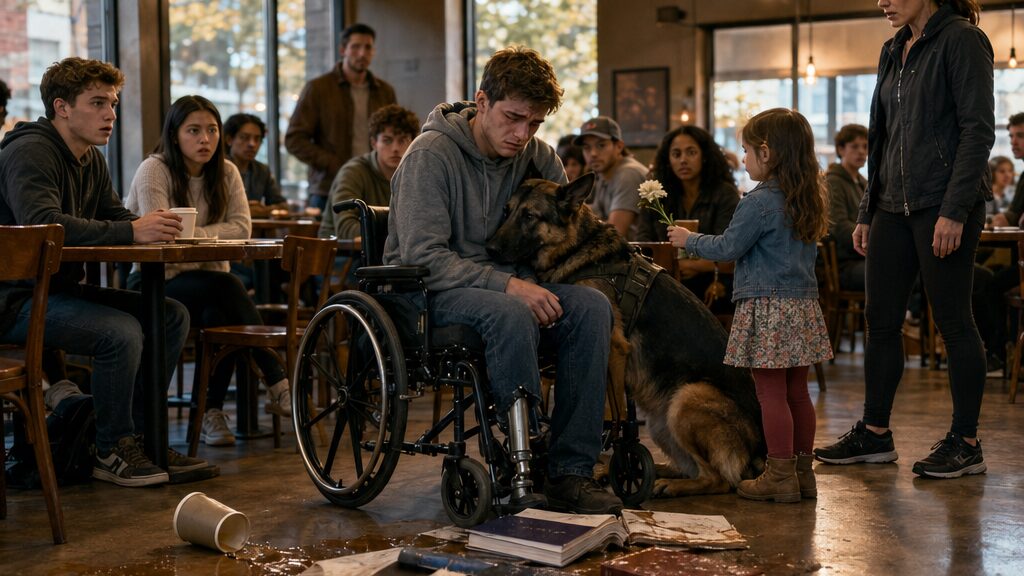
A little child stood there.
No older than six.
Holding a small flower.
The child’s parent looked horrified.
Already moving forward.
“I’m so sorry—”
The child ignored them.
Ignored the wheelchair.
Ignored the prosthetic attachment.
Ignored everything adults seemed unable to ignore.
Instead the child held out the flower.
For a moment, nobody spoke.
The coffee shop seemed suspended in time.
Andrew looked down.
The child smiled.
Simple.
Certain.
“Thank you for being brave.”
The words landed harder than any accusation ever had.
Not because they were profound.
Because they weren’t.
The child wasn’t rewarding military service.
Wasn’t recognizing sacrifice.
Wasn’t making a statement.
The child simply saw someone hurting.
And chose kindness.
Andrew’s vision blurred unexpectedly.
The dog rose.
Moved closer.
Rested against his chair.
The child placed the flower into his hand.
Then ran back toward the waiting parent.
The room remained quiet.
No applause.
No speeches.
No dramatic moment.
Just people sitting with something they suddenly understood.
The dog lifted his head.
Andrew looked down.
The familiar brown eyes met his.
Steady.
Loyal.
Unchanging.
The same eyes that had followed him through the worst days of his life.
The same eyes that never asked for explanations.
The same eyes that never cared about appearances.
A laugh escaped him.
Then a tear.
Then another.
The dog immediately moved closer.
And gently licked the tears from his face.
Ignoring the room.
Ignoring the people.
Ignoring every complicated human thing surrounding them.
The coffee shop watched.
Not because of the veteran.
Not because of the disability.
Because of the dog.
Because loyalty had become impossible to misunderstand.
For the first time since returning home, Andrew felt something stronger than isolation.
Connection.
Chapter 7: Moving Forward Without Looking Away
The flower sat beside Andrew’s textbooks.
Three days later, it was still there.
Pressed carefully between pages.
A small thing.
An ordinary thing.
Yet every time he saw it, he smiled.
The classroom door opened.
Students filtered inside.
Normal conversations.
Normal complaints.
Normal lives.
For once, Andrew didn’t feel entirely outside them.
The dog nudged the wheelchair forward.
Toward the front row.
Toward the future.
Not away from it.
Nicole dropped into the seat beside him.
“You’re early.”
Andrew looked at her.
“So are you.”
“Miracles happen.”
He laughed.
Nicole looked suspiciously pleased with herself.
That was becoming a pattern.
Class hadn’t started yet.
The room buzzed with conversation.
For a few moments neither spoke.
Then Nicole glanced toward the dog.
“Can I ask something?”
“You usually do.”
She rolled her eyes.
“Fair.”
The smile faded slightly.
“How are you doing?”
Andrew almost gave the automatic answer.
Fine.
Always fine.
The safest lie.
The familiar lie.
The one that required nothing from anyone.
His mouth opened.
Then closed.
He looked down at the flower tucked inside his textbook.
At the coffee stain still visible across several pages.
At the dog beside him.
At Nicole waiting patiently.
Not pushing.
Just waiting.
Something shifted.
Small.
But real.
“I’m trying.”
Nicole smiled.
Not because the answer was impressive.
Because it was honest.
“Good.”
The conversation moved on.
Yet Andrew couldn’t stop thinking about it.
Trying.
Not fixed.
Not healed.
Just trying.
That felt achievable.
After class ended, students gathered outside.
A group project discussion.
Normally Andrew would have slipped away.
Avoided the crowd.
Avoided the awkwardness.
Avoided the possibility of belonging and being disappointed.
Instead he stayed.
Only for a few minutes.
But he stayed.
The dog rested beside him while conversations flowed around them.
No accusations.
No whispers.
No performance.
Just ordinary interaction.
It felt strange.
And strangely valuable.
Later that afternoon, Andrew stopped by the coffee shop.
Not because he had to.
Because he wanted to.
Jerry greeted him with a nod.
Nothing more.
Nothing less.
Exactly what Andrew preferred.
He ordered coffee.
Found his table.
Opened his books.
The dog settled beside him.
A familiar routine.
Yet the meaning had changed.
The wheelchair remained.
The missing limb remained.
The scars remained.
The difficult memories remained.
None of that had disappeared.
What changed was the certainty that he would always be alone with them.
The dog suddenly nudged the chair.
Andrew looked down.
The familiar signal.
Move.
Keep moving.
He smiled.
“Okay.”
The dog pushed gently with his nose.
The wheelchair rolled forward.
Past the window.
Past the memories attached to the room.
Past the moment that nearly convinced him to quit.
Toward another assignment.
Another class.
Another day.
Nothing dramatic.
Nothing perfect.
Just forward.
And for the first time in a long while, that felt like enough.
The story has ended.