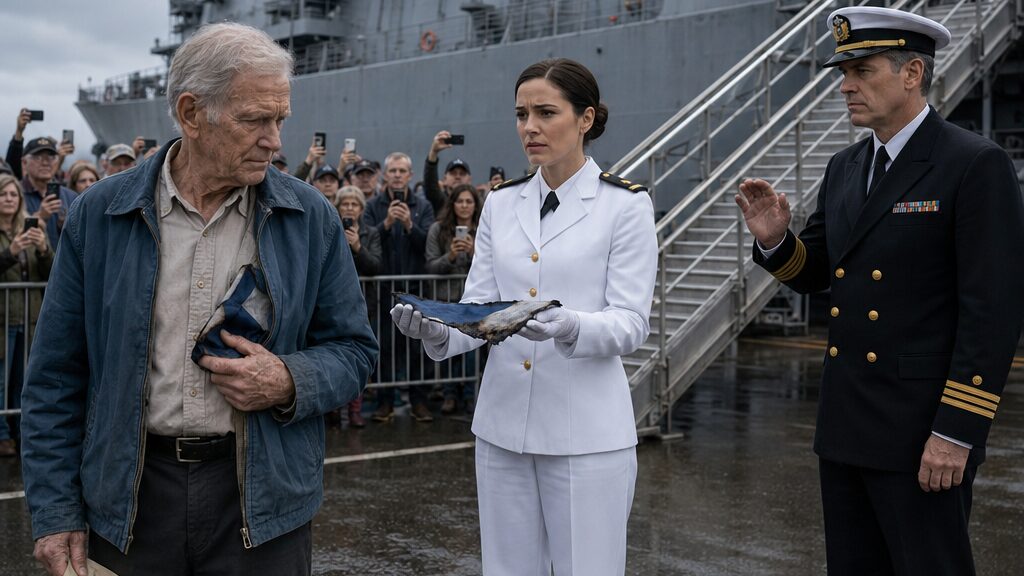
They Tried to Move the Old Sailor Away Until the Ship Remembered His Name
Chapter 1: The Man Beside the Restricted Gangway
The invitation had begun dissolving in Samuel Thompson’s hand before he reached the ship.
A fine mist moved across the harbor, too light to call rain and steady enough to soften the paper at its folds. The printed barcode had bled into a gray ladder. Samuel held the page beneath the flap of his faded blue jacket, but the damage was already done.
Ahead of him, the destroyer rose above the pier like a long steel wall. Fresh signal flags snapped from her lines. White-uniformed sailors moved along the gangway while families crowded behind temporary barriers, raising phones toward the ship that would leave active service before sunset.
Samuel stopped where the pier narrowed.
For a moment, he could not see the bunting, the camera platform, or the polished brass rail at the top of the gangway. He saw six oval doors in a smoke-filled passage.
One.
Two.
Three.
His thumb pressed against the object inside his jacket pocket.
Four.
Five.
Six.
“Sir?”
The voice brought him back to the wet pier.
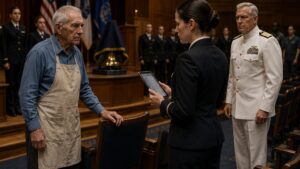
A young lieutenant stood between him and the gangway. Her white uniform was immaculate despite the mist. A tablet rested against one forearm. A security sailor waited behind her, scanning invitations as the official party moved past.
“Your pass, please.”
Samuel held out the page.
The lieutenant took it by one corner and tilted it beneath the gray daylight. Her nameplate read ADAMS.
“The barcode won’t scan,” she said.
“It was clear when it came.”
“I understand, sir. Do you have identification?”
He gave her his driver’s license.
She checked the tablet, tapped twice, then looked at the line behind him. People had begun shifting around his shoulders to see what was delaying them.
“Samuel Thompson,” she said.
“Yes.”
“I don’t have that name on the verified guest list.”
“It was on the invitation.”
“The public entrance is farther down the pier.” She pointed past the barriers. “They can help you at the information tent.”
“I don’t need the tour.”
Her attention moved from his old jacket to his dark trousers and scuffed shoes. She did not look unkind. She looked busy.
“This gangway is for former crew, families of the official party, and invited guests.”
Samuel glanced toward the deck. The ship’s hull number had been repainted for the ceremony, but beneath the clean white edges he could still imagine the older layers. He knew where the metal had warped aft. He knew which bulkheads had been replaced and which deck plates still carried heat beneath their paint.
“I only need to leave something aboard,” he said.
Lieutenant Adams lowered her voice. “Sir, no one can carry uninspected items onto the ship.”
“It belongs to her.”
“To whom?”
He looked up at the gray hull.
“The ship.”
A woman behind him whispered something to her husband. A phone lifted slightly, its lens turning toward Samuel and the lieutenant.
Adams checked the line again. A ceremony coordinator near the foot of the gangway touched an earpiece and made an impatient circling motion with one hand.
“Please step to the side,” Adams said. “We’ll sort this out without holding everyone.”
Samuel moved where she directed him, beside a stanchion wound with ceremonial rope. The security sailor resumed scanning passes. Former crew members in caps embroidered with ship names walked past, some leaning on canes, some escorted by children and grandchildren.
Samuel wore no cap.
Heather had asked him about that when she drove him to the harbor.
“You still have the blue one,” she had said.
“It has a name on it.”
“That’s generally what ship caps do.”
He had looked out the passenger window until she stopped asking.
Now she waited somewhere beyond the outer checkpoint, probably watching the clock. Samuel had told her he would not need long. He had not told her what he carried.
Adams returned after admitting three more guests.
“I can call the public-affairs desk,” she said. “But I need to know exactly what you’re trying to bring aboard.”
Samuel slid one hand inside his jacket. His fingers found the folded cloth where it had rested for fifty-one years: first in a metal toolbox, later in a dresser drawer, and finally in the cedar box that had belonged to his wife.
He withdrew it carefully.
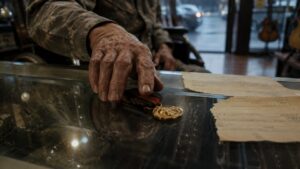
The fragment was no larger than a handkerchief. Blue and white cloth showed through soot-darkened creases. One edge had curled and hardened from heat. The fabric carried no shine, no decorative stitching, nothing that would tell the crowd why it mattered.
Adams studied it.
“What is that?”
“Part of an emergency signal flag.”
“From this ship?”
Samuel nodded.
“How did you obtain it?”
The question was reasonable. That made it harder to answer.
“It came down after the fire.”
“What fire?”
He looked past her toward the gangway. Sailors in dress whites descended in pairs. Their shoes struck the metal treads at even intervals.
One.
Two.
Three.
Adams shifted the tablet beneath her arm. “Sir, I need more than that.”
“There was an aft casualty.”
“When?”
“Long before you came aboard.”
She took a breath through her nose. Behind her, the ceremony coordinator made the circling motion again.
“Do you have documentation proving this is Navy property?”
“No.”
“Then I can’t let you carry it through the checkpoint.”
“You don’t have to let me carry it.” Samuel held the folded cloth toward her. “Give it to someone aboard.”
Her expression tightened. “I can’t transfer an unidentified object to the crew based on an unverified story.”
Samuel let his arm fall.
The mist gathered on his white hair. He should have expected this. The invitation had arrived after decades of silence, addressed to Petty Officer Samuel Thompson, Retired. He had almost thrown it away.
Instead, he had opened the cedar box.
The flag fragment had smelled of nothing by then. No fuel, no burned insulation, no salt. Memory supplied those things without help.
“I’ll go,” he said.
Adams seemed relieved, though she tried not to show it. “The information tent may still be able to verify you.”
“The ship won’t be there tomorrow.”
“She isn’t leaving the harbor tomorrow.”
“She’ll be out of commission.”
“That doesn’t mean—”
“It means what I said.”
His voice had not risen, but something in it made her pause.
A few feet away, another phone turned toward them. Samuel saw himself reflected in the black screen: an old man holding burned cloth while a lieutenant prevented him from reaching a ship that no longer belonged to either of them.
He folded the fragment once, matching the old creases.
Adams extended a gloved hand. “Let me see it before you put it away.”
Samuel hesitated.
“It may have identifying marks,” she said. “If it does, I can give public affairs something useful.”
He placed the cloth across her palm.
She unfolded it with quick, efficient movements. The scorched edge caught against the white fabric of her glove.
Samuel’s hand rose before he could stop it.
“Not there, Lieutenant.”
Adams froze.
“It tears along the heat line,” he said.
She adjusted her grip, but the blackened edge had already begun to separate. A fine thread curled loose between her fingers.
Samuel watched it tremble in the harbor wind.
Behind them, a bell sounded aboard the ship. The crowd shifted closer to the barriers as the next group prepared to descend the gangway.
Adams turned the fragment over.
Faded block letters appeared on the reverse, written in grease pencil and darkened by smoke.
B-42.
Her gaze moved from the compartment notation to Samuel.
Before she could ask what it meant, a man’s voice sounded from the gangway behind her.
“Lieutenant Adams, hold exactly where you are.”
Chapter 2: The Salute That Solved Nothing
Nicole Adams kept the cloth suspended between her hands.
Captain Andrew Campbell descended the final steps of the gangway without looking toward the ceremony coordinator, who had already begun signaling that the receiving line was late. His dark dress uniform made the white-clad sailors around him appear brighter. He moved with the contained speed of someone accustomed to people clearing a path before he asked.
Nicole had seen him cross a deck in heavy weather without touching a rail. She had never seen his attention narrow the way it did now.
His eyes were fixed on the burned cloth.
“What did you say your name was, sir?” Nicole asked the elderly man.
He did not answer her. He was watching the captain.
Campbell stopped an arm’s length away.
“May I?” he asked.
The question was directed not to Nicole but to Samuel.
Samuel gave a slight nod.
Nicole shifted the fragment toward the captain. Campbell did not take it. He leaned close enough to read the notation on the reverse.
“B-42,” he said.
The sound of the crowd seemed to withdraw from Nicole’s awareness. The compartment number meant little to her beyond an older damage-control designation. The ship had been modified several times. B-42 no longer appeared on any current diagram she used.
Campbell looked at the scorched blue field and then at Samuel’s face.
“Were you in B-42 the night the aft fire crossed the fuel trunk?”
A phone chimed nearby. Someone whispered, “What did he say?”
Samuel’s shoulders did not change, but Nicole saw his fingers tighten against the seam of his jacket.
“I was at the door,” he said.
Campbell’s expression altered.
Not dramatically. His mouth did not fall open. He did not announce anything to the crowd. He simply looked again, this time not at Samuel’s worn clothes or weathered posture but at the man himself.
“Samuel Thompson?”
Samuel nodded once.
Campbell straightened.
His hand rose to the brim of his cap.
The salute was clean, formal, and held.
Nicole felt the burned fragment become weightless between her fingers. The security sailor behind her came to attention without being ordered. Conversations near the barrier faded as people realized something had changed.
Samuel looked at the captain for a long second. Then, slowly, he returned the salute.
His hand trembled near his brow. Not enough for the crowd to notice, perhaps, but Nicole stood close enough to see it.
Campbell lowered his hand only after Samuel did.
“Welcome back aboard,” he said.
Samuel looked toward the gangway.
“The man you should know stayed on the other side.”
Campbell’s face tightened almost imperceptibly.
“Who?” Nicole asked.
Samuel reached for the flag fragment.
She returned it at once, careful now to support the unburned corners. He folded it along the original creases and slid it inside his jacket.
The crowd’s silence lasted only another moment. Then the pier filled with murmurs. Phones rose higher. A local reporter pushed along the barrier, calling toward the captain.
“Captain Campbell, who is he?”
A public-affairs officer hurried over from the platform. “Sir, we’re live in seven minutes.”
Campbell ignored him.
“Mr. Thompson,” he said, “I’ve read the casualty reports. Your name is in every history of this ship.”
“That may be the problem.”
Nicole heard the words, but Campbell’s attention had shifted toward the reporter. The public-affairs officer leaned close to the captain and spoke rapidly.
“This could be part of the opening,” he said. “A returning crewman, decommissioning day, the historical connection—”
“No,” Samuel said.
The officer blinked as though he had not expected the old man to hear.
Campbell turned back. “No to the opening?”
“I came to return something.”
“We can certainly arrange that. But first, I would be honored to escort you aboard.”
Samuel looked toward the public line, then beyond it toward the parking area where Nicole could see rows of vehicles behind the security fence. Someone might be waiting for him there. He seemed ready to turn away despite the salute, the captain, and the sudden interest surrounding him.
Nicole stepped aside from the gangway.
The movement felt inadequate. She had blocked him with her body minutes earlier. Now she opened a path, but the cameras still crowded it.
“Sir,” she said, “your invitation should have been on my list.”
“It wasn’t.”
“No.”
She wanted to explain the damaged barcode, the revised roster, the delayed schedule. Each fact remained true, yet together they sounded smaller than they had before Campbell arrived.
“I made an assumption,” she said.
Samuel regarded her. His face held neither anger nor reassurance.
“Yes,” he said.
The single word landed more heavily than accusation.
Campbell removed one glove and offered Samuel his hand. “Come aboard. We’ll find a secure place for the flag.”
Samuel did not take it immediately.
“Not a display case,” he said.
“All right.”
“And not the stage.”
Campbell glanced toward the platform where chairs had been arranged beneath a banner. “All right.”
Only then did Samuel shake his hand.
The public-affairs officer stepped closer. “Could we at least get a photograph at the gangway? Just the captain welcoming him back?”
“No,” Samuel said again.
Campbell looked toward the officer. “You heard him.”
That was the first change Nicole noticed that went beyond the salute. The captain did not soften Samuel’s refusal or reinterpret it. He simply allowed it to stand.
They began up the gangway.
Samuel moved carefully, placing both feet on each tread. Nicole followed one pace behind in case he stumbled, though she kept her hands to herself.
Halfway up, he stopped.
Below them, the harbor water slapped the pilings. The sound was ordinary, but Samuel’s attention seemed fixed on something within the ship. His lips moved.
“One,” he murmured.
Nicole leaned closer. “Sir?”
He continued climbing.
“Two.”
At the quarterdeck, the watch team stood ready. Campbell spoke quietly to them before Samuel crossed the brow.
“This is Samuel Thompson, former damage-control petty officer.”
The sailor of the watch straightened.
Samuel’s jaw tightened. “Just Samuel will do.”
Campbell considered this, then nodded. “Samuel Thompson has permission to come aboard.”
No announcement followed. No bell was rung for him.
Nicole suspected that was intentional.
They entered the reception area, where temporary panels displayed photographs from the ship’s long service. One showed the destroyer in heavy seas. Another showed a line of sailors on a foreign pier. A third carried the heading: THE NIGHT THE SHIP SURVIVED.
Samuel stopped.
Beneath the heading was a black-and-white photograph of a younger man with dark hair and a narrow face. Nicole looked from the photograph to the old man beside her and recognized the eyes.
The caption beneath it read:
PETTY OFFICER SAMUEL THOMPSON, WHO SEALED THE AFT COMPARTMENT AND PREVENTED THE LOSS OF THE SHIP.
The public-affairs officer smiled carefully. “We had planned to mention you during the historical segment.”
Samuel did not appear to hear him.
His gaze moved lower, to a list titled CASUALTIES AND COMMENDATIONS.
Nicole watched him read every line.
His finger stopped at the empty space beneath his own name.
“Where is Ronald Allen?” he asked.
The public-affairs officer checked the panel as though a name might appear if he looked long enough.
Campbell stepped beside Samuel. “I don’t know.”
Samuel read the list again.
“Where are the other three from the engine room?”
No one answered.
The scorched flag fragment pressed visibly against the inside of his jacket, making a small square over his heart.
The captain’s salute had changed how everyone looked at him.
It had not changed what the ship remembered.
Chapter 3: A Hero’s Name Without the Crew
The reception compartment smelled of fresh paint and coffee.
Samuel remembered it smelling of wet canvas, machine oil, and men who had slept too little. The overhead piping had been boxed in for visitors, and the old gray deck had been covered with temporary carpet. Nothing under his shoes sounded right.
Captain Campbell ordered the exhibit area closed for ten minutes. The public-affairs officer objected quietly, then retreated when Campbell repeated himself.
Nicole remained near the entrance. She had removed one glove. The other still carried a dark smear where the flag fragment had touched it.
Samuel stood before the display bearing his younger face.
He had forgotten the photograph existed. It had been taken after an inspection, weeks before the fire. Ronald had stood just outside the frame, laughing because Samuel’s collar was crooked and no one had told him until the camera shutter clicked.
The caption beneath Samuel’s picture made no mention of laughter.
It made no mention of Ronald.
“Who prepared this?” Samuel asked.
Campbell turned to the public-affairs officer, who called for the Navy historian. A middle-aged civilian arrived carrying a folder and wearing the alarmed expression of someone summoned into a room where a mistake had acquired witnesses.
“The exhibit is based on the command history and archived casualty summary,” the historian said.
“Show me the source for this list.”
“We have digital copies in the briefing room.”
“The names.”
The historian glanced at Campbell before answering. “The recognized casualties from the official incident report.”
“Recognized by whom?”
“Mr. Thompson,” Campbell said gently, “we’ll review every record.”
Samuel looked at him.
The captain had offered a salute, access, and now a review. He was trying. Samuel could see that. But the words still placed the truth at a safe administrative distance.
He touched the square inside his jacket.
“Ronald Allen was in B-42,” he said. “So were three others when the fuel trunk split.”
The historian opened the folder. “The casualty summary lists one fatality in the sealed compartment.”
“Then the summary is wrong.”
“Were the others transferred before—”
“They were still working.”
Samuel’s voice sharpened enough that Nicole looked up.
He lowered it again. “Ronald stayed behind. The others were in the passage and lower engine space. They kept the pumps running after the smoke came through.”
The historian searched his papers.
Samuel knew the gesture. Men had searched papers after the fire too, looking for a version of events clean enough to type.
Campbell gestured toward a small table. “Please sit down.”
“I didn’t come to sit beneath my own photograph.”
“No. You came to return the flag.”
Samuel looked at the captain.
Campbell had remembered.
That, too, was a kind of change.
Samuel sat. The chair was too light and shifted under him. Nicole steadied its back without touching his shoulder, then stepped away.
He removed the flag fragment and placed it on the table.
Beside it stood a display replica made for the ceremony: a spotless square of blue-and-white signal cloth under acrylic, labeled EMERGENCY FLAG FLOWN AFTER THE AFT FIRE.
Samuel stared at the clean fabric.
“That isn’t the flag,” he said.
“It’s a reproduction,” the historian explained. “The original was believed lost.”
Samuel unfolded the real fragment.
Against the bright replica, it looked small and ruined. The heat-stiffened edge had nearly separated where Nicole’s glove caught it. Smoke stains radiated from one corner. A pale hand-sewn repair crossed the white portion.
Campbell leaned closer. “Who stitched that?”
“Ronald.”
“Before the fire?”
“Three weeks before. It tore during a drill.”
The historian looked from the fragment to the replica. “This could be authenticated.”
Samuel’s hand closed over the cloth.
“It isn’t here to prove anything.”
The historian stopped reaching.
Samuel turned the fragment so the compartment notation showed. Beneath B-42 were marks almost too faded to see: four short lines, each drawn in a different hand.
“What are those?” Nicole asked.
“Not today,” Samuel said.
She accepted the boundary without repeating the question.
A ceremony coordinator appeared at the doorway. “Captain, the opening is delayed. We need a decision about the historical segment.”
Campbell stood. “Move the musical introduction forward.”
“That gives us twelve minutes.”
“Then use twelve.”
The coordinator left.
Campbell sat opposite Samuel. “Your invitation came from my office.”
Samuel raised his eyes.
“I asked for you to be located,” Campbell continued. “We sent letters to three addresses before public affairs found your daughter.”
“Heather had no business answering.”
“She confirmed only that the final address was current.”
Samuel could picture his daughter at her kitchen counter, reading the letter he had left unopened for two days. She had driven him without asking to come aboard. That restraint had cost her more than he admitted.
“Why were you looking for me?” he asked.
Campbell glanced toward the photograph. “Because every history says you saved the ship.”
“There it is again.”
“I’m telling you what the record says.”
“The record wasn’t behind the door.”
Campbell did not defend it.
The historian returned with a tablet. “I found the digitized action report.”
Samuel felt the compartment tighten around him despite its fresh paint and open doorway.
The historian scrolled. “Damage-control actions, aft fire. Initial rupture near fuel transfer line. Boundary cooling established. Watertight door at B-42 sealed on order of Petty Officer Thompson.”
Samuel’s fingers curled against the table.
“Continue,” Campbell said.
“Fire contained after forty-three minutes. Ship maintained propulsion. Twenty-seven personnel evacuated from adjacent spaces.”
“And the crew in the engine room?” Samuel asked.
The historian’s eyes moved over the screen. “Not listed individually in this section.”
“Of course not.”
“There may be attachments.”
“There were always attachments.”
Nicole watched him from the doorway. Earlier, her attention had been divided among the line, the tablet, the coordinator, and the weather. Now she stood entirely still.
Campbell folded his hands. “Why did you decline the earlier invitations?”
Samuel looked at him sharply.
“The ship held reunions for the twentieth, thirtieth, and fortieth anniversaries,” Campbell said. “Letters were sent to you.”
“You found those.”
“Yes.”
“I didn’t come.”
“I know.”
“Then you know why I declined.”
“No,” Campbell said. “I only know you did.”
Samuel looked down at the burned cloth.
For years, he had believed silence kept the fire from becoming a story told over banquet tables. He had refused interviews, reunion programs, anniversary panels, and one request for a recorded oral history. He had told himself the dead did not need polished words.
But while he stayed away, the polished words had been written without them.
The historian cleared his throat. “There is a personal statement attached to the inquiry.”
Samuel’s chest tightened.
Campbell turned. “His?”
“Yes, sir.”
“How long?”
The historian hesitated. “Six words.”
Samuel knew them before they were read.
He had written them in a sick bay compartment while his hands were bandaged. An officer had placed a form on the table and asked for a factual account. Samuel had held the pen until the ink pooled beneath its point.
Campbell looked at him. “Do you want us to stop?”
Samuel almost said yes.
Instead, he folded the flag fragment once, covering the compartment number.
“Read it.”
The historian lowered his eyes to the screen.
“The door was shut on my order.”
No one spoke.
Outside the compartment, the ceremony band began playing to fill the delay. Brass music passed through the bulkheads, softened until it sounded distant and underwater.
Samuel pressed his thumb against the old fold in the cloth.
He had spent fifty-one years making those six words carry everything.
Now the ship had built a hero o
Chapter 4: What Happened Behind Door B-Forty-Two
The old compartment number no longer existed on the ship’s current diagrams.
Nicole found that out after three calls, two archived deck plans, and a conversation with an engineer who insisted the passage had been renumbered during a modernization overhaul. The bulkheads remained, but labels had changed, pipes had moved, and a storage space now occupied part of what had once been the aft damage-control station.
Samuel listened without correcting her.
They stood outside the temporary exhibit while the ceremony continued above them. Music and amplified voices traveled through the decks as a low vibration. Captain Campbell had gone to deal with the schedule. The historian had taken Samuel’s six-word statement to the briefing room, promising to search the attachments to the original inquiry.
Nicole held a photocopy of the oldest diagram they had located.
“I think B-42 was through here,” she said.
Samuel looked at the passage.
The nearest watertight door had been repainted a bright institutional gray. Its wheel was red, its dogs newly greased. Visitors would see nothing unusual in it.
He counted anyway.
One dog at the top.
Two on the starboard edge.
Three below.
Four.
Five.
Six.
His hand tightened around the folded flag fragment.
Nicole noticed his lips moving but did not ask what he was saying. Instead, she turned the diagram toward him.
“Will you help me verify it?”
The words were careful. Not Tell me where it was. Not You must remember.
Samuel looked down the passage.
“I know where it was.”
Nicole waited.
That was new.
He stepped through the first door. The metal coaming rose several inches from the deck. His right foot cleared it; his left caught lightly, and he steadied himself against the frame.
Nicole moved half a step forward, then stopped before touching him.
Beyond the door, the air was warmer. The ship’s ventilation hummed overhead. Samuel followed the passage past a ladder well and a bank of electrical panels.
“This used to be open,” he said. “No cabinets here.”
Nicole marked the diagram.
“They moved the repair lockers after the overhaul?”
“After the fire.”
He continued.
The shape of the ship returned through his feet before it returned through sight. The slight slope of the deck. The narrowing near the fuel trunk. The place where sound changed because one bulkhead was thicker than the next.
At the second watertight door, Samuel stopped.
The present door was not the one he remembered. That one had warped inward from heat and had to be cut apart in port. But the frame remained. A faint weld line crossed the lower corner, buried beneath layers of paint.
Samuel crouched as far as his knees allowed and touched it.
The passage disappeared.
Alarms hammered through smoke. Men shouted through breathing masks. Water ran black beneath Samuel’s boots while heat pressed against the bulkhead hard enough to make the paint blister.
Ronald Allen was on the sound-powered phone.
His voice came in broken pieces through the static.
Fuel line.
Manual valve.
Need another minute.
Samuel had one hand on the door wheel and the other braced against the frame. Three sailors waited behind him with a hose. Somewhere lower in the engine room, pumps were still running.
“Sir?”
Nicole’s voice came from a distance.
Samuel pulled his hand from the weld line.
The present passage returned: gray paint, electric hum, clean air.
“This is it,” he said.
Nicole checked the diagram. “B-42?”
“The door to it.”
She looked beyond the frame. “What was on the other side?”
“Fuel transfer trunk. Auxiliary machinery space. Access down to the lower engine room.”
“And Ronald Allen?”
Samuel stood slowly.
“He knew the valves better than anyone.”
Nicole waited again.
Samuel walked through the door.
He had not crossed that threshold since the inquiry team forced it open after the fire. He had told himself there was nothing to return to. The compartment had been stripped, repaired, renumbered, and eventually repurposed.
But the air inside seemed smaller than the passage.
The current space contained storage racks and secured equipment cases. On the far bulkhead, new piping ran where the old fuel line had ruptured.
Samuel saw Ronald kneeling beneath it, wrench braced across his shoulder.
“Ronald stayed to shut the manual valve,” he said.
Nicole did not write.
“There was remote control from damage control central,” Samuel continued, “but the cable burned through. The fuel kept feeding the fire. If the line stayed open, it would reach the next compartment.”
“Could he have left?”
“He could have left before he started.”
The answer came too quickly.
Nicole looked at him, but her face held no challenge.
“What happened to the others?” she asked.
“Two were in the lower space keeping the pumps alive. One was passing pressure readings through the trunk. Smoke cut them off from the forward route.”
“Did they get out?”
“Two did. One was evacuated unconscious. Ronald didn’t.”
Samuel unfolded the flag fragment.
In the dim compartment light, the blue looked almost black. The white stripe carried the hand-sewn repair Ronald had made before the fire.
“He patched this during a drill,” Samuel said. “Complained the whole time. Said sailors weren’t supposed to sew unless somebody was watching.”
Nicole’s mouth moved toward a smile but did not complete it.
“What was the flag used for?”
“After the radios failed, we sent signals from the upper deck. This one meant the casualty boundary was holding.”
“Was it?”
“For a while.”
Samuel turned the cloth over. The four faded marks beneath B-42 appeared.
Nicole looked at them but did not ask.
He appreciated that more than he wanted to.
“The fire crossed the trunk,” he said. “The boundary team lost water pressure. The lower space started flooding. The order came to seal the compartment.”
“From the bridge?”
“Damage control central.”
“And you were at the door.”
“Yes.”
“Ronald was still inside.”
“Yes.”
The word entered the compartment and stayed there.
Nicole lowered her eyes to the deck. “Did you speak to him?”
“Sound-powered phone.”
“What did he say?”
Samuel folded the cloth over the marks.
“That the valve was nearly shut.”
“Anything else?”
The alarm from memory struck again. The wheel resisting under Samuel’s burned gloves. Ronald’s voice breaking through static.
Shut it when I signal.
Samuel looked at the present door. The wheel had six spokes.
One.
Two.
Three.
Four.
Five.
Six.
“I closed it,” he said.
Nicole did not ask what Ronald had said.
She asked, “What happened because you closed it?”
The question unsettled him more than blame would have.
“The fire lost air. Flooding stayed aft. The pumps held.”
“How many people were forward of the door?”
“Twenty-seven in the adjacent spaces. More farther forward.”
She looked at him steadily. “And because you closed it?”
“They lived.”
Samuel heard the official language in his own answer and hated it.
Nicole seemed to hear something else.
“You’re telling me what happened to everyone but you.”
“I’m standing here.”
“That isn’t what I meant.”
He turned toward her.
Her posture changed at once, as if she expected him to object. Yet she did not retreat from the question.
Samuel looked at the floor where black water had once run around his boots.
“I heard him strike the door,” he said.
Nicole’s face tightened.
“Once?” she asked.
Samuel closed his eyes.
“Three times.”
He had never told Heather that. Had never told his wife. The inquiry had asked whether communication continued after the door was secured. Samuel had said no because the phone line was dead.
No one had asked about the sound through the steel.
“He might have been signaling,” Nicole said.
“He might have been trying to get out.”
“Do you know which?”
“No.”
That uncertainty had filled fifty-one years.
Footsteps sounded in the passage. The historian appeared carrying a clear archival sleeve.
“I found something,” he said.
Samuel’s eyes fixed on the paper inside it.
The sheet was smoke-stained along one edge, copied from an original maintenance log. Most of the writing was technical: pressure figures, valve positions, fuel readings.
At the bottom was Ronald’s handwriting.
Samuel knew the narrow slant immediately.
The historian held it beneath the compartment light.
“Last entry before communications failed,” he said.
The first line was complete.
Shut it when I signal.
Below it, the second line continued:
Don’t come back for me.
Samuel stopped breathing.
There was more after that, but the sentence ended in a black smear where water or heat had damaged the page.
The unfinished words began:
Sam, tell—
Chapter 5: The Tribute Samuel Would Not Accept
The briefing room had been prepared for dignitaries, not survivors.
Bottled water stood in straight rows. Printed schedules waited at each chair. Through the open door, stagehands moved equipment across the pier while the band tested the same eight bars of music again and again.
Samuel sat at the end of the table with Ronald’s maintenance note before him.
Shut it when I signal. Don’t come back for me.
The words had survived because someone had torn the page from the damaged log and placed it among the inquiry attachments. No one in the room knew why it had not been included in the final casualty summary.
The line beneath remained incomplete.
Sam, tell—
The rest was a burn mark.
Samuel read the beginning until it stopped looking like language.
Captain Campbell stood near the window with the historian and public-affairs officer. Nicole remained beside the door, no longer directing anyone. The burned flag fragment lay on the table near Samuel’s hand.
A clean reproduction had been placed beside it.
The public-affairs officer lifted the reproduction. “This is what we planned to use onstage. The original flag was assumed lost, so the museum team recreated it from photographs.”
Samuel looked at the bright blue cloth.
No smoke. No hand-sewn repair. No grease-pencil notation. No marks from the men who carried it.
“You can keep that one,” he said.
The officer set it down.
Captain Campbell returned to the table. “The main ceremony begins in forty minutes. We can postpone the historical segment.”
“Postpone it until when?”
“We can conduct a full review before the ship transfers to inactive status.”
“And what happens out there today?”
Campbell glanced through the window. Hundreds of people had filled the pier. Families held programs bearing the same history Samuel had seen in the exhibit.
“The prepared remarks can be shortened,” the captain said.
“Shortened lies are still lies.”
The public-affairs officer shifted. “Mr. Thompson, no one intended to misrepresent—”
“You printed one man where there were five.”
“We relied on the official record.”
“So did everybody else.”
Samuel touched the note’s plastic sleeve. “That’s how it happens. One report says one thing. The next person copies it. Then the copy gets polished until nobody remembers there was blood under it.”
No one answered.
Nicole watched the captain. He wanted the ceremony to proceed. She could see it in the way he checked the clock without turning his wrist fully. He had spent months planning the ship’s farewell. Families had traveled across states. Senior officers waited in reserved seats. A live broadcast had already begun.
He also had Samuel sitting beneath a photograph that made him into something he refused to be.
“We could invite you to correct the record during the program,” the public-affairs officer said. “A brief statement. Two or three minutes.”
Samuel looked at him.
“We would introduce you as the sailor whose decisive action saved the ship. Then you could acknowledge the engine-room team.”
“There it is again.”
The officer frowned. “What?”
“You want the same story with more names attached.”
“That isn’t what I meant.”
“It’s what you said.”
The room went quiet.
Samuel stood. His knees objected, and he waited until they settled.
“I’m leaving.”
Nicole moved away from the door rather than blocking it.
Captain Campbell said, “If you leave, the current program goes forward unless I cancel the segment entirely.”
Samuel stopped.
That was not a threat. Campbell’s voice carried no pressure. He was stating the practical choice before them.
Cancel the segment, and Ronald remained absent.
Proceed with it, and Samuel became the lone hero again.
Speak, and the fire would leave the sealed compartment where he had kept it for fifty-one years.
Heather appeared in the passage outside.
She had been escorted aboard by the security sailor after asking why her father’s visit had taken so long. Her hair was damp from the mist. She looked from Samuel to the enlarged photograph propped against the wall.
“What is that?” she asked.
“No business of yours,” Samuel said automatically.
The hurt crossed her face before she hid it.
Nicole looked down.
Heather stepped into the room. “You asked me to drive you here. You disappeared through a checkpoint. A sailor came out and said the captain had recognized you.”
“I didn’t ask for that.”
“I know.”
She saw the maintenance note. “Is that from the fire?”
Samuel did not answer.
Heather had grown up around the edges of that word. The fire. Never a date. Never a shipmate’s name. Her mother had taught her not to ask when Samuel woke in the night and counted doors beneath his breath.
Heather approached the table but did not touch the note.
“Who was Ronald Allen?” she asked.
Samuel’s head lifted.
She pointed toward the ceremony program. “His name is written on your copy.”
Samuel had marked it in pencil before coming. He had forgotten.
“A sailor,” he said.
“Your friend?”
“He worked the fuel system.”
“That wasn’t my question.”
Samuel looked at the incomplete line.
Sam, tell—
He had imagined endings for it over the years.
Tell my mother.
Tell them the valve held.
Tell them I was afraid.
Tell them you left me.
Every ending had sounded possible because Ronald was not alive to reject it.
Heather said, “You don’t have to speak to all those people.”
The relief came too quickly, and with it shame.
Then she added, “But don’t let them speak for you because you’re afraid they’ll hear the wrong thing.”
Samuel looked at her.
She had never accused him of fear before. She did not do it now with cruelty. Her voice was quiet.
The public-affairs officer reached for the reproduction flag. “We can remove this from the program.”
Nicole stepped between him and the table.
“Leave it,” she said.
He stared at her. “Lieutenant?”
She turned to Campbell. “Sir, the media outline calls for Mr. Thompson to hold the replica during the tribute.”
Campbell’s jaw set. “I wasn’t aware of that.”
“It was added this morning.”
Samuel looked at the clean cloth.
A photograph formed in his mind before it happened: the old sailor beneath a giant image of his younger self, holding a spotless version of the object Ronald had repaired. The crowd would call it moving. The broadcast would cut away before anyone asked about B-42.
Nicole picked up the media outline.
“It also describes Mr. Allen as the sole fatality,” she said. “The other three engine-room sailors aren’t named.”
“Lieutenant, that language came from the archived summary,” the officer said.
“And now we know the summary is incomplete.”
“We don’t know enough to rewrite a historical record in thirty minutes.”
“No,” Nicole said. “But we know enough not to repeat it as settled fact.”
Campbell studied her.
Earlier that morning, she had moved Samuel aside because the line needed to keep moving. Now she was asking the entire ceremony to stop for an uncertainty.
The captain took the media outline from her and tore off the page describing the tribute.
“The photograph comes down,” he said.
The public-affairs officer looked toward the window. “Sir, the press has already been told there will be a special recognition.”
“Then tell them the program changed.”
“What replaces it?”
Campbell looked at Samuel.
Nothing in his expression resembled the public salute. There was no ceremony in it now, only a question.
“What do you want us to do?”
Samuel had spent years resenting people who claimed to know what should be done with the fire. Now the decision had been returned to him, and he discovered that anger was easier than choosing.
He picked up Ronald’s note.
Three knocks against steel.
The memory changed shape.
He had always heard desperation in them. But Ronald had written, Shut it when I signal.
Three knocks could have been the signal.
Samuel’s certainty did not vanish. It cracked.
“What happened to the other men?” he asked the historian.
“One later died of complications unrelated to the fire. Two survived. Their statements are in the attachments, but neither was included in the public summary.”
“Did they name Ronald?”
“Yes.”
“Did they name the man who kept the pumps running?”
“Yes.”
Samuel looked toward the pier.
The band had stopped rehearsing. Beyond the glass, families took their seats beneath the gray hull.
“I won’t stand under that photograph,” he said.
Campbell nodded.
“I won’t hold the clean flag.”
“Understood.”
“No one calls me the man who saved the ship.”
The public-affairs officer opened his mouth, then closed it.
Samuel slid Ronald’s note back toward the historian.
“You put every engine-room name in the program.”
“There isn’t time to reprint it,” the officer said.
“Then don’t print it. Speak them.”
Campbell said, “All of them.”
Samuel looked at Nicole. “And no one touches the real flag unless they ask.”
She met his eyes. “Yes, sir.”
He almost corrected the title, then let it pass—not because he wanted deference, but because she had finally made it a question of permission.
Heather stood beside him.
“Are you going up there?” she asked.
Samuel folded the scorched fragment and placed it inside his jacket.
He could still leave. The pier exit remained open. His daughter would drive him home, and the ceremony would struggle around the hole his absence created.
Ronald’s unfinished words would remain unfinished either way.
Samuel looked at Campbell.
“I’ll walk onto your stage,” he said, “but not for the words you printed.”
Chapter 6: The Names Spoken Before the Ship Departed
By sunset, the mist had lifted from the harbor.
The ship’s gray hull caught the last pale light while the crowd settled beneath it. Rows of folding chairs faced the platform. Former crew members sat with caps in their laps. Families stood along the barriers. Camera operators waited behind marked lines.
Samuel watched from the side of the stage.
The enlarged photograph had been removed. A blank easel remained where it had stood. The clean reproduction flag was gone.
Captain Campbell approached the microphone and changed the program without explanation.
“The next portion of today’s ceremony was prepared from a historical summary that we have learned is incomplete,” he said. “We will not present it as written.”
A murmur moved through the audience.
Samuel felt Heather’s hand near his elbow, not holding him, simply present. Nicole stood a few feet away with the scorched flag fragment resting on both palms. She had asked before taking it from him.
Campbell continued. “A former member of this crew has agreed to speak. He has also asked that we listen before we decide what his service means.”
The captain stepped aside.
Samuel did not move.
For one terrible second, his feet refused the stage.
He saw the gangway where Nicole had stopped him that morning. He saw phones raised behind her. He saw the door wheel turning under his hands.
One.
Two.
Three.
Heather said nothing.
Samuel crossed the platform.
The audience recognized him from the commotion at the gangway. Phones rose immediately. A local reporter moved closer to the barrier.
Samuel reached the microphone but did not touch it.
“My name is Samuel Thompson,” he said.
His voice carried farther than he expected.
“I served aboard this ship when I was young. Some of you were told I saved her.”
More phones lifted.
Samuel looked at the screens, each holding a small version of his face.
“If you want to hear the names,” he said, “put those down.”
The request passed through the crowd unevenly. A few people lowered their phones at once. Others hesitated. One camera operator looked toward the public-affairs officer.
Campbell gave no instruction.
Nicole stepped forward and lowered the tablet she had been using.
The movement spread.
Phones descended row by row until Samuel could see faces instead of lenses. The broadcast cameras remained, but their red lights went dark.
He waited until the pier became still.
“Thank you.”
Nicole carried the flag fragment to him. “May I place it here?”
A narrow table stood beside the microphone.
“Yes.”
She laid it down carefully, supporting the unburned corners. Then she stepped back.
Samuel unfolded the cloth.
Wind lifted one edge. He held it with two fingers.
“This was part of an emergency signal flag,” he said. “Ronald Allen repaired it three weeks before an aft fire crossed the fuel trunk.”
He turned the cloth so the crowd could see the four faded lines beneath B-42.
“These marks were made after the casualty. Ronald made the first before the fire, when he patched the cloth and wrote the compartment number. The second was added by the sailor who carried pressure readings through the passage. The third came from the man who kept the lower pump running after smoke filled the space. The fourth was made by the sailor who dragged him out.”
Samuel did not give the names yet.
He needed the audience to understand that the marks were not decoration.
“The official account says I sealed a door and prevented the loss of the ship. That sentence is true.”
The words tightened around his chest.
“It is also not the truth by itself.”
The harbor water struck the pilings below.
“Fuel had ruptured aft. Ronald stayed to close a manual valve after the controls failed. Other men remained below to keep the pumps alive. The fire was moving toward compartments where twenty-seven sailors were trapped between smoke and flooding.”
Samuel looked at Captain Campbell. The captain stood at the side of the platform, hands clasped behind his back, listening.
“I received an order to seal B-42.”
Samuel’s fingers pressed against the table.
“Ronald was still inside.”
No sound came from the audience.
“For fifty-one years, I have said the door was shut on my order. I wrote those words in the inquiry. I wrote nothing else.”
He saw the note again.
Shut it when I signal. Don’t come back for me.
“I thought silence kept other people from turning that night into a story. Instead, silence left room for the wrong story.”
Heather stood with both hands folded at her waist. Tears had gathered in her eyes, but she did not look away.
“Ronald sent an instruction before communications failed. He told me to shut the door when he signaled. He told me not to come back for him.”
Samuel paused.
“The phone line died. Then I heard three strikes on the steel.”
His voice nearly failed.
“I closed the door.”
The crowd did not rescue him with applause. He had asked for listening, and they gave it.
“I spent most of my life hearing those strikes as a man trying to get out. Today I saw Ronald’s written order for the first time since the inquiry. I cannot prove what the strikes meant. But I know now that I took away his choice every time I remembered him only as someone I left behind.”
Samuel looked down at the four marks.
“He chose to stay at the valve. The others chose to keep the pumps running. I carried out the order at the door. None of those actions stands alone.”
He unfolded a page Nicole had prepared by hand.
The printed programs still carried the incomplete account. This page did not.
Samuel read the names of Ronald Allen and the three engine-room sailors.
He gave each name space.
After the last, he added the names of the boundary team who held the passage and the sailors who carried the injured forward. Some were in the audience. Some had died in later years. Some were represented by children who had never heard the details before.
No one clapped between names.
When he finished, Samuel folded the page.
“I am not asking you to remove my name,” he said. “I am asking you to stop putting it where the crew should be.”
He stepped away from the microphone.
For several seconds, the only sound was the flag line striking the mast above the ship.
Then Captain Campbell came forward.
He did not salute.
He stood beside Samuel and faced the crowd.
“The prepared historical account will not be entered into today’s decommissioning record,” he said. “The casualty history and memorial display will be corrected to include the complete engine-room and damage-control teams.”
The historian, standing near the stage steps, nodded once.
Campbell turned to Samuel. “That correction will require review of every surviving statement, not only the summary.”
“That’s what should have happened the first time.”
“Yes.”
The captain accepted the answer without defense.
The public-affairs officer approached the blank easel and lifted the placard that had been placed facedown behind it. Samuel saw his own name printed in letters large enough to read from the back row.
Campbell took the placard from him.
He removed it from the easel and laid it flat beneath the stage.
The action was quiet. No camera captured it.
“What should replace it?” Campbell asked Samuel.
Samuel looked at the ship, at the open gangway, and at the audience whose phones remained lowered.
“Not a bigger photograph,” he said.
A few people smiled, but the sound did not become laughter.
Samuel touched the scorched cloth.
“Put the compartment number at the top,” he said. “Then every name beneath it. No ranks.”
Campbell nodded. “And the flag?”
Samuel looked at the burned edge Ronald had repaired before the fire.
He was not ready to answer.
“Ask me after the cameras are gone,” he said.
Chapter 7: Respect After the Cameras Were Lowered
By the time the last television van left the harbor, the pier lights had come on.
Their reflections trembled in the dark water beneath the ship. Folding chairs stood in uneven rows, abandoned programs lifting at the corners whenever the wind passed through. Sailors carried cables and microphone stands toward storage cases. The ceremonial flags had been lowered, but the destroyer still towered above the pier, gray and silent.
Samuel remained near the stage.
Heather had gone to bring the car closer. She had asked whether he wanted her to stay, and he had told her he needed a few minutes. For once, she had not mistaken that answer for a dismissal.
Captain Campbell stood beside the blank easel, speaking with the historian. The placard bearing Samuel’s enlarged name was no longer beneath the stage. It had been taken away with the discarded program materials.
Nicole approached carrying the scorched flag fragment on both hands.
She had changed out of her white gloves. The fabric rested against her bare palms, supported beneath the unburned corners. The blackened edge faced away from the wind.
Samuel noticed all of that before he looked at her face.
“The media area is clear,” she said. “The public-affairs officer confirmed that no close image of the flag will be released without your permission.”
Samuel nodded.
Nicole glanced toward the ship. “Captain Campbell asked me to return this to you.”
She did not extend it.
“May I?” she asked.
The question was small enough to disappear beneath the sound of water against the pilings.
Samuel looked at the folded cloth.
That morning, she had taken it quickly because there were people waiting and a schedule slipping. Now the pier was nearly empty, and she waited as though his answer mattered more than either.
“Yes,” he said.
Nicole placed the fragment in his hands.
The fabric felt colder than it had earlier. Samuel folded it along Ronald’s original repair, careful not to strain the heat line.
“I’m sorry,” Nicole said.
Samuel continued folding.
“For the flag,” she added. “And for deciding what you were before I knew anything about you.”
He looked at her.
She stood straight, but not at attention. There was no rehearsed apology in her expression, no request that he release her from discomfort.
“You had a damaged invitation,” he said. “A line behind me. A ceremony running late.”
“That explains why I moved quickly.”
“It does.”
“It doesn’t explain why I stopped listening.”
Samuel slipped the cloth inside his jacket.
“No,” he said. “It doesn’t.”
Nicole accepted that too.
Behind them, Campbell dismissed the remaining stage crew. The historian carried a box of exhibit materials toward the gangway. On top lay the clean reproduction flag, still bright beneath the pier lights.
“What happens now?” Samuel asked.
Nicole followed his gaze. “The temporary exhibit stays closed. The historian is reviewing the inquiry attachments tonight. Captain Campbell has ordered the decommissioning record held until the crew list can be verified.”
“And after the ship is transferred?”
“The memorial office keeps custody of the corrected record. They want to build a permanent B-42 panel.”
Samuel’s hand rested against the square inside his jacket.
“They want the fragment,” Nicole said. “But no one is assuming you’ll give it.”
Campbell approached, carrying a plain folder instead of the ceremonial program.
“The historian found enough tonight to confirm all four engine-room names,” he said. “The rest of the damage-control roster will take longer.”
Samuel took the folder.
Inside was a draft sheet. B-42 appeared at the top in plain black type. Beneath it were the names he had spoken from the stage, each in the same size.
No ranks.
No decorations.
No sentence claiming that one man had saved the ship.
Samuel read the list twice.
“Ronald’s maintenance note?” he asked.
“It will be reproduced beside the account if the family permits it,” Campbell said. “The original remains in the archive.”
“And the six words I wrote?”
Campbell hesitated. “They are part of the record.”
“Don’t remove them.”
“I wasn’t planning to.”
“Put them beside Ronald’s instruction.”
Campbell looked at him carefully. “Both?”
“People should see what happens when one sentence is kept and the other is lost.”
The captain nodded. “Both.”
Samuel closed the folder.
Campbell did not salute. He offered his hand.
Samuel shook it.
“Thank you for coming back,” Campbell said.
“I nearly didn’t.”
“I know.”
“No, you don’t.”
Campbell held his gaze. “You’re right.”
There was no defense after the words.
Samuel found that more respectful than agreement would have been.
Three weeks later, the memorial office called his house.
Samuel let the phone ring four times before answering.
The corrected display was ready. They wanted him to inspect it before it opened to the public.
Heather drove him to the harbor on a clear morning. The ship remained at the pier awaiting transfer, stripped now of ceremonial bunting. Work crews moved equipment across the deck. Without the crowd and music, she looked older.
At the checkpoint, an elderly couple stood before a security sailor. The man searched his pockets while the woman tried to unfold an email printout. People waited behind them.
The sailor did not wave them aside.
He asked their names, called the verification desk, and offered them two chairs beneath the shelter while the list was checked.
Samuel watched without speaking.
A new card had been attached to the checkpoint station:
PAUSE. VERIFY. EXPLAIN THE NEXT STEP.
Nicole came through the gate wearing her working uniform.
“Good morning, Mr. Thompson. Ms. Thompson.”
“Samuel,” he said.
A brief smile reached her face. “Good morning, Samuel.”
She turned to Heather. “The memorial office is ready when you are.”
Samuel looked at the gangway.
The first time he had approached it, he had carried the flag fragment hidden inside his jacket. Now Nicole knew it was there, and she did not ask to see it.
They crossed the brow without announcement.
The temporary exhibit had been rebuilt in a smaller compartment. Samuel’s enlarged photograph was gone. In its place stood a steel-gray panel with B-42 at the top.
The full engine-room and damage-control teams appeared beneath it.
Ronald Allen’s name was first only because the list was alphabetical.
Beside the names were two short documents.
Ronald’s instruction:
Shut it when I signal. Don’t come back for me.
Samuel’s statement:
The door was shut on my order.
No caption told visitors which sentence mattered more.
A narrow empty mount waited below them.
Nicole stood several feet away. Campbell and the historian were absent. Samuel understood that this, too, had been arranged deliberately.
Nicole held out neither hand.
“The mount can remain empty,” she said. “Or the fragment can be photographed and returned to you. Or it can stay here under preservation glass.”
Samuel removed the folded cloth.
Heather inhaled softly. She had never seen it before that day.
He opened it on the nearby table.
The blue-and-white field lay between them, smoke-stained and uneven. Ronald’s repair crossed the pale stripe. Four faded marks sat beneath B-42.
Heather touched neither the cloth nor her father.
“That was in the cedar box?” she asked.
“Yes.”
“All those years?”
“Yes.”
She studied the hand-sewn repair. “You could have shown me.”
Samuel looked at the fragment.
“I thought keeping it closed kept everything else closed.”
“Did it?”
“No.”
The answer came without resistance.
Nicole waited near the wall.
Samuel lifted the flag fragment by its safe corners. For decades, he had believed possession was a form of duty. He had kept the cloth from ceremonies, museums, speeches, and hands that might clean away what made it true.
But he had also kept it from Ronald’s name.
“Place it beneath the list,” he said.
Nicole did not move.
“Are you certain?”
Samuel looked at Heather, then at the two sentences displayed side by side.
“No,” he said. “But put it there.”
Nicole approached. She received the fragment with both hands.
Together, they fitted it into the shallow mount. The preservation cover lowered without flattening the burned edge. Its curl remained visible, casting a small shadow across the panel.
Samuel stepped back.
The fragment no longer looked like evidence he had guarded. It looked like part of a larger record, incomplete without the names above it.
Heather slipped her arm through his, loosely enough that he could withdraw if he wished.
He did not.
Weeks later, Samuel returned alone.
The ship was open for one of its final public tours. Families gathered at the pier, and sailors checked names beneath the shelter. Samuel wore the same faded blue jacket, but the inner pocket was empty.
Nicole saw him before he reached the checkpoint.
She came through the gate and stopped on the other side of the barrier.
“Good morning, Samuel.”
“Lieutenant.”
“The memorial office is open.”
“I know.”
She glanced toward the gangway, then back at him.
“Would you like company?”
Samuel looked at the ship.
He counted no doors.
Nicole waited without pointing, directing, or stepping into his path.
After a moment, Samuel nodded toward the gangway.
“For the first part,” he said.
She opened the gate and let him choose the way aboard.
The story has ended.