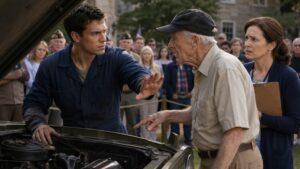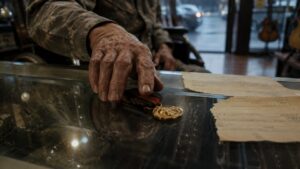
The Young Instructor Mocked An Old Man’s Rifle Until The Final Target Came Back Silent
Chapter 1: The Old Rifle Case At Lane Seven
The first thing people noticed was the rifle case.
Not Robert White.
Not the careful way he closed the gate behind himself.
Not the folded card tucked into the breast pocket of his faded field jacket.
Just the rifle case.
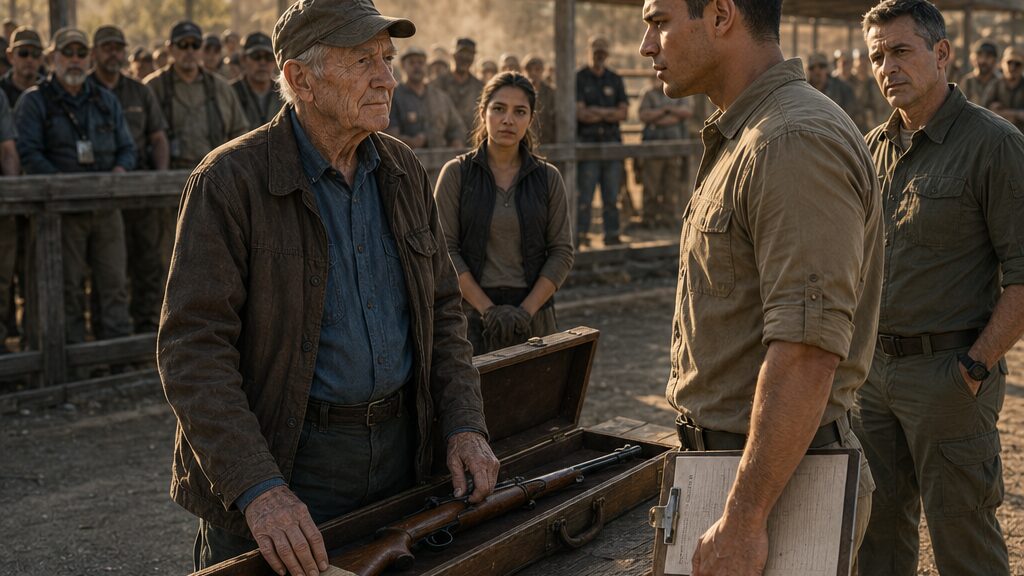
The wooden case looked older than some of the volunteers setting up targets across the dusty range. Its brass corners were worn smooth. The handle had been repaired more than once. When Robert carried it from the parking lot toward the registration tent, conversations slowed around him.
A few veterans nodded politely.
Most people simply stared.
The annual charity qualification day had already filled the range with noise. Families gathered behind the safety barriers. Volunteers carried clipboards. Trainees clustered around instructors.
Robert moved through the crowd without hurry.
The morning air carried the dry scent of dust and sun-warmed grass. Flags along the firing line fluttered gently.
He noticed the wind immediately.
Habit.
Some habits survived longer than strength.
At the registration table, a woman with a headset looked up from a stack of forms.
“Good morning,” she said. “Name?”
“Robert White.”
She scanned a list.
“Qualification participant?”
“Yes.”
Her fingers stopped.
She looked up.
“You registered months ago.”
“I know.”
“You still intend to shoot?”
Robert smiled faintly.
“That was the plan.”
The woman hesitated.
Then she handed him a badge.
“Lane assignments are being finalized. Please wait near the firing line.”
“Thank you.”
As he turned away, he noticed her glance at the rifle case.
Not hostile.
Curious.
That was easier to live with.
Robert walked toward the line and found an empty bench.
Around him, younger shooters unpacked modern equipment. Synthetic stocks. Precision optics. Bright range bags covered in logos.
Nobody paid much attention to the old man until he opened his case.
The rifle rested inside on worn cloth.
Wooden stock.
Blued steel.
Clean enough to reflect sunlight.
A few nearby trainees exchanged looks.
One laughed quietly.
Robert ignored them.
He removed the rifle.
Checked the chamber.
Checked it again.
Then placed it safely on the bench.
Every motion looked deliberate.
Every movement followed a rhythm older than the range itself.
His hand brushed the folded card in his pocket.
The paper felt soft with age.
For a moment he simply stood there.
Looking at it.
Remembering.
Then he folded it once more and slipped it away.
“Sir.”
The voice carried authority.
Or at least tried to.
Robert turned.
A young instructor approached with a clipboard tucked beneath one arm.
Tall.
Confident.
Pressed uniform.
Sharp expression.
Eric Martinez.
The name tag sat proudly across his chest.
“Can I help you?” Eric asked.
“I hope so.”
Eric glanced at the rifle.
Then at Robert.
Then at the registration badge.
“You’re competing today?”
“That’s correct.”
A slight smile appeared.
Not friendly.
The sort of smile people wore when they believed they already understood a situation.
“We have spectator seating over there.”
Eric pointed toward a row of benches beneath a canopy.
Robert followed the gesture.
Then looked back.
“I’m registered.”
“I saw that.”
“Then I assume I’m on the participant list.”
Eric shifted the clipboard.
“You understand this is a qualification event?”
“Yes.”
“It’s not a historical demonstration.”
A few trainees nearby laughed.
Robert remained silent.
Eric seemed encouraged.
“You’ll be working with timed drills and distance targets.”
Robert nodded.
“I read the event description.”
The young instructor looked almost disappointed.
As though he had expected confusion.
Or argument.
“Do you have current qualification records?”
Robert reached into his pocket.
Instead of producing a certificate, he unfolded the worn card.
Eric accepted it.
His expression changed immediately.
Not to respect.
To amusement.
“This?”
Robert said nothing.
The card contained faded writing and old range procedures.
The edges were rounded from years of handling.
Eric flipped it over.
“Sir, these rules are ancient.”
“They worked.”
“They were replaced.”
“Some were.”
Eric handed it back.
“This isn’t valid documentation.”
“It wasn’t meant to be.”
“Then why carry it?”
Robert folded the card carefully.
“Reminder.”
Eric shook his head.
“You know what my concern is?”
“No.”
“Safety.”
Robert waited.
“You’re carrying equipment older than most of the shooters here.”
“The rifle functions.”
“That’s not the point.”
“What is?”
Eric lowered his voice.
“The point is that if someone isn’t capable of completing the event safely, I need to make that decision before problems happen.”
Silence settled between them.
Robert could feel people watching.
Waiting.
The easiest thing would have been to explain.
To mention decades of instruction.
Qualifications.
Records.
Students.
Instead he simply said, “I understand.”
The answer seemed to surprise Eric.
“You do?”
“Yes.”
“And?”
“And safety matters.”
For a second uncertainty crossed the instructor’s face.
Then it vanished.
“Well. We’ll see.”
He made a note on his clipboard.
Robert watched him walk away.
The young man moved quickly from group to group, speaking loudly enough for everyone nearby to hear.
Authority performed in public.
Confidence displayed like a uniform.
Robert had known instructors like that.
Some grew out of it.
Some never did.
The morning continued.
Shooters checked equipment.
Volunteers posted lane assignments.
Dust drifted across the range.
When the final board went up, a crowd gathered around it.
Robert joined them.
His name appeared near the bottom.
Lane Seven.
A few shooters frowned.
Lane Seven sat at the far end of the range.
The least popular position.
Older target carrier.
Uneven shade.
Nobody fought to get assigned there.
Robert smiled.
A lane was a lane.
As he turned away, he heard Eric speaking with another instructor.
“Put him on Seven.”
“Why?”
“Because if something goes wrong, I want space around him.”
Robert continued walking.
He reached the lane and began setting up.
Rifle.
Mat.
Data notebook.
Nothing else.
No complaints.
No audience.
Just preparation.
By the time the first safety briefing began, Eric was already watching him.
Waiting for a mistake.
Robert knew the look.
He had seen it before.
The assumption that age had finally caught up.
That trembling hands must follow gray hair.
That old equipment belonged in display cases.
Not on firing lines.
The briefing ended.
Participants moved into position.
Range commands echoed across the dusty field.
Robert checked his chamber one last time.
Then rested his hand over the folded card.
The paper felt warm from the sun.
A memory.
A promise.
A reason for being there.
Across the range, Eric noticed him again.
Their eyes met.
The instructor raised one hand and pointed toward the spectator benches.
The gesture was unmistakable.
A final invitation to leave before the qualification began.
Robert looked at the benches.
Then back at Lane Seven.
Without a word, he laid out his shooting mat.
And stayed.
Chapter 2: The Instructor Who Spoke Too Loud
Eric Martinez hated uncertainty.
Unfortunately, uncertainty seemed determined to follow him all morning.
The charity qualification event should have been simple.
Run the line.
Manage safety.
Look professional.
Impress the visitors.
Finish the day with praise from senior staff.
Instead, he kept finding himself looking toward Lane Seven.
Toward the old man.
Toward the rifle.
Toward the worn card.
Everything about Robert White irritated him.
Not because the man had done anything wrong.
Because he refused to react.
Most people reacted.
Challenge them and they argued.
Correct them and they apologized.
Question them and they explained themselves.
Robert did none of those things.
He simply listened.
Which somehow felt worse.
Eric moved through the firing line checking equipment.
“Bolt open.”
“Good.”
“Safety engaged.”
“Thank you.”
“Eye protection.”
“Excellent.”
The trainees followed instructions quickly.
Most wanted his approval.
He knew that.
And he liked it more than he admitted.
A cluster of younger shooters gathered around him near the benches.
One of them nodded toward Lane Seven.
“Think he can actually qualify?”
Eric smirked.
“You saw the rifle.”
“Yeah.”
“Then you already know.”
The group laughed.
Eric laughed too.
But the feeling disappeared almost immediately.
Because when he looked toward Robert again, the old man was checking his rifle.
Methodically.
Patiently.
Not fumbling.
Not confused.
Not careless.
Every step looked practiced.
Melissa Garcia noticed it too.
She stood slightly apart from the others.
New trainee.
Quiet.
Observant.
Eric had barely spoken to her all morning.
“His chamber checks are good,” she said.
Eric glanced over.
“What?”
“The older gentleman.”
She pointed carefully.
“He keeps verifying everything.”
“That’s called being slow.”
“Or careful.”
Eric frowned.
“Careful doesn’t matter if you can’t hit anything.”
Melissa didn’t answer.
That irritated him almost as much as Robert’s silence.
The morning drills began.
Participants practiced positioning and timing.
Eric walked the line issuing corrections.
“Lower your elbow.”
“Watch your breathing.”
“Slow down.”
Ironically, most of the advice sounded similar to things Robert was already doing.
Eric ignored the thought.
At Lane Four, a shooter rushed through a reload.
Eric corrected him.
At Lane Five, another participant forgot a command.
Eric corrected him.
At Lane Seven, Robert simply followed every instruction before it finished being spoken.
No corrections needed.
That should have pleased Eric.
Instead it made him uncomfortable.
Around noon, registration paperwork arrived from the front office.
Janet Hill handed him a stack of participant files.
“Make sure everything matches before qualification starts.”
“Got it.”
Eric flipped through the pages.
Names.
Numbers.
Emergency contacts.
Routine work.
Then he found Robert White.
The file looked thin.
Too thin.
No recent competition history.
No sponsorships.
No awards listed.
Just old records and a registration date.
Eric felt relieved.
There.
Proof.
Nothing special.
Exactly what he expected.
He closed the folder.
Nearby, Melissa watched Robert roll up his sleeves before checking the rifle again.
“Why does he keep touching that card?”
“Because old habits die hard.”
“What kind of card is it?”
“Outdated range rules.”
“Have you read them?”
Eric laughed.
“No.”
“Then how do you know?”
He opened his mouth.
Then stopped.
Because he actually didn’t know.
Someone had told him they were obsolete.
That had been enough.
Before he could answer, movement near the parking area caught his attention.
A dark vehicle rolled through the gate.
Several volunteers straightened immediately.
Janet noticed it too.
“Oh.”
“What?”
“That’ll be David Thompson.”
Eric blinked.
“The senior officer?”
“Yep.”
His stomach tightened.
David rarely attended routine events.
When he did, people noticed.
The vehicle stopped.
The door opened.
David stepped out carrying a folder beneath one arm.
Calm.
Composed.
The sort of authority that never needed volume.
Eric immediately adjusted his posture.
A few instructors did the same.
David greeted Janet first.
Then accepted a participant list.
His eyes moved down the page.
Slowly.
Casually.
Until they stopped.
Completely.
Eric noticed the change instantly.
David’s expression froze.
Not shock.
Recognition.
Something close to disbelief.
“Sir?” Janet asked.
David didn’t answer immediately.
His gaze remained fixed on one line.
One name.
Then he looked toward the firing line.
Toward Lane Seven.
Toward Robert White.
For several seconds he simply stared.
The noise of the range continued around him.
Commands.
Conversation.
Metal.
Wind.
Yet David seemed to hear none of it.
Eric followed his gaze.
“What is it?”
David folded the paper carefully.
“Nothing.”
But the answer sounded wrong.
“Do you know him?”
Another pause.
“Perhaps.”
Then David started walking toward the firing line.
Not quickly.
Not dramatically.
Just with quiet purpose.
And for the first time all morning, Eric felt a small thread of uncertainty tighten in his chest.
Because senior officers did not freeze at names without reason.
Chapter 3: When The Senior Officer Went Quiet
David Thompson recognized the name before he recognized the face.
Age changed faces.
Years changed posture.
Time took things.
But some names stayed exactly where memory left them.
Robert White.
David had not expected to see that name again.
Certainly not on a charity qualification roster.
Certainly not at Lane Seven.
He stood near the range office window and watched the old man through the glass.
Robert was arranging equipment.
Nothing dramatic.
Nothing designed to attract attention.
Yet every movement carried a familiarity David couldn’t ignore.
Years earlier, when David was barely more than a trainee himself, stories about Robert had circulated through ranges across the region.
Not stories about trophies.
Not stories about records.
Stories about discipline.
About safety.
About instructors who learned that procedure mattered even when nobody was watching.
David remembered one phrase especially.
Slow is smooth.
Smooth is accurate.
He had heard it dozens of times.
Sometimes from teachers who probably didn’t know where it originated.
Now he suspected he was looking at the source.
Janet entered the office carrying a clipboard.
“You know him.”
David smiled slightly.
“That’s not a question.”
“No.”
“Then yes.”
“Should I announce it?”
The answer came immediately.
“No.”
She looked surprised.
“Why not?”
“Because if Robert wanted attention, he’d already have it.”
Janet glanced through the window.
“He doesn’t seem interested in defending himself.”
“He never was.”
Outside, Eric continued organizing participants.
David watched him carefully.
The young instructor wasn’t malicious.
He was insecure.
There was a difference.
Unfortunately, insecurity often sounded like confidence until pressure arrived.
“Are you going to intervene?” Janet asked.
“About what?”
“The lane assignment. The comments.”
David shook his head.
“Not unless safety requires it.”
“He’s being treated unfairly.”
“Maybe.”
“Maybe?”
David looked back toward Robert.
“If I walk out there and explain who he is, nobody learns anything.”
Janet considered that.
Eventually she nodded.
The qualification round began shortly after midday.
Shooters moved into position.
Range commands echoed across the field.
The dust had thickened as temperatures climbed.
Flags along the firing line fluttered more noticeably now.
The wind was changing.
David noticed Robert watching the flags.
Not casually.
Studying them.
Measuring.
Calculating.
Eric walked the line with visible confidence.
By now much of the crowd had noticed the tension surrounding Lane Seven.
People whispered.
Watched.
Waited.
The old man had become a story before firing a single round.
David disliked that.
But he understood it.
Public judgment always arrived early.
Truth arrived later.
At Lane Seven, Robert remained calm.
He checked the rifle.
Checked the chamber.
Touched the folded card.
Then slowly lowered himself to one knee beside the mat.
The movement drew attention across the range.
Conversation faded.
Even Eric stopped walking.
Robert settled into position without haste.
The image felt strangely familiar.
Dust.
Wood stock.
Kneeling shooter.
Steady hands.
David suddenly remembered an old photograph hanging in a training building decades ago.
The posture was nearly identical.
A memory from another era.
Eric stepped closer.
“Comfortable?”
Robert looked up.
“Yes.”
“You still want to continue?”
“Yes.”
The younger man’s jaw tightened.
“This isn’t about pride.”
“No.”
“You can stop anytime.”
“I know.”
Silence.
Neither man looked away.
Finally Eric nodded toward the distant targets.
“Good.”
Robert waited.
“Good?” he asked.
Eric crossed his arms.
“You wanted to qualify.”
“Yes.”
“Then qualify.”
The crowd sensed a challenge.
Not officially.
Not in writing.
But unmistakable.
Melissa watched from nearby, anxiety visible on her face.
David watched too.
He considered stepping forward.
Considered ending the tension before it grew.
Then he noticed Robert’s expression.
Calm.
Unbothered.
Completely in control.
The decision wasn’t his to make.
The range officer called the next command.
Shooters prepared.
Dust drifted across the lanes.
Flags shifted again.
Robert inhaled slowly.
Held it.
Released it.
Steady breath.
The same rhythm David remembered hearing about years ago.
Eric remained standing nearby.
Waiting.
Expecting something.
Perhaps a mistake.
Perhaps confirmation.
Perhaps proof that his assumptions had been correct all along.
Instead he received nothing.
No stumble.
No confusion.
No complaint.
Only patience.
Finally Eric looked toward the distant targets and said the words everyone would remember later.
“Let the target tell us.”
And for the first time that day, even the wind seemed to pause and listen.
Chapter 4: The Wind No One Else Read
Robert did not lift the rifle when Eric spoke.
He watched the flags.
The young instructor’s words hung in the hot air, but the cloth strips downrange told a more useful story. Near the firing line, the wind moved left to right. Halfway out, it softened. Near the target berm, it curled back against the dust.
A small thing.
Enough to matter.
Around him, shooters settled into position. Bolts clicked. Mats shifted. Someone coughed behind the spectator barrier.
Robert placed the folded range card flat beside his left hand.
The paper moved slightly in the breeze.
Eric noticed.
“Still using that as a guide?”
Robert looked at the card, then at the distance marker.
“No.”
“Then what is it doing there?”
“Keeping still.”
A few people laughed.
Eric smiled as if the answer proved something.
Robert let him have it.
The command came.
“Prepare.”
Robert lowered himself fully into position.
His right knee pressed into the dusty mat. His left elbow found bone support, not muscle. The old rifle settled into his shoulder as if returning to a place it remembered.
His hands trembled faintly.
They often did now.
Before the rifle settled.
Before the breath came right.
Age had not spared him. It had simply forced him to become more honest with every motion.
He closed his fingers around the stock.
The tremor disappeared into structure.
Eric stepped close enough that Robert could feel him watching.
“You have five rounds,” Eric said. “Two hundred yards. Standard qualification target.”
Robert nodded.
“Timed.”
“I heard.”
“You’ll need to keep pace.”
“I will keep safe.”
Eric’s mouth tightened.
The range officer called the line ready.
Robert inhaled slowly.
The first shot would tell him whether the sight picture matched the morning light.
He did not rush it.
The target blurred for a heartbeat.
Then cleared.
He waited through one full breath.
The wind flag near the berm flicked back.
Robert pressed the trigger.
The rifle cracked.
Not loud compared with the modern rifles along the line, but sharper somehow. Cleaner.
Dust lifted beyond the lane.
Eric glanced toward the target as if he expected to see failure with the naked eye.
Robert worked the bolt.
Slowly.
Smoothly.
His hand returned to position.
Second breath.
Second shift of wind.
Second shot.
The line continued around him.
Some shooters fired quickly. Others overcorrected. The dust moved strangely, curling low along the range like smoke.
Robert heard Eric call corrections to another lane.
“Don’t wait too long. Commit.”
Robert waited.
The third shot broke only when the mirage softened.
The fourth followed after a longer pause.
By then the muttering behind the barrier had thinned.
People were no longer laughing.
They were trying to understand why the old man seemed less hurried than everyone else.
For the fifth shot, Robert let his finger rest outside the guard.
The wind had changed again.
The old card shifted under his palm.
Not much.
Just enough.
Eric leaned closer.
“Problem?”
“No.”
“Then finish.”
Robert did not answer.
The flag at one hundred yards snapped once, then dipped.
He settled the front sight with a minute correction no one else saw.
Breath.
Pause.
Press.
The fifth shot cracked across the range.
Robert opened the bolt and set the rifle safe before lifting his head.
Only then did he look at Eric.
“Clear.”
Eric stared down at the open action, as if searching for something to criticize.
Finding nothing, he turned away.
“Retrieve targets.”
The carriers began to move.
Metal rattled downrange.
Spectators pressed closer to the barrier.
Melissa stood with both hands locked around the strap of her range bag. David remained near the side of the line, face unreadable. Janet hovered near the scorekeeper, no longer pretending she was occupied with paperwork.
The first targets returned.
Lane One had a wide group.
Lane Two was better.
Lane Three had one shot outside the scoring ring.
Eric commented loudly on each.
“Good adjustment.”
“Too fast.”
“Watch your follow-through.”
Then Lane Seven’s carrier rattled back.
The target turned toward them.
Silence arrived before anyone named it.
Five holes sat in a tight cluster just off center, corrected perfectly for the wind.
Not luck.
Not one good shot.
Five.
The scorekeeper leaned forward.
Eric said nothing.
Robert remained kneeling.
The rifle lay open beside him.
He could hear the small sounds now. A flag rope tapping against its pole. Someone’s shoe scraping gravel. Melissa’s quiet inhale.
Eric took the target from the carrier.
He held it longer than necessary.
“Acceptable,” he said.
The word fell flat.
David’s eyes moved from the target to Robert.
Something passed between them, not spoken.
Robert folded the range card and slipped it back into his pocket.
The proof should have felt satisfying.
It didn’t.
Not fully.
Because Eric’s face had hardened instead of softened.
The young instructor looked at the target again, then at the crowd, then at Robert.
“One clean group at two hundred doesn’t decide the day,” he said.
Robert rose carefully.
His knee protested.
He ignored it.
“No,” he said. “It doesn’t.”
Eric’s pride had found a new place to stand.
He lifted his voice so everyone could hear.
“Then we’ll add a longer-distance round.”
Chapter 5: The Rule Written In Faded Ink
Melissa Garcia found herself staring at the old man’s hands.
Not because they were steady.
Because they weren’t.
When Robert White stood from Lane Seven, his fingers flexed once around the edge of the bench before he released it. His knee took a moment to straighten. His breath came slow, controlled, but not effortless.
He was not pretending age had spared him.
That made the target harder to dismiss.
Around Melissa, the other trainees whispered.
“Did you see that?”
“Five rounds.”
“Old rifle too.”
“Maybe the target was wrong.”
Eric heard enough of it to raise his voice.
“Everyone back from the line until the next course is set.”
The crowd moved.
Melissa stayed near her gear.
Her own rifle lay on the bench with the chamber open. She checked it once, then again, copying the rhythm she had seen at Lane Seven.
Eric noticed.
“You’re clear already,” he said.
“I know.”
“Then stop fussing with it.”
She pulled her hand back.
Heat climbed into her face.
“I just wanted to be sure.”
“You follow commands, you’ll be sure.”
Robert, standing nearby, turned slightly.
Not enough to interfere.
Enough to listen.
Eric gestured toward the equipment shed.
“Melissa, help move the spotting scopes.”
She nodded and hurried after him.
Inside the shed, the air smelled of canvas, oil, and old wood. Racks lined the walls. Folded mats leaned in a corner. A few volunteers sorted boxes near the door.
Eric grabbed a scope case and thrust another toward her.
“Carry that.”
Melissa took it.
The case was heavier than it looked.
Eric was already turning away when she noticed a rifle on the side table, left from an earlier inspection. Its action looked closed.
“Should we check that before moving things around it?”
Eric barely glanced back.
“It was cleared earlier.”
“But—”
“Melissa.”
She stopped.
His tone was not angry exactly.
Worse.
Impatient.
Embarrassed that she had questioned him where others could hear.
“Don’t freeze every time you see equipment,” he said. “Confidence matters.”
She nodded, though something inside her tightened.
Confidence.
The word had followed her all morning like a command she could not quite obey.
She reached for the scope case again.
A quiet voice came from the doorway.
“Confidence is not a substitute for checking.”
Eric turned.
Robert stood just outside the shed, hat brim shading his eyes.
For a moment no one spoke.
Then Eric said, “This is staff handling.”
Robert nodded.
“So handle it safely.”
The volunteers stopped sorting boxes.
Melissa looked at the closed action on the side table.
Eric followed her gaze.
His jaw tightened.
“It’s clear.”
Robert did not move.
“Then proving it will cost you nothing.”
The shed went very still.
Eric stepped to the table.
For a second Melissa thought he might refuse.
Instead he picked up the rifle, turned it safely, and opened the action.
A small brass casing flicked out and landed on the wooden floor.
The sound was tiny.
It filled the shed.
Melissa stared at it.
Eric’s face changed.
Not much.
But enough.
Robert bent slowly, picked up the casing, and placed it on the table.
No lecture.
No triumph.
Only the fact itself.
“Thank you,” Melissa whispered.
Robert looked at her.
“Check because you respect everyone around you,” he said. “Not because you doubt yourself.”
The words settled somewhere deep.
Eric set the rifle down, open this time.
“Fine,” he said quietly. “We caught it.”
Robert’s eyes remained kind.
“You caught it after she noticed.”
Eric looked away.
Outside, a new stir rose near the range office.
Janet was calling for David.
Melissa followed the sound and saw the coordinator holding a flat archival box.
Papers lay inside.
Old rosters.
Range maps.
Faded cards.
Janet’s face had lost its event-day brightness.
She carried the box to a folding table near the office and spread out a yellowed document beneath David’s hand.
Melissa drifted close enough to see.
At the top were printed range procedures.
The wording looked almost identical to Robert’s folded card.
Near the bottom, in faded ink, were initials and signatures.
One name was still readable.
Robert White.
David exhaled.
“I thought so.”
Janet looked toward Lane Seven.
“He helped write these?”
David nodded.
“More than that. He taught half the men who taught us.”
Melissa turned back toward Robert.
He was outside the shed now, brushing dust from the old card with his thumb.
Not displaying it.
Not hiding it.
Just carrying it.
Eric had heard.
Of course he had.
His shoulders were stiff.
For the first time all day, he looked less like an instructor being challenged and more like a young man realizing the floor beneath him had shifted.
Melissa approached Robert quietly.
“Is that your rule?”
He glanced at the card.
“No rule belongs to one person.”
“But you wrote on it?”
“A long time ago.”
She waited.
He seemed to understand what she really wanted to know.
He tapped one faded line with his finger.
“Slow is smooth. Smooth is accurate.”
Melissa repeated it silently.
Eric stepped out of the shed behind them.
His voice was lower now, but pride still held him upright.
“The final round is set.”
Robert folded the card.
Melissa noticed how carefully he creased the worn paper along its old lines.
As if preserving something fragile.
Then Janet came from the office with the archived record in her hand.
Her eyes were fixed on Robert.
And everyone nearby could see that the day had become about more than a target.
Chapter 6: The Final Target Came Back Silent
By late afternoon, Robert could feel the day in his bones.
His right knee ached.
His shoulder carried the bruise of recoil.
The heat had pressed through his jacket and settled at the back of his neck.
He considered stepping away.
Not from fear.
From proportion.
A man had to know the difference between proving a point and feeding one.
But then he saw Melissa checking an open chamber before touching a scope case.
He saw two trainees near Lane Three doing the same.
He saw Eric watching them, silent.
Something had already shifted.
Not enough.
But enough to matter.
The final qualification lane had been prepared at the far end of the range.
Longer distance.
Less forgiving light.
The old target carrier at Lane Seven rattled in the wind like loose teeth.
Eric stood beside the scorekeeper.
His face had regained some composure, but not its earlier shine.
“Final round,” he announced. “Five shots. Standard scoring. Same conditions for both shooters.”
Robert looked at him.
“Both?”
Eric met his eyes.
“I’ll shoot first.”
A murmur moved through the spectators.
David stepped forward slightly.
“Eric.”
“It’s allowed,” Eric said. “Instructor demonstration.”
David studied him.
“Demonstration of what?”
Eric had no answer ready.
That alone seemed to trouble him.
Robert set the wooden rifle case on the bench.
“You don’t need to do this.”
Eric’s mouth tightened.
“Yes, I do.”
Robert understood then.
The young man was no longer trying only to embarrass him.
He was trying to recover himself in front of everyone.
That was a harder thing to watch.
The line was cleared.
Eric took position first.
His rifle was modern, clean, precise.
He moved quickly through preparation.
Too quickly.
But safely now.
Robert noticed that.
So did David.
The command came.
Eric fired.
One shot.
Then another.
The rhythm was controlled, but tight with strain.
His third shot broke after a gust shifted the far flag.
Robert saw it.
Eric saw it too, a breath too late.
His fourth and fifth were better.
When he opened the action and stepped back, sweat shone at his temple.
The target returned.
A respectable group.
Not perfect.
Not poor.
Good enough to win many ordinary days.
A volunteer posted the score.
The crowd murmured approval, though cautiously now.
Eric did not look at Robert.
“Your turn.”
Robert nodded.
He placed his folded range card on the bench.
Then paused.
His right hand trembled as he lifted the rifle.
Not much.
Enough for those nearest him to see.
A whisper moved behind the barrier.
Eric saw it and looked away.
That small mercy surprised Robert.
He lowered himself toward the mat.
The knee resisted.
Pain flashed up his leg.
For a moment the rifle felt heavier than memory.
He breathed through it.
One hand on the bench.
One knee down.
Then the other.
Dust rose around him.
He settled behind the rifle at Lane Seven.
The world narrowed.
Not dramatically.
Not magically.
Just as it always had.
Bench.
Mat.
Stock.
Sight.
Wind.
Breath.
He touched the card once.
The paper was thin beneath his fingers.
He thought of the former student who had called him three months earlier.
You should see the range, the man had said. They have good hearts there, but they’re starting to teach speed like it’s discipline.
Robert had not wanted to come.
Not at first.
Old men could become symbols too easily.
And symbols were often used instead of lessons.
But he had come because the range mattered.
Because young hands were learning.
Because safety forgotten in small ways became danger in large ones.
The command came.
“Ready.”
Robert did not move fast.
The first breath only settled his body.
The second found the wind.
The third found the shot.
He pressed.
The rifle cracked.
He opened the bolt.
The tremor returned briefly as his hand moved.
Then disappeared when he settled again.
Second shot.
He waited longer before the third.
Somewhere behind him, a child shifted against the barrier and was hushed by a parent.
Robert watched the far flag.
There.
The third shot broke.
The fourth followed after a correction so small it lived entirely in his shoulder.
Before the fifth, he stopped.
Eric’s voice came from behind him, quieter than before.
“Wind?”
Robert kept his cheek to the stock.
“Yes.”
He waited.
The whole range seemed impatient now.
But the wind did not care about impatience.
It moved when it moved.
Robert breathed out slowly.
Slow is smooth.
Smooth is accurate.
The final shot cracked across the late afternoon.
Robert opened the action.
“Clear.”
He did not rise immediately.
His knee needed time.
So did the range.
The carrier rattled forward.
Everyone watched it come.
Metal clacked.
Dust lifted.
The target turned.
No one spoke.
The five holes formed one tight, almost impossible group near center.
Not scattered.
Not lucky.
Not explained away by old stories or hidden rank or sentimental memory.
There it was.
Paper.
Distance.
Wind.
Proof.
Eric stared at the target.
His lips parted slightly.
No words came.
The scorekeeper looked at David, then at Janet, as if asking permission to believe what was plainly visible.
Janet’s eyes had gone wet, though she blinked it away quickly.
Melissa stood completely still.
Robert rose with care.
The movement took longer than he wished.
When he was upright, he turned to Eric.
The young instructor looked smaller now.
Not ruined.
Simply stripped of performance.
Robert held out a hand.
Eric stared at it.
Then took it.
His grip was firm, but his face had lost color.
“I was wrong,” he said.
The words were barely above the wind.
Robert nodded.
“That happens.”
“I spoke out of turn.”
“Yes.”
Eric swallowed.
“I’m sorry.”
Robert looked toward the trainees.
“They’ll remember what you do next more than what you did before.”
Eric followed his gaze.
For once, he seemed to understand.
David approached with the archived sheet in one hand and Robert’s old card in the other.
He did not raise his voice.
He did not make an announcement.
“Robert,” he said, “may the range restore your old rule card?”
Robert looked at the faded paper.
Then at Melissa.
Then at Eric.
The final target still hung behind
Chapter 7: What The Old Hands Remembered
Evening softened the range.
The crowd thinned first.
Then the volunteers.
Then the noise.
By the time the last target frame had been stacked against the shed, the range had settled into a quiet Robert trusted more than applause.
Dust still hung low over Lane Seven.
The final target remained on the table near the scorekeeper’s station, weighted by a brass casing so the wind would not take it. People had gathered around it earlier, whispering, pointing, looking from the holes in the paper to the old rifle case as if one might explain the other.
Robert had stayed away from it.
A target could speak once.
After that, people tended to make it say more than it meant.
He wiped the rifle down with a cloth and returned it to the wooden case. His hands moved slower now. Fatigue made the tremor honest again. He did not resent it. Hands that had served a man for nearly eight decades deserved to complain.
David stood nearby, holding the faded archive sheet.
Janet waited beside him with Robert’s folded card.
Eric had not left.
That mattered.
He was helping clear benches, quietly, without giving orders he did not need to give. Twice, Robert saw him stop a trainee with a hand gesture, then check the chamber himself before moving equipment.
No lecture.
No performance.
Just the work.
Melissa lingered near the firing line, pretending to coil a rope that had already been coiled.
Robert closed the case.
The sound of the latches carried in the cooling air.
David stepped closer.
“I meant what I asked.”
Robert looked at the card in Janet’s hand.
“About restoring it.”
“Yes.”
Janet offered it carefully.
Robert took the card but did not unfold it.
“It was never meant to be framed.”
“No,” David said. “It was meant to be followed.”
The words landed quietly.
Robert looked downrange.
The flags barely moved now.
Years ago, a former student had called him late in the evening, voice rough with worry and affection.
You should see the range, he had said. They remember the ceremonies. They remember the uniforms. I’m not sure they remember why the rules were written.
Robert had almost refused.
He was tired of being introduced as history.
Tired of people searching his face for stories instead of listening to the lesson in front of them.
But then the former student had said something else.
There are young people learning there.
So Robert had come.
Not to win.
Not to shame anyone.
To see whether the old habits still had a place.
Eric approached slowly.
He stopped a few feet away.
“Mr. White.”
Robert turned.
Eric held his cap in both hands.
“I don’t know what to say that won’t sound too small.”
“Small is sometimes enough.”
Eric absorbed that.
“I treated you like a problem before you became one.”
Robert nodded.
“You did.”
“I thought I was protecting the line.”
“You were protecting yourself.”
Eric looked down.
The honesty hurt him. Robert could see that.
But he did not look away.
“I don’t want to be that kind of instructor,” Eric said.
“Then don’t be.”
A faint, broken smile crossed Eric’s face.
“That simple?”
“No.”
Robert picked up the folded card.
“But it starts simple.”
He unfolded it.
The old paper resisted at the creases.
The faded line was still readable.
Slow is smooth. Smooth is accurate.
Robert handed it to Eric first.
“Read it.”
Eric read silently.
Then aloud, barely above the wind.
“Slow is smooth. Smooth is accurate.”
Robert nodded toward Melissa.
“Now teach it.”
Eric turned.
Melissa had gone still.
He walked to her and offered the card with both hands, not as a trophy, but as something borrowed.
She accepted it carefully.
Robert saw her thumb trace the faded ink.
“May I copy it?” she asked.
“No,” Robert said.
Her face fell for half a second.
Then he added, “Learn it first. Copy it after.”
Melissa nodded.
Behind her, Janet wiped at one eye and pretended it was dust.
David gave Robert a look that carried decades of things neither man needed to say.
The sun dropped behind the berm.
The range lights had not yet come on.
For a moment, everything stood in that blue edge between day and night.
Melissa stepped onto the empty mat at Lane Seven.
No rifle.
No audience.
Only posture.
She knelt carefully, awkwardly, then adjusted.
Eric started to speak, stopped himself, and looked to Robert.
Robert lifted one hand slightly.
Let her find it.
Melissa inhaled.
Held too long.
Released too fast.
Then tried again.
Slower.
The second breath settled her shoulders.
The third steadied her hands.
Robert watched from beside the old wooden case.
The card rested on the bench near her, its faded ink catching the last thin light.
Slow is smooth.
Smooth is accur