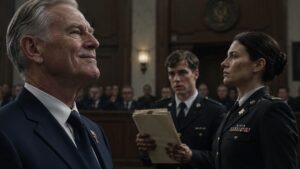
The Old Veteran Waited Beside The Cemetery Gate Until One Officer Finally Read His Name
Chapter 1: The Man Who Would Not Move His Car
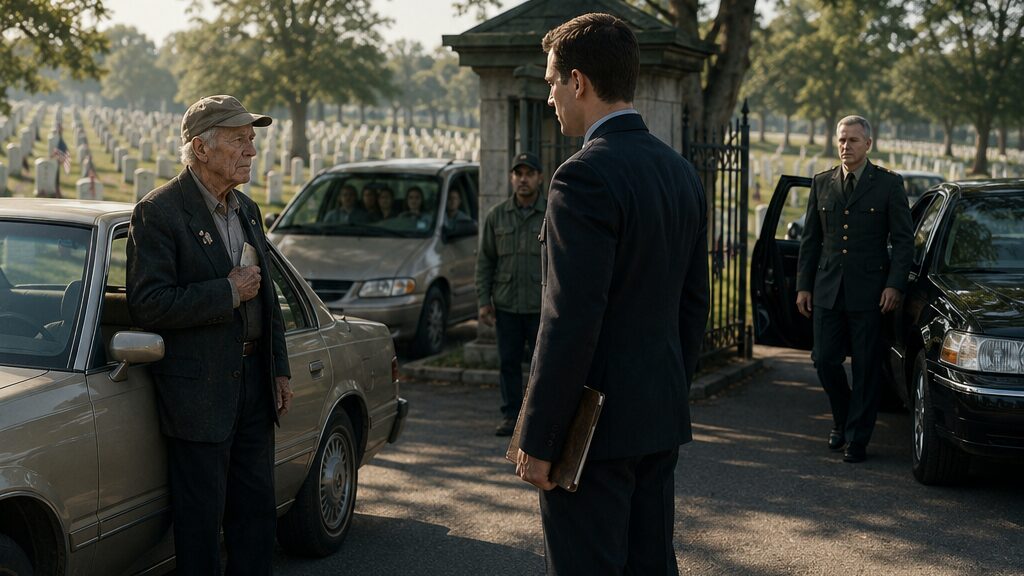
The horn behind David Wright sounded twice before the young serviceman stepped into the lane.
It was not an angry horn, not yet. Just two short taps from a black sedan waiting near the cemetery gate, the kind of sound that said a schedule had already been written and one old man in a beige Buick was not part of it.
David kept both hands on the steering wheel.
Beyond the windshield, the morning had the pale brightness of polished stone. Rows of white grave markers ran up the gentle hill in lines too straight to be natural. Flags trembled beside some of them. A grounds worker walked slowly between sections with a rake over one shoulder. Farther down the main road, an honor guard detail stood in formation near the ceremony shelter, their dark shoes still, their faces turned toward instructions David could not hear.
He had been here enough times to know when a cemetery was quiet and when it was holding its breath.
Today it was holding its breath.
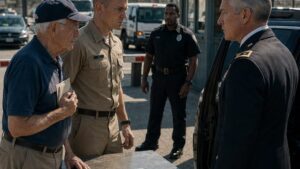
The young serviceman came to David’s driver-side window with quick steps. His uniform was clean enough to catch the sun at the creases. He carried a clipboard under one arm and wore the expression of a man responsible for too many moving pieces.
David rolled the window down halfway.
“Sir,” the serviceman said, polite but clipped, “you can’t stop here. This lane has to stay clear.”
David looked past him at the gate attendant, then at the temporary sign that had been set near a row of orange cones. Ceremony Traffic Only. Authorized Vehicles Beyond This Point.
“I’m looking for Section Twelve,” David said.
The serviceman’s eyes shifted, not toward David’s face but toward the line of cars backing up behind him. “Visitor parking is down the west loop. The attendant can give you a map.”
“The attendant sent me here.”
“He sent you into this lane?”
“He pointed this way.”
The serviceman drew a breath through his nose. “Sir, this is a restricted lane this morning. We’ve got a scheduled service starting in twenty minutes.”
David nodded once, as if the young man had informed him of the weather. He did not move his car.
A second horn tapped behind him.
The serviceman glanced back, then bent slightly so his voice did not carry. “I need you to circle around. You can park by the administration building and someone will assist you.”
“I don’t circle as well as I used to,” David said.
The serviceman paused. Something changed in his eyes then, but not toward understanding. Toward the careful patience people used when speaking to the very old. David had seen that look at grocery counters, doctor’s offices, bank windows, the church hallway after Nancy’s funeral. It was not cruelty. Cruelty would have been easier. It was dismissal wrapped in kindness, and it had a way of making a man feel smaller without anyone raising a hand.
“Do you have an appointment?” the serviceman asked.
David looked down at the passenger seat.
The folded card lay where he had placed it before leaving the house. It had once been white, maybe, before years of handling and drawer dust had turned it the color of dry straw. Its edges were soft. One corner had been bent so often it now held the crease like memory.
He picked it up carefully.
“I have this.”
The serviceman looked at the card, then at David’s jacket. David wore the same dark jacket he had worn to Nancy’s graveside service three months earlier. It was too warm for the June morning, but it was the only jacket with the small pins already fixed to the lapel. One showed the flag. One was a unit crest so worn the enamel had thinned. One was nothing more than a simple bar Nancy had polished every Veterans Day without asking him what it meant.
The serviceman noticed the pins, but only briefly. His attention went back to the traffic.
“Sir, a card isn’t going to get you through this gate today.”
David held the card in both hands. “It has the section.”
“There are public maps.”
“Not for this one.”
The young man’s mouth tightened. He looked toward the administration building, then toward the waiting sedan. A driver in dark glasses lifted one hand off the wheel. Not a wave. A question.
“May I see it?” the serviceman asked.
David’s fingers closed before the young man finished speaking.
The motion was small, but the serviceman noticed. His brows came together.
“It’s all right,” he said, softer now in the tone people used when they thought softness could solve confusion. “I just need to check where you’re trying to go.”
David did not give him the card.
He could hear Nancy’s voice from the kitchen table, thin with sickness but still carrying that old steadiness that had made nurses straighten their backs without knowing why.
Don’t let them put it away again, David.
He had promised her. Not in a dramatic way. They had both been too tired for dramatic promises by then. She had turned the card over with one finger and written his name on the back because her hands shook too much to write more. David Wright. Section Twelve. Near the east oak. Please.
She had slid it toward him as if passing a grocery list.
He had nodded.
Then he had put it in the top drawer of his dresser because promises sometimes needed to wait until a man was strong enough to keep them.
“Sir?” the serviceman said.
David blinked. The cemetery came back into focus: the gate, the cones, the black sedan, the sharp morning light on marble.
“I can wait,” David said.
The young man stared at him. “You can’t wait here.”
David turned off the Buick’s engine.
The silence after the motor died seemed louder than the horn had been.
The serviceman straightened. “Sir, I’m asking you to move the vehicle.”
David placed the folded card against his chest with one hand. His other hand found the door handle, but he did not open it yet. Moving took planning now. His right knee had its own ideas about timing. His left hand was better than his right for pushing, but the card was in his left hand, and he would not set it down where it might slide under the seat.
“I’ll step out,” David said.
“That’s not necessary.”
“It is for me.”
The young man looked behind him again. More vehicles were gathering. A family in a minivan watched through the windshield. The gate attendant stood under the shade of a small booth, pretending not to see enough to be responsible. On the hill, the honor guard remained still.
David opened the door.
The serviceman stepped back quickly, as if afraid the old man might fall toward him. David noticed. He noticed everything now because people rarely believed he did. He planted one shoe on the pavement, waited for the knee, then brought the other foot down. The world tipped slightly and steadied.
He stood.
Before he spoke, he straightened the front of his jacket.
It was an old habit. Nancy used to tease him for it. You stand like somebody’s about to inspect you, David.
Maybe somebody always was.
The serviceman’s eyes dropped again to the pins. This time they stayed there a moment longer.
“Sir,” he said, “I don’t want this to become a problem.”
“It already is one,” David said.
The young man’s face flushed. “I mean for you.”
David accepted that. He even believed him. The young man was not trying to shame him. He was trying to keep the morning moving. That was how most harm arrived now: not with malice, but with a schedule.
The sedan behind them sounded one longer horn.
The serviceman turned sharply, raised a palm toward the driver, then faced David again. His patience had thinned.
“Please give me the card.”
David did not.
“It has my wife’s handwriting on it,” he said.
For the first time, the young man’s expression flickered.
David saw the opening and almost walked through it. He almost said Nancy’s name. He almost said she had asked him to come before the summer heat grew heavy, before his legs gave out entirely, before memory did what winter did to leaves. He almost said he had delayed too long already.
Instead, he folded the card once more along its tired crease.
The young serviceman reached out.
He did not snatch. He did not mean offense. He simply reached as though the paper were a traffic pass, a visitor slip, an item to be checked and returned.
David’s thumb pressed hard against the card.
The serviceman’s fingers stopped an inch from it.
Behind them, the black staff vehicle that had been honking rolled forward and braked close enough for both men to hear the tires bite against the pavement.
The rear door opened.
Chapter 2: The Officer Who Recognized The Name
Larry Robinson knew he had mishandled the old man the moment the staff vehicle door opened.
Not badly. Not in any way that would show up on a report. He had used “sir.” He had kept his voice low. He had not rolled his eyes, though he had wanted to when the Buick’s engine shut off in the middle of the ceremony lane. He had done what he had been told to do: keep the lane open, keep the procession on time, keep confused visitors from wandering into restricted traffic.
But when the black sedan stopped and the senior officer stepped out, Larry felt the mistake before he understood it.
The officer was Alexander Hall. Larry had seen him twice that morning, once during setup and once near the ceremony shelter, where the cemetery director had walked beside him with the nervous energy people reserved for someone whose schedule mattered. Alexander was not tall in a way that announced itself, but he carried stillness like rank. He did not hurry. He did not waste motion. When he emerged from the vehicle, the driver remained silent.
Larry snapped straighter.
“Sir,” he said.
Alexander’s eyes took in the scene: the Buick blocking the lane, the waiting vehicles, Larry’s half-extended hand, and the old man standing beside the open door with a folded card held against his chest.
There was no reprimand in the officer’s face. That made it worse.
“Problem here?” Alexander asked.
Larry glanced at David. “Visitor looking for a restricted section, sir. I was redirecting him to administration.”
The old man said nothing.
Alexander looked at him then, fully.
Larry watched the officer’s face change, not all at once, but in the way light changed when a cloud thinned. His eyes sharpened. His shoulders, already straight, settled into something more formal. He did not look first at the pins, as Larry had. He looked at the man’s face.
“Sir,” Alexander said, and the word was different from the one Larry had used.
The old man dipped his head. “Morning.”
Alexander took one step closer. “May I ask your name?”
Larry nearly answered from the clipboard out of nervous habit, but the old man spoke first.
“David Wright.”
The air shifted.
It was foolish to think air could shift, but Larry felt it anyway. The waiting cars remained where they were. The flags still moved in the faint breeze. The honor guard detail was still a distant line at the edge of the hill. Yet the lane seemed suddenly narrower, as if everyone had stepped closer without moving.
Alexander’s gaze lowered to the folded card.
“David Wright,” he repeated quietly.
Larry heard recognition in the repetition. Not uncertainty. Not checking. Recognition.
The old man’s hand stayed over the card. “That’s what she wrote.”
“She?”
“My wife.”
Alexander did not ask more. He looked once toward Larry’s hand, still hovering between help and intrusion.
Larry drew it back.
A hot embarrassment moved up his neck.
“Mr. Wright,” Alexander said, “would you allow me to see the card?”
The difference was small. Would you allow me. Not give me. Not I need to check. Not let me see.
David looked at him for a long second.
Larry expected the old man to refuse again. Instead, David unfolded the card with slow care. The paper made a dry sound in the morning air. He did not hand it over immediately. He turned it so the officer could read without taking it.
Larry leaned despite himself.
On the front was a printed cemetery map so faded it looked almost blank. A section number had been circled in blue ink, then crossed out, then marked again in pencil. On the back, in uneven handwriting, was a name.
David Wright.
Beneath that, smaller, shakier:
Section Twelve. Near the east oak. Please.
Larry saw Alexander read it.
He saw the officer’s jaw tighten.
For one strange second, Larry thought the handwriting itself had caused it. Then Alexander’s eyes moved from the card to the old man’s lapel, and from the lapel back to David’s face.
“I know your name,” Alexander said.
David’s expression did not change. “A lot of men had it.”
“No, sir,” Alexander said. “Not like yours.”
The old man looked away first, toward the hill.
Larry had never seen a man reject praise without a word. David did not wave it off, did not smile, did not pretend not to hear. He simply stood still as if the words had passed through him and landed somewhere behind.
Alexander brought his heels together.
The motion was not theatrical. There was no command barked, no sudden attention drawn from the ceremony detail. Just one officer in a cemetery lane, standing before an old man with a folded card.
Then Alexander raised his hand in salute.
Larry forgot the cars.
He forgot the clipboard under his arm.
He forgot the morning instructions, the traffic map, the ceremony timeline, and the exact sentence he had been about to say.
David looked at the salute for a moment as if it belonged to someone standing just behind him. Then his hand moved slowly from the card to the edge of his jacket. It stopped there. Not a full return. Not quite. His fingers brushed the worn fabric near the pins, and his chin dipped once.
“Colonel,” David said.
Alexander’s hand remained up one beat longer, then lowered.
Larry swallowed.
He did not know how he had missed it. Not the rank. He still did not know the rank, if there had been one worth naming. He meant the bearing. The way David had stood before speaking. The way he had refused to clutch at importance. The way he had protected the card not because it proved who he was, but because it carried someone else.
The driver behind the black sedan leaned out slightly, ready to ask a question. Alexander turned his head, and the driver withdrew without speaking.
“Robinson,” Alexander said.
Larry stiffened. “Sir.”
“Traffic can use the west loop for ten minutes.”
“Yes, sir.”
“Quietly.”
“Yes, sir.”
Larry stepped backward, then caught himself before he moved too fast. He turned to the gate attendant and signaled the reroute. The attendant stared blankly until Larry pointed with two fingers and mouthed, West loop. Now.
Cars began to shift. Tires whispered over the pavement. A minivan reversed awkwardly. Someone in a sedan lifted both hands in annoyance, but Larry no longer cared about annoyance as much as he had ninety seconds earlier.
When he turned back, Alexander was still with David.
“Are you here for a service?” Alexander asked.
“No.”
“Visiting?”
David looked at the folded card.
“Trying to.”
Alexander’s face softened, but only slightly. “Section Twelve hasn’t been on the public map for years.”
“I know.”
Larry had moved close enough to hear and wished he had not, because the old man’s voice carried something heavier than confusion.
Alexander looked toward the administration building. “The records office can pull the old layout.”
“They told me once it was moved,” David said. “Then they told me it was merged. Then they told me there was no Section Twelve.”
“When was that?”
David folded the card along the same crease. “After Nancy got sick, before she stopped asking.”
Larry lowered his eyes.
He had assumed the old man was lost. Maybe he was. But not in the way Larry had thought.
Alexander glanced at the waiting ceremony shelter, then back at David. “I’m scheduled across the grounds.”
“I’m not asking you to miss it.”
“No, sir,” Alexander said. “I’m asking what you need.”
David’s mouth tightened. For the first time, Larry saw the effort it took him not to look tired.
“I need to find the place on this card,” David said. “And I need nobody to throw it away because the computer doesn’t like it.”
Larry felt those words land where his own fingers had almost taken the paper.
Alexander turned to him.
“Robinson, bring Mr. Wright to records. Park his vehicle properly. Stay with him until someone finds the old section file.”
Larry nodded. “Yes, sir.”
David looked at Larry then. Not unkindly. That made it worse.
“I can walk,” David said.
“I believe you,” Larry said, and heard how different his own voice sounded now. “But the lane is uneven near the office. May I walk with you?”
The old man studied him.
Larry held still.
Finally David nodded.
Alexander took half a step aside, making room rather than leading.
As Larry moved toward the Buick, he saw the card still in David’s hand, folded small and careful, the name hidden again. He had wanted to take it because he thought it was paperwork. Alexander had saluted because he understood it was more than that.
David reached for the car door.
Larry did not touch him.
He waited until David had his balance, then walked at his pace.
Behind them, Alexander’s voice followed, quiet but clear.
“Sir, are you here for Section Twelve?”
David stopped with one hand on the Buick roof.
For the first time since Larry had met him, the old man looked afraid of the answer.
Chapter 3: The Section That Was Not On The Map
The records office smelled of paper, carpet glue, and coffee left too long on a warmer.
David stood just inside the doorway until Larry noticed and moved the nearest chair away from the wall. He did not sit immediately. Sitting too fast made rising worse, and he had learned to keep his weakness from becoming the first thing in the room. He touched the back of the chair, straightened his jacket, and waited while the woman at the counter finished a phone call.
Behind her, metal cabinets lined the wall. Some were new and gray, with printed labels. Others were older, darker, and dented around the handles. A framed cemetery map hung near the doorway, bright and clean, all sections numbered with comforting certainty.
Section Twelve was not on it.
David had checked before anyone told him. His eyes still knew where to look.
The woman hung up the phone and turned toward them. Her nameplate read Nicole Ramirez. She was younger than David had expected for someone responsible for the dead. She had dark hair pulled neatly back and a face trained into professional calm.
“Can I help you?” she asked.
Larry stepped forward. “Mr. Wright needs assistance locating an older section designation. Colonel Hall asked that we pull any archived layout for Section Twelve.”
Nicole looked from Larry to David. Her eyes paused at the jacket pins, then at the folded card in his hand. Unlike Larry, she did not reach for it.
“Section Twelve?” she said.
David nodded.
“We don’t use that designation anymore.”
“I was told.”
“It may correspond to a current section. Do you have a grave number?”
“No.”
“Interment name?”
David’s hand tightened around the card. “Not exactly.”
Nicole waited.
Larry stood near the door, too straight, as if he were still at the cemetery lane and trying to make up for it by posture alone.
David unfolded the card. He turned it front side up and placed it on the counter, keeping two fingers on the bottom edge.
Nicole leaned over it.
“This is very old,” she said.
“Yes.”
“The map layout has been revised several times.” She looked closer. “This circle doesn’t match our current grid.”
“It matched when she wrote it.”
“Your wife?”
David looked at her then.
Nicole’s tone had not been sharp, but it had been quick. Efficient. The tone of someone sorting a problem into fields and categories. David did not resent it. He had once spoken that way to young men who asked whether they would be home by winter.
“Yes,” he said. “Nancy.”
Nicole’s fingers hovered near the paper. She stopped herself before touching it. David noticed. Larry noticed too.
“May I?” she asked.
David lifted his fingers.
She turned the card over.
Nancy’s handwriting faced up under the fluorescent lights.
David Wright.
Section Twelve. Near the east oak. Please.
For a moment nobody spoke.
Nicole read the words, then read them again as if more might appear if she gave them time.
“There’s no interment name listed,” she said gently.
“No.”
“Was Mrs. Wright buried here?”
David’s eyes moved past her to the map on the wall. Bright. Updated. Certain.
“She was cremated,” he said. “Her ashes are with our daughter.”
Larry shifted in the corner.
Nicole’s expression became careful. “Then what are you trying to locate, Mr. Wright?”
“The place she meant.”
“I understand, but for cemetery records, we need a specific grave, memorial marker, or eligible interment request.”
David let out a breath. He had expected this. Not the exact words, but the shape of them. Every office had its way of saying no without wanting to sound unkind.
“She didn’t want a marker,” he said. “Not for herself.”
Nicole lowered the card to the counter.
David’s fingers returned to its edge.
“She wanted me to come here,” he said. “To the east oak. Section Twelve. She said I would know where to stand once I found it.”
Nicole looked at Larry, then back at David. “There are several oak trees on the grounds.”
“Not like that one.”
“Do you remember what section it was near on a newer map?”
“If I did, I would not be standing here.”
The words came out drier than he intended.
Larry lowered his head. Nicole accepted the correction without offense.
“I can search archived maps,” she said, “but I need to be honest with you. If Section Twelve was renumbered, merged, or altered during reinterment work, it may take time to verify.”
“I have time today.”
“It may take more than today.”
David folded his hands over the card so they would not see them shake.
“I don’t,” he said.
Nicole’s professional calm faltered.
He wished he had not said it that way. It sounded like a plea, and David had never liked pleading. But he was tired. The drive had been longer than he admitted to himself. The walk from the lane had left a thin pain in his hip. The office lights hummed above him, and Nancy’s handwriting lay exposed between strangers.
Nicole turned to the computer.
“What is your full name?”
“David Wright.”
“Date of birth?”
He gave it.
Larry looked up then. There was no dramatic reaction, but David saw the calculation cross his face. Late eighties. Old enough for one war, maybe two. Old enough to be treated like furniture by people who did not know what he had survived.
Nicole typed. The keyboard sounded too loud.
“I have visitor logs under that name,” she said. “Several years back. Memorial Day entries. Veterans Day entries.”
David said nothing.
“Were you visiting a particular grave?”
“Yes.”
“Name?”
He closed his eyes briefly.
There were names he still carried by order of death. Names Nancy had listened to in the dark when he thought she was sleeping. Names he had visited when he could, and avoided when he could not bear the counting.
“More than one,” he said.
Nicole stopped typing.
Larry’s gaze moved to the window.
Outside, the cemetery rolled away in white rows under the brightening sky. A bugle sounded faintly from the ceremony shelter. Not taps. A rehearsal note, broken off midway.
Nicole opened a drawer, then another. “The current digital system won’t help with unofficial notes. Let me check the archived section conversion files.”
She crossed to the older cabinets. Her fingers moved along the labels: Original Plot Index, Conversion Maps, Reinterment Records, Pre-Digitization Visitor References.
David remained standing.
Larry noticed. “Mr. Wright, would you like to sit?”
“Not yet.”
Nicole pulled one drawer. It stuck. Larry moved to help, then stopped and looked at her first. She nodded. Together they eased it open.
File folders shifted inside with a dry, heavy sound.
Nicole searched through them, lips moving silently as she read tabs. David watched her hands. They were careful hands. Not sentimental, but careful. He trusted careful more than kind.
Minutes passed.
The phone rang twice. Nicole ignored it. A clerk from another room stepped in, saw the scene, and quietly stepped back out.
At last Nicole withdrew a folder thinner than the others. Its label had been typed long ago, then marked over in red pencil.
SECTION 12 — EAST GROUNDS — UNVERIFIED.
David’s fingers tightened on the counter.
Nicole looked at the folder, then at him.
Larry took one small step closer.
On the front, beneath the red pencil, someone had written another note in faded ink.
D. Wright
Chapter 4: The Promise Written On The Back
Nicole Ramirez had handled thousands of records, and she had learned early not to imagine too much.
A name was a name. A date was a date. A plot number was not a story; it was a location. If she allowed every folded flag, every delayed request, every trembling signature to become personal, she would never finish a day’s work. The cemetery had rules because grief did not. Her job was to keep one from swallowing the other.
But the old folder in her hands did not feel like a record.
It felt like something that had been waiting.
She carried it back to the counter and laid it beside David Wright’s folded card. Larry Robinson stepped closer but said nothing. David remained standing, his fingers resting against the counter’s edge, not gripping it exactly, but close enough that Nicole noticed the effort in his stillness.
“Mr. Wright,” she said, “this file is marked unverified. That means the designation was either changed, retired, or not fully transferred into the current index.”
David looked at the folder. “But it existed.”
“Yes.”
The word changed his face more than the salute had.
Not relief. Not yet. Relief was too large for a man who had learned not to trust easy doors. His eyes simply settled on the folder, and something in his shoulders lowered by the smallest degree.
Nicole opened the file.
Inside were old maps, photocopied work orders, handwritten notations, and a narrow sheet listing section conversions from decades earlier. The paper was thin and soft at the edges. Some numbers had been circled; others were crossed through. On one sheet, Section Twelve appeared near the east grounds, bordered by an access road that no longer existed and a tree line that had since been cleared.
Near one corner was a handwritten note:
Visitor reference: D. Wright. East oak. Multiple visits. No active case.
Nicole looked up. “You’ve been here before.”
David’s gaze stayed on the page. “Yes.”
“How many times?”
“Enough to know when a tree is missing from a map.”
Larry looked toward the window.
Nicole turned another sheet. “This note says multiple visits, but no active case. Were you trying to file a request before?”
David’s hand moved to the card. “Nancy was.”
“Your wife?”
He nodded.
“What was she requesting?”
The office grew quiet around the question.
David looked down at Nancy’s handwriting. The word please was smaller than the rest, as if she had run out of strength before reaching the end. Nicole saw his thumb move toward it, then stop just before touching.
“She wanted me to find the place where I stopped going,” he said.
Nicole waited.
Larry shifted his weight but did not interrupt.
David gave a faint breath that was almost a laugh but had no humor in it. “She knew I came here on Memorial Day. Veterans Day. Some birthdays if I remembered them before they passed. She knew I parked by the old road and walked until my knees complained. But there was one place I stopped visiting.”
“Section Twelve,” Nicole said.
“Yes.”
“Why?”
David looked at her. His eyes were pale, steady, and very tired.
“Because I knew too many names there.”
Nicole lowered her gaze to the file.
Rules. Procedures. Forms. She could feel them lining up in her mind, asking for their place in the conversation. She knew what the cemetery could and could not authorize. She knew that personal promises could not alter public records without documentation. She knew the director would ask for verification, written authorization, a current section match, and a reason the old visitor reference mattered.
She also knew that if she said all of that now, she would be turning Nancy Wright’s handwriting back into a paper problem.
“Was Mrs. Wright asking to be placed here?” she asked carefully.
“No.” David shook his head. “Nancy never wanted a stone. She said I already had enough stones in my head.”
Larry looked down.
“She wanted me to bring a note,” David said. “That was all. A note, a prayer maybe. She didn’t care if anyone else knew. She said if I found the east oak, I’d know where to stand.”
Nicole looked again at the map. “The east oak may have been removed.”
“I figured.”
“And Section Twelve may not exist under that name anymore.”
“That’s why I came while I still could argue.”
The line might have sounded stubborn from another man. From David, it sounded like an apology to time.
Nicole glanced at the clock. Ceremony traffic would be moving for another hour. The director would be tied up. The current records system would not accept “place where his wife told him to stand” as a searchable field.
“I can begin a formal archival request,” she said. “We can scan the card, compare the old map to the current grid, and contact you when we have confirmation.”
David’s face closed gently.
Not in anger. In acceptance.
Nicole hated that most of all. He had expected to be postponed. He had trained himself for it before she even said the words.
“How long?” he asked.
“It depends.”
“How long usually?”
Nicole glanced at Larry. He gave no help. He only watched her with the same discomfort she felt.
“Several weeks,” she said.
David nodded once. He folded the card with slow precision.
Larry spoke before Nicole could.
“Ma’am, Colonel Hall said to pull the old section file.”
“I did.”
“He said to stay with him until someone finds it.”
Nicole kept her eyes on David. “We found the file. We haven’t verified the current location.”
Larry’s jaw tightened. “Can we do that today?”
“With a ceremony on the grounds, limited staff, and an unverified retired section?” Nicole looked at him then. “Not easily.”
“Not easily isn’t no.”
The words hung there.
David turned his head toward Larry. There was no triumph in his expression, only a quiet warning against making this larger than it was.
Nicole saw it and understood something she had missed. David did not want a young serviceman fighting for him in the office. He did not want a scene. He wanted someone to take the card seriously without taking his choice away.
She closed the folder halfway.
“Mr. Wright,” she said, “did Mrs. Wright write anything else? Any other note, date, name, or reference?”
David’s thumb stayed on the crease of the card.
“For years, no,” he said. “She just reminded me. Section Twelve, east oak. I told her there was no reason to go back. She said there was always a reason to go back if a man was still carrying what belonged in the ground.”
Nicole felt the sentence settle inside her.
“When she got sick,” David continued, “she asked me for the card. I thought she wanted to throw it away. She wrote my name on the back instead.”
His voice did not break. Somehow that made the words harder to hear.
“She said, ‘They’ll make you explain yourself, David. I know you. You’ll turn around before you do. So let the card start for you.’”
Nicole looked at the handwriting again.
David Wright.
Section Twelve. Near the east oak. Please.
It was not a form. It was a wife leaving a door open for a husband too proud, or too wounded, to knock.
Nicole reached for the file, then stopped.
“May I make a copy of the card?” she asked.
David hesitated.
“Not to take it from you,” she said. “To compare the handwriting note with the visitor reference. You keep the original.”
He studied her, then unfolded it one more time and slid it forward.
The trust in the gesture was not complete. But it was something.
Nicole copied both sides, then placed the original back in front of him with both hands. She did not know why she used both. She only knew one hand felt wrong.
“I’ll check the conversion sheet against the grounds archive,” she said. “If Section Twelve became part of another section, there will be a work order.”
“How long?” David asked.
“Today,” Nicole said.
Larry looked at her.
Nicole opened the folder again before she could change her mind. “But I need to be clear. Finding the place doesn’t mean I can authorize any change or memorial placement today.”
David took the card and tucked it inside his jacket. “I didn’t ask for a marker.”
“What are you asking for?”
He looked toward the window, where the white stones continued beyond the glass.
“A place to stand,” he said.
Nicole turned back to the file cabinets. This time she did not search as if she were hunting for a number. She searched as if the number belonged to someone.
Folders came open. Old maps spread across the counter. Larry helped hold down curling corners. A clerk brought a heavier binder from storage and left without speaking. Nicole compared grids, road names, tree lines, and reinterment notes until the bright certainty of the modern wall map began to look thin.
Then Larry, standing over the conversion sheet by the window, pointed to a faded line.
“What’s this?”
Nicole leaned in.
The note was written in red pencil beside the retired section:
East Grounds Twelve consolidated after reinterment. See Section 12A transfer — oak removed, memorial line retained.
Below it was a current section reference.
Larry read it aloud, quietly.
Nicole looked up at David.
David’s hand moved inside his jacket, over the card.
Larry’s finger remained on the line as if he were afraid the past might vanish again if he lifted it.
Chapter 5: The Graves He Still Counted
The cemetery cart moved slowly because David asked it to.
Larry drove with both hands on the wheel, though the little electric cart did not require much steering. Nicole sat beside him with the archive folder on her lap. David sat in the rear-facing seat, facing the road they had already passed. It made him feel as if the cemetery were unrolling backward before him, each row of stones appearing and receding like names half-remembered in sleep.
He did not mind facing backward.
Most of his life had felt that way.
They left the administration building and followed a service road that curved away from the ceremony shelter. The bugle practice had stopped. A chaplain’s voice drifted faintly over the grass, too far away for words, close enough for cadence. Families stood in small clusters near polished markers. Some had flowers. Some had folded chairs. Some stood empty-handed because grief often arrived before planning did.
Larry slowed near a fork in the road.
“Current section marker says 12A is this way,” he said.
Nicole checked the copied map. “Yes. The old access road would have run along that ridge.”
David looked past them.
The ridge was lower than he remembered. Or he was higher in memory than he was now. The old road had been gravel once, pale and uneven, with weeds along the edges and a drainage ditch deep enough to twist an ankle if a man stepped carelessly. Nancy had disliked that road. She said cemeteries should not make widows climb.
There had been an oak near the bend. Not large in the way storybook oaks were large, but stubborn. It leaned slightly east, as if listening for something from the hills.
David had stood beneath it the first time because he could not make himself step closer to the stones.
“Stop here,” he said.
Larry braked at once.
Not too sharply. David noticed.
The cart settled beside the road. Ahead, newer section markers stood in clean rows. The current sign read 12A, but the stones themselves were older than the sign, their surfaces softened by years of weather. The grass was bright and recently cut. No oak stood anywhere.
“There used to be a tree,” Larry said, then seemed to regret saying it.
“Yes,” David replied.
Nicole opened the folder. “The work order says the oak was removed after root damage affected several markers. Some remains were reinterred or realigned. Most stones stayed within the memorial line.”
“Most,” David said.
Nicole did not answer.
David stepped down from the cart before Larry could move to help. His hip protested, and the ground lifted slightly under him, but he waited. He had learned to let pain pass through without giving it conversation.
Larry came around anyway, stopping an arm’s length away.
David looked at him. “You hovering?”
Larry’s face went red. “Trying not to.”
David almost smiled. “Keep trying.”
The young man stepped back.
Nicole stayed by the cart with the folder. “Mr. Wright, do you know which names you’re looking for?”
David looked at the stones.
“Yes.”
He began walking.
The first row was not the one. He knew before reading. Wrong spacing. Wrong slope. The second row made him slow. He stopped at the end, straightened his jacket, and stood before speaking.
Larry and Nicole remained behind him.
David read the first name in silence.
He did not say it aloud. Not yet.
He moved to the next. Then the next.
His body remembered this better than his mind wanted to admit. Stop. Stand. Read. Breathe. Move. It was not ceremony, not exactly. It was counting. He had counted men into trucks, counted them out of trucks, counted letters sent, counted empty bunks, counted days until home, then counted years after home when nobody asked him to count anymore.
At the fourth marker, he stopped longer.
The name was still there.
The dates were still there.
He had no right to be surprised. Stone was better at staying than flesh. Still, his throat tightened.
Larry’s boots sounded softly behind him, then stopped.
David did not turn. “He was nineteen.”
Larry said nothing.
“He lied about his age,” David said. “Everyone knew. Nobody said anything because we needed hands.”
The wind moved through the grass.
David walked to the next marker.
“This one could sing,” he said. “Badly. Loud enough to make men throw socks at him.”
Another step.
“This one kept a picture of his mother tucked inside his helmet liner. Said it made him duck faster.”
Nicole’s hand tightened around the folder.
David had not meant to speak this much. The words came because the place had opened under him. Not the ground. The years.
He stopped at a gap where the row bent slightly.
“This isn’t right,” he said.
Larry looked from the map to the stones. “What isn’t?”
David pointed with two fingers. “There should be another marker here.”
Nicole came forward. “Some stones were realigned after the reinterment work.”
“No.”
She paused.
David heard the hardness in his own voice and softened it with effort. “No. There was a marker here. Small chip near the top. I remember because Nancy brought flowers once and said the stone looked like it had taken a breath wrong.”
Larry studied the row. “Do you remember the name?”
David closed his eyes.
For a moment, nothing came. That frightened him more than he expected. Not death. Not pain. The blank. The place where a name should be.
He opened his eyes quickly.
The row blurred.
Larry stepped forward, then stopped himself.
Nicole turned pages in the folder. “If a marker was moved, there should be a transfer notation.”
David walked farther down the row. He did not use his cane because he had left it in the car, out of vanity or habit or foolishness. Nancy would have scolded him. She had scolded him even when she had no strength left to lift a cup.
You don’t get extra credit for falling, David.
He reached the end of the row and turned.
The old oak was gone, but its absence had a shape. He could see where shade used to fall. He could see himself younger, standing with his hat in his hands, Nancy beside him in a blue dress, her fingers resting lightly against his sleeve. He had not gone near the stones that day. She had.
She had read the names. Every one he could not.
Then, years later, when sickness had thinned her voice, she had said the thing that angered him enough to leave the room.
You visit the men you can forgive yourself for losing.
He had not answered.
Because he had known exactly which row she meant.
David walked back toward the gap.
Larry was crouched now, looking at the base of the markers without touching them. “There’s an alignment pin here,” he said. “And another there. Looks like something was between.”
Nicole knelt carefully in the grass with the folder spread open beside her. “The reinterment note says three stones were shifted from the old east line to the current memorial line. One marker temporarily removed for repair.”
“Temporarily,” David said.
Nicole turned a page.
Larry looked up. “What name?”
Nicole read silently, then once more.
David waited. Waiting was supposed to get easier with age. It did not.
Nicole’s face changed.
“What?” Larry asked.
She looked at David. “There’s a repair tag, but no completion mark.”
David’s hand went to his jacket.
The folded card was there. Nancy’s handwriting, his name, the place she had sent him.
“What does that mean?” Larry asked.
Nicole closed the folder halfway. “It may mean the marker was never returned to this row.”
David looked at the empty place.
He had thought Nancy sent him here to stand. To pray. To stop avoiding an old sorrow before it outlived him.
But the place itself had been waiting too.
Larry rose slowly. “Mr. Wright, whose marker was it?”
This time the name came, not gently, but all at once.
David said it.
The wind moved through the grass again, and for a moment he was twenty-three, holding a list nobody wanted to read.
Nicole checked the folder.
Larry stepped back, his face pale with the understanding that he had not been looking at rank or history or even one old man’s memory.
He had been looking at a grave that had gone missing from its place.
Chapter 6: Permission Before Touching The Card
Larry Robinson had never been afraid of paperwork before.
He had disliked it, ignored it when he could, hurried through it when he could not, but he had never looked at a form and felt that a wrong line might become a second burial.
In the cemetery director’s office, the correction request lay centered on the desk. It looked harmless. Clean white paper. Boxes. Signature lines. A place for supporting documentation. A place for authorization. A place for remarks, which seemed far too small for what David Wright had carried into the building.
The cemetery director stood behind the desk, reading Nicole’s notes with a frown that was more burden than disbelief. Alexander Hall stood near the window, hands loosely behind his back. He had removed himself from the center of the room by choice, but his presence still held the air steady.
David sat in the chair nearest the door.
He had not wanted the chair at first. Larry had seen the refusal forming and had almost said, Please sit. Instead he had moved the chair so David could choose it without being offered weakness. After a moment, David sat.
The folded card rested inside his jacket.
Larry knew because David touched that spot whenever the conversation grew too official.
Nicole stood beside the desk with the archive folder, the copied map, and the repair notation. Her calm had changed since the morning. It was still professional, but no longer distant. She answered the director’s questions precisely, never once saying “the old man thinks” or “he believes.” She said, “Mr. Wright identified the original line.” She said, “The archived conversion supports his location.” She said, “The repair tag lacks completion.”
Each sentence moved something.
Not fast enough.
The director set down the page. “We can submit an internal review today. Actual marker relocation or confirmation requires facilities verification, preservation clearance, and next-of-kin or military record cross-check depending on the individual.”
David looked at the floor.
Larry felt his own hands curl.
Nicole said, “The marker is not being relocated today. We’re asking to confirm why the repair was not completed and whether the stone is in storage.”
“That still requires authorization.”
Alexander spoke then. “I can verify the unit record connected to the old section reference.”
The director looked toward him. “That helps, Colonel, but it does not replace cemetery process.”
“No,” Alexander said. “It shouldn’t.”
Larry glanced at him, surprised.
Alexander’s eyes stayed on David. “Mr. Wright is the one who needs to make the request.”
The room turned toward the old man.
David did not move.
For a few seconds, the only sound was the muted thrum of an air vent and a distant mower beyond the glass. Larry looked at David’s hands. The fingers were bent with age, the knuckles large, the skin thin enough to show blue lines beneath. Earlier that morning Larry had nearly taken the card from those hands as if impatience were authority.
He stepped closer, then stopped.
“Mr. Wright,” Nicole said gently, “if you authorize the request, we can attach your card copy, the archived visitor reference, and the section conversion sheet. That will let us open the review today.”
David’s mouth tightened. “And if I don’t?”
“Then I can still flag the repair discrepancy,” Nicole said. “But your statement connects the old section, the missing marker, and the visitor reference. Without it, the file may move slower.”
“How much slower?”
Nicole did not answer quickly.
David gave a small nod. “That much.”
Larry looked at the correction request. The signature line waited.
Alexander stepped away from the window. “Sir, no one in this room should tell you what to carry.”
David looked up at him.
“But if you want the record corrected,” Alexander said, “it has to begin with your voice.”
David’s eyes moved from Alexander to Nicole, then to Larry.
Larry wanted to say he was sorry again, but he had already said it once on the ride back from the old section. David had heard him, nodded, and ended the matter with a silence Larry was still trying to understand. Sorry was easy compared with standing still long enough to be useful.
The director slid a pen across the desk.
David did not reach for it.
Instead, he reached inside his jacket and withdrew the folded card.
The room seemed to wait for the paper.
David held it in his lap for a moment. Then he looked at Larry.
“Would you hold this?”
Larry took one step forward too quickly, then stopped.
The memory of his hand reaching at the gate struck him so sharply that his face warmed.
He lowered his voice. “May I?”
David studied him.
It was not a test exactly. It was more serious than that. A test could be passed. This required remembering.
“Yes,” David said.
Larry held out both hands.
David placed the card in them.
It weighed almost nothing. It felt heavier than the clipboard had all morning.
Larry did not unfold it. He did not turn it over. He simply held it while David reached for the pen.
The old man’s hand shook before it touched the paper.
Nobody spoke.
David adjusted the correction request with two fingers, aligning it squarely with the edge of the desk. Larry thought of the way he had straightened his jacket before speaking, the way he had stood at each grave marker before allowing a name into the air. Even now, even seated, he prepared himself.
The director pointed to the signature line. “Here, Mr. Wright.”
David looked at the space.
“What does it say I’m asking?”
Nicole leaned slightly forward. “That the cemetery review the retired Section Twelve conversion, verify the missing marker from the east line, and correct any incomplete repair or placement record.”
David nodded. “Does it say Nancy?”
Nicole looked at the form. “No.”
“Can it?”
The director hesitated. “Mrs. Wright is not part of the official cemetery record.”
David’s eyes lowered.
Larry felt the room begin to slip back into procedure.
Nicole opened the copied card and placed it beside the request. “Her handwriting is supporting context. We can reference the submitted visitor note in the remarks.”
The director looked doubtful.
Alexander said nothing.
Nicole took the pen from the desk, not from David, and wrote in the remarks field with small, controlled letters:
Submitted with original family-held location card bearing handwritten request by Nancy Wright.
She turned the form back.
David read the line slowly.
“Family-held,” he said.
“Is that all right?”
He nodded.
The pen looked thin in his hand. His fingers tightened around it once, loosened, tightened again. He started the D and stopped. For a moment Larry thought he would not finish.
Then David signed.
Not smoothly. Not beautifully. But fully.
David Wright.
When it was done, he kept his hand on the paper a second longer, as if a signature could take something out of a man that needed time to leave.
Larry stepped forward with the card.
He did not place it on the desk. He did not give it to Nicole. He waited until David looked up.
“Mr. Wright,” Larry said, “may I return this?”
David’s eyes moved to Larry’s hands.
The old man reached out.
Larry placed the folded card back into his palm with both hands, careful not to let go before David had it.
David tucked it inside his jacket.
The director gathered the papers, but more slowly now. Nicole clipped the copied card to the request. Alexander looked out toward the cemetery grounds, where the afternoon light had begun to soften over the rows.
“We can go back out,” Nicole said. “If you’d like.”
David looked tired enough to disappear into the chair. For a moment Larry thought he would refuse, that the signature had cost him the last of the day.
Instead, David pushed himself upright.
Larry did not move to help. Not until David looked at him.
Then the old man gave the smallest nod.
Larry offered his arm, not as rescue, but as something requested.
David took it.
Together they stepped back toward the door, the correction request behind
Chapter 7: A Salute Quiet Enough To Mean Something
By sunset, the cemetery no longer looked like a place arranged for visitors.
The morning signs had been taken down. The ceremony shelter stood empty except for two folded chairs forgotten near the back. The family clusters had thinned into single cars moving slowly toward the gate. Shadows from the grave markers stretched across the grass, each one longer than the stone that cast it.
David Wright rode in the cemetery cart without speaking.
Larry drove slower than before. Nicole sat beside him with the folder closed on her lap. Alexander followed behind them on foot for part of the way, then stopped near the service road, as if he understood that some distances should not be crossed by rank.
David noticed.
He noticed, too, that Larry did not ask if he was all right. The young man had asked earlier, twice, and both times David had answered with the same lie older men used when they were tired of making their bodies public.
I’m fine.
Larry had accepted it the third time by not asking.
The cart stopped near Section 12A.
The missing space waited in the row as if it had always been visible and only David had refused to see it. Late light rested on the tops of the stones. The grass around the gap had been trimmed cleanly, the small alignment pins still half-hidden near the soil.
Nicole stepped down first. She carried no forms now, only the old folder and a single copy of the map. Larry came around to David’s side, then stopped at the distance he had learned.
David placed both hands on his knees.
For a moment, standing seemed like a thing he had done in another life.
He felt the weight of the day in his hip, his back, his hands, behind his eyes. The drive. The horn. The office. The names. The empty place. The signature. All of it had gathered inside him until his chest felt too crowded for breath.
Then Larry extended his arm.
He did not speak.
David looked at the arm, then at the young man’s face.
There was no pity in it. No hurry either.
David took it.
The ground did not tilt as much this time. Or perhaps he simply did not have to pretend it was level.
They walked to the row together. Nicole remained a few steps behind. Alexander stood near the road, cap in hand, looking toward the hill rather than toward David.
At the empty space, David released Larry’s arm.
He straightened his jacket.
The old pins caught the last of the sun. The flag. The worn unit crest. The plain bar Nancy had kept polished until her fingers could no longer hold the cloth.
David reached inside the jacket and took out the folded card.
The paper had been opened and closed so many times that the creases had gone soft as fabric. He held it in both hands and turned it over. Nancy’s handwriting looked darker in the evening light.
David Wright.
Section Twelve. Near the east oak. Please.
He had spent three months thinking the please was for the cemetery.
Now he knew better.
It had been for him.
Please come back.
Please stop leaving that row unfinished.
Please let someone else know where to stand when you can’t.
He drew a breath and looked at the gap.
“I found it,” he said.
The words were not loud. They did not need to be.
Larry lowered his eyes. Nicole held the folder against her chest.
David looked down the row and read the stones again, one by one. The names came more easily now. Not because they hurt less, but because he had stopped trying to keep them silent.
At the gap, he said the missing name.
No stone answered. No bugle sounded. No flag moved differently. The cemetery did not rearrange itself around the moment.
Still, something settled.
David unfolded the card fully and pressed the crease flat against his palm.
“I should have come sooner,” he said.
The wind moved over the grass.
He could imagine what Nancy would have said. Not with accusation. Never that. She had never wasted cruelty on truth.
You came when you could.
He swallowed and looked toward the empty place where the oak had once stood.
“I told myself I was honoring the ones I visited,” he said. “Truth was, I was avoiding the ones who asked more of me.”
Larry’s voice came quietly from beside him. “Asked what, sir?”
David looked at him.
The young man did not flinch from the question he had asked. That mattered.
“To remember without choosing,” David said. “To stop deciding which names I could bear.”
Larry’s face changed, not with full understanding, because he could not have that. But with effort. Sometimes effort was the beginning of respect.
Nicole stepped forward. “The review will open tonight. I can’t promise how quickly the marker will be located, but the repair record won’t stay buried in storage.”
David nodded.
“I know that doesn’t fix today,” she said.
“No,” David said. “It fixes how tomorrow begins.”
Nicole looked down.
Larry shifted once, then stilled. “When they find it,” he said, “will someone call you?”
David looked at the card. “If I’m there to answer.”
Larry’s jaw tightened.
David almost regretted the words, but not enough to take them back. Age made other people uncomfortable because it spoke plainly about endings. He had spent too long softening facts for the young.
Nicole said, “We can also notify your family.”
David nodded. “Our daughter.”
He folded the card once. Then again.
For years, he had carried it like evidence against himself. Proof that Nancy had asked and he had delayed. Proof that there was one place in the cemetery where he still lacked the courage to stand.
Now the card felt different.
Not lighter. Sacred things were rarely light.
He slipped it inside his jacket, over his heart, where Larry had first seen him hold it at the gate.
Alexander approached then, slowly enough that David could refuse the interruption if he wished. He stopped beside Larry, not in front of David.
“Mr. Wright,” Alexander said, “the director will send confirmation of the request before close of business.”
“Good.”
“And I’ll add what I can from the unit record.”
David gave him a tired look. “Careful, Colonel. Paperwork spreads.”
Alexander’s mouth softened. “So I’ve heard.”
For a brief moment, David felt Nancy there in the almost-smile, in the dry remark, in the mercy of not making grief larger than it needed to be.
He turned back to the row.
“I didn’t come here for a salute,” he said.
“No, sir,” Alexander said.
“I know what men think it means. Sometimes it means respect. Sometimes it means they don’t have to ask anything harder.”
Larry looked down sharply.
David saw it and let the words finish their work.
Then he said, “This morning, you saluted before you knew why I was here.”
Alexander stood very still.
David faced him. “This evening, I’d rather you know.”
Alexander’s eyes lowered for a moment, not in shame, but in acceptance.
“Yes, sir.”
David nodded toward the empty space. “Nancy sent me back because I left a man out. Not from the record. From myself.”
No one answered.
The sun touched the horizon beyond the far line of trees. The stones glowed briefly, then cooled.
David’s legs trembled. Larry saw it but did not move until David gave him the smallest glance. Then the young man came beside him and offered his arm again.
David took it without embarrassment this time.
They walked back toward the cart.
At the road, Alexander brought his heels together. Larry noticed and did the same, but not as a copy. His movement was quieter, less polished, more careful.
Alexander saluted first.
Larry did not raise his hand immediately. He looked at David, then at the row behind him, then back at David as if asking whether the gesture had room to belong here.
David held his gaze.
Larry raised his hand.
There was no audience for it. Nicole stood with the folder. The grounds worker passed far away near another section. A car rolled slowly toward the gate, its headlights just beginning to show in the dimness.
David did not return the salute fully.
His hand rose only to his jacket, to the place where the folded card rested. His fingers pressed there once.
That was enough.
Alexander lowered his hand.
Larry lowered his.
“Thank you,” Larry said.
David looked at him. “For what?”
Larry took a breath, then chose not to reach for an easy answer.
“For letting me learn slower than I should have.”
David studied him a moment. “Learn faster next time.”
“Yes, sir.”
Nicole opened the cart’s rear gate. “Mr. Wright, would you like us to take you back to your car?”
David looked toward the distant cemetery gate. In the morning, he had waited there as an obstacle. Now the lane was clear, the cones gone, the black staff vehicle absent.
“Yes,” he said. “But not too fast.”
Larry helped him into the seat, then waited until David was settled before closing the gate. Nicole climbed in with the folder. Alexander stayed beside the road.
As the cart began to move, David looked back at Section 12A.
The missing marker was still missing. The oak was still gone. Nancy was still beyond reach. No salute could change any of that.
But the empty space had a name again.
And someone else had heard it.
The cart rolled past the rows in the fading light. Larry drove with his shoulders straighter than he had that morning, but softer too, as if he had learned that standing at attention and paying attention were not the same thing.
At the gate, David’s Buick waited alone.
Larry helped him down, then stepped away while David found his balance. The old man opened the driver’s door, paused, and looked once more across the cemetery.
Nicole stood quietly with the folder held in both arms.
Alexander had not followed them to the gate.
David was grateful for that.
Some respect knew when to remain at a distance.
He lowered himself into the car, closed the door, and started the engine. Before he pulled away, he reached inside his jacket and touched the folded card one last time.
Not to make sure it was there.
To tell Nancy he had kept it.
Larry stood near the lane as the Buick rolled forward. When David passed, the young serviceman did not wave. He simply stood straighter.
David drove through the cemetery gate as the last light left the stones behind him.
The story has ended.