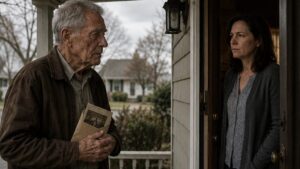
The Old Veteran Kept His Hand on the Black Case Until They Finally Asked Why
Chapter 1: The Old Man at Lane Seven
The desert had a way of making every sound honest.
Boot soles on gravel. Brass hitting concrete. The dry clack of a safety lever. Voices carrying farther than people meant them to. Even under the long shade roof, with the wooden shooting benches lined in a row like church pews facing a hard horizon, nothing stayed private for long.
Thomas Bennett knew that before he stepped out of his truck.
He sat behind the wheel for a moment with both hands resting on top of it, feeling the old vinyl cover warm beneath his palms. The range lay ahead of him beyond a chain-link gate and a faded sign warning visitors to check in before handling firearms. Past the gate, young men in tan and green moved with the quick assurance of bodies that did not yet complain when they bent down or stood up too fast. Some wore tactical vests. Some had caps pulled low. A few laughed near the water cooler, their voices bright and careless in the heat.
Thomas watched them without resentment.
He had been young once. He had stood that straight once. He had believed a stiff back meant discipline and a loud answer meant confidence. Time had taught him the difference.
On the passenger seat lay a black soft rifle case, long and narrow, the fabric worn smooth at the handle. He had cleaned it the night before with a damp cloth, not because it was dirty, but because his hands needed something to do. Beside it sat a small laminated pass with a cracked corner and a faded blue stripe. The pass had been in his kitchen drawer for three months, under a stack of paid bills and a packet of batteries. He had taken it out twice a week to make sure it was still there.
Now that he was here, the little card looked thinner than he remembered.
Thomas picked it up and held it close to the steering wheel. His name was still readable. The date was not as kind. He lowered it into his shirt pocket, then reached for the case.
The weight of it pulled at his shoulder before he had cleared the truck seat. His right knee complained when his boot found the gravel. He waited, breathing through his nose, until the joint settled into obedience. Then he locked the truck and walked toward the office.
The clerk behind the window was young enough to call him sir without meaning anything by it.
“Checking in?” the clerk asked.
“Yes.”
Thomas slid the pass through the half-moon opening beneath the glass.
The clerk glanced at it, then at the computer, then back at the card. His smile thinned.
“This is an older format.”
“I was told to bring that one.”
“Who told you?”
“Range coordinator. Back in February.”
The clerk typed something. The keys clicked fast, stopped, clicked again.
“Do you remember the name?”
Thomas looked past the clerk through the office window, out toward the lanes. Lane seven sat under the center of the shade structure. The bench there was empty, its surface scarred by years of elbows, bags, tools, and impatience.
“No,” Thomas said. Then, after a second, “I remember his voice.”
The clerk did not know what to do with that. He leaned closer to the screen.
“We’ve had some staff changes. I’m not seeing a current reservation.”
Thomas kept the case upright beside his leg, fingers looped around the handle. “He said lane seven would be held today.”
“For a class?”
“No.”
“For qualification?”
“No.”
The clerk looked at him differently then. Not rudely. Not yet. Just with the mild caution people used when an old man gave answers that were too short.
Thomas had seen that look at pharmacies, banks, grocery counters. It said, Maybe he forgot. Maybe he is confused. Maybe someone should be called.
The clerk reached for a clipboard. “What exactly are you here to do today?”
Thomas’s thumb moved once along the case handle.
“One shot,” he said.
The clerk blinked. “One shot?”
“Yes.”
“At lane seven?”
“Yes.”
The clerk looked through the window again, as if the bench itself might explain the request. “Sir, we’re running a training rotation this morning. Security is tight. You’ll need current authorization.”
Thomas tapped the laminated card with one finger. “That’s what I was given.”
“I understand, but this pass doesn’t scan in the new system.”
“I don’t need much time.”
“It’s not about time.”
Thomas nodded because that was what people said when it was about time, about age, about inconvenience, about the small weight of a man becoming a problem someone else had to manage.
The clerk stepped away and spoke to someone in the back room. Thomas heard only fragments: old pass, lane seven, soft case, says he had approval. He did not turn around. Outside, a gust of dry wind moved dust across the concrete. A young trainee at lane three laughed when another missed a target. The sound came sharp through the glass.
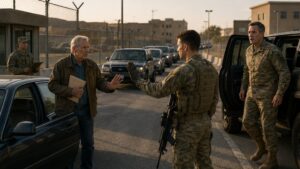
A man in tactical gear emerged from the side door.
He was tall, square-shouldered, with close-cropped dark hair under a cap and a radio clipped high on his vest. His belt carried the usual equipment. His expression carried something heavier: responsibility worn like armor. He glanced first at the case, then at Thomas, then at the pass still lying on the counter.
“I’m Carter,” he said. “Range security.”
Thomas gave a small nod. “Thomas Bennett.”
The younger man did not offer his hand. “You brought a firearm onto the property?”
“It’s cased.”
“That wasn’t my question.”
Thomas let the tone pass over him. He had learned long ago that not every challenge deserved the dignity of being treated as an insult.
“It is in the case,” he said.
“Loaded?”
“No.”
“Magazine?”
“No.”
“Ammo?”
“One round.”
Tyler Carter’s eyes sharpened. Behind him, through the side door, another uniformed man paused to listen. Older than Carter, broader through the chest, his face lined from sun rather than age. Thomas read him as someone with authority who preferred to let younger men use their voices first.
Carter picked up the pass and turned it between two fingers.
“This expired in the system.”
“It was arranged.”
“With who?”
Thomas looked again toward lane seven.
“With a man who understood why I asked.”
Carter’s mouth tightened. “That’s not enough for me.”
“No,” Thomas said quietly. “I suppose it wouldn’t be.”
The younger man studied him, perhaps deciding whether the answer was cooperation or defiance. Around them, the range kept moving. Commands barked from one end of the line. A bolt slammed shut. Someone called for eyes and ears. The world went on with its rules intact.
Carter set the pass down.
“Wait here.”
Thomas did not move until Carter walked away. Then he looked at the clerk. The young man’s face had gone apologetic in that helpless way people looked when the machine behind them had made the decision and all they could do was stand beside it.
“It may take a minute,” the clerk said.
Thomas nodded.
Minutes had become strange to him in old age. Some vanished before he could cross a room. Others stretched wide enough to hold forty years.
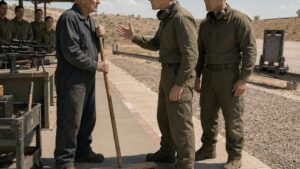
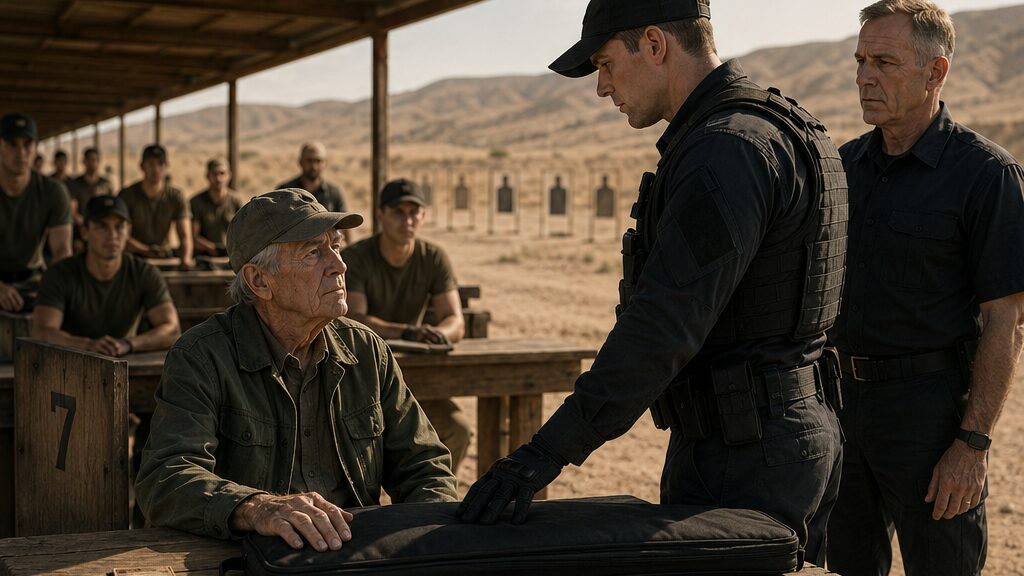
He carried the case outside because no one told him not to. Lane seven was still empty. The bench waited under the shade roof, dust gathered in the corners of its boards. Thomas reached it slowly, set the black case on top, and placed the pass beside it where anyone could see.
Then he lowered himself onto the stool.
The bench smelled of hot wood, gun oil, and desert dust. Thomas rested his left hand near the zipper of the case and let his fingers relax there. Beyond the firing line, the targets stood white and flat against the berm. Lane seven’s target frame leaned slightly to the right.
It had leaned that way before, too.
A voice from years ago rose in his memory, light with irritation.
If they ever fix that thing, Bennett, I won’t know where to aim.
Thomas closed his eyes once.
When he opened them, Tyler Carter was walking toward him with the older uniformed man a few steps behind. Carter’s gaze was on the black case.
The trainees at the nearby benches had begun to notice. One lowered his earmuffs. Another turned his head. Thomas kept his hand where it was.
Carter stopped at the edge of lane seven.
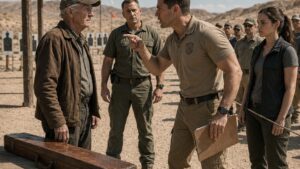
“Mr. Bennett,” he said, loud enough for the line to hear, “we need to talk about that case.”
Chapter 2: Do Not Open a Man’s Promise
Tyler Carter stood between Thomas and the sun.
It was not intentional, Thomas thought. The young man had simply stopped where authority told his body to stop—close enough to control the bench, far enough to keep his boots behind the red safety line, shoulders squared so no one nearby could mistake who was in charge.
The shadow of him fell across the black case.
Thomas looked at the shadow first, then up at the man.
“You were told to wait in the office,” Carter said.
“I was told to wait.”
“Not at an active lane.”
Thomas moved his eyes to the empty target stand downrange. “This one isn’t active.”
“That’s not your call to make.”
A few benches away, one of the trainees stopped loading a magazine. Another pretended not to watch and failed. The range had not gone silent, but the sounds around lane seven had thinned. Men could feel trouble even when it arrived politely.
The older uniformed man remained behind Carter, arms relaxed but face attentive. His name tape read Reed. Thomas noticed because old habits noticed things even when pride did not want to.
“Mr. Bennett,” Carter said, “I need you to step away from the case.”
Thomas’s fingers stayed lightly on the wooden bench, near the zipper but not touching it.
“No.”
The word was not loud. It did not need to be. It landed between them with the firmness of a cartridge seated properly.
Carter’s jaw shifted. “That wasn’t a request.”
“No,” Thomas said. “It should have been.”
Something changed in Carter’s face then. Not anger exactly. Embarrassment wrapped in procedure. Young men with an audience did not like being corrected by old men who remained seated.
The older man behind him took one slow step closer.
“Sir,” Carter said, voice harder now, “we have an unverified firearm on a controlled range during an active training rotation. Your pass is not valid in our system. You brought ammunition after being told your reservation couldn’t be confirmed. I’m going to secure the case until we sort this out.”
Thomas looked down at the pass. The cracked corner had curled slightly in the heat. He had carried it carefully all morning as though lamination could hold a promise together.
“It was confirmed,” he said.
“Not by anyone here.”
Thomas let the sentence pass. It was true in the small way that rules were often true.
Carter stepped around the end of the bench.
The movement drew every nearby eye. He came to Thomas’s right side, where the case lay within reach. Thomas could smell sun-warmed nylon, dust, and the faint clean oil from inside the case. He could also smell the young man’s soap, sharp and manufactured.
“Please stand up,” Carter said.
Thomas stayed seated.
His hip had stiffened during the wait. Standing quickly would make him grab the bench, and he refused to give them that picture—the old man struggling upright while they took what he had carried here.
“I can hear you from here,” Thomas said.
Carter leaned forward and placed one gloved hand on the black case.
The pressure was not heavy. That made it worse. He touched it the way a man might touch an abandoned bag at an airport, or a piece of property already halfway claimed by the institution. Not cruelly. Not roughly. Without understanding.
Thomas’s hand moved.
It did not snatch. It did not slap. It simply came down flat over the zipper pull before Carter could take it. His fingers were bent at the knuckles, skin browned and thin, veins raised like old river lines. Carter’s glove stopped an inch away.
“Remove your hand,” Carter said.
Thomas looked at the young man’s glove, then at the faces watching from the other benches.
One trainee had his phone halfway out before the older man, Reed, gave him a look that put it away. Another stared at Thomas with uncomfortable curiosity. The clerk had come to the office doorway. Heat shimmered beyond the targets.
Thomas had thought he would be ashamed if this happened. Instead, he felt something quieter and more familiar: the old discipline of keeping his voice level when the wrong thing would cost too much.
He lifted his eyes to Carter.
“Son,” he said, “don’t open a man’s promise without asking.”
The range seemed to hold its breath around the sentence.
Carter did not move. His expression flickered, and for one second Thomas saw the person beneath the vest: a young man trying to decide whether he had been challenged, warned, or trusted with something he had not earned.
Then the vest came back.
“I’m not here to discuss promises,” Carter said. “I’m here to maintain safety.”
“Those are not enemies.”
“They are when you won’t comply.”
Thomas drew a slow breath through his nose. “I have complied with every safe instruction I was given.”
“You walked yourself to a firing lane with an unverified weapon.”
“I walked to the lane I was assigned.”
“That assignment does not exist.”
Thomas looked at the pass again. “Not in your machine.”
The words were mild. Carter heard them as accusation.
Reed moved closer. “Carter.”
The younger man did not look back. “I have it.”
Thomas could tell he believed that. Carter believed having control meant having understanding. Thomas had once believed similar things, though perhaps not in those exact words.
The black case lay between them, soft-sided, ordinary, holding more silence than any object should have to hold.
“What’s inside?” Reed asked.
Carter turned slightly, annoyed at the interruption. Thomas looked past him to the older man.
“A rifle,” Thomas said.
Carter gave a small humorless breath, as if that settled the matter.
“And?” Reed asked.
Thomas did not answer at once. That was the question he had feared, though not because the answer was complicated. Because it was simple, and simple things were the easiest for people to mishandle.
“A letter,” he said.
Reed’s eyes moved to the case.
Carter said, “A letter doesn’t change the safety issue.”
“No,” Thomas said. “It changes the way a man ought to ask.”
For the first time, Carter looked away.
A command cracked from the far end of the range. Fire paused. Someone called clear. The sound of the desert came back in thin layers—wind dragging dust, a metal target stand creaking, a radio muttering against Carter’s shoulder.
Reed stepped to the bench, not as close as Carter had. “Mr. Bennett, who approved your visit?”
Thomas kept his palm over the zipper.
“I spoke with a coordinator in February. He said lane seven could be made available today. Private use. Ten minutes.”
“Name?”
Thomas searched for it again and found only a voice, a cough between sentences, the scrape of paper as the man wrote something down.
“I don’t remember,” he said.
Carter’s face closed.
Reed noticed. “You came alone?”
“Yes.”
“Family know you’re here?”
Thomas felt a small pain behind the ribs that had nothing to do with age.
“My daughter knows I drive.”
“That isn’t what I asked.”
“No,” Thomas said. “It isn’t.”
Carter straightened. “This is exactly the problem. We have no confirmed reservation, no current authorization, one round of ammunition, and an elderly visitor refusing to surrender a firearm case on a controlled line.”
The word elderly carried farther than the rest.
Thomas heard it reach the trainees. He saw one of them glance down, embarrassed for him. That, more than Carter’s tone, brought heat to Thomas’s face.
Not because elderly was untrue. Because Carter had used it as evidence.
Thomas lifted his hand from the zipper and placed it flat on the bench beside the case.
“You can call me old,” he said. “You can call me slow. Both would be fair most mornings.”
Carter’s mouth opened, then closed.
“But don’t call me unsafe because I wouldn’t let a stranger open what he had not asked about.”
The words were not loud. The men nearby still heard them.
Reed looked at Carter then, and the look was not a reprimand yet, but it contained the beginning of one.
Carter reached for the case handle.
Thomas did not stop him this time.
That choice cost more than resistance would have. His fingers curled against the wood, empty now, while Carter lifted the case from the bench. The old nylon sagged slightly in the middle. Thomas watched its weight pull against the young man’s arm.
“Mr. Bennett,” Reed said, “we’ll hold it in the office until we can verify your paperwork.”
Thomas turned his eyes to him.
“And the letter?”
Reed paused.
“It stays inside,” Carter said.
Thomas looked at the young man for a long moment. “Then you are holding more than you know.”
Carter carried the case away.
The trainees looked down at their benches as he passed. The clerk disappeared from the doorway. Reed remained beside Thomas for another second, perhaps to say something, perhaps to see whether the old man would stand.
Thomas picked up the cracked pass from the bench.
His hand shook once before he could stop it.
He tucked the pass into his pocket and looked downrange at lane seven’s crooked target frame.
The bench in front of him was suddenly too empty.
Chapter 3: The Pass That Was Only Almost Enough
The range office was cooler than the line, but not kinder.
An air conditioner rattled in the high window, working hard enough to sound resentful. The walls held laminated safety rules, training schedules, a faded map of the property, and a framed photograph of men in older uniforms standing where the range now stretched wider and flatter. A metal cabinet sat behind the counter. Tyler Carter placed Thomas Bennett’s black case on top of it as if setting down an argument he intended to win.
Anthony Reed watched him do it.
“Lock it,” Tyler said to the clerk.
The clerk looked at Anthony first.
Anthony gave a small nod. “For now.”
The clerk took the case into the back room. Tyler removed his cap and ran a hand over his close-cropped hair. Sweat had darkened the band. He glanced through the office window.
The old man was still sitting at lane seven.
That bothered Tyler more than it should have. Most people argued, threatened to call someone, demanded a supervisor, or left in a way that proved they thought the world owed them a softer rule. Thomas Bennett simply sat where the case had been, one hand in his lap, the other resting on the scarred bench.
“He shouldn’t be out there,” Tyler said.
Anthony leaned against the counter. “He’s not handling anything now.”
“He shouldn’t have been out there before.”
“No argument.”
But Anthony’s tone did not give Tyler the satisfaction of agreement. It carried a weight Tyler disliked.
The clerk handed over the pass. “It’s not in the active system. I checked visitor reservations, private lane requests, veteran programs, everything.”
Tyler took the card. It was old but not ancient. The photograph showed Thomas a few years younger, same cap, same closed mouth, same eyes that seemed to look at things longer than necessary. The printed date had passed by nine days.
“Expired,” Tyler said.
“Barely,” the clerk said, then regretted saying it.
“Expired is expired.”
Anthony took the pass from Tyler without asking. He studied it under the fluorescent light.
“This format was used before the software change,” he said.
“Then it’s invalid.”
“It may be incomplete.”
“That’s a pretty generous word.”
Anthony looked at him. “You were correct to secure the weapon.”
Tyler held his gaze, waiting.
“You were also too fast to decide what kind of man you were securing it from.”
The sentence struck cleanly because Anthony did not raise his voice.
Tyler looked away. “I had a line full of trainees and an unverified firearm.”
“You had an old man with one round and a pass that almost checked out.”
“Almost doesn’t keep people safe.”
“No,” Anthony said. “But neither does pride.”
The office seemed to shrink around them.
Tyler set his cap on the counter. He wanted to say he had done everything by the book. The trouble was, he could still feel the moment his glove touched the case. He had expected resistance. He had been ready for stubbornness, confusion, even anger.
He had not been ready for the old man’s sentence.
Don’t open a man’s promise without asking.
It had sounded foolish at first. Then it had followed him back to the office and sat there under the noise of the air conditioner.
The clerk cleared his throat. “There’s a note in the old manual binder.”
Anthony turned. “What note?”
The clerk opened a drawer and pulled out a thick binder with cracked plastic rings. “Some things didn’t transfer right when they updated the system. The retired coordinator kept handwritten pending requests.”
Tyler frowned. “Retired coordinator?”
“Before Mr. Reed took over the full range schedule,” the clerk said carefully.
Anthony reached for the binder.
The pages were divided by month, then by range section. Some entries were neat. Others had been crossed out, rewritten, initialed. Anthony flipped to the current month, then to the day’s date.
Lane Seven. Private memorial use. 1400 window. T.B. One round. Confirm closer to date.
No full name. No phone number visible. The initials beside it were from a man who no longer worked there.
Tyler read the line twice.
“Confirm closer to date,” he said. “Was it confirmed?”
“No note saying it was,” the clerk said.
“No note saying it wasn’t,” Anthony replied.
Tyler felt irritation rise because uncertainty always made discipline harder. “So we still don’t know.”
“No,” Anthony said. “We know more than we did.”
“A handwritten line in an old binder doesn’t authorize him to sit on a hot line with a firearm.”
Anthony closed the binder gently. “I already said you were right about securing the case.”
“Then what are we talking about?”
Anthony looked out the window.
Thomas had finally stood. It was not easy for him. One hand pressed the bench, and his shoulders angled forward before he straightened. He did not look toward the office. He looked downrange once, then turned toward the parking lot.
“We’re talking about the part after being right,” Anthony said.
Tyler did not answer.
The radio on his vest crackled. A safety instructor asked if lane seven was cleared for the next rotation. Tyler pressed the button.
“Hold lane seven.”
Anthony looked at him.
Tyler released the button. “Until we finish this.”
Outside, Thomas walked slowly but steadily across the gravel. The trainees watched him with quick glances, careful not to stare too openly. He passed the office without entering.
Tyler stepped toward the door.
Anthony stopped him with one word. “Wait.”
“For what?”
“For your voice to change.”
Tyler turned on him. “You think I enjoyed that?”
“No.”
“Then what?”
“I think you got scared of being responsible and made him carry the shame for it.”
Tyler’s face warmed. He looked again through the glass. Thomas had reached an older pickup near the edge of the lot. He stood beside it with one hand on the door, not opening it yet.
The clerk held up a phone. “There’s a contact number in the old binder, but it’s smudged. I can make out part of it.”
Anthony took the binder again. “Try the registration attached to his pass.”
“It may be outdated.”
“Try.”
The clerk typed. A moment later, the office phone rang through to someone’s voicemail, then disconnected. He tried another number from the pass record.
This time, someone answered.
“Range office,” the clerk said. “I’m calling regarding Thomas Bennett.”
Tyler watched Thomas through the window. The old man had taken the cracked pass from his pocket. He looked down at it, then at the range.
The clerk’s face shifted. “Yes, ma’am. No, he’s okay. There’s been a paperwork issue.”
Anthony held out his hand for the phone.
“Who is it?” Tyler asked.
The clerk covered the receiver. “His daughter.”
Anthony took the call and turned slightly away. His voice softened into the careful tone used when trouble had not yet become disaster.
Outside, Thomas opened the truck door at last. He sat sideways in the driver’s seat but did not pull his legs in. For a moment he looked like a man who had forgotten where he meant to go.
Tyler picked up the pass from the counter again.
Thomas Bennett. The photograph. The cracked corner. The expired date.
Only almost enough.
Anthony ended the call.
“His daughter is coming,” he said.
Tyler kept his eyes on the pass. “Did she know why he was here?”
“No.”
The answer hung there.
Through the window, Thomas slowly closed the truck door without starting the engine. He remained inside, facing the range, while his black case sat locked in the back room and lane seven stayed empty under the shade.
Chapter 4: Sarah Thought Grief Should Stay Home
Sarah Bennett drove too fast until she saw the range sign.
Then her foot eased off the gas, and the speedometer dropped as if her body had remembered before her mind did. The road narrowed into a strip of pale asphalt cutting through low desert brush. Heat lifted from it in wavering sheets. Ahead, the range roof sat flat against the sky, its shade line full of small figures and movement.
Her father’s truck was parked near the far edge of the lot.
Sarah pulled in beside it and killed the engine. For a few seconds she did not get out. Through the windshield, she could see him sitting behind the wheel of his old pickup, both hands folded around the cracked pass in his lap.
He looked smaller inside the truck than he did at home.
That frightened her.
She opened her door and crossed the gravel quickly, though the heat hit her ankles and made the air feel sharp. Thomas looked up when she reached him. He did not seem surprised. That bothered her too.
“Dad.”
“Sarah.”
The way he said her name was calm enough to make her angrier than panic would have.
“What happened?”
“Paperwork.”
“The range called me.”
“I know.”
“They said there was an issue with a firearm.”
“It’s in the case.”
“Where is the case?”
“In the office.”
Sarah looked toward the low building. A young man in tactical gear stood inside near the window, speaking with another uniformed man. Neither looked like someone who had just made a harmless paperwork call.
She turned back to her father. “Why didn’t you tell me you were coming here?”
“I didn’t want you worrying.”
“That’s not an answer.”
“It’s the only one I had ready.”
Her chest tightened. She reached for the truck door handle, then let it go. “You can’t just drive out here with a rifle and one old pass and hope people understand what you mean.”
“I didn’t hope. I arranged it.”
“With who?”
Thomas looked down at the pass. “A man who retired, apparently.”
Sarah exhaled through her nose. She heard her own voice before she could soften it. “Dad, this is exactly what I was afraid of.”
His eyes lifted.
She regretted it, but not enough to stop.
“You keep doing this,” she said. “You keep deciding some old thing matters more than what is happening now. The garage, the boxes, the case, that calendar with dates circled that you won’t explain. And now I get a call that you’re sitting at a weapons range while security has your rifle locked up.”
“It isn’t just a rifle.”
“Then tell me what it is.”
Thomas turned the pass between his fingers. The cracked laminated corner caught against his thumb.
Sarah waited. The old version of her father—the one from childhood, the one who fixed faucets, made school lunches after her mother died, and never let a storm rattle the windows without checking every latch—would have answered. Or maybe she had only imagined that version. Maybe he had always had rooms inside him she was not allowed to enter.
“I needed lane seven,” he said.
“Why?”
His mouth moved once, but no answer came.
Sarah looked across the range. Lane seven sat empty beneath the shade, a bare wooden bench facing a crooked target frame. It looked like nothing. That made her feel worse, because nothing had pulled him out here alone with a gun case and an expired pass.
“Dad,” she said more quietly, “come home.”
He did not move.
“We’ll get the case back. We’ll sort out whatever form they need. But not today. Not like this.”
“That’s what people keep saying.”
“What?”
“Not today.”
A dry gust moved dust across the lot. Thomas looked past her toward the office window. Tyler Carter had disappeared from view. The older man remained, phone to his ear.
Sarah crouched beside the open truck door so she could look up into her father’s face instead of down. “Were they rude to you?”
Thomas gave a small, tired smile. “They were young.”
“That isn’t what I asked.”
“No.”
The word came with enough weight that she stopped.
“What did they do?”
He folded the pass once in both hands, not enough to bend it, only enough to feel its edges. “The security officer put his hand on the case.”
Sarah felt anger move through her quickly and then collide with fear. “Did he open it?”
“No.”
“Did you stop him?”
“I asked him not to open a promise without asking.”
She stared at him.
The sentence was so much like him and so unlike anything he had said in years that she had no answer. The door of the range office opened before she could find one. The older uniformed man stepped out. Tyler Carter followed, carrying his cap now instead of wearing it.
Sarah stood.
The older man approached first. “Mr. Bennett. Ma’am. I’m Anthony Reed, range coordinator.”
Sarah kept her voice level. “Sarah Bennett.”
“I’m sorry for the confusion.”
Thomas looked at him. “Is it confusion?”
Anthony accepted the question with a slight dip of his head. “Partly. Not all.”
Tyler stood behind him, eyes on the gravel.
Anthony continued, “We found a handwritten note in an old scheduling binder. It appears a private lane use was tentatively approved for today, but it was never properly confirmed in the current system. I can’t release the firearm back onto the range without completing verification.”
Sarah glanced at her father. “Then we’re leaving.”
Thomas’s hand closed around the pass.
Anthony said, “You may take the case home after we log it out. Or we can keep it secured here until tomorrow while I try to reach the retired coordinator.”
“No,” Sarah said. “He’s not coming back tomorrow.”
Thomas looked at her then.
Not sharply. Not with anger. With disappointment so quiet she nearly missed it.
Sarah swallowed. “Dad, I didn’t mean—”
“Yes,” he said. “You did.”
Anthony shifted his weight, uncomfortable with being present for something more private than range policy.
Thomas opened the truck door wider and lowered one boot to the gravel. Sarah reached automatically to help him, but he lifted one hand.
“I have it.”
He stood slowly, using the door frame. The movement cost him, but he did not hurry it. When he was upright, he looked at Anthony.
“I’ll take the case home.”
“Of course.”
Tyler stepped forward. “Mr. Bennett—”
Thomas turned toward him.
The young man stopped. His cap twisted once in his hands. “I’ll get it.”
“No,” Anthony said. “I will.”
Tyler’s face tightened, but he nodded.
Sarah watched the exchange and understood only part of it. Something had happened at that bench that no one was naming. Her father had been hurt, the young officer knew it, and the older man knew it too.
Anthony returned with the black case held in both hands.
He did not set it on the gravel. He brought it directly to Thomas.
Thomas took it by the handle. For a moment the weight pulled his shoulder down. Sarah reached toward him again and stopped herself.
“Thank you,” Thomas said.
Anthony gave him the worn pass as well. “I’ll call you when I know more.”
Thomas tucked the pass into his shirt pocket. “All right.”
Tyler looked as if he wanted to say something, but the range behind him cracked alive again with commands and movement. The moment passed.
Sarah opened the passenger door of her car.
Thomas did not move toward it. He looked at his truck, then at her.
“I can drive home.”
“No,” she said, too quickly.
His face closed.
She softened her voice. “Please. Let me drive you. We can come back for the truck later.”
“I don’t need managing, Sarah.”
“I know.”
They both knew she did not fully know.
He set the case carefully across the back seat of her car. Not in the trunk. Sarah noticed that. She noticed the way his hand lingered on the fabric before he closed the door.
The drive home was mostly silent.
The range fell behind them. The desert opened on both sides, brittle and bright. Sarah kept both hands on the wheel. In the rearview mirror, the black case lay across the seat like a third passenger.
At a stoplight near town, she said, “Was it Mom?”
Thomas looked out the window. “No.”
“Was it something from the Army?”
“Yes.”
That was all. It should have frustrated her. Instead, it made her afraid of asking the next question.
At his house, Thomas carried the case himself into the garage.
The garage was organized in the way of a man who could no longer remember where he put his reading glasses but knew the exact drawer for a 3/8 wrench. Tools hung in neat rows. Cardboard boxes lined one wall. On the workbench sat an old calendar, the date circled in dark pencil.
Sarah saw it and felt her throat tighten.
Today’s date.
Thomas set the case on the workbench. The sound was soft. He stood with both hands resting on either side of it.
“His name was Daniel Morgan,” he said.
Sarah stayed near the doorway.
Thomas did not look at her. “He used to complain that lane seven had a crooked target frame.”
“Who was he?”
“A friend.”
The word was too small for the silence that followed.
Thomas reached toward a metal drawer beneath the bench and pulled it open. Inside were envelopes, rags, a small bottle of oil, and a bundle of old photographs held with a rubber band. He did not touch the photographs. Instead, he lifted a sealed envelope from the back.
The paper had yellowed at the edges. One word was written across the front in a firm, faded hand.
Morgan.
Sarah stepped closer.
Thomas held the envelope but did not open it.
“I thought grief was supposed to get quieter,” he said.
Sarah looked at the black case, at the circled date, at the envelope in her father’s hand.
Then she understood, with a dull ache of shame, that she had spent years asking him to let go of something she had never asked him to name.
Chapter 5: The Name Anthony Remembered Too Late
Anthony Reed came back to the range before sunrise.
The desert was still blue at that hour, the hard edges softened before heat and noise returned. The benches under the shade structure looked abandoned, their surfaces pale with dust. Lane seven sat in the middle row, ordinary and empty, but Anthony found himself looking at it longer than the others.
He had seen old men at ranges before.
Some came to show off for grandsons. Some came to feel young for an hour. Some came because their hands remembered a discipline their lives no longer required. He had learned to be careful with all of them, not because old age made men sacred, but because it made their reasons harder to see.
Yesterday, he had not been careful enough.
In the office, the air still held a faint smell of coffee left too long on a burner. Anthony turned on the lights, opened the old manual binder, and laid it flat on the counter. The handwritten note was still there.
Lane Seven. Private memorial use. 1400 window. T.B. One round. Confirm closer to date.
He stared at the initials beside it until memory began to arrange itself.
The retired coordinator had been a man who kept too much in his head and too little in the system. He had a habit of writing reminders on whatever paper was nearest. Anthony had cursed that habit more than once during the transition. Most of the loose ends had been class schedules, maintenance orders, private instruction hours.
Private memorial use was different.
Anthony went to the records room.
It was not much of a room, just a narrow space behind the office where old files lived in cabinets that stuck when the weather changed. He opened the drawer marked Visitor Programs and pulled folders by month. Some held waivers. Some held correspondence from veteran groups. He found nothing under Bennett.
He tried Morgan.
Nothing.
He stood there with one hand on the drawer handle, annoyed by the shape of his own disappointment.
The clerk arrived at seven and found him with three boxes open on the floor.
“You’re early,” the clerk said.
“So are you.”
“I forgot my lunch yesterday.”
Anthony looked at the boxes. “Help me find anything connected to private memorial use, lane seven, Bennett, or Morgan.”
The clerk hesitated. “Is this about yesterday?”
“Yes.”
The young man set his lunch in the small refrigerator and joined him.
They searched through forms brittle with age, range agreements from veterans’ organizations, printed emails, and old handwritten notes. At eight-thirty, Tyler Carter arrived in uniform, clean-shaven, cap under one arm. He stopped in the doorway when he saw the mess.
“What are we doing?”
Anthony did not look up. “Looking for the part the computer didn’t know.”
Tyler came in slowly. “Do you need me on the line?”
“In twenty minutes.”
The answer dismissed him. Tyler stayed.
The clerk pulled out a manila folder from the bottom of a box. “There’s a note here from February.”
Anthony took it.
It was a printed email, forwarded twice, then marked with a sticky note from the retired coordinator. The message was brief.
Elderly veteran requesting private lane access for personal memorial observance. One legally registered rifle, one round. Prefers no ceremony. Asked for lane seven because of prior service connection. Call back after schedule clears.
There was a phone number. Part of it had been obscured by the sticky note adhesive, but the name at the top was readable.
Thomas Bennett.
Anthony read it once, then again.
Tyler stood beside him but did not ask to see it. Anthony handed it over anyway.
The younger man’s eyes moved across the page. His face did not change much, but his thumb pressed into the paper hard enough to bend it.
“Private memorial,” Tyler said.
“Yes.”
“Still didn’t say approved.”
“No.”
Tyler lowered the page. “But he wasn’t making it up.”
Anthony let the silence answer.
The clerk found another sheet inside the folder: a copied registration number, a note that the ammunition was to be inspected on arrival, and a handwritten line at the bottom.
If I am not here, treat this one gently. He asked for nothing extra except quiet.
No signature, only the retired coordinator’s initials.
Anthony felt the sentence land in him with more force than any official stamp would have.
Treat this one gently.
He looked through the office window at lane seven.
Tyler read the line too. His mouth tightened, and for once it did not look like resistance. It looked like the first honest bruise of understanding.
“I didn’t know,” Tyler said.
Anthony closed the folder. “You didn’t ask long enough to know.”
Tyler’s eyes cut toward him.
Anthony held up one hand. “You were not wrong to stop him. You were wrong to shrink him while you did it.”
Tyler turned away, jaw working.
Outside, the first trainees were gathering near the water cooler. A safety instructor was checking targets. The range was waking into its usual order, but the office felt suspended.
Anthony picked up the phone and called the number from the old note. No answer. He tried the number Sarah had given him the day before. It rang four times before she picked up.
“This is Anthony Reed from the range,” he said. “May I speak with Thomas Bennett?”
There was a pause. Her voice came guarded. “He’s in the garage.”
“I found documentation for his request. Not perfect documentation, but enough to tell me we mishandled part of yesterday.”
Another pause.
“Part of it?”
Anthony accepted the correction. “More than part.”
Sarah did not soften. “He doesn’t want to be made into an event.”
“I understand.”
“I’m not sure you do.”
Anthony looked at the handwritten sentence again. Treat this one gently.
“I would like to,” he said.
She covered the phone, but not fully. He heard her call to her father. The muffled exchange that followed was brief. Then Thomas’s voice came on the line.
“Yes.”
“Mr. Bennett, this is Anthony Reed.”
“I know.”
Anthony deserved that.
“I found the old paperwork. Your request should have been transferred into the current schedule. It wasn’t. That failure is on us.”
Thomas said nothing.
Anthony continued, choosing each word with care. “If you still wish to use lane seven, I can make it available today. Private. No class on either side for the window. Ammunition inspected properly. Your case handled only by you unless safety requires otherwise.”
The quiet stretched.
“Mr. Bennett?”
“I’m here.”
“Would you like to come back?”
Thomas breathed once, close to the receiver. “I don’t know yet.”
It was not the answer Anthony expected. He had assumed correction would be enough to reopen the door. He understood, too late, that a door closed by embarrassment did not swing back just because someone found a paper.
“I understand,” he said.
“No,” Thomas replied, not harshly. “But you’re closer than you were.”
The line went dead.
Anthony remained with the receiver in his hand for a moment after the call ended.
Tyler stood by the counter, watching him.
“He coming?” Tyler asked.
“He doesn’t know.”
Tyler looked out toward lane seven. “I should apologize.”
“Yes.”
“I mean before he decides.”
“Yes.”
Tyler picked up his cap, turned it once in his hands, then set it back down. “What am I supposed to say?”
Anthony walked to the back room and opened the locked cabinet where the case had been held the day before. It was empty now, but the shelf still showed a clean line in the dust where the black fabric had rested.
“Start with less than you want to defend,” Anthony said.
Tyler did not answer.
Anthony returned to the counter and tapped the folder.
“You put your hand on something you didn’t understand.”
Tyler flinched slightly, as if the words had found the exact place.
Outside, the first command of the morning carried down the firing line. The trainees lifted their rifles. The range resumed its rhythm.
Anthony picked up the old pass record, the February note, and the handwritten binder page. He placed them together in a new folder and wrote Bennett on the tab.
Then he added a second word beneath it.
Lane Seven.
Chapter 6: The Case Was Never About the Rifle
Thomas had slept badly and woken early, which was not unusual enough to blame on the range.
He made coffee before sunrise and forgot to drink half of it. He fed the neighbor’s cat that had never officially become his. He checked the lock on the back door twice. Then he went to the garage and stood before the black case until the light under the door turned from gray to gold.
Sarah found him there at nine.
She wore the same jeans from the day before and a sweater too light for the morning chill. Her hair was pulled back carelessly, which told him she had not slept well either. She stood in the doorway with two mugs, one in each hand.
“You didn’t eat,” she said.
“I wasn’t hungry.”
“You say that like it answers something.”
He accepted the coffee because refusing it would have turned concern into an argument. She came inside and set her own mug on the workbench, careful not to place it too close to the case.
That small care touched him more than he wanted it to.
The sealed envelope lay where he had left it, beside the case. Morgan. The faded letters looked darker in the morning light.
Sarah looked at it but did not ask.
Thomas ran his thumb along the case seam. “Anthony Reed called.”
“I know.”
“You listened?”
“I handed you the phone.”
“You stayed close enough.”
She had the grace to look down. “Yes.”
Thomas nodded. He could have scolded her. He had scolded her as a child for crossing streets without looking, for leaving wet towels on wooden chairs, for rolling her eyes at teachers who were trying their best. But this was different. She had stayed close because she was afraid. Fear made people rude in ways love later had to repair.
“He offered lane seven today,” Thomas said.
Sarah folded her arms. “Do you want to go?”
“I don’t want to.”
The answer surprised her. He saw it.
“But I need to,” he said.
She leaned against the door frame. “Can you tell me why before we drive back into that place?”
Thomas looked at the envelope.
For years, he had treated the story like a locked room in a house where he still lived. Sarah knew the room existed. She had walked past it. She had seen light under the door. But he had never invited her in, then quietly resented her for not knowing what was inside.
That was not fair. Old grief did not excuse every locked door.
He picked up the envelope.
“Daniel Morgan was in my unit,” he said. “He was younger than me by three years and older than me by common sense. He could sleep anywhere. Truck bed, wet ground, once sitting upright with a radio in his lap. He wrote letters to his wife every Sunday whether we had mail going out or not.”
Sarah came farther into the garage.
“He liked lane seven?” she asked.
Thomas almost smiled. “He hated lane seven. We trained at this range before deployment, long before they modernized the place. Target frame leaned right. Daniel blamed every bad shot on that frame.”
“Was he right?”
“Once in a while.”
Sarah’s mouth softened.
Thomas turned the envelope over. The flap was still sealed. “Before we shipped out, he made me promise something foolish. Said if he didn’t make it home, I had to come back to that crooked lane and fire one careful round for both of us. Not a salute. Not a ceremony. Just one round. He said if I rushed it, he’d know.”
The garage seemed to grow quieter around the words.
Sarah’s eyes moved from the envelope to the case. “And he didn’t come home.”
“No.”
“You never told me.”
“No.”
“Why?”
Thomas looked toward the shelves where old paint cans stood in a row. “Because telling it made me the man who came home. Not telling it let me pretend there was still some way to balance the account.”
Sarah’s face changed. The anger she had carried since yesterday finally loosened, leaving something younger underneath.
“Dad.”
He shook his head once. “Don’t make it pretty.”
“I’m not.”
“People like to make promises pretty after they’ve failed to keep them.”
“You haven’t failed.”
“It took me forty-nine years.”
She stepped closer to the workbench. “Why today?”
Thomas touched the circled date on the calendar. “Daniel’s birthday. Seventy-two, if he’d had the courtesy to keep aging.”
The line came out drier than he expected. Sarah gave a small, broken laugh and wiped at one eye with her wrist.
Thomas picked up the case zipper but did not open it yet.
“The rifle was mine from after service, not issued. Same model family we trained on, civilian legal, registered, maintained. That part matters to the range. It matters to safety. It does not matter to the promise.” He looked at the case. “The case was never about the rifle.”
Sarah stood beside him now.
“May I?” she asked.
Not Can I see it. Not Open it. May I.
Thomas looked at her hands. They were her mother’s hands in shape, his in the knuckles.
“Yes.”
He unzipped the outer pocket first. Inside was a small cleaning cloth, a copy of the registration, and the single cartridge secured in a plastic box. Behind them lay the letter.
Sarah did not reach for it. She waited.
Thomas lifted the envelope and opened it with a pocketknife he kept on the bench. The paper inside had been folded once. He had read it only three times in all his life. Once when it was given to him. Once after Sarah’s mother died. Once last winter, when he realized his hands were not going to get steadier with time.
He unfolded it.
The handwriting was Daniel’s, tight and slanted.
Bennett,
If you are reading this, I am absent without permission from getting old. Don’t make a shrine out of me. I would hate that and you know it.
Do one thing. Go back to that sorry crooked lane. Take your time. One careful round. Not for glory. Not for grief if you can help it. Just so one of us finishes the day properly.
Then go home.
D.M.
Sarah read it beside him, one hand pressed to her mouth.
Thomas folded the letter again. His fingers were not as steady as he wanted.
“I thought if I did it,” he said, “then he would be gone in a way I couldn’t argue with anymore.”
“And if you didn’t?”
“Then I still owed him.”
Sarah looked at the case. “You’ve been carrying a debt in a rifle bag.”
He gave a faint nod. “That sounds foolish when someone else says it.”
“It sounds heavy.”
The phone rang inside the house. Neither of them moved at first. On the fourth ring, Sarah went in and answered. Thomas heard her voice low in the kitchen. When she returned, she stood a little straighter.
“It was the range. Anthony Reed again.”
“What did he say?”
“Lane seven is held from four to four-thirty. No trainees beside it. Tyler Carter asked if he could be present only long enough to apologize, and then he’ll step back if you want him to.”
Thomas closed his eyes briefly.
Sarah watched him. “You don’t have to go.”
“Yes,” he said. “I do.”
“I’ll drive.”
“I can drive.”
“You can,” she said. “But I’d like to.”
That was different from yesterday. He heard the difference, and he allowed it.
In the afternoon, Thomas changed into a clean button-down shirt and the same faded green field jacket. He put the worn pass in his pocket. He placed the registration, the cartridge box, and Daniel’s letter back into the case. Before closing it, he rested his palm inside the empty space near the pocket.
Then he zipped it shut.
Sarah carried nothing for him. She walked beside him to the car and opened the back door. Thomas placed the black case across the seat himself, the same way he had the day before.
The drive back to the range was quieter than the drive home had been, but not empty. Sarah kept the radio off. Thomas watched the desert pass in pale bands of dust and brush. The closer they came, the more he felt yesterday waiting for him—not as memory, but as a place he had to walk through again.
At the gate, the clerk looked up from the office window and stood immediately.
Sarah parked near the same spot. Thomas got out slowly. His knee resisted, then yielded. He reached into the back seat and took the case.
Across the lot, under the shade structure, the trainees had been moved to the far lanes. Lane seven sat open.
Tyler Carter stood near the office, cap in hand.
Anthony Reed waited a few steps behind him.
Thomas walked toward them with Sarah at his side, the black case hanging from his right hand and the old pass resting against his heart.
Chapter 7: Lane Seven Stayed Quiet This Time
Tyler Carter did not step forward when Thomas reached the office.
That was the first thing Thomas noticed.
The young man stood with his cap held against his thigh, shoulders set but not squared for command. He kept his hands visible. He did not look at the case first. He looked at Thomas.
Anthony Reed came down the office step and stopped at a respectful distance.
“Mr. Bennett,” he said. “Lane seven is ready.”
Thomas nodded once.
The clerk opened the office door and stayed behind the counter. No one asked Thomas to surrender the case. No one reached for the handle. The difference was small enough that a stranger might have missed it and large enough that Thomas felt it in his chest.
Sarah stood beside him, not touching his arm.
Tyler cleared his throat. “Mr. Bennett.”
Thomas turned to him.
The young man’s face had the strained stillness of someone who had rehearsed and then discovered rehearsed words were not enough.
“I was responsible for safety yesterday,” Tyler said. “But I treated you like a problem before I understood you were a person standing in one. I put my hand on your case without asking. I embarrassed you in front of others. I’m sorry.”
The apology did not ask to be admired. It did not explain itself away. Thomas gave it the silence it deserved.
A command rang from the far end of the range, but lane seven and the two benches on either side remained empty. The space around them had been cleared without being decorated. There were no gathered trainees, no announcement, no ceremony trying to polish a bruise into a lesson.
Thomas looked at Tyler’s hands.
“Do you know why I stopped you?” he asked.
Tyler’s eyes flicked to the black case and back. “Because it wasn’t mine to open.”
“Yes.”
Tyler swallowed. “I understand that now.”
“No,” Thomas said gently. “You understand the rule of it. That’s a start.”
A faint color rose in Tyler’s face, but he did not defend himself.
Anthony stepped closer with a clipboard. “We’ll inspect the firearm at the bench if that’s acceptable. You handle the case. You clear it. Carter observes. I verify. After that, the lane is yours.”
Thomas looked to Sarah.
Her eyes were wet, but her chin was steady. She gave no instruction. She only waited.
“All right,” Thomas said.
They walked together across the gravel.
The range felt different at four in the afternoon. The heat had lost its sharpest edge, and the shadows beneath the shade roof stretched longer across the concrete. Dust clung to the legs of the benches. Far down the line, the remaining trainees worked under low voices and careful supervision, far enough away to become background rather than audience.
Lane seven waited.
The target frame still leaned slightly right.
Thomas stopped when he saw it and felt a small, unexpected laugh move through him. It barely made a sound.
Sarah glanced at him. “What?”
“Nothing,” he said. “They never did fix it.”
He set the black case on the bench.
For a moment, his hands rested on top of it, palms flat against the worn nylon. Yesterday, that gesture had been resistance. Today it was permission, but only because he chose it.
Tyler stood back.
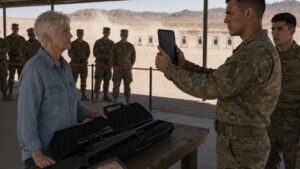
Thomas unzipped the case.
The sound was plain and soft, teeth parting one by one. Inside lay the rifle, clean and dark, secured with careful straps. In the outer pocket were the registration papers, the plastic box holding one round, the cleaning cloth, and Daniel Morgan’s folded letter.
Thomas removed the papers first and handed them to Anthony.
Anthony checked them against the clipboard. “Everything matches.”
Then Thomas opened the action and showed the chamber. Tyler leaned only as close as necessary.
“Clear,” Tyler said quietly.
Thomas looked at him.
Tyler corrected himself. “Chamber is clear.”
Thomas almost smiled. “That one was free.”
A little breath escaped Sarah behind him, half laugh, half relief.
Anthony inspected the single cartridge in its plastic box, then set it on the bench. “One round, as requested.”
Thomas nodded.
The official part ended there. No one said it aloud. They simply knew.
Anthony took one step back. “We’ll be at the office if you need anything.”
Tyler hesitated. “Would you prefer I leave too?”
Thomas looked downrange. The crooked target stood in the light, waiting without opinion.
“No,” he said. “Stand where you are.”
Tyler did.
Sarah remained behind Thomas’s left shoulder. She did not ask to read the letter again. She had already been given more than she had known to ask for.
Thomas took the folded page from the pocket and placed it on the bench beside the pass. The pass’s cracked corner had curled more since yesterday. He smoothed it with one finger.
Then he lifted the rifle.
His hands were not as steady as they had once been. There was no use pretending otherwise. He settled the stock carefully, adjusted his stance, and breathed until the tremor became part of the rhythm rather than an enemy of it.
For a moment, the years folded strangely.
The old range rose beneath the new one. Dust, heat, sun, young men with too much confidence. Daniel Morgan muttering that the target frame was crooked because the Army knew he was coming. Daniel grinning with one cheek tucked in. Daniel saying, Take your time, Bennett. If you rush, I’ll know.
Thomas closed his eyes once.
When he opened them, he was an old man at lane seven, with his daughter behind him and the young officer who had misjudged him standing quietly where he had been asked to stand.
He loaded the single round.
No one spoke.
The rifle came to his shoulder. He did not hurry the sight picture. The target blurred, sharpened, blurred again. He let his breath out partway and held the rest.
One careful round.
The shot cracked across the desert and rolled back from the berm.
Thomas lowered the rifle.
The silence after was not empty. It held the dust, the heat, the letter, the old promise, the young man’s apology, Sarah’s breathing, and the strange mercy of having done at last what could no longer be postponed.
He opened the chamber and cleared the rifle.
Tyler did not move until Thomas looked at him. Then he stepped forward, inspected from a proper distance, and nodded.
“Clear.”
Thomas set the rifle back into the case.
Sarah came beside him then. She did not hug him. Not there. She placed her hand on the bench near his, close enough that he could cover it if he wanted.
He did.
Anthony returned after several minutes, not before. He looked at the target, then at Thomas, but he did not ask where the round had gone. That was another kindness.
“Mr. Bennett,” Anthony said, “thank you for coming back.”
Thomas zipped the case halfway, leaving the letter still on the bench.
“I almost didn’t.”
“I know.”
“No,” Thomas said, but there was no sharpness in it now. “But you’re closer than you were.”
Anthony accepted that with a small nod.
Tyler stood with both hands empty. “May I carry it to your car?”
Thomas looked at the black case.
Yesterday, that offer would have felt like another taking. Today, because of the word may, it felt like something else.
“No,” Thomas said.
Tyler nodded immediately.
Thomas closed the zipper and took the handle himself. The weight pulled, but not as hard as before.
At the office, the clerk held out the worn pass. “Mr. Bennett, Mr. Reed said we can issue a new one if you’d like.”
Thomas looked at the cracked card in the clerk’s hand.
For months, he had treated it like proof. Yesterday, it had been almost enough. Today, it had become something different: a reminder that paper could fail, systems could forget, and people could still choose to ask better questions.
He took the pass and turned it over.
Then he walked back to lane seven.
Sarah followed a few steps behind but did not stop him. Tyler and Anthony stayed near the office.
Thomas placed the pass on the wooden bench, just where it had lain the day before beside the black case. The cracked corner lifted in the dry wind.
He rested two fingers on it for a moment.
Then he left it there.
When he returned to the lot, Sarah opened the back door of her car. Thomas set the case across the seat. Before he straightened, he touched the side pocket where Daniel’s letter rested.
Sarah waited by the driver’s door. “Ready?”
Thomas looked once more at the shade roof, at lane seven, at Tyler Carter standing quietly with his cap in his hands.
“Almost,” he said.
Tyler crossed the gravel and stopped several feet away.
“Mr. Bennett?”
Thomas turned.
Tyler held something out. Not the pass. A small blank range card from the office, unsigned, unused.
“For the next person,” Tyler said. “I’ll make sure we ask before we decide.”
Thomas looked at the card, then at the young man.
“You won’t always remember,” he said.
Tyler’s hand lowered slightly.
“None of us do,” Thomas added. “That’s why we practice.”
Tyler nodded, and this time he seemed to understand more than the rule.
Thomas got into the passenger seat. Sarah started the car but did not pull away at once.
“Did you hit the target?” she asked.
Thomas looked out the window toward the desert.
“I finished the day properly,” he said.
Sarah smiled through tears she did not wipe away. “Good.”
As they drove out, the range grew smaller behind them. The black case lay quiet across the back seat, no longer heavier than it had to be. Thomas rested his hand over his shirt pocket and found it empty where the pass had been.
For the first time all day, the emptiness felt right.
The story has ended.