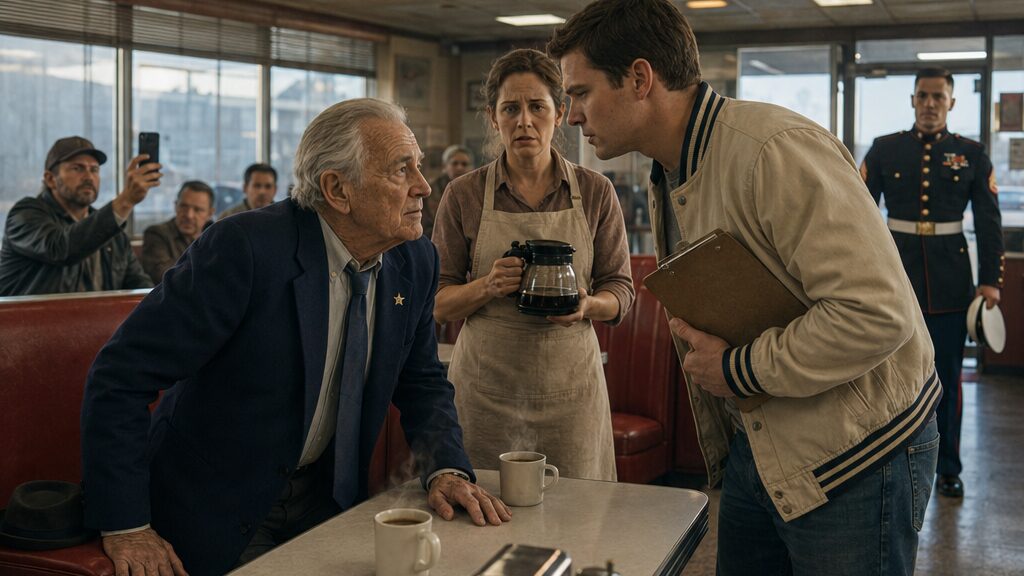
He Tried To Move The Old Man From The Red Booth Until The Star Pin Spoke
Chapter 1: The Old Man In The Red Booth
Frank Bennett stood outside Carter’s Diner for almost a full minute before he touched the door.
The morning was still pale, the kind of pale that made the chrome trim around the diner windows look colder than it was. A delivery truck idled at the curb, breathing exhaust into the late autumn air. Inside, fluorescent lights washed the red booths and white tabletops in a flat, practical brightness. Coffee steamed behind the counter. Someone had already stacked clean mugs beside the register.
Frank adjusted the knot of his tie with two fingers.
It was not a good tie. The blue had faded at the edges, and the narrow end always slipped lower than it should. Brenda Carter had once told him nobody in town dressed for breakfast anymore, and he had replied that breakfast could dress for him if it wanted. She had laughed then. A small laugh, quiet enough not to draw attention from the grill.
That had been years ago, before Brenda started moving slower behind the counter, before her son began taking the early shifts, before the old sign outside lost one of its letters and nobody climbed up to fix it.
Frank lowered his hand from his tie to the small star-shaped pin on his left lapel.
The pin was not shiny. It had no engraving anyone could read from a distance. It was plain silver, dulled from touch, its five points softened by years of being held between thumb and forefinger. It did not look official. It looked almost homemade, which was close enough to true.
He pressed it once, not for luck.
Then he opened the door.
The bell above the entrance gave its familiar tired jangle. Warm air rolled over him, carrying coffee, fryer oil, toast, and the faint sweetness of pancake syrup. A few customers looked up and then away. A man in a work jacket stirred sugar into a paper cup. Two women in scrubs leaned over their phones near the window. A child at the counter dragged a straw wrapper through a smear of ketchup.
Frank took off his dark wool hat and held it in both hands for a moment.
Rachel Miller looked up from behind the counter. She had a coffee pot in one hand and a pencil tucked behind her ear. When she saw him, her face softened in a way she tried to hide from other customers.
“Morning, Mr. Bennett.”
“Morning, Rachel.”
“Black coffee?”
“If it’s not too much trouble.”
“It never is.”
He gave her a small nod and began toward the back corner booth.
The red booth waited beneath the framed photograph of the diner from 1968, when the parking lot had been gravel and the sign out front still had all its neon. The vinyl seat was split at the left edge, repaired twice with tape that never matched. The table had a faint yellow ring near the wall where too many coffee cups had sat too long. Frank always sat on the side facing the door.
He had done it so many times that his body turned before his mind told it to.
But this morning, a white card leaned against the metal napkin holder.
RESERVED.
Frank stopped beside the booth.
Across the diner, Rachel saw him pause. Her hand tightened slightly around the coffee pot. She set it down and started from behind the counter, but a voice from the kitchen cut through.
“Rachel, I need those extra menus up front.”
The voice belonged to Mark Carter.
Frank did not turn yet. He looked at the card, then at the booth. There were other empty seats. Plenty of them. Two along the counter. Three booths on the east wall. A small table near the restrooms where the light hummed louder than anywhere else.
He reached for the card, then stopped.
It was not his booth. He knew that. No booth belonged to a man just because grief had worn a path to it. No table remembered unless people did the remembering for it.
He removed the card gently and set it flat on the tabletop, not hiding it, just moving it aside enough to sit.
His knees complained as he lowered himself into the red vinyl. The booth sighed under his weight. He placed his hat beside him, smoothed the front of his blazer, and looked once toward the door.
Rachel arrived with the coffee before Mark did.
She filled the mug without asking, her eyes flicking to the reservation card.
“I should’ve told you,” she said quietly.
Frank wrapped both hands around the mug. “Told me what?”
“They’re doing that community breakfast this morning. Local veterans, first responders, town council people. Brenda wanted it simple, but Mark’s got some camera people coming by. Maybe a couple donors.”
Frank looked around the diner again. Now he noticed the small things that had been changed. Two tables had been pushed together near the center. A banner lay rolled near the register. A stack of paper programs rested by the pie display. Someone had polished the old brass bell near the kitchen pass-through.
“Good for Brenda,” he said.
Rachel lowered her voice. “She’s not here yet. Doctor told her to stop doing twelve-hour days. Mark’s trying to handle it.”
Frank took a sip of coffee. It was too hot, and exactly right.
“Then he’ll have his hands full.”
Rachel did not move. “I can find you another seat.”
He looked up at her then, not sharply, but enough that she stopped.
“I’ll be gone before I’m in the way.”
“You’re not in the way.”
The words came out too quickly. A customer at the counter glanced over. Rachel straightened, forcing a server’s smile back onto her face.
Frank looked at the card on the table. RESERVED. Black marker, block letters, slightly uneven.
“For who?” he asked.
Rachel hesitated.
Before she could answer, Mark Carter came out from the kitchen with a clipboard under one arm and a stack of folded napkins in the other. He was young in the way men could still be young at thirty—broad in the shoulders, hurried in the eyes, certain that exhaustion was proof of importance. His cream varsity jacket was clean, too clean for the diner. His sneakers squeaked on the tile.
He saw Rachel standing by the red booth. Then he saw Frank.
His mouth tightened.
“Rachel,” he called, “why is somebody sitting there?”
Rachel turned. “Mark—”
“That booth is reserved.”
Frank set his mug down carefully.
Mark came closer, already looking past Frank toward the front windows, as if measuring what outsiders might see when they arrived. He shifted the napkins to his other hand and tapped the clipboard against his thigh.
“Sir, that booth’s reserved for the breakfast,” he said. “We’ve got people coming in.”
Frank looked at him for a moment. “Good morning.”
Mark blinked, impatient at the courtesy. “Good morning. But I need you to move.”
Rachel stepped between the end of the table and the aisle, not blocking Mark exactly, but slowing him. “He’ll just have his coffee.”
“That’s not the point. The council photographer is supposed to get a shot from that corner. Mom said we need that booth clear.”
Frank’s fingers rested near the star pin. He did not touch it.
Brenda had not said that. He knew without asking. Brenda would have told him herself if she wanted him moved. She would have sat down across from him first, poured coffee for both of them, and said, Frank, I’ve got a problem.
Mark was not Brenda.
“I can finish quickly,” Frank said.
Mark exhaled through his nose. “Sir, I’m asking politely.”
The child at the counter stopped playing with the straw wrapper. The two women in scrubs went still. The diner did not fall silent all at once; it thinned, sound by sound.
Frank looked at the coffee ring near the wall. His thumb moved once across the handle of the mug.
“How long before they arrive?” he asked.
“Any minute.”
“Then I’ll drink half.”
Mark stared at him, unsure whether the old man was making fun of him. “That’s not how reservations work.”
“No,” Frank said. “I suppose not.”
He placed both palms on the table and began to shift his weight forward. His right knee stiffened before his left. He did not grimace, because grimacing had never made pain more polite. Rachel reached instinctively toward his elbow.
“I’ve got it,” Frank said.
The bell above the door jingled again. A delivery driver came in carrying a crate, then stopped when he felt the tension. Behind him, outside the window, a dark sedan pulled into the lot.
Mark glanced toward it and swore under his breath.
“Sir,” he said, sharper now, “I need this booth open.”
Frank remained halfway risen, one hand braced on the white tabletop, the other on the split red vinyl. His hat had slipped against his hip. The star pin on his lapel caught the fluorescent light for one small second.
A customer near the window lifted a phone.
Frank saw the movement in the reflection of the napkin dispenser.
He did not look at the camera.
Mark did.
His face changed when he realized he was being recorded—not softened, not ashamed, only tightened by the knowledge that the moment had become something outside his control.
“Please,” Rachel said under her breath.
Frank stood fully at last.
He was taller than he looked sitting down, though age had bowed him slightly at the shoulders. He picked up the white reservation card and set it upright again, exactly where it had been.
“If the booth belongs to someone else,” he said, “I won’t argue.”
Mark opened his mouth, but before he could answer, the sedan door outside closed.
Frank looked once toward the window.
A man in formal Marine dress blues stepped onto the sidewalk, white cap tucked beneath one arm.
The coffee in Frank’s mug steamed between them.
Mark turned toward the door, relieved at first, because guests were arriving. Then the bell rang, and the Marine entered, and the relief left Mark’s face so quickly it seemed to drop from him.
The Marine’s eyes moved across the diner, past the banner, past the customers, past the polished bell, and stopped on Frank Bennett standing beside the red booth.
The man took one step forward.
Then he removed his cap.
Chapter 2: The Phone Rose Before The Coffee Cooled
For a moment nobody in Carter’s Diner understood what had changed.
The Marine in dress blues did not speak loudly. He did not announce himself. He did not scan the room for the best angle or the person in charge. He simply stood inside the doorway with his white cap held against his side, his posture straight enough to make the room seem crooked around him.
Frank Bennett looked at him and said nothing.
Mark Carter held the clipboard against his chest as if it had become a shield. He took a half step toward the Marine, slipping into the smooth voice he had practiced that morning while arranging programs beside the pie case.
“Good morning, sir. Welcome to Carter’s. We’re still setting up, but—”
The Marine did not look at him.
“Mr. Bennett,” he said.
The words were quiet, but they carried. Not because they were loud. Because of the care in them.
Frank’s hand rested on the back of the booth. “Stephen.”
Stephen Sullivan’s face changed at the sound of his name. It was only a small movement around the eyes, a tightening that might have been mistaken for fatigue by someone who did not know what restraint looked like in a uniform.
“I was told you’d be here early,” Stephen said.
Frank glanced at Rachel.
Rachel lifted both hands slightly, caught.
“I didn’t call him,” she said.
“No,” Stephen said. “Brenda did.”
Mark’s head turned. “My mother?”
Stephen finally looked at him. “She asked whether I could come before the crowd.”
“The breakfast starts at nine.” Mark’s voice had thinned. “We were trying to get this booth cleared for—”
“For what?” Stephen asked.
Mark swallowed. He looked at the phone near the window, still raised, still recording. He looked at the customers. He looked at Frank standing with his hat pressed against his side.
“For the event,” Mark said.
Frank set his hat on the table. “It’s all right.”
Stephen’s attention returned to him. “Is it?”
The question was not accusing. That made it worse.
Frank’s mouth pulled at one corner, not quite a smile. “He’s doing his job.”
Mark wanted to accept that. The old man had given him a door out, and every practical part of him wanted to walk through it. He almost did. Then the customer with the phone shifted closer, and the small black lens pointed toward his face.
Mark felt heat rise beneath his collar.
“I was polite,” he said, too quickly.
Rachel closed her eyes for half a second.
Frank did not move.
Stephen placed his cap on the nearest empty table. He was not an old man, but he carried himself with the controlled economy of someone trained not to waste motion. His medals and ribbons caught the diner light, and Mark hated that he noticed them. He hated that the whole room noticed them. It made him feel as though everyone was measuring his cream jacket against the uniform, his clipboard against the cap, his impatience against whatever history had walked in behind the Marine.
“Mr. Bennett,” Stephen said again, “would you like to sit?”
Frank looked at the red booth.
Mark looked at it too.
The booth was just vinyl and metal and old tape. He had wiped syrup from it a hundred times as a teenager. He had slept in it once when he was fourteen, waiting for Brenda to finish inventory after a storm knocked out power on the west side of town. He had scratched gum from the underside of the table with a butter knife. It had never been sacred to him.
That morning, he had needed it empty because the town council volunteer had said the photographer wanted depth in the shot. The veterans near the front, the banner behind, the light from the window catching the coffee mugs. “Authentic,” the volunteer had called it.
Now the old man was standing beside it as if he had been asked to step away from something alive.
Frank lowered himself back into the booth before anyone could help him. He did it slowly, without apology. His knee resisted. His hand found the edge of the table. Rachel moved, then stopped herself because he had already made clear he wanted to stand and sit under his own command.
Stephen waited until Frank was settled before he sat across from him.
That was when the diner truly went quiet.
Not because a Marine had sat down. Because he had chosen the side of the booth that left his back to the room.
The act was small. It meant nothing to most people. It meant enough to Frank that he looked away.
Mark stood at the end of the table, no longer sure what role he had in the scene. Manager. Son. Host. Fool. The phone still recorded. He could feel it like a heat lamp.
“Sir,” Mark said, this time to Stephen, “I didn’t know he was part of the program.”
Frank’s eyes flicked up.
Stephen’s jaw tightened.
“He isn’t part of a program,” Stephen said.
The sentence landed harder than if he had raised his voice.
Mark’s face burned. “That’s not what I meant.”
Frank’s hand moved to the star pin on his lapel. His fingers covered it, gently but completely.
“Stephen,” he said.
Stephen stopped.
There was a warning in the old man’s voice, though it was not sharp. It was the kind of warning that came from knowing exactly how much truth a room could hold before it became theater.
Stephen lowered his eyes. “Yes, sir.”
The “sir” moved through the diner like a second bell.
Mark heard someone behind him whisper. The customer’s phone tilted for a better angle.
Frank noticed. Of course he noticed. He had noticed everything since the moment he walked in: the reserved sign, Rachel’s worry, Mark’s tired anger, the camera lifting before anyone thought to lower their voice. Men who survived by pretending not to see usually saw more than anyone.
He took his hand from the pin and wrapped both palms around his mug.
“Mark,” Brenda Carter’s voice said from the doorway.
Mark turned so quickly the clipboard slipped from under his arm and clattered against the tile.
Brenda stood just inside the diner, one hand on the back of a chair. She wore a gray cardigan over her blouse, her hair pinned loosely, her face pale with the effort of having come in when she was supposed to be home. She looked first at Frank, then Stephen, then the phone by the window.
“Put that down,” she said.
The customer holding the phone hesitated.
Brenda did not raise her voice. “This is my diner. Put it down.”
The phone lowered, but not before the recording had already become more than enough.
Mark bent to pick up the clipboard. His fingers fumbled once before they closed around it.
“Mom, you said this booth had to be clear.”
“I said keep it open if Mr. Bennett hadn’t arrived yet.”
He stared at her.
Brenda looked tired enough to sit, but she remained standing. “And if he had, you were to pour his coffee and let him be.”
The room seemed to lean toward Mark.
His throat worked. “You didn’t tell me that.”
“I wrote it on the prep sheet.”
“I had the produce delivery, the banner, the council woman calling twice, Rachel asking about extra mugs—”
“Mark.”
He stopped.
Frank’s mug clicked softly against the table as he set it down.
“It’s a misunderstanding,” Frank said.
Mark looked at him, startled.
No anger. No satisfaction. No attempt to enjoy the fact that the room had turned. If anything, Frank looked burdened by it.
Stephen sat very still across from him.
Brenda took a breath. “Frank, I’m sorry.”
“No need.”
“There is.”
He shook his head once.
Rachel came with the coffee pot because it was the only thing she could think to do. She filled Frank’s cup, then Stephen’s, though Stephen had not asked. Her hand shook just enough that a dark drop ran down the side of the mug.
Mark saw it and wanted the whole morning to reverse.
The bell above the door rang again. Two older men entered wearing caps with service patches. Behind them came the town council volunteer with a tote bag full of folded flyers. The breakfast was arriving whether the room was ready or not.
Brenda straightened. “Rachel, front tables. Mark, kitchen. I’ll greet.”
Mark did not move.
Frank looked up at him.
For one second, Mark expected judgment. He expected the old man to say something that would seal the clip, something short and devastating that would leave no room for explanation. Instead, Frank reached for the reservation card, turned it around, and slid it toward Mark.
“Your sign,” he said.
Mark took it because not taking it would have made him look worse. The card felt thin and stupid in his hand.
Stephen leaned back slightly. “Mr. Bennett, I owe you—”
Frank’s eyes stopped him again.
“Not here,” Frank said.
The two words were almost too quiet for anyone beyond the booth to hear.
But Mark heard them.
So did Rachel.
So did Brenda.
The customer near the window, despite having lowered the phone, heard them too. The phrase would not be on the recording. The phone had caught the Marine’s arrival, the cap removed, the “sir,” Brenda’s correction, Mark’s exposed confusion. It had caught enough to make a story. It had missed the thing that mattered most.
Not here.
Mark stood holding the reservation card while the breakfast guests shuffled around him. Someone asked where to put the flyers. Someone else wanted to know if the coffee was self-serve. The grill hissed from the kitchen. The diner’s ordinary noises returned, but they did not restore the morning.
Frank sat facing the door. Stephen sat across from him, his cap still on the next table. Rachel moved between customers with careful efficiency. Brenda greeted people by name with a smile that did not reach her eyes.
Mark went to the kitchen because he had been told to.
Before the swinging door closed behind him, he looked back.
Frank had taken the star pin between his thumb and forefinger. He was not showing it to Stephen. He was holding it as if it might steady him.
Stephen’s head was bowed.
Mark could not hear what either man said.
He only saw the old man release the pin, pick up his coffee, and sit quietly in the booth Mark had tried to empty.
Chapter 3: The Clip Without The Before
By noon, Mark Carter had watched himself become a stranger fourteen times.
He watched on the diner’s office computer first, standing behind the chair because sitting felt like admitting he had time to care. The clip was short, vertical, and cruel in the way short things could be cruel. It began after Frank was already half out of the booth, so nobody saw the reservation card, the event setup, the missing prep note, or Rachel’s attempt to explain. It caught Mark standing too close. It caught Frank braced on the table. It caught the phone’s own movement, the little shake of excitement from whoever had filmed it.
Then Stephen Sullivan came in.
The comments began there.
At first they were only beneath the original post. Then someone copied it. Then someone added music. Then someone froze the frame where Stephen held his cap and Frank stood beside the booth, and they circled the star pin on Frank’s lapel in yellow.
WHO IS THIS OLD MAN?
Mark stared at the words until they blurred.
Another version had a caption across the top: DINER MANAGER TRIES TO KICK OUT ELDERLY VETERAN—WATCH WHAT HAPPENS NEXT.
“I didn’t kick him out,” Mark said to the empty office.
The office smelled like printer ink, old receipts, and Brenda’s peppermint tea. A calendar from an insurance company hung beside the filing cabinet, still turned to the previous month. On the desk lay the prep sheet Brenda had written in her slanted hand.
9:00 community breakfast.
Keep red booth open if Mr. Bennett not here.
If he arrives, coffee first. Ask me.
Mark had found it under a stack of vendor invoices twenty minutes after Brenda went home.
He had read the line six times. Then he had folded the sheet once, unfolded it, and placed it beside the keyboard like evidence against himself.
His phone buzzed again.
He did not pick it up. He already knew what it would be. A cousin sending the clip with question marks. A former classmate making a joke. A supplier saying, Rough morning? A stranger calling the diner to ask whether they hated veterans.
They did not hate veterans. His mother had organized the breakfast. They had donated pies to the American Legion for years. There was a framed photograph near the register of Brenda standing between two old men in caps, each holding a slice of cherry pie. Mark had grown up carrying plates to men who spoke softly and tipped in quarters.
But the clip did not need context. It had a young man, an old man, a uniform, and shame. The rest built itself.
The office door opened without a knock.
Rachel stepped in holding a bus tub against her hip. “Your mother wants you to eat something.”
“I’m not hungry.”
“She said you’d say that.”
“I’m busy.”
Rachel looked at the computer screen. The clip had looped back to the moment Stephen entered. Her mouth tightened, but not with surprise. She had already seen it.
Mark reached for the mouse and paused the video before the “sir.”
“I know,” he said.
Rachel leaned against the doorframe. “Know what?”
“That it looks bad.”
“It was bad.”
He turned from the computer. “You think I don’t know that?”
“I think you know it looks bad. I’m not sure you know yet that it was bad before the phone came up.”
The words were plain enough to leave no bruise and still hurt.
Mark laughed once, without humor. “Everybody’s got a clean view from the outside.”
Rachel set the bus tub on the chair. “I was inside.”
“Then you know I had a hundred things going wrong.”
“I know you were tired.”
“I was trying to keep Mom’s event from falling apart.”
“I know that too.”
“Then what do you want me to say?”
Rachel looked down at the prep sheet on the desk. “Nothing right now.”
That irritated him more than if she had asked for an apology. “Great.”
She did not rise to it. Rachel had worked for Brenda Carter for eleven years. She had learned which pans burned fastest, which customers needed silence with coffee, and which angry people were really scared. Mark hated, at that moment, that he might be one of them.
He picked up the prep sheet. “She should’ve told me directly.”
“She’s been sick.”
“I know she’s been sick.”
“And you’ve been acting like if you move fast enough, nobody will notice.”
Mark looked at her.
The computer screen showed his paused face in profile, mouth open, hand slightly raised. It made him look mean. Maybe he had been mean. The thought arrived and left no place to stand.
His phone buzzed again. This time it was Brenda.
He answered.
“I’m fine,” she said before he could speak.
“I didn’t ask.”
“You were going to.”
He closed his eyes. “Are you watching this?”
“I saw enough.”
“Mom, I can fix it. I can post the prep sheet. I can explain the reservation. I can say we were hosting a veterans’ event and people are twisting—”
“No.”
The word came through soft and absolute.
“You haven’t even heard what I’m going to write.”
“I heard you say ‘I.’ That was enough.”
Mark gripped the phone harder. “People are calling the diner.”
“I know.”
“They’re saying we disrespect veterans.”
“Do we?”
He stared at the desk. “Of course not.”
“Then start there. Not online. Here.”
He wanted to argue, but Brenda’s breathing changed. He heard the effort behind it, the shallow pause she tried to hide.
“Mom?”
“I’m fine.”
“You should be resting.”
“And you should be listening.”
Rachel pretended to adjust the tub so she was not listening, though there was nowhere else to be.
Brenda continued, “Frank came in today for a reason. Same as every year.”
Mark looked at the prep sheet. “Because he likes the booth.”
“No,” Brenda said. “He sits there because the booth remembers something the rest of us forgot how to ask about.”
The office seemed smaller.
“What does that mean?”
“It means ask Rachel what she knows. Then ask yourself why an old man had to be defended in my diner by a Marine who wasn’t there when it started.”
The line went silent for a moment except for Brenda’s breath.
“Mom.”
“I’m tired, Mark.”
“I’m sorry.”
“Don’t spend that word too soon.”
The call ended.
Mark kept the phone against his ear until the screen went dark.
Rachel picked up the bus tub again. She had not moved toward the door.
“What does she mean?” Mark asked.
Rachel’s face changed. It was not pity. Pity would have been easier to reject.
“She means Mr. Bennett has come in on the same date every year since before you were old enough to see over the counter.”
“A lot of regulars have routines.”
“Not like that.”
Mark waited.
Rachel shifted the tub against her hip. “He sits in that booth facing the door. Orders black coffee. Never breakfast. Leaves cash for two cups, even though he drinks one. Sometimes he stays twenty minutes. Sometimes an hour. He never complains. Never asks for special treatment. But Brenda always keeps that booth open if she remembers the date in time.”
Mark looked through the office window into the diner. The red booth was empty now. Frank and Stephen had left before the breakfast ended. Mark had been in the kitchen, pretending the grill required all his attention.
“For who?” he asked.
Rachel did not answer right away.
Instead she looked toward the front, where the lunch crowd had begun to drift in and where the white card Mark had taken from Frank still sat beside the register.
“I don’t know the whole story,” she said. “But I know it starts with a name your mother won’t let anybody paint over.”
Mark frowned. “What name?”
Rachel opened the office door.
From the dining room came the scrape of chairs, the clink of silverware, the ordinary life of a place that had just become famous for the wrong twelve seconds.
Rachel looked back at him.
“Joseph Morgan,” she said. “And if you want to know why that booth matters, you should start under the table.”
Chapter 4: What Rachel Remembered But Never Asked
Rachel Miller had learned to read a diner by the sounds it made before opening.
A good morning had the soft scrape of chairs being pulled down from tables, the low gurgle of coffee starting in the machine, Brenda humming off-key while counting cash into the register. A bad morning had silence in the wrong places. No joking from the kitchen. No clatter from Mark pretending not to worry. No radio.
The morning after the clip spread, Carter’s Diner sounded careful.
Rachel unlocked the front door at six and found Mark already inside, sitting in the red booth with the lights still half-off. He had not made coffee. That alone told her he had been there awhile. The reservation card from the day before lay flat in front of him, bent at one corner from where his thumb had worried it.
He was looking under the table.
“You’ll hurt your neck like that,” Rachel said.
Mark jerked up too fast and hit the back of his head against the table edge.
She winced. “Or your head.”
He slid out of the booth, rubbing the spot. His eyes were red, either from not sleeping or from staring too long at his phone. Probably both.
“You said start under the table,” he said.
“I said if you wanted to know why it mattered.”
“I want to know.”
Rachel hung her coat on the rack near the kitchen and tied on her apron. “Coffee first.”
“Rachel.”
“Coffee first,” she repeated.
He looked as though he wanted to argue, then seemed to remember where arguing had gotten him. He stood aside while she moved behind the counter.
The diner’s fluorescent lights came on in sections, blinking awake over the red booths, the pie case, the old framed photographs. Rachel filled the filter, measured grounds, and pressed the switch. The machine coughed once and began its familiar drip.
Mark stayed near the red booth but did not sit back down.
“I didn’t find anything,” he said.
“You looked too fast.”
“There’s gum under there. Two screws. Something that might be petrified French fry.”
Rachel took two mugs from the rack. “Left side. Toward the wall. You need light.”
Mark grabbed his phone, then stopped, as if the idea of aiming it at the booth felt wrong now. He went to the utility closet instead and came back with a flashlight.
Rachel watched him crouch again.
The front windows were still black with early morning. Outside, one car passed on the wet street, its tires whispering through last night’s rain. Inside, the coffee began to smell strong and bitter. Rachel poured two cups though neither of them had asked for one.
Mark angled the flashlight beneath the table. His shoulders stilled.
“What is that?”
Rachel slid into the booth across from him, careful not to touch the tabletop with her elbows. “What do you see?”
“A name.” His voice changed. “Joseph.”
“Keep looking.”
He shifted the light.
The carving was faint, hidden where only a child, a janitor, or someone searching for it would find it. The letters had been scratched into the underside of the wooden table frame long before the current laminate top was installed.
JOSEPH M.
Beside it was a small uneven star.
Mark sat back on his heels. “Joseph Morgan.”
Rachel nodded.
“Who carved it?”
“I don’t know.”
“But you knew it was there.”
“Brenda showed me years ago. I asked why she never sanded it down when they repaired the booth.” Rachel wrapped both hands around her mug. “She told me some marks were older than damage.”
Mark remained on the floor longer than necessary. When he stood, he looked at the booth as if it had changed size.
“Was Joseph a regular?”
“I think he was more than that.”
“You think?”
Rachel breathed out slowly. “Your mother knows more than I do. Frank knows the most. Stephen Sullivan knows enough to keep quiet when Frank tells him to.”
Mark lowered himself onto the opposite seat, leaving the flashlight on the table. Its beam rolled against the napkin holder, catching the dented chrome.
“Why didn’t anybody tell me?”
Rachel looked at him over the rim of her mug.
He heard himself then and flinched slightly.
“Right,” he said. “Because I didn’t ask.”
She let that sit.
A delivery truck passed outside and did not stop. The silence after it felt almost private.
“When I started here,” Rachel said, “Mr. Bennett came in every Thursday at seven. Not this dressed up. Just coffee, sometimes toast. Brenda knew his order before he sat down. He tipped exact change and folded his napkin into a square before he left. I thought he was just particular.”
“He still does that.”
“Yes.” Her face softened. “Then one year he came in wearing that navy blazer and the pin. Same date as yesterday. Sat there for nearly an hour. Didn’t order food. Paid for two coffees.”
“Two coffees,” Mark said.
“One for him. One untouched across from him.”
Mark glanced at the empty seat where Stephen had sat the day before.
“I asked Brenda whether I should clear it,” Rachel said. “She said no. Later, when he left, she poured the second coffee down the sink herself.”
“Why?”
“I asked that too.” Rachel looked toward the counter, toward the place where Brenda used to stand with one hip against the register and a towel over her shoulder. “She said, ‘Because he paid for it, and because some cups aren’t ours to touch while they’re full.’”
Mark frowned. “That sounds like Mom.”
“It does.”
The coffee machine clicked off.
Rachel rose to get the pot, but Mark reached it first. He filled her mug awkwardly, splashing a little into the saucer. She did not comment.
He stood there with the pot in his hand, looking too large for the small space behind the counter. Rachel remembered him at twelve, doing homework in the last booth while Brenda closed, his sneakers not touching the floor. She remembered him at nineteen, leaving for community college with three boxes and a used car that smelled like fries. She remembered him at twenty-eight, coming back because Brenda’s hands had started shaking when she lifted full coffee pots.
He was not cruel. That was what made yesterday worse. Cruel people made sense of cruelty. Ordinary people who were scared and busy and embarrassed could do harm while thinking they were only managing a room.
“Do you know where Mr. Bennett lives?” he asked.
Rachel’s expression tightened. “Yes.”
“I should go apologize.”
“You should. But not yet.”
“Why not?”
“Because right now you want him to make you feel better.”
The pot hovered in his hand.
Rachel took it gently from him and set it back on the warmer. “That’s not the same as apologizing.”
His jaw worked once.
The bell above the door jingled, and they both turned.
Brenda Carter came in wearing her gray cardigan again, though today she had put lipstick on. That meant she wanted people to think she was stronger than she felt. She paused just inside the door, taking in Mark in the aisle, Rachel in the booth, the flashlight on the table.
“You found it,” she said.
Mark nodded.
Brenda walked slowly to the red booth. Neither of them moved to help her. They knew better. She lowered herself into the seat beside Rachel and ran her fingers along the table’s edge, not under it, as though she did not need to touch the carved name to know where it was.
“When my father bought this place,” she said, “that table was already old. He tried to replace it in ’89, but Frank came in and asked if he could buy it.”
“Buy the table?” Mark asked.
Brenda nodded. “Dad laughed at him. Thought he was joking. Frank wasn’t.”
Rachel watched Mark absorb that.
Brenda looked toward the window. “Joseph Morgan worked here before he enlisted. Washed dishes. Burned toast. Sang along with the radio so badly customers complained.”
“Frank knew him from here?”
“Frank knew him after.”
The answer left more closed than open.
Mark sat down slowly at the end of the booth, not in Frank’s place, not across from it, but on the outside edge.
“What happened to him?”
Brenda’s fingers tapped the table once, a small private rhythm. “That is not my story to spend.”
“Mom, people are calling us every ten minutes. They think—”
“They think what the clip taught them to think.”
“I can’t fix it if nobody tells me what’s true.”
Brenda looked at him then. Her tiredness did not soften the look.
“You don’t need the whole truth to know what you did wrong.”
The words struck him cleanly. He lowered his eyes.
“No,” he said. “I don’t.”
Rachel looked down at her coffee.
Brenda reached into the pocket of her cardigan and took out a folded piece of paper. She placed it on the table. It was not old, only a photocopy worn soft at the creases. Across the top was a photograph of the diner from decades earlier. Two young men stood outside under the old neon sign. One had his arm thrown around the other’s shoulders. Their faces were grainy, half-lost to the copier.
Mark leaned in.
“Is that Frank?”
Brenda touched the figure on the left. “Yes.”
“And Joseph?”
Her finger moved to the other young man. “Yes.”
In the picture, Frank was not old. He was lean and unsmiling, but his eyes had the same guarded steadiness. Joseph Morgan was laughing at something outside the frame.
Mark looked from the photograph to the booth.
There were many things he wanted to ask. Too many. They crowded at the back of his throat until none of them could come out cleanly.
Brenda folded the paper again and returned it to her pocket.
“You wanted to know why I kept that booth open,” she said. “That’s enough for today.”
“It isn’t enough.”
“It has to be.”
The first morning customers approached the door. Rachel stood, wiping her hands on her apron though they were dry. Mark stayed seated.
Brenda pushed herself up from the booth, then paused.
“When you were little,” she said, “you used to ask why Mr. Bennett always looked at the door.”
Mark did not remember, but something in his chest moved as if he should.
“What did you say?”
Brenda looked toward the entrance as the bell jingled and the day began.
“I said he was waiting for someone who taught him how to come home.”
Chapter 5: The Name Under The Table
Mark waited until the diner closed before he crawled under the red booth again.
All day, the carved name had tugged at him from beneath the table. He poured coffee, carried plates, answered calls, and apologized to strangers who did not want apologies so much as a chance to be angry. A man from two towns over called him “boy” and told him his generation had no respect. A woman said she would never eat at Carter’s again, then asked whether the Marine in the clip was married. Three people asked for Frank Bennett’s address.
Mark gave none of them anything.
By six-thirty the last customer left. Rachel flipped the sign to CLOSED. Brenda had gone home after lunch, though only after making Mark promise not to post anything. The grill cooled with soft metallic ticks. Rain blurred the front windows and turned the diner’s neon sign into a red smear on the glass.
Mark brought a screwdriver, a towel, and a small work light to the booth.
Rachel watched from the counter. “What are you doing?”
“Looking properly.”
“You planning to take the table apart?”
“No.”
“That’s a screwdriver.”
“For gum.”
She gave him a look.
He ignored it and ducked beneath the table.
Up close, the underside looked like every year the diner had survived. Hardened gum. Scratches. Initials. A dark blot where a screw had rusted. But the carving was clearer now that he knew how to angle the light.
JOSEPH M.
The star beside it was rough, each point uneven. It had been carved by someone with a dull blade or an impatient hand.
Mark touched the letters with one finger.
He expected nothing, of course. Still, he was disappointed by how ordinary the wood felt.
The bell above the door rang.
“We’re closed,” Rachel called.
“I know,” said Stephen Sullivan.
Mark hit his shoulder on the table as he turned.
Stephen stood inside the entrance in civilian clothes this time: dark jacket, plain shirt, no cap, no ribbons. Without the formal uniform, he seemed less like a symbol and more like a tired man who had driven somewhere he had not wanted to go.
Rachel’s posture changed. “Can I get you coffee?”
“No, thank you.”
Mark slid out from under the table and stood. He realized he had dust on one sleeve and something sticky on his knee. “Mr. Sullivan.”
“Stephen is fine.”
Neither of them believed that yet.
Stephen looked at the work light, then at the underside of the table. His face did not change much, but his eyes settled.
“You found Joseph’s name.”
“Rachel told me.”
Stephen nodded once. “Rachel knows where to look.”
That made Rachel turn away toward the coffee machine.
Mark wiped his hands on the towel. “Do you know the whole story?”
“No.”
“You said that fast.”
“Because Frank is alive, and it is his.”
Mark looked at the red booth. “I don’t want to use it. I just need to understand what I stepped on.”
Stephen considered him. Rain tapped against the window behind him.
“That may be the first useful sentence you’ve said about it,” he said.
Mark accepted it because he had earned worse.
Stephen walked to the booth but did not sit. He placed one hand on the top edge of the seat, exactly where Frank’s hand had rested the morning before.
“My father served with Frank after Joseph died,” he said. “Different unit, later year. I grew up hearing Frank Bennett’s name in half stories. Not hero stories. Not the kind men tell when they want the room to buy them drinks. My father said Frank was the man who remembered what others tried to pack away.”
Rachel returned with three cups anyway. Stephen looked at his, then took it.
“Joseph Morgan worked here,” Mark said.
“Yes.”
“And served with Frank?”
Stephen looked down into the coffee. “For a short time.”
“What happened?”
Stephen did not answer.
Mark felt impatience rise, then recognized it and forced it down. The effort must have shown, because Stephen’s mouth tightened—not quite approval, but something near it.
“I know pieces,” Stephen said. “Joseph was younger. Loud, from what Frank once said. He carried a little star pin from his mother because she told him every man needed something small enough to hide and strong enough to come back to.”
Mark looked at Rachel.
She looked at the booth.
“Frank has the pin,” Mark said.
Stephen nodded.
“Then Joseph didn’t come back.”
“No.”
The diner’s hum filled the space where the rest of the sentence might have gone.
Stephen took a sip of coffee. “That is more than Frank would want me to say.”
“Why did Brenda call you yesterday?”
“She knew Frank might come. She knew the breakfast would be crowded. She thought my being early might make it easier for him to stay unnoticed.”
Mark almost laughed at the bitter shape of it. “That worked out.”
“No.”
“I ruined it.”
Stephen set the cup down. “You hurt him. Those are not always the same thing.”
Mark looked up.
“If you make yourself the villain of the story,” Stephen said, “you still make it about yourself.”
Rachel’s eyes moved to Mark, waiting to see whether he would defend himself.
He did not.
Instead he sat in the booth across from where Frank always sat. The seat felt too soft, sinking him lower than he expected. He looked toward the door. From this angle he could see everyone who entered, every car that turned into the lot, every person who passed without stopping.
“Why does he face the door?”
Stephen’s fingers brushed the coffee cup handle. “Ask him.”
“I tried calling. He didn’t answer.”
“Then don’t call.”
“What am I supposed to do?”
Stephen looked at him for a long moment. “Be someone he would not regret answering.”
The words were not cruel. They gave him work, which was worse and better.
Rachel sat beside Mark’s usual side of the booth. “He pays for two coffees.”
Stephen’s gaze lowered.
“You know why,” Rachel said.
“I know enough not to tell it for him.”
Mark rubbed both hands over his face. “Everybody keeps saying that.”
“Because you keep asking for something that is not owed to you.”
The bell above the door jingled again.
All three turned.
Frank Bennett stood in the doorway with rain on the shoulders of his navy blazer and his wool hat in one hand.
For a strange second, no one moved. Mark felt caught in the booth that was not his, under the carved name that had been hidden from him all his life.
Frank’s eyes passed over Stephen, Rachel, the work light, the towel, the screwdriver. Then they settled on Mark sitting in the red booth.
Mark stood immediately.
“I’m sorry,” he said.
The words came too fast, but they were real.
Frank looked at him. “For sitting?”
“For yesterday.”
Rachel lowered her eyes to the table.
Stephen remained still.
Frank removed his hat slowly, rainwater darkening the brim. “You said that like a man trying to get out of a room.”
Mark felt the words land exactly where they belonged.
“Yes,” he said after a moment. “I did.”
Frank stepped farther inside. Rachel moved to get a towel, but Frank shook his head. He hung his hat on the hook by the door himself, then came to the booth. He did not sit.
Mark looked at the tabletop. “I found the name.”
“I see that.”
“I shouldn’t have looked.”
“No.” Frank’s hand rested on the back of the seat. “But you did.”
Mark waited for anger. Frank offered none. The lack of it made the air harder to breathe.
“I thought if I understood, I could fix what people were saying.”
Frank looked toward the dark window. For a moment his reflection appeared there: old face, tie, star pin, rain behind him like static.
“And now?”
Mark swallowed. “Now I think I wanted the story to make me look less wrong.”
The smallest change moved through Stephen’s expression.
Frank turned back to him. “That’s a start.”
Not forgiveness. Not absolution. A start.
Mark nodded.
Rachel set a towel on the table near Frank’s hand. He did not pick it up.
“Joseph Morgan,” Mark said carefully, “was your friend?”
Frank’s thumb moved once against the booth’s red vinyl. “He was a man who laughed too loud in places where silence was safer.”
Rachel’s lips pressed together.
“He worked here?” Mark asked.
“Before. For a little while.”
“And the pin was his.”
Frank looked down at the star on his lapel. He touched it with two fingers, not hiding it this time, but not offering it either.
“His mother gave it to him. He hated it. Wore it anyway.”
“Why do you have it?”
Frank’s eyes lifted.
The question had stepped too close. Mark knew it the moment it left him.
Stephen shifted. “Mark.”
Frank raised one hand slightly, stopping him.
The diner held still.
“Because one morning,” Frank said, “Joseph asked me to keep something small enough to carry if he couldn’t.”
Mark felt every other question in him go quiet.
Frank took his hand from the pin.
“That’s enough for tonight,” he said.
He turned toward the door.
Mark spoke before fear could dress itself as caution. “Mr. Bennett.”
Frank paused.
“If I come by tomorrow—not with a camera, not with anything to post—would you let me apologize properly?”
Frank looked back. His face gave away little, but his eyes moved once toward the booth, then toward the carved name hidden beneath the table.
“An apology is not a key,” he said. “It does not open every door.”
“I know.”
“Do you?”
Mark stood with his hands at his sides, the towel and screwdriver on the table behind him, the rain tapping at the glass, the whole diner smelling of old coffee and cooled grease.
“No,” he said. “But I’d like to learn before I say it again.”
For the first time, Frank seemed to study him not as an interruption, but as a person who might yet become useful in a way that did not involve fixing his own name.
“Tomorrow,” Frank said. “After breakfast rush. Outside.”
Then he put on his hat and stepped back into the rain.
Stephen waited until the door closed before he spoke.
“Do not ask him for the truth because you are curious.”
Mark kept looking at the door.
“Why should I ask?”
Stephen picked up his cup and carried it to the counter.
“Because you are ready to be changed by the answer.”
Chapter 6: An Apology Is Not A Performance
Frank Bennett did not sleep much that night.
He had learned long ago not to fight sleeplessness. Fighting made it feel like failure. Instead he sat in the narrow chair by his apartment window with the lamp off and let the room keep its shapes in the dark. The folded blanket on the sofa. The framed photograph turned slightly toward the wall. The small kitchen table with one chair pulled out.
Rain ran down the glass.
At two in the morning, he removed the star pin from his blazer.
The pin resisted, as it always did, catching in the fabric for one brief second before coming free. Frank held it in his palm. Without the weight of the blazer beneath it, the star seemed even smaller. A cheap piece of silver-colored metal. A thing a young man once complained about wearing and then checked for every morning.
Frank set it on the table.
The apartment became too quiet.
He had not meant to go back to the diner after closing. He had told himself he was only walking, that the rain helped his knee, that the streetlights looked different enough to make old memories behave. But his feet had brought him to Carter’s before his pride could stop them.
And there had been Mark Carter under the table, looking for Joseph like the boy had been misplaced with the gum and screws.
Frank rubbed his thumb over the center of the star.
He could still hear Joseph Morgan’s laugh. Not clearly anymore. That was the cruelty of time. It kept the guilt sharp and let the sound fade. Some mornings Frank remembered the shape of Joseph’s grin better than the voice that went with it. Other mornings he remembered the voice and could not find the face until he opened the old photocopy Brenda had once given him.
He had no right to be angry at Mark for not knowing a story Frank had hidden.
That did not mean the boy had no fault.
Both things could sit in the same room. Age had taught him that truth rarely came alone.
At dawn, Frank shaved carefully. His hand shook once near his jaw, and he lowered the razor until it passed. He dressed without the blazer at first: white shirt, dark trousers, suspenders. He made coffee and did not drink it.
At seven, he picked up the star pin and tried to place it in the small wooden box on the shelf near the photograph.
He could not.
“Stubborn old fool,” he muttered.
Whether he meant himself or the dead, he did not decide.
By ten-thirty the rain had stopped, leaving the sidewalk outside Carter’s Diner dark and shining. Frank arrived from the east, where the pavement was flatter. He saw Mark before Mark saw him.
The young man stood near the side wall beneath the faded mural of a coffee cup. No phone in his hand. No varsity jacket today. Just a plain gray shirt under a work coat, sleeves pushed up, hair still damp from the kitchen heat. He had a paper cup in each hand.
Frank slowed.
Mark straightened. “Mr. Bennett.”
Frank looked at the cups.
“Black,” Mark said. “Both of them. I didn’t know if I should—” He stopped himself. “I brought two because Rachel said you usually paid for two. I can throw one away if that was wrong.”
Frank took one cup. “Waste is a poor apology.”
Mark looked down. “Yes, sir.”
“Don’t call me that because Stephen did.”
The correction was mild, but Mark absorbed it. “Yes.”
Frank leaned against the brick wall. He did not sit because there was no chair, and he did not want Mark running inside to fetch one. For a moment they drank coffee and watched cars pass through the thin brightness after rain.
Inside, Rachel moved between tables. She glanced out once, then away.
Mark held his cup with both hands. “I thought about what you said. About an apology not being a key.”
Frank waited.
“I still want to apologize,” Mark said. “But I don’t want to ask you to make it easier for me.”
“That’s a better start than last night.”
Mark gave a small nod. “I’m sorry for how I spoke to you. I’m sorry I stood over you. I’m sorry I treated the booth like a prop and you like a problem. I’m sorry I cared more about how the room looked than what was happening in it.”
The words were plain. No polish. No speechwriter hiding in them.
Frank looked at the street.
“I was embarrassed,” Mark continued. “Before the phone. Before Stephen came in. I was embarrassed that I couldn’t keep up. Mom being sick, the event, the calls, people expecting me to run the place like she does. And I put that on you because you were quiet.”
Frank’s fingers tightened slightly around the cup.
Mark noticed, but kept going.
“That doesn’t excuse it.”
“No,” Frank said.
“I know.”
A truck rumbled by, spraying water from a shallow puddle. Neither man moved quickly enough to avoid the mist. Mark looked at Frank’s sleeve, startled, but Frank only brushed it once.
“My mother says I should ask what you need,” Mark said. “Not what I need to give.”
“She’s a sensible woman.”
“Yes.”
“And what do you think I need?”
Mark’s mouth opened, then closed.
Frank waited because silence was sometimes the only honest teacher left.
Finally Mark said, “I don’t know.”
Frank took a sip of coffee. “Good.”
Mark looked at him.
“Men cause a great deal of trouble pretending they know what other people need.”
A humorless smile touched Mark’s face and vanished. “There’s something else.”
“There usually is.”
Mark reached into his coat pocket and took out a folded sheet of paper. He did not hand it over immediately.
“I wrote a post.”
Frank’s eyes moved to the paper.
“I didn’t publish it. I wanted to say I was wrong. I wanted to tell people to leave you and the diner alone. I wanted to explain that the video didn’t show everything.”
Frank held out his hand.
Mark gave him the paper.
The writing was cramped, full of crossed-out lines. Frank read slowly. Mark stood very still while he did.
I publicly disrespected Mr. Bennett yesterday. No excuse. The booth matters for reasons I did not understand. I ask people not to harass him or my mother’s diner. I will be apologizing privately and making it right.
Frank folded the paper along its original crease.
“You want my permission.”
“I wanted your opinion.”
“That was not what I said.”
Mark’s face colored. “Yes. I want your permission.”
“No.”
Mark accepted it too quickly, then blinked as though the acceptance surprised him.
Frank handed the paper back. “If you post that, strangers will praise you for admitting wrong before you have done the work of being different. Others will punish you because punishment is easier than thought. Either way, you will still be standing in the center of the room.”
Mark looked at the paper. “Then what do I do?”
“Work.”
“At the diner?”
“At yourself first. Then the diner.”
Mark let out a breath that might have become a laugh if it had found any joy. “That sounds harder than posting.”
“It is.”
Inside, a customer knocked a spoon from a table. Rachel bent to retrieve it. The ordinary clink carried through the glass.
Mark folded the paper smaller and put it away. “Stephen said not to ask for the truth unless I was ready to be changed by the answer.”
“Stephen talks too much for a man who claims not to.”
That almost drew a smile from Mark.
Frank looked down at his coffee. The second cup in Mark’s hand remained untouched.
“Joseph Morgan liked sugar in his coffee,” Frank said.
Mark stilled.
“Too much. Three packets if anyone was watching, four if he thought nobody was.” Frank’s gaze stayed on the street. “He worked at that diner before he wore any uniform. Used to sit in that booth after close and say one day he’d own a place like it, except cleaner and with better music.”
Mark did not move.
“He carved his name under the table the week before he left. Brenda’s father caught him and made him scrub the grill until midnight.”
Frank’s mouth moved slightly at the memory. “Joseph sang the whole time. Badly.”
Mark’s eyes lowered.
“The star came from his mother,” Frank said. “He said it was foolish. He wore it anyway.”
“Why did he give it to you?”
“He didn’t give it.” Frank’s voice became quieter. “I took it from his hand because he asked me not to let it get lost.”
The air between them changed.
Mark’s cup had stopped steaming.
Frank looked at him then, fully. “That is all I’m giving you today.”
“Thank you,” Mark said, barely above a whisper.
“Don’t thank me for pain.”
Mark nodded once.
Frank pushed himself away from the wall. His knee resisted, and for once he let the pause show. Mark did not reach for him. Frank noticed.
“You said you wanted to make it right,” Frank said.
“Yes.”
“Next week, Brenda is still having her breakfast?”
“Smaller. She was going to cancel, but Rachel talked her out of it.”
“No cameras.”
“I can make sure of that.”
“No speeches.”
“Yes.”
“No reserved sign on the booth.”
Mark looked through the window at the red seat. “Then how do I keep it open?”
Frank put his coffee cup in the trash can beside the door.
“You serve the room,” he said. “And when the time comes, you know what not to move.”
He stepped toward the sidewalk, then stopped.
“And Mark.”
“Yes?”
“If you apologize again, do it with your hands full.”
Mark looked confused.
Frank glanced toward the diner, where Rachel carried plates to a table of tired customers and the coffee machine gave its steady, ordinary sigh.
“Empty hands make a man think too much about himself,” Frank said.
Then he left Mark outside with two cups of cooling black coffee, a folded apology he could not post, and work that had no audience.
Chapter 7: The Booth Was Kept For The Missing
Brenda Carter almost canceled the breakfast three times before the doors opened.
The first time was at five-thirty, when she stood in the kitchen with her cardigan buttoned wrong and watched Mark line up mugs along the counter. He was moving slower than usual, which made him look less like himself and more like someone learning the weight of each object. He set every mug down without a clack.
“We can call it off,” she said.
Mark did not turn. “No.”
“You don’t have to prove anything.”
“I’m not.”
She watched him place two sugar caddies on the center tables, then remove one and carry it to the back shelf. “Then why are your shoulders up around your ears?”
He stopped and let them drop.
The second time was when Rachel arrived and found the front windows fogged from the coffee urns. The diner looked too quiet for an event. No banner this time. No paper programs. No town council flyers stacked by the register. Only clean tables, warm lights, and the red booth left empty without a sign on it.
Rachel looked at Brenda. Brenda looked at Rachel.
“We can still make it a normal morning,” Brenda said.
Rachel tied on her apron. “It already is.”
The third time was when Stephen Sullivan came in at seven-forty, not in dress blues but in a dark jacket, with his cap tucked flat beneath his arm. He paused by the door and looked toward the back corner.
The booth waited.
“No cameras?” he asked.
Mark was wiping the counter. “No cameras.”
“If someone takes out a phone?”
“I ask them to put it away.”
“If they don’t?”
Mark folded the towel. “They don’t get coffee.”
Rachel almost smiled.
Brenda leaned against the register. “That may be bad business.”
“It may be good sense,” Mark said.
Stephen studied him for a moment, then nodded and took a seat at the counter instead of the booth.
By eight, the diner had begun to fill. Not with a crowd, not with the kind of crowd the council volunteer would have wanted for a photograph, but with people who came in gently. Two older men sat near the window and removed their caps before drinking coffee. A woman in a postal jacket ordered eggs to go and lowered her voice when she saw Stephen. The delivery driver stopped by with bread and did not linger. A local veteran who usually joked too loudly asked Rachel whether he should sit somewhere special, and Rachel said, “Anywhere that lets you eat while it’s hot.”
The red booth remained empty.
Mark noticed every person glance at it.
He also noticed nobody asked about it.
At eight-thirty, a customer near the front raised a phone to answer a message. Mark crossed the room before he could talk himself out of it.
“Excuse me,” he said quietly. “No recording this morning.”
The customer frowned. “I’m not recording.”
“I understand. Still asking.”
“For a diner?”
“For today.”
The man looked past him toward the empty booth, then down at the phone. Something in Mark’s face must have carried more than policy, because the man put it in his pocket.
“Fine,” he said.
“Thank you,” Mark replied.
He felt Stephen watching from the counter, but he did not look for approval.
At eight-forty-five, Frank Bennett arrived.
He came through the door in the navy blazer, the faded blue tie, and the small star pin fastened to his left lapel. He had brushed his hat clean. His shoes were polished but old, the leather wrinkled where his feet bent. He stopped just inside as the bell gave its tired jangle.
Every instinct in the diner seemed to rise toward him.
Rachel held still with a coffee pot in her hand. Brenda’s fingers rested on the register drawer. Stephen lowered his eyes for the space of one breath. Mark stood near the red booth with two mugs in his hands.
Frank looked at the room and saw all of it. The lack of banner. The absent reserved card. The customers pretending not to stare. The phones kept down. The booth waiting like a question that had been asked in silence.
He came forward.
Mark moved only when Frank reached the booth. He set one mug on the side facing the door and the other across from it. Both were black coffee.
Frank looked at the two cups, then at Mark.
Mark said nothing.
That was harder than the apology had been.
Frank removed his hat and slid into the booth. He did not ask Mark to take away the second cup. He did not thank him. He placed his hat beside him and sat facing the door, the star pin catching the light and then dulling as he turned.
Mark stood for one second longer, then stepped back.
“Breakfast?” Rachel asked softly when she came by.
Frank shook his head.
She nodded and left him the pot on the warmer nearby, though they both knew he would not refill his own cup.
The morning continued around him. Forks touched plates. The grill hissed. Brenda greeted customers with the careful cheer of someone rationing strength. Mark carried orders with his hands full, as Frank had told him. Full hands made it harder to stand in the center of anything.
At nine, Stephen rose from the counter. He walked to the red booth and stopped beside it.
“May I sit?” he asked.
Frank looked at the empty seat across from him. The second cup steamed.
“Not yet.”
Stephen accepted that and returned to the counter.
Mark saw it. Rachel saw it. Brenda closed her eyes briefly, not from pain this time.
Frank waited until the diner had settled into its work, until nobody seemed to know what they were waiting for anymore. Then he took the star pin from his lapel.
The motion was small, but Rachel stopped beside the coffee machine. Mark, carrying two plates of toast, slowed before he could stop himself. Stephen turned from the counter.
Frank placed the pin on the table beside the untouched cup.
It looked smaller there. Without the blazer to give it ceremony, it could have been something found in a drawer. A child’s keepsake. A cheap charm. A thing easy to throw away if nobody knew the hands it had passed through.
Mark delivered the toast and returned to the end of the counter. He did not come closer.
Frank’s fingers remained near the pin.
“Joseph Morgan worked the dish sink in this diner,” Frank said.
His voice was not loud. The room changed itself to hear him.
Brenda lowered herself onto a stool behind the register.
Frank kept his eyes on the coffee cup across from him. “He was seventeen when Brenda’s father hired him. Eighteen when he carved his name under this table. Nineteen when he left town wearing a jacket too thin for the weather and a smile too big for where he was going.”
No one moved.
“He sang badly,” Frank said.
A faint sound came from Brenda, almost a laugh, almost not.
“He put sugar in coffee until it stopped being coffee. He said if he ever came home with money, he’d buy this diner and fix the jukebox. There was no jukebox. He just liked saying it.”
Frank touched the star pin lightly, turning one point toward the cup.
“His mother gave him this. Told him every man needed something small enough to carry and strong enough to come back to. Joseph said that was nonsense. But he wore it.”
Stephen’s head bowed.
Frank’s hand flattened on the table. The veins stood raised beneath his skin. “He did not give it to me like a ceremony. There was no ceremony. There was noise and dirt and orders being shouted by men who were trying not to sound afraid. He closed his hand around mine and told me not to let it get lost.”
The grill hissed in the kitchen.
Frank looked toward the door, not at the people listening. “I came home with it. He did not. That is the whole of it and not nearly the whole of it.”
Mark’s throat tightened.
Frank’s eyes moved to him then. Not accusing. Not forgiving. Simply including him in the truth because Mark had chosen not to look away.
“For years, I came here and sat where he said he would sit again. I ordered coffee for him because I did not know what else a man could do with a promise that outlived the man he made it to.” His hand closed once, then opened. “Some days I thought it was foolish. Some days I thought it was all that kept him from becoming only a name under a table.”
Brenda wiped her cheek with the heel of her hand and looked irritated at herself for it.
Frank picked up the star pin.
“I should have told Brenda to stop keeping the booth for me years ago,” he said. “A promise can become pride if you hold it too tightly. It can make a man think grief gives him ownership.”
Mark looked at the red vinyl, the white tabletop, the cup across from Frank.
Frank turned the pin in his hand. “But yesterday I learned something worse. Silence can make room for forgetting. And forgetting lets a boy with a clipboard think a seat is empty because he cannot see who is missing.”
Mark did not lower his eyes. He wanted to. He did not.
Frank nodded once, as if that mattered.
“I was that boy once,” Frank said.
The room breathed again, softly.
“I thought old men were slow because they had nothing urgent left inside them. I thought quiet meant empty. Joseph knew better before I did.”
He set the pin down again.
Then he looked at Mark fully.
“You asked me how to make it right.”
Mark’s hands were empty. He reached for the nearest coffee pot and held it by his side.
Frank noticed.
“You do not make this right by being shamed. Shame is noisy and short-lived. You make it right by remembering after the noise is gone.”
Mark nodded once.
Frank pushed the second cup across the table an inch.
“Sit, Stephen.”
Stephen rose. For a moment he seemed younger than he was and older than he ought to be. He came to the booth and sat across from Frank, but not before touching the back of the seat with two fingers.
Mark approached with the coffee pot.
Frank looked up at him. “Joseph took four sugars if no one stopped him.”
Mark’s mouth twitched once, unsteady.
“I’ll bring them,” he said.
“No.” Frank looked at the untouched cup. “Today, black is fine.”
Mark filled Stephen’s cup, then Frank’s, careful not to spill. His hand trembled once. Frank saw and said nothing.
When Mark stepped back, a customer near the window began to clap softly, unsure.
Frank turned his head.
The sound died at once.
Not angrily. Not ashamed. Simply understood.
“No,” Frank said, his voice gentle. “Eat your breakfast.”
The customer lowered his hands.
And that was how the room honored him: forks lifted again, coffee was poured, the grill kept working, and nobody turned Frank Bennett’s grief into a performance.
Later, when the plates were cleared and the morning thinned, Frank stood. He took the star pin from the table and held it for a long moment. Mark thought he would fasten it back to his lapel.
Instead, Frank placed it beside the coffee cup.
Brenda straightened. “Frank?”
He put on his hat.
Stephen looked at the pin, then at him.
Frank’s hand rested on the booth’s edge. “Leave it there until closing.”
Mark stepped forward without knowing he had moved. “Will you come back for it?”
Frank looked at the door, then at the booth, then at the name hidden beneath the table.
“I don’t know yet,” he said.
He walked out before anyone could ask him to stay.
Chapter 8: The Seat No One Moved Again
For three weeks, the star pin stayed in the register drawer.
Brenda wanted to put it in an envelope. Rachel wanted to wrap it in a napkin and place it somewhere softer. Stephen, when he came by once for coffee, said Frank had not answered his call and then said that was not unusual. Mark said nothing. He took the pin out only after closing, laid it on the counter beneath the light, and wiped around it with a clean cloth.
He did not polish it.
Something about making it shine felt wrong.
The clip faded online the way all fires faded when there was fresh smoke elsewhere. For a while people still came in and looked toward the red booth with hungry curiosity. A few asked whether that was the booth. One woman tried to take a picture of herself sitting there, smiling with one hand over her heart. Mark asked her to move before Rachel could reach the table.
“It’s just a booth,” the woman said.
“No,” Mark replied. “It isn’t.”
He expected the words to feel dramatic. They did not. They felt like work.
Brenda watched from the counter that day, arms folded over her cardigan. After the woman left in a huff, she said, “Bad for business.”
Mark wiped the table. “Probably.”
“You okay with that?”
He looked at the red vinyl, at the patched split on the seat, at the place beneath the table where the carved name hid in darkness.
“No,” he said. “But I’m doing it anyway.”
Brenda smiled at him then, not proudly exactly, but with relief she tried to disguise. “Good. Pride makes people unbearable.”
“Runs in the family.”
“Careful.”
The diner returned to its usual rhythms, but not all the way. On the first Monday of the next month, Mark came in early and placed a small card on the red booth table. Not RESERVED. He had written and rewritten the words until they became simple enough.
Please ask before using this table before 9 a.m.
Rachel read it and raised an eyebrow. “That all?”
“That’s all.”
“No explanation?”
“No.”
She looked at him for a long second, then nodded. “Good.”
At eight-fifteen, the first person tested it.
A man in a dark jacket came in talking loudly into a phone. He pointed at the red booth without looking at the card and told the person on the line that he had found “the famous seat.” He slid halfway in before Mark reached him.
“Sir,” Mark said, “that table isn’t available yet.”
The man covered the phone with one hand. “There’s nobody here.”
“It still isn’t available.”
“I’m a paying customer.”
“Yes.”
The man stared at him. “You people really learned nothing from that video, huh?”
Mark felt the old heat flare—defensiveness, embarrassment, the quick desire to explain himself into innocence. It rose fast, familiar as touching a burn.
He picked up two menus.
“There are booths by the window,” he said. “Coffee is fresh.”
“I want this one.”
“I understand.”
“You understand? That your whole thing now?”
Mark held the menus with both hands. Full hands. He thought of Frank outside the diner, saying empty hands made a man think too much about himself.
“This table is kept open for someone until nine,” Mark said.
“For who?”
Mark did not answer.
The man looked around as if searching for an audience. Two customers at the counter watched over their mugs. Rachel stood near the register, still as a warning bell. Brenda was in the kitchen, but Mark could feel her attention through the pass-through window.
The man’s phone was still in his hand.
“Maybe I’ll record this too,” he said.
Mark looked at the phone, then back at him. “You can put that away, or you can leave.”
The diner went quiet in the same thinning way it had the morning with Frank.
The man laughed once. “Over a table?”
“No,” Mark said. “Over what happens when people use a table to make themselves important.”
The words surprised him. They sounded like something he had earned the slow way.
For a moment, the man seemed ready to make it worse. Then he saw that nobody in the diner was leaning toward him. No one had the appetite. He shoved the phone into his pocket and stood.
“Window’s fine,” he muttered.
Mark led him there, set down the menus, and poured coffee without another word.
At nine, the red booth was still empty.
Mark cleared the card and put it under the counter. He had just turned toward the kitchen when the bell above the door rang.
Frank Bennett stood in the entrance.
The diner did not stop this time. That was the first gift. Forks continued. Coffee poured. The grill hissed. A chair scraped near the window. Rachel looked up and smiled, then kept moving. Brenda came to the kitchen pass-through and rested both hands on the sill.
Frank wore no tie. His blazer was buttoned wrong at the middle, and his hat sat low against the cold. The left lapel was bare.
Mark reached into the register drawer.
Frank saw the motion and shook his head slightly.
“Coffee first,” he said.
Mark took a mug from the rack. “Black?”
Frank looked toward the red booth. “Two.”
Mark filled both cups.
This time, he did not carry them ahead of Frank like an announcement. He walked beside him, one pace back, and waited while the old man lowered himself into the seat facing the door. Frank’s hand found the table edge. His knee paused. No one reached for him.
Mark set one cup in front of Frank and one across from him.
Then he took the star pin from his apron pocket. He had put it there when Frank entered, though he could not remember deciding to. He placed it on the table beside Frank’s coffee.
Frank looked at it for a long time.
“I thought you might keep it in the drawer,” he said.
“I did.”
“For safekeeping?”
“At first.” Mark stood with the coffee pot in one hand. “Then because I didn’t know how to give it back without making a scene.”
Frank’s mouth moved slightly. “And now?”
“Now I’m working.”
Frank looked at the pot and gave the smallest nod.
Mark filled the untouched cup across from him even though it was already full enough. A dark line of coffee rose close to the rim and held there without spilling.
Frank picked up the pin. His thumb moved across its dulled points.
“Joseph would have hated that card,” he said.
Mark glanced toward the counter where the small card now rested face down.
“Too polite?” he asked.
“Too quiet.”
“I can make it louder.”
“No.” Frank fastened the pin to his lapel, slower than before. “Quiet has its uses.”
Rachel arrived with the coffee pot though Mark still held one, just to have a reason to stand near. “Morning, Mr. Bennett.”
“Rachel.”
“Toast today?”
Frank considered it.
Mark and Rachel both waited as though the answer mattered.
“One slice,” Frank said. “Butter on the side.”
Rachel blinked once, then smiled down at her order pad. “One slice.”
When she walked away, Brenda came out from behind the counter and approached the booth. She did not apologize again. She had already done that once in private, and Frank had accepted it by asking whether she still burned the first pot of decaf.
She stood beside the table and looked at the second cup.
“Morning, Frank.”
“Brenda.”
“You look thin.”
“You look bossy.”
“I own the place.”
“So you’ve said.”
Her hand touched the top of the booth. “We’re trying something next month. Quiet breakfast. First Monday. No flyers. No speakers. No discounts unless Rachel bullies me. Just coffee if people want somewhere to sit.”
Frank looked toward Mark.
Mark was wiping the counter, though there was nothing on it.
“His idea?” Frank asked.
“Some of it.”
“The useful part?”
“Mine,” Brenda said.
Frank’s eyes warmed, though his face barely changed.
Brenda touched the table once and left them.
For a while, Frank drank coffee in silence. He added no sugar to either cup. When Rachel brought toast, he buttered half a slice and left the other half untouched on the plate. He looked toward the door whenever it opened. Not with expectation exactly. More like respect for the possibility of arrival.
Mark worked the room.
He refilled cups before they emptied. He listened when an older man at the counter told him the eggs were too dry and did not explain that the man had ordered them that way. He moved a chair for a woman with a cane, then returned to the grill before she could thank him too much. Whenever someone glanced too long at Frank, Mark stepped into their line of sight with coffee.
Near ten, the man by the window who had wanted the booth raised one hand.
Mark approached. “More coffee?”
The man looked toward Frank, then back at Mark. His voice was lower now. “Who is he?”
Mark held the pot steady. “A customer.”
“That all?”
Mark thought of Joseph’s name under the table, of the star pin in Frank’s palm, of Stephen removing his cap, of the phone rising before the coffee cooled.
“No,” he said. “But that’s enough for you to treat him right.”
The man nodded after a moment and turned back to his plate.
When the breakfast rush thinned, Frank reached into his jacket and took out folded cash. Mark came before he could leave it.
“On the house,” Mark said.
Frank looked at him over the rim of his glasses.
Mark corrected himself. “No. Sorry. Not on the house.”
“Good.”
Mark placed the bill on the table. Frank paid exact change and added enough for the second cup.
Before he stood, he slid the untouched coffee a little closer to the empty seat across from him. Then he touched the star pin once.
Mark did not ask what that meant.
Frank put on his hat and eased himself out of the booth. This time, when his knee caught, he allowed one hand to rest on the tabletop until the pain moved through. Mark stayed near but did not reach.
At the door, Frank paused.
“Mark.”
“Yes?”
“Next month. First Monday.”
“We’ll keep the coffee hot.”
Frank nodded toward the red booth. “Don’t keep it empty for ghosts.”
Mark felt the words settle slowly.
Frank opened the door, and the bell rang above him.
“Then who do we keep it for?” Mark asked.
Frank looked back. The morning light caught the small star on his lapel, not enough to make it shine, only enough to show it was still there.
“For whoever needs to remember without explaining,” he said.
Then he stepped outside.
Mark watched him through the window until he passed the old neon sign and turned down the sidewalk. Behind him, the diner carried on. Rachel laughed softly at something Brenda said. A spoon chimed against a mug. The grill breathed heat into the room.
Mark went to the red booth and picked up the two cups.
One was empty.
One was not.
He carried them to the sink but did not pour the second one out right away. He stood there with the cup in his hand, feeling its warmth fade, understanding at last that some things were not meant to be fixed while they were still full.
When he finally emptied it, he did so quietly.
Then he washed the cup, dried it, and placed it back on the shelf beside the others, ready for morning.
The story has ended.