The Sound That Remained
Part I — Twelve Seconds
At 2:13 in the morning, Sarah Mitchell played the recording for the seventeenth time, and her right hand stopped above the keyboard as if someone had said her name from inside the static.
The file was twelve seconds long.
No image. No transcript. No clean voice.
Just a hard crack in the first second, a rush of breath and metal, a buried human sound, then something strange around the four-second mark that kept lifting itself out of the noise like a hand from dark water.
Sarah clicked back to the beginning.
Again.
The speaker snapped.
She flinched.
She hated that. She had spent years learning how not to flinch. She had listened to panic, pain, bad radios, damaged calls, clipped last words, scrambled field reports, voices swallowed by weather and distance. She had trained herself to sit still while other people’s worst moments passed through her headphones.
But this sound reached past training.
It knew where she lived.
The archive room was windowless, cold, and too bright for the hour. Rows of gray cabinets lined the walls. A machine hummed behind her. On the monitor, the waveform glowed in a thin blue line, twelve seconds of jagged evidence waiting to become whatever someone powerful needed it to become.
A folder lay open beside the keyboard.
SERGEANT DANIEL CARTER.
OPERATION NIGHT BELL.
POSTHUMOUS SILVER STAR CEREMONY: 1400 HOURS.
AUDIO AUTHENTICATION REQUIRED BEFORE 0700.
Sarah read the last line again, though she had memorized it two hours ago.
Authentication required.
Not review. Not analysis. Not independent finding.
Required.
She pressed play once more.
Crack.
Breath.
Metal scrape.
A faint voice, buried so deep it could have been imagination.
Then the shift.
Two hard taps.
A pause.
Three softer ones.
Sarah leaned closer.
The room seemed to narrow around the sound.
Behind her, the archive door unlocked with a soft electric click.
She closed the file window before the man entered, but not fast enough to hide the tremor in her hand.
Colonel Robert Hayes stepped into the room wearing a pressed service uniform that made the hour look improper. He was tall, silver-haired, clean-shaven, and still in the way some men were still because the world had spent decades making room for them.
“You’re early,” Sarah said.
“So are you.”
“I never left.”
Hayes glanced at the monitor, then at the folder. “Then you understand the priority.”
Sarah turned back to the screen. “I understand someone waited three years to care about twelve seconds.”
A faint tightening moved across his face. It might have been irritation. It might have been grief. With Hayes, most things were folded before they reached the surface.
“The family requested it,” he said.
“The family requested the file?”
“The widow asked whether any final transmission existed. Public affairs found this in the archive. It supports the citation.”
Sarah looked at the blue waveform.
“Does it?”
Hayes did not step closer. He didn’t have to. Authority traveled well in small rooms.
“Sergeant Carter held the north checkpoint until extraction cleared. That has never been in dispute.”
“The report says the first spike is incoming fire.”
“It was a chaotic environment.”
“The report says there was no intelligible signal after the first second.”
“I’m aware of what the report says.”
Sarah turned in her chair. “Then why am I here?”
Hayes held her gaze. “Because you were the best audio intelligence analyst this command ever had.”
“Was,” she said.
The word sat between them.
Hayes did not correct her.
Three years earlier, Operation Night Bell had ended her uniformed career without ending her relationship to its ghosts. The Army no longer trusted her judgment enough to give her command, but still trusted her ear enough to call her at midnight when buried sound needed blessing.
That was the institution’s genius. It could distrust you and use you at the same time.
Hayes placed a sealed envelope beside the folder.
“Your statement needs to confirm the file is consistent with the official record.”
Sarah looked at the envelope but did not touch it.
“Consistent is a flexible word.”
“It is an accurate word.”
“The four-second anomaly isn’t random.”
His hands stayed still at his sides. “You don’t know that.”
“No,” Sarah said. “But I know when a sound is trying to repeat.”
For the first time, Hayes looked at the speaker.
Not the screen.
The speaker.
It was a small difference, but Sarah caught it.
“You have until seven,” he said.
“And if it isn’t consistent?”
His answer came too quickly. “Then you keep listening until it is.”
Sarah let out one quiet breath.
Hayes moved toward the door, then paused.
“The ceremony is at two,” he said. “Mrs. Carter has built three years of grief around the belief that her husband died saving his unit. Do not mistake uncertainty for courage.”
When he left, the door clicked shut behind him.
Sarah sat alone with the file.
After a while, she pressed play again.
Crack.
Breath.
Metal.
Two hard taps.
A pause.
Three softer ones.
This time, she did not flinch.
This time, something worse happened.
She remembered.
Part II — The Question
At 5:41, Sarah found the first layer.
The opening spike was not shaped like incoming fire. Not exactly. It had too much blunt contact, too little travel. Less like a round striking nearby metal, more like metal being struck deliberately from inches away.
Two impacts.
Close together.
Hard.
She isolated the frequency band and played only that fragment.
Tap. Tap.
Her stomach tightened.
She lowered the volume and played it again.
Tap. Tap.
Then breathing.
Then the scrape.
Then the buried voice.
She could not make out the word, but she knew the mouth behind it had been close to the radio. Too close for a man holding a position with both hands. Too close for a man simply reporting.
At 6:08, someone knocked softly on the archive door.
Sarah expected Hayes.
Instead, a woman stood in the hallway wearing a black dress under a tan coat too large for her shoulders. Her sandy-blonde hair had been pinned in a hurry and was already slipping at one side. Around her neck, a wedding ring hung from a thin chain, catching the fluorescent light each time she breathed.
“Ms. Mitchell?”
Sarah stood. “Yes.”
“I’m Emily Carter.”
For one second, Sarah forgot how faces worked.
She had seen Daniel Carter only in field photos and the occasional memory: broad shoulders, restless hands, a grin that looked embarrassed to exist. He had been thirty-four when the operation ended. Emily looked thirty-two now and much older in the eyes.
“I’m sorry,” Sarah said, because it was the sentence everyone gave widows when they had nothing useful to offer.
Emily nodded like she had learned to receive it without touching it.
“Colonel Hayes said you were reviewing Daniel’s recording.”
“He shouldn’t have told you I was here.”
“He didn’t. The woman at the front desk did. She looked like she wanted me to stop asking questions.”
Sarah said nothing.
Emily held a small folded notebook against her chest. Its cover was green fabric, worn pale at the corners.
“I know the ceremony isn’t until this afternoon,” Emily said. “I couldn’t stay at the hotel.”
“You don’t have to explain.”
“I think I do. Everyone keeps saying today is an honor. They say it very carefully. Like if they say it carefully enough, I won’t notice nobody wants to talk about him as a person.”
Sarah felt the sentence land where the file had landed.
Emily looked past her into the archive room.
“Did you hear him?”
“I’m still working on the file.”
“That isn’t what I asked.”
Sarah should have called Hayes. She should have escorted Emily to the waiting area. She should have said something clean and professional.
Instead, she stepped aside.
Emily entered the archive room with the caution of someone walking into a chapel she did not believe in but wanted to respect anyway. Her eyes went to the monitor. The blue waveform sat there, twelve seconds of Daniel Carter reduced to peaks and valleys.
“That’s it?” she asked.
“Yes.”
“Twelve seconds?”
Sarah nodded.
Emily gave a small, humorless laugh. “Three years, and they find twelve seconds.”
She touched the notebook with her thumb.
“He used to say I asked questions like a prosecutor. But after he left, I stopped asking anything because every answer sounded prepared.”
Sarah watched her hand on the notebook.
“Mrs. Carter—”
“Emily, please.”
“Emily. I can’t tell you what the file means yet.”
“I don’t need the whole meaning.”
Her voice thinned, but did not break.
“I just need to know one thing.”
Sarah knew before she asked.
“What?”
Emily looked straight at her.
“Did he sound scared?”
The archive room became very quiet.
The kind of quiet that does not mean absence of sound. The kind that means every sound has decided to wait.
Sarah thought of the first spike. The breath. The voice too buried to name. The rhythm she had not yet allowed herself to understand.
She thought of the official citation waiting upstairs, with its polished verbs and shaped bravery. Held. Defended. Secured. Preserved.
There was no room in those words for a man to be scared.
There was no room in them for him to be wrong, or disobedient, or desperate, or human.
“I don’t know yet,” Sarah said.
Emily studied her.
It would have been easier if she had looked disappointed. Instead, she looked as if she had heard the shape of a withheld answer.
“That’s the first honest thing anyone here has said to me.”
Sarah looked away.
Emily set the notebook gently on the desk.
“He wrote in that when he couldn’t sleep. I don’t know if it matters. They gave me back his watch, his ring, two letters, and that. The letters were checked first. They told me that like it was normal.”
Her mouth tightened.
“I don’t know what counts as evidence in this place.”
Sarah looked at the notebook.
“May I?”
Emily nodded.
The pages were creased, practical, crowded with small notes: supply counts, names, coordinates, reminders to call Emily on Sunday if the relay opened. On one page, near the back, were short vertical marks arranged in groups.
Two lines.
Space.
Three lines.
Two lines.
Space.
Three lines.
Sarah’s throat closed.
“Did he draw those often?” she asked.
Emily stepped closer. “All the time. On napkins. Envelopes. The edge of grocery receipts.”
“What did he say they were?”
“Nothing. Just something he did when he was thinking.”
She gave Sarah a careful look.
“Why?”
Sarah closed the notebook.
Because your husband may have been trying to teach men how to be found without a working radio.
Because I may have heard that pattern once and called it noise.
Because the dead do not stop speaking just because we file them correctly.
Sarah said, “I need to listen again.”
Emily nodded once.
“Then listen like he belongs to someone.”
Part III — The Pattern
By 7:00, Sarah had not signed the statement.
By 7:06, Colonel Hayes returned.
He took in the room quickly: Sarah at the workstation, Emily in the corner holding a paper cup of untouched coffee, Daniel’s notebook open on the desk.
His face did not change, which was how Sarah knew he was angry.
“Mrs. Carter,” he said, gently enough to pass for kindness. “You should be with the liaison officer.”
“I’m fine here.”
“This is a restricted workspace.”
“My husband’s voice is in it.”
Hayes paused.
Sarah almost admired Emily for that. A clean sentence. No raised volume. No room to step around it.
Hayes turned to Sarah. “Do we have the statement?”
“No.”
“Why not?”
“Because the file does not match the report.”
Emily’s hand tightened around the paper cup.
Hayes looked at her, then back at Sarah. “Careful.”
“I am being careful.”
“No. You are being drawn into interpretation.”
“That’s the job.”
“The job is authentication.”
“The file contains intentional contact at the opening. Two impacts on or near the transmitter casing. The four-second anomaly repeats in a cadence. The final beat echoes the same structure under signal loss.”
Hayes stared at her.
Emily whispered, “Cadence?”
Sarah looked at the screen, not at Emily.
“Two hard taps. Breath. Three softer taps.”
Emily’s face changed.
Not dramatically. Not like shock in a movie. It was worse because it was smaller. Her lips parted. Her eyes moved to the notebook.
“He did that at home,” she said.
Hayes said, “Many people tap when they’re under stress.”
Sarah opened Daniel’s notebook to the marked page and turned it toward him.
Hayes did not look down.
That told her enough.
“You’ve seen this before,” Sarah said.
His jaw worked once.
Emily looked between them. “What is it?”
Hayes said, “It may be nothing.”
Sarah said, “It was a field signal.”
The words entered the room like a door opening onto bad weather.
Emily did not move.
Sarah continued before Hayes could stop her.
“When radios failed, small units sometimes improvised ways to mark position. Taps on metal. Repeated patterns. Crude, unreliable, but recognizable if you knew to listen.”
Emily’s voice dropped. “Daniel knew?”
Sarah saw it then: a sandstorm three years ago, tan sky turning black at the edges, a temporary shelter made from two damaged vehicles and a tarp. Wounded men lying shoulder to shoulder. Daniel Carter crouched near an overturned crate, tapping a rhythm against an ammo box to keep a nineteen-year-old private conscious.
Two taps.
Pause.
Three taps.
“Stay with me,” Daniel had said then. “Hear that? Answer it.”
The private had tapped back weakly.
Daniel had smiled. “There you go. Still here.”
Sarah had been near the radio table, headset pressed to one ear, listening to broken calls from three sectors at once. She remembered Daniel’s hands because they had been steady while everything else shook.
She had forgotten until the sound brought them back.
Or she had buried it. There was a difference, but not enough of one.
Emily stepped closer to the desk. “Was he calling for help?”
Sarah hesitated.
Hayes answered first.
“Sergeant Carter held his assigned position under extreme pressure. That is what the record supports.”
Sarah turned on him. “The record supports what survived.”
His voice hardened. “You are not cleared to reopen Night Bell.”
“I’m not reopening it. It’s open. We’re standing in it.”
Emily’s cup bent in her hand. Coffee spilled over her fingers. She didn’t seem to feel it.
“Tell me what he was doing,” she said.
Sarah swallowed.
“I think he was marking a position outside the extraction line.”
The room seemed to tilt.
Hayes said, “You do not know that.”
“No. I know the signal repeats. I know the opening is deliberate. I know the final beat is the same pattern degraded by distance or damage. And I know the north checkpoint report says no survivors remained outside the line when the order was given to seal the sector.”
Hayes stepped closer.
“That report was based on available information.”
Sarah heard something underneath his words.
Not denial.
Defense.
“What did you hear?” she asked.
Hayes went still.
Emily looked at him.
The archive hum filled the silence.
Sarah felt her own pulse in her ear. She knew the answer now, or part of it. Not from the file. From his refusal to look at the notebook. From the way he had said mercy earlier without using the word.
Hayes lowered his voice.
“Mrs. Carter, you should not have to hear operational disputes on the day your husband is being honored.”
Emily’s eyes were wet, but her voice held.
“I have had three years of not hearing things.”
Hayes looked at Sarah.
“Outside.”
Sarah followed him into the hall.
The door closed behind them, leaving Emily alone with the twelve seconds.
Hayes did not raise his voice.
That made it worse.
“You think truth is a clean thing because you only have to hold one piece at a time,” he said.
Sarah stared at him. “That’s what this is?”
“This is a ceremony for a man who deserves honor.”
“Then honor him.”
“I am.”
“No. You’re polishing him until nobody can recognize him.”
Hayes looked down the empty corridor. “There were six disputed signals that night. Six. Bad equipment, weather interference, reflected traffic, panic. Your own relay classified the outer-sector calls as unreliable.”
Sarah felt the words enter her body slowly.
Your own relay.
“I classified them as unconfirmed.”
“You recommended sealing the valley.”
“I relayed the recommendation.”
“You were part of the decision chain.”
There it was.
Not accusation. Not cruelty.
A fact.
Sarah leaned back against the wall. The corridor lights seemed too white.
That night came back in pieces: the headset burning against her ear; three maps open at once; Hayes’s voice over command net; someone saying the window was closing; Sarah saying outer-sector signatures were likely phantoms because the equipment was throwing ghost returns in the storm.
Then Daniel’s unit went quiet.
Then the report came.
Then Sarah stopped sleeping.
She had told herself she had made the best call with the information she had.
She had survived on that sentence.
Hayes watched her absorb it.
“This is what happens if you open it,” he said, quieter now. “Not justice. Not clarity. You will give families new pain without giving them bodies, answers, or years back.”
Sarah looked at him. “You heard the signal.”
Hayes’s mouth tightened.
“For God’s sake, Sarah.”
“You heard it.”
He closed his eyes for half a second.
“When the recovery team brought the radio casing in, there were impact marks near the transmitter. Someone suggested he may have been striking it.”
“Someone?”
“I did.”
Sarah’s breath caught.
Hayes opened his eyes.
“And I was told the same thing I am telling you. That by then, no one could have reached them. That turning the record into a dispute would not bring anyone home. That Carter’s family deserved a clean line to hold.”
“A clean line.”
“Yes,” he said, and for the first time his voice cracked around the edge. “Because sometimes that is all we can give.”
Sarah looked through the narrow window in the archive door.
Emily stood inside, one hand resting on Daniel’s notebook.
“No,” Sarah said. “Sometimes it’s what we keep for ourselves.”
Part IV — What He Kept
At 12:31, the ceremony hall began filling.
Sarah knew because the hallway changed sound.
Polished shoes. Low voices. Chairs shifting. Flags being adjusted. The careful hush of people preparing to feel solemn in public.
She stayed in the archive with Emily.
Hayes had left them under guard in every way except visibly. He had not confiscated the file. He had not removed Sarah’s access. He had simply said, “You have until the citation begins,” and walked away.
It was not permission.
It was a warning with manners.
Sarah replayed the cleaned file through the small speaker.
This time, the first two taps were unmistakable.
Tap. Tap.
Breath.
Metal scrape.
Then the four-second pattern.
Tap. Tap.
A ragged inhale.
Tap. Tap. Tap.
Emily pressed both hands to her mouth.
Sarah stopped the playback.
“No,” Emily said. “Let it finish.”
Sarah hesitated, then played the last three seconds.
Static rolled low.
A faint drag of sound.
Then three taps, soft and uneven, fading before the last one could fully land.
Emily lowered her hands.
“He was alive there,” she said.
Sarah did not answer.
Emily reached for the notebook and opened it to the marked page. The little lines looked almost childish now. Two. Three. Two. Three. A private language hiding in plain sight.
“He did this when he made coffee,” Emily said. “When he waited for the toaster. When he was trying not to argue with me.”
A brief, broken smile crossed her face.
“I used to ask if he was summoning something.”
“What did he say?”
“He said, ‘Just making sure the room answers.’”
The line hit Sarah so hard she had to look away.
Emily touched the page.
“I hated that he brought pieces of that place home. Little habits. Sleeping near the bedroom door. Counting exits. Leaving half his closet empty before he deployed, like he didn’t want the house to get used to him.”
She looked at the speaker.
“But this wasn’t just that place, was it?”
“No,” Sarah said.
“What was it?”
Sarah’s answer came slowly.
“A way to say, I’m here. Or, someone is here. A way to make noise mean location.”
Emily closed her eyes.
“He wasn’t holding the checkpoint.”
“He may have started there.”
“But he left.”
Sarah nodded.
Emily opened her eyes. “Why?”
“Because he believed someone outside the line was alive.”
“Were they?”
That was the question Sarah had feared most. Not because it was complicated.
Because it was simple.
“I don’t know.”
Emily stared at her.
Sarah forced herself to continue.
“I heard signals that night. I marked them unreliable. I said the outer sector was likely throwing false returns.”
Emily’s face did not change, but something in the room did.
“You?” she said.
Sarah nodded.
“You were there?”
“In command relay.”
“You heard them?”
“I heard something.”
“And Daniel heard it too?”
“I think he did.”
Emily looked down at the notebook.
For a moment, Sarah thought she might leave. Or scream. Or demand someone else. Someone cleaner. Someone who had not touched the machinery of her husband’s last night.
Instead, Emily asked, “Did you know it was him?”
“No.”
“Would it have changed what you said?”
Sarah wanted to lie. Not to protect herself. To give Emily something less ugly.
“I don’t know.”
Emily absorbed that with a small nod, as if honesty hurt but at least had edges she could hold.
“My mother told me not to ask anything today,” she said.
Sarah waited.
“She said, ‘Take the medal. Let it be beautiful.’”
Her fingers closed around the notebook.
“But Daniel hated beautiful things that weren’t true.”
Outside, a voice announced that guests should begin taking their seats.
The ceremony was minutes away.
Sarah looked at the unsigned statement on the desk.
The official version waited patiently. It had all the advantages: letterhead, authority, rehearsed language, a room prepared to receive it.
The truth had twelve damaged seconds and a widow’s notebook.
Emily said, “If you say this out loud, what happens to you?”
Sarah almost smiled.
“That depends how generous they’re feeling.”
“And if you don’t?”
Sarah looked at the speaker.
The final taps seemed to hang there, unheard but present.
“If I don’t,” she said, “then he disappears twice.”
Emily’s eyes filled again, but no tears fell.
“Then don’t make me clap for half of him.”
Part V — The Room Answers
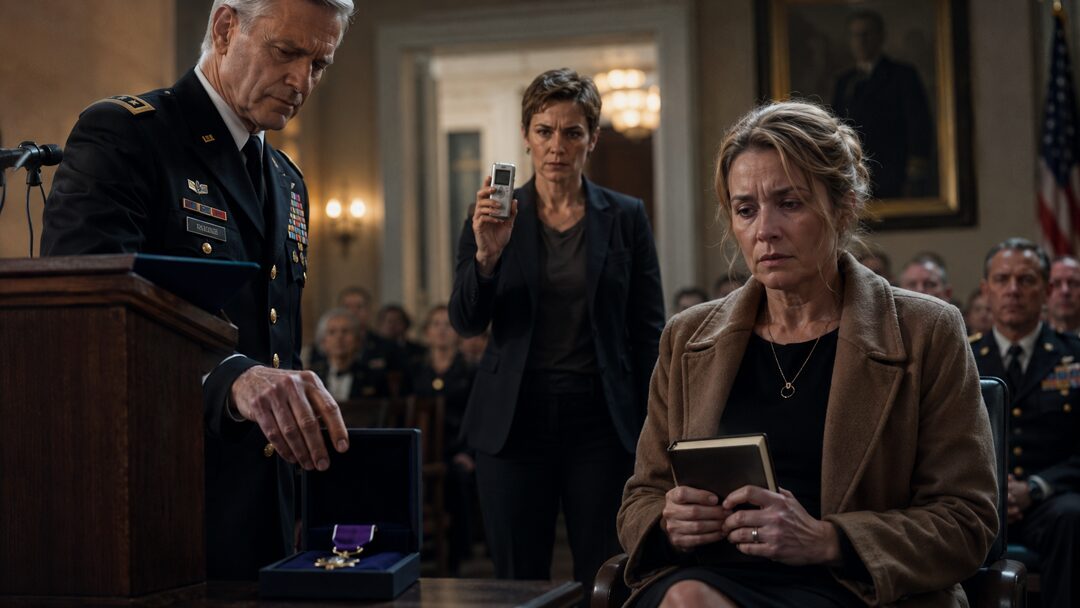
The citation began at 2:04.
Sarah stood at the back of the ceremony hall with a small audio player in her jacket pocket and a security officer near the side door watching her as if she were a misplaced object.
The hall was full.
Rows of uniforms. Folded programs. White gloves. Quiet relatives. Men and women who had known parts of Daniel Carter, or the shape of his absence, or the usefulness of his story.
Emily sat in the front row, straight-backed, Daniel’s notebook in her lap. The medal case rested on a small table near the podium.
Hayes stood at the microphone.
He looked composed again. If he had been shaken in the archive, he had sealed it away. His silver hair was perfect. His hands rested on either side of the folder containing the citation.
“Sergeant Daniel Carter,” Hayes began, “distinguished himself by extraordinary courage and devotion to duty during Operation Night Bell…”
Sarah felt each word settle into the room like varnish.
Courage.
Devotion.
Duty.
None of them were false.
That was the trap.
A lie did not need to invent everything. Sometimes it only had to arrange the true parts until the missing part had nowhere to stand.
Hayes continued.
“While assigned to the north checkpoint, Sergeant Carter maintained his position under hostile pressure, ensuring the safe withdrawal of personnel within the approved extraction zone.”
Emily’s head bowed slightly.
Sarah’s thumb found the audio player in her pocket.
Her body felt very calm now. Too calm. The way it had felt the night she gave the relay recommendation. Calm was not innocence. Calm was only the shape fear took when there was work to do.
Hayes turned a page.
“His actions reflect great credit upon himself, his unit, and—”
Sarah pressed play.
The first crack hit the hall like something dropped from a height.
Every head turned.
The speaker in Sarah’s hand was small, but the room was built to carry sound. The two hard taps struck the walls, then the breath, the metal scrape, the buried voice.
Hayes stopped speaking.
A murmur rose and died.
Then came the four-second shift.
Tap. Tap.
Breath.
Tap. Tap. Tap.
Emily closed her eyes.
Sarah walked down the center aisle before anyone decided whether to stop her.
The security officer moved, then froze when Hayes lifted one hand. Not enough to approve. Enough not to create a scene worse than the one already unfolding.
The final seconds played.
Static.
A failing breath.
Three soft taps.
One almost gone.
Sarah stopped beside the front row.
For a moment, no one spoke.
The hall had heard something it could not easily turn back into ceremony.
Hayes’s face was pale with controlled fury, but there was something else there too. Recognition. Or surrender. Or the exhaustion of a man whose chosen mercy had finally been played through speakers.
Sarah faced the room.
“This recording was entered into evidence as consistent with the official account of Sergeant Carter’s final position,” she said.
Her voice sounded plain. Almost too plain for what it was doing.
“It is not.”
A rustle moved through the rows.
Hayes said, “Ms. Mitchell.”
She did not look at him.
“The opening sound is not incoming fire. It is contact with the transmitter casing. Two deliberate strikes. The four-second pattern that follows matches an improvised field signal used by members of Sergeant Carter’s unit when radio contact failed.”
She could feel Emily beside her, still as stone.
“Two taps. A breath. Three taps.”
The room seemed to listen backward.
“Sergeant Carter was not only holding a checkpoint. The evidence indicates he left his assigned position to mark possible survivors outside the approved extraction line after command believed no one remained there.”
A woman in the second row made a small sound.
Sarah kept going before courage could leave her.
“I was part of the relay team that night. I classified outer-sector signals as unreliable. My recommendation helped support the decision to seal the sector.”
Now she looked at Emily.
“I cannot tell you with certainty who he reached. I cannot tell you whether anyone heard him in time. I can tell you he was still trying to be heard.”
Emily’s hand moved to the ring at her throat.
Sarah’s voice lowered.
“And I can tell you he did not sound like a symbol. He sounded hurt. He sounded determined. He sounded like Daniel Carter.”
No one moved.
The sentence did not comfort the room. It disturbed it.
But it was alive.
Hayes stepped away from the podium.
For one terrible second, Sarah thought he would order her removed and the room would obey because rooms like this were built to obey.
Instead, Hayes looked at Emily.
The silence stretched.
Emily stood.
She held Daniel’s notebook against her chest and looked at the medal case.
“I’ll accept it,” she said.
Her voice was not loud, but everyone heard.
“But not with that citation.”
Hayes’s mouth tightened.
Emily turned toward him.
“You can honor what he did,” she said. “Or you can honor what was convenient. But don’t ask me to carry both and call them the same.”
That was when the room changed.
Not dramatically. Not cleanly. No one applauded. No one rose in sudden moral agreement. But the old version had been broken. Everyone had heard it crack.
Hayes looked down at the citation in his hands.
For a long moment, Sarah saw the man inside the uniform. Older than he had looked that morning. More tired. Not innocent. Not monstrous. Just a man who had mistaken control for mercy long enough that he no longer knew how to put it down.
He closed the folder.
“The citation will be reviewed,” he said.
Three words.
Not enough.
But not nothing.
Part VI — The Answer
By late afternoon, Sarah’s clearance had been suspended.
The notice arrived by email before she reached the archive room. Efficient, polite, bloodless in the way institutions preferred their punishments to be.
She read it once, then shut the laptop.
Her badge still opened the archive door, though probably not for long. She went inside to collect her jacket, Daniel’s copied file, and the old Army T-shirt she had left folded on the back of the chair months ago and never admitted was hers.
The room looked smaller now.
Without the file playing, it was only cabinets, machines, light.
Sarah stood in front of the speaker.
For years, she had believed the worst thing about Night Bell was uncertainty. The unconfirmed calls. The disputed signals. The reports that never settled. The way every answer arrived with a footnote.
Now she knew uncertainty had also been shelter.
If you never knew enough, you never had to say what you had done with what you knew.
She picked up her bag.
At the door, Hayes was waiting.
Neither of them spoke at first.
He looked like a man who had spent the last hour in rooms where people used careful phrases to avoid saying his name with blame attached.
“Your contract is under review,” he said.
“I saw.”
“You understand why.”
“Yes.”
His jaw tightened. “Do you?”
Sarah met his eyes.
“You taught me the difference between protecting people and protecting the story.”
Something in his face moved, then stopped.
He looked past her into the archive.
“I thought I was giving them something they could survive.”
“Maybe you were.”
That seemed to surprise him.
Sarah adjusted the strap of her bag.
“But it wasn’t yours to give.”
Hayes looked down.
For a moment, she thought he might apologize. Not because he was ready. Because the shape of one passed through him and failed to become speech.
Instead, he said, “Mrs. Carter asked for you.”
Sarah found Emily outside near the side entrance, away from the front steps where the last guests were leaving in quiet clusters.
The sky had turned gray. A cold wind moved across the base, lifting the edge of Emily’s coat. She held the medal case under one arm and Daniel’s notebook under the other.
For a second, neither woman said anything.
Then Emily looked at Sarah’s bag.
“They suspended you.”
“Yes.”
“I’m sorry.”
Sarah shook her head. “Don’t be.”
“I’m still sorry.”
That was harder to answer.
Emily looked toward the parking lot.
“My liaison officer asked if I wanted to file a formal statement. My mother asked if I was okay. A reporter asked if I felt proud.”
“Do you?”
Emily gave a small laugh that almost became something else.
“I feel like I met him again and lost him again in the same hour.”
Sarah looked at the medal case.
Emily followed her gaze.
“I’m keeping it,” she said. “Daniel earned it. Maybe not for the sentence they wrote. But for what he did.”
Sarah nodded.
“That sounds right.”
Emily shifted the notebook in her arms.
“I keep thinking about what you said. That you don’t know if anyone heard him.”
Sarah said nothing.
Emily’s eyes shone in the gray light.
“I heard him.”
The words were soft.
They undid Sarah more than anger would have.
Emily opened the medal case. The silver rested inside, bright and formal and too small for the weight it had been asked to carry.
Then she tapped the edge of the case with her knuckle.
Two hard taps.
She stopped.
Took a breath.
Three softer taps.
The rhythm moved through the cold air, fragile and unmistakable.
Not a distress call now.
Not evidence.
Not a question.
Sarah felt her throat tighten. She lifted her hand and tapped the metal doorframe beside her.
Two.
A breath.
Three.
Emily closed the medal case.
For the first time all day, her face changed without breaking. Not peace. Not healing. Something more difficult and more honest.
Recognition.
Behind them, the base continued its ordinary work. Doors opened. Engines started. Men and women carried folders from one building to another. Somewhere, a printer was probably producing a new version of a sentence that would still fail to hold the whole man.
But outside the archive, for a few seconds, the room answered.
Emily turned to leave, then stopped.
“Did he sound scared?” she asked again.
Sarah held the question carefully this time.
“Yes,” she said. “A little.”
Emily nodded.
Sarah added, “But he kept tapping.”
The wind moved between them.
Emily touched the ring at her throat.
“That sounds like him.”
Then she walked toward the parking lot with the notebook, the medal, and the truth no one had managed to make clean.
Sarah stayed by the door until Emily’s car disappeared past the gate.
Only then did she go back inside.
The archive room was waiting, bright and cold.
Sarah placed her badge on the desk. She did not play the file again. She did not need to.
For three years, she had thought the dead lived in silence because the living could not bear to hear them.
Now she knew silence was not empty.
Sometimes it was full of people waiting for someone to listen correctly.
She turned off the speaker, closed the door behind her, and left the room quiet.
Not clean.
Quiet.