They Questioned the Old Man at the Green Table Until His Name Opened the Drawer
Chapter 1: The Old Man at the Green Table
The camera flash struck Joseph Carter’s bandaged hands before anyone asked his name.
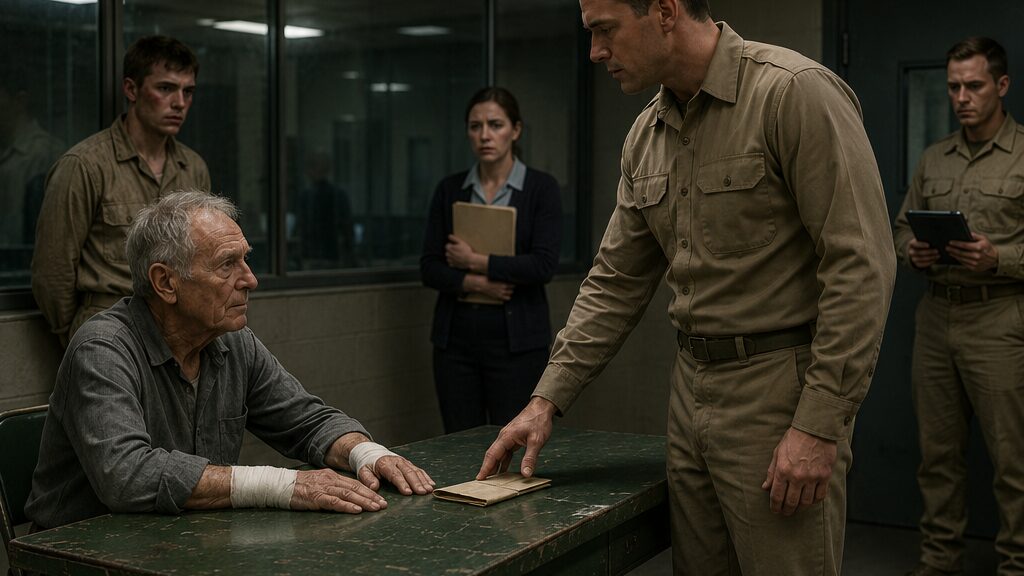
A duty sergeant held the small base tablet above the worn green table and took another photograph, closer this time, as if the gauze wrapped around Joseph’s wrists were contraband. Beside his hands lay a visitor incident form with the first line already filled in: unidentified elderly male, unauthorized administrative entry.
Joseph kept his fingers still.
The room smelled faintly of floor wax, old coffee, and paper stored too long in metal drawers. On the other side of the glass wall, two junior soldiers pretended not to stare. One of them whispered something to the other. The sound did not carry, but the glance did. Old man. Trouble. Confused.
Joseph had seen younger faces make harder judgments with less evidence.
Across the table, Captain Brandon Moore stood instead of sitting. He had the pressed uniform, clipped voice, and polished impatience of an officer who believed a chair was something granted, not shared. He turned Joseph’s driver’s license between two fingers, then dropped it beside the form.
“Joseph Carter,” Brandon read. “No active credential. No appointment in the system. No sponsor listed at the gate.”
Joseph looked at the folded paper in front of him. The paper had softened along its creases from years of being opened and closed. Its edges were yellowed. A pale blue archive stamp showed through one fold, too faded to read unless someone cared to look.
“I gave the gate guard the name of the soldier I came to see,” Joseph said.
“You gave the gate guard a last name and an old building number.” Brandon tapped the tablet. “Fort Lawson does not admit walk-ins because they remember a building number from thirty years ago.”
Joseph’s mouth almost moved at that. Thirty years would have been easier.
“I understand,” he said.
Brandon’s eyes narrowed, as if agreement itself were suspicious. “Do you?”
The door opened behind him.
A young soldier stepped in with one sleeve rolled over a bruised forearm and a dark mark beneath his left eye. He moved like every joint had been inspected and found guilty. When he saw Joseph at the table, he stopped so quickly that the duty sergeant nearly ran into him.
Joseph lifted his eyes.
The young soldier’s lips parted. “Gen—”
Then he swallowed the word.
Brandon turned sharply. “Specialist Davis, you will stand where instructed.”
Matthew Davis shut his mouth and moved to the wall. His gaze fell to the folded paper on the table, then to Joseph’s bandaged hands. The bruise beneath his eye had begun to yellow at the edge. There was dried dirt along the seam of his collar.
Joseph had expected fear. He had not expected that much.
“You know this man?” Brandon asked.
Matthew’s throat worked. “He’s the man I wrote to, sir.”
A small silence followed.
Brandon looked back at Joseph with a different kind of suspicion, the kind that sharpened when two explanations seemed possible and one of them might embarrass the person in charge.
“You wrote to him,” Brandon said. “A retired civilian with no active credentials.”
Matthew said nothing.
Joseph noticed the tremor in the young man’s right hand and the careful way he held his ribs when he breathed. Whatever had happened during training had not stayed on paper.
Brandon picked up Joseph’s folded document without asking.
Joseph’s hands remained on the table.
“This what you brought?” Brandon asked.
“Yes.”
“What is it?”
“A copy of an order.”
“Current?”
“No.”
Brandon gave a short laugh. “That is already a problem.”
Joseph watched the paper bend under the captain’s thumb. He felt, not for the first time, the old urge to correct a young officer’s grip before the edge split. Instead he said, “It may still be relevant.”
“To what?”
“To Specialist Davis.”
Brandon unfolded the top crease. His eyes moved over the first lines without slowing. He did not reach the signature block before he folded it again.
“Old photocopy. No active seal. No date I recognize.” He placed it back on the table just out of Joseph’s reach. “Mr. Carter, do you understand where you are?”
Joseph turned his head slightly toward the glass. Beyond it, soldiers moved through the outer office carrying files, radios, clipboards, coffee. The same rhythms. Different faces. The building had been painted twice since he last stood inside it, but the green tables were the same. So were the drawers.
“I believe I do,” Joseph said.
Brandon leaned forward. “This is an administrative security facility on an active Army installation. You entered a restricted wing after presenting an obsolete reference and asking for a soldier currently under disciplinary review. That does not make you a concerned citizen. It makes you part of the review.”
Matthew took one involuntary step forward. “Sir, he didn’t—”
“Back against the wall, Specialist.”
Matthew obeyed, but his eyes stayed on Joseph.
Joseph knew that look. A young man asking permission to tell the truth and afraid the truth would ruin him faster.
Brandon opened the narrow table drawer. Its metal runners scraped. Inside were blank forms, two pens, a black stamp box, and a few old file tabs curled from use. He slid Joseph’s folded paper into the drawer.
Joseph finally moved. Only his fingers. They pressed once against the table where the paper had been.
Brandon noticed. “Unverified material stays with me.”
“You can check the name again,” Joseph said.
“The name is not the issue.”
“It often is.”
Brandon’s face hardened. The duty sergeant looked down. Matthew stared at the floor as if he had heard more in the sentence than anyone else.
“Mr. Carter,” Brandon said, “I do not have time for riddles from men who wander in with old paper and no authority.”
Joseph looked at him then, fully. Not angrily. Not even coldly. Just long enough that Brandon shifted his weight.
“I did not wander in,” Joseph said.
Brandon’s jaw tightened. “Then you should have known enough to follow procedure.”
Joseph almost answered. He almost said that procedures had names before they had numbers, and that some of them were written in rooms where men had not yet finished crying. He almost said that a gate badge did not measure belonging.
Instead he looked past Brandon to Matthew.
The young soldier’s fear had changed. It was no longer fear for himself alone. He was watching Joseph endure the thing he had tried to prevent.
That was when Joseph understood the letter had not told him everything.
Brandon gathered the tablet, Joseph’s license, and the visitor form. “Until the commander reviews this, you remain here. If he determines you entered under false pretenses, I will recommend charges for unauthorized access and interference with an active disciplinary proceeding.”
The duty sergeant’s eyebrows flicked upward, but he said nothing.
Matthew did. “Sir, he came because I asked—”
“You are already one signature from discharge,” Brandon snapped. “Do not make it two.”
The room went still.
Joseph’s bandaged hands curled once, then eased open.
Brandon reached for the door. Before leaving, he turned back to Joseph. “You will wait here. Quietly.”
Joseph nodded.
The door shut. The lock clicked with a small, clean sound.
On the far side of the glass, Brandon handed the tablet to the duty sergeant and pointed toward the outer office. Matthew remained in the room, back against the wall, breathing shallowly.
For several seconds neither of them spoke.
Then Matthew whispered, barely loud enough for Joseph to hear, “I’m sorry.”
Joseph looked at the closed drawer where the folded paper had disappeared.
“No,” he said. “Not yet.”
Chapter 2: The Bruised Soldier Who Almost Spoke
Matthew Davis was told he could save his career if he stopped saying the word protocol.
The unnamed legal officer slid a corrected statement across the counter-height desk in the hallway outside the holding room. The page had already been printed. Matthew’s name sat at the top. His version of events, stripped clean of the reason he had refused the order, waited beneath it in neat official sentences.
“You sign this,” the legal officer said, “and Captain Moore recommends corrective counseling instead of separation review.”
Matthew stared at the line left blank for his signature.
Through the glass wall, he could see Joseph Carter sitting alone at the green table, hands folded, shoulders slightly stooped. The old man’s paper was gone. The drawer was closed. Somehow that made the room feel worse than when Brandon had been standing over him.
The legal officer tapped the page. “Specialist.”
Matthew looked down. “It leaves out why I stopped the drill.”
“It says you misunderstood range safety instructions.”
“I didn’t misunderstand them.”
The legal officer lowered his voice, not unkindly. “Then you disobeyed them. Pick the version that leaves you with a uniform.”
Matthew could feel the bruise under his eye pulse each time he blinked. The injury had not come from a fight. Not really. It had come from the blast door frame when he pulled the training lever back and the overloaded rack jammed hard enough to throw him sideways. Three other soldiers had still been inside the practice bay. The instructor had shouted at him to continue the sequence. Matthew had shouted back that the bay was not clear.
Then everyone had started using different words.
Delay. Panic. Insubordination. Embarrassment.
No one wanted the word that mattered.
Protocol.
Brandon came down the corridor with his folder tucked under one arm. “Has he signed?”
The legal officer did not answer quickly enough.
Brandon’s eyes went to Matthew. “Specialist Davis, I have given you a way out.”
“You gave me a lie, sir.”
The hallway seemed to shrink around them.
Behind the glass, Joseph’s head lifted. He could not hear everything, maybe not even most of it, but Matthew saw the old man’s eyes settle on him. Steady. Warning him without commanding him.
Do not lie.
Brandon stepped closer. “You want to be careful with that tone.”
Matthew swallowed. “I wrote down what happened.”
“You wrote down what you think happened. Then you dragged in an elderly civilian with a fake order and an old story.”
“He isn’t fake.”
Brandon let out a breath through his nose. “You do not know what he is.”
Matthew looked again through the glass.
The first time he had seen the name Joseph Carter, it had been on a scanned fragment buried in the base’s training portal, attached to a safety bulletin so old the file opened sideways. Carter Protocol. Emergency override authority. Stop-sequence authorization when a trainee or observer identifies a bay-clearance conflict. The document had been referenced in a footnote nobody used anymore. At the bottom was an archival address for correspondence.
Matthew had written because there had been nowhere else to write. Not a dramatic letter. Not a plea. Just three pages of facts, a copy of the training schedule, and one question: Does this still apply if everyone says it does not?
He had expected the letter to return undelivered.
Instead, an old man had arrived at Fort Lawson with bandaged wrists and a folded paper.
“I know he came,” Matthew said.
Brandon’s expression shifted, just slightly. “What does that mean?”
Matthew’s mouth dried.
It meant Joseph Carter had read the letter. It meant he had believed enough of it to come in person. It meant the name at the bottom of the old order belonged to a living man, not a dead footnote.
Matthew looked at the corrected statement. If he signed it, Joseph could go home. Maybe Brandon would release him with a warning. Maybe the old man would not be pulled any deeper into a mess Matthew had made by believing old rules still mattered.
Through the glass, Joseph moved one hand.
It was a small gesture. Two fingers extended, then folded back. Not a signal Matthew knew from any current manual. Not a command. More like a man smoothing a crease no one else could see.
Matthew pushed the statement back.
“I can’t sign that.”
The legal officer closed his eyes for half a second.
Brandon’s voice went flat. “Then tomorrow morning this becomes formal.”
Matthew said nothing.
“You understand what that means?” Brandon asked. “Your record goes before the commander. Your refusal becomes part of the file. Your outside contact becomes part of the file. And Mr. Carter’s unauthorized involvement becomes part of the file.”
“He didn’t do anything wrong.”
“He entered a restricted wing asking for you.”
“Because I wrote to him.”
“Why?”
Matthew looked at the green table, the closed drawer, Joseph’s bowed gray head.
“Because the order had his name on it.”
Brandon’s stare held for too long.
Then he laughed once, without humor. “So that is it.”
Matthew felt something cold settle in his stomach.
Brandon turned to the legal officer. “Add that. Specialist Davis admits he solicited outside interference based on an obsolete document attributed to a person whose authority cannot be verified.”
“It can be verified,” Matthew said.
“With what? That paper?” Brandon gestured through the glass. “A copy old enough to have been made before you were born?”
Matthew’s face burned.
Brandon stepped close enough that his voice dropped beneath the corridor noise. “Listen to me, Specialist. Dead men’s names do not save careers.”
Joseph stood inside the holding room.
The movement was slow, but it cut through the hallway. Even Brandon turned.
Joseph did not come to the glass. He did not knock. He simply stood beside the green table with his bandaged hands at his sides, looking through the wall as if distance and rank and locked doors were all temporary inventions.
Matthew felt his throat tighten.
“He’s not dead,” Matthew said.
Brandon looked back at him. “No. But whatever he thinks he remembers is not going into your hearing.”
The legal officer collected the unsigned statement.
Brandon opened the holding-room door and stepped halfway inside. “Mr. Carter, you are not a witness in tomorrow’s inquiry. You will not address the panel. You will not speak to Specialist Davis unless authorized. You will remain available until Commander Thompson reviews whether your presence here constitutes interference.”
Joseph’s face did not change.
Matthew wanted him to say it. Whatever the title was. Whatever the old name meant. Say it and end this.
But Joseph only nodded once.
Brandon closed the door again.
Matthew understood then that the old man was not trapped because he could not defend himself. He was choosing not to. And somehow that choice was costing both of them more with every minute.
As the duty sergeant led Matthew toward the barracks wing, Brandon called after him.
“Formal inquiry at zero eight hundred. And Specialist—leave the Carter Protocol out of your mouth unless you want that phrase to be the reason you lose everything.”
Matthew looked back through the glass.
Joseph was still standing.
The drawer between them stayed shut.
Chapter 3: The Paper Brandon Would Not Check
Rachel Smith saw the archive code before she saw the signature.
It was written in the bottom corner of the intake copy, half-hidden by the fold where Captain Moore had flattened the old paper against the copier glass. Most people would have missed it. Most current files did not use letters before the number string anymore. But Rachel had spent six years in the records office at Fort Lawson, long enough to know that old systems did not disappear. They slept in drawers until someone important forgot they needed them.
C-17-LAW/Command Safety Annex.
She stared at the code while the copier hummed behind her.
Brandon stood near the door, checking his phone. “Log it as unverified outside material.”
Rachel glanced up. “Sir, this has an archive prefix.”
“It has an old-looking prefix.”
“The format matches pre-digital command orders.”
“Does it match a current active directive?”
“I’d need to check.”
“No.” Brandon pocketed his phone. “You need to log it.”
Rachel looked down again. The paper was brittle at the corners, but not fake. The typeface belonged to a machine old enough that some letters sat lower than others. The blue stamp had faded, but its shape was familiar: Fort Lawson command archive. Not public. Not ceremonial. Administrative.
“Sir, if this is tied to Specialist Davis’s claim, the inquiry panel may want—”
“The inquiry panel wants current evidence.” Brandon took the copy from the machine. “Not a scavenger hunt.”
Rachel had learned the difference between an officer who wanted a file and an officer who wanted a record of having asked for one. Brandon wanted neither. He wanted a line in a log that made the paper stop existing.
Through the open office door, down the hall, she could see the holding room. The elderly man sat at the green table again. He had been given a paper cup of water and had not touched it. His bandaged hands rested on either side of the cup, palms down, as if holding the table still.
“Who is he?” Rachel asked before she could stop herself.
Brandon’s answer came too quickly. “A problem.”
“That’s not a name.”
“It is all you need for the log.”
Rachel lowered her eyes. “Yes, sir.”
He left with the original folded paper in his folder.
Rachel stood over the copier until the machine went quiet.
The records office was narrow, windowless, and crowded with the kind of furniture no department admitted owning. Two gray file cabinets leaned slightly toward each other near the back wall. A rolling shelf held archived index drawers no one had budgeted time to digitize. Rachel had once suggested scanning them. A major had told her old paper was only useful after someone had already failed to find it.
She opened the intake log and typed what Brandon had ordered.
Unverified outside material presented by civilian visitor Joseph Carter.
Her fingers hovered over the next field.
Archive relevance: unknown.
She did not press enter.
From the hallway came Brandon’s voice, sharper now. The holding-room door opened. Rachel stepped just far enough from her desk to see without being seen.
Brandon entered with the folded paper in his hand. Joseph looked up.
“I had Records look at it,” Brandon said.
Rachel stiffened.
Joseph’s gaze moved to the paper, then back to Brandon. “And?”
“And it remains unverified.”
“That is not the same as false.”
Brandon smiled faintly. “Mr. Carter, men your age come onto bases with stories more often than you think. Some served. Some knew someone who served. Some collect language that sounds official. I am not accusing you of anything yet.”
“Yet,” Joseph repeated.
“You are making that difficult.”
Brandon placed the folded paper on the green table and tapped it twice with two fingers. The sound carried through the glass. Soft. Paper against metal. Still, Rachel felt it in her teeth.
Joseph’s bandaged hand moved toward it.
Brandon pulled it back.
“Do not touch evidence.”
Matthew Davis, seated against the wall now with a guard beside him, flinched as if Brandon had touched him instead.
Joseph withdrew his hand.
Brandon unfolded the paper enough to expose the faded heading. “Carter Protocol. Emergency override authority. Command Safety Annex.” He looked at Matthew. “This is the phrase you want to risk your career on?”
Matthew’s jaw tightened. He did not answer.
Brandon turned back to Joseph. “You see what you’ve done? You gave a scared soldier a myth.”
Joseph looked at the paper for a long moment. Rachel could not see his face clearly through the reflection in the glass, but she saw his shoulders settle, as if some inner door had closed.
“You can check the name again,” he said.
Brandon laughed under his breath. “There is nothing to check.”
Joseph’s voice stayed quiet. “There is always something to check.”
For a second, no one moved.
Rachel’s eyes dropped to Brandon’s hand. He was holding the document with the bottom corner facing outward. The archive code was visible again.
C-17-LAW.
Then Brandon folded the paper sharply, too sharply, and slid it back into his folder.
Joseph’s hands remained open on the table.
Brandon leaned down. “If you had authority here, Mr. Carter, someone would know it.”
Joseph looked past him, not at the soldiers, not at Rachel, but at the old file cabinets behind her office door.
“Someone does,” he said.
Brandon’s expression hardened.
He turned, walked out, and came straight toward Records.
Rachel stepped back to her desk, pulse quick.
“Log complete?” he asked.
“Almost, sir.”
“Complete it now.”
She pressed enter with one hand. With the other, hidden beside the keyboard, she wrote the archive code on a yellow sticky note.
C-17-LAW/Command Safety Annex.
Brandon reached over and closed the intake folder on her desk. “No archive search unless Commander Thompson requests it. Understood?”
“Yes, sir.”
He left the office with the folded paper still in his folder.
Rachel waited until his footsteps faded. Then she crossed to the old rolling shelf at the back of the room and touched the first index drawer.
The metal handle was cold. The label cards inside smelled like dust and carbon paper. Her sticky note trembled slightly between her fingers.
She had not disobeyed an order.
Not yet.
But before Brandon closed the corridor door, Rachel slipped the yellow note under her blotter, where the archive code waited under Joseph Carter’s name.
Chapter 4: The Protocol Written After the Loss
“How did you injure both wrists?”
The medical aide had asked it while cutting away the edge of Joseph Carter’s old bandage, but the question made the small exam room go quieter than the blade should have allowed.
Joseph looked at the red line beneath the gauze, then at the closed door. A guard stood outside it, visible only as a shadow through the wired glass. Somewhere down the corridor, a printer began to spit pages into a tray, each sheet striking like a soft verdict.
“Opening a door someone else was afraid to touch,” Joseph said.
The medical aide paused.
Joseph offered no more.
The aide finished cleaning the shallow burns along his wrists with careful, practiced motions. The injuries were not fresh enough to be dramatic and not old enough to ignore. Rope burn, metal heat, torn skin from forcing something that had not wanted to move. The aide glanced once at Joseph’s face, perhaps expecting a complaint. Joseph gave none.
“Range bay?” the aide asked.
Joseph’s fingers flexed once.
The aide understood enough to stop asking. He wrapped fresh gauze around the right wrist, then the left. “You need rest.”
“I have had enough of that.”
“You also need to avoid stress.”
Joseph almost smiled. “At my age, stress is usually delivered by younger men with folders.”
The aide looked toward the hallway. “They said you’re being held for the commander.”
“They said many things.”
The aide secured the last strip of tape. “You’re cleared medically. That’s all I can put down.”
Joseph lowered his sleeves slowly. The faded gray shirt had been washed thin at the cuffs. He had chosen it that morning because it had buttons he could manage with stiff fingers. He had not expected it to become evidence against him.
The door opened before the aide could knock. The duty sergeant looked in. “Mr. Carter, Captain Moore says you stay in the holding room until the inquiry.”
“What time?”
“Zero eight hundred.”
Joseph looked at the wall clock.
It was seven twenty-six.
The aide frowned. “I was told it was at ten.”
The duty sergeant’s expression tightened. “It changed.”
Of course it had.
Joseph stood, and for a moment the room tilted. Not enough to fall. Enough to remind him that his body had begun negotiating with gravity without his permission. He steadied himself with two fingers against the exam table.
The duty sergeant saw it. He looked away quickly.
Joseph did not resent him for that. Young men often mistook dignity for the absence of need. Older men sometimes helped them make that mistake.
He walked back through the corridor with the duty sergeant behind him. Fort Lawson smelled different in the morning: stronger disinfectant, newer coffee, warmed plastic from machines waking up. Voices moved behind doors. Phones rang. Boots struck tile with purpose. The base was alive and uninterested.
At the turn near the records annex, Joseph saw Rachel Smith through the half-open office door. She stood at the old rolling shelf with one hand on a metal drawer and the other pressed flat over something on her desk. When she looked up and saw Joseph, her eyes flicked to his bandaged wrists.
Then to his face.
Then away.
She had seen something.
The duty sergeant kept him moving.
The holding room waited with its green table, paper cup, and glass wall. The folded paper was still gone. Its absence had become louder than its presence. Joseph sat where Brandon had left him and placed his newly wrapped hands on the metal edge.
The tape was too white. Too clean.
He remembered another white thing.
A strip of chalk drawn across concrete.
The old range bay had not had the clean glass walls of the current training rooms. It had smelled of oil, dust, sweat, and hot wiring. Men had crowded around a safety board, impatient to complete a demonstration before visiting inspectors arrived. A young corporal had raised his hand. Not high. Just enough to be ignored by men who knew the schedule.
Sir, the bay-clear call came before the rear hatch check.
Joseph had been younger then. Not young, but still hard in the shoulders, still certain that command meant sorting urgent warnings from nervous noise. He had looked at the watch on his wrist. He had looked at the row of officers waiting behind him. He had told the corporal to note it for review after the demonstration.
After.
The word lived longer than the man did.
The jam had taken seconds. The correction had taken years. The first order Joseph wrote afterward had not been elegant. It had been angry, exhausted, and written at a desk where the corporal’s empty chair remained visible through the open door. Emergency override authority. Any trainee, observer, or support soldier identifying bay-clearance conflict may halt sequence pending command review. No disciplinary action shall attach to good-faith stoppage.
The staff had called it Carter Protocol because officers liked attaching names to procedures once the blood had dried.
Joseph had signed it too late.
A knock struck the glass.
Matthew stood outside the holding room, flanked by a guard. He had no helmet now, no weapon, no defensive posture. Without the gear, he looked younger. Bruised, tired, trying to appear more disciplined than afraid.
The guard opened the door. “Two minutes. Captain said no case discussion.”
Matthew stepped inside.
Joseph remained seated. “Did you sleep?”
Matthew let out a humorless breath. “No, sir.”
The sir landed in the room carefully. Not as recognition. As habit. As plea.
Joseph glanced at the guard, then back to Matthew. “Do not give them a false statement.”
“They moved the hearing up.”
“I heard.”
“Rachel—the records clerk—she was looking for something last night. I saw her near the drawers. But Captain Moore said no archive search unless Commander Thompson asks.”
Joseph absorbed that. The machine still worked the way machines worked: permission before memory.
Matthew lowered his voice. “If you tell them who you are, maybe they have to listen.”
Joseph looked at his bandaged hands.
There it was. The simple solution. The old temptation hidden inside humility’s clothing. Say the title. Open the room. Make men stand straighter. Use the years.
And beside it, the older fear: that once the title entered, no one would hear the dead corporal, or Matthew, or the simple fact that a warning from below should not need a famous name above it.
“Maybe,” Joseph said.
Matthew’s face fell.
Joseph hated himself a little for that.
The guard opened the door wider. “Time.”
Matthew stepped back, then stopped. “I wrote to the address because I didn’t think anyone would answer.”
Joseph looked up.
Matthew’s voice cracked but did not break. “You did.”
The guard took him away.
Joseph sat alone with the sentence.
You did.
For years, he had treated his absence as a kind of penance. He did not attend base dedications. He did not correct articles that abbreviated his career into medals and commands. He did not stand beneath flags while younger officers thanked him for decisions that still visited him at night.
But Matthew had not asked for a monument. He had asked if the rule still applied.
Joseph heard movement in the hallway. Brandon’s voice came through first, clipped and controlled.
“Bring Mr. Carter after the first statement. He is not to address the panel unless asked.”
Joseph stood before the door opened.
The duty sergeant blinked at him. “Sir—Mr. Carter, they’ll send for you.”
“No.”
The old word surprised both of them.
Joseph stepped toward the doorway, his bandaged hands hanging at his sides.
The duty sergeant shifted uncertainly. “Captain Moore’s order is to keep you here.”
“Then tell Captain Moore I will go to the inquiry room now.”
“I can’t authorize that.”
Joseph looked through the glass toward the room where Matthew had disappeared.
“I am not asking to be authorized,” he said. “If they want me as the accused, I will stand as the accused. But I will not sit at this table while a soldier answers for a rule I came here to discuss.”
The duty sergeant hesitated, one hand near the radio on his shoulder.
Joseph did not raise his voice.
“Take me to the inquiry room.”
Chapter 5: The Inquiry Behind the Glass
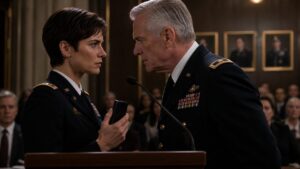
“The old man cannot even prove he belongs on base,” Brandon Moore said, and the sentence sounded clean enough to survive review.
That mattered.
He stood at the end of the inquiry table with his folder aligned to the edge, every page squared, every tab visible. The unnamed legal officer sat to his left. Matthew Davis sat alone on the opposite side, hands clasped too tightly. Through the glass wall behind him, the holding room and the green table remained visible, empty now except for the paper cup Joseph Carter had not touched.
Brandon did not like that empty chair.
He had ordered Carter brought later. The duty sergeant had not confirmed. That was one more small failure in a morning already filling with them.
“Specialist Davis was instructed to continue a standard training sequence,” Brandon said. “He refused the order, interrupted the exercise, damaged equipment, and later attempted to justify his actions using an obsolete document of uncertain origin supplied by an unauthorized visitor.”
Matthew stared at the tabletop.
The legal officer made a note.
Brandon kept his shoulders relaxed. If he presented this correctly, it remained procedural. Not emotional. Not personal. A soldier panicked during a drill. An elderly outsider complicated the inquiry. A captain contained the situation. That was all.
It had to be all.
Because if Matthew’s claim had weight, then the earlier complaints had weight too.
The first complaint had come three weeks before the incident, from a range technician who said the rear hatch indicator lagged under load. Brandon had routed it for maintenance review. The second came from Matthew, who said the safety sequence did not match the archived training language. Brandon had told him to use current manuals, not old portal scraps. The third had been verbal, messy, inconvenient, delivered twelve hours before an inspection team arrived.
No injury. No failure during official observation. No reason to stop the schedule.
That was what Brandon had told himself.
Then Matthew had stopped the drill.
Now a bruised specialist sat across from him with a stubborn jaw, and an old man with bandaged wrists had appeared carrying paper from the past.
Brandon turned a page. “Specialist Davis, did you or did you not refuse a direct instruction?”
Matthew looked up. “I refused to continue a sequence while the bay-clearance conflict was unresolved.”
“That is not what I asked.”
“It’s the answer.”
The legal officer’s pen paused.
Brandon felt heat rise under his collar. “Did you identify yourself as qualified to countermand the instructor?”
“No.”
“Did you hold emergency command authority?”
“No.”
“Did you believe an old archived phrase gave you that authority?”
Matthew swallowed. “I believed the Carter Protocol did.”
Brandon allowed a controlled silence.
There. Let the phrase hang. Let it sound like what it was: a young soldier reaching for a ghost.
“The Carter Protocol,” Brandon repeated. “A term not found in the current training directive.”
Matthew’s eyes flicked toward the glass.
Brandon followed the glance.
Joseph Carter stood in the corridor outside the inquiry room.
The duty sergeant stood behind him, looking as if he had lost a short argument and was trying not to admit it. Joseph’s posture was upright but not easy. Fresh white bandages showed beneath the cuffs of his faded shirt. He looked less like a threat than a man waiting for a bus that no longer ran.
That, Brandon reminded himself, was exactly how people got careless.
The legal officer noticed the old man. “Captain?”
Brandon opened the door himself. “Mr. Carter, you were instructed to wait.”
Joseph looked past him to Matthew. “I was.”
“And yet?”
“And yet I am here.”
Brandon stepped into the corridor, lowering his voice. “You are making your situation worse.”
Joseph’s eyes stayed steady. “No. I am clarifying it.”
For one sharp second, Brandon wanted to ask him plainly: Who are you?
He did not.
A question like that gave ground.
“You may sit behind the observer line,” Brandon said. “You will not address the panel. You will not signal the specialist. You will not introduce unverified documents.”
Joseph’s gaze moved to the folder under Brandon’s arm.
“Is my paper inside?”
“Your paper is part of the incident file.”
“Then the incident file is incomplete.”
Brandon leaned closer. “You are very confident for a man with no standing here.”
Joseph’s face changed only slightly. Not anger. Something worse. Disappointment old enough not to need display.
“I have stood here before,” he said.
Brandon’s hand tightened on the folder.
Behind them, in the inquiry room, Matthew had turned fully in his chair. The legal officer watched through narrowed eyes. The two junior soldiers beyond the outer glass had stopped pretending not to listen.
Brandon stepped aside. “Observer line.”
Joseph entered.
He took the chair against the wall, not the one near the table. He sat slowly. Matthew looked at him once. Joseph did not nod. He only placed both bandaged hands on his knees, palms down.
Do not lie.
Brandon returned to the head of the table.
“Continue,” the legal officer said.
Brandon did, but the room had changed. He could feel it in the way Matthew’s breathing steadied, in the way the duty sergeant kept glancing toward Carter, in the way the empty green table behind the glass seemed to hold the shape of the missing paper.
“Specialist Davis,” Brandon said, “you were offered a corrected statement.”
“I was offered a false one.”
The words landed harder with Joseph in the room.
Brandon kept his voice level. “You understand refusal may result in separation proceedings.”
“Yes.”
“You understand claiming authority from an obsolete document does not protect you.”
Matthew’s hands unclasped. “The document said good-faith stoppage couldn’t be punished.”
“The document has not been verified.”
“Because you won’t verify it.”
The legal officer looked up.
Brandon saw the line before he crossed it, and crossed it anyway. “You are not in a position to question my handling of evidence.”
“No, sir,” Matthew said. “But he is.”
The room went still.
Matthew pointed, not dramatically, just enough.
Joseph closed his eyes for half a breath.
Brandon felt the first real crack in the morning.
“Specialist,” the legal officer warned.
Matthew’s voice shook now, but he kept going. “I wrote to the address in the archive. I asked if the Carter Protocol was real. Mr. Carter came because I asked him to. Not to interfere. To answer.”
Brandon opened the folder. “And Mr. Carter has provided no verifiable authority to answer anything.”
Joseph spoke from the wall.
“I did not come to provide authority.”
Every face turned.
Brandon snapped, “You were not asked to speak.”
Joseph inclined his head. “Then ask me.”
Brandon almost did. The question rose: What is your connection to the order?
But asking would enter the answer into the room. It would make Carter part of the record instead of a problem outside it. Brandon had already built the morning around keeping that distinction intact.
“No,” Brandon said. “The panel will consider only verified material.”
“Then verify it,” Matthew said.
Brandon turned on him. “Enough.”
The word came out too sharp.
In the silence after it, everyone heard footsteps in the corridor. Firm, unhurried, accompanied by the faint flap of paper.
The door opened without a knock.
Gary Thompson entered in duty uniform, gray at the temples, face set in the expression of a man who had been interrupted by something that made interruption necessary. In his right hand he held a pale request slip.
Rachel Smith stood just behind him, eyes lowered but shoulders squared.
Gary looked first at Brandon. Then at Matthew. Then at Joseph sitting against the wall.
His gaze lingered.
Something like recognition moved behind his eyes, but not enough to name.
“Captain Moore,” Gary said, “why did a records clerk have to send me an archive request slip that your report says was unnecessary?”
Brandon’s mouth went dry.
Gary lifted the slip.
On it, in Rachel’s careful handwriting, was the code Brandon had refused to check.
C-17-LAW/Command Safety Annex.
Chapter 6: The Drawer Opens Under His Name
Rachel Smith opened the drawer labeled C-17 and found Joseph Carter before anyone in the room was ready for him.
The archive drawer stuck halfway, as it always did, so she had to brace one hand against the cabinet and pull with the other. Metal shrieked softly along the runners. Behind her, Commander Gary Thompson waited without speaking. Brandon Moore stood near the office door, too still. The duty sergeant hovered in the corridor. No one had asked Joseph to come into Records. He remained behind the glass in the holding room, seated at the green table again, where Gary had ordered him placed “for a moment” until the archive could be checked properly.
Properly. The word had made Rachel want to laugh and apologize at the same time.
The drawer gave at last.
Index cards sat in tight rows, yellowed at the edges, their typed labels fading into brown. Rachel moved through them carefully.
C-17-LAW/Building Maintenance.
C-17-LAW/Command Rotation.
C-17-LAW/Command Safety Annex.
Her fingers stopped.
Gary stepped closer. “Pull it.”
Rachel lifted the card. Behind it sat a thin folder, dark green, the same shade as the holding-room table after years of hands had worn through its finish. A red archive ribbon held it closed. The label had been typed, then amended by hand.
CARTER, JOSEPH — COMMAND AUTHORITY
EMERGENCY OVERRIDE ORDER
FORT LAWSON TRAINING ANNEX
No one spoke.
Brandon said, “Commander, old archive labels can be misleading.”
Gary did not look at him. “Open it.”
Rachel untied the ribbon.
The first page was a preservation copy of the same order Brandon had dismissed. Not similar. The same. Same uneven type. Same heading. Same emergency override language. Same blue stamp, clearer here. Same signature line at the bottom, dark and unmistakable.
Joseph A. Carter
Commanding General
Rachel’s breath caught.
She had handled records for officers, visiting inspectors, civilian contractors, retired colonels, foundation donors, and families searching for burial paperwork. Names became categories after a while. Last name, first name, middle initial. Rank, office, date.
This one made the room change.
Gary reached for the page but did not lift it yet. “Is there a service record attached?”
Rachel turned the folder flap.
There was a photograph beneath the order.
A younger Joseph Carter looked out from the print in dress uniform, shoulders squared, stars visible, eyes not yet softened by age but already carrying something heavy. Behind him, the old Fort Lawson training annex stood under construction. A line of officers and soldiers flanked him. The caption had been typed on a white strip and taped beneath the image.
General Joseph A. Carter, Commanding General, Fort Lawson Safety Reorganization.
Gary took the photograph.
Brandon shifted his stance. “Commander, I had no basis to assume—”
Gary raised one hand.
Brandon stopped.
Gary looked through the glass toward the holding room.
Joseph sat with his hands folded on the green table. The fresh white bandages rested where the folded copy had first lain. He did not look toward Records. He looked down at the empty table surface as if listening to something no one else could hear.
Gary held the photograph beside his face, comparing age to memory, bone to shadow, the line of the jaw changed but not lost.
Then he whispered, “My God.”
Rachel heard Brandon swallow.
Gary turned the next page. Appointment summaries. Command postings. A withdrawal memo. A distribution order for the emergency safety protocol. A handwritten notation from decades earlier: retain in command archive; do not purge with obsolete training manuals.
Rachel saw the notation and felt a flush climb her neck.
The institution had not forgotten by accident.
It had stored the truth correctly and then taught its people not to ask for it.
Gary closed the folder halfway and faced Brandon. “You had this man’s document in your possession?”
“Yes, sir, but it was an old copy.”
“And he told you to check the name?”
Brandon’s lips parted.
Rachel looked down at her desk.
Gary repeated, quieter, “Did he tell you to check the name?”
“Yes, sir.”
“And you did not.”
Brandon’s face had gone pale under the controlled set of his features. “I judged it outside the scope of the inquiry.”
“No,” Gary said. “You judged the man outside the scope.”
The sentence stayed in the records office like a struck bell.
Gary picked up the folder. “Bring Specialist Davis. Bring the legal officer. And bring Captain Moore’s report.”
Brandon said, “Sir—”
Gary looked at him then, and whatever Brandon saw in his commander’s face closed his mouth.
Rachel carried the folder because Gary told her to. Her hands trembled once before she steadied them. The corridor seemed longer than usual. The junior soldiers behind the outer glass stepped aside when Gary approached. The duty sergeant opened the holding-room door.
Joseph began to stand.
Gary entered first.
“Please remain seated,” Gary said, then stopped as if the courtesy had arrived too late.
Joseph stood anyway, slowly, because some habits outlasted bodies. He looked at the folder in Rachel’s hands, not with surprise, but with a weariness that made the paper feel heavier.
Gary set the archive folder on the green table. Rachel placed Joseph’s folded copy beside it. Brandon must have handed it over somewhere in the corridor; she had not seen when. The two documents lay together now: one aged by official storage, one softened by human keeping.
Gary opened the folder.
Matthew was brought in and positioned near the wall. His eyes went immediately to the photograph. He stared at the young commander in the print, then at the old man beside the table.
The legal officer entered last and stopped just inside the door.
Gary looked at Joseph.
For the first time since Rachel had worked at Fort Lawson, she saw the base commander uncertain about how to address someone.
Then Gary straightened.
“General Carter.”
The room fell silent so completely that the fluorescent lights seemed louder.
Matthew’s face changed first. Not triumph. Relief struck too deep to become a smile. The duty sergeant looked down at his boots. The legal officer closed the folder he had brought as if embarrassed by its thinness.
Brandon did not move.
Joseph closed his eyes briefly.
“Commander Thompson,” he said.
Gary’s breath caught at being named by a man he had not introduced himself to in the room. “Sir, I owe you—”
Joseph lifted one bandaged hand.
Gary stopped.
“Not yet,” Joseph said.
The two words carried less force than an order and more weight than one.
Gary looked at the hand, then at the old paper. He understood enough to nod.
Rachel remained near the door, the archive ribbon looped around her finger. She could not stop looking at the folded copy Joseph had carried. He had not brought a medal. Not a photograph. Not a framed certificate. He had brought a rule.
Gary turned toward Brandon. “Captain Moore, your incident report states Mr. Carter’s material was unverified and irrelevant. That report is now under review.”
Brandon’s jaw worked once. “Yes, sir.”
“It also states Specialist Davis invoked nonexistent authority.”
“Yes, sir.”
Gary touched the original order. “This appears to be very existent.”
Matthew looked at Joseph, waiting. Everyone was waiting now, and that was its own danger.
Joseph’s shoulders drew inward almost imperceptibly.
Rachel saw it and understood that recognition could be another kind of pressure. The room had been cruel when it thought he was nobody. Now it was becoming careful because it knew he was somebody. Neither version seemed to comfort him.
Gary sat at the head of the green table. “We are going back on record.”
The legal officer scrambled into place. Brandon stood beside the wall, no longer controlling the room but still part of its damage.
Gary opened the archive folder to the signature page, then placed Joseph’s folded copy beside it. “General Carter, I need to ask you directly. Based on this order, based on your authorship of the Carter Protocol, was Specialist Davis within his authority to stop the training sequence?”
Matthew held his breath.
Brandon stared at the floor.
Joseph looked at the folded paper he had carried all those years, then at the young soldier with the bruised face.
His bandaged fingers touched the old crease.
The truth that could save Matthew waited in front of him. So did the truth Joseph had spent decades refusing to say aloud.
Gary’s voice softened, but the recorder on the table caught every word.
“General Carter, was he right?”
Chapter 7: Do Not Apologize Because I Was a General
“General Carter, I apologize,” Brandon Moore said, before Joseph had answered the question that mattered.
The words came out too fast, polished by panic rather than remorse. They struck the green table and lay there beside the open archive folder, beside the folded copy Joseph had carried for years, beside the recorder that had not stopped blinking red.
Joseph lifted his eyes.
“No,” he said.
Brandon froze.
Gary Thompson, seated at the head of the table, did not speak. Matthew Davis stood against the wall with his bruised face pale and still. Rachel Smith held the archive ribbon in both hands as if it might keep her from moving.
Joseph kept his bandaged fingers on the fold of the paper.
“Do not apologize because I was a general,” he said. “That is too easy.”
Brandon’s mouth closed.
Joseph looked at the captain’s uniform, the perfect creases, the name tape, the careful arrangement of authority that had filled the room until the drawer opened. He had worn more stars than Brandon had ever stood near. He had also made mistakes that no title had forgiven.
Gary leaned toward the recorder. “General Carter, the question remains. Was Specialist Davis right to stop the training sequence?”
Joseph looked at Matthew.
The young soldier was trying not to hope. That was what hurt most. Hope, in young men under discipline, often looked like fear wearing a straighter back.
“Yes,” Joseph said.
Matthew’s breath broke silently.
Joseph continued before anyone could turn the answer into a clean rescue. “Based on the order before you, Specialist Davis had authority to stop the sequence if he identified a bay-clearance conflict in good faith. He did not need command rank. He did not need permission from the instructor he believed was wrong. The purpose of the protocol was to prevent a soldier from being punished for stopping a sequence that could injure people.”
Gary nodded once. “The order is valid?”
Joseph’s fingers pressed the crease.
“It was valid when I signed it. If the base failed to teach it, retire it properly, or reconcile it with current manuals, that failure does not belong to Specialist Davis.”
The legal officer wrote quickly now, no longer lazily collecting statements but chasing them.
Brandon shifted near the wall. “Sir, the current directive does not include that language.”
Joseph turned to him.
Brandon seemed to regret the sentence before it finished breathing.
“Then the current directive is incomplete,” Joseph said.
Gary looked at Brandon. “Captain, did Specialist Davis raise a concern about bay-clearance language before the incident?”
Brandon’s eyes flicked toward Matthew, then away. “He referenced old material, sir.”
“That was not my question.”
Brandon’s jaw tightened. “Yes, sir. He raised concerns.”
“How many times?”
Brandon did not answer immediately.
Joseph watched him struggle. Not with truth. With cost.
“More than once,” Brandon said.
Gary’s face hardened, but Joseph raised one hand slightly.
“Let him finish,” Joseph said.
Brandon looked at him as if he did not understand the mercy. Perhaps it was not mercy. Joseph did not know anymore. He only knew that if the room made Brandon into the whole disease, the institution would avoid examining the infection.
Brandon drew a measured breath. “There was an inspection scheduled. The bay had passed the latest maintenance review. Specialist Davis’s objections were… disruptive. I believed he was using outdated material to avoid a sequence he lacked confidence in.”
Matthew’s face flushed. “That’s not true.”
“I believed it,” Brandon said, and for the first time his voice lost its edge. “That does not make it true.”
The room changed again, not with forgiveness, but with the first sound of a locked thing loosening.
Gary asked, “Why wasn’t the archive checked when the document was presented?”
Brandon looked at the folded paper. “Because I thought checking it would make the claim larger than it was.”
“And now?”
Brandon swallowed. “Now I understand it was already larger than I wanted it to be.”
Joseph closed his eyes briefly.
He heard another room under this one. A hotter one. A room where a corporal’s warning had seemed badly timed, poorly phrased, inconvenient. Joseph could still see the young man’s hand raised halfway. Not demanding. Not dramatic. Just asking command to slow down.
Sir, the bay-clear call came before the rear hatch check.
Joseph opened his eyes.
“Captain Moore is not the first officer to mistake inconvenience for unreliability,” he said.
Gary looked at him carefully.
Joseph unfolded the paper himself.
The motion took longer than he wanted. The bandages caught against the softened crease. Rachel took a small step forward, then stopped when Joseph managed it. The page opened flat beneath his hands.
“This order was written after a soldier died,” Joseph said.
No one moved.
“The first time this base needed a rule like this, it did not have one. A corporal noticed a sequencing problem during a demonstration. He raised it before the run. I heard him. I did not ignore him entirely. That is the worst part. I told myself I would review it afterward.”
His voice remained steady. That surprised him less than it once would have. Old grief learned to walk without shaking.
“There was no afterward for him.”
Matthew’s eyes dropped.
Gary’s hand closed slowly over the edge of the folder.
Joseph looked at the signature at the bottom of the order. His own name, younger ink, a man trying to make policy out of regret.
“I wrote this protocol so no soldier at Fort Lawson would have to be important before being believed. So a private, a specialist, a clerk, a mechanic, anyone close enough to see danger could stop a sequence without first winning an argument with pride.”
The recorder light blinked.
Joseph turned to Brandon. “That is why your apology cannot begin with my rank.”
Brandon’s face had lost its official stillness.
“You treated me poorly when you thought I was no one,” Joseph said. “Then you apologized when you learned I had been someone. That is the wrong order.”
Brandon looked down at the table.
Joseph’s voice softened, and that made the words harder. “If I had been exactly what you first believed—old, confused, poorly dressed, without authority—you still owed me verification before contempt. You owed Specialist Davis the same before punishment.”
For a moment, the only sound was the building’s ventilation pushing air through the vents.
Then Brandon said, quietly, “Yes.”
It was not enough. But it was the first word that sounded like it belonged to him.
Gary leaned forward. “Captain Moore, you will submit all prior safety complaints connected to this incident before the end of the day. The inquiry will include your handling of those complaints and your refusal to verify archived material.”
“Yes, sir.”
Matthew looked at Joseph, but Joseph did not let the room become simple. He faced Gary again.
“Commander Thompson, the base may decide what administrative action belongs to Captain Moore. That is not why I came.”
Gary’s eyes sharpened. “Why did you come, sir?”
Joseph placed his folded copy beside the original.
“Because Specialist Davis wrote to a dead address and still deserved an answer.”
Matthew’s face tightened.
Joseph continued, “He saw a conflict. He stopped the sequence. He took injury, pressure, and threat of discharge rather than sign a false statement. Under the order before you, and under the purpose of the order even if someone failed to teach it, he did exactly what he was supposed to do.”
Gary sat back.
Joseph’s bandaged wrists ached now. He was tired of standing near his own past, but the tiredness no longer felt like punishment. It felt like work.
He looked at the legal officer. “Put that in the record.”
The legal officer nodded.
Joseph turned to Gary. “And withdraw the charge publicly. Not in a quiet correction hidden in a folder. Publicly enough that every soldier who heard he was insubordinate hears that he was right.”
Matthew stared at him.
Brandon closed his eyes once.
Gary looked from the original order to the folded copy, then to Joseph.
“I will convene the correction immediately,” he said.
Joseph sat back, his hands finally leaving the paper.
Chapter 8: The Same Old Shirt Leaving the Base
“Before you correct anything for me,” Joseph said, “has Specialist Davis’s record been cleared?”
Gary Thompson had met him in the exit corridor with two aides, a formal written correction in one hand and the strained expression of a commander who had discovered a failure in his own walls. Behind him, the inquiry room door remained open. Voices moved inside, lower now, careful around the shape of what had happened.
Gary stopped with the paper still extended.
“Yes,” he said. “The disciplinary charge is withdrawn. The corrected finding states he acted in good faith under archived emergency authority.”
Joseph looked past him.
Matthew stood near the green table room, no longer flanked by a guard. His posture had not relaxed yet. Relief had reached him, but it had not taught his body to trust it.
“In writing?” Joseph asked.
Gary handed him the correction.
Joseph did not take it. “Give it to him.”
Gary turned and did so.
Matthew accepted the page with both hands, as if it might vanish if he held it carelessly. His eyes moved over the lines. When he reached the sentence clearing him of misconduct, his chin dipped once.
No celebration followed. None was needed.
Joseph preferred the quiet. Applause had a way of covering the sound of responsibility.
Gary returned to him. “Sir, I would like to make a formal announcement this afternoon. The officers assigned to training oversight should know who you are and what this protocol represents.”
Joseph looked down at his faded gray shirt. The cuff on the right sleeve had frayed where the bandage pushed against it. There was a faint stain near the pocket from coffee he had spilled weeks earlier in his kitchen. He had worn the same shirt into the gate, into the holding room, into the question that had waited years to be answered.
“No formal introduction,” Joseph said.
Gary’s face tightened. “With respect, sir, the base owes you—”
“The base owes its soldiers a working safety system.”
Gary absorbed the correction.
Joseph softened it with a look. “Do not put me in front of them to make everyone feel better. Put the protocol in front of them so the next Matthew Davis does not need to write to an old address.”
Gary folded the announcement paper slowly. “Then we will retrain under the incident file. Specialist Davis’s stoppage will be the case study.”
Matthew looked up at that.
Joseph nodded. “Good.”
Rachel Smith emerged from the records office carrying a small archival sleeve. Inside it lay Joseph’s folded copy, protected now, though the page had survived decades without anyone’s help. She stopped a respectful distance away.
“Sir,” she said, then corrected herself before Joseph could. “Mr. Carter. I made a preservation scan for the file. This is yours.”
Joseph took the folded paper. The plastic sleeve felt wrong. Too clean, too careful. He opened the flap and removed the page itself.
Rachel’s eyes widened slightly. “It will wear faster that way.”
“It has earned the right.”
She smiled faintly, then looked embarrassed by it.
Joseph folded the paper along its old lines. The creases knew the way.
Brandon Moore appeared at the far end of the corridor.
For a moment nobody moved. He had removed nothing from his uniform, lost no visible sign of authority, but he seemed smaller without the certainty that had held him upright before. His folder was gone. His hands were empty.
Gary’s expression cooled. “Captain.”
Brandon stopped in front of Joseph.
Matthew stiffened. Rachel looked down at the floor. The duty sergeant, passing behind them with a stack of forms, slowed and then thought better of it.
Brandon did not salute. Perhaps he had learned that would be easier than what he had come to do.
“Mr. Carter,” he said.
Joseph waited.
Brandon’s throat moved. “I apologize for how I treated you when I thought you were just an elderly visitor with no standing here.”
Joseph heard the work inside the sentence. Not perfect. Not complete. But no title hid in it. No stars. No easy escape.
Brandon turned to Matthew. “Specialist Davis, I apologize for pressuring you to sign a statement that left out the truth. You raised a safety concern. I treated it like an inconvenience because I was afraid of what it would expose.”
Matthew held the corrected finding against his side. “Yes, sir.”
The answer carried discipline, not forgiveness. That was fair.
Brandon looked back at Joseph. “I don’t expect that to fix it.”
“It does not,” Joseph said.
Brandon nodded once, as if he had expected no less.
“But it may begin something,” Joseph added.
For the first time, Brandon looked directly at him without trying to win the room.
Gary said, “Captain Moore, report to my office after the corrective notice is distributed.”
“Yes, sir.”
Brandon left.
No one watched him go for long.
Joseph walked back into the holding room alone. No one stopped him. The green table stood under the fluorescent lights, scratched, plain, and empty except for the paper cup he had never touched. The drawer was closed.
He placed his hand on it.
For years he had thought the folded copy was a weight he had to carry because a young corporal never got to carry anything else. But the paper had not asked to be a punishment. It had been an answer waiting for someone brave enough to ask the question again.
Matthew entered quietly behind him.
Joseph turned.
The young soldier held the corrected finding in one hand. In the other, he held nothing. He looked at the folded paper in Joseph’s hand but did not reach for it.
Joseph extended it.
Matthew stepped back. “Sir, I can’t take that.”
“Do not call me sir because of what was in the drawer.”
Matthew’s face flushed. “Mr. Carter.”
Joseph held the paper out again. “This copy reached the person it needed to reach.”
Matthew took it carefully.
Joseph closed Matthew’s fingers over the fold. “Keep it until they give you something better than memory.”
Matthew’s eyes shone, but he kept his voice steady. “What about you?”
Joseph looked at his bandaged wrists, then at the table where suspicion had become record and record had become truth.
“I know what it says now.”
Gary appeared in the doorway but did not interrupt.
Joseph walked toward him. Rachel stood behind the commander. The duty sergeant waited near the outer door. Even the two junior soldiers beyond the glass had gone still.
For one dangerous moment, Joseph felt the room preparing to stand for him.
He shook his head once.
The movement was small, but they understood. Or perhaps they simply obeyed the quiet of it.
Gary opened the exit door.
Outside, the afternoon light hit Joseph’s face. Fort Lawson continued around him: engines, distant commands, boots on pavement, a flag moving somewhere above the roofline. He stepped into it wearing the same faded shirt, the same plain shoes, the same white bandages.
Behind him, Matthew Davis stood inside the doorway with the folded paper in his hand.
Joseph did not look back until he reached the sidewalk.
When he did, he saw Matthew watching him, not as a legend leaving a base, not as a general hidden in an old man’s clothes, but as someone who had answered a letter.
Joseph nodded once.
Then he walked on, carrying less than he had brought.
The story has ended.