They Mocked The Old Veteran’s Rifle Until The Desert Target Came Back Silent
Chapter 1: The Old Rifle Case At Lane Seven
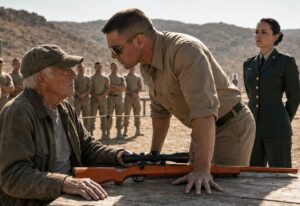
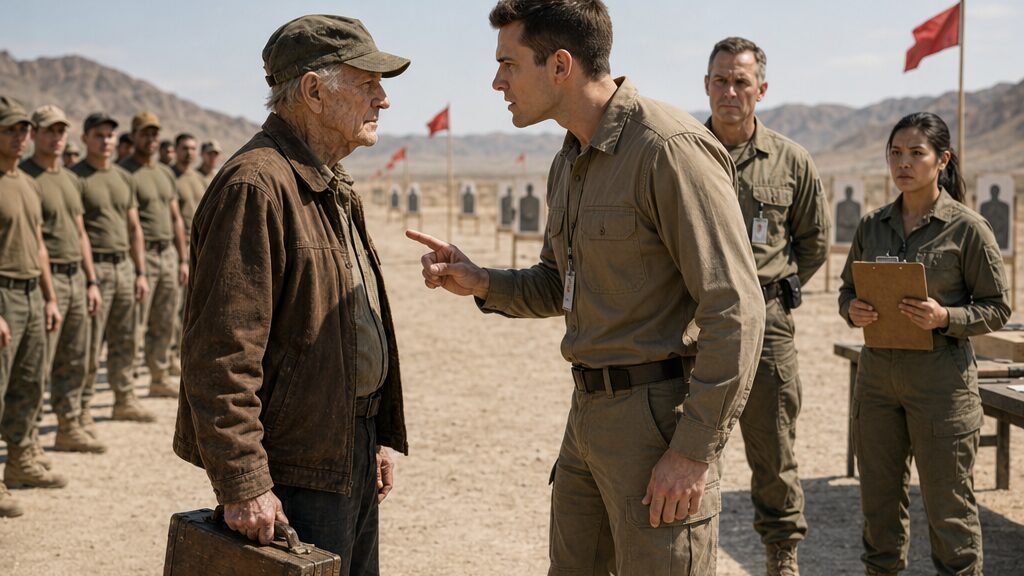
The young instructor put one hand on Frank Harris’s rifle case before Frank had even finished signing his name.
It was not a hard shove, not enough to knock the case off the folding table, but it stopped the old wood from sliding forward. Frank’s fingers remained on the leather handle. The instructor’s palm pressed flat against the lid as if he were holding down something that might embarrass the range by being opened.
“Sir,” the young man said, loud enough for the first row of trainees to hear, “this line is for qualified shooters.”
Frank looked at the hand first.
It was a clean hand, young and strong, the knuckles not yet swollen by weather or years. A black range watch sat tight on the wrist. Dust gathered around its edges. The man wore a pressed tan field shirt, sleeves rolled in neat military folds, and his instructor badge clipped bright over his chest. He had the square shoulders of someone who knew people were watching.
Frank lifted his eyes.
Behind the young instructor, the desert range stretched into morning glare. Red flags snapped from poles. Paper silhouettes stood in rows beyond the berms. Farther back, parked military trucks shimmered in heat that had not yet fully risen. A wind flag at the long-distance bay stirred once, then hung low, undecided.
There were more people here than Frank had expected.
Veteran spectators sat beneath canvas shade. Trainees in uniform clustered near water coolers, laughing in small bursts, rifles cased at their feet. A sign near the registration tent read MEMORIAL RELAY QUALIFICATION DAY in blue letters. Sarah Martinez, the event coordinator, moved between clipboards and radio calls, trying to make the morning look organized.
Frank had almost turned around when he saw the crowd.
Then he had remembered why he had come.
He kept his hand on the case.
“I registered,” Frank said.
The instructor glanced at the sheet, then back at Frank, then at the case. His mouth tightened the way people’s mouths tightened when they believed courtesy was being wasted.
“Frank Harris,” he read. “Open relay entry. No unit listed. No current certification number.”
“I was told open relay allowed walk-in veterans.”
“It does,” the instructor said. “When they can safely handle the event.”
A few trainees stopped talking. The words had been ordinary, but the shape of them was not. Frank could feel attention turn toward him, small and sharp as burrs.
He wore his old brown jacket despite the heat. The cuffs were worn smooth. His hat had faded from black to the color of campfire ash. His left hand, the one around the rifle case handle, trembled faintly when he held it still too long. He knew what people saw. A man in his late seventies who should have been under the shade with the other old-timers, drinking coffee from a paper cup and telling stories that nobody had asked for.
The instructor saw it too.
“My name is Justin Allen,” he said. “I run this firing line today. We’ve got active trainees, junior shooters, donors, and veterans on site. I’m not putting anyone on the line because they brought an antique case and a memory.”
Frank let the sentence pass.
He looked down at the case. The wood was dark with oil and age. One brass corner had been dented in a move decades ago, and the leather handle had been wrapped twice after it split. Near the latch, under a cloudy strip of old tape, was a range card so faded that most people would not know it was there unless they had put it there themselves.
He had put it there himself.
Sarah came over with a clipboard tucked under one arm. “Is there a problem?”
Justin did not look away from Frank. “Just checking eligibility.”
Frank watched Sarah’s eyes flick from him to the rifle case. She gave him the kind of smile busy people gave older people when they did not want to seem impatient.
“Mr. Harris,” she said, “we’re glad you’re here. Did someone invite you through the memorial office?”
Frank reached into his jacket. His fingers moved slowly, not because he could not hurry, but because haste around paperwork always seemed to make young people more nervous. He removed a folded card from his shirt pocket. The card had a small crease across the printed seal.
Sarah took it and read.
Her face changed, but not enough for the crowd to notice.
“Honor relay,” she said softly.
Justin leaned in. “That roster closed last week.”
Sarah lowered her voice. “There was a discretionary slot.”
“Then he should have come through admin.”
Frank held out his hand for the card. “The letter said report to the range.”
Justin let out a short breath, almost a laugh, and finally took his hand off the case. The lid rose a hair where the pressure had been.
“Mr. Harris, no disrespect,” he said, though everything around the sentence had already done the work, “but this isn’t a photo opportunity. We’re shooting at distance today. Timed commands, live range procedures, wind calls, safety checks. You can’t just show up with something your grandfather might have carried and expect us to stop the line.”
The word grandfather landed strangely.
Frank had been a grandfather once, nearly. His son’s child had not lived long enough to learn anyone’s hands. He pushed the memory away before it could open.
“I don’t expect you to stop anything,” Frank said.
A trainee near the water cooler whispered something. Another one smirked and looked down. Frank did not turn his head. The old habit remained: never chase noise on a firing line.
Justin reached for the case latch. “What’s in it?”
Frank’s hand closed over the latch before Justin touched it.
For the first time, the instructor’s expression sharpened.
“You don’t open another man’s case,” Frank said.
The voice was quiet. It did not rise. It did not need to. A few of the trainees who had been smiling stopped.
Justin’s jaw shifted. He looked embarrassed for half a second, then annoyed that he had been made to feel it.
“On my range,” he said, “I inspect every firearm.”
“After the owner opens it.”
The wind flag downrange lifted once and fell.
Sarah stepped between them a little, not blocking either man, just making a human pause. “Justin, we can run him through a safety check. If he passes, he can take the open lane.”
Justin looked toward the firing line. Six lanes had been assigned with neat white numbers. Lane Seven sat farther down, near the edge where blown sand gathered against the mat. The shade did not reach it. The rest was set aside for late entries, demonstrations, or equipment problems.
Justin turned back to Frank.
“Lane Seven,” he said. “But not the relay. Not yet. Beginner test first.”
Sarah frowned. “Justin.”
“No,” he said, louder now. “If Mr. Harris wants to shoot with everyone watching, he can show everyone he remembers which end points downrange.”
That one drew a laugh from somewhere behind him.
Not a big laugh. Not cruel enough to be named cruelty. Just the quick little bark people gave when they wanted to belong to the stronger side of a moment.
Frank felt it in his chest, not as anger, but as a tired recognition.
He had heard men laugh that way at new recruits. At quiet boys. At anyone whose boots were too clean or hands shook too much or voice sounded wrong. Most grew out of it if a better man reached them in time. Some did not.
He loosened his grip on the handle and opened the case.
The smell rose first: old oil, walnut, dust trapped in cloth. Inside lay the wooden rifle, plain and dark, its finish rubbed smooth where hands had carried it for years. Beside it sat a cleaning cloth folded into a square, two empty chamber flags, a small notebook, and a short pencil worn almost to nothing.
Justin looked at the rifle and smiled without warmth.
“Well,” he said, “that belongs in the museum tent.”
Frank removed the rifle with both hands, muzzle angled safely toward the berm, action open. He checked the chamber once, then again, not for Justin, not for the crowd, but because the ritual deserved to be done whether one person watched or a hundred.
The movement slowed the air around him.
His fingers trembled when they left the stock. They stopped when they touched metal.
Justin noticed, but not the change. Only the tremor before it.
“Beginner test,” he repeated. “Safety table. Then dry commands. Then maybe we let you touch paper.”
Frank tucked the faded invitation card back into his pocket.
“All right,” he said.
The trainees shifted to make a path that was not quite wide enough. Frank carried the rifle in one hand and the case in the other, the old wood bumping lightly against his leg. Lane Seven waited in the sun.
Halfway there, Justin called after him.
“And Mr. Harris?”
Frank stopped.
“If you fail it, you sit down. No arguments.”
Frank turned just enough for the young man to see his face beneath the brim of the hat.
“The target will tell you what I remember,” he said.
Justin’s smile thinned.
“That’s what I’m afraid of.”
Chapter 2: The Young Instructor Spoke Too Loudly
Amanda Lee first noticed the old man because he did not look toward the people laughing.
Everyone else did.
That was how laughter worked on a range full of young trainees. A joke snapped through the air, and heads turned to see where it landed. The old man simply kept walking toward Lane Seven with the rifle angled safely downrange and the case hanging from his left hand. Dust rolled around his shoes. His jacket looked too heavy for the desert heat.
Amanda stood at the safety table with three other junior trainees, a checklist clipped to the board in front of her. The day was supposed to be simple: qualify, record scores, learn from the veterans’ relay, and not embarrass herself in front of instructors who remembered every mistake.
Justin Allen remembered every mistake loudly.
He was good. That was the problem. He shot well, moved well, gave commands that cut clean through wind and chatter. When he corrected someone, his technical points were usually right. But he corrected with an audience in mind, and the audience had learned to laugh before deciding whether something was funny.
Amanda had been on the receiving end during the previous month’s training.
“Lee,” he had said then, in front of the entire line, “your trigger control looks like you’re trying to ring a doorbell in a house fire.”
He had fixed the problem. She had not forgotten the heat in her face.
Now his attention had found the old man.
“Gather in,” Justin called. “We’ll do a quick remedial safety check before the first relay. Good chance for the juniors to review what not to assume.”
The trainees came closer. Veteran spectators leaned in from the shade. Sarah Martinez hesitated near the registration tent, then stayed where she was, her radio pressed against her shoulder. The old man placed his rifle case beside the safety table with careful hands.
“Name?” Justin asked, though he had already read it.
“Frank Harris.”
“Experience?”
Frank looked at the berm rather than at Justin. “Some.”
A few trainees chuckled.
Justin picked up the checklist. “Some. All right. Mr. Harris, point out the safety line.”
Frank did.
“Point out the medical station.”
Frank did.
“Point out the emergency cease-fire signal.”
Frank did.
His answers were plain and correct. No extra words, no irritation. Amanda watched his hands more than his face. They trembled when they hung empty at his sides, a slight flutter of age or nerve. But when he reached toward the rifle, his fingers set themselves with a care that made the trembling seem separate from him, like wind moving a loose sleeve.
Justin held up a chamber flag. “What’s this?”
Frank looked at him.
Amanda felt the question insult the air.
“A chamber flag,” Frank said.
“And why do we use it?”
“To show clear without asking anyone to guess.”
Justin blinked once. The answer was better than the expected one.
“Fine,” he said. “Demonstrate clear.”
Frank opened the action, angled the rifle so Justin could inspect without stepping in front of the muzzle, checked chamber and magazine, then inserted the flag. He did it with a rhythm Amanda had never seen from the speed shooters. They were fast, almost musical. Frank was slower, but there was no wasted movement in him. He seemed to leave space for the range itself to breathe.
Justin frowned as if competence had complicated his plan.
“Now dry command sequence,” he said. “You will respond only when instructed. You will not load. You will not close the action unless told. You will not—”
“Your trainee has his muzzle past the table edge,” Frank said.
The words were quiet, but Amanda heard them.
So did Justin.
Everyone turned.
One of the younger trainees at the far side of the table had lifted a cased rifle halfway out while trying to adjust the strap. The muzzle, still covered but angled poorly, had drifted toward the side instead of downrange. It was not a disaster. It was exactly the kind of small carelessness that became one if nobody spoke.
The trainee froze.
Justin’s face flushed before he controlled it.
“Set it down,” he snapped. “Now.”
The trainee obeyed.
Frank did not look satisfied. He did not look proud. He simply waited until the rifle was safe, then looked back at the berm.
Amanda felt something shift among the watchers. Not admiration yet. Not belief. Just the first tiny hesitation in the story Justin had been telling them.
Justin stepped closer to Frank. “I saw it.”
Frank said nothing.
“I was about to address it.”
Frank still said nothing.
That was worse somehow.
Justin turned to the trainees. “The lesson here is that nobody touches equipment until cleared by line staff. Understood?”
“Yes, sir,” several answered.
Amanda answered too, but her eyes stayed on Frank.
Justin resumed the test with sharper edges. He called positions. He called dry commands. He asked Frank to shoulder the rifle, then stop, then ground it, then step back. Frank obeyed every command exactly and added nothing except one pause.
At the pause, Justin pounced.
“Problem?”
Frank looked downrange. The wind flag at the far bay had lifted and was twisting sideways.
“Wait for the quiet,” Frank said.
Justin stared. “This is a dry sequence.”
“Yes.”
“Then the wind doesn’t matter.”
Frank’s fingers rested along the stock. “It always matters. You just decide when.”
A few trainees exchanged looks. Someone under the shade murmured. Amanda wrote the phrase in the margin of her checklist without meaning to.
Wait for the quiet.
Justin saw the pencil move. “Lee,” he said, “you taking poetry notes or safety notes?”
Amanda straightened. “Safety, sir.”
“Then write this: the command matters more than the weather.”
Frank’s eyes lowered for the first time from the berm to Justin.
“The command keeps people alive,” he said. “The weather tells the truth after that.”
The range went still enough that the paper targets could be heard snapping faintly on their frames.
Justin laughed once. “That’s a nice line.”
Frank gave no answer.
“Where’d you pick that up?”
“Here.”
The word was so soft Amanda nearly missed it.
Justin did not. “Here?”
Frank’s face had gone distant. Not confused. Not lost. Distant in the way people looked at empty chairs or old roads.
“Long time ago,” he said.
Justin tapped the checklist against his palm. “Well, a lot has changed since a long time ago.”
Frank looked at the rifles on the racks, the electronic timers, the new flags, the painted safety lanes, the fresh berm markers.
“Not everything,” he said.
Amanda expected Justin to turn that into another joke. He opened his mouth to do it.
Then a vehicle door shut behind the shade tent.
The sound carried cleanly across the range.
Several trainees straightened before they had even turned around. Justin’s posture changed too, the casual authority tightening into something more formal. Amanda looked past him.
A senior officer had stepped out of a dark utility vehicle near the registration area. He wore field tan without unnecessary shine. Close-cropped hair, gray at the temples. Calm face. He spoke briefly with Sarah Martinez, who pointed toward Lane Seven.
The officer started walking.
Amanda saw his gaze move across the firing line, past Justin, past the trainees, and stop on the old wooden rifle case beside the safety table.
Not on Frank at first.
On the case.
The officer’s steps slowed.
Frank had his back partly turned, chamber flag bright in the open action. He did not see the officer yet, or maybe he did and chose not to turn. The wind flag downrange stirred again.
Justin swallowed, then called out with forced brightness, “Major Brown. We’re just finishing a remedial check.”
Matthew Brown did not answer right away.
He was still looking at the rifle case.
Chapter 3: When The Officer Stopped Walking
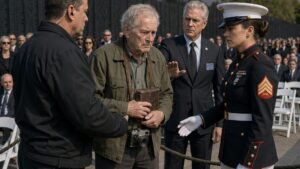
Matthew Brown had seen that rifle case only once before, and he had been nineteen years old when he decided he would never forget it.
Back then the case had been darker, the brass corners less dull, the leather handle not yet wrapped. It had sat on a wooden bench at this same desert range while a line of young men tried to pretend they were not afraid of disappointing the instructor who owned it. Matthew had been one of them. Too eager. Too fast. Too certain that wanting to be good was the same as being ready.
The instructor had not raised his voice.
That was what Matthew remembered most.
While other men barked, the old instructor—though he had not been old then—spoke in sentences that made people lean closer. He could stop an unsafe motion with a word. He could read wind with a glance. He could make a frightened recruit steady by putting one hand near his shoulder and saying, “Wait for the quiet.”
Matthew had not heard that phrase in thirty-two years.
Now he stood near Lane Seven, watching a man in a faded hat hold an old rifle with the chamber flagged open, and the years folded in on themselves so sharply that he forgot, for one unguarded second, that everyone on the range was watching him.
Justin Allen filled the silence.
“Sir,” he said, “we’ve got a walk-in entry claiming an open relay slot. I initiated a safety verification. There are some concerns about whether he’s fit for the line.”
Matthew looked at Justin. The young instructor’s face was controlled, but the color sat high along his cheekbones. Too much audience, Matthew thought. Too much pride already committed.
“What concerns?” Matthew asked.
“Age, equipment, lack of current certification, possible mobility limitations.”
Frank turned then.
His eyes met Matthew’s without surprise.
There were more lines in his face than Matthew could count. His shoulders had narrowed. The brim of his hat cast shade over eyes that had once seemed able to measure distance by sound alone. But the posture remained. Not parade posture. Range posture. A man aware of muzzles, flags, wind, feet, people, and the thousand small ways carelessness tried to enter a morning.
Matthew felt the old instinct rise before rank could stop it.
He almost said Instructor.
Frank gave the smallest shake of his head.
Not here.
Not yet.
Matthew closed his mouth.
Justin noticed the exchange and mistook it for hesitation. “Sir, I’m happy to remove him discreetly. We’ve got donors coming through after lunch. Last thing we need is a safety incident.”
Frank looked back downrange.
Matthew heard, under Justin’s words, the pressure Sarah Martinez was carrying: donors, memorial families, public image, active trainees, old veterans wanting one more day to stand where they had once mattered. The event had been built to honor discipline. It would fail if discipline became performance.
“Mr. Harris,” Matthew said, choosing the civilian shape of the name, “did you request special handling?”
“No.”
“Do you want special handling?”
“No.”
Justin’s mouth tightened. “Sir, with respect, that’s not the point.”
Matthew turned to him. “Then make the point.”
“The point is I run this line. If I clear someone who can’t manage the course, that’s on me.”
“That is correct.”
“And if he freezes, drops equipment, misses commands, or becomes a distraction—”
“The line has procedures for all of that.”
Justin looked briefly toward the trainees. He knew he was losing the shape of the scene and reached for firmer ground.
“I assigned him Lane Seven and a beginner test.”
Matthew’s gaze moved toward Lane Seven. The worst edge lane. Sun on the mat, loose sand near the firing position, angle just awkward enough to make wind harder to judge. It was still legal. Still within rules. Still unkind in the way ambitious young men convinced themselves was fairness.
Frank spoke before Matthew could.
“Lane Seven is fine.”
Matthew looked at him.
Frank’s left hand trembled beside the stock. His right hand did not. He had always carried age in parts, Matthew thought, even when young: one part tired, one part absolutely awake.
“You don’t have to prove anything,” Matthew said quietly.
The words were not meant for the trainees. They were meant for the man who had taught him that proof was what targets were for, not people.
Frank’s eyes moved to the memorial banner, then to the old range wall beyond the shade tent where faded plaques hung in rows. Some names had peeled under sun. Some had been replaced. Some had vanished.
“I didn’t come to prove,” Frank said. “I came because the card said relay.”
Sarah Martinez had approached without making noise. The folded invitation card was in her hand. Matthew took it and read the name of the memorial relay printed on the front. A remembered name sat there below the blue seal, old enough to hurt.
He looked back at Frank.
“You knew him?” Sarah asked.
Frank accepted the card from Matthew and tucked it away. “I taught him to slow down.”
No one spoke.
Justin shifted his weight. “Sir, if there’s history here, maybe we should move this off the line.”
Frank turned toward him fully then.
There was no anger in the old man’s face, and that made the words heavier.
“Your line,” Frank said. “Your rules. Same test.”
Justin blinked.
Matthew understood. Frank had not come to be rescued by recognition. He would not let a senior officer turn humiliation into privilege. If he stepped onto that mat, he would step as every shooter did: by command, under safety, judged by the target.
It was the only way the lesson would hold.
Matthew handed the checklist back to Justin. “Proceed.”
A murmur passed through the trainees.
Justin seemed surprised by the order, then relieved, then annoyed at himself for being relieved. He squared his shoulders and pointed toward the far edge.
“Lane Seven, then.”
Frank lifted the old rifle case from the table.
As he did, the tape near the latch peeled back a fraction. Matthew saw the faded range card underneath. The ink was nearly gone, but one line remained readable enough to strike him like a hand on the chest.
HARRIS, F. — WIND QUALIFICATION STANDARD.
Matthew looked away before his face gave too much.
Amanda Lee, standing closest with the clipboard, saw more than she pretended to. Her eyes flicked from the card to Frank, then to Matthew. She said nothing, but her pencil stopped moving.
At Lane Seven, Frank set the case down on the sand as if placing something fragile beside an old grave. He lowered himself carefully, one knee first, then the other, the rifle still open and safe. The movement was slow enough that one of the trainees near the back whispered, “He’s not getting back up.”
Justin heard it and did not correct him.
Frank settled onto the mat. Loose sand pressed into the fabric. The sun touched the back of his neck. The wind flag downrange lifted, fell, then lifted again at a different angle.
Justin stood behind the line with his timer and range board.
“For the beginner test,” he called, “Mr. Harris will demonstrate basic position, command response, and one controlled shot at short paper.”
Frank did not look back.
Matthew stepped beside Justin, close enough to be present, not close enough to interfere.
Justin looked downrange, then at the flag, then at his board.
“Wind is negligible,” he said.
Frank’s cheek rested lightly against the stock. His eyes stayed on the far movement of cloth and dust.
“No,” he said.
Justin stiffened. “Excuse me?”
Frank breathed once, slow enough that Matthew felt memory move through his own chest.
“Same wind call you’d give them,” Frank said.
Justin looked toward the watching trainees, then toward Matthew, then back at the old man kneeling in the worst lane with the old rifle and the desert moving quietly in front of him.
The range waited.
Frank did not.
Chapter 4: The Wind Flag Moved Before The Shot
Justin gave the wind call again, louder this time, as if volume could make it correct.
“Negligible wind,” he said. “Short paper. One controlled shot on command.”
Frank’s cheek remained against the old rifle stock. The wood had warmed under the sun, but beneath the heat there was the familiar smoothness where years of use had rubbed away finish. His breathing was already finding its old place, somewhere below the ribs, somewhere deeper than the noise behind him.
He could hear the range without looking at it.
The trainees shifting their boots in the sand. Sarah’s radio crackling softly near the shade. Justin’s timer clicking against the plastic board in his hand. Matthew Brown standing to the side, silent but present, carrying old memory like a weight he had not expected to lift today.
And downrange, the wind flag moved.
Not much. Enough.
It pulled left, dropped, twisted, and then the dust near the berm brushed sideways a fraction later. Young eyes watched flags. Older eyes watched what the flag had not yet admitted.
Frank lifted his head from the stock.
Justin’s shoulders rose. “Problem already?”
Frank opened his right hand slightly, fingers loose. “You called short paper.”
“Yes.”
“You set the test.”
“Yes.”
Frank looked downrange. “Then call it clean.”
Justin’s mouth pressed into a line. “Fine. Half-value from the right. Barely worth mentioning.”
Frank lowered his cheek again. “Worth mentioning.”
A trainee laughed under his breath. It died quickly when Matthew turned his head.
Frank did not smile.
He had stood on this desert ground when the targets were wood-framed and the flags were hand-stitched. He had watched boys become steady and steady men become careless. He had watched a young trainee named Mark—no, he would not say the name inside himself, not now—rush a shot because somebody behind him had been laughing. The memory hovered at the edge of the sight picture, but Frank let it pass the way a shooter let a bad gust pass.
Wait for the quiet.
Justin raised his voice. “Shooter ready?”
Frank touched the safety with the side of his thumb. Not hurried. Not theatrical.
“Ready.”
“On command, one round only. Load.”
Frank loaded one round, keeping the muzzle settled downrange. The sound was small, metal accepting brass. He closed the action.
The rifle became a different weight in his hands.
Before that moment, he was an old man kneeling on a mat with sand against his knees. After it, he was not younger, not stronger, not untouched by time. He was simply gathered. The tremor in his left hand disappeared into purpose. His finger lay straight outside the trigger guard. His eye measured the front sight, then the target, then the space between.
He could feel people noticing.
That was dangerous too. Attention was weather. Pride was weather. Shame was weather. You did not beat weather by pretending it was not there. You let it move, waited for what it offered, and took only the moment that belonged to you.
“Fire.”
Frank did not fire.
Justin’s head snapped slightly. “Command given.”
Frank waited.
The flag lifted, bent, softened.
He exhaled.
The shot cracked across the desert.
No one spoke. The sound rolled against the berm and broke apart. Frank opened the action, cleared the rifle, set the safety, and inserted the chamber flag before Justin could remind him.
“Shot complete,” Frank said.
Justin looked irritated rather than impressed. “One shot doesn’t mean anything. Bring it in.”
The target puller downrange signaled, then the paper began its return along the carrier line. It came slowly, fluttering in the heat. The watchers leaned without meaning to. Frank remained kneeling until the rifle was safe beside him, then sat back enough to relieve his knees.
The target arrived.
Justin stepped to it first, as if ownership of the line gave him ownership of the evidence.
The hole sat just off center, not dramatic to untrained eyes. Not a miracle. Not a trick. It was where a clean correction should have placed it with the wind Frank had read and Justin had almost dismissed.
Justin tapped the paper. “Slight left.”
Frank looked up. “No.”
Justin gave a short laugh. “It’s right there.”
“That is where half-value from the right places a cold barrel on this lane.”
The sentence settled strangely. Most of the trainees did not know whether to believe it. Amanda Lee did. Frank saw it in the way her pencil froze against the board.
Justin pulled the target free and held it toward Matthew, perhaps expecting him to restore order with rank.
Matthew studied the paper, then looked downrange at Lane Seven.
“Cold barrel, old lane angle,” he said quietly. “Correct.”
A murmur moved through the watchers.
Justin’s jaw tightened.
Frank began to stand. His knees objected. For a moment, the old body returned fully, stiff and heavy. He put one hand on the mat, careful not to touch the rifle until he was stable. Amanda took half a step forward, then stopped herself. Frank noticed and gave her the faintest nod, not thanks exactly, more permission to remain respectful by not helping too soon.
He rose.
Justin watched the tremor come back into the old hand and seized on it like a man grabbing a rope.
“That was controlled,” he said, “but short paper isn’t the relay.”
“No,” Frank said.
“And one corrected shot doesn’t prove you can handle timed distance.”
“No.”
“And since you seem concerned with proper calls, let’s move to the distance lane and see how much the wind tells the truth.”
Sarah came forward. “Justin, the schedule—”
“This won’t take long.” Justin kept his eyes on Frank. “Three-shot group. Long paper. Standard prone or kneeling. If he passes, he enters the relay. If he doesn’t, he sits with the spectators.”
Matthew’s face remained still, but Frank could feel the officer measuring whether to step in.
Frank saved him the trouble.
“Kneeling,” Frank said.
Justin’s eyes narrowed. “At distance?”
“My knees got down once. Might as well make them useful.”
That earned a few uncertain laughs, softer this time. Not at him. With him, almost. The difference mattered.
They moved from the short lane to the long-distance bay. The desert widened there. The targets sat far enough away that the paper looked less like a shape and more like an argument. Mirage trembled above the ground. The wind flag on the long bay moved differently from the first, catching crosscurrents from the berm cut and the parked trucks.
Justin brought out a spotting scope on a tripod and positioned it with crisp, practiced motions.
“Modern glass helps,” he said.
Frank set his rifle case on the ground beside the mat. “I imagine it does.”
“You don’t use one?”
“Sometimes.”
“But not today?”
Frank looked at the far paper, then at the flag, then at dust crawling low along the range.
“Today I can see enough.”
Justin gave Matthew a quick glance as if to say, You hear this? Then he stepped back and called the safety sequence.
Frank followed every word.
Load. Ready. Fire when ready.
This time Justin did not call the wind. He wanted Frank to own the miss if there was one.
Frank waited.
The first shot came after a long silence.
Then nothing.
A trainee shifted. Someone coughed. Justin looked at his watch.
Frank waited again, the rifle held steady not by strength but by arrangement: bone beneath muscle, breath beneath thought, patience beneath all of it.
The second shot cracked.
The wind flag snapped hard left, then fell slack. Frank’s eye remained through the sight, but he did not chase the movement. He waited until the low dust changed direction.
The third shot came so softly in the rhythm of the range that several watchers seemed surprised it had happened.
Frank cleared the rifle and sat back.
Justin went to the scope.
For several seconds, he said nothing.
That silence changed the crowd more than any announcement could have. People leaned. The veteran spectators under the shade stopped fanning themselves. Amanda’s pencil hovered in midair. Sarah lowered her radio.
Justin adjusted the scope, bent closer, adjusted it again.
Matthew did not move.
“Well?” Sarah asked.
Justin stepped back from the glass. “Target.”
The paper came in slow.
Frank kept his eyes on the wind flag, not the target. The flag lifted and fell, lifted and fell, telling the same old story to anyone patient enough to listen.
When the target reached the line, Amanda was close enough to see it before most others did.
Three holes formed a small, tight group slightly off the printed center, held together with the kind of discipline that made the paper seem quieter than blank paper. Not a single miraculous hole. Not a carnival trick. A group that said the shooter had known exactly what the wind was doing and had made the same promise three times.
No one laughed.
Justin took the paper down. He held it too hard, creasing the edge.
Frank finally looked at it.
“Acceptable?” he asked.
The word was mild. That made it worse.
Justin’s face had changed. The confidence had not vanished, but it had lost its easy shape. He was searching for a place to stand where the crowd could still see him as the man in charge.
“It’s good,” he said.
Matthew’s eyes moved to him.
Justin corrected himself. “It passes.”
Frank nodded once and reached for his rifle case.
The matter could have ended there.
It should have.
But Justin looked at the old wooden rifle, then the tight group, then the trainees who were no longer watching him the same way.
“That rifle familiar to you?” he asked.
Frank closed the action on an empty chamber, checked it, and opened it again. “Yes.”
“Maybe that’s the trick.”
Frank looked at him.
Justin lifted his voice so everyone could hear. “The relay allows range equipment. If Mr. Harris is as good as the paper says, he shouldn’t mind a second round with something he hasn’t spent fifty years memorizing.”
Sarah said his name sharply. “Justin.”
Frank put the chamber flag into place and laid the old rifle in its case.
The tremor had returned to his hand as he folded the cleaning cloth beside it.
Justin watched the tremor and found his smile again, smaller and meaner around the edges.
“Different rifle,” he said. “Same distance.”
Frank closed the case, but did not latch it.
“All right,” he said.
Chapter 5: The Worst Rifle On The Rack
Sarah Martinez had spent the entire morning trying to keep the event from becoming a story people told for the wrong reasons.
By afternoon, she knew she had failed.
Every range had its own weather, and not all of it came from the desert. Some came from pride, some from old grief, some from young men afraid to lose authority in front of people who had just begun to respect them. Sarah had organized enough charity events to know when a room—or a firing line—started turning toward spectacle.
The veterans’ memorial relay was supposed to be clean.
Four qualification rounds, public demonstration, donor lunch, youth safety clinic, closing presentation. Families of past service members would walk through the shaded area and see discipline, continuity, and care. No politics. No chest-beating. No turning memory into performance.
Then Frank Harris had arrived with his old rifle case, and Justin Allen had decided the old man’s dignity was an obstacle to be tested in public.
Sarah followed them toward the equipment shed with her clipboard pressed against her ribs. The shed sat behind the long bay, a low metal structure that smelled of rubber mats, old oil, and sun-baked dust. Range rifles stood locked in numbered racks. Some were newer, some kept for training, some stubborn survivors of years of classes and careless hands.
Justin unlocked the rack.
“If we’re doing this,” Sarah said quietly, “we do it clean.”
Justin did not look at her. “That’s exactly what I’m doing.”
“No. Clean means not personal.”
He turned then. Sweat had darkened the collar of his instructor shirt. The sun had sharpened his face.
“You think I’m making it personal?”
“I think everyone outside knows you are.”
That hit. Not enough to stop him, but enough to make him glance toward the open shed door where trainees clustered at a careful distance.
Frank stood just inside the shade, rifle case at his feet. He seemed less bothered by Justin than by the clutter around the racks. His eyes moved over the muzzles, the tags, the cleaning rods, the logbook hanging from a nail. Not judging. Counting.
Justin pulled one rifle from the rack, inspected it, then put it back. He chose another, newer one, lifted it halfway, hesitated, and returned it too.
Sarah saw what he was doing.
“Don’t,” she said.
Justin removed a worn training rifle from the far end of the rack. Its stock was scratched. The sling had been replaced with a faded one, and the finish near the bolt showed years of hard use. It was safe, legal, maintained, but no one chose it when better rifles were available.
Justin checked it properly, to his credit. Chamber. Bore flag. Bolt. Safety. He was not careless. Only unfair.
“This one’s in rotation,” he said.
“For remedial classes,” Sarah said.
“For fundamentals,” Justin replied. “Which Mr. Harris seems to appreciate.”
Frank reached for the rifle only after Justin angled it safely and presented it correctly. Their hands did not touch.
The old man weighed it, opened the action, inspected the chamber, checked the sling attachment, then looked at the stock number stamped near the receiver.
Something passed over his face.
Not surprise. Recognition with sadness inside it.
Sarah caught it because she was watching him too closely now.
“You know that one?” she asked.
Frank ran his thumb near the stamped number, not over it, as if touching it would claim too much.
“I know the system,” he said.
Justin gave a short laugh. “The system?”
“The way the racks were numbered. Training rifles on the left by wear pattern. Competition rifles on the right by confirmed zero. Problem rifles tagged, not hidden.”
Sarah looked at the racks.
Justin’s expression hardened. “That was before my time.”
“Yes.”
“And now we use digital logs.”
Frank looked at the old logbook hanging from the nail. “Do you?”
The question was not an accusation. It had no heat. That made Justin’s neck redden again.
Sarah stepped to the logbook and opened it. Recent entries filled the first pages. Initials, dates, maintenance notes. Several pages back, older handwriting appeared—clean block letters, precise, almost architectural.
She looked from the page to Frank.
His initials were not there. Not on the page she had opened. But the format was. The categories. The inspection order. The little box for “shooter-reported drift” that every new instructor complained about filling out.
“You wrote this procedure?” she asked.
Justin’s eyes flicked to her.
Frank took a breath. “Helped.”
Outside, a trainee called for others to move back from the shed door. Amanda Lee remained near the edge, holding her clipboard. She was not trying to intrude, but she was close enough to hear.
Justin took the logbook from Sarah and flipped pages without reading them.
“This is irrelevant,” he said. “We’re not here to tour old paperwork.”
Frank looked at the rifle in his hands. “Paperwork keeps rifles honest when people forget.”
Justin shut the logbook harder than necessary.
Sarah almost told him to stop then. She had the authority to pause the event, to move the relay, to let Matthew Brown make a formal decision. But Frank had refused rescue once already. His quietness was not helplessness. It was choice.
She turned to him. “Mr. Harris, you can decline this. Your first group qualifies you. I’ll record it.”
Frank looked through the shed door toward the firing line, where the trainees waited with the anxious hunger of people watching a lesson become something larger than instruction.
Then he looked at Justin.
“No,” he said. “He should know.”
Justin frowned. “Know what?”
Frank did not answer.
He carried the worn range rifle out into the glare.
The second firing line had changed since morning. People stood farther apart now, as if the space around Frank had become part of the rules. Veteran spectators had left their shade. Trainees who had laughed earlier now looked at the ground when Frank passed. Amanda walked near Sarah, her clipboard clutched tight.
At Lane Seven, Frank set his old rifle case beside the borrowed rifle. The contrast was plain: one object cared for across decades, one object used hard by hundreds of hands. He opened his case and removed the small notebook, then the short pencil.
Justin saw it. “Taking notes?”
Frank looked at the borrowed rifle’s sights, then at the sling.
“Listening to the rifle.”
A few people smiled, but no one laughed.
Justin called the line hot after the standard safety checks. Matthew stood near the rear, arms relaxed, face unreadable. Sarah watched the crowd as much as the shooters. She could feel the story turning, and for the first time all day she was not sure she wanted to stop it.
Frank settled into position.
The borrowed rifle did not fit him. Sarah could see that immediately. The sling pulled wrong. The stock sat slightly off his shoulder. His neck had to angle more than with his own rifle. His left hand trembled as he adjusted the position.
Justin saw all of it.
Amanda saw something else.
She slipped away from Sarah and moved to the old range board near the shed wall, where laminated sheets had been pinned under cloudy plastic for years. Safety commands. Emergency procedures. Equipment numbering. Qualification standards.
At the bottom of one yellowed sheet, almost hidden by a newer update stapled over it, she saw a line of text.
Original field standard prepared by: F. Harris.
Amanda stared.
Then she lifted the plastic cover.
The staple resisted, then gave. The newer sheet swung aside enough to reveal more.
Wind Qualification Standard — Harris Method.
Amanda turned toward the firing line.
Frank was already waiting on the wind.
Justin gave the command.
The first shot landed. Through the scope, Justin said nothing.
The second came after a longer pause. Then the third.
Frank cleared the rifle and wrote one small mark in his notebook.
Justin went to the scope and stiffened.
Sarah could not see the target yet, but she saw his face. It was not defeat. Not yet. It was the face of a man realizing the ground beneath him had rules older than his confidence.
Before the target could return, Amanda stepped forward with the yellowed range sheet in both hands.
“Major Brown,” she said, her voice unsteady but clear, “his name is on the standard.”
Every head turned.
Frank closed the notebook slowly.
Justin looked from the sheet to the old man.
And for the first time all day, he had no quick answer.
Chapter 6: The Target Told The Truth
By late afternoon the desert had stopped pretending to be gentle.
Heat rose off the firing line in wavering sheets. The shade tents flapped and snapped. Dust worked into collars, into rifle cases, into the folds of target paper stacked beside the scoring table. The wind flag at the long bay no longer hung undecided; it moved in restless angles, tugged one way near the pole and another near the berm.
It was not easy weather.
That made it honest.
Frank stood at Lane Seven with the borrowed range rifle on the mat and his old wooden case closed beside it. He had placed the faded range card on top of the case, weighted under the short pencil so the wind would not take it. He had not meant to display it. Amanda had found the range sheet, and after that hiding small proofs seemed childish.
Still, the card looked vulnerable in the open.
HARRIS, F. — WIND QUALIFICATION STANDARD.
The ink had survived badly. Frank understood that. Paper was not meant to carry a life. Neither were plaques, trophies, records, or the stories men told when memory softened the hard parts. The only proof worth trusting on a range was what a person did after the command was given.
Justin Allen stood two lanes over.
He had requested the final match under equal rules. Sarah had resisted. Matthew had asked Frank once, quietly, if he wanted to end it with the qualification already secured.
Frank had looked at Justin, then at the trainees watching from behind the safety line.
“No,” he had said. “Let the lesson finish.”
Now the lesson had shape.
Three rounds at distance. Same wind. Same time limit. Range rifles only. No personal equipment except eye and ear protection. Scoring by target, witnessed by Sarah and Matthew. The winner would take the relay’s final demonstration slot.
Justin had chosen a newer range rifle for himself, not the best one, but better fitted and freshly zeroed. It was not cheating. It was not generous either. Frank did not begrudge him that. A man backed into public humility reached for whatever dignity remained.
Amanda stood behind the line with the old yellowed standard sheet held flat against her clipboard. She had not put it down since finding it. Frank wished she would. Young hands should not have to carry old reputations before they understood their weight.
Matthew stepped forward.
“Final round,” he said. “Safety rules remain unchanged. No movement until line command. No handling after cease-fire. Targets tell the result.”
Targets tell the result.
Frank almost smiled. Matthew had learned that sentence here.
Justin rolled his shoulders. His earlier loudness had tightened into focus. That was good. Arrogance had made him careless with people, but not with rifles. Frank had seen that from the start. The young man had skill. His hands were competent. His safety checks were real. His flaw was not inability. It was contempt.
Contempt spoiled judgment faster than fear.
“Shooters to the line,” Matthew called.
Frank lowered himself carefully. Pain moved through both knees, sharp then dull. He breathed around it. The borrowed rifle lay open on the mat, chamber flagged. He checked it. Then again. Beside him, Justin did the same with quick precision.
Behind them, the crowd quieted.
Frank could feel Justin glance over once.
“You really wrote that standard?” Justin asked.
Frank kept his eyes downrange. “Helped.”
“That’s all you ever say?”
“When it’s enough.”
Justin looked back at his target. “My first instructor used to say that.”
Frank’s hand paused near the sling.
Justin continued, less loudly now. “Old guy named Mark. Not old then, I guess. He’d smack the back of my helmet if I rushed a shot.”
Frank looked at him.
The desert sound thinned.
“What did he teach you?” Frank asked.
Justin seemed thrown by the question. “Basics.”
Frank waited.
Justin swallowed. “Slow is smooth. Smooth is accurate.”
The words moved through Frank with such force that for a moment the target blurred.
Mark had said that too, after he learned it. Had said it with a grin, turning instruction into something young trainees could remember. Had become an instructor himself. Had carried forward what Frank could no longer bear to carry after the accident that ended one boy’s season and changed the way the range wrote its rules. Not fatal. Not the worst story a range could hold. But enough. Enough to teach Frank that a careless second could live for decades in a man’s hands.
Frank lowered his face again before anyone could read it.
“He was a good instructor,” Frank said.
Justin’s voice changed. “You knew him?”
Frank closed his eyes once.
“I taught him to slow down.”
No one behind them spoke. Frank did not know how far the words had carried. It did not matter. Justin had heard them.
Matthew’s command came steady.
“Load.”
Frank loaded.
“Ready.”
Frank settled.
The wind flag snapped hard, then dipped. Mirage drifted low. The paper downrange shimmered in the sight picture. The borrowed rifle’s stock still fit poorly, but by now Frank had learned its complaint. It pulled a shade low if held too tightly. The sling wanted to drag the muzzle left. The trigger had a small roughness before the break.
Every rifle told the truth. Some simply mumbled.
“Fire when ready.”
Justin fired first.
A clean shot. Too quick for the wind change, but clean. Frank heard the control in it and was glad.
He waited.
The wind moved.
Frank breathed out and let the first shot go.
Justin fired his second after a pause. Better. He had adjusted. He was listening now, not only performing.
Frank waited longer. The timer ran. A murmur moved behind the line and died under Matthew’s presence.
The old guilt rose with the heat. Not as memory this time, but as accusation.
You left.
Frank kept his eye on the sight.
He had left the range after the investigation. Others had told him the accident was not his fault, not fully. The trainee had broken command. Another instructor had failed to stop him. The system had gaps. Procedures were rewritten. Everyone had signed papers.
But Frank had signed the new standard, packed his rifle case, and walked away.
Mark had stayed.
Mark had taught Justin.
Frank had come today because Mark’s name was on the memorial relay invitation, and because the card in his pocket had felt heavier every year. He had told himself he owed the dead and the living one appearance. One safe relay. One promise kept.
He had not expected to be mocked.
He had not expected to feel useful.
The wind flag lifted, turned, and softened.
Second shot.
The rifle bucked gently into his shoulder. Frank opened the action only enough to chamber the next round when safe. His hand did not tremble now. Not because age had vanished, but because the work was holding him.
Justin’s third shot cracked before Frank’s.
Then the range waited for the old man.
The timer neared its final seconds. Frank heard it in Justin’s breath, in Amanda’s pencil pressing too hard against paper, in Sarah’s radio hissing unanswered.
He did not chase the shot.
The quiet came late.
Frank took it.
The final round left the barrel and crossed the desert without drama.
“Cease-fire,” Matthew called.
Both rifles were cleared, flagged, and grounded. Frank sat back, knees protesting, chest still. Justin rose first, then hesitated as if he might offer a hand. Frank saw the impulse. He respected it by standing on his own.
The targets came back together.
Nobody moved toward them until Matthew gave permission.
Sarah and Matthew stood at the scoring table. Justin stayed two steps back, jaw set. Frank remained near Lane Seven, his old case at his feet. Amanda watched the paper as if it might speak.
Justin’s target was good.
Three shots in a disciplined cluster, slightly spread by the first wind error, corrected after. It would have won most afternoons. It deserved respect.
Frank’s target came next.
Sarah laid it flat.
The three holes sat tighter, not perfectly through one hole, not impossible, but close enough that the surrounding paper seemed untouched. The group was placed where a man would place it if he had read not only the wind but the rifle’s small habits and his own body’s limits.
For a long moment, the range made no sound except the flags.
Justin stepped closer. He looked once, then again. His face changed slowly, the way a man’s face changes when he is not struck by surprise but relieved of a lie he had been holding up with both hands.
Amanda whispered, “That’s his rifle?”
Sarah shook her head softly. “No. That’s the range rifle.”
Matthew looked at Justin. He did not gloat. He did not rescue him from the silence.
Justin’s throat moved.
“I was wrong,” he said.
It was not loud. It was loud enough.
Frank walked to the table. The crowd parted without being asked. He looked at Justin’s target first.
“Good correction after the first shot,” he said.
Justin stared at him.
Frank touched the edge of Justin’s paper, not the holes. “You heard it on the second.”
Justin looked down. The embarrassment on his face was no longer sharp. It was younger than that.
“I should have heard it before I opened my mouth,” he said.
Frank let the words stand. He would not polish them into comfort.
Matthew marked the score. “Final demonstration slot goes to Mr. Harris.”
A small sound rose from the crowd, not quite cheering, not quite applause. It stopped when Frank turned away from the scoring table.
The trophy table sat under the shade tent with polished plaques, certificates, and a ceremonial relay badge. Sarah had already begun to move toward it, expecting him to follow.
Frank did not.
He went to Lane Seven, picked up the old range card from the top of his rifle case, and slid it back under the cloudy tape near the latch. Then he closed the case and lifted it by the repaired handle.
“Mr. Harris?” Sarah called.
Frank kept walking past the trophy table, past the watching trainees, past the place where his name had just become useful to everyone else.
Amanda took one step after him.
Justin did not move.
Matthew watched Frank head toward the old memorial wall at the edge of the range, carrying the rifle case as if the day’s prize had nev
Chapter 7: The Lesson Was Never The Shot
Frank stopped at the memorial wall because his knees needed the rest and because the old names deserved not to be passed in haste.
The wall had changed since he last stood before it. New plaques had been added in tidy rows. Some were bright enough to catch the evening sun. Others had weathered into the same dusty bronze color, as if the desert eventually claimed all grief into one shade. A narrow strip of shade from the range office reached the bottom of the wall, leaving the upper names lit.
Frank set the rifle case down at his feet.
The range behind him had not returned to its usual noise. People were speaking again, but softly, in pockets. Rifles were being cleared and cased. Chairs scraped under the tents. A radio called for the next schedule item and then went unanswered. The world after a target told the truth always felt a little embarrassed, even when the truth had been good.
Frank removed his hat.
Mark’s plaque was not hard to find. Sarah Martinez had made sure of that. The memorial relay had been organized around his name, his years as an instructor, his patience with junior shooters, his habit of writing safety notes in the margins of every roster. The plaque said enough for strangers. Not enough for those who had known him.
Frank read the name once.
Then he looked down at the rifle case.
He had carried the invitation card for three weeks before deciding to come. He had placed it on the kitchen table, moved it to the mantel, moved it into a drawer, taken it out again. Each time he saw the range seal, he thought of sand, commands, a young trainee moving too fast, the sharp report of a mistake that should have been stopped before it became one. Not the kind of mistake the public made stories about. Not a tragedy large enough for headlines. But large enough to change how a man slept.
Frank had written the corrected standard afterward. He had taught it for another season. Then he had packed the wooden case and left the range to men who could still stand before a line without seeing every failure inside every movement.
Mark had stayed.
Mark had taken the lesson, softened it, carried it forward.
Slow is smooth. Smooth is accurate.
Frank heard footsteps behind him and knew by their rhythm that it was Matthew before he spoke.
“You walked past the trophy table,” Matthew said.
Frank kept his eyes on the wall. “I saw it.”
“Sarah is trying to decide whether to bring it over here.”
“Tell her not to.”
Matthew came to stand beside him. For a moment, neither man spoke. The wind had cooled by a few degrees, and the flag at the long bay moved lazily now, no longer arguing with anyone.
“He would have enjoyed today,” Matthew said.
Frank looked at Mark’s plaque. “No. He would have corrected half of it.”
Matthew smiled faintly. “Then enjoyed that.”
Frank put his hat back on. His hands trembled as he adjusted the brim. There was no rifle in them now, no work to hold them steady.
“I should have come sooner,” he said.
Matthew did not answer quickly. That was one thing he had learned well.
Finally he said, “Maybe. But you came today.”
Frank let that settle where it could.
Behind them, Sarah approached with Amanda Lee a few steps back. Sarah carried a folder and the yellowed range standard Amanda had found. She did not carry the trophy.
“Mr. Harris,” Sarah said, “I owe you an apology.”
Frank turned. “You ran your event.”
“I watched too long before stepping in.”
“You were trying to keep it from turning ugly.”
“And it did anyway.”
Frank looked back toward the firing line where Justin Allen stood alone near Lane Seven, uncasing nothing, instructing no one. “Not as ugly as it might have.”
Sarah held up the range standard. “Amanda found this. There are more in storage. Your name should have been preserved with the procedure.”
Frank’s eyes rested on the sheet. The handwriting looked like someone else’s now. A younger man’s certainty, drawn in block letters.
“Procedures matter if people use them,” he said. “Names matter less.”
Amanda spoke before Sarah could answer.
“Names matter when people forget who taught the procedure.”
Frank looked at her. She flushed but did not look away.
She was still holding the clipboard. On it, beneath the old standard sheet, he could see the margin where she had written his phrase.
Wait for the quiet.
“You shoot?” he asked.
“Yes, sir. Not well yet.”
“Yet is useful.”
Her mouth moved, almost a smile.
Sarah opened the folder. “The final demonstration slot is yours. Donors are waiting. The junior clinic is scheduled after that. You can say a few words, fire the ceremonial relay, whatever you prefer.”
Frank looked toward the waiting tents. He saw the polished plaques, the ceremonial badge, the young trainees pretending not to stare, the older veterans watching with the careful hope of people who knew how easily meaning could be mishandled.
Then he looked at Amanda’s clipboard.
“Give the slot to her,” he said.
Amanda blinked. “Sir?”
Frank nodded toward the range. “Let her shoot the demonstration.”
Sarah hesitated. “She’s a junior trainee.”
“She listens.”
Amanda’s hands tightened on the clipboard. “I don’t know if I’m ready.”
“You aren’t,” Frank said. “That’s why you’ll follow commands.”
Matthew lowered his head to hide a smile.
Sarah looked from Frank to Amanda, then toward the range schedule in her folder. “The donors expected a veteran demonstration.”
“They’ll get one,” Frank said. “I’ll stand behind the line and keep my mouth shut unless she needs me.”
Amanda looked as if he had handed her something heavier than a rifle.
Before Sarah could answer, Justin approached.
He had removed his instructor badge from the center of his chest and was holding it in one hand. Not surrendering it. Just feeling its weight, perhaps for the first time that day. He stopped a respectful distance away.
“Mr. Harris,” he said.
Frank waited.
Justin looked at the memorial wall, then at Amanda, then finally at Frank. The young man’s face was still proud, but the pride had been broken open enough for something better to show through.
“I’m sorry,” he said. “For how I spoke. For the lane. For making a lesson out of you before I knew what lesson I was standing in.”
Frank studied him.
An easy apology asked to be accepted quickly so everyone could feel clean again. This one did not. Justin stood inside the discomfort of it.
Frank respected that.
“Mark taught you?” Frank asked.
Justin nodded. “My first year. He said I had talent and too much noise.”
“He was right.”
Justin gave a small, wounded laugh. “Yes, sir.”
Frank looked at the badge in Justin’s hand. “Put that back on if you’re going to work.”
Justin looked down at it.
“But remember what it is,” Frank said. “Not a microphone. Not a crown. It’s a reminder that somebody may copy your worst habit because they think it’s strength.”
Justin’s jaw tightened, but he nodded.
“Yes, sir.”
Frank turned to Amanda. “And you.”
She straightened.
“When you step to the line, don’t try to impress them.”
“I won’t.”
“You will. Everybody does. Notice it, then let it pass.”
Amanda swallowed. “Yes, sir.”
Frank bent slowly and opened the rifle case. He did not take out the rifle. Instead he removed the faded range card from beneath the tape. For a moment he held it in his palm. The paper was soft at the corners, the ink nearly gone. He had kept it so long that letting it go felt like setting down a piece of himself he had mistaken for punishment.
He handed it to Sarah.
“Put it with the standard,” he said. “Not above anybody’s name. Beside it.”
Sarah accepted it carefully. “I will.”
Frank closed the case.
This time the sound of the latches did not feel like an ending. Just a thing made safe before moving on.
The junior demonstration took place in the last clean light of the day. Amanda stepped to Lane Seven because Frank asked her to. Justin ran the line, quieter now, every command clear and stripped of performance. Matthew stood behind him. Sarah watched from the scoring table with the old range card tucked in her folder.
Frank remained behind the line, hands empty.
Amanda’s first shot was not perfect. It did not need to be. She followed command, cleared correctly, breathed again when her shoulders rose too high, and waited when the wind flag moved.
Before her second shot, she looked back once.
Frank did not give advice.
He only lifted one hand slightly, palm down, the smallest gesture in the world.
Wait.
She turned back.
The flag softened.
The shot broke.
Downrange, the paper took the truth without comment.
When it was over, there was applause, but not the loud kind that tried to own the moment. It came gently, like people thanking the range for returning something they had nearly missed.
Frank picked up his rifle case.
Justin saw him leaving and stepped aside, not with shame now, but with respect.
“Will you come back?” Amanda asked.
Frank looked out past the berms, where the desert had begun to purple under the falling sun. The wind flag moved once, then rested.
“I might,” he said.
He walked toward the parking area with the old case at his side. Behind him, someone had already taken down the newer sheet from the standards board and pinned the yellowed one where people could see the first line. Sarah would place the range card beside it before dark. Matthew would make sure it stayed there. Justin would read it more than once. Amanda would write the phrase again until it became less like a quote and more like a habit.
Frank did not turn around to check.
At the edge of the range, he paused long enough to look back at Lane Seven. The mat was empty. The target line stood quiet. The flag waited for wind.
Then Frank Harris put on his faded hat and carried the old rifle case into the evening, leaving the range quieter than he had found it, but not forgotten.
The story has ended.