The Workshop They Tried to Tear Down Before Anyone Knew Why It Mattered
Chapter 1: The Excavator Waiting Beside the Garage
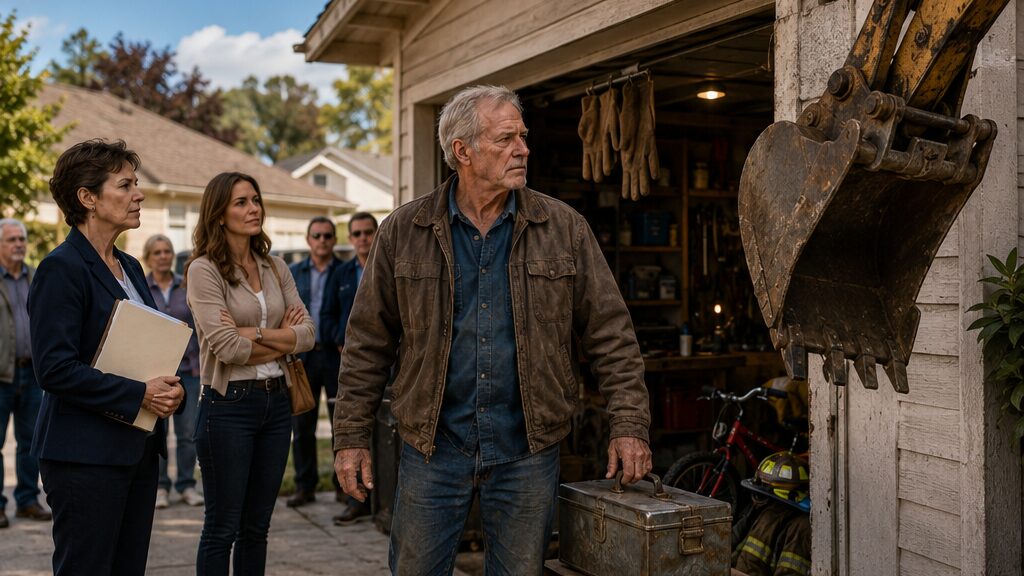
The excavator bucket hovered less than a foot from the workshop wall.
Jack Adams slammed the brakes of his pickup and stared through the windshield, certain for a moment that he had taken a wrong turn into someone else’s neighborhood.
The machine was real.
So was the dumpster parked beside his driveway.
And so was the bright red notice stapled to the side of his garage.
The paper snapped in the breeze like a warning flag.
His chest tightened.
He threw open the truck door before the engine stopped running.
“What is this?”
No one answered immediately.
Three workers stood near the workshop. One held a clipboard. Another carried a cardboard box filled with old parts.
The third was walking toward the dumpster with a steel toolbox.
Jack recognized the box instantly.
His toolbox.
The one he had owned for nearly forty years.
“Hey!”
The worker looked up.
Jack crossed the driveway in long strides.
“Put that down.”
The worker hesitated.
“It’s on the inventory list, sir.”
“I said put it down.”
The toolbox rattled as Jack grabbed the handle. The worker kept hold of the opposite side.
For one awkward second they stood there pulling against each other.
Then the younger man released it.
Metal clanked loudly.
The neighborhood had already gathered.
Jack noticed faces watching from sidewalks.
Porches.
Driveways.
People who normally waved at him now stood silent.
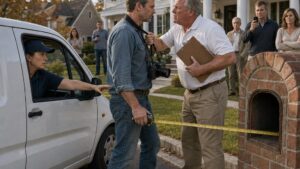
A sharp voice cut through the tension.
“You’re interfering with authorized work.”
Jack turned.
Samantha Carter stood near the curb holding a folder.
She looked perfectly composed.
New landscaping.
New house.
New car.
New neighbor.
Everything about her seemed polished.
Everything except the satisfaction in her eyes.
Jack set the toolbox on the concrete.
“Authorized by who?”
“The board.”
“The board doesn’t own my property.”
“It governs the community.”
Jack laughed once.
There was no humor in it.
“That machine was about to hit my building.”
“The structure is in violation.”
Another figure approached.
Pamela Anderson.
HOA president.
Clipboard tucked under one arm.
Expression tight.
Unlike Samantha, Pamela looked uncomfortable.
But she didn’t leave.
That told Jack enough.
He looked beyond them toward the workshop.
The wide garage doors were partly open.
Inside, sunlight stretched across crowded shelves.
Tool cabinets.
Workbench.
Storage racks.
Years of accumulated projects.
And hanging beside the entrance—
The gloves.
His gloves.
Dark leather stained with oil and age.
They swung slightly in the breeze.
For a strange moment they seemed more vulnerable than the building itself.
“Nobody said demolition was today,” Jack said.
Pamela cleared her throat.
“The enforcement action was scheduled after repeated notices.”
“I appealed.”
“The appeal was reviewed.”
“You never answered it.”
Pamela’s eyes shifted away.
That silence bothered him more than an argument.
A worker emerged carrying another box.
Jack stepped forward immediately.
“No.”
The worker stopped.
“What?”
“Nothing leaves that workshop.”
The worker looked toward Pamela.
Pamela looked toward Samantha.
Samantha answered first.
“The board voted.”
Jack felt the entire neighborhood watching.
Not one person stepped forward.
Not yet.
A man from two houses down folded his arms.
A woman whispered something to her husband.
Someone lifted a phone and began recording.
Samantha seemed to notice.
She straightened.
“The workshop has generated complaints for years.”
Jack stared at her.
“You’ve lived here eight months.”
“Long enough.”
The words landed harder than they should have.
Because they weren’t entirely wrong.
The workshop looked rough.
The paint had faded.
The roof needed work.
Scrap materials occupied one corner.
A stack of old lawn equipment sat under a tarp.
Jack knew what people saw.
He just never cared.
Inside mattered more.
The outside had always been the last thing on his list.
Now it seemed to be the first thing on everyone else’s.
Another worker opened the dumpster lid.
Jack noticed boxes already inside.
His stomach dropped.
They had started before he arrived.
Not preparations.
Actual removal.
He crossed to the dumpster.
Inside sat old shelving, broken cabinets, and several containers from the workshop.
His jaw tightened.
“You entered the building.”
“It was authorized.”
“You entered my building.”
The worker looked away.
Jack suddenly understood something.
This wasn’t a threat.
It wasn’t a warning.
It was already happening.
They had expected him to come home after half the place was gone.
The realization burned.
He turned back toward Pamela.
“Who approved starting before I was here?”
Pamela opened her mouth.
Closed it.
Then glanced at Samantha.
That answer was enough.
A pickup rolled slowly past the cul-de-sac.
The driver slowed to watch.
Jack hated the feeling.
Not anger.
Exposure.
Like strangers were being invited into something private.
Something they didn’t understand.
Sarah Lewis arrived ten minutes later.
Her car stopped beside the curb.
She stepped out quickly.
“Dad.”
Jack looked at her.
She had obviously rushed over.
Concern filled her face.
Then she noticed the excavator.
The dumpster.
The crowd.
The concern became shock.
“What happened?”
“They came to tear it down.”
Sarah blinked.
“What?”
“They started before I got home.”
She turned toward Pamela.
“Is that true?”
Pamela answered carefully.
“The board approved enforcement measures.”
“That’s not what I asked.”
Nobody spoke.
Sarah looked back at the workshop.
The same workshop she had spent half her childhood inside.
The same workshop she had spent the last few years arguing about.
“Dad…”
Jack knew that tone.
She was worried.
Not about the building.
About him.
That somehow hurt more.
Samantha stepped forward.
“The issue isn’t personal.”
Jack almost laughed again.
An excavator stood beside his workshop.
A dumpster held pieces of his life.
And it wasn’t personal.
Samantha opened her folder.
“Commercial activity has been reported repeatedly.”
Jack frowned.
“What commercial activity?”
“Repairs.”
“I don’t charge people.”
“That isn’t what complaints indicate.”
Now several neighbors exchanged looks.
Jack noticed it.
Some looked uncertain.
Others looked embarrassed.
For the first time all morning, he sensed cracks in the certainty surrounding him.
Then Samantha removed a packet of papers.
Official forms.
Board signatures.
Stamped approval.
She held them up for everyone to see.
“The vote was unanimous.”
Jack stared at the documents.
The crowd fell silent.
Even the workers stopped moving.
The excavator idled beside the workshop.
Hydraulics hissed softly.
And Jack realized there was a question far bigger than the paperwork itself.
Why had they been in such a hurry to destroy the place before anyone bothered to find out what it actually was?
Chapter 2: What Everyone Thinks Is Inside
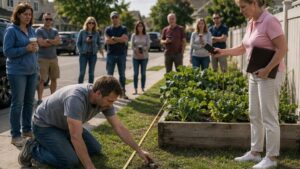
By noon, the cul-de-sac looked less like a neighborhood and more like a public hearing without chairs.
Nobody left.
The excavator remained in place.
The workers waited.
And the workshop sat open for everyone to inspect from a distance.
That alone felt wrong to Jack.
People stared inside as if it were an exhibit.
A mystery.
A problem.
Anything except a place where real work happened.
Samantha stood near the sidewalk speaking with several homeowners.
Jack caught fragments.
“Property values.”
“Appearance.”
“Compliance.”
Words that sounded reasonable until they were aimed directly at someone.
Sarah remained beside him.
“Dad.”
“Hm.”
“Did you ever tell them what you do in there?”
Jack looked at her.
She already knew the answer.
“No.”
“Why not?”
He shrugged.
The gesture irritated her immediately.
“That’s not an answer.”
“It wasn’t anybody’s business.”
Sarah exhaled.
“There it is.”
“What?”
“The thing you always do.”
Jack frowned.
“What thing?”
“You decide nobody needs an explanation.”
He looked away.
The workshop doors remained open.
Inside, the gloves hung beside the entrance.
Grease-darkened.
Worn smooth from decades of use.
His eyes lingered there.
The conversation ended.
Not because Sarah agreed.
Because she knew he wouldn’t continue.
A worker emerged carrying a clipboard.
Andrew Green.
Young.
Maybe late twenties.
The only one who seemed uncomfortable.
He approached Pamela.
“Ma’am?”
Pamela looked up.
“What is it?”
“We still need to catalog everything.”
“Proceed.”
Jack stepped into his path.
“No one touches another thing.”
Andrew hesitated.
“I’m just making a list.”
“No.”
Pamela intervened.
“Mr. Adams, the review requires documentation.”
“You should’ve thought of that before bringing a demolition crew.”
Several neighbors nodded.
Not many.
But enough for Jack to notice.
The certainty in the crowd was changing.
Slowly.
A retired teacher from down the street cleared her throat.
“I never thought he was running a business.”
Samantha turned.
“You filed a complaint.”
“About the exterior.”
“Exactly.”
“That’s not the same thing.”
Others began speaking.
Not defending Jack exactly.
But questioning assumptions.
“I never saw customers.”
“Me neither.”
“I thought he just worked on things.”
The comments spread through the crowd.
Small.
Tentative.
Pamela’s expression tightened.
Jack noticed something then.
The board hadn’t expected discussion.
They had expected agreement.
Andrew resumed cataloging.
This time Pamela insisted.
The workers entered the workshop.
Jack followed.
Sarah came too.
The interior smelled like machine oil, sawdust, and metal.
Familiar.
Steady.
Unlike the chaos outside.
Andrew paused beside a shelf.
Labels covered dozens of bins.
Hydraulic fittings.
Electrical connectors.
Brake assemblies.
Fasteners.
Carefully organized.
Not the random clutter outsiders imagined.
The worker wrote notes.
Another photographed equipment.
The process felt invasive.
Sarah wandered deeper into the building.
Her gaze moved across projects in various stages of completion.
“You’ve been busy.”
Jack didn’t answer.
A bicycle frame leaned against one wall.
A portable generator sat beside a workbench.
Two chainsaws rested on a shelf awaiting repair.
Everything had a purpose.
Everything had a destination.
Nothing was for sale.
Yet from the street it probably looked like a junkyard.
Maybe he should have understood that earlier.
A voice interrupted.
Samantha.
Standing near the doorway.
“I see a lot of equipment.”
Jack faced her.
“And?”
“Most people don’t keep this much.”
“Most people don’t fix things.”
The response came sharper than intended.
Samantha stiffened.
But she didn’t leave.
Instead she studied the room.
Not with contempt.
With confusion.
As if reality wasn’t matching the picture she had built.
That gave Jack no satisfaction.
The damage was already done.
Sarah stopped beside an old workbench.
Photographs sat tucked against the wall.
Her mother appeared in several of them.
Laughing.
Holding tools.
Standing beside finished projects.
Sarah stared longer than expected.
Then quietly turned away.
Andrew continued moving through the workshop.
Toward the rear wall.
Toward a tall storage cabinet.
A faded label was attached to one door.
Most people would have missed it.
Andrew didn’t.
He brushed away dust.
Read the words.
Then frowned.
“Community Repairs.”
The workshop seemed to go silent.
Andrew reached for the handle.
Jack took a step forward.
Not to stop him.
Just because suddenly he remembered exactly what was inside.
Years of work.
Years nobody had seen.
Years nobody had asked about.
The cabinet door creaked open.
Andrew leaned inside.
His eyes widened.
“What is all this?”
Chapter 3: The Bicycle Covered in Notes
The cabinet was deeper than it looked.
Shelves stretched from floor to ceiling.
Boxes.
Folders.
Parts bins.
Small projects waiting for pickup.
Andrew reached toward the nearest shelf.
Then stopped.
“What?”
Sarah moved beside him.
Andrew pointed.
A child’s bicycle sat in the center compartment.
Fresh paint covered the frame.
The tires looked new.
Colorful streamers hung from the handlebars.
But that wasn’t what caught everyone’s attention.
Notes.
Dozens of them.
Taped across the frame.
Attached to the spokes.
Folded beneath the seat.
Handwritten messages in different colors.
Different handwriting.
Different years.
Sarah carefully removed one.
“Thank you for fixing my bike.”
Another.
“I got to ride with my friends again.”
Another.
“My dad said you wouldn’t take money.”
The crowd pressed closer to the doorway.
Even Samantha stepped inside.
Andrew looked at Jack.
“You repaired this?”
Jack nodded.
The answer felt too small for the room.
Andrew picked up one note.
A photograph slipped from behind it.
The picture showed a smiling child standing beside the bicycle.
On the back someone had written:
You saved her summer.
The room remained quiet.
A worker lowered his camera.
Nobody seemed interested in documenting violations anymore.
Sarah touched the handlebars.
“I remember this bike.”
Jack glanced at her.
She looked surprised by her own memory.
“The little girl from three streets over.”
Jack nodded again.
“She couldn’t afford a new one.”
Sarah swallowed.
For the first time all day, her attention wasn’t on the workshop.
It was on her father.
On things she hadn’t known.
Or maybe hadn’t bothered to ask.
Andrew looked deeper into the cabinet.
There were generators.
Mobility scooters.
Wheelchairs.
Toolboxes.
Equipment tags.
Repair receipts marked PAID in some cases.
FREE in many others.
Nothing resembled a business inventory.
Samantha crossed her arms.
One bicycle wasn’t enough.
Jack could see it on her face.
She wanted facts.
Proof.
Something larger.
Before anyone could speak, Andrew discovered another box.
Inside were hundreds of folded notes.
He opened one randomly.
Then another.
Then another.
The expressions around the room began changing.
A volunteer coach thanking someone for repairing field equipment.
An elderly resident grateful for a fixed walker.
A family thanking an unnamed mechanic for restoring a generator before a storm.
No signatures from Jack.
No advertisements.
No invoices.
Just gratitude.
Pamela stepped forward.
“These notes don’t prove the workshop complies with regulations.”
The statement sounded weaker than she intended.
Several neighbors exchanged glances.
Andrew removed a larger envelope.
Inside was a letter.
The paper had yellowed slightly with age.
He unfolded it.
“I think this belongs to you.”
Jack recognized the handwriting instantly.
A mother.
Years ago.
Her son’s bicycle had been stolen.
The replacement had come from spare parts collected over months.
He remembered every detail.
The woman had written afterward.
Not because of the bicycle.
Because her son had smiled again.
Andrew lowered the letter slowly.
“What exactly do you do here?”
Jack looked around the workshop.
The shelves.
The tools.
The gloves hanging near the entrance.
The place everyone suddenly found mysterious.
“I fix things.”
Several people laughed softly.
Not because it was funny.
Because it was obviously incomplete.
Outside, more neighbors arrived.
Word was spreading.
The workshop wasn’t empty clutter.
The workshop contained stories.
That realization traveled quickly.
A pickup stopped at the curb.
A man stepped out.
Then another.
Neither entered yet.
They stood watching.
Waiting.
As if they recognized something important unfolding.
Inside, Andrew continued exploring.
Near the back of the cabinet he found several binders.
Thick ones.
Labeled by year.
He pulled one free.
Dust drifted into the air.
“What are these?”
Jack felt an unexpected knot in his stomach.
Those binders documented more than repairs.
They documented years.
Lives.
Promises.
Things he never intended to show anyone.
Andrew opened the first binder.
His eyebrows rose immediately.
Page after page contained records.
Equipment.
Names.
Organizations.
Volunteer groups.
Emergency repairs.
Dates.
Photographs.
Not a few jobs.
Hundreds.
The room grew very still.
Andrew looked up.
“How much of this is here?”
Jack didn’t answer.
Because for the first time, he wasn’t sure he knew.
Andrew reached for another binder.
And another.
The stack seemed endless.
Behind him, Samantha stared at the shelves in silence.
The story she had believed all morning was beginning to crack.
But nobody yet knew how large the truth might be.
And as Andrew pulled another binder from the cabinet, the question hanging over the workshop became impossible to ignore.
How many people had this place quietly helped while the rest of the neighborhood saw only junk?
Chapter 4: The Things Nobody Bothered to Count
The first person to arrive was carrying a chainsaw.
Nobody recognized him until he walked straight past the crowd and into the driveway.
“Jack.”
Jack looked up from the open binders.
The man lifted the chainsaw.
“You fix this one three times.”
A few people laughed.
The man didn’t.
“Last storm, this thing quit while we were clearing fallen trees. He had it running again before sunrise.”
He set the chainsaw carefully beside the workshop.
“I heard what was happening.”
The crowd shifted.
Then another vehicle arrived.
A pickup belonging to the volunteer fire department.
Patrick Garcia climbed out.
The moment Jack saw him, he sighed.
“Patrick.”
Patrick ignored the warning in his voice.
He walked toward the workshop carrying a thick folder.
“You should’ve called.”
Jack folded his arms.
“You were busy.”
“That’s not the point.”
Patrick stopped beside the open cabinet.
The crowd immediately noticed the fire department logo on his shirt.
Samantha noticed too.
“So you’re involved in this?”
Patrick looked at her.
“Depends what you mean by involved.”
He opened the folder.
Inside were maintenance records.
Repair logs.
Equipment inspection sheets.
Photographs.
Years of them.
“Half our portable pumps would’ve been scrapped without him.”
Murmurs spread through the neighborhood.
Patrick continued.
“Generator repairs. Trailer wiring. Emergency lighting. We brought equipment here because it came back working.”
Pamela stepped forward.
“Was he charging the department?”
Patrick stared at her.
“Usually he refused.”
“Usually?”
“We’d try leaving money. Sometimes he’d hide it back in the truck.”
Several people laughed softly.
Pamela didn’t.
She looked uncomfortable.
Patrick placed several photographs on the workbench.
One showed volunteer firefighters standing beside equipment.
Another showed flood response gear.
A third showed a damaged rescue trailer before and after repairs.
Every picture contained the same background.
Jack’s workshop.
The room seemed smaller now.
Crowded not by objects but by evidence.
Andrew turned another binder page.
“There’s a lot more here.”
“There should be,” Patrick said.
“How much?”
Patrick looked at Jack.
Then back at Andrew.
“More than most people know.”
The answer lingered.
Outside, another resident stepped forward.
An elderly woman carrying a walker.
The crowd parted for her.
She stopped beside Sarah.
“Your father fixed this.”
Sarah blinked.
“What?”
The woman touched the walker’s handle.
“The brakes failed. I couldn’t afford replacement parts.”
She smiled at Jack.
“You wouldn’t even let me buy lunch.”
Jack rubbed the back of his neck.
The attention was becoming unbearable.
One person was manageable.
Ten wasn’t.
Thirty felt impossible.
The workshop had always been easier than people.
Machines didn’t ask questions.
Machines didn’t expect explanations.
Sarah watched him carefully.
For the first time all day, she seemed to understand that.
Not approve of it.
Understand it.
Andrew continued sorting through records.
Each discovery created another conversation.
A repaired wheelchair.
Emergency generator service during a winter outage.
Equipment loaned to community events.
A box of tools labeled FOR RETURN.
Nothing glamorous.
Nothing headline-worthy.
Just years of practical help.
The sort of work that vanished the moment it was finished.
Which was exactly why nobody had noticed.
Samantha stood near the doorway.
Silent.
Watching.
Her certainty had faded.
But she wasn’t ready to surrender it.
Finally she spoke.
“That still doesn’t address the violation.”
Several heads turned.
Patrick frowned.
“What violation?”
“The structure.”
“The appearance.”
“The complaints.”
A few neighbors nodded.
Others didn’t.
The division was becoming visible now.
Samantha straightened.
“I’m not saying he hasn’t helped people.”
“Sounds like you are.”
“No.”
She paused.
“I moved here because this neighborhood was well maintained.”
The honesty surprised everyone.
Including her.
She looked around.
“When I saw the workshop, I assumed nobody cared.”
The statement landed differently than an accusation.
Because it sounded real.
Not cruel.
Just mistaken.
Jack looked at her for a long moment.
Then toward the faded siding.
The weathered roof.
The clutter visible from the street.
He hated admitting it.
But she wasn’t entirely wrong.
The outside looked neglected.
Because he’d spent every spare hour working inside.
Patrick broke the silence.
“So your solution was demolition?”
Samantha looked away.
The answer wasn’t easy anymore.
A siren sounded faintly in the distance.
Someone’s phone rang.
The neighborhood continued around them.
But the mood had changed.
Nobody was talking about junk.
Nobody was talking about property values.
They were talking about use.
About impact.
About things nobody had bothered to count.
Sarah wandered deeper into the workshop while everyone argued near the entrance.
Past the repair benches.
Past storage racks.
Toward a corner section hidden behind a canvas divider.
She stopped.
A worktable sat beneath a window.
Dust covered everything.
That alone felt strange.
Most of the workshop was actively used.
This area wasn’t.
A wooden project rested on the table.
Half-finished.
Carefully constructed.
Abandoned.
Beside it sat several framed photographs.
Her mother appeared in every one.
Sarah stepped closer.
The air seemed to change.
There were sketches.
Measurements.
Notes in familiar handwriting.
Two pairs of gloves hung from a peg above the table.
One pair belonged to Jack.
The other had belonged to her mother.
Sarah touched the unfinished project gently.
“Dad?”
The conversation near the entrance faded.
Jack turned.
She rarely used that tone anymore.
Quiet.
Careful.
He walked toward her.
Then stopped.
The moment he saw the table, something closed behind his eyes.
A door.
A wall.
A memory.
Sarah looked at the unfinished project.
Then at him.
“What is this?”
Jack didn’t answer.
And for the first time all day, the workshop revealed something that even the binders couldn’t explain.
Chapter 5: The Promise Hidden Behind the Workbench
The photographs were spread across the table when Jack returned.
Sarah had already dusted them off.
That made it worse.
Now every image was clear.
Her mother smiling beside the workshop.
Holding a tape measure.
Laughing over sketches.
Standing beside the unfinished project.
A project that now sat frozen halfway between beginning and completion.
Jack stopped several feet away.
“Don’t.”
Sarah looked up.
“Don’t what?”
“Start going through things.”
Her expression hardened.
“Everybody else has been going through things all day.”
“That’s different.”
“No. It isn’t.”
Silence stretched between them.
Outside, voices drifted through the open garage.
The crowd hadn’t left.
Patrick was speaking with neighbors.
Andrew was still sorting records.
Life continued.
But inside this corner of the workshop, everything narrowed.
Sarah held up one photograph.
“When was this taken?”
Jack recognized it immediately.
The last spring before her mother’s illness became impossible to ignore.
He looked away.
“I don’t remember.”
“Yes, you do.”
The answer came too quickly.
Too accurately.
Sarah set the photograph down.
“What is this project?”
Jack stared at the unfinished woodwork.
The curves.
The measurements.
The sections still waiting for assembly.
Years had passed.
Yet he remembered exactly where every piece belonged.
Because he had never truly stopped building it.
Only stopped touching it.
Finally he walked closer.
His gloves hung beside hers.
Dark leather next to faded canvas.
One pair worn recently.
One untouched for years.
Sarah followed his gaze.
“Mom’s gloves.”
He nodded.
Neither spoke for several seconds.
Then Sarah noticed an envelope beneath a stack of drawings.
Unopened.
Her mother’s handwriting covered the front.
She froze.
“Did you ever read this?”
Jack’s jaw tightened.
“No.”
“Why?”
He didn’t answer.
Sarah carefully picked it up.
The envelope looked fragile.
Like something preserved rather than forgotten.
Her eyes filled with disbelief.
“It’s been here all this time?”
Jack finally spoke.
“It wasn’t meant for me.”
“What?”
“It was for after.”
The word carried more weight than the rest of the sentence.
After.
After treatments.
After hospitals.
After hope became uncertainty.
Sarah lowered the envelope.
Outside, a loud discussion broke out near the driveway.
Neither moved.
“What was the project?” she asked quietly.
Jack sat on a nearby stool.
For the first time that day he looked tired.
Not angry.
Not defensive.
Just tired.
“We were building it together.”
“For what?”
“A community tool library.”
Sarah blinked.
“A what?”
“People borrow books from libraries.”
He looked at the unfinished structure.
“We thought maybe people should be able to borrow tools too.”
The idea sounded exactly like her mother.
Practical.
Generous.
A little ambitious.
Sarah smiled despite herself.
Then the smile faded.
“You never finished it.”
“No.”
“Because she died?”
Jack nodded.
The workshop became silent again.
Now the unfinished project made sense.
Not a forgotten hobby.
A stopped conversation.
Sarah sat beside him.
“You should’ve told me.”
Jack laughed softly.
A sad sound.
“You would’ve said the same thing everybody else says.”
“What?”
“Move on.”
Sarah looked down.
Because she had said exactly that.
More than once.
The realization stung.
She remembered arguments.
Suggestions to downsize.
To sell tools.
To clean out the workshop.
All made with good intentions.
All missing something important.
Outside, a vehicle pulled into the cul-de-sac.
A board member arrived carrying paperwork.
The timing felt cruel.
The conflict waiting beyond the walls had not disappeared.
A knock sounded on the workbench.
Andrew stood nearby.
Neither had heard him approach.
“Sorry.”
He held out a document.
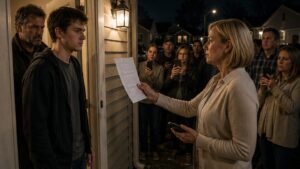
“Pamela asked me to give you this.”
Jack took it.
His expression darkened immediately.
Sarah leaned closer.
Emergency HOA hearing.
Tomorrow morning.
Final determination regarding the workshop.
The pressure returned instantly.
A deadline.
A decision.
A threat.
Andrew hesitated.
Then looked toward the unfinished project.
“Was she helping build that?”
Jack nodded.
Andrew glanced at the gloves.
The photographs.
The envelope.
Something changed in his expression.
Respect, maybe.
Or understanding.
He left without another word.
Sarah watched him go.
Then picked up the unopened envelope again.
“You still haven’t read it.”
“No.”
“Aren’t you curious?”
Jack stared at the handwriting.
Every day.
Every single day.
But curiosity wasn’t the problem.
Fear was.
If the letter remained unopened, possibilities remained alive.
The moment he read it, there would only be truth.
Sarah understood before he said anything.
She placed the envelope back on the table.
Neither touched it again.
Outside, the crowd slowly thinned as evening approached.
But one person remained.
Samantha.
She wandered through the workshop alone after most conversations ended.
Not snooping.
Looking.
Trying to reconcile two versions of reality.
Near a side shelf she paused.
A repaired hedge trimmer sat there awaiting pickup.
Attached was an old service tag.
Samantha frowned.
The address looked familiar.
Very familiar.
She checked again.
Then again.
The tag belonged to the elderly man who had sold her his house.
Months before she moved in.
Another note sat beneath it.
Thank you for helping me keep the yard manageable after my surgery.
Samantha stared.
The date matched the year before she bought the property.
Suddenly she understood something.
The immaculate yard that had convinced her to purchase the house.
The yard she had admired.
The yard that increased the home’s value.
Had been maintained partly because of repairs made in this workshop.
She slowly lowered the tag.
For the first time since the demolition began, the conflict no longer felt distant.
It felt personal.
And she wasn’t sure which side of it she belonged on anymore.
Chapter 6: The Meeting Beside the Demolition Order
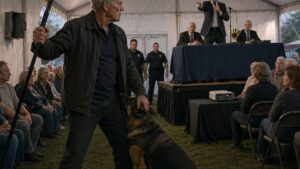
The excavator was still parked outside the workshop when the HOA hearing began.
Its bucket hung over the driveway like a deadline made of steel.
Residents filled folding chairs inside the community clubhouse.
Every seat was occupied.
Others stood along the walls.
Nobody expected this kind of turnout for an HOA meeting.
Pamela Anderson sat at the front table with several board members.
Stacks of documents surrounded her.
Rules.
Violation notices.
Inspection reports.
The official version of the story.
Jack entered carrying his work gloves.
Not wearing them.
Carrying them.
Sarah noticed immediately.
So did Patrick.
The gloves looked strangely important now.
Not tools.
Something more.
Conversations quieted as Jack walked to the front row.
Across the room Samantha sat alone.
Her expression was unreadable.
The meeting began.
Pamela tapped a microphone.
“We are here to review the enforcement action regarding the workshop located on Mr. Adams’s property.”
The room remained silent.
No one wanted procedural language anymore.
Everyone wanted answers.
Pamela continued.
“The board has received additional information since the original determination.”
A murmur spread through the audience.
Additional information.
An understatement.
Andrew sat near the back with several binders stacked beside him.
Patrick had brought records from the fire department.
Neighbors carried photographs.
Letters.
Receipts.
Proof.
Not proof of compliance.
Proof of usefulness.
Pamela began reviewing complaints.
Appearance concerns.
Storage concerns.
Structure concerns.
The original reasons behind enforcement.
For a few minutes it sounded convincing again.
Orderly.
Reasonable.
Necessary.
Then Patrick stood.
“May I speak?”
Pamela nodded reluctantly.
Patrick walked to the front carrying a photograph.
He placed it on the display screen.
Flood response equipment.
Jack’s workshop visible in the background.
Then another image.
And another.
The audience leaned forward.
“This equipment was repaired there.”
He pointed toward Jack.
“When we couldn’t afford replacement.”
The room listened.
Not because Patrick was dramatic.
Because he wasn’t.
He spoke like someone describing facts.
The strongest kind of testimony.
More residents followed.
A neighbor whose wheelchair had been repaired.
A parent whose child’s bicycle had been restored.
A volunteer coach.
An elderly resident.
One after another.
The pattern became impossible to ignore.
The workshop was not what many had assumed.
Pamela listened.
Occasionally making notes.
Occasionally rubbing her forehead.
The pressure on her was visible now.
Not just public pressure.
Responsibility.
A board member beside her finally asked the question everyone had avoided.
“Why wasn’t any of this reviewed before enforcement?”
The room became very quiet.
Pamela answered honestly.
“We received repeated complaints.”
“That wasn’t the question.”
She looked down.
The silence lasted several seconds too long.
Because there was no good answer.
They had assumed.
And then acted.
That realization settled heavily over the room.
For the first time, the board itself appeared divided.
Hope flickered through the audience.
Then the attorney advising the association cleared his throat.
The mood shifted immediately.
“Community value does not automatically negate compliance requirements.”
The room tensed.
There it was.
The complication nobody could ignore.
Usefulness wasn’t the same as legality.
The structure still faced technical violations.
The threat remained alive.
Jack felt hope retreat.
Not disappear.
Retreat.
Patrick sat down heavily.
Sarah looked toward her father.
He seemed smaller suddenly.
Not physically.
Emotionally.
As if he expected disappointment.
Then Samantha stood.
Heads turned.
Even she looked surprised by the decision.
“I need to clarify something.”
Pamela stared at her.
Samantha took a breath.
“When I filed complaints, I believed the workshop was harming the neighborhood.”
Nobody interrupted.
“I never investigated what happened inside.”
Her voice remained steady.
“I assumed appearances told the whole story.”
The admission changed the room.
Not because it solved anything.
Because it broke the certainty behind the original accusations.
Several residents nodded slowly.
Others looked away.
The division widened.
The board recessed briefly to review options.
Conversations exploded throughout the room.
Speculation.
Arguments.
Hope.
Frustration.
Twenty minutes later the members returned.
Pamela’s expression revealed nothing.
She adjusted several papers.
Then looked directly at Jack.
“Before we proceed, is there anything you wish to add?”
Jack froze.
Normally he would’ve said no.
Always no.
That was the problem.
Sarah knew it.
Patrick knew it.
Even Samantha probably knew it now.
Silence had protected him for years.
It had also nearly cost him everything.
Jack looked down at the gloves in his hands.
Then toward the audience.
Toward people who knew pieces of the story.
Not all of it.
Never all of it.
He stood slowly.
And for the first time, he decided to explain.
Not the repairs.
Not the records.
Not the workshop.
The reason the workshop existed at all.
He lifted a photograph from his pocket.
A photograph of the unfinished project.
The room fell silent.
“My wife and I started building something together.”
He looked at the image.
Then at the crowd.
“And that’s the part nobody knows.”
Chapter 7: The Project Carried Into the Afternoon Light
The room remained silent after Jack’s last words.
Dozens of people sat waiting.
No one interrupted.
For years Jack had hidden behind short answers, shrugs, and closed doors.
Now every eye in the clubhouse was fixed on him.
He looked at the photograph in his hand.
His wife stood beside the unfinished project, smiling at something outside the frame.
For a moment he forgot about the board.
The violation notices.
The excavator.
The hearing.
Everything except her.
“We started building a tool library,” he said quietly.
Several people exchanged confused looks.
Jack continued.
“The idea wasn’t complicated. Borrow a drill. Return a drill. Borrow a ladder. Return a ladder.”
A faint smile touched a few faces.
“She thought people spent too much money replacing things they only needed once.”
Sarah lowered her eyes.
The idea sounded exactly like her mother.
Jack swallowed.
“We worked on it every weekend.”
His voice nearly failed there.
But he continued.
“Then she got sick.”
Nobody moved.
Even the attorney remained silent.
“We kept talking about finishing it.”
Jack looked at the photograph again.
“After treatments. After appointments. After all the things that were supposed to come next.”
The room understood where the sentence was heading before he finished it.
“They didn’t.”
A long silence followed.
Not awkward.
Respectful.
Jack placed the photograph on the table in front of him.
“When she died, people told me to move on.”
Sarah felt those words land like a stone.
Because she had been one of those people.
Not out of cruelty.
Out of love.
But now she understood how different those things could look from the other side.
Jack held up the gloves he had carried into the meeting.
The worn leather pair.
“They belonged to me.”
Then he pointed toward another photograph showing the workshop wall.
“And hers hung beside them.”
His gaze swept across the audience.
“The workshop wasn’t keeping me stuck.”
His voice steadied.
“It was keeping a promise.”
No one spoke.
“The promise was simple.”
He looked toward Sarah.
Then Patrick.
Then even Samantha.
“Keep helping people.”
The words sounded almost too ordinary.
Yet they carried years inside them.
“If I fixed something for someone, I could hear her voice for another hour.”
Jack laughed softly.
Embarrassed by the admission.
“But that’s the truth.”
A few people wiped at their eyes.
Patrick stared at the floor.
Sarah looked away entirely.
The hearing no longer felt like a hearing.
It felt like a door opening.
One Jack should have opened years ago.
Pamela leaned back slowly.
The documents in front of her suddenly seemed very small.
After several seconds, she spoke.
“Mr. Adams…”
She stopped.
Started again.
“The board made decisions based on incomplete information.”
The attorney shifted uncomfortably.
Pamela ignored him.
“We should have conducted a full review before authorizing demolition activity.”
No one argued.
Because everyone knew it was true.
A board member nodded.
Another followed.
The mood inside the room changed completely.
Not because regulations vanished.
Because people finally understood what they were actually deciding.
Discussion continued for another hour.
There were still practical concerns.
Exterior maintenance.
Storage visibility.
Structural compliance.
Real issues.
But they no longer felt like reasons to destroy something.
They felt like problems to solve.
By the time the hearing ended, no final vote had been announced.
The board needed time.
The excavator remained parked outside.
The uncertainty lingered.
But something fundamental had shifted.
Jack wasn’t standing alone anymore.
The next afternoon, the excavator waited at the edge of the driveway.
The operator sat inside the cab.
Engine running.
Awaiting instructions.
Neighbors gathered again.
Not to watch a demolition.
To hear a decision.
Jack stood near the workshop entrance.
The doors were open.
Sunlight reached deeper inside than usual.
The gloves still hung near the wall.
His pair beside hers.
Pamela arrived carrying a folder.
The crowd quieted immediately.
She approached Jack.
Then faced the residents.
“The board has reached a decision.”
No one moved.
“The demolition order is withdrawn.”
Relief swept through the crowd.
Not cheering.
Not applause.
Something calmer.
Something deeper.
The excavator operator shut down the engine.
The sudden silence felt enormous.
Pamela continued.
“The workshop will remain.”
A few smiles appeared.
Patrick exhaled heavily.
Sarah closed her eyes.
But Pamela wasn’t finished.
“The board will work with Mr. Adams on exterior improvements and compliance adjustments.”
Jack nodded once.
Reasonable.
Fair.
Then a voice called out from the crowd.
“I’ll help.”
Another followed.
“So will I.”
A neighbor raised a hand.
“I’ve got paint.”
Someone else offered roofing materials.
Another offered landscaping equipment.
The suggestions multiplied.
Nobody had organized it.
Nobody had planned it.
It simply happened.
The workshop had spent years helping people.
Now people wanted to help the workshop.
Jack stood speechless.
Sarah smiled.
“You should say something.”
“I don’t know what.”
“That’s a first.”
He laughed.
A real laugh this time.
Nearby, Samantha stepped forward.
She hesitated before speaking.
“I’m sorry.”
Jack looked at her.
The apology clearly cost her something.
“I thought I knew what I was looking at.”
She glanced toward the workshop.
“I didn’t.”
Jack considered the words.
Then nodded.
Neither tried to make the moment bigger than it was.
That was enough.
Patrick approached carrying a box.
He set it near the entrance.
“First donation.”
Jack frowned.
“For what?”
“The tool library.”
Several people laughed.
Patrick shrugged.
“You think we’re letting that project stay unfinished?”
Sarah turned toward her father.
His expression softened immediately.
The unfinished project.
The one frozen for years.
The one he could never bring himself to complete.
For the first time, finishing it no longer felt impossible.
It felt shared.
Jack stepped into the workshop.
Past the repair benches.
Past the shelves.
Toward the corner where the unfinished structure waited.
He lifted it carefully.
The wood felt lighter than he remembered.
Or maybe he did.
When he carried it toward the open doors, the crowd instinctively stepped aside.
Sunlight spilled across the unfinished project.
Across the concrete floor.
Across the driveway.
Across the faces waiting outside.
Jack paused beneath the doorway.
The place where shadow met afternoon light.
For years the workshop had been a refuge.
A place to hide grief.
To work without explanation.
To keep promises privately.
Now the doors stood open.
Not because someone forced them open.
Because he chose to leave them that way.
Sarah stepped beside him.
Patrick followed.
Others gathered nearby.
Not intruding.
Sharing the moment.
Jack looked back once.
At the workbench.
At the tools.
At the gloves hanging together on the wall.
Then he reached up.
Carefully removed his own pair.
And carried them back to the entrance.
Andrew happened to be standing closest.
The young worker looked startled when Jack held them out.
“What are you doing?”
“You’ve got good hands.”
Andrew blinked.
“I just opened a cabinet.”
Jack smiled.
“Sometimes that’s enough.”
After a moment, Andrew accepted the gloves.
Not as a gift.
As a responsibility.
The gesture seemed to ripple through the crowd.
The workshop no longer belonged only to memory.
It belonged to the future too.
Jack turned toward the unfinished project.
Toward the people waiting to help.
Toward the promise that had survived longer than he ever expected.
And for the first time since his wife had died, carrying it forward no longer felt like something he had to do alone.
The story has ended.