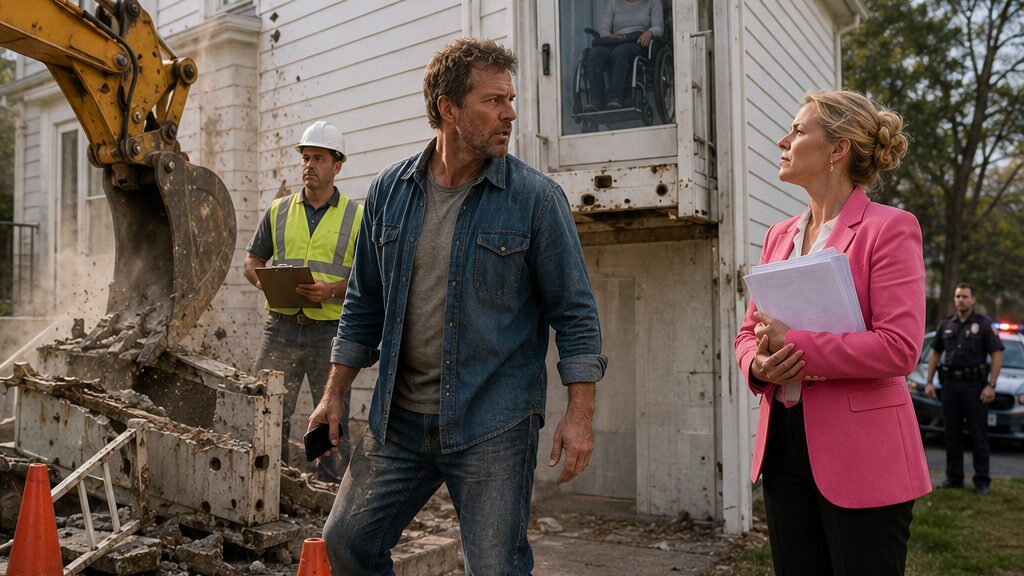
She Sent An Excavator To Tear Down The Ramp That Kept His Daughter Home
Chapter 1: The Machine Was Already At The House
The excavator bucket struck the side of Patrick Hall’s white house before he reached the driveway.
The sound was not like wood breaking. It was deeper than that, a heavy metallic crunch followed by the splintering crack of treated lumber and the dull pop of bolts tearing out of concrete. Dust jumped from the siding. A strip of white trim twisted loose and fell across the shrubs Amanda had planted in spring because she wanted “something alive by the ramp.”
Patrick stopped his truck half in the street.
For one second, he did not move.
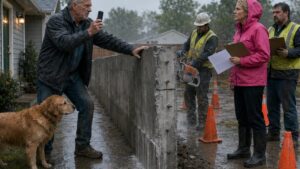
The yellow excavator was parked on the edge of his front lawn with its engine growling, its bucket raised against the landing that connected the exterior lift to the second-floor entrance. Two workers in neon vests stood near orange cones. One held a pry bar. Another had already stacked pieces of railing near the curb as if they were garbage from a remodel.
The landing was not a remodel.
It was the way Amanda came home.
Patrick got out and left the truck door open.
“Stop the machine,” he called.
No one heard him over the engine. Or no one wanted to.
The bucket pulled again. A corner post jerked sideways, still attached to a metal bracket. The bracket tore free and left four dark bolt holes in the concrete pad below. Patrick saw those holes with a clarity that made his throat close. He had drilled them himself, one at a time, after measuring twice because Amanda hated when he muttered under his breath and had teased him from the doorway.
“Dad, you’re building a spaceship.”
“Only if the spaceship gets you inside before dinner.”
The memory vanished under the shriek of another screw giving way.
Patrick crossed the lawn fast, but not running. Running made people think panic. Running gave other people permission to say you were unstable. He lifted his phone and started recording before he reached the cones.
“Stop work,” he said, louder. “This is private property. Who authorized this?”
The excavator arm paused in midair.
A man with a clipboard turned from the crew. He was broad-shouldered, sunburned across the nose, and wearing a hard hat with no company name on it. His eyes flicked to Patrick’s phone, then to the truck in the street.
“You the owner?” he asked.
“Patrick Hall. This is my house. Stop work now.”
The man looked past him toward the driveway.
Patrick followed his gaze.
Barbara Williams stood near the walkway in a bright pink blazer, white shirt, and heels that were already dusted gray at the toes. Her blonde hair was pinned into a smooth knot. She held a sheaf of papers against her chest as if the papers themselves made her untouchable.
“Mr. Hall,” she said, using the voice she used at HOA meetings when someone’s mailbox had the wrong finish. “This removal has been authorized.”
Patrick kept the phone raised. “By whom?”
“By the board’s enforcement authority.”
“That isn’t an answer.”
Barbara’s mouth tightened. She glanced at the worker with the clipboard, then back at Patrick. “Andrew, please keep your crew within the marked area. Mr. Hall has received notice.”
Andrew shifted his weight but did not signal the machine.
Patrick stepped inside the line of cones, far enough to be seen, not close enough to be accused of charging anyone. “No one touches that structure again.”
Barbara lifted the top page from her stack. “The exterior addition attached to your side elevation was installed without architectural approval. It violates the community’s exterior standards, creates an insurance concern, and has been declared subject to removal.”
“That exterior addition,” Patrick said, the words coming out even, “is a medical accommodation.”
Barbara’s eyes moved for a fraction of a second toward the broken landing. Not long enough to understand it. Long enough to dismiss it.
“You were given multiple opportunities to submit the correct form.”
“I submitted the form four weeks ago.”
“You submitted a request for a design variance.”
“No. I submitted a medical accommodation request with the brace plan and the lift landing drawing.”
Barbara looked down at her papers as if she already knew what was on every line. “The board reviewed the materials before it.”
“The board reviewed pictures,” Patrick said. “That’s not the same thing.”
Andrew cleared his throat. “Ma’am, do you want us to hold?”
Barbara did not look at him. “The order says removal today.”
Patrick turned the camera toward the exposed bolt holes, then toward the torn railing pieces near the curb. “Say that again on camera.”
Barbara’s face hardened. “I am not required to perform for your phone.”
“No,” Patrick said. “You’re required not to destroy a medical access point before proper notice.”
“We left a notice on your door.”
“When?”
“This morning.”
Patrick held still.
The excavator engine idled behind him, vibrating through the ground.
“This morning,” he repeated, “when the crew was already here?”
Barbara’s confidence did not break, but it shifted. A careful person watching would have seen it. She adjusted the papers against her blazer.
“Notice was posted prior to active removal.”
Patrick turned his phone toward the front door. A white sheet was taped crookedly beside the porch light, its bottom corner flapping in the breeze from the machine’s exhaust. He had left before seven to pick up Amanda’s prescription and a new set of transfer straps. There had been no notice then.
He looked back at Andrew. “Did she tell you anyone was home?”
Andrew’s jaw moved. “We were told the structure was unauthorized and the property owner had been notified.”
“That wasn’t my question.”
Barbara cut in. “Andrew, you do not need to answer him. Mr. Hall, you are interfering with an enforcement action.”
Patrick felt the old training settle over him, the part that knew how to keep hands visible and voice low when a situation wanted to catch fire. He lowered his phone slightly, enough that they could see his face.
“You are removing the only safe second-floor access point for my daughter.”
Barbara’s eyebrows drew together. For the first time, something like irritation gave way to uncertainty. But it lasted only a moment.
“The HOA cannot verify personal claims made after construction,” she said. “There is a process.”
Patrick looked at the broken landing. The lift door was still closed on the second floor, suspended uselessly above the torn edge. Amanda was inside. She would hear the machine. She would know.
“She has an appointment at ten,” he said. “How is she supposed to leave?”
Barbara’s voice softened by one artificial degree. “That is unfortunate, but you cannot install exterior structures first and seek approval afterward.”
“I installed emergency access after the stairs became unsafe. I told you that.”
“You told the management office many things.”
“And you sent a machine.”
Andrew looked at the excavator operator and made a small cutting motion across his throat. The engine dropped to a lower rumble but did not shut off.
Barbara turned sharply. “I did not authorize a stop.”
Andrew’s hand stayed raised. “There’s a person inside?”
Patrick answered without looking away from Barbara. “Yes.”
A worker near the curb stopped lifting railing sections. The pry bar hung loose in his hand.
Barbara inhaled through her nose. “No one is entering the home. The removal is exterior only.”
“The exterior is how she enters the home.”
The words landed harder than Patrick intended. Not loud. Not dramatic. Just plain enough that even the workers understood what the papers had not shown them.
Barbara’s face colored. “Mr. Hall, if there is a disability-related request, the appropriate documentation should have been provided in the correct channel.”
Patrick almost said, It was.
But he heard Amanda’s voice in his head from the night he had filled out the form.
Don’t put everything, Dad. Please. I don’t want a bunch of strangers reading about me.
So he had kept the language narrow. Mobility limitation. Medical access. Temporary exterior accommodation. He had attached the therapist’s letter to an email instead of uploading it through the portal that wanted diagnosis codes and details Amanda did not want shared. He had thought a reasonable board would ask before denying.
A reasonable board had not sent an excavator.
Patrick lifted his phone again. “Barbara Williams, president of the association, is present on my property with a demolition crew. She states a notice was posted this morning before active removal, and she has ordered removal of a medical access structure while the resident who uses it is inside the home.”
Barbara stepped toward him. “Turn that off.”
“No.”
“You are escalating this.”
“You brought machinery to my daughter’s door.”
For the first time, Barbara’s gaze flicked toward the upstairs lift entrance. Patrick followed it and saw the curtain move behind the glass.
Amanda.
The sight nearly broke his control.
He moved two steps toward the house, then stopped himself. If he went inside, they could resume. If he stayed out here, Amanda was alone.
Andrew came closer, lowering his voice. “Mr. Hall, I can keep the machine idle for a few minutes, but I need to know if there’s a legal stop-work order.”
Patrick turned to him. “Do you have a court order?”
Andrew looked at Barbara.
Barbara said, “We have an HOA enforcement order.”
“That is not a court order,” Patrick said.
“It is enforceable under the covenants you agreed to when you bought in this community.”
“It does not give you the right to destroy a medical accommodation without review.”
Barbara raised the papers, shaking them once. “This structure was denied.”
“Show me the denial.”
She pulled a page from the stack and held it out, but not close enough for him to take. He stepped forward, read the bold line across the top, and felt his stomach tighten.
DESIGN VARIANCE DENIED.
Not accommodation. Not emergency access. Design variance.
Patrick looked from the page to the torn landing. The machine had not just ripped wood and metal away. It had ripped away the assumption that the facts would matter if he had written them down somewhere.
A siren chirped once at the end of the street.
Everyone turned.
Two police cars rolled past Patrick’s open truck and stopped at the curb. Neighbors had begun to gather on porches. A woman across the street held her phone upright. Someone whispered, “Is he being arrested?”
Barbara’s shoulders relaxed slightly, as if the sight of uniforms restored the shape of the world she wanted.
“Good,” she said, loud enough for the workers to hear. “Maybe now we can proceed without interference.”
Patrick slid his phone into his shirt pocket, camera still facing outward. He reached slowly to the back pocket of his jeans.
Barbara watched his hand.
The first officer stepped out of the nearest cruiser and started toward the lawn.
Patrick opened his badge wallet.
Chapter 2: The Badge Did Not Open The Door
Barbara Williams’s face changed before the officer reached the cones.
It was not fear exactly. Patrick knew fear. He had seen it in accident victims, in parents who could not find their children in a crowded parking lot, in men who had shouted until cuffs touched skin and suddenly understood the rest of the day would not belong to them. Barbara’s expression was something smaller and more brittle. Calculation interrupted by surprise.
Her eyes dropped to the badge in Patrick’s open wallet.
Then she looked at his face as if seeing the denim overshirt, the gray T-shirt, the worn jeans, and the dust on his boots had been a mistake.
“You’re law enforcement?” she asked.
Patrick did not answer her. He turned the badge toward the approaching officer long enough for recognition, then closed the wallet halfway.
“Patrick Hall,” he said. “County police. Limited duty. This is my residence. I called dispatch for a property damage and safety issue.”
The officer slowed, then nodded once. “I know you, Hall.”
Barbara’s lips parted.
Andrew stared at the badge wallet, then at the exposed lift bolts, as if the two facts belonged to different worlds and he had been asked to stand between them.
Patrick put the badge away.
He did it deliberately. Barbara noticed. So did the officer.
“This is not me making an arrest,” Patrick said. “This is me asking you to secure an unsafe worksite and stop unauthorized destruction until the documents are reviewed.”
The officer stepped around the cones and looked up at the torn landing. The second-floor lift door hung above nothing now, a clean rectangle of white against the damaged siding. Below it, the concrete pad showed the four dark bolt holes where the corner post had been pulled out. A piece of railing leaned against the curb like a broken bedframe.
“Anyone inside?” the officer asked.
“My daughter.”
“Can she exit another way?”
Patrick looked toward the front door. There were stairs inside. Too narrow at the turn. Too steep at the last three steps. A month ago Amanda had tried them with him bracing her from below and had gone white around the mouth halfway down.
“No,” he said.
The officer’s eyes stayed on him a moment, and Patrick hated that he understood the look. Professional concern first. Personal concern underneath. The kind you pushed down because the scene needed you useful.
Barbara lifted her papers. “Officer, with respect, this is a civil enforcement matter. The association has authority to remove unapproved exterior modifications.”
“Ma’am,” the officer said, “right now I’m looking at an active demolition site with a resident potentially blocked inside.”
“No one is blocked inside. The main entrance remains available.”
Patrick turned. “The main entrance is not accessible to her.”
Barbara’s gaze cut toward the upstairs window. The curtain had stopped moving.
The second officer spoke with Andrew near the excavator. The engine finally shut down. The sudden quiet rang in Patrick’s ears. Without the machine, the smaller sounds came back—the clicking of a neighbor’s phone, the paper fluttering on the door, Barbara’s sharp breath, his own pulse beating behind his jaw.
Andrew removed his hard hat and rubbed the back of his head. “We’ll hold until somebody tells me different.”
“I’m telling you different,” Barbara said.
The officer looked at her. “And I’m telling everyone the site stays paused until we know if continuing creates a safety hazard or a breach of peace.”
Barbara’s fingers tightened around the enforcement order. “This delay increases cost to the association.”
Patrick almost laughed. It came up as one dry breath and died there.
“My daughter missing care increases cost too,” he said.
The officer asked, “What time is the appointment?”
“Ten.”
He checked his watch. “You have forty minutes.”
Patrick looked at the broken landing. Forty minutes might as well have been forty seconds. The lift stopped at a platform that no longer existed. The inside stairs would hurt her. Calling transport would take longer than the appointment window. Canceling would mean waiting two weeks for the specialist unless someone else canceled first.
The officer lowered his voice. “Can you carry her?”
Patrick’s jaw tightened.
He had carried Amanda after surgery. He had carried her once from the bathroom floor when the transfer bench slipped. She had cried less from pain than from humiliation. After that, she made him promise not to carry her unless there was a fire.
“No,” he said.
Barbara heard enough to step in. “Personal transportation issues are not the association’s responsibility.”
Patrick turned toward her so sharply the officer shifted half a step.
Then Patrick stopped.
He put both hands flat at his sides.
Barbara watched the movement. The officer watched it too.
“My daughter’s ability to enter and leave her home is not a transportation issue,” Patrick said.
The front door opened.
Amanda sat just inside in her wheelchair, one hand on the wheel rim, the other gripping the doorframe. Her dark hair was pulled back badly, the way she did it when she was in a hurry and did not want help. She was seventeen, but pain could make her look younger in the morning. Today she looked older.
“Dad,” she said.
He was already moving.
“Stay there,” he told her.
“I can see the yard.”
“I know.”
“No,” she said, looking past him at the landing debris. “I can see it.”
The sentence did what the excavator had not. It made the damage enter the house.
Patrick crouched by the threshold. “I’m handling it.”
Amanda looked at Barbara, at the workers, at the police cars, at the neighbor still filming from across the street. Her face shut down piece by piece.
“I have my appointment,” she said.
“I know.”
“We can’t use the stairs.”
“I know.”
She looked at the badge wallet clipped inside his back pocket. “Can’t you make them put it back?”
Patrick had been asked many harder questions in his life. None had made him feel this useless.
“Not like that,” he said.
Barbara spoke from behind him, softer now because Amanda was visible. “Miss Hall, no one intended to cause you distress. The association was not provided sufficient documentation to evaluate a medical need.”
Amanda blinked once. Patrick saw the hurt before it hardened.
“You tore it down before asking me,” she said.
Barbara’s face flushed again, but she did not answer.
The officer took statements. He photographed the site. He asked Barbara for the order and asked Andrew for the work authorization. Barbara kept repeating that the association had followed procedure. Andrew kept saying his crew had been scheduled for eight and told notice was complete.
No one restarted the machine.
That was the small mercy.
It was not enough.
By nine fifty-five, Patrick was on the phone with the clinic, listening to a receptionist say she understood but the doctor was fully booked. Amanda sat in the hallway behind him, turned slightly away, the unused transfer straps on her lap.
“I’ll take the next available,” Patrick said.
The receptionist gave him a date sixteen days out.
Amanda closed her eyes.
After the police left and Andrew’s crew loaded their tools without touching the landing again, Barbara remained near the walkway with her folder. The neighbors drifted back into their houses, disappointed that no one had been handcuffed.
Patrick stepped outside alone.
Barbara held out a copy of the enforcement order. “For your records.”
He did not take it immediately.
“You posted notice this morning.”
“That is correct.”
“When the crew was already scheduled.”
“The association is not required to accommodate delay tactics.”
Patrick took the paper. “You still think that’s what this is?”
“I think,” Barbara said, choosing each word, “that rules cannot function if every homeowner claims an emergency after violating them.”
There it was. Not hatred. Not even indifference, exactly. A locked door with a rule number painted on it.
Patrick looked at the dead lift, the torn brackets, the bolt holes.
“The emergency was in the paperwork,” he said. “You just didn’t read it.”
Barbara’s expression flickered.
Then she turned and walked toward her car.
Inside, Amanda had gone quiet. That worried him more than anger. Anger moved. Quiet stayed.
Patrick sat at the kitchen table with the enforcement order, the denial page Barbara had shown him, his laptop, his sent emails, and the folder he kept too neatly labeled. He opened the original submission and compared dates. Portal receipt. Architectural review form. Email to management with therapist letter attached. Emergency brace diagram. Temporary landing plan.
He printed everything again.
The printer hummed in the corner.
Page by page, the stack grew.
Then the denial page slid from Barbara’s packet onto the table.
Patrick stared at the top line.
DESIGN VARIANCE DENIED.
Under “requested improvement,” someone had typed: exterior platform addition visible from street.
Under “medical accommodation,” the box was blank.
Patrick went still.
He pulled the rest of Barbara’s packet apart, page by page, until he found the cover sheet.
There was a stamp across it in red.
DESIGN VARIANCE DENIED.
Chapter 3: The Form That Changed The Truth
The attachment line was missing.
Patrick saw it before the coffee finished dripping, before Amanda came out of her room, before he had even sat down properly at the kitchen table. His sent email had five attachments listed at the bottom. The HOA packet had four.
The missing one was not the drawing. Not the contractor invoice. Not the photograph of the cracked stair tread.
It was the letter from Amanda’s physical therapist.
Patrick laid the two pages side by side and pressed his palms flat to the table.
On his copy, the email read:
Attached: temporary lift landing plan, emergency stair brace estimate, contractor insurance certificate, exterior photo, medical access letter.
On the HOA’s printed packet, the last line ended at exterior photo.
No medical access letter.
No explanation of why the lift mattered.
No statement that the interior stairs were unsafe for Amanda.
Just a picture of a white house with a platform attached to the side, visible from the street.
Patrick leaned back. The chair creaked.
For four weeks, he had believed the board had seen enough and chosen not to care. That was easier to hate. The new possibility was worse. Maybe they had never seen Amanda at all. Maybe he had handed them the truth in a way that let them lose it.
Amanda rolled into the kitchen wearing a gray sweatshirt and the expression she used when she wanted the day to require nothing from her.
“Did you sleep?” she asked.
“Some.”
“That means no.”
Patrick moved the therapist letter under another page without thinking.
Amanda saw the motion.
“What’s that?”
“Paperwork.”
“That means me.”
He opened his mouth, then closed it.
She wheeled closer and looked at the two stacks. Her eyes moved quickly, faster than his when it came to screens and forms and everything he still printed because paper felt harder to ignore.
“They didn’t have the letter,” she said.
“I sent it.”
“I know. Did they have it?”
Patrick did not answer.
Amanda looked at the window over the sink. From there, the side yard was visible through the fence gap. The lift tower stood with nothing to meet at the bottom, a useless machine attached to a damaged wall.
“I told you not to put details in the portal,” she said.
“You asked me not to upload your diagnosis.”
“I asked you not to make me a board agenda item.”
“I didn’t.”
“No,” she said. “You made me invisible.”
He looked down.
She regretted the sentence as soon as she said it; he could see that. Her fingers tightened around the wheel rims.
“I didn’t mean—”
“You did,” he said. “And maybe you’re right.”
That stopped her.
Patrick gathered the printed copies and slid them into a folder. “I’m going to the HOA office.”
Amanda’s mouth twisted. “In uniform?”
“No.”
“With the badge?”
“No.”
“Good.”
It stung because he deserved it.
The HOA office occupied the front room of the clubhouse beside the pool, where notices about landscaping schedules and lost pets were pinned to a corkboard. Christine Allen sat behind the counter with a headset around her neck and two monitors angled away from the public side. She was in her thirties, tidy in the way of people who spend all day keeping other people’s messes in folders.
When she saw Patrick, she did not smile.
“Mr. Hall.”
“Christine.”
“If this is about yesterday, Barbara isn’t in yet.”
“It’s about the packet.”
Her eyes dropped to the folder under his arm. “You’ll need to submit any appeal in writing.”
“I’m not appealing yet.” Patrick placed the two pages on the counter. “I want to know why this attachment was removed.”
Christine looked at the pages without touching them. “Removed?”
“My sent email had five attachments. The board packet had four.”
She leaned closer, then straightened. “Sometimes large files separate in the system.”
“The missing file was one page.”
“I don’t manage the portal software.”
“It wasn’t uploaded through the portal. I emailed it to management because the portal requested medical details my daughter did not want shared.”
Christine’s face changed slightly.
There it was again: not guilt, not yet. Recognition.
Patrick lowered his voice. “Did the board see the medical access letter?”
Christine looked toward the hallway behind her. No one was there.
“The board saw what was in the architectural packet.”
“That’s not what I asked.”
She took the papers then, but only to align them. “The request was categorized as a design variance.”
“By who?”
“The office receives submissions. Barbara sets the agenda for review.”
“And you prepared the packet.”
Christine’s hands went still.
Patrick heard his own tone and pulled it back. “I’m not here to trap you. I’m trying to understand how a medical accommodation became a design problem.”
“You submitted architectural drawings.”
“Because they required drawings.”
“You submitted exterior photos.”
“Because they required photos.”
“You did not complete the medical accommodation portal fields.”
“My daughter did not want her private medical information sitting in a community management database.”
Christine looked at him then, and for the first time she looked less like a gatekeeper than a person caught between a bad rule and a worse result.
“I remember the email,” she said quietly.
Patrick waited.
Christine glanced again toward the hallway. “I forwarded it for classification.”
“To Barbara?”
“To the board president.”
“And?”
“And I was told to process it with architectural review because the exterior structure had already been partially installed.”
Patrick felt his jaw tighten.
“It was partially installed because the stairs failed.”
“I know what your email said.”
“But the board didn’t.”
Christine did not answer.
Outside, a pool maintenance machine buzzed against the tile, bumping the wall, reversing, bumping again. The sound seemed too small for the room.
Patrick placed the therapist letter on top of the denial page. “Look at those two together and tell me they reviewed the same request.”
Christine’s eyes moved over the letter.
Her voice dropped further. “They didn’t see this.”
The small payoff was so sharp it hurt. Patrick had proof now—not enough to fix the landing, not enough to get Amanda down the stairs, but enough to show the truth had been narrowed before anyone voted.
“Put that in writing,” he said.
Christine drew back. “I can’t.”
“You can.”
“No. I mean I can’t without authorization.”
“Christine.”
She shook her head. “You don’t understand how this board works.”
“I understand they sent an excavator to my house.”
Her face tightened. “And I understand that I have a job, and minutes, and procedures, and a president who will say I mishandled private medical information if I say the wrong thing.”
Patrick looked at her for a moment and saw the mixed thing in her eyes: fear, yes, but also resentment at being asked to be brave after she had spent months being useful.
“I’m not asking you to take the blame,” he said.
“That’s exactly what truth does in an office like this. It looks for the lowest person it can land on.”
Before Patrick could answer, Barbara’s voice came from the hallway.
“Mr. Hall.”
She walked in carrying the same pink folder from the yard, now clean and squared. Without the dust and the excavator, she looked less shocking, more official. That somehow made him angrier.
“This is inappropriate,” she said.
“What is?”
“Pressuring staff.”
“I’m asking for records.”
“Records requests must be submitted through the management portal.”
Patrick gave a humorless breath. “The portal seems to have lost the important page.”
Barbara’s gaze moved to Christine, then to the papers.
Christine lowered her eyes.
Barbara came to the counter and picked up the denial page. “The association reviewed the request before it. It was denied.”
“It wasn’t the request I submitted.”
“You failed to complete the accommodation process.”
“I refused to upload my daughter’s private diagnosis into a neighborhood portal.”
“Then you limited what the board could consider.”
Patrick stared at her. “So you knew it was medical.”
Barbara did not speak for half a beat.
Christine looked up.
Patrick saw it land.
Barbara recovered quickly. “I knew you had mentioned medical concerns after beginning unauthorized work. That is not the same as submitting a complete accommodation request.”
“You could have asked.”
“You could have waited.”
“The stairs were unsafe.”
“Then you should have pursued temporary internal arrangements while approval was pending.”
“My daughter lives there.”
Barbara’s voice chilled. “And eighty-six other families live in a community governed by rules they expect this board to enforce.”
Patrick picked up the therapist letter. “Did you show this to them?”
Barbara’s answer came too fast. “The board packet was complete for the category under review.”
“Did you show this to them?”
She turned to Christine. “Schedule the emergency compliance meeting.”
Christine’s eyes widened. “For when?”
“Friday.”
Patrick felt the room narrow. “For what purpose?”
Barbara slid the denial page back across the counter toward him. “To formalize the violation, set the deadline for full removal, and address your interference with authorized association work.”
Christine looked as if she wanted to speak and could not.
Patrick gathered his papers slowly. His hands wanted to shake, so he gave them tasks: align, tap, folder, close.
“You’re going to hold a meeting about my daughter’s access without showing them the letter.”
Barbara looked at him over the top of the folder. “You may submit whatever documents you believe are relevant, through the proper channel, before close of business tomorrow.”
He nodded once.
Then he left before he sai
Chapter 4: The Meeting Where Safety Became Appearance
The first slide on the clubhouse screen was a photograph of Patrick’s damaged house with a red circle around the torn lift landing and the words UNAUTHORIZED STRUCTURE typed beneath it.
Amanda sat beside him in the back row, her hands folded too tightly in her lap.
Patrick felt her go still before he looked over. On the screen, the white siding looked dirty and warped from the excavator dust. The exposed bolt holes showed as black dots. A broken strip of trim hung from the edge of the frame. The photograph had been taken after the crew had done the damage, but the title made it look like the damage was proof against him.
Barbara Williams stood at the front of the room in her pink blazer, one hand on a remote, the other resting on the folder Patrick had come to recognize. It was the color of a warning sign disguised as a flower.
“This emergency compliance meeting,” she said, “has been called to address an exterior alteration installed without prior approval, removal interference, and the continued presence of a nonconforming structure attached to a residence within the community.”
Patrick heard Amanda breathe out through her nose.
He leaned closer. “You okay?”
She did not look at him. “That’s our house.”
“I know.”
“No,” she said quietly. “That’s what they made it look like.”
The clubhouse was nearly full. Board members sat at a long folding table under framed photos of neighborhood holiday events and pool safety rules. A neighbor from across the street stood near the back wall with her arms crossed, pretending not to stare at Patrick. Someone had brought coffee, and the smell of it mixed with floor cleaner and printer toner.
Barbara clicked to the next slide. Another photo: the lift landing before demolition, taken from the street. The angle made it look larger than it was, a gray platform interrupting the clean side of the house.
“This was installed without complete approval,” Barbara said. “The association’s standards exist to maintain safety, uniformity, and property values.”
Patrick raised his hand.
Barbara looked at him as if she had expected him to speak too early. “There will be a resident comment period.”
“This isn’t a resident comment,” he said. “It’s a correction. The structure was installed as temporary medical access after the internal stairs became unsafe.”
Murmurs moved through the room.
Barbara’s jaw tightened. “Mr. Hall, you will have an opportunity—”
“You’re showing them pictures without the therapist’s letter.”
One board member turned toward Christine Allen, who sat at the end of the table with a laptop open and her fingers resting above the keyboard.
Christine did not look up.
Barbara clicked the remote again. “The board packet contains the documents submitted for architectural review.”
Patrick stood. Not fast. Not aggressively. Just enough that the room could see him over the row of chairs.
“That’s the problem,” he said.
Amanda’s hand touched his wrist.
He looked down.
Not everything, her eyes said.
He sat back down, the words he wanted burning behind his teeth.
Barbara continued with practiced steadiness. “The association was informed after the fact that the homeowner believed the structure had a medical purpose. However, exterior construction cannot proceed simply because a resident later characterizes it as necessary.”
Amanda’s hand disappeared from his wrist.
Patrick had faced suspects who lied with more shame.
A man in the second row raised his hand without waiting to be called. “Can I say something?”
Barbara hesitated, then nodded. “Briefly.”
The neighbor stood. “I’m not unsympathetic to anybody’s personal situation, but some of us bought here because the community has standards. If people start adding platforms and lifts and braces wherever they want, it affects values. We have to think about everyone.”
Amanda’s chair made the smallest sound as her hands moved to the wheels.
Patrick turned. “Amanda.”
“I need air.”
“I’ll come with you.”
“No.” Her voice was low, but hard. “Stay and talk about my platform.”
The neighbor looked away as she rolled toward the side exit. No one opened the door quickly enough. Patrick was halfway out of his seat when a woman near the aisle reached it and pushed it open.
Amanda went through without looking back.
The door clicked shut behind her.
For a few seconds, Barbara did not speak. The room had been forced to see the person the slides had removed.
Then Barbara recovered. “We are not here to discuss an individual’s private medical information. We are here to determine whether the association’s rules were followed.”
Patrick stood again. “That’s convenient.”
The board chair, a gray-haired man with reading glasses, cleared his throat. “Mr. Hall, please keep comments directed to procedure.”
“Procedure is why we’re here.”
Barbara looked at the chair. “The homeowner did not complete the accommodation section of the portal. He submitted architectural materials and proceeded with exterior work before approval.”
Patrick opened his folder. “I emailed the therapist’s letter to management with the drawings. Christine received it.”
Christine’s fingers froze over the keys.
Barbara did not turn her head. “The submitted architectural review packet did not include medical documentation.”
Patrick pulled out his copy. “Because someone separated it.”
“That is an accusation.”
“It’s a fact.”
The board chair looked at Christine. “Was there an additional attachment?”
The room changed. Not loudly. Chairs shifted. Someone whispered. Barbara finally turned toward Christine.
Christine’s throat moved before she spoke. “An email was received with additional material.”
Barbara’s voice sharpened. “The accommodation process requires portal completion.”
Christine kept her eyes on the laptop. “Yes.”
“That does not answer the question,” Patrick said.
Christine looked at him, then at the board chair. “The board packet reviewed under architectural standards did not include the medical letter.”
The words did not free Patrick. They only proved how far the damage had traveled before anyone admitted the road existed.
Barbara placed both hands on the table. “Because the matter before the board was an architectural violation.”
“You made it one,” Patrick said.
The chair tapped his pen once against the table. “Mrs. Williams, if there was a medical component, should this have been referred to accommodation review?”
Barbara’s face stayed composed, but a red mark had appeared high on her neck. “Only upon proper submission. The association cannot be expected to search informal emails and guess which rules a resident wants applied.”
Patrick nearly said Amanda’s name. He nearly said every detail he had refused to put in the portal. He nearly described the angle of the stairs, the failed transfer, the way she had looked at him from the floor and asked him not to make her body a committee topic.
Instead he said, “You didn’t have to guess. You had the letter.”
Barbara turned back to the board. “The issue tonight is whether the remaining structure must be removed for safety and compliance while the homeowner pursues any separate process.”
Separate process. The words landed like a second demolition.
A board member near Christine leaned toward the microphone. “Can we pause enforcement until accommodation review?”
Barbara answered before anyone else could. “The insurance carrier has repeatedly warned against unapproved exterior structures. If the association knowingly permits this to remain, we expose every homeowner.”
Patrick caught that.
Insurance carrier.
It was the first time she had said it in the open.
The board chair asked, “Is the remaining portion safe?”
Barbara clicked to a photo of the damaged landing. “Not as it currently stands.”
“Because your crew tore it apart,” Patrick said.
Barbara looked at him. “Because it was not approved before installation.”
The circle closed. Every fact entered one side and came out shaped like a violation.
After twenty more minutes, the board voted. Not unanimously. Christine did not vote; she only recorded. One board member wanted more review. Two wanted enforcement. The chair, after a long pause, said the remaining exterior structure had to be removed within seven days unless a complete accommodation request was submitted and accepted for emergency review.
Accepted. Not approved. Accepted for review.
Barbara wrote the deadline on a form and slid it across the table to Patrick as if he had lost a parking appeal.
Amanda waited outside under the clubhouse awning, her face turned toward the parking lot. Patrick stopped beside her and held the paper folded in his hand.
“They voted,” she said.
“Yes.”
“Seven days?”
He looked at her.
She laughed once, but there was nothing light in it. “They gave the broken thing a deadline.”
His phone buzzed before he could answer.
An email preview lit the screen.
From: Ryan Perez
Subject: Emergency Brace / Temporary Access Permit
Patrick opened it.
I reviewed the preliminary record attached to your address. The emergency stair brace and temporary exterior access work may have been provisionally permitted pending inspection. Do not allow further removal until this is clarified.
Patrick read the message twice.
Then he looked back toward the clubhouse doors, where Barbara stood inside the glass, pink folder pressed against her side.
Chapter 5: The Permit They Pretended Was Not There
“This was not supposed to be removed before inspection,” Ryan Perez said.
Patrick stood on the public side of the city permit counter with both hands resting on the edge, afraid that if he moved too quickly he would tear the paper Ryan had just placed between them. The page was stamped provisional, the word faint but readable in blue across the top. Below it were Patrick’s address, the emergency stair brace, temporary access landing, and a note: field inspection required before final modification or removal.
Ryan looked younger than Patrick expected, but tired in the practiced way of someone who spent all day telling angry people that rules were not the same thing as answers. He wore a city badge clipped to his belt, not a police badge, and kept glancing toward the waiting area where two contractors sat with rolled plans.
“You’re saying the city had this on file,” Patrick said.
“I’m saying the preliminary emergency work record exists.” Ryan tapped the page. “It doesn’t mean everything was final-approved. It means nobody should have treated it like an illegal deck and started ripping it off before inspection.”
Patrick stared at the line until the words blurred.
“Can I get a copy?”
Ryan hesitated. “You can request one formally.”
Patrick looked at him.
Ryan sighed, took the page, and walked to the copier behind him. “I can give you the public record copy. I can’t give legal advice, and I’m not taking a side in an HOA dispute.”
“I’m not asking you to.”
“Yes, you are,” Ryan said without turning around. “Maybe not with words.”
Patrick’s mouth closed.
The copier light slid under the lid.
Ryan brought back the copy and laid it on the counter. “You need a licensed contractor to stabilize what’s left. You need the HOA to stop interfering until this is reviewed. And you need to stop assuming every official-looking document means the same thing.”
Patrick looked up.
Ryan’s expression was not unkind. “An HOA letter is not a city order. A city provisional record is not a final approval. Your badge is not a building permit. Everybody in this mess is acting like their paper is the one that ends the argument.”
The words hit clean because they were true.
Patrick folded the copy into his folder. “Can you inspect today?”
“I can inspect the hazard. I cannot rebuild your access today.”
“I know.”
Ryan lowered his voice. “Do you?”
Patrick had no answer.
By noon, Ryan was in the side yard beside the torn landing, photographing the exposed bolts and cracked brace connection. Amanda watched from the upstairs lift doorway behind glass. The lift could travel down, but there was nowhere safe to land. Its closed door made her look like she was standing behind an aquarium wall.
Ryan called up, “Don’t operate that until we stabilize below.”
Amanda gave a thumbs-up without smiling.
Patrick stood near the excavator tracks still pressed into the lawn. The machine was gone, but its path remained: deep parallel scars across the grass, orange cone marks, wood dust caught in the mulch.
Ryan crouched near the concrete pad. “These anchor holes are fresh.”
“Monday.”
He photographed them. “And the removal stopped here?”
“After police arrived.”
Ryan looked up. “Police arrived because you called?”
“Yes.”
“And you identified yourself?”
Patrick felt the question under the question. “Yes.”
Ryan stood. “That’s going to become part of the story.”
“It already has?”
Patrick’s phone vibrated in his pocket.
Amanda called from upstairs through the cracked window. “Dad. You need to see this.”
Inside, she had her laptop open on the dining table. A community email had gone out from the HOA president’s account.
Patrick read it standing behind her chair.
Dear Residents,
The board is aware of yesterday’s disturbance involving an unauthorized exterior structure and the attempted intimidation of association volunteers and contractors by a resident claiming law enforcement authority…
Patrick stopped reading.
Amanda’s face had gone pale in the hard, angry way.
“She didn’t say my name,” Amanda said. “She didn’t say the ramp. She didn’t say appointment. Just you and your badge.”
Patrick took the laptop, then set it down too carefully.
“She’s changing the story.”
Amanda looked at him. “You helped.”
He flinched.
“I know you didn’t mean to,” she said. “But you showed them the badge, and now that’s what they’re talking about. Not the ramp.”
Patrick turned toward the window. Ryan was still outside, measuring the height from the concrete pad to the lift threshold. A city inspector with a tape measure was doing more for Amanda’s access than Patrick’s badge had done.
“I’ll correct it,” Patrick said.
Amanda grabbed his sleeve before he could move. “How?”
He looked at her hand, then at her face.
“Carefully,” she said. “Please.”
He nodded.
He meant it.
Then he saw Barbara outside.
She had parked at the curb and was standing near Ryan with her pink folder against her ribs, speaking in the crisp, controlled posture of a person who had never sent a sentence she could not defend. Ryan was listening with his notebook in hand.
Patrick was out the front door before he had decided to go.
Barbara turned as he crossed the lawn. A neighbor across the street lifted a phone from chest height to eye level.
Patrick saw it.
He kept walking anyway.
“Did you send that email?” he asked.
Barbara’s eyes flicked past him to the neighbor’s phone. “The board issued a community update.”
“You accused me of intimidating volunteers.”
“You displayed a badge during a civil matter.”
“You brought an excavator to a medical access point.”
Ryan stepped between them slightly. “Mr. Hall.”
Patrick heard the warning and ignored it. “Say the whole sentence in your next email. Say what you were removing.”
Barbara’s voice stayed calm enough for the phone across the street. “We were removing an unauthorized exterior structure after proper denial.”
“You mean the landing my daughter needs to leave the house.”
“Medical claims must be verified through the correct process.”
“They were verified. You buried the letter.”
Barbara’s eyes sharpened. “Be very careful.”
“No. You be careful.”
The neighbor’s phone tilted closer.
Ryan said, “Patrick.”
That time the use of his first name cut through.
Patrick stopped. His hands were open, but his voice had not been. The neighbor had captured the part Barbara needed: angry homeowner, police officer, accusing HOA president in the street.
Barbara lowered her chin slightly. It was almost invisible, but Patrick saw it. She knew the moment had turned.
“I understand this is emotional,” she said, loud enough for the phone. “That is why the board has procedures.”
Patrick stepped back as if he had touched heat.
Amanda was in the doorway behind him now, inside, watching from the hall. She had heard enough.
The shame arrived late and heavy.
Ryan held out the permit copy. “I’ll file a hazard note today. You’ll receive it by email. That’s what helps you now.”
Patrick took it.
Barbara walked back to her car.
The neighbor lowered her phone only after Barbara drove away.
That evening, the clip appeared in the community group without Patrick’s first sentence. It began with him saying, “You buried the letter.” It ended with Barbara saying procedures existed because the issue was emotional.
Comments gathered beneath it.
This is why officers shouldn’t use badges in personal disputes.
HOA should have handled privately.
What structure was this?
If he had approval, why is he yelling?
Patrick read until Amanda closed the laptop.
“Stop,” she said.
He sat beside her at the kitchen table. Between them lay Ryan’s permit copy, Barbara’s community email, the seven-day removal order, and a photograph Patrick had printed of the exposed bolt holes. Paper everywhere. Access nowhere.
“I made it worse,” he said.
Amanda looked at the dark window. “You made it louder.”
“That’s not better.”
“No.”
His phone rang.
Unknown number.
Patrick almost let it go, then answered.
No one spoke at first. Then Christine Allen’s voice came through, hushed and strained.
“Don’t call me back on this number,” she said.
Patrick sat straighter.
“Christine?”
“The insurance letter is why she rushed it.”
The line clicked dead before he could ask what letter.
Chapter 6: The Letter Behind The Pink Folder
Christine handed Patrick a copied letter in the hallway outside the HOA office and said, “This is what she was really afraid of.”
She did not let go immediately.
Patrick looked at her fingers on the page. They trembled once, then tightened.
“If you say I gave you this, I’ll deny it,” she said.
“Then don’t give it to me.”
Her eyes lifted, angry and frightened at the same time. “Don’t make this noble. Just take it.”
Patrick took the copy.
Christine stepped back, smoothing the front of her cardigan as if the hallway camera might read guilt from wrinkles. The office door behind her was closed. From inside came the muffled sound of a printer and Barbara’s voice on a call, polite enough to be dangerous.
Patrick read the letter where he stood.
It was from the HOA’s insurance carrier, dated three weeks before the excavator arrived. The language was formal, but the message was simple: after a prior claim involving an unapproved exterior structure in the community, the carrier wanted documentation that the association was actively enforcing architectural standards. Failure to enforce could affect coverage review and premiums.
Patrick read the final paragraph twice.
The carrier recommended consistent documentation, review, and risk assessment.
It did not recommend same-day demolition.
It did not recommend removing a medical access structure before accommodation review.
Barbara had turned a warning into a weapon because a clean file was easier to defend than a complicated person.
Christine watched his face. “She brought it to the executive session. Said if the board started making exceptions, the whole neighborhood could pay for it.”
“Did anyone ask about accommodations?”
“One board member did.” Christine looked toward the office door. “Barbara said there wasn’t a complete accommodation request.”
Patrick folded the letter once. “And you knew there was.”
Christine’s mouth tightened. “I knew there was an email. I didn’t know what she would do.”
“You prepared the packet.”
“I prepared what I was told to prepare.”
The answer was small. It was also honest in a way that did not absolve her.
Patrick placed the letter in his folder. “Why tell me now?”
Christine’s eyes moved past him to the glass doors at the end of the hallway, where the pool shimmered empty beyond the clubhouse patio.
“Because when Amanda left that meeting, nobody looked at the screen for a full ten seconds,” she said. “And Barbara still kept talking.”
Patrick had no answer.
Christine lowered her voice. “There’s more. The work order.”
She pulled another page from under her clipboard and gave it to him.
The contractor instruction sheet listed Patrick’s property. Under occupancy during work hours, someone had checked: vacant / resident notified.
Patrick stared at the word vacant.
“My daughter was inside.”
“I know.”
“Who filled this out?”
Christine shook her head. “The final packet came from Barbara’s folder.”
Before Patrick could respond, the office door opened.
Barbara stepped into the hallway with her phone in one hand. She stopped when she saw them.
Christine’s face went blank.
Patrick slid the papers into his folder without rushing. Barbara’s eyes followed the movement.
“Mr. Hall,” she said. “You seem to spend a great deal of time in restricted areas.”
“This hallway is open.”
“Christine has work to do.”
Christine looked down at her clipboard. “I was just leaving copies for the board packet.”
Barbara did not look at her. “Were you?”
The air tightened.
Patrick could have pulled the insurance letter out right there. He could have read the carrier’s careful language aloud and watched Barbara explain why a coverage warning justified tearing out Amanda’s access. He could have made Christine’s fear visible.
Instead he said, “I’m requesting the full work order, notice log, and board packet for Friday’s decision.”
Barbara’s expression cooled. “Submit through the portal.”
“I will.”
“And any further unsupported accusations will be referred to counsel.”
Patrick nodded once. “Then make sure your support is better than mine was.”
He left before Christine had to choose a side in front of Barbara.
That afternoon, Andrew Clark called.
Patrick met him at the curb because Amanda was resting and he did not want another stranger at the door. Andrew arrived in his work truck, no hard hat, no vest, looking smaller without the machinery behind him.
“I shouldn’t be here,” Andrew said.
“Probably not.”
“I’m not getting in the middle of your HOA fight.”
“You already were.”
Andrew looked toward the side yard. The lift landing had been braced temporarily with two wooden supports Ryan had required, but it still led nowhere useful. “We were told the house would be vacant during the removal window.”
Patrick held out the copied work order. “This?”
Andrew’s face changed. “Where’d you get that?”
“Is it accurate?”
“No.” He rubbed a hand over his jaw. “I mean, that’s what we received. But no one said anything about a resident inside. No one said medical. If they had, I’d have asked for a different scope.”
“You started before I was home.”
“We were scheduled for eight. Notice was supposed to be posted before we arrived.”
“It wasn’t.”
Andrew looked down the street. “Our truck pulled in at seven forty-eight. The notice wasn’t on your door then.”
Patrick went still.
Andrew kept his voice low. “Barbara showed up at eight with the packet. One of my guys put the notice up after she handed it to him.”
Patrick felt the missing shape of the morning click into place.
“Will you put that in writing?”
Andrew gave a short laugh without humor. “That can cost me work.”
“So can destroying the wrong thing.”
Andrew looked at him then, not offended. Tired. “You think I don’t know that?”
Patrick looked back at the house. Upstairs, Amanda’s curtain was closed.
Andrew followed his gaze. “I’ll give you my job log. It has arrival time, stop time, photos. I won’t write an accusation. But the times are the times.”
“That’s enough.”
“No,” Andrew said. “It isn’t. But it’s what I can do.”
Patrick took the envelope Andrew pulled from his truck.
After Andrew drove away, Patrick stood in the yard with the new papers under his arm. Insurance letter. Work order. Job log. Permit record. Therapist letter. None of them, alone, put a ramp back under Amanda’s lift. Together, they made a shape Barbara could no longer call emotional.
His phone buzzed with an email from the HOA.
Barbara had offered a private resolution.
The message was clean and lawyerly: the association would consider temporary conditional approval of the access structure if Patrick submitted a revised plan, agreed not to pursue claims related to the removal action, acknowledged that the association had acted reasonably based on available information, and kept the matter confidential.
Patrick read the sentence three times.
Reasonably.
He thought of Amanda behind the lift door. He thought of Barbara saying personal transportation issues were not the association’s responsibility. He thought of himself in the street, angry enough to let the wrong clip become the story.
The old Patrick—the one who believed in closing problems quietly, controlling damage, keeping Amanda’s name out of rooms where strangers measured other people’s pain—would have considered signing.
A private approval. A repaired landing. No more comments. No more meetings.
He printed the email and carried it to Amanda’s room.
She was sitting by the window with the lights off, the glow from her tablet on her face. She looked at the paper but did not take it.
“What is it?”
“They’ll consider temporary approval if I sign that they acted reasonably and keep it confidential.”
Amanda’s eyes moved from the page to him. “Will you?”
He looked at the folded blanket at the end of her bed, the transfer board leaning against the wall, the sneakers she had not worn since Monday because there was nowhere to go without turning leaving into an operation.
“No.”
Something in her shoulders lowered.
Patrick sat on the edge of the chair near her desk. “But it means another hearing. It means more people might hear more than you wanted them to.”
Amanda looked out the window. In the side yard, the temporary brace cast a crooked shadow against the house.
“I don’t want them to know everything,” she said.
“They don’t have to.”
“They have to know enough.”
Patrick waited.
Amanda turned her chair slightly toward him. Her face was pale, but her voice did not shake.
“I want to write my own statement,” she said.
Chapter 7: The Statement That Made The Ramp Visible
Barbara opened the final accommodation hearing with a settlement offer before Amanda was allowed to speak.
Patrick knew it was a settlement offer because it had been placed at each board member’s seat in a plain white envelope, as if the paper itself were embarrassed. He saw his name on the top page. He saw temporary conditional approval. He saw confidentiality. He saw acknowledgment that the association had acted reasonably based on information available at the time.
Amanda sat beside him with her statement folded once in her lap.
She had typed it herself, printed it herself, and refused to let Patrick read the final version until they were in the truck outside the clubhouse. Then she had handed it over and watched his face while he read.
It was not dramatic. That was what hurt.
It said she could manage pain, embarrassment, appointments, braces, and bad days. It said what she could not manage was being trapped in a house because adults argued over what a ramp looked like from the street. It said the lift landing was not an improvement to her father’s property. It was the part of the house that let her come and go without being carried.
Patrick had folded it carefully and given it back.
Now Barbara stood at the front of the same clubhouse room, pink folder open, voice composed.
“The association is prepared,” she said, “to resolve this matter cooperatively. Mr. Hall may submit revised plans for temporary access, subject to safety modifications and exterior screening. In exchange, the association requests confidentiality regarding prior enforcement actions and written acknowledgment that the board acted based on incomplete information supplied by the homeowner.”
Amanda’s fingers tightened around her statement.
Patrick felt the old instinct rise: take the practical path, get the landing approved, end the bleeding. He could sign, rebuild, and spare Amanda another hour in a room where strangers had already turned her doorway into a standards issue.
Then he looked at the photographs on the table in front of him.
Exposed bolt holes. Torn railing. The lift door opening above empty air. Andrew’s job log. Ryan’s provisional permit record. Christine’s printed packet with the missing therapist letter. The work order marked vacant.
Barbara had not offered repair. She had offered quiet.
The board chair adjusted his glasses. “Mr. Hall, do you wish to respond to the proposed resolution?”
Patrick stood.
Every head turned toward him. He could feel the neighbor from the last meeting watching for anger, for the clipable mistake, for the moment when he would become the story Barbara preferred.
His badge wallet was in his back pocket. He took it out.
Barbara’s eyes sharpened.
Patrick placed the closed wallet on the table beside Amanda’s folded statement.
Then he moved his hand away from it.
“The badge is not the point,” he said.
The room stayed quiet.
“It did not make the lift safe. It did not put the landing back. It did not get my daughter to her appointment. It did not turn an HOA order into a court order, and it does not turn my anger into evidence.”
Amanda looked up at him.
Patrick kept his eyes on the board, not on Barbara. “The point is that a medical access request was processed as a design variance. The point is that a crew was told my house would be vacant when my daughter was inside. The point is that notice was posted the same morning removal began. The point is that the city had a provisional emergency record that should have been inspected before anything was removed.”
Barbara’s hand closed around the edge of her folder. “Several of those claims are disputed.”
“Then don’t settle them privately,” Patrick said. “Review them publicly, in the record you should have made the first time.”
A board member leaned forward. “Mr. Hall, are you rejecting the proposed resolution?”
“Yes.”
The word landed harder than he expected.
Amanda unfolded her statement.
Patrick sat.
Barbara’s face gave away nothing, but the color had returned high on her neck. “If Mr. Hall rejects a reasonable cooperative path, the board must still determine whether the request satisfies safety, exterior, and documentation requirements.”
Christine Allen sat at the side table with the meeting minutes open. She had not looked at Patrick since he entered. Now she raised her hand slightly.
The board chair glanced at her. “Christine?”
Christine swallowed. “For the minutes, I need to clarify something before the board frames this as a complete documentation issue.”
Barbara turned toward her slowly. “Christine, staff notes can be added after deliberation.”
“It affects deliberation.”
The chair nodded. “Go ahead.”
Christine’s hands were clasped so tightly her knuckles had gone pale. “The medical access letter was received by the management office before the initial architectural review. It was not included in the board packet for that review. The board did not review the accommodation request as an accommodation before the removal order.”
Barbara’s voice came low. “That is not a complete characterization.”
“It’s the part I can document,” Christine said.
The room shifted again, but this time Patrick did not feel triumph. He felt the terrible relief of watching someone choose the truth after fear had made it expensive.
Barbara looked at the board chair. “The homeowner bypassed the correct portal fields.”
“And the office knew why,” Patrick said. “Because my daughter did not want private medical details uploaded into a community system.”
Amanda lifted her statement.
“I can speak now,” she said.
No one moved.
The chair looked at Barbara, then back at Amanda. “Yes.”
Amanda rolled forward to the small microphone placed at the front table. Patrick started to move with her, but she shook her head once.
He stopped.
She positioned herself under the clubhouse lights with the torn-landing photographs spread on the table behind her. Her voice was quiet at first.
“My name is Amanda Hall. I live at the white house you keep showing in the pictures.”
A few people looked down.
Amanda unfolded the page. “I’m not going to give you my whole medical history. I don’t owe that to everyone who lives near me. But I will tell you what the structure was. It was how I left my house without my dad carrying me. It was how I got to therapy. It was how I went outside without planning it like an emergency.”
Patrick looked at the closed badge wallet. He did not touch it.
Amanda continued. “When you call it a platform, it sounds extra. When you call it an exterior addition, it sounds like my dad wanted a bigger deck. When you call it a violation, it sounds like we did something wrong. But when the crew tore it down, I didn’t lose a design feature. I lost the door I could use.”
The room had gone so still that the hum of the projector sounded loud.
Barbara stared at the table.
Amanda looked at her then. Not pleading. Not angry enough to be dismissed as emotional. Just direct.
“You didn’t have to know everything about me to stop the machine long enough to ask one more question.”
Barbara’s mouth moved slightly, but no words came.
Amanda folded the paper again, not because she was finished, but because she had decided the rest did not belong to them.
The chair cleared his throat. “Thank you, Amanda.”
Patrick looked at his daughter. She returned to his side without help.
The hearing turned procedural after that, but procedure had changed shape. Ryan’s record was read into the minutes. Andrew’s job log showed arrival before notice posting. Christine confirmed the missing attachment. Barbara argued that the board had acted under insurance pressure and incomplete submission. She was not entirely wrong. That was what made the room harder. She had feared liability. Patrick had feared exposure. Christine had feared blame. Everyone had hidden behind the part of the truth that protected them.
But only one of those hidden truths had brought an excavator.
After nearly an hour, the board chair called for a vote on three motions: withdraw the violation, approve temporary reconstruction subject to Ryan’s safety conditions, and create an emergency medical modification review process.
One board member abstained.
Another voted yes.
A third hesitated, then voted yes.
The chair voted yes.
Barbara sat with her hands folded on the pink folder. Because of the abstention and the board rules, her vote was required to finalize the written withdrawal that night.
The chair looked at her. “Barbara?”
For the first time all evening, she did not seem ready with language.
Patrick did not look at Amanda. He kept his eyes on the closed badge wallet, the folded statement, and the photograph of the bolt holes.
Barbara’s deciding vote would show whether she was still protecting the process that had hurt them, or the person it had failed to see.
Chapter 8: The Space Where The Bolts Were Filled
The first new bolt went into the same place where the old one had been torn out.
Patrick stood beside the concrete pad with his arms folded, not because he was trying to look stern, but because he did not trust his hands to stay still. The drill whined, bit into the patched anchor point, and sent a curl of gray dust across the worker’s glove. The sound was smaller than the excavator had been. Cleaner. Still, Amanda flinched from the open doorway above.
Patrick saw it and looked away before she noticed him noticing.
Andrew Clark had come back with a smaller crew and no machine larger than a lift jack. He had asked twice whether Patrick was comfortable with him taking the job. Patrick had said yes because Andrew had brought his logs when it mattered, and because the man knew exactly what had been damaged.
“You want the bracket set half an inch wider than before,” Andrew said, checking the revised plan. “Inspector’s note.”
Patrick nodded. “Half an inch.”
Ryan Perez stood with a clipboard near the side yard, watching the installation without pretending it was anything but uncomfortable. The provisional permit had become a conditional approval after two revisions, a contractor letter, and three emails nobody answered quickly. The HOA’s violation had been withdrawn in writing.
Barbara had voted yes.
She had not looked at Patrick when she did it. She had looked at Amanda.
That was not forgiveness. It was not apology. It was a choice made too late and still necessary.
The new landing frame rose slowly through the morning: posts first, then cross supports, then the reinforced platform that would meet the lift door. The old exposed bolt holes had been cleaned and filled where they could not be reused. Andrew marked each patch with blue tape until Ryan inspected it.
The yard still carried the marks of the machine. Two dull tracks crossed the grass where the excavator had rolled in like it belonged there. Patrick had tried raking them out, but the soil held memory better than he wanted.
Inside, Amanda waited in the upstairs hall.
She had insisted on being there for the first test.
“You don’t have to watch them build it,” Patrick had said earlier.
“I watched them tear it down,” she replied. “I’m watching this too.”
By late morning, a dark sedan pulled to the curb.
Patrick knew it was Barbara before she stepped out. The pink blazer was gone. She wore a navy jacket, plain slacks, and carried one folder, not pressed like a shield but held at her side.
Andrew saw her and stopped tightening a bolt.
Patrick walked to the front path before she reached the cones.
“Mr. Hall,” Barbara said.
“Barbara.”
She opened the folder and removed two pages. “The board signed the withdrawal notice and the conditional accommodation approval. I’m delivering copies.”
“You could have mailed them.”
“Yes.”
She held them out.
Patrick took the pages. The first withdrew the violation and removal demand. The second approved the rebuilt access landing and emergency brace under Ryan’s safety conditions. At the bottom was Barbara’s signature, smaller than he remembered from the notices.
Behind him, the drill started again.
Barbara looked toward the side yard. Her face did not collapse into regret. It did not need to. Patrick would not have trusted a performance anyway.
“The board also approved the emergency review policy,” she said. “Medical modifications can be temporarily stabilized pending documentation review, with privacy-protected submission to a third-party reviewer.”
Patrick looked up from the paper.
“That should have existed before,” he said.
“Yes.”
The word was plain. No defense attached.
For a moment, they stood with the sound of rebuilding between them.
Barbara looked toward the upstairs lift door, where Amanda’s silhouette was visible behind the glass. “I thought I was preventing one unsafe exception from becoming ten.”
Patrick said nothing.
“I was told by insurance that inconsistent enforcement could affect everyone. I let that become the only fact I could see.”
“You had other facts.”
“I did.”
That was as close as she came to apology then. Maybe as close as she could come without turning it into a scene about herself.
Patrick folded the approval notice. “The delay cost her care.”
“I know.”
“No,” he said, not harshly. “You know it as information. She knows it as days she couldn’t leave.”
Barbara accepted that without answering.
Amanda opened the upstairs window. “Dad?”
Patrick turned. “They’re almost ready.”
Barbara looked up. Amanda saw her and did not disappear from the window.
For a second, neither of them spoke.
Then Amanda said, “Did you sign it?”
Barbara lifted her chin. “Yes.”
“Good.”
The window closed.
Patrick almost smiled, but the feeling caught somewhere before it reached his face.
By afternoon, Ryan signed off on the first safe test. Andrew checked the gate latch twice, then stepped back. The new platform sat clean and level against the white house, not hidden, not decorative, not pretending to be anything other than what it was.
A way in.
A way out.
Patrick went upstairs.
Amanda was waiting in front of the lift door, both hands on her wheels. She had changed into the sneakers she had not worn since the morning of the demolition. The laces were tied tight and uneven.
“You ready?” he asked.
“No.”
He nodded. “Okay.”
She exhaled. “Open it.”
Patrick pressed the button.
The lift door unlocked with a soft click. It swung open to the new landing.
Amanda did not move immediately. Her eyes went to the platform, the railing, the new brackets, the place where the old bolts had been filled. Patrick stood behind her and forced himself not to speak.
Then she rolled forward.
The wheels crossed the threshold onto the rebuilt landing with a low, ordinary sound.
Patrick had not known he was holding his breath until she turned around outside and looked back at him through the open doorway.
“It works,” she said.
Two words. Not victory. Not healing. Function.
It was enough to make his eyes burn.
He stepped onto the landing after her, leaving space, letting her occupy it first. Below, Andrew packed tools into the truck. Ryan wrote final notes on his clipboard. Barbara stood near the curb with the signed folder against her side, watching without asking to be included.
Amanda looked down at the yard. “The tracks are still there.”
“I’ll reseed.”
“They’ll still be there under it.”
“For a while,” Patrick said.
She nodded, accepting the truth without softening it.
Later, after the crew left and the street emptied, Patrick sat at the kitchen table with the rebuilt access plan, the withdrawal notice, the conditional approval, Ryan’s inspection sign-off, and Amanda’s folded statement.
He read the statement one last time.
Then he did not put it in the HOA folder.
He placed it in a separate envelope and wrote Amanda’s name on it, because it was hers before it was evidence.
His badge wallet lay beside the stack, scuffed at the corner from the morning he had opened it in the yard and believed, for one foolish second, that authority could substitute for being heard.
Patrick picked it up and carried it to the small drawer near the hallway.
He put the badge wallet inside.
Then he returned to the kitchen table and left the rebuilt access plan where anyone entering