The HOA Drained His Sixty-Year-Old Pond, Then the Cracked Mud Exposed What They Had Buried
Chapter 1: The Morning the Water Left His Yard
The excavator bucket came over William Clark’s fence before sunrise.
It swung above the cottonwoods, black against the pale kitchen window, and dropped hard enough to shake a row of framed photographs on the wall. One of them tilted sideways: a black-and-white picture taken in 1962, showing William’s father standing beside a newly dug pond with a shovel planted in the mud.
William was out the back door before Susan could ask what had happened.
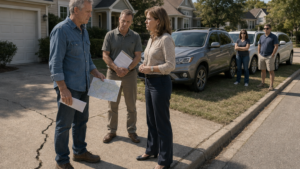
Cold air hit his bare forearms. Beyond the lawn, floodlights washed the pond in white glare. An excavator sat on the HOA walking trail, its tracks pressed into the gravel. Orange mesh had been unrolled across William’s side gate. Two workers in reflective vests stood beside a portable pump, feeding thick hoses toward the water.
A man in a clean navy jacket watched from the trail with a phone in his hand.
“Brandon.”
Brandon Wright looked up. “Morning, William.”
“What is that machine doing over my fence?”
“It isn’t over your fence. The boom is operating inside the drainage easement.”
William walked past the mesh. One worker stepped into his path, then moved aside when William did not slow.
“There is no association easement across my yard.”
Brandon held out a laminated notice. At the top was the HOA logo. Beneath it, in bold letters, were the words EMERGENCY DRAINAGE REMEDIATION.
“The board approved immediate access last night,” Brandon said. “We’ve had three clubhouse floods in two years. The engineer identified your pond as an unauthorized retention feature obstructing the natural flow.”
William stared at him.
“My pond was here before your clubhouse.”
“That doesn’t make it compliant.”
The pump coughed to life.
Water shuddered inside the hose. The pond surface dipped around the intake cage, then drew down in a slow, widening circle.
William stepped toward the controls.
Matthew Nelson, the maintenance supervisor, moved between him and the pump. Matthew’s vest was dirty at the shoulders, and he would not meet William’s eyes.
“Don’t touch it,” Matthew said quietly.
“You know what that pond feeds.”
“I know what the work order says.”
“That wasn’t my question.”
Matthew glanced toward Brandon.
Brandon slipped his phone into his pocket. “William, we offered you a hearing.”
“You scheduled it at ten on a Tuesday.”
“You declined.”
“I said I wouldn’t sit in a clubhouse and ask permission to keep water on land my family owned before your streets had names.”
“That attitude is exactly why we’re here.”
A woman walking a terrier had stopped on the trail. Two teenage residents stood behind her, filming through the fence. Across the pond, upstairs blinds opened one by one.
William saw the scene as they did: an older man in work pants arguing beside machinery, trying to stop an improvement project. Brandon had a printed notice. The workers had reflective vests. William had bare feet inside old boots and no document in his hand.
He lowered his voice.
“Shut the pump down for one hour. I’ll show you the original route.”
Brandon shook his head. “We asked for documentation six months ago.”
“You asked whether the pond had an architectural approval.”
“And you answered with a three-page letter about your father.”
“He built the spillway.”
“There is no spillway on the recorded subdivision plan.”
William looked toward the far bank. The waterline had already dropped two inches, exposing black roots beneath the rushes.
The cottonwoods nearest the pond had been planted by his mother. The oldest leaned toward the water as if listening.
“Where are you sending it?” William asked.
Brandon pointed past the trail.
Beyond the clubhouse, a new basin had been cut into the common green. Its banks were smooth and raw, lined with black synthetic material. A pipe protruded over one side.
A clear stream was pouring into it.
The new basin gleamed under the work lights while William’s pond sank.
“It will be an amenity lake once the drainage work is finished,” Brandon said. “Walking path. Native grasses. Better storm capacity.”
“You’re moving the spring uphill into a plastic hole.”
“We’re redirecting runoff into an engineered basin.”
“That soil won’t hold a full storm.”
“The engineers disagree.”
“Which engineers?”
Brandon’s jaw tightened. “You don’t get to interrogate contractors on an association project.”
William turned toward Matthew. “Did they core the west bank?”
Matthew adjusted one glove.
Brandon answered for him. “All required testing was completed.”
“That isn’t what I asked.”
The excavator operator lowered the bucket beside the pond’s upper channel and began scraping away reeds. Mud rolled over itself in thick folds. Water rushed through the cut and struck the temporary pipe with a hollow metallic sound.
William felt the vibration through the ground.
He crossed to a patch of grass beside the old willow. The workers watched him crouch and brush away dead leaves from a square iron plate almost hidden beneath the turf.
Matthew took one step closer.
“What is that?” Brandon asked.
William cleared the edges with his fingers. A rusted ring sat flat in the center.
“Secondary gate.”
“There’s no gate on our drawings.”
“There’s plenty missing from your drawings.”
He pulled the ring. It did not lift, but the metal answered with a deep sound from underground.
Matthew’s expression changed.
William looked at him. “If you close the upstream valve before this is inspected, the lower channel has nowhere to breathe.”
Brandon laughed once, without humor. “Channels don’t breathe.”
“They do when they’re buried under forty years of houses.”
The woman with the terrier glanced toward the row of homes below the clubhouse.
Brandon noticed.
He walked to William’s fence and fastened the laminated notice to a post with two plastic ties. Then he added a second page.
“Interference with emergency work carries a five-hundred-dollar daily fine,” he said. “Unauthorized removal of association notices is another violation.”
“This is my fence.”
“The fence crosses the work-access zone.”
William looked at the two sheets fluttering against weathered cedar. The HOA seal appeared more official than anything he could say without proof.
Behind him, the pump deepened its rhythm.
The pond surface fell past the first ring of stones.
Susan came down the yard carrying William’s jacket. She did not speak until she reached him.
“You left the door open,” she said.
He took the jacket.
Her eyes moved from the machinery to the bright new basin beyond the trail. “Can they do this?”
“Not if they know what they’re touching.”
“Do they?”
William looked at Matthew, who was studying the hidden plate.
“Not yet.”
By late morning, mud had appeared around the pond’s entire edge. Frogs leaped from the retreating shallows. The intake hose swallowed leaves and made a choking sound. William stayed in the yard, refusing Susan’s coffee and refusing to call anyone.
Brandon left shortly after noon, then returned with the board treasurer and a fresh set of papers.
“Work resumes at six tomorrow,” he said. “The upstream valve will be fully closed at sunrise.”
William stood beside the iron plate.
“You close that valve,” he said, “and whatever is under this pond stops being a pond.”
Brandon folded his arms. “That is the objective.”
“No.” William looked at the sinking water, then toward the lower houses beyond the clubhouse. “It isn’t.”
Brandon gave Matthew the written order before walking away.
Full closure. Six a.m.
Matthew read it twice.
William saw the hesitation in his face, but Matthew folded the page and put it into his vest.
The last sunlight struck the framed photograph through the kitchen window. William’s father stood beside the young pond, one boot on a line of stone that no one outside the Clark family had seen in decades.
By sunrise, the water would be gone.
And whatever his father had buried beneath it would be visible to everyone.
Chapter 2: What the Cracked Mud Revealed
The pond bottom split open just after five in the morning.
William heard the sound from the porch—a low, wet crack followed by the soft collapse of mud. He crossed the yard with a flashlight and found a straight line emerging beneath the drained basin.
Not roots.
Stone.
Flat, hand-set blocks ran from the old willow toward the downhill bank, too even to be natural. Mud slid from their edges in slow ribbons. Between two stones, a rusted iron point rose three inches above the pond floor.
The 1962 photograph lay folded inside William’s jacket pocket.
He had taken it from the kitchen wall without telling Susan.
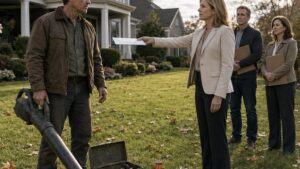
On the trail, contractor lights were already on. Residents gathered behind the temporary barrier, some dressed for work, others in robes and coats. The two teenagers from the day before had returned with their phones.
Brandon stood beside the main valve box.
“You’re early,” he called.
“So are you.”
“The crew needs daylight to finish grading.”
William stepped over the sagging orange mesh and started down the pond bank.
“Stay out of the work area,” Brandon said.
William kept going.
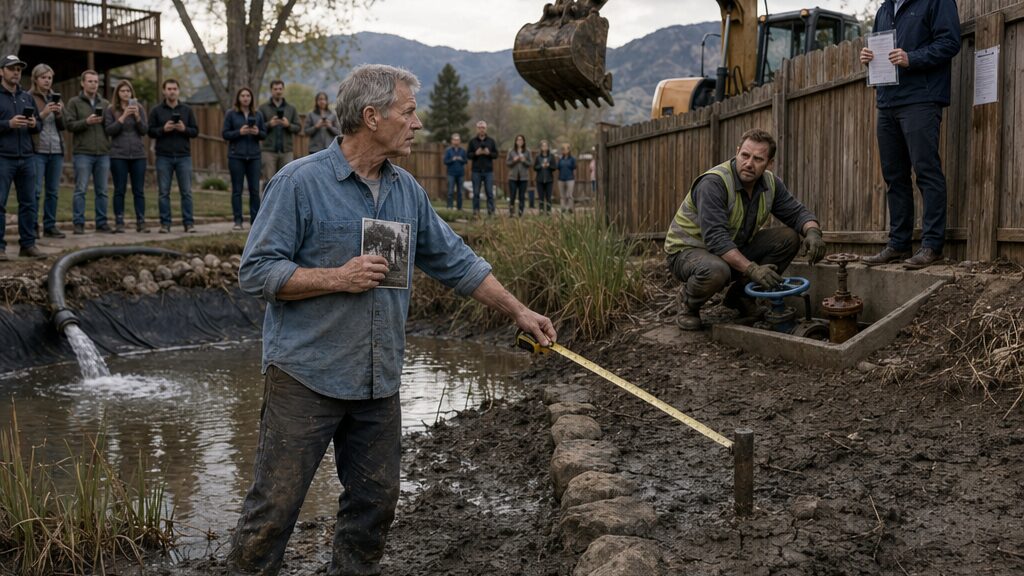
The mud took his boots to the ankles. He moved carefully, using an old steel tape measure as a probe. At the center of the basin, he knelt beside the iron point and scraped away clay.
A round marker emerged, capped with a cross-shaped groove.
Matthew came to the edge of the pond.
“Survey monument?” he asked.
“Control marker.”
“For what?”
William wiped the cap with his sleeve. “For the spillway alignment.”
Brandon climbed halfway down the bank. “There is no recorded spillway.”
William pulled the photograph from his pocket and unfolded it.
The image was creased through the sky. His father stood young and narrow-shouldered beside a row of newly placed stones. Behind him, the cottonwoods were no taller than fence posts. A white paint mark showed on one stone at his boot.
William turned the photograph toward the exposed line.
The same stone was beneath them now, stained gray and missing one corner.
Murmuring moved along the trail.
Brandon took the photograph, looked at it, then handed it back.
“A family photo does not establish a legal drainage structure.”
“No,” William said. “The iron marker does.”
“It establishes a piece of metal in the mud.”
William measured from the marker to the hidden plate near the willow. Then he extended the tape toward the downhill bank.
“Forty-eight feet to the gate. Ninety-six to the split box.”
Matthew looked toward the lower edge. “There’s a box under there?”
“Stone chamber. Two outlets. One runs under the trail. One used to feed the pasture ditch.”
“There’s no pasture ditch.”
“There was before your houses.”
Brandon climbed out of the pond. “We are not reopening a sixty-year-old farm system under a residential subdivision.”
“You already connected to it.”
“We connected to mapped stormwater infrastructure.”
“You connected to the upper spring. That is not the same thing.”
The excavator operator started the engine. Brandon raised one hand, and the machine idled.
“Proceed with closure,” he said.
Matthew did not move.
Brandon turned. “Did you hear me?”
Matthew walked to the valve box and opened the metal cover. Inside, the main wheel was new and painted blue. Beside it, half hidden by gravel, was a smaller rusted stem.
William pointed with the tape measure.
“That’s the secondary.”
Matthew crouched. “This isn’t on the replacement plan.”
“Because they didn’t replace it.”
Brandon came closer. “Close both.”
William climbed out of the pond and stood beside the box.
“You shut the secondary, the next heavy runoff goes east.”
“Toward the basin.”
“No. Past it.”
He pointed beyond the clubhouse.
The subdivision dropped gently toward three streets. The newest homes sat lowest, their finished basements below the elevation of William’s pond.
“The water will cross the clubhouse lot,” William said. “Then it will take Alder Lane, cut behind the mail kiosk, and collect against the retaining walls on Briar Court.”
A man in the crowd lowered his coffee.
Brandon’s face hardened. “You’re trying to frighten residents.”
“I’m telling you where gravity goes.”
“You expect us to believe you can predict a flood from a buried pipe you never disclosed?”
William looked at him for a long moment.
“I worked county irrigation for thirty-two years.”
The crowd quieted.
Brandon blinked. “That doesn’t make you the engineer of record.”
“No. It means I know why my father put a relief gate where the ground falls six feet in two hundred yards.”
Matthew rested one hand on the small valve stem.
Brandon said, “Close it.”
Matthew tightened his grip but did not turn.
“Now.”
William stepped back. He did not touch Matthew or the wheel.
“Your choice,” he said.
Matthew looked toward the lower homes, then toward Brandon.
He turned the main blue wheel until it stopped.
The rush of water in the pipe weakened.
Then Matthew placed a wrench on the rusted secondary stem and rotated it only a quarter turn.
Not closed.
Brandon was watching the excavator operator and did not see.
William did.
The old channel beneath the ground gave a faint gurgle.
It was not enough to restore the pond, but it was enough to keep the buried line open.
A small, private decision passed between William and Matthew without either acknowledging it.
Brandon turned back. “Done?”
“Main flow is shut,” Matthew said.
That answer was true.
It was not complete.
The excavator moved into position. Its bucket scraped the upper bank, tearing out the last reeds. Mud slumped from the exposed stone channel. A child-sized turtle shell rolled free, empty and sun-bleached.
Someone on the trail said, “He really had a whole drainage thing under there.”
Another voice answered, “Then why didn’t he tell anybody?”
William heard both.
The first gave him a brief, bitter satisfaction. The second landed harder.
Brandon heard it too.
He faced the residents. “This is precisely the problem. Mr. Clark has been aware of unapproved infrastructure beneath association-adjacent property and has refused repeated requests for records.”
William climbed the bank.
“You asked for landscaping approvals.”
“We asked for all documentation.”
“You sent form letters.”
“And you ignored them.”
A few residents nodded.
The uneasiness that had moved toward William shifted again. He saw how easily buried history could look like concealed danger.
Brandon stepped closer.
“Did you know that structure was there?”
“Yes.”
“Did you disclose it?”
“No.”
“Why not?”
William folded the photograph and put it back into his pocket.
“Because it wasn’t yours.”
The answer sounded weaker once spoken aloud.
Brandon saw it.
“You interfered with an emergency drainage project,” he said. “You entered a restricted work zone and directed association personnel against an approved plan. I’m documenting all of it.”
“I didn’t direct him.”
“You issued warnings in front of residents to undermine the board.”
“I told you where the water goes.”
“You made claims without plans, permits, or recorded engineering.”
William pointed toward the marker. “There’s your record.”
“There is a piece of iron and a photograph.”
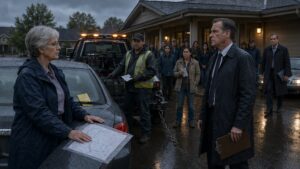
A white municipal truck turned onto the trail access road.
The stormwater inspector stepped out carrying a rolled set of plans under one arm. Brandon’s expression relaxed as if authority had finally arrived on his side.
The inspector surveyed the pond, the exposed stones, and the crowd.
“Who is Mr. Clark?”
William raised a hand.
The inspector approached him. “I reviewed the current subdivision drainage map after yesterday’s complaint.”
Brandon nodded toward the basin. “Then you can confirm the pond is not part of the approved system.”
The inspector unrolled the plans across the hood of the truck.
Roads, lots, catch basins, and the clubhouse were drawn in clean blue lines.
William’s house appeared near the edge.
Behind it was empty paper.
No pond.
No spillway.
No secondary gate.
No channel beneath the trail.
The inspector tapped the blank space.
“According to the city file,” he said, “none of what we’re standing beside exists.”
Chapter 3: The Records His Father Never Filed
The certified lien notice arrived before breakfast.
Susan signed for it at the door and carried the envelope into the kitchen without opening it. She placed it beside William’s coffee, exactly where she usually left the morning paper.
He recognized the HOA attorney’s return address.
“You knew this was coming,” she said.
“I knew they’d threaten it.”
“This isn’t a threat.”
William cut the envelope with a butter knife.
The association claimed emergency-access violations, interference with contracted work, unpaid daily fines, and legal review costs. The total was already over six thousand dollars. A final paragraph warned that continued nonpayment could result in a lien against the property.
Susan read over his shoulder.
“They can’t take the house over a pond.”
“They can attach debt to it.”
“That is not the answer I needed.”
William folded the notice once and set it beside his cup.
Susan remained standing.
“What did the inspector say after I went inside?”
“That the city map shows nothing.”
“And the stones?”
“He photographed them.”
“And Brandon?”
“Talked.”
“Of course he did.”
William pushed his chair back.
Susan took the lien notice before he could pick it up. “You are not going outside to stare at mud.”
“I’m going to the county records office.”
“Good.”
He looked at her, surprised.
She crossed to the hall cabinet and opened the bottom drawer.
For years, William had believed the old family papers were stored in a single metal box in his workshop. Susan pulled out a thick manila envelope, its corners soft with age.
On the front, in his father’s handwriting, were the words POND—ORIGINAL.
“You had that?”
“You told me the workshop box had everything.”
“That doesn’t answer me.”
“You told me to throw out the rest when we cleaned the spare room.”
William remembered the day. They had filled the truck with broken lamps, school binders, old tax returns, and boxes that smelled of dust. He had been impatient. Susan had asked him twice which papers mattered.
He had said, If Dad wanted them kept, he would have filed them properly.
Susan opened the envelope.
The 1962 photograph was inside, along with two pages of handwritten measurements, a faded material receipt, and a narrow strip of tracing paper marked with lines and arrows.
William touched the photograph.
The copy in his pocket had been taken from the frame. This was the original, sharper and less faded. His father stood beside the spillway with the shovel angled across his body. At the far edge of the picture, almost outside the frame, a white post carried a small metal plate.
Susan laid the tracing paper over the photograph.
The arrows matched the stone line.
“You knew about this?” she asked.
“Not the overlay.”
“You knew there were plans.”
“I knew Dad made notes.”
“Where are the rest?”
William looked at the lien notice.
“I don’t know.”
The county records office occupied the lower floor of an old government building twenty minutes away. William carried the envelope under one arm and refused Susan’s offer to come with him.
The records clerk listened without interrupting while he explained the pond, the original property, and the subdivision built around it. She searched by parcel number, then by his father’s surname, then by the name of the irrigation company listed on the receipt.
Nothing appeared.
William watched the cursor blink.
“Try 1962,” he said.
“That is not how the index works.”
“Try the drainage district.”
The clerk sighed, but opened a scanned ledger arranged by year.
Pages passed in gray columns. Deeds. Utility reservations. Road access. Agricultural transfers.
Then she stopped.
A handwritten entry crossed one line:
Clark Parcel—drainage and irrigation easement—Book 418.
The clerk clicked the book reference.
A typed index page appeared. It listed an easement benefiting the Clark parcel and “successor residential drainage lands.” An attachment was referenced as Exhibit B.
The digital file ended at Exhibit A.
“Where is B?” William asked.
“It may not have been scanned.”
“Can you pull the book?”
“If the original volume is still here.”
She disappeared through a secured door.
William sat beneath fluorescent lights with the envelope on his knees. Across from him, a young couple whispered over a property transfer form. He wondered how many decisions that looked permanent were supported by paper no one had bothered to preserve.
The clerk returned carrying a wide bound volume.
The binding cracked when she opened it.
Exhibit A was there.
Exhibit B was not.
A narrow stub remained between two pages where something had once been attached.
“Removed?” William asked.
“Possibly separated before archiving. Possibly filed with an engineering packet.”
“Where would that be?”
“County public works, if it survived.”
The clerk printed the index page and stamped it.
“This proves an easement was recorded,” she said. “It does not prove the exact route.”
William placed the 1962 photograph beside the printout.
The white post in the photograph carried numbers too small to read with the naked eye. The index page listed a survey reference.
The numbers appeared to match.
For the first time since the pump started, William felt the ground shift slightly in his favor.
Nicole Perez’s office was above a pharmacy in town. She examined the lien, the stamped index, the photograph, and the tracing paper without speaking.
When she finished, she placed the HOA notice on one side of her desk and the 1962 materials on the other.
“The association has a problem,” she said.
William waited.
“If this easement serves successor drainage lands, the HOA cannot simply classify your pond as private landscaping. At minimum, they had a duty to investigate before altering the system.”
“So we stop them.”
“We may get an injunction.”
“And remove the lien.”
“Eventually.”
William frowned. “Eventually?”
Nicole tapped the tracing paper. “This is persuasive. It is not complete. We need the missing exhibit, maintenance records, city correspondence, and every notice exchanged between you and the association.”
“They sent forms.”
“You answered them?”
“Some.”
“All?”
“No.”
“Did they ever ask about drainage maintenance?”
William looked toward the window.
Nicole watched him for several seconds. “Mr. Clark.”
“The old board sent letters.”
“How old?”
“Eight years. Maybe nine.”
“What did they ask?”
“They wanted access to inspect the lower channel.”
“Did you allow it?”
“No.”
“Why?”
“They came onto my property without calling. One of them said my father had built a mosquito pit and left the neighborhood to deal with it.”
Nicole leaned back.
“What happened after that?”
“I told them the pond was mine and they were not to cross the fence again.”
“And the letters?”
“I kept the first few.”
“Where are they?”
“I threw them out.”
Nicole’s expression did not change, which made the silence worse.
“Were you responsible for maintaining any part of the system?” she asked.
“My father maintained it.”
“That was not my question.”
William’s hand tightened around the edge of the chair.
“There was a sediment gate,” he said.
“The iron plate near the willow?”
“Yes.”
“What did it do?”
“Caught silt before the lower channel.”
“How often did it need clearing?”
“Every few years. Depending on runoff.”
“When was the last time you cleared it?”
William saw his father in the photograph, one boot braced beside the stones, shovel blade dark with wet earth. He remembered standing nearby as a boy, annoyed by mosquitoes and the smell of mud, while his father told him that water always collected the bill eventually.
Nicole waited.
William looked at the stamped easement index, the missing attachment, and the lien notice threatening his home.
Then she asked the question he had been avoiding since the pond began to drain.
“Mr. Clark, did you ever close that sediment gate yourself?”
Chapter 4: The Flooding Brandon Was Trying to Stop
The water stains reached nearly to William’s shoulder.
They ran around the clubhouse basement in uneven brown bands, crossing painted drywall, electrical conduit, and the metal legs of folded banquet tables stacked against one wall. A dehumidifier rattled in the corner, but the room still smelled of wet carpet and bleach.
William stood beneath the highest mark while Nicole photographed it.
“This was the last storm?” he asked.
Brandon Wright closed the basement door behind them. “The worst of three.”
The board treasurer remained near the stairs with a binder pressed to her chest. Matthew stood beside the sump pit, studying the floor rather than anyone’s face.
William touched the dried edge of the stain. It flaked under his thumb.
“You had five feet of water down here?”
“Four feet, eight inches,” Brandon said. “The mechanical room took the rest.”
A door at the far end had been removed from its hinges. Through the opening, William could see two new pumps, both mounted above the old flood line.
Nicole lowered her phone. “Why wasn’t this disclosed in the emergency notice?”
“It was summarized.”
“You wrote ‘localized drainage intrusion.’”
“That is what our counsel approved.”
William looked at Brandon. “You called this localized?”
“I called it expensive.”
Brandon opened the binder the treasurer handed him. Inside were photographs of soaked walls, warped flooring, and a maintenance crew carrying ruined furniture through standing water.
“The first flood cost sixty-eight thousand dollars,” Brandon said. “The second was less because we moved equipment upstairs. The third triggered an insurance review.”
He turned to a letter clipped behind the photographs.
“Our carrier gave us until the end of this month to demonstrate corrective action. If they cancel, every homeowner pays more. Some owners may lose mortgage compliance. That is not a theoretical problem.”
William looked again at the stains.
He had imagined Brandon wanting the new basin because it would look good in brochures and raise property values. That had been part of it; Brandon had said so himself. But the ruined basement was not a rendering. The smell was real. The pumps were real. So were the homeowners whose dues would absorb another failure.
“Where did the water enter?” William asked.
Matthew pointed to the west foundation wall. “Backed through the old storm line, then came under the utility door.”
“During peak runoff?”
“About twenty minutes after.”
“And the upper spring?”
“Running hard.”
William crouched near the sump pit. A thin mineral line marked the concrete around the drain.
“The spring didn’t cause all of this,” he said.
Brandon’s mouth tightened. “Our engineer said it contributed.”
“It contributed because the lower release wasn’t carrying flow.”
“Which brings us back to your pond.”
“No. It brings us back to maintenance.”
The word settled in the room.
Nicole watched William. “Whose maintenance?”
He stood slowly.
Brandon closed the binder. “That is what we have been trying to determine for years.”
William turned toward Matthew. “Did anyone inspect the sediment gate before designing the basin?”
Matthew hesitated.
Brandon answered. “We were denied access.”
“You could have filed for it.”
“We sent notices.”
“You sent compliance letters that called the pond an unapproved feature.”
“Because you would not provide records proving otherwise.”
William felt Nicole’s attention shift toward him.
Brandon continued, quieter now. “Every time the board asked a question, you treated it as an insult. Every time we proposed an inspection, you said the property predated the association and told us to stay off it.”
“My father built that system.”
“That did not answer who was maintaining it.”
William looked at the floor.
The old board had first asked to inspect the lower gate nine years earlier. The request had arrived after two members entered his yard without notice and photographed the pond from beneath the willow. One of them had joked that his father had left the neighborhood a mosquito pit.
William had ordered them out.
The next letter requested access again. He ignored it.
A third warned that the lower channel might be obstructed. He wrote back that the association had no authority over private property.
After that, the letters became more formal and his replies became shorter. Eventually, he stopped replying at all.
“How often did your father clear the sediment gate?” Nicole asked.
William studied the flood line on the wall.
“Every three years,” he said. “Sometimes two.”
“When did you last clear it?”
“Eleven years ago.”
The treasurer let out a breath.
Brandon did not smile. That made the admission worse.
Matthew looked up. “That would explain the back pressure.”
“It would explain part of it,” William said.
Nicole’s voice remained even. “Why did you stop?”
William rubbed dried paint dust from his thumb.
“Because I was tired of people who had never touched a ditch telling me what my father built wrong.”
“That is not a maintenance reason,” she said.
“No.”
Brandon opened the binder again and removed a photograph. It showed water pushing through the clubhouse utility door in a flat brown sheet.
“My board inherited this,” he said. “Homeowners wanted repairs without higher dues. The insurer wanted a permanent solution. The city plans showed no pond, no shared easement, and no functional channel through your lot. We had one homeowner refusing access and one documented source of runoff above us.”
“So you moved the water.”
“We acted on the information available.”
“You acted before you had final approval.”
Brandon’s eyes shifted toward Nicole.
She noticed.
“What final approval?” she asked.
Brandon looked at the treasurer, but she was staring at the binder.
Nicole took one step closer. “The municipal inspector said the basin alteration required a completed geotechnical review. Was it completed?”
“The contractor submitted testing.”
“That is not the same answer.”
Matthew’s shoulders tightened.
William saw it.
“West bank core,” he said.
No one spoke.
He remembered asking about it beside the draining pond. Matthew had looked away then too.
Nicole turned to him. “What is the west bank core?”
“The new basin was cut into fill dirt,” William said. “That side needs testing before it holds pressure.”
Brandon closed the binder. “The test was performed.”
“And passed?” Nicole asked.
Brandon’s pause lasted less than a second.
It was enough.
The executive session began upstairs thirty minutes later.
The board sat at one end of a long table. William and Nicole sat opposite Brandon and the association attorney. Matthew occupied a chair near the wall, officially present to answer maintenance questions.
The association attorney argued that William’s refusal to maintain or disclose the old system had created an emergency. Nicole answered that the HOA had altered a recorded drainage corridor without locating the easement or confirming the new basin’s stability.
Neither side disputed the clubhouse flooding anymore.
That changed the room. William was no longer simply the man whose pond had been taken. Brandon was no longer simply the man who had taken it.
They had each guarded a version of the truth until water found the gaps between them.
Halfway through the meeting, Nicole’s phone vibrated.
She checked the screen, then stood.
“I need five minutes.”
The association attorney objected, but she was already in the hallway.
When she returned, she carried a printed email forwarded by the municipal stormwater inspector.
“This was attached to the contractor’s preliminary submission,” she said.
Brandon did not reach for it.
Nicole laid the page in front of him.
The geotechnical summary listed unstable compaction along the basin’s west bank and recommended additional reinforcement before full storage.
At the bottom, stamped in red, were the words NOT APPROVED FOR FINAL IMPOUNDMENT.
The board treasurer stared at Brandon.
“You told us the testing was complete.”
“It was preliminary,” Brandon said.
“You said it passed.”
“I said corrective work was included in the construction schedule.”
Matthew spoke from the wall. “It wasn’t.”
Everyone turned.
He swallowed. “They told us to fill first and reinforce after the liner settled.”
Brandon’s face went still. “That is not an accurate characterization.”
“It’s what the site supervisor said.”
The association attorney asked for a recess.
Nicole folded the failed test into her file.
William should have felt vindicated. Instead he pictured the cracked pond, the blocked sediment gate, and five feet of dirty water against the basement wall.
Brandon had hidden a failed test.
William had hidden a neglected system.
Outside the clubhouse windows, clouds were building over the foothills.
The municipal stormwater inspector entered without knocking. He carried a tablet and spoke directly to the board.
“The weather service has upgraded the weekend forecast,” he said. “Severe thunderstorm system. High runoff potential. Earliest arrival Friday night.”
Matthew looked toward William.
The old pond could no longer hold water. The new basin had never been approved to hold it.
And the storm was coming for both.
Chapter 5: The Injunction That Solved Nothing
The judge stopped the construction and left the danger exactly where it was.
“No further excavation, pumping, filling, grading, or valve alteration,” she said from the bench. “The existing condition is to remain undisturbed pending inspection.”
Nicole rose. “Your Honor, the existing condition includes an unstable basin and a dewatered historic drainage feature.”
“I understand.”
“We are asking for limited restoration of the original flow.”
“And opposing counsel argues that restoration may reactivate an unverified and poorly maintained system beneath occupied homes.”
The judge looked over her glasses at both tables.
“I am not choosing between two unproven drainage configurations hours before a major storm. The city may take emergency action if public safety requires it. The parties may not.”
The gavel never struck. The ruling simply landed.
Outside the courthouse, reporters were absent, and no residents waited to cheer. Susan stood beneath the overhang with two paper cups of coffee while rain-dark clouds gathered beyond the municipal building.
“Well?” she asked.
Nicole answered first. “We got the injunction.”
Susan looked at William. “Then why do you both look like that?”
“Because nothing moves,” he said.
“The pond?”
“Stays empty.”
“The new lake?”
“Stays full enough to be a problem.”
Susan handed him a cup. He took it, but did not drink.
Brandon emerged with the association attorney and walked past without speaking. At the curb, he stopped and looked back.
“We need access to the bypass,” he said.
Nicole stepped between them. “Any request goes through counsel.”
“This isn’t a litigation request.”
“It became one when you filed a lien.”
“The storm does not care about the lien.”
William looked at him. “Neither did you when you closed the valve.”
Brandon’s expression tightened. “If the basin overtops, we need the original release path.”
“You said it did not exist.”
“I was wrong about that.”
The admission was quiet and incomplete, but William heard the effort it cost.
“You don’t know whether it works,” William said.
“Neither do you.”
William did not answer.
By noon, the city had placed temporary barriers around the clubhouse basin. Sandbags lined the west bank where the failed soil test had identified weak compaction. The water inside sat several feet below the top, dark and unnaturally still beneath the black liner.
Matthew met William near the trail.
He had removed his reflective vest and wore an old canvas jacket instead. Without the HOA logo, he looked less like an enforcer and more like a tired maintenance man who had been sleeping badly.
“You need to see something,” he said.
William followed him along the basin’s west edge.
At first he saw only wet soil beneath the sandbags. Then Matthew pointed to a thin line in the exposed clay.
A crack ran six feet from the lip toward the liner.
“Wasn’t there yesterday,” Matthew said.
William crouched and pressed two fingers beside it. The soil shifted softly.
“Water getting behind the liner.”
“That’s what I thought.”
“How high did they fill it before the injunction?”
“About sixty percent.”
“And with runoff?”
Matthew looked toward the foothills. “Depends how fast it comes.”
“It always depends how fast.”
Matthew lowered his voice. “The temporary overflow pipe drains toward the parking lot.”
William straightened. “Not the lower storm inlet?”
“Pipe elevation is too high. Once the west bank saturates, it will sheet over.”
“Toward Alder Lane.”
Matthew nodded.
William walked to the basin outlet and studied the grade. Brandon’s project had been designed to collect water quickly, but its safe release depended on reinforcement that had never been completed.
The old pond had worked differently. It spread the load across reeds, stone, mud, and time. It was not elegant. It leaked. It required clearing. But it gave water places to slow down.
A folded copy of the 1962 photograph was in William’s coat pocket. He took it out and held it against the landscape.
In the picture, his father stood where the drained pond wall now lay exposed. The shovel crossed his body at an angle. Behind him, the white survey post aligned with a low break in the stone bank.
William had always assumed the break was unfinished work.
Now he wondered whether it marked the buried manual release.
“Matthew,” he said, “when you closed the main valve, how far did you turn the secondary?”
Matthew glanced toward the clubhouse.
“Quarter turn.”
“So it’s still breathing.”
“I thought you knew what you were talking about.”
“That could have cost you your job.”
“It still might.”
“Why didn’t you tell Brandon?”
“I told him the old line mattered. Twice. He said the engineer had accounted for it.”
Matthew rubbed his hands together against the cold.
“I’ve worked here eleven years. I have a daughter in college and a mortgage that doesn’t care whether the board is right. So I left the valve cracked and kept my mouth shut.”
William folded the photograph.
“You should have spoken.”
Matthew gave him a tired look. “So should you.”
The words struck cleanly because there was no anger behind them.
Brandon approached from the parking lot carrying rolled plans. He stopped when he saw the crack.
“It’s longer,” he said.
“You knew about it?” William asked.
“Since this morning.”
“And?”
“I asked the contractor for emergency reinforcement. The injunction prevents them from working.”
“The city can authorize it.”
“The city wants a full assessment first.”
William looked at the sky. “You don’t have time.”
“No.”
Brandon unrolled the plans across the hood of a maintenance cart. His hands shook slightly in the wind.
“The insurer’s deadline is Monday,” he said. “If we had not begun corrective work, coverage would have been suspended.”
“So you filled a basin that failed testing.”
“I believed the reinforcement could be completed before full storage.”
“You believed a schedule.”
“I believed we were one storm away from losing the clubhouse again.”
William studied him.
Brandon’s jacket was still clean, but there was mud on his shoes now. His phone remained in his pocket.
“I should have disclosed the preliminary failure,” Brandon said. “I thought if the board saw another delay, they would kill the project and blame me for the next flood.”
“They might have.”
“They already blamed me for the last one.”
“That doesn’t make the bank stronger.”
“No.”
For a moment, neither man defended himself.
Then Brandon tapped the old route shown faintly on Nicole’s reconstructed sketch.
“We need access to your lower gate.”
“You need a court order.”
“I need you to stop hiding behind the same process you accused me of abusing.”
William felt heat rise beneath his collar.
“That gate sits on my land.”
“And the water does not stay there.”
“You had no trouble pretending it did when you drained the pond.”
“I am not pretending now.”
Brandon stepped closer.
“If the basin fails, those homes take the water. If your old bypass can carry even part of it, we need it open.”
“Your people are not touching that gate.”
“Then you open it.”
William looked toward his property. The workshop roof showed beyond the cottonwoods. Inside, hanging on a nail behind the tool cabinet, was the long iron key his father had used on the sediment gate.
He had not turned it in eleven years.
“I don’t know what condition it’s in,” he said.
“Then let us inspect it.”
“No.”
Matthew stared at him.
Brandon’s voice lowered. “Is this about safety or ownership?”
“You do not get to ask me that.”
“I am asking anyway.”
William rolled the plans and shoved them back across the cart.
“No one enters my yard.”
He walked away before either man could answer.
At home, Susan was spreading documents across the kitchen table. The original photograph rested beside the easement index and the lien notice.
“You said no,” she guessed.
“They want access without knowing what they’re doing.”
“Do you know?”
William removed his wet coat.
“I know more than they do.”
“That was not my question.”
He looked toward the workshop through the window.
The first drops struck the glass, wide and widely spaced.
Susan followed his gaze.
“Where is the key?”
“In the shop.”
“And the gate?”
“Under the willow.”
“Does it work?”
William did not answer.
The rain thickened, tapping the roof and darkening the drained pond outside. Water began collecting in the straight channel of exposed stones.
On the far side of the trail, the new basin waited behind its sandbags.
The original bypass key remained locked in William’s workshop, and he alone had the key to that door.
Chapter 6: The Gate Beneath the Rising Water
Water crossed the clubhouse parking lot at 11:17 that night.
It came first as a bright sheet beneath the security lamps, sliding over painted spaces and curling around the wheels of abandoned maintenance carts. Then the west edge of the basin slumped, and the sheet became a brown current carrying mulch, branches, and two orange barriers toward Alder Lane.
William saw it from his upstairs window.
His phone was already ringing.
Susan sat up beside him. “Who is it?”
He did not need to look.
Brandon’s name glowed on the screen.
William let it ring once more before answering.
“The bank is going,” Brandon said. Rain hammered his words into fragments. “The city crew is twenty minutes out. We need the bypass.”
William looked toward the workshop. Lightning flashed behind the cottonwoods, showing the drained pond half full again—not with spring water, but with muddy runoff trapped above the blocked lower channel.
“I’m coming.”
He dressed without turning on the light.
Susan followed him downstairs. At the back door, she handed him the original 1962 photograph inside a clear kitchen bag.
“You left it on the table,” she said.
“I don’t need a picture.”
“You have spent three days looking at it.”
He put it inside his jacket.
The yard was already ankle-deep in places. Rain struck the pond hard enough to flatten the surface. The old stone spillway disappeared beneath churning brown water.
William unlocked the workshop.
The iron bypass key hung where it had hung since his father died: five feet long, flattened at one end, with a square socket at the other. Rust coated the shaft, but the grip marks were still visible beneath it.
He lifted it from the wall.
For a second, he remembered his father’s last clear instruction about the pond.
Don’t let the subdivision take it from you.
William had treated the words as a boundary.
Now water was crossing every boundary in sight.
Matthew reached the side gate in a yellow rain jacket.
“The west bank’s overtopping,” he shouted. “Brandon is moving people off Alder.”
“Secondary channel?”
“Still open, but not taking enough.”
“Main gate?”
“Locked under pressure.”
William handed him a shovel and carried the iron key toward the willow.
The pond edge no longer existed. Water had risen across the lawn and covered the hidden iron plate. William probed with one boot until he found the concrete rim beneath the current.
“Help me clear it.”
They dug by feel. Mud filled each hole as quickly as they opened it. Matthew drove the shovel beside the plate while William worked his fingers under the rusted ring.
Together they lifted.
The iron cover rose six inches, then jammed against packed silt.
A foul smell escaped from below.
William pushed the bypass key into the opening. The socket struck stone.
“Gate stem should be three feet down,” he said.
“Should be?”
“My father changed the chamber after the photograph.”
Matthew stared through the rain. “You never opened it after?”
“Not this release.”
Another surge entered the pond from the upper channel. Water climbed above William’s knees.
Headlights swept across the yard.
Brandon arrived with the board treasurer and two residents carrying sandbags. He had no umbrella and no phone in his hand.
“Alder Lane is under six inches,” he said. “Briar Court has started moving cars.”
“Get everyone off the lower trail,” William said.
Brandon began to answer.
William cut him off. “Do it.”
Brandon turned immediately to the residents. “Clear the trail. Then stack bags along the mail kiosk, not the clubhouse.”
The absence of argument unsettled William more than resistance would have.
Matthew forced the cover higher. William reached into the chamber with the iron key and swept the bottom.
Metal struck metal.
“There.”
He fitted the square socket over the buried stem and pulled.
Nothing moved.
He changed his grip and leaned his weight into it. The shaft bowed slightly.
“Seized,” Matthew said.
“Silt gate’s loaded.”
“Can we flush it from above?”
“Not with the pond wall holding this pressure.”
Lightning lit the yard.
In the white flash, William saw the 1962 photograph inside his jacket as clearly as if it were framed on the kitchen wall. His father’s shovel was angled across his body. The blade pointed not toward the gate chamber, but toward the low break in the stone spillway.
William pulled out the bagged photograph.
“What are you doing?” Matthew shouted.
William held it beside the flooded landscape.
The young cottonwoods in the picture aligned with the old trunks. The survey post aligned with the iron marker. His father’s shovel pointed six feet left of the chamber.
Not at the gate.
At the manual release.
“Move,” William said.
He waded through the pond toward the exposed stone line, though it was no longer exposed. With the photograph held against his chest, he counted the stones beneath the water using his boots.
One. Two. Three.
The fourth dropped lower.
He drove the shovel into the mud beside it.
The blade struck iron.
Matthew joined him. Together they cleared a narrow slot where two stones met. Beneath it lay a horizontal bar packed in clay.
William remembered kneeling there as a boy while his father explained that the release was never to be used unless the lower homes were in danger.
There had been no lower homes then.
Only pasture.
Brandon splashed toward them.
“The parking lot current is getting stronger.”
“Go to the valve box,” William said. “When I tell you, open the secondary all the way.”
Matthew looked at him. “The stem could shear.”
“If it does, we lose the line.”
“And if it holds?”
William looked toward the pond wall separating his yard from the lower channel.
“If it holds, this wall goes.”
The wall was the oldest part of the pond. His father had built it from stone and clay, compacting each layer by hand. The cottonwoods depended on the water it retained. Once the release opened under full pressure, the current would tear through the weak western seam and scour the pond into the bypass.
The lower homes might be spared.
The pond would not.
Brandon understood.
“Is there another way?”
“Not before Alder floods.”
William wrapped both hands around the horizontal bar.
Brandon did not question him again. He ran toward the valve box.
Matthew wedged the shovel beneath the bar. “On three?”
“No. When the channel opens.”
They pulled.
The bar moved half an inch.
Mud sucked around it.
William reset his boots and pulled again. Pain shot through his shoulder. The bar rose another inch, and water began threading through the slot with a thin whistle.
At the valve box, Brandon shouted, “Ready.”
William looked at the dark outline of his house. Susan stood on the porch beneath the light, one hand gripping the railing.
His father’s promise pressed against him harder than the rain.
Don’t let the subdivision take it from you.
For years, William had believed keeping the pond meant keeping everyone else out. He had refused inspections, withheld plans, and let the sediment gate choke rather than allow people he distrusted to claim authority over it.
Now the pond was holding water that belonged nowhere and threatened everyone downhill.
“Open it,” he shouted.
Brandon and the board treasurer turned the secondary wheel.
The buried line groaned.
Matthew’s shovel jerked downward as pressure pulled at the release bar.
“Again,” William said.
They lifted together.
The bar tore free.
Water vanished beneath them.
For one suspended second, the pond surface folded inward around the opening. Then the manual release took hold with a roar that drowned the storm.
The current struck the buried chamber, rushed through the secondary line, and burst from the lower outlet beyond the trail. Water spread into the old drainage swale, bending grass flat as it moved away from Alder Lane.
Brandon shouted something William could not hear.
The pond wall trembled.
A crack opened along the western seam.
Matthew grabbed William’s arm. “Move!”
William did not.
The crack widened through the clay his father had packed sixty years earlier. Water cut into it, carrying stones the size of dinner plates. One cottonwood root lifted from the bank.
William watched the wall begin to fail.
He could still stop part of it. The release bar could be dropped back into place before the breach widened. It might save the pond wall long enough for the city crew to arrive.
It would also send the water back toward the parking lot.
Matthew saw him looking at the bar.
“William.”
Behind the clubhouse, a vehicle horn sounded repeatedly. Residents were moving cars from Briar Court. Porch lights burned through the rain.
William let go of the bar.
“Leave it open.”
They climbed toward higher ground.
The pond wall collapsed behind them.
The sound was not an explosion. It was a deep, rolling surrender as stone, roots, and clay gave way together. Water rushed through the break and entered the reopened corridor.
The current across the clubhouse lot weakened within minutes.
Brandon returned from the valve box soaked and breathing hard.
“Alder is dropping,” he said. “Briar never reached the first foundations.”
William looked back at the pond.
Half the western wall was gone. The water level fell rapidly, exposing the old spillway a second time. One cottonwood leaned at a new angle, its roots hanging in the current.
The 1962 photograph had slipped from William’s jacket.
Susan found it caught against the porch step inside its plastic bag. She carried it to him and placed it in his muddy hand.
In the photograph, the pond wall was new and unbroken. His father stood beside it with the shovel, proud of what he had made.
William looked from the picture to the breach.
Brandon stood a few feet away, waiting as if there might be an order left to follow.
William folded the photograph carefully.
“The city crew will need the lower route marked before daylight,” he said.
Brandon nodded. “Tell me where.”
For the first time, William did.
By dawn, the flood had turned away from the occupied homes.
The pond that had protected them was no longer whole.
Chapter 7: The Pond They Could No Longer Call Private
William entered the HOA meeting carrying the original photograph instead of a demand letter.
The room noticed.
Six weeks earlier, most residents had seen him ankle-deep in mud, arguing beside an excavator while his pond drained. Now they watched him cross the clubhouse floor in a clean work shirt, the black-and-white picture held flat between both hands.
The repaired basement smelled of fresh paint. The old flood line had been covered, but one discolored strip remained visible near the utility door where the contractor had not yet replaced the trim.
Nicole Perez sat at the end of the board table with three folders arranged before her. Susan took a seat in the front row. Matthew stood beside a newly printed drainage map mounted on an easel.
Brandon Wright sat with the board members rather than at the center.
The treasurer opened the meeting.
“Tonight’s agenda is limited to the Clark drainage easement, storm remediation, project accountability, and the proposed maintenance agreement.”
No one applauded. William was grateful for that.
The treasurer reviewed the settlement terms in a careful voice. The association would withdraw the lien and all related fines. It would reimburse William and Susan for damaged landscaping, emergency legal expenses, and the cost of stabilizing the cottonwoods. The failed amenity-lake design would be abandoned. The basin would remain, but only as a shallow stormwater feature with reinforced banks and no permanent impoundment.
The association’s insurer and contractor would divide most of the repair costs. Homeowners would still face a smaller special assessment for improvements that had been deferred before Brandon’s project began.
A man in the second row raised his hand.
“So we still pay?”
“Yes,” the treasurer said. “The clubhouse flooding was not created by one decision or one person.”
The room shifted.
That sentence had been negotiated as carefully as any dollar amount.
Nicole opened the first folder.
“The county located a public-works survey referenced by the 1962 easement,” she said. “It confirms that the original pond, spillway, sediment chamber, and lower channel formed one drainage system.”
Matthew pointed to the map.
A blue line began at the upper spring, crossed William’s property, widened at the pond, then divided beneath the walking trail. One branch entered the old pasture route. The other followed the lower grade where Alder Lane and Briar Court now stood.
“The easement protects the function of the corridor,” Nicole continued. “It does not grant the association ownership of the Clark property. It also does not give the Clark family exclusive control over infrastructure serving downstream land.”
William felt several residents look toward him.
Six weeks ago, he would have heard accusation in that silence.
Now he heard the plain weight of the finding.
The pond had never been only his.
The fact did not make the loss smaller. It made his father’s work larger.
The treasurer turned to Brandon.
He stood slowly.
A folded statement lay in front of him, but he did not pick it up.
“I authorized the diversion before final geotechnical approval,” he said. “I also failed to provide the board with the preliminary soil report showing that the west bank required reinforcement before storage.”
No one moved.
“I believed the contractor could complete the work before another flood. I believed delaying the project would put insurance coverage at risk and leave the clubhouse exposed.”
He looked toward the discolored trim near the utility door.
“Those concerns were real. What I did with them was wrong.”
The board’s association attorney sat against the wall, expressionless.
Brandon continued.
“I treated incomplete information as permission to move faster. When the test raised problems, I withheld it because I thought another delay would end the project and my position with it.”
He faced William.
“I also assumed your refusal to cooperate meant you had nothing worth hearing.”
William held his gaze.
“You assumed wrong.”
“Yes.”
The admission did not restore the pond wall. It did not revive the damaged roots beneath the oldest cottonwood. It did not erase the image of clear water pouring into a plastic-lined basin while William’s yard turned to mud.
But it was specific.
That mattered.
Brandon stepped away from the table. Under the proposed governance terms, he would remain on the HOA board until the next election but would hold no authority over construction, drainage, or contractor procurement. The city would review all future stormwater work.
There was no public expulsion. No handcuffs. No sudden collapse of the association.
Only limits, written down where everyone could see them.
Matthew uncovered the second easel.
It held a maintenance schedule.
The association would inspect the common downstream channel twice each year. William’s sediment gate would be cleared every third spring or after any runoff event above the listed threshold. No one could enter the Clark property without notice except during a documented emergency.
Beside William’s name was a blank signature line.
Nicole slid the agreement toward him.
Susan watched without urging him.
William read the clause he had objected to most:
The property owner shall provide scheduled access to designated association maintenance personnel for inspection and operation of shared drainage infrastructure.
His father’s promise returned to him, quieter now.
Don’t let the subdivision take it from you.
William had spent years protecting the wrong part of the sentence. The subdivision could not take the land. It could not rewrite who had built the pond. But neither could he use memory as a locked gate against everyone living downhill.
He signed.
Matthew signed beneath him.
The treasurer signed for the association.
Then William stood and carried the photograph to the drainage map.
The image had been cleaned and mounted behind protective glass. His father stood beside the new spillway, shovel across his body, with bare pasture behind him and no houses in sight.
William placed it on the easel.
“My father built the pond in 1962,” he said.
The room became still.
“He built it to hold spring water and slow runoff before it crossed the lower ground. Later, when the first roads came through, he extended the release channel. He said water did not care where a deed line was.”
William looked at the residents of Alder Lane and Briar Court.
“I remembered the part about keeping the pond. I forgot the part about why it was there.”
Susan lowered her eyes for a moment.
William touched one corner of the frame.
“This belongs with the maintenance records now.”
The elderly neighbor near the aisle asked, “You’re giving it to the HOA?”
“No,” William said. “I’m giving it to the people who have to remember what the map leaves out.”
Six weeks after the storm, water returned to the repaired corridor.
The new pond wall sat lower than the old one, reinforced with stone rather than hidden beneath clay. Native sedges had been planted along the edges. The weakened cottonwood remained supported by cables, its survival uncertain.
William and Matthew stood beside the reopened spillway during the first controlled release.
The water moved slowly across the stones. It filled the shallow pond, reached the iron marker, then slipped into the secondary channel with a low, steady sound.
Matthew held a clipboard.
“Gate inspection every April,” he said.
“And after heavy runoff.”
“That too.”
William took a duplicate iron key from his coat.
It was shorter than the old one and newly cut, with a bright square socket at the end. He turned it once in his hand before offering it to Matthew.
Matthew did not take it immediately.
“You sure?”
“No,” William said.
Matthew almost smiled.
Then William placed the key in his palm.
The repaired spillway began carrying water beneath them.
Behind the cottonwoods, the subdivision roofs caught the late afternoon light. The pond remained on William’s land, but the sound of it traveled beyond his fence.
The story has ended.