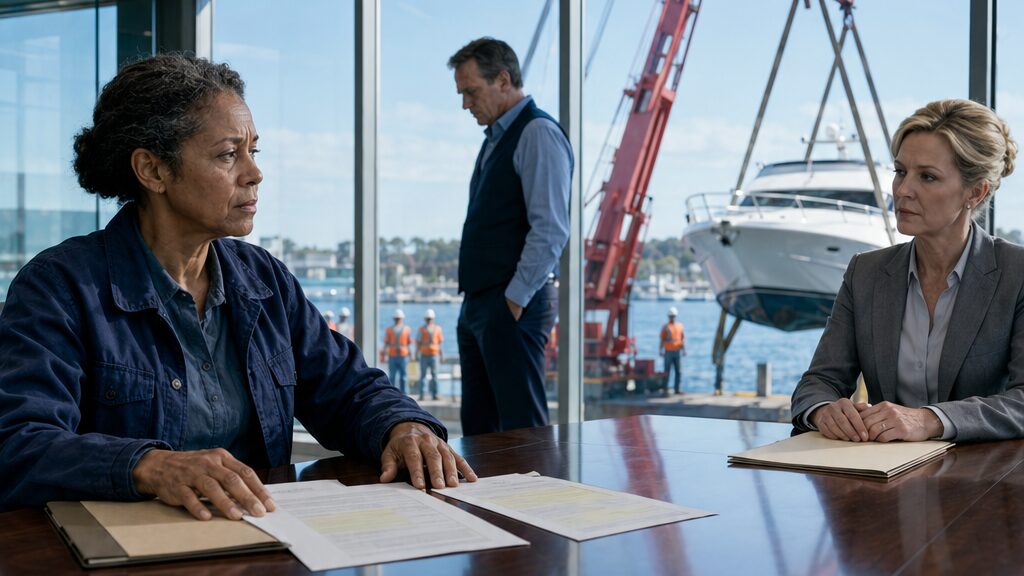
She Lifted Their Million-Dollar Yacht, Then They Fired Her Eighteen Days Before Profit Sharing Vested
Chapter 1: The Letter Arrived While The Crane Was Still Moving
The red crane was already swinging over the water when Carolyn Adams slid the white envelope across the conference table.
Angela Davis did not touch it at first.
Through the glass wall behind Carolyn, the morning glare off Seabright Yacht Yard broke into sharp pieces across the marina. Dockhands in orange vests moved along the floating platform below, stepping over coils of line and yellow spreader bars. The white hull of Jonathan Perez’s yacht sat half-shadowed in the slip, glossy and enormous, its bow pointed toward the open channel like it was impatient to leave the water.
The crane boom groaned. The hook dropped slowly.
Angela’s radio hissed at her hip.
Carolyn folded her hands on top of a manila folder. “Angela, this meeting is difficult for everyone.”
Ryan Scott stood near the window instead of sitting. That was the first wrong thing. Ryan always sat when he wanted to look calm. Now he had one hand on the back of a chair and the other pressed flat against his phone, as if holding down a call he did not want to answer.
Angela looked from him to the envelope.
“Is this about the Perez haul-out?” she asked.
“No,” Ryan said too quickly.
The radio at her hip cracked again. “Lift team to Angela. We’re setting straps under stern now. Need confirmation on cradle pins before load.”
Angela reached for the radio.
Ryan’s hand came up. “Let the crew handle it.”
The second wrong thing.
Angela had run heavy lifts at Seabright for nineteen years. Nobody told her to let the crew handle it when a forty-eight-foot yacht was about to come out of salt water with six people standing inside the swing radius. Not Ryan. Not the owner. Not the crane operator. Not even the old yard manager who used to say Angela could hear a bad strap before it tightened.
Carolyn pushed the envelope another inch forward.
“Your position has been eliminated as part of a restructuring,” she said.
Angela stared at her.
Outside, the hook stopped above the yacht’s centerline. A dockhand raised one arm, waiting.
Angela heard the words, but for a moment they had no place to land. Restructuring belonged to emails and quarterly calls and conference rooms with blinds. Not to this glass office with the crane moving, not with her lift plan clipped to a board downstairs, not with the Perez yacht scheduled for 8:40 and a storm window in two days.
“My position,” Angela said.
“Yes,” Carolyn replied. “Effective today.”
Ryan finally sat down.
That was the third wrong thing.
Angela picked up the envelope. Her name was typed on the front, no middle initial. Angela Davis. Nineteen years reduced to two words, centered and clean.
She opened it without tearing the flap.
Inside was a letter on company paper, a release agreement, a separation checklist, a final pay notice, and a glossy sheet about career transition resources. She read the first paragraph twice, not because she did not understand it, but because her eyes refused to leave the date.
June 1.
Effective June 1.
The crane outside gave a small metallic shudder as the operator took up slack in the cables.
Carolyn’s voice softened into the tone people used when they wanted bad news to sound like weather. “This decision is not a reflection of your years of service.”
Angela looked up.
Ryan’s eyes were on the marina, not on her.
“Then what is it a reflection of?” Angela asked.
“Business needs,” Carolyn said. “Reduced seasonal volume, changing operational structure, and consolidation of supervisory duties.”
“There’s a million-dollar yacht in the sling in ten minutes.”
Ryan’s jaw tightened. “The yard has other qualified personnel.”
Angela placed the letter flat on the table. Her hands were dry. That surprised her. She expected them to shake, or sweat, or betray something. They only spread the paper smooth.
“Who’s supervising the lift?”
Ryan glanced down at his phone. “The crane operator has the plan.”
“The crane operator does not have the hull history. He has a plan I wrote because the aft cradle pins were replaced after the last haul-out and never re-marked.”
Carolyn opened the manila folder. “Angela, we need to keep this meeting focused.”
The radio hissed again. “Angela? Pins on the starboard cradle don’t match the diagram. Confirm position?”
The room went still.
Angela reached for the radio again. Ryan moved before she could touch it.
“I’ll go down,” he said.
“You don’t know which pins,” Angela said.
“I said I’ll go down.”
He left the room with his phone in his hand and the conference door clicking softly behind him.
Carolyn exhaled through her nose, not quite a sigh. She turned a page in the folder. “Your company benefits will be processed according to plan terms. Final wages will be issued through normal payroll. You’ll have until the end of the day to collect personal belongings, escorted if necessary.”
Angela heard only one word.
Benefits.
She looked at her own canvas work folder on the chair beside her. She had brought it because Ryan had asked for the final lift plan, and she never walked into a crane meeting without every sheet that mattered. Inside were rigging diagrams, tide notes, hull photos, service orders, and the benefits schedule Samantha Johnson had printed for her in April after Angela had asked about the retirement bridge.
Angela opened the folder.
Carolyn stopped speaking.
The schedule was tucked behind a laminated diagram of the Perez yacht. Angela slid it out. At the top, in small black print, was the heading she had barely looked at when Samantha handed it to her: Long-Term Profit Sharing and Retirement Bridge Eligibility. She had circled the date weeks ago because Samantha had smiled and said, “Nineteen years, Angela. You should at least know when it becomes real.”
Angela had forgotten the circle.
Now it sat there in blue ink.
June 19.
Angela put the benefits schedule beside the termination letter.
The two dates stared up from the table.
June 1.
June 19.
Eighteen days.
Carolyn’s face did not change. That was worse than surprise.
Angela pressed one finger lightly on the termination letter, then one on the benefit schedule. “My profit-sharing and retirement bridge vest on the nineteenth.”
Carolyn closed the manila folder halfway. “Benefit eligibility is determined by plan rules.”
“I’m looking at the plan rules.”
“I can provide contact information for the benefits administrator.”
Angela did not look away. “Can you explain why today?”
Carolyn blinked once. “As I said, this was a restructuring decision.”
“I’m asking about the date.”
“This decision was based on business needs.”
“Eighteen days before this.” Angela tapped the circled date.
Carolyn’s mouth tightened, not with anger. With caution.
The radio erupted again, louder this time because the room had gone so quiet.
“Crane operator to yard office. We need Angela on cradle confirmation. We are not loading until somebody signs off.”
Outside, the red crane hung motionless over the white yacht. Dockhands were looking up toward the office now. A few spectators had gathered near the railing, phones already raised because people always filmed expensive things about to move through the air.
Angela slid the release agreement back toward Carolyn without signing it.
Carolyn looked at the blank signature line.
Ryan reappeared in the doorway, his face flushed from the stairs. “Angela, the cradle pins.”
She stood slowly, taking the termination letter and the benefits schedule with her.
Carolyn’s voice sharpened by one degree. “Angela, we have not finished.”
Angela looked through the glass at the crane, the yacht, the crew waiting under a suspended hook, and the water flashing beneath all of it.
“No,” she said. “You haven’t.”
The radio hissed against her hip.
“Angela,” the crane operator said, “if those pins are wrong, we stop now or we risk shifting the whole load.”
Angela held the two documents against her chest and looked at Ryan.
“Then I guess,” she said, “you still need the position you just eliminated.”
Chapter 2: The Yacht Hung Over Water And Everyone Looked At Her
The yacht rose with water pouring from its hull while Angela stood on the dock with a cardboard box under one arm and the termination letter tucked against her ribs.
For three seconds nobody moved.
The crane cables tightened above the white cabin roof, four black straps biting gently into the hull where Angela had marked the safe points the afternoon before. Sun flashed off the wet fiberglass. Water ran in sheets from the keel and slapped back into the marina, making a sound like someone dumping buckets from a roof. The yacht’s bow lifted first, then settled as the aft straps took weight.
“Hold,” Angela said.
The crane operator’s thumb came off the control.
Ryan, breathing hard from the stairs, stopped beside the dock office door. “Angela, you are no longer authorized to direct yard operations.”
The starboard stern strap creaked.
Angela did not look at him. “Then authorize someone who knows why that sound is wrong.”
A dockhand froze with both hands on a tag line. The crane operator looked down from the cab. Even Jonathan Perez, standing behind the safety tape in a linen shirt and expensive sunglasses, lowered his phone.
Angela set her box on a bollard. Her coffee mug, a spare pair of gloves, two tide tables, and a faded Seabright sweatshirt shifted inside it. The folder on top slid sideways, exposing the two documents she had not meant for anyone outside that room to see.
June 1.
June 19.
She pushed them back under the folder.
“Port aft has more weight than starboard,” she called. “You’re loading against the wrong cradle pin. Drop two inches. Nobody pulls until I say.”
Ryan stepped closer. “Angela.”
She turned then, just enough that only he could hear her.
“That yacht is insured for more than your annual payroll,” she said. “Do you want to explain to Jonathan Perez why you removed the lift supervisor ten minutes before the lift?”
His eyes flicked toward the owner.
Jonathan had heard enough to know his name. “Removed?”
Ryan’s expression changed into the one he used for clients: calm forehead, empty smile. “We’re handling an internal staffing matter.”
“With my boat in the air?” Jonathan asked.
The crane operator leaned out. “Need a call, folks.”
Angela looked at the straps. The starboard aft strap was not fully seated. The cradle pins below were off by one set from her diagram, exactly as the radio had warned. If the operator committed to the lift, the yacht would not drop straight into the cradle. It would twist, perhaps only a foot, perhaps enough to crack the gelcoat or crush the support. Nobody would die if everyone stayed clear. But workers rarely stayed clear when million-dollar property started to move wrong.
“Lower two inches,” Angela said again. “Ease, don’t drop. Starboard crew, reset aft strap six inches forward. Port crew, stay hands off until it stops dripping. Water weight is lying to you.”
The crane answered before Ryan did. The yacht descended barely enough for the strap to slacken. The dockhand moved quickly, face tight, boots slipping on wet planks. Angela watched his hand, the strap angle, the tag line, the cradle, the small dark gap beneath the keel.
“Stop.”
The crane stopped.
“Now bring it up slow.”
The yacht lifted again.
This time the sound changed. Not silent, never silent, but right. The straps took weight evenly. The hull cleared the water with a steady pull, water draining in silver lines. On the dock, a spectator whispered, “That was close,” and another kept filming.
Angela hated that they were filming.
Not because she feared being seen, but because the yard looked best from far away. From a phone screen, the marina was clean white boats, red crane, bright water, controlled spectacle. Nobody saw the taped gloves in her box or the unsigned release agreement upstairs or the little blue circle around June 19.
Jonathan stepped toward the safety tape. “Is she supervising this lift or not?”
Ryan looked at Angela. Beneath the anger, there was something else: calculation, maybe fear. He had always been good with numbers. Bad with things that could not be made to sound neutral.
“She is assisting with transition,” he said.
Angela almost laughed. It came up sharp and dry, then disappeared before it became sound.
The yacht rose higher. For one breath it hung completely out of the water, suspended above the turquoise channel, the keel dripping, the polished sides catching the sun. Every person on the dock looked at it. The whole yard seemed to hold still beneath the red crane.
Angela lifted one hand. “Swing three degrees port. Slow. Keep stern clear of the east piling.”
The crane operator obeyed.
A security guard arrived at the dock entrance, uncertain where to stand. Carolyn appeared behind him, heels unsuitable for dock grating, one hand gripping the folder she had carried downstairs.
“Angela,” Carolyn called, “we need you to come back inside.”
Angela kept watching the yacht. “Not while it’s over water.”
Carolyn lowered her voice when she reached her. “Your access will be disabled. You can collect your belongings afterward.”
“My belongings are in that box.”
“Company materials need to remain on-site.”
Angela glanced at the box. The folder inside held her personal copies of lift notes and benefit papers. The official lift log was still in the dock office. Her name was on the schedule. Her handwriting was on the diagram. Her initials were beside the cradle correction from the prior month.
Ryan followed her gaze.
“That folder stays,” he said.
Angela picked up the folder and held it against the box. “My benefits schedule stays with me.”
“Not that,” he said. “The lift plan.”
“You have the official copy.”
“We need all company records retained.”
Angela looked at him carefully. “You mean the records proving I planned today’s lift?”
His face hardened. “Don’t make this harder than it needs to be.”
The yacht began its slow swing toward the cradle. Workers moved with tag lines, cautious and quiet now. Nobody joked during the middle of a lift. Nobody trusted the air between hull and cradle until the weight was settled and the straps were slack.
Jonathan came closer to the tape. “I specifically requested Angela for this haul-out.”
Ryan turned. “You requested our senior lift team.”
“No,” Jonathan said. “I requested Angela Davis. It’s in the service order. Your office confirmed it.”
The words landed harder than Angela expected.
She had known the request existed. She had seen it when the scheduler printed the packet. She had not thought of it as anything more than a client preference. Now it stood beside the termination letter in her mind, another date, another line, another quiet contradiction.
Position eliminated.
Requested by client.
Effective today.
Needed at 8:40.
The stern cleared the piling by less than two feet.
Angela raised her hand. “Hold swing. Bring it down to cradle line. Crew, nobody reaches under. Use poles.”
The yacht descended inch by inch. The cradle waited below like a steel hand. Angela watched the keel approach, watched the aft blocks, watched the corrected pin sit exactly where it should have been if anyone had bothered to update the diagram after maintenance.
The hull settled.
The straps slackened.
Only then did Angela breathe.
Around them, the dock loosened. A few spectators clapped once or twice, awkwardly, as if they had watched a street performer instead of six workers avoiding a claim that could have ended careers. Angela ignored it.
Ryan stepped into her path before she could pick up her box.
“Thank you,” he said quietly. “Now we need to finish the process.”
“You mean you need me off the property before anyone asks why the eliminated position just kept Jonathan’s yacht out of the water.”
His eyes flashed. “That isn’t fair.”
Angela felt the sentence strike somewhere old. Not fair. As if fairness was now the thing he was willing to name.
Carolyn moved beside him. “Angela, you’re upset. That is understandable. But refusing to follow offboarding procedure can affect the terms of separation.”
Angela opened her folder.
She removed the termination letter and the benefits schedule. Dock noise faded at the edges. The crane idled behind her. The wet yacht sat in its cradle, white and safe and expensive.
She held the papers so Ryan could see them.
“This letter says June first,” she said. “This schedule says June nineteenth.”
Carolyn’s expression closed. “We should discuss benefits questions with the administrator.”
“I am not asking the administrator.” Angela looked at Ryan. “I am asking the man who signed the lift schedule yesterday and the termination approval today.”
Ryan said nothing.
Angela placed the two papers on top of her box, side by side, the wind lifting their corners.
“My pension bridge and profit-sharing vested on the nineteenth. You terminated me on the first. Can you explain that?”
Carolyn reached for the papers as if to straighten them. Angela put one finger on the termination letter and held it down.
“The decision was based on business needs,” Carolyn said.
Angela did not look at her.
Ryan’s gaze moved from June 1 to June 19 and away again.
“I’ll leave,” Angela said. “But I’ll leave when you answer why June first came before June nineteenth.”
Chapter 3: Three Reviews Said Exceeds Expectations
The phrase had not been in the meeting.
Angela found it at her kitchen table just after four, buried on page three of the separation packet beneath a paragraph about final wages and company property.
Recent performance alignment concerns.
She read it once, then again, while the late afternoon light flattened across the table and the smell of marina diesel still clung to her sleeves. Her cardboard box sat on the floor by the back door. She had not unpacked it. The Seabright sweatshirt hung over one edge like something tired enough to fall.
Recent performance alignment concerns.
Carolyn had said restructuring. Ryan had said business needs. Neither had said performance.
Angela placed the page beside the termination letter. The documents made a neat square with the benefits schedule and the service order copy she had removed from the lift packet before security watched her leave. She had not stolen it. That was what she told herself first. Then she corrected herself because precision mattered now. It was her personal copy of the customer-facing work order. Jonathan Perez’s signature was at the bottom. In the notes field, someone in scheduling had typed: Client requests Angela Davis as lift supervisor due to prior hull support issue.
Position eliminated.
Client requests Angela Davis.
Performance alignment concerns.
June 1.
June 19.
She pushed back from the table.
For nineteen years Angela had kept paper because boats punished forgetfulness. Hull photos, service notes, tide tables, strap measurements, oil stains on diagrams, all of it mattered when somebody later claimed a scratch had not been there before or a support block had shifted on its own. She did not keep paper to defend her character. She had believed the work did that.
In the hallway closet, behind an old coil of extension cord and a plastic bin of winter gloves, sat a banker’s box labeled REVIEWS / CERTS / TAX. She dragged it out and carried it to the kitchen.
The first file was training. The second was crane-signal certification. The third was annual reviews.
Angela opened the most recent.
Ryan’s signature was at the bottom.
Exceeds expectations.
She stared at the rating, then at the date. February 12. Less than four months ago.
Under comments, Ryan had written in his small, square handwriting: Angela remains the yard’s most reliable heavy-lift supervisor. Zero reportable lift incidents in the past review year. Essential to client retention on complex haul-outs.
Essential.
Angela sat very still.
She had not cried in Carolyn’s office. She had not cried on the dock. She had not cried when the security guard stood outside her office while she packed her gloves and coffee mug and a framed photograph of the first boat she had ever lifted at Seabright.
Now her eyes burned, not because the review was kind, but because she had once felt foolishly proud of that word.
Essential.
She pulled the two prior reviews.
Exceeds expectations.
Exceeds expectations.
The three sheets lay in a row, each signed by Ryan. Zero incidents. Client trust. Supervisory judgment. Strong safety culture. Critical operational knowledge.
Then, in the separation packet, recent performance alignment concerns.
She took a pen and circled both phrases. Essential. Performance concerns. The ink pressed hard enough to dent the paper.
Her phone rang.
Angela looked at the screen. Samantha Johnson.
She let it ring twice before answering.
“Don’t use company email,” Samantha said before Angela could speak.
Angela straightened. “Hello to you too.”
“I’m serious.”
“I don’t have company email anymore.”
“Don’t send anything from your personal email to anyone at Seabright asking about payroll, vesting, profit-sharing, or termination dates. Not yet.”
Angela looked down at the benefits schedule. “You knew?”
A silence opened on the line.
“Samantha.”
“I knew your vesting date because you asked me to print the schedule,” Samantha said. “That’s all I knew.”
“You printed it in April.”
“Yes.”
“Who else could see it?”
“Angela…”
“Who else?”
Samantha lowered her voice. Angela could hear office noise behind her, a printer, a drawer, someone laughing too loudly in the distance. “Benefits eligibility is not a secret inside payroll. Managers don’t see everything, but reports exist. Tenure bands. projected liabilities, vesting windows. I’m not saying anyone used them.”
“You’re saying they could.”
“I’m saying don’t ask questions in a way that lets them prepare the answers before you know what you’re asking.”
Angela looked toward the back door. Her box sat there with the Seabright sweatshirt hanging out.
“They put performance language in the packet,” she said.
Samantha went quiet again.
Angela picked up Ryan’s February review. “My last review says essential.”
“Keep that.”
“I have three.”
“Keep all of them. Keep copies somewhere that isn’t your kitchen table.”
Angela’s hand tightened around the phone. “Samantha, did Ryan know about June nineteenth?”
“I can’t answer that.”
“Can’t or won’t?”
“Both.”
The honesty landed harder than a lie.
Angela could picture Samantha at her payroll desk, shoulders drawn in, eyes on the hallway. Samantha had two kids in college and a mortgage Angela had heard about only once, after a payroll system crash kept them both at the yard until midnight. She was not fearless. Angela had no right to demand that she become so in one phone call.
“What can you tell me?” Angela asked.
“Read every page of what they gave you. Especially the release. Don’t sign anything until you understand what you’re giving up. And Angela?”
“Yes.”
“If you request records, request all of them. Don’t ask informally.”
The line clicked off.
Angela sat with the dead phone against her ear.
Outside her kitchen window, a neighbor’s sprinkler ticked steadily over a strip of grass. Ordinary sound. Ordinary street. Nothing like the dock radio, the crane alarm, the slap of water off a lifted hull. Yet her body stayed braced, as if something heavy still hung above her and no one had called clear.
She began sorting.
Termination letter.
Benefits schedule.
Perez service order.
February review.
Last year’s review.
The year before that.
Separation packet.
Release agreement.
She read the release slowly. The severance amount was smaller than three months of pay. Enough to tempt someone who wanted to stop shaking. Enough to make silence look practical. The document said she agreed not to pursue claims related to termination, compensation, benefits, or any employment decision through the date of signing.
Benefits.
Termination.
Compensation.
Any employment decision.
She wrote those words on a yellow pad, then stopped because her handwriting looked too angry.
A memory rose, unwanted: Gregory Lee standing near the tool cage six months earlier, holding a cardboard box just like hers. He had looked at Angela as if waiting for her to say something. Ryan had told the crew there had been attendance concerns, documentation problems, restructuring across maintenance. Angela had believed the part that let her keep working. She had told herself Gregory was bitter, that management knew what was in the file, that it was not her place.
Not her place.
She went back to the banker’s box and searched for the old crew schedule from that month. Gregory’s name appeared in pencil until the week it vanished. No explanation. No goodbye note. No retirement cake. Just an empty slot covered by overtime.
Angela took out a fresh folder and wrote DATES on the tab.
Her phone rang again.
Unknown number.
She almost ignored it. Then some instinct made her answer without speaking.
For a second there was only breathing, road noise, maybe a turn signal.
Then a man’s voice said, “Angela?”
She knew it before he gave his name.
“Gregory,” she said.
A rough laugh came through the speaker. “Heard they walked you out.”
Angela closed her eyes. “Who told you?”
“Yards talk.”
She looked at the papers spread across her table. “I’m sorry.”
“For getting fired?”
“For not calling you when it happened to you.”
The line went quiet long enough that she thought he had hung up.
When Gregory spoke again, the roughness was still there, but something under it had shifted. “They put performance alignment in yours?”
Angela looked down at the circled phrase.
Her kitchen seemed to narrow around the table.
“Yes,” she said.
Gregory exhaled once, sharp and humorless.
“They gave me the same sentence in my letter.”
Chapter 4: Gregory’s Date Was Sixteen Days Short
Gregory Lee put his termination letter on the diner table before he took off his jacket.
The paper was creased across the middle, softened at the edges from being folded and unfolded too many times. He did not slide it toward Angela. He laid it down carefully, then tapped one finger on the date as if touching a bruise.
“February third,” he said.
Angela sat across from him with her folder still closed on her lap. The diner was two blocks from the marina, close enough that she could smell salt when the door opened, far enough that Seabright workers rarely came in unless they wanted coffee they did not have to drink under Ryan’s eye. The waitress had put two mugs between them and left without asking why neither of them had ordered food.
Gregory turned the paper so Angela could read it.
Effective February 3.
Below it, in the second paragraph, the sentence waited like a copy of her own.
Recent performance alignment concerns.
Angela’s throat tightened.
Gregory reached inside his jacket and took out another sheet, a benefits notice with a stapled corner and a coffee stain along one side. “Maintenance bonus step-up. February nineteenth. Sixteen days.”
Angela opened her folder slowly.
Her termination letter and benefits schedule lay side by side inside, June 1 beside June 19. She placed them on the table next to Gregory’s.
For a moment neither of them spoke.
Four dates. Two people. Same gap.
Gregory gave a small, bitter smile. “Looks cleaner when it’s somebody else’s paper, doesn’t it?”
Angela did not answer right away. She watched a busboy wipe the counter in small circles. Watched steam rise from Gregory’s coffee. Watched her own hand rest near the edge of the table, close enough to the papers that one movement could gather them back into private shame.
“I should have called you,” she said.
“You should have asked Ryan why my locker was empty before my appeal period ended.”
The words landed flat, not loud. That made them harder to hide from.
Angela nodded once.
Gregory leaned back. He had lost weight since she last saw him at the yard. His beard had more gray in it, and his hands, still thick across the knuckles, stayed folded tight over his stomach as if he did not trust them loose on the table.
“They told the crew I had attendance issues,” he said.
“I heard that.”
“You believed it?”
Angela looked at his February letter. “I let myself.”
His mouth twisted. “That’s almost honest.”
“I’m sorry.”
“No, you’re not. Not yet.”
Angela looked up.
Gregory’s eyes had the hard shine of a man who had rehearsed this meeting in his truck and still hated that he came. “You’re sorry because now you know they did it to you. That’s different from being sorry when they did it to me.”
Angela could have defended herself. She could have said she had not seen his paperwork, that Ryan had implied there was a file, that the yard was tense then, that she had a crew to protect and lifts on the schedule and no authority over HR.
All of it would have been true enough to be useless.
“You’re right,” she said.
That seemed to irritate him more than an argument would have.
He took a long drink of coffee, then pulled another folded sheet from his jacket. “Final review before they changed the wording.”
Angela recognized the form before he flattened it. Same header, same boxes, same company logo. Gregory’s rating was not as high as hers, but it was solid. Meets expectations. Reliable mechanical troubleshooting. Strong emergency response. Needed improvement on documentation turnaround.
“Nothing about alignment concerns,” Angela said.
“No. That phrase showed up in the termination packet.”
“Who signed your review?”
“Ryan.”
Angela looked at the signature. It matched the one on hers, careful and square.
The waitress returned and asked if they needed anything else. Gregory said no without looking up. Angela asked for water, because her coffee had gone untouched and bitter.
When the waitress left, Gregory leaned forward.
“You want to know the worst part? I almost signed. They put two weeks’ pay in front of me. I was behind on my truck. My daughter needed help with rent. Carolyn kept saying I could leave with a clean record if I didn’t complicate the process.”
Angela heard the phrase as if Carolyn had spoken from the booth beside them.
Clean record.
“They offered me a release,” she said.
Gregory gave a short laugh. “Of course they did.”
“I haven’t signed it.”
“Yet.”
Angela did not protest.
Gregory tapped her benefits schedule. “What do you want from me?”
“The truth.”
“The truth is I was mad enough to call a lawyer and too broke to keep calling after the first consultation.”
Angela’s stomach tightened. “Did you file anything?”
“No.”
“Why?”
“Because I was alone.” His voice dropped, and for the first time the anger in it bent around something else. “Because nobody from the yard returned my calls. Because when you spend fifteen years fixing everyone else’s mistakes and then they tell people you were the mistake, you start wondering if maybe there’s something in the file you didn’t see.”
Angela looked at him then.
That was the cruelty she had missed. Not the money first. The doubt.
The company had not only removed him. It had left him outside the gate with a story he could not disprove and people he had worked beside pretending not to hear it.
“I don’t want to do that again,” Angela said.
Gregory’s eyes narrowed. “Do what?”
“Let their version stand because it’s easier for everyone still inside.”
For the first time, he looked less certain of his anger. He picked at the edge of his letter, then pulled out his phone. “I kept pictures of the schedule. I kept the text from the supervisor telling me my bonus would step up after February nineteenth. I kept everything after I realized nobody was going to ask.”
Angela opened her folder wider.
He did not hand her the phone.
“If I help,” Gregory said, “my name goes on it.”
Angela paused.
He saw the pause and leaned back. “There it is.”
“No. I’m thinking about what that means for you.”
“What it means is they don’t get to use me as your supporting detail while I stay the bitter guy they fired for performance.”
Angela accepted that without flinching. “Then your name goes on it.”
“And you don’t soften it.”
“I won’t.”
“You don’t say they may have misunderstood the timeline.”
“I won’t.”
“You don’t call me a former employee with concerns.”
Angela met his eyes. “I’ll call you Gregory Lee. Maintenance mechanic. Terminated sixteen days before your benefit step-up after a review that did not support the reason they gave.”
His face shifted. Not softened. Not forgiven. But something in him stopped pushing quite so hard against the table.
The waitress brought Angela’s water. Gregory waited until she left.
“Ryan knew,” he said.
Angela stilled.
Gregory looked toward the window, where gulls moved over the marina roofs in broken white flashes. “I can’t prove it. But two weeks before they cut me, he asked me whether I had looked at retirement options. Said payroll reports were making everyone think about long-term planning. I thought he was being decent.”
Angela wrote that down.
Gregory watched the pen move. “You really going to do this?”
“I don’t know how yet.”
“That’s not what I asked.”
Angela capped the pen and looked at the four dates lying between them.
“Yes,” she said. “I am.”
That evening, at her kitchen table, Angela placed Gregory’s copies beside hers and made the first list.
Name. Termination date. Benefit date. Gap. Stated reason. Last review.
The columns looked simple, almost harmless. That made them worse.
She had just written Gregory’s gap—sixteen days—when her phone buzzed.
A message from Samantha Johnson appeared on the screen.
Request your full employment record. Do it formally.
A second message came immediately after.
All of it.
Chapter 5: The Spreadsheet Had No Column For Loyalty
The records packet arrived eight days later, and Angela knew it was wrong before she opened it because it was too thin.
The envelope from Seabright Yacht Yard lay bent inside her mailbox, the company logo stamped in the upper left corner, her address printed on a label that sat slightly crooked. She carried it to the kitchen table without taking off her shoes. The folder marked DATES was already there, thick now with copies, notes, highlighted reviews, and Gregory’s signed statement.
Angela slit the envelope open with a paring knife.
Inside were twenty-six pages.
Nineteen years of work, reduced to twenty-six pages.
She spread them across the table. Payroll summary. Job title history. Separation notice. Final wage calculation. Two certifications. One safety acknowledgment. The February review. Not the prior two. No mention of Jonathan Perez’s service order. No lift logs. No internal notes. No selection approval.
She checked the envelope twice.
Then she laughed once, without humor.
“They didn’t even try to make it heavy.”
At the labor board office downtown, the intake clerk behind the glass looked at the packet, then at Angela’s list of missing records.
“You requested personnel file, payroll history, benefit eligibility records, performance records, termination decision documents, and internal communications related to separation?”
“Yes.”
The clerk stamped the top page of Angela’s copy. “This is not legal advice. But if what they produced doesn’t match what you requested, keep the envelope, keep the postmark, and write down what’s missing.”
Angela had already written it down. The list filled half a page.
The clerk gave her a form with boxes too small for the story they were supposed to hold. Angela printed carefully anyway. Terminated June 1. Vesting June 19. Performance reviews contradictory. Similar termination: Gregory Lee, February 3, benefit step-up February 19. Company offered release.
When she reached the box labeled Brief Description, she paused.
Brief.
The whole system wanted brief. HR wanted business needs. Ryan wanted restructuring. Carolyn wanted clean record. The release wanted all claims erased in exchange for a number that looked tidy on a page.
Angela wrote: I believe my termination date was selected to prevent vesting of earned benefits. Records requested may show employer knew the date.
The clerk read it upside down as Angela slid the form back.
“You have supporting documents?”
Angela lifted the folder.
The clerk looked at its thickness and raised one eyebrow. “Make copies. Keep originals.”
At the copy shop, the machine jammed on Gregory’s benefits sheet.
Angela stood under fluorescent lights while the clerk opened the drawer and pulled out the wrinkled paper carefully, as if it mattered. Behind her, the machine kept spitting out duplicates of her termination letter, June 1 appearing again and again in the tray.
She made three sets.
One for the labor board.
One for the employment attorney she had not yet hired.
One for the kitchen table.
At home, she started numbering pages. Her own system calmed her. A-1, termination letter. A-2, benefits schedule. A-3, February review. A-4, Perez service order. G-1, Gregory termination. G-2, Gregory benefits notice. G-3, Gregory review. Notes after each.
The copied records from Seabright went into a separate stack.
She was halfway through labeling the safety acknowledgment when a loose page slid from behind it.
Angela almost missed it.
It was not stapled. It had copied badly, gray at the edges, as if it had been part of another document placed slightly crooked on the scanner. At the top, cut off by the margin, were only the last letters of a heading.
—tion Impact Matrix.
The rows beneath were small.
Angela leaned closer.
Employee ID. Role. Tenure Band. Current Salary. Projected Benefit Liability. Retention Risk. Separation Window. Manager Approval.
Her hand went cold.
There were no names. Just employee numbers and job classifications. Lift Supervisor. Dock Mechanic. Parts Lead. Yard Admin. The dates ran down the right-hand side in neat blocks.
February 3.
June 1.
Angela stood so abruptly the chair scraped the floor.
She took the page to the window for better light. The copy was poor, but not unreadable. Her role was there. Lift Supervisor. Tenure Band: 15+ Years. Projected Benefit Liability: High. Separation Window: Q2 pre-vesting.
Pre-vesting.
Not seasonal volume.
Not performance alignment.
Pre-vesting.
Angela placed the matrix beside her termination letter and benefits schedule. For a long moment she did not move. She had wanted proof, but wanting proof was different from seeing a column that turned her life into a liability category.
There was no column for the yacht she had saved.
No column for the apprentice she had trained after he almost crushed his hand under a support block. No column for the Saturday she came in during a tropical storm watch because two boats needed extra straps. No column for nineteen years of knowing which sound meant stop.
There was only High.
Her phone rang while she was still looking at the page.
Carolyn Adams.
Angela let it ring until the final tone, then answered.
“Angela,” Carolyn said, “thank you for taking my call.”
Angela looked at the matrix. “What do you need?”
“We received notice that you contacted the state labor board.”
“That’s correct.”
“I wanted to let you know Seabright is willing to revisit the separation terms in recognition of your tenure.”
“My tenure was recognized on the matrix.”
A pause.
“What matrix?” Carolyn asked.
Angela did not answer.
Carolyn recovered quickly. “I’m not sure what you’re referring to, but we would like to avoid unnecessary escalation. We can increase the severance amount and provide a neutral reference. The offer would remain contingent on signing the release.”
“How long do I have?”
“Forty-eight hours.”
Angela wrote that down.
Carolyn’s voice softened. “Angela, I know this has been emotional. A formal process can take months. There is no guarantee of outcome. This offer gives you certainty.”
Certainty.
The word nearly worked.
Angela looked at the stack of bills near the refrigerator, at the health insurance notice she had not opened, at her old Seabright sweatshirt still hanging over the chair because she had not known where to put it. Certainty had weight. It had groceries and prescriptions and the quiet relief of not waking up every morning with the company in her kitchen.
“How much?” she asked.
Carolyn named a number.
It was more than the first offer. Not enough to equal the vested benefit. Enough to make her hand tighten around the phone.
“And the release?”
“Standard language.”
“Send it.”
“Of course. I hope you’ll see this as a good-faith effort.”
Angela looked again at the matrix.
Good faith did not have columns like pre-vesting.
The email arrived nine minutes later.
Angela printed the release and read it standing beside the printer. The number was there. The neutral reference was there. The deadline was there.
Then she reached paragraph seven.
She read it twice.
The employee agrees not to initiate, participate in, encourage, coordinate, or support any claim, charge, complaint, or proceeding involving any current or former employee alleging substantially similar circumstances, including but not limited to compensation, benefits, termination timing, restructuring selection, or employment separation.
Angela carried the page back to the table.
Gregory’s name was not in the paragraph.
It did not need to be.
She set the release beside his termination letter. February 3. February 19. June 1. June 19. The matrix in the middle.
Her phone buzzed with a text from Gregory.
Any news?
Angela looked at the forty-eight-hour deadline.
Then she wrote one sentence on her yellow pad before calling him.
They are paying extra for me not to say your name.
Chapter 6: She Asked About The Date Again
Angela walked back into Seabright Yacht Yard carrying no box, no mug, no sweatshirt, and no apology.
Only a folder.
The security guard at the gate looked at her name on the visitor list and then at the folder pressed under her arm. For a moment Angela thought he might tell her to wait outside, but he only handed her a temporary badge with a red stripe through the middle.
VISITOR.
She clipped it to her jacket without looking down.
The marina looked too bright. The same boats rocked in their slips. The same gulls walked the roofline of the parts shed. The red crane stood folded now, its boom resting over the yard like an arm held close after strain. Near the haul-out bay, Jonathan Perez’s yacht sat in its cradle, blocked clean and level, the straps removed.
Angela made herself look at it.
Safe.
Still here.
So was the file.
Carolyn met her at the conference room door. “Ryan will be joining us.”
“I assumed he would.”
“This meeting is not a negotiation.”
Angela stepped past her. “Then it should be short.”
Ryan was already inside, seated this time, a legal pad in front of him and no pen in his hand. Angela noticed that first. Ryan always held a pen when he wanted to look prepared. Without one, his hands rested flat on the table, palms down, like he was steadying himself.
Carolyn closed the door.
Angela sat opposite them and opened the folder.
She placed the termination letter on the table.
June 1.
Then the benefits schedule.
June 19.
Carolyn’s face tightened in familiar anticipation.
Angela placed Gregory’s termination letter beside hers.
February 3.
Then Gregory’s benefit notice.
February 19.
Ryan looked at the four dates and said nothing.
Carolyn folded her hands. “Angela, as I said on the phone, Seabright has made an enhanced severance offer in recognition of your service. We are prepared to move forward today if you’re ready to sign.”
Angela took out the release and set it apart from the dates. “Paragraph seven prevents me from supporting any similar claim by a former employee.”
“It is standard settlement language.”
“No,” Angela said. “The first release didn’t say that.”
Carolyn glanced down.
Ryan looked at her then, a quick look, but Angela saw it.
She placed the copied matrix page in the center of the table.
The room changed.
It was subtle. No one gasped. No one confessed. But Carolyn’s fingers stopped moving, and Ryan’s shoulders settled back half an inch, as if he had recognized a boat drifting toward a piling and knew he could not reach it in time.
Angela tapped the cut-off heading. “This was misfiled in the records you sent me.”
Carolyn did not touch it. “I can’t authenticate a partial document.”
“I’m not asking you to. I’m asking why my role appears beside the words projected benefit liability and pre-vesting.”
Ryan spoke for the first time. “You don’t have context for that document.”
“Then give it to me.”
“That’s an internal planning tool.”
“For restructuring?”
“Yes.”
“For performance?”
Carolyn stepped in. “Angela, the decision involved multiple factors.”
Angela pulled out her February review and placed it below the matrix. “My last review says exceeds expectations. Ryan signed it. It calls me essential to client retention on complex haul-outs.”
Ryan’s mouth tightened.
Angela added the prior two reviews. “Three reviews. Same rating. No performance alignment concerns until the separation packet.”
Carolyn leaned forward. “Performance can change after an annual review.”
“In less than four months?”
“It can.”
Angela nodded once, as if accepting that the sentence existed. Then she removed the Perez service order.
Ryan looked away before it touched the table.
Angela noticed.
“Jonathan Perez requested me by name for the June first haul-out,” she said. “Your office confirmed it. On the same morning Seabright eliminated my position as unnecessary, I supervised the lift because the cradle pins were wrong.”
Ryan’s voice sharpened. “You assisted after being instructed not to.”
“I prevented a bad lift.”
“You created confusion on the dock.”
Angela looked at him steadily. “The yacht settled clean.”
He did not answer.
Carolyn drew the release toward her side of the table by one inch. “This is precisely why settlement is the better path. A hearing will involve disputed facts. Nobody benefits from turning an operational transition into an accusation.”
Angela almost smiled at that. Almost.
“Operational transition,” she repeated.
Carolyn held her gaze. “Business necessity.”
The phrase seemed to give Ryan permission to breathe.
“Yes,” he said. “Business necessity. Angela, this yard is under pressure you don’t see. Insurance costs, acquisition review, benefit liabilities, seasonal volatility. If the sale doesn’t go through, more people lose jobs. We had to reduce overhead.”
There it was.
Not performance.
Not alignment.
Not reduced seasonal volume.
Overhead.
Angela let the word sit on the table with the dates.
“Then say that,” she said.
Ryan’s face flushed. “It isn’t that simple.”
“It became simple when you dated the letter June first.”
He looked toward the window. Down on the dock, a crew member was coiling a tag line near the crane pad. For a second Angela saw the Ryan she had known ten years ago, sleeves rolled up, helping her reset a cradle block in rain because the old yard manager had gone home sick. That Ryan would have cursed at the corporate math. This one had signed it.
“You think I wanted this?” he said quietly.
Angela did not soften. “I think you knew.”
Carolyn’s head turned slightly toward him.
Ryan looked back at Angela. “I knew your vesting window was coming. Payroll reports flag long-term liabilities during restructuring. That doesn’t mean the date was chosen for that reason.”
Angela slid the matrix closer to him. “It says pre-vesting.”
“I didn’t create that language.”
“But you signed the termination list.”
He said nothing.
The silence was the first honest thing he had given her.
Angela removed one final page: her labor board intake form, stamped and dated.
“I am not signing the release,” she said. “I want my record corrected. I want the vested value calculated as if Seabright had not terminated me eighteen days before eligibility. And Gregory Lee’s documents go with mine.”
Carolyn’s professional calm thinned. “If you file this with Gregory attached, it becomes a pattern claim.”
Angela put Gregory’s letter beside hers again, straightening the edges until the dates lined up.
“I know.”
“You understand that may delay any payment to you.”
“I know.”
“You understand the company will defend its decision.”
Angela looked at Ryan. “Then they should bring the records that explain why June first came before June nineteenth.”
Ryan rubbed both hands over his face, then stopped, as if remembering where he was.
Carolyn closed the release folder. “We’ll need to involve counsel.”
Angela stood.
The visitor badge tugged at her jacket. She unclipped it and placed it on the table beside the unsigned release.
“Do that,” she said.
At the door, Ryan spoke behind her.
“Angela.”
She turned.
He looked tired now, older than he had that morning by the crane. Not sorry. Not innocent. Just trapped inside the language he had chosen to survive.
“If this becomes a pattern claim,” he said, “it won’t stay small.”
Angela held the folder against her side.
“It was never small,” she said. “You just kept the columns narrow.”
Chapter 7: The Crane Log Stayed In The File
The mediator placed the crane log on the table and asked why a redundant employee had directed a million-dollar haul-out at 8:47 on the same morning her position was eliminated.
No one answered immediately.
The room was smaller than Angela expected. No windows, no marina light, no gulls screaming over rooflines. Just a rectangular table, two pitchers of water, a wall clock with a tired second hand, and stacks of paper arranged by people who understood that silence could be part of a negotiation.
Angela sat with her folder closed in front of her.
Across the table, Carolyn Adams had a legal pad, a pen, and the same careful posture she had used in the HR office. Ryan Scott sat beside her, jacket buttoned, eyes on the crane log as if it had floated in from another life. An employment attorney sat at Angela’s side. Gregory Lee was not in the room, but his signed statement was in the file, clipped behind his February termination letter and benefit notice.
The mediator tapped the log again. “The entry says lift supervision: Angela Davis.”
Carolyn spoke first. “The company’s position is that Ms. Davis assisted during a transition period.”
Angela watched Ryan.
The mediator looked down at the page. “The termination was effective before the lift.”
“That is correct,” Carolyn said.
“And the client service order requested Ms. Davis by name?”
Carolyn’s pen moved once across her pad. “The client requested continuity.”
Jonathan Perez had not come to the mediation. He had sent a signed statement and a copy of the service order with his note in the margin: I was not informed Angela Davis had been terminated before the lift. I would not have consented to a change in lift supervision during active haul-out.
The mediator placed that page beside the crane log.
Two documents side by side again.
Angela had learned to watch faces when paper landed. Carolyn looked at documents as tasks. Ryan looked at them as weather. The attorney looked at them as tools. Angela still looked at them as things that should have been honest the first time.
The mediator turned to another page. “The selection matrix provided in supplemental production includes projected benefit liability and separation window. Seabright’s response says this was a planning document, not a termination directive.”
“That is correct,” Carolyn said.
The employment attorney beside Angela said, “It also says pre-vesting.”
Ryan shifted.
Angela did not.
Months ago, she would have filled the silence to spare everyone the discomfort. She would have explained too much, softened the word, offered the company a ladder down from what its own document said. Now she let the silence sit on the table and take up room.
The mediator turned one more page. “Ms. Davis’s annual reviews show exceeds expectations for three consecutive years.”
Carolyn’s voice remained level. “Performance reviews are one factor among many.”
“The separation packet references performance alignment concerns.”
“Yes.”
“Do you have documentation of performance concerns arising after the last review?”
Carolyn looked at Ryan.
It was a small glance, but Angela saw it, and Ryan knew she saw it.
He rubbed his thumb once along the edge of his legal pad. “There were operational concerns during restructuring.”
“That wasn’t the question,” the mediator said.
Ryan’s mouth closed.
Angela felt no triumph. Only a slow, heavy ache.
She had once respected that Ryan could stand on a dock in a crosswind and make quick decisions without showing panic. She had mistaken that for courage everywhere. But this room did not have a crane alarm or a moving hull. It had paper. It had dates. It had places where a man could say he had been wrong, and Ryan kept reaching for safer words.
The mediator leaned back. “Let’s be clear. Nobody here is asking Seabright to admit intent today. But the record as presented creates risk. Termination date, vesting date, similar employee pattern, matrix language, positive reviews, client-requested work on the effective date. That is a lot of alignment for a coincidence.”
Carolyn’s pen stopped.
A recess was called.
Angela went into the hallway with the employment attorney. The floor smelled faintly of wax and old coffee. At the far end, Gregory stood near a vending machine with his hands in his jacket pockets. He had said he would wait outside. Angela had told him he did not have to. He had answered, “I know.”
He looked up when she came out.
“Well?”
“They’re not admitting anything.”
Gregory gave a tired laugh. “Shocking.”
“But they’re talking numbers now.”
He looked at the folder in her hand. “For both?”
Angela nodded. “Your case stays attached.”
For a second his face moved through something too private to name. Then he looked away toward the vending machine glass. “Good.”
The attorney stepped aside to take a call. Angela and Gregory stood in the hallway with the hum of the machine between them.
“I used to think if I kept my work clean, no one could make me look dirty,” Gregory said.
Angela looked down at the folder. “I thought the same thing.”
“You were wrong first,” he said.
She accepted it.
Then he added, quieter, “So was I.”
When they returned to the room, the offer had changed.
The company would pay Angela the value of the profit-sharing and retirement bridge as though she had remained employed through June 19. Her personnel file would be corrected to remove the phrase performance alignment concerns. Her final record would state position eliminated due to restructuring, with no performance basis. Gregory’s complaint would remain under review separately, but the company would provide comparable documents for his file and enter a separate settlement discussion.
No admission of wrongdoing.
No public statement.
No apology.
Carolyn slid the proposed terms across the table. “This resolves Ms. Davis’s individual claim.”
Angela read every line. The money was real. The correction was real. The silence was also real, built into the language with polished care.
Ryan had not spoken since the recess.
The mediator looked at him. “Mr. Scott, the corrected record includes a statement that Ms. Davis was qualified for her position at the time of separation. Any objection?”
Ryan looked at Angela then.
For one moment the conference room vanished and she saw the dock again: the white yacht hanging over the water, straps tightening, the crew looking to her, Ryan telling her she was no longer authorized while needing her to save the lift.
He looked older now. Not ruined. Not punished enough to make a story neat. Just a man who had chosen the column over the person and now had to sit beside the page.
“No objection,” he said.
Carolyn’s pen moved.
Ryan cleared his throat. “She was not unqualified.”
Angela did not thank him.
The mediator waited, perhaps expecting more, but Ryan gave nothing else. No explanation. No regret. No sentence that could restore the years between them. Angela was almost relieved. An apology might have asked something of her she was not willing to give.
She signed only after the attorney nodded.
Her signature looked steady.
Outside the building, Gregory stood beside her at the curb while traffic moved past in hot waves.
“You got yours,” he said.
“Some of it.”
“That’s more than they planned.”
Angela looked at him. “They have to answer yours now.”
He gave a short nod. “Because you put my name on it.”
“Because I should have asked sooner.”
This time he did not correct her.
Several weeks later, Angela returned to Seabright not as an employee, not as a visitor with a red-striped badge, but as someone meeting Jonathan Perez to review a private lift plan for another yard that wanted her opinion. She stopped at the public edge of the marina before she left.
The red crane was moving.
A different yacht sat in the straps, smaller than Jonathan’s but still bright against the blue water. A dockhand guided a tag line. The crane operator lowered slow. Someone had updated the cradle pin markings in fresh yellow paint.
Angela watched from behind the railing.
Her old Seabright badge was not in her purse. She had thrown it away the day the corrected record arrived. But the corrected record itself was folded inside her folder, behind the termination letter and the benefits schedule, behind Gregory’s statement, behind the crane log that had stayed in the file.
June 1.
June 19.
The gap had not disappeared. It had only stopped being hidden.
The yacht settled clean into its cradle. The straps slackened. The crew stepped back.
Angela turned from the railing before anyone inside the yard could decide whether to wave.
The story has ended.