She Called My Dock Repair a Violation While the Crane Lifted Away My Daughter’s Only Safe Way Out
Chapter 1: The Crane Was Already Over the Water
Michael Brown stepped onto the back deck with a chipped mug in his right hand and saw a crane hook hanging over his boat.
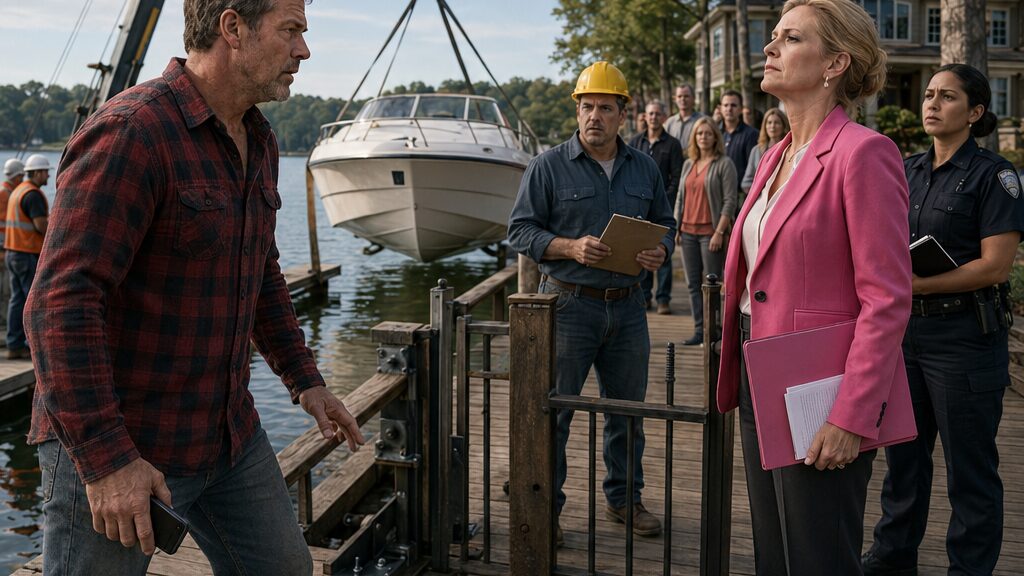
For one second, his mind refused to make sense of it. The white hull of the boat rocked against the morning water, still tied to the dock where he had left it the night before. A red service truck idled near the gravel turnoff by the side yard. Two workers in orange vests stood on his dock with their boots planted beside the new metal brackets he had installed under the transfer rail. One of them was already loosening a bolt.
The hook swung lower.
Michael set the mug on the deck rail so carefully that coffee sloshed over his knuckles.
“Stop,” he called.
The worker with the wrench looked up, then looked past him.
That was when Michael saw Karen Carter.
She stood near the dock gate in a bright pink blazer, one hand wrapped around a glossy folder, the other holding a stapled notice as if she had been waiting for him to walk outside and become part of the scene. Her hair was pinned tight. Her sunglasses sat on top of her head. Beside her, a man with a clipboard watched the crane operator and did not meet Michael’s eyes.
“Mr. Brown,” Karen said, “please remain clear of the work area.”
“My dock is the work area.”
“The association has authorized removal.”
Michael was already moving down the steps. His socks were damp before he remembered he had not put on shoes. The boards of the lower deck were cold under his feet. He crossed the yard in the red-and-black plaid shirt he had slept in, phone in his left hand now, thumb finding the camera without looking.
The crane engine growled. The hook kissed the boat’s lifting eye with a metallic tap.
“Do not attach that,” Michael said.
One of the workers paused again.
The man with the clipboard lifted one hand. “Continue.”
Michael stopped at the dock gate, close enough to see the printed logo at the top of Karen’s paper: Lakeview Ridge Homeowners Association. The date on the notice was today.
Today.
The work had started before the notice had touched his hand.
Karen extended the paper toward him. “You were advised of the violation and given opportunity to restore the dock to approved condition.”
Michael did not take it. “You dated this this morning.”
“It was posted this morning.”
“The crane was here before I opened the door.”
“That does not change the board’s authority.”
He looked beyond her. The worker had fastened the hook. The boat rose an inch, then settled as the straps tightened. Water slipped away from the hull in shining sheets.
“Put it down,” Michael said.
The crane supervisor finally looked at him. He had a square face and a yellow hard hat with a scratched sticker on the front. The stitched name on his work shirt read Hall.
“You the owner?” the man asked.
“Michael Brown. This is my property. That is my boat. That rail you’re unbolting is part of a repair I filed with the association.”
Karen’s mouth tightened. “It is an unauthorized exterior modification.”
“It’s a safety repair.”
“It is a lakefront structure outside approved design standards.”
“That bracket keeps the dock from twisting.”
“That bracket was not approved.”
The boat rose again, higher this time, its hull clearing the side bumper. It looked wrong suspended there, not floating, not moving under its own weight, just hanging above the water like something seized from a place where it belonged.
Michael stepped onto the dock.
The supervisor moved quickly, not aggressively, but enough to block him. “Sir, you need to stay back.”
“I need to see your work order.”
“We have one.”
“I need to see the authority that lets you remove property from my dock.”
Karen pushed the notice closer. “It is all in the enforcement packet.”
Michael looked at the packet but kept filming. “No. I asked him. Do you have a court order?”
The supervisor’s expression changed. Only a fraction, but Michael caught it. A small hesitation. A flick of the eyes toward Karen. A man who had been told one thing and had just realized he might be standing inside another.
“We were hired by the association,” the supervisor said.
“That isn’t what I asked.”
Karen stepped closer, her folder pressed against her ribs. “Mr. Brown, the association common rules allow corrective action when an owner refuses to remove a violation.”
“Corrective action does not mean taking my boat.”
“It means restoring the dock to compliance.”
“The boat is attached to the lift system.”
“The lift system is part of the noncompliant installation.”
Michael felt his jaw tighten. He forced his voice lower. “That lift system is not decorative.”
Karen glanced at the worker with the wrench. “Proceed with the rail.”
The worker bent toward the transfer rail.
Michael moved past the gate and stood between him and the remaining post.
“Do not touch that rail again,” he said.
The worker froze.
For the first time, Karen’s confidence sharpened into irritation. “You are obstructing authorized work.”
“I am standing on my dock asking for written authority before your crew dismantles a safety repair.”
“You received notice.”
“I received it after the crew arrived.”
“You had weeks to comply.”
“I had weeks of you not answering the emergency repair request.”
Her eyes flicked toward the phone in his hand. “Are you recording?”
“Yes.”
“Then record this accurately. You installed unapproved hardware, ignored the restoration deadline, and refused the association’s lawful correction.”
Michael held the camera steady on the suspended boat, the half-removed rail, the pink folder in Karen’s hand. “And you sent a crane to my property before serving the notice.”
A neighbor had appeared on the path beyond the yard. Then another. Someone stood near the red truck, phone lifted chest-high. Michael saw curtains move in the lake house next door. The engine noise made everything feel public, even his own breathing.
The supervisor shifted his clipboard from one hand to the other. “Ma’am,” he said to Karen, quieter, “maybe we should wait until this is clarified.”
“It has been clarified,” Karen said. “Continue.”
Michael turned the camera toward the supervisor. “Your name?”
The man swallowed. “James Hall.”
“James, do you have anything signed by a judge?”
“No.”
“Anything signed by me?”
“No.”
“Anything showing the appeal window closed?”
Karen cut in. “He is not required to debate you.”
“No,” Michael said. “But he is required to know what he’s taking.”
A siren chirped once near the driveway. Not a full arrival, just the short pulse of a patrol car letting everyone know it was there. Officer Melissa Lopez stepped out beside the red service truck and adjusted her belt as she took in the scene: crane, boat, neighbors, Karen, Michael barefoot on the dock with his phone raised.
Karen turned at once. “Officer, thank you. We have a homeowner obstructing an association enforcement action.”
Michael kept his phone up but lowered his voice. “Officer, they are removing my boat and dismantling a safety repair without a court order. The notice in her hand is dated today.”
Officer Lopez walked down to the dock gate, her face controlled in the way of someone already bracing for three versions of the truth. “Nobody move equipment for a minute.”
The crane engine stayed running. The boat hung still in the air, white hull suspended above green water.
Karen exhaled through her nose. “This is a civil enforcement matter.”
“Then it can stay civil while I understand it,” Officer Lopez said.
Michael felt the first thin line of relief, but it did not last. The boat still hung from the hook. The rail still had one bolt missing. The dock still looked exposed, wounded in the exact place he had tried to protect.
Officer Lopez asked for IDs, then paperwork. Karen produced her folder immediately, each page tabbed and clipped. Michael handed over his license with wet fingers and kept filming the exchange.
“What is the modification?” Officer Lopez asked.
Karen answered first. “A metal lift reinforcement and transfer rail added to a dock without approval.”
Michael said, “An emergency brace and rail after storm damage.”
“Was there a permit?”
“No permit required for replacing damaged bracing under the size threshold,” Michael said. “I checked with the marina clerk and submitted repair documentation to the HOA.”
Karen gave a small laugh without smiling. “He submitted an incomplete request after ordering work.”
Michael looked at her. “I submitted photos the day the dock shifted.”
“You submitted a vague safety concern.”
The words hit harder than they should have.
Vague. Safety. Concern.
Michael looked toward the house. Sarah’s curtains were still closed. She hated morning commotion. She hated strangers seeing any part of her life before she chose to show it. He had promised her, after the last neighborhood dinner where someone had spoken to her like a child, that he would never turn her body into an argument without her permission.
So he swallowed the full truth again.
“The rail is necessary,” he said.
Karen’s gaze sharpened, as if she had been waiting for the gap. “Necessary for what?”
Michael did not answer fast enough.
Karen looked at Officer Lopez. “This is what the board has dealt with for weeks. Assertions. No proper documentation. No approved hardship request. No completed accommodation form. Just unauthorized work on a lakefront structure.”
Officer Lopez turned to Michael. “Sir?”
Michael’s phone felt heavy. Behind him, the suspended boat creaked in its straps. The empty space beneath it showed the dark water and the new metal bracket bolted cleanly against the dock frame. He could hear Sarah’s voice from four weeks ago: Don’t make me the neighborhood project, Dad.
“It’s for family access,” he said.
Karen’s expression did not change, but something in her posture did. She looked more certain, not less.
Officer Lopez nodded once, not satisfied, not dismissive. “I can’t determine HOA authority or accommodation law standing here on the dock. I can document that there is a dispute. I can keep the peace. If either side believes property is being unlawfully taken, you’ll need civil process.”
“They’re taking it now,” Michael said.
“I understand.”
“No,” he said, then stopped himself. His voice had almost broken, and that would not help. “Officer, if they finish this, the dock won’t be usable the way it needs to be used.”
Karen snapped the folder shut. “The dock was usable before he altered it.”
Michael looked at the missing bolt. “You don’t know that.”
“I know what was approved.”
James Hall stood near the suspended boat, eyes moving between them. “Officer, I can lower it back into the slip while they sort it out.”
Karen turned on him. “You will not.”
Officer Lopez raised a hand. “Nobody is ordering anything for thirty seconds.”
The crane hummed. The lake slapped softly against the dock posts. A neighbor whispered from the path. Michael could feel the whole community watching a scene they did not understand and deciding anyway.
Karen opened the pink folder again and removed a second sheet. “The board has already incurred removal costs due to Mr. Brown’s refusal. If he interferes further, the association will add those costs to his account, including storage, labor, and restoration.”
“Storage?” Michael asked.
“The boat must be moved to access the noncompliant lift components.”
“That boat is not yours to store.”
“The association has the right to secure property involved in a violation until costs are reimbursed.”
Officer Lopez looked at Karen. “That sounds like something your attorney should be very sure about.”
Karen’s chin lifted. “We are proceeding under counsel’s guidance.”
Michael heard the sentence the way Karen intended it: final, official, polished enough to scare a homeowner back onto his porch.
He did not move.
Karen turned toward him, the lake light flashing across her sunglasses. “Until the association is reimbursed, that boat is under our control.”
Chapter 2: Four Weeks Before the Hook Touched the Hull
Sarah’s front wheel stopped at the edge of the dock, and the board under it shifted with a sound Michael felt in his teeth.
“Back up,” he said too sharply.
Sarah’s hands froze on the rims.
Michael was already crouching before she could answer. The lake was choppy from the storm that had blown through before dawn, and the dock moved in a way it never had before, not with the familiar give of floating lumber but with a sideways twist. The outer brace below the transfer rail had split along the grain. One metal fastener hung loose, bright and useless.
Sarah looked down at him. “Dad.”
“Just back up two inches.”
“I’m not on a cliff.”
“Sarah.”
She sighed but reversed carefully, palms controlled, shoulders tight. The front wheels rolled back onto the wider landing. The dock groaned again, softer this time, as if warning him not to pretend.
Michael pressed his hand against the cracked brace. It shifted.
For three seconds, neither of them spoke.
The boat bumped gently against its side fenders. White hull, clean deck, old blue rope tied twice around the cleat because Michael never trusted a single knot when Sarah was transferring. The boat had become more than recreation after the move to Lakeview Ridge. It was the easiest way to get Sarah to the lakeside therapy dock across the cove when traffic on the ridge road backed up, and it was the route the medical transport plan listed if the lower road flooded. More than that, it was the one place where Sarah could still decide to go somewhere without waiting for three neighbors to move their cars or for Michael to angle the van down the narrow drive.
She followed his gaze to the crack. “Can you fix it?”
“Yes.”
“You said that too fast.”
“I can stabilize it today and get a contractor out.”
“The association is going to have feelings about that rail again.”
“The association can have feelings after the dock stops trying to fold.”
Sarah gave him a look. “That is not how Karen Carter thinks.”
Michael stood and wiped damp grit from his palm onto his jeans. “Karen Carter is not standing on this board.”
“No. I am.”
That stopped him.
Sarah looked away first, toward the water, jaw set. She was thirty-one, old enough to hate being watched and young enough that every new compromise still felt like a theft. Michael saw the frustration in her hands before he saw it in her face. She was gripping the rims harder than necessary.
“I’ll take photos,” he said. “I’ll file the emergency repair notice. We’ll do it right.”
She laughed once, without humor. “Right as in safe, or right as in approved?”
He did not answer because he already knew those two things might not move at the same speed.
By noon, the storm clouds had cleared, leaving the kind of polished lake view that sold houses and disguised rot. Michael photographed everything: the cracked brace, the shifted board, the rusted fastener, the transfer rail angled a quarter inch out of true. He took one photo with a tape measure against the split and another from Sarah’s eye level, showing how the rail lined up with the boat’s side gate.
He opened the Lakeview Ridge HOA portal at the kitchen table while Sarah sorted through mail beside him, pretending not to watch.
The form offered neat categories.
Landscaping change.
Exterior color change.
Dock addition.
Boat lift modification.
Other.
Michael clicked “Other,” then changed it to “Dock repair,” then realized there was no dock repair option. He chose “Boat lift modification” because the transfer rail connected to the lift bracket, then wrote in the description box: Storm damage to existing dock brace and safety transfer rail. Emergency repair needed to preserve safe access and prevent further structural damage. Photos attached. Contractor estimate pending.
He hovered over the next line.
Medical accommodation request?
There was a checkbox.
Sarah’s mail stopped rustling.
Michael did not look up. “It might make this faster.”
“It might make me the subject of the next board email.”
“It would be private.”
“Nothing is private in this place once Karen gets a folder.”
He leaned back. “Sarah.”
“No diagnosis. No chair photos. No neighbor sympathy tour.”
“I wasn’t going to—”
“You think you’re subtle when you’re scared. You’re not.”
He closed his mouth.
The kitchen was quiet except for the refrigerator and the faint tap of a loose halyard from someone’s sailboat down the shoreline. Sarah reached across the table and touched the edge of his laptop, not closing it, just bringing his attention back to her hand.
“I need the rail,” she said. “I don’t need to become a committee item.”
Michael looked at the checkbox. Then at the photos. The one from her eye level showed only the rail and the boat gate. No part of her chair. No part of her.
He left the box unchecked.
“I’ll write family safety,” he said.
Sarah’s shoulders lowered a fraction. “Thank you.”
The portal accepted his submission at 12:43 p.m. and immediately sent an automated reply.
Your lakefront exterior modification request has been received. Architectural and shoreline changes require review within thirty days. Do not begin work until written approval has been issued.
Michael read it twice.
Sarah read it once and said, “Thirty days.”
“The contractor will tell me what can wait.”
“Dad.”
“I know.”
The original dock contractor arrived the next afternoon with a tool bag, a moisture meter, and the expression of a man who had seen homeowners wait too long because paperwork had trained them to ignore physics. He crouched where Michael had crouched and pushed one hand against the brace.
The board shifted.
“No,” the contractor said.
That single word did more than any paragraph.
“How bad?” Michael asked.
“Bad enough that I wouldn’t transfer weight across this corner. Bad enough that if the wind turns and the boat pulls against the lift, you could lose the bracket and twist the outer frame.”
“Can you stabilize it without changing the design?”
“I can reinforce the brace and reset the rail. It’ll look a little different because I’m not putting weak material back where stronger material is needed.”
“HOA says thirty-day review.”
The contractor looked toward the house, where Sarah sat just inside the sliding door, visible through the glass but out of earshot. “Does the dock need to be used before thirty days?”
“Yes.”
“Then the dock doesn’t care about their review.”
Michael almost smiled. Almost.
“What would you do if it were yours?”
“I’d document the damage, make the minimum necessary repair, and send them the invoice with photos. If they want pretty later, they can discuss pretty after safe.”
That sentence stayed with Michael.
Pretty after safe.
By evening, the temporary support was in place. Not beautiful, not invisible, but solid. A clean metal bracket hugged the cracked section. The rail stood straight again, cooler to the touch than the old painted wood. Sarah tested it only after the contractor had gone and Michael had checked every bolt twice.
She rolled to the transfer point, set her brake, placed her hand on the rail, and shifted her weight.
The dock held.
Michael did not breathe until she was seated safely in the boat.
Sarah looked up at him from the deck. “You’re doing that thing where you pretend you weren’t panicking.”
“I don’t have a thing.”
“You have several.”
He handed her the folded transfer strap. She took it, then let her hand rest for a moment on the new rail.
“It feels steadier,” she said.
That was all. No big speech. No gratitude that made either of them uncomfortable. Just a fact.
For Michael, it landed like a promise kept.
He sent the updated photos through the HOA portal that night, along with the contractor’s note: Emergency stabilization completed to prevent failure of damaged dock brace. Final cosmetic review pending.
The reply did not come until the next morning.
It was not automated.
Dear Mr. Brown,
Do not proceed until aesthetic review is complete.
Any unapproved modification to lakefront structures, including visible metal reinforcement, transfer rails, lift hardware, or dock extensions, may be subject to enforcement under Section 7.4 of the Lakeview Ridge Exterior Standards.
Regards,
Karen Carter
HOA Board Chair
Michael sat at the kitchen table with the email open and the lake bright behind the glass.
Sarah rolled in, saw his face, and did not ask whether they had approved it.
Chapter 3: The Pink Folder Made Safety Sound Optional
Karen Carter arrived before the contractor had packed the last drill battery into his case.
Michael saw her from the dock, a flash of pink moving down the stone path with the confidence of someone who believed every yard in Lakeview Ridge was partly hers. She had a phone in one hand, her enforcement folder in the other, and Amanda Nelson walking half a step behind her with a thinner binder pressed to her chest.
The contractor muttered, “That your reviewer?”
“That’s the board chair.”
“Lucky you.”
Karen stopped at the dock gate and photographed the new rail before saying good morning.
The sound of the phone camera clicked three times. Bracket. Rail. Boat lift. Then she lowered the phone and looked at Michael as if the photos had already proven something about his character.
“Mr. Brown,” she said, “you were instructed not to proceed.”
Michael stepped off the dock onto the landing. “The damaged brace was unsafe.”
“You were instructed not to proceed.”
“It was an emergency stabilization.”
Karen opened the pink folder. Even the inside tabs were color-coded. “Section 7.4 requires written approval before any visible lakefront alteration.”
“This was a repair.”
“It includes new visible metal hardware.”
“Because the old brace split.”
“It changes the exterior appearance.”
“It keeps the dock from shifting.”
Amanda glanced toward the rail but did not speak. She was dressed for a meeting, not a dock inspection, in tan slacks and flat shoes already collecting grit from the path. Michael had seen her at neighborhood events, usually polite, usually quiet when Karen spoke too long.
The contractor lifted his bag. “I can explain the structural issue if that helps.”
Karen barely looked at him. “Are you licensed for shoreline work under our association vendor policy?”
He paused. “I’m licensed for dock repair.”
“That is not what I asked.”
Michael felt heat rise in his neck. “He repaired damage that couldn’t wait.”
Karen turned a page in her folder. “Mr. Brown, the association is not disputing that you prefer the modification. The association is saying preference is not approval.”
“Preference?”
Her eyes moved to the rail. “Why do you need commercial-grade hardware on a residential dock?”
The contractor opened his mouth, but Michael lifted a hand slightly. Not now.
For a moment, the answer sat right there between them. Because Sarah’s weight shifts through that rail. Because the dock has to hold when she transfers. Because if the road floods, that boat is not a toy. Because my daughter asked me not to turn her life into paperwork for people who already stare.
Instead Michael said, “For family safety.”
Karen’s pen stopped above the form.
“Family safety,” she repeated.
“Yes.”
“What specific safety requirement?”
“The dock was unstable.”
“That explains the brace. It does not explain the transfer rail.”
“It was part of the same repair.”
“Is there an engineer’s letter?”
“The contractor’s note is in the portal.”
“Is there a medical accommodation request?”
Michael’s gaze moved, despite himself, toward the house.
Amanda followed the glance.
Near the sliding glass door, partly hidden in shadow, Sarah’s blue transfer cushion rested on the bench where Michael had set it after cleaning the boat. Beside it was the folded strap she used when the dock angle was bad. Ordinary objects if you did not know. A whole explanation if you did.
Amanda saw them. Michael saw that she saw them. Her expression changed, not dramatically, but enough: a brief pause, a slight lowering of the binder.
Karen did not turn. “Mr. Brown?”
“No,” Michael said. “There is no medical accommodation request.”
“Then the board has no basis to evaluate this as anything other than an exterior modification.”
“It is a safety repair.”
“You keep using that phrase without providing the required category.”
“Because safety is the category.”
Karen closed the folder halfway, then opened it again as if giving herself one more chance to remain patient. “I understand homeowners sometimes feel board standards are inconvenient. But lakefront structures affect sight lines, property values, shoreline compliance, and insurance exposure. If every resident makes individual changes and calls them urgent, the standards become meaningless.”
Michael looked at the cracked brace lying beside the contractor’s tool bag. “That piece of wood was not a standard. It was a failure.”
“Then you should have waited for inspection.”
“While no one used the dock?”
“If the dock was unsafe, you should have closed it.”
He almost laughed. Not because it was funny, but because the sentence was so clean and useless. Close the dock. Close the route. Close the one part of the house Sarah still reached without asking him to drive.
“And if closing it blocked access?” he asked.
Karen’s eyes sharpened. “Access to what?”
Again, the open door. Again, the promise.
Michael kept his voice even. “Access to normal use of the property.”
Karen wrote something down.
He knew, immediately, that it was the wrong answer.
The contractor shifted his weight. “Ma’am, for what it’s worth, the repair is minimal. It can be painted or capped if the issue is appearance.”
“The issue is process,” Karen said.
“With respect,” he said, “the process doesn’t keep a dock from moving.”
Karen looked at him then, fully. “And your invoice does not grant permission to alter association-regulated structures.”
The contractor shut his mouth.
Amanda finally spoke. “Karen, maybe we should ask for supplemental documentation before—”
“We have asked,” Karen said. “The portal record is incomplete.”
Michael turned to Amanda. “I uploaded photos the day after the storm. I uploaded the contractor’s note. I uploaded the invoice.”
Amanda’s grip tightened on her binder. “I saw the photos.”
“Then you saw the crack.”
“I did.”
Karen’s head turned a fraction. “Amanda.”
Amanda looked down.
There it was, Michael thought. The whole association in one small movement. Someone saw enough to hesitate, then looked down because Karen had the folder.
Karen removed a sheet from the front pocket and held it out. “This is not a fine yet. It is a notice of continuing violation and demand to restore the dock to its previously approved condition pending board review.”
Michael took the paper this time.
The language was formal enough to make harm sound tidy.
Unauthorized visible reinforcement.
Unapproved transfer rail alteration.
Potential impact on community shoreline standards.
Required restoration.
He looked up. “Restoring it means weakening it.”
“Restoring it means returning it to approved condition.”
“The approved condition cracked.”
“Then submit a compliant repair plan.”
“I did.”
“You submitted after-the-fact work.”
“Because the dock moved under my daughter’s chair.”
The sentence came out before he could stop it.
Karen went still.
Amanda looked at him.
The contractor looked away, suddenly busy with the zipper on his tool bag.
Michael’s hand tightened around the notice. He had not said diagnosis. He had not said medical. He had not said anything Sarah had forbidden. But he had opened the door, and he knew it.
Karen’s voice softened by one degree, which somehow made it worse. “If there is a disability-related request, the association has forms for that.”
Michael heard the word forms and felt something in him close.
“I’m not discussing my daughter’s private medical information on the dock.”
“Then you cannot expect the board to evaluate what you refuse to provide.”
“I expect the board not to order unsafe restoration while review is pending.”
“The unsafe condition was created when you chose to proceed without approval.”
“No. The unsafe condition was created by the storm.”
“And the violation was created by you.”
The contractor lifted his bag. “Mr. Brown, I’ll send the updated photos tonight.”
“Thank you,” Michael said.
Karen’s phone clicked again. This time, the camera pointed toward the rail from an angle that made it look larger, more industrial, less like something held by a human hand and more like something imposed on the view.
Amanda’s gaze drifted once more toward the transfer cushion near the door.
Michael wanted her to say something. He wanted anyone with a binder, a title, or a vote to say out loud that they understood there was a person behind the rail.
But Amanda only said, quietly, “You should submit the accommodation form.”
Michael looked at her. “Would that stop this notice?”
She did not answer.
Karen slid the pink folder under one arm and walked back toward the gate. “You have until the hearing to cure the violation or provide a complete application. If neither happens, the board will consider enforcement remedies.”
“What remedies?”
She paused with one hand on the dock gate.
“Restoration at owner expense,” she said.
Then she posted the violation notice on the gate with two strips of clear tape, smoothing the corners with her fingertips until it lay flat against the wood.
Chapter 4: The Hearing Turned a Rail Into a Fine
Michael walked into the clubhouse and saw his dock projected on the wall like evidence from a crime scene.
The photo was not one he had taken. It had been shot from low and close, with the new metal bracket catching the fluorescent light in a way that made it look oversized, almost industrial. The transfer rail cut across the screen at an angle. The cracked wood that had made the repair necessary was outside the frame.
Karen Carter stood beside the projection screen with a remote in one hand and her pink folder open on the table in front of her. Three HOA board members sat behind folding tables arranged in a shallow arc. Amanda Nelson sat at the far end, a pen between her fingers, eyes lowered to a printed packet.
A few residents had come. Not many. Enough.
Michael took the chair facing the board. The paper packet in front of him was thick with things he had already sent them: photos, invoice, contractor note, portal confirmation, storm date, emergency explanation. He had placed Sarah’s transfer details in a separate envelope and left it sealed inside his folder. She had not asked him to bring it. He had brought it anyway.
Karen clicked the remote.
Another photo filled the wall.
“Item four,” she said. “Brown residence. Unauthorized lift enhancement and visible metal reinforcement to a lakefront dock structure.”
Michael lifted his head. “It was a repair.”
“You’ll have a chance to speak.”
“I’d like the description corrected before the board discusses it.”
Karen’s eyes stayed on the packet. “The description reflects the violation.”
The board member beside Amanda cleared his throat. “Let’s proceed.”
Michael pressed his palm flat against his folder. He felt the sealed envelope inside it, a small ridge under the cardboard. Across the room, two neighbors whispered. One of them looked at the projected image, then at Michael, as if comparing the man to the metal.
Karen spoke for nearly six minutes before anyone asked him a question.
She did not raise her voice. That was the worst part. She read dates, sections, phrases from the governing documents. She described lakefront sight lines, consistency standards, shoreline exposure, and the association’s duty to prevent unapproved structures. Then she clicked to a highlighted page.
“Section 7.4,” she said. “No owner may alter, expand, reinforce, attach, replace, or modify any dock, lift, rail, pier, shoreline fixture, or lake-facing exterior component without prior written approval, except as expressly authorized under emergency maintenance guidelines.”
Michael looked up.
Except.
Karen clicked past the page before he could read the line beneath it.
She moved to an email from the insurance representative, enlarged on the screen. The visible paragraph warned that unapproved dock modifications could affect the community’s lakefront liability policy if left undocumented or inconsistent with association standards.
“This is not a cosmetic obsession,” Karen said. “We have a carrier review pending. After the accident at the north slip last year, the association cannot allow individual owners to improvise lakefront changes and then expect the rest of the community to absorb the liability.”
For the first time that night, Michael saw the room shift toward her.
Insurance did that. Liability did that. One person’s rail became everyone’s premium. One family’s dock became a community risk.
Karen clicked again. “Mr. Brown was told not to proceed. He proceeded. He was asked for a complete application. He did not provide one. He has described the alteration as a safety issue, but has not submitted the required accommodation documentation, engineering letter, or approved shoreline repair plan.”
Amanda looked up at the word accommodation.
Michael noticed.
The board member in the center turned toward him. “Mr. Brown, you may respond.”
Michael opened his folder. His hands were steady until he touched the sealed envelope. He slid past it.
“The storm on May sixth damaged the outer brace,” he said. “The dock shifted under use. I submitted photos the same day. The contractor said the brace could not wait thirty days. The repair was the minimum necessary to stabilize the dock and reset an existing transfer rail.”
Karen’s pen moved.
Michael placed copies on the table. “These are the photos with the cracked brace visible. These are the portal receipts. This is the contractor’s note. This is the invoice. This is the message I sent after the work was stabilized.”
The center board member read the top sheet. “This says final cosmetic review pending.”
“Yes. Because I was not refusing review. I was refusing to leave the dock unsafe while review happened.”
Karen turned a page in her packet. “The problem is that Mr. Brown is redefining approval as notification.”
“No,” Michael said. “I’m saying the emergency rule exists for emergencies.”
“Then he should have cited the emergency rule and filed the proper follow-up within forty-eight hours.”
“I filed the photos.”
“You filed an exterior modification request.”
“Because the portal did not have a dock repair option.”
A small murmur moved through the room. Not sympathy exactly. Recognition. Everyone who had ever fought a dropdown menu knew that kind of trap.
Amanda leaned toward her microphone. “Karen, did the board receive any hardship or accommodation request connected to this property?”
The room went quiet enough that Michael heard the building’s air conditioner click on.
Karen’s hand paused over her folder. “We received no completed accommodation form.”
“That wasn’t my question,” Amanda said.
Karen looked at her.
Amanda did not look away this time. “Did we receive any communication suggesting the repair related to access?”
Michael’s throat tightened.
Karen’s answer came carefully. “Mr. Brown used general language about family safety. He declined to provide specifics.”
Amanda looked at him then, not accusing, not forgiving. Just asking him to understand what his silence had cost.
The center board member turned to Michael. “Is this connected to a disability accommodation?”
Michael felt every face in the room angle toward him.
In his mind he saw Sarah at the kitchen table, mail in front of her, saying, No diagnosis. No chair photos. No neighbor sympathy tour.
He saw her hand on the rail after the repair, testing steadiness with the controlled force she hated needing.
He slid the sealed envelope forward one inch, then stopped.
“It is connected to safe access for my family,” he said.
Karen’s shoulders settled. That small movement told him she had what she needed.
The board member waited. “Can you be more specific?”
“Not in an open meeting without my daughter’s permission.”
Karen closed her folder, then opened it again to a tabbed page. “And that is exactly the issue. The association cannot evaluate claims that are not submitted through the required process. We are not mind readers, and we cannot expose the community to liability based on vague statements.”
Michael looked at Amanda. She looked down at her notes.
There was no victory in paperwork that proved only half the truth.
The board discussed the matter for twelve minutes. Michael heard his own repair become “after-the-fact work,” then “lakefront inconsistency,” then “potential precedent.” Amanda asked whether enforcement should be paused long enough for supplemental documentation. Karen answered that delay would reward noncompliance and weaken the association’s position during insurance review.
When the vote came, Amanda abstained.
The others voted to sustain the violation.
Karen read the motion as if she were reading weather conditions. “Owner is ordered to restore the dock and lift area to previously approved condition within seventy-two hours. If owner fails to do so, the association is authorized to take corrective action at owner expense, including removal of noncompliant components as necessary.”
Michael stood slowly. “Restoring it creates the unsafe condition again.”
Karen looked at him over the top of her folder. “Then submit a compliant emergency repair plan.”
“I did.”
“You submitted an incomplete request.”
He picked up the sealed envelope, felt its weight, and hated himself a little for being relieved he had not opened it.
Amanda caught him near the doorway before he left.
“Michael,” she said quietly.
He stopped but did not turn fully.
“You should file the accommodation form tonight.”
He gave a short laugh, tired and flat. “Would you have voted differently?”
Her face changed. “I didn’t vote against you.”
“No. You just made sure it counted the same.”
She absorbed that without defending herself.
Then she said, “Karen is scared of the carrier review. She thinks if she lets one dock stand outside process, the whole lakefront policy becomes vulnerable.”
“My daughter is not a loophole.”
“I know.”
“Do you?”
Amanda looked toward the meeting room, where Karen was stacking papers back into the pink folder. “I know more than I said.”
Michael waited.
Amanda lowered her voice. “There’s an emergency maintenance clause. It’s narrow, but it exists. I asked because I thought Karen would address it.”
“She skipped it.”
“She emphasized another section.”
“That’s a polite way to say skipped.”
Amanda did not argue.
From inside the room, Karen called Amanda’s name. The moment closed.
Michael walked out with the denial packet under his arm. On top, clipped to the front, was the order requiring restoration within seventy-two hours.
By the time he reached his truck, an email notification lit his phone.
Official Notice of Board Action.
He opened it under the parking lot light and read the final line twice.
Failure to restore may result in association-directed removal, storage, and cost assessment without further hearing.
Chapter 5: The Notice Came After the Truck
Michael replayed the recording at the edge of the patrol car and heard Karen’s voice say, clear as a bell, “Until the association is reimbursed, that boat is under our control.”
He dragged the slider back and played it again.
The crane engine rumbled beneath her words. The boat creaked in the straps. Somewhere on the recording, a neighbor whispered, “Can they do that?” and another answered, “It’s HOA. They can do anything.”
Michael paused the video and looked toward the dock.
The boat was no longer above the water. Officer Melissa Lopez had made them lower it back into the slip while she wrote down names, times, and the visible status of the property. But the damage had already been done. One section of the transfer rail lay on the dock like a broken railing from a different house. Two bolts were missing. The metal bracket at the outer brace was still attached, but the workers had loosened the cover plate, leaving dark holes in the wood where water would get in if he did not reseal them by nightfall.
Karen stood near the red truck, speaking into her phone. Her pink blazer looked too bright against the dull equipment and wet boards.
James Hall was by the crane controls, rubbing the back of his neck.
Michael walked over with his phone recording again, held low enough not to shove it in the man’s face.
“Mr. Hall.”
James turned. “Look, I don’t want trouble.”
“Neither do I. I want the timeline.”
James looked past him toward Karen.
Michael said, “She can hear me ask if she wants. What time were you told to be here?”
“I’d have to check the work order.”
“Please check.”
James hesitated, then pulled a folded sheet from the clipboard. He scanned it, jaw tightening slightly. “Crew arrival seven-thirty.”
“The notice was served after eight.”
“I don’t know when she served it.”
“You were already in my yard.”
He said nothing.
Michael pointed at the paper. “When was the work order issued?”
James folded it halfway, then seemed to think better of it. “Yesterday afternoon.”
“Yesterday.”
“That’s what it says.”
“My appeal window wasn’t closed yesterday afternoon.”
“I don’t know anything about your appeal.”
“But you were told the property was cleared for removal.”
James looked at the crane, at the boat, at the workers pretending not to listen. “That was the language.”
“Cleared by who?”
“The association.”
“Karen?”
He took too long to answer.
Michael did not push. He only let the silence sit until James filled it.
“She was the contact.”
Officer Lopez approached before Michael could ask more. “Mr. Brown, I’m noting that there’s a dispute about service time and authority. I’ve got photographs of the notice, the dock condition, and the boat position. I’m also noting that the work order appears to predate today’s notice, based on what I was shown.”
Karen ended her call and turned sharply. “Officer, the association’s internal scheduling is not a police matter.”
“No,” Officer Lopez said. “But statements made on scene are part of my incident notes.”
Karen’s mouth flattened. “I hope your notes also reflect Mr. Brown’s obstruction.”
“They’ll reflect that he requested written authority and stood near the rail. They’ll also reflect that I instructed all parties to pause physical work.”
Michael looked at Officer Lopez. “Can they leave with the boat?”
She chose her words carefully. “I am not authorizing them to take your boat. I am not adjudicating whether the association has civil authority to assess costs or seek removal. If they remove property today over your objection, that becomes part of the record.”
That was not victory. But it put a line on the ground.
Karen heard it too.
She closed the pink folder and walked toward James. Their conversation was low. James shook his head once. Karen pointed at the dock. He shook his head again, smaller this time.
Ten minutes later, the crane hook lifted away empty.
The red truck did not leave right away. The crew loaded the detached rail section into the back, then unloaded it after Michael said, “Those are my materials.” James looked at Karen. Karen looked at Officer Lopez. The rail came back off the truck and landed on the grass beside the dock gate with a metallic thud.
Michael photographed it from three angles.
By the time the crew finally pulled out, neighbors had begun to disappear behind curtains and hedges. The performance was over for them. For Michael, it had only changed forms.
He walked the dock with Officer Lopez while she took final notes. He pointed to each loosened bolt, each hole, each scraped plate. He did not mention Sarah until they reached the transfer point and saw the rail section missing.
Officer Lopez looked at the gap. “Is someone in your household using this?”
Michael leaned against the post, suddenly tired. “Yes.”
“Mobility?”
He looked toward the house. “Yes.”
“Did the association know that?”
He thought of Karen asking, Necessary for what? He thought of Amanda looking at the transfer cushion. He thought of the sealed envelope still inside his hearing folder.
“They knew there was an access issue,” he said. “I didn’t give them every detail.”
Officer Lopez wrote that down too.
By noon, Michael had created a folder on his laptop called Removal Timeline. He hated the name immediately and kept it anyway.
He uploaded the video from his phone. He saved screenshots: crane hook over boat, notice date, Karen holding the paper, James’s work order with the visible timestamp, rail on the grass, empty bolt holes. He scanned the hearing order and the original portal submission. He added Officer Lopez’s incident number to the top of a document.
Only after that did he check his email.
There were three new messages from the HOA.
The first was a notice of continuing violation.
The second was a cost assessment for attempted corrective action: crane dispatch, labor minimum, administrative fee.
The third made him sit back in his chair.
Lakeview Ridge HOA has incurred costs associated with removal preparation and compliance restoration. Additional charges will accrue for storage, rescheduling, and site restoration if owner continues to deny access. Association reserves the right to secure vessel and related lift components until owner account is brought current.
Secure vessel.
Related lift components.
Until owner account is brought current.
Michael printed it because holding the page made it easier not to throw the laptop.
He spent the afternoon sealing the bolt holes before moisture could spread. The work was awkward because the rail section was down. Every time he knelt, he saw the empty brackets and pictured Sarah’s hand reaching for a rail that was no longer there.
At five-thirty, the sliding door opened.
Sarah came out onto the deck but stopped before the ramp down to the yard. She had the controlled expression she used when she had decided not to ask for help. Michael set down the sealant gun and wiped his hands.
“Don’t come down yet,” he said. “I need to secure the—”
“I can see.”
He looked at the dock, then back at her.
Her eyes were on the rail lying in the grass.
“What happened to the boat?” she asked.
“It’s still here.”
“What happened to the rail?”
“They loosened it. I stopped them before they took the rest.”
She rolled forward to the top of the yard ramp. “They?”
“Karen. A crew. Officer Lopez came.”
Sarah’s hands closed around the rims of her chair. “You didn’t call me.”
“It was already happening.”
“That’s not an answer.”
He picked up the printed HOA email and immediately wished he had not. Sarah saw the paper. Her gaze moved from the page to his face.
“What is that?”
“Another assessment.”
“For what?”
“Attempted removal.”
She laughed once, disbelief more than humor. “They’re charging you for not letting them take it?”
Michael did not answer.
Sarah looked past him to the empty dock brackets. She was quiet long enough that the lake sounds came back: water against posts, a boat engine far across the cove, the ticking of cooling metal where the rail sat in the grass.
Then she said, “Dad, you didn’t tell them because of me.”
Michael folded the paper in half.
Sarah’s voice changed, not louder, but sharper. “You let them stand there and call it optional because of me.”
Chapter 6: Sarah Chose the Word Michael Avoided
Sarah placed the violation notice beside her medical transfer plan and circled the word optional so hard the pen tore the paper.
Michael stood on the other side of the kitchen table with the coffee he had not touched. The house was too bright, the lake throwing morning light through the glass doors onto the documents spread between them: Karen’s notice, the hearing order, the cost assessment, Officer Lopez’s incident number, contractor photos, the printed portal receipt, and Sarah’s laminated emergency access checklist.
Sarah tapped the torn circle with the pen.
“That’s the word,” she said.
Michael looked at the notice. “I know.”
“No. You hate the word because it’s wrong. I hate it because you let them use it.”
He felt the sentence land and did not defend himself fast enough.
Sarah’s chair was angled toward the table, brakes locked. Her hair was still damp from the shower. The transfer from bathroom to chair had taken longer because the dock rail was down and the boat was unusable, which should not have affected the bathroom at all, except everything did now. Once a system broke in one place, the whole day rearranged itself around the missing piece.
“I was trying to keep your privacy,” he said.
“You were trying to keep control.”
That one made him look up.
Sarah’s face was not angry in the way he expected. It was worse. It was steady. She had already cried somewhere he had not seen, or had chosen not to, and now she was past the part where he could comfort her instead of hearing her.
“You asked me not to make your medical information public,” he said.
“I asked you not to turn me into a sad story for the neighborhood.”
“I didn’t.”
“No. You turned me into a blank space. They filled it with ‘optional.’”
He leaned both hands on the table. “Sarah, in that room, if I had said more—”
“Then I could have been mad at you for saying more. That would have been between us. Instead Karen got to decide what my life sounded like.”
Michael looked at the checklist. It had been written by a medical supply technician two years earlier after Sarah moved in: transfer heights, stable handhold points, emergency transport route, alternate exit if driveway blocked, boat access when lower road flooded. The language was dry and exact. It did not pity anyone. It simply stated what had to exist.
“After the community dinner,” Michael said quietly, “you said you never wanted them discussing your chair again.”
“I know what I said.”
“I promised.”
“And I believed you.” Her hand softened on the pen. “But I didn’t ask you to lose the dock.”
He pulled out the chair and sat. The printed pages blurred for a moment, not from tears, but from fatigue. Two days of calls, emails, hardware checks, and careful anger had left him hollowed out.
His phone buzzed.
Amanda Nelson.
He answered because Sarah nodded once.
“Michael,” Amanda said, without greeting, “Karen called an emergency board session for tonight.”
Michael put the phone on speaker. “For what?”
“Final compliance action and cost authorization.”
Sarah’s gaze sharpened.
Amanda continued, “She wants to convert the attempted removal charges into a formal account assessment and authorize rescheduling the crew after insurance counsel reviews the language.”
Michael closed his eyes briefly. “The insurance review that supposedly required immediate action.”
“I know.”
“Are you calling to warn me or prepare me?”
A pause.
“Both,” Amanda said.
Sarah leaned closer to the phone. “Did she include the emergency repair clause this time?”
Amanda went silent.
Michael looked at Sarah.
Sarah’s expression did not change. “This is Sarah Brown.”
Amanda recovered. “Sarah. I’m sorry. I didn’t realize you were there.”
“I live here.”
Another silence. Smaller, more ashamed.
Amanda said, “No. Karen’s packet emphasizes Section 7.4 and the board’s corrective authority. It does not include the full emergency maintenance language.”
Michael wrote that down.
Sarah said, “Does the board have my father’s portal submission?”
“Yes.”
“Does it show the storm damage?”
“Yes.”
“Does it show he asked for emergency review?”
“It shows he described emergency stabilization.”
“Does it show you received it before the repair was finished?”
Amanda’s voice was quieter now. “Yes.”
Sarah looked at Michael, and he understood the look. Not triumph. A door opening.
Amanda said, “Michael, there’s something else. Karen may offer you a settlement before the meeting. If she does, read it carefully.”
As if summoned by the warning, another call flashed on Michael’s screen.
Karen Carter.
He let Amanda hear him say it. “She’s calling now.”
Amanda exhaled. “Then read it more carefully than that.”
The call ended.
Michael let Karen’s call ring until it stopped. Thirty seconds later, an email arrived.
Settlement proposal.
Sarah watched him open it.
The terms were short. Michael would accept responsibility for the unapproved modification, pay a reduced administrative fine, withdraw any objection to the attempted removal costs, and submit a new dock repair request with complete documentation. In exchange, the HOA would temporarily suspend further removal pending review.
There was no admission of error.
No reversal of the violation.
No restoration of the rail.
No promise the boat would remain untouched.
At the bottom, Karen had written one sentence in the message body.
This allows everyone to move forward without unnecessary public discussion.
Sarah read it twice.
Then she laughed, but there was no amusement in it. “There I am again.”
Michael looked at her.
“Unnecessary public discussion,” she said. “That’s me.”
“No.”
“That’s what she means.”
He wanted to say Karen meant process, liability, the board, the neighbors, anything else. But he had spent too long letting cleaner words cover uglier ones.
“Yes,” he said.
Sarah’s eyes flicked to his. Something between them shifted, not healed but made honest.
Michael selected reply, then stopped. “What do you want me to say?”
Sarah’s hand moved to the laminated checklist. “Nothing yet.”
She rolled away from the table and toward the sliding door. At the threshold, she stopped. The path to the dock was visible from there. So was the rail section still lying on padded blocks in the grass, ready for reinstallation if the board ever allowed the obvious.
“I want to go tonight,” she said.
“To the meeting?”
“Yes.”
“You don’t have to.”
“I know.”
“It may get uncomfortable.”
“It already is.”
Michael walked to the door but did not stand in front of her. He had done that too often, he realized. Positioned himself between her and the thing coming, whether she had asked him to or not.
Sarah looked up at him. “I’m not giving them my diagnosis. I’m not answering questions about my body. I’m not becoming their lesson.”
“What do you want to give them?”
She held up the checklist. “This. The part that says what the house requires. Not why my body requires it.”
Michael nodded slowly. “You decide what gets said.”
“Yes,” she said. “I do.”
That evening, before the meeting, Karen tried one more time.
She approached them in the clubhouse parking lot with the pink folder tucked under one arm and her phone in the other. She was dressed as if for a board portrait, blazer pressed, shoes clean, mouth arranged into professional concern.
“Mr. Brown,” she said. Then, after the smallest hesitation, “Sarah.”
Sarah’s hands rested loosely on her wheels. “Ms. Carter.”
Karen glanced toward the clubhouse doors. “I sent a proposal that would avoid escalation tonight.”
Michael said, “It asks me to admit the repair was improper.”
“It was unapproved.”
“It was emergency stabilization.”
“It asks you to follow the process.”
Sarah said, “The process removed my rail.”
Karen’s face tightened. “The rail was not removed.”
“Part of it was unbolted and put on the grass.”
“The work paused.”
“Because my father stood there.”
Karen looked at Michael. “This is exactly why a calm settlement is best. Public meetings are not designed for sensitive personal circumstances.”
Sarah smiled faintly. “Then maybe don’t make sensitive personal circumstances into public violations.”
For the first time, Karen had no immediate answer.
Inside, the board table had been rearranged. More residents had come this time. Word had spread after the crane. Michael saw phones in hands, whispers passing, eyes moving to Sarah and away again.
He felt the old instinct rise: step in, answer first, make it easier.
Sarah touched his wrist once.
Not hard. Not dramatic.
Just enough.
Karen opened the meeting with the settlement proposal, calling it a reasonable path to compliance. She spoke of insurance exposure, inconsistent dock hardware, and the danger of allowing owners to self-certify emergency work.
Then Michael stood. He did not open with Sarah. He opened with the timeline: storm damage, portal submission, contractor warning, repair photos, board notice, hearing, removal order, crane arrival before service. He handed each board member a packet.
Karen interrupted twice. The board let him continue once Amanda said, “I’d like the timeline entered.”
Then Sarah rolled forward.
The room changed. Michael hated that it changed. Sarah noticed too; he saw it in the angle of her shoulders. But she did not retreat.
She placed the laminated checklist on the table.
“This is not my medical history,” she said. “It is not an invitation to discuss me. It is the access plan for the home where I live.”
Karen’s lips parted. “Sarah, no one is questioning—”
Sarah turned the checklist toward the board. “This line identifies the dock transfer rail. This line identifies the boat route when the lower road is blocked. This line identifies stable handhold points required for safe transfer. The rail your crew unbolted is on that list.”
No one spoke.
Sarah looked directly at Karen. “My father should have let me decide sooner. That part is between us. But you had his emergency repair request. You had photos of storm damage. You had a board member ask whether this involved accommodation. You still sent a crew before the notice was served.”
Karen’s fingers tightened on the pink folder. “The association acted under the information provided.”
Sarah’s voice stayed even. “Who signed responsibility for blocking my only safe dock exit?”
Chapter 7: The Dock Marks Stayed After the Fine Was Gone
Karen opened the meeting with an apology that did not contain the word wrong.
She stood behind the same folding table where she had turned Michael’s dock into a projected violation, the pink folder closed this time but still centered in front of her like a shield. Sarah sat beside Michael in the front row. The laminated access checklist rested on her lap. Michael had asked once in the parking lot if she wanted him to hold it for her. She had said no, not sharply, just clearly enough that he had put both hands in his pockets and left them there.
Karen adjusted the microphone.
“After further review,” she began, “the board recognizes that the Brown matter involved circumstances that were not fully understood at the time of enforcement.”
Michael heard the carefulness in every word.
Not mishandled.
Not misrepresented.
Not rushed.
Not wrong.
Amanda Nelson sat at the board table with a stack of marked documents in front of her. She was not looking at Karen. She was looking at the packet Karen had sent out two hours before the meeting, the revised version with softened language and no admission that the crane work order had been issued before Michael’s appeal window closed.
Karen continued. “The association remains committed to consistent lakefront standards. However, in light of supplemental information provided by the owner and resident, I propose that we suspend additional enforcement while a compliant repair application is reviewed.”
Sarah’s fingers tightened on the edge of the checklist.
Michael stood.
Karen stopped.
He did not raise his voice. “Suspend isn’t enough.”
The room turned toward him in the same way it had turned toward Sarah before, with curiosity dressed up as concern.
Karen’s expression held. “Mr. Brown, you will have time for owner comment after the motion is introduced.”
“No,” Amanda said.
Karen looked at her.
Amanda lifted one page from her stack. “He should respond before we frame the motion.”
The center board member shifted in his chair. “Let’s hear him.”
Michael walked to the table and placed three documents side by side: the storm damage photo, the crane work order, and Karen’s settlement proposal. He had slept badly for a week, but his hands did not shake.
“This started as a repair,” he said. “Not an upgrade. Not a dock expansion. Not a lift enhancement. A repair after a storm shifted the brace under a transfer rail.”
Karen opened her mouth.
Michael looked at her once. She closed it.
He pointed to the first page. “This photo was submitted before the work was finished. This work order was issued before the final notice was served. This settlement asked me to accept responsibility for a violation without the association admitting it tried to remove access before review was complete.”
A low murmur moved through the room.
The center board member leaned forward. “Mr. Brown, what resolution are you asking for?”
Michael had written it down. He did not read from the paper. He had spent too long hiding behind careful language.
“Withdraw the violation. Reverse the attempted removal charges and any storage or administrative fees tied to the crane. Approve emergency stabilization under the repair clause, subject to a real inspection. Put in writing that the boat and lift components are not association-controlled property. And restore the transfer rail to safe use.”
Karen said, “The board cannot simply approve noncompliant hardware without—”
Amanda lifted the page in her hand. “Actually, we can approve emergency stabilization pending retroactive design review.”
She turned the document toward the room. “Section 7.4 is not the only applicable provision. The emergency maintenance clause allows an owner to take minimum necessary action to prevent damage, injury, or loss of access, provided the owner submits documentation promptly and cooperates with later review.”
Michael looked at the page.
It was the line Karen had clicked past at the hearing.
Amanda kept reading. “The owner submitted photographs, contractor notes, and an emergency description through the portal. Whether the submission was ideally categorized is a separate question from whether the association had grounds to order physical removal before completing review.”
Karen’s face had changed color, not dramatically, but enough.
“The portal category was wrong,” Karen said. “He filed under lift modification.”
“Because there was no dock repair option,” Amanda said.
“That does not waive standards.”
“No one is saying it does. We’re saying standards include the emergency clause.”
The room had gone still in a different way now. Not the hungry stillness of neighbors waiting for conflict, but the uncomfortable stillness of people realizing the clean story had seams.
Karen’s hand moved to the pink folder. “The insurance issue remains.”
Amanda nodded. “Then require inspection and a finish treatment compatible with the dock standards. Do not call a necessary temporary stabilization an owner refusal. Do not charge the owner for a crane that arrived before service was complete.”
Michael looked at Sarah.
She was watching Amanda, not with gratitude, but with assessment. She had learned, faster than he had, not to confuse someone finally saying the right thing with the harm disappearing.
The center board member asked Karen, “Did counsel approve the phrase association control of the vessel?”
Karen’s jaw tightened. “That phrase was used informally during a tense enforcement scene.”
Michael took out his phone and set it on the table. He did not play the recording. He only placed it there.
“No,” he said. “It was used while my boat was hanging from a crane.”
Karen looked at the phone as if it might speak on its own.
Officer Melissa Lopez’s incident report lay in Michael’s folder, but he did not pull it out yet. He did not want to win by burying the room in paper. He wanted the board to say what had happened plainly enough that Sarah could cross the dock without the word optional following her down the ramp.
Sarah rolled forward.
Michael stepped back without thinking, giving her the space before she had to ask.
She placed the laminated checklist beside his documents. “I don’t need the association to approve me,” she said. “I need the association to stop treating access like decoration.”
No one interrupted her.
“The rail can be painted. The bracket can be inspected. The finish can match the dock. I’m not arguing for ugly hardware. I’m arguing that you don’t get to tear out the safe thing first and discuss appearance later.”
Karen looked down.
Sarah’s voice remained steady. “My father made a mistake when he tried to protect my privacy by not being specific. I made a mistake thinking privacy meant silence would be safe. But the board had enough information to pause. You didn’t.”
Michael felt the sentence pass through him like a clean cut.
The center board member folded his hands. “Ms. Brown, thank you.”
Sarah’s mouth tightened. “Please don’t thank me yet. Vote.”
Amanda moved first. “I move that the board withdraw the violation issued to the Brown residence, reverse all attempted removal, storage, labor, and administrative assessments connected to the crane action, recognize the dock repair as emergency stabilization pending inspection, and require the association to provide written approval terms for a compliant final finish within seven days.”
The room inhaled.
Another board member seconded.
Karen did not.
The vote was not unanimous, but it passed.
Karen voted no. She did it softly, almost under her breath, as if volume could change meaning.
Michael did not feel triumph. He felt the weight of a thing set down after being carried too far.
The written decision came three days later, not perfect, not warm, but real. Violation withdrawn. Fees reversed. Emergency stabilization accepted. Inspection required. Final rail finish to be painted matte white to match existing dock trim. Boat and lift not subject to association control absent court order or owner consent. Future accommodation-related repair requests to be reviewed under a revised confidential process.
Michael read the last line twice.
Confidential.
He handed the letter to Sarah.
She read it at the kitchen table, expression unreadable. “They still didn’t say wrong.”
“No.”
“But they put it in writing.”
“Yes.”
She folded the letter once, then slid it back to him. “That matters more.”
The contractor returned on Thursday with the rail section and a new cover bracket. James Hall came too, not with the crane, but in his own pickup. He stayed near the driveway until Michael saw him and walked over.
“I wanted to say something,” James said.
Michael waited.
“I should’ve paused sooner.”
Michael looked past him to the dock, where the contractor was aligning the rail over the old bolt holes. “Yes.”
James nodded, accepting the answer without excuse. “I told the board when the work order came through. Time and date. I don’t know if it helped.”
“It did.”
James looked relieved, then ashamed of the relief. “I’m sorry about the boat.”
Michael looked at the water. The white hull was back in its slip, tied twice to the cleat. “It wasn’t just the boat.”
“I know that now.”
Michael nodded once. That was all he had to give him.
The inspection required two adjustments. A rounded cap on the rail end. A matching finish on the bracket. The contractor grumbled but did the work cleanly. By late afternoon, the new approved bracket covered most of the scar where the crew had loosened the plate. Not all of it. Two darker marks remained in the wood, faint but visible if you knew where to look.
Sarah saw them immediately.
“They didn’t cover everything,” Michael said.
“I know.”
“I can ask him to replace that board.”
She studied the marks, then shook her head. “Leave it.”
He looked at her.
“I want to remember where the weak spot was.”
The sun had dropped low enough to turn the lake silver. Michael stood on the dock while Sarah waited at the top of the ramp. He had positioned himself beside the transfer point out of habit, close enough to help if she needed him, far enough not to crowd her. She rolled forward slowly, front wheels crossing the first seam, then the next.
The repaired rail waited at the edge, matte white now, ordinary to anyone passing by.
Sarah reached for it.
Michael’s hands twitched at his sides.
She noticed. Of course she did.
“Don’t,” she said.
He put his hands behind his back.
Sarah set her brake, shifted her weight, and used the rail. The dock held. The bracket held. The boat moved gently against its rope, ready but not claiming the moment.
She completed the transfer without his hand on the chair, without his palm hovering at her shoulder, without the whole neighborhood turning her life into a meeting.
When she was settled, she looked back at him. “See?”
Michael nodded.
His throat felt tight, so he said only, “I see.”
Behind them, the old bolt marks stayed visible beside the new bracket. Not as proof for Karen. Not as a monument for the neighbors. Just two dark circles in the wood where a rule had become a wall, and where they had decided not to let it stay one.
The story has ended.