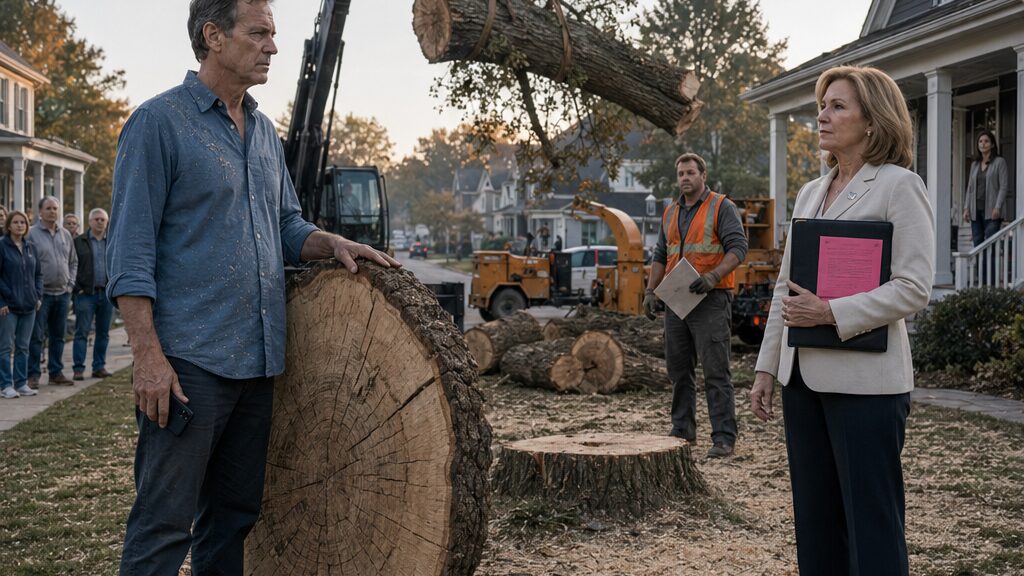
The HOA Cut Down Robert’s Seventy-Five-Year-Old Oak, Then Charged Him for the Damage
Chapter 1: The Crane Arrived Before Robert Could Reach the Lawn
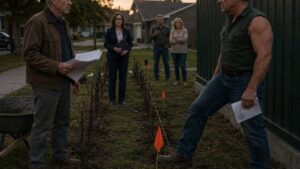
The crane had already lifted one of the oak’s largest limbs above Robert Anderson’s roof when he ran onto the lawn barefoot.
For one disoriented second, he thought the grinding sound had come from a garbage truck. Then the chainsaw bit deeper, and the limb hanging from the crane shuddered as if it were still trying to pull itself back toward the trunk.
“Stop!” Robert shouted.
The tree-crew foreman looked down from beside the bucket truck. His orange vest glowed under the work lights. “Sir, stay clear of the drop zone.”
“That’s my tree.”
The foreman glanced toward the street, not at the oak. “We have an authorized work order.”
“Then show it to me.”
Another saw started above them.
Robert stepped toward the trunk. The foreman moved into his path and raised one gloved hand. Behind him, the crane operator swung the severed limb toward a flatbed already piled with branches. The oak had shaded the front of the house for as long as Robert could remember. Now half its crown was gone, leaving a pale opening in the sky.
“What time did you start?” Robert asked.
“Six.”
“It’s six twenty-three.”
“We were told the owner had been notified.”
“I’m the owner.”
The foreman’s expression tightened. He turned and called for the saws to pause, but the worker in the bucket had already completed another cut. A section of branch dropped against its rigging and sent leaves trembling over the driveway.
Robert looked toward the curb. Three trucks. A crane. A chipper. No marked county vehicle. No arborist’s placard. No permit displayed in a windshield.
“Who hired you?”
“Association contract.”
“Who signed the authorization for this lot?”
The foreman pulled a folded packet from the cab. He kept it in his own hands while Robert read upside down.
Community appearance and reserve restoration work.
Tree obstruction removal.
Open-view improvement—lot 208.
Robert read the last line again.
Lot 208 stood across the street, slightly uphill from his property. Jennifer Hill’s gray house had been listed for sale two weeks earlier. From her upstairs windows, the oak blocked part of the distant reservoir.
“This isn’t lot 208,” Robert said.
“The tree affects the view corridor.”
“There is no view corridor.”
The foreman tapped the packet. “That’s what we were given.”
“Where is my signature?”
The man turned the page. There was a line for association authorization and another for vendor acknowledgment. Robert’s name did not appear anywhere.
“Who told you I approved this?”
“I don’t handle the office side.”
“Then call whoever does.”
The foreman stared at the remaining trunk. “Sir, the crown is already compromised. We can’t leave it standing like this.”
Robert looked up. They had removed enough weight from one side that the tree leaned visibly toward the house. Stopping now would not save it. The decision had been made before he woke.
He swallowed the first words that came to him.
“Photograph every page,” he said.
“What?”
“Lay the work order on the hood. I’m photographing it.”
The foreman hesitated, then complied. Robert took pictures of the packet, the equipment, the company markings, the truck plates, the cut line, and the absence of any posted permit. His hands shook only once, when he aimed the phone at the oak.
The final trunk cut took nearly twenty minutes. The chainsaw entered from both sides, throwing pale dust across the grass. When the crane eased the upper trunk away, the fresh cross-section appeared broad and white, its rings tight near the center and wider toward the bark.
Something dark showed on one slab.
Robert moved closer.
The cut had passed beneath an old carving. The letters were blunt and uneven: T.S. Beneath them, almost swallowed by the bark, was the year 1952.
His father, Steven, had carved it when he was seventeen.
Robert had seen those initials every time he mowed around the roots, but never from this angle. The cutting had opened the tree’s hidden center beneath them, seventy-five years of weather stacked into circles.
The crew began rolling the slab toward the chipper.
“No,” Robert said.
The worker kept pushing.
Robert planted himself between the slab and the machine. “That section stays.”
“It’s part of the removal.”
“It is evidence from my property. It stays.”
The foreman came over, his jaw set. “We’re contracted to haul all debris.”
“You have no owner authorization, and you’ve already admitted it. Call your office before you touch that piece again.”
For several seconds, only the chipper engine filled the yard.
Then the foreman motioned for the worker to leave it.
Robert dragged the slab toward his garage. It was heavier than he expected. The rough bark scraped his palms. He managed only a few feet before one of the younger workers silently took the other side and helped him set it beside the wall.
“Sorry,” the worker said without meeting his eyes.
By seven fifteen, neighbors had gathered along the sidewalks. Some held coffee mugs. Others stood in robes or running clothes, watching the crew load sections of the oak onto the flatbed.
A dark SUV stopped near Robert’s driveway.
Sharon Campbell stepped out wearing pressed slacks, a cream jacket, and the small silver pin she wore at every HOA meeting. She carried a binder under one arm and a bright pink sheet of paper in her hand.
Robert walked toward her.
“Did you authorize this?”
Sharon looked past him at the stump. “The board approved necessary landscape correction.”
“On private property?”
“The tree created an obstruction affecting an adjacent home.”
“Show me the covenant.”
“You’ll receive the documentation through the normal process.”
“The work order has no owner signature.”
“The association has easement authority for community maintenance.”
“Not for a healthy tree twenty feet inside my property line.”
Her mouth tightened. “That’s a matter for review.”
She crossed the lawn toward his front door.
“What are you doing?”
“Posting notice.”
She placed the pink sheet at eye level and pressed two strips of clear tape across the top.
Robert read the bold line first.
REMOVAL ASSESSMENT: $3,200.
Below it, the notice cited obstruction correction, emergency vendor deployment, and failure to maintain a compliant view condition.
“You cut down my tree,” Robert said, “and you’re charging me for it.”
“The condition originated on your lot.”
“There is no view condition in the recorded rules.”
“That determination is not yours to make.”
A few neighbors shifted closer. Sharon lowered her voice, but not enough to keep them from hearing.
“Rules are rules, Robert.”
He looked at the notice, then at the carved slab beside the garage.
Without answering, he peeled the pink page from the door and carried it across the lawn. He set it against the pale rings, directly below T.S. 1952, and took three photographs.
Sharon watched him.
“What exactly are you doing?”
“Establishing the condition in which the assessment was delivered.”
Her eyes narrowed slightly. It was the first sign that his calm had unsettled her.
Robert turned toward the crew. “I need the legal name of the contracting company, the project number, the person who issued verbal instructions, and the insurer listed on your certificate.”
The foreman began reciting the information.
Sharon closed her binder. “This performance won’t alter the outcome.”
Robert did not look at her. “Then the records should support you.”
Across the street, the front door of lot 208 opened.
Jennifer Hill stepped onto her porch. Her house now had an uninterrupted view across Robert’s ruined yard toward the reservoir. Sharon lifted a hand toward her.
“Lot 208 required the obstruction removed,” she said.
Jennifer did not return the gesture.
She stared at the stump, then at Robert, her face drained of color.
Whatever Robert had expected to see in the expression of the neighbor who had benefited, it was not horror.
Chapter 2: The Neighbor Who Benefited Would Not Meet His Eyes
The second pink notice was tucked beneath Robert’s welcome mat before the first appeal had even been scheduled.
He found it when the paper rasped against the concrete under his shoe. The notice cited an unapproved exterior decorative item and assessed a hundred and eighty dollars. The photograph attached to it showed the same brown mat that had been outside his door for six years.
Robert stood on the porch holding the notice while sawdust drifted in pale lines across the lawn.
The stump had been ground only halfway. Splinters and curled shavings remained around the exposed roots. The crew had taken every piece except the carved slab, which Robert had moved into the garage and covered with an old moving blanket.
He carried the second notice inside and placed it beside the first.
At ten that morning, he walked across the street to lot 208.
A real-estate lockbox hung from Jennifer’s front handle. Through the sidelights, he could see stacked moving cartons and a bare wall where photographs had been removed.
Jennifer opened the door only a few inches.
“Robert.”
“I need to ask you one question.”
“This isn’t a good time.”
“Did you request that the oak be removed?”
Her gaze slid toward his yard.
“No.”
The answer came quickly, but not firmly.
“Did Sharon discuss it with you?”
Jennifer’s fingers tightened around the edge of the door. “She mentioned improving the sight line for the listing.”
“Improving it how?”
“She didn’t say they were going onto your property.”
“Did you sign anything?”
“No.”
“Did you tell her you wanted the tree gone?”
Jennifer looked over her shoulder into the empty house. “I told her the agent photographs would look brighter if the reservoir were more visible.”
“You are the agent.”
“For my own listing, yes.”
“That wasn’t my question.”
Her face hardened, then softened again almost at once. “I didn’t ask her to cut it down.”
“Will you put that in writing?”
“I have a closing pending.”
“That isn’t an answer either.”
She lowered her voice. “The buyer has already asked why there are trucks and people taking pictures. I cannot have a property dispute attached to the sale.”
“A property dispute?”
“I’m not saying it’s your fault.”
“My tree is gone.”
“I know.”
He waited for more. Jennifer looked down at the threshold.
“You saw the crew,” Robert said. “You were outside before they finished.”
“I didn’t know what authority they had.”
“Neither did they.”
Her eyes lifted to his. For a moment, he thought she might finally say what she had seen. Instead, she stepped back.
“I’m sorry, Robert. I can’t be involved until the closing is complete.”
The door shut quietly.
By afternoon, a third pink notice appeared by certified mail. This one cited his porch light as an unauthorized change, although the bulb had been replaced with the same warm-white type listed in the community guidelines.
Robert arranged all three notices on his worktable. Beside them, he placed photographs of the work order, the missing signature line, the stump, and Sharon’s removal assessment propped against the oak rings.
He opened the recorded declaration and searched for view, corridor, obstruction, vista, tree removal, and adjacent property benefit.
Nothing supported Sharon’s claim.
The association could enter portions of a lot for limited utility maintenance, drainage work, or genuine emergencies. A healthy oak blocking a neighbor’s view did not qualify.
Robert printed the relevant pages and drove to the HOA office.
The community manager met him behind a counter designed to resemble a small bank window.
“I’m requesting the complete work authorization, board minutes approving the project, vendor invoice, easement basis, arborist report, and all correspondence concerning lot 208.”
The manager’s professional smile faded as she read the list. “That’s broad.”
“It concerns the removal of one tree.”
“It concerns board communications.”
“Which are association records unless privileged.”
“I’ll forward your request.”
“I also want the provision supporting the so-called open-view requirement.”
She typed something into her computer. “The president has advised that you direct all questions through the appeal process.”
“The appeal process doesn’t suspend my inspection rights.”
A door opened behind the counter. Sharon emerged carrying the same binder she had brought to his lawn.
“You were told not to contact Jennifer Hill,” she said.
“I asked whether she authorized work affecting my property.”
“She reported feeling pressured.”
Robert thought of Jennifer’s barely open door. “Did she file a complaint?”
“The board is not obligated to provide you with confidential resident communications.”
“Then don’t characterize them as complaints.”
Sharon stepped closer to the counter. “Your conduct since the removal has become increasingly adversarial.”
“My conduct consists of taking photographs and requesting records.”
“You have approached a homeowner with a pending sale, challenged contractors in the street, and implied financial misconduct.”
“I haven’t implied anything.”
“You asked for reserve authorization connected to a landscaping invoice.”
“Because the work order labels it reserve restoration.”
For the first time, the community manager glanced at Sharon.
Sharon’s expression did not change. “Your access will be limited to documents directly relevant to your assessment appeal. Repetitive or disruptive requests may incur administrative charges.”
Robert placed the printed covenant pages on the counter.
“There is no open-view rule.”
“The board has interpretive authority.”
“Interpretation requires language to interpret.”
Sharon pushed the pages back toward him. “You are not association counsel.”
“No.”
“Then perhaps you should stop behaving as though you are.”
Robert collected the pages. The easy answer would have been to tell her what he had done for nineteen years. It would also tell her exactly how carefully to prepare the records before he saw them.
He kept silent.
That evening, an electronic folder arrived from the HOA office. It contained a cropped board resolution, the removal assessment, and a landscaping invoice.
No arborist report.
No signed owner authorization.
No minutes showing a vote.
The invoice came from Scott Community Landscaping.
Robert enlarged the footer. The owner was Joseph Scott.
He recognized the surname. Sharon had mentioned a brother named Joseph at a holiday gathering years earlier, a contractor who had “helped the community through emergencies.”
The invoice grouped the oak removal with drainage clearing, pool-deck repair, and slope stabilization. A handwritten code appeared beside Robert’s address:
RR-4.
At the bottom, someone had typed the description in full.
Reserve restoration.
Robert sat back from the screen.
A private tree removed for a neighbor’s view had not merely been mislabeled. It had been charged against money reserved for major community assets.
The question was no longer why Sharon had invented a rule.
It was why she needed the tree to become a reserve expense.
Chapter 3: Nineteen Years of Numbers Hid Behind His Silence
“Do you have any relevant experience interpreting association finances, Mr. Anderson?”
Sharon asked the question before Robert had finished placing his documents on the hearing table.
The clubhouse room held only the board, the community manager, and six folding chairs for residents. Five were empty. Nicole Roberts sat in the last one with her arms crossed.
Robert looked at Sharon. “Relevant to whether you had permission to remove my tree?”
“Relevant to the accusations embedded in your records demands.”
“I requested records.”
“You requested banking confirmations, vendor schedules, reserve studies, invoices, and board communications. That goes far beyond appealing a landscaping assessment.”
Eric Thompson sat to Sharon’s right with a calculator beside his yellow legal pad. He had served as treasurer for four years. Until that morning, he had always waved when Robert passed his driveway.
Now he kept his eyes on the table.
Robert opened the folder containing the pink notices.
“The board removed a healthy tree from my property without written authorization. The work was described as an open-view improvement for lot 208, although no such rule exists. The cost was then coded as reserve restoration. Those facts make the records relevant.”
Sharon folded her hands. “The board acted under its maintenance authority.”
“Where is the arborist report?”
“The condition was evaluated operationally.”
“By whom?”
“The vendor.”
“Your brother’s company?”
A small silence settled over the room.
Sharon’s face remained composed. “Joseph Scott’s relationship to me was disclosed when the master landscaping agreement was approved.”
“Was it disclosed on this work order?”
“This hearing concerns your assessment, not vendor procurement.”
Robert slid a copy of the covenant across the table. “Then identify the provision I violated.”
The association attorney leaned toward Sharon and whispered something. She listened, nodded, then looked back at Robert.
“The board finds the assessment valid pending any evidence that the work was unauthorized.”
“The absence of authorization is the evidence.”
“You have not demonstrated that the association required your personal consent.”
“You haven’t demonstrated that it didn’t.”
Sharon closed his appeal folder.
“The charge stands.”
Nicole shifted sharply in her chair. Robert heard her whisper, “Unbelievable,” but he said nothing. He gathered his papers with deliberate care.
Sharon watched him. “The board will permit a limited inspection of documents directly associated with the reserve restoration project. Your personal opinions about accounting classifications do not create an entitlement to unrestricted review.”
Robert paused.
“Is that the board’s final position?”
“It is.”
“Please put it in writing.”
Outside, Nicole caught up with him near the parking lot.
“You let her walk right over you.”
“I got access.”
“To whatever they decide to show you.”
“That’s more than I had yesterday.”
Nicole stared at him. “You knew exactly what that code meant, didn’t you?”
Robert tucked the folder beneath his arm.
“I knew it was unusual.”
“That isn’t what I asked.”
He looked toward the clubhouse windows. Eric was standing behind the glass, watching them.
Robert had spent nineteen years reviewing reserve studies, capital plans, insurance allocations, vendor relationships, and financial reports for regional property associations. His work had begun with simple compliance reviews and ended with cases where maintenance contracts concealed transfers no board member wanted explained in public.
He had left the field two years earlier, tired of being called after people had already decided which truth they could afford.
“I know enough not to accuse anyone before I verify the records,” he said.
Nicole’s expression changed. “Does Sharon know?”
“No.”
“Why not?”
“Because right now she thinks I’m angry.”
“You are angry.”
“That doesn’t mean I intend to be careless.”
The inspection took place two days later in a records room behind the HOA office.
The community manager wheeled in three banker’s boxes and told Robert he had two hours. He could take notes but could not remove originals. Copies would cost fifty cents per page.
Eric joined him after twenty minutes.
“I’m here to answer classification questions,” he said.
Robert opened the first reserve summary. “Good.”
The annual report listed total reserves of $14.2 million. The figure appeared again in the community newsletter beneath a reassuring sentence about long-term stability.
Robert compared it with the interest income reported on the year-end statement.
“This yield is impossible,” he said.
Eric looked over. “Rates changed.”
“Not enough.”
“The accounts are spread across institutions.”
“Then the combined interest should be higher, not lower.”
Eric pulled his chair closer. “You’re looking at a summarized figure.”
“Fourteen-point-two million at even a conservative blended rate would not produce this amount of interest.”
“There were transfers.”
“Where are they listed?”
“In the schedules.”
Robert turned the page.
The schedule was missing.
He checked the second copy. The table of contents referenced Vendor Schedule C, Restricted Reserve Transfers, and Capital Project Reconciliation.
None were present.
“Where are the attachments?”
Eric glanced toward the door. “They may be in another box.”
They were not.
The next box contained invoices. Robert found the pool-deck project, drainage work, retaining-wall repairs, and multiple landscaping charges from Joseph’s company. Several invoices used nearly identical descriptions while carrying different project codes.
He photographed nothing; the inspection rules prohibited it. Instead, he wrote document titles, dates, amounts, and page references in a narrow column on his legal pad.
Eric watched the notes accumulate.
“You’ve done this before,” he said.
Robert continued writing. “Nineteen years.”
“As what?”
“Reserve-study review. Financial compliance. Related-party transaction analysis.”
Eric leaned back.
“So this isn’t just about the tree.”
“It began with the tree.”
“You think money is missing.”
“I think the disclosures don’t reconcile.”
“That’s not the same thing.”
“No. It isn’t.”
Eric lowered his voice. “You should be careful how you describe this to people. A misunderstanding about reserve reporting can cause panic.”
“Then complete records would prevent a misunderstanding.”
“You don’t know what projects were prepaid.”
“Because the schedules are missing.”
Eric tapped the table once with his pen. “I can authorize bank confirmation summaries. Nothing more without a board vote.”
“Authorize them.”
The decision seemed to cost him. He filled out a records-release form and signed beneath the treasurer line.
That evening, Robert carried the copied reserve summary into his garage.
He uncovered the oak slab and set the paper beside it. Under the bright work light, the growth rings appeared in uneven bands. He marked every tenth ring with a removable paper tab, working outward from the dark center.
When he reached 1952, his finger stopped near the carved initials.
His father had been seventeen then. The house had not existed. The neighborhood had been open pasture. Steven had once told Robert that the oak was the only thing on the property older than every promise people later wrote about it.
Robert had dismissed the line as one of his father’s sayings.
Now the tree lay against a garage wall because a board had interpreted a rule that did not exist.
The bank confirmation arrived the following afternoon.
Robert opened it at his desk.
The association newsletter reported fourteen million two hundred thousand dollars in reserve holdings.
The confirmed balance across the disclosed restricted accounts was two million six hundred and twelve thousand.
He checked the reporting date.
Then he checked it again.
The difference was not a rounding issue, a late transfer, or an interest calculation.
More than eleven million dollars existed in the community’s public assurances but not in the accounts used to support them.
Robert looked at the pink assessment beside his keyboard.
The tree had not led him to a bookkeeping error.
It had led him to a hole large enough to swallow the entire neighborhood.
Chapter 4: The Missing Millions Were Not the Only Lie
Nicole Roberts arrived at Robert’s house carrying a paper grocery bag that split at the bottom before she reached his kitchen table.
Pink notices slid across the floor.
Some were faded nearly white at the folds. Others still held the hard fluorescent color of recent paper. Robert crouched to gather them while Nicole stood with one hand pressed against her lower back.
“Seven years,” she said. “I kept thinking I’d throw them out after the next board election.”
Robert picked up a citation for an unapproved flowerpot.
Then one for a mailbox flag.
Then a three-hundred-dollar charge for leaving a trash container visible forty minutes past the collection window.
“Are these all yours?”
“Most.” Nicole set the torn grocery bag upright. “A few came from neighbors who didn’t want their names used.”
Robert aligned the papers by date. “Why bring them now?”
“Because Eric told people you were trying to prove the association was broke.”
Robert stopped sorting.
“He told you that?”
“He said questions were being asked that could force a special assessment.”
“That isn’t the same as being broke.”
“It sounds the same to people on fixed incomes.”
Nicole pulled out a chair but did not sit. “I can’t afford twenty thousand dollars because the board made bad decisions. Neither can half this street.”
“I haven’t accused the board of anything publicly.”
“That may be part of the problem.”
Robert looked up.
“You’re collecting papers in your house,” she said. “Sharon is talking to everyone else.”
The words landed harder than he expected. He had spent years telling clients not to let the subject of an investigation define the narrative while the facts were still being assembled. Yet he had done exactly that here, believing silence made him disciplined rather than absent.
He gathered the notices into a single stack.
“Will the other residents let me verify these?”
“Some will. Some want you to fix this without involving them.”
“That isn’t how it works.”
“I know.” Nicole finally sat. “But it is how fear works.”
By noon, Robert had created a timeline across the length of the table. The citations clustered around three periods: a disputed roof contract, a failed pool repair, and the year the board claimed reserve balances had reached fourteen million dollars.
The pattern was not proof of financial misconduct. It was, however, evidence that enforcement intensified whenever residents asked about major expenses.
Nicole touched the pink removal assessment.
“This one is different.”
“It is.”
“Because of the amount?”
“Because they created the condition, billed me for correcting it, then charged the cost to reserves.”
He showed her the invoice from Scott Community Landscaping. Nicole read the project description twice.
“What does reserve restoration mean?”
“It should mean work on a common asset with a useful life long enough to justify reserve funding. A private tree removed for a neighboring view doesn’t qualify.”
“Could it be a mistake?”
“Yes.”
She seemed relieved.
Robert added, “But the missing schedules make that explanation harder.”
The bank branch occupied a low brick building near the highway. Robert met with a compliance officer in a glass-walled office after presenting the association’s written authorization and Eric’s signed release.
The officer could confirm balances and restricted-account designations, but not explain where prior transfers had gone without a broader board authorization.
“There were several large outbound transfers over the last four years,” she said, turning her monitor slightly away from him. “Some went to operating accounts. Some were paid directly to vendors.”
“Were they marked as reimbursements?”
“I can’t characterize them beyond the account coding.”
“Can you confirm whether Scott Community Landscaping received reserve payments?”
She studied the release again.
“I can confirm payments to that vendor existed.”
“How many?”
“I can provide a transaction list if the association’s treasurer signs the supplemental request.”
Robert almost laughed. Eric had barely signed the first one.
He left with confirmation of the present balance and a list of account identifiers, but not the transaction detail he needed.
Back in the HOA records room, he began with the invoices rather than the bank statements.
A pool-deck resurfacing project had been approved for four hundred eighty thousand dollars. The first invoice matched the authorization. Eleven months later, a second invoice appeared under a different project code, describing “surface stabilization and safety restoration” for nearly the same amount.
The work photographs were identical.
Robert placed the two invoices side by side.
The same cracked tile appeared in the lower-left corner of both before-images. The same orange cone leaned at the same angle. Even the shadow of the photographer crossed the concrete in precisely the same place.
Eric entered carrying a folder.
“You asked for the vendor schedules.”
“Yes.”
“I found partial copies.”
He set the folder down without releasing it.
Robert pointed to the invoices. “Was the pool deck repaired twice?”
Eric looked at the photographs, then at the dates.
“One may have been a supplemental phase.”
“With the same before-images?”
Eric’s face tightened.
Robert opened another file. An outside consulting firm had billed nineteen thousand dollars for a reserve review. A later association summary allocated eighty-eight thousand to “forensic capital planning.”
The difference flowed through an administrative contract managed by Joseph’s company.
“Did the board approve this markup?” Robert asked.
“I don’t remember the specific allocation.”
“You signed the quarterly report.”
“I sign what the management company prepares.”
“That is still a signature.”
Eric finally released the folder. “You need to understand what happens if these numbers become public without context.”
“Then give me the context.”
“The roofs are nearing replacement. The retaining wall estimate doubled. Insurance premiums tripled in five years. If homeowners believe the reserve is underfunded, they’ll demand immediate correction.”
“They should.”
“And when correction means a thirty-thousand-dollar special assessment?”
Robert said nothing.
Eric leaned closer. “People will sell at a loss. Some won’t be able to sell at all. Nicole may lose her house. Families will blame the board, the management company, and you.”
“For discovering it?”
“For forcing it all at once.”
Robert looked at the pink notices spread in his file. “How long has the board been buying time?”
Eric’s eyes moved toward the door.
“I didn’t say that.”
“You didn’t have to.”
The partial vendor schedules contained enough to establish a pattern but not enough to explain the entire gap. Payments had been shifted among project codes. Deferred repairs were listed as completed. Operating expenses had been reimbursed from reserves, then carried forward in public summaries as if the money remained restricted.
Some transactions looked negligent.
Others looked designed.
Robert returned home after dark. Nicole’s notices still covered half the table. He began marking each one according to the issue that had preceded it: roof questions, pool complaints, landscape bids, budget meetings.
By ten, selective enforcement had become more than a suspicion. It was a visible response to scrutiny.
His phone chimed.
The email came from Jennifer Hill.
There was no greeting, only an attachment and one sentence.
I told Sharon in writing not to remove Robert’s tree.
Robert opened the attachment.
It was an email chain dated six days before the crew arrived. Sharon had proposed an “expedited view correction” to strengthen Jennifer’s listing photographs. Jennifer’s reply was brief and unmistakable.
Do not authorize tree work on Robert Anderson’s property. I will not accept liability for removal or boundary damage.
Robert read it again.
Jennifer had not ordered the tree removed.
She had refused.
Yet on the morning the crane arrived, she had stood on her porch and watched without saying a word.
Chapter 5: Jennifer’s Silence Protected More Than Her Home Sale
Jennifer placed a printed copy of the email on her bare kitchen counter and kept one hand over it, as though Robert might take it before she finished speaking.
The room echoed. Nearly everything had been packed except a coffee maker, two mugs, and a row of cleaning supplies near the sink. Through the uncovered windows, Robert could see the reservoir clearly for the first time from inside her house.
The stump occupied the lower edge of the view.
“You can keep the copy,” Jennifer said. “But I need you to wait before distributing it.”
“How long?”
“My closing is Friday.”
“Four days.”
“The buyer has already threatened to delay.”
Robert looked at the email beneath her hand. “Because of the tree?”
“Because Sharon told them there might be litigation affecting the view.”
“So Sharon removed the tree, then warned your buyer that I might challenge the removal.”
Jennifer’s mouth tightened. “Yes.”
“And you still want me to wait.”
“I want four days.”
Robert stepped closer to the window. From there, he could see the pale ground where the oak’s shadow had once fallen. Jennifer’s listing photographs were propped against a wall nearby. In the older image, the tree filled half the glass with leaves. In the new one, the reservoir formed a blue strip beyond Robert’s roof.
“Why didn’t you come across the street that morning?” he asked.
“I told you I didn’t know what authority they had.”
“You knew what you had written.”
Jennifer was silent.
“You saw the crew cross the property line,” Robert said.
“Yes.”
“You saw me asking for the work order.”
“Yes.”
“You heard Sharon say lot 208 required the view.”
Jennifer removed her hand from the email. “Yes.”
The answer stripped away the last place for Robert to put his anger cleanly.
“Then why?”
She faced the window rather than him. “The buyer’s inspection had already found foundation settling. My commission income was down. I had put money into staging and repairs that I couldn’t recover if the deal fell apart.”
“That explains the pressure.”
“I know what it doesn’t explain.”
Robert waited.
Jennifer pressed both palms against the counter. “When you came outside, I thought you would stop them. Then when I saw how much they had already cut, I thought speaking up would only attach me to it.”
“It would have established the truth.”
“It would have attached my listing to a dispute before I had a chance to sell.”
“So you let Sharon attach me instead.”
Jennifer looked at him then. There was no defense in her expression, only exhaustion.
“Yes.”
The admission did not make Robert feel better. It made the conflict wider and less useful. Jennifer had not wanted the tree removed. She had simply wanted the consequences to belong to someone else.
He folded the email once.
“I’ll verify the metadata and keep your buyer’s name out of anything I release.”
“That isn’t the same as waiting.”
“No.”
“You could cost me this sale.”
Robert thought of Nicole’s grocery bag, Eric’s warning, and the difference between two million and fourteen.
“You had four days before the removal to insist Sharon withdraw the order.”
“I did insist.”
“In private.”
Jennifer looked down.
Robert placed the folded email inside his file. “Silence is not neutral when someone else is paying for it.”
Outside, they crossed to his yard. Jennifer stopped near the stump.
“I never saw the carving,” she said.
Robert did not answer.
“My father planted a maple when I was born,” she continued. “It died before I finished college. I remember thinking my mother was unreasonable because she kept a piece of it in the garage.”
Robert looked at her.
“I’m not asking you to forgive me.”
“Good.”
“I’ll sign a statement after the closing.”
“I need it before the meeting.”
Her shoulders lowered. “Then write it. I’ll review it tonight.”
It was the first useful thing she had offered without protecting herself first.
When Robert returned home, a courier envelope waited against his front door. The sender was the association’s law firm.
Inside was a proposed settlement.
The board would waive the $3,200 removal assessment, dismiss all pending exterior violations, reimburse Robert for an independent tree appraisal, and pay an additional amount for loss of use and landscaping restoration.
The number at the bottom was larger than he expected.
It would cover legal expenses. It would replace the damaged lawn, remove the remaining stump, plant a mature tree, and leave enough to rebuild the front walk his father had poured by hand.
A second document imposed confidentiality.
Robert would agree not to discuss association finances, vendor relationships, reserve classifications, or board communications. He would withdraw all records demands and destroy copies, notes, summaries, and reports derived from the inspection.
He had until noon the next day.
At six, Sharon called.
Robert let it ring twice before answering.
“You received the proposal,” she said.
“I did.”
“It is more generous than the association is obligated to offer.”
“It is not an acknowledgment.”
“It is a resolution.”
“Of my claim.”
“Yes.”
“Not the reserve reporting.”
A pause followed.
“Those are separate matters,” Sharon said.
“You made them the same matter when Joseph’s invoice charged my tree to reserve restoration.”
“The vendor used a broad project code.”
“The pool project used two.”
“You are drawing conclusions from incomplete records.”
“Then release complete ones.”
Her voice softened. “Robert, I understand that the tree had personal value. The board is prepared to compensate you in a way most associations would not consider.”
He looked through the open garage door at the covered slab.
“Why the destruction clause?”
“Standard confidentiality protection.”
“You want me to destroy a report you claim is based on incomplete information.”
“We want finality.”
“For whom?”
“For the community.”
Robert could hear restrained impatience beneath her careful tone.
“You know the roofs need replacement,” she said. “You know what happens if lenders, insurers, and prospective buyers lose confidence in our financial position.”
“What happens when the roofs fail?”
“That is precisely what we are trying to prevent.”
“By reporting money that isn’t there?”
“By managing timing. Something professionals in your field used to understand.”
Robert gripped the phone.
“My field understood reserves are not promises you can rewrite because the truth is inconvenient.”
“And your field sends invoices after leaving volunteer boards to explain why families need thirty thousand dollars in sixty days.”
For the first time, he heard the fear beneath her certainty.
Then she made her choice again.
“Sign the agreement,” Sharon said. “Take the compensation. Let the board correct the rest without turning your grief into a public crisis.”
After the call, Robert spread the settlement documents across his worktable.
Beside them lay Jennifer’s email, Nicole’s notices, the duplicate pool invoices, and the reserve confirmation.
The settlement offered justice sized precisely to his property line.
In exchange, he would agree not to look beyond it.
At the bottom of the confidentiality page, one sentence was printed in bold:
All investigative notes and derivative reports must be permanently destroyed upon execution.
Robert set the page beside the carved oak section and read it until the offer stopped looking like compensation.
It looked like a price.
Chapter 6: The Settlement Check Could Not Restore Seventy-Five Years
The settlement check sat unopened beside the carved section marked T.S. 1952.
The law firm had enclosed it in a separate envelope, payable only after Robert signed the agreement. The amount showed faintly through the paper when the morning light crossed his worktable.
He moved it away from the oak.
At nine, Robert met the association attorney in a conference room above a dental office. Sharon was not present. The attorney wore reading glasses low on his nose and spoke as though every sentence had already survived review.
“The board wants this concluded without further expense.”
“Then remove the confidentiality clause.”
“That is not negotiable.”
“Remove the requirement that I destroy my notes.”
“Your notes contain information obtained under limited inspection rights.”
“They contain figures from association records.”
“Which may be misunderstood outside context.”
Robert slid the unsigned agreement back across the table.
“The context is what I’m trying to verify.”
The attorney did not touch the document. “Mr. Anderson, the offer compensates you well beyond the appraised landscape value.”
“The tree was healthy.”
“The appraisal acknowledges that.”
“My father carved his initials into it in 1952.”
The attorney’s expression shifted, but only slightly. “Sentimental value is difficult to quantify.”
“I didn’t ask you to quantify it.”
Robert stood.
“You have until noon,” the attorney said.
“No. I had until noon while I was considering the offer.”
“And now?”
“Now I’m declining it.”
The attorney removed his glasses. “You should understand that public distribution of unverified allegations may expose you to claims.”
“I intend to distribute documents, calculations, and questions.”
“Questions can defame when framed irresponsibly.”
“Then the board should answer them before the membership.”
Robert left the check on the table.
Back home, he began rebuilding his report from the first page.
His earlier draft read like something prepared for regulators: transaction tables, statutory references, vendor coding, reserve classifications. Nicole had been right. Facts did not become clear merely because he arranged them correctly.
He took a photograph of the oak cross-section and traced the rings into a simple timeline.
At the center, he marked 1952.
Farther out, he marked the year the HOA was created, the pool project, the roof deferral, the first large transfer, the duplicate invoice, Jennifer’s refusal email, and the morning of the removal.
One ring for each year the tree had stood while people built systems around it.
By late afternoon, the first page showed only three numbers:
$14.2 million reported.
$2.6 million confirmed.
$11.6 million requiring explanation.
Below them, he placed the pink removal notice beside the reserve-coded landscaping invoice.
Nicole read the draft at his kitchen table.
“This I understand,” she said.
“That isn’t the same as agreeing.”
“No. But now I know what I’m being asked to disagree with.”
She tapped the section on possible assessment exposure. “You’re telling people this may cost them money.”
“It may.”
“Sharon won’t include that in whatever she says about you.”
“I’m not doing this to beat her version.”
Nicole studied him. “Aren’t you?”
Robert looked toward the garage.
He had spent every hour since the tree fell trying to make the facts so exact that no one could accuse him of acting from grief. Yet the report existed because of grief. Pretending otherwise had not made him objective. It had only made him harder to understand.
“I want the charges canceled,” he said. “I want the contracts reviewed. I want the reserve corrected.”
“And?”
He took longer to answer.
“I want someone to admit the tree mattered before it became evidence.”
Nicole’s expression softened, but she did not rescue him from the admission.
“Put that in the report.”
“It isn’t financial analysis.”
“It is why anyone will read the financial analysis.”
At seven that evening, Eric knocked on Robert’s door.
He looked older than he had at the hearing. His collar was open, and he held a thick envelope against his chest.
“I can’t stay,” he said.
Robert let him in.
Eric placed the envelope on the kitchen table. Inside were transaction schedules, draft budgets, email printouts, and three unsigned reserve reports.
“You removed these from the office?”
“I copied them.”
“Why?”
“Because Sharon called an emergency executive session for tomorrow.”
Robert glanced at the pages. “To discuss the report?”
“To discuss you.”
Eric sat without being invited.
“The board knew the reserve was underfunded,” he said. “Not at first by this much. We thought the roofs could be delayed five years. Then insurance required replacement sooner. The retaining wall estimate doubled. We moved money to operating, expecting to repay it after dues increased.”
“But the dues didn’t increase.”
“Residents fought every proposal.”
“So the reports kept the original figures.”
Eric rubbed his forehead. “Sharon said if we published the adjusted balance, lenders would flag the association. Sales would stall. We would lose owners before we could repair anything.”
“You signed numbers you knew were false.”
“I signed summaries that included committed funds, future assessments, insurance recoveries, and projected contributions.”
“As if they were cash reserves.”
“Yes.”
The word settled between them.
“Did you receive any money?” Robert asked.
“No.”
“Did the other directors?”
“Not that I know.”
“Joseph?”
Eric looked toward the window. “His contracts were larger than they should have been. Sharon said he could mobilize quickly and carry unpaid balances when the association was short.”
“In exchange for markups.”
“In exchange for not stopping work.”
Robert opened the transaction schedule. Several payments to Joseph’s company had been divided among project codes. Some covered legitimate work. Others reimbursed expenses that should never have touched reserves.
“Why give me this now?”
Eric’s laugh was brief and hollow. “Because the bank called.”
Robert looked up.
“The compliance department reviewed the reserve transfers after your confirmation request. They froze restricted disbursements pending documentation.”
“How long?”
“They didn’t say.”
Vendor payments would stop. Projects would pause. The crisis Sharon feared was no longer theoretical.
Eric gripped the edge of the table.
“We thought we were buying time.”
“You were spending it.”
“I know that now.”
“No. You knew it when you signed.”
Eric’s face tightened. “You think I don’t understand what I did? My daughter’s house is in this community. Nicole is three doors down from a roof she may not be able to afford. I kept telling myself one more year would give us room.”
“And when it didn’t?”
“We told the next lie.”
This was not the confession Robert had expected. Eric was neither innocent nor enriched. He had allowed fear to make dishonesty feel temporary, then necessary, then protective.
Robert placed the transaction schedule beside the oak-ring timeline.
“The report goes out tomorrow morning.”
Eric looked at him. “If you send it now, people will panic.”
“If I don’t, Sharon controls what the freeze means.”
“She will say you caused it.”
“I triggered scrutiny. The transfers caused it.”
“That distinction won’t protect you at the meeting.”
Robert closed the envelope. “Are you willing to authenticate these records publicly?”
Eric stood.
“I don’t know.”
“Then decide before someone decides for you again.”
After Eric left, Robert added a section titled What Disclosure May Cost Us. He listed delayed projects, potential assessment ranges, legal expenses, and the risk of reduced property values. He did not soften the figures.
He also added one paragraph about the tree.
Not its market value.
Not its canopy coverage.
Its age, the carving, and the fact that no financial correction could replace it.
At 10:43 p.m., an association email arrived.
EMERGENCY MEMBERSHIP PROCEDURE NOTICE.
The board had called a special meeting for the following evening. The first agenda item authorized suspension of speaking privileges for any owner circulating “unverified financial claims or disruptive materials.”
Robert read the attached motion.
His name appeared in the supporting memorandum.
The meeting would begin before the distribution deadline he had announced to Nicole.
Sharon was not waiting for his report.
She was moving to make sure the membership heard
Chapter 7: Twelve Minutes Broke the Board’s Version of the Truth
“Mr. Anderson is out of order before he begins.”
Sharon’s voice carried cleanly through the clubhouse microphone.
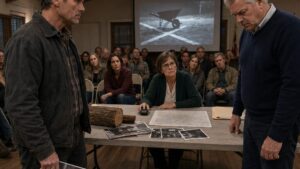
Robert stood three rows from the front with a file box at his feet and the oak cross-section balanced against his leg. Every folding chair was occupied. Residents lined the back wall, some holding printed copies of the emergency notice, others staring at the projector screen where the proposed motion appeared in large black letters:
SUSPENSION OF DISRUPTIVE MEMBER PRIVILEGES.
Sharon sat at the center of the board table. Eric occupied his usual place to her right, pale and rigid. The two other directors avoided looking at the crowd.
“The motion concerns circulation of unverified claims,” Sharon continued. “Until the board’s legal review is complete, Mr. Anderson will not be recognized.”
Nicole rose from the second row.
“This is a membership meeting.”
“You are also out of order,” Sharon said.
The room stirred.
Robert bent, lifted the oak section with both hands, and carried it to the narrow presentation table beneath the screen. Sharon struck the gavel once.
“Do not place personal materials in the meeting area.”
Robert set the wood down anyway.
The carved initials faced the residents.
T.S. 1952.
He placed the pink removal notice beneath them.
No one applauded. The room simply became quieter.
“I was given twelve minutes on the original agenda,” Robert said. “I am asking the membership to decide whether I should use them.”
Sharon leaned toward the microphone. “Procedure is not determined by a show of hands from the floor.”
The association attorney whispered to her. She shook her head, but several residents were already raising their hands.
Nicole counted aloud.
“Twenty-eight. Thirty-one. Thirty-six.”
The community manager checked the sign-in sheet. “A majority of members present have requested recognition.”
Sharon’s jaw tightened.
“You have twelve minutes,” she said. “Any defamatory statement will be addressed separately.”
Robert connected his laptop.
The first slide showed two images: the oak cross-section and the pink assessment.
“This began as a property dispute,” he said. “The association removed a healthy tree from my lot without signed owner authorization and charged me thirty-two hundred dollars for the removal.”
The next slide displayed the work order.
“Lot 208 was listed as the beneficiary of an open-view improvement. No open-view rule exists in the recorded covenants.”
Jennifer stood near the side wall, arms folded tightly.
Robert displayed her email refusing the work.
A murmur passed through the room.
“This was sent six days before the removal,” he said. “Jennifer Hill did not authorize the work.”
Sharon reached for her microphone. “The board retained authority independent of the adjacent owner.”
Robert clicked to the next slide.
“Then the board should be able to identify the authority it used. To date, it has not.”
The landscaping invoice appeared. Robert highlighted the reserve-restoration code.
“The cost of removing my private tree was not charged as ordinary landscaping. It was grouped with common-property repairs and paid through reserve classifications.”
He advanced to the three numbers Nicole had insisted he place at the front of the report.
$14.2 million reported.
$2.6 million confirmed.
$11.6 million requiring explanation.
The room did not erupt. It contracted.
A resident in the front row whispered, “That can’t be right.”
Robert faced the board.
“The confirmed figure comes from the association’s disclosed restricted accounts. The reported figure appears in the newsletter and annual summary. Some of the difference may represent commitments, transfers, projected contributions, or improperly combined categories. But those items were presented to homeowners as if they were available reserves.”
Sharon spoke over him.
“He is comparing cash balances to long-term funding projections.”
“Then produce the schedule that reconciles them,” Robert said.
“It is under review.”
“It was missing from the inspection file.”
“You had limited access.”
“Because you limited it.”
The attorney raised a hand. “Mr. Anderson, address the members, not the board.”
Robert looked back at the residents.
He showed the duplicate pool invoices. Identical before-photographs appeared side by side. Then the consulting charge: nineteen thousand dollars paid to the original firm, eighty-eight thousand allocated through an administrative contract.
He did not call it theft.
He called it unresolved.
He showed the transfers to Joseph Scott’s landscaping company, the repeated project codes, and the absence of competitive documentation for several large assignments.
At the eight-minute mark, Sharon stood.
“This presentation omits emergency conditions, deferred obligations, insurance requirements, and the reality that vendors continued working when this association could not pay them on schedule.”
Robert stopped the slide.
“That context matters,” he said.
The residents turned toward her.
Sharon gripped the table edge. “We had roofs nearing failure. A retaining wall at risk. Premiums increasing faster than dues. Every time the board proposed a meaningful increase, homeowners demanded cuts. Joseph’s company carried invoices for months. We combined projects because stopping work would have cost more.”
“Did you direct the crew to remove my tree?” Robert asked.
The attorney leaned toward her, but Sharon did not sit.
“I authorized a view correction that supported a pending sale and improved neighborhood value.”
“After Jennifer refused it.”
“She refused liability. That is not the same as opposing the benefit.”
Jennifer stepped away from the wall.
“I opposed the removal.”
Sharon looked at her. “You said the listing needed light.”
“I said photographs would look better. I told you not to touch his property.”
“And then you accepted the improved view.”
Jennifer flinched, but remained standing.
“Yes,” she said. “And I stayed silent because I wanted my closing. That was wrong.”
The admission changed the room more than the email had. It removed the comfort of a single villain.
Robert turned to the next slide.
The oak-ring timeline filled the screen. Each ring marked a year. The association’s creation. The first roof deferral. The pool approval. The transfers. The second invoice. The removal order.
“This tree stood through every decision shown here,” Robert said. “It was not part of the financial problem. Its invoice exposed the way the problem was being hidden.”
Eric pushed back his chair.
Sharon turned sharply. “Sit down.”
He stood.
“The bank records are authentic,” he said.
The room broke into overlapping voices.
Eric raised both hands, not for silence but as if surrendering something heavy.
“I signed the summaries,” he continued. “I knew committed funds and future contributions were being shown in a way homeowners would read as current reserves.”
One director whispered, “Eric.”
He looked at the board table rather than the residents.
“I told myself we were preventing panic. I told myself the next dues increase would repair it. When that failed, we carried the same numbers forward.”
“Did you take money?” someone called.
“No.”
“Did Sharon?”
“I don’t know.”
Sharon’s face hardened. “This is reckless.”
Eric looked at her. “So was signing it.”
The community manager’s phone buzzed. She read the screen, then whispered to the attorney.
Robert knew before anyone announced it.
“The bank has suspended restricted reserve disbursements pending documentation,” the attorney said. “That is a temporary compliance action, not a finding of wrongdoing.”
A resident near the aisle stood. “Are vendors getting paid?”
“Operating payments continue where funds are available,” Sharon said.
“So we are underfunded.”
“We are managing a timing crisis.”
“You reported fourteen million dollars.”
“We reported the association’s full reserve position.”
Robert looked at the clock. Eleven minutes.
He could have used the last minute to press Sharon harder. He could have listed every false notice, every missing attachment, every invoice bearing Joseph’s name.
Instead, he closed the financial slides.
The final image showed the carved oak section on the morning of the removal.
“My father carved those initials when he was seventeen,” Robert said. “I kept that out of my appeal because I thought personal grief would weaken the facts.”
He rested one hand on the cut edge.
“It didn’t make me more objective. It made it easier for me to treat all of you as an audience instead of neighbors.”
No one moved.
“The board’s conduct must be reviewed. The contracts must be reviewed. The reserve figures must be corrected. But Sharon did not create this alone. Directors signed. Vendors accepted vague orders. Jennifer stayed silent. Residents rejected increases without asking what delay would cost. I worked alone because I preferred being right to being understood.”
Sharon stared at him across the room.
Robert took the pink notice from beneath the carved initials.
“Rules only protect us when the people using them accept that they are bound by them too.”
His twelve minutes expired.
Nicole walked to the front carrying a thick packet. She raised it high enough for the board to see the signature pages.
“This petition requests removal of the president and the directors who approved the disputed reports,” she said. “It also requests an independent audit and temporary oversight committee.”
The association attorney asked to inspect the signatures.
Nicole handed him the packet.
Sharon sat slowly.
One of the directors resigned before the signatures were counted. The second followed after Eric stated that he would also step down and cooperate with the audit.
The petition met the threshold for an immediate membership vote.
The removal language included a permanent ban on future board service.
Nicole came to Robert’s side and lowered her voice.
“People will follow your recommendation.”
Robert looked at Sharon.
For the first time since the crane arrived, she was not controlling the room. She looked smaller behind the microphone, but not harmless. Her choices had destroyed his tree, punished questions, and protected a false picture of stability.
A permanent ban would be easy to endorse.
It might even be deserved.
The community manager handed Robert the ballot amendment form.
He picked up the pen, aware that the next rule written in that room could become either correction or revenge.
Chapter 8: A New Tree Could Mark the Loss, Not Erase It
Six months later, Robert returned the unopened settlement envelope across the mediation table.
The association attorney looked at it, then at him.
“You could still accept the personal-property portion.”
“No.”
“The governance agreement is separate now.”
“It was never separate.”
Sharon sat at the other end of the table without her silver HOA pin. She had agreed to a seven-year ban from board service, not the permanent ban written into the original petition. Robert had supported the narrower term after adding independent audit controls, mandatory conflict disclosures, and member access rules that could not be suspended by executive session.
Some residents had called that mercy.
Others had called it weakness.
Robert considered it a rule he would be willing to live under if the names were reversed.
The independent audit lay between them.
It confirmed improper reserve reporting, unauthorized transfers, duplicate billing, and conflicted vendor arrangements. Joseph’s company had performed legitimate work, but its bundled invoices concealed markups and classifications that should never have been approved. He had surrendered the contract and entered a repayment agreement through mediation.
Eric and the other directors were found negligent rather than enriched. They had signed misleading reports, delayed disclosure, and allowed Sharon’s explanations to replace verification.
Sharon’s findings were more severe. She had directed the tree removal after Jennifer objected, approved related-party work without adequate disclosure, and used enforcement actions against homeowners who questioned major projects.
The report did not call her a monster.
It called her responsible.
The mediator turned to Sharon. “The final agreement requires acknowledgment of unauthorized removal, repayment participation, and compliance with the governance restriction.”
Sharon signed.
She did not look at Robert.
He had imagined this moment many times. In some versions, she apologized. In others, she explained the exact instant fear became permission.
Instead, she capped the pen and said, “The assessment will be worse now than it would have been two years ago.”
“That may be true,” Robert said.
“People will lose homes.”
“Some may.”
“And you still believe this was the better outcome.”
“I believe hiding it made every outcome worse.”
Her eyes met his then.
“I was trying to hold the community together.”
“You held the picture together.”
For a moment, anger returned to her face. Then it drained.
“The picture was what people bought.”
She stood and left before the mediator collected the papers.
The corrected reserve report reached every homeowner the following week. The numbers were painful. Roof replacements were phased over three years. Dues increased. A special assessment was approved with hardship deferrals for fixed-income residents.
Nicole joined the interim oversight committee and spent her first meeting arguing against a decorative entrance project that had no funding source.
Eric attended as a resident, not a director. He turned over the remaining records and answered questions without asking to be forgiven.
Jennifer’s sale closed late and below the original price. Before moving, she signed a statement describing Sharon’s proposal and her own silence. She gave Robert a copy without requesting that he delay using it.
The pink fines were voided.
Joseph’s contract was canceled.
Quarterly bank reconciliations became available through the association portal, along with vendor disclosures and meeting packets posted before votes rather than after them.
None of it brought back the oak.
A county arborist examined the remaining stump in early spring. Robert had hoped to plant the replacement directly beside it, close enough that the new roots might seem to continue where the old ones ended.
The arborist shook his head.
“The decay zone is wider than it looks. Put the sapling twelve feet away.”
Robert stared at the empty stretch of lawn. “That far?”
“If you put it here, the old root system will interfere. The new tree needs its own ground.”
The sentence bothered him for days.
He had wanted continuity to be visible. The young oak rising from the exact place where the old one had stood. A clean image of restoration.
Instead, the stump remained separate, low and weathered, while the new tree waited in a burlap root ball across the yard.
Nicole arrived with a shovel. Eric brought mulch. Jennifer returned before leaving town and stood near the driveway, unsure whether she had been invited until Robert handed her the garden hose.
They planted the sapling twelve feet from the stump.
It looked fragile in the open space, its trunk no thicker than Robert’s wrist.
“No one is going to confuse that with a replacement,” Nicole said.
“No,” Robert replied.
He found that he was grateful for the distinction.
The carved section had been cleaned, sealed, and mounted on a low steel stand. Robert kept it in his garage until the reorganized board asked whether he would allow it to be displayed in the HOA office.
His first answer was no.
The wood belonged to his father. It had already been turned into an invoice, an exhibit, a timeline, and a symbol for people who had not known Steven.
Then Robert remembered Nicole telling him that facts kept in his house could not protect anyone.
At the next membership meeting, he carried the section into the office.
The board had cleared a space beside the meeting-room entrance. Every resident would pass it before reaching the chairs and microphones.
Robert set it on the stand with the initials facing outward.
Beneath it, the board had proposed a brass plaque. He removed the plaque before anyone attached it.
“What should it say?” Nicole asked.
“Nothing.”
She looked at the carved date.
“People may not understand.”
“They can ask.”
Outside, the sapling’s first leaves moved in the afternoon wind. The old stump remained visible farther across the lawn, separate from the new tree and too large to pretend away.
Robert placed the final voided pink notice in the association archive, not beneath the carving.
Then he stepped back.
The growth rings did not restore what had been cut down. They recorded that it had existed, that time had passed through it, and that people had once mistaken authority for permission.
Before every future board meeting, residents would have to walk past that record.
The story has ended.