She Came With Moving Boxes For Her Father’s House, But The New Will Said She Was A Stranger
Chapter 1: The Gate Card Still Opened His House
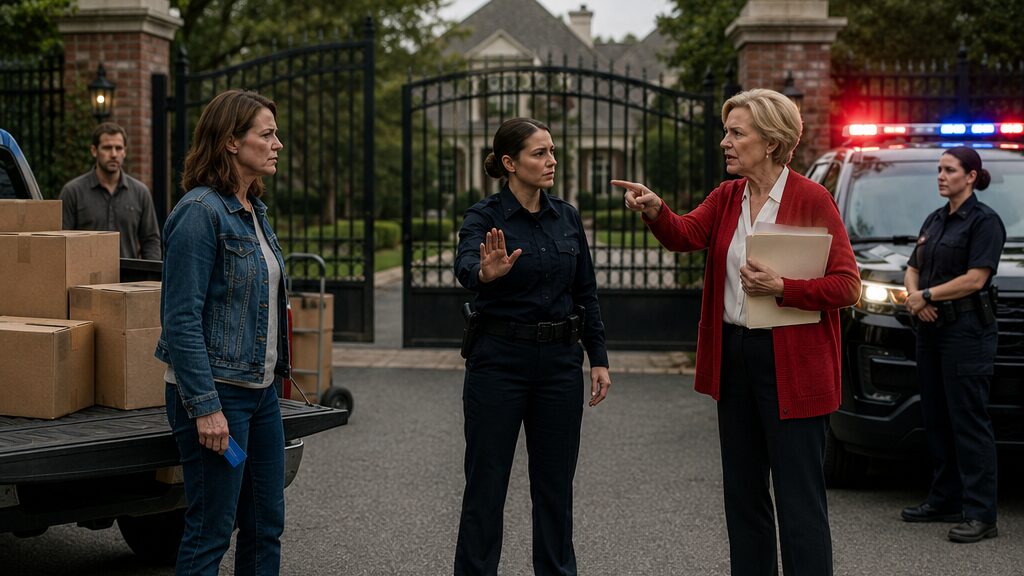
Police lights flashed against the black iron gate while Carolyn Moore pointed at Jennifer’s truck as if it were a stolen thing.
“She is trespassing,” Carolyn said, her red cardigan pulled tight around her shoulders, her voice sharp enough to carry across the brick pillars. “I want her removed before she unloads one box.”
Jennifer stood beside the open tailgate with a flattened cardboard box under one arm and her father’s blue gate card in her other hand. Behind her, the moving driver had gone still, one hand resting on the dolly, eyes lowered in the practiced way of someone who did not want to be involved in another family’s trouble.
Two weeks ago, Jennifer had stood in a funeral home and watched strangers tell her what a generous man Charles Davis had been. Today, she stood in front of his neighborhood while a police SUV idled behind her stepmother and neighbors slowed their cars to look.
One officer stepped toward Jennifer. “Ma’am, can you tell me why you’re here?”
Jennifer swallowed once before answering. “This is my father’s house. I’m here to pick up his workshop tools and some boxes from the den.”
Carolyn let out a small laugh, not amused, not soft. “It was your father’s house. It is mine now.”
The words struck harder than Jennifer expected. Not because Carolyn had said them—Carolyn had been saying versions of that since the funeral—but because she said them in front of police, in front of the guard booth, in front of the same gate Charles had opened for Jennifer every Sunday when he still insisted on cooking too much breakfast.
Jennifer held up the blue plastic card.
“He gave me this,” she said. “Years ago.”
Carolyn’s mouth tightened. “A gate card is not a deed.”
“No,” Jennifer said, keeping her voice level. “But it means he expected me to be able to come here.”
The officer glanced at the card. “Does it work?”
Jennifer looked past him at the keypad. For a second she almost lied and said she did not know. The last time she had used it, Charles had still been alive. His hands had been thin around a mug of coffee, but he had smiled when the gate opened and said, “See? You never have to ask permission to come home.”
She walked to the post before she could lose courage. Carolyn made a sound behind her.
“Officer, she is trying to create a scene.”
Jennifer tapped the card against the reader.
The gate beeped.
Then the iron panels began to part.
No one moved for a moment. The sound of the gate motor filled the gap between them, low and mechanical, as if the neighborhood itself had answered before any person could.
The officer looked from the opening gate to Carolyn. “Ma’am?”
Carolyn stepped forward, face flushed. “That card should have been deactivated. It proves nothing. Charles forgot to clean up things like that. He was sick.”
Jennifer turned slowly. “He was sick, yes.”
Carolyn seized on it. “Exactly. Which is why I handled his affairs.”
“Then why didn’t you cancel the card?”
“Because I had a dying husband, Jennifer. I was not spending my days thinking about plastic cards.”
The second officer had moved closer to the truck. She glanced at the boxes. Each one had Jennifer’s neat writing on blue painter’s tape: Dad’s den. Workshop shelf. Old photos. The labels now looked naïve, almost embarrassing, as if Jennifer had arrived with proof of a promise no one else intended to honor.
“Is there paperwork?” the first officer asked.
Carolyn lifted a folder from under her arm. Jennifer had not noticed it before. Cream-colored, legal-sized, clipped shut. Carolyn held it the way people held documents when they wanted the paper to do the talking.
“Yes,” Carolyn said. “There is a will. The current one. Charles left the house and personal property to me. Jennifer is not authorized to enter without my permission.”
Jennifer felt the box under her arm soften where her fingers dug into it.
“That’s not what he told me,” she said.
Carolyn’s eyes flicked toward the officers, then back. “Families say many things when emotions are high.”
“He told me to come get his tools. He told me the den boxes were mine. He told me—”
“He changed his mind.”
The gate had fully opened behind Jennifer, revealing the curved drive beyond it, the trimmed hedges, the pale roofline of the house. Her father’s house. The house where he had taught her how to sand a table smooth with the grain instead of against it. The house where Carolyn had rearranged the furniture after marrying him, but never quite managed to remove the faint smell of sawdust from the garage.
Jennifer forced herself not to look at it too long.
“When?” she asked.
Carolyn blinked. “What?”
“When did he change his mind?”
Carolyn gave the folder a small tap with her fingers. “It’s all in the legal documents.”
“Then you know the date.”
The officers were quiet now. The moving driver shifted behind Jennifer, and the dolly wheels clicked once against the curb.
Carolyn’s face hardened in a way Jennifer recognized. It was the expression she used whenever Jennifer had asked to sit with Charles alone in the last few months. Not today. He’s tired. The nurse said no stress. Come another time. She had always sounded reasonable. Jennifer had always backed down because Charles looked so exhausted when people argued.
Not this time.
“Tell me the date,” Jennifer said.
Carolyn looked toward the first officer. “This is exactly the kind of harassment I was trying to avoid.”
“It’s a simple question,” Jennifer said.
Carolyn opened the folder and pulled out the first page. She did not hand it over. She only looked down, then up again with the confidence of someone who believed the final answer belonged to her.
“Six weeks before he died,” Carolyn said.
Jennifer heard the gate motor stop behind her. The silence after it felt too clean.
Six weeks.
She saw Charles in the hospital bed they had brought into the downstairs study. Saw the calendar on the wall with the sailboat picture he kept calling a barn. Saw him ask, three times in one visit, whether her mother was coming by, though Jennifer’s mother had been gone for twelve years. Saw Carolyn squeeze Jennifer’s shoulder in the hallway and whisper, “Don’t correct him. It only upsets him.”
Jennifer looked at the folder again.
“Six weeks before,” she repeated.
Carolyn’s chin lifted. “That was his right.”
Jennifer folded the empty cardboard box until it creased down the middle.
The first officer’s voice softened. “Ma’am, until this is clarified, it may be best if you leave the property today.”
Jennifer nodded once. She could feel the old habit rising in her: apologize, retreat, keep peace, come back later when everyone was calmer. It had carried her through hospital hallways, awkward dinners, and phone calls where Carolyn spoke for Charles before Jennifer could hear his voice.
But as she walked back toward the truck, the blue gate card lay hot in her palm.
At the tailgate, she turned.
“Carolyn,” she said.
Carolyn had already begun sliding the will page back into the folder.
Jennifer held up the card, not high, just enough for Carolyn to see it.
“If he changed his mind six weeks before he died,” Jennifer said, “then why did he still know this card was mine seven weeks before he died?”
For the first time that morning, Carolyn did not answer.
Chapter 2: The New Will Had No Place For Her Name
“Your name is not listed as a beneficiary,” the estate attorney said, and the sentence landed on the polished conference table as quietly as a glass being set down.
Jennifer stared at the page in front of him. She could see the black print, the numbered paragraphs, the tidy margins. None of it looked cruel. That was what bothered her most. The paper did not shake. The paper did not hesitate. The paper did not remember her father’s hand on the back of her head when she cried into his shirt at twelve years old because her mother was sick.
It simply left her out.
Across the table, Carolyn sat with her purse in her lap and her ankles crossed. She had changed from the red cardigan into a cream blouse and a navy jacket, and somehow the softer colors made her look more prepared, not less. She watched Jennifer as if waiting for the first improper word.
The attorney adjusted his glasses. “The revised estate plan leaves the residence, personal contents, and remaining liquid assets to Mrs. Moore. There are no specific distributions listed for you in this version.”
“This version,” Jennifer said.
The attorney looked at the page. “Correct.”
“So there was another one.”
Carolyn inhaled through her nose. “Jennifer.”
The attorney’s expression did not change, but his fingers shifted slightly on the paper. “There were prior estate documents. That is common.”
“Was I in those?”
“I’m not at liberty to characterize prior drafts without proper request and review.”
Carolyn leaned forward. “Charles wanted simplicity at the end. He did not want his estate picked apart.”
Jennifer looked at her stepmother. “He wanted me to have his workshop tools.”
“You keep saying that.”
“Because he said it.”
“People say things when they’re sentimental.” Carolyn’s voice was controlled, but there was a thinness under it. “That doesn’t mean they want legal chaos after they die.”
Jennifer reached into her notebook and felt the edge of the blue gate card tucked into the inside pocket. She had put it there that morning without knowing why. It seemed childish to bring it to an attorney’s office, a plastic rectangle against a signed will. Still, touching it kept her from folding into the old shape of apology.
“I want a copy,” Jennifer said.
The attorney nodded. “You’re entitled to request certain documents, depending on standing. We can provide the final will summary today. A full copy may require formal probate filing.”
“Depending on standing,” Jennifer repeated.
Carolyn’s mouth tightened again. “This is what I mean. You’re turning grief into a fight.”
Jennifer looked at the attorney, not Carolyn. “When was the file opened for the revision?”
The room changed by a fraction. The attorney did not move, but the young man seated near the side cabinet lifted his eyes from a tablet. Jennifer remembered him introducing himself as Ryan Clark, an assistant who handled intake and copies. He had been nearly invisible until that moment.
The attorney answered first. “The execution date is listed six weeks before Mr. Davis passed.”
“That’s not what I asked.”
Carolyn gave a small laugh. “Listen to yourself.”
Jennifer felt heat rise in her face, and with it the fear Carolyn knew how to summon: that everyone in the room would decide she was greedy, unstable, a daughter who had not done enough and now wanted property to make up for guilt.
She pressed her thumb against the notebook pocket until the card’s corner dug into her skin.
“I asked when the file was opened,” she said.
The attorney turned slightly. “Ryan, can you confirm the intake note?”
Ryan hesitated only a second too long. Then he tapped the tablet twice. “Initial contact logged October third.”
Carolyn’s head turned toward him.
Jennifer sat still. “October third?”
Ryan’s eyes flicked to the attorney. “That appears to be the date the office received a call about possible revisions.”
“From my father?”
The attorney said, “We would need to review the complete intake record before answering that.”
But Ryan had already looked down again, and Jennifer had seen what his face tried to hide: the answer was not simple.
Carolyn placed both hands on her purse. “Charles and I discussed things privately. Husband and wife. You were not part of every conversation.”
“No,” Jennifer said. “I was not.”
There it was, the small opening Carolyn always used. Jennifer’s absence. Jennifer’s silence. Jennifer’s willingness to wait in the hallway when Carolyn said Charles needed quiet. The story had already been written before the will was printed: Carolyn stayed; Jennifer drifted.
The attorney slid a form toward Jennifer. “If you want to make a formal document request, you can complete this. I should warn you that contesting an estate can become costly and emotionally difficult.”
Carolyn turned in her chair. “Or we can handle this like family.”
Jennifer looked at her.
Carolyn reached into her purse and removed a folded paper. “I spoke with my attorney before this meeting. I am willing to let you come by for one box of sentimental items. Photos, maybe some small things from the den. In exchange, you agree not to challenge the will or interfere with administration.”
Jennifer stared at the paper.
“One box,” she said.
“It’s more than the document requires.”
The sentence was so honest that Jennifer almost admired it. Carolyn was not pretending kindness. She was offering the exact amount of mercy the paper forced her to offer: none, plus one box to make silence cheaper than conflict.
The attorney cleared his throat. “Mrs. Moore, separate settlement discussions should be handled outside—”
“I’m trying to avoid ugliness,” Carolyn said.
Jennifer remembered Charles’s voice, thinner near the end but still his. Don’t make the house a battlefield, Jenny. Promise me you two won’t do that.
She had promised. She had meant it. Every time Carolyn blocked a visit, every time she said he was sleeping, every time she answered his phone and said he could not talk, Jennifer had swallowed her frustration because she thought peace was the last gift she could give him.
Now peace looked like a signature line under a waiver.
Jennifer pushed the paper back without reading past the first paragraph.
“No.”
Carolyn’s expression sharpened. “You haven’t even looked at it.”
“I saw enough.”
“You would rather spend money fighting over things your father chose to leave to his wife?”
Jennifer stood before she could be talked back into sitting. Her knees felt unsteady, but her voice held.
“I’m not signing away the right to ask when he supposedly chose it.”
The attorney’s face remained professionally blank. Ryan, at the side of the room, lowered his tablet and looked at Jennifer as if she had just stepped onto a road he knew was dangerous.
Jennifer gathered her notebook. The blue gate card slipped partway out of the pocket and landed on the table beside the will summary. For one second, the two objects lay next to each other: the plastic card worn at the corners from years of use, and the clean legal page that said she did not belong anywhere near what her father left behind.
Carolyn looked at the card.
Something passed across her face so quickly Jennifer almost missed it. Not surprise. Recognition.
Jennifer picked it up.
At the door, while Carolyn spoke tightly to the attorney behind her, Ryan stepped into the hallway with a stack of blank copy forms. He did not look directly at Jennifer when he handed them over.
“If you submit the request,” he said quietly, “ask for more than the will.”
Jennifer looked down at the forms. “What else?”
Ryan kept his voice low. “Visitor logs. Gate records. Anything that shows who came in and out before the signing.”
Jennifer’s fingers closed around the paper.
Behind them, Carolyn’s chair scraped back.
Ryan stepped away before she reached the hall, but his final words stayed behind.
“Ask for the visitor logs from the gate.”
Chapter 3: The Logs Remembered What The Family Denied
“Your card was active,” the security guard said. “That’s the strange part.”
Jennifer stood at the small counter inside the gatehouse while morning traffic hummed behind her through the glass. Residents rolled through in clean SUVs, barely slowing when the barrier lifted. The guard had printed three pages and placed them face down at first, as if paper could become dangerous if exposed too quickly.
Jennifer set the blue card on the counter.
“Active,” she repeated.
He nodded, uncomfortable. “It wasn’t canceled. It was manually blocked on specific dates.”
The words made her feel colder than canceled would have. Canceled would have been final, clean, administrative. Manually blocked meant someone had looked at her access and decided when she could be kept out.
“Which dates?”
The guard turned the pages over.
Jennifer saw her name in the system as J. Davis, family access. Beside it were entries in narrow columns: card read, entry denied, override placed. The first blocked date was a Saturday, five weeks before Charles died. The second was the following Thursday. The third made her throat tighten.
The day before the will was signed.
She touched the line with one finger. “Who placed the block?”
The guard shifted. “It lists resident request.”
“Which resident?”
“I can’t release that without management approval.”
“Carolyn Moore?”
He looked away.
That was answer enough, but not enough for paper, not enough for an attorney, not enough to push back against a will that had already made her invisible.
Jennifer folded the printouts carefully. “Can I get certified copies?”
“You can request them through management.” His voice lowered. “But Mrs. Moore already called this morning.”
Jennifer looked up.
“She said you might come by,” he said. “She said there was an estate dispute and that staff should not be intimidated into releasing private residential information.”
Jennifer almost laughed, but nothing about it was funny. Carolyn had moved faster than grief, faster than paperwork, faster than Jennifer’s own courage.
“I’m not here to intimidate anyone.”
“I know.” The guard glanced at the blue card. “I remember your father. He used to stop here and talk about fixing the old call box himself.”
Jennifer’s hand tightened around the pages.
“He hated that call box,” she said.
The guard’s face softened. “He said the new system made people ask permission from machines.”
For a second, Charles was there in the cramped gatehouse, half amused and half irritated, complaining about bad wiring and cheap screws. Jennifer could almost hear him: Never trust a device that won’t tell you why it failed.
The guard slid a business card toward her. “Put the request in writing. That’s all I can say.”
At home, Jennifer spread the pages across her small kitchen table. Her apartment seemed too quiet around them. The moving boxes she had brought back unopened stood against the wall like witnesses that had not been allowed to speak.
She made a timeline on a legal pad.
October third: estate office intake opened.
October tenth: Jennifer gate access denied.
October seventeenth: Jennifer gate access denied.
October twenty-fourth: Jennifer gate access denied.
October twenty-fifth: will signed.
She stopped there. Her pen hovered above the next line.
Charles died six weeks later.
For months, she had told herself she had not done enough. That maybe Carolyn was right, in the cruelest possible way. Jennifer had called, yes. She had visited when allowed. She had sent groceries, paid for a cleaning service Carolyn complained about, sat with Charles through the first specialist appointment before Carolyn began saying short visits were better. But Jennifer had not forced her way in. She had not shouted at gates. She had not accused a tired wife of keeping a daughter away from her dying father.
She had mistaken not making trouble for being good.
Her phone buzzed on the table.
The email subject line made her stomach tighten before she opened it: Notice Regarding Estate Interference.
Carolyn’s attorney had written in a tone so polished it barely seemed human. Jennifer was instructed to cease direct contact with residential staff, refrain from attempting to access the property, and direct all estate-related inquiries through proper legal channels. Any further attempts to obtain private records could be considered harassment.
Jennifer read it twice.
Then she printed it.
The printer coughed in the corner, dragging the page out slowly as if reluctant to join the pile. She placed the warning letter beside the access logs. Carolyn had called police when Jennifer came with boxes. Carolyn had offered one box for silence. Carolyn had warned the gate before Jennifer arrived.
The pattern was no longer only emotional. It had edges.
At the probate clerk’s office that afternoon, Jennifer stood under fluorescent lights with a numbered ticket in her hand. She had never been in that building before. Around her, people waited with folders and envelopes and the stiff expressions of those trying to make grief behave like procedure.
When her number appeared, the clerk behind the glass asked for the estate name without looking up.
“Charles Davis,” Jennifer said.
The clerk typed. “Relationship?”
“Daughter.”
The word came out firmer than she felt.
The clerk’s fingers moved across the keyboard. “Probate file has preliminary filings. Inventory not complete.”
“I need to request copies of documents.”
“You can request what has been filed. Some items may not be available yet.”
Jennifer slid her form through the opening. “I also need to know whether visitor logs or gate access records can be subpoenaed or requested as part of a will contest.”
At that, the clerk finally looked up. Not unkindly, but with caution. “Are you represented by counsel?”
“Not yet.”
The clerk nodded as if she had heard that answer many times from people standing at the edge of something expensive. “Then be careful what you file and when. Once certain deadlines pass, undoing them is harder.”
Jennifer wrote the deadline on her pad with a hand that tried not to shake.
Before leaving, she asked for the public filing index. The clerk printed two pages. Jennifer stepped aside near a row of hard plastic chairs and scanned the entries.
Petition for probate.
Notice to interested parties.
Self-proving affidavit.
Attorney attendance record.
She almost missed the date because her eyes were tired.
October twenty-fourth.
One day before the signing.
Attorney attendance record — residential visit.
Jennifer stared until the words blurred.
October twenty-fourth was the third blocked gate date. The same day Carolyn had texted Jennifer, Not today. He is too weak for visitors. Please don’t make this harder.
Jennifer still had the message. She knew she did because she had never deleted the thread. She had kept every small exchange from those months, even the ones that made her feel ashamed.
She sat down in the nearest chair and pulled out her phone.
There it was.
Carolyn: Not today. He is too weak for visitors. Please don’t make this harder.
Jennifer looked from the text to the filing index.
On the day Carolyn said Charles was too weak for his daughter, an attorney had been allowed through the gate.
For several minutes, Jennifer did not move. The office sounds continued around her: numbers called, papers stamped, a child whispering, a copier warming and stopping. Ordinary sounds for a place where families came to learn what the dead had supposedly decided.
Then Jennifer placed the phone beside the printed access log and took a picture of both together.
The gate had remembered what the family denied. And now it was pointing to someone else who had been let in.
Chapter 4: She Said He Needed Quiet, But Someone Needed A Signature
“I remember that week because your father kept asking why you stopped coming,” Melissa Allen said, and then immediately looked toward the hospice office window as if the words had escaped before she could lock them back in.
Jennifer sat across from her at a small round table meant for families waiting on updates. A plastic plant stood between them. On the wall behind Melissa, a framed poster about dignity in end-of-life care hung slightly crooked.
Jennifer had come prepared for refusal. She had brought copies of the access logs, Carolyn’s text, the probate filing index, and the attorney attendance record. She had expected policy language. Confidentiality. Boundaries. We can’t get involved.
She had not expected her father’s question.
“He asked that?” Jennifer said.
Melissa pressed her fingers together. She wore no jewelry except a thin watch, and Jennifer noticed how often she checked it without seeming to see the time. “I shouldn’t have said it that way.”
“But he asked.”
Melissa exhaled. “More than once.”
Jennifer looked down at the blue gate card lying beside her folder. She had not meant to take it out, but it seemed to find its way onto every table now, a small plastic witness no one had sworn in.
“Carolyn said he needed quiet,” Jennifer said. “She said visits upset him.”
“Sometimes they did.”
The answer stopped Jennifer.
Melissa did not rush to soften it. “Your father had moments of agitation. Confusion. Especially later in the day. Sometimes too many voices made it worse.”
Jennifer nodded, though the admission hurt. Part of her had wanted Melissa to say Carolyn lied about everything. A clean line. A cruel woman at one end, Jennifer and Charles at the other. But grief had not been clean when he was alive; it was not going to become clean now.
“Did I upset him?” Jennifer asked.
Melissa’s eyes softened. “You made him emotional.”
“That’s not the same thing.”
“No.”
The office door behind them opened, and a nurse stepped out with a chart tucked under one arm. Melissa waited until she passed before speaking again.
“Mrs. Moore was exhausted,” Melissa said. “I’m not defending every decision she made. But she was carrying a lot. Medication schedules. Night confusion. Bills. His fear. Her own fear.”
Jennifer stared at the table. “She keeps saying she stayed.”
“She did.”
“And she kept me away.”
Melissa did not deny it.
Jennifer slid the printed access log across the table. “My card was blocked three times. One of those times was the day before he signed the new will.”
Melissa lowered her gaze to the page but did not touch it.
“I can’t authenticate gate records,” she said.
“I’m not asking you to. I’m asking if he was capable of understanding a will revision that week.”
Melissa sat back. For the first time since Jennifer had arrived, the professional calm left her face completely. Under it was something older than caution. Guilt, maybe. Or fatigue.
“There are legal standards for capacity,” Melissa said. “I’m not an attorney.”
“I know.”
“And people can have lucid periods.”
“I know that too.”
Melissa looked at the access log again. “That week was uneven.”
Jennifer waited.
“Some mornings, he could talk about old projects. The house. The workshop. He remembered your name. He remembered Carolyn. Other times he would ask if he was late for work, or if his first wife had called. He would confuse days.” Melissa’s voice lowered. “He asked twice whether Thanksgiving had already happened. It was October.”
Jennifer’s throat tightened. She remembered the sailboat calendar, the way Charles had smiled at it and called it a barn, then frowned when no one else laughed.
“Was he having a good day when the attorney came?”
Melissa’s fingers moved toward the access log, then stopped just short of touching the paper. “I wasn’t present for the full meeting.”
“But you saw him.”
“Yes.”
“And?”
Melissa’s eyes lifted. “He had been medicated that morning.”
The room seemed to narrow.
“For pain?” Jennifer asked.
“Yes. And anxiety.”
“Did Carolyn know?”
“Carolyn administered most of his medication with nurse guidance.”
Jennifer closed her eyes for one second, not long enough to fall apart.
Melissa continued, quieter. “Before that day, Mrs. Moore asked us not to bring up missed visits. She said it distressed him.”
“Missed visits,” Jennifer said.
“She said you were busy. That you were having a hard time accepting his decline. She asked staff to redirect him if he asked why you hadn’t come.”
Jennifer’s hands curled under the table. “I came. I tried.”
“I believe you.”
The words were small, but they went through Jennifer with such force she had to look away.
For weeks after Charles died, she had replayed every moment she had chosen not to push. Every time Carolyn said not today and Jennifer said okay. Every unanswered call. Every text she had accepted because arguing seemed selfish beside a dying man. She had carried those choices like proof of failure.
Now the proof was changing shape.
“Why didn’t anyone call me?” Jennifer asked.
Melissa’s face tightened. “Because family access decisions usually come through the primary caregiver unless there’s a formal restriction or abuse concern. Carolyn was his wife. She was here every day. She knew his routines. And, frankly, we were trying to keep him comfortable.”
Jennifer heard what Melissa was not saying: the system had believed the person in the room.
“She told you I stayed away,” Jennifer said.
“She told us you needed distance.”
Jennifer almost smiled. Needed distance. It sounded kinder than abandoned him. Carolyn had always understood the value of a softer phrase.
Melissa glanced toward the office door again. “I can’t give you medical records without proper authorization or subpoena. But I can tell you what to ask for. Medication logs. Cognitive notes. Visit restrictions. Any notation from the day of the signing.”
Jennifer pulled her legal pad from her folder and wrote each phrase. Her handwriting looked too neat for how her chest felt.
“And Melissa?” she said. “Did he ever say he wanted Carolyn to have everything?”
Melissa did not answer quickly.
“He worried about her,” she said at last. “He worried she would be alone in that house. He worried about you too.”
“Me?”
“He said you would act like you were fine even if you weren’t.”
A sound almost escaped Jennifer, but she held it down.
“That sounds like him,” she said.
Melissa’s eyes moved to the blue gate card. “He mentioned that once.”
Jennifer looked up.
“The card?”
“He was agitated one afternoon because he thought the front gate wouldn’t let you in. Carolyn told him it was handled. He said, ‘Jenny has her card. Don’t make her ask.’”
The words were so close to Jennifer’s own memory that for a moment she could not speak.
Melissa stood abruptly. “I need to get back.”
Jennifer gathered the papers, but Melissa touched the edge of the access log with one finger before she could put it away.
“There’s something else,” Melissa said.
Jennifer froze.
“I remember the signing day because I came in after lunch and he was upset. Not angry. Embarrassed.” Melissa swallowed. “There was a pen on the tray table. Carolyn was wiping his hand with a tissue. He kept saying, ‘I can’t make it look right.’”
Jennifer’s voice came out thin. “His signature?”
Melissa looked toward the office window one more time.
“His hand was shaking too badly to hold the pen steady,” she said.
Chapter 5: The Settlement Offer Came With One Box
Carolyn opened the front door only wide enough for Jennifer to see the taped cardboard box at her feet.
“Take the box, sign the paper, and stop pretending this is about your father,” Carolyn said.
Jennifer stood on the porch where she had once waited with grocery bags while Charles took too long to answer because he refused to use a cane. The brass door knocker was still shaped like a fox. Carolyn had polished it recently; it caught the afternoon light and threw a hard little glare into Jennifer’s eyes.
“I’m not signing today,” Jennifer said.
Carolyn’s expression flattened. “Then you should not have come.”
“You invited me.”
“I invited you to be reasonable.”
Behind Carolyn, the house smelled faintly of lemon cleaner and closed rooms. Jennifer could see the hall table where Charles used to leave his keys in a chipped ceramic bowl. The bowl was gone. In its place stood a narrow vase with white silk flowers.
Carolyn stepped back, not quite welcoming her in, not quite blocking her. Jennifer entered because retreating now would turn every document in her folder into another thing she had failed to use.
The kitchen looked staged for a sale that had not yet been announced. Counters cleared. Mail hidden. No coffee mug by the sink, no folded newspaper on the chair Charles favored, no pencil marks on the wall near the pantry where he used to measure nothing important and call it “structural planning.”
On the table sat a legal envelope, a pen, and the box.
Jennifer placed her folder beside them. She took the blue gate card from her pocket and set it on the table where both of them could see it.
Carolyn glanced at it. “That little card is not going to give you a house.”
“I’m not here for the house.”
“You keep saying that, but here you are.”
Jennifer looked at the envelope. “What’s in the agreement?”
“A distribution. More than you are entitled to.” Carolyn pulled out the chair opposite her. “A small cash amount and the sentimental items in that box. In exchange, you stop contacting staff, stop implying I did something wrong, and stop interfering with administration.”
Jennifer did not sit.
“Who blocked my gate card?”
Carolyn’s hand paused on the chair back.
“You were upsetting him,” she said.
“That isn’t an answer.”
“I did what his doctor told me.”
“Which doctor?”
Carolyn’s jaw moved, but no name came.
Jennifer waited.
Carolyn looked away first. “You have no idea what it was like here.”
“I know what it was like outside the gate.”
Carolyn’s eyes flashed. “Because you could leave. That is what you keep leaving out. You came when it suited you, and when it became ugly, you went home to your quiet apartment and slept through the night.”
Jennifer felt the old guilt rise so fast it almost spoke for her. Carolyn knew where to press because some of it was true. Jennifer had slept in her own bed. She had gone to work. She had answered emails while Carolyn sat beside oxygen tubing and medication charts.
But guilt was not the same as consent.
“I asked to stay overnight,” Jennifer said. “You said it confused him.”
“It did.”
“I asked to take him to appointments.”
“He wanted me.”
“I asked to sit with him alone.”
Carolyn’s face tightened. “He needed calm.”
Jennifer touched the edge of the gate card. “He asked why I stopped coming.”
For the first time, Carolyn looked genuinely startled.
Jennifer did not say Melissa’s name. Not yet.
Carolyn recovered quickly, but not completely. “He had confused moments. He asked for people who were dead. He asked for your mother.”
“And he asked for me.”
Carolyn pulled out the chair and sat as if her legs had suddenly become unreliable. “You think this is simple because you found a few dates on paper.”
“No. I think you made it look simple because the papers say I was gone.”
“You were gone.”
“You blocked the card.”
“You would come in and cry, Jennifer. You would sit by his bed and make him remember he was dying.”
Jennifer took the hit. It was not cleanly false. There had been days Charles looked at her tears and tried to comfort her, though he could barely lift his hand. Days when Carolyn stood in the doorway with exhausted accusation written across her face.
“I cried because he was my father.”
Carolyn’s voice dropped. “And I was his wife.”
There it was, not as a legal argument, but as a wound. Jennifer saw it then—not enough to excuse her, but enough to understand the shape of it. Carolyn had been terrified that all her years with Charles would be treated as an interruption between his first family and his estate. She had guarded the house because she thought the house was proof she had mattered.
Jennifer sat down slowly.
“Did he ask to change the will?”
Carolyn looked toward the silk flowers.
“Charles wanted me protected.”
“That’s not what I asked.”
“He knew you had your own life.”
“Carolyn.”
“He knew I had given up mine.”
The silence after that was not empty. It was crowded with pill bottles, unpaid bills, stepfamily dinners, Jennifer’s careful politeness, Carolyn’s careful control, Charles avoiding conversations that would have made everyone uncomfortable while he still had strength to have them.
Jennifer opened her folder and took out only one page: the access log with the three blocked dates. She did not show the probate filing index. She did not mention the attorney visit. She did not mention the shaking hand.
“Why was I blocked the day before the signing?”
Carolyn’s gaze lowered to the page.
“Because I knew what you would do.”
“What would I do?”
“Make him doubt himself.”
Jennifer stared at her. “Or make him answer me.”
Carolyn pushed the legal envelope across the table. “Sign it.”
“No.”
“If you drag this out, there may be nothing left worth fighting over after attorneys finish with it.”
“Then you should have let me in when he was alive.”
Carolyn’s face went pale under her makeup. “Get out.”
Jennifer rose, but she took the box when Carolyn nudged it toward her with one foot.
“Take it,” Carolyn said bitterly. “That is what you came for, isn’t it? Things?”
Jennifer lifted the box. It was lighter than she expected.
At the door, Carolyn said, “Your father hated conflict.”
Jennifer stopped with her hand on the knob.
“I know,” she said. “That’s why this worked.”
She did not look back.
That evening, the warning letter from Carolyn’s attorney arrived by email, accusing Jennifer of disrupting estate administration and attempting to pressure the surviving spouse into improper disclosures. Jennifer printed it and added it to the growing stack on her kitchen table.
Only then did she open the box.
Carolyn had packed it carelessly. A few framed photos wrapped in newspaper. Charles’s old measuring tape. A chipped mug from the workshop. A bundle of greeting cards held together with a rubber band.
At the bottom, under a folded flannel shirt that still smelled faintly of sawdust, Jennifer found a photograph she did not remember seeing before.
She was younger in it, maybe twenty-five, standing beside Charles at the front gate. He was laughing, one hand extended toward her. In Jennifer’s hand was the same blue gate card, brand new then, unworn, shining in the sun.
On the back, in Charles’s blocky handwriting, was a date and eight words.
Jenny’s card. So she never has to ask.
Chapter 6: The Date On The Form Was Not The Day He Chose
“The signatures are verified,” Carolyn’s attorney said, tapping the will packet with two fingers. “If Ms. Davis is suggesting forgery, she should be prepared to support that allegation.”
Jennifer placed the blue gate card on the mediation table.
“Then tell me why the appointment was opened before he asked for it,” she said.
The room went still.
Carolyn sat across from her with her hands folded so tightly the knuckles had whitened. Between them were stacks of paper arranged by people who believed order could make pain manageable: the will summary, the access logs, the probate filing index, the medication notes Melissa had told Jennifer how to request, the warning letter, the settlement offer, and the photograph from the box.
The mediator, a calm woman with silver glasses, looked from Jennifer to Carolyn’s attorney. “Let’s slow down. Ms. Davis, clarify what you mean.”
Jennifer slid forward a copy of the intake record Ryan Clark had provided after receiving formal authorization through the document request process. He had not given her everything. He had not broken rules in a dramatic act of conscience. He had done exactly what cautious people did when the paper itself made silence harder: he confirmed the dates.
“October third,” Jennifer said. “That’s when the estate revision file was opened. The notes show the call came from Carolyn. Not my father.”
Carolyn’s attorney adjusted his cuffs. “Spouses often assist with scheduling.”
“The will was signed October twenty-fifth. Carolyn told the police my father changed his mind six weeks before he died. But the office was contacted before any record of him asking for a change.”
Carolyn leaned forward. “Because he and I had discussed it.”
Jennifer looked at her. “Then why wasn’t he the one who called?”
“He was dying.”
“Yes,” Jennifer said. “That is my point.”
The mediator lifted one hand before Carolyn could respond. “Mrs. Moore, you’ll have a chance.”
Carolyn sat back, but the restraint looked painful now, less like confidence and more like a door braced from the inside.
Jennifer took out the access log next. She did not rush. The old version of herself would have spilled everything at once, desperate to prove she was not greedy, not dramatic, not wrong. This time she let each page do only its part.
“My card was blocked three times,” she said. “Not canceled. Blocked. On October tenth, October seventeenth, and October twenty-fourth.”
The mediator read the highlighted lines.
Carolyn’s attorney said, “Residential access decisions are not estate decisions.”
“No,” Jennifer said. “But October twenty-fourth is also the date an attorney visited my father at the house.”
The mediator looked at Carolyn.
Jennifer continued, “That same day, Carolyn texted me that he was too weak for visitors.”
Carolyn’s face tightened. “He was too weak for you.”
The sentence hit hard enough that Jennifer had to pause.
Carolyn seemed to regret the wording, but not enough to take it back. “You came in with all that grief on your face. He would spend the rest of the afternoon trying to comfort you. I was the one who had to calm him down after you left.”
Jennifer looked down at the gate card. Its edge was worn pale from years in her wallet. She thought of Charles saying Jenny has her card. Don’t make her ask. She thought of him trying to comfort her from a bed he could not leave.
“I should have done better at that,” Jennifer said.
Carolyn blinked.
Jennifer felt everyone watching her, waiting for the accusation to continue. Instead, she made herself say the thing she had not wanted to admit in any room where Carolyn could hear it.
“I should not have made him take care of my feelings while he was dying. And I should not have stayed quiet just because you told me quiet was kinder.”
Carolyn looked away.
“But that does not give you the right to turn my silence into abandonment.”
The mediator’s pen stopped moving.
Jennifer slid the photograph forward now. The one from the box. Charles at the gate, laughing. Jennifer with the new blue card in her hand.
“He gave me this because he wanted me to come without asking permission. You knew that. You packed the picture yourself.”
Carolyn’s voice came out lower. “I didn’t know that photo was in there.”
“Maybe not. But he wrote on the back.”
Carolyn did not reach for it.
The attorney beside her did. He turned the photograph over, read the handwriting, and placed it down again without comment.
Jennifer turned to him. “I’m not saying the signature was forged. I’m saying the process was not neutral. I’m saying my father was medicated that week, confused about dates, and isolated from the one person who might have asked him what he meant.”
Carolyn’s attorney began, “There is no medical determination of incapacity in the record—”
“But there are notes,” Jennifer said. “Medication logs. Cognitive observations. A hospice coordinator who remembers his hand shaking so badly he said he couldn’t make it look right.”
Carolyn closed her eyes.
That was the first time Jennifer saw fear in her, clear and unguarded. Not fear of being caught, exactly. Fear of the room seeing a version of caregiving she could no longer polish: the tissue in her hand, the pen on the tray table, Charles embarrassed by his own body, a decision pushed through while everyone else was kept outside.
The mediator folded her hands. “Mrs. Moore, did you instruct the gate to block Ms. Davis’s card?”
Carolyn did not answer.
Her attorney leaned slightly toward her. “You don’t need to respond to every characterization.”
Jennifer looked only at Carolyn. “Why didn’t you cancel it?”
Carolyn’s eyes opened.
“If you believed he wanted me out,” Jennifer said, “why block it only on certain days? Why not cancel it?”
Carolyn’s lips parted. No sound came.
The room waited.
Jennifer felt the answer before Carolyn gave none. Canceling the card would have been a declaration. A traceable severing. Blocking it on certain days let Carolyn manage the story while keeping Charles calm if he asked. Jenny still has her card. Don’t make her ask.
Only Jennifer had been asking. Outside the gate. By phone. Through texts Carolyn answered for him.
The mediator leaned back. The attorney looked down at the will packet, and for the first time since Jennifer had met him, he seemed less certain of its weight.
Carolyn’s hands loosened on the table. “He wanted me protected,” she said, but her voice had lost its sharp edge.
Jennifer nodded once. “I believe that.”
Carolyn looked up.
“I believe he worried about you,” Jennifer said. “I believe you were tired. I believe he avoided hard conversations because he didn’t want either of us hurt.”
She touched the gate card.
“But I do not believe he chose to make me a stranger. And I do not believe you thought he had chosen that either.”
Carolyn’s attorney shifted. “We should caucus privately.”
The mediator agreed, and chairs moved back. Carolyn stood too quickly, gathering her purse and papers. At the door to the private room, she stopped.
Jennifer thought she might say something then. Not an apology. Not a confession. Maybe just one human sentence without legal armor.
Instead Carolyn looked at the blue card still lying on the table beside the will packet.
Her mouth trembled once.
Then she walked out without answering the only question that mattered: why Jennifer’s card had been blocked, but never canc
Chapter 7: The House Did Not Come Back, But Her Place Did
Carolyn was waiting at the gate without police.
For a moment, Jennifer kept her foot on the brake and stared through the windshield, unsure what to do with the sight of her stepmother standing alone beside the call box. No red cardigan. No folder held like a shield. No officers behind her, no neighbor slowing dramatically to watch. Just Carolyn in a gray coat, one hand resting on the brick pillar as if the house behind it had become too heavy to stand in front of without support.
The gate stayed closed.
Jennifer lowered her window.
Carolyn looked older than she had at mediation. Not softer. Just less arranged. “I told them to let you in.”
Jennifer did not reach for the blue card clipped to her visor. “Why?”
Carolyn’s mouth tightened. “Because if you use the card, I suppose that will become another exhibit.”
The old sharpness was there, but it had dulled at the edge.
Jennifer did not answer.
Carolyn glanced toward the guard booth, then back at Jennifer. “There’s paperwork inside. My attorney sent a draft agreement to yours.”
“I don’t have an attorney.”
“You should.”
“I know.”
A pause moved between them, full of things neither of them had known how to say while Charles was alive.
Carolyn pressed the visitor button. The gate opened with the same low mechanical hum. Jennifer drove through slowly, both hands on the wheel, and felt the old reflex flare: relief, then suspicion, then grief. The curved drive looked unchanged. The hedges were trimmed. The front windows reflected a pale sky. It seemed impossible that a house could look so calm after being used as a weapon.
Carolyn walked ahead of the truck rather than riding with her. Jennifer followed at a careful distance.
Near the garage, two cardboard boxes sat beside a long metal toolbox she recognized at once. Charles’s old workshop toolbox had a dent near the handle from the year he dropped it off the back of his pickup and insisted the dent gave it “character.” Jennifer had not seen it since before he became too weak to go into the garage.
She parked and got out.
Carolyn stood beside the boxes. “The tools are listed separately in the draft agreement. So are some personal items from the den. There’s also a proposed cash distribution.”
Jennifer looked at the toolbox, not the house. “Why?”
Carolyn’s laugh was short and empty. “Because my attorney says if you push for a full review, the estate could spend more defending the will than it would cost to settle part of this now.”
“That’s his reason.”
Carolyn looked toward the front door. “It’s also mine.”
Jennifer waited.
Carolyn folded her arms, then let them fall. “And because I am tired.”
The words were plain enough that Jennifer believed them.
Inside, the house no longer smelled staged. It smelled like cardboard, dust, and something faintly metallic from the old tools. Carolyn had laid documents on the kitchen table: a draft settlement, an itemized list, copies of access logs, and a signed authorization releasing additional gate records to Jennifer.
The blue gate card stayed in Jennifer’s coat pocket. For once, she did not put it on the table.
Carolyn noticed anyway. “You don’t have it?”
“I have it.”
“You always did.”
Jennifer looked up.
Carolyn sat across from her, but she did not touch the papers. “He asked for you more than once.”
The sentence entered the room carefully, as if it knew it might not be welcome.
Jennifer’s fingers tightened around the edge of the chair.
Carolyn stared at the table. “At first I told myself he was confused. Then I told myself you upset him. Then I told myself it was better if I handled things.” Her throat moved. “Some of that was true. Not all of it.”
Jennifer did not trust herself to speak yet.
“He would ask why you hadn’t come,” Carolyn said. “And I would say you were busy. Or that you had called. Or that you would come tomorrow.”
“Why?”
Carolyn’s face hardened, but this time the hardness seemed aimed inward. “Because when you came, I disappeared.”
Jennifer frowned.
Carolyn looked toward the den hallway. “He would look at you and become more himself. Even if it exhausted him. Even if it confused him after. He would try harder. Smile harder. Remember more.” Her voice thinned. “And then you would leave, and I would be there with what was left of him.”
Jennifer absorbed that in silence.
It was not an apology. Not fully. It was not enough. But it was the first true thing Carolyn had said without pushing a document in front of it.
“You should have told me that,” Jennifer said.
“I know.”
“You should have let me help.”
“I know.”
“You should not have blocked the card.”
Carolyn closed her eyes briefly. “I know.”
Jennifer looked down at the draft agreement. The numbers were not large enough to change her life. The house would remain Carolyn’s. The will would not be torn apart in some sweeping public correction. Charles’s final signature would stay in the record, surrounded now by enough doubt that it no longer looked clean, but still legally present.
Partial justice looked smaller on paper than it had in Jennifer’s imagination.
She turned to the itemized list. Workshop tools. Den photographs. The chipped mug. His measuring tape. Selected family records. The old flannel shirt. A small distribution from one account Carolyn had agreed to divide rather than defend.
“This doesn’t restore what happened,” Jennifer said.
“No.”
“It doesn’t give me those weeks back.”
Carolyn’s lips pressed together. “No.”
“It doesn’t make the will true.”
Carolyn looked at her then.
Jennifer held her gaze. “It may stay legal. That doesn’t make it true.”
For a second, Carolyn looked as if she might reach for the old defense. The signatures are verified. He wanted me protected. You had your own life. Then her shoulders lowered.
“No,” Carolyn said. “It doesn’t.”
The admission did not heal anything instantly. It did not make Jennifer want to embrace her. It did not turn the kitchen warm. But the room changed. The will packet on the table lost some of its command. It became paper again. Important paper, costly paper, paper that had done damage—but no longer the only voice allowed to speak.
Jennifer signed nothing that day. She took the draft agreement home, reviewed it line by line, asked the probate clerk procedural questions, and waited two more days before agreeing to the terms with handwritten clarifications. The access logs would be preserved. The medical notes referenced in mediation would remain part of the estate file. The returned items would be documented as personal property Charles had intended Jennifer to receive, not charity from Carolyn.
When she came back for the toolbox, Carolyn did not come outside.
The moving driver helped lift it into Jennifer’s truck, then loaded the boxes beside it. He did not ask questions. The guard at the booth raised a hand as Jennifer drove out, and she raised one back.
At her apartment, the toolbox took up half the space beside her kitchen table. Jennifer opened it carefully, expecting rusted pliers, screwdrivers, rolls of tape, the ordinary clutter of Charles’s hands. All of that was there.
In the top tray, wrapped in a rag, she found the small brass level he had used for everything, even hanging crooked picture frames he claimed were “emotionally straight.” She held it for a long time.
Then she took the blue gate card from her wallet.
It no longer felt like permission. It no longer felt like evidence either. It had been both when she needed it to be. Now it was something quieter: a witness to what Charles had meant before fear, illness, and paperwork crowded the door.
Jennifer placed the card inside the toolbox, beside the brass level and the old photograph of Charles laughing at the gate.
On the back of the photograph, his handwriting remained steady.
Jenny’s card. So she never has to ask.
Jennifer closed the toolbox, not because the story was clean, and not because the house had come back, but because at last the will was no longer the only record of where she belonged.
The story has ended.