When the HOA’s Security Car Burned, They Put the Repair Bill on the Quiet Neighbor
Chapter 1: The Red Gas Can Beside the Fire
The HOA security car was already burning when Cynthia Taylor pointed at the red gas can in Joseph Carter’s hand.
“Don’t you dare move,” she said.
Joseph stood halfway between his garage and the curb, the plastic handle biting into his fingers, heat pressing against his face hard enough to make his eyes water. The white patrol sedan, the one with HOA SECURITY printed in blue along the side, had become a blackened shape inside a roaring orange shell. Flames snapped from the front wheel well. Smoke rose in a thick column above the roofs of Maple Ridge Lane.
Behind him, someone shouted for the fire department. A dog barked from behind a fence. Across the street, curtains lifted.
Joseph looked down at the can in his hand, then at Cynthia’s face.
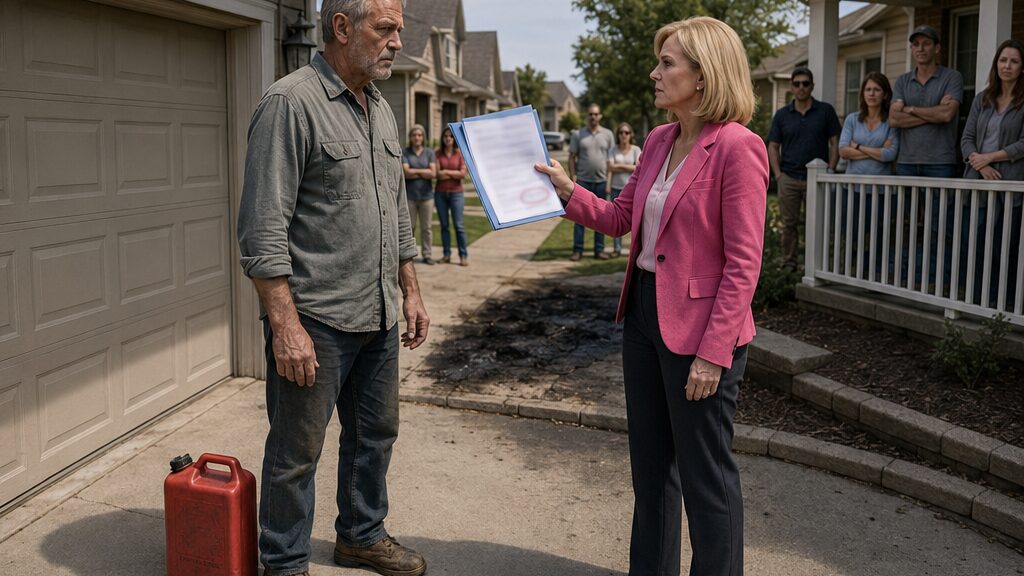
Her hot-pink blazer looked almost unreal against the smoke, too bright and clean for a driveway full of ash. She stood near the curb with her phone held upright, not toward the fire, but toward him.
“You were standing right there with gasoline,” she said, loud enough for the neighbors to hear.
“It was already smoking,” Joseph said.
His voice came out lower than he expected. Not weak, but thin, as if the heat had dried it.
Cynthia stepped closer. “Do not start explaining this away.”
Joseph tightened his grip on the handle. The can was half full, mixed for the mower. He had filled it two days ago because the back grass had gone wild after the rain. It had been sitting inside the shed, beside the weed trimmer, until he smelled something sharp and chemical through the open kitchen window.
Not gasoline. Hot plastic.
He had come out through the garage, seen the HOA car idling too close to his side gate, and noticed a gray ribbon of smoke rising from under its hood. Then he had seen the red can near the shed wall, too close to where the heat was beginning to spread, and his first thought had been simple: move it away before everything got worse.
That was the moment Cynthia had turned the corner.
That was the moment Nicholas Miller had come out onto his porch.
That was the moment the car’s front end had bloomed with flame.
Now Joseph was holding the thing everyone could understand without thinking.
Gas can. Burning car. Quiet man.
“You need to put that down exactly where you were standing,” Cynthia said.
“I was moving it away from the heat.”
“You were standing beside a security vehicle with fuel in your hand.”
“Because the vehicle was smoking.”
Cynthia’s mouth tightened. She had been HOA president for three years, long enough to make people lower their voices when she walked into a room. Joseph had seen her correct mailbox paint colors, measure fence heights, and stop a moving truck because the owner had not submitted the proper form for street blockage. She did not yell often. She did not need to.
Today she was yelling.
“You understand this vehicle belongs to the association,” she said. “This is not some private matter you can shrug off.”
Joseph glanced past her at the car. The windshield gave a sharp crack. One of the neighbors gasped. The heat licked toward the strip of grass between the curb and his driveway.
“Everybody should move back,” he said.
Cynthia lifted her arm, blocking him as if he had tried to escape instead of warn her. “No. You stay right here.”
A siren sounded in the distance, faint but coming closer.
Joseph could feel the neighborhood gathering around the edges of the smoke. A man in running shorts at the corner. A woman with her hand over her mouth near the mailbox cluster. Nicholas on his porch, one hand on the railing, eyes moving from the can to Joseph’s face and away again.
Joseph wanted to tell them all what he had seen. The slow smoke. The clicking sound from under the hood. The strange blinking from the roof light before the flame. But the more faces he saw, the harder the words became. His throat closed around the explanation.
For years, quiet had worked for him. Quiet kept him out of board arguments. Quiet let him pass through grocery aisles without being trapped in stories about dues and drainage. Quiet had gotten him through the year after his wife died, when people brought casseroles and then stopped knowing what to say.
But standing there with the gas can, quiet changed shape.
It began to look like guilt.
Cynthia turned toward the neighbors. “Several residents saw Mr. Carter standing beside the vehicle with fuel.”
“I wasn’t beside it until I saw smoke,” Joseph said.
She swung back. “Were you holding that can or not?”
Joseph looked at the red plastic container. The spout cap was on tight. A little dried grass stuck to the bottom. His thumb rested near the faded black marker where he had written MOWER MIX so he would not confuse it with anything else.
“Yes,” he said.
The answer moved through the watching neighbors faster than the smoke.
Cynthia’s expression sharpened. “Thank you.”
“That is not the whole thing.”
“It is the part that matters right now.”
The fire engine turned onto the street. The sound filled the lane, bounced off garage doors, rattled in Joseph’s chest. Two firefighters jumped down before the truck fully stopped. One called for everyone to move back. Another dragged a hose toward the burning sedan.
Joseph started to step away.
Cynthia snapped, “I said don’t move that can.”
A firefighter glanced at them. “Sir, set it down and move back.”
Joseph lowered the can carefully onto the driveway, far from the flame, far from the car, far from where Cynthia seemed to want it. He held his hands open for a moment, palms visible, though no one had asked him to. The gesture embarrassed him as soon as he did it.
The fire crew pushed everyone away. Water hit the car with a violent hiss. Steam rolled across the street. Cynthia kept talking into her phone, not quite filming now, but narrating.
“HOA security vehicle. Maple Ridge Lane. Resident present with gasoline container. Yes, we’ll need a full incident report.”
Joseph heard each phrase as if she were laying boards across a door.
Resident present.
Gasoline container.
Incident report.
Daniel Wilson, the security driver, was nowhere near the car. Joseph searched through the smoke for him, expecting to see the gray uniform shirt, the clipped radio at his shoulder, the nervous way he tapped his pen against the patrol log. The car had not appeared by itself. Daniel had parked it there less than half an hour earlier, after rolling slowly down the lane twice that afternoon. Joseph had seen him through the kitchen window while rinsing a coffee cup.
But the driver was gone.
“Where’s Daniel?” Joseph asked.
Cynthia lowered her phone. “This is not about Daniel.”
“It’s his vehicle.”
“It is the association’s vehicle.”
“He parked it here.”
Her eyes flashed toward the curb, then back. It was quick enough that most people would miss it. Joseph did not. He had spent years noticing small things because he preferred not to argue about large ones.
The firefighters had the worst of the flames down now, though the hood still spat smoke. A black stain ran along the street gutter. Burned plastic smell settled into the air, thick and sour.
Cynthia came closer again, lowering her voice just enough to make the words feel more private and more dangerous.
“The board will file a claim,” she said. “You should prepare yourself for that.”
Joseph wiped soot from the corner of his eye with the heel of his hand. “A claim against who?”
She looked at the gas can on his driveway.
Against whom, his wife would have corrected softly, and he hated that the thought came to him now.
“You know exactly what this looks like,” Cynthia said.
Joseph looked at the melted shape of the HOA security car, the neighbors staring from their careful distances, the red gas can sitting obediently where he had placed it.
For the first time since the fire started, he felt something colder than fear.
He felt the shape of a story forming without him.
Cynthia pointed at the can again and raised her voice so everyone nearby could hear.
“Don’t move that can. It’s evidence.”
Chapter 2: A Repair Bill Written Like a Verdict
Cynthia Taylor laid the repair estimate on Joseph’s porch rail before he had finished sweeping ash from the driveway.
The top page was clipped to a blue folder with the HOA seal printed in the corner. A yellow sticky note marked the signature line. The number at the bottom had been circled in red.
$21,830.
Joseph looked at the paper, then at Cynthia.
She wore the same hot-pink blazer as the day before, or one so similar it seemed intentional. Her hair was smoothed back, her lipstick precise. Behind her, the blackened patch on the curb still smelled faintly of burned rubber. The tow truck had taken the security car away before sunset, but it had left a dark scar in the street and a pale rectangle where the tires had protected the pavement from soot.
The red gas can sat on the ground near Joseph’s garage door. He had not moved it inside. Not yet.
Cynthia followed his glance. “Good. At least you understood that part.”
“I understood you told everyone it was evidence.”
“It may be.”
“You have a fire report already?”
“The preliminary incident summary is enough for the board to act.”
Joseph picked up the top page without removing it from the clip. The estimate listed towing, body damage, electrical replacement, paint, detailing, and something called temporary patrol coverage. The total included a deductible reimbursement and a projected increase line marked pending. Lower down, under cause notes, someone had typed: possible negligent fuel storage adjacent to association vehicle.
Joseph read the phrase twice.
Negligent fuel storage.
The can had never been adjacent to the vehicle. It had been inside his shed until he pulled it away from the wall. The HOA car had been beside his driveway, not his can beside their car.
“You need to sign the acknowledgment by tomorrow evening,” Cynthia said.
Joseph turned the page. “Acknowledgment of what?”
“That you were present with the fuel container at the time of ignition and agree to cooperate with the association’s claim.”
“That is not what this says.”
Cynthia’s expression did not change.
Joseph tapped the signature line. “This says I accept responsibility for improper storage of combustible material resulting in damage to association property.”
“It says you acknowledge the circumstances.”
“It says I caused it.”
“It says what the insurer will need.”
Joseph looked at the street. Nicholas Miller’s blinds shifted across the way. Someone was watching again.
He wanted to step inside and close the door. He wanted to let Cynthia stand on the porch until she got tired of holding her folder. He wanted, more than anything, not to discuss money in front of his own front windows where his wife had once taped paper snowflakes for the neighborhood children.
Instead, he read the number one more time.
$21,830.
It was not enough to ruin a wealthy person. It was enough to crack open Joseph’s savings. Enough to turn the roof repair he had postponed into another year of buckets. Enough to make him choose between keeping his truck and keeping the emergency account he had promised Samantha he would not touch.
Cynthia mistook his silence for softening.
“The board is willing to handle this efficiently,” she said. “No one wants to make it uglier than it has to be.”
“It is already ugly.”
“Then don’t make it worse.”
Joseph lowered the estimate. “The can was moved away from heat. Not toward the car.”
Cynthia blinked once.
“I smelled smoke,” he said. “I came outside. The vehicle was already smoking near the front. The can was by my shed. I moved it away.”
“You expect the board to believe you carried gasoline into a fire scene for safety?”
“I carried it away from my shed.”
“Several people saw you with it.”
“They saw me after the smoke started.”
“Several people saw what they saw.”
Joseph almost laughed, but there was no humor in him. He could hear the phrase for what it was: a fence built from other people’s partial views.
He lifted the second page. “Who wrote this incident summary?”
“The board compiled it.”
“From whom?”
“From residents, my own observation, and relevant parties.”
“Daniel Wilson is not listed.”
Cynthia’s fingers tightened on the folder edge. “Daniel was not responsible for the container in your possession.”
“He was responsible for the vehicle.”
“The vehicle was association property.”
“He parked it beside my driveway.”
Her gaze drifted past him toward the garage, toward the red can, toward the black line of soot that still ran near the curb. She looked tired for half a second, and in that half second Joseph saw something other than anger. Calculation, maybe. Or fear.
Then she straightened.
“Mr. Carter, the HOA carries insurance. But deductibles, premium changes, rental security coverage, administrative handling—those costs do not disappear. They go somewhere. If the source of damage is a homeowner’s negligence, it is the board’s duty to recover those costs.”
“Duty,” Joseph said.
“Yes.”
“You had already decided before you came here.”
“We have enough to proceed.”
“No,” he said. “You have enough to point.”
Cynthia’s face hardened. “Be careful.”
The warning was quiet. Not dramatic. That made it worse.
Joseph set the estimate back on the rail. “I will not sign a statement that is not true.”
“You are refusing to cooperate?”
“I am refusing to accept responsibility for a fire I did not cause.”
Cynthia took out her phone and tapped the screen with her thumb. “I’m noting resident declined preliminary cooperation.”
“I did not decline cooperation. I declined your wording.”
She spoke as she typed. “Resident disputes responsibility despite being witnessed holding fuel container at scene.”
Joseph looked past her toward Nicholas’s house. The blinds were still now. Other houses along the lane had their garage doors shut, their sprinklers ticking, their flags hanging still. Maple Ridge Lane had returned to its careful morning shape, except for the burned stain and the woman turning him into a line item.
“Why was Daniel here?” Joseph asked.
Cynthia stopped typing.
“He usually drives through,” Joseph said. “He doesn’t park in front of my house.”
“There had been reports of unauthorized soliciting.”
“On this street?”
“In the neighborhood.”
“So he parked by my side gate?”
“He was doing his job.”
“Where was he when the car caught fire?”
“That question is not relevant to whether you had an unsafe fuel container.”
“It is relevant to why the car was there.”
Cynthia slipped her phone into her blazer pocket. “You have until tomorrow evening. If we do not receive a signed acknowledgment, the board may assess related fines for noncooperation and preservation issues.”
“Preservation issues?”
“You moved the container.”
“I moved it before you called it evidence.”
“You moved it after the incident began.”
Joseph felt heat rise in his face, not from the sun, not from the burned curb. He steadied himself by placing one hand on the porch rail. The wood was rough beneath his palm. Last spring he had told himself he should sand and stain it before summer. He had not done it. There were always small things waiting for attention.
Now a large thing had arrived and placed itself on top of all of them.
Cynthia pushed the folder toward him. “Keep the copy. I suggest you read it carefully.”
“I already did.”
“Then you understand the seriousness.”
Joseph picked up the packet. The pages were warm from the morning sun. The red circled number showed through the top sheet like a wound.
Cynthia turned to leave, then paused beside the gas can.
“If I were you,” she said, “I would not touch that again until this is resolved.”
Joseph watched her walk down the driveway, pink blazer bright against the black stain.
Only after her car door closed did he look again at the incident summary. He read each line slowly this time, not the way a frightened man reads a bill, but the way a careful man reads a mistake.
Date. Time. Location. Witnesses.
Cynthia Taylor. Several residents. Association representative.
No Daniel Wilson.
Joseph stood on his porch with the repair packet in his hand and the red gas can at his feet, staring at the empty place where the driver’s name should have been.
Chapter 3: The Folder Cynthia Did Not Notice
Samantha Carter found the estimate under Joseph’s fruit bowl and went silent before she reached the second page.
Joseph knew that silence. It was the one she used when she was trying not to sound afraid of something practical: a bill, a lab result, a loose step, an unopened letter from the bank. She stood at his kitchen counter in her work blouse, one hand on the paper, the other still holding the grocery bag she had brought in from her car.
“Dad,” she said, “can you afford this?”
The question landed harder than Cynthia’s accusation.
Joseph took the milk from the bag and put it in the refrigerator. He did not need milk. Samantha brought it anyway every few days, along with bread, bananas, and little containers of soup he pretended not to recognize as supervision.
“I’m not paying it,” he said.
“That isn’t what I asked.”
“It’s the answer.”
She looked down again at the circled total. “Twenty-one thousand eight hundred thirty dollars.”
“I can read it.”
“Then read the part where they can add fines.”
He closed the refrigerator too firmly. A jar rattled in the door.
Samantha softened immediately, which made him feel worse.
“I’m not saying you did anything,” she said.
“I didn’t.”
“I know.”
But she said it too quickly.
Joseph turned from the counter. “You know?”
“I know you wouldn’t set a car on fire.”
“That is not the same as knowing.”
Her eyes flicked toward the kitchen window, where the edge of the driveway was visible. The red gas can still sat near the garage. Joseph had left it outside because moving it felt like obeying Cynthia and not moving it felt like surrendering to her. So it remained where everyone could see it, absurdly bright in the morning light.
Samantha followed his gaze. “Why is it still out there?”
“Because your HOA president told me not to touch it.”
“She isn’t my HOA president.”
“You grew up here. That counts.”
“Dad.”
Joseph pulled out a chair and sat. His knees ached from standing too long the day before, though he had no intention of saying that. Samantha sat across from him, the estimate between them like a third person.
“If there’s a way to settle for less,” she said carefully, “maybe you should at least hear it.”
He looked at her.
“I hate saying that,” she added. “I do. But if this turns into insurance lawyers and HOA fees and court costs—”
“No lawyers.”
“You don’t know that.”
“I know I’m not signing a lie.”
“What if not signing costs you more?”
He heard the fear under her words and saw, for one sharp second, the child she had been after her mother’s funeral, standing in this same kitchen with a casserole dish too heavy for her hands. She had learned early that loss came with paperwork. Death certificate. Insurance forms. Mortgage statements. Utility transfers. Practical things that did not care whether anyone had slept.
“I didn’t cause it,” he said, quieter.
“I believe you.”
“You are talking like someone who wants me to pay anyway.”
“I am talking like someone who doesn’t want you crushed by a neighborhood board that has more time and money than you do.”
The words opened something between them.
Joseph pushed back from the table and went to the pantry closet. On the top shelf, behind extra light bulbs and a box of old extension cords, was a green hanging folder with CARTER HOUSE written on the tab in his wife’s neat block letters. He took it down carefully. Dust marked the edge.
Samantha watched him return with it.
“What is that?”
“House records.”
“You still keep paper copies?”
“I still own paper problems.”
He opened the folder. Inside were envelopes, receipts, printed emails, old HOA notices, photos with dates written on the back, and a small spiral notebook. His wife had started the system when they moved in. Joseph had continued it after she died, partly because it was useful, partly because throwing it away would have felt like correcting her.
He sorted through the first stack.
Fence approval. Roof color notice. Drainage complaint. Security patrol schedule.
Then he found the page he had not remembered until Cynthia called the can evidence.
It was a photo printed on ordinary paper: the HOA security sedan parked crookedly near the mailbox cluster three weeks earlier. The image itself was not dramatic. Just a white car, a hot day, a faint blur at the hood edge. Joseph had written beneath it: Security car smell near mailboxes. Burning plastic? Mentioned to board portal 4/18.
Samantha leaned closer. “What is that?”
“Something I sent in.”
“About the car?”
“About the smell.”
He found the printed portal confirmation next. Thank you for your submission. Maintenance concerns will be reviewed by the board as needed.
No name. No follow-up. No resolution.
He kept digging.
A receipt from the hardware store, dated two days before the fire. One red five-gallon fuel can. One bottle of two-cycle oil. Mower blades. Work gloves. The cashier had circled the survey code at the bottom in blue pen.
Joseph stared at it longer than necessary.
“That can wasn’t new yesterday,” Samantha said.
“No.”
“And the fuel was for the mower.”
“Yes.”
“Does that prove anything?”
“It proves one small thing.”
“That you didn’t run out and buy gas to burn a car?”
Joseph looked at her. “Do you hear yourself?”
She closed her mouth.
He did not want to punish her for being afraid. But fear had a way of taking the other side before it meant to.
The answering machine on the small counter by the wall blinked red. Joseph rarely used it, but he still kept the landline because his wife had insisted storms took cell service before copper lines. He pressed the button.
A woman’s voice filled the kitchen.
“Mr. Carter, this is a claims clerk calling on behalf of the association’s property insurer. We are requesting a recorded statement regarding the fuel-related incident at Maple Ridge Lane involving association patrol vehicle damage. Please return this call by close of business tomorrow so we can confirm your account and cooperation status.”
The machine clicked.
Samantha’s face changed. “They already called it fuel-related.”
Joseph looked at the folder spread open on the table, at the old photo, the hardware receipt, the repair estimate, the portal confirmation, the little notebook with his wife’s handwriting on some pages and his own on others.
For two days he had believed Cynthia was trying to make a story.
Now he understood she had already sent it somewhere official.
Chapter 4: The Claim That Changed Its Story
Laura Johnson’s paperwork called the red gas can an accelerant source before Joseph had spoken one recorded word.
He stood in his garage with the claim form in one hand and the can on the concrete floor between his shoes. The label he had written in black marker—MOWER MIX—faced upward, plain as a name tag. Sunlight came through the open garage door and caught the scuffed handle, the dried grass stuck near the bottom, the little smear of oil where he had overfilled it two mornings before the fire.
On the paper, under Cause Summary, someone had typed: homeowner stored accelerant adjacent to association patrol vehicle at time of ignition.
Adjacent.
Joseph read it again, then looked out toward the curb where the burned stain still marked the street.
The can had been by the shed. The vehicle had been by the driveway. Between them had been distance, fence shadow, and the few seconds it took for him to decide heat and fuel did not belong near each other. Now the claim made that distance disappear.
His phone rang on the workbench.
He let it ring twice, then picked up. “Joseph Carter.”
“Mr. Carter, this is Laura Johnson. I’m the adjuster assigned to the Maple Ridge association vehicle claim.”
Her voice was even, practiced, not unkind. That almost made it worse. Cynthia’s accusation had heat in it. Laura’s had forms.
“I received your message,” Joseph said.
“I appreciate the callback. I’m reviewing the incident, and I’ll need to confirm some basic details. Is now a good time?”
Joseph looked at the can. “No. But I’ll answer.”
There was a pause long enough for him to know she had heard more than the words.
“I understand this is stressful,” Laura said. “I’m only gathering information.”
“That paper you sent already gathered some.”
“The preliminary cause summary came from the association’s submitted incident report.”
“Cynthia Taylor’s report.”
“The association’s report,” Laura said carefully.
Joseph set the claim form on the workbench beside the hardware receipt. “It says I stored fuel beside the vehicle. That is not true.”
“Where was the container before the fire?”
“In my shed area.”
“Inside or outside?”
He hesitated. The truth was exact, and exact truth sometimes sounded worse than simple lies.
“Just outside the shed door,” he said. “I had used it earlier that week. I moved it away after I smelled smoke.”
“Moved it where?”
“Toward the driveway, away from the shed wall. Then I saw the vehicle smoking harder.”
“So you were carrying the container during the incident.”
“Yes.”
Laura did not say anything for a moment. Joseph could hear keys clicking faintly.
He felt Cynthia’s story tightening again.
“I was carrying it away from heat,” he said. “Not toward the car.”
“I’m noting your statement.”
“That is not a small difference.”
“I understand.”
“I’m not sure you do.”
Another pause.
Laura’s voice softened by one degree. “Mr. Carter, I have to work with documentation. The association submitted statements indicating multiple residents observed you with a fuel container near the vehicle. The vehicle was reportedly parked for approximately ten minutes before visible flames.”
Joseph looked up.
“Ten minutes?” he said.
“That is the submitted timeline.”
“No.”
“Your recollection differs?”
“It was there longer than ten minutes.”
“How much longer?”
Joseph closed his eyes. He saw the kitchen sink, the coffee cup, the white sedan rolling slow past the window, then returning and stopping near his side gate. He had rinsed the cup, wiped the counter, taken stale crackers from the pantry, looked through the mail, and checked the mower blade order on his phone. More than ten minutes. Much more.
“Twenty-five,” he said. “Maybe thirty.”
“That’s a significant difference.”
“The car didn’t just arrive.”
“Can you document that?”
Joseph opened his eyes.
There it was. The wall he kept meeting.
“I can tell you what I saw.”
“I’m not dismissing that,” Laura said. “But if the association’s version is disputed, third-party corroboration would help.”
“Third-party,” he repeated.
“A neighbor, a timestamped record, a service note, anything that supports your timeline.”
Joseph looked at the printed portal complaint from weeks earlier. The photo of the security car near the mailboxes. The hardware receipt. The can. Small things. Useful things. Not enough things.
“What about the fuel itself?” he asked.
“What do you mean?”
“It’s mixed for a mower. Oil in it. I wrote it on the can. If someone poured that on a car, would that matter?”
“It might matter to a fire investigator. I’m not making a cause determination myself.”
“But your claim says accelerant.”
“The report uses that term.”
“The report is wrong.”
Laura was quiet again. When she spoke, she sounded less procedural. “Then send me what you have. Receipts, photos, prior complaints, anything dated. And if anyone saw smoke before you approached the vehicle, I need that person’s statement.”
Joseph looked across the street.
Nicholas Miller was outside with a trash bin, moving slower than a man needed to move a trash bin. He glanced toward Joseph’s garage, then looked away.
“I may know someone,” Joseph said.
“May?”
“He saw something.”
“Can he put it in writing?”
Joseph watched Nicholas pull the bin back from the curb though pickup had already passed. Avoiding the garage. Avoiding him.
“I don’t know.”
“Please understand,” Laura said. “Without corroboration, the association’s submitted timeline may control the initial handling of the claim.”
The word control stayed with him after the call ended.
Joseph picked up the red gas can. For the first time since Cynthia had called it evidence, he unscrewed the cap. The smell was sharp but familiar: gasoline and two-cycle oil, the smell of Saturday yard work, not disaster. He dipped a clean wooden paint stirrer into the liquid, lifted it, watched the faint bluish sheen slide down the stick.
Mower mix.
Not innocence by itself. But a line in the right direction.
He set the can down, capped it, and gathered the receipt, photo, portal confirmation, and claim form. His hands moved more quickly than usual. Then he stopped and looked again at the street.
Nicholas was still outside.
Joseph stepped out of the garage before he could talk himself out of it.
Nicholas saw him coming and immediately bent to adjust one of the bin wheels.
“Nicholas.”
The man straightened with a forced half-smile. “Hey, Joseph. How’re you holding up?”
“Badly.”
The answer seemed to remove whatever neighborly sentence Nicholas had prepared.
Joseph crossed the street. “I need to ask what you saw.”
Nicholas glanced toward his own front window. “About the fire?”
“Yes.”
“Cynthia already asked everybody.”
“I’m asking you.”
A car moved slowly down the lane, both men turning slightly as it passed. Joseph hated that they did that now, like people afraid of being overheard in their own neighborhood.
Nicholas rubbed the back of his neck. “I saw you with the can.”
“I know.”
“That’s all I told her.”
“Is it all you saw?”
Nicholas’s face changed. Not enough for a stranger to notice. Enough for Joseph.
“I don’t want to get in the middle,” Nicholas said.
“You live across from the middle.”
“That’s exactly why I don’t want to be in it.”
Joseph waited.
Nicholas looked toward the curb stain. “There was smoke before you came out.”
Joseph felt something inside him loosen and tighten at the same time.
“From the car?”
“Looked like it. Front end. Not much at first.”
“Did you see me outside before that?”
“No.”
“Did you see the gas can before that?”
“No.”
Nicholas lowered his voice. “But Joseph, please don’t use my name yet.”
Joseph stared at him.
Nicholas had the decency to look ashamed. “Cynthia is already mad about my side fence. She’s been after me for the lattice height for months. If I sign something against her report, she’ll make my life miserable.”
“She is making mine miserable now.”
“I know.”
The words were small. True, but small.
Joseph turned back toward his house. In his garage, the red gas can waited beside the claim form that had made him adjacent to a fire he did not start.
“Joseph,” Nicholas called quietly.
He looked back.
Nicholas stood with one hand on the empty trash bin, eyes fixed on the street between them.
“I saw smoke before you stepped outside,” he said. “I just can’t be the first person saying it.”
Chapter 5: The Driver Who Remembered the Smoke
Daniel Wilson saw Joseph in the repair shop parking lot and immediately turned toward the vending machine as if a bottle of water could save him.
The burned HOA security car sat behind the chain-link fence, its front end wrapped in plastic sheeting, the roof light half melted into a dark lump. Without the flames, it looked smaller. Sadder. Less like an accusation and more like a machine that had failed while everyone was watching the wrong man.
Joseph parked his truck beside the customer entrance and waited.
Daniel kept his back turned. He wore a gray polo with the security company logo, though the collar had curled at one edge. His shoulders were narrow. Younger than Joseph had thought from a distance. Old enough to know better than to disappear from a fire scene.
“You don’t have to pretend that machine sells anything good,” Joseph said.
Daniel’s hand froze near the buttons.
For a moment neither of them moved. Inside the repair bay, metal clanged and an air hose hissed. A mechanic walked past the fence without looking at either man.
Daniel turned slowly. “Mr. Carter.”
“You left before the fire crew finished.”
“I had to call my supervisor.”
“From somewhere else?”
Daniel looked toward the shop office. “I don’t think I’m supposed to talk to you.”
“That seems to be going around.”
“I didn’t write the report.”
“No,” Joseph said. “That’s part of the problem.”
Daniel swallowed. He looked at the burned vehicle, then away. “I told them what I knew.”
“Did you tell them the car was smoking before I came outside?”
Daniel’s face shut down.
Joseph had expected denial. He had prepared himself for it on the drive over, fingers tight on the steering wheel, folder on the passenger seat. But Daniel did not deny it. He only looked tired.
“I smelled something,” Daniel said.
“When?”
“Earlier.”
“How much earlier?”
Daniel shoved his hands into his pockets. “That morning.”
Joseph let the silence work.
“It had been running hot,” Daniel said finally. “The light bar flickered twice on the north loop. I thought it was the battery, maybe wiring. I told Cynthia.”
“You told her before it burned?”
“Not like an official report.”
“What does that mean?”
“It means I said it.”
“Those are usually the same thing when the truth matters.”
Daniel flinched.
Joseph almost regretted the sharpness. Almost.
A repair shop estimator came out of the office carrying a clipboard. He walked toward the fenced lot, glanced at them, and kept moving.
Daniel lowered his voice. “It wasn’t supposed to be parked that long.”
Joseph’s eyes narrowed. “In front of my house?”
“Anywhere. The instruction was to stay visible, keep moving, do passes through the streets, sit near the entrance if needed. Cynthia wanted residents to see patrol before the board meeting next week.”
“What board meeting?”
“Contract renewal. Security budget. Some people have been complaining it’s a waste.”
Joseph looked at the burned sedan. The HOA security car, visible until it became unmissable.
“Why did you park by my gate?”
Daniel rubbed his forehead. “I got a call. Not official. Cynthia asked if I could watch for solicitors on your block because someone complained.”
“Who complained?”
“I don’t know. She just said Maple Ridge Lane.”
Joseph remembered Cynthia saying reports of unauthorized soliciting. He remembered the car passing once, then again, then stopping. He remembered thinking Daniel must have been writing something down.
“How long were you there?”
“Maybe twenty minutes.”
“Not ten.”
Daniel looked at him then. “No. Not ten.”
The words were so simple Joseph felt anger rise in him like heat. Twenty minutes had become ten on a report. A smoking car had become a fuel incident. A man moving a can had become a man storing accelerant beside association property.
“Will you tell the adjuster that?” Joseph asked.
Daniel shook his head before Joseph finished.
“I can’t.”
“You just did.”
“Not in writing.”
“Daniel.”
“I have two kids,” Daniel said, and the words came out rough. “This contract is half my hours. If Cynthia says I didn’t report maintenance right, my supervisor cuts me loose and tells the HOA we’ll assign somebody else. I’m not salary. I don’t get to be brave for free.”
Joseph’s anger did not leave. It changed direction.
He saw Daniel now not as the missing piece that had chosen to hide, but as another man under a bill he could not afford, another man doing calculations with fear. That did not excuse him. It made the thing uglier.
“You let her put this on me,” Joseph said.
Daniel looked down. “I thought it would get sorted out by the fire report.”
“It got sorted out on my porch with twenty-one thousand dollars circled in red.”
Daniel’s mouth tightened. “I didn’t know she did that.”
“Now you do.”
A truck rumbled behind them. The repair shop estimator opened the gate and walked toward the burned car. Joseph saw him lift the plastic sheeting and look into the front compartment. He whistled under his breath.
Daniel glanced back, nervous.
“Did the shop find anything?” Joseph asked.
“I’m not allowed to ask.”
“But you did.”
Daniel did not answer.
Joseph waited.
“They said light bar wiring maybe,” Daniel said. “Aftermarket connection. Heat damage around the front harness. I don’t know the terms.”
“Was it written down?”
“Maybe in their system.”
“Can I get that?”
“Not from me.”
The estimator came out from behind the fence and headed toward the office. Joseph stepped aside, blocking his path just enough to be noticed but not enough to be rude.
“Excuse me,” Joseph said. “That HOA sedan. Was there prior electrical trouble?”
The estimator looked from Joseph to Daniel.
“I can’t release findings to someone who isn’t authorized on the vehicle.”
“I understand.”
“Then you understand.”
The man went inside.
Joseph turned back to Daniel. “Cynthia knew about the warning light.”
“I told her it flickered.”
“And she still told the insurer it was fuel storage.”
Daniel pressed his lips together.
“Say it,” Joseph said.
Daniel shook his head. “I can’t write a statement.”
Joseph took one step closer. “I did not ask if you were scared. I asked what happened.”
Daniel’s eyes lifted. For a second Joseph saw resentment there, then shame.
“I told Cynthia about the light,” Daniel said. “Before the fire. That’s all I can say.”
“It isn’t all you can say. It is all you will say.”
Daniel looked away.
Joseph walked back to his truck with the folder under his arm. His hand shook when he opened the door, and he hated that too. At home, he had mail waiting in the box: a grocery flyer, a water bill, and a white HOA envelope with Cynthia’s signature printed above the return address.
He opened it standing in the driveway.
NOTICE OF COMMUNITY DISCUSSION ITEM.
The burned vehicle photograph would be reviewed at the upcoming HOA meeting. The subject line read: Fuel Negligence Incident and Association Loss Exposure.
Before Joseph could fold the paper, his phone buzzed.
An email from Cynthia had gone to the neighborhood distribution list.
Residents are encouraged to attend Thursday’s meeting regarding the recent security vehicle damage caused by improper fuel handling on Maple Ridge Lane.
Joseph read the sentence once, then again.
She had not waited for the claim. She had not waited for the fire report. She had not waited for Daniel, or Nicholas, or Joseph’s records.
She had taken the story public.
Chapter 6: The Meeting Where Silence Finally Cost Too Much
The first thing Cynthia Taylor put on the clubhouse screen was a photograph of the burned car with Joseph’s red gas can visible in the corner.
No one spoke for a moment. They did not need to. The picture did the work Cynthia wanted it to do.
Joseph sat in the second row with his folder flat across his knees. The metal chair felt too narrow. The clubhouse smelled faintly of coffee and floor cleaner, the same as every HOA meeting he had avoided for the better part of a decade. Tonight nearly every chair was filled.
He could feel people noticing him without turning their heads.
Cynthia stood beside the screen in a navy dress this time, the hot-pink blazer draped over the back of her chair like a flag waiting to be raised. She held a remote in one hand and the blue repair packet in the other.
“This meeting is not a trial,” she said. “It is a community discussion regarding association loss exposure and homeowner responsibility.”
Joseph looked down at his folder.
Not a trial, he thought. Just the verdict first.
Samantha slipped into the room three minutes late and stopped when she saw the screen. Her face changed before she found him. She moved quickly to the empty chair beside him.
“Dad,” she whispered. “That photo—”
“I know.”
Two women behind them were whispering.
“Nearly burned the whole block.”
“I heard he keeps gas everywhere.”
Joseph felt Samantha stiffen beside him.
He did not turn around. He had learned in the last week that there were moments when defending yourself against a whisper only fed it.
Cynthia clicked to the next slide. The estimate appeared: towing, assessment, temporary patrol coverage, deductible exposure. The total was still circled in red.
“The current documented amount is twenty-one thousand eight hundred thirty dollars, excluding future premium impact,” she said. “The board has attempted preliminary cooperation with the homeowner involved.”
Involved.
Joseph gripped the folder edge.
A board member cleared his throat. “Cynthia, maybe we should be careful with wording until the insurer finalizes.”
“We are being careful,” Cynthia said. “That is why this is a discussion item.”
She clicked again. A paragraph from the incident summary filled the screen.
Resident observed holding fuel container near association patrol vehicle at time of ignition.
Samantha leaned toward Joseph. “You cannot let that sit.”
He looked at her, surprised.
Her eyes were wet, but her voice was steady. “I know what I said in the kitchen. I was scared. But you cannot let that be the only sentence people hear.”
Cynthia lifted the repair packet. “The board has no desire to create hardship. In fact, we have discussed a practical path. If Mr. Carter is willing to sign a no-fault cooperation acknowledgment and contribute six thousand dollars toward deductible and temporary coverage costs, we may be able to close the association portion without pursuing additional fines at this time.”
Murmurs moved through the room.
Six thousand.
The number was smaller than twenty-one thousand. That was its danger. It sounded like mercy to anyone who did not have to sign the sentence beneath it.
Cynthia looked directly at him. “Mr. Carter, this option would prevent further community expense.”
There it was. Not just a bill now. A neighborhood burden tied around his name.
Joseph stood.
The chair legs scraped louder than he intended. Every face turned. His mouth went dry. For one terrible second, he felt the old reflex come for him: sit down, wait, write a letter later, let the room pass over you.
He opened the folder.
“My name is Joseph Carter,” he said.
A few people shifted, as if his voice had startled them.
“I did not cause that fire.”
Cynthia’s mouth tightened. “Mr. Carter, you’ll have a chance to submit—”
“I am speaking now because you put my driveway on a screen.”
The room went still.
Joseph held up the hardware receipt. “This is the receipt for the red can. Two days before the fire. Mower fuel. Two-cycle oil. The can was for yard equipment.”
Cynthia folded her arms. “No one has claimed you bought it that day.”
“The claim calls it an accelerant source beside the vehicle. It was not beside the vehicle. It was near my shed. I moved it because I smelled smoke.”
Someone in the back asked, “From the car?”
Joseph turned toward the voice. “Yes.”
Cynthia clicked the remote, but the slide did not change. “The documented witness statements place you at the scene with the container.”
“They place me after smoke began.”
“According to you.”
Joseph felt the room tilt toward her. He had receipt paper, a printed portal complaint, a photograph from weeks before, his own notes. But he also had his own long habit of being private, and Cynthia knew how to make privacy look like emptiness.
He pulled out the old portal confirmation. “Three weeks before the fire, I reported that the security car smelled like burning plastic near the mailboxes. I printed the confirmation.”
Cynthia’s eyes flickered.
A murmur moved through the chairs again, different this time.
“Why didn’t the board respond?” someone asked.
Cynthia lifted a hand. “Maintenance comments are triaged. A resident’s casual observation does not establish—”
“I also have a photo,” Joseph said.
He held it up, but the room was too large and the paper too small. He felt foolish immediately, an old man holding a printout no one could see.
Samantha stood beside him. “Can he put it on the table?”
Cynthia hesitated. “This is not an evidentiary hearing.”
“You put your evidence on a screen,” Samantha said.
That earned a few low sounds from the room.
Joseph placed the photo and receipt on the front table. His hands were steady now, though he did not feel steady anywhere else.
Cynthia looked at the papers but did not touch them. “Even if prior concerns existed, the issue remains that Mr. Carter moved a fuel container during an active incident.”
“To get it away from heat,” Joseph said.
“You cannot expect this association to absorb costs simply because you now disagree with how the situation looked.”
“No,” Joseph said. “I expect you not to ask me to buy your version with six thousand dollars.”
The room quieted again.
Cynthia’s face colored. Not dramatically. Just enough.
“The board is trying to avoid a special assessment,” she said. “If the insurer finds homeowner negligence and we fail to preserve our rights, every resident could pay for that mistake.”
There it was, fully spoken. Joseph against everyone’s dues.
He looked at the faces around him. Some suspicious. Some uncertain. Some embarrassed to be seen listening.
He turned back to Cynthia. “Then preserve the truth too.”
The side door opened.
Nicholas Miller stood there, one hand still on the handle as if he had not decided whether to enter or leave. He looked at the screen, then at Joseph, then at Cynthia.
Cynthia’s expression changed before she spoke. “Nicholas, we’re in the middle of—”
“I know.”
His voice was not loud, but it carried because the room had become hungry for the next thing.
Nicholas walked halfway down the aisle and stopped. He did not look at Joseph.
“I saw smoke before the can,” he said.
Cynthia went still.
Nicholas swallowed. His hands hung awkwardly at his sides.
“I’m not saying I know what started it,” he added. “I’m saying there was smoke from the car before Joseph stepped outside with anything in his hand.”
Chapter 7: The Receipt That Rewrote the Fire
Laura Johnson called at 8:07 the next morning and gave Joseph until noon.
“If I don’t receive your documentation by then,” she said, “the claim proceeds under the association’s submitted timeline.”
Joseph stood in his kitchen with the phone pressed to his ear and the green folder open on the table. The hardware receipt, the old photo, the portal confirmation, and his handwritten notes were spread across the wood in uneven rows. Beside them sat the red gas can’s cap, which he had removed to photograph the marked fuel mix inside.
“Noon,” he repeated.
“I know that’s tight,” Laura said.
“It’s not tight. It’s designed to close.”
“I’m telling you the deadline because your statement at the meeting created enough discrepancy that I can hold classification for a few hours. Not days.”
His eyes moved to the kitchen window. The gas can sat just inside the garage now, no longer out in the driveway for Cynthia to point at, but not hidden either.
“What exactly do you need?” he asked.
“Dated records. Your written timeline. Any statement from Mr. Miller. The fuel receipt. Anything showing prior vehicle concerns. If there is anything from the driver, send it.”
“Daniel won’t write one.”
“Then send what you have.”
“That may not be enough.”
“It may not,” Laura said. “But it is more than I had yesterday.”
When the call ended, Joseph stood still for three breaths. Then he took his wife’s old stapler from the drawer and began building a packet the way she used to: clean order, visible dates, no loose pages if a paper clip would fail.
Samantha arrived twenty minutes later with coffee he did not drink and a face that said she had slept badly.
“Tell me what to do,” she said.
He handed her the old photo. “Write the date from the back on a sticky note large enough to read in a scan.”
She nodded and sat.
For a while they worked without apology. Joseph wrote his timeline by hand first, then typed it slowly on the old laptop Samantha had tried to replace twice. He kept deleting sentences that sounded angry. He did not need Laura to know how Cynthia had looked at him. He needed Laura to know where the can had been.
At 9:14, Nicholas came to the back door instead of the front.
Samantha saw him first. “Dad.”
Nicholas stood on the small concrete step, holding a folded piece of notebook paper. He looked as if he had crossed a much larger distance than the width of the street.
Joseph opened the door.
“I wrote what I said,” Nicholas told him. “Only what I saw. No guesses.”
“That is all I need.”
Nicholas handed over the paper. “I don’t want this turning into a fight with Cynthia.”
“It already is.”
“I mean for me.”
Joseph almost said something sharp. Instead he unfolded the paper.
I saw light smoke from the front of the HOA security vehicle before Joseph Carter came out of his house carrying anything. I did not see him near the vehicle before that smoke.
Nicholas had signed and dated it.
Joseph read it twice. “Thank you.”
Nicholas nodded, already backing away. “I should get home.”
After he left, Samantha touched the paper lightly with two fingers. “He came.”
“He came late.”
“But he came.”
Joseph wanted to reject that mercy. He wanted anger to stay simple. But nothing in the last week had stayed simple, not even fear.
At 9:52, Joseph’s phone buzzed with a text from an unknown number.
It was Daniel.
I told Cynthia about the light.
Joseph stared at the six words until the screen dimmed.
Samantha leaned over. “Is that him?”
Joseph tapped the screen awake.
Another message appeared.
That morning. Before Maple Ridge. Roof bar flickered. Hot smell. I said it should go back but she said finish visible patrol. Please don’t make this worse than it has to be.
Joseph read the last sentence and felt no satisfaction. Daniel was still asking for protection inside a confession too small to stand on by itself.
He typed: May I send this to the adjuster?
The answer did not come for six minutes.
Then: Send what you need. Don’t say I’m accusing anyone.
Joseph set the phone down carefully.
“What?” Samantha asked.
“He opened the door.”
“To the truth?”
“To a hallway.”
By 10:30, Joseph had the documents arranged: receipt for the can and two-cycle oil; photo of the can label; written statement of where the can had been; old printed complaint about burning-plastic smell; photo of the security vehicle from weeks earlier; Nicholas’s statement; screenshots of Daniel’s texts; copy of Cynthia’s demand; copy of the estimate with the cause language circled.
He scanned each page at the small printer in the corner while Samantha watched for crooked edges. The machine made a tired grinding noise on every pass. Twice it jammed. The second time, Joseph nearly slapped the lid shut, then stopped himself and breathed through his nose until the anger drained out of his hand.
At 11:11, the repair shop returned his call.
The estimator would not release the vehicle file to him, but he said one sentence Joseph wrote down exactly.
“Prior electrical complaint noted in association intake; light bar harness under review.”
“Can you email that?” Joseph asked.
“I can email general confirmation that prior electrical concern exists in the file. Not findings.”
“That’s enough.”
“It may not be.”
“I’m getting used to that.”
The email arrived at 11:26.
Joseph printed it, scanned it, and added it to the packet.
At 11:43, Cynthia sent a neighborhood email.
Joseph saw the subject line first: Clarification Regarding Last Night’s Meeting.
His stomach tightened.
The message was shorter than usual.
The board remains committed to protecting association funds. While some residents have offered informal opinions, the core issue remains unsafe homeowner fuel storage in proximity to association property. The board reserves all rights to pursue reimbursement or settlement.
Attached was a revised demand.
The new amount was lower, but the wording was sharper. Joseph’s “unsafe storage” had become contributing negligence. The six-thousand-dollar offer remained open for forty-eight hours.
Samantha read over his shoulder. “She’s doubling down.”
Joseph looked at the scanned packet waiting on the laptop screen. For a moment the kitchen seemed to divide into two futures. In one, he paid less than the first number and carried the lie privately. In the other, he sent what he had and let people decide whether facts mattered after gossip had already done its work.
He attached the packet to an email addressed to Laura.
His hand paused over the mouse.
Samantha did not tell him what to do. That helped.
Joseph added one final line to the message.
I am not asking the carrier to decide whether people like me. I am asking that the timeline be corrected.
Then he clicked send.
The house became quiet enough for the refrigerator motor to sound loud.
At 12:18, Laura replied that she had received the packet and was reviewing.
At 1:03, she asked for permission to contact Nicholas.
At 1:40, she asked whether Joseph would authorize use of Daniel’s texts in internal claim review.
At 2:17, Cynthia sent no message at all, which somehow made Joseph more uneasy.
He went into the garage and stood near the red can. He had wiped soot from one side, but ash remained in the grooves around the handle. He thought of Cynthia’s finger pointing at it. He thought of Nicholas’s paper, Daniel’s six words, the old portal complaint nobody had answered.
At 3:02, his phone rang.
Laura did not begin with small talk.
“Mr. Carter,” she said, “based on the materials submitted, the claim classification has changed.”
Chapter 8: What Joseph Refused to Pay For
Cynthia Taylor left the envelope at Joseph’s door one week later and walked away without knocking.
Joseph watched her through the narrow window beside the entry. She came up the porch steps in a pale jacket, placed the envelope carefully against the threshold, then glanced once toward the garage before turning back to the sidewalk. No phone in her hand this time. No repair packet. No audience.
He waited until she reached her car before he opened the door.
The envelope had his name typed on the front. Not Joseph. Not Mr. Carter in Cynthia’s sharp board-meeting voice. JOSEPH CARTER, centered and formal, as if distance could make the contents cleaner.
He carried it to the kitchen and opened it with a butter knife.
Inside was a two-page HOA letter and a copy of an insurance notice. The first line said the association would not pursue reimbursement from him for the security vehicle loss.
Joseph read that sentence once, then set the page flat on the table.
His body did not know what to do with relief. It arrived without softness. His knees felt loose, his chest tight. The number had been removed from his name, but the place it had occupied was still sore.
He read on.
After review of additional materials, the association has determined that homeowner contribution will not be required at this time.
At this time.
He kept reading.
The association reserves all rights related to future findings and encourages all residents to store combustible materials safely and cooperate fully with investigation procedures.
Combustible materials. Cooperate fully.
The letter cleared the money and left the stain.
Samantha arrived half an hour later because Joseph had sent her a photograph of the first page without comment. She came in using her key, stopped in the kitchen doorway, and saw from his face that the fight had not ended in the way she had hoped.
“They dropped it,” he said.
She crossed to the table and read. “This says you don’t owe anything.”
“It says they won’t pursue reimbursement.”
“That’s good.”
“Yes.”
“But?”
He tapped the second paragraph.
Samantha read it, and her mouth tightened. “They still make it sound like you did something wrong.”
“They make it sound like they are being generous.”
She sat across from him. For a while neither spoke. Outside, a mower started two houses down, an ordinary sound returning to an ordinary street that had not been ordinary for Joseph since the fire.
“What do you want?” Samantha asked.
He knew what she feared. Another round. More emails. More meetings. More strain pressing into his sleep. A month ago he might have accepted the letter, filed it away, and told himself that owing nothing was enough.
But he had heard his name under the burned-car photograph. He had heard neighbors whisper. He had watched a false sentence travel faster than he could correct it.
“One sentence,” he said.
“What sentence?”
“That I did not cause the fire.”
Samantha looked at him for a long moment, then nodded. “Then ask for it.”
He called Cynthia before he could decide not to.
She answered on the fourth ring. “Mr. Carter.”
“I received the envelope.”
“Then you understand the matter is closed.”
“No.”
A pause.
“The association is not pursuing reimbursement,” she said. “That is the resolution.”
“It is a financial resolution. The record is still wrong.”
“The letter was reviewed for appropriate language.”
“By whom?”
“Mr. Carter—”
“I want one sentence added. Joseph Carter did not cause the vehicle fire.”
“That is not language the association can use.”
“Why?”
“Because causation determinations are complex.”
“The insurer changed the classification.”
“The insurer declined to pursue you.”
“Because the timeline changed.”
Another pause, longer this time.
Joseph could picture Cynthia at her desk, fingers pressed against her forehead, the same way she had stood beside the burned curb pretending certainty was the same as control.
“Cynthia,” he said, and it was the first time he had used her first name since the fire, “you put my photograph on a screen.”
“I put an incident photograph on a screen.”
“With my gas can in it.”
“It was relevant at the time.”
“It was useful at the time.”
Her breath moved against the phone.
When she spoke again, the edge had dulled. “Do you understand what happens if the association admits mishandling before the maintenance review is complete?”
“I understand what happens when a person is blamed before the review begins.”
“That is not fair.”
“No,” Joseph said. “It wasn’t.”
He heard, faintly, papers shifting on her end.
“I was trying to prevent a special assessment,” Cynthia said.
“I know.”
“The security contract was already controversial. The reserve account is not where it should be. People think dues cover everything until something burns in the street. Then they want someone responsible immediately.”
“And you chose me.”
“You were holding the can.”
“I was.”
“That mattered.”
“It mattered. It wasn’t enough.”
The line went quiet.
Joseph did not fill the silence. That was the old habit, but it had changed. Before, silence had hidden him. Now it held the space open until Cynthia had to decide what kind of person she intended to be inside it.
“I can issue a revised closure notice,” she said finally. “Limited wording.”
“One sentence.”
“I cannot say you had no involvement in the incident.”
“I did not ask for that. I moved the can. I called for people to move back. I was involved in trying to keep it from getting worse.”
Another silence.
Then Cynthia said, “I can write: The association has no basis to conclude Joseph Carter caused the vehicle fire.”
Joseph closed his eyes.
It was not an apology. It was not warmth. It was not the neighborhood turning back into what it had been.
It was accurate.
“Send it to the same list,” he said.
“That may not be necessary.”
“You sent the other one to the list.”
Her voice hardened out of instinct, then softened under its own weight. “I’ll send it.”
The email arrived that evening.
It did not mention embarrassment. It did not mention the meeting, or the gas can photograph, or the twenty-one thousand eight hundred thirty dollars that had sat on Joseph’s porch rail like a verdict. It did not say Cynthia was sorry.
But the sentence was there.
The association has no basis to conclude Joseph Carter caused the vehicle fire.
Joseph printed three copies.
One went into the green folder behind the insurance notice. One went into the drawer beside the landline. The third he held for a long moment at the garage doorway, looking at the red gas can on the shelf.
He had cleaned it, tightened the cap, and put it back where it belonged beside the mower oil and work gloves. For a week, he had wanted to hide it behind paint cans, bury it under a tarp, make it stop being the thing people saw first.
Instead, he left it visible.
The next morning, Nicholas lifted a hand from across the street. Joseph returned the gesture. It was not friendship restored. It was not nothing.
Cynthia’s car slowed at the stop sign, then continued.
Joseph stepped into the garage, opened the green folder one last time, and placed the corrected letter flat against all the papers that had come before it: the estimate, the receipt, the old photo, the witness statement, Daniel’s message, the claim notice, the sentence that finally held.
Then he closed the folder, slid it back onto the shelf, and left the red gas can where anyone walking past the open garage could see it.
The story has ended.