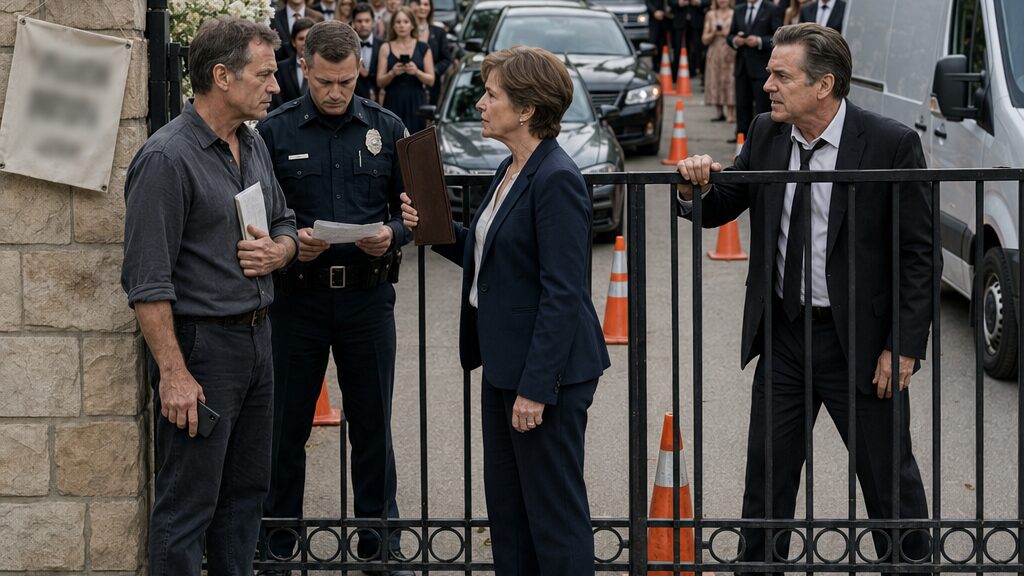
They Turned His Private Driveway Into Wedding Parking, but the Gate Hid a Harder Truth
Chapter 1: The Wedding Sign on His Stone Wall
The sedan sat three inches from Ronald Mitchell’s garage door.
He knew because he measured distances without thinking. Thirty-seven years of survey work had trained his eyes to find lines other people ignored: curb edges, fence setbacks, drainage grades, the difference between almost clear and blocked.
This was blocked.
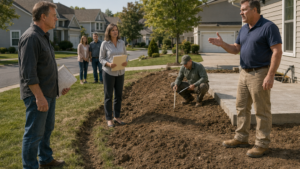
The sedan’s rear bumper hung across the seam where the garage door met the concrete. Beyond it, a row of vehicles filled the sixty-foot driveway from the house to the metal gate: polished SUVs, rental sedans, a pickup with white ribbons tied to the mirrors. Two orange cones stood beside Ronald’s hydrangeas as if somebody had appointed themselves traffic control.
Music drifted over the low stone wall separating his property from the Kings’ backyard. Strings, laughter, the clatter of folding chairs. White fabric moved between the trees.
Ronald stepped farther outside in his house shoes.
A woman in a pale dress was taking a gift box from her trunk. She looked at him, then at his clothes, and smiled as though he were hired help.
“Could you tell me where the ceremony is?”
“This is my driveway,” Ronald said.
Her smile held for a second too long. “I was told to park here.”
“By whom?”
She glanced toward the King house. “The family.”
Ronald looked down the drive again. A homemade sign had been taped to his stone wall.
WEDDING PARKING.
The tape crossed the pale patch where Katherine once hung a small brass planter. Ronald had never removed the two empty screw holes.
He walked to the wall and peeled the sign away carefully so the paper would not tear. Whoever had made it had drawn an arrow beneath the words. The arrow pointed through his gate.
A catering van rolled up from the street.
Ronald raised one hand.
The driver lowered the window. “Delivery for King.”
“You can’t come through here.”
The driver checked a printed sheet clipped to the dashboard. “This is the vendor entrance.”
“It isn’t.”
A young man in a black vest jogged toward them from the backyard. “They’re expecting you. Just pull in behind the blue SUV.”
Ronald stood in the center of the drive.
The van idled. Behind it, another car stopped in the street. A horn sounded once.
“This is private property,” Ronald said. “No vendors. No additional vehicles.”
The young man’s face tightened. “Sir, the ceremony starts in forty minutes.”
“That doesn’t change the property line.”
The driver shifted in his seat. “I was given this address.”
“You were given the wrong access.”
The young man looked past Ronald toward the garage, then over his shoulder toward the decorated yard. His embarrassment turned into irritation.
“Can you move for thirty seconds?”
“No.”
The van backed into the street, forcing the waiting car to reverse. Someone shouted from near the gate. Ronald heard his own name carried over the music.
He took his phone from his pocket and began photographing.
First the sedan against the garage. Then the line of cars. The cones. The sign in his hand. The catering instructions visible through the van’s windshield. He photographed license plates, wheel positions, the gate hinges, and the stone wall.
A man in a dark suit approached from the street, one hand raised in appeal.
“Mr. Mitchell, nobody wants trouble.”
“Then move the cars.”
“We’re guests. We parked where we were directed.”
“Who directed you?”
The man looked toward the King house and lowered his voice. “I don’t know. Somebody at the entrance.”
Ronald photographed the cone beside him.
Another guest came through the open pedestrian gap near the wall. “Are you really doing this now?”
Ronald did not answer. He called the municipal non-emergency number and described the obstruction without adding anything that could be mistaken for anger.
Private driveway. Recorded access restriction. Vehicle trapped in garage. Commercial vendors being directed across the property.
The dispatcher said officers would come when available.
He ended the call.
Laura King appeared near the stone wall in a blue dress, carrying a bundle of white ribbon. Her face looked already tired beneath the careful makeup.
“Ronald,” she said. “Please.”
He held up the parking sign.
“Who put this on my wall?”
Laura looked at it but did not answer.
“Who told these people they could park here?”
“We’re trying to get Emma married.”
“That isn’t an answer.”
“We had changes. Last-minute changes.” Laura lowered her voice. “Can you let it go until after the ceremony?”
“My car is trapped.”
“We can find the owner.”
“There are twelve vehicles on my property.”
“Fourteen,” said a voice behind him.
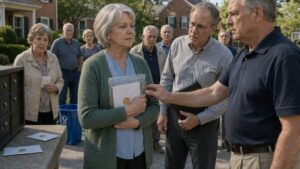
Kathleen Moore walked up the driveway holding a leather folder against her side. She wore a navy jacket despite the heat, and the small silver pin on her lapel marked her as president of the Sycamore Hills Homeowners Association.
Ronald had attended exactly one board meeting in the past three years. Kathleen had spent most of it reminding residents not to leave trash bins visible from the street.
She looked over the parked cars, then at Ronald.
“I counted fourteen,” she said. “Two are vendors.”
“Then you understand the scale of the problem.”
“I understand there’s a wedding next door and a temporary access issue.”
“There is no temporary access issue. There is trespassing.”
Several guests had stopped moving. They watched from between the cars and the wall.
Kathleen lowered her voice in a gesture that made the conversation feel more public, not less.
“The association permits reasonable event access when street parking is insufficient.”
“Not on this parcel.”
“Ronald.”
“My lot predates the association.”
“The easement connects the properties.”
“For residential access by the dominant parcel. Not for third-party parking. Not for commercial vendors.”
Kathleen opened her folder. “The board was informed about the event.”
“By Andrew?”
“That doesn’t matter.”
“It matters if he told you he had permission.”
Laura shifted the ribbons from one arm to the other. “This is Emma’s wedding day.”
Ronald looked toward the backyard. Through the trees, he could see a white arch and rows of chairs. Someone adjusted flowers along the aisle. For one brief second he saw Emma as a child, running through Katherine’s sprinklers while Laura called her home for dinner.
Then a horn sounded again at the gate.
Kathleen stepped closer. “Open the gate and let the vendors finish unloading. We can discuss the documentation afterward.”
Ronald folded the parking sign once.
“No.”
A murmur moved through the guests.
Kathleen’s expression hardened. “You’re creating a safety problem.”
“The cars blocking my garage created it.”
“You’re escalating a neighbor matter in front of an entire wedding.”
“I didn’t invite the wedding onto my driveway.”
Laura looked toward her backyard, where the music had stopped.
Ronald heard the metallic click of his gate latch shifting under pressure. Someone outside was testing it.
He walked toward the entrance. The orange cones formed a crooked channel around the locked gate, directing vehicles exactly where Andrew had once asked to direct them.
It had not happened by accident.
A figure appeared beyond the gate in a dark tuxedo, walking quickly from the street. Andrew King’s tie was already loose, and sweat darkened the collar of his white shirt.
He stopped on the other side of the metal bars.
For a moment neither man spoke.
Then Andrew looked at the folded sign in Ronald’s hand and said, “You already lost this argument six weeks ago.”
Chapter 2: Six Weeks Before the Cars Arrived
Six weeks earlier, Andrew had arrived with a parking plan that already included Ronald’s land.
He spread it across the porch rail before saying hello.
The page showed the King backyard, the street, the cul-de-sac, and Ronald’s driveway shaded in yellow. Small rectangles marked spaces for twenty-two cars. Arrows showed catering vans entering through Ronald’s gate and exiting beside the stone wall.
Ronald stared at the diagram.
“You had this drawn before asking me.”
“I had options drawn.”
“My property is labeled Guest Parking.”
Andrew pressed one finger to the page. “Overflow only. The immediate family will use our drive.”
“No.”
“You haven’t heard the details.”
“I don’t need the details.”
Andrew took a breath through his nose. “The original venue fell through.”
Ronald waited.
“We’re moving the reception here. The ceremony too, probably. Laura’s family is coming from three states. Emma’s fiancé has people flying in. The street can’t handle the cars.”
“Then arrange transportation.”
“We’re looking at it.”
“Look harder.”
Andrew’s jaw moved. He was broad through the shoulders and usually carried himself with the confidence of a man who believed other people would eventually accept his solution. That morning, the confidence seemed patched over something thinner.
“It’s one day,” he said.
“It’s still my driveway.”
“You use half of it.”
“I own all of it.”
“The easement gives us access.”
“It gives your property residential ingress and egress along the marked lane. It does not permit third-party parking or commercial use.”
Andrew tapped the paper. “You worked for the city. You know easements aren’t always that narrow.”
“This one is.”
Ronald went inside and returned with a copy of the recorded instrument. He kept it in a gray file near the front door, along with the deed, the old survey, and the county correspondence Katherine had organized in labeled sleeves.
He opened to the relevant paragraph and held it out.
Andrew read without taking the page.
“‘No access by guests, contractors, commercial vehicles, or other third parties without the written consent of the servient estate owner,’” Ronald said.
“I can read.”
“Then we’re finished.”
Andrew looked toward the metal gate at the end of the drive. “That gate wasn’t there when we bought.”
“It was permitted.”
“And it’s part of the problem.”
Ronald closed the document.
“The drain beneath it has been backing up for two years,” Andrew said. “Water crosses onto our side every hard rain. I sent you notices.”
“You sent estimates.”
“I sent certified letters.”
“The contractor wanted to replace half the apron.”
“Because the grade has failed.”
“The grade is within tolerance.”
“You haven’t checked it since Katherine died.”
The name landed between them with more force than Andrew seemed to intend.
Ronald slid the document back into its sleeve.
Andrew lowered his voice. “I’m not trying to make this personal.”
“You brought my wife into it.”
“I brought up the fact that she used to answer the door.”
Ronald looked at him.
Andrew took one step back. “That’s not what I meant.”
“It’s what you said.”
For years, Katherine had handled the neighbor conversations Ronald considered inefficient. She had discussed shared hedges, drainage, holiday lights, delivery trucks, and once a dog that kept digging beneath the wall. Ronald provided measurements and documents. Katherine provided sentences people could live with.
After she died, the conversations became shorter.
Ronald set the parking diagram back into Andrew’s hands.
“You do not have permission.”
Andrew folded the page. “The HOA thinks temporary access is reasonable.”
“The HOA has no jurisdiction over my lot.”
“They maintain the road.”
“They do not own my driveway.”
“Would you at least speak to Kathleen?”
“No.”
“Why not?”
“Because the answer won’t change.”
Andrew studied him for a moment. “You think every request is someone trying to take the place from you.”
Ronald reached for the storm door.
“I’m asking for one afternoon,” Andrew said.
“You’re asking after planning around my consent.”
“I planned an option.”
“You labeled it.”
Andrew’s face reddened. “Fine. Put it in writing so there’s no confusion.”
Ronald did.
He typed a short letter that afternoon. It identified the parcel, quoted the access restriction, denied wedding parking and vendor use, and stated that no oral representation from the HOA could replace his written consent.
He printed two copies. One went into his file. The other he placed in an envelope and walked next door.
Laura answered. Behind her, fabric samples covered the dining table.
“Is that for Andrew?”
“Yes.”
She looked at the envelope, then at Ronald. “He’s under pressure.”
“So am I.”
She gave a small, tired smile. “No, Ronald. You’re under protection. There’s a difference.”
He did not ask what she meant.
Andrew came to the door and accepted the letter.
He opened it while Ronald stood on the porch.
“You really needed a formal denial?”
“You requested one.”
Andrew read to the end. “You know, shared access also means shared obligations.”
“If you want to discuss maintenance, send a proper proposal.”
“I sent two.”
“They were inflated.”
“So you did receive them.”
Ronald said nothing.
Andrew folded the letter once, then again. “Understood.”
Ronald walked home and closed the metal gate behind him.
The latch struck the post with a harder sound than usual. Rust had begun to form inside the lower hinge, and the gate dragged slightly across the concrete before locking.
He noticed.
He told himself he would address it after the summer.
In the weeks that followed, he saw rental chairs delivered to the King house, strings of lights tested between trees, and a temporary platform built near the back fence. He received no further request about parking.
Kathleen sent one email asking him to attend “a brief neighborhood-access discussion.” Ronald deleted it after reading the subject line.
Three days before the wedding, orange cones appeared stacked beside Andrew’s garage.
Ronald saw them through the kitchen window.
He considered walking over.
Instead, he shut the blind.
On the wedding morning, after the cars arrived and the homemade sign appeared on his wall, Ronald photographed every detail. Near the gate, one cone leaned at an angle. Something white showed beneath its rubber base.
He lifted the cone.
His refusal letter lay folded underneath, flattened by the weight.
Andrew had not misunderstood.
He had used Ronald’s answer to hold the cone in place.
Chapter 3: The Man Who Placed the Cones
The first officer looked at Kathleen and said, “Show me the rule you’ve been quoting.”
Until then, Kathleen had spoken with the steady confidence of someone accustomed to being obeyed at mailbox meetings and architectural-review hearings. Now she opened her leather folder and began turning pages too quickly.
The second officer stood near Ronald’s garage, writing down license plates.
Andrew remained outside the gate, one hand gripping the bars.
“The association has temporary-event authority,” Kathleen said. “We regulate traffic flow and common access.”
“Is this common property?” the first officer asked.
“It serves two lots.”
“That’s not what I asked.”
Kathleen stopped turning pages.
Ronald handed the officer a copy of the recorded easement and the original subdivision map. He had marked nothing. He did not need to.
“My parcel was recorded eleven years before the association covenant,” he said. “The Kings have residential ingress and egress over the eastern lane. Third-party use requires written consent.”
The officer read the paragraph, then checked the map against the property pins visible beside the stone wall.
Andrew spoke through the gate. “This is ridiculous. We’re not claiming ownership.”
“You’re parking fourteen vehicles,” Ronald said.
“For a family event.”
“And directing vendors.”
“For a family event.”
The officer looked at Andrew. “Do you have written consent?”
Andrew’s gaze shifted toward Kathleen.
Kathleen said, “The board approved the event plan.”
“The board doesn’t appear to own this parcel,” the officer said.
A guest near the wall whispered something. Another lifted a phone, then lowered it when Ronald looked in that direction.
The first officer handed the document back.
“Mr. Mitchell, do you want the vehicles removed?”
“Yes.”
“Tow or voluntary departure?”
“Voluntary first.”
Andrew laughed once without humor. “There it is.”
Ronald turned to him. “There what is?”
“You want the wedding disrupted.”
“I want my driveway cleared.”
“You could wait two hours.”
“You asked six weeks ago. I said no.”
“You refused to discuss it.”
“I gave you the controlling language.”
“You gave me a wall.”
The word drew Ronald’s eyes toward the stone boundary. Beyond it, white flowers trembled in the breeze. Music had resumed, softer now.
Laura came through the pedestrian opening. “Andrew, stop.”
“No. He wants everyone to think this is about consent.” Andrew pointed toward the lower end of the drive. “That whole side floods because he won’t maintain what the easement requires.”
The officer raised a hand. “We’ll address one issue at a time.”
A black delivery van appeared at the street entrance and stopped behind the locked gate. Its driver leaned on the horn.
Ronald took the key from his pocket.
Kathleen stepped toward him. “Good. Open it.”
Ronald inserted the key and released the latch. Then he pulled the gate inward only far enough to create an exit lane around the parked cars.
“No new vehicles,” he said. “Anyone already parked may leave.”
The delivery driver lowered his window. “I need access to unload.”
“You don’t have it.”
Kathleen’s face tightened. “Ronald, you cannot obstruct an approved vendor.”
“He can if the vendor has no right to enter,” the officer said.
The driver reversed.
Guests began searching for vehicle owners. A woman in heels hurried toward the backyard calling out descriptions of cars. The second officer placed a printed citation beneath the wiper of the sedan blocking Ronald’s garage.
The paper was pale yellow.
“How much?” someone asked.
“Ninety-five dollars,” the officer said.
A sharper murmur traveled through the group.
Andrew pushed the gate wider, but Ronald caught it with one hand.
“Only outward.”
“You don’t get to manage traffic like this.”
“It’s my gate.”
“It blocks our access.”
“Your residential access is clear. The vehicles are the obstruction.”
“I put the cones there to keep the lane organized because you wouldn’t cooperate.”
Silence fell with surprising speed.
The first officer looked at Andrew. “You placed the cones?”
Andrew released the gate.
“I arranged the parking,” he said. “Yes.”
“And the sign?”
“Yes.”
“You directed the guests onto this property after being denied permission?”
Andrew’s expression changed. He had heard the question too late.
“I directed them onto the easement.”
“After the property owner denied third-party use?”
“The HOA approved it.”
The officer glanced at Kathleen.
She said nothing.
Ronald held the gate steady. The metal edge pressed into his palm. He felt no triumph yet, only the clean alignment of fact after fact.
The officer asked Andrew to step aside. He explained that unauthorized parking citations would be issued to vehicles remaining on the private parcel. Any obstruction of lawful access could be documented separately for civil review.
Andrew’s face went pale beneath the heat.
Laura closed her eyes.
One by one, guests came forward. Some were apologetic. Some angry. One man insisted he had been told parking was included in the event directions. A woman showed Ronald a text message that read: HOA OVERFLOW LOT—ENTER AT STONE WALL.
Ronald photographed the screen with her permission.
The second officer continued printing citations.
Each mechanical whir from the handheld device seemed to pull the wedding farther from celebration and closer to accounting.
Andrew returned from the street carrying a manila envelope.
“You want documents?” he said. “Let’s use all of them.”
He opened the envelope across the hood of a parked SUV and spread out photographs.
The first showed water pooled along the lower edge of the Kings’ lawn. The second showed mud against their side fence. The third showed the drain beneath Ronald’s gate clogged with leaves and black sediment. Dates were printed in the corners.
Two years of storms.
“I sent certified notices,” Andrew said. “Twice.”
Ronald did not touch the photographs.
“You’re responsible for the drain and the surface grade under paragraph seven,” Andrew continued. “You’ve refused every estimate and every meeting.”
“That does not authorize this.”
“No. It explains why I stopped asking you to act like a neighbor.”
The officer studied the easement again.
“Is there a maintenance clause?” Kathleen asked.
Ronald knew the answer before the officer turned the page.
“Yes,” the officer said. “There is.”
The satisfaction Ronald had felt watching the first citation settle beneath a windshield wiper thinned into something harder.
Andrew pointed toward the drain. “He keeps talking about rights. Ask him about obligations.”
The officer looked at Ronald. “Have the repairs been completed?”
“The estimates were excessive.”
“That wasn’t the question.”
Ronald’s hand remained on the gate.
“No,” he said.
Kathleen had recovered enough to close her folder. “Then the association needs to issue an immediate compliance notice.”
“My parcel is not under your covenant.”
“The drainage affects a member property and event access.”
“You just established that you don’t control event access.”
“I established nothing. The officers are handling parking. The board will handle the continuing hazard.”
She removed a single sheet from the back of her folder, wrote the date across the top, and signed it against the stone wall.
Then she handed it to Ronald in front of the wedding guests.
EMERGENCY COMPLIANCE NOTICE was printed across the top.
The paper cited obstruction, unsafe drainage, and failure to maintain shared access.
Ronald read the first paragraph while another $95 citation printed behind him.
For the first time that morning, he was no longer certain which document mattered most.
Chapter 4: The Clause Ronald Never Mentioned
Water began crossing onto the King property before the last food truck reached the street.
A paper plate floated against the curb. Melted ice from catering bins ran down Ronald’s driveway, met the dark ridge of sediment beneath the gate, and spread sideways through the grass. Within minutes, a shallow brown sheet covered the lower edge of Andrew’s lawn.
Andrew stood beside it in his tuxedo shirt, sleeves rolled unevenly, watching water soak the hem of a white tablecloth that had been draped over a supply crate.
He looked at Ronald but said nothing.
The silence felt worse than another accusation.
Ronald crouched near the drain. Leaves, gravel, and black mud filled the grate. He pulled at the debris with two fingers, but the packed material did not move. Rust flaked from the bottom of the gate and stained his knuckles.
Behind him, engines started one after another as guests moved cited cars. Doors slammed. The ceremony music had stopped entirely.
The municipal officers finished their records and left copies of the incident report with both property owners. Kathleen’s compliance notice remained folded in Ronald’s pocket.
He could feel its edges whenever he moved.
By late afternoon, the driveway was mostly clear. Tire marks crossed the concrete. Two crushed flower petals clung to the seam near the garage. Someone had left an orange cone by the stone wall.
Ronald carried it to the gate and set it upright.
Improvised authority, he thought. Bright enough to look official from a distance.
Andrew walked over from his yard. Without the jacket and tie, he looked less like the host of an expensive wedding and more like a man who had been awake for several days.
“The drain did exactly what I said it would do.”
Ronald stood.
“You still had no right to use the driveway.”
“I know.”
The answer unsettled him.
Andrew glanced toward the backyard, where guests were quietly moving chairs beneath a tent. “You think I’m going to apologize right now?”
“I didn’t ask you to.”
“No. You prefer documents.”
He held up his phone. On the screen was a photograph of the flooded strip taken months earlier.
“My attorney will send one.”
Laura called Andrew’s name from the yard.
He put the phone away. “You should read paragraph seven before you answer.”
Ronald waited until Andrew had gone before taking the easement from its sleeve.
He read the access restriction first. Then the definition section. Then, reluctantly, paragraph seven.
The owner of the servient estate shall maintain the access surface, gate drainage channel, and associated grade in serviceable condition sufficient to prevent unreasonable obstruction or runoff onto the dominant estate.
The words had not changed.
He had read them before. Many times.
What had changed was that Andrew had forced them into the same daylight as the parked cars.
Ronald carried the document into the kitchen and placed it beside Kathleen’s notice. He heated coffee and forgot to drink it.
The first maintenance letter had arrived twenty-three months earlier. Andrew included photographs and an estimate from a drainage contractor. Ronald had objected to the proposed replacement of the entire apron and sent no reply.
The second letter came certified six months later.
Ronald had signed for it.
He remembered setting it beneath a stack of medical invoices from Katherine’s final year because the contractor’s estimate used the phrase full excavation. The language had felt aggressive. So had Andrew’s reminder. So had every envelope that required him to decide something after Katherine was no longer there to discuss it with.
The letters remained in the gray cabinet.
On Monday morning, Ronald brought the easement, the original plat, Kathleen’s notice, and Andrew’s maintenance letters to the county records office.
A clerk behind the counter examined the parcel numbers.
“Your lot predates the association,” she said.
“Yes.”
“And this declaration doesn’t incorporate it later.” She tapped the screen. “The HOA can regulate the subdivision road. It cannot issue a covenant violation against this parcel.”
Ronald felt the first clean relief he had experienced since the wedding.
“So the notice is invalid.”
“As an HOA compliance action against your lot, probably. I can’t give legal advice.”
“But the easement remains enforceable.”
“Yes.”
“And paragraph seven?”
The clerk read it, then looked at the photographs Andrew had attached.
“That obligation appears to belong to the servient estate owner.”
“Me.”
She gave a small nod.
Ronald looked through the glass partition at rows of bound plats and scanned records. He had spent most of his working life trusting lines because they did not become offended, embarrassed, or impatient. A boundary either existed or it did not.
Obligations were less comfortable. They could run in both directions.
The clerk returned the documents. “You might want counsel before responding to any demand.”
When Ronald arrived home, a certified envelope was waiting inside the storm door.
Andrew’s attorney demanded reimbursement for drainage damage, immediate repair of the gate channel, and compensation for alleged interference with easement access. Several neighboring homeowners had signed statements saying runoff had worsened along the street during heavy storms.
The amount requested was far greater than the original repair estimate.
Ronald read it twice.
The parking citations had not settled anything. They had only moved the argument from the driveway into paperwork with deadlines.
He walked outside and tried to close the gate.
The lower hinge caught halfway. He pushed harder. Metal scraped concrete with a long, resisting sound.
For the first time, he did not blame the ground.
That evening, Kathleen called.
“The board’s attorney reviewed the parcel history,” she said. Her voice had lost its public certainty. “We may need to reconsider the notice.”
“May?”
“I’m waiting for a written opinion.”
“You issued it in front of forty people without one.”
“I was trying to contain an escalating event.”
“You chose a side.”
“I chose what I believed was the governing document.”
“You didn’t read the older one.”
Kathleen was silent.
Then she said, “Andrew’s drainage claim may survive even if ours doesn’t.”
“I know.”
“I thought you might.”
After the call, Ronald took the emergency notice from his pocket and flattened it on the kitchen table. Beside it, the easement restriction protected his consent. Paragraph seven exposed his neglect. Both carried the county recorder’s stamp.
Neither canceled the other.
A knock sounded at the front door.
Ronald expected a process server.
Instead, Emma King stood on the porch in jeans and a plain gray sweater. Her hair was tied back, and there was no trace of the careful wedding makeup Ronald had seen through the trees.
She held a folded contract and an invoice with a red cancellation line across the top.
“I need you to see what my father didn’t use,” she said.
Chapter 5: The Wedding Had Another Way In
Emma placed the canceled shuttle invoice directly beside Ronald’s easement papers.
The total was less than the catering deposit.
Two buses, three pickup periods, remote parking at a church lot four miles away. The contract included a route map that never touched Ronald’s driveway.
He looked up at her.
“When was this arranged?”
“Seven weeks ago.”
“Before Andrew asked me.”
“Yes.”
“Who canceled it?”
“My father.”
Emma remained outside the closed gate. Ronald had offered to open it when she arrived, but she had shaken her head and walked around to the porch from the sidewalk.
Now the iron bars stood between the porch steps and the driveway, visible through the front window.
“Why?” Ronald asked.
Emma folded her arms. “Because buses made it obvious.”
“Obvious to whom?”
“My mother’s family. My fiancé’s parents. Everyone who thought the hotel ballroom was still handling transportation.”
Ronald waited.
“The venue didn’t just fall through,” she said. “My father stopped making payments after his business lost a contract. The hotel canceled us. He told everyone there had been a scheduling problem.”
The answer did not excuse the cones. It did not move the sedan that had blocked Ronald’s garage. But it replaced the shape Ronald had given Andrew’s decision.
Not confidence.
Panic wearing confidence’s clothes.
Emma looked toward the King house. The reception tent was still standing, empty except for stacks of rented chairs.
“He promised me nothing would look smaller,” she said. “That was his phrase. He said moving it home didn’t mean it had to look smaller.”
“And the shuttle did?”
“To him. Guests parking at a church and arriving in buses looked like something had gone wrong.”
“Something had.”
“I know.”
Her voice sharpened, then softened again. “I didn’t want to talk about it either. I let him handle everything because I was tired of watching my mother calculate what could still be refunded.”
Ronald touched the edge of the invoice.
“You believed he had my permission?”
“I believed the HOA had approved overflow access. That’s what he told us. He said you were refusing to sign something formal because you disliked Kathleen.”
“That is not what happened.”
“I know that now.”
A truck passed on the street. Emma watched it disappear beyond the trees.
“I’m not asking you to cancel what happened,” she said. “The citations were legal.”
“Some of your guests were misled.”
“All of them were.”
“Andrew directed them.”
“Yes.”
The word came without hesitation.
Ronald studied her face. He remembered a much younger Emma standing at the same porch with a scraped knee while Katherine cleaned it using bottled water and a handkerchief. Andrew had not been home. Laura had been searching the neighborhood.
Emma looked at the documents. “My father says you want towing fees too.”
“The tow company was called.”
“But nobody was towed.”
“They dispatched a truck.”
“Are you planning to demand the guests pay that?”
Ronald had considered it. The dispatcher’s charge was real. The disruption had been real. So had the hours spent documenting license plates and answering questions from people who treated him as though he had appeared at the wedding solely to ruin it.
“What are you asking?” he said.
“Make my father responsible for what he decided. Don’t spread it across people who followed directions.”
“That may not be my choice. The city issued the citations.”
“I’m not asking you to interfere with those.”
Ronald looked at her more carefully.
Emma’s eyes were tired, but there was no appeal to sentiment in them. No request that he pretend the driveway had not been taken.
“You want the consequences left in place,” he said.
“Yes. I want them put where they belong.”
It was not the answer he expected from the bride whose ceremony had been interrupted.
He picked up the tow-company invoice. “I can notify them that I won’t seek recovery from individual vehicle owners.”
Emma nodded once.
“I will not withdraw the property complaint.”
“I didn’t ask you to.”
“And Andrew’s drainage claim remains separate.”
“I know.”
Ronald placed the invoice back on the table. The distinction mattered. It was the kind of distinction Katherine had once insisted he make before anger compressed every question into one.
Emma’s gaze moved to a framed photograph on the shelf. Katherine stood beside the metal gate shortly after it had been installed, one hand resting on the latch.
“She opened it for us once,” Emma said.
Ronald’s shoulders tightened.
“When?”
“The night my grandmother fell.”
He remembered the ambulance lights but not Emma being there.
“Our driveway was blocked by my uncle’s truck,” she continued. “Your gate gave the paramedics a straight route to the back door. Mrs. Mitchell unlocked it before anyone asked.”
“That was an emergency.”
“I know.”
“Which the easement permits.”
Emma looked at him. “She didn’t quote it.”
The kitchen seemed to contract around the remark.
“She knew the rules,” Ronald said.
“I’m sure she did.”
There was no challenge in Emma’s voice, which made the answer harder to dismiss.
She gathered the shuttle papers but left the cancellation invoice.
“My father was wrong,” she said. “He also thinks you ignored the drain because answering him would mean admitting he had a point.”
Ronald’s jaw set.
Emma moved toward the door.
“Did he send you here?”
“No.”
“Does he know?”
“No.”
“Then why come?”
She rested her hand on the doorknob. “Because he keeps telling everyone the wedding forced him to do it. It didn’t. He chose appearances.”
She looked back toward the easement.
“And I chose not to ask questions because I wanted the day he promised. That part belongs to me.”
After she left, Ronald watched her walk along the sidewalk rather than use the driveway.
The gate remained closed.
Across the wall, Laura and Andrew moved separately through the empty reception yard. Laura folded linens. Andrew dragged a trash bag toward the garage. Neither looked toward Ronald’s house.
He called the tow company and stated that he would accept the dispatch fee himself until responsibility could be addressed in mediation. Then he emailed the guests whose contact information appeared in the incident report, explaining that he would not pursue additional private charges against them.
He did not apologize for the citations.
By evening, replies had begun arriving. Some were grateful. One accused him of making an already difficult day worse. Another forwarded the parking instructions Andrew had sent, including the sentence: HOA authorization confirmed.
Ronald printed it.
He placed it beside Andrew’s photographs of the flooded drain.
The documents no longer formed two opposing piles. They formed one record of two men avoiding different truths.
At the back of the gray cabinet, beneath Katherine’s labeled folders, Ronald found a narrow file marked GATE—ACCESS AND NEIGHBORS.
He had not opened it since the week after her funeral.
His hand remained on the tab for several seconds.
Then he carried the file to the kitchen table and released the metal clasp.
Chapter 6: What Katherine Meant by Keeping the Gate
A yellow note lay on top of Katherine’s file.
A gate is useful only if you still know when to open it.
Ronald read the sentence twice before sitting down.
The handwriting slanted slightly upward, as though Katherine had written it in a hurry. Beneath the note were copies of old access requests: a plumber’s van, a moving truck, the ambulance route Emma had remembered, a delivery during road resurfacing. Katherine had approved some and denied others.
Every approval contained dates, hours, and conditions.
Every denial contained an explanation.
Ronald had remembered only the firmness.
He found a longer page near the back, written after a developer had once proposed widening the easement into a shared neighborhood lane. Katherine had underlined one sentence:
We are protecting consent, not protecting ourselves from people.
Ronald closed his eyes.
For three years, he had treated the promise he made beside her hospital bed as though it required no interpretation. Keep the driveway private. Keep the gate. Don’t let them turn it into a road.
She had not told him to stop answering the door.
At sunrise, Ronald carried oil, a wire brush, and a wrench to the gate. He scraped rust from the latch until the metal showed through. The hinge still dragged, but it closed without striking the post.
Andrew watched from his yard.
Neither man spoke.
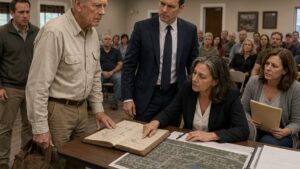
The mediation took place four days later in a small conference room above a title office. Ronald sat with the easement file before him. Andrew and Laura occupied the opposite side. Kathleen sat near the end of the table beside the HOA attorney.
Emma had not come.
The mediator began with the least disputed facts.
The vehicles had entered Ronald’s property without written consent.
Andrew had organized the parking and placed the cones.
The HOA had approved an event plan without confirming jurisdiction.
Ronald had failed to complete maintenance required by paragraph seven.
No one objected.
Kathleen slid a letter across the table.
“The board withdraws the emergency compliance notice,” she said. “Our attorney confirmed that Mr. Mitchell’s parcel is not subject to the association declaration.”
Ronald read the first paragraph, then the signature.
“You could have mailed this.”
“I issued the notice publicly.”
The room remained quiet.
Kathleen folded her hands. “I’m withdrawing it on the record.”
It was not an apology, but it was more than Ronald expected.
The proposed settlement divided costs. Andrew would accept responsibility for vendor redirection, the parking operation, and guest reimbursements. Ronald would complete the drain and surface repairs. Future third-party access would require a standard written request.
Andrew pushed the draft away.
“No.”
Laura turned toward him. “Andrew.”
“He gets everything he wanted.”
Ronald looked at the document. “I pay for the repairs.”
“Repairs you already owed.”
“And you pay costs created by parking you had no right to organize.”
Andrew leaned forward. “Your neglect damaged our yard for two years. You ignored me until officers showed up and handed tickets to my family.”
“I did not bring your family onto my driveway.”
“You knew what those citations would do.”
“I knew what the cars were doing.”
The mediator raised a hand, but Andrew continued.
“You stood there counting fines while my daughter’s ceremony stopped.”
Ronald felt the old answer rise: You caused it.
It was true. It was also incomplete.
Laura spoke before he could.
“You canceled the buses.”
Andrew turned to her.
“You told me the deposit was nonrefundable,” she said. “It was refundable until ten days before the wedding.”
His face changed.
Laura’s voice remained low. “Emma showed me the contract.”
Andrew looked toward Ronald. “So she came to you.”
“She told me the truth,” Ronald said.
Andrew sat back. The anger left him so quickly that what remained looked smaller.
“I had already lost the venue,” he said.
No one interrupted.
“I told Emma I would fix it. I told Laura nobody would know the difference.” He rubbed one hand over his mouth. “Then the buses made it look like we couldn’t even park our own guests.”
“You couldn’t,” Laura said.
“I know.”
The admission was barely audible.
Andrew looked at the proposed agreement. “Her fiancé’s parents paid for half the hotel. My business was supposed to cover the rest. When the contract disappeared, I kept thinking I could replace each lost piece before anyone saw it.”
“And Ronald’s driveway became another piece,” the mediator said.
Andrew gave a tired nod. “He’d ignored every maintenance letter. Kathleen said the board supported temporary access. I decided he had used the easement when it suited him and I would do the same.”
“You decided my refusal didn’t count,” Ronald said.
“Yes.”
The directness removed the pleasure Ronald might once have taken from hearing it.
Andrew looked across the table. “But don’t sit there like the drain is an unrelated oversight. You left us with water against the fence because answering me would mean dealing with me.”
Ronald placed both hands on Katherine’s file.
He could deny the motive. He could say the estimates were inflated, which was true. He could say Andrew’s letters were combative, also true. He could let those smaller truths cover the larger one.
“I stopped answering most people,” Ronald said.
Laura looked at him.
“After Katherine died, every request felt like the beginning of someone taking something she had protected. I treated delay as refusal and refusal as protection.”
Andrew’s expression remained guarded.
Ronald opened the file and removed Katherine’s yellow note. He did not pass it around.
“The maintenance obligation is mine,” he said. “I should have responded. I should have obtained another estimate and completed the work.”
Kathleen shifted in her chair.
Andrew looked toward the mediator. “Will that be in the agreement?”
Ronald felt heat move into his face.
A private acknowledgment would have been easier. Repairs could be completed quietly. The neighborhood would remember Andrew’s cones and the officers’ citations, not the months of runoff Ronald had allowed.
Andrew knew that. It was why he asked.
“I won’t sign unless it’s acknowledged,” Andrew said. “Not just paid. Acknowledged.”
Laura closed her eyes briefly.
The mediator turned to Ronald. “You are not required to agree today.”
That offered him an exit. Litigation could sort the clauses. The HOA notice was already withdrawn. His written refusal remained valid. Andrew’s admission was documented.
Ronald looked through the conference-room window at the parking lot below. Painted lines separated every space. Drivers trusted them because the rules applied in both directions.
Katherine had never confused a boundary with silence.
“Add it,” he said.
Andrew stared at him.
Ronald continued before pride could recover. “State that I failed to maintain the drainage channel within a reasonable period after notice. State that I will complete repairs under an agreed independent estimate.”
The mediator began writing.
“And state,” Ronald said, “that the failure did not authorize event parking or third-party access.”
“That stays,” Andrew replied.
It was the first thing they had agreed on without argument.
The mediator revised the pages. Future access requests would require written notice, stated purpose, vehicle count, insurance where applicable, and an answer within five business days. Emergency access required no advance consent. Event overflow remained prohibited.
A key could be held by Andrew for emergencies only, numbered and recorded.
The gate would remain.
When the meeting ended, Kathleen gathered her papers.
“The board will review all pre-association parcels,” she said. “Before issuing anything else.”
Ronald nodded.
Laura paused at the door. “Emma will be glad this didn’t become a lawsuit.”
“It still could,” Andrew said.
Everyone looked at him.
He picked up the revised agreement but did not sign.
“You admitted your part,” Ronald said.
“I heard you admit yours.”
“Then what remains?”
Andrew looked at the empty signature line.
“I need to know whether you said it because you mean it or because you want me trapped by the same page.”
He left the room carrying the unsigned agreement.
That afternoon, Ronald returned to the gate. The repaired latch closed cleanly beneath his hand.
For years, the sound had meant the conversation was over.
Now he stood beside it, holding the settlement and Katherine’s note, waiting to learn whether telling the truth had opened anything at all.
Chapter 7: The Gate Opened Under Written Terms
Ronald handed Andrew a key with a narrow metal tag stamped EMERGENCY ACCESS ONLY.
They stood beside the gate six weeks after the wedding, close enough to see the new gravel settled around the drainage channel. The orange cones were gone. The homemade sign had disappeared with the trash from the reception. Only faint strips of adhesive remained on the stone wall where the morning sun caught them.
Andrew turned the key over in his palm.
“This opens the main latch?”
“Only the emergency cylinder. It won’t hold the gate open.”
“And you have the other copy?”
“The original stays with me. The key number is in the agreement.”
Andrew slid it onto his ring beside his house key. “You really numbered it.”
“Yes.”
“I expected nothing less.”
The remark carried no warmth, but it no longer carried insult either.
A maintenance truck waited at the curb with replacement drain sections strapped to its bed. Ronald had scheduled the work for eight. Andrew had arrived at seven fifty-three.
That mattered more than Ronald wanted to admit.
He unlocked the gate and opened it wide enough for the truck. The repaired hinge moved without scraping. No metal dragged across concrete. No rust marked his fingers.
The driver checked the work order. “Both property owners here?”
Andrew raised a hand.
Ronald did the same.
The acknowledgment felt awkward, almost ceremonial. Neither man commented on it.
The final agreement had been signed four days after mediation. Andrew returned with his signature already in place and no explanation for the delay. Ronald had signed beneath him. Laura witnessed both signatures, and the mediator recorded the revised access terms with the county.
The settlement required Andrew to reimburse guests who had relied on his parking instructions, cover the vendor redirection charges, and pay the tow-company dispatch fee. Ronald was responsible for the drainage repairs and resurfacing work specified by an independent contractor.
Neither man paid for the other’s pride. There was no line item for that.
The crew removed the old grate while Ronald and Andrew stood on opposite sides of the channel. Beneath the packed sediment, the concrete lip had cracked and shifted toward the King property.
The foreman pointed with a gloved hand. “That’s where your runoff was crossing.”
Ronald crouched to inspect it.
Andrew said nothing.
“I should have repaired it sooner,” Ronald said.
The foreman looked between them, unsure whether the statement required a response.
Andrew answered instead.
“Yes.”
Ronald stood. The word irritated him because it was accurate.
Before he could reply, Kathleen Moore’s car stopped near the curb.
“The board meeting starts in twenty minutes,” she said through the open window. “You’re both still coming?”
Andrew looked at Ronald.
“We said we would,” Ronald replied.
Kathleen nodded toward the truck. “Will the lane be clear by noon?”
The foreman confirmed it.
“Good,” she said. Then, after a pause, “The revised parcel policy is on the agenda.”
She drove on.
Andrew watched her leave. “She called me three times to verify the language.”
“She should have called the attorney before issuing the notice.”
“She knows.”
“That doesn’t undo it.”
“No.”
They left the crew working and walked to the association clubhouse by separate sides of the street.
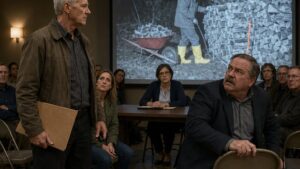
The meeting room held fifteen folding chairs, a long laminate table, and a bulletin board crowded with pool rules and landscaping notices. Several neighbors who had watched the wedding confrontation sat along the wall. Ronald recognized the man who had asked the amount of the citations.
Kathleen opened the meeting by reading a proposed procedure for properties recorded before the HOA covenant. No enforcement notice could be issued until parcel status, deed restrictions, and easements had been reviewed by counsel or the county record.
A board member objected to the legal expense.
Kathleen answered, “It costs less than enforcing rules we do not have.”
Ronald did not look at her, but he heard the change in her voice. She was not defending herself. She was correcting the process.
The motion passed without applause.
Kathleen then addressed the wedding incident.
“The association approved an event plan based on incomplete information,” she said. “That approval did not authorize use of Mr. Mitchell’s private driveway.”
Andrew shifted in his chair.
Kathleen continued. “Mr. King has asked to clarify the record.”
Every face turned toward him.
He stood slowly.
“The board did not tell guests or vendors that the driveway was authorized,” Andrew said. “I did.”
No one moved.
“I had a written refusal from Ronald. I told people the HOA approval covered the access anyway. It did not.”
The man near the wall crossed his arms.
Andrew looked toward the floor, then back at the room. “The citations resulted from instructions I gave. I have reimbursed the guests who parked there and covered the vendor costs under the settlement.”
A woman asked, “Why did you tell us it was approved?”
Andrew’s jaw tightened.
For a second Ronald expected him to return to the maintenance dispute, to explain how the drain and unanswered letters had convinced him the boundary no longer deserved respect.
Instead Andrew said, “Because I did not want people to know I had lost the original venue and canceled the shuttle.”
Laura sat near the back. She lowered her eyes.
Andrew remained standing. “That was my decision. Not Emma’s. Not the board’s. Not Ronald’s.”
The room stayed quiet.
There was no public reversal in Ronald’s favor, no satisfying turn in which every neighbor suddenly understood him. One woman still looked at him with the same guarded expression she had worn at the wedding. Another whispered to the person beside her.
But the false claim had been corrected by the man who made it.
Ronald found that enough.
After the meeting, Emma waited outside near the sidewalk. She wore work clothes and held an envelope.
“I brought the last reimbursement confirmations,” she told Andrew.
He took them.
Then she looked at Ronald. “My mother mentioned an anniversary dinner next summer. Small one.”
Ronald glanced toward Andrew.
Emma shook her head. “Not in the backyard.”
“You don’t need my permission to use your yard,” Ronald said.
“No. But everyone would spend the evening looking at the gate.”
Andrew’s mouth tightened, though not in anger.
“We found a restaurant,” Emma continued. “It has a parking lot.”
Ronald almost smiled.
Almost.
“Probably wise,” he said.
Emma nodded toward the repair truck visible down the street. “Is the drain finally being fixed?”
“It is.”
“Good.”
She turned to leave, then stopped.
“Mrs. Mitchell would have liked the agreement.”
Ronald looked at her.
“You don’t know that.”
“No,” Emma said. “But she liked things written down after people had finished telling the truth.”
She walked away before he could answer.
By early afternoon, the crew had installed the new channel and reset the cracked edge. Water from a test hose ran cleanly through the grate and away from both lawns.
The foreman asked Ronald and Andrew to inspect the work.
Andrew crouched first. “The slope’s better.”
“It meets the specified grade,” Ronald said.
Andrew glanced up. “I said better.”
Ronald looked at the water disappearing beneath the grate.
“It is.”
The foreman packed his tools. The truck remained inside the driveway while the crew swept loose gravel from the concrete.
Ronald stood beside the open gate.
For most of the afternoon, anyone passing the corner could see straight through to his garage. The opening made the property look less defended, almost ordinary. He felt exposed by it.
He also felt no urge to close it before the work was finished.
Andrew brought over the final inspection sheet. Both men signed.
“Laura wants to replace the section of grass the runoff ruined,” Andrew said.
“That is on your property.”
“I’m aware.”
Ronald waited.
Andrew slipped the paper into a folder. “She asked whether you wanted the same seed along your edge so it matches.”
Six months earlier, Ronald would have heard the request as the first step toward shared landscaping, shared decisions, shared claims.
Now he looked at the narrow strip of mud along the wall.
“The same seed is fine,” he said. “Send me the product name before she buys it.”
Andrew nodded. “In writing?”
“Yes.”
“Of course.”
The maintenance truck rolled toward the street. Ronald held the gate while it passed through. The driver raised two fingers in thanks.
Andrew remained on the other side of the drainage channel.
Neither man offered a handshake.
The agreement had not made them friends. It had not erased the wedding morning, the ignored letters, the flooded grass, or the years Ronald had hidden behind Katherine’s promise. It had given each fact a place where it could not cancel the others.
Andrew touched the emergency key in his pocket.
“I won’t use it unless I have to.”
“I know.”
It was the first time Ronald had said those words to him without suspicion.
Andrew walked home.
Ronald stayed beside the gate until the truck turned out of sight. The driveway was empty now, clear from the garage to the street. No cones. No signs. No strangers’ cars. The boundary remained exactly where it had always been.
He found Katherine’s yellow note in his shirt pocket and read it once more.
A gate is useful only if you still know when to open it.
Ronald folded the paper along its old crease.
Then he closed the gate.
The latch settled into place with a clean, measured click—not the sound of a conversation ending, but the sound of an agreement being kept.
The story has ended.