They Tore Down His Grandfather’s Fence, Then He Found Where the HOA President Planned to Drive
Chapter 1: The Empty Holes Along the Southern Line
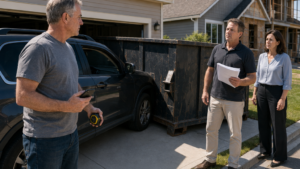
James Hernandez knew something was wrong before he shut off the truck.
His headlights swept across the southern edge of the yard and kept going. No cedar boards caught the light. No posts cast their familiar narrow shadows over the grass. The beam traveled uninterrupted from the driveway to the back corner of the property, exposing a long strip of raw earth where a fence had stood for nearly forty years.
He remained behind the wheel with both hands resting on it.
Four days earlier, he had left for a surveying job two counties north. The fence had been there then: weathered silver-brown, slightly bowed in two sections, solid everywhere that mattered. His grandfather had built it when James was a child, setting each post below the frost line and checking the run with a string stretched so tight it could hum.
Now there were only holes.
James stepped from the truck and crossed the lawn without taking his overnight bag. The nearest post hole was packed with broken roots and fresh mud. A pale cedar splinter lay beside it, crushed into the tread mark of a heavy tire.
He took out his phone.
One photograph of the first hole. One facing east. One west. A wider frame showing the full missing run.
He had learned early in his work that memory changed under pressure. Measurements did not. Images did not, provided they were taken before rain, footsteps, or argument altered the scene.
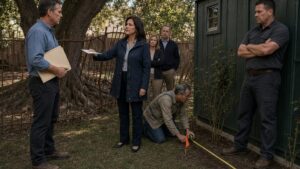
The fence had followed the southern boundary for roughly one hundred eighty feet, separating his yard from the narrow common strip behind Thomas Mitchell’s house. James walked the old line slowly, photographing every disturbed post setting.
Halfway down, the tire tracks turned.
They crossed the grass in a wide arc and drove directly through the rose bed beside the patio.
James stopped.
The bushes had belonged to his mother. Not officially. The deed did not say so, and no county record identified them. But she had planted the first six after his father died, then added one every spring until arthritis made the shovel too difficult to hold. She had made James promise not to replace them with “something easier” after she was gone.
Three bushes had been flattened. Another had been ripped partly from the soil, its roots exposed beneath a fan of red clay. A late bloom lay face down in the mud.
James crouched and lifted the torn stem without knowing why. The flower came apart between his fingers.
For several seconds, he did not take photographs.
Then he set the pieces down, stood, and documented the tire impressions, the crushed border stones, the broken irrigation line, and the angle from which the vehicle had entered.
The back of his neck felt hot despite the cool air.
Someone had not merely dismantled the fence. They had brought machinery through his property. They had chosen a route. They had seen the rose bed and driven across it anyway.
At the kitchen door, a white sheet of paper fluttered beneath a staple.
NOTICE OF COVENANT COMPLIANCE ACTION appeared across the top in bold letters.
James read the first paragraph twice.
The Briar Glen Homeowners Association had authorized removal of a noncompliant perimeter structure after prior notice and opportunity to cure. The work had been completed by an approved contractor. Costs would be assessed to the property owner.
He looked at the date.
The notice had been posted that morning.
He had received no prior notice. No email. No certified letter. No voicemail. He had checked all three from the hotel each night because the surveying company was waiting on revised access instructions.
At the bottom was Thomas Mitchell’s name, printed beneath the title BOARD PRESIDENT.
James removed the notice carefully, preserving the staple hole, and carried it inside.
His filing cabinet stood in the small room his mother had called the den. James opened the bottom drawer and pulled out the property folder. The documents were arranged by year, then by type. Deed. Tax maps. Utility easements. Repair permits. At the back, inside a stiff plastic sleeve, was the original boundary survey dated June 18, 1987.
The paper had yellowed at the edges. A brass-colored embossed stamp pressed into the lower corner carried the seal of the surveyor who had recorded the lot before James’s grandfather built the fence.
James placed it under the desk lamp.
The southern boundary was a clean black line. The fence notation followed it almost exactly, offset inward by four inches. Beside the notation was the date of installation and a handwritten approval reference from the developer that had controlled the subdivision before Briar Glen adopted its current covenants.
His breathing slowed.
The current HOA rules had been rewritten in 2009. James knew because residents had been required to vote on them. The fence had existed for twenty-two years before that document.
He scanned the survey, then opened the association portal on his laptop. The login page loaded slowly. Three new notices waited in his account.
One was the posted compliance notice.
One was a copy of the contractor completion statement.
The third was his quarterly account balance.
James clicked it.
Regular dues appeared on the first line. Landscaping assessment on the second. Beneath them, in a separate block, was a new charge:
COVENANT ENFORCEMENT—STRUCTURE REMOVAL: $8,400.
A payment deadline appeared thirty days away.
He stared at the figure until the screen dimmed.
The HOA had entered his property, torn out one hundred eighty feet of cedar fence, driven through his mother’s roses, and sent him the bill.
James printed every page.
He created folders on his computer marked PHOTOGRAPHS, NOTICE, SURVEY, and ACCOUNT. Then he opened the governing documents and searched for the words removal, entry, emergency, and self-help. He found provisions authorizing fines after notice and hearing. He found language covering abandoned debris on common property. He found nothing allowing the board to demolish a structure on a privately owned lot without consent or a court order.
At 10:14 that night, he sent a formal records request to the HOA manager. He asked for all notices allegedly sent to him, the contractor’s name, the board resolution authorizing entry, photographs taken before removal, and complete minutes of every meeting in which his fence had been discussed.
The reply arrived Saturday afternoon.
The manager attached a single-page excerpt from the prior month’s minutes.
James printed it and laid it beside the 1987 survey.
Under NEW BUSINESS, the minutes recorded a motion to remove the Hernandez boundary fence as a noncompliant structure and assess the owner for all costs.
The result was listed as four in favor, one opposed.
No names appeared beside the votes.
James read the line again.
Someone on that board had said no.
Chapter 2: The Vote Nobody Wanted to Explain
“The contractor’s identity is association business,” the HOA manager said. “You’ll need to submit that request in writing.”
James looked through the glass partition at the woman seated behind the front desk.
“I submitted it Friday night.”
“Then the board will respond within the period allowed by the governing documents.”
“The contractor entered my lot.”
“I understand that you’re upset.”
“I didn’t say I was upset. I asked who entered my property.”
The manager folded her hands on the desk. Behind her, framed certificates from neighborhood-beautification programs lined the wall. “I can’t release vendor information based on a walk-in request.”
James slid a printed copy of his email through the opening beneath the glass.
“This is the written request.”
She glanced at the first page without touching it. “The board has thirty business days.”
“The payment deadline is before that.”
“You may dispute the charge through the hearing process.”
“How do I request a hearing?”
She passed him a one-page form.
James took it and left before the conversation became circular.
Outside, two residents stood near the clubhouse entrance talking beside a golf cart. They stopped when he passed. One looked toward the folder under his arm, then quickly away.
By Monday, the missing fence had become neighborhood information.
A man walking a terrier slowed near the southern line. A delivery driver turned around in James’s driveway and stared at the empty holes. Someone posted in the community message board that the HOA had “finally addressed an unsafe eyesore,” though the fence had never leaned toward the sidewalk and could not be seen from the main entrance.
James saved a screenshot but did not respond.
He spent the next two evenings comparing the 1987 survey with every version of the covenants he could obtain. The earliest subdivision rules allowed cedar boundary fences with developer approval. The 2009 covenants changed the preferred height and stain color, but the grandfathering provision protected existing structures unless they became dangerous or were substantially rebuilt.
There was no engineering report calling his fence dangerous.
There was no inspection report at all.
On Wednesday morning, the HOA portal posted a new letter. It demanded payment of the $8,400 within thirty days and warned that unpaid assessments could result in collection costs and a lien against the property.
James printed it.
He placed the lien warning beside the survey. On paper, the old boundary remained exact and unbroken. Outside the window, sunlight passed through the empty space where the cedar boards had blocked the view of Thomas Mitchell’s yard.
Thomas was standing near his back patio.
He wore tan slacks and a navy sweater despite the warmth, one hand in his pocket, the other holding a phone. When he noticed James at the window, he turned toward the house.
James added the observation to a dated notebook, then disliked himself for doing it.
He was beginning to record people the way he recorded disturbed soil.
That afternoon, he drove to the county archive office to confirm the survey’s recording history. The clerk pulled the microfilmed index and matched the approval reference in the corner of James’s document to the original subdivision file.
“It’s legitimate,” she said. “Recorded before the association existed in its current form.”
“Does the county show any order declaring the fence unsafe?”
She searched the parcel number. “Nothing here.”
James asked for certified copies.
When he returned to Briar Glen, a woman stood near his mailbox with a canvas grocery bag resting against her leg. He recognized Brenda Clark from HOA meetings, though they had never spoken beyond a greeting. She was one of the five board members.
“James,” she called.
He stopped several feet away.
“I heard you requested a hearing.”
“I did.”
She glanced toward the clubhouse. “Could we talk somewhere private?”
“Anything about the board should be in writing.”
Her expression tightened. “Not everything starts in writing.”
“Everything about my fence should have.”
“I know.”
The answer came too quickly, and James felt his suspicion settle into certainty.
“Then send me whatever you know.”
“James, I’m trying to—”
“I’m not discussing this off the record with a board member.”
Brenda looked at him for a moment. “You think all five of us agreed.”
“The minutes say four to one. They don’t say who did what.”
“No. They don’t.”
“Then correct them.”
A car turned onto the street behind her. Brenda picked up her grocery bag.
“You’re making this harder than it needs to be,” she said quietly.
James almost laughed. Instead, he said, “My fence is gone.”
She walked away without answering.
That evening, he completed the hearing request. He attached the certified survey, the historical covenant provision, photographs of the post holes and roses, the account statement, and a demand that the board identify the authority it relied on to enter the property.
He also requested the complete minutes, including individual votes.
The response arrived two days later from Robert Anderson, legal counsel for the association.
The letter acknowledged James’s hearing request but denied that individual vote records were required. It stated that the board had acted within its discretionary enforcement authority and reserved all rights to recover legal and collection expenses.
James read the letter twice, then highlighted the phrase discretionary enforcement authority.
It cited three covenant sections. None permitted demolition.
He drafted a six-page response explaining why each citation failed. He included a boundary chronology beginning in 1987 and a table comparing the original and current restrictions.
Before sending it, he remembered Brenda saying, You think all five of us agreed.
He deleted the sentence in which he accused the entire board of knowingly authorizing trespass.
Then he put it back.
Documents were safer than impressions. Documents did not soften a fact because someone looked nervous beside a mailbox.
On Monday, an envelope from the HOA arrived by certified mail. James signed for it at the door.
Inside was the hearing notice.
The date was the following Tuesday at 7:00 p.m. in the clubhouse. The board would permit him to present relevant information before voting on whether to affirm the charge.
At the bottom, a bold paragraph stated:
HOMEOWNER PRESENTATION SHALL NOT EXCEED THREE MINUTES.
James looked at the three-inch folder he had assembled on the kitchen table.
The board had given itself thirty business days to answer who entered his property.
It had given him three minutes to explain why they had no right to do it.
Chapter 3: Three Minutes Before the Board Closed Ranks
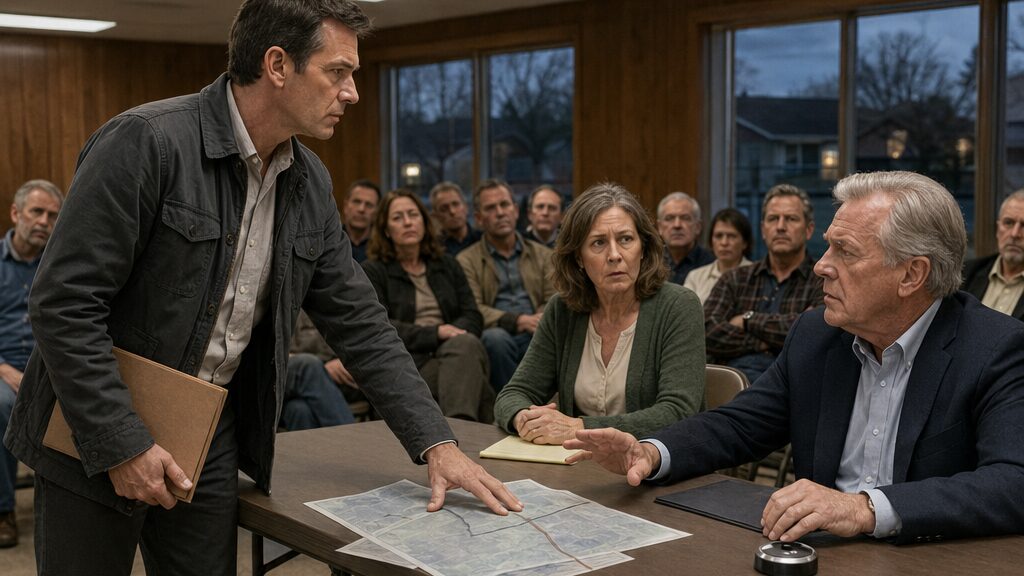
Thomas Mitchell started the timer before James opened his folder.
A small digital display on the table flashed 3:00, then changed to 2:59.
“Mr. Hernandez,” Thomas said, “your presentation time has begun.”
James remained standing at the end of the conference table. Twelve folding chairs had been arranged behind him for residents. Most were occupied. Brenda sat at the far end with the other board members, her hands clasped over a yellow legal pad.
“You haven’t stated the matter being heard,” James said.
“The matter is your appeal of the covenant-enforcement assessment.”
“And the board’s entry onto my property?”
“The assessment includes all related actions.”
“That isn’t an answer.”
Thomas glanced at the timer. “Two minutes, forty-three seconds.”
A few residents shifted in their chairs.
Thomas looked exactly as he had from James’s kitchen window: silver hair neatly combed, navy jacket fitted across his shoulders, expression composed enough to imply that anyone else’s anger was evidence against them.
James opened the folder.
“The fence was built in 1987 with developer approval. The current covenants were adopted in 2009 and expressly protect existing structures unless they become dangerous or are substantially altered. The board produced no inspection, no engineering report, no notice, and no opportunity to cure.”
He placed the certified survey on the table.
Thomas did not look down.
“The fence exceeded current design standards,” he said.
“Current standards do not erase approved structures that predate them.”
“That is your interpretation.”
“It is the language of the covenant.”
“One minute, fifty-eight.”
James heard someone behind him whisper, “This is ridiculous,” though he could not tell whether they meant the demolition or his appeal.
He removed the posted notice and the account statement.
“The association entered a privately owned lot, removed one hundred eighty feet of cedar fencing, damaged an established garden, and charged the owner $8,400. I am asking the board to identify the provision authorizing physical removal without consent or court order.”
Thomas leaned back.
“The board is not required to conduct a legal seminar at every enforcement hearing.”
“No. It is required to have authority before it sends a contractor.”
One of the unnamed board members cleared his throat. Thomas raised a hand without looking at him.
“The structure was noncompliant,” Thomas said. “The board voted four to one. The work is complete. We are here only to decide whether the assessment should remain.”
Brenda’s pen stopped moving.
James noticed.
“Who made the motion for immediate removal?” he asked.
Thomas’s jaw shifted slightly. “That is reflected in the minutes.”
“It isn’t.”
“Then submit another records request.”
“I did.”
“Forty-seven seconds.”
James closed the folder.
Thomas’s eyes moved toward the residents as if the gesture meant surrender.
James reached instead for the clear plastic sleeve at the bottom.
“I have one final exhibit.”
Thomas gave a small, tired exhale. “Make it relevant.”
The first sheet was a transparency James had produced from the certified 1987 survey. The southern boundary appeared as a black line. The fence location ran beside it in faded red.
The second sheet was a county planning map James had found that afternoon while searching the public permit index for activity near his parcel.
He had not expected Thomas Mitchell’s name to appear.
The application was incomplete and had not yet been approved, but the site plan was public. A blue line began near the Mitchell patio, crossed the narrow rear strip, and extended toward the road behind James’s property.
James placed the permit map beneath the survey transparency.
The black boundary and red fence line settled directly over the blue proposed drive.
The room became quiet.
The timer reached zero and emitted a soft electronic beep.
Thomas looked down for the first time.
James adjusted the corners by less than an inch. The route did not merely approach the old fence. It passed through the exact section the contractor had removed.
One resident stood to see better. Another lifted a phone, though Brenda immediately said, “No recording during executive proceedings.”
“This permit application was filed two months before my fence was demolished,” James said.
Thomas’s hand moved across the table and stopped short of the documents.
“Where did you get that?”
“County records.”
“That file contains preliminary planning material.”
“It contains your name.”
“It is unrelated to covenant enforcement.”
James pointed to the route. “Then explain why your proposed driveway crosses the structure you ordered removed.”
A murmur rose from the folding chairs.
Thomas’s face did not redden. He grew still instead, which James found more revealing.
“You are mischaracterizing a conceptual drawing,” Thomas said.
“Is the blue route yours?”
“This hearing is adjourned.”
“You haven’t voted.”
“The homeowner’s time has expired.”
“The permit was filed before the demolition.”
Thomas gathered the papers nearest him, though none belonged to James. “Mr. Hernandez has introduced material outside the noticed scope of this proceeding.”
“The noticed scope is an $8,400 charge for removing the fence that blocked your proposed drive.”
“Enough.”
Thomas struck the table with the flat of his hand. The sound cracked through the room.
James did not raise his voice.
“Did you disclose this application before the board voted?”
The unnamed member beside Brenda turned toward Thomas.
Brenda looked down at her legal pad.
Thomas stood. “This meeting is concluded.”
“You said it was a four-to-one vote.”
“It was.”
“Did the other four know you had applied for this route?”
Thomas closed James’s folder and pushed it toward him.
“You obtained a private planning document and used it to make a defamatory accusation in a public meeting. The association’s counsel will address that separately.”
“It was in the county’s public index.”
“The board will not tolerate harassment.”
James looked at the residents. Their expressions had changed. He no longer saw the mild impatience that had greeted him. He saw calculation. People mentally redrawing the lots behind their own houses. People wondering what the board could remove while calling it compliance.
Thomas moved toward the clubhouse door.
Brenda spoke before he reached it.
“We should vote.”
Thomas stopped.
“The chair has adjourned.”
“We noticed an appeal,” she said. “The notice says the board will vote.”
“The presentation exceeded its scope.”
“That doesn’t cancel the hearing.”
Thomas turned toward her. “Brenda, this is not the time.”
Her face tightened, but she lowered her eyes.
The moment passed.
One by one, the residents stood. Some left without speaking. A man near the back paused beside James and looked at the layered maps.
“That line really goes through your yard?”
“My boundary,” James said. “The removed fence was four inches inside it.”
The man nodded slowly and followed the others out.
James collected his documents. The survey transparency clung to the permit map from static. He separated them carefully and returned each to its sleeve.
Brenda remained seated while the other board members moved into the hallway. Thomas was speaking sharply to someone near the office door.
James slid the folder under his arm.
As he passed Brenda, she placed one hand over the edge of his folder.
He looked down.
Her fingers were trembling.
“I tried to stop it,” she said.
James thought of the mailbox, her request to speak privately, and the sentence he had put back into his letter accusing the entire board.
“Then why didn’t you?”
Thomas called her name from the hallway.
Brenda withdrew her hand.
When James lifted the folder, a folded square of yellow paper remained beneath it.
He waited until he reached his truck to open it.
The note contained seven words.
The vote was not what he said.
Chapter 4: The Dissenting Vote Had a Price
Brenda Clark’s email printout began with a sentence James had not seen in any board record.
Proceed with removal Friday morning. Formal ratification can follow.
Thomas Mitchell had sent it at 6:42 p.m. the night before the contractor entered James’s property.
Brenda laid the page on her kitchen table and kept one palm over the bottom half, as if the paper might slide away from her.
“I saved it outside the board account,” she said. “I knew it would disappear.”
James remained standing. Her kitchen smelled faintly of coffee and furniture polish. A stack of unopened mail sat beside a bowl of oranges, everything arranged neatly except the papers between them.
“You’re saying the fence was removed before the vote.”
“I’m saying Thomas ordered the contractor before the vote was finished.”
“That isn’t the same thing.”
“No.” Brenda looked up. “It’s worse.”
She lifted her hand.
Below Thomas’s instruction was Brenda’s reply. She had written that the board lacked authority to enter a privately owned lot, that James had not received notice, and that Thomas should recuse himself because of “a possible adjoining-property interest.”
James read the phrase twice.
“What interest?”
“He wouldn’t say. He told us it was irrelevant.”
“And the others?”
“One wanted a legal opinion. One said the fence was old and ugly and nobody would care. The other kept asking whether postponing would increase the contractor’s price.”
James looked at the date. “The minutes say four to one.”
“The final motion was not to remove the fence. Not exactly.” Brenda drew a breath. “Thomas worded it as a motion to affirm emergency compliance action already taken. By then the fence was gone.”
“So they voted after the fact.”
“Yes.”
“And you voted no.”
“Yes.”
James pulled out the chair across from her but did not sit. “Why didn’t you tell me at the mailbox?”
“I tried.”
“You asked to speak privately.”
“Because board correspondence is supposed to remain confidential until released.”
“He had already demolished my fence.”
“And he had already warned me that disclosing internal communications could be treated as a breach of duty.”
James stared at her.
Brenda’s voice lowered. “He said he would move to remove me from the board and tell the neighborhood I had exposed the association to liability.”
“That stopped you?”
“It slowed me.”
The honesty unsettled him more than an excuse would have.
He had imagined the dissenting voter as either principled or useless. Brenda was neither. She had objected, preserved evidence, and then gone quiet when the cost became personal.
James sat down.
“I shouldn’t have shut you down at the mailbox,” he said.
“No, you shouldn’t have.”
She did not soften the answer, and he was grateful for that.
Brenda gathered a second set of pages. “There’s more.”
The fence contractor’s invoice listed equipment hours, disposal fees, labor, and an “accelerated mobilization surcharge.” At the bottom, beneath SITE AUTHORIZATION, appeared Thomas Mitchell’s name and cell number.
James traced the entry with one finger.
“Was he there?”
“The contractor called him when they couldn’t get the equipment through the common strip.”
“So Thomas redirected them through my yard.”
“I don’t know exactly what he said.”
“The tire tracks turn at his patio.”
Brenda pressed her lips together. “Then you should photograph that angle before anyone changes it.”
“I already did.”
For the first time, she gave him a brief, tired smile. “Of course you did.”
They walked to James’s property with the documents sealed in a large envelope. Brenda stopped at the beginning of the empty southern line.
From there, the damage looked less like a construction site than a scar. Each hole marked where a post had been pulled. The track through the roses had dried into ridged clay.
Brenda stepped carefully around the broken irrigation hose.
“I voted for Thomas as president,” she said. “He knew the covenants. He knew how to run meetings. When people argued, he could make the rules feel clear.”
“Even when they weren’t.”
“Yes.”
James looked toward the Mitchell patio. A concrete pad extended from the rear doors to a narrow gravel strip. Beyond it lay the open ground where the fence had blocked any direct route toward the road.
“Did he ever mention a driveway?”
“No. But two months ago he asked whether the strip behind these lots was common property.”
“What did you tell him?”
“That most of it was. Not the part inside your survey.”
“And he knew that?”
“He should have.”
James crouched beside a post hole. The old cedar had left a dark square impression in the soil. His grandfather had once shown him how to check alignment by looking along the tops rather than the faces of the posts. A board could warp. The line had to remain true.
His phone buzzed.
The email was from Robert Anderson.
James opened it while Brenda watched.
Robert’s letter stated that the board and its individual members were protected from liability for good-faith covenant enforcement. It warned that continuing to make unsupported allegations of self-dealing could increase the association’s legal expenses, which might be added to James’s account if permitted by the governing documents.
A second attachment updated the balance.
The $8,400 remained. A legal-review fee had been added beneath it.
Brenda read over his shoulder.
“He didn’t have all this when he wrote that,” she said.
“He had what Thomas gave him.”
“Robert usually asks questions.”
“Not enough of them.”
James forwarded the email to a separate evidence account, then photographed the screen beside the empty fence line. Brenda watched him do it.
“You make a record of everything,” she said.
“It’s the only thing people can’t later claim they misunderstood.”
“That isn’t true.”
He looked at her.
“People misunderstand records all the time,” she said. “Sometimes on purpose.”
The next morning, James went to the county records office with the permit number from the public index. The clerk brought him a thin planning file and explained that the application remained incomplete.
The first page named Thomas Mitchell as applicant.
The filing date was two months before the demolition.
The proposed improvement was described as a private residential driveway connecting the Mitchell rear patio area to the service road beyond the southern lots.
James turned to the site plan.
The blue route crossed the boundary exactly where his fence had stood.
A handwritten note beside the line read: OBSTRUCTION TO BE REMOVED BY OWNER/ASSOCIATION.
James asked for a certified copy.
The clerk stamped the request and slid the receipt across the counter.
“Association?” she said. “Is that yours?”
“No.”
“Then whoever wrote this may have assumed authority they didn’t have.”
James looked through the office window at the parking lot. For days, he had been asking whether the HOA had used covenant enforcement to remove his fence.
The permit suggested a sharper question.
Had the board been used to clear Thomas Mitchell’s private road?
Chapter 5: The Reason Behind the Blue Driveway Line
The mobility-access note was clipped behind the site plan.
James had missed it during the hearing because the public index showed only the permit map. The full county file included a short statement from the applicant requesting expedited review due to “significant household mobility limitations following an injurious fall.”
The document did not name Cynthia Mitchell.
It did not need to.
James stood at the records counter with the page in his hand and felt the clean shape of his argument become less comfortable.
The permit was still Thomas’s. The route still crossed James’s property. The fence had still been removed without notice. None of that changed.
But the blue line had not begun with a plan for a pool house, a second garage, or a convenient shortcut.
It had begun with someone falling.
The clerk returned with the certified copy. “There’s also a rejected preliminary option in the file.”
She unfolded another sheet. A route from the front driveway curved around the Mitchell house, but the grade along the side yard exceeded the county’s recommended slope. A note suggested retaining work and drainage changes.
“More expensive,” James said.
“Probably.”
“And slower.”
“Definitely.”
The direct rear route was shorter, flatter, and blocked by the cedar fence.
James left the office with both plans.
At Briar Glen, Cynthia Mitchell was on the back patio.
He had seen her many times over the years, usually beside Thomas at holiday events or walking briskly near the mailboxes. Now she stood behind a metal walker, moving a tray from a small table to the open rear door. The motion took her several careful attempts.
James stopped at the edge of his yard.
The missing fence had once prevented any clear view between the properties. Without it, Cynthia’s effort unfolded in front of him with an intimacy neither of them had chosen.
The tray tilted.
James crossed the grass before he thought about it and caught one side.
Cynthia startled, then tightened her grip.
“I have it.”
“I can see that.”
“Then let go.”
He released the tray. She steadied it against the walker and looked at him closely.
“You’re James.”
“Yes.”
“Thomas said you were away.”
“I came back Friday.”
Her gaze moved toward the empty post holes. “I know.”
The broken rose bed lay between them. From the Mitchell patio, the contractor’s path was unmistakable.
Cynthia followed his eyes and said, “He told me they were taking down an old association fence.”
“It was mine.”
Her face changed only slightly. “No.”
“It was four inches inside my surveyed boundary.”
“That strip is common land.”
“Most of it is. The fence wasn’t.”
Cynthia gripped the walker handles. “Thomas said the route had been reviewed.”
“By whom?”
“The board. The county. I don’t know. He handles those things.”
James took the certified plan from his folder but did not hand it to her. The page contained the mobility note. He folded that section backward and showed her only the map.
“This is the route he applied for.”
Cynthia studied the blue line.
“He said it came through the common strip.”
“It crosses my boundary here.”
James placed a finger where the route cut through the red survey line.
Cynthia leaned closer. Her knuckles whitened against the walker.
“He didn’t show me this.”
“Did you know the HOA planned to remove the fence?”
“I knew Thomas said there was an obstruction. I thought it belonged to the association.”
“He signed the contractor’s authorization.”
She straightened, and pain moved across her face before she hid it.
“You think he did this for me.”
“I think the permit says the route was connected to a mobility need.”
“That is not permission to discuss my health.”
“I’m not discussing it.”
“You went through the file.”
“It’s a public permit application.”
Her mouth tightened. “Public does not mean decent.”
The sentence landed harder than James expected.
For days he had treated every document as something clean: available or withheld, authentic or altered, relevant or irrelevant. Cynthia stood before him reminding him that information could be true and still be used cruelly.
“I’m not going to publish your medical details,” he said.
“Thomas says you’re trying to have him charged.”
“I’m trying to find out who ordered people onto my land.”
“He was trying to make the house usable for me.”
“Then he should have asked.”
Cynthia looked toward her patio door. The distance was no more than fifteen feet, but she seemed to measure it before every movement.
“I fell in the front drive in January,” she said. “The pavement was wet. I fractured my hip and my wrist. The car is too far from the back entrance, and the front steps are worse.”
James said nothing.
“He promised he could solve it without turning me into a neighborhood project.” Her voice became thinner. “No fundraisers. No committees. No people bringing casseroles and asking whether I can still bathe alone.”
“That doesn’t make my property common land.”
“I know that now.”
The admission left them both silent.
Cynthia lowered herself into a patio chair. James set the tray on the table without asking.
“Did Thomas know it was my fence?” he said.
She stared at the map. “He knows every lot line in this neighborhood. He helped review half the resale disputes.”
That was an answer, though not the one James had requested.
“If this becomes public,” she said, “they’ll talk about the fall instead of what he did.”
“I can separate them.”
“Can everyone else?”
No. James had seen the neighborhood message board. He knew how quickly a fact became entertainment when it belonged to someone else.
Cynthia folded the map and handed it back.
“Don’t protect him,” she said. “But don’t use me to punish him.”
That afternoon, James rebuilt his evidence packet.
He included the 1987 survey, the current covenants, photographs of the fence line and roses, the contractor invoice, Thomas’s pre-vote email, the hearing notice, the permit application, and the route map.
He removed the mobility note.
He also removed the rejected route that described the grade problem in language that could identify Cynthia’s limitations.
Brenda met him at the sheriff’s office but did not go inside. She signed a short statement authenticating the board emails and the timing of the vote.
“You’re leaving something out,” she said when she saw him separate the pages.
“Something that explains Thomas’s urgency.”
“Does it excuse him?”
“No.”
“Then why leave it out?”
“Because it belongs to Cynthia.”
Brenda considered that. “Thomas will use it if he has to.”
“That will be his choice.”
Inside, the sheriff’s investigator reviewed the packet in silence. He asked about notice, ownership, the contractor’s entry route, and the permit’s filing date.
When he reached the blue-line map, he placed it beside the certified survey.
“This does not prove criminal intent by itself,” he said.
“I know.”
“It does support a conflict that should have been disclosed.”
James nodded.
The investigator tapped Brenda’s statement. “And this suggests the work began before valid board approval.”
“Yes.”
“Why was the driveway needed?”
James looked at the pages he had withheld.
“There was a private household reason.”
“Relevant?”
“To motive. Not to ownership.”
The investigator waited.
James did not elaborate.
At last, the man closed the folder. “I’ll contact the association and the contractor. Do not alter the site.”
“I won’t.”
As James left the office, he understood that the packet was no longer perfect. It contained a deliberate absence.
For the first time, he had chosen a person over a complete record.
Chapter 6: When the Sheriff Asked for Thomas’s Full Name
The sheriff’s investigator entered the clubhouse while Thomas Mitchell was calling roll.
Thomas had just said Brenda Clark’s name when the rear door opened and every face turned.
The investigator wore a dark county uniform and carried a slim folder under one arm. He did not hurry. That made his arrival feel less theatrical and more serious.
Thomas remained standing behind the board table.
“Can we help you?”
“I need to speak with Thomas Mitchell.”
“You’re interrupting a scheduled association meeting.”
“I’m aware.”
Residents filled nearly every folding chair. News of the permit overlay had spread without anyone admitting to spreading it. James sat in the second row with his evidence folder beneath his chair and a square cedar post cap resting in his palm.
He had found it in the weeds near the crushed roses. The top was scarred where the contractor’s tool had struck it, but the underside still carried his grandfather’s pencil mark: S-14.
Southern line, post fourteen.
The investigator approached the table.
“Are you Thomas Mitchell?”
Thomas looked briefly toward Robert Anderson, who sat beside the board with a legal pad.
“I am the board president.”
“That wasn’t my question.”
A murmur passed through the room.
Thomas’s jaw tightened. “Yes.”
“Please state your full legal name.”
For one suspended moment, James saw the earlier hearing reversed with exact cruelty. Thomas had started a timer before James opened his folder. Now an outside authority had entered before Thomas finished roll call.
“Thomas Edward Mitchell,” he said.
The investigator opened his folder.
“I’m advising you that the sheriff’s office has begun an inquiry concerning unauthorized entry and destruction of property at the Hernandez residence. I will be requesting records from the association and interviewing individuals involved in the contractor authorization.”
Thomas’s face remained controlled. “This was a lawful covenant action.”
“That will be part of the inquiry.”
Robert rose. “My client is represented regarding association matters.”
The investigator handed him a document. “Then you can coordinate production.”
James set the cedar cap on the empty chair beside him.
Thomas noticed it.
“You brought a prop?” he asked.
James did not answer.
Robert read the document quickly, then leaned toward Thomas. Their exchange was too quiet to hear.
One of the unnamed board members asked, “Does this mean we shouldn’t discuss the Hernandez appeal?”
“You shouldn’t destroy, alter, or conceal any related material,” the investigator said.
Brenda lowered her eyes to the table.
Thomas gripped the back of his chair. “This board acted in good faith based on a visible covenant violation.”
The investigator looked at him. “Were you the applicant on a private driveway permit crossing the disputed fence line?”
The room went still.
Thomas glanced at James.
“That application was preliminary.”
“Were you the applicant?”
“Yes.”
“Did you disclose that interest before directing the contractor?”
“I dispute the premise of your question.”
“That wasn’t the question.”
Robert touched Thomas’s sleeve. “Do not answer further right now.”
A woman in the front row whispered, “He didn’t tell them.”
Thomas heard her.
“The driveway was not a personal luxury,” he said. “It concerned essential access for a disabled resident.”
James felt the room turn before anyone moved.
Several heads angled toward the Mitchell house beyond the dark clubhouse windows. Someone behind James said Cynthia’s name under their breath.
Thomas continued, his voice gaining force. “Mr. Hernandez has taken a private accommodation matter and transformed it into an attack on this board.”
The investigator raised one hand. “Medical circumstances are not necessary for this discussion.”
“They are necessary if he intends to portray me as corrupt.”
James stood.
Every eye moved to him.
Thomas pointed across the table. “Tell them why the route was requested.”
James could hear Cynthia’s voice on the patio: Public does not mean decent.
“The ownership record is enough,” he said.
Thomas gave a short, disbelieving laugh. “Convenient.”
“The reason someone wants my land does not decide whether it belongs to them.”
“You know exactly what was at stake.”
“I know what was at stake for Cynthia.”
The use of her name caused another stir. James regretted it immediately, though Thomas had already made the implication public.
He continued carefully. “I also know she was told the route crossed common property.”
Thomas’s expression changed.
Not much. A slight narrowing around the eyes. But James saw the blow land.
Robert looked at him. “How would you know what Mrs. Mitchell was told?”
James did not answer.
Thomas’s voice dropped. “You went to my house.”
“I spoke to my neighbor across the boundary you removed.”
“You involved my wife.”
“You involved her when you used her need to justify what you did.”
The investigator stepped between the lines of sight. “This meeting is not the place to litigate the matter.”
Thomas turned toward the residents. “He wants you to believe I tore down a fence for my own benefit. I was trying to prevent another injury.”
Brenda spoke from the table.
“You could have requested an easement.”
Thomas looked at her.
“You could have presented the alternate route,” she continued. “You could have disclosed the permit and recused yourself.”
“The alternate route was impractical.”
“More expensive is not the same as impossible.”
The unnamed board member beside her shifted away from Thomas.
Robert closed his legal pad. “I recommend the board suspend all collection activity related to the Hernandez account pending review.”
Thomas turned sharply. “That would imply the charge was improper.”
“It would preserve the association’s position.”
“The board already affirmed it.”
“No,” Brenda said. “The hearing was adjourned without a vote.”
The room erupted in overlapping questions.
Thomas struck the gavel once, but the sound no longer controlled anyone.
Robert raised his voice. “The association will suspend the $8,400 charge and all related collection fees until the investigation and internal review are complete.”
That was the first concrete thing James had won.
It did not restore a single cedar post.
The investigator collected the contractor invoice and the certified copies James had brought. Before leaving, he paused beside James.
“Someone from our office will follow up.”
James nodded.
When he sat again, the cedar cap remained on the chair beside him. He placed it on the table next to the layered survey and permit map. The old pencil mark faced upward.
Thomas stared at it.
For a moment, James expected satisfaction. He had imagined this reversal repeatedly: the public room, the external authority, Thomas forced to answer.
Instead, he saw Cynthia’s walker beside the patio door and felt the victory narrow.
Thomas had done real harm. He had also been afraid.
The two truths did not cancel each other.
They only made the boundary harder to draw.
The meeting dissolved without formal adjournment. Residents clustered around Brenda and Robert. Thomas left through the side door alone.
James gathered the survey, the permit map, and the cedar cap.
At 8:07 the next morning, his phone rang.
“Mr. Hernandez,” Robert Anderson said. His voice was careful and unusually quiet. “The association would like to discuss a confidential resolution.”
“What resolution?”
“A payment of $4,008 in exchange for a complete release of claims.”
James looked through the kitchen window at the empty southern line.
The offer was less than half the amount they had charged him for destroying it.
Chapter 7: The Settlement That Bought Silence, Not Repair
Robert Anderson’s proposed agreement fit on six pages.
The number that mattered appeared twice.
$4,008.
James read it at his kitchen table while the morning light fell across the empty fence line. The offer released the association from all claims arising from the demolition. It required confidentiality. It prohibited him from challenging the board’s authority in connection with the incident. It did not rescind the violation. It did not cancel the original finding that his fence had been noncompliant.
It did not mention the roses.
Robert had emailed the document fifteen minutes after their phone call with a note describing the offer as a practical resolution that avoided further expense for all parties.
James printed it and placed it beside the $8,400 assessment.
The two amounts sat on the table like numbers from unrelated disputes.
At noon, he met Robert in a small conference room at the association counsel’s office. The walls were bare except for framed certificates and a clock that ticked loudly whenever neither man spoke.
Robert folded his hands over a leather portfolio.
“The collection suspension remains in place,” he said. “That is separate from the offer.”
“Suspension isn’t cancellation.”
“No final determination has been made.”
“The board made one when it tore down the fence.”
Robert let the statement pass. “The association is trying to limit ongoing costs. You receive payment. The matter closes.”
“The fence still stays on my record as a violation.”
“That notation is internal.”
“It follows the property.”
“It may never matter.”
James slid the agreement back across the table. “Then remove it.”
Robert did not touch the pages. “A formal rescission could affect insurance coverage.”
“How?”
“The carrier may cover accidental or negligent property damage. It becomes more complicated if the board admits intentional misconduct or action outside its authority.”
“So the association can rebuild the fence only if it keeps pretending the demolition was legitimate.”
“I didn’t say that.”
“You said the carrier needs the board’s position.”
Robert looked toward the clock. “The insurer has indicated that restoration may be available if the board conducts an internal review and modifies its finding.”
“Modifies?”
“Rescinds, potentially.”
That was the first useful information Robert had given him.
James leaned back. “Then why offer me four thousand dollars to sign away the review?”
“Because certainty has value.”
“To whom?”
Robert’s expression tightened.
James gathered the agreement. “Does Thomas know insurance could cover full restoration?”
“He is aware of the general process.”
“And he still approved this offer?”
“The board authorized counsel to negotiate.”
“That wasn’t my question.”
Robert closed the portfolio. “Mr. Hernandez, you have a strong property claim. You also face years of litigation if every issue becomes personal.”
“It became personal when Thomas used the board to clear his driveway.”
“His position is that the route addressed an urgent accessibility problem.”
“His reason does not move my boundary.”
Robert’s gaze shifted to the window. “No. It does not.”
The concession was quiet enough that James nearly missed it.
Back home, he carried his measuring equipment into the yard. He set a tripod near the first post hole and sighted along the southern line. The old survey coordinates remained fixed, though the ground had been torn and compressed by equipment.
One hundred eighty feet.
He marked each former post location with a narrow wooden stake. Near the rose bed, the line passed exactly where his grandfather had placed it.
At the far end, James stopped and looked toward the Mitchell house.
The alternate permit route could curve along the other side of the common strip, avoiding his boundary if a short retaining wall controlled the slope. It would cost more. It would require drainage review and the removal of two ornamental trees. But it was possible.
He took measurements.
When he turned, Cynthia was standing behind him with her walker.
“I saw the equipment,” she said.
“I’m checking a route.”
“For the fence?”
“And your driveway.”
Her face closed. “I didn’t ask you to do that.”
“No. Thomas should have.”
She moved closer, the walker’s rubber feet pressing small circles into the grass.
“He says you want him removed from the board.”
“I want the violation rescinded, the charges canceled, the fence and garden restored, and the board’s records corrected.”
“That isn’t what I asked.”
James adjusted the tripod. “Yes. I want him to resign.”
Cynthia looked toward her house.
“He thinks if he resigns, everyone will assume he is guilty of a crime.”
“He ordered the work before the vote.”
“He says the board would have approved it anyway.”
“That doesn’t make it legal.”
“No.”
The answer surprised him.
Cynthia rested both hands on the walker. “He showed me the settlement.”
“Did he show you the confidentiality clause?”
“Yes.”
“And the amount?”
Her mouth tightened. “It’s insulting.”
James waited.
“He told me you were refusing because you wanted to punish him.”
“I’m refusing because it buys silence, not repair.”
Cynthia looked at the stakes running along the empty boundary. “He has started telling people the criminal inquiry exists because you oppose accommodation for a disabled resident.”
James felt the words as a physical pressure beneath his ribs.
“Do you believe that?”
“No.”
“Will you tell him to stop?”
“I already did.”
“And?”
“He said the board needs a public-interest explanation.”
James looked toward Thomas’s patio. “You are not an explanation.”
Cynthia’s eyes lifted to his.
“He does that,” she said. “He turns fear into procedure.”
James thought of the timer, the gavel, the immunity letter, and the motion held after the fence was already gone.
“I do something similar,” he said.
“What?”
“I turn people into exhibits.”
Cynthia studied him for a moment. “At least you noticed.”
He showed her the alternate route on his field tablet. It began near the existing front drive, curved behind the ornamental trees, and reached the patio without touching his property.
“The grade needs engineering,” he said. “It needs drainage work and probably a retaining wall. But it can be done.”
“It will cost more.”
“Yes.”
“Thomas said the association shouldn’t pay for private work.”
“The association paid to destroy my fence.”
“That isn’t the same.”
“No. It is worse.”
Cynthia’s mouth moved as if she might smile, but she did not.
“I will not let him use my fall as a defense at another meeting,” she said.
“You don’t owe anyone your medical history.”
“I know. I can tell them that without giving it.”
She turned the walker toward home, then stopped.
“He will not resign while the criminal inquiry is open.”
“How do you know?”
“He told Robert he would step down only if you withdrew the complaint.”
James looked at the cedar stakes.
The demand was another exchange: accountability for resignation, truth for convenience.
He folded the settlement offer and placed it beneath the brass survey stamp on his kitchen table. Then he drafted a response to Robert.
He rejected the $4,008.
He demanded formal rescission of the violation, cancellation of all charges, complete restoration, release of the internal vote record, independent review of the driveway route, and an open special meeting at which residents could see the correction entered into the association’s minutes.
He did not agree to withdraw anything.
Before sending it, he called Brenda.
“Can you force a special meeting?”
“With two board votes or a resident petition.”
“How many signatures?”
“Twenty percent of the homes.”
James looked at the neighborhood directory.
For weeks, he had believed the documents should carry the case without him. Now he would have to knock on doors and ask people to put their own names beside his.
“Prepare the petition,” he said.
He sent Robert the rejection.
Then James walked to the first house on the street with the unsigned pages under his arm.
Chapter 8: A Gate Where the Boundary Could Still Hold
James placed the rejected settlement check beside the 1987 survey before the special meeting began.
The check had never been valid for deposit; Robert had marked it FOR SETTLEMENT PURPOSES ONLY. Still, its printed amount drew every eye toward the table.
$4,008.
Beside it, the old survey’s brass stamp caught the clubhouse lights.
Residents filled all the chairs and stood along the rear wall. The petition had gathered enough signatures in two days. People who had once slowed their dogs to stare at James’s empty yard now carried copies of the proposed resolution.
Thomas sat at the end of the board table without the president’s gavel.
Robert occupied the chair beside him. Brenda sat across from them, a folder of preserved emails open in front of her. The two unnamed board members kept their eyes on the printed agenda.
Cynthia entered last.
She moved with her walker down the center aisle. Thomas rose automatically, but she shook her head and chose a chair in the front row instead of sitting beside him.
Brenda called the meeting to order.
“The first motion concerns rescission of the covenant finding against the Hernandez property.”
Thomas lifted one hand. “Before any vote, counsel should explain the consequences of language implying intentional misconduct.”
Robert adjusted his glasses. “The proposed resolution does not determine criminal liability. It states that required notice was not given, valid authorization was not obtained before removal, and the structure was protected under the preexisting-use provision.”
“In other words,” Thomas said, “it adopts Mr. Hernandez’s entire position.”
James remained standing beside the survey.
“No,” he said. “My entire position includes the garden, the unauthorized entry, the false minutes, and your undisclosed permit.”
Thomas looked at him. “And my wife’s access?”
A murmur moved through the room.
Cynthia pushed herself upright.
“My access never required taking James’s property.”
The room quieted.
Thomas’s face lost color.
“Cynthia,” he said, “you do not need to discuss this.”
“I know.”
She turned toward the residents, not toward him.
“I fell. I needed a safer route into my home. Thomas told me the proposed driveway crossed association land and that the board had approved removing an old common fence. He did not tell me it belonged to James. He did not tell me contractors entered James’s yard. My need was real. His explanation to me was not.”
Thomas lowered his eyes.
No one applauded. The silence was more difficult than applause would have been.
Cynthia sat again.
Brenda called for the vote.
All four participating board members voted to rescind the violation. Thomas abstained.
The $8,400 charge and every legal or collection fee attached to it were canceled. Robert confirmed that the association’s insurance carrier had accepted a restoration claim subject to an independent estimate. The resolution required replacement of the cedar fence along the certified 1987 line, repair of the irrigation system, replacement of the damaged rose bushes, and reimbursement of James’s documented expenses.
The words entered the minutes one by one.
James watched the secretary type them.
For weeks, he had wanted the record corrected. When it finally happened, it felt less like victory than a weight being moved from one side of a scale to the other.
Brenda introduced the governance reforms next: mandatory conflict disclosures, recorded individual votes on property enforcement, legal review before entry onto a private lot, and written notice with an opportunity to cure except in genuine emergencies.
Those motions passed as well.
Then came Thomas’s resignation.
He had submitted a letter effective at the close of the meeting. Brenda read only the final paragraph, in which he accepted responsibility for failing to disclose his interest and for directing action before proper authorization.
Thomas asked to speak.
He stood with both hands resting on the table.
“I believed I was solving an urgent problem,” he said. “I also believed that if I explained the problem, people would look at Cynthia differently and look at me as someone who could no longer manage his own household.”
Cynthia stared straight ahead.
Thomas continued. “I knew the rear route was the shortest. I knew the fence was inside the Hernandez property. I told myself the board would approve removal because the structure did not match current standards. When Brenda objected, I treated her objection as disloyalty. When James produced the survey, I treated accuracy as aggression.”
He looked toward the old brass stamp.
“I did not want pity. I chose authority instead.”
James heard no request for forgiveness in the words. That made them easier to believe.
Thomas sat down.
The sheriff’s inquiry remained open. Robert stated that the association could not bargain it away, and James had not been asked to withdraw his cooperation. Thomas’s resignation was not immunity. The civil resolution was not absolution.
There would be consequences outside the room, perhaps limited, perhaps lasting. James no longer needed to control their shape.
The final motion concerned the alternate driveway.
An independent engineer had reviewed James’s proposed route. It avoided his property, required a retaining wall, and preserved drainage into the common basin. The Mitchells would pay the private construction costs. The HOA would remove two ornamental trees from common land and approve a narrow gate in the new fence for emergency and agreed accessibility use.
The gate would remain on James’s property.
The easement terms would be written, recorded, and revocable only under conditions both households accepted.
Brenda looked at James. “The motion requires your consent.”
Thomas did not raise his head.
James looked at Cynthia.
She had asked for no public sympathy and no special exemption. She had also stood in front of the neighborhood and separated her need from the harm done in her name.
James thought of his grandfather pulling a string between two posts. A boundary was not the refusal of all passage. It was the place where passage required permission.
“I consent to the surveyed route and the recorded gate agreement,” he said.
The motion passed.
Six weeks later, the new cedar fence followed the southern line.
The contractor used the old survey coordinates and replaced every post inside the boundary. James stood beside the work as the first section rose, the fresh boards gold against the dark soil.
The rose bed took longer.
Three bushes could not be saved. The nursery found the same varieties, though the replacements were smaller and carried no memory of his mother’s hands. James planted them himself. He placed the broken border stones back in their original curve and repaired the irrigation line beneath them.
Near the far end of the fence, outside the garden, the builders installed a narrow cedar gate.
It matched the boards so closely that it disappeared when closed.
The alternate driveway curved behind the Mitchell house, supported by a low retaining wall. It was not elegant. It cost more than Thomas’s blue-line route would have cost. It also remained entirely outside James’s land.
On the afternoon the work was completed, Cynthia crossed the new path with her walker.
James met her at the gate.
She stopped on the other side.
“May I?”
He lifted the latch.
The gate opened inward. Cynthia passed through and followed the short level path to the edge of his patio, where the route connected to the sidewalk leading toward the mailboxes.
She tested the distance, turned, and looked back at the fence.
“Your grandfather built it straight,” she said.
“He was particular.”
“So are you.”
James rested one hand on the cedar post.
“Not always about the right things.”
Cynthia nodded as if that answer was enough.
Thomas stood on his patio in the distance. He did not approach. He raised one hand, uncertainly.
James did not return the gesture immediately.
Then he did, once.
Cynthia passed back through the gate.
James closed it behind her. The latch settled into place with a small, solid click.
The cedar line held exactly where it had in 1987.
But now, where passage was necessary, there was an opening no one had taken without asking.
The story has ended.