My Neighbor Built Seven Feet Into My Yard, but the Roses Exposed More Than His Shed
Chapter 1: The Green Shed Beyond the Rusted Fence
The concrete was still wet when Jacob Mitchell pushed the tape measure beneath the green shed.
Its edge sank into the gray surface and left a clean groove. The nearest footing sat seven feet beyond the boundary shown on the survey copy in his hand.
He measured again.
The result did not change.
Beyond him, the old iron fence leaned between the oak trees, rusted at the joints and softened by decades of vines. Jacob had treated that fence as scenery for most of his adult life. It had been there when his father owned the house, there when Jacob and Anna moved in, there through storms, repainting projects, and three different families in the house next door.
Now a prefabricated shed stood on the wrong side of it.
The shed was dark green with white trim, large enough for shelving, power tools, and a riding mower. Four concrete footings anchored it to the ground. The contractor had leveled the soil, crushed the grass, and left pale tracks through the mud.
Jacob heard the sliding door open next door.
Tyler Clark stepped onto his patio carrying a cardboard box of electrical supplies. He wore a gray work shirt with the sleeves cut short. Even from thirty yards away, his posture had the tight, forward angle of someone expecting an argument.
Jacob withdrew the tape before Tyler looked over.
He hated that instinct in himself—the quick concealment, the decision to gather one more fact before speaking. He had spent thirty-six years estimating repair costs for commercial facilities. He could walk through a damaged boiler room and tell a manager what had failed before the manager finished describing the noise. He trusted measurements because measurements did not interrupt or raise their voices.
People did.
“Is it over?” Anna asked when he returned to the kitchen.
Jacob set the survey copy on the table. “Part of it is.”
“How much is part?”
He looked through the window at the shed. “Enough.”
Anna followed his gaze. “That isn’t an answer.”
“The old survey shows the corner near the oak. I need to locate the second pin before I say exactly.”
“You could ask Tyler where he thinks the line is.”
“I could ask him after I know where it actually is.”
She dried her hands on a dish towel. “Those aren’t mutually exclusive.”
Jacob folded the survey along its existing crease. “The footings are poured.”
Anna’s expression changed. She understood costs even if she did not share his appetite for precision. Wet concrete meant the structure had crossed from plan to commitment.
“Did he tell you he was building it?”
“No.”
“Did the HOA?”
“No.”
Outside, a truck door slammed. Tyler and the shed contractor carried a metal shelving unit across the yard.
Jacob remembered seeing two wooden stakes there the previous Tuesday. One had a strip of pink ribbon tied near the top. He had noticed them while taking the recycling bin to the curb. They had seemed close to the fence, but temporary construction stakes appeared around the neighborhood every spring.
He had considered walking over.
Then he had told himself the fence made the limit obvious.
The memory irritated him more than the mistake itself. He had seen the warning and chosen the comfort of assuming someone else understood it.
By Saturday afternoon, Tyler had arranged the shed and set a charcoal grill beside it.
The first smoke arrived as a thin gray ribbon. It struck the broad metal wall, rolled upward, and drifted toward Jacob’s kitchen. Anna shut the window over the sink. Ten minutes later, the smell had entered through the screened porch.
Jacob closed the porch door, then the dining-room windows.
The smoke remained.
It clung to the curtains and settled into the upholstered chairs. Anna moved a bowl of fruit away from the window as if that might protect it.
“This is ridiculous,” she said.
Jacob stood at the glass. Tyler was turning meat on the grill, unaware or unconcerned that the shed had changed the path of every easterly breeze.
“I’ll speak to him,” Anna said.
“No.”
She looked at Jacob.
“I need the corners first.”
“Your kitchen smells like a campfire.”
“Our kitchen.”
“That correction is exactly why I should speak to him.”
Jacob took the old survey envelope from the drawer where property papers had accumulated behind appliance warranties and tax receipts. The paper inside was a reduced copy, stamped by the county but difficult to read. A bearing line ran from the rear iron pin toward the oak-side corner. The fence did not appear on the drawing.
He carried the tape, a small shovel, and a flashlight outside.
Wild rose canes had grown through the lower rails of the iron fence. One caught his sleeve and held him until he backed away and freed the fabric thorn by thorn.
He found the first survey pin beneath two inches of soil near the rear corner. The second took longer. He worked while smoke moved through the yard in uneven waves and Tyler’s music thumped behind the shed.
Near the oak, the shovel struck metal.
Jacob cleared the dirt with his fingers. A short iron rod emerged at an angle, orange rust staining the surrounding soil. It stood several feet away from the visible fence line.
He stretched the tape between the pins.
The legal line ran through the disturbed soil, beneath the outer wall of the shed, and across the front concrete footing.
Not all of the structure was seven feet inside his property. The deepest part of the disputed strip reached that distance because the old fence angled inward. The shed itself crossed by less near the rear and more at the front.
That distinction would matter to a surveyor.
It did not make the footing any less permanent.
Tyler noticed him then.
“What are you doing?” he called.
Jacob straightened, tape in hand.
For a moment, the words were available. Jacob could have said that the footing appeared to cross the deed line. He could have asked Tyler to stop using the shed until they checked it together.
Instead he answered, “Locating my corner.”
Tyler looked toward the exposed pin. “Fence has been there forever.”
“It has.”
Tyler waited, but Jacob offered nothing more.
“Contractor measured from it,” Tyler said.
Jacob glanced at the green wall, then at the concrete beneath it. “I figured.”
The music continued. Tyler returned to the grill.
Jacob drove a temporary orange flag beside each iron pin. He photographed the tape, the shed wall, and the footing from three angles. Then he wrote the measurements in a pocket notebook.
When he finished, the nearest footing was still warm from curing.
The tape crossed its center.
Chapter 2: Fourteen Roses and One Unsent Warning
“HOA approval doesn’t convey land,” the county zoning clerk told Jacob. “It only means the structure met whatever plan they reviewed.”
She turned his photocopy toward the fluorescent light and traced the setback note with one finger.
“So they can approve a shed that sits on someone else’s property?”
“They can approve a drawing that says it doesn’t.”
“That sounds like the same thing.”
“It won’t sound the same in a hearing.”
Jacob disliked her answer because it was accurate.
The clerk printed the county vegetation provisions and highlighted a paragraph concerning living barriers. Shrubs could be planted without a variance if they remained within the owner’s parcel and did not block a required sight line or drainage easement.
“Natural barriers are a separate issue,” she said. “Don’t confuse landscaping permission with resolution of your boundary dispute.”
“I’m not confusing them.”
Her eyes rested on him for a moment longer than necessary. “Good.”
He left the county office with copies of the recorded plat, the vegetation rule, and an application for formal boundary verification. In the parking lot, he sat in his truck and drafted a letter to Tyler.
The first version began, Your shed is located on my property.
The second began, I have reason to believe your contractor used an incorrect reference line.
The third was shorter.
Tyler, we need to discuss the shed before any further work or use.
Jacob read it twice, folded it, and placed it beneath the ordinance printout.
He did not deliver it.
At the garden supplier, fourteen bare-root roses stood bundled near the rear greenhouse. Their canes were thin but densely thorned, each plant tagged as a vigorous old variety suitable for boundary hedging.
The employee warned him they would spread if neglected.
“I won’t neglect them,” Jacob said.
He bought fourteen, along with hardwood mulch, stakes, ties, and two bags of compost.
Anna found the letter that evening when she moved his papers away from the coffee maker.
“You wrote this?”
“Yes.”
“Did you give it to him?”
“Not yet.”
She looked through the kitchen window. The rose bundles lay beside the garage, their roots wrapped in damp burlap.
“What are those?”
“A legal natural barrier.”
“That isn’t what I asked.”
“Roses.”
She read the ordinance paragraph. “With thorns.”
“All roses have thorns.”
“Not like those.”
Jacob took the paper from her and squared its corners against the table. “The shed wall is redirecting smoke into the house. The plants will create separation.”
“The shed is already creating separation.”
“They’ll define the property line.”
“Then why not send the letter first?”
He did not answer.
Anna placed the folded warning on top of the ordinance. “You want him to discover the roses after they’re planted.”
“I want something on our land that makes the boundary visible.”
“You want him trapped between a survey and a hedge.”
Jacob felt the accusation land because it described part of what he wanted. Not all of it, but enough.
“He poured concrete without asking us.”
“And you saw the stakes.”
“I didn’t know what they were.”
“You knew they were close.”
He carried the papers into his study.
On Friday, Jacob planted the first row.
He measured from the orange flags and set every root ball several inches inside the line he had calculated. The holes were spaced eighteen inches apart. He mixed compost into the soil, watered each plant, and tied the tallest canes to narrow wooden stakes.
By sunset, fourteen thorny stems formed a deliberate line between his lawn and the shed.
On Saturday, he staggered a second shallow row using divided shoots from older wild roses near the iron fence. On Sunday, he spread mulch beneath them and photographed every plant from both directions.
He included the tape measure in each frame.
The work calmed him. Holes had dimensions. Plants had spacing. Photographs captured what words could later distort.
Anna watched from the porch but did not help.
When Jacob finished, he came inside with scratches across both forearms.
“You look satisfied,” she said.
“They’re inside the line.”
“That wasn’t what I said.”
He washed the cuts at the sink. Through the glass, the green shed stood behind the thin canes. The roses looked too small to threaten anything.
Three weeks later, new leaves had opened along every stem.
The fastest canes leaned toward the warm metal siding. Jacob redirected them with ties, careful not to let them cross beyond the line he had marked. He documented the growth twice a week.
Tyler said nothing.
Then, on a Wednesday evening, Jacob saw him standing beside the shed with his phone raised.
Tyler photographed the roses, the mulch, the orange flags, and the distance between the thorns and the shed wall. He moved slowly, framing each image as carefully as Jacob had framed his own.
When he finished, he looked directly toward Jacob’s kitchen.
Jacob stepped onto the porch.
Tyler did not approach. He tapped at his phone, waited for the screen to change, and slipped it into his pocket.
The email arrived twenty minutes later.
The subject line read: FORMAL HOA NUISANCE COMPLAINT—AGGRESSIVE BOUNDARY PLANTING.
Chapter 3: The Survey Line Through Concrete
Pamela Perez arrived carrying a violation notice with Jacob’s name printed across the top.
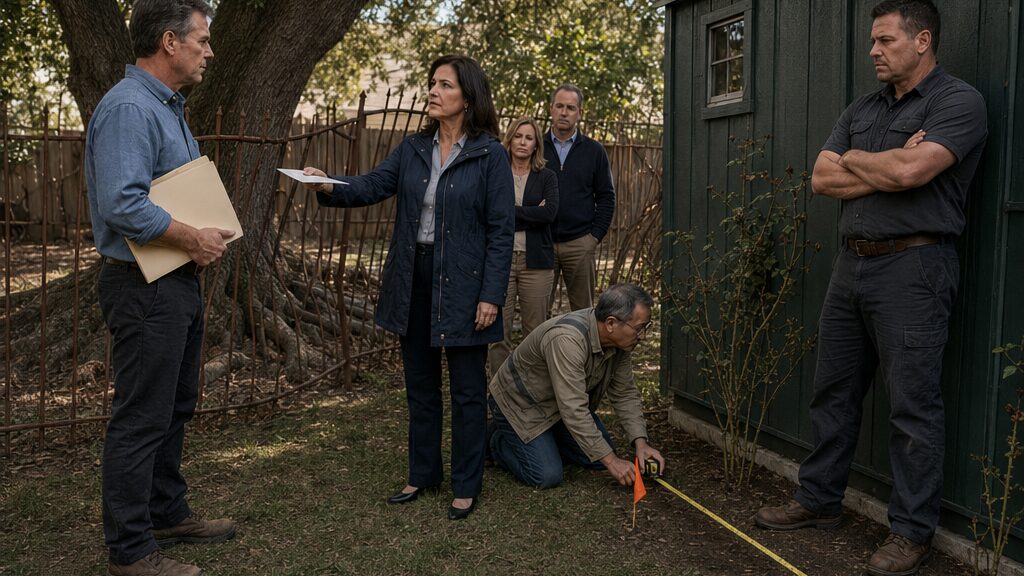
She wore a navy raincoat despite the clear sky and held a thin binder against her side. Behind her came the HOA board president, another board representative, Tyler, and a man Jacob did not recognize until Pamela introduced him as Michael Lee, the licensed surveyor retained for the inspection.
“You retained him?” Jacob asked.
“The association requested a neutral review,” Pamela said.
“I already submitted a request to the county.”
“This is faster.”
Tyler stood beside the green shed with his arms crossed. Several rose canes had reached the siding, their leaves flattened against the metal by the morning breeze.
Pamela offered Jacob the notice.
“Your planting has been reported as a hazardous and retaliatory nuisance,” she said. “Pending measurement, the association is requesting removal within ten days.”
Jacob did not take the paper immediately. “You’re ordering me to remove plants before determining whose property they’re on?”
“We’re requesting temporary compliance while we determine whether they create a maintenance hazard.”
“They’re roses.”
“They have extended thorns.”
“So do the roses at the clubhouse entrance.”
The board president shifted his weight. Tyler looked toward the shed rather than at Jacob.
Pamela lowered the notice slightly. “The concern is placement and intent.”
“Intent isn’t in the landscaping standard.”
“No, but neighbor harassment is in the community conduct provision.”
Anna stood on the porch behind Jacob. He could feel her attention on the back of his neck.
Michael Lee set a hard equipment case on the grass. “I’d like to locate the recorded corners before anybody removes anything.”
Pamela nodded, relieved by the interruption.
Michael worked without conversation. He checked the county plat, established a temporary reference point near the driveway, then located the rear iron pin Jacob had uncovered. At the oak-side corner, he knelt beside the orange flag and brushed away soil with a narrow hand tool.
Tyler watched him expose the rod.
“That’s not where the fence is,” Tyler said.
Michael glanced at the iron rails several feet away. “I see that.”
“The fence is the boundary.”
“A fence can be a boundary marker,” Michael said. “It can also be a fence.”
Tyler’s jaw tightened.
Michael placed a survey rod over the corner and walked the line. Jacob followed at a distance, resisting the urge to explain his own measurements. The surveyor’s neutrality felt almost rude, but Jacob knew that was precisely what they needed.
At the opposite pin, Michael attached a steel tape and asked his assistant, a role-only technician who had arrived in a second vehicle, to hold the far end.
The tape came taut above the grass.
It passed six inches outside the nearest rose trunk, then continued under the overhanging wall of the shed.
Everyone went quiet.
Michael crouched at the front footing and lowered the tape until it touched the concrete. The bright metal line crossed the footing several inches from its outer edge.
Tyler unfolded his arms.
Pamela stepped closer. “How far?”
“I’m not issuing a final boundary opinion in the field,” Michael said. “But the recorded line appears to intersect this footing and a portion of the structure.”
“A portion,” Tyler repeated.
Jacob heard the word as an attempt to reduce the result before it had settled.
Michael measured the rose spacing. Every trunk stood inside Jacob’s recorded side, the nearest by four inches, the farthest by almost a foot.
“The plant bases are within the Mitchell parcel as presently located,” he said.
“What about the canes?” Pamela asked.
“Growth can be trimmed. Ownership follows the trunk placement unless local rules establish something else.”
Jacob took the violation notice from Pamela and folded it once.
“So the shed crosses the line, and the roses don’t.”
Pamela’s face remained composed. “The physical findings do not resolve intent or approval history.”
“They resolve enough to withdraw that notice.”
“They may require amendment.”
Tyler stepped forward. “I had approval.”
“Approval to build on his lot?” Jacob asked.
“Approval for the shed exactly where it is.”
“You had a drawing.”
“I had the association’s written authorization and a contractor who measured from a thirty-year-old fence.”
Jacob pointed at the steel tape passing beneath the shed. “The concrete doesn’t care what paper you had.”
Tyler’s face flushed. “Neither did you, apparently. You planted those things to grow into my siding.”
“Your siding is over my land.”
“You could’ve knocked on my door.”
The sentence struck harder than Jacob expected.
Anna moved slightly behind him. Not enough to interrupt, only enough that he knew she had heard it too.
Jacob opened his folder and removed photographs of the footing, copies of the recorded survey, the vegetation ordinance, and the letter drafted by the local attorney.
“I documented the line,” he said.
“That isn’t the same as talking,” Tyler replied.
Pamela raised one hand. “We’re not resolving personal communication today.”
“No,” Anna said from the porch. “Apparently we’re only measuring the consequences of it.”
Jacob kept his eyes on Tyler.
Michael began recording elevations and offsets. The board representatives whispered near the oak. One of them photographed the tape line crossing the concrete.
For a brief moment, Jacob felt the satisfaction he had imagined while planting the roses. The visible proof lay in the grass where no one could argue it away. Tyler’s shed crossed the line. The association’s accusation against Jacob had weakened in front of its own witnesses.
Then Pamela opened her binder.
She removed a site sketch bearing the HOA approval stamp and Tyler’s address. The drawing showed the shed behind the old iron fence with a marked setback from that fence. A handwritten note indicated that the contractor was to preserve three feet for maintenance access.
“The architectural committee approved this location in February,” she said.
Jacob studied the page. “That isn’t a recorded survey.”
“No,” Pamela said. “But it explains the placement.”
“It explains your mistake.”
“It may explain several mistakes.”
Tyler tapped the approval signature. “I submitted what they asked for.”
“You submitted a fence as a property line.”
“Because everybody treated it as one.”
Michael took the sketch and compared it with the county plat. His expression changed—not dramatically, but enough for Jacob to notice.
“What?” Pamela asked.
“The fence angle on this sketch doesn’t match the deed bearing.”
“It was copied from the subdivision landscaping map.”
“Then the landscaping map is not a boundary map.”
Pamela closed her binder halfway. “Can you determine why they differ?”
“Not from this.”
Michael walked toward the oak-side corner, following the fence rather than the steel tape. At the largest oak, the fence bent inward around a root flare before continuing toward the rear of Jacob’s property.
He measured the distance between the fence and the recorded line, then checked another point farther down.
“The offset changes,” he said.
“How much?” Jacob asked.
“Nearly seven feet at the widest section. Less near the rear.”
The number matched Jacob’s first rough measurement, but now it meant something different. Tyler had not placed the entire shed seven feet across a straight boundary. The fence itself wandered inward, creating a wedge of Jacob’s land that looked as though it belonged next door.
Michael examined the rusted posts. “These weren’t installed to follow the deed bearing.”
Tyler gave a humorless laugh. “So whose fence is it?”
Jacob looked at the iron rails. His father had repaired them twice when Jacob was young. He remembered carrying replacement bolts in a coffee can and being told not to dig too close to the oak roots.
“It was my father’s,” Jacob said.
Michael stood and brushed soil from his gloves.
“Then your father,” he said, “or whoever installed it for him, deliberately placed this fence inside your legal boundary.”
The steel tape still ran beneath Tyler’s shed, bright and undeniable.
But now everyone was looking at Jacob.
Chapter 4: What Jacob’s Father Left Inside the Line
“Fence is not the line.”
Anna read the sentence aloud from a yellowed sheet of paper she had found inside a cracked plastic folder in the attic.
Jacob took the page from her.
The handwriting belonged to his father—heavy block letters pressed hard enough to leave grooves. Beneath the warning was a rough sketch of the oak-side boundary. Two iron pins were marked with small circles. The fence curved inward between them, avoiding three wide root zones.
At the bottom, his father had written: Keep posts off roots. Property continues beyond fence.
Jacob sat on the attic floor among boxes of tax records, holiday decorations, and old appliance manuals. Dust settled on his knees. The survey folder lay open beside him, its metal clasp rusted almost shut.
Anna watched him read the note again.
“You knew about this?” she asked.
“I knew the fence bent around the trees.”
“That wasn’t my question.”
He turned the page over. Nothing was written on the back.
His father had installed the iron fence when Jacob was in his twenties, before Jacob and Anna took over the house. Jacob remembered carrying tools along the oak line and holding posts upright while his father checked the roots with a narrow shovel.
He remembered more than that now.
His father had walked him from one survey pin to the other after the work was done. He had pointed beyond the new fence and said, “Don’t give that strip away just because the iron doesn’t sit on it.”
At the time, Jacob had been distracted by a new job and a leaking transmission. The warning had seemed like one of his father’s many instructions—important to the man giving it, easy for everyone else to postpone.
“I forgot,” Jacob said.
Anna crouched and began sorting the remaining papers.
“You didn’t forget the whole thing. You told me years ago the fence wasn’t perfectly straight.”
“Not straight isn’t the same as seven feet inside.”
“It is when you never check.”
Jacob looked toward the attic window. From that angle, the green shed appeared beyond the oak branches, solid and newly painted. The rose canes had begun to brush its siding whenever the wind pushed them.
A brittle shape slipped from the folder and landed across Jacob’s shoe.
It was a dried rose clipping, pressed flat between two sheets of wax paper. A faded note beneath it identified the plant as coming from Jacob’s mother’s garden. His father had apparently planned to grow it along part of the fence but never had.
Jacob lifted the fragile stem by the paper, careful not to break it.
The thorns were still visible.
Downstairs, he spread the original survey, the handwritten note, and Michael Lee’s preliminary measurements across the dining table.
The documents no longer told the simple story Jacob had wanted. Tyler’s shed still crossed the deed line. The HOA still had no authority to transfer land. But the visible fence had misled anyone who did not inspect the recorded plat, and Jacob’s own family had allowed that misunderstanding to survive for three decades.
“The strip wasn’t abandoned,” Jacob said.
“No,” Anna replied. “Your father protected the roots.”
“And Tyler assumed the fence was the line.”
“He didn’t only assume. He got approval.”
“From a bad drawing.”
Anna folded her arms. “And you saw his stakes.”
Jacob looked up.
She had not said it during the inspection. Not directly.
“I saw two sticks in the grass.”
“You stood at the kitchen window and said they looked too close.”
“I said they might.”
“You also said Tyler would figure it out before he poured anything.”
Jacob remembered the conversation now. Anna had suggested he walk over. He had said Tyler disliked being questioned and that there was no reason to create friction over temporary stakes.
The silence between them had not been patience. It had been avoidance with a polite name.
“You could have said that yesterday,” he told her.
“In front of the board?”
“Yes.”
“And hand Pamela a reason to pretend the shed was your fault?”
“It matters.”
“It does. But not in the way they would have used it.”
Jacob gathered the papers into a stack, then separated them again. His hands needed an orderly task.
“I planted the roses after I knew.”
Anna nodded.
“He poured the footing after he saw the flags,” Jacob said.
“We don’t know that yet.”
Jacob did not like the uncertainty. He wanted the wrong divided cleanly: Tyler’s concrete on one side, Jacob’s roses on the other. The papers refused to cooperate.
That afternoon, he walked the strip outside the fence.
The hidden ground was uneven, shaded by the oaks and covered in old leaves. For years, Tyler had mowed part of it from his side because the fence made it appear connected to his yard. Jacob had rarely entered it. There was no gate in the ironwork and no clear path around the rear.
Near the largest oak, he found an old post hole filled with compacted soil. His father had shifted the fence almost six feet inward there to avoid a root flare as broad as a chair.
Michael arrived before sunset to verify two additional points.
“This supports what I suspected,” he said after reading the note. “The fence was deliberately offset.”
“Does that weaken my ownership claim?”
“No. Fences don’t usually change recorded title by themselves.”
“Usually?”
Michael packed his instrument carefully. “Long use can create arguments. Permission, maintenance, state law, how the land was treated—all of it matters. I’m a surveyor, not your attorney.”
“Tyler’s been mowing beyond the fence for years.”
“So did the prior owner next door, probably.”
“My father allowed it.”
“Then tell your attorney that.”
Jacob glanced at the shed. “Would you have assumed the fence was the boundary?”
Michael considered the question.
“If I were a homeowner without a survey? Possibly. If I were placing permanent concrete? I’d verify.”
It was not absolution for either man.
The following morning, a certified envelope arrived.
Anna signed for it. Jacob opened it at the kitchen table while the mail carrier was still walking down the driveway.
The letter came from Tyler’s attorney. It accused Jacob of planting hazardous vegetation with the intent to damage the shed’s siding, obstruct maintenance, and create personal injury risk. It demanded immediate removal of any cane touching or approaching the structure and reserved Tyler’s right to seek compensation.
Attached were close photographs of the thorns against the green metal.
One image showed a fresh scratch.
Anna read over Jacob’s shoulder.
“He moved faster than you did,” she said.
Jacob placed the attorney’s letter beside his own unsigned warning.
The two documents looked almost identical in weight.
Only one had been sent.
Chapter 5: The Approval That Could Not Grant Land
Tyler placed the shed invoice on the HOA meeting table and pushed it toward Jacob.
“Eleven thousand eight hundred,” he said. “That’s before electrical work, shelving, or moving anything.”
A broken rose cane rested across the top page. One thorn had caught in the staple.
Pamela Perez sat between the men with the HOA binder open in front of her. The board president and association counsel occupied the far end of the table. Anna sat beside Jacob but had said little since they entered.
Tyler tapped the invoice.
“If they tear that shed apart, I don’t have the cash to replace it.”
“No one said tear it apart,” Jacob replied.
“Your attorney demanded removal.”
“My attorney described remedies.”
“Removal is one of them.”
The meeting room was usually used for neighborhood budget sessions and holiday planning. Framed photographs of landscaped entrances hung on the walls. The artificial calm made every disagreement sound sharper.
Pamela turned to Tyler. “Explain why the shed had to be built when it was.”
Tyler leaned back.
“Somebody cut the locks on my work trailer twice in six months. First time they took wire and hand tools. Second time, two testers and a crimping set. Insurance didn’t cover half of it.”
Jacob had heard about thefts in nearby subdivisions but not Tyler’s.
“I needed secure storage,” Tyler continued. “The HOA required a drawing. I measured from the fence because every yard on that side uses the fence. I submitted the dimensions. Pamela’s office approved it.”
Association counsel adjusted her glasses. “The approval states that the applicant remains responsible for property-line verification.”
“In fine print on page three,” Tyler said.
“You signed it.”
“I signed what everybody signs.”
Pamela’s mouth tightened. “We used the landscaping map available in the association archive. It shows the fence as the edge of the Mitchell lot.”
“It isn’t a boundary map,” Jacob said.
“We understand that now.”
“You should have understood it before approving concrete.”
The board president shifted toward Jacob. “We’re trying to determine a workable remedy, not assign every failure in one sentence.”
“That usually means spreading responsibility until nobody has enough to act.”
Anna placed one hand on Jacob’s sleeve. Not to stop him. To remind him of the tone he was using.
Pamela opened a proposed settlement. The HOA would withdraw Jacob’s nuisance violation if he cut the roses back eighteen inches from the shed. Tyler would seal the siding scratch and agree not to grill beside the structure. The property dispute would be deferred pending a formal survey.
“The formal survey already shows encroachment,” Jacob said.
“Michael’s final report is not yet recorded,” Pamela replied.
“So the shed stays while my plants are restricted.”
“Temporarily.”
Tyler shook his head. “Those plants were put there to damage it.”
“They’re on my property.”
“That doesn’t answer why you planted them.”
Jacob glanced at Anna. Her face remained still.
“I wanted the line visible,” he said.
Tyler gave a short laugh. “You wanted me boxed in.”
The association counsel looked down at the papers, but not before Jacob saw her register the statement.
Pamela asked Tyler when he first saw the orange flags.
He hesitated.
“After the shed was delivered.”
“Before or after the footings were poured?” she asked.
Tyler looked at the broken rose cane.
“The contractor had started.”
“That isn’t an answer,” Jacob said.
Tyler’s eyes lifted to his.
“The flags were there the morning of the pour.”
The room changed.
Pamela stopped turning pages.
“You saw them,” Jacob said.
“I saw orange markers.”
“You asked me what I was doing.”
“That was later.”
“You knew there was a question.”
“I had approval, a contractor on site, materials delivered, and a crew charging by the hour.”
“So you poured anyway.”
Tyler leaned forward. “You stood twenty yards away with a tape measure and said nothing. Don’t act like you tried to stop me.”
The words held because they were true.
Jacob could have argued that Tyler had the greater duty before placing permanent concrete. He could have listed every photograph, every recorded corner, every clause stating that HOA approval did not convey land.
Instead he looked at the invoice.
Tyler had initially relied on the fence and the approval. That mistake was understandable. Seeing the flags and continuing was not.
Jacob had initially relied on Tyler’s common sense. Seeing the stakes and remaining silent had not caused the encroachment, but it had allowed the cost to grow.
Association counsel slid a page toward Jacob.
“There is another issue,” she said. “Your photographs and purchase receipts establish that the roses were planted after you believed the structure encroached.”
“Yes.”
“Tyler may argue they were intended to increase damage or interfere with access. Even if the trunks are on your parcel, retaliatory conduct could affect damages and attorney-fee recovery.”
“So I lose part of my claim because I planted on my land?”
“I said it could affect the claim. Not ownership.”
Tyler sat back, some of his confidence returning.
Anna finally spoke.
“He shouldn’t have planted them before sending the letter.”
Jacob turned toward her.
She continued before he could respond. “And Tyler shouldn’t have poured after seeing the flags. Those are not equal mistakes.”
No one contradicted her.
After the meeting, Jacob found Tyler beside his driveway loading extension cords into his work van. The green shed stood behind him, close enough that the roses cast thin shadows across its wall.
“You could move it,” Jacob said.
“With what money?”
“The HOA may have insurance.”
“May.”
“The contractor may share responsibility.”
Tyler shut the van door. “Everybody keeps naming people who might pay because nobody wants to say what happens if they don’t.”
Jacob looked at the trailer parked beside the garage. New locks had been welded onto its doors.
“You should have stopped the pour.”
“You should have spoken.”
“I know.”
Tyler’s expression shifted, not softening, but losing some of its readiness.
Jacob had not intended to say it so plainly.
“I’m still not giving up the land,” he added.
“I’m not asking you to.”
“You’re asking to leave the shed on it.”
“I’m asking not to lose my business over a fence your family put in the wrong place.”
“My family put it inside our property.”
“And then let everybody treat the other side like mine.”
The distinction mattered legally. In the driveway, it sounded less clean.
That evening, Jacob’s attorney emailed a draft demand. It sought full removal, restoration of the soil, compensation for loss of use, attorney fees, and an injunction preventing Tyler from entering the disputed strip.
Jacob printed it.
He read the demand twice at the dining table. The language was forceful, accurate, and designed to leave the other side with no comfortable option.
A week earlier, that would have satisfied him.
Now he saw the roses in the window, their thorns touching the shed whenever the breeze shifted. He saw the orange flags Tyler had ignored and the layout stakes Jacob had ignored before them.
Anna sat across from him.
“What are you going to do?”
Jacob drew a line through the signature block.
The next morning, he called Pamela.
“Don’t send the settlement you drafted,” he said.
“Then are you filing?”
“No.”
A pause followed.
“I need one night,” Jacob said. “I’m bringing a different proposal tomorrow.”
Chapter 6: Moving the Shed Without Erasing the Harm
“I planted the roses because I wanted Tyler to regret the shed.”
Jacob said it before anyone opened a binder.
Pamela looked up from her notes. Tyler stopped adjusting the cuff of his work shirt. The association counsel leaned back slightly, as if clearing space for the admission.
Anna sat beside Jacob at the mediation table.
Jacob continued. “They were inside my line. I measured them. I documented them. That doesn’t change why I chose that variety or why I planted before delivering notice.”
Tyler’s gaze moved toward him, wary rather than triumphant.
“I’m not surrendering the boundary,” Jacob said. “I’m separating the boundary from the way I reacted.”
Pamela closed her binder.
“What are you proposing?”
Jacob placed three pages on the table.
The first was Michael Lee’s final survey showing the recorded line and the shed’s encroachment. The second was an estimate from a structure-moving contractor. The shed could be disconnected, lifted with hydraulic jacks, placed on temporary beams, and shifted onto new footings entirely within Tyler’s lot.
The estimate was far lower than demolition and replacement, though still substantial.
The third page divided responsibility.
Tyler would pay the largest share because he authorized the pour after seeing the orange flags. The HOA would pay a smaller but significant portion through its liability coverage because it approved placement using a non-boundary landscaping sketch. Jacob would pay for cutting back and relocating the roses and would withdraw claims for punitive damages, loss of enjoyment, and attorney fees beyond the initial consultation.
Tyler read the percentages.
“You want me to pay more than half.”
“Yes.”
“You planted against the siding.”
“I’m paying to remove that problem.”
“The footing was based on their approval.”
“And you saw the flags.”
Tyler looked toward Pamela. “Is the association actually agreeing to this?”
Pamela did not answer immediately.
“We have notified the carrier,” she said. “They are reviewing whether the approval process created covered exposure.”
“That means no.”
“It means not yet.”
Jacob pushed another paper forward. “The contractor will hold the estimate for fourteen days. If we wait, the schedule moves into summer and the price increases.”
Association counsel examined the estimate. “What happens if the carrier denies coverage?”
Jacob had expected the question.
“The HOA pays from reserves and replenishes the amount over the next budget cycle.”
The board president frowned. “Homeowners will object.”
“They should,” Jacob said. “That is what makes a bad approval matter.”
Pamela’s eyes narrowed, but she did not dismiss the proposal.
Tyler turned the final page over and back. “And if I agree, you drop the rest?”
“I release the damage claims once the shed is moved, the ground is restored, and the survey is recorded.”
“No public statement from the HOA blaming me?”
Jacob looked at Pamela.
“No statement blaming anyone,” she said. “But the architectural guidelines will be revised.”
Tyler rubbed one hand over his jaw.
“My equipment stays in the shed during the move?”
“The contractor said most shelving has to be emptied.”
“So I lose two workdays.”
Jacob had included nothing for lost work. For a moment, he wanted to say that Tyler had created the problem. Then he pictured the trailer locks and the invoice.
“I’ll make my garage bay available for temporary storage,” Jacob said.
Anna turned toward him, surprised.
Tyler was equally still.
“It locks,” Jacob added. “You inventory everything before it goes in.”
Tyler lowered the proposal.
“You trust me in your garage now?”
“No,” Jacob said. “That’s why we inventory it.”
A reluctant breath escaped Tyler that was almost a laugh.
By the end of the meeting, no one called the arrangement fair. That helped Jacob believe it might work.
The HOA carrier agreed to contribute after Pamela supplied the approval file and Michael’s report. The board covered the deductible from reserves. Tyler signed the agreement three days before the contractor’s estimate expired.
The morning before the move, Jacob cut the roses back.
He wore thick gloves and worked from one end of the hedge to the other. Each cane made a dry snapping sound as he clipped it. He tied the cut branches into bundles and carried them away from the shed.
Tyler came outside while Jacob was clearing the last section.
“You don’t have to take all of them out,” he said.
“The roots need to move for equipment access.”
“I meant afterward.”
Jacob set the shears down. “They aren’t staying against your siding.”
Tyler looked along the shortened row. “Good.”
It was not gratitude. It was enough.
The moving crew arrived with hydraulic jacks, steel beams, and a compact loader. Electric service was disconnected. Tyler’s tools went into Jacob’s garage in labeled boxes. Each container was photographed before the door was locked.
The shed contractor had poured the original front footing wider than the plans showed. When the crew began lifting, one corner resisted.
A sharp crack traveled through the concrete.
Everyone stopped.
The front footing split diagonally, and one section dropped into the soil. The shed tilted less than an inch, but the sound brought Tyler running from the driveway.
“What happened?”
The crew supervisor pointed to the broken slab. “Footing wasn’t reinforced where we expected. We’ll need another beam and a partial cut.”
“How much?”
The revised figure added nearly two thousand dollars.
Tyler looked at Pamela. Pamela looked toward the association counsel, who had come to observe.
“We signed percentages,” Tyler said. “Not blank checks.”
“The agreement covers necessary relocation costs,” counsel replied.
“I’m already carrying the largest share.”
Jacob looked at the cracked footing crossing his line. For weeks, he had imagined that concrete being broken as proof of victory. Now the sight produced no satisfaction.
“We keep the same percentages,” he said.
Tyler turned on him. “Easy for you to say. Yours is the smallest.”
“I’ll cover the rose relocation separately, including soil repair. That removes it from the shared total.”
Anna, standing near the garage, gave a small nod.
Pamela calculated the adjustment. It did not erase the new cost, but it reduced Tyler’s increase enough for him to accept it.
The crew added the beam.
By noon, the green shed rose several inches above the ground. Sunlight appeared beneath it where shadow had rested for weeks. The steel supports carried the structure slowly across the survey line while bundles of cut roses lay beside the old fence.
Jacob watched the wall pass above the place where Michael’s tape had crossed the footing.
Nothing about the movement looked triumphant. Workers called measurements. Hydraulic pumps whined. Tyler followed every shift with his hands clenched at his sides.
When the shed settled onto new footings inside Tyler’s lot, the space between the properties opened for the first time.
The hidden strip looked smaller without the structure and larger without the assumption.
Over the next month, the contractor removed the broken concrete, filled the holes, and restored the grade. Michael returned to set permanent markers at both corners. Pamela circulated revised HOA rules requiring a recorded survey for any permanent structure proposed within ten feet of an apparent lot line.
On the final afternoon, Tyler stood beside one of the new markers while Jacob watered the rose roots he had temporarily moved into containers.
Tyler pointed toward the open strip.
“So what goes there now?”
Jacob looked from the permanent marker to the old iron fence bending around the oaks.
“I haven’t decided.”
“You’re putting something there.”
“Probably.”
Tyler nodded toward the potted roses. “Where?”
The question was practical, but it carried more than placement.
Jacob set down the hose.
“This time,” he said, “we measure it together.”
Chapter 7: The Boundary They Finally Chose Together
The old iron fence came out in sections, and each section revealed another strip of ground that had been hidden for thirty years.
Jacob stood beside the largest oak while the contractor eased a rusted post from the soil. The post emerged bent around a root, its lower end orange with corrosion. Beyond it lay nearly six feet of shaded earth that had always belonged to the Mitchell parcel and had rarely been walked by anyone in the Mitchell family.
Without the fence, the space looked exposed rather than reclaimed.
Tyler stood on his side of the permanent survey marker, watching the crew stack the iron panels near Jacob’s garage. The green shed now sat well inside Tyler’s lot on new concrete pads. A gravel path ran around it, leaving enough room for maintenance without crossing the boundary.
The distance between the shed and Jacob’s kitchen window had restored the air. Tyler had moved his grill to the far side of his patio. For weeks, no charcoal smell had entered the house.
Jacob should have felt finished.
Instead, he kept looking at the open strip and seeing every version of the dispute layered over it: the wet footing, the orange flags, the thorn canes pressing against green siding, the steel tape running beneath the shed while neighbors watched.
Anna came out carrying a folder.
“Pamela sent the final guideline revision.”
Jacob wiped soil from his gloves and opened it.
Any permanent structure proposed within ten feet of an apparent property line would now require either a recorded survey or written confirmation from a licensed surveyor. Architectural approval forms had been revised to state, in bold type, that fences, mowing patterns, hedges, and landscaping maps were not proof of ownership.
“They put it in bold,” Anna said.
“They should have put it in bold before.”
“They should have known before.”
Jacob closed the folder. “So should I.”
Anna did not correct him or reassure him. That was one of the things he loved about her, though he did not always enjoy it.
Michael Lee arrived with two permanent markers and a fresh copy of the recorded survey. He had already set the rear corner. The oak-side marker required a shallow concrete collar to keep future landscaping from burying it.
Tyler crossed his yard carrying a post-hole digger.
Michael looked at the tool. “You planning to help?”
“I was told there’d be a marker.”
“There will be. Don’t dig until I point.”
Tyler rested the handles against his shoulder. “I’ve learned that part.”
The line was dry, but not hostile.
Michael positioned the marker several feet beyond where the old fence had curved around the roots. He checked the coordinates twice and showed both men the point before work began.
Tyler drove the post-hole digger into the soil. Jacob cleared loose dirt with a hand trowel. They worked without touching the marker itself until Michael lowered it into place and verified the top.
It was the first time Jacob and Tyler had worked on the same task since the shed had appeared.
Neither man mentioned that.
When the marker was secure, Michael packed his equipment. “This one should outlast all of you.”
“That’s reassuring,” Tyler said.
“It isn’t meant to be.”
After Michael left, Tyler remained beside the marker. The sunlight caught the new brass cap, making it brighter than anything else along the line.
“I’m still paying for that shed,” he said.
Jacob waited.
“I’ll be paying for it next year too.”
“I know.”
“I agreed to move it because it was over the line. That doesn’t mean I’m happy about how all of this landed.”
“I don’t expect you to be.”
Tyler looked toward the potted roses near Jacob’s garage. Their roots had survived the relocation, and new shoots had formed below the cuts.
“You’re really putting those back?”
“Some of them.”
“Against the line?”
“Inside it.”
“That answer sounds familiar.”
Jacob almost smiled, but Tyler’s expression remained serious.
“I don’t want them touching the shed,” Tyler said.
“They won’t.”
“I don’t want to reach through thorns if something blows over.”
“You won’t have to.”
“And I don’t want another surprise hedge.”
Jacob nodded. “That’s fair.”
The word seemed to catch Tyler off guard.
Anna had helped Jacob choose a low black trellis system that followed the recorded boundary without sitting directly on it. The nearest support would remain two feet inside Jacob’s property. The roses would be trained parallel to the line, not allowed to spread into the maintenance space.
It would create a visible boundary.
It would not create a trap.
That afternoon, Jacob and Anna set the trellis posts. They measured every placement from the permanent markers, then wrote the distances on the back of the new survey.
Anna held the first post upright while Jacob checked the level.
“This is what you thought you were doing the first time,” she said.
“No.”
She looked at him over the top of the level.
Jacob adjusted the post. “The first time, I wanted him to see the thorns before he saw me.”
“And now?”
“Now I want whoever lives here next to know exactly where the line is.”
She steadied the post while he filled the hole.
By early evening, the trellis stood in a straight, modest run beneath the oaks. It did not follow the old fence’s curve. It followed the recorded bearing, leaving room around the roots without pretending the protected space belonged to someone else.
Tyler returned carrying two bags of topsoil.
“I had these left from the new footings,” he said. “They’re clean fill.”
Jacob examined the label.
Tyler gave him a tired look. “You can test it if you want.”
“I was checking the mix.”
“It’s dirt.”
“It’s amended topsoil.”
Anna took one bag from Tyler before the discussion could become familiar.
“Thank you,” she said.
They planted the surviving roses one by one.
Jacob handled the roots while Anna added soil. Tyler held the canes away from their gloves. The work required care because even cut back, the plants had enough thorns to catch sleeves and skin.
At the second rose, Tyler pulled his hand away sharply.
A thorn had opened a small line across his knuckle.
Jacob reached for the first-aid kit on the porch.
“It’s a scratch,” Tyler said.
“That’s what I said about the siding.”
Tyler looked at him.
Then, unexpectedly, he laughed.
It was brief and rough, but it loosened something that months of documents had not.
They did not become friends in that moment. Jacob did not mistake the laugh for forgiveness, and Tyler did not turn it into an apology.
They returned to work.
When only the last rose remained, Jacob went inside and brought out a large envelope.
He handed it to Tyler.
Inside was a certified copy of the recorded survey, Michael’s final marker report, and a simple diagram showing the trellis setback and maintenance space.
Tyler flipped through the pages.
“You already gave Pamela copies.”
“This one is yours.”
“I can get one from the county.”
“You shouldn’t have to search for it.”
Tyler studied the survey longer than necessary. Then he folded the envelope closed and set it beside the permanent marker where it would stay clean.
Together, they lowered the final rose into the prepared hole.
Jacob spread the roots. Tyler held the plant upright. Anna filled the space around it with soil and pressed it firm with the heel of her glove.
The last cane leaned toward the boundary.
Jacob guided it back to the trellis and secured it with a soft tie.
On Tyler’s side, the gravel path remained clear.
On Jacob’s side, the line was visible.
The roses would grow, but they would be maintained. The markers would remain uncovered. The survey would exist in both houses, not buried in one attic or reduced to a memory no one acted upon.
Tyler picked up his copy and stepped across the open grass toward home.
At the permanent marker, he stopped.
“I should’ve stopped the concrete,” he said without turning around.
Jacob looked at the new trellis.
“I should’ve knocked on your door.”
Tyler nodded once and continued across his yard.
Anna gathered the empty soil bags. “That may be all you get.”
“It’s enough.”
She glanced at him. “Is it?”
Jacob considered the restored yard, the moved shed, and the roses tied neatly inside the line. Enough did not mean the harm had vanished. It meant the truth no longer required either man to pretend the other carried all of it.
“Yes,” he said. “It is.”
That evening, Anna opened the kitchen window.
A breeze moved through the screen carrying the smell of cut grass and damp soil. The curtains lifted, clean and light, without smoke.
Outside, the last rose stood beside the brass marker, its thorns turned away from the neighboring path.
The story has ended.