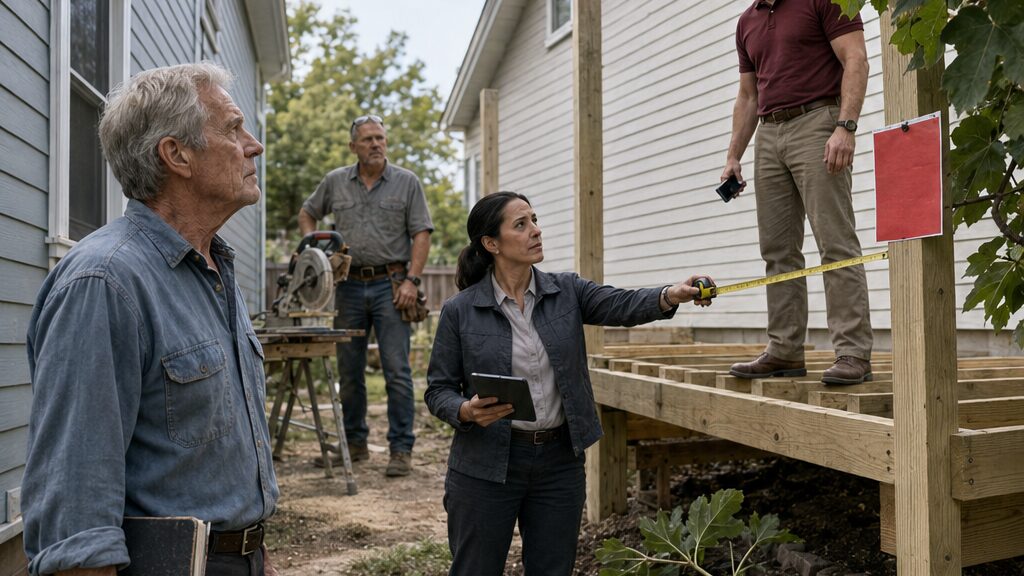
He Built His Dream Deck Over My Garden, but the Boundary Held a Harder Truth
Chapter 1: The Deck Posts Landed Beside Patricia’s Fig Tree
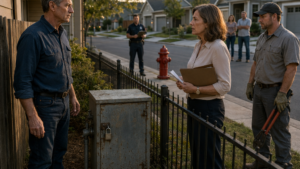
The power auger struck the ground before Steven Hall finished tying his boots.
Its engine rattled the kitchen windows. A second later, the rotating bit bit into the narrow strip of soil beside his raised tomato bed, throwing dark earth against the lower branches of Patricia’s fig tree.
Steven crossed the porch without his coffee.
“Stop that machine.”
The operator released the throttle. The sudden quiet left a high ringing in Steven’s ears. Three workers stood in Brandon Carter’s yard among stacks of pressure-treated lumber. Orange paint marked a row of proposed post holes. One of those marks sat on Steven’s side of the weathered metal stake near the fig tree.
The foreman removed his ear protection. “Can I help you?”
“You can move that auger.”
“We’re building next door.”
“You’re digging in my garden.”
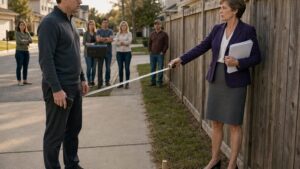
The foreman glanced at the stake, then at the chalk line stretched from Brandon’s house. “Homeowner said the line runs here.”
Steven stepped between the auger and the fig tree. The nearest branch brushed his shoulder. Patricia had planted the tree nineteen years earlier, after buying a bruised sapling from a nursery clearance rack. She had insisted that damaged things deserved better ground, not less time.
The tree now stood taller than the fence.
“That line is wrong,” Steven said.
A sliding door opened behind the workers. Brandon came down the unfinished back steps holding a travel mug. He wore pressed work pants and a polo shirt, as if he had walked out to inspect a project already under control.
“Morning, Steven.”
“You should have told me you were building this close.”
“I mentioned the deck.”
“You said you were replacing the back steps.”
“The plan grew.”
Steven pointed at the orange mark. “That post hole is over the line.”
Brandon looked toward the stake. “The contractor measured.”
“With what?”
“A tape. What else?”
The foreman gave a small shrug, unwilling to join the argument.
Steven had spent thirty-four years maintaining municipal buildings. He knew how often a sentence like the contractor measured was used to make uncertainty sound finished.
“Show me the survey,” he said.
Brandon took a slow drink. “The HOA approved the plan.”
“That isn’t a survey.”
“It’s approved.”
“That isn’t a permit either.”
The easy expression left Brandon’s face. “We did what we were supposed to do.”
Steven looked at the lumber stacked along the fence. Enough joists for a platform nearly the width of Brandon’s house. Tall support posts waited beside bags of concrete. This was not a replacement landing. It was an elevated deck that would look directly over Steven’s garden.
The chalk line passed so close to the fig tree that the planned rim board would cut through its lower canopy.
Steven crouched beside the old marker. Only two inches of rusted metal remained above the soil. The stake had leaned east for years. During a winter freeze, perhaps six years earlier, he had noticed the surrounding dirt pushed up on one side. He had written it down in the maintenance notebook he kept in the garage.
He had meant to order a survey.
Then Patricia’s treatments had begun, followed by appointments, medications, hospital parking lots and the quiet year after her death when opening any file connected to the house felt like inviting her absence to sit beside him.
The stake was still there. That had been enough until this morning.
Brandon stepped closer. “You’ve lived here forever. You know the line.”
“I know that hole doesn’t belong there.”
“Based on what?”
Steven did not answer quickly enough.
Brandon noticed.
“That’s what I thought,” he said. “You don’t like the deck.”
“I don’t care what you build on your property.”
“You complained when we removed the hedge.”
“I told you the hedge gave both houses privacy.”
“And now you’re telling my crew where they can dig.”
Steven rose. “Because they’re digging beside my tomatoes.”
Brandon turned to the foreman. “Keep going. Stay on the layout.”
The auger operator hesitated.
Steven placed one boot directly over the orange mark. “Not here.”
For several seconds nobody moved. A truck passed on the street beyond the houses. Somewhere across the subdivision, a lawn sprinkler clicked.
The foreman lowered his voice. “Mr. Carter, maybe we verify this one before we drill.”
Brandon’s jaw tightened. “We already verified it.”
“You verified from that stake?” Steven asked.
“From the property layout.”
“What property layout?”
“The one the contractor uses.”
Steven almost laughed, but there was nothing funny in the way Brandon had begun speaking around facts instead of naming them.
The foreman redirected the crew to a hole closer to Brandon’s foundation. The auger started again, and Steven remained beside the fig tree, watching the chalk line.
By late morning, the yard had changed shape. Four posts stood in concrete. Workers carried joists across Brandon’s grass and lifted them into place. The frame rose faster than Steven expected, each board making the next one harder to challenge.
He called the HOA office twice. Both calls went to voicemail.
At noon, one of the workers carried a twelve-foot board backward through the narrow side yard. The far end struck the fig tree with a dry crack.
A low branch dropped across the raised bed.
Steven was there before the worker could drag it away.
“Leave it.”
“Sorry, sir. I didn’t see it.”
The branch was as thick as Steven’s wrist, heavy with green figs. Torn fibers hung pale against the bark.
The worker looked genuinely ashamed. “We can trim it clean.”
“You’ve done enough.”
Brandon came around the frame. “It’s one branch.”
Steven lifted his head.
Brandon looked away first, but only for a moment. “I’ll pay for an arborist.”
“You can’t buy back nineteen years.”
“I said I’ll fix it.”
Steven took a pruning saw from his shed and cut the branch clean at the break. Then he checked the exposed roots near the auger mark. A worker had begun scraping soil away to reposition the machine. The edge of the bit was aimed toward a root as wide as Steven’s forearm.
“No,” Steven said.
The foreman followed his gaze and immediately raised a hand. “Move the hole six inches.”
Brandon objected. “That changes the spacing.”
“It keeps you from cutting a structural root,” Steven said.
The foreman nodded. “He’s right.”
It was a small victory, but it saved the tree from damage that might not have shown until the next season.
Steven carried the broken branch to the porch. Sap dampened his palm. For an instant he remembered Patricia standing under the same tree with a bowl against her hip, laughing because a fig had fallen down the front of her shirt.
Behind him, a drill drove a screw with a sharp mechanical whine.
He turned.
A new post hole had been marked beyond the leaning metal stake, plainly inside the edge of his raised bed. The crew had shifted the structural root, but the revised position made the possible encroachment worse.
Steven walked to Brandon’s driveway, where Brandon was speaking with the foreman over a rolled plan.
“I’m asking you once more,” Steven said. “Stop until the line is verified.”
Brandon folded the plan before Steven could see it.
“We’re not losing a day because you’re sentimental about a tree.”
“This isn’t about sentiment.”
“Then prove it.”
Steven looked past him at the rising frame, at the joists already throwing striped shadows over Patricia’s garden.
“I’ll call the city.”
Brandon gave a humorless smile. “Call whoever you want.”
He turned toward the crew and raised his voice.
“Finish the framing before sunset.”
Chapter 2: The Approval Email That Approved Almost Nothing
Brandon thrust his phone toward Steven before Steven reached the end of the driveway.
“There,” he said. “Read it yourself.”
The screen showed an email from the HOA architectural-review committee. At the top, beside a small green check mark, were the words Application Approved.
Brandon held the phone as if the phrase settled every question.
Steven adjusted his glasses. “Scroll down.”
“You wanted proof.”
“I want to read it.”
Brandon’s thumb moved reluctantly. Beneath a short description of the deck were three dense paragraphs in smaller type. Steven read them once, then again.
Approval was conditional upon compliance with municipal building requirements, verified setbacks, drainage rules and all applicable permits.
“This approves the appearance,” Steven said. “Not the location.”
“It approves the project.”
“Subject to municipal approval.”
“The contractor handles that.”
“Does he have the permit?”
Brandon lowered the phone. “He filed what he needed.”
“That isn’t what I asked.”
Behind them, a nail gun snapped. The deck frame now stood shoulder-high at its outer edge. Workers were installing blocking between the joists.
Brandon looked toward the crew instead of Steven. “You’re trying to make this more complicated than it is.”
Steven held out his hand. “Let me photograph the email.”
“No.”
“Why?”
“Because it’s my correspondence.”
“It concerns a structure beside my property.”
“It doesn’t concern you unless it crosses the line.”
“That’s the issue.”
Brandon slid the phone into his pocket. “You haven’t proven that.”
The words landed harder because they were true.
Steven returned home carrying the broken fig branch. In the kitchen, he trimmed the torn end at an angle, filled a tall glass jar and placed the branch in water beside the sink. Patricia had once rooted cuttings that way, though Steven could not remember whether she had stripped the lower leaves first.
He almost reached for her gardening binder.
Instead, he opened his laptop.
The HOA portal required three attempts before accepting his password. Brandon’s application was not visible to neighboring homeowners, but the community guidelines were. Steven found the section on exterior structures.
Architectural approval did not replace municipal permits. Applicants remained responsible for property lines, setbacks and utility locations. The HOA did not certify surveys.
He printed the page.
Then he called the management office again.
This time the architectural-review chair answered.
Steven explained the construction, the disputed boundary and the broken branch. He kept his voice level. Years of speaking with vendors and department supervisors had taught him that anger gave people permission to focus on tone instead of facts.
The chair listened, then said, “Mr. Carter’s application was approved based on the drawing he submitted.”
“Did the drawing include a certified survey?”
“We don’t certify surveys.”
“Did it include one?”
A pause.
“It included a site sketch.”
“Prepared by whom?”
“I don’t have that information in front of me.”
“Did the committee verify the setback?”
“The homeowner attested that the plan complied with governing requirements.”
Steven looked through the kitchen window. A worker balanced on the frame, passing boards upward.
“So you accepted his statement.”
“We are an architectural committee, Mr. Hall. We review materials, scale, visibility and community standards. Boundary disputes are private matters.”
“A structure approved by your committee is being built into my garden.”
“If you believe there is an encroachment, you should contact the city or obtain a survey.”
“Can you order the work stopped while that happens?”
“We do not have authority to stop private construction.”
“You have authority to fine people for the wrong shade of fence.”
“That is not the same issue.”
“No,” Steven said. “It’s easier.”
The chair’s voice cooled. “I understand you are upset.”
Steven closed his eyes.
“I am asking whether you told Brandon Carter that his approval depended on permits and verified setbacks.”
“It is written in the approval.”
“Did anyone explain it?”
“Applicants are responsible for reading their correspondence.”
That answer was technically clean and practically useless.
Steven thanked her and ended the call before frustration made him say something that would help no one.
Outside, Brandon stood beneath the frame with the contractor, pointing toward Steven’s side yard. The contractor extended a tape from the foundation to the leaning marker, then called out a number. Brandon nodded as if a ritual had been completed.
Steven watched the tape bow over the grass.
A measurement was only as reliable as its starting point.
He went to the garage and opened the metal cabinet where he kept house records. Tax statements. Appliance manuals. Drainage repairs. A copy of the subdivision plat from when he and Patricia bought the house.
The plat showed dimensions but no easy reference Steven could transfer to the ground without proper equipment. The boundary ran from a front monument to a rear pin. The leaning stake near the fig tree might be the rear pin, or it might be an old landscaping marker someone had treated as official long enough for everyone to forget the difference.
He found his maintenance notebooks stacked behind a box of sprinkler parts.
The top one covered the last four years. The older volume beneath it contained the winter he remembered.
Steven rested his hand on the cover but did not open it.
Not yet.
He called the municipal building office.
A clerk asked for Brandon’s street address and placed him on hold. While Steven waited, the crew began laying the first deck boards. Each screw pulled the structure tighter.
The clerk returned.
“I’m not finding an issued residential deck permit at that address.”
“Could it be pending?”
“It could be under review, or filed under a contractor account. Do you have the contractor’s name?”
Steven did not.
“Can someone inspect it?”
“If active construction is occurring without a posted permit, I can enter a complaint.”
“How soon would anyone come?”
“I can’t promise a time.”
“They’re building now.”
“I understand.”
Steven gave his name, address and phone number. When the clerk asked whether he had spoken with the property owner, he looked through the window at Brandon.
“Yes.”
“And?”
“He told them to finish before sunset.”
The clerk marked the complaint urgent because of the disputed property line and elevated framing.
Steven ended the call and went outside with the printed HOA guidelines.
The deck boards were advancing toward the fig tree.
He showed the conditional language to the foreman.
The foreman read it, frowned and called the contractor. Their conversation took place near the truck, too low for Steven to hear. Brandon joined them. He gestured toward Steven twice.
Then the contractor walked over.
“Mr. Hall, we have a submitted permit package.”
“Submitted isn’t issued.”
“We do this all the time.”
“That doesn’t make it legal.”
“We’re within the owner’s boundary.”
“Based on the leaning stake?”
The contractor looked toward it. “Based on field measurements.”
“From what recorded point?”
For the first time, the contractor had no immediate answer.
Brandon stepped between them. “You made your complaint. Now stay off my job site.”
“Your job site is leaning over my garden.”
“Not according to our layout.”
Steven held up the HOA page. “Not according to your approval either.”
Brandon’s face tightened. “You’ve been waiting for a reason to object since we moved in.”
Steven stared at him. “Why would I do that?”
“You liked the house empty. You liked the hedge. You liked everything exactly the way your wife left it.”
The workers went quiet without appearing to.
Steven felt the sentence find the place Brandon could not have known was exposed.
He folded the paper once.
“This is about the line,” he said.
“Then let the inspector tell us where it is.”
“I intend to.”
Brandon turned away, but he did not tell the crew to stop.
At six seventeen, after the workers had finally left, Steven received a call from the building office. No issued permit had been found under Brandon’s address or the contractor’s company.
An inspector would come Tuesday morning.
Steven looked outside.
The frame was nearly complete.
Chapter 3: The Inspector Measured Past the Broken Branch
Karen Moore arrived while the circular saw was still running.
She parked a white municipal vehicle at the curb, stepped out with a tablet and a red document folder, and stood for several seconds listening to the construction behind the houses.
Steven met her at the driveway.
“You filed the complaint?”
“Yes.”
“Show me the structure first. Tell me the rest while we walk.”
She did not offer sympathy or ask which neighbor was difficult. Steven appreciated that.
They entered the side yard beneath the new deck frame. Joists crossed overhead, close enough for Steven to touch. The edge projected over the crushed corner of his raised bed. The broken fig branch remained in its jar on the kitchen sill, visible through the window.
Karen examined the post bases, ledger connection and temporary bracing. She photographed a row of fasteners, then the spacing between the nearest post and Steven’s house.
The saw stopped.
Brandon came around the corner with the contractor behind him.
“Can I ask who you are?” Brandon said.
Karen displayed her identification. “Building inspection. Who is responsible for the work?”
“I am the homeowner. We have HOA approval and a permit application in process.”
“Is a permit posted?”
“It hasn’t come through yet.”
“Then why is construction continuing?”
“The contractor said preliminary work was allowed.”
Karen looked at the contractor.
He cleared his throat. “We submitted the package.”
“That was not my question.”
“No permit has been issued yet.”
Karen entered something on her tablet.
Brandon pointed toward Steven. “This is really a boundary complaint. He thinks part of the deck is on his land.”
“I’ll address one issue at a time.”
She asked for the plans. The contractor retrieved a rolled set from his truck. Karen spread them across Brandon’s outdoor table.
The drawing showed deck dimensions, post locations and framing details. Where a survey should have established the lot line, a dashed line had been drawn by hand. Beside it someone had written field verified.
“Who verified this?” Karen asked.
The contractor said, “My foreman measured from the existing rear marker.”
“Which marker?”
Brandon led them to the rusted stake near the fig tree.
Karen crouched without touching it. “Is this a survey pin?”
“That’s the property marker,” Brandon said.
“Who identified it as such?”
“It’s on the line.”
“That doesn’t answer the question.”
Steven stood beneath the joists, saying nothing.
Karen opened the municipal permit system on her tablet. She searched Brandon’s address, then the contractor’s application number.
A red status bar appeared across the screen.
NO ACTIVE PERMIT.
The contractor leaned closer. “It was submitted Friday.”
“It was rejected Monday morning for an incomplete site plan and missing setback verification.”
Brandon turned toward him. “You said it was being processed.”
“It is being processed.”
Karen looked up. “It is not approved. Work should not have started.”
Brandon’s voice sharpened. “Then we stop now and fix the paperwork.”
“That addresses one violation.”
She retrieved a red stop-work notice from the folder and filled in the address. The sound of her pen across the paper seemed louder than the saw had been.
When she fastened the notice to the nearest post, two workers watched from the frame. Across the alley, a neighbor stood beside a trash bin pretending to rearrange cardboard.
Brandon lowered his voice. “This could have been handled without making a public show.”
Karen capped her pen. “The work was public.”
She asked Steven to show the area he believed had been crossed. He pointed to the edge of the raised bed, the damaged branch and the orange layout marks.
Karen took a steel tape from her bag. She had the contractor hold one end at the corner of Brandon’s foundation while she measured toward the rear of the lot. The tape passed beneath the deck, over disturbed soil and across the fallen leaves beneath the fig tree.
At the nearest post, she read the measurement twice.
Then she checked the approved subdivision dimensions on her tablet.
“This post appears to violate the required side setback,” she said.
Brandon folded his arms. “Appears?”
“The building setback and the ownership boundary are related, but they are not the same determination. I can enforce an unpermitted structure and obvious safety issues. I cannot certify a private property line from a GIS image.”
Steven felt his anticipated relief narrow.
“But it’s over my garden,” he said.
“It may be. A licensed surveyor needs to establish that.”
“The county map shows it.”
“The county map is not a boundary survey.”
Brandon gave Steven a brief, satisfied look. “Exactly.”
Karen turned to him. “You still have an unpermitted elevated deck with a rejected application and probable setback violations. Do not mistake procedural caution for approval.”
The satisfaction disappeared.
She measured from a second reference point near the rear corners of the houses. The numbers placed the deck edge very close to where Steven believed the boundary ran, perhaps beyond it. But both calculations depended on identifying a reliable monument.
Karen returned to the rusted stake.
“Mr. Hall, how long has this been here?”
“As long as I can remember.”
“That isn’t what I asked.”
Steven looked at the soil around it. He could feel Brandon waiting.
“More than twenty years,” Steven said. “Maybe longer.”
“Has it ever been disturbed?”
The truthful answer rose immediately, but he held it behind his teeth.
He could have said he did not know. No one could prove otherwise at that moment. The stop-work notice was already posted. The missing permit was Brandon’s problem. Silence would preserve the clean shape of the dispute: careless neighbor, damaged garden, official correction.
Then Steven looked at the broken place on the fig tree.
Patricia had disliked clean stories. Whenever he blamed a contractor, a clerk or a relative without including his own part, she would ask, What happened before the part you’re telling me?
“Yes,” he said.
Brandon shifted.
Karen waited.
“Six years ago, maybe seven, the ground heaved after a freeze. I noticed the stake leaning farther east.”
“How far?”
“I don’t know.”
“Did you move it?”
“No.”
“Did anyone?”
“Not that I saw.”
“Did you have it surveyed?”
Steven looked toward his garage. “No.”
“Did you document the change?”
He could have denied that too.
“I wrote it in a maintenance notebook.”
The contractor exhaled through his nose. Brandon stared at Steven as if a hidden door had opened.
Karen’s voice remained neutral. “I’ll need a copy.”
Steven went inside.
The garage felt cooler than the yard. He opened the cabinet and pulled out the older notebook. Dust had settled along the spine. Inside were dates, repairs and small diagrams in his compact block printing.
He found the entry from February.
Rear marker by fig leaning approximately three inches after freeze. Verify before fence or permanent work.
Below it, in Patricia’s handwriting, was a note written in blue ink.
Ask about path when we redo the bed.
Steven ran his thumb over the words.
Patricia had still been alive then. They had discussed widening the raised bed and shifting the shared path that curved around the tree. He had not called a surveyor because her first specialist appointment came the following week.
He carried the notebook outside.
Karen photographed the entry.
Brandon read it over her shoulder. “So you knew the marker was wrong.”
“I knew it might be.”
“And you watched us build.”
“I told you to stop before the first hole.”
“You didn’t tell me this.”
“No.”
“Why not?”
Steven closed the notebook. There were answers he could give: because Brandon had dismissed him, because construction should never have begun without verification, because the contractor carried responsibility for his own layout.
All were true. None were complete.
“I should have,” Steven said.
Brandon laughed once, without humor. “Unbelievable.”
Karen placed herself between the men, not dramatically, simply enough to interrupt the line of accusation.
“Here is what happens next,” she said. “Work remains stopped. The permit application cannot proceed until a certified survey establishes the boundary and required setbacks. The framing must not be loaded, enclosed or used.”
Brandon pointed at Steven’s notebook. “He withheld information that would have changed the layout.”
Karen looked at him. “You began permanent construction without an issued permit or certified boundary verification.”
“He let us.”
“He objected.”
“He objected because he doesn’t want a deck.”
Steven tightened his grip on the notebook.
Karen turned to him. “Do you have a current survey?”
“No.”
“Then obtain one or coordinate access for one. Until that is complete, neither of you gets to declare where the line is.”
She gave copies of the stop-work notice to Brandon and the contractor. The workers climbed down and began packing tools. The sudden absence of machinery exposed ordinary sounds: birds in the fig leaves, a delivery truck braking at the corner, water dripping from a hose connection.
Brandon stood beneath the unfinished structure, looking at the red notice.
For the first time since construction began, the deck seemed less like an accomplished fact than a suspended mistake.
Karen closed her folder.
Then Brandon lifted his head and spoke loudly enough for the workers and the neighbor by the alley to hear.
“You need to document something else,” he said. “Steven moved that marker himself.”
Chapter 4: The Survey Line Cut Through Both Men’s Stories
By Thursday morning, fluorescent survey flags stood beneath Brandon’s deck frame like small warnings no one could talk around.
One flag had been driven into the dirt beside the fig tree. Another rose from the crushed corner of Steven’s raised bed. A bright string connected them, passing under the outer joists and cutting through the space Brandon had claimed as his.
The licensed surveyor moved between the houses with a tripod, receiver and field tablet. He spoke little, checking measurements against recorded monuments at the front and rear of the subdivision.
Brandon watched from his patio with his arms folded. Heather stood behind the sliding door, visible only when the light caught the glass.
Steven remained beside the fig tree.
The stop-work notice still hung from the nearest deck post. Its red paper had curled at the corners after two damp nights.
The surveyor adjusted the receiver and waited for a tone.
“This rear monument is intact,” he said. “The visible stake near the tree is not the controlling corner.”
Brandon looked at Steven. “So that stake was wrong.”
“It was unreliable,” Steven said.
The surveyor lifted a hand without looking up. “Let me finish.”
He walked the measured line toward the houses. The fluorescent string ran several feet inside the outer edge of Brandon’s framing before narrowing closer to the foundation.
The result was not subtle.
Two deck posts stood on Steven’s side. Part of a third footing crossed the boundary. The rim beam projected beyond the line, and the required setback placed the legal buildable edge farther into Brandon’s yard still.
The contractor arrived halfway through the survey and stopped near the driveway when he saw the flags.
“How far?” Brandon asked.
The surveyor gave him the measured encroachment at each point, then showed both homeowners the certified field sketch on his tablet.
Brandon stared at the numbers.
“That can’t be right.”
“They are tied to recorded monuments,” the surveyor said.
“My contractor measured.”
The contractor looked toward the foreman’s chalk marks as if someone else had made them.
“We measured from the existing stake,” he said.
“You told me it was the property pin.”
“I told you it appeared to be.”
“No, you didn’t.”
Karen Moore arrived before the argument could grow. She reviewed the surveyor’s field notes, photographed the flags and examined the marked post locations.
“This resolves the ownership question,” she said. “The framing encroaches onto Mr. Hall’s property and violates the side setback.”
For three days Steven had imagined that sentence bringing relief.
Instead, he noticed Brandon’s daughter’s plastic cup sitting on the unfinished steps. Purple, with a faded cartoon animal on one side. The deck had not been built only as a declaration of ownership. Someone had expected to drink lemonade there, to sit above the grass and believe the house finally had enough room.
That did not excuse anything.
It made the waste easier to see.
Brandon pointed toward the fig tree. “That path has always been on our side.”
Steven turned. “What path?”
“The bare strip around the tree. The previous owner showed it to us. He said both houses used it.”
The ground beneath the fig canopy was indeed worn smoother than the soil around the vegetable beds. Steven had walked it thousands of times. Patricia had too.
So had the former neighbors.
Years earlier, before the hedge grew thick, the woman next door had used the path to reach the shared hose connection near the rear fence. Patricia had kept the curve open so neither of them had to squeeze behind the tree.
It had never seemed important enough to explain.
Brandon continued, “If people on both properties used that strip for years, then it wasn’t treated like exclusively yours.”
Karen’s expression did not change. “Shared use does not automatically change legal ownership.”
“But it matters.”
“It may matter in a private claim. It does not legalize construction without a permit.”
The surveyor packed his equipment while Steven followed the string with his eyes. It crossed exactly where Patricia’s path had curved.
The legal line was clean.
Their habits had not been.
That afternoon, Steven drove to the county records office with the certified survey and the old subdivision plat. A records clerk helped him locate archived parcel documents and a prior transfer sketch from the neighboring property.
The sketch showed the boundary plainly. No easement had been recorded. No shared-access agreement existed. The strip belonged to Steven’s lot.
In one faded attachment, however, a hand-drawn landscaping note showed a curved path around the fig tree. It appeared to have been submitted years earlier with a fence request. The note carried Patricia’s initials and those of the former neighbor.
Shared garden access. No permanent improvements.
Steven read the sentence twice.
Patricia had formalized the courtesy just enough for the HOA, but not through the county. She had understood the distinction he had allowed himself to forget.
Use was not ownership.
Kindness was not surrender.
Back home, Brandon stood beneath the deck with the contractor. Their voices carried over the fence.
“You laid it out,” Brandon said.
“You gave us the site sketch.”
“You said the sketch worked.”
“You signed the contract acknowledging boundary verification was the owner’s responsibility.”
Brandon laughed sharply. “Of course you put that in the contract.”
Steven entered his yard without speaking. The survey string glowed against the dark soil.
Karen had left a written notice requiring Brandon to submit a correction or removal plan. The city would determine the extent of necessary demolition after reviewing structural dependencies. Because the outer supports were tied into the entire frame, partial removal might be difficult.
Brandon came to the fence.
“You got what you wanted.”
Steven looked at him. “I wanted you to stop before the first hole.”
“You knew that marker was questionable.”
“Yes.”
“And you didn’t say anything until the inspector asked.”
“I told you the line needed verification.”
“You told me I was on your property. That’s different from saying you didn’t actually know where it was.”
Steven rested one hand on the fig trunk. The bark was rough beneath his palm.
“I knew the garden was mine.”
“That path wasn’t treated like it.”
“No. It was shared.”
Brandon seized on the word. “Exactly.”
“Shared,” Steven said. “Not transferred.”
Brandon looked toward the string. “You could let the deck stay if we compensate you.”
“No.”
“You didn’t even think about it.”
“It is over the tree roots and the garden bed.”
“We can redesign the lower section.”
“You already designed without asking.”
Brandon’s face hardened. “So this is punishment.”
Steven opened his mouth, then stopped.
He wanted to say it was protection. That Patricia had planted the tree. That the beds were not decorative. That he had promised to maintain them.
But the promise had become something he used like a locked gate. He had not explained the shared path to Brandon. He had not explained the shifted marker. He had expected a stranger to understand rules Steven himself had left half-spoken.
None of that made the deck legal.
It did make the silence part of the story.
That evening, Heather crossed the grass between the properties after Brandon drove away with the contractor. She moved carefully beneath the suspended frame, avoiding the survey string.
She stopped near Steven’s porch.
“Can I ask you something without him here?”
Steven set down his watering can.
Heather glanced toward her house.
“Are you going to make us tear down the whole thing?”
Chapter 5: Heather Finally Said What Brandon Already Knew
Heather did not sit when Steven offered her the porch chair.
She stood near the kitchen window, looking at the fig cutting in its glass jar. Small white roots had begun to show beneath the water.
“Please don’t call the police,” she said.
Steven frowned. “Why would I call the police?”
“I came over without telling Brandon.”
“That isn’t a crime.”
“You don’t know how angry he is.”
Steven studied her face. She was not afraid that Brandon would hurt her. The fear seemed financial, domestic and exhausted—the fear of another argument in a house where every disagreement had begun attaching itself to money.
“What do you need to tell me?” he asked.
Heather looked again at the cutting.
“That came from the branch they broke?”
“Yes.”
“It’s growing.”
“Trying to.”
She drew a breath. “Brandon knew the permit wasn’t approved.”
Steven said nothing.
“The contractor told him Friday that the city wanted a better site plan. Brandon said they should start anyway because the HOA had already approved the design.”
“Why?”
“We were supposed to have people over this weekend.”
“That was worth starting without a permit?”
“It wasn’t only the weekend.”
Heather finally sat. Her hands remained clasped.
“When we bought the house, Brandon told everyone we were going to renovate. New kitchen. Finished basement. Big deck. He kept saying the house would be worth more when we were done.”
Steven leaned against the porch rail.
“We paid too much,” she said. “Then the interest rate changed before closing. We used most of our savings on the down payment. The deck was supposed to make the house feel like the decision still made sense.”
“And the contractor?”
“He said he could fit us in if we started immediately. Brandon was afraid we would lose the slot.”
Steven looked through the unfinished frame toward the Carter house. It was larger than his, newer, with freshly painted trim and landscaping that still looked arranged rather than grown.
Heather lowered her voice.
“When you objected Monday, Brandon told the crew to finish the frame before anyone could stop them.”
The exact phrase from the chapter before returned to Steven: finish before sunset.
“He knew there was a problem,” Steven said.
“He knew there might be one. He convinced himself the HOA email was enough.”
“That is not the same as misunderstanding it.”
“No.”
The word came quietly.
Heather looked toward her own yard. “I should have said something. I read the email too.”
“Why didn’t you?”
“Because every conversation about the house becomes a conversation about whether we made a mistake buying it.”
Steven understood more than he wanted to.
Patricia’s illness had turned ordinary discussions into tests of loyalty. A repair delayed meant he was giving up. A future plan meant he was pretending she would recover. Eventually he had stopped raising questions unless he already knew the answer.
Silence could keep peace for an evening and damage years.
“What is Brandon doing now?” he asked.
“Blaming the contractor. The HOA. You.”
“And you?”
“I’m trying to keep us from owing money we don’t have.”
Steven looked at the rooted branch.
“I’m not asking the city to punish your family,” he said. “I’m asking for my property back.”
Heather nodded, though relief did not reach her face.
“There’s an HOA meeting tomorrow,” she said. “Brandon is going to argue that the committee’s approval caused this.”
“It contributed.”
“He’ll leave out the part where he knew the permit was pending.”
“Will you?”
Heather’s eyes lifted to his.
“I don’t know.”
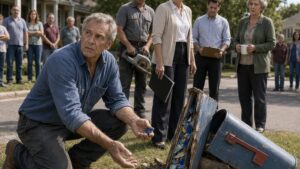
The following evening, the HOA clubhouse filled beyond its usual attendance. The dispute had spread through the subdivision in fragments: illegal deck, confused boundary, angry widower, dishonest contractor. No version contained everyone’s responsibility.
The architectural-review chair sat at the front table with printed copies of Brandon’s approval email. Karen attended as a municipal representative but made clear she would discuss only code status, not private liability.
Steven took a chair near the aisle. Brandon sat across from him with Heather.
The chair began by explaining that the committee approved exterior appearance, dimensions and materials based on the homeowner’s submission.
Brandon interrupted.
“You approved the deck.”
“We approved it conditionally.”
“The word approved was at the top of the email.”
“And the conditions were directly below it.”
“You knew homeowners would read the first line as authorization.”
The chair’s mouth tightened. “The committee cannot obtain permits for residents.”
“No, but you can reject plans that don’t include a survey.”
“That requirement was not part of our checklist.”
“So you approved a structure without knowing whether it fit.”
A murmur moved through the room.
Steven watched Brandon closely. His anger was not entirely false. The HOA had issued a message designed to feel decisive while transferring every important responsibility elsewhere.
The chair folded her hands.
“Our wording could have been clearer.”
It was a small institutional admission, but it changed the room. Several homeowners began asking whether their own approvals were valid. The chair promised a revised process requiring survey documentation for structures near lot lines.
Then Brandon turned toward the contractor’s foreman, who had attended at the contractor’s request.
“You measured from the wrong marker.”
“We measured the marker you identified.”
“You told me it was correct.”
“We told you to verify ownership boundaries.”
Brandon produced his contract and read the clause assigning that responsibility to the homeowner. His voice rose as he read, as though the unfairness lay in the fact that the clause existed.
Heather touched his arm.
He pulled away.
Karen summarized the municipal findings: no permit had been issued; the application had been rejected as incomplete; certified survey results now confirmed encroachment and setback violations.
“The owner must submit a compliant correction plan,” she said. “Enforcement costs and restoration of private property are separate matters.”
Brandon stood.
“What about Steven’s role?”
Steven felt the room turn.
Brandon held up a photocopy.
“He knew the marker was displaced. He wrote it down years ago. He didn’t tell me until the inspector was already here.”
The notebook page passed down the table.
The chair read the entry aloud.
Rear marker by fig leaning approximately three inches after freeze. Verify before fence or permanent work.
Whispers followed.
Steven could feel the story rearranging itself around him. Not enough to make Brandon right, but enough to make Steven less simple.
The chair looked at him. “Mr. Hall, is this your writing?”
“Yes.”
“Why did you not provide this information before construction?”
“I told Brandon the line needed verification.”
“That isn’t the question,” Brandon said.
Steven looked across the room at Heather.
She had promised nothing on the porch.
Her face had gone pale.
Brandon continued. “He watched the crew lay it out from that marker, knowing it might be wrong.”
“I objected before they drilled.”
“You never said why.”
Steven’s instinct was to defend himself point by point. He could list the missing permit, the contractor’s duty, Brandon’s refusal to stop.
All true.
He looked at the photocopy instead.
“I should have told him about the entry,” Steven said.
The room quieted.
Brandon seemed startled by the admission.
Steven continued. “That does not make the deck permitted. It does not move the certified line. But I knew there was uncertainty, and I did not explain it.”
The chair nodded slowly.
Before Brandon could use the moment, Heather spoke.
“He knew the permit wasn’t issued.”
Brandon turned toward her.
She kept her hands flat on the table.
“You told the contractor to start because you wanted the frame finished before the city could object.”
“That is not what I said.”
“You said, ‘Finish before anyone can stop it.’”
The same sentence, stripped of its force, sat between them.
Heather’s voice shook but did not break.
“I read the HOA email. We both knew approval was conditional.”
Brandon stared at her.
No document had forced the truth from her. No official had asked. She had simply reached the limit of helping him make fear look like certainty.
Karen opened her red folder.
“The city is issuing a formal correction notice,” she said.
She placed copies on the table before Steven and Brandon.
“Within seventy-two hours, the property owner must submit a removal or correction plan addressing the encroachment, setback violation and unsafe structural dependencies. Failure to submit a viable plan will trigger daily enforcement penalties.”
Brandon read the notice without sitting.
Steven looked at the deadline printed in bold.
Seventy-two hours.
For the first time, the question was no longer whether the deck had to change.
It was how much Steven would require Brandon to lose.
Chapter 6: Seventy-Two Hours to Choose What Justice Meant
Karen placed two demolition plans on the conference table.
The first showed complete removal of the deck frame, ledger and all support posts. The second preserved the section nearest Brandon’s house but removed the encroaching outer frame, replaced the support system and reduced the deck to a smaller compliant footprint.
“The full-removal plan is simpler from an enforcement standpoint,” she said. “The partial correction is cheaper, but structurally more complicated.”
Brandon sat across from Steven with his contractor’s estimate folded beside him. Heather occupied the chair at his right, though there was a visible space between them.
Steven opened the first plan.
Complete removal would eliminate every beam that had crossed the garden. It would also require heavy equipment near the fig tree and removal of footings that did not encroach but were tied into the frame.
“What happens to the roots?” he asked.
Karen pointed to the excavation area. “There is risk under either plan. More under full removal.”
Brandon leaned forward. “Then the partial plan makes sense.”
“It requires access through Mr. Hall’s property,” Karen said. “Temporary protective mats, equipment passage and permission to work beside the garden.”
Steven studied the second drawing. The corrected deck would end well inside Brandon’s legal setback. The outer posts on Steven’s land would be removed by hand. The damaged bed would be rebuilt, soil replaced and the fig tree evaluated by an arborist.
Brandon tapped the cost estimate.
“This is already more than we can manage.”
Steven looked up. “You started before the permit.”
“And you knew the marker was wrong.”
Heather closed her eyes briefly.
Karen said, “We are not revisiting facts already established.”
Brandon sat back, but resentment remained visible in the set of his shoulders.
Steven had brought his maintenance notebook. It lay inside his document folder with Patricia’s gardening binder.
Brandon’s attorney had submitted the copied notebook entry that morning, arguing that Steven’s failure to disclose the shifted marker contributed to the contractor’s reliance on the site conditions. It might reduce some private damages. It could not legalize the deck.
Steven removed the original notebook and placed it on the table.
“This is the complete entry,” he said.
Brandon looked at it suspiciously.
Karen read the page, including Patricia’s line beneath Steven’s note.
Ask about path when we redo the bed.
Steven turned several pages. There were sketches of the garden, irrigation repairs and dates when Patricia and the former neighbor replaced stepping stones along the shared curve.
“I knew the marker might be unreliable,” he said. “I should have ordered a survey years ago. I should have told Brandon the full history the first morning.”
Brandon’s expression shifted, not toward gratitude but uncertainty. Steven had taken away the accusation before it could be used as leverage.
“But,” Steven continued, “I told him to stop. The contractor knew there was no certified survey. The HOA approval required one. The city had issued no permit.”
Karen nodded once.
Steven opened Patricia’s binder.
Pressed between two pages was a dried fig leaf, brown and nearly transparent. He had forgotten it was there. Patricia had written notes around it in blue ink, listing who received fruit each summer: the former neighbors, the mail carrier, a teacher down the street.
At the bottom she had added one sentence.
Grow enough to keep the tree healthy, and enough to give away.
Steven looked at the words longer than the room required.
For four years he had cared for the garden as if maintenance were the same as fidelity. He had replaced boards in the raised beds with matching wood. He had replanted tomatoes in Patricia’s preferred rows. When branches spread toward the neighboring yard, he trimmed them back before anyone asked.
He had kept the garden alive.
He had also kept it from changing.
“The full-removal plan would damage more of the tree,” Steven said.
Brandon glanced at Karen, then back at Steven.
“I will allow temporary access for the partial correction.”
Heather released a breath.
Brandon reached for the plan.
Steven placed his hand over it.
“Under conditions.”
Brandon’s jaw tightened. “Of course.”
“You accept full responsibility for restoring the bed, soil, irrigation and tree damage. The work follows the city plan. No changes without written approval. An arborist supervises excavation near the roots.”
“That adds cost.”
“Yes.”
“And you admit your failure to disclose the marker contributed.”
“I have admitted it.”
“In writing.”
“I will sign a factual statement. I will not accept responsibility for your decision to build without a permit.”
Brandon looked at Heather. She did not rescue him.
Karen slid a restoration agreement across the table. “The city cannot impose private restoration terms beyond code authority, but both parties may sign this as an access condition.”
Brandon read each page. His finger paused over the estimate.
“If I don’t sign?”
Steven answered before Karen could.
“Then I do not grant access. The full-removal plan proceeds from your side where possible, and any court-ordered access will take longer and cost more.”
Brandon stared at him.
There was no triumph in Steven’s voice. That seemed to make the boundary firmer.
“You’re making me pay for everything.”
“I am making you repair what crossed the line.”
“The contractor has liability.”
“Pursue it.”
“The HOA admitted fault.”
“Pursue that too.”
“You get to walk away after admitting you withheld information.”
Steven looked at the notebook.
“No,” he said. “I get to live next door after this.”
The answer quieted Brandon more effectively than an accusation.
Karen left them ten minutes to review the agreement. Steven carried Patricia’s binder outside to the municipal courtyard. A single ornamental tree grew beside the parking lot, surrounded by concrete.
Heather followed him.
“You could have required the whole thing to come down,” she said.
“I still require the illegal part removed.”
“That isn’t what I meant.”
Steven touched the edge of the pressed fig leaf through the plastic sleeve.
“Patricia shared the path,” he said. “She would not have shared a deck over her garden. But she would have understood the difference between protecting something and destroying more than necessary.”
Heather looked toward the conference-room window. Brandon sat alone at the table, reading the agreement.
“He thinks backing down means everyone was right about him,” she said.
“Who is everyone?”
“People he grew up with. People at work. Himself.”
Steven closed the binder.
“That doesn’t move a property line.”
“No.”
“But it explains why he kept pushing after the line should have stopped him.”
Heather nodded.
When they returned, Brandon had signed the restoration agreement.
His signature pressed so hard into the paper that the final letters tore the fibers.
Karen reviewed the conditions and added the city’s correction deadline. Work would begin within five business days. Daily penalties would remain suspended as long as the approved plan was followed.
Steven signed the temporary-access consent.
Brandon looked at him across the table.
“Don’t mistake this for me agreeing with how you handled it.”
“I don’t.”
“And don’t expect us to become friends.”
“I don’t.”
Heather almost smiled, but neither man did.
That afternoon, the contractor’s crew arrived to install protective fencing around the fig tree and mark the removal zone. Steven supervised the mats laid across his grass. He checked each edge before allowing equipment through.
Brandon stood beneath the frame holding the signed plan.
At the first encroaching post, the foreman marked a red line where the beam would be cut.
The saw had not yet started when Brandon approached Steven.
“I signed your restoration terms,” he said.
“Our restoration terms.”
Brandon looked toward the fig tree, then at the smaller legal footprint drawn in spray paint inside his yard.
“You think leaving part of it standing makes this mercy?”
Steven considered the word.
“No,” he said. “I think it makes it accurate.”
The foreman called for clearance.
Steven stepped back behind the protective barrier. Brandon did the same.
The saw started, and the first cut entered the beam that crossed the line.
Chapter 7: The New Boundary Left Room for Something Living
The first deck beam came down hard enough to shake soil loose from the fig tree’s roots.
It struck the protective mat beside Steven’s raised bed, bounced once and settled with its cut end facing the survey line. The workers paused to check the tree. Steven did too.
The trunk had not moved.
Brandon stood on the remaining frame with a pry bar in one hand. He had spent the morning beside the demolition crew instead of watching from his patio. His work shirt was dark across the back, and sawdust clung to his forearms.
The contractor had offered to send more labor, but Brandon had refused the added cost. He had sold a riding mower, a set of unused woodworking tools and the large television from the basement to cover the first restoration payment. The rest would come in installments.
None of that changed the agreement.
It changed the way he carried it.
“Clear below,” the foreman called.
Brandon levered another joist loose. Its nails complained against the wood before releasing. The worker below guided the board away from the fig canopy.
Steven watched every movement near the tree but no longer stood with his arms folded. He held the correction plan and checked each removed piece against the red markings.
The outer frame disappeared first. Then the railing posts. Then the section that had hung above Patricia’s garden bed.
As open sky returned between the houses, the structure looked less like a deck being destroyed than a mistake being reduced to its actual size.
Karen arrived near noon for the required inspection. She checked the temporary bracing, photographed the exposed ledger and confirmed that no load would remain on the encroaching supports.
“The next post comes out by hand,” she said. “No machine excavation inside the root zone.”
The contractor nodded.
The final illegal post stood near the place where the first auger hole had opened. Concrete held it deep in the soil. Digging around it revealed a pale fig root curving within inches of the footing.
Brandon climbed down from the frame.
“I’ll do it,” he said.
The foreman looked at Karen.
“As long as he follows the arborist’s instructions,” she said.
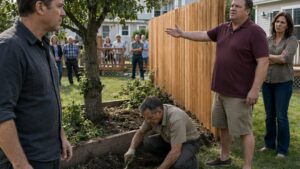
Brandon knelt in the dirt with a narrow shovel and hand trowel. He worked slowly around the concrete, exposing the footing without cutting the root. Sweat ran from his temple and left a dark drop on the soil.
Steven expected impatience to take over.
It did not.
When the footing finally loosened, Brandon tied a lifting strap around it. Two workers pulled while he guided the concrete away from the root. The post rose inch by inch, shedding dirt from its base.
At last it came free.
The hole it left was deeper than Steven had imagined.
Brandon stood over it, breathing heavily.
“That’s the last one across the line,” Karen said.
No one applauded. The foreman checked the plan. The arborist examined the exposed root and approved the backfill mixture. Karen signed the removal stage of the correction order.
It was enough.
Over the following days, the side yard became a place of work rather than argument.
The damaged irrigation line was replaced. Fresh soil filled the crushed corner of the bed. A carpenter rebuilt the edging to match the older boards, though Steven asked him not to stain the new wood.
“It should look repaired,” he said. “Not pretend it never happened.”
The carpenter glanced at him, then left the pale boards as they were.
Heather brought their daughter over on the Saturday they replanted the bed. The child carried a small hand shovel and a tray of tomato seedlings. She stopped beneath the fig tree and looked up.
“Is this the tree Dad broke?”
Heather’s face tightened.
“A branch was broken during the work,” she said.
Steven crouched beside the child. “The tree is still here.”
“Did it hurt?”
“Probably.”
“Will it be okay?”
Steven looked at the clean scar where the branch had been removed.
“It will grow differently,” he said. “That isn’t the same as not being okay.”
The child considered this, then pressed her shovel into the restored soil.
Heather worked beside her without trying to fill the silence. They planted tomatoes in a row that did not match Patricia’s old spacing. Steven noticed immediately.
He almost corrected them.
Instead, he moved the next seedling a few inches farther apart and let the new row establish its own order.
On the porch, the fig cutting had developed a dense cluster of roots. Steven carried it outside in the glass jar.
Heather wiped soil from her hands. “You’re planting that too?”
“Near the corrected line.”
Brandon had been rebuilding the smaller deck frame inside his legal setback. He set down his drill and came over when Steven began digging.
The new location was several feet from the parent tree, close enough to remain in the same shelter but far enough to grow independently.
Steven widened the hole.
Brandon watched him lower the cutting into the ground.
“You think that little thing will survive?”
“If the roots take.”
“That sounds uncertain.”
“It is.”
Brandon gave a brief nod, as though uncertainty had become something he could finally hear without treating it as a challenge.
He helped backfill the hole. Neither man mentioned Patricia, the permit or the meeting.
When they finished, the young cutting leaned slightly toward Brandon’s yard. Steven placed a temporary stake beside it and tied the stem loosely enough to move with the wind.
The restored garden passed its final inspection the next week. Karen confirmed the deck’s revised footprint, safe supports and municipal permit. The HOA adopted a new rule requiring certified site plans for structures within ten feet of a property boundary.
The contractor and Brandon continued disputing costs through their insurers. Steven received the restoration payments required by the agreement. They did not make him feel victorious. They paid for soil, lumber, arborist visits and the irrigation repair—nothing more, nothing less.
By early fall, the smaller deck had railings and a modest set of steps. It no longer towered over Steven’s garden. From his kitchen, he could see only the top of the railing beyond the hedge.
One evening, Brandon came to the boundary carrying a steel tape measure.
Steven looked at it, then at him.
“What now?”
Brandon stopped on his side of the survey marker. “I want to add a narrow planter along the deck. Heather said I should ask before I buy anything.”
“That would be new.”
Brandon accepted the remark.
“I measured from the certified line. Still want you to check it.”
Steven took the end of the tape. Together they extended it from the marked boundary to the proposed planter location.
The distance exceeded the required setback.
“It fits,” Steven said.
Brandon did not pull the tape away.
“Would a larger deck always have been a problem?”
Steven knew what he was really asking. Whether the conflict had begun with the size of the structure or with the fact that Brandon had built it. Whether there had ever been a version of the plan Steven might have accepted.
“Over the garden?” Steven said. “Yes.”
“What about here?”
He pointed to the smaller frame, now contained within his own yard.
“No.”
Brandon looked toward the fig tree. “I thought you objected because you didn’t want anything to change.”
“I did object for that reason too.”
Brandon seemed surprised.
Steven reeled in a foot of tape.
“My wife planted most of this. After she died, I kept it the way she left it.”
“That makes sense.”
“It made sense for a while.”
The fig leaves moved above them, broad and green. New growth had filled some of the space left by the broken branch, though the shape of the tree would never be exactly the same.
Brandon rubbed a thumb over the tape casing.
“I thought if the house looked finished, buying it would stop feeling like a mistake.”
“Did it?”
“No.”
The answer came without defense.
Steven looked at the Carter house, the smaller deck and the planter line marked in chalk.
“Maybe houses aren’t supposed to prove that much.”
Brandon gave a tired half smile. “You could have told me that before I spent the money.”
“You would not have listened.”
“No.”
The honesty sat more easily between them than politeness ever had.
Winter stripped the fig tree bare. The new cutting disappeared beneath a small protective wrap. Steven worried through the cold months that it had failed, but in March a green point appeared near the top of the stem.
By April, two leaves had opened.
Steven carried the steel tape into the yard one Saturday morning. Brandon’s new planter materials were stacked beside the smaller deck, still untouched.
Steven located the certified boundary marker and measured the required setback himself. He pressed a wooden stake into Brandon’s soil at the legal edge, then placed a second one where the planter could safely begin.
Brandon came outside and stopped at the deck steps.
“You already checked it?”
“I marked it.”
Brandon walked over and examined the measurements.
The stakes stood well clear of Steven’s garden. Between them and the boundary, there was enough space for maintenance, drainage and someone to pass without touching the fig tree.
Brandon picked up one of the planter boards.
“Coffee when I’m done?”
Steven looked toward his porch.
“I have some.”
It was not friendship. Not yet, perhaps not ever. The restoration agreement remained in Steven’s filing cabinet. Brandon still disputed part of the contractor’s bill. Heather still spoke more carefully when both men were present.
But the boundary no longer carried every word they had failed to say.
Steven returned the tape measure to his pocket and walked to the new fig cutting. Its leaves had opened above the clear survey line, small enough for sunlight to pass through.
Behind it, Brandon began assembling the planter inside the marked setback.
The garden was no longer exactly as Patricia had left it.
It was alive.
The story has ended.