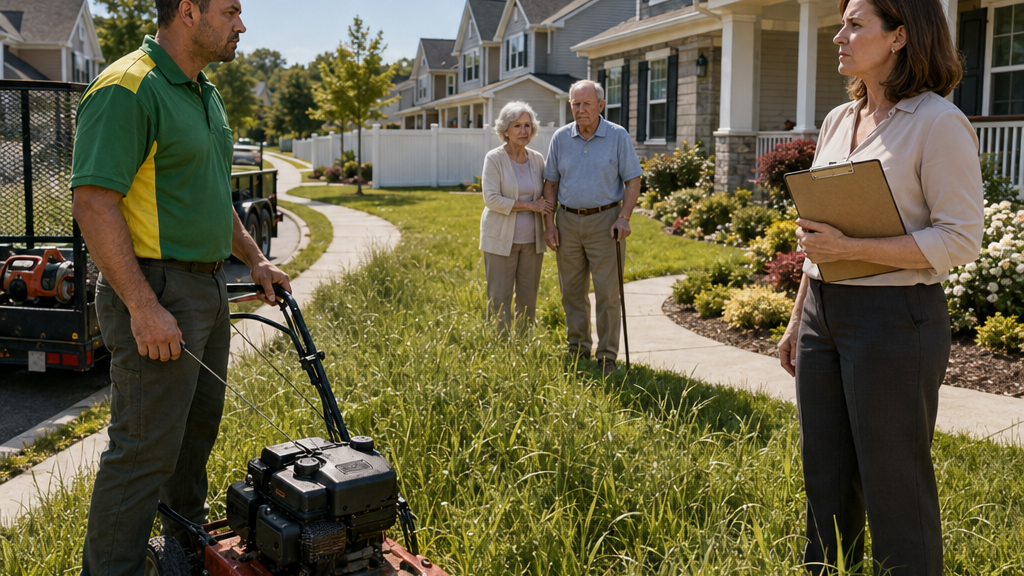
The HOA Kept Fining an Elderly Couple’s Lawn Until Their Landscaper Asked What the Money Was Really For
Chapter 1: The Morning Steven Pulled the Starter Cord
“The yard is still out of compliance.”
Steven Martinez had one boot on the trailer ramp and one hand around the mower handle when the woman said it.
He looked past her clipboard toward the house.
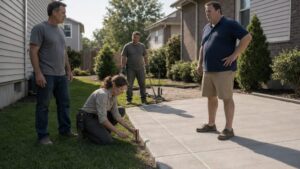
The lawn was bad, but not abandoned. The grass had grown six or seven inches in uneven patches, taller around the mailbox and flower beds, thinner beneath the oak near the driveway. A narrow strip beside the front walk looked as if someone had tried to cut it recently and stopped after ten feet.
The woman stood between Steven and the yard as if that strip were evidence.
“I can see that,” Steven said.
Karen Wilson glanced at the mower. “Then you understand why I’m here.”
Steven had been called that morning by a neighbor who said an older couple needed help. He had expected a simple cleanup before his regular route. Forty minutes, maybe an hour if the edging was bad.
He had not expected an HOA compliance chair waiting at the curb.
The front door opened.
Mary Hill stepped out first. She was small, silver-haired, wearing a pale cardigan despite the heat. Behind her came Thomas, moving slowly with one hand on the doorframe and the other gripping a cane.
Steven’s irritation shifted.
Thomas paused at the threshold before attempting the step down. His left hand trembled hard enough that the cane tip ticked twice against the concrete.
Mary reached for his elbow.
“I’ve got it,” Thomas murmured.
She let go immediately.
Steven noticed that.
Karen turned slightly. “Mr. and Mrs. Hill, I was explaining that the property remains in violation.”
Mary’s mouth tightened. “He came to mow it.”
“That doesn’t change the existing account.”
Steven looked at Karen. “If the violation is the grass, cutting the grass seems like it changes something.”
“It changes the current condition.” She tapped the clipboard with one finger. “It doesn’t erase notices already issued.”
Thomas reached the walkway. Each step seemed to require a decision.
Steven had seen that kind of effort before.
His father had moved that way near the end—slow enough that Steven had started reaching for things before the old man asked. Chairs. Doors. Grocery bags. A jacket sleeve. Every time, his father’s jaw had tightened a little more.
Steven pushed the memory away.
“How long’s it been like this?” he asked Mary.
“Not that long.”
Thomas gave her a look.
Mary lowered her eyes. “Long enough.”
Karen shifted the clipboard against her hip. “The first notice was sent more than two months ago.”
Steven looked at Thomas.
Thomas’s expression changed before he spoke. Not surprise. Embarrassment.
“I used to do it myself.”
“No shame in getting behind,” Steven said.
“I didn’t say there was.”
The correction was quiet, but it landed.
Steven nodded once. “Fair enough.”
Karen continued. “There were multiple notices. The association has standards, and those standards have to apply equally.”
Mary twisted her fingers together.
Steven watched her do it twice before she spoke.
“We know about the standards.”
“Then you understand the fines.”
“We understand the letters.”
“That’s not quite the same thing.”
Mary’s face flushed.
Steven straightened. “What’s that supposed to mean?”
Karen looked at him. “It means this is association business.”
“And I’m cutting their grass.”
“If they’ve hired you, that’s between you and them. But I’m asking you not to interfere while I explain where the account stands.”
Mary’s fingers stopped moving.
“We didn’t hire him,” she said.
Karen glanced toward Steven.
He felt the trap before anyone said another word. To Karen, he had just become an outsider with equipment and an opinion. To Steven, the difference seemed meaningless.
“I’m doing it as a favor.”
Karen’s expression hardened by a degree. “That creates its own issue.”
“What issue?”
“Vendor authorization. Liability. If you damage irrigation, hardscape, common-area edging—”
“It’s a front lawn.”
“It is property governed by association covenants.”
Steven gave a short laugh.
Mary flinched at the sound.
He regretted it immediately.
Karen noticed.
“This is exactly why we have procedures,” she said.
Thomas tried to speak. The first sound caught in his throat. He waited, swallowed, and tried again.
“The sprinkler heads are marked.”
Karen turned toward him.
Thomas pointed with the cane, his hand shaking. “Blue flags. Along the edge.”
Steven saw them then: three faded survey-style flags tucked low in the grass.
“I put them there,” Thomas said. “So nobody hits them.”
The statement carried more pride than the subject deserved, which meant the pride was not about sprinkler heads.
Steven understood that too.
He stepped off the trailer ramp.
“All right,” he said. “I’ll watch for them.”
Karen lifted the clipboard. “Mr. Martinez—”
Mary suddenly said, “We had to choose.”
Everybody stopped.
Steven looked at her.
She was staring at the driveway now, not at him.
“Choose what?” he asked.
Mary took a breath.
“His refill was due last week.”
Thomas’s face changed.
“Mary.”
She kept going.
“The fines came again. Then another fee. We paid part of it because we thought if we showed we were trying…” Her voice thinned. “We pushed the refill three days.”
Thomas looked away.
Steven felt something cold move through his chest.
“You delayed medication to pay lawn fines?”
“It wasn’t exactly—”
“Yes,” Mary said.
Thomas shut his eyes.
Karen’s posture shifted. For the first time, she lowered the clipboard.
“Mrs. Hill, medical expenses aren’t something the board—”
“I know what the board handles.”
Mary’s voice was not loud. That made it sharper.
“I’m telling you why the grass is long.”
Silence settled over the front yard.
Somewhere two houses down, a sprinkler clicked in a steady circle.
Steven looked at the mower.
Then at Mary.
Then at Thomas.
His anger had found a target already. Karen with her clipboard. The board. The notices. Every person who could look at an old man struggling down three porch steps and still talk first about standards.
That certainty felt clean.
Too clean.
He ignored the thought.
“Mrs. Hill,” he said, “do you want me to cut your lawn?”
Karen opened her mouth.
Steven held up one hand without looking at her.
Mary stared at him.
“Yes.”
“Thomas?”
Thomas lifted his eyes.
For a moment Steven thought he might refuse from pride alone.
Then Thomas nodded.
“Just don’t scalp it.”
Steven smiled despite himself. “Wouldn’t dare.”
He walked to the mower.
Karen said, “Mr. Martinez, I need you to understand that mowing today will not stop the existing collection process.”
Steven wrapped his fingers around the starter cord.
“All I understand right now is they asked me to mow.”
“That isn’t what I said.”
He looked back at Mary.
She nodded once.
Steven pulled.
The engine coughed, failed, then caught on the second pull with a hard mechanical roar.
Karen stepped back.
Steven lowered the deck and made the first pass from the sidewalk toward the porch.
The grass folded beneath the blades in a dark, uneven stripe.
Halfway up, he glanced to his left.
Thomas was watching closely.
Steven adjusted two inches to avoid the first blue sprinkler flag.
At the end of the pass, Thomas gave the smallest nod.
Steven turned the mower.
For the next forty minutes, nobody argued.
The lawn changed one stripe at a time. Tall grass became clean lines. The edges around the walkway sharpened. Clippings disappeared into the bag. What had looked neglected began to resemble every other front yard on the street.
That should have felt like winning.
It did, for about five minutes.
When Steven shut the mower down, the sudden quiet seemed louder than the engine had been.
Mary walked across the freshly cut grass carefully, almost apologetically.
“It looks beautiful.”
Thomas stood near the porch.
“Second pass by the oak’s a little crooked,” he said.
Steven looked.
It was.
“Don’t tell anybody.”
Thomas’s mouth twitched.
Then Karen stepped forward again.
She had stayed.
Steven had almost forgotten she was there.
Karen looked over the yard, then made a notation on her clipboard.
“The physical violation can be documented as corrected today.”
“Good,” Steven said. “Then we’re done.”
“No.”
The word was calm.
Steven felt his jaw tighten.
Karen looked at Mary, not him.
“The lawn condition is corrected. The account is not.”
Mary’s relief disappeared.
“What does that mean?” Steven asked.
Karen closed the clipboard.
“It means this stopped being only about lawn fines some time ago.”
Chapter 2: The Lawn Was Fixed but the Debt Wasn’t
Mary laid the letter on the kitchen table with both hands.
Steven saw the word before he sat down.
LIEN.
It appeared in the middle of a paragraph dense with smaller type, but it was the only word his eyes caught.
“What is this?”
Mary remained standing.
Thomas was seated at the far end of the table with his cane leaning against his chair. Through the window behind him, Steven could see the front lawn he had finished two hours earlier.
The stripes were almost embarrassingly neat.
Outside, the problem looked solved.
Inside, Mary had spread six months of envelopes across the table.
“Karen said you wanted to understand the account,” she said.
“I want to understand how grass turns into that.”
He tapped the letter.
Thomas looked irritated. “Don’t hit it. It doesn’t improve with force.”
Steven pulled his hand back.
“Sorry.”
Mary sat across from him and began arranging the papers by date.
Steven hated paperwork.
He could price a cleanup from the curb, diagnose a belt problem by sound, and remember which customer had a buried dog fence running too close to the east hedge. But put five letters in front of him with account numbers and fee codes, and his patience shortened fast.
He forced himself to slow down.
The first notice was simple.
Overgrown turf.
No fine.
The second showed a deadline.
The third included fifty dollars.
Then another fifty.
Then seventy-five.
Then came something labeled an administrative processing charge.
Then certified-mail costs.
Then another processing charge.
Then a collection referral fee.
Steven frowned.
“Wait.”
He put one finger on the first fine and another on the most recent balance.
“This started at fifty?”
Mary nodded.
“And now it’s…”
She told him the number.
Steven sat back.
Thomas looked toward the window.
“How much of this is actually the lawn?”
Mary had made a pencil mark beside several items.
“The original fines? Two hundred and twenty-five.”
Steven scanned the final balance again.
The added charges were several times that.
“So most of what you owe isn’t because the grass was long.”
Thomas said, “Depends who you ask.”
Steven looked at him.
Thomas’s right hand rested flat on the tabletop, trembling lightly against the wood.
Mary pushed another page toward Steven.
“This one came after I paid one of the fines.”
He read it.
The payment had reduced the balance, but another fee had appeared a week later.
“What did you think was happening?”
“I thought we were catching up.”
“You weren’t.”
“I know that now.”
Steven looked from Mary to Thomas.
“Why didn’t somebody call the management office?”
Mary’s silence answered first.
Then Thomas said, “They called us plenty.”
“That’s not what I asked.”
Thomas’s eyes hardened.
Steven recognized the look. Pride again. The same kind his father had worn when Steven asked whether he needed help with the stairs.
He should have stopped.
Instead he pressed.
“You had notices for months. Why let it get this far?”
Mary inhaled sharply.
Thomas lifted his chin.
“Because I thought I could still mow my own damn yard.”
The room went still.
Steven looked down at the papers.
Thomas continued, slower now.
“The first notice came after I missed two weeks. I figured I’d do it Saturday. Saturday came and my legs didn’t cooperate. Next week I got halfway through.”
Steven remembered the narrow strip beside the walk.
Thomas saw recognition on his face.
“That was me.”
Mary reached toward him, then stopped.
Thomas stared at the table.
“I’ve taken care of that place for twenty-three years. I didn’t need a committee telling me the grass was long. I knew it was long.”
His voice weakened on the last sentence, but he forced it out.
“I kept thinking next week would be better.”
Steven’s anger changed shape.
Not smaller.
Less simple.
He had been imagining the Hills as people trapped by a machine they could not understand.
But Thomas had understood enough.
He had simply believed he could catch up before anyone saw how much had changed.
Steven knew something about that kind of denial too.
His father had once spent forty minutes trying to button one cuff rather than ask for help.
Steven had finally taken the shirt from him and done it himself.
His father had not spoken to him for the rest of the morning.
At the time, Steven had thought the old man was being stubborn.
Years later, he understood he had taken over too quickly.
Mary tapped one of the later letters.
“This is when I started hiding them.”
Thomas turned.
“What?”
Mary froze.
Steven looked between them.
Thomas’s voice became clearer.
“What do you mean, hiding them?”
Mary pressed her lips together.
“Not all of them.”
“Mary.”
“I knew you were already worried about the medication.”
“What letters?”
She pulled two envelopes from beneath the stack.
Thomas stared at them.
His hand shook harder.
“You told me the account was under review.”
“I was trying to get it under review.”
“That isn’t the same thing.”
“I know.”
Steven wanted to disappear.
Instead, he remained still.
Mary looked at him, not Thomas.
“We had enough for the prescription or enough to send another payment that week. Not both.”
Thomas shut his eyes.
“You should’ve told me.”
“And then what?”
“We would’ve decided together.”
“You would’ve skipped the medication.”
“You don’t know that.”
“I do.”
The anger between them was quiet and practiced, the kind that came from years of knowing exactly where the other person would hurt.
Steven looked toward the lawn again.
Dark green lines ran perfectly from curb to porch.
He had felt proud of them earlier.
Now they looked almost absurd.
A clean yard hiding a kitchen table full of debt.
He turned back to the letters.
“Okay.”
Neither Hill responded.
Steven gathered the pages into date order.
“Forget blame for a minute.”
Thomas gave him a dry look.
“Easy for the landscaper.”
Steven accepted that.
“Fair.”
He pointed to the charges.
“What I want to know is which of these had to happen and which happened because nobody stopped the process.”
Mary looked at him.
“Karen said the account had already moved to collections.”
“That doesn’t answer how.”
He found another page.
There was a notation about compliance inspections.
Another fee.
Another photograph.
Another date.
“Did anyone ever tell them why you fell behind?”
Mary’s eyes shifted.
Thomas noticed.
“What?”
Mary did not answer immediately.
Steven waited.
Finally she stood, walked to a drawer beside the refrigerator, and pulled out a folded sheet of paper.
It had been creased into thirds and opened so many times that the folds had gone soft.
“I wrote to them.”
Steven took it.
The letter was dated almost three months earlier.
Mary had explained Thomas’s declining mobility. She had asked for additional time to arrange lawn service. She had not asked to erase the violation or waive all responsibility.
Only time.
At the bottom was a handwritten note.
Mailed and emailed.
Steven looked up.
“You sent this?”
“Yes.”
“To who?”
“The management company. And I copied the compliance address.”
“What did they say?”
Mary looked toward Thomas.
Thomas was still staring at the two letters she had hidden.
“They never answered the request,” she said. “Not really.”
Steven read the date again.
It had been sent before several of the largest charges appeared.
He laid the letter flat beside the lien notice.
The lawn had not created the whole debt.
Something had happened after Mary asked for help.
Or nothing had happened when something should have.
Steven tapped the old letter once.
“This,” he said, “is where we start.”
Chapter 3: The Letter Nobody Put Before the Board
Sarah Lee did not make Steven wait for the bad news.
“Yes,” she said. “We received Mrs. Hill’s letter.”
Steven stopped halfway into the chair across from her desk.
“You received it?”
Sarah turned her monitor slightly, enough for him to see a line in the account history without giving him a full view.
“March eighteenth. Email attachment logged at 9:14 a.m.”
Steven sat.
Two days had passed since he mowed the Hills’ lawn. Mary had called the management office first and told them Steven was helping her understand the account. That was the only reason Sarah had agreed to meet with him at all.
Even then, she had warned him on the phone that she could discuss process, not confidential account details.
Steven had expected evasion.
Instead, Sarah had confirmed the one thing he thought would be hardest to prove in less than thirty seconds.
“So why didn’t anybody answer it?”
“That depends what you mean by answer.”
“I mean a person reads it, sees an elderly homeowner asking for time because her husband can barely manage the yard, and does something besides add another fee.”
Sarah’s expression did not change.
Steven heard himself and knew he had started too hot.
Again.
He leaned back.
“Sorry. Start over.”
Sarah folded her hands.
“The email was received. It was categorized as homeowner correspondence and attached to the property record.”
“Why wasn’t it treated as a hardship request?”
“We don’t have a dedicated hardship category in the compliance workflow.”
Steven stared at her.
“That sounds like a problem.”
“It may be.”
“May?”
“It depends what the governing documents require and what authority management has without board direction.”
Steven looked around the office.
Framed subdivision maps hung on one wall. A printer hummed behind a partition. Everything was clean, quiet, and orderly.
It bothered him more than Karen’s clipboard had.
“You’re telling me her letter arrived, got saved, and then everybody just kept going?”
“I’m telling you the system did.”
“That’s worse.”
Sarah gave him a tired look.
“No. It’s more complicated.”
She pulled a blank sheet of paper toward her and drew a short sequence of boxes.
“Management sends courtesy notice. Then formal notice. Then fine if authorized. Continued noncompliance generates inspection follow-ups. If the account remains unpaid past a threshold, it moves into collection handling.”
“And every box costs money?”
“Some actions do.”
“Who clicks the button?”
“Sometimes staff. Sometimes the system generates the next task automatically. Some charges are vendor costs. Some are collection costs.”
“Karen?”
Sarah paused.
“Ms. Wilson does not personally generate most of those charges.”
Steven said nothing.
Sarah watched him.
“You thought she did.”
“I thought she was standing in their yard talking about collection like she owned the whole thing.”
“She chairs compliance. She reviews violations and recommendations. She does not sit here adding postage fees or attorney referral costs one by one.”
Steven looked at the sequence Sarah had drawn.
Something uncomfortable loosened in his certainty.
Karen could still be wrong.
But wrong was no longer the same as personally responsible for every number on the Hills’ account.
“When Mary’s letter came in,” he said, “did Karen see it?”
Sarah’s face closed slightly.
“That is an account-specific question.”
“You just told me the letter was logged.”
“Because Mrs. Hill authorized me to confirm receipt.”
“Then confirm where it went.”
“I can’t.”
Steven exhaled through his nose.
“So we know it existed. We know the process kept running. But I can’t know who saw it.”
“Not without broader written authorization from the homeowners.”
Steven stood halfway, then sat again.
His instinct was to walk out, call Karen, and demand an answer.
That instinct had already gotten him into one public argument based on half the facts.
He looked at Sarah’s paper.
“What can you tell me?”
She seemed to approve of the question.
“I can explain the general workflow.”
“For hardship?”
“We don’t have a formal hardship workflow.”
“There it is again.”
“Yes.”
Sarah leaned back.
“That doesn’t mean nobody can exercise judgment. It means the judgment isn’t standardized.”
Steven frowned.
“That sounds like exactly the kind of thing an HOA would want standardized.”
“You’d think.”
The dry edge in her voice surprised him.
Sarah glanced toward the closed office door.
“Informal exceptions create problems too.”
“What kind?”
“Homeowner A gets extra time. Homeowner B doesn’t. Then Homeowner B asks whether it was because A is friends with a board member. Somebody waives one fine but not another. Six months later, nobody remembers why.”
“So the answer is never make exceptions?”
“I didn’t say that.”
“What are you saying?”
“I’m saying fairness is harder than being nice once.”
Steven sat with that.
It annoyed him because it sounded reasonable.
Sarah slid the blank flowchart toward him.
“If the Hills want full account information shared with you, they can sign an authorization. Better yet, they can request their own ledger, compliance history, and correspondence record directly.”
“Can they ask for the board to review the hardship letter now?”
“Yes.”
“Could someone have asked then?”
Sarah hesitated.
“That would depend on who saw it and how they interpreted it.”
There it was.
A narrow opening.
Steven leaned forward.
“So it could have gone to the board.”
“It could have.”
“But it didn’t.”
“I did not say that.”
“You didn’t have to.”
Sarah’s mouth tightened, but she did not correct him.
He stood.
“Send Mary whatever form she needs.”
“I already did.”
Steven paused.
Sarah gave him the smallest smile.
“Mrs. Hill called before you arrived.”
That surprised him too.
Good.
Mary was moving without him.
He liked that more than he expected.
Outside, Steven sat in his truck for several minutes before starting the engine.
He had come prepared to prove Karen cruel.
Instead, he had learned the uglier possibility: there might be no single person to blame for most of what had happened.
A letter entered the system.
The system stored it.
The system kept moving.
Everybody touched one piece and nobody owned the whole result.
He drove back through the subdivision slowly.
The lawns were almost identical from house to house. Straight edges. Mulched beds. Trimmed shrubs. Decorative trees spaced with deliberate symmetry.
Steven found himself studying the mowing lines.
Every yard looked controlled.
He wondered how many messy things existed behind those clean fronts.
Near the Hills’ street, he stopped at a corner sign to let a pedestrian cross.
An older man walking a small dog raised one hand.
Then he recognized Steven’s trailer.
“You’re the guy who cut the Hill place.”
Steven lowered his window.
“That’s me.”
“Looks better.”
“Thomas would tell you one stripe’s crooked.”
The man smiled.
“He would.”
Then the smile faded.
“You mixed up in their HOA thing?”
Steven hesitated.
“Helping them sort out some paperwork.”
The man nodded slowly.
“Good luck with that.”
Something in his tone kept Steven from driving off.
“What does that mean?”
The man shifted the leash to his other hand.
“They stopped bending on anything after last year.”
“Bending?”
“Exceptions. Extensions. Whatever you want to call them.”
Steven thought of Sarah.
“Why?”
The man looked toward the clubhouse in the distance.
“One owner got extra time on a fence violation. Another didn’t. Turned out the first one knew a board member socially. Didn’t matter whether that actually influenced anything. People went crazy.”
“What happened?”
“Packed meeting. Accusations. Emails. Somebody demanded old records.”
“And after that?”
The man shrugged.
“Board decided the safest thing was to treat everybody exactly the same.”
Steven looked down the street.
The Hill lawn was visible from here, darker than the neighboring yards because of the fresh cut.
“Exactly the same,” he repeated.
“That was the idea.”
The dog tugged gently at the leash.
The man started to move on, then stopped.
“Karen took the worst of it.”
Steven looked at him.
“She was on the board then?”
“Compliance committee. People said she was playing favorites even though that fence decision wasn’t hers alone.”
The man gave a small, humorless laugh.
“After that, she got real strict.”
He walked away.
Steven remained at the stop sign long after the road was clear.
He had spent two days asking whether Karen was cruel enough to let an elderly couple sink over a lawn.
Now a different question had taken its place.
Had she become rigid because she had once seen discretion abused?
Or had that old fight simply given her a reason never to use judgment again?
Chapter 4: Why Karen Stopped Making Exceptions
Karen Wilson placed two photographs side by side on the clubhouse table.
“Tell me which homeowner deserves more time.”
Steven looked down.
The photographs showed two different houses, but the violations were nearly identical: grass grown high along the foundation, weeds pushing through decorative stone, edging lost beneath a soft green fringe.
He pointed to the left one. “I don’t know anything about either homeowner.”
“Exactly.”
Karen sat across from him with her clipboard closed beside her instead of held against her chest.
It was the first time Steven had seen her without using it like a shield.
“You saw Thomas struggling,” she said. “You saw Mary upset. That makes their situation immediate to you.”
“They are struggling.”
“I didn’t say they weren’t.”
“Then why are we looking at somebody else’s grass?”
“Because I have to.”
Steven leaned back.
They were alone except for the board secretary, who sat at the far end of the room organizing folders and making a deliberate effort not to listen.
Karen tapped the photograph on the right.
“This homeowner was recovering from surgery.”
Then the left.
“This one was working two jobs after a divorce.”
Steven looked again.
Same grass. Different stories.
“Both got extensions?”
Karen shook her head.
“Neither case happened while I was chair.”
“So what’s your point?”
“My point is that everybody has a reason.”
“That doesn’t mean every reason is the same.”
“No. But once the association starts deciding whose reason is sympathetic enough, you create a different problem.”
Steven thought of Sarah’s words.
Fairness is harder than being nice once.
Karen reached into a folder and removed another page.
“This was last year.”
The document was a copy of a violation photograph showing a fence with several unfinished boards.
“One homeowner received extra time before fines began. Informally. No written board vote.”
“Why?”
“A committee member knew he was waiting on a contractor.”
“Reasonable.”
“That’s what they thought.”
Karen placed a second page beside it.
“Another homeowner had a similar violation and didn’t get extra time. She found out about the first extension.”
Steven could already see where it was going.
“She accused you of favoritism.”
“She accused the board.”
“You?”
Karen’s jaw tightened.
“I was the person who had emailed both owners.”
There was no anger in the sentence. That made Steven pay attention.
“What happened?”
“Three meetings full of people asking who knew whom. Requests for correspondence. Accusations that we were enforcing against residents we didn’t like.”
“Were you?”
“No.”
The answer came quickly.
Then Karen added, “But once you’ve created a record that looks inconsistent, intent stops mattering very much.”
Steven looked through the clubhouse windows.
Outside, the landscaping beds were trimmed so evenly that even the mulch edges looked measured.
“After that, you stopped giving extensions.”
“We stopped giving undocumented ones.”
“But if somebody needed one?”
“They needed to ask for formal board review.”
Steven looked back at her.
“Mary did ask.”
Karen’s fingers moved toward the clipboard, then stopped.
“She sent correspondence.”
“She asked for time because her husband couldn’t mow.”
“That does not automatically make it a formal request.”
“You’re splitting hairs.”
“I’m distinguishing procedure.”
“Same thing when procedure is the problem.”
Karen’s eyes sharpened.
“And this is what you keep doing.”
“What?”
“Deciding you know the whole situation before you do.”
Steven said nothing.
That landed harder because Sarah had already shown him the same flaw from a different angle.
Karen opened the clipboard.
“Mrs. Hill’s account had late assessments unrelated to the grass issue.”
Steven frowned.
“What?”
“Small amount. Paid later.”
“That wasn’t on the paperwork she showed me.”
“I’m not discussing her full account with you. I’m telling you why management was already treating the file cautiously.”
“So now you’re saying this is their fault?”
“No.”
“You keep getting close.”
Karen closed the clipboard again.
“I’m saying files accumulate history. People accumulate history. Then somebody like you walks in on one morning and sees the worst-looking ten minutes.”
Steven felt heat rise into his face.
“You think watching Thomas barely make it down his front steps was only ten minutes?”
“No.”
For the first time, Karen’s voice softened.
“I think it was terrible.”
The answer unsettled him.
He had expected resistance.
Not that.
Karen looked at the two violation photographs again.
“You think I enjoyed standing there?”
“You didn’t exactly look conflicted.”
“I was trying not to make the situation more emotional.”
“It was already emotional.”
“That doesn’t mean I should have added to it.”
Steven studied her.
There it was again: the possibility that what he had read as coldness had partly been control.
Only partly.
He was not ready to give her more than that.
“So tell me something straight,” he said. “Did you know about Thomas’s condition before that morning?”
Karen hesitated.
“Yes.”
“How long?”
“I knew he was having mobility problems.”
“From where?”
She looked toward the folders.
“Mary’s message was attached to the compliance record.”
Steven sat forward.
“You saw it.”
Karen did not answer immediately.
The board secretary stopped shuffling papers.
Then resumed.
Steven’s voice dropped.
“You saw Mary’s hardship letter.”
“I saw a note indicating she was requesting additional time.”
“Before collections?”
“Yes.”
The word seemed to strip the room of sound.
Steven stared at her.
“So you knew.”
“I knew they were asking for more time.”
“And you let it keep going.”
Karen’s expression hardened again, but this time Steven could see strain underneath it.
“I did not have unilateral authority to suspend fines indefinitely.”
“Did you have authority to ask the board?”
She looked away.
That was the first answer.
Steven waited for the second.
Karen drew a breath.
“I could have brought it to the board.”
“Why didn’t you?”
“Because at that point the violation had already been open for weeks, and after what happened last year, any pause without a standard policy would have been challenged.”
“That’s not an answer.”
“It is the answer.”
“No. That explains why you were afraid.”
Karen’s eyes returned to him.
Steven held her gaze.
“What did you actually do?”
“I told management to continue according to the existing process unless the board received a formal request through the proper channel.”
“Mary thought she had made one.”
“She hadn’t.”
“Did you tell her that?”
Karen said nothing.
Steven felt the anger come back, but it was different now.
Less clean.
More useful.
“You knew they needed help,” he said. “You knew the system wasn’t built to handle the request she made. And instead of bringing it to somebody who could decide, you let the process keep running because you didn’t want another accusation.”
Karen’s mouth tightened.
“That is not how I would describe it.”
“But it’s what happened.”
“I was trying to avoid making an exception I had no authority to make.”
“You didn’t need to make it yourself.”
Silence.
Steven looked again at the two violation photographs.
He understood her fear now.
That bothered him because understanding made anger harder to carry.
But understanding did not erase responsibility.
“You thought the safest thing was treating everybody exactly the same,” he said.
Karen’s voice was quiet.
“Yes.”
“Even when they weren’t in the same situation.”
“That is the problem with rules.”
“No,” Steven said. “That’s the problem with pretending rules make the decision for you.”
Karen’s face changed.
Not defeated. Not convinced.
Tired.
“I believed pausing their case without a formal vote would put us right back where we were last year.”
Steven stood.
“Then you should’ve asked for the vote.”
Karen looked down at her closed clipboard.
For once, she had no procedural phrase ready.
Chapter 5: Mary Refused to Become Steven’s Cause
“You are not speaking for us at that meeting.”
Mary said it before Steven had finished unfolding his chair on the porch.
He stopped with both hands on the metal frame.
“I wasn’t planning to speak for you.”
“You were planning something.”
Thomas, seated near the railing, gave Steven a look that suggested denial would be useless.
Steven set the chair down.
On the coffee table beside Mary sat a yellow legal pad covered with his handwriting.
Dates.
Fees.
Questions.
A rough timeline.
He had spent most of the previous evening making it.
“I was planning to explain what happened.”
Mary folded her arms.
“To whom?”
“The board.”
“About whose account?”
Steven looked at her.
“Yours.”
“And whose hardship?”
He did not answer.
Mary’s expression softened just enough to make the next words sting more.
“You mean well.”
Steven almost laughed.
“That usually comes right before somebody tells you to leave.”
“I’m not asking you to leave.”
“Then what are you asking?”
“To stop turning this into a fight you need to win.”
Thomas lowered his eyes.
Steven felt exposed in a way Karen had never managed.
He looked toward the lawn.
Five days had passed since he cut it. New growth had begun softening the stripes. Along the sidewalk, the edge was no longer razor clean.
His first instinct was to stand up, get the trimmer from his truck, and fix it.
He remained seated.
Mary noticed.
“I know what you did for us,” she said.
“You don’t owe me anything.”
“That’s not what I’m saying.”
“I know.”
“Do you?”
Steven looked back at her.
Mary touched the yellow pad.
“These are good questions. Some of them are questions we should have asked months ago.”
Thomas muttered, “Some of us thought we could handle it.”
Mary glanced at him.
“And some of us thought hiding letters counted as handling it.”
Thomas gave her a look.
The tension between them was still there, but no longer secret.
Steven had learned not to interrupt it.
Mary returned her attention to him.
“You went to the management office. You talked to Karen. You found out things we didn’t know.”
“Exactly.”
“And now you’re angry.”
“Yes.”
“So am I.”
Steven waited.
Mary leaned forward.
“But I don’t want to walk into that meeting with everybody looking at us like we’re the poor old couple Steven Martinez rescued from the HOA.”
“I never said that.”
“You don’t have to.”
The words hit an old place in him.
His father in the bedroom, standing with one cuff undone.
Steven taking over.
His father staring at the floor.
He had called it helping then too.
Thomas shifted in his chair.
“I’m not looking for charity.”
Steven turned.
“I know.”
Thomas raised his eyebrows.
Steven corrected himself.
“I’m starting to.”
Thomas nodded.
“My lawn was too long.”
Mary looked at him.
“So?”
“So I knew it was too long. I got the notices. I ignored some of them because I was embarrassed and because I kept thinking I’d get better enough to handle it.”
His hand trembled against the armrest.
“I didn’t.”
Steven said nothing.
Thomas continued.
“That part belongs to me.”
Mary reached for his hand.
This time Thomas let her.
“The part that doesn’t belong to us,” he said, “is asking for time and having nobody tell us the right way to do it while fees keep stacking up.”
Steven looked at the legal pad.
“So what do you want?”
Mary’s face changed.
It was a small thing, but he saw it.
Until that moment, he had been asking what happened, who knew, who failed, what rule applied.
He had not asked that question.
Not really.
Mary unfolded her arms.
“We want the account reviewed from the date I sent that letter.”
Steven nodded.
“If there are fines before that date that we legitimately owed, we’ll deal with them.”
Thomas added, “And assessments.”
Mary looked at him.
“And assessments.”
Steven picked up the pen but stopped before writing.
“What about collection charges after the letter?”
“That’s what we want them to explain.”
“And if some are valid?”
Thomas looked directly at him.
“Then they’re valid.”
Steven frowned.
“You’re okay paying charges that came out of a bad process?”
“I didn’t say that.”
Thomas’s voice was weak but precise.
“I said I’m not going in there asking them to erase every dollar just because they handled part of it wrong.”
Steven sat back.
That was not the result he had imagined.
His version was cleaner.
Hardship letter found. HOA exposed. Charges wiped out.
A line drawn straight across the page.
Thomas seemed to read his disappointment.
“You want them to be completely wrong.”
Steven looked at him.
“It’d make things easier.”
“For you.”
There was no cruelty in it.
That made it harder.
Mary stood and went inside.
She returned carrying three unopened envelopes.
Thomas saw them and exhaled.
“More?”
“Older ones.”
Mary set them down.
“I hid these too.”
Steven looked from her to Thomas.
Mary’s fingers tightened around the envelope edges.
“I thought if he saw every notice, he’d stop taking one of the medications to make room in the budget.”
Thomas’s jaw clenched.
“You decided for me.”
“Yes.”
“That wasn’t your decision.”
“I know.”
The apology came without defense.
Steven felt something in him shift.
Mary had made the same mistake he had.
Protection without permission.
Different stakes. Same instinct.
Thomas looked away toward the lawn.
After a long silence, he said, “We’ve all been doing a lot of deciding for each other.”
Steven almost smiled.
Mary did.
Barely.
Steven pulled the yellow pad toward him.
“All right.”
He tore off the top page.
Mary stared.
“What are you doing?”
“Starting over.”
He wrote one sentence at the top of the clean sheet.
What do Thomas and Mary want corrected?
Then he slid the pad toward them.
Mary read it.
Thomas leaned closer.
“We want the legitimate balance separated from everything that accumulated because the hardship request was mishandled,” Mary said.
Steven wrote it down.
“We want them to explain the process in plain English,” Thomas added.
Steven wrote that too.
“And we want the lien process paused while they review it,” Mary said.
He added the third line.
“No public apology?” Steven asked.
Thomas gave him a dry look.
“I’d settle for an accurate ledger.”
Steven laughed.
Mary did too.
The tension on the porch loosened.
Not gone.
Changed.
Steven glanced toward the grass again. The stripes he had cut were fading into the new growth.
He understood now why that bothered him less.
A straight line could look satisfying without telling the truth about what was underneath.
Mary brought out a form Sarah had sent.
“I signed authorization for the account records.”
Steven reached for it.
Mary did not release it.
He looked up.
“This lets you help us organize the timeline,” she said.
“Okay.”
“It does not make you our representative.”
Steven nodded.
“And at the meeting?”
“You sit with us.”
“Not in front of you?”
“No.”
“Not speaking unless you ask?”
Mary held his gaze.
“Exactly.”
Steven accepted the form.
Thomas tapped the porch railing with one finger.
“Think you can manage that?”
Steven folded the paper carefully.
“I can try.”
Thomas nodded toward the overgrown edge along the sidewalk.
“You can start by leaving that alone until I ask.”
Steven looked at it.
Then at the trimmer in his truck.
He stayed in the chair.
Chapter 6: The Meeting Where the Numbers Changed Meaning
“The lawn violation itself is no longer disputed.”
Karen Wilson said it before Steven had fully settled into the folding chair beside Thomas.
Across the clubhouse meeting room, a projector displayed a photograph of the Hills’ front yard after Steven had mowed it.
Straight dark lines ran from sidewalk to porch.
The image looked almost absurdly peaceful.
Karen stood at the board table with Sarah Lee seated several feet to her right. The HOA treasurer had a calculator, a stack of account summaries, and reading glasses resting low on his nose. The board secretary sat with minutes open on a laptop.
A community association attorney occupied the end seat.
Steven disliked that immediately.
He reminded himself he was not there to speak.
Mary sat on Thomas’s other side with a folder in her lap.
Thomas had insisted on walking into the room himself.
It had taken him nearly a minute from the clubhouse entrance to the chair.
Nobody rushed him.
Steven considered that a good sign.
Karen advanced to the next projected page.
“This hearing concerns the remaining account balance and the homeowners’ request for review of charges following their March correspondence.”
Mary leaned toward Steven.
“They’re calling it correspondence again.”
He whispered back, “You heard it too.”
Karen glanced toward them but continued.
“The original compliance history began with an overgrown lawn. That condition has been corrected.”
One of the board members asked, “So why are we still here?”
The treasurer answered.
“Because correction does not automatically remove prior fines or collection charges.”
The attorney added, “And some amounts may remain legally collectible even if the underlying violation has since been cured.”
Steven felt his hands tighten.
Mary noticed.
She touched the folder once.
Not him.
The reminder was enough.
Karen displayed the timeline.
Courtesy notice.
Formal notice.
Fine.
Inspection.
Fine.
Administrative charge.
Collection referral.
More charges.
Steven had helped arrange the dates on Mary’s kitchen table. Seeing them projected made the sequence look more official but no more logical.
Then Mary raised her hand.
Karen stopped.
“Yes, Mrs. Hill?”
Mary stood slowly.
Steven had assumed she would remain seated.
He had assumed wrong.
“I have one question before we discuss the dollar amounts.”
The room quieted.
Mary held up a copy of her March letter.
“This was received by management on March eighteenth?”
Sarah answered.
“Yes.”
“Does the association dispute that?”
“No.”
“Did the letter explain that my husband was having mobility problems and that we needed additional time to arrange lawn service?”
Sarah glanced toward Karen.
“Yes.”
Mary nodded.
“Then why did it never reach the board?”
Nobody answered immediately.
Steven felt the entire meeting tighten around that silence.
Karen spoke first.
“It was not submitted through a formal hearing request.”
Mary looked at her.
“I didn’t know there was a different form.”
“The violation notices explain appeal procedures.”
“They explain how to contest a violation.”
Karen paused.
Mary held up the letter again.
“I wasn’t contesting it.”
The board member nearest the projector leaned forward.
“What exactly was she asking for?”
Sarah answered this time.
“Additional time based on medical hardship.”
“Do we have a process for that?”
Sarah’s pause was shorter than Karen’s had been.
“No dedicated process.”
The attorney made a note.
The board member frowned.
“So if a homeowner doesn’t contest the violation but says they physically need more time, where does that go?”
Sarah looked at the projected timeline.
“At the time, it was stored as correspondence attached to the compliance record.”
“And then?”
“The standard workflow continued.”
There it was.
Not dramatic.
Not a confession.
A sentence about workflow.
Yet Steven felt the meaning of the whole case shift.
Mary sat down.
Thomas whispered, “That’s what I wanted them to say.”
Steven nodded.
Karen remained standing.
“To be clear, management followed the policy as written.”
Sarah looked at her.
“The policy does not address hardship requests clearly.”
Karen’s face tightened.
The distinction mattered.
The treasurer adjusted his glasses.
“Can we isolate the charges by date?”
Sarah had prepared a ledger.
She distributed copies.
Steven received one only because Mary passed hers between them.
The numbers were divided into columns.
Original assessment amounts.
Compliance fines.
Administrative charges.
Collection costs.
Attorney-related fees.
Steven followed the dates with one finger.
Before March eighteenth, the total was uncomfortable but manageable.
After March eighteenth, the account climbed sharply.
An inspection fee.
Another fine.
Certified mailing.
Collection referral.
Administrative processing.
Attorney review.
The largest portion of the disputed balance had appeared after Mary’s letter entered the system.
The treasurer reached the same conclusion.
“Well.”
Karen turned toward him.
“Well what?”
He tapped the page.
“If we’d paused for review in March, some of these later charges may never have occurred.”
“May,” the attorney said.
Everyone looked at him.
He removed his glasses.
“We need to separate two questions. First, was the process handled well? Second, are the resulting charges legally valid under the governing documents and applicable law?”
Steven hated the sentence because it sounded like a doorway closing just as they reached it.
The attorney continued.
“A process failure does not automatically invalidate every charge.”
Mary’s shoulders lowered slightly.
Steven almost spoke.
Thomas moved his cane half an inch across the floor.
The sound stopped him.
Karen sat.
“For example,” the attorney said, “the underlying fines assessed before compliance was achieved may remain valid. Certain collection expenses may also remain valid if they were actually incurred.”
“What about charges that only happened because nobody reviewed the letter?” Mary asked.
“That is the difficult part.”
“So there’s no answer?”
“There may be an equitable answer even where the documents allow collection.”
Steven looked at Thomas.
The old man was watching the numbers.
Not Karen.
Not the attorney.
Numbers.
The treasurer began reading them aloud.
Steven had seen those same amounts at the Hills’ kitchen table, but hearing them in sequence changed them.
Fifty dollars sounded small.
Another fifty sounded irritating.
Seventy-five sounded manageable.
Then one hundred.
Then another fee.
Then several hundred more.
What had begun as lawn enforcement had become a balance large enough to frighten Mary when she saw the word lien.
Karen folded her hands.
“I want the board to understand why the compliance process was not paused.”
Steven expected her to talk about authority.
She did.
But she also talked about the previous year.
The fence case.
The accusation of favoritism.
The packed meeting.
Residents demanding proof that one household had not received treatment another was denied.
“We were told very clearly that informal discretion was unacceptable,” she said. “So I stopped using informal discretion.”
One board member asked, “Did you see Mrs. Hill’s letter?”
Karen looked at Mary.
“Yes.”
“Did you bring it to us?”
“No.”
“Why?”
Karen’s answer came slower.
“I believed management would advise them if a formal hearing was required.”
Sarah looked up.
“I believed compliance would flag it if board review was appropriate.”
Silence.
Steven felt something almost like disbelief.
Two competent people.
Each believing the other would move the problem.
No conspiracy.
No secret plan.
Just a gap wide enough for an elderly couple’s debt to fall through.
The board member leaned back.
“So everybody followed their piece.”
Nobody answered.
“And nobody owned the whole thing.”
Sarah looked down.
Karen’s jaw tightened.
Steven recognized the statement because it was almost exactly what he had thought in his truck.
The attorney began identifying charges he believed could not simply be erased without board action.
The discussion became technical.
Steven felt his anger rising again.
He imagined standing, pointing at the projected timeline, telling them that they were discussing procedure while Thomas rationed his strength just to sit in the room.
Then Mary opened her folder.
She did not look at Steven.
She did not need to.
He stayed seated.
After nearly twenty minutes, Karen said, “Mr. and Mrs. Hill, are you requesting complete forgiveness of the account?”
Steven looked at Thomas.
This was the clean ending he had once wanted.
Erase it all.
Declare the system wrong.
Walk out victorious.
Thomas reached for the table edge and stood.
Mary moved instinctively to help.
He shook his head.
She stopped.
His voice was soft enough that the room leaned toward him.
“No.”
Karen seemed surprised.
Thomas rested both hands on his cane.
“My grass was too long.”
The attorney looked up.
“I got notices. I ignored some because I was embarrassed. That part is mine.”
Mary’s eyes filled but she did not look away.
Thomas continued.
“My wife paid some things. Hid some things too.”
A faint murmur moved through the room.
Mary gave him a look.
Thomas almost smiled.
“We’ve discussed it.”
A few people shifted, but nobody laughed.
Thomas looked at the projected account.
“I am not asking you to pretend none of that happened.”
He pointed with one trembling hand toward the dates after March eighteenth.
“I’m asking you not to make us pay for what happened after we told you we needed help and nobody knew what to do with the message.”
Karen stared at him.
Thomas lowered his hand.
“If a charge belongs to us, we’ll pay it.”
He took a breath.
“If it belongs to your mistake, you pay it.”
No applause followed.
Steven was grateful.
The room remained quiet enough that the projector fan could be heard.
The treasurer looked at the ledger again.
The board secretary stopped typing.
Karen’s face had lost its defensive stiffness.
For the first time since Steven met her, she looked not like a compliance chair, but like a person being asked to separate what the rules allowed from what she believed was fair.
The board member nearest the projector closed the account packet.
“I think we need to make that distinction.”
The attorney nodded slowly.
“That can be done. But the board will have to identify the basis for each adjustment and vote on it.”
Karen looked toward Sarah.
Sarah looked back.
A process, Steven thought.
This time one built around the actual question.
Thomas lowered himself carefully into his chair.
Steven leaned toward him.
“You okay?”
Thomas nodded.
Then, after a second, whispered, “I said enough.”
Steven looked at the straight mowing lines projected above them and the crooked climb of charges printed beneath.
For once, he had nothing to add.
Chapter 7: The Standard They Finally Changed
Steven arrived expecting to find Thomas inside.
Instead, Thomas was standing beside the mower.
He had one hand on his cane and the other resting lightly on the machine’s handle as though he were inspecting equipment he still considered partly his responsibility.
Steven parked at the curb and climbed out.
“You planning to steal my route?”
Thomas looked at him.
“Your second stripe still drifts by the oak.”
Steven glanced toward the lawn.
Three weeks had passed since the board meeting. The grass had grown enough to erase most of the old mowing lines, leaving only faint variations in color where Steven had changed direction.
“That stripe was fine.”
“It wasn’t.”
Mary appeared in the doorway.
“He’s been waiting ten minutes to tell you that.”
Thomas frowned at her.
“I was waiting outside.”
“For him.”
“That’s different.”
Steven opened the trailer.
He had learned enough not to reach for Thomas’s arm when the older man stepped off the driveway.
Thomas pointed his cane toward the front corner.
“Start there today.”
Steven looked.
“Different direction?”
“Exactly.”
“You’re changing the pattern.”
“I’m allowed.”
Steven smiled.
“Yes, sir.”
Before he could lower the trailer ramp, a sedan stopped at the curb.
Steven recognized Karen Wilson behind the wheel.
His smile disappeared.
Mary saw the car too.
She came down the walkway slowly.
Karen got out carrying an envelope.
No clipboard.
That detail mattered more than Steven wanted it to.
Thomas remained beside the mower.
Karen crossed the lawn and stopped several feet away.
“Mr. and Mrs. Hill.”
Mary nodded.
“Karen.”
“I wanted to bring this myself.”
She held out the envelope.
Mary took it but did not open it immediately.
“Is this another notice?”
“No.”
Karen looked briefly toward Steven, then back to the Hills.
“It’s the revised account.”
Thomas shifted his weight.
“And?”
“The board completed the review.”
Mary tore the envelope carefully along the top.
Steven stayed where he was.
Part of him wanted to step closer.
He did not.
Mary unfolded two pages.
Her eyes moved down the first sheet, then back up as if she did not trust the numbers.
Thomas said, “Read it.”
“They removed the collection referral charges after March eighteenth.”
Karen nodded.
“And the additional administrative fees tied to the continued compliance cycle after the hardship request.”
Mary kept reading.
“The attorney charge?”
“Removed.”
Thomas looked at Karen.
“The fines?”
“Some remain.”
Steven watched Thomas’s reaction.
There was no disappointment.
Only attention.
Karen continued.
“The board kept the fines assessed before the hardship letter and one later amount tied to the period before the lawn was corrected.”
Thomas nodded once.
“That sounds about right.”
Mary looked at him.
“You haven’t even seen the total.”
“I heard what she said.”
Mary turned the second page.
The balance was no longer frightening.
Still inconvenient.
Still real.
But it had been reduced to something the Hills could pay without choosing between an account notice and medication.
Karen said, “The treasurer approved a payment plan if you want it.”
Mary looked up.
“No added collection fee?”
“No.”
“Interest?”
“Not during the plan, provided payments stay current.”
Thomas extended his hand.
Mary passed him the page.
His hand trembled enough that the paper fluttered.
Steven almost stepped forward.
He stopped himself.
Thomas read slowly.
After a moment, he said, “We’ll take the plan.”
Mary looked at him.
“You sure?”
“Yes.”
“We could pay more upfront.”
“We could.”
He folded the page once.
“But we don’t need to prove anything.”
Mary’s shoulders relaxed.
Steven looked away toward the street.
For weeks he had imagined what justice would feel like.
He had imagined anger finally justified. Karen embarrassed. The board forced into an admission. Every charge erased.
Instead, justice looked like an old man studying a reduced balance and deciding what he was willing to pay.
Karen shifted her weight.
“There’s something else.”
Mary’s expression tightened again.
Karen noticed.
“It isn’t about your account.”
She looked toward the clubhouse end of the subdivision.
“The board adopted a hardship-review procedure.”
Steven turned back.
Karen continued.
“Medical limitations, temporary disability, caregiving emergencies, financial hardship tied to documented circumstances. Requests can now be flagged directly for board review instead of staying in ordinary correspondence.”
Mary lowered the papers.
“So someone will actually see them?”
“Yes.”
“How long before a decision?”
“There’s a temporary pause while the request is reviewed.”
Steven raised an eyebrow.
Karen saw it.
“We learned something.”
The sentence was quiet.
No speech followed.
No apology large enough to erase what had happened.
Steven respected that more than he expected.
Thomas tapped the revised ledger against his palm.
“What about people already in the system?”
Karen hesitated.
“Current open accounts can request review.”
“Automatically?”
“No.”
Thomas’s mouth tightened.
“So they have to know to ask.”
“Yes.”
“That part could be better.”
Karen nodded.
“It could.”
Steven almost smiled.
Thomas was not going to give anyone an easy ending.
Karen looked at Mary.
“I should have brought your letter to the board.”
The words came without a folder or meeting table between them.
Mary did not rescue her from the silence afterward.
Karen continued.
“I was trying to avoid making another informal exception. I treated that as safer than asking whether your situation needed formal review.”
Mary folded the account pages.
“And while you were being safe, the balance kept growing.”
“Yes.”
Karen’s face tightened, but she did not defend herself.
Mary looked down at the envelope.
“I appreciate you saying it.”
It was not forgiveness.
Karen seemed to understand.
Thomas handed the account back to Mary.
“We’ll pay what we owe.”
Karen nodded.
“That’s all the board is asking now.”
Thomas looked at her.
“That should’ve been all it asked before.”
Karen absorbed that.
“Yes.”
A few seconds later, she walked back to her car.
No one waved when she left.
Steven did not think that made the moment incomplete.
Trust was not a fine that could be waived by motion.
Mary carried the revised account inside.
Steven lowered the trailer ramp.
Thomas remained beside him.
“Ready?”
Thomas pointed toward the far corner.
“I told you. Start there.”
Steven rolled the mower down.
“Diagonal?”
Thomas looked offended.
“Do I look like somebody who wants diagonal lines?”
“You’re getting adventurous.”
“I’m not reckless.”
Steven positioned the mower.
Thomas watched carefully.
Before pulling the starter, Steven looked toward him.
“You want me to go ahead?”
Thomas nodded.
“Now you ask every time?”
“Apparently I’m trainable.”
Thomas’s mouth twitched.
Steven pulled the cord.
The engine caught.
He made the first pass exactly where Thomas had indicated.
At the end, he turned and looked back.
Thomas raised one hand.
Stop.
Steven killed the engine.
“What?”
Thomas walked several slow steps onto the lawn.
He pointed with his cane.
“Move over about four inches on the return.”
Steven studied the line.
“That’ll make the spacing uneven.”
“Not when you finish the third pass.”
Steven looked again.
Thomas was right.
“You planned this?”
“I mowed this yard for twenty-three years.”
Steven restarted the mower.
This time he followed Thomas’s direction without argument.
The pattern developed gradually.
One stripe.
Then another.
Then a third that made the spacing fall into place.
Steven found himself grinning.
By the time he reached the oak, Thomas had moved to a chair Mary placed near the porch.
He did not look weak sitting there.
He looked supervisory.
Halfway through the lawn, Steven stopped to empty the bag.
Thomas called out.
“Leave the strip by the sidewalk.”
Steven looked toward it.
The grass there was only slightly taller.
“You want me to edge it last?”
“No.”
Thomas pointed toward the garage.
Steven followed the gesture.
A small push mower stood just inside the open door.
Old.
Narrow deck.
Clean.
Steven looked back.
Thomas rested both hands on his cane.
“Leave me that strip.”
Mary had come outside again.
She looked at Thomas but said nothing.
Steven understood.
“You sure?”
“Not today.”
Thomas glanced toward the small mower.
“Maybe next week. Maybe the week after.”
Steven waited.
Thomas looked back at the narrow strip.
“When I feel able.”
Steven could have finished it in less than two minutes.
The old version of him would have.
He would have called it kindness.
Instead, he nodded.
“All right.”
He restarted the mower and turned before reaching the sidewalk.
When he finished, the lawn was almost perfect.
Almost.
A narrow band of grass remained untouched along the front edge.
Anyone driving past might have noticed it.
Weeks earlier, Steven would have seen unfinished work.
Now he saw something else.
A place deliberately left for its owner.
He loaded the mower onto the trailer.
Thomas studied the fresh lines from his chair.
“Well?”
Steven asked.
Thomas considered them.
“Better.”
“That’s all I get?”
“One near the oak still wanders.”
Steven laughed.
Mary shook her head.
Thomas looked toward the narrow uncut strip and then toward the small mower waiting in the garage.
Steven followed his gaze.
For the first time since he had met the Hills, he did not feel the urge to fix what remained.
He closed the trailer gate and left it exactly as Thomas had asked.
The story has ended.