He Took Eleven Feet of Shoreline, but the Old Survey Wasn’t the Only Thing He Ignored
Chapter 1: Eleven Feet Beyond the Orange Stake
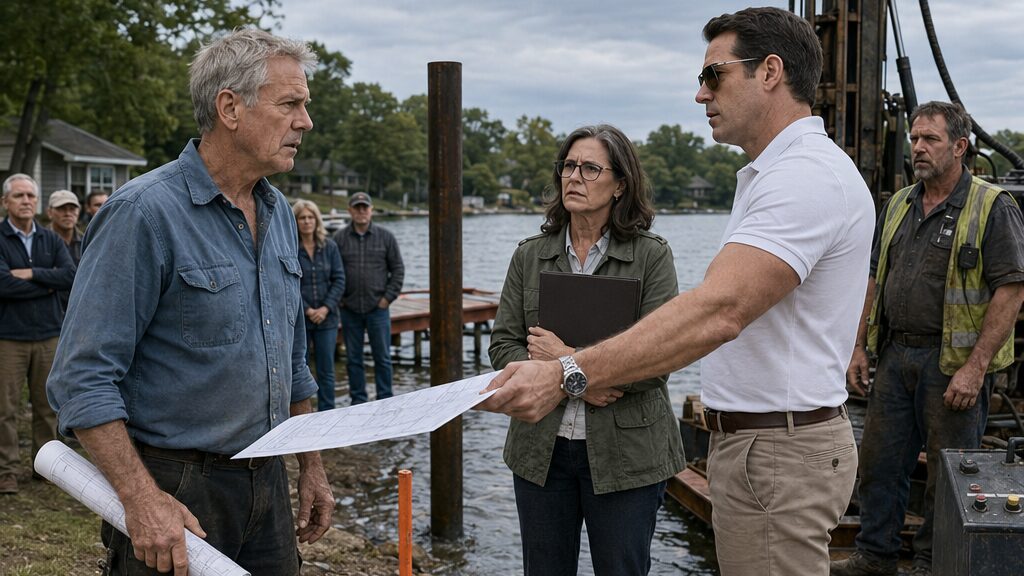
The steel piling struck the lakebed eleven feet beyond Frank Nelson’s orange marker.
The impact traveled through the water, up the cedar posts beneath his dock, and into the soles of his boots. A flock of gulls lifted from the shallows. The pile driver’s engine dropped to an idle, but the ringing metal carried across the bay.
Frank stood at the end of his dock with a rolled survey under one arm.
“Hold it there,” he called.
The operator looked toward Gregory Baker, who stood on the construction barge with a radio clipped to his vest. Gregory glanced at the piling, then at the glass house rising behind him. He did not signal the operator to stop.
Frank stepped off his dock and followed the narrow strip of gravel between the properties. Fresh tire ruts had pressed the ground flat where Benjamin King’s lawn would eventually meet the water. Four board members from the lake association were already gathered near the work zone. Catherine Rivera stood among them with a folder against her chest.
Benjamin came down the temporary stairs from his new house. He wore a white polo without a speck of dust on it, though nearly everything around him was coated in pale grit.
“You can’t put that there,” Frank said.
Benjamin removed his sunglasses. “Morning to you, too.”
“That piling is across my projected boundary.”
“The lake is shared.”
“The water is shared. Access is not the same thing as a boundary.”
Benjamin looked toward the board members as though Frank had supplied the joke for him. “This is exactly why I asked Catherine to come. I’m not spending another week debating imaginary lines.”
Frank placed the rolled survey on the hood of a parked utility cart and opened it. The paper resisted at the corners, shaped by years inside a cardboard tube. He set a metal tape at the orange stake and drew it toward the shoreline.
Benjamin glanced at the document. “How old is that?”
“It was updated six years ago.”
“That cabin was built before color television. I’m guessing the map isn’t much younger.”
One of the neighboring residents gave a short, uncomfortable laugh. Frank kept the tape level.
The measurement ended where the piling broke the water.
“Eleven feet, two inches,” he said.
Benjamin folded his arms. “According to your stake.”
“According to the recorded survey.”
Catherine moved closer. “Frank, nobody is saying your documents don’t matter. But the association has a shoreline concept plan that was reviewed when the lots were reclassified.”
“Concept plans don’t change recorded boundaries.”
“They guide improvements inside the community.”
“They don’t authorize one owner to occupy another owner’s access.”
Benjamin turned to Gregory. “Can we continue?”
Gregory rubbed the side of his jaw. “I’d rather settle the marker question first.”
Benjamin’s expression tightened. “You settled it when you laid out the coordinates.”
Frank looked up from the tape. “Which coordinate set did you use?”
Gregory did not answer immediately.
The pile driver engine idled behind him. A worker on the barge lowered his eyes to a coil of cable. Catherine opened her folder and removed a large sheet.
“This is what the board has,” she said.
She spread it over Frank’s survey.
The association drawing showed broad curved lines along the waterfront, softened to follow the shape of the bay. On it, Benjamin’s proposed boathouse sat neatly inside a shaded area. There were no survey seals, no monument references, and no legal description.
Benjamin tapped the paper. “There. Approved.”
Frank lifted one corner. “This says conceptual use area.”
“It shows the same shoreline.”
“It shows an approximation.”
“It shows what the association understood.”
Frank looked at Catherine. “Was this recorded with the county?”
Her pause was slight, but he saw it.
“It’s part of the association file,” she said.
“That wasn’t my question.”
“We’re not holding a hearing on the beach.”
“No. You’re holding construction over a boundary you haven’t verified.”
Benjamin took the concept drawing and laid it directly across Frank’s survey, covering the legal description. “We have a modern plan, a board review, and a contractor who has already mobilized. You have an old piece of paper and a grudge against change.”
Frank felt the attention of the neighbors shift toward him. It was not agreement so much as relief that Benjamin had said aloud what some of them preferred to imply.
The old cabin. The patched dock. The man who measured twice and spoke once.
Frank knelt beside the orange stake.
He photographed the cap, then the tape stretched toward the water. He made sure the piling, stake, and measurement were visible in the same frame. His phone recorded the time and location automatically.
Benjamin sighed. “Are we documenting the sunrise next?”
Frank stood. “Gregory, which coordinates did you use?”
Gregory looked at Benjamin before answering.
“The revision sent last Friday.”
“From the stamped construction set?”
Gregory shifted his weight. “From an email.”
“Whose email?”
Benjamin stepped between them. “You don’t get to interrogate my contractor.”
Frank looked past him. “Did the revision come from the survey technician?”
Gregory’s hesitation lasted less than two seconds.
It was long enough.
Catherine closed her folder. “The work will pause until noon. I’ll compare what the association has with the submitted plans.”
“Noon isn’t enough,” Frank said.
“It is what I can authorize without calling an emergency board meeting.”
“The next piling locks the frame farther into the disputed area.”
Benjamin put his sunglasses back on. “Then you’d better spend your morning finding something better than that antique map.”
Catherine asked Gregory to shut down the equipment. He signaled the operator, and the pile driver’s engine went silent. The sudden quiet exposed smaller sounds: water tapping steel, a truck reversing near the house, canvas snapping on the barge.
The board members began walking toward their cars. Two neighbors followed them, speaking in lowered voices.
Frank rolled his survey carefully. He noticed Gregory watching him.
“You should preserve the email,” Frank said.
Gregory’s face closed. “I preserve my project records.”
“Good.”
Benjamin laughed once. “You think you’re building a case.”
Frank slid the survey into its tube. “I think you’re building in the wrong place.”
Catherine stopped beside Frank before leaving. “Bring me the county copy, not just your field survey. And try not to make this harder than it needs to be.”
He almost asked who had made it hard.
Instead, he nodded.
At eleven forty-three, Frank stood inside his cabin, arranging photographs on the kitchen table. Through the open window came the first low churn of the pile driver restarting.
He reached the shoreline in time to see the operator lift another steel column.
Catherine’s car was still visible at the top of Benjamin’s drive.
Benjamin stood below her, one hand raised toward Gregory.
“Resume,” he said. “Before everyone leaves.”
Chapter 2: The Map the Association Preferred
The new piling was already six feet into the lakebed when Frank reached the orange stake.
He did not shout. Gregory had seen him coming, and the contractor’s eyes remained fixed on the hydraulic controls as if attention alone could make the decision belong to someone else.
Frank raised his phone and took three photographs.
Benjamin stood beside Catherine’s car. “The pause was until noon.”
Frank checked the time. “It’s eleven fifty-one.”
Benjamin looked at his watch, then smiled without embarrassment. “Close enough for construction.”
Catherine lowered her voice. “Benjamin, I told you to wait.”
“You told him to compare records. He has his record. We have ours.”
Frank turned to Gregory. “Mark the installation time in your field log.”
Gregory’s jaw moved. “I log every operation.”
“Then include the instruction to resume.”
Benjamin took a step forward. “You don’t direct my crew.”
“No. I’m making sure nobody forgets who did.”
Catherine asked Frank to bring the county documents to the association office that afternoon. Her tone suggested a reasonable next step, but she did not order the work stopped again. By the time Frank left, the second disputed piling was upright.
The county recorder’s office occupied the lower floor of a brick building twenty miles from the lake. Frank had been there often enough to know the sound of the old document scanner before he entered the records room.
The clerk brought up the parcel map on a monitor and compared it with the survey Frank had carried in.
“This references the recorded plat from the shoreline adjustment,” she said.
“Any later boundary instrument?”
She searched by parcel, owner, and association.
“No amended plat. No boundary-line agreement. No easement affecting this edge.”
Frank showed her a photograph of Catherine’s concept map.
The clerk leaned closer. “That looks like a planning exhibit.”
“The association is treating it as an approval map.”
“Approval of what?”
“A boathouse location.”
She zoomed in on the recorded documents. “There should be an attachment if the association submitted a shoreline-use amendment.”
“There isn’t?”
“There’s a cover notation from eight years ago. It says ‘see exhibit B.’ Exhibit B isn’t in the county packet.”
Frank felt the small, cold satisfaction of a question becoming specific.
“Could it have been omitted during scanning?”
“It could have been omitted before recording. Or it could never have been submitted.”
She printed the index and stamped the copy showing that no later boundary instrument appeared in the public record.
It was not victory. It was narrower than that.
The concept map had no legal force on its face, but its existence still needed explaining. Someone had used it. Someone had filed it with the association. Someone had decided its smooth curved line mattered more than the monuments in Frank’s survey.
At the association office, Catherine sat behind a folding table beneath framed photographs of summer boat parades. Frank laid the recorded plat, index, and survey beside the concept drawing.
She studied them in silence.
“The county has no exhibit B,” he said.
“We do.”
She opened a thin file and removed a photocopy. The page contained the same curved waterfront line and a block of notes about drainage, vegetation buffers, and recommended shared-use corridors.
Frank scanned the footer.
“Draft,” he said.
“It was reviewed.”
“It wasn’t recorded.”
“That doesn’t make it meaningless.”
“It makes it incapable of changing a boundary.”
Catherine pressed her fingers to the edge of the table. “The association has relied on drawings like this for years.”
“That may be the larger problem.”
Her eyes sharpened. “Do you understand what happens if I tell the board every shoreline approval based on these files has to be reopened?”
“Yes.”
“I don’t think you do.”
Frank began arranging the pages so the recorded plat sat beneath the survey and the concept map remained to one side.
Catherine watched his hands. “You always do that.”
“Do what?”
“Make the paper look orderly before telling people their lives aren’t.”
He let the comment pass.
She pointed to the concept map. “Benjamin submitted plans consistent with what he was shown.”
“His pilings are not consistent with the recorded line.”
“He says the water-use area was understood differently.”
“By whom?”
“The prior board. The planning committee. Possibly you.”
Frank looked up.
Catherine opened another folder. “Your name appears in the old files.”
Before she could show him, the office door opened.
Samantha Nelson stood there holding her car keys and wearing the expression she used when concern had already hardened into anger.
“I called your house six times,” she said.
Frank glanced at his phone. It was still on silent.
Catherine gathered the papers. “We can continue tomorrow.”
Samantha saw the survey, the copies, the highlighted parcels. “Of course.”
“This isn’t a good time,” Frank said.
“It hasn’t been a good time for fifteen years.”
Catherine quietly left the room.
Samantha remained by the door. “The neighbor called me.”
Frank straightened. “Benjamin called you?”
“He said you threatened his contractor and were blocking an approved project.”
“I asked which coordinates they used.”
“He said you were taking photographs of his workers.”
“I photographed the boundary.”
“You always photograph the thing you can measure.”
He slid the stamped index toward her. “The association map was never recorded. My survey is still the governing reference.”
She did not look at it.
“Do you hear yourself?”
“Yes.”
“No, you hear your case. You don’t hear what this does to you.”
“A piling is eleven feet over my line.”
“And you haven’t asked me one question since I walked in.”
Frank folded his arms, then immediately regretted the resemblance to Benjamin.
Samantha noticed it too.
She looked toward the documents. “How long are you planning to spend on this?”
“As long as it takes to correct.”
“Then sell the cabin.”
“No.”
“You barely use it except to maintain it. Mom wanted you to sell after she got sick.”
“That wasn’t what she wanted.”
“She wanted you home.”
The room seemed to contract around the table.
Frank picked up the recorded plat. “This is not about your mother.”
“That’s what you said about the bridge dispute. And the drainage case. And every folder you carried through the door while she waited for you to explain why you were afraid.”
“I wasn’t afraid.”
Samantha gave him a tired look. “That’s the problem. You think fear only counts if you say it.”
She began stacking the loose association papers, perhaps only to keep her hands occupied. A yellowed memo slipped from beneath the concept plan.
At the top was the association letterhead.
Below it, in faded type, were the words: Preliminary Shoreline Drainage and Use Review.
Samantha read the first page, then turned it toward him.
Frank Nelson, P.E., appeared beneath the heading Technical Comments.
Her anger changed shape.
“You reviewed this?”
“It was an early drainage concept.”
“You told Catherine you didn’t know where the map came from.”
“I said it didn’t change the boundary.”
“That isn’t what I asked.”
She found a meeting date near the bottom and tapped it with one finger.
“Why weren’t you there when they adopted it?”
Frank looked at the date.
He knew before reading it twice exactly where he had been.
Chapter 3: What Frank Refused to Explain
Samantha laid the old association memo beside her mother’s hospital bracelet.
She had brought the bracelet from the glove compartment, where she had kept it looped around the gearshift for reasons Frank had never asked about. The plastic was cloudy with age. His wife’s name had nearly rubbed away.
The date on the bracelet matched the date of the shoreline meeting.
Frank remained standing by the kitchen table. The survey lay between them, still rolled.
“You reviewed the plan,” Samantha said. “Then you skipped the meeting.”
“I reviewed drainage flow, not lot boundaries.”
“You wrote technical comments.”
“I warned them not to use the concept lines as legal property lines.”
“Did you tell them that in person?”
“No.”
“Did you send the warning?”
“I sent the memo.”
She lifted it. “This one?”
“Yes.”
“This says the drawing is suitable for preliminary drainage coordination.”
“Read the next paragraph.”
“I did. It says final locations require verification against recorded instruments.”
“That is the warning.”
“That is one sentence in a four-page memo.”
“It is clear.”
“To you.”
Frank pulled out a chair but did not sit. Through the window, the upper edge of Benjamin’s glass house caught the afternoon sun. A construction saw started and stopped across the water.
Samantha touched the bracelet.
“Mom was admitted that morning,” she said.
“I know.”
“You left the hospital.”
“For two hours.”
“You went to the county office.”
“I needed the drainage files.”
“She thought you went home to shower.”
Frank looked at the cedar wall behind Samantha rather than at her face.
The medical crisis had not arrived dramatically. No ambulance. No collapse. His wife had become short of breath while carrying laundry. At the hospital, tests multiplied, and certainty narrowed. Frank had done what he always did when something could not yet be fixed: he found a problem that could.
The association had been pressing him for comments on shoreline drainage. He had driven to the county office, reviewed the files, and returned with marked pages under his arm.
His wife had seen them.
She had not argued. That silence had been worse.
“I came back,” Frank said.
“You came back with work.”
“It wasn’t work.”
“It was something you could control.”
He sat then, slowly.
Samantha continued. “The board called three times that week. Once while Mom was having the procedure. Once the night she came home. Once after she asked you to stop answering.”
Frank’s eyes moved to the memo.
“I didn’t answer.”
“No.”
“I had already written what mattered.”
“You decided they should understand you without you having to speak.”
“They were adults serving on a property board.”
“And you were the engineer whose name made the drawing look safe.”
He felt the words settle with more weight than accusation deserved and less than truth required.
“I never approved a boundary change.”
“I believe you.”
The answer surprised him.
Samantha sat across from him. “But believing you isn’t the same as believing you had nothing to do with it.”
Frank unrolled the survey halfway, then stopped. The edge curled back under his hand.
“The concept plan was for runoff,” he said. “Several lots were draining toward the bay. The association wanted broad use corridors so owners wouldn’t build in areas needed for swales.”
“And the shoreline curves?”
“Graphic approximations.”
“Did the board know that?”
“They should have.”
“There it is again.”
He released the paper. It rolled itself closed.
Samantha leaned back. “Benjamin offered to buy the cabin.”
“I know.”
“He called me before he spoke to you at the association office.”
“What did he say?”
“That you were confused. That he could make the dispute disappear. He said the offer would be generous enough that you could move closer to me.”
Frank’s mouth tightened. “He doesn’t know where you live.”
“I told him.”
That landed differently.
“You considered it.”
“I’m still considering whether you should.”
“He crossed the boundary.”
“And you crossed out of a hospital room because a drainage memo felt easier than sitting beside Mom.”
Frank stood so abruptly that the chair legs scraped the floor.
Samantha did not flinch.
“That has nothing to do with eleven feet of shoreline.”
“It has everything to do with how long you’ll wait before saying what matters.”
He walked to the window.
Across the bay, workers were fastening beams between the new pilings. Each strike of a hammer carried faintly over the water.
“My survey is valid,” he said.
“I’m not disputing the survey.”
“The association map is not recorded.”
“I’m not disputing that either.”
“Then what do you want?”
“For once, don’t make me choose between admitting you’re right and admitting you caused harm.”
The hammering stopped.
Frank turned from the window. Samantha had placed the hospital bracelet on top of the rolled survey. The plastic loop looked small against the thick paper.
His wife had not hated the cabin. She had loved mornings there, coffee on the dock, the sound of fishing boats before dawn. What she had hated was the way Frank disappeared into precision whenever life asked for something less exact.
“I thought if I waited until I had the whole answer,” he said, “I wouldn’t make things worse.”
Samantha’s face softened, but only slightly. “You waited through her illness.”
“I know.”
“You waited after she died.”
“I know.”
“And now you’re waiting while they build.”
Frank looked toward Benjamin’s property.
“I started documenting the first day.”
“That isn’t the same as warning everyone who could be hurt.”
“I spoke to Catherine.”
“You corrected her. You didn’t tell her you had history with the plan. You didn’t tell Gregory the permit problem. You didn’t tell the neighbors what could happen if that structure has to come out.”
“I don’t know yet that the permit is missing.”
“Then ask.”
Her voice was not loud. It did not need to be.
Frank picked up the bracelet. For a moment, he considered returning it to her. Instead, he placed it beside the association memo, leaving both visible.
“Benjamin’s offer expires Friday,” Samantha said.
“He gave you a deadline?”
“He said financing decisions were being made.”
“That means he needs certainty.”
“So do you.”
“No. I need the line restored.”
“Those aren’t always the same thing.”
She rose and moved toward the door.
“Are you telling me to accept?” Frank asked.
“I’m telling you I won’t help you turn this into another folder you can close after everyone else is gone.”
The door shut behind her.
Frank remained at the table until the light shifted across the floor. He opened the survey fully and placed the concept drawing beside it. His original technical memo lay above both.
In the second paragraph, the warning was exactly where he remembered it.
Final shoreline-use locations must be verified against recorded parcel instruments and field monuments.
Clear, he had always thought.
Clear enough to excuse his absence.
His phone vibrated near the edge of the table.
The screen showed an unknown number. A voicemail appeared before he could answer.
Frank played it.
Gregory Baker’s voice was low, nearly covered by workshop noise.
“Mr. Nelson, it’s Gregory. I need to show you something from the layout records. Not at the site. Benjamin can’t know yet.”
There was a pause.
“When we set the first marker, the coordinate didn’t match the line on the stamped plan.”
Another pause, shorter this time.
“I crossed it out in my field log before he told us which number to use.”
Chapter 4: The Contractor’s Private Field Log
Gregory Baker had crossed out one coordinate so hard the pen had torn the page.
He slid the field log across the scarred workbench inside the marina workshop and kept one hand resting on it, as if he might still pull it back.
The building was closed for the season. Aluminum ladders hung from ceiling hooks. A row of shrink-wrapped boats filled the dark behind them. Through the open service door, Frank could see a narrow slice of lake and the pale frame of Benjamin’s boathouse rising across the bay.
“This was the first layout point,” Gregory said.
The original coordinate ended near Frank’s orange stake. Beneath it, written in different ink, was a revised number that pushed the line eleven feet toward Frank’s dock.
“Who gave you the revision?” Frank asked.
“You know who.”
“I need you to say it.”
Gregory looked toward the door. “Benjamin emailed it Friday night.”
“Was the survey technician copied?”
“No.”
“Catherine?”
“No.”
“Did the email identify the source?”
“It said the association plan controlled the water-use area.”
Frank placed his rolled survey beside the log and opened it just far enough to expose the monument references. He aligned the survey with Gregory’s first coordinate. They matched within the tolerance expected from a field setup.
The crossed-out number did not.
“You knew,” Frank said.
“I knew there was a conflict.”
“That is not the same sentence.”
Gregory’s fingers tightened on the workbench. “I called him before we drove the first pile. He said the board had resolved it and you were refusing to accept the new plan.”
“And you believed him.”
“I believed the property owner who hired me had obtained the approvals.”
“You had a stamped construction set.”
“I also had a signed change directive.”
“Signed by Benjamin.”
“Yes.”
Frank photographed the page.
Gregory reached for the log. “No names in a complaint until we talk about my crew.”
Frank lowered the phone. “You called me.”
“I called because this is getting worse.”
He opened a metal drawer and removed a clear plastic sleeve containing printed photographs. The first showed wet concrete collecting in a shallow containment tray on the barge. The second showed gray water spilling from one corner into the lake. In the third, a worker stood ankle-deep beside a cloud spreading through the shallows.
Frank held the photograph closer.
“When?”
“Two weeks ago. The pump hose split.”
“How much entered the water?”
“I don’t know.”
“Was it reported?”
“To Benjamin.”
“To the state?”
Gregory shook his head.
The gray plume had drifted toward a patch of reeds near the edge of Frank’s parcel. Frank knew enough not to name the violation before testing, but he also knew the work no longer concerned only two property owners.
“What permit number is on your site file?” he asked.
Gregory removed another sheet. “County building permit. Association approval letter. State shoreline application marked pending.”
“And the federal waterway authorization?”
“Benjamin said it was covered under the marina permit.”
“This isn’t the marina.”
“That’s what I told him.”
Frank read the email summary clipped behind the permit list. Benjamin had written that the remaining authorization was administrative and expected within days.
The date was three weeks old.
“You continued anyway,” Frank said.
Gregory turned away. “I have six people on payroll. The crane rental is by the week. The steel was fabricated for this footprint. If I shut down without written cause, Benjamin withholds payment and calls it abandonment.”
“You had written cause in your own log.”
“I had a discrepancy. He had an association drawing and a change directive.”
“You also had a pending permit.”
“So did half the shoreline jobs I worked when I was younger.”
Frank let the answer sit between them.
Gregory was not careless. That made the choice harder to excuse, not easier. He had seen the risk, written it down, and continued because stopping would have transferred the cost directly onto him and his workers.
“How much does he owe you?” Frank asked.
Gregory gave a bitter laugh. “Enough.”
“That isn’t a number.”
“It’s enough that if he freezes the final draw, I miss payroll twice.”
Frank looked again at the photographs. He had imagined the project stopping cleanly: machines silent, pilings marked, agencies notified. He had not pictured six workers waiting for checks or a small contractor trapped between a client’s instruction and a disputed line.
“Why keep the photographs?” Frank asked.
“Because after the hose broke, Benjamin told me to delete anything that made the site look uncontrolled.”
“And you didn’t.”
“No.”
“Why?”
Gregory stared past him at the wrapped boats. “Because I’ve spent twenty-two years telling crews that records protect everyone. I figured I should try believing myself.”
Frank rolled the survey closed.
“I won’t promise protection I can’t provide,” he said. “But I can distinguish between the person who ordered the work and the people who depended on it.”
Gregory looked at him. “You filing?”
“I haven’t decided how.”
“That means yes.”
“It means the boundary is no longer the only issue.”
They walked to the shoreline behind the workshop. From there, the new boathouse looked nearly complete. Workers were fastening roof panels, and electrical conduit ran along the inside beams.
Gregory pointed toward the outer row of pilings. “Immediate removal isn’t simple now. They tied the frame laterally. Pull one without bracing the others, the load shifts.”
“Could it affect neighboring docks?”
“If the soil sloughs, maybe. Depends how they extract.”
Frank studied the water. The surface gave no sign of what had been driven beneath it.
“When is the permit review?” he asked.
“End of the month.”
“And construction completion?”
“Benjamin wants it finished next week.”
Gregory’s phone vibrated. He read the screen and swore under his breath.
“What?”
He turned the phone toward Frank.
A glossy digital invitation filled the display. The photograph showed Benjamin’s glass house at sunset, the boathouse rendered as if it had always belonged there.
LAKE HOUSE OPENING — SATURDAY.
Below it, smaller text promised drinks, catered food, and live music on the water.
“The roof isn’t finished,” Frank said.
“It will be.”
“The permit review is after the party.”
Gregory slid the phone into his pocket. “That’s the point.”
Across the bay, another truck arrived carrying lighting fixtures.
Chapter 5: Champagne Above an Unfinished Permit
Music began inside the boathouse before the final inspection sticker had a place to go.
By six on Saturday evening, strings of warm bulbs reflected across the lake. Guests moved between Benjamin’s glass house and the dock carrying narrow champagne flutes. A country band played beneath the new roof while caterers arranged trays along a counter built directly above the disputed line.
Frank stood at the end of his cedar dock with the survey tube under his arm.
He had not intended to bring it. He had carried it out of habit, then resented himself for doing so.
Boats approached Benjamin’s property from both directions. Their wakes struck Frank’s dock and made the old boards shift beneath his feet. On the far side of the bay, association members gathered near the temporary bar.
Samantha came down the path behind him.
“You’re going over there?” she asked.
“I was invited.”
“So was everyone within hearing distance.”
“I need to speak to Catherine.”
“You’ve needed to speak for three weeks.”
Frank watched Benjamin greet a couple at the end of the new dock. He moved with the ease of a man presenting completion as proof of permission.
“I have the field coordinates now,” Frank said.
“Does Catherine?”
“Not yet.”
“Does the state?”
“Not yet.”
Samantha looked at the survey tube. “You brought paper to a party.”
“I brought the recorded line.”
“No. You brought the thing that lets you avoid deciding when to use your voice.”
She walked ahead without waiting for him.
Frank followed across the temporary path connecting the properties. Party guests smiled politely as he passed. Several glanced at the survey tube. He recognized the look from the association site walk: curiosity mixed with the hope that nothing uncomfortable would happen near the food.
Benjamin saw him and raised a glass.
“Frank. Glad you came.”
The greeting was loud enough for those nearby to hear.
“I need five minutes,” Frank said.
“Monday.”
“The structure is occupied tonight.”
“It’s a housewarming, not an engineering conference.”
“The permit review is still pending.”
Benjamin’s smile held. “Catherine is here. If there were a problem, the board president wouldn’t be drinking my champagne.”
Catherine stood several yards away with a glass of sparkling water. At the mention of her name, she looked toward them.
Benjamin placed one hand on Frank’s shoulder. Frank removed it without drama.
“Actually,” Benjamin said, still projecting toward the guests, “this might be the right time to settle something.”
Samantha stopped near the dock railing.
Benjamin lifted his glass. “Frank and I have had a little disagreement about shoreline use. Nothing neighbors can’t solve.”
Frank felt the room around the open dock shift toward them.
“I’ve made him an offer,” Benjamin continued. “A fair one. More than fair. I’m willing to buy his cabin and end the confusion for everyone.”
A few guests looked toward Frank’s weathered cedar place. From Benjamin’s illuminated boathouse, it appeared smaller than it was.
Frank said nothing.
Benjamin lowered his voice just enough to make the insult feel private while preserving its audience. “You’d be closer to your daughter. No maintenance. No legal fees. Everybody wins.”
“The boundary doesn’t become correct because you buy the property,” Frank said.
“It stops being a community problem.”
“It became a community problem when you built across it.”
The band had stopped between songs. In the sudden quiet, glassware clicked against the counter.
Catherine stepped closer. “This isn’t the setting.”
“Then call an emergency meeting,” Frank said.
“We’re waiting on agency review.”
“You knew the authorization was incomplete.”
Her expression changed.
Benjamin looked between them. “Incomplete is not denied.”
Catherine spoke carefully. “The remaining permit was represented as routine.”
“By whom?” Frank asked.
She did not answer.
Benjamin did. “By professionals who understand development.”
Frank almost reached for Gregory’s photographs. The survey tube pressed against his ribs. He could have opened it across the catering table. He could have named the revised coordinate, the pending authorization, the slurry entering the shallows.
Instead, he looked at the guests.
Several workers from Gregory’s crew stood near the service entrance, eating from paper plates. One had brought a child. Gregory himself remained beside the boathouse frame, watching Frank without invitation or warning.
Frank wanted complete proof. A permit search in writing. A confirmed environmental report. A record no one could soften into misunderstanding.
“Monday,” he said.
Samantha stared at him.
Benjamin smiled. “There. We agree.”
Frank turned toward Catherine. “You relied on his assurances.”
She lowered her eyes. “The board relied on the submitted package and the expectation that final authorization would follow.”
“You knew it had not.”
“I knew it was pending.”
“And you let them finish.”
Her grip tightened around the glass. “Do you understand what a stop-work order does once a project reaches this stage? Loans, contractors, neighboring access, potential claims against the association. I believed the permit would be issued before any of that mattered.”
Frank looked at the roof above them.
“It matters now.”
“Yes,” she said quietly. “It does.”
That was the first admission he had received from her. It should have felt useful.
Instead, Samantha stepped past them toward the path.
“Where are you going?” Frank asked.
“Home.”
“You just got here.”
“I came because I thought you were finally going to say it where people could hear.”
“I need the agency record.”
“You always need one more page.”
“This affects Gregory’s crew.”
“So warn them.”
“I’m trying not to cause damage.”
Samantha’s face tightened. “You keep calling silence restraint after it stops being kind.”
She left before he could answer.
The band resumed. Conversation filled the space she had crossed, restoring the party’s surface. Benjamin returned to his guests with visible relief.
Frank remained near Catherine.
“I’ll call the board Monday,” she said.
“Do it tonight.”
“I won’t turn a party into an enforcement hearing.”
“It is already an occupied structure.”
“Then file what you have.”
Frank looked toward Gregory. The contractor gave a small shake of his head, not refusal but warning. The crew was still owed money. The frame was tied together. The lakebed beneath it had already been disturbed.
Frank left with the survey unopened.
Near midnight, thunder rolled over the western shore. Wind pressed against the cabin windows. Rain began hard enough to erase the lights across the bay.
Frank went outside when he heard something strike his dock.
The water around the cedar posts had turned gray.
He followed the cloudy current toward Benjamin’s property. Sediment poured through the shallows from beneath the new boathouse, carrying pale streaks around the pilings. The storm had loosened disturbed soil and driven it along the shoreline.
A neighboring dock shifted as the wake and runoff reached it. One of its outer posts leaned, then settled at a different angle.
Frank raised his phone and photographed the spreading plume.
For the first time, the damage did not stop at his orange stake.
Chapter 6: The Complaint Frank Signed With His Own Fault
Frank typed his own name beneath the words prior technical involvement.
He stared at it for nearly a minute.
The complaint form lay on the kitchen table beside the unrolled survey, Gregory’s field notes, the county index, photographs of the slurry, and images from the storm. Outside, the lake had returned to blue, but a pale band of sediment remained caught in the reeds.
Frank had written seven pages describing Benjamin’s construction decisions.
He had written three lines about himself.
He deleted the three lines and began again.
Eight years earlier, he wrote, he had provided limited drainage comments on a preliminary association concept plan. His memo had warned that the drawing was not suitable for establishing legal shoreline boundaries. He had not attended the final meeting, had not confirmed how the association later used the drawing, and had not corrected the misunderstanding when construction began.
The facts looked different when arranged without defense.
A truck stopped outside the cabin.
Samantha entered carrying two coffees and placed one beside him. Her eyes moved over the documents.
“You sent it?” she asked.
“Not yet.”
She read the paragraph about his involvement.
“You left out the first week.”
“I documented the work during the first week.”
“You left out that you waited before notifying the board in writing.”
“I spoke to Catherine at the site.”
“You challenged the map. You didn’t disclose your history with it.”
“That history doesn’t make the piling legal.”
“No. It makes your delay relevant.”
Frank leaned back. “This is a regulatory complaint, not a confession.”
“It’s both if you want anyone to trust the parts that hurt you.”
He looked toward the survey. The paper occupied most of the table now, no longer rolled into a private cylinder. Beside it, the hospital bracelet remained where Samantha had left it.
“What wording do you want?” he asked.
“I don’t want wording. I want the truth.”
“The truth is not improved by including every emotion attached to it.”
“The truth is that you saw the risk and waited because you wanted evidence nobody could argue with.”
“I wanted to avoid making an unsupported accusation.”
“You also wanted to avoid standing in front of people while they doubted you.”
Frank said nothing.
Samantha pulled out a chair. “Write that you delayed formal notice while gathering records. Write that the delay may have allowed additional work and sediment disturbance. Don’t explain why. Just own what happened.”
He turned back to the form.
The sentence took less than a minute to type.
It cost more than the seven pages above it.
They spent the morning assembling identical packets. Each contained the recorded plat, survey, association concept drawing, Frank’s old technical memo, photographs, Gregory’s redacted field-log pages, permit status records, and the storm images.
One packet went to the state environmental office. One to the federal waterways office. One to the county. One to Catherine and the association board. Gregory received a copy limited to materials affecting his company.
At the post office, Frank requested certified delivery for every envelope.
The clerk weighed the stack. “This is going to cost you.”
“It already has.”
Samantha looked at him, but said nothing.
Catherine called before they returned to the cabin.
“I received the electronic copy,” she said. “You included your own memo.”
“Yes.”
“And a statement saying you delayed formal notice.”
“Yes.”
There was a pause.
“That will complicate your position.”
“It complicates the facts.”
“The board’s attorney may treat it as shared responsibility.”
“Then the board’s attorney will have read the whole packet.”
Catherine exhaled. “I’m scheduling a meeting.”
“Before the agencies respond?”
“Before the neighbors hear about it from someone else.”
“That is part of the problem.”
“I know.”
Her answer was quiet enough that Frank nearly missed it.
The first agency reply came four days later: acknowledgment, case number, request for photographs in original format. The second asked for confirmation of navigability and ownership records. Neither promised action.
Benjamin’s attorney sent Frank a letter accusing him of interfering with approved construction and damaging the value of the property through unsupported claims.
Frank placed it in the file.
He did not answer.
A week passed. Then another.
Work at the boathouse slowed but did not stop. Gregory removed most of his crew, leaving only two workers to finish weather protection. Benjamin began parking his truck where Frank could see it from the cabin, as though presence itself were a rebuttal.
On the nineteenth day, a state inspector arrived without warning.
She walked the shoreline with Frank, photographed the gray residue in the reeds, and examined the altered post at the neighboring dock. A federal waterways officer joined them an hour later.
At Benjamin’s property, Gregory opened the site file.
The officer studied the structural drawings. “If an order requires removal, can these piles come out individually?”
“Not safely in the current sequence,” Gregory said.
Benjamin stood nearby with his attorney and a man in a dark jacket Frank assumed was connected to the lender.
“What does that mean?” the lender asked.
“It means the frame distributes load across the row,” Gregory said. “Immediate extraction could destabilize the shoreline and put lateral force on the adjacent docks.”
Benjamin turned on him. “You said the structure could be modified.”
“Modified isn’t the same as pulled out tomorrow.”
The state inspector looked toward Frank. “Your complaint requests restoration of the recorded boundary.”
“Yes.”
“Full immediate removal may create additional disturbance.”
Frank watched the water move around the pilings. He had imagined the red notice, the silence after machinery stopped, the line returned to where it belonged.
He had not imagined being asked what damage justice might cause.
“What are the alternatives?” he said.
“Engineering plan, staged removal, sediment controls, seasonal timing,” the officer said. “Assuming a violation is confirmed.”
Benjamin’s attorney stepped forward. “Nothing has been confirmed.”
The federal officer closed the file. “The absence of an issued authorization is confirmed.”
Benjamin’s face lost color.
The lender said something too low for Frank to hear, then led Benjamin toward the glass house.
The officers continued measuring until late afternoon.
Three weeks after Frank mailed the packets, two official vehicles turned into Benjamin’s drive. A third car was already parked near the house.
Through the cabin window, Frank saw Benjamin standing beside the lender at the dining table.
The state inspector stepped out carrying a red folder.
The federal officer followed with a roll of adhesive notice tape.
Chapter 7: The Red Notice Was Not the Ending
The federal officer pressed the red notice flat against Benjamin King’s glass door while the lender watched from inside.
The tape made a dry ripping sound each time it crossed the page. STOP WORK AND CEASE ACTIVITY was printed in letters large enough to read from Frank’s shoreline.
Benjamin came out before the officer finished.
“You can’t post that here,” he said.
The officer smoothed the final strip. “This is the location of the unauthorized work.”
“My attorney is on the way.”
“He can meet us during the inspection.”
“This project was reviewed by the association.”
“That is not a federal authorization.”
The lender remained near the dining table, one hand resting on a leather folder. He did not look at Benjamin.
Frank stood near the edge of the property with Catherine, Gregory, and two association board members. No one spoke. The house that had seemed designed to display every room now offered Benjamin nowhere private to receive bad news.
The state inspector walked toward the boathouse carrying a clipboard.
“Mr. King,” she said, “until further notice, no construction, occupancy, modification, removal, or material handling may occur in the affected shoreline area.”
“Occupancy?”
“The boathouse is closed.”
“We had one party.”
“You supplied electricity and hosted guests inside an unapproved structure over disturbed lakebed.”
Benjamin looked toward Frank. “This is what you wanted.”
Frank held the survey tube against his side. “I wanted the line respected.”
“You wanted officials on my property.”
“I asked them to inspect the work.”
“And you waited until it was finished.”
The accusation found its mark because it was not entirely false.
Before Frank could answer, Gregory stepped toward the inspector. “We need to discuss removal sequencing.”
Benjamin turned on him. “You don’t discuss anything without me.”
“I’m the contractor of record.”
“You were.”
Gregory’s face tightened but his voice stayed level. “That frame can’t be dismantled in the order it was built. The outer row is carrying lateral load from the roof and walkways.”
The federal officer looked over the water. “Could extraction affect adjacent structures?”
“Yes.”
“How many?”
“Two docks for certain. Possibly Frank’s, depending on equipment position and lakebed response.”
One board member muttered, “Then leave it until winter.”
The state inspector shook her head. “Leaving it is not authorization.”
Catherine pressed her folder closer to her body. “We need an emergency meeting tonight.”
Benjamin laughed without humor. “Now you want a meeting.”
“The board has to address the association approval.”
“You approved it.”
“We approved a concept placement based on incomplete information.”
“You approved exactly what I built.”
“No,” Frank said.
Every face turned toward him.
He removed the survey from its tube and opened it across the hood of an agency vehicle. The corners lifted in the breeze until Gregory placed two metal clamps on them.
“This is the recorded parcel line,” Frank said. “This is the association concept curve. They are not the same instrument, and they do not serve the same purpose.”
Benjamin stepped forward. “Your own name is on the concept review.”
“Yes.”
The answer stopped him for half a second.
Frank continued. “I reviewed drainage. I warned that the drawing could not establish property lines.”
“You disappeared before the board adopted it.”
“Yes.”
Catherine looked at him.
Frank kept his hands on the survey. “I did not attend the final meeting. I did not confirm how the association stored or described the drawing afterward. When your construction began, I waited too long to disclose that history because I wanted evidence no one could dispute.”
Benjamin’s attorney arrived in a dark sedan and hurried toward them.
Benjamin pointed at Frank. “There. Shared responsibility.”
“It is shared confusion,” Frank said. “Not shared instruction.”
Gregory opened his field log.
Benjamin’s face changed.
Gregory placed the log beside the survey, turning to the torn page. “The stamped coordinate matched Mr. Nelson’s recorded line. Mr. King sent a revision eleven feet inside it.”
The attorney held out a hand. “Do not display private project records.”
Gregory did not move the book.
The federal officer read the entries. “Is there written confirmation?”
Gregory removed a printed email from the plastic sleeve. “Signed change directive attached.”
Benjamin stared at him. “I told you the board had settled it.”
“You told me to use that number after I warned you it conflicted with the stamped set.”
“I relied on the association drawing.”
“You also wrote that stopping would jeopardize the lender inspection.”
The lender closed his folder inside the house.
The state inspector collected copies. “The cease-and-desist remains in effect. A formal restoration directive will follow after engineering review.”
For a moment, the result looked complete. The red notice faced the lake. Benjamin had no answer. Catherine had lowered her eyes. Even the machinery seemed chastened by silence.
Then Gregory pointed toward the neighboring dock.
“If you order full removal now,” he said, “that one may shift first.”
The dock’s outer post already leaned from the storm.
The state inspector nodded. “We will not authorize uncontrolled extraction.”
One board member looked at Frank. “So what does that mean? Benjamin gets to keep it?”
“No,” the federal officer said. “It means correction must not create a second violation.”
The emergency association meeting began after sunset in the small hall near the boat launch. Every chair was filled. Residents stood along the back wall, some holding copies of the cease-and-desist photographed from Benjamin’s door.
Catherine opened the meeting without ceremony.
“The association relied on a conceptual shoreline drawing that was not recorded and was not suitable for establishing legal boundaries,” she said. “That reliance was an error.”
A murmur moved through the room.
Benjamin sat with his attorney on one side. Frank and Samantha sat together on the other, though a full chair remained between them. Gregory stood near the wall.
Benjamin’s attorney distributed copies of Frank’s old technical memo.
“The board should understand,” he said, “that Mr. Nelson participated in the creation of the very document he now claims was misused.”
Several residents turned toward Frank.
Samantha looked at him but did not speak.
Frank rose and carried the rolled survey to the front table. This time he opened the entire sheet, not only the section that proved his line. Catherine helped hold one corner flat.
“My name is on the drainage review,” Frank said. “I did not attend the final meeting. I also delayed formal notice after construction began. Those were my decisions.”
The room became still.
“But this memo says final locations must be checked against recorded instruments. Gregory’s stamped set did that. Benjamin’s revision did not.”
Gregory stepped forward and confirmed the instruction. His voice shook once when he described continuing work to protect payroll, then steadied.
Benjamin remained seated.
Catherine asked whether the board should request immediate demolition.
Hands rose across the room.
Gregory spoke before she could count them. “Immediate demolition could undermine two docks and release more sediment. You’d be fixing one line by damaging three properties.”
The raised hands lowered unevenly.
Frank looked at the survey, the red-notice photograph, and the residents who had treated his precision as stubbornness. He could demand removal and let the agencies solve the consequences. He could finally be right without qualification.
Instead, he asked Gregory, “How long for a staged plan?”
“Ten days to design and price. Longer for review.”
“Could the outer frame be braced before extraction?”
“Yes.”
“Could the disputed eleven feet be removed first while preserving the lawful section?”
“Possibly, if the agencies approve cofferdam or containment work.”
Benjamin stood. “You’re designing my property now?”
“No,” Frank said. “I’m trying to keep your mistake from becoming everyone else’s.”
Benjamin’s mouth tightened. “And what do you expect from me?”
“Access, payment for the corrective work, and written acceptance of the recorded line.”
“My lender froze the final draw.”
“That doesn’t move the boundary.”
“It may bankrupt the project.”
Frank met his eyes. “That still doesn’t move it.”
Catherine asked him to state his proposal formally.
Frank rested one hand on the open survey.
“Staged removal under agency supervision. Sediment control before extraction. Monitoring at both neighboring docks. Gregory’s crew paid before new cosmetic work. The lawful portion can be reconsidered only after permits are complete.”
The room did not applaud. People whispered, calculated, frowned.
It was better that way.
Catherine looked toward Benjamin. “Will you cooperate?”
His attorney leaned close to him.
Benjamin stared at the red notice photograph on the wall, then at the lender’s empty chair.
“I want the full cost estimate,” he said.
“That is not an answer,” Catherine replied.
Frank rolled the survey only halfway, leaving the disputed section visible.
Benjamin looked at him.
For the first time since the piling crossed the orange stake, there was no contempt in his face. Only fear, stripped of polish.
Frank waited.
After a long silence, Benjamin said, “Bring me the staged plan.”
Chapter 8: The Shoreline After Everyone Was Measured
The first unauthorized piling rose from the lake six weeks later, black water streaming from its sides.
Gregory’s crane lifted slowly while a containment curtain held the cloudy sediment inside a narrow work area. Workers guided the steel with ropes from the barge. On the neighboring docks, temporary braces held each outer post in place.
Frank watched from his cedar dock beside Samantha.
The piling cleared the surface with a hollow sucking sound. For a moment it hung above the water, eleven feet of evidence exposed to the morning air. Then Gregory swung it onto the barge and lowered it onto timber blocks.
No one cheered.
A state inspector checked the turbidity reading. The federal officer marked the removal sequence on a clipboard. Catherine stood farther up the shoreline with a binder containing the new association review policy.
Benjamin watched from beneath the unfinished overhang of his glass house.
The work had changed him in small visible ways. He no longer wore clean shoes near the site. His shirt sleeves were rolled above the elbows, and a line of fatigue remained between his eyes even when he spoke calmly.
The lender had released enough money to complete weather protection on the house but nothing for the boathouse. Benjamin had sold one of his boats and postponed landscaping. The catered counter where champagne had been served now held pumps, hoses, and sediment-control fabric.
Gregory approached Frank during a pause.
“The neighboring post hasn’t moved,” he said.
Frank checked the gauge fixed to the cedar rail. “Less than an eighth.”
“Within tolerance.”
“For now.”
Gregory nodded. “Second piling after lunch.”
His crew had been paid from a corrective-work escrow required under the enforcement agreement. The arrangement had not erased his responsibility, but it had kept six households from carrying all of Benjamin’s loss.
Across the water, Catherine opened the association binder for two residents. Each shoreline file now required a recorded plat, stamped site plan, permit status, and conflict disclosure. The old concept drawings remained in the archive, stamped in red with a warning that they were not legal boundary instruments.
Frank’s survey had become the model for the new system.
That made him uncomfortable in a way private vindication had not.
Samantha noticed him watching.
“You don’t like seeing your paper in Catherine’s binder?”
“I don’t like people treating one survey as a substitute for checking their own.”
“She knows that.”
“People prefer shortcuts.”
“So do you.”
He looked at her.
“You prefer a document to a conversation,” she said. “Same instinct. Better stationery.”
Frank almost defended himself. Instead, he smiled once.
The second piling came free that afternoon. The third resisted until Gregory adjusted the extraction angle and reduced pressure on the surrounding soil. By the fourth day, the outer eleven feet of the structure had been dismantled.
The lawful portion remained braced and unusable pending permit review. Benjamin’s house stood complete behind it, but the shoreline in front looked raw: exposed gravel, protective fabric, and a line of temporary markers where the lakebed would be restored.
Winter would come before vegetation could be fully reestablished.
The agencies approved stabilization work for the fall and final planting for spring. It was not the clean restoration Frank had imagined when he first measured the piling. The water would carry the memory of disturbance through at least one freeze.
One evening after the crew left, Benjamin walked onto Frank’s dock.
He stopped at the first cedar post rather than coming all the way down.
“May I?” he asked.
Frank moved a tackle box aside.
Benjamin sat at the opposite end of the bench. Between them, the corrected boundary marker stood bright against the dim water.
For a while, neither spoke.
Then Benjamin said, “Why didn’t you demand they tear out all of it?”
“The lawful section may qualify after review.”
“That isn’t what I asked.”
Frank rested his hands on his knees.
Benjamin looked toward his house. “You could have made the board support complete removal. They were afraid of looking soft.”
“Complete removal would have damaged the neighboring docks.”
“You could have said that was my problem.”
“It would not have stayed your problem.”
Benjamin drew a slow breath. “I thought you wanted me gone.”
“I wanted you off my line.”
“Same thing, from where I was standing.”
“No.”
Benjamin rubbed a thumb across a scrape on his palm. “The lender inspection was three days after Gregory called about the coordinates. If I stopped, they would have reviewed the whole budget.”
“And found what?”
“That I’d used the contingency money to finish the glass package. That the shoreline work was carrying more debt than the appraisal supported.”
Frank waited.
Benjamin continued. “I told myself the permit would arrive. I told myself the association drawing gave me enough cover. Then every day I kept building made stopping more expensive.”
“That was still a choice.”
“I know.”
The words came without argument.
Benjamin looked at the corrected marker. “When you showed up with that old survey, I thought you were protecting a view you barely used.”
“I was protecting access.”
“I thought you were protecting the past.”
Frank considered the cedar boards beneath them, replaced in sections over forty years until little of the original dock remained except its line into the water.
“Maybe I was,” he said. “That doesn’t make the line false.”
“No.”
Benjamin stood.
Before leaving, he looked back at the partially dismantled boathouse. “A boundary should have been easier to understand.”
“It was easy to understand.”
Benjamin waited.
Frank added, “Accepting it was the difficult part.”
The association held one final shoreline meeting before winter. Catherine did not frame it as a victory. She listed the errors plainly: the board had circulated an unsuitable concept map, failed to verify permit status, and treated a wealthy owner’s confidence as evidence of completion.
Frank spoke after her.
He explained his own role in the old drainage review and his absence from the meeting that allowed the concept drawing to acquire meaning it had never been designed to carry. He did not mention the hospital bracelet. That belonged to Samantha and him, not the board.
“I believed the warning in my memo was sufficient,” he said. “It was technically clear and practically ignored. When the new construction began, I again relied on records before I communicated the full risk. That delay allowed more work and more damage.”
No one interrupted him.
The association adopted the transparent boundary archive unanimously. The vote did not repair the shoreline, but it made repeating the same mistake harder.
Afterward, Catherine returned Frank’s survey.
“We scanned it,” she said.
“You scanned the recorded copy?”
“And linked it to the county index.”
“Good.”
She held the tube out to him. “I’m sorry I asked you not to make things difficult.”
Frank accepted it. “You meant complicated.”
“No. I meant difficult.”
He met her eyes.
She continued. “I was afraid one admission would open every old decision. So I treated your certainty as the threat instead of the missing information.”
Frank nodded. “That was easier.”
“Yes.”
They did not call it forgiveness.
By late October, Gregory’s crew finished the temporary stabilization. Native shoreline plants would wait until spring. The remaining lawful frame of Benjamin’s boathouse sat dark and empty beneath a weatherproof cover.
On the last workday, Samantha helped Frank reset the orange marker.
He held the survey open while she sighted along the recorded line. The paper no longer curled as tightly as it once had. Its creases had softened from repeated handling.
“A little left,” Frank said.
She moved the marker.
“Half an inch back.”
“You’re enjoying this.”
“No.”
She looked at him.
“A little.”
She pressed the stake into the ground with her boot. They checked it once more, then walked to the cedar dock.
Frank brought two mugs of coffee. Samantha sat where her mother used to sit, facing the western shore.
The corrected marker was visible from the bench. Beyond it, the water moved freely through the space where the pilings had stood.
“Mom wouldn’t have wanted you to sell,” Samantha said.
Frank looked down at his mug.
“She wanted you to stop disappearing,” Samantha continued. “Those aren’t the same thing.”
“I know that now.”
“You knew it then.”
“Yes.”
The admission no longer felt like surrender.
He took the hospital bracelet from his jacket pocket. Samantha had allowed him to keep it through the hearings and restoration work. He placed it in her palm.
“I should have asked why you carried this,” he said.
She closed her fingers around it. “I kept thinking I’d give it to you when you were ready to talk about that week.”
“You waited a long time.”
“So did you.”
They sat without speaking, but the silence had changed. It did not hide a document, postpone a warning, or ask the other person to guess what mattered.
Across the bay, Benjamin turned off the work lights around his unfinished shoreline. Catherine locked the association archive for the evening. Gregory’s crane rolled slowly up the access road.
Frank looked at the survey tube beside him, then left it closed.
The line was marked. The record was shared. Nothing needed to be proved before he finished his coffee with his daughter.
The story has ended.