The Farmer Locked His Tractor Across the Wetland Road and Let the Fraud Tow Itself Away
Chapter 1: The Red Line Across the Wetland Grass
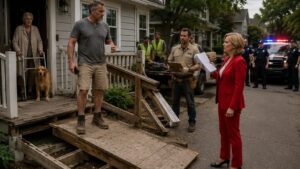
The tripod snapped open in the wet grass with a sound like a trap closing.
Richard Clark stopped with one boot on the low bank of the drainage channel and one hand around the handle of his shovel. The red beam from the laser surveyor cut across the morning reeds, clean and bright and wrong. It passed six inches inside the old iron boundary stake his father had driven there decades ago, the one Richard had repainted every spring until the metal had more memory than color.
The man unfolding the tripod wore black work pants, black boots, and a pale security vest too clean for the mud. He planted one foot beside a cluster of wetland sedge and pressed the tripod deeper into Richard’s soil.
“Move that,” Richard said.
The man looked up as if surprised the land had spoken.
Behind him, two more security men stepped out of a dark SUV, watching Richard instead of the marker. A fourth man stood near the open tailgate, arms folded, scanning the farmhouse, the tractor shed, the narrow entrance road, the shallow ditch, the fence line. He had the stillness of someone waiting to give orders.
Richard knew that kind of stillness. Not patience. Performance.
The fourth man came forward with a rolled map in one hand and a phone clipped to his belt. He had a sharp face, trimmed hair, and boots polished enough to reflect the grass. His name was printed on a plastic badge: Brian Carter.
“This land is locked down,” Brian said. “Move, old man.”
Richard did not move. He looked at the tripod leg again, at the steel point sinking into the soft soil on his side of the line. The red beam had crossed the marker, crossed the sedge, and touched the lower rail of his fence like a warning drawn in light.
“You’re on my side,” Richard said.
Brian smiled without warmth. “Not anymore.”
From the farmhouse porch, the wind nudged the screen door against its latch. Richard had left coffee cooling on the kitchen table, beside two folders he had not wanted to carry outside. The folders were old enough to curl at the corners, packed with wetland maintenance logs, subsidy inspections, and copies of boundary certifications. He had spent enough mornings with paper to know paper did not stop a boot. Not by itself.
The security man at the tripod pressed buttons on the laser head. The beam turned, measuring Richard’s fence, the ditch, the entrance road. Richard felt the numbers being taken from him, not because numbers were powerful, but because they would be printed somewhere later by someone who had never cut reeds out of a blocked channel with cold hands.
Brian unrolled his map over one forearm. “Clark parcel access survey begins today. By order of authorized site control. You can stand aside, or we can make a record that you interfered.”
“My record starts at the road,” Richard said. “Yours starts at the county line. You missed both.”
A younger security man laughed, then stopped when Brian did not join him.
The wetland behind Richard was still, but not empty. Red-winged blackbirds clung to the cattails. Water moved in thin threads beneath flattened grass. Beyond the channel, the low field opened into a green sheet that looked ordinary only to people who did not know how much work it took to keep water where water belonged.
Richard had cleaned that first culvert two days after his father’s funeral. He had patched the north fence the winter his hands stopped closing right in the mornings. He had sat with federal inspectors at the kitchen table while they asked why the old boundary stakes mattered if satellite maps existed. He had answered politely then. He did not feel polite now.
Brian glanced toward the farmhouse. “You live alone?”
Richard’s eyes lifted.
“Just determining occupancy,” Brian said. “For the report.”
“This isn’t your report.”
“It is now.”
A white pickup rolled to a stop near the entrance, followed by another black SUV. The narrow road was already crowded, tires close to the ditch on one side and Richard’s fence on the other. If another vehicle came in wrong, it would crush the soft shoulder and bleed mud into the channel.
Richard planted the shovel blade in the grass. “No more vehicles past that stone.”
Brian followed his gaze to the flat stone Richard used as a turn marker. It sat before the road tightened, before the wetland ditch and fence squeezed the entrance to a single lane. Brian’s expression barely changed, but Richard saw the calculation move behind it.
“You worried about your grass?” Brian asked.
“Wetland buffer.”
“Convenient.”
“Federal.”
That word touched the men differently. The one at the tripod looked down. One of the SUV men shifted. Brian’s smile thinned, but did not break.
“You people love words that slow things down,” Brian said. “Buffer. Habitat. Review. Heritage. Meanwhile every project in this county gets held hostage by a fence post and a story about granddad.”
Richard looked at the iron marker. It leaned slightly east where frost had worked it over the years, but the stamped number was still visible beneath the chipped paint. His father had never called it heritage. He had called it the line.
Brian stepped closer. “I’m not here to debate feelings. I have authorization to secure this access.”
“Then you brought the wrong map.”
The first flicker of irritation crossed Brian’s face.
Richard saw the clipboard tucked under Brian’s arm. On the top sheet, under the glossy plastic cover, a coordinate line had been highlighted in yellow. The parcel suffix ended in a seven.
Richard’s land ended in a three.
It was not much. One wrong digit on one displayed page. Enough to make his mouth go dry.
“Show me the order,” Richard said.
Brian tucked the map tighter. “You’ll be served after site control.”
“That isn’t how serving works.”
“You a lawyer?”
“No.”
“Then don’t pretend.”
Richard reached into his shirt pocket, took out his phone, and photographed the tripod legs in the grass. The man operating it turned away, as if the camera were an insult. Richard took another photo, wide enough to catch the iron marker and the laser beam crossing past it.
Brian’s voice sharpened. “You do not have permission to photograph my personnel.”
“They’re standing on my land.”
“Your land is under dispute.”
“Not by anyone with the right number.”
Brian came close enough that Richard could smell mint gum beneath his coffee breath. “Listen carefully. The developer wants clean access by noon. My company gets clean access by noon. The people who hired me have already spent more on filings than that tractor shed of yours is worth.”
Richard’s eyes moved to the shed before he could stop them.
That was his mistake. Brian saw it.
“There it is,” Brian said softly. “You know what this is. You just thought nobody would show up with enough weight to finish it.”
A low diesel rumble rose from beyond the SUVs.
Richard turned.
At the far end of the lane, squeezing past Jennifer Hill’s mailbox, a massive flatbed tow truck crawled into view. Its amber lights were not flashing yet, but the steel winch assembly on its bed caught the morning light. A heavy hook swung from the rear. Behind the windshield, the driver leaned forward, measuring the ditch, the fence, the old gate, and the rusted antique tractor parked beside Richard’s shed.
The truck was too large for the road. Brian had brought it anyway.
Jennifer Hill appeared at the edge of her driveway across the road, arms wrapped around herself, her face pale with the helpless curiosity of someone watching trouble choose a neighbor first.
Richard wanted to call to her, to say the marker was there, to ask her to remember where the line had always been. Instead, he kept quiet. He had learned long ago that asking too soon made people step back. Nobody wanted to be the first witness against money.
Brian lifted a black remote from his vest pocket. The tow truck’s winch gave a short mechanical chirp in response, as if answering a master’s whistle.
“That old machine blocks my access path,” Brian said, nodding toward the tractor. “We’ll remove it first.”
Chapter 2: The Order That Did Not Match the Markers
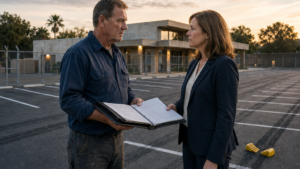
Brian shoved the laminated court order so close to Richard’s face that the plastic edge brushed the brim of his cap.
Richard did not reach for it. He read what he could from the glare: case number, filing stamp, parcel line, authorized temporary access, enforcement pending site verification. It had enough official language to frighten a person who had never spent years reading the difference between a boundary description and a threat.
The parcel suffix still ended in seven.
Richard looked from the order to the iron marker behind the tripod. “That’s not my number.”
Brian tapped the page with two fingers. “It’s the number on the order.”
“It’s the number for the old transfer strip north of the creek.”
“That sounds like your problem with the county.”
“It becomes your problem when your tripod is in my buffer.”
Brian turned to the men behind him with a small laugh. “He likes that word.”
The men smiled because they were paid to understand the laugh. Eric Roberts, the tow operator, climbed down from the flatbed and did not smile. He was broad through the shoulders and wore a brown work jacket with grease-black cuffs. A motorized winch remote hung from a strap across his chest. His eyes moved over the road in a practical way, taking in the softness at the edges, the ditch angle, the old tractor, the fence post, the distance to the farmhouse.
Richard recognized the look. Eric was not thinking about ownership. He was thinking about weight.
“That road won’t take your truck past the stone,” Richard said to him.
Eric glanced at Brian before answering. “It’ll take what it has to.”
“No, it won’t.”
Brian snapped the order down. “You’re done giving directions.”
Richard took one step past him, close to the tripod. The red beam slid over his shirt. He crouched slowly, making sure no one could say he lunged, and set his phone near the grass. He took three photographs: tripod foot, wetland marker, red beam. Then he stood and put the phone away.
The operator at the surveyor stiffened. “He’s recording evidence.”
Brian did not look away from Richard. “Let him. People like him think pictures make them official.”
Across the road, Jennifer Hill had come closer, stopping at her mailbox. Richard had known Jennifer since before her husband died, since before she replaced the old porch rail and stopped coming to the county meetings. She had signed two petitions against the developer and withdrawn from the third after someone from the developer’s office called her about drainage liability on her own back lot.
“Jennifer,” Richard called.
Her shoulders rose.
Brian turned, interested now.
“You see where that tripod is?” Richard asked.
Jennifer’s eyes went to the red beam, then to Brian, then to the road where the tow truck idled large and impatient. “Richard…”
“Just the marker,” Richard said. “You know where it is.”
Brian folded the order against his palm. “Ma’am, I would be careful giving statements on an active enforcement matter.”
Jennifer’s mouth tightened. “I’m not giving any statement.”
Richard felt the answer hit harder than he expected. He had no right to ask courage from someone whose land might be next. Still, something in him closed.
Brian saw that too. He seemed to feed on small withdrawals.
“Smart,” Brian said to Jennifer. “Nobody needs to get dragged into Mr. Clark’s obstruction.”
Richard went back to the marker and rubbed mud from its stamped face with his thumb. The old paint flaked under his nail. C-143. He knew every marker from the creek bend to the west culvert. He knew which ones had been reset after the flood, which ones leaned because cattle from the old Robinson place had pressed through the fence before the land changed hands, which ones county surveyors forgot because they trusted aerial overlays more than iron in the ground.
Brian’s order showed C-147.
“You’re four markers north,” Richard said.
“According to your memory.”
“According to the federal maintenance map inside my house.”
Brian’s eyes flicked toward the farmhouse again, just briefly. “Then bring it out.”
“No.”
“No?”
“You’re not getting a document from me while your equipment stands on my land.”
Brian’s jaw worked once. “You understand what refusal means?”
“It means I’m refusing.”
“It means interference with authorized access. It means any delay, equipment cost, or obstruction can be attached to you personally. It means if we have to move that antique scrap pile and it gets damaged, your complaint won’t matter.”
The tractor sat beside the shed, dull red under rust, its front tires half turned toward the road as if it had been listening. Richard had rebuilt the starter twice, replaced belts with parts filed by hand, and kept the old engine sheltered even when neighbors told him it made the place look poor. It had pulled trees, lifted culvert pipe, dragged broken gates out of flood mud. It had never once failed him when he asked it honestly.
Brian pointed toward it. “That machine sits inside the designated access area.”
“It sits beside my shed.”
“The order says otherwise.”
“The order is wrong.”
“Then appeal it after we secure the site.”
Richard almost laughed. Appeal after access. Object after entry. Complain after the damage. That was how people with money taught land to surrender: not by winning first, but by making the fight too late to matter.
A gust pushed through the reeds. The laser beam trembled across the grass.
Eric walked toward the flat stone at the start of the narrow lane. He looked down at the ditch, then back at the tow truck. “It’s tight.”
Brian did not turn. “You said you could move tractors.”
“I can move tractors.”
“Then position.”
Eric hesitated. Not long. Long enough for Richard to see that he knew something about this was wrong and had decided that knowing was not part of his job.
Richard looked at Jennifer again. She held her phone in one hand now, not raised, just gripped like a charm. Her eyes were wet with apology she was not yet ready to spend.
Brian lifted his voice so everyone could hear. “For the record, Richard Clark has refused to comply with a lawful site access order, refused to produce contrary documentation, and continues to obstruct movement of equipment.”
“You haven’t moved equipment,” Richard said.
Brian smiled. “We’re about to.”
He signaled with two fingers.
Eric climbed into the flatbed. The truck’s air brakes sighed. Its nose swung toward the entrance road, wide and slow. One tire rolled over the edge of the grass before Eric corrected. Mud squeezed up black around the tread. The truck stopped with its grille facing the narrow strip between ditch and fence, blocking Richard’s view of the mailbox, Jennifer, and the open road beyond.
The winch cable rattled once on the bed.
Brian stepped aside and looked at Richard as if offering him the courtesy of witnessing his own defeat.
“Last chance,” he said. “Move the tractor yourself, or Eric moves it for you.”
Chapter 3: The Tractor in the Only Road
Richard started toward the tractor, and one of Brian’s men laughed under his breath.
It was not a loud laugh. It was worse than that. It was the kind meant to be overheard, the kind that said the ending had already been agreed upon by everyone except the person losing. Richard kept walking past the shed, past the stacked culvert pipe, past the old fuel barrel chained to the post. He did not look back.
The tractor waited under a roof of corrugated metal patched with three different colors of tin. Rust had eaten through the paint on the hood in broad freckles. The seat was cracked. One headlamp had gone cloudy with age. A stranger would have seen junk.
Richard set one hand on the iron step and felt the cold come through his palm.
His father had taught him to climb up from the left, never with mud on the sole if he could help it, never yanking the wheel like a younger man showing off. The tractor had outlived two newer machines and one bank loan officer who called it “obsolete collateral.” Richard had kept it because it was heavy in the right places and simple in ways that newer things had forgotten how to be.
Behind him Brian called, “You got thirty seconds.”
Richard climbed into the seat. The key was already in his pocket. It had been there since before dawn, since before Brian arrived, since before Edward Lewis took his second cup of coffee at Richard’s kitchen table and said, “Don’t force it, Richard. Let them show what they came to do.”
Richard had not told Jennifer. Had not told anyone on the road. He had thought secrecy would keep the morning clean. Now Jennifer’s hesitation sat in his chest like a stone.
He slid the key into the ignition.
“Come on,” one of the security men said. “Let’s see if it coughs itself dead.”
Richard pulled the choke, set his heel, and turned the key.
The starter ground once.
The men laughed again, fuller this time.
Then the engine caught.
It did not roar. It hit deep, steady, and old, each cylinder finding its place like a hammer remembering the nail. Black smoke puffed once from the stack, then cleared. The whole shed trembled around the sound. Even the birds in the reeds lifted and scattered before settling farther down the channel.
Nobody laughed after that.
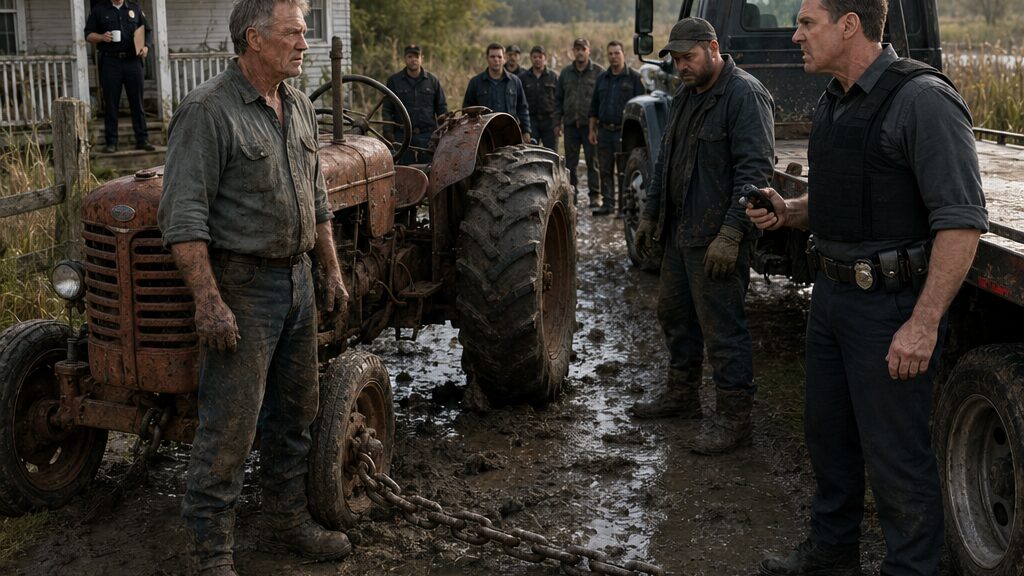
Richard eased the tractor out, slow enough that no one could claim panic, direct enough that every man stepped back. The front tires rolled over packed dirt, then onto the entrance road. He turned before the flat stone, lining the tractor across the tightest section where the ditch came closest to the fence. The rear wheels were wide, iron-weighted, and sunk just enough into the firm center to hold.
Brian’s expression changed as he understood the geometry.
The tractor did not merely block the road. It completed it. Fence on one side, ditch on the other, steel between.
Richard shut off the engine.
The sudden silence had weight.
He removed the key, climbed down, and put it back in his pocket. Then he stood beside the hood with one hand resting on the warm iron.
Brian walked toward him slowly. “That was a poor decision.”
“You’re standing on my side,” Richard said.
“You moved equipment into an authorized access path.”
“I moved my tractor on my road.”
“You think being stubborn makes you lawful?”
“No.”
Brian waited, but Richard did not give him more.
The security men spread without being told. They did not touch Richard, but they shaped the space around him, making the road feel narrower than it already was. Eric remained by the flatbed, watching the tractor with a mechanic’s unwilling respect.
Brian glanced back. “Can you pull it?”
Eric rubbed his jaw. “Maybe.”
“Maybe?”
“It’s heavier than it looks. Rear wheels are loaded. Ground’s firm under him, soft under me. Bad angle from here.”
“I didn’t ask for a lecture.”
Richard looked at Eric then. “If you pull from that truck’s current position, you’ll chew the shoulder into the ditch.”
Eric’s eyes flicked to the mud near his tires.
Brian snapped, “Do not consult with him.”
“I’m not consulting,” Richard said. “I’m warning you.”
Brian stepped close enough that the shine on his boots nearly touched the tractor’s shadow. “You had a chance to handle this like an adult. Now we document obstruction, equipment interference, and refusal to comply. If that machine gets damaged, that is on you.”
Richard felt anger move through him, slow and hot, but his face stayed still. Brian kept offering him the shape of a fool: angry old man, backward farmer, sentimental holdout. Every word was a hook. Richard had spent a life learning which hooks to leave in the water.
“Eric,” Brian said. “Hook the winch.”
Eric did not move at once. “We should wait for a deputy.”
Brian turned on him. “We are authorized to secure the site. The deputy responds after resistance is documented. That is the sequence. Hook it.”
There it was. Not law, Richard thought. Sequence.
A private order dressed in official timing.
Eric crossed to the flatbed and lifted the heavy chain from its side mount. Link after link came down with a hard iron clatter. The chain was thicker than Richard’s wrist, oil-dark and scarred by use. He dragged it toward the tractor, the hook bumping over gravel, then mud, then the packed center of the road.
The chain’s sound carried across the wetland.
Jennifer had moved nearer the old fence, though she still stayed on her side of the road. She looked from Richard to the farmhouse, then back to Brian, as if searching for the hidden piece that would make the morning make sense.
Richard did not look toward the farmhouse. He had promised Edward he would not reveal him too soon. He had also promised himself, years before and without witness, that no one would cut a private road through the wetland while he still had hands to stop it.
Eric stopped at the tractor’s front frame. He crouched with the hook, studying the old iron.
“Not there,” Richard said.
Eric froze.
Brian barked, “Ignore him.”
“If you hook there, you’ll twist the steering arm before you move the body,” Richard said.
Eric’s face tightened, angry at being corrected and angrier because the correction was true.
Brian pointed the remote at the winch. “Hook it wherever it holds.”
Richard’s fingers closed once around the tractor key in his pocket.
The red laser still shone across the grass behind them, crossing the wrong side of the marker. Brian’s laminated order flashed in the morning light. The tripod stood where it had no right to stand. The truck idled where it had no room to work.
Eric dropped the iron tow chain at Richard’s feet.
The mud splashed Richa
Chapter 4: The Chain Under the Wrong Axle
The winch motor whined before Eric had even fastened the hook.
It was a thin, rising sound, wrong for the stillness of the wetland. Richard looked at the chain in the mud, then at Eric’s thumb hovering over the remote on his chest strap. The cable on the flatbed tightened a little, enough to make the loose links twitch like something alive.
“Shut that off,” Richard said.
Eric’s thumb lifted. “It’s not pulling.”
“Not yet.”
Brian stepped between them. “Do not give my operator instructions.”
Richard bent, gripped the chain with both hands, and felt the wet cold oil smear into the cracked lines of his palms. The iron was heavy enough that a careless man would drag it. Richard lifted it instead, link by link, letting the weight hang where he wanted it.
One of Brian’s men moved forward.
Brian held up a hand. “Let him. He damages his own equipment, that’s another charge.”
Richard did not look at him. He looked under the flatbed.
Eric had parked nose-first into the narrow road, just as ordered, but the truck sat wrong for pulling anything stubborn. Its front wheels were near the crown of the lane; its rear duals had eased onto the softer edge where the ground held water beneath the gravel. The rear axle was exposed beyond the frame rail. A clean angle for a chain. A bad place for pride.
Richard had set culverts in mud deeper than this. He had hauled storm-felled oak out of the channel with that tractor while the county waited three days to send a crew. He knew the difference between force that moved weight and force that buried it.
Eric saw Richard looking.
“Don’t,” Eric said quietly.
Richard met his eyes. There was no threat in Eric’s voice. Only knowledge.
Brian heard it anyway. “Hook the tractor.”
Eric swallowed. “Brian, from this angle—”
“Hook it.”
Richard took one step away from the tractor, chain gathered in both arms. The men tensed, but he moved toward the flatbed, not away. Mud sucked lightly at his boots. The chain scraped over gravel behind him, link after link, louder than anyone’s breathing.
Brian’s face sharpened. “What are you doing?”
Richard crouched near the truck’s rear axle.
Eric took two steps forward. “Hey.”
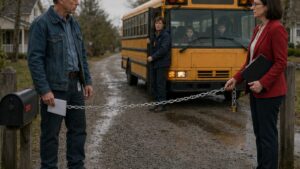
Richard fed the chain under the axle housing with a practiced shove. The first loop clanged against steel. He drew it around, pulled slack through, then wrapped it again, tighter this time, the iron links biting against greasy metal. The chain was Brian’s chain. The truck was Brian’s leverage. Richard made them meet.
Brian’s voice cracked across the road. “Touch that chain and I’ll have you arrested.”
Richard reached into his back pocket.
The padlock was not new. It was a massive old brass-bodied lock with a hardened shackle, scarred from years on the fuel chain and heavy enough to bruise if dropped. Richard had oiled it that morning before the SUVs arrived, not because he knew exactly what would happen, but because old tools deserved to be ready.
Eric stared at it. “You had that on you?”
Richard slid the shackle through two links and closed it around the chain.
The sound was final.
Brian lunged forward, then stopped short when he realized no one else had moved. Even his own men looked unsure now. A chain meant to drag a tractor was locked to the axle of the truck meant to do the dragging. The remote hung useless against Eric’s chest. If the winch pulled, it would pull the truck against itself, twist metal, dig tires, or both.
Richard stood.
Brian pointed at the lock. “Remove it.”
“No.”
“That is sabotage.”
“That is my road.”
“That is my equipment.”
Richard looked down at the chain wrapped around the axle. “You brought it across the line.”
Brian turned to Eric. “Cut it.”
Eric shook his head once before he could stop himself. “Not under tension.”
“It’s not under tension.”
“It will be if somebody hits that remote. And I’m not putting a cutter near an axle while you’re shouting.”
The answer hung in the road. For the first time, one of Brian’s men had refused him in public.
Brian’s face darkened. “You work for me today.”
“I work the truck,” Eric said. “And that truck is not moving like this.”
A faint sound came from across the road. Richard turned just enough to see Jennifer Hill holding her phone up now. Not high, not bold, but pointed toward the truck and the chain. Her mouth was pressed flat. She looked frightened and ashamed and determined in the same breath.
Brian saw the phone too.
“Ma’am,” he called, “you need to stop recording an active enforcement action.”
Jennifer lowered it halfway.
Richard did not tell her to keep filming. That would have made her choose in front of them. He only looked at the iron marker beside the tripod, then back at her. Her phone rose again, a few inches.
Brian stepped toward Richard, voice low. “You think this is clever. You think because you know mud and old machines, you can turn this into some county-road circus.”
Richard wiped chain oil from his hands on his work pants. “I think you should move your tripod.”
Brian’s lips parted in disbelief. “The tripod?”
“It’s still on my side.”
The red laser beam continued its thin bright cut through the grass, indifferent to men and threats. Brian looked at it, then back at Richard, and something in him gave way to anger.
“You have no idea what’s behind this,” Brian said. “You think I woke up wanting to fight over weeds? There’s a schedule. There are signed contracts. There are crews waiting because people like you drag your feet until every permit dies in committee. I was hired to make sure one farmer with a rusted toy does not hold up an entire development corridor.”
“Wetland,” Richard said.
“Access corridor.”
“Wetland.”
Brian’s jaw flexed. “Call it whatever keeps you warm at night.”
Richard nearly told him then. Nearly said the police chief was inside the farmhouse, that the coffee on the kitchen table was not only Richard’s, that the folders Brian wanted had already been opened by someone with a badge and a county seal. The words rose, tempting and sharp.
He swallowed them.
Edward had said, Let them show what they came to do.
Richard had not liked that. Letting men show harm meant standing still while they harmed something. It meant Jennifer thinking he was alone. It meant Eric pretending orders washed his hands clean. It meant the wetland had to endure the insult long enough for the insult to be recorded.
Brian took out his phone. “Fine. You want law? I’ll bring law.”
Richard did not answer.
Brian held the phone up as if it were a weapon. “I’m calling Police Chief Edward Lewis personally. Then we’ll see how long your little lock stays on my truck.”
The farmhouse screen door shifted in the breeze behind Richard, tapping once against its frame, but it did not open.
Chapter 5: The Coffee Cup Behind the Farmhouse Door
The farmhouse door opened before Brian finished dialing.
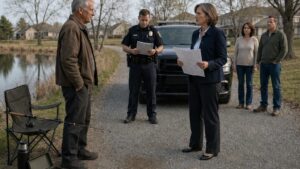
Everyone turned toward the sound. The screen door creaked outward, slow and ordinary, and Edward Lewis stepped onto the porch with a white coffee mug in one hand and a folder tucked under his other arm. He wore no hat. His badge sat clipped at his belt, plain in the morning light. He looked less like a man arriving than a man interrupted.
Brian’s thumb froze over his phone.
Edward took one step down from the porch. “No need to call. I’ve been here all morning.”
For three seconds, the road belonged to the sound of the idling flatbed and the birds settling back into the reeds.
Then Brian found his voice. “Chief Lewis. Good. You can witness obstruction and equipment tampering.”
Edward sipped his coffee.
It was such a small thing that it pulled the anger out of the air and exposed the panic underneath it. Brian’s men looked at one another. Eric shifted beside the trapped axle. Jennifer lowered her phone, then raised it again as if she did not trust her own hands.
Edward came down the path from the porch, careful not to step onto the soft ground. “Richard asked me here before sunrise.”
Brian’s eyes snapped to Richard. “So this was staged.”
Richard felt the accusation land where guilt already waited. He had staged nothing, yet he had hidden enough to let others think he had. Jennifer’s face changed when she heard Edward’s words. Not betrayal, exactly. More like the hurt of someone realizing she had been asked to be brave without being told she was not alone.
Edward stopped near the flat stone. “He asked me to review records.”
“My authorization is valid,” Brian said. “Temporary site access, signed and stamped.”
“Let me see it.”
Brian hesitated for half a breath too long, then handed over the laminated order.
Edward set his coffee on the fence post beside the old iron marker. The mug steamed faintly. He took the order, angled it away from the glare, and read without expression. When he reached the highlighted parcel line, his eyes paused.
Richard watched Brian watch Edward.
“That order uses C-147,” Edward said.
Brian’s answer came too fast. “That is the access parcel.”
“No,” Edward said. “It is not.”
Brian laughed once. “With respect, Chief, this was filed through the court. If there is a clerical issue, it is not grounds for a farmer to immobilize my equipment.”
Edward looked past him to the tripod. “Why is your surveyor on C-143?”
No one spoke.
The survey operator stepped away from the instrument as if distance might make him less responsible.
Brian pointed at the map. “The disputed line is under review.”
“Disputed by whom?”
“By the filing party.”
“Filed under a tax parcel number that does not exist in the current county record?”
That changed the road.
Not loudly. No one gasped. No one shouted. But the men in vests stopped looking at Richard as the problem and started looking at the paper in Edward’s hand. Eric’s face tightened. Jennifer took one slow step closer to the fence.
Brian’s voice cooled. “You’re overstepping.”
Edward opened the folder under his arm. Inside were copies of tax filings, wetland subsidy documents, parcel maps, and a paper Richard recognized by its water stain on the corner. His own maintenance log summary. Edward had spread those pages across the kitchen table before dawn while Richard poured coffee and tried not to look through the window.
“Your employer filed a claim last quarter classifying this buffer strip as nonproductive access acreage,” Edward said. “Two weeks later, another filing described the same strip as privately maintained dry frontage. Then this order appears, citing a parcel suffix that belonged to an old transfer strip north of the creek.”
Brian’s smile had vanished. “I’m security. I don’t prepare tax filings.”
“No. You execute site control.”
“I enforce lawful access.”
“You set a tripod across the line before service. You brought a tow truck before verification. You ordered a chain attached to private equipment while the boundary was actively disputed.”
Brian jabbed a finger toward Richard. “He locked my truck.”
“He locked your chain to your axle after your chain crossed his road.”
“That is not how this works.”
Edward glanced at the padlocked axle. “It appears to be how it worked today.”
A sound almost escaped Jennifer. Not laughter. Something tighter. She pressed a hand to her mouth.
Brian turned on her. “You saw him interfere.”
Jennifer lowered her hand. Her face had gone pale, but she did not step back.
“I saw your tripod,” she said.
Brian stared.
She swallowed. “It was past the iron marker. I saw it before Richard said anything.”
Richard looked down.
There it was. Not a speech. Not heroism in bright colors. Just one sentence, paid for with fear.
Edward nodded to her. “Thank you.”
Brian’s face hardened into calculation. “This is local favoritism. He calls you before dawn, you sit in his house drinking coffee, and now you’re manufacturing a criminal issue out of a civil access order.”
Edward closed the folder. “I came because the county assessor flagged inconsistencies and Richard had records going back far enough to compare.”
Brian shifted. “Then call the assessor. Call the developer’s counsel. Do this correctly.”
“I already called the state tax investigator.”
For the first time, Brian looked toward the open road, past the tow truck, past Jennifer, as if measuring the distance to escape.
Eric saw it too.
Brian’s tone changed. “Eric acted independently on the chain.”
Eric’s head snapped up. “What?”
“You chose the hook point,” Brian said. “You were responsible for equipment movement.”
Eric’s mouth opened, then closed. Mud clung to the bottoms of his boots. The remote lay against his chest like a brand.
Richard felt the old anger move again. He had disliked Eric for lowering the chain. Now he saw a man trying to decide whether obedience would save him or bury him.
Edward looked at Eric. “Did Mr. Carter order you to attach the winch?”
Eric glanced at Brian.
Brian said, “Careful.”
That one word did more than any confession could have done.
Eric’s shoulders dropped. “Yes. He ordered it.”
Brian stepped toward him. “You were hired to—”
“Enough,” Edward said.
The word was not loud, but it carried down the ditch and into the grass.
Edward lifted his radio from his belt. “Dispatch, this is Lewis. Send the state units to the Clark wetland access. Preserve all vehicles and equipment that crossed the protected boundary. Possible tax fraud, unlawful entry, and evidence tampering risk. No removals except under state direction.”
Brian stared at the radio as if it had betrayed him personally.
Richard looked at the tractor, at the chain, at the tripod, at Jennifer standing beside the old marker now. He had thought silence kept the truth safe until the right person could carry it. But the truth had not been safe. It had stood outside with everyone else, waiting for him to stop hiding it behind his farmhouse door.
Edward set the radio back on his belt.
Brian’s phone began to ring in his hand. The name on the screen was not visible to Richard, but Brian looked at it and did not answer.
In the distance, beyond the blocked road, a siren chirped once.
Chapter 6: The Fraud Hidden in the Buffer Zone
The first state trooper opened the back of Brian’s SUV and pulled out a second map.
It was folded badly, shoved between a black equipment case and a hard plastic box of survey stakes. When the trooper spread it over the hood, the paper tried to curl back on itself. Blue ink marked a proposed access lane straight through Richard’s wetland buffer, clean as a knife line. The parcel number printed at the top ended in seven.
Someone had crossed out the seven by hand and written three.
Edward leaned over it without touching. Richard stood beside him, the tractor key still in his pocket, feeling the shape of it against his thigh like a question.
Brian barked, “That is not mine.”
The trooper looked at him. “It was in your vehicle.”
“I said it’s not mine. We transport materials provided by the client.”
Eric, standing near the flatbed with one hand on the useless remote strap, looked at the map and then away.
Richard stepped closer. The hand-written three was dark, heavy, pressed hard enough that the pen had dented the paper. Whoever had changed it had wanted the old parcel to become his land by force of ink.
Edward glanced at Richard. “Do you have the maintenance ledger?”
Richard looked toward the farmhouse.
He had not wanted to bring that ledger into the road. It was not official in the way Brian respected. It was a battered green book with swollen pages and his father’s handwriting in the first half, Richard’s in the second. Dates, water levels, culvert checks, reed clearing, fence repairs, inspector visits. Mud and time had made the cover soft at the corners.
“It’s inside,” Richard said.
Edward waited.
The waiting was worse than an order. Richard understood what it asked. Not proof hidden in a kitchen. Not truth kept clean while other people took the risk of speaking. His hand went into his pocket, closed around the tractor key, then came out empty.
“I’ll get it,” he said.
Brian laughed, too quickly. “Wonderful. More homemade records.”
Richard walked to the farmhouse. No one stopped him. On the porch, Edward’s coffee had left a ring on the rail where he had set the mug earlier. Richard stepped inside and saw the kitchen as it had been before the morning broke open: chairs pulled out, two cups on the table, folders spread near the sugar bowl, the old green ledger waiting at the center.
For a moment he saw his father’s hand there instead of his own, knuckles swollen, pencil tucked behind one ear, saying, A man who keeps land keeps account. Not for them. For the land.
Richard took the ledger.
When he returned, the road had tightened around the map. Jennifer stood near the fence marker, hands clasped, as if moving away now would undo what she had already said. Eric watched the trooper photograph the folded creases. Brian paced three steps one way, three steps back, trapped by vehicles he had brought to trap Richard.
Richard placed the ledger on the flat hood of the state vehicle. The green cover looked small beside the crisp forged map.
Brian snorted. “You expect that to override court filings?”
“No,” Richard said. “I expect it to remember what your filing forgot.”
He opened to a page marked with a strip of old feed sack paper. The handwriting changed halfway down. His father’s square letters ended in the spring of one year; Richard’s narrower script began that fall. He did not explain why.
Edward pointed to an entry. “Read that line.”
Richard did.
“West buffer channel cleared from marker C-143 to lower culvert. Standing water held inside protected strip. Federal inspector present.”
The date was twenty-two years old.
Edward laid the forged map beside the ledger. The proposed access line crossed the same channel the ledger named, the channel the developer’s tax filing had claimed did not exist as protected wetland.
The trooper photographed both pages together.
Brian’s voice lowered. “This is absurd. Old farm notes don’t prove intent. You people are turning a boundary issue into a criminal story because he called his friend before I arrived.”
Richard looked at him then. “I didn’t call him before you arrived.”
Edward’s eyes shifted, but he did not interrupt.
“I called him last night,” Richard said. “After the assessor’s clerk told me someone had asked for emergency access verification on my parcel without notifying me.”
Brian seized on it. “So you did stage this.”
Richard felt the road waiting.
He could let Edward answer. He could step back into the old safety of saying little and letting someone official carry the weight. It had worked so far, mostly. It had also left Jennifer alone at her mailbox, Eric pretending not to know, and the wetland marked by a red beam while Richard protected his pride inside his own silence.
“No,” Richard said. “I prepared for it.”
Brian’s expression flickered.
Richard opened another page in the ledger. “This field floods if the shoulder breaks. The water carries silt into the lower channel. If your truck cuts through there, the repair takes months. If your access road goes where that map says, the wetland dies from the edge inward. You don’t have to care. I do.”
Brian looked away, but not before Richard saw the strain beneath his contempt.
“I clear sites,” Brian said. “That’s what I do. Every job has someone standing in front of equipment with a reason the rules shouldn’t apply to them.”
“The rules do apply,” Richard said. “That’s why you’re angry.”
Eric made a quiet sound, almost agreement.
Edward turned to him. “Mr. Roberts, did Mr. Carter know the boundary was disputed before he ordered the chain attached?”
Eric rubbed both hands over his face. Grease streaked one cheek. “He knew the landowner objected.”
“That’s not what I asked.”
Eric glanced at Brian. The contractor’s stare was hard, warning and pleading at once. Richard saw then that Brian was not only cruel. He was cornered by the same machine he served. If the access failed, he became the man who could not move one old farmer. If the fraud surfaced, he became the disposable hand that touched the dirty work.
Eric looked at Edward. “Yes. He knew. We were told not to argue markers. Just establish position.”
Brian’s face went white with anger. “You coward.”
Eric’s eyes hardened. “You told me to hook it anyway.”
The trooper wrote that down.
Brian turned on Richard, voice rising. “You wanted this. You wanted a show. You sat in that house with the police chief and waited until my truck was in the road so you could play victim.”
Richard stepped away from the ledger and toward him. Not close enough to threaten. Close enough that Brian had to stop pacing.
The tractor key lay in Richard’s palm now, rust-dark and ordinary.
“My father marked this land when men like you called it swamp,” Richard said. “I maintained it when your developer called it frontage. You call it access because that makes it sound empty.”
Brian’s eyes dropped to the key.
Richard closed his fingers around it. “This land has a longer memory than your paperwork.”
Chapter 7: The Vehicles Taken for Evidence
A state trooper hooked Brian’s luxury SUV while Brian shouted that nobody had permission to touch it.
The trooper did not shout back. He bent, secured the chain beneath the front frame, then stood and stepped aside as another trooper photographed the license plate, the tires, the mud line along the rocker panel, and the streak of wetland grass caught under the running board.
“That vehicle never crossed his boundary,” Brian said.
Edward Lewis looked at the grass hanging from the undercarriage. “Then it picked up protected sedge from the road?”
Brian spun toward Eric. “Tell them where the SUV was parked.”
Eric looked exhausted. “Past the stone.”
“Not past the marker.”
“Past the stone,” Eric repeated. “Near enough they’re going to measure it.”
The words landed harder because they were plain. Not accusation. Not apology. Just a man finally choosing the shape of what happened over the shape of what he had been paid to say.
Brian’s mouth tightened. He turned back toward Edward. “I was following client direction.”
“You were directing the crew,” Edward said.
“On a civil access matter.”
“A civil access matter does not require a security convoy, a pre-positioned tow truck, and a modified parcel map.”
A second trooper lifted the laser surveyor from the wet grass. Its red beam jittered across the fence rail, then slashed over Richard’s boot before the trooper switched it off. The sudden absence of that red line made the whole wetland seem to exhale. The reeds behind the ditch moved in a faint ripple. Water clicked under the culvert, quiet and patient.
The survey operator protested weakly. “That equipment is calibrated.”
“It will remain calibrated in evidence,” the trooper said.
He folded the tripod legs one by one. Each metallic snap felt different from the first. Less like a trap closing now. More like one being disarmed.
Jennifer Hill stood beside the iron marker, not touching it. When a trooper asked where she had been standing when she saw the tripod placed, she walked to her mailbox first, then retraced her steps. Her voice shook through the first answer but steadied by the second.
“I saw the leg go in there,” she said, pointing to the wet impression in the grass. “Inside the marker. I didn’t say anything at first.”
The trooper wrote without looking up. “Why not?”
Jennifer glanced at Richard.
Because she was afraid, Richard thought. Because everyone on this road had learned the price of being first. Because he had let her stand there thinking the morning had only one honest witness.
Jennifer said, “I didn’t want trouble.”
The trooper nodded as if that, too, belonged in the record.
Richard turned away before she could apologize with her eyes again. He did not want to make her smaller for having been frightened. There had been enough of that already.
The tow truck brought by the state idled at the open road beyond Jennifer’s mailbox. Its driver waited until the photographers finished with Brian’s SUV, then tightened the line. The luxury vehicle rolled backward an inch, then another, tires wet and dark, mud peeling off in strips. Brian took one step after it.
A trooper blocked him with a palm held low. “Stand back.”
“That vehicle contains private security files.”
“It contains evidence.”
“You don’t know what it contains.”
“That is why we secure it.”
Brian looked at Edward. For the first time all morning, his voice broke away from command and entered negotiation. “Chief, separate me from the developer’s tax issue. I’m a contractor. I don’t file acreage reports. I don’t classify wetland buffers. My team was sent here with an order and equipment. You know how this works.”
Edward’s face remained calm, but Richard saw the strain in his eyes. Caution had kept Edward quiet all morning. Now caution had become something else: a deliberate refusal to let Brian wriggle into the gap between the hand that signed and the hand that pushed.
“You crossed the line before service,” Edward said. “You ignored the marker. You ordered the tow. You threatened arrest to force compliance.”
Brian jabbed toward Eric. “He hooked the chain.”
Eric’s laugh was short and bitter. “I tried to wait.”
“You took the job.”
“So did you.”
Brian’s hand curled. One of the troopers shifted nearer, and Brian saw it. He swallowed whatever he had been about to say.
Richard stood beside the tractor, still holding the key. The old machine had not moved. Mud had dried in streaks on the rear tires. The chain around the flatbed’s axle sat under the truck like a verdict, the padlock dull against dark steel. It amazed Richard how little force it had taken at the end. Not little strength. Little motion. One loop. One lock. One refusal placed at the exact point where Brian’s machine could not argue its way free.
Edward came to him quietly. “We need photographs before that lock comes off.”
Richard nodded.
“And after that, a state driver will back the flatbed out. Slowly.”
Richard nodded again.
Edward studied him. “You all right?”
Richard looked at Brian’s SUV being hauled away past the mailbox. The man who had pointed at Richard’s farmhouse like he already owned it now stood empty-handed in the road, watching his own world get tagged, photographed, and pulled from under him piece by piece.
Richard felt the temptation then.
Not to laugh. Not exactly. To say something small and sharp. To give Brian the same kind of sentence Brian had given him. Move, old man. Not anymore. Last chance.
It rose in him clean and poisonous.
He closed his hand around the key until the teeth pressed into his palm.
“I’ll be all right when the grass is clear,” Richard said.
Edward held his gaze for a moment, then nodded.
A trooper approached Jennifer with a clipboard. She stepped closer to the iron marker and signed where he indicated. When she finished, she did not leave. She stayed there, beside the line she had been too afraid to name, and that was the only apology Richard needed from her.
The laser surveyor went into a padded evidence case. The forged map followed in a separate sleeve. Brian’s second SUV was marked, then the smaller equipment trailer. Each tag made Brian’s face harder and paler, as if every label took another piece of his uniform away.
At last only the flatbed remained.
Eric looked at the chained axle. “You’ll need the lock off before you pull.”
“Not yet,” the trooper said.
Photographs flashed beneath the truck. Mud, chain, axle, padlock. Brian watched the process with a strange helpless fury. He had arrived with the largest machine on the road, and now that machine could not leave until Richard allowed the lock to open.
Edward turned to Brian. “You’ll come with the state unit.”
Brian’s head snapped up. “Am I under arrest?”
“You are being detained while the scene is secured and your statements are checked against the evidence.”
“This is career suicide for everyone involved.”
“No,” Edward said. “It’s recordkeeping.”
The trooper guided Brian toward the waiting state vehicle. Brian resisted only by walking slowly. At the edge of the road, he looked back once at Richard, at the tractor, at the wetland, at the old fence marker that had beaten his map by standing still.
Richard said nothing.
Brian was led away from the road he had tried to own while, behind him, the flatbed tow truck strained backward against the locked chain around its own axle.
Chapter 8: Coffee Steam Over the Locked Road
Richard stood alone with the padlock key while tire marks stopped inches short of the protected grass.
The road was not quiet yet. Engines idled beyond the mailbox. Troopers spoke in low voices. A camera clicked under the flatbed one last time. But the loud part of the morning had passed, and what remained felt more delicate. Mud pressed down. Grass bent. The iron marker leaned in its old direction, its chipped number catching light through the smear Richard had made with his thumb.
The red beam was gone.
Edward came over with the evidence photographer. “All right,” he said. “You can unlock it.”
Richard crouched beside the axle. The chain was streaked with mud where he had dragged it and bright in places where it had bitten against steel. His hand found the padlock. For a moment he did not insert the key.
That lock had held more than a chain. It had held the shape of the morning in place long enough for people to see it.
He turned the key.
The shackle opened with a dull click.
Eric stepped forward, then stopped. “Want me to take it?”
Richard looked at him.
Eric’s face carried shame without asking anyone to comfort it. “It’s my chain,” he said. “I can clear it.”
Richard let go.
Eric knelt in the mud and unwound the links from the axle slowly, careful not to scrape more than he had to. When he finished, he did not meet Brian’s absent gaze because Brian was already in the state vehicle. He only set the chain on the flatbed and handed the padlock back to Richard.
“For what it’s worth,” Eric said, “you were right about the angle.”
Richard put the lock in his coat pocket. “I know.”
Eric almost smiled, then looked away.
The state driver climbed into the flatbed. With two troopers guiding from either side, the truck backed out inch by inch. Its tires gripped, slipped, then climbed onto firmer gravel. The mud at the shoulder trembled but did not collapse into the ditch. Richard watched the line between damage and survival hold.
Only after the flatbed cleared the stone did he breathe fully.
Edward stood beside him. “I’ll make a public statement by this afternoon. Clarify the boundary issue, the seizure, the tax investigation.”
Richard looked across the road to where Jennifer had walked back toward her mailbox but had not gone inside. She kept looking at the wetland, then at her phone, as if the morning had given her proof she did not know how to carry.
“Before that,” Richard said, “I want the markers repaired.”
Edward blinked. “The markers?”
“Recorded. Photographed. Repainted if they’ll let me. The tripod holes filled. The shoulder checked before any rain.”
Edward studied him, then nodded. “I can have the conservation office send someone.”
“Today.”
“I’ll ask.”
“Tell them the line was crossed today.”
Edward’s expression softened, not with pity but with understanding that arrived late and stood still when it came. “I will.”
Richard walked to the tractor and climbed into the seat. He did not start it yet. From that height, the wetland opened beyond the ditch in its plain, stubborn beauty. No crowd applauded. No neighbor cheered. There was only flattened grass where the tripod had stood, tire marks in the road, state tags flapping from seized equipment, and a farmhouse door left open since Edward stepped through it with coffee.
Richard had thought the worst thing would be losing the land.
He understood now that another loss had been working on him longer and quieter: the fear that the land could be dismissed before it was taken, renamed before it was damaged, treated as empty because he was the only one left saying otherwise.
Edward came to the tractor’s side. “Richard.”
Richard looked down.
“You didn’t ask me here for revenge.”
“No.”
“Why did you?”
Richard’s hand rested on the steering wheel, fingers curled over worn enamel. He could have said tax records. He could have said parcel fraud. He could have said he knew Brian would come early and hard. All of that was true and easier than the rest.
Instead he looked at Jennifer, still standing by her mailbox.
“I thought if it was just me saying it,” he said, “nobody would believe the land mattered.”
Edward did not answer at once.
The words had cost more than Richard expected. They made him feel exposed in a way Brian’s insults had not. Anger could be held like a tool. Shame had no handle.
Jennifer crossed the road carefully after the state driver waved her through. She stopped near the iron marker, leaving respectful space between herself and Richard.
“Will it ever feel safe again?” she asked.
Richard looked at the wet grass where the tripod had pierced it. He looked at the entrance road, at the old tractor, at the farmhouse, at the channel still carrying water because the shoulder had held.
“No,” he said.
Jennifer’s face fell slightly.
Richard climbed down from the tractor. “Not if safe means nobody tries again.”
She nodded, hurt but listening.
He took the thermos from where he had left it in the tractor’s side box before dawn. The metal was scratched, the cap dented, the coffee inside still hot enough to steam when he poured it into the cup.
“But it can be watched,” he said.
The last seized vehicle rolled away beyond the mailbox, tires humming on the county road until the sound thinned and disappeared. Brian did not look back from the state car. Eric’s flatbed followed under escort, its winch silent, its chain stowed uselessly along the bed.
Edward lifted his mug from the fence post where he had left it. The coffee inside had gone cold. He looked at Richard’s steaming cup and almost laughed.
Richard held out the thermos.
Edward shook his head. “You keep it.”
Jennifer stood beside the marker, then bent and pressed the loosened grass back around the tripod holes with her fingertips. It was not enough to repair anything. It was enough to mean she saw it.
Richard drank his coffee. Heat moved through his chest, steady and plain.
The road remained blocked by the tractor for a few minutes more, not because it needed to be, but because Richard wanted the final record to show the land untouched after the machines left. Then he climbed back into the seat, inserted the old key, and started the engine.
No one laughed this time.
He eased the tractor forward, clearing the entrance without cutting the shoulder. The iron body rolled past the marker, past Jennifer, past Edward with his cold mug, then came to rest beside the shed where it had begun the morning.
Richard shut it down.
The wetland settled around the silence. Water moved under the culvert. Reeds shifted back into place. Coffee steam rose beside the rusted tractor while the road, the grass, and the old iron line remained exactly where they belonged.
The story has ended.