When the Trailer Blocked His Driveway, George Found the Rule His Neighbor Feared Most
Chapter 1: The Trailer Waiting Across the Only Way Home
George’s headlights stopped against two broad metal doors where the road should have been.
For several seconds he did not understand what he was seeing. Rain slid down the windshield, bending the red reflectors into long, trembling streaks. Then the wipers cleared the glass, and the trailer settled into shape: twenty feet of white commercial siding, dual axles, black wheel wells, and the blue wave logo Tyler King used on every truck in his pool-service fleet.
The trailer stood crosswise near the narrowest part of the drive.
George eased his pickup forward until the headlights filled its rear doors. There was no driver in the cab of the tow vehicle because there was no tow vehicle. The trailer had been unhitched and left on its stabilizing jack, angled just enough that George could not pass on gravel.
He checked the clock. 8:17.
The shared driveway ran two hundred and twenty feet from the county road, past Tyler’s property, then along the edge of George’s pasture before reaching the small cedar-sided house where George had lived for eleven years. The gravel lane was barely wide enough for two vehicles to squeeze by in dry weather. Tonight, the shoulder had dissolved into dark mud.
George lowered his window. Rain struck his sleeve. From somewhere beyond the trailer came the hollow dripping of water from its roof.
He pressed the horn once.
Nothing moved.
A porch light glowed at Tyler’s house, fifty yards away. A television flickered blue through the front windows. Someone was home.
George picked up his phone, found Tyler’s number, and called. It rang until voicemail answered.
“This is George,” he said. “Your trailer is blocking the drive. I need you to move it.”
He ended the call before irritation could enter his voice.
The sensible choice was to wait. Tyler might call back in five minutes. George had groceries in the bed beneath a cover, and nothing inside the bags would spoil quickly in the cold. He could reverse to the county road and park there.
But the road had no shoulder, only a drainage ditch and a line of mailboxes. Leaving the pickup there overnight would invite a citation or an accident. Walking the rest of the way meant crossing the same wet ground while carrying groceries in the dark.
George looked at the grass beside the trailer.
It sloped toward a shallow swale. In summer, he drove the riding mower over it without thinking. After two days of rain, it had the sheen of clay beneath the blades.
He shifted into four-wheel drive.
The pickup’s front tires left the gravel slowly. The steering wheel resisted as the left side sank lower than the right. Mud pressed outward from the tread. George kept his foot steady, trying not to spin the wheels.
For one moment, the truck stopped moving.
A pressure opened beneath his ribs—not pain exactly, but something cold and immediate. His hands tightened around the wheel. The trailer’s red reflectors hovered ahead of him like fixed eyes.
“Come on,” he whispered.
He eased off the accelerator, turned slightly downhill, then tried again. The rear tires slipped. Mud struck the underside of the truck in wet, heavy blows.
The vehicle lurched forward.
George passed the trailer with less than a foot between his passenger mirror and the white siding. The left tires dug a trench through the shoulder. When he finally regained the gravel, the truck rocked hard enough to send one grocery bag tipping against the tailgate.
He stopped ten yards beyond the trailer and sat with both hands still on the wheel.
Rain tapped the roof.
The trailer had not moved. Tyler had not called.
George stepped out. His boot sank to the welt. The headlights illuminated two deep tracks curving around the obstruction, black against the flattened grass. Water was already gathering inside them.
He took photographs from four angles. One showed the trailer’s position in relation to the gravel. Another showed the jack planted beside the drive. A third included his tire marks and the narrow clearance. For the last, he walked back far enough to capture the entire blocked lane, Tyler’s lighted house visible beyond it.
He saved the time and date automatically.
At home, George carried the groceries inside and wiped mud from the kitchen floor where his boots had crossed. He set a can of soup in the wrong cupboard, noticed, and left it there.
His phone remained silent.
He ate standing at the counter. Twice he looked through the front window toward the dark line of the drive, though the trailer was too far away to see.
At ten thirty, he called again.
No answer.
At eleven, a message appeared.
Busy. Deal with it in the morning.
George read the words once. Then again.
He typed, The driveway must remain passable.
He erased it.
He typed, This is an access easement, not a storage area.
He erased that too.
Finally he set the phone facedown.
In bed, he could hear rainwater moving through the gutter. Every few minutes, his mind returned to the moment the wheels had stopped in the mud. He pictured an ambulance at the county road. A fire engine unable to turn. A delivery vehicle backing blindly toward traffic.
He rolled onto his side and shut his eyes.
The image remained.
At seven the next morning, a van sounded its horn from the far end of the driveway.
George pulled on yesterday’s jeans and went outside. The rain had weakened to mist, but the trailer still stood in the same place. Beyond it, a delivery driver had stopped beside the mailboxes with hazard lights blinking.
The driver lowered his window when George approached.
“Package for Anderson,” he said. “I can’t get through there.”
George glanced at the long box resting on the passenger seat. Replacement rails for the basement stairway. Nothing urgent.
“That’s all right. I’ll carry it.”
The driver looked from George to the trailer. “They leave that there often?”
“No.”
The answer came too quickly.
George accepted the box and signed on the driver’s screen. As the van pulled away, he stood at the entrance to the drive with the package balanced against his hip.
Behind the trailer, Tyler’s garage door rose.
Tyler stepped out in a blue work polo, coffee mug in one hand and truck keys in the other. He glanced toward George, then toward the trailer, as if seeing both for the first time.
George carried the package down the wet lane. He stopped where Tyler could hear him without either man raising his voice.
“I need it moved today.”
Tyler took a drink from his mug. “I’ve got crews out.”
“It’s blocking the driveway.”
“There’s room on the side.”
“There was mud on the side.”
Tyler looked at the tracks. His expression barely changed.
“You got through.”
George felt the weight of the box pressing into his forearm.
“That isn’t the point.”
Tyler unlocked his truck. “It’ll be there through Friday. Maybe Saturday. Depends when I need the equipment.”
George looked at the trailer, then at the rut filling slowly with brown water.
“All week?”
“That’s what I said.”
Tyler climbed into his truck and shut the door.
Chapter 2: Two Words Hidden Inside an Old Easement
Tyler smiled before George finished asking him to move the trailer.
It was a small smile, more weary than friendly, as if George had brought him a problem too minor to deserve the interruption. He leaned against the porch frame with one shoulder while a dog scratched behind the closed storm door.
“I’m not asking whether you can use the drive,” George said. “I’m asking you not to store the trailer in it.”
Tyler folded his arms. “It’s not stored. I’m using it.”
“It hasn’t moved since yesterday.”
“That’s because I don’t need it today.”
George looked past him. Pool-cleaning poles leaned beside the garage. Plastic chemical drums stood beneath a tarp. A second company truck occupied most of the concrete pad.
“The easement gives you passage,” George said. “It doesn’t give you parking.”
Tyler’s smile widened.
“You still keeping county records in your head?”
“I remember how words work.”
“This isn’t the courthouse, George. It’s a driveway.”
“It’s the only way to my house.”
“And you drove around.”
“Through my yard.”
Tyler’s face tightened slightly, the first sign that he was no longer amused. “The HOA doesn’t want commercial rigs on the road. You know that.”
“I know what the recorded easement says.”
“You know what people have actually done for years.”
“I’ve never agreed to that trailer being left there.”
“You never complained before.”
“It never blocked me before.”
Tyler exhaled through his nose. “Look, I’ve got a business to run. I can’t rearrange everything every time you decide a tire is too close to your gravel.”
George waited. He had learned during thirty-two years in the county records office that silence often made people add the sentence they should have withheld.
Tyler did.
“It’s a hobby-sized operation anyway. Not like I’ve got semis coming through.”
George glanced toward the commercial trailer with its company logo, equipment racks, and printed service number.
“A hobby.”
“You know what I mean.”
“I do now.”
The dog barked once behind the door. Tyler straightened.
“I’m done talking about this.”
George could have told him then.
He could have said that access was not an abstraction to him. He could have explained why the sight of an obstructed lane made his hands tighten before he understood he was afraid. He could have said that there had once been flashing lights at the county road and men carrying equipment down the drive because a vehicle could not reach the house.
Instead, he nodded.
“Thank you for your time.”
Tyler blinked, apparently surprised by the courtesy.
George turned and walked home.
His study had been his wife’s sewing room before illness narrowed her world to the downstairs bedroom. After she died, George moved in a desk, two steel filing cabinets, and a green banker’s lamp from the county surplus auction. He kept the window curtains half closed to protect the papers from sunlight.
The safe stood inside the lower cabinet.
George entered the combination and removed a flat archival envelope. On its face, in his own block handwriting, were the words ACCESS—PARCEL 14B.
He laid the documents beneath the lamp.
The first page was the warranty deed. The second was a county recorder’s map dated May 1996. A hatched strip followed the driveway from the public road across what was now George’s land to the adjoining parcel.
He found the easement language on the third page.
A perpetual nonexclusive easement for purposes of ingress and egress.
George read the sentence twice, though he had remembered it correctly.
Ingress and egress.
Entry and exit.
Movement, not occupation.
He traced the hatched strip on the map. The easement was twenty feet wide, centered on the gravel lane. It did not grant parking, storage, staging, or exclusive use. It did not mention commercial vehicles. It did not transfer possession.
A dried crescent of mud had flaked from his shoe onto the floor beside the desk. George left it there while he compared the photograph of the trailer with the map.
The jack sat within the easement. So did both left wheels. The angle forced any passing vehicle beyond the recorded strip and onto George’s unburdened land.
The document answered one question and opened another.
If Tyler understood the right as passage, why was he so certain George could do nothing?
George checked the HOA covenants. Commercial vehicles over a specified length could not be parked overnight on the subdivision’s public-facing streets. Nothing in the rule authorized residents to move them onto another owner’s land.
He searched his email for board notices. There were reminders about garbage bins, fence stains, irrigation schedules, and winter parking. None mentioned Tyler’s trailer.
At noon, George called the county recorder’s office.
The clerk confirmed the easement had not been amended.
“No additional parking agreement?” George asked.
“Nothing recorded under either parcel.”
“And no license attached to the plat?”
“Not that I can see.”
George thanked the clerk and hung up.
He should have called Virginia Miller next. As HOA president, she would want to know the dispute involved a covenant the board had apparently failed to address.
Instead, George opened a blank document.
He wrote Tyler’s address at the top, followed by the date. The first paragraph identified the recorded easement. The second quoted the limiting purpose. The third requested removal of the trailer within ten calendar days and stated that future obstruction would be documented.
He avoided accusations. He did not mention zoning, permits, towing, or damages.
When the letter was finished, it sounded like something written by a man who had no feelings about the matter at all.
George printed two copies.
Nicole called while he was signing them.
“You sound tired,” she said after he answered.
“I slept poorly.”
“Everything okay?”
“There’s a trailer in the driveway.”
“What kind of trailer?”
“Tyler’s business trailer.”
“Can he move it?”
“He can.”
There was a pause. Nicole knew the difference between her father’s short answers and his ordinary ones.
“Did you ask him?”
“Yes.”
“And?”
“He declined.”
“What are you going to do?”
George looked at the formal notice beneath his hand.
“Handle it.”
“Dad.”
“It’s a property issue.”
“That isn’t an answer.”
“It’s the answer I have.”
Nicole was quiet long enough that he could hear traffic through her car speaker.
“Don’t turn it into another file,” she said.
He looked at the safe.
“It already is one.”
He ended the call gently, before she could ask what he meant.
George sent the letter by certified mail and placed the second copy in the archival envelope. Then he photographed the trailer again. It had not moved. The tracks beside it were deeper now, widened by his morning trip to the mailbox.
At four sixteen, his phone vibrated.
Tyler had sent a photograph of the unopened certified envelope lying on his kitchen counter.
Beneath it were six words.
Lawyer up if you want. Trailer stays.
George sat beneath the green lamp with the phone in one hand and the easement map under the other.
For the first time since seeing the trailer, the pressure in his chest eased.
Tyler had stopped pretending the obstruction was accidental.
Chapter 3: The Board Asked Him to Drive Through Mud
Virginia Miller arrived while George’s pickup was trapped behind the trailer.
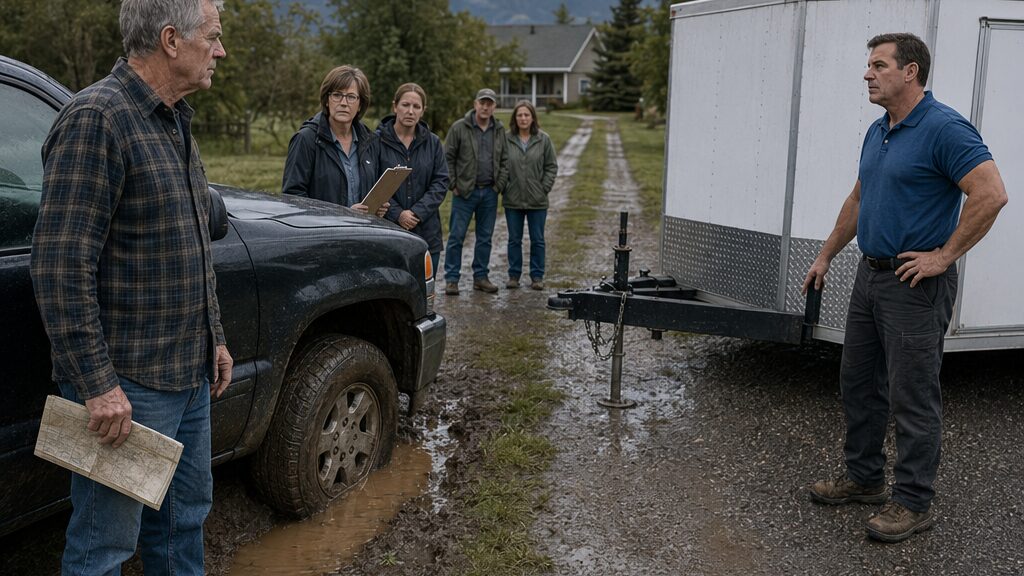
Her white SUV stopped near Tyler’s mailbox, followed by the HOA secretary’s compact car and two vehicles belonging to neighboring homeowners. Virginia stepped out holding a clipboard beneath one arm. She wore clean walking shoes unsuited to the wet shoulder and looked first at the trailer, then at George’s idling truck.
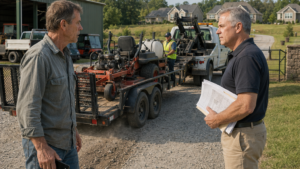
Tyler stood beside the trailer with a coil of extension cord over one shoulder.
“I thought this was a compliance walk,” he said.
“It is,” Virginia replied. “And apparently a mediation.”
“No mediation needed. George sent me a legal threat.”
George switched off the engine.
He had been returning from the hardware store when he found the trailer angled farther into the lane than before. The front passenger tire of his pickup rested in the same muddy track he had made two nights earlier. When he tried to pass, the wheel sank until the mud reached the lower sidewall.
He had stopped rather than force it.
Virginia approached his window. “Can you back up a little so we can talk without blocking everyone?”
George looked at her.
“I’m not blocking anyone.”
Her eyes shifted toward the trailer. “You know what I mean.”
“Yes,” he said. “I do.”
He stepped out carrying the folded easement map he had placed on the passenger seat that morning. Mud clung to the edge of his boot. The pickup leaned slightly toward the shoulder.
One neighbor stood with his hands in his jacket pockets. The other kept glancing at the company logo on Tyler’s trailer, as if reluctant to be seen choosing a side.
Virginia opened her clipboard.
“Tyler says the trailer is temporary.”
“Five days so far,” George said.
“Four,” Tyler corrected.
“It arrived Monday evening.”
“After business hours.”
“That does not make Tuesday disappear.”
The HOA secretary lowered her eyes, but one of the neighbors coughed into his fist to hide a laugh.
Virginia’s mouth tightened. “We’re not here to count nights. We’re here to find a practical solution.”
“The practical solution is to move the trailer.”
Tyler dropped the extension cord onto the trailer tongue. “And put it where?”
“On your property.”
“My driveway is full.”
“That is not my doing.”
“You’ve got a whole strip of grass.”
George looked down at the front tire resting in the rut. Brown water trembled around the tread.
“That strip of grass belongs to me.”
Virginia raised one hand. “Nobody disputes ownership.”
“Then why am I being asked to leave the easement so Tyler can occupy it?”
The question settled over the group.
Virginia turned toward the trailer. “Could you shift it three feet?”
Tyler shook his head. “Not without hooking up the truck, and Justin has it on a job.”
“For one night,” Virginia said to George, “could you continue using the shoulder? We can revisit this tomorrow when Tyler has the truck.”
George unfolded the map.
The paper had softened at the creases over twenty-nine years. He held it flat against the hood of his pickup, pinning one corner with his palm.
“I drove through the shoulder once because I had no other choice.”
Virginia glanced toward the lane. “And I understand that it was inconvenient.”
“No,” George said. “You understand that I got through.”
Tyler made a frustrated sound. “This is exactly what I’m talking about. He wants a courtroom over a patch of gravel.”
George did not look at him.
He pointed to the typed easement language beneath the recorded map.
“Virginia, would you read the purpose aloud?”
She hesitated. “George—”
“Just the purpose.”
The neighbors moved closer without seeming to intend to. Even Tyler leaned far enough to see the page.
Virginia adjusted the paper under the gray daylight.
“For purposes of ingress and egress.”
“Again, please.”
Her expression sharpened. “We can all read it.”
“I’m asking you as board president.”
Virginia stared at him for several seconds.
“Ingress and egress,” she said.
“Entry and exit,” George replied. “Not parking. Not storage. Not staging.”
Tyler crossed his arms. “That’s your interpretation.”
“It is the ordinary meaning of the words.”
“The board told me to keep the trailer off the subdivision road.”
Virginia’s head turned sharply toward him.
The HOA secretary stopped writing.
George felt something shift—not victory, but the loosening of a hidden board beneath the conflict.
“What did you say?” one neighbor asked.
Tyler looked at Virginia. “Last fall. You and the secretary said the road rule was getting complaints. You told me the shared drive was less visible.”
Virginia’s face lost color.
“I said you should explore options on your own lot.”
“You said, ‘Use the side drive if George doesn’t object.’”
“I did object,” George said.
“Not last fall.”
“I was never asked.”
Tyler shrugged. “You saw it there.”
“A few hours at a time. Attached to a truck.”
“So this is about duration now?”
“It has always been about obstruction.”
Virginia closed the clipboard. “This conversation is becoming unproductive.”
George folded the map once, then stopped. He looked at the muddy tire, the trailer, and the line of people waiting for him to make the scene easier for them.
For years, he had made things easier by saying less. He had let neighbors mistake quiet for agreement because correcting them required a kind of exposure he no longer trusted.
Not this time.
“I will not drive across the lawn again,” he said.
Tyler gave a humorless laugh. “Then you’re choosing to stay there.”
“No. You are choosing to keep me there.”
“George,” Virginia said, her voice lowered, “let’s not make this bigger than it needs to be.”
He met her eyes.
“You asked me to damage my land so the board would not have to enforce its own rule against a popular contractor. It is already bigger than the trailer.”
The second neighbor looked away from Tyler.
Virginia stepped closer to George, keeping her voice controlled. “If the board gave informal guidance that contributed to this, we need time to review our records.”
“You may review them.”
“And if your notice triggers a claim against Tyler, he may bring the association into it.”
“That is between Tyler and the association.”
“It may also affect every homeowner through insurance and legal costs.”
There it was—the pressure translated into the language communities understood best. Assessments. Premiums. Property values. The expense of refusing to remain inconvenienced.
Tyler watched the neighbors absorb it.
George saw the moment sympathy began to divide.
He folded the map carefully and placed it on the hood.
“I did not create this obstruction,” he said.
“No,” Virginia replied. “But you chose a formal notice before bringing the issue to the board.”
The statement struck because it was true.
George had known she should be called. He had chosen paper first because paper did not interrupt, reinterpret, or ask what frightened him.
The HOA secretary opened her folder.
“There was a discussion in September,” she said quietly. “I may have notes.”
Virginia looked at her. “Not here.”
“You asked for the record.”
“I said we would review it.”
Tyler’s expression changed. The confidence did not leave, but it narrowed.
George noticed.
“So there is a record,” he said.
“Possibly,” Virginia answered.
The secretary removed a page halfway, then slid it back when Virginia gave her a warning look.
George placed both hands on the hood of his pickup. Beneath the right front tire, mud released a soft bubbling sound as the vehicle settled another fraction of an inch.
“What happens now?” he asked.
Virginia looked toward Tyler. “He moves the trailer as soon as the truck returns.”
“Today,” George said.
“Tomorrow morning,” Tyler replied.
“Today.”
Justin’s truck appeared at the county road before either of them could continue. It turned into the drive towing a small equipment rack. Justin slowed when he saw the gathering, then stopped.
Tyler walked toward him without looking at George.
Within twenty minutes, the commercial trailer was hitched. Its jack rose from the gravel with a metallic clank. Justin guided Tyler while the trailer rolled backward, its tires passing inches from the muddy rut.
George moved his pickup onto the gravel but did not drive home.
Virginia stood beside her SUV, the clipboard closed against her chest.
“You understand,” she said, “that if Tyler relies on board guidance, your notice could expose the association to liability.”
George looked at the departing trailer.
“No,” he said. “The board’s guidance could expose the association to liability.”
Virginia’s jaw tightened.
Then she spoke softly enough that only he and the secretary could hear.
“We told him to keep it out of sight. We did not put that instruction in the minutes.”
George turned toward her.
The secretary held the folder against her body as if it contained something fragile.
Virginia looked down the long driveway, now open from the county road to George’s house.
“If the county asks why,” she said, “this stops being a dispute between two neighbors.”
Chapter 4: The Permit File Made Everyone Look Guilty
Amanda Harris did not ask whether George was right.
She placed his photographs on the county counter, aligned their edges with one finger, and asked, “Do you want your driveway cleared, or do you want his business closed?”
George looked through the glass wall behind her. Metal shelving held rows of permit folders in colors that meant something only to the people who worked there. He had once known a similar system by instinct. Retirement had not erased the comfort of labeled drawers and dated stamps.
“I filed a complaint about access and commercial storage,” he said.
“That isn’t an answer.”
Amanda clipped the photograph of the muddy rut to the intake sheet. “Once I open the land-use file, I cannot pretend I saw only the trailer.”
George sat back.
The county planning office occupied the second floor of a low concrete building twenty minutes from his house. He had arrived carrying the easement map, certified-mail receipt, photographs, and a written timeline. Amanda had read everything without interrupting.
Now she opened Tyler’s parcel record.
The zoning classification appeared first: rural residential.
Below it were permits for a garage addition, a well repair, and an electrical upgrade. There was no home-occupation approval. No conditional-use permit. No authorization for commercial equipment storage.
Amanda searched under the company name, then Tyler’s name, then the property address.
Nothing changed.
“Is it possible the permit is under an older system?” George asked.
“It’s possible.” She kept typing. “It’s also possible he never applied.”
She pulled a county map onto the screen. A red outline marked Tyler’s parcel. The trailer’s usual position, based on George’s photographs, sat outside Tyler’s boundary and inside the easement crossing George’s land.
Amanda leaned closer to the image.
“How many employees report to the house?”
“I don’t know.”
“How many company vehicles?”
“At least two trucks. The trailer. Sometimes another pickup.”
“Chemical storage?”
“I’ve seen drums under a tarp. I don’t know what they contain.”
She made a note. “Good answer.”
George looked at her.
“People usually tell me what they think helps their complaint,” she said. “You told me what you actually know.”
“That used to matter.”
“It still does. Just more slowly.”
She printed a property summary and placed it beside the photographs. The clean black lines of the parcel map made the muddy tracks look almost indecent.
Amanda tapped the file.
“Your easement issue is civil unless there is an immediate safety obstruction or a court order. The commercial use is county jurisdiction. Those are separate problems.”
“But connected.”
“Connected facts. Separate remedies.”
George understood the distinction. He also understood what she was warning him not to do: use one lawful complaint to manufacture leverage over another.
“What happens next?”
“I inspect. I ask Mr. King for records. If the business exceeds home-occupation limits, he applies, relocates, reduces the operation, or faces enforcement.”
“And the trailer?”
“If it is commercial storage on residential property without approval, that becomes part of the case.”
Amanda closed the folder but kept one hand on it.
“I’ll ask again. What outcome are you seeking?”
George saw the trailer’s red reflectors in his headlights. He saw the wheel dropping into mud. He heard Tyler say, You got through.
“Access,” he said.
Amanda studied him long enough to make the answer feel incomplete.
Then she wrote it down.
That evening, the HOA meeting room was fuller than George had ever seen it. Folding chairs lined the walls. Two homeowners stood near the coffee table whispering about insurance deductibles. Tyler sat in the front row with Justin beside him. Virginia occupied the center of the board table, the HOA secretary to her right.
George chose a chair near the aisle.
Virginia opened with a prepared statement about “resolving a misunderstanding while protecting community interests.” She did not mention the hidden instruction to keep Tyler’s trailer out of sight.
The secretary distributed copies of the prior September notes.
The relevant entry consisted of three lines:
Commercial vehicle complaints discussed.
Tyler King advised to avoid overnight street parking.
Alternative placement to be handled informally.
There was no vote. No definition of alternative placement. No notice to George.
Virginia adjusted her glasses. “This confirms the board did not authorize use of George’s property.”
Tyler raised one hand. “You told me to use the side drive.”
“I told you to find an alternative that complied with the covenants.”
“You stood at my mailbox and pointed down the drive.”
Virginia’s face remained composed. “That was not permission to obstruct an easement.”
“No, it was permission as long as nobody complained.”
Several people shifted in their chairs.
George looked at the page again. The minutes did not vindicate anyone. They showed a board speaking vaguely to avoid responsibility and a contractor hearing exactly what made his work easier.
The HOA secretary cleared her throat. “There are emails too.”
Virginia turned. “Those were not included in the packet.”
“I found them this afternoon.”
The secretary opened a folder and removed two printed messages. In one, Virginia had written that Tyler’s trailer was becoming “a visual concern near the entrance.” In the other, she suggested he use “the less visible shared lane temporarily.”
Temporarily had no date attached to it.
Tyler leaned back with grim satisfaction.
George felt the room’s attention move toward him, waiting for anger.
Instead, he asked, “Why wasn’t I copied?”
Virginia placed both palms on the table. “Because we were discussing covenant compliance with Tyler.”
“On land I own.”
“We did not intend permanent use.”
“You did not ask how temporary use affected access.”
“No,” she said after a pause. “We did not.”
It was the first direct admission George had heard from her.
It should have satisfied him. Instead, the permit file inside his folder felt heavier.
Virginia moved the discussion toward insurance exposure. Tyler spoke about lost workdays. A neighbor said George should have approached the board before sending a certified notice. Another said the trailer had clearly become too large for the location.
The room divided itself into people who feared blocked access and people who feared higher dues.
Nicole entered during public comment.
She stood along the back wall in her work coat, arms folded. George had not invited her. He suspected the HOA secretary had called after recognizing her last name on an old emergency contact sheet.
When the meeting paused, Nicole walked over and looked at the folder on his lap.
“What’s that?”
“County zoning records.”
“You already went to the county?”
“The trailer may be part of an unpermitted business use.”
Her eyes sharpened. “You said you wanted him to move it.”
“I do.”
“So why are you checking whether he can operate at all?”
“I filed accurate information.”
“That’s not what I asked.”
Tyler glanced toward them from the front row. George lowered his voice.
“He refused every reasonable request.”
“And now you have a bigger hammer.”
George closed the folder.
Nicole’s expression changed—not softer, but more tired.
“You always do this,” she said. “You wait until you can be technically untouchable, then you act like nobody is allowed to ask what it costs.”
The words reached a place the meeting had not.
“Nicole.”
“You could have called me before you turned this into a case.”
“It is not your case.”
“No. It’s your house, your rule, your file. Just like before.”
She stepped away before he could answer.
The meeting resumed, but George heard little of it. Virginia announced that the HOA would obtain legal advice. Tyler promised the trailer would remain off the easement during review, though he refused to sign anything.
Amanda’s inspection would occur the following morning.
When the chairs began folding and people moved toward the door, George stayed seated until the room thinned.
A boy of sixteen or seventeen stood near the exit. He had Tyler’s broad shoulders but not his confidence. He held a pool-company cap against his chest.
“You’re Mr. Anderson?”
George stood. “Yes.”
“My dad says the county might shut us down.”
George looked past him. Tyler was outside arguing quietly with Justin.
“The county makes its own decisions.”
The boy swallowed.
“Are you taking away my dad’s job?”
George’s hand tightened around the permit folder.
He had documents for every question except that one.
Chapter 5: The Night George Never Explained to Anyone
Nicole placed her mother’s medical transport bracelet beside the unopened zoning packet.
The thin plastic band landed without sound, but George stepped back as if she had struck the table.
He had not seen it in years. The printed name had faded. The emergency barcode was still visible beneath a crease.
“Where did you get that?” he asked.
“In the box from the downstairs closet.”
“You had no reason to go through that.”
“I came for the insurance papers you said were there.”
The kitchen light caught the bracelet’s cracked fastening tab. George looked away.
Nicole removed her coat and draped it over a chair. The zoning packet remained sealed where Amanda had left it that afternoon after completing the property inspection. It likely contained preliminary findings, deadlines, and possible violations. George had not opened it.
“You told the county about the chemicals,” Nicole said.
“I told them what I had observed.”
“You told them enough to inspect everything.”
“That is their job.”
“And this is what you do when you’re scared.”
George’s eyes returned to the bracelet.
“I am not scared of Tyler.”
“I didn’t say you were.”
The refrigerator motor stopped, leaving the room unnaturally quiet.
Nicole sat across from him. “Tell me why you couldn’t wait one night for the trailer to move.”
“He said a week.”
“That isn’t the question.”
George pulled out a chair but remained standing behind it.
Outside the window, the fresh tire rut curved around the edge of the drive. The rain had stopped, but the depression still held water. Beyond it lay an older line in the ground, almost hidden beneath winter-killed grass.
He had noticed that old track every spring and pretended it was ordinary settling.
“It was January,” he said.
Nicole did not move.
“Your mother had been worse for three days. She wouldn’t let me call you because she knew you were traveling for work.”
“I remember.”
“No. You remember getting there later.”
Her face tightened.
George rested both hands on the chair back.
“That morning, she collapsed beside the bed. I called emergency services. There was a utility truck parked near the turn in the easement. Not Tyler’s. A contractor working on the neighboring well.”
Nicole stared at him.
“The ambulance couldn’t make the corner. They stopped at the county road. Two medics carried their equipment down.”
“How long?”
“I don’t know.”
“You always know times.”
George looked at the bracelet.
“Seven minutes,” he said. “Maybe eight.”
Nicole’s eyes closed briefly.
“Did it change what happened?”
“The doctor said no.”
“But you don’t believe him.”
“I believe access should have been clear.”
“That wasn’t what I asked.”
George pulled out the chair and sat.
The memory came in pieces he had spent years keeping separate: the flash of red light against snow, the medics running carefully because ice hid beneath the powder, his wife conscious enough to apologize for causing trouble, the oxygen bag striking the door frame.
She had survived that morning. She died four months later.
The delay had not killed her. Facts established that.
Facts had never prevented George from reliving it.
“I promised her I would not let it happen again,” he said.
Nicole’s voice dropped. “She asked you to promise that?”
“No.”
“Then you promised yourself.”
George said nothing.
Nicole touched the edge of the bracelet with one finger. “Why didn’t you tell Tyler?”
“He would have called it emotional manipulation.”
“You don’t know that.”
“I know how he speaks.”
“You know how he speaks when you approach him like a notice.”
The criticism was fair enough to make him angry.
“He blocked the drive. He laughed. He refused a written deadline.”
“And you never told him why you were standing there looking like the world had ended.”
George pushed back from the table.
“I did not owe him my wife’s final months.”
“No. But you expected him to understand the weight of them.”
He walked to the window.
On the dark glass, his reflection stood over the muddy track.
Years earlier, after his wife became ill, George had forced the sale of a small inherited parcel he co-owned with Nicole because he wanted money available for home modifications. Nicole had asked for time to explore another arrangement. George had relied on the agreement’s strict deadline and filed before she was ready.
The sale had been lawful. It had also cost her the garden where her children had played.
They rarely spoke of it directly.
“You think this is the same,” he said.
“I think rules make you feel safe because people don’t.”
George turned.
Nicole’s eyes were wet, but her voice remained level. “And when you’re frightened, you stop explaining. Then everyone else gets one chance to obey.”
The kitchen clock moved through one minute.
George sat again.
“I should have called the board first,” he said.
“Yes.”
“I should have told Tyler the access was not negotiable before I sent the notice.”
“Yes.”
“The trailer still has to move.”
Nicole nodded. “Yes.”
The agreement between them hurt more than an argument would have.
George opened the zoning packet.
Amanda’s preliminary findings listed unapproved commercial storage, potential limits on employee reporting, and possible hazardous-material review. Tyler had fifteen days to produce records. Immediate enforcement could follow if the access obstruction continued.
At the bottom, Amanda had written by hand:
Purpose of complainant’s requested remedy remains unclear.
Nicole read it over his shoulder.
“She sees it too.”
George folded the page.
A pair of headlights entered the drive.
Both of them turned toward the window.
A company pickup stopped near George’s house. Justin stepped out alone. He approached the porch slowly, holding his cap in both hands.
George opened the door before he knocked.
“I need to tell you something,” Justin said. He looked past George toward Nicole, then back. “About the trailer.”
They sat in the kitchen. Justin refused coffee. His work boots left damp prints beside George’s clean floor mat.
“Tyler says you told the county we keep it there every night,” he began.
“I said it had been left there repeatedly.”
Justin rubbed his thumb across the cap’s brim. “That’s true. More than he admits.”
George waited.
“Last winter, when the snow got bad, he had me move it after dark.”
“Why?”
Justin looked toward the window.
“Because he saw the ambulance marker at your gate. The reflective one. He said emergency rigs needed the turn clear.”
The room seemed to narrow around George.
“How many times?”
“Four. Maybe five.”
Nicole leaned forward. “He knew access mattered?”
Justin nodded. “He’d move it late and bring it back before crews arrived. Said there was no point making a big deal if you weren’t complaining.”
George pictured Tyler watching the drive, understanding the risk well enough to act when nobody could see.
“Why are you telling me now?” he asked.
Justin’s grip tightened on the cap.
“Because Tyler told the county inspector it was never left in the easement overnight before this week.”
Nicole looked at George.
Justin continued, “He told me to say the same if they ask.”
“Will you?”
“I need the job.”
“That isn’t an answer,” George said.
“No.” Justin’s face reddened. “It’s the problem.”
He stood, then stopped beside the table.
“There’s more. Tyler didn’t leave it there this week because he had nowhere else for one night. He wanted you to quit objecting. He said once you drove around it enough times, you’d stop acting like the drive belonged only to you.”
George looked at the old bracelet beside the county packet.
Tyler had understood the danger.
He had simply decided George’s resistance would be easier to wear down than his own inconvenience.
Justin put on his cap.
“If Amanda asks me directly, I won’t lie,” he said. “But Tyler told me this morning that if anyone admits those overnight moves happened, he’ll say I used the truck without permission.”
Chapter 6: Tyler’s Business Was Smaller Than His Pride
Tyler was feeding a steel chain through the trailer wheel when George found him.
The links scraped across the rim and dropped onto the gravel. A heavy padlock hung from Tyler’s left hand. Behind him, the trailer sat inside the easement again, angled toward the shoulder as if the previous week had never happened.
“You’re chaining it in place?” George asked.
Tyler did not turn. “Insurance requirement.”
“Your insurer requires you to block my driveway?”
“My insurer requires secured equipment.”
George looked toward Tyler’s workshop. The garage doors stood open. Pumps, hoses, cleaning poles, and boxed filters crowded the floor. Justin was nowhere in sight.
The ten-day deadline ended the following morning.
“Move it now,” George said.
Tyler snapped the padlock shut.
“No.”
The single word carried less swagger than before. Tyler’s face looked drawn, and gray showed along his jaw. A stack of unopened envelopes sat on the workbench behind him.
“County says I can’t store it by the shop,” he said. “HOA says I can’t leave it on the road. Commercial yard wants first month, last month, and a deposit.”
“That does not create a right to use my land.”
“You think I don’t know what your paper says?”
George held the folded easement map at his side.
“Then why are we still here?”
Tyler kicked the chain once to test it. “Because your paper doesn’t pay my bills.”
Inside the workshop, a compressor clicked off. The sudden silence exposed the tremor in Tyler’s breathing.
He pulled an invoice from the workbench and held it out.
George did not take it.
“Read it,” Tyler said.
It was an equipment-loan statement. The balance was larger than George expected. Three pumps, a filtration rig, and the trailer itself secured the debt. A handwritten note at the bottom warned of default after another missed payment.
“I bought before the season,” Tyler said. “Then two developments delayed opening their pools. One client filed bankruptcy. The legal yards raised rates because everyone wants fenced storage.”
“You should have applied for the proper use.”
“I did what the board told me.”
“You did what was cheapest.”
Tyler’s eyes flashed. “You think that’s a crime?”
“No. Blocking access after you knew better is the part I object to.”
Tyler looked toward the drive.
For the first time, he did not deny knowing.
They met that afternoon in the HOA room. Virginia sat at the head of the table. Amanda occupied one side with the county file closed in front of her. Nicole sat behind George, not beside him. Justin took a chair near the door.
George unfolded the easement map and placed it in the center.
No glass. No archival sleeve. No protective weight at the corners.
Tyler looked down at the hatched strip.
“That thing has become your Bible,” he said.
“No,” George replied. “It is a boundary.”
Amanda opened the meeting. “Mr. King’s records confirm business activity beyond the county’s minor home-occupation allowance. Employee reporting, equipment storage, vehicle staging, and chemical quantities all require correction.”
“How long?” Tyler asked.
“That depends on whether the immediate access violation ends today.”
Tyler leaned back. “So George controls whether I get shut down.”
“No,” Amanda said. “Your conduct controls that.”
Virginia placed a proposed temporary agreement on the table. Tyler could load one truck at his house between seven and eight in the morning. The trailer would be stored at a legal commercial yard. The HOA would suspend enforcement of its vehicle-visibility rule during a thirty-day transition.
Tyler laughed once. “There is no yard I can afford.”
Justin spoke from the doorway. “The place by the industrial park has space.”
Tyler turned. “Stay out of this.”
“I called them.”
“You had no authority.”
“They’ll take monthly payments if we sign six months.”
“Using what money?”
Justin’s jaw tightened. “The money we lose every time we move equipment twice because the trailer is stuck here.”
Tyler stood so quickly his chair struck the wall.
“You’ve been talking to him?”
Justin did not answer.
George saw the fear beneath Tyler’s anger now. It was not only the loan or the county. Tyler had built the company around being the man who solved problems. His employee had found a solution without him. The HOA had stopped shielding him. The quiet neighbor he expected to exhaust had brought everyone to one table.
Tyler pointed at George.
“You want to know why I left it there? Because you always give in eventually. You glare, you take pictures, you send some letter, then you go back inside.”
Nicole shifted behind George.
Tyler continued, voice rougher. “You don’t talk to anybody. You make everyone guess what rule you’re about to use. I figured if you drove around it three or four times, you’d decide the fight wasn’t worth it.”
George felt the words land because they contained something true.
“You knew the blockage was unsafe,” he said.
Tyler glanced at Justin.
“You moved it during winter.”
Tyler’s face closed.
Amanda looked between them. “Is that accurate?”
Tyler sat again.
“I moved it when conditions were bad.”
“Without being asked,” George said.
“Don’t make that into kindness.”
“I’m not. I’m making it into knowledge.”
The room went still.
Tyler rubbed both hands across his face. “I knew emergency vehicles needed the corner. I didn’t know you were going to act like every overnight was a crisis.”
George could have told him then about the ambulance, the snow, and the seven minutes.
He did not.
Not yet.
Instead, he pushed the proposed agreement toward Tyler.
“This keeps your business operating.”
“It keeps me under your thumb.”
“It keeps the easement open.”
“It gives me thirty days to move half a company with money I don’t have.”
Virginia said, “The association will waive its commercial-vehicle restriction during morning loading.”
“After you caused this.”
“We contributed,” Virginia replied. The words appeared to cost her. “We did not authorize obstruction.”
Tyler looked at each person in turn.
Then he tore the unsigned agreement in half.
“I’m not accepting a solution designed to make him feel powerful.”
George watched the paper fall onto the table.
Whatever sympathy he felt for the loan, Justin’s household, or Tyler’s fear did not alter the trailer’s position. Compassion could explain pressure. It could not make George’s land absorb it indefinitely.
He refolded the easement map.
“You have until morning,” he said.
Tyler stood. “The trailer stays tonight.”
George met his eyes. “Then you are choosing what comes next.”
Outside, dusk had settled over the driveway. The trailer blocked the turn once more, its chain bright against the wheel. George stood beside the muddy rut while Nicole waited near his pickup.
A county vehicle entered from the road.
Amanda stepped out carrying a red enforcement folder. A deputy followed in a separate cruiser and parked without activating the lights.
Amanda approached Tyler, who had come out of the workshop.
“I have authority to order immediate cessation of the commercial use,” she said. “Before I issue it, I need the complainant’s requested remedy entered into the record.”
She turned to George.
The red folder remained open in her hands.
“What exactly do you want me to do?”
Chapter 7: The Rule That Restored the Road Without Erasing the Damage
Amanda held the red folder open and waited.
Behind her, the county vehicle idled at the edge of the drive. The deputy remained beside his cruiser, hands resting loosely near his belt. Tyler stood between the trailer and his workshop, while Nicole, Virginia, and Justin formed an uneven line along the gravel.
George looked at the chain around the trailer wheel.
For ten days, he had imagined this moment as a clean result: an official order, a required removal, the open road restored. Instead, Amanda had placed the consequence in his hands.
“What exactly do you want me to do?” she repeated.
Tyler stared at him without speaking.
George could ask for immediate cessation of every business activity on the property. Amanda’s findings supported it. The trailer, employee traffic, equipment staging, and chemical storage all exceeded the permitted residential use. The county could post the order before sunset.
Tyler would have no legal place for the equipment. Justin might lose work. The loan company might seize the trailer. George could clear the driveway and watch the rest happen from his window.
The thought gave him no relief.
“I want the trailer removed from the easement now,” George said.
Amanda’s pen moved.
“And the business use?”
“Brought into compliance.”
“That may require immediate suspension.”
George glanced at Justin. “There is a legal yard available.”
Justin nodded. “Thirty days. They’ll take installments.”
Tyler’s mouth tightened. “I never agreed to that.”
“No,” George said. “You tore the agreement in half.”
The wind lifted one corner of the folded easement map in George’s hand. He opened it and laid it across the hood of Amanda’s vehicle.
“I am not asking the county to erase your business,” he continued. “I am asking you to stop making your business depend on my surrender.”
Tyler looked toward his workshop.
George pointed to the marked strip on the map.
“This remains open at all times. Not most nights. Not when snow is expected. Not when you think I have somewhere important to be.”
Virginia stepped closer. “The association can suspend the visibility restriction for thirty days and permit limited loading at Tyler’s house.”
Amanda looked at her. “In writing?”
Virginia hesitated only briefly. “Yes.”
“With a board vote and notice to the affected owners?”
“Yes.”
Amanda turned back to George. “You understand that once I issue a compliance schedule, failure to meet it brings the full enforcement action.”
“I understand.”
Tyler gave a quiet, bitter laugh. “Everybody has decided this except me.”
George met his eyes.
“You decided when you chained the wheel.”
For a moment, Tyler looked ready to argue again. Then his shoulders lowered. He turned toward the workshop and called for the truck keys.
Justin did not move.
Tyler faced him. “You have them?”
Justin reached into his jacket pocket and held them out.
“You said nobody was moving it until morning.”
“That was before the county arrived.”
“No,” Justin said. “That was before George didn’t ask her to shut us down.”
Tyler’s expression changed. The anger remained, but something underneath it gave way.
He took the keys.
The chain came off first. Tyler unlocked the padlock and dragged the links away from the wheel. The metal scraped over gravel, louder than it should have been. Justin backed the company truck into position while the deputy watched from a distance.
When the hitch settled onto the ball, Tyler secured it himself.
George stood beside the muddy rut.
The trailer’s tires began to roll. Its white side passed within several feet of him, filling his vision before moving steadily toward the county road. The blue company logo disappeared behind the trees.
For the first time in ten days, the drive lay open from George’s house to the public road.
No one applauded.
Amanda wrote the compliance terms on a temporary order: immediate removal from the easement, fifteen days to submit a relocation plan, thirty days to transfer commercial storage, restricted morning loading during the transition, and full inspection of chemical handling.
Tyler signed last.
He pressed the pen hard enough to leave an impression on the copies beneath.
“This doesn’t mean I agree with him,” he said.
Amanda collected the paper. “It means you agree to comply.”
Virginia scheduled an emergency HOA meeting for the following evening.
At the meeting, every folding chair was occupied again. This time, the easement map lay in the center of the board table where anyone could read it.
Virginia stood before the homeowners without her usual prepared introduction.
“The board attempted to solve a covenant issue through informal guidance,” she said. “That guidance was incomplete, was not properly recorded, and placed the burden on an owner who was not consulted.”
The room remained quiet.
“We contributed to the conflict,” she continued. “We will adopt a written rule prohibiting parking, storage, or staging within any access easement and requiring notice to affected property owners before temporary exceptions are discussed.”
One homeowner asked whether the new policy meant higher legal costs.
“It may,” Virginia replied. “Avoiding a written decision did not avoid the cost. It increased it.”
George watched her sit down. The admission did not undo the mud, the threats, or the nights of anger. It did place responsibility where it belonged.
Tyler sat near the back beside Justin. He did not speak during the meeting.
Outside afterward, he caught George near the steps.
“The yard approved the payment plan,” Tyler said.
George waited.
“We start moving equipment Monday.”
“That meets the order.”
Tyler looked toward the parking lot. “I thought you’d ask her to close me.”
“So did I.”
“Why didn’t you?”
George considered giving him the easy answer—that closure had not been necessary, that the county preferred voluntary compliance, that the agreement protected everyone.
Instead, he said, “Because I know what it is to use a rule correctly and still do damage with it.”
Tyler looked at him then.
George continued, “But do not confuse that with permission.”
“I won’t.”
After a pause, Tyler added, “I knew the drive mattered. I figured your silence meant you’d adjust.”
“My silence meant I wasn’t explaining.”
“That too.”
It was not an apology, but it was the first honest sentence they had exchanged.
Three weeks later, the commercial yard held Tyler’s trailer behind a chain-link fence near the industrial park. Justin had reorganized the morning routes so only one truck reported to Tyler’s house. Amanda completed the follow-up inspection and left the business under a conditional compliance schedule.
The muddy shoulder beside George’s driveway took longer to repair.
Justin arrived one Saturday with a compact loader, topsoil, seed, and straw. Nicole came carrying work gloves and coffee. Tyler appeared last, driving an unmarked pickup.
George watched them grade the rut until the worst depression disappeared.
“More soil on the turn,” he told Justin.
Justin smiled. “You still inspect like the county pays you.”
“The county never paid me enough.”
Nicole laughed from beside the seed spreader.
They left one narrow stone marker at the edge of the easement, low enough not to obstruct a tire but visible from the drive. It marked where passage ended and George’s yard began.
By afternoon, straw covered the fresh soil. The ground no longer held brown water, though the repaired strip remained a different color from the surrounding grass.
George preferred it that way.
That evening, he carried the 1996 easement map into the HOA office. Virginia had created a shared-access file containing the new policy, the recorded instruments, and the compliance agreement.
She opened the cabinet for him.
George held the map a moment longer. For years, he had kept it in a safe beneath the green lamp, protected from light, disagreement, and other people’s hands.
Then he placed it in the folder.
Virginia closed the drawer.
When George drove home, the full two hundred and twenty feet of gravel remained clear. His tires stayed within the road. At the repaired shoulder, the new stone marker caught the last light.
The track had not vanished.
It had become a boundary everyone could see.
The story has ended.