The HOA Drained the Pond My Family Had Maintained Since 1962—Then Fined Me for the Damage
Chapter 1: The Pond Was Dry Before the Violation Arrived
The white envelope lay in the deepest crack of the pond bed, as if someone had walked twenty feet across the mud just to place it where David Carter could not miss it.
He stopped at the edge with the garden hose still looped over one shoulder.
Three days earlier, water had covered the flat stone beside the cattails. Now the cattails leaned against one another in dusty clumps, their roots exposed. The pond liner had never been visible before. Neither had the narrow course of rounded stones entering from the uphill corner of the yard.
David lowered the hose.
The envelope carried the Cedar Ridge Community Association logo and his address beneath a clear plastic window. One corner had absorbed the last of the mud.
Lisa stood on the patio behind him, holding two coffee mugs.
“Is that ours?”
David stepped into the pond bed. The ground gave a dry crunch beneath his boots.
“It has my name on it.”
He picked up the envelope and opened it with his thumbnail. The paper inside was clean except for the smear his thumb left along the bottom.
NOTICE OF LANDSCAPE AND WATER-FEATURE NONCOMPLIANCE.
The letter described the pond as “stagnant, unsightly, and potentially hazardous.” It required him to restore it to an approved condition or submit plans to fill it permanently. Corrective action had to begin within ten calendar days. After that, a daily fine would accrue.
David read the first paragraph twice.
Lisa came down the steps. “They’re citing us because the water disappeared?”
“They’re citing us because the pond is dry.”
“That isn’t an answer.”
“No.”
He looked uphill.
Beyond the cedar fence stood Andrew Hill’s house, newer than theirs by twenty years and set twelve feet higher on the slope. A row of young aspens hid most of the yard. Until that spring, water had entered David’s property beneath the fence, crossed the stone-lined swale, and emptied into the pond. It was not a strong flow, but it had been steady enough to keep the basin alive through dry summers.
David crouched beside the channel. Dust coated the upper stones. Lower down, where the swale met the pond bed, one stone remained dark along its underside.
He pressed two fingers into the soil beside it.
Damp.
“Turn on the hose,” he said.
Lisa stared at the dead pond. “That won’t fill this.”
“I know. I need to hear something.”
She went back to the spigot. Water rattled through the line behind him, then hissed from the nozzle near the patio. David listened past it.
A faint, continuous trickle came from uphill.
He raised one hand. Lisa shut off the hose.
The trickle remained.
David followed the swale to the fence. The old stonework disappeared beneath leaf litter near the property line, but the sound was clearer there. Water was moving somewhere behind the boards.
Lisa joined him. “Could it be a broken irrigation line?”
“Could be.”
“You don’t believe that.”
David did not answer. He pushed aside the leaves with his boot. The stones beneath them had been laid by his father and grandfather before Cedar Ridge had a clubhouse, a management company, or rules about decorative water features.
He had been seven when the pond was widened. He remembered standing barefoot in the shallow end while his father set stones into the channel and told him not to touch the level.
The memory irritated him now. It felt too sentimental for the problem in front of him.
He walked the side yard toward the service lane. Near Andrew’s rear fence, the packed gravel showed two fresh tire tracks. They curved toward a double gate David had never seen open. The tracks were wide, their edges sharp enough that the work had been recent.
At the base of the gate, pale soil had been pushed into a low ridge.
David knelt and rubbed it between his fingers. Compacted clay, not the dark topsoil used in Cedar Ridge landscaping. A machine had brought it up from below.
Lisa held out the violation letter. “Call the property manager.”
“I will.”
“Today.”
David looked at the deadline printed in bold. “I said I will.”
The manager answered on the fourth ring. Her voice carried the smooth patience of someone reading from notes.
The association had received complaints, she explained. Standing mud could attract insects. Exposed liner and stone created a liability concern. The board had scheduled an inspection for Thursday.
“The pond was full last week,” David said.
“I’m not disputing that, Mr. Carter.”
“Then what exactly are you inspecting?”
“The present condition.”
“The present condition was caused by something uphill.”
A pause followed. He could hear typing.
“The association recently completed approved drainage improvements in the common corridor.”
“What improvements?”
“I don’t have the project documents in front of me.”
“Who approved them?”
“The board.”
“Andrew?”
“The board acts collectively.”
David looked at the fresh tire marks. “When did the work start?”
“I believe the contractor mobilized last Monday.”
Eight days earlier.
David closed his eyes. That was the morning he had first noticed the pond level falling faster than evaporation could explain.
The manager continued. “You’ll have an opportunity to discuss your concerns during Thursday’s inspection.”
“Before you fine me?”
“The notice provides a cure period.”
“It provides ten days to repair damage I didn’t cause.”
“I understand you disagree with the notice.”
“No,” David said. “You understand that I received it.”
He ended the call before his temper gave her something useful.
Lisa watched him fold the letter into quarters.
“What did she say?”
“They changed the drainage last Monday.”
“And now they’re inspecting us.”
“Yes.”
She looked at the pond, then at the brown leaves curling on the nearest cottonwood. “We should call someone.”
“I worked municipal drainage for thirty-one years.”
“That isn’t what I meant.”
David tucked the letter into his shirt pocket. “Let me see what they built first.”
He waited until dusk, when the service lane was empty. From the rear corner of his lot, a narrow gap between fence boards gave him a view into Andrew’s yard.
The old runoff path was gone.
A new earth berm crossed the slope from the common corridor to Andrew’s property. Behind it sat a plastic-lined basin edged with fresh flagstone. Water spilled from a black pipe into the center, clear and steady, filling a decorative pool beneath three newly planted aspens.
David could hear the pump humming.
At the far end, an overflow pipe pointed away from his fence.
The pond that had gone missing from his yard was shining behind Andrew Hill’s.
Chapter 2: They Measured the Damage and Called It Neglect
The contractors arrived Thursday morning carrying measuring rods, orange flags, and a tablet loaded with a drawing of David’s pond already shaded as fill.
One man stepped into the dry basin without asking permission.
“Out,” David said.
The contractor looked toward the property manager, who stood near the patio with Andrew and two board members.
“We need the depth measurements,” she said.
“You need permission to enter my property.”
“This is an association compliance inspection.”
“It’s still my property.”
Andrew adjusted the cuff of his pale blue shirt. He had dressed for the meeting as though it were taking place in an office rather than beside cracked mud. “David, no one is trying to make this adversarial.”
“You sent a contractor with a fill plan.”
“It’s a preliminary option.”
The contractor remained in the basin, waiting.
David pointed toward the edge. “Step out.”
The man climbed back up without argument.
Several neighbors had gathered along the path outside the fence. David recognized Christine Roberts from two houses downhill. She had objected at the last annual meeting when he questioned the landscaping budget, saying older residents treated every change as a threat.
Now she stood with her arms folded, watching.
The property manager opened a folder. “The immediate concern is the condition of the water feature. The exposed liner is deteriorating, and the remaining damp areas may present a mosquito risk.”
“There are no mosquitoes,” David said. “There’s no water.”
“That does not eliminate the maintenance issue.”
Andrew moved closer to the pond. “The board is willing to waive the initial enforcement fee if you submit a restoration plan.”
“Restoration to what?”
“An approved dry landscape would be the simplest solution.”
“You mean fill it.”
“That may be the most responsible option.”
David looked at the orange flags in the contractor’s hand. “You decided that before you came.”
One of the board members shifted uncomfortably. Andrew did not.
“The association can’t require an obsolete drainage feature to remain indefinitely,” he said.
David felt Lisa’s hand touch the back of his arm, then fall away. It was not restraint so much as a reminder that people were watching.
He stepped down into the pond bed.
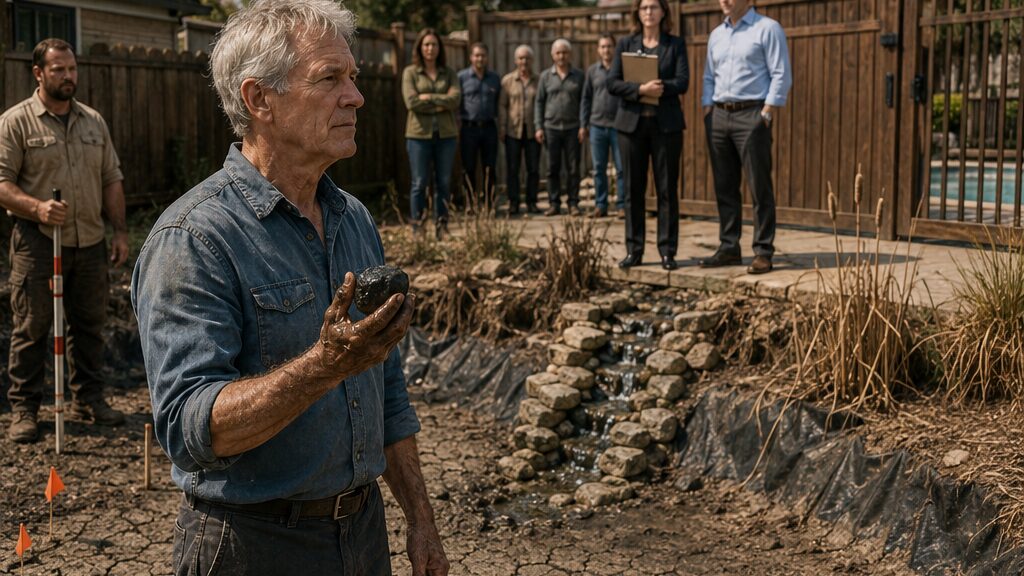
The contractor began to say something, but David ignored him. He crossed to the channel and knelt beside the exposed stones. Most were pale with dust. He worked his fingers beneath the dark one he had found Monday and lifted it free.
The earth beneath it was wet enough to stain his palm.
At that moment, the pump behind Andrew’s fence cycled off.
For two seconds the yard went quiet.
Then everyone heard the water.
It ran with a soft, steady rush on the other side of the cedar boards.
Christine lowered her arms.
David carried the stone back to the edge. The property manager held out the inspection report.
“This documents today’s conditions,” she said. “Your signature only acknowledges receipt.”
David placed the damp stone on the paper.
A crescent of moisture spread across the line marked OWNER RESPONSE.
“The water stopped entering this pond last Tuesday at approximately eleven in the morning,” he said. “Your contractor began work uphill on Monday. By Wednesday, the level had dropped six inches. By Sunday, the basin was dry.”
Andrew’s expression tightened. “You can’t know the time that precisely.”
“I checked the staff gauge every morning at seven and every evening at five. I did that for twenty-four years.”
“Why?”
“Because this isn’t a decorative pond.”
The neighbors remained quiet.
David pointed to the stone channel. “That swale takes runoff from the upper lots and releases it here before it continues through the overflow at the south end. It was built before Cedar Ridge existed.”
Andrew glanced at the contractor. “There is no active association-approved drainage structure shown on the current plan.”
“Current plan,” David repeated.
“The historical use of your backyard doesn’t create a permanent obligation for every uphill owner.”
“It isn’t a backyard habit. It’s a drainage line.”
“Then produce the authorization.”
David held Andrew’s gaze. “I will.”
It was the first promise he had made all morning that he was not certain he could keep.
The property manager removed the damp report from beneath the stone. “Until documentation is reviewed, the violation remains active.”
Andrew spoke more gently, which made the words worse. “You served on this board, David. You know we can’t govern through memories.”
“No. You govern through records.”
“Then bring one.”
Behind the fence, the pump restarted. The water’s sound rose again, louder now that no one could pretend not to hear it.
Christine looked toward Andrew’s yard. “Is that the new retention basin?”
“It’s part of an approved runoff-control project,” Andrew said.
“On your property?”
“The location was selected by the consultant.”
David turned to the contractor. “When did you close the old channel?”
The man looked at Andrew before answering. “We installed the berm last Monday.”
“Did the plan identify this pond?”
“There was a low area shown downstream.”
“A low area.”
“That’s how it was labeled.”
“And the flow was redirected into the lined basin?”
“We followed the grading sheet.”
The property manager cut in. “Technical questions should be submitted in writing.”
David faced Andrew again. “You knew the water came here.”
“I knew runoff crossed several lots in an informal path. The project was designed to control that.”
“You controlled it into your yard.”
Andrew’s jaw shifted. “The basin is accessible to the association for maintenance.”
“Through your locked gate.”
A few neighbors exchanged looks.
Andrew lowered his voice. “You’re making this personal.”
“My pond is empty. Your pond is full.”
“It isn’t a pond.”
David looked at the cracked basin beneath his boots. “Then neither is this, according to your notice.”
For the first time, Andrew looked away.
The inspection ended without measurements. The property manager left a new copy of the report on the patio table, marked OWNER REFUSED SIGNATURE. The contractor gathered his flags. Christine departed without speaking to either man.
Inside, Lisa filled two glasses with water and pushed one across the kitchen counter.
David did not drink it.
“You told him you had a record,” she said.
“There should be one.”
“That isn’t the same thing.”
“My father kept every property document.”
“Your father kept tractor manuals from machines he never owned.”
“He kept records.”
Lisa studied him for a moment. “You could call an attorney.”
“Not yet.”
“Why not?”
“Because I don’t need to pay someone to tell me where my own water used to run.”
She set her glass down harder than necessary. “This stopped being about where the water used to run when they put a daily fine on it.”
David went to the garage.
The old files occupied three metal cabinets beneath the workbench. Tax receipts filled one drawer. Survey maps and utility bills filled another. He searched until dust coated both forearms and the light outside had turned orange.
Lisa joined him without comment and opened the cardboard boxes stacked above the cabinets.
Near the bottom of the third box, she stopped.
The lid had softened with age, but the black marker on one side remained legible.
DRAINAGE EASEMENT—1962.
She turned the box toward him.
David stared at his father’s handwriting and felt, for the first time since the pond dried, something more dangerous than anger.
Hope.
Chapter 3: The Old Photograph Showed More Than a Family Pond
The photograph had been in David’s house for forty years, but he had never noticed the survey marker behind his grandfather’s left shoulder.
Lisa saw it first.
They sat beneath the kitchen light with the contents of the 1962 box spread between them: brittle receipts, a hand-drawn contour map, maintenance notes in pencil, and six black-and-white photographs curled at the edges.
In the clearest image, David’s grandfather stood in the unfinished pond while David’s father, seventeen at the time, set stones along the incoming swale. Behind them rose a narrow wooden stake with a white-painted top and three dark numerals.
Lisa held the photograph beneath the lamp. “That isn’t a fence post.”
David took it from her.
The marker stood exactly where the upper property line had existed before the land was subdivided. He recognized its shape from old county surveys: a temporary construction reference point.
He turned over the photograph.
MAY 19, 1962—COUNTY DRAINAGE INSPECTION was written on the back.
Beneath it, in his father’s smaller handwriting, were four words David had never seen before.
EASEMENT RECORDED AFTER APPROVAL.
Lisa leaned over his shoulder. “Is that enough?”
“It’s enough to look.”
A folded certificate rested at the bottom of the box, but damp had blurred the stamp and part of the legal description. The document referred to a drainage and overflow corridor serving three parcels. David could make out his family’s original tract number but not the recording reference.
He laid the photograph beside the certificate. The same stone line appeared in both the hand-drawn map and the picture.
For years, he had thought of the swale as something his father built because the slope required it. The papers suggested something larger. The county had inspected it. The neighboring landowner had signed. The channel had not merely existed; it had been assigned a purpose.
By seven the next morning, David had attached a temporary water tank to the truck and run a hose toward the cottonwoods. The closest tree had already begun dropping yellow leaves.
Lisa watched the meter on the rental tank turn.
“How much?”
“Two hundred and eighty for delivery. More if we need another load.”
“We’ll need another load.”
David looked toward the pond. The exposed liner had contracted in the heat, pulling loose from the stones along the north edge.
Lisa handed him the photograph in a clear plastic sleeve. “Go to the county.”
The records office occupied the lower floor of a concrete building twenty-five miles away. A clerk listened while David explained the old tract numbers, then disappeared into a back room.
She returned with a microfilm index and an apology.
“Your neighborhood changed legal descriptions twice,” she said. “Once during subdivision and again when the association annexed the upper lots.”
“I only need the original recording.”
“That’s what makes it difficult.”
She scrolled through entries while David watched numbers move across the screen. Easements. Utility corridors. Irrigation access. Road dedications.
Then she stopped.
“Carter drainage reserve,” she read. “Recorded June fourth, 1962.”
David gripped the edge of the counter.
The clerk opened the image.
The document was faint, but the wording was clear enough. A twenty-foot drainage corridor crossed the upper tract, entered the Carter property through a stone-lined conveyance, discharged into a holding basin, and continued through a southern overflow. Maintenance responsibility was shared among benefiting parcels.
The clerk printed three copies.
David compared the map to the photograph. The survey marker stood at the bend where the channel crossed what was now Andrew’s rear yard.
“So they can’t block it,” he said.
The clerk did not answer immediately.
“What?”
“I’m not an attorney.”
“I didn’t ask you to be.”
“You should still talk to one.” She pointed to a notation added during the Cedar Ridge subdivision. “The easement was carried forward, but I don’t see recent maintenance filings.”
“It was maintained.”
“By whom?”
“My family.”
“Was the upper corridor inspected?”
David looked at the map.
For many years, it had been. He remembered walking the route with a clipboard when he served on the association board. Then the inspections had stopped.
The clerk tapped the old document. “An association attorney may argue abandonment if the shared purpose wasn’t enforced.”
“The water ran through it until last week.”
“That helps. It may not answer everything.”
David folded the copies more sharply than necessary. “A functioning drain isn’t abandoned.”
“I agree with you as a practical matter,” she said. “Legal arguments aren’t always practical.”
He left with the easement, the photograph, and less certainty than he had carried into the building.
At home, the second tank delivery was already parked along the curb. A hose ran across the lawn to the cottonwoods. Lisa stood beneath the nearest tree, holding a branch whose leaves had gone brittle along the edges.
“This one won’t last long,” she said.
David showed her the recorded easement.
For a moment, relief softened her face.
Then he told her about abandonment.
She looked back at the tree. “Call the attorney.”
This time he did not argue.
Jennifer Lee’s office returned the call within an hour. She asked for the easement, the current HOA declaration, the violation notice, photographs of the swale, and any board records relating to drainage maintenance.
David hesitated over the last item.
Jennifer heard it.
“Mr. Carter, did you serve on the association board?”
“Years ago.”
“In what capacity?”
“Treasurer for two terms. Then vice president.”
“During the period when the drainage inspections stopped?”
David looked through the kitchen doorway toward the garage, where the old board binders sat in the bottom drawer of the third cabinet.
He knew exactly which binder contained the answer.
Jennifer waited.
“Possibly,” he said.
Her voice became quieter. “Before I tell you what this easement can do, I need to know what you did while you had authority over it.”
Chapter 4: David’s Own Vote Gave Andrew His Best Defense
Jennifer placed the meeting minutes between them and turned the page so David could not avoid his own signature.
The motion occupied three lines.
Suspend annual inspection of noncritical drainage features until reserve funding improves.
Moved by David Carter. Approved four to one.
Jennifer tapped the date. “Fifteen years ago.”
David kept his hands flat on his knees. “The association had a roof claim, two failed pumps at the clubhouse, and less than twelve thousand dollars in reserves.”
“I understand why you made the motion.”
“Then you understand it wasn’t abandonment.”
“I understand Andrew’s attorney will call it that.”
Her conference room overlooked a parking lot in Cheyenne. Heat shimmered above the cars. On the table beside the minutes sat the 1962 easement, the violation notice, and three photographs of the dry pond.
David had expected the old document to change the room. Instead, his signature had.
“The inspections were supposed to resume the next year,” he said.
“Did they?”
“No.”
“Did you ask?”
He looked toward the window.
Jennifer waited.
“I left the board two years later.”
“That isn’t what I asked.”
David’s jaw tightened. “No.”
Jennifer leaned back. “The easement was never formally released. That matters. Water continued through the corridor until Andrew’s project blocked it. That matters more. But if we present this as a pristine historic right that everyone faithfully protected, his side will show the board stopped inspecting it under a motion you introduced.”
“The stones were still there.”
“Some were buried.”
“The water still ran.”
“Until someone decided the channel looked informal enough to ignore.”
David stared at the maintenance photographs she had enlarged. In the earliest, the swale was clean and visible. In later years, leaves covered its edges. One image showed a section nearly swallowed by decorative grass.
He remembered taking that photograph himself.
At the time, he had marked the corridor functional and moved on.
Jennifer slid a letter across the table. It had arrived from the association’s attorney that morning.
The association denied interfering with any active easement. The old drainage feature, the letter argued, had been abandoned through nonenforcement, altered maintenance practices, and changes to the subdivision plan. It cited David’s motion by date and quoted the exact phrase noncritical drainage features.
Andrew already had the minutes.
“How did they get this so fast?” David asked.
“They keep their own records.”
“The property manager told me she couldn’t find project documents.”
“Finding helpful records and producing harmful ones are different tasks.”
David read the letter again. Near the bottom, the association offered to suspend the daily fine for thirty days if he submitted a pond-fill plan.
“They’re pretending to compromise.”
“They’re buying time.”
“For what?”
“To make the altered drainage system look permanent.”
Jennifer gathered the photographs into a stack. “I can send a preservation notice today. I can demand the consultant’s plans, contractor instructions, board communications, and insurance correspondence. But I need everything from you first.”
“You have everything relevant.”
“No. I have what you decided was relevant.”
The words landed quietly.
David looked at his signature.
Jennifer continued. “If there are more board minutes, emails, inspection logs, or maintenance notes, I need them before Andrew’s attorney uses them. A damaging fact disclosed by us is manageable. A damaging fact discovered after you deny it is not.”
“I haven’t denied anything.”
“You told me you possibly served when the inspections stopped.”
“I didn’t remember the exact year.”
“You remembered which binder held the minutes.”
David stood too quickly, pushing the chair backward.
Jennifer did not react.
“I made a budget decision,” he said. “I did not give Andrew permission to block the channel.”
“No one said you did.”
“That is what his letter says.”
“His letter says your old decision helps his current argument. Those are not the same thing.”
David picked up the easement.
Jennifer placed one hand over the document before he could take it. “Your strongest case is not that you never made a mistake. It’s that the easement remained physically active despite that mistake.”
He met her eyes.
“If you try to hide the first part,” she said, “you may lose the second.”
On the drive home, the old motion sat in an envelope on the passenger seat. David kept glancing at it as though the paper might change if left alone long enough.
Lisa was in the yard when he arrived, directing the water-delivery driver toward the cottonwoods. The rental tank’s meter clicked as the hose filled. Brown leaves had gathered around the base of the largest tree.
“How did it go?” she asked.
“The easement is valid enough to fight over.”
“That doesn’t sound like good news.”
“It’s not bad news.”
“What did Jennifer say?”
David looked at the driver, then at the open garage.
“She needs more records.”
Lisa followed his gaze. “Did she find something?”
“Andrew’s attorney is claiming abandonment.”
“Based on what?”
“Lack of inspections.”
Lisa waited.
David folded the envelope once, although it was already sealed. “I need to go through the old maintenance binders.”
“David.”
“The driver needs a signature.”
He walked past her before she could ask again.
In the garage, he opened the bottom drawer and pulled out three binders. The oldest smelled of dust and damp cardboard. He found annual inspection sheets, reserve reports, and photographs showing the swale slowly disappearing beneath leaves.
Between two reports lay a handwritten reminder from the former HOA secretary.
David—drainage walk deferred again. Board needs permanent schedule before next storm season.
He remembered seeing the note. He had meant to raise it at the next meeting. Then Lisa’s mother became ill, and he missed two months of board business. By the time he returned, the budget crisis had shifted to roofs and roads.
He had never raised it.
From the kitchen, Lisa called his name.
David placed the note beneath the minutes and closed the binder.
His phone rang.
Jennifer’s number appeared on the screen.
“I just received another letter,” she said when he answered. “The association has formally withdrawn the current fine.”
David exhaled.
“Temporarily,” Jennifer added. “They’re claiming the pond and channel are abandoned structures. The board plans to vote on permanent removal.”
“When?”
“They haven’t posted the date yet.”
David looked at the closed binder.
“Did you find anything else?” Jennifer asked.
He could hear Lisa approaching the garage.
“No,” David said.
Lisa stepped into the doorway just as he ended the call.
She looked at the binder, then at his face.
“What aren’t you telling me?”
David slid the meeting minutes beneath a stack of maintenance photographs.
“Nothing we can’t handle,” he said.
Chapter 5: The First Storm Sent Andrew’s Solution Downhill
Christine called at 1:17 in the morning and said there was water under her house.
David was awake before the second ring. Rain struck the bedroom window in hard, slanting sheets, and somewhere outside, runoff moved with the low roar of traffic.
Lisa sat up. “Who is it?”
“Christine Roberts.”
He put the phone on speaker.
“I know what I said at the inspection,” Christine said. Her breathing was fast. “I know I stood there and supported the board. But the crawlspace alarm is going off, and water is coming through the rear vent.”
David was already pulling on his jeans. “Turn off the breaker to the basement circuits.”
“The panel is in the garage.”
“Then stay out of the crawlspace. I’m coming.”
Lisa caught his wrist. “The lightning—”
“If that berm overtops, it will follow the old grade.”
“You don’t owe her this.”
“No,” David said. “But the water doesn’t know that.”
He drove downhill with hazard lights flashing. Rainwater crossed the street in shallow brown sheets. At Christine’s house, the backyard had become a broad, moving pool. Water pressed against the foundation and disappeared through a vent beneath the siding.
Christine stood on the covered porch in rubber boots and a raincoat pulled over her pajamas.
“I called the emergency number,” she said. “The property manager told me to contact a restoration company.”
“They can dry it after the water stops coming in.”
David swept his flashlight uphill.
The new basin behind Andrew’s fence was overflowing. Instead of moving through the old stone corridor toward David’s pond, runoff struck the berm, spread sideways across the slope, and poured through a low gap toward Christine’s property.
The project had not removed the water. It had moved the problem downhill.
David followed the fence line until he found the blocked section of the old swale. Fresh clay filled the channel from bank to bank. Water pooled behind it, rising by the minute.
Christine came after him. “Can you open it?”
“Not cleanly.”
“What does that mean?”
“It means the board will say I altered association drainage without approval.”
Water slapped against the foundation behind them.
Christine stared at him. “Will it help?”
“Yes.”
“Then open it.”
David fetched a shovel from his truck.
The clay was packed hard enough to resist the first strike. He drove the blade in again, working beside the old stones by feel. Rain ran down his sleeves and filled his boots. The trench needed only to be deep enough to restore a path, but every inch increased the chance that the release would cut too quickly.
“Stand back,” he told Christine.
He removed one final wedge of clay.
Water punched through the opening.
It surged along the uncovered stones, dark and fast, then curved toward David’s property. For several seconds the old channel held exactly as it had been designed to hold.
Then the flow reached a section buried beneath landscaping fabric and decorative gravel.
The water jumped the edge and spread across the common path.
David swore under his breath.
Christine pointed. “Is it supposed to do that?”
“No.”
He followed the spill and pulled at the fabric. Its metal pins had been driven directly through the shallow channel during an earlier landscaping project. The stones beneath were intact but choked.
He cut the fabric with his pocketknife and dragged it free.
The flow dropped into the swale again.
Behind them, the water against Christine’s house stopped rising.
She stood in the rain, watching the channel carry it away.
“You knew where it would go,” she said.
“I knew where it used to go.”
“That’s not the same thing?”
“Not after fifteen years without inspection.”
The answer surprised her.
Before she could ask more, headlights turned into the lane.
Andrew’s SUV stopped beside David’s truck. He stepped out beneath an umbrella, followed by the property manager.
“What are you doing?” Andrew shouted over the rain.
“Keeping water out of her crawlspace.”
“You cut the berm.”
“I opened the blocked drainage line.”
“You had no authority.”
Christine moved between them. “My foundation was taking water.”
Andrew looked toward the house. “The basin is designed for a twenty-five-year storm. This event may exceed that.”
“So the overflow plan was my crawlspace?” she asked.
“That isn’t what I said.”
David pointed his flashlight toward the moving water. “The basin surcharged. The berm forced the excess sideways. The original corridor was still here, but your contractor filled it.”
Andrew’s face hardened. “You just modified an approved system during an active storm.”
“I restored an outlet.”
“You may have redirected water onto other properties.”
“It’s going into my pond.”
“And beyond that?”
“Through the southern overflow, if no one filled that too.”
The property manager raised her phone and began taking photographs.
David watched her capture the cut in the berm, his shovel, and the torn landscaping fabric.
“Take one uphill,” he said. “Get the water line against Christine’s foundation.”
“I’m documenting all conditions.”
“You’re documenting me.”
Andrew stepped closer. “This is precisely why the board can’t let individual homeowners manage shared infrastructure.”
David almost laughed. Rain ran from his hair into his eyes.
“You called it obsolete three days ago.”
Andrew did not answer.
The worst of the storm passed before dawn. Water continued through the opened channel, carrying silt across the stones and into David’s dry pond. It formed a shallow brown pool no deeper than his ankle, but the sight of water in the basin made his chest tighten.
It was not restoration. It was proof.
At eight, an email arrived from the property manager.
The association was investigating an unauthorized alteration to common drainage infrastructure. David was instructed not to disturb the berm again.
Christine received a different email.
Hers contained a claim form, emergency drying instructions, and a copy of the consultant’s drainage diagram attached by mistake.
She called David before breakfast.
“I think they sent me something they didn’t mean to.”
At her kitchen table, they opened the file on her laptop. Colored arrows traced the new basin and berm. One red zone spread below the project across three lower lots, including hers.
Beside it, in capital letters, were the words:
DOWNSTREAM SURCHARGE RISK IF HISTORIC CONVEYANCE IS CLOSED.
Christine zoomed in.
A note at the bottom recommended preserving the original swale until a shared overflow system could be built.
“Who got this?” she asked.
David read the distribution line.
HOA PRESIDENT. PROPERTY MANAGER. PROJECT CONTRACTOR.
The issue date was six weeks before construction.
Christine’s face changed—not into outrage, but into the look of someone recalculating every conversation she had accepted too easily.
“They knew,” she said.
David pointed to a blank beside RECEIVED BY.
“No signature.”
Christine scrolled to the next page.
There, beneath a short routing note, someone had initialed the diagram in dark blue ink.
The letters were small but clear.
A.H.
Chapter 6: The Warning Was Filed Before the Berm Was Built
Andrew’s initials appeared on every page of the consultant’s warning except the one he had quoted at the neighborhood meeting.
Jennifer spread the diagram across the conference table. Red arrows flowed over Christine’s lot, crossed the common path, and ended at the old stone swale.
“He can argue that initials confirm receipt, not agreement,” she said.
“He built the berm anyway,” Christine replied.
She sat beside David with a folder of photographs from the storm. Mud marked the cuffs of her jeans. Two days earlier, she would not have entered an attorney’s office with him.
Jennifer nodded. “That makes the warning important. It doesn’t make the rest automatic.”
David traced the recommended overflow route with one finger. It followed the same line his grandfather had built in stone.
“What did the alternative cost?” he asked.
Jennifer turned to the project estimate.
The consultant had proposed clearing and surveying the old corridor, replacing the southern overflow pipe, and adding a shared detention structure in the common area. Estimated cost: one hundred eighty-six thousand dollars.
The basin and berm approved by the board had cost thirty-nine thousand.
Christine let out a short breath. “So they saved money by sending water toward my house.”
“They postponed spending,” Jennifer said. “That is not always the same as saving.”
The HOA office produced the remaining records only after Jennifer threatened emergency court action. The emails showed Andrew had forwarded the consultant’s full recommendation to the insurance representative. The reply warned that unresolved drainage exposure could increase the association’s premium and potentially require a special assessment.
Andrew had then asked whether the cheaper basin could qualify as corrective work.
The consultant answered that it could reduce ordinary runoff but should not replace the historic conveyance without a downstream analysis.
No further analysis appeared in the file.
David read the exchange twice. “He knew the basin wasn’t enough.”
“He knew there was a documented risk,” Jennifer said. “That is the language we can prove.”
Christine pointed to another message. “He also wrote that residents would revolt over a special assessment.”
The email was addressed to the property manager.
If we propose $2,500 per lot after last year’s premium increase, I will lose the board and the project will die. Proceed with the affordable option and manage downstream concerns if they arise.
David leaned back.
The line sounded less like greed than fear disguised as management. He knew that kind of decision. A failing system, an inadequate reserve, and a room full of people who wanted the problem solved without paying what the solution cost.
Jennifer watched him. “You recognize it.”
“Yes.”
“Because of your old vote?”
David did not answer.
Christine looked between them. “What old vote?”
Jennifer allowed the silence to remain David’s.
He closed the file. “Fifteen years ago, I moved to suspend annual drainage inspections.”
Christine stared at him.
“The association was nearly broke,” he continued. “It was meant to last one year. No one put the inspections back.”
“You were on the board?”
“Yes.”
“And you didn’t mention that at the pond inspection.”
“No.”
Her expression hardened. “You let me stand there thinking this was all Andrew.”
“The diversion is Andrew’s.”
“The neglected channel isn’t.”
David felt the truth of it before Jennifer spoke.
“No,” he said. “It isn’t.”
Christine stood and walked to the window. “My deductible is five thousand dollars.”
“I know.”
“No, you don’t. You knew enough to tell everyone the channel was historic. You didn’t tell us you helped stop checking it.”
“I should have.”
“That would have changed how I heard you.”
“Yes.”
She turned back. “Why didn’t you say it?”
David looked at the easement, the consultant warning, and the photographs of water beneath her house.
“Because I wanted to be right before I admitted where I was wrong.”
Christine picked up her folder. For a moment, he thought she would leave.
Instead, she sat down again.
“That doesn’t make Andrew less responsible,” she said.
“No.”
“But it makes this mess older than his pond.”
“Yes.”
Jennifer gathered the documents. “Which is why a private claim may be easier than a public fight. David’s property damage is measurable. Christine’s insurance loss is measurable. The association can restore the Carter flow, reimburse direct costs, and settle without deciding every governance failure.”
“What about the other lower houses?” David asked.
“They haven’t reported damage.”
“Yet.”
Jennifer gave him a measured look. “Litigation is not an engineering department.”
“No. But a settlement that puts water back in my pond and leaves the same risk downhill is not a solution.”
“It may be the fastest enforceable result.”
Before they could go further, the property manager called.
Andrew wanted to meet David privately at the clubhouse.
Jennifer advised against going alone. David went anyway.
Andrew sat at the end of the empty meeting room with two bottles of water and a thin folder between them. Without the board members beside him, he looked older. The skin beneath his eyes had darkened.
“You saw the consultant memo,” he said.
“Yes.”
“I should have circulated it.”
“You should have followed it.”
Andrew unscrewed his bottle but did not drink. “Do you know what happened when I told the board the full project cost?”
“They didn’t want to pay.”
“One member threatened to resign. Another said a special assessment would force two retired couples to sell. Our insurance carrier had already warned us about nonrenewal.”
“So you chose the cheap option.”
“I chose the option I thought I could get built.”
“And when my pond dried?”
“I thought your feature had no active protection.”
“You had the easement map.”
“I had six conflicting maps and no recent inspection.”
“You had the consultant warning.”
Andrew looked down. “I believed the basin would hold.”
“After the storm?”
“I was wrong.”
The admission was so plain that David had no answer ready.
Andrew slid the folder across the table.
Inside was a settlement proposal. The association would restore water to David’s pond, reimburse tank deliveries, pay for damaged landscaping, withdraw all violations, and cover Jennifer’s fees. David would release the association and agree not to distribute internal project communications.
“What about Christine?”
“Her claim is being handled separately.”
“What about the drainage corridor?”
“We’ll install a controlled pipe to your basin.”
“And the lower lots?”
“The engineer will evaluate them.”
“Later.”
Andrew’s voice tightened. “This resolves your problem now.”
“My problem was the first place the system failed visibly.”
“It is your pond.”
“It is the neighborhood’s water.”
Andrew rubbed one hand across his forehead. “You helped create this funding problem.”
“I know.”
“Then you know what happens if every document becomes public. Dues rise. Insurance may leave. Home values take a hit. People who had nothing to do with either decision pay for both.”
David looked at the confidentiality clause.
For three weeks he had wanted water back in the pond, the fines removed, and the dead trees paid for. The offer gave him all of it.
It also allowed everyone to keep calling the corridor obsolete until the next storm proved otherwise.
“When does this expire?” he asked.
“Tomorrow at noon.”
David closed the folder.
As he stood, the clubhouse screen behind Andrew came to life. The property manager had activated it remotely for the next evening’s agenda.
One item appeared beneath EMERGENCY BOARD MEETING:
MOTION TO AUTHORIZE PERMANENT FILL AND REMOVAL OF CARTER POND FEATURE.
David read it twice.
Andrew followed his gaze.
“The board posted it an hour ago,” he said. “If you sign, I can withdraw the motion.”
“And if I don’t?”
Andrew’s silence answered.
David picked up the settlement folder.
By the time he reached the door, he understood that the vote was not only about filling an empty pond.
It was about burying the last visible place where the old system could still be proved.
Chapter 7: He Read His Own Mistake Before Naming Theirs
The motion to fill David’s pond was already on the screen when he entered the clubhouse.
The words were projected in black against a white background above the board table:
AUTHORIZE PERMANENT REMOVAL OF OBSOLETE WATER FEATURE AND RELATED DRAINAGE MATERIALS.
No one had written his name into the motion, but every chair in the room faced him when he walked in.
Lisa came beside him carrying the old photograph in a protective sleeve. Jennifer followed with two document boxes and the settlement offer David had refused to sign. Christine sat in the front row, her insurance folder on her lap.
Andrew was already at the center of the board table.
“You received the agenda,” he said.
“I received it.”
“The board intends to keep public comment focused.”
David looked at the projected motion. “Then you should have written a narrower motion.”
The property manager asked everyone to take their seats. More than forty residents filled the room, some standing along the rear wall. David recognized people who had waved to him for years and others who now avoided his eyes.
He placed three objects on the presentation table: the damp stone from the pond inspection, the 1962 photograph, and the meeting minutes bearing his signature.
Andrew watched the third item land.
The property manager read the motion aloud. She described the pond as a maintenance liability, the stone channel as an inactive landscape feature, and permanent filling as the most cost-effective way to eliminate uncertainty.
One board member moved to approve.
Another seconded.
“Public comment,” the manager announced.
David approached the microphone.
Andrew lifted one hand. “Five minutes.”
“I’ll use less if no one interrupts.”
A few people shifted. No one laughed.
David picked up the old minutes first.
“My family’s drainage easement was recorded in 1962,” he began. “Water crossed the upper lots, entered the stone channel behind my house, settled in the pond, and continued south through an overflow. That system remained active until the association’s project blocked it last month.”
Andrew leaned toward his microphone. “The status of the easement is disputed.”
David nodded. “It is. And part of the reason it can be disputed is mine.”
The room changed.
Lisa stood very still near the wall.
David unfolded the minutes.
“Fifteen years ago, while serving on this board, I moved to suspend annual inspections of noncritical drainage features. We were short on reserves. I believed the suspension would last one year.”
He read the motion exactly as it appeared, including the vote and his own name.
No one interrupted now.
“The inspections did not resume,” he said. “I did not force the issue. I left the board knowing the schedule had never been restored.”
Christine looked down at her folder.
David continued. “That failure helped bury sections of the old channel. It made the system easier to dismiss as informal. Andrew’s attorney has used my vote to argue the easement was abandoned.”
One of the residents near the rear called out, “Then why should we listen to you now?”
David turned toward the voice.
“Because I should have told you that before I asked you to believe anything else.”
The answer left no opening for defense.
He set the minutes beside the damp stone.
“This is not proof that the easement vanished. Water continued through it for fifteen years after my vote. But it is proof that I helped create the uncertainty we have now.”
Andrew’s fingers tightened around a pen.
David lifted the consultant’s engineering plan.
“What happened last month was not uncertainty.”
Jennifer connected her laptop to the projector. The motion disappeared, replaced by the drainage diagram. Red arrows spread across the lower lots.
David pointed to the warning printed beside them.
“The association’s consultant recommended preserving the historic conveyance until a shared overflow system could be constructed. The warning said closing it created a downstream surcharge risk.”
Andrew reached for his microphone. “That language was preliminary.”
David changed the page.
Andrew’s initials appeared at the bottom.
“You received it six weeks before construction.”
“I did.”
The admission moved through the room as a murmur.
Andrew straightened. “The full project cost was one hundred eighty-six thousand dollars. We had already been warned of an insurance increase. A special assessment would have been approximately twenty-five hundred dollars per household. Several owners had told the board they could not absorb another charge.”
A resident asked, “So you chose the smaller basin?”
“I chose a project the association could fund immediately.”
“You chose it in your yard,” Christine said.
Andrew looked at her. “The location was selected because the upper parcel had available grade and access.”
“And when your basin overflowed, the water came under my house.”
“The storm exceeded expected conditions.”
“The consultant expected it enough to draw my property in red.”
Andrew’s face tightened, but he did not raise his voice. “I believed the basin would reduce the risk. I was wrong about its capacity.”
That was not an apology. It was not nothing either.
David placed the 1962 photograph beneath the diagram. In the image, his father and grandfather stood beside the newly laid stones. The survey marker rose behind them.
“The board can spend money filling my pond,” David said, “and we can pretend the old system ended there. Or we can acknowledge that the water belongs to the slope. It will move whether the association budgets for it or not.”
One of the board members asked Jennifer, “What happens if we pass the motion?”
She stood but did not approach the microphone. “My clients seek an injunction preventing alteration of the recorded corridor. The board may choose litigation. The existing consultant warning, storm damage, and pending insurance claims will be part of that record.”
The room became quieter.
Andrew looked at David. “You had a settlement offer that restored your pond.”
“Yes.”
“You rejected it.”
“Yes.”
“Why?”
David glanced at Christine, then at the red zone covering the lower properties.
“Because a private pipe to my yard would solve the damage everyone can see and leave the rest where no one has looked yet.”
The property manager reminded him that his time had expired.
David stepped away from the microphone.
For one terrible moment, nothing happened.
Then Christine rose.
“I supported the violation against David,” she said. “I thought he was using an old family story to stop a current project. He was also hiding something, and I’m still angry about that.”
David accepted the words without looking away.
“But the water entered my house because the board closed a route its own consultant said to preserve. Filling David’s pond will not make that untrue.”
She faced the board.
“I move that the fill order be rejected, that the association hire an independent drainage engineer, and that no part of the historic corridor be altered until the review is complete.”
Only board members could make formal motions, but one of the two members who had supported filling the pond slowly raised her hand.
“I’ll make that motion.”
The other board member who had seconded the fill proposal stared at the diagram, then withdrew his second.
Andrew closed his eyes briefly.
The vote was three to two.
The fill order failed.
There was no applause. Some residents began asking what the review would cost. Others wanted to know whether dues would rise and who would pay Christine’s deductible. The room filled with the practical anger of people realizing that stopping a bad decision did not erase its bill.
Jennifer leaned toward David. “They can still fight every part of the repair.”
“I know.”
Across the room, Andrew removed the fill motion from the projector. In its place appeared the newly approved resolution for an independent review.
Christine came to David’s table. She picked up the old inspection ledger he had brought with the boxes but not yet opened.
“Does this show every year the channel wasn’t checked?”
“Most of them.”
She held it out to the board member who had made the motion.
“Then the engineer should start with this.”
For the first time, the record David had hidden was no longer being used only against him.
It had become the first thing the neighborhood agreed to examine.
Chapter 8: Water Returned Through the Channel No One Wanted
The first test flow stopped twelve feet short of the pond.
David stood inside the restored swale while the independent engineer checked the temporary release valve uphill. Water had crossed Andrew’s former basin site, passed beneath the rebuilt common path, and followed the old stone line through David’s fence.
Then it disappeared beneath a mound of wet leaves.
“Close it,” David called.
The engineer shut the valve. The narrow stream thinned to a glisten between the stones.
Three months of meetings, excavation, insurance negotiations, and revised estimates had led to that morning. The decorative basin had been removed. The berm had been cut back. A reinforced overflow had been installed below Christine’s property, and the original drainage corridor had been cleared and formally added to the association’s maintenance map.
Yet the water had still failed to reach the pond.
David knelt beside the blockage.
Lisa stood at the pond edge with Christine and two board members. Andrew remained farther uphill beside the contractor. He had resigned as board president under the final agreement but continued to attend project meetings as the owner of the upper lot.
The arrangement pleased no one, which was partly why it worked.
David pulled away the leaves. Beneath them, one of the old stones had shifted inward during reconstruction, narrowing the channel. It was the same size and color as the damp stone he had lifted during the inspection.
He worked his fingers beneath it.
The engineer approached. “We can bring the excavator down.”
“No.”
“You’ll hurt your back.”
“It’s one stone.”
David rocked it once, then again. Mud tightened around the edges. Christine stepped into the swale and offered him a pry bar.
He took it without comment.
Together they lifted the stone and reset it against the bank. The channel opened by four inches.
“Try again,” David said.
The valve turned uphill.
Water entered the stones with a soft rush. It passed the repaired section, curved around David’s boots, and spilled into the pond.
No one cheered.
They watched the first clear sheet spread across the liner, carrying small pieces of leaf and silt toward the deepest part of the basin.
The final agreement had removed every violation against the Carters. It reimbursed the water deliveries, paid for the damaged liner, covered Christine’s emergency restoration deductible, and required the HOA to maintain the full corridor under an engineer-approved schedule.
It also increased annual dues.
Three of David’s cottonwoods had been too damaged to save. Their stumps remained near the fence, pale and flat against the recovering grass.
The public record attached to the agreement named two failures: the board’s decision to proceed despite the consultant warning, and the association’s long lapse in drainage inspection beginning with David’s motion.
Jennifer had insisted on precise language. Andrew had insisted that the document distinguish bad judgment from deliberate intent. David had agreed.
He no longer needed the record to make him innocent.
Andrew came down the slope after the test flow stabilized.
“The new aspens won’t survive relocation,” he said.
David looked toward the bare patch where the private basin had been.
“No.”
“I’m replacing them myself.”
“That’s your choice.”
Andrew watched the pond filling. “I thought people would forgive a cheaper project if it worked.”
“They might have.”
“And when it didn’t, I thought admitting the warning would make everything worse.”
“It did make things worse.”
Andrew gave a tired nod. “Yes.”
The conversation ended there. It was not reconciliation, but neither man pretended the other had nothing worth understanding.
By noon, the pond held several inches of water. The exposed liner disappeared beneath the surface. A pair of birds landed near the cattails, tested the edge, and flew off again.
Christine sat with David on the low stone wall while Lisa brought out coffee.
“The next inspection is in October,” Christine said.
“First week.”
“You already know the date?”
“I know every date now.”
She smiled slightly. “The board asked me to maintain the inspection ledger.”
David went to the garage and returned with the old book.
Its cover was cracked, and several pages bore his handwriting from years earlier. The final completed entry ended just before the inspections were suspended.
He opened to the first blank page.
For a moment, his pen hovered above it.
Then he wrote the date of the restored test flow and noted the shifted stone, the correction, and the time the water reached the basin.
He handed the ledger to Christine.
“You should keep the next entry,” he said.
She accepted it carefully. “You’re not going to check my work?”
“I probably will.”
“That sounds more like you.”
Water moved through the swale behind them, visible now from the neighborhood path. The engineer had rejected a proposal to cover it with decorative rock. The channel needed to remain open enough that anyone walking past could see whether it was functioning.
David’s grandfather had built the stones as a practical answer to gravity. David’s father had maintained them as part of the property. David had spent years treating them as something his family alone understood.
Now small metal markers identified the swale as shared drainage infrastructure.
The words were plain and unremarkable.
That was what made them matter.
Lisa sat beside David and placed one hand over his. Across the pond, the water reached the old staff gauge and climbed above the first mark.
It would take several more releases to restore the normal level. The dead trees would not return. The dues increase would remain on every owner’s statement, including theirs. Andrew’s resignation did not recover the money spent on the failed basin, and David’s confession did not restore the years when no one inspected the channel.
The repair had not erased the cost.
It had made the cost visible enough to share.
Christine walked uphill carrying the ledger beneath one arm. At the bend in the path, she stopped to examine the water passing over the reset stone.
Then she opened the book and wrote something down.
David could not read the entry from where he sat.
He did not need to.
The story has ended.