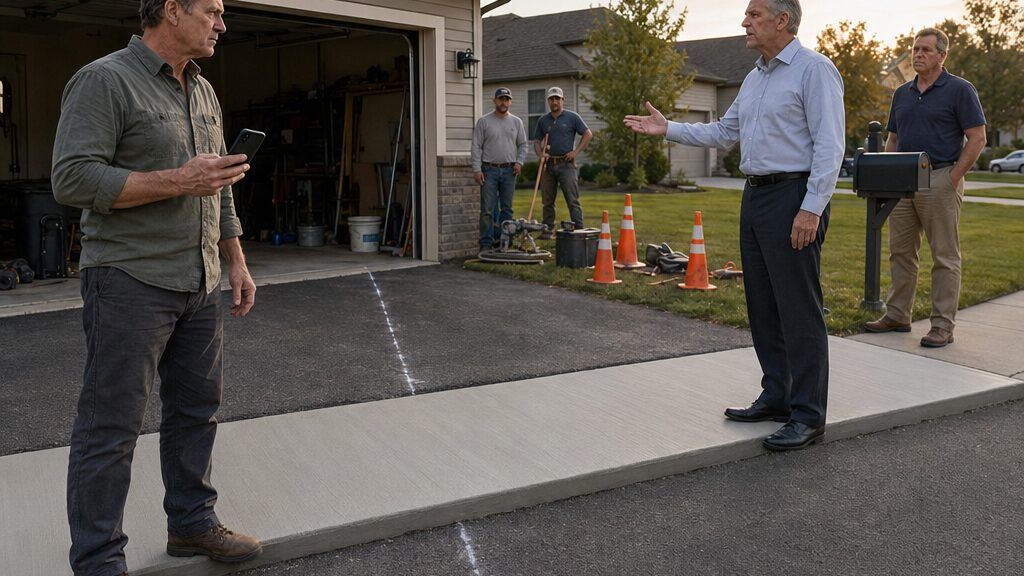
They Poured a Sidewalk Across His Driveway, but the Seventy-Two-Hour Deadline Changed Everything
Chapter 1: The Concrete Was Already Hardening Across His Driveway
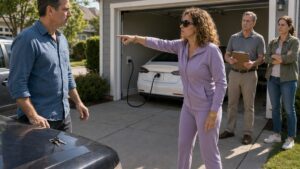
Jack Harris hit the garage-door button and stopped halfway toward his truck.
Morning light spread under the rising door, revealing something pale gray where black asphalt should have been.
Concrete.
Fresh concrete ran across the mouth of his driveway in a wide strip, joining the new sidewalk on either side as if his garage had never been meant to open onto the street at all.
For several seconds Jack did nothing.
Then he heard the scrape of a finishing trowel.
Two workers stood near the curb. One smoothed the edge of the new slab while another pulled orange cones toward a pickup. Farther down the street, the sidewalk continued in a clean line past trimmed lawns and mailboxes.
Jack stepped outside.
“Who authorized this section?”
The worker with the trowel straightened. “You’ll have to talk to the association.”
“Who told you to pour across the driveway?”
“The plans did.”
Jack looked down again.
The concrete was already beginning to lose its surface shine. Tire tracks would ruin it now. Driving through it would also give someone an excuse to make the damage his problem.
He took out his phone.
One photograph from the garage.
One from the street.
One from each side.
Then he went inside for the tape measure.
By the time he returned, three neighbors had come out to look.
Edward Adams stood near his mailbox in running shoes, arms folded.
“Well,” Edward said cautiously, “I guess they finally connected it.”
Jack laid the end of the tape against the garage-side seam.
“Connected what?”
“The sidewalk.”
Jack looked up.
Edward’s expression changed slightly.
“You didn’t know?”
Jack didn’t answer.
He measured from the fixed corner of his lot, then checked the numbers against a photograph on his phone. The survey drawing had been scanned years ago, along with the deed and closing papers.
The property line didn’t follow the curb.
That was the problem.
The association maintained the grass strip and drainage along the street. But the lower section of Jack’s driveway extended farther into the disputed transition than the sidewalk plan seemed to acknowledge.
And now concrete sat across it.
A sedan slowed.
Ronald King got out before Jack could call him.
The HOA president was still dressed for work, pressed shirt tucked neatly into dark pants. He approached with the strained patience of a man arriving at a problem he believed should already be settled.
“Jack.”
“You approved this?”
Ronald glanced at the slab. “The board approved the sidewalk project months ago.”
“That isn’t what I asked.”
“The entire route was approved.”
Jack crouched and held his phone near the concrete edge.
“Not this portion.”
Ronald exhaled.
“We’ve been through this.”
“No. I sent you an objection. You stopped responding.”
“This is a community improvement.”
Jack stood.
Behind Ronald, two more residents had stopped on the opposite sidewalk.
Ronald lowered his voice.
“We had a missing section. People were walking in the street. The board voted. The work was scheduled. It’s finished.”
“It’s on my driveway.”
“It crosses the driveway, Jack. Sidewalks cross driveways all over the neighborhood.”
“That doesn’t make the land yours.”
One of the workers began loading tools faster.
Ronald looked toward the small audience, then back at Jack.
“You’re making this sound much more dramatic than it is.”
Jack felt something sharp rise behind his ribs.
Years earlier, a contractor had told him not to worry about a change order. They would “work it out.” Jack had trusted the handshake.
The bill had arrived two months later.
He had paid thousands he could not prove he hadn’t agreed to.
Since then, Jack kept everything.
Receipts. Emails. Drawings. Dates.
Especially dates.
He looked at the fresh slab and forced himself not to say the first thing that came to mind.
Instead he walked into the house.
Ronald followed as far as the open garage.
“Where are you going?”
“To get the letter you said we’ve already been through.”
Jack returned with a folder.
He opened it on the hood of his truck and pulled out a printed email.
The date was three months old.
The subject concerned the sidewalk extension.
Jack tapped a paragraph with one finger.
“I told you the driveway was private property. I told you any construction across it required my written approval.”
Ronald barely looked.
“The association has authority over common improvements.”
“Show me where I approved this.”
“That isn’t the only relevant authority.”
“Then show me the relevant authority.”
Ronald’s jaw tightened.
Edward had crossed the street now.
“Come on, Jack,” he said. “Nobody’s trying to steal your driveway.”
Jack turned toward him.
“I didn’t say anyone was.”
“You’ve been against this from the start.”
“I objected to them building on my property.”
Edward gestured toward the new sidewalk stretching past the houses.
“It was one missing gap.”
“And now the gap is across my driveway.”
“That’s not what I meant.”
Jack looked from Edward to Ronald.
Something had shifted without him noticing.
This was no longer a disagreement about a line on a plan.
The neighborhood had already been given a story about him.
Jack Harris, the man holding up the sidewalk.
He folded the email.
“I’m checking the permit.”
Ronald’s expression sharpened.
“For what?”
“For the work.”
“The contractor handles permits.”
“Good. Then it should be easy to find.”
Jack spent the next twenty minutes photographing the concrete, the curb, the sidewalk joints, and the location where his survey placed the boundary.
Then he called the county.
The permit clerk asked for the subdivision name, street address, and the type of work.
Jack gave all three.
Keyboard clicks came faintly through the phone.
“I see the broader association improvement file,” the clerk said.
Jack stared at the concrete.
“And the driveway crossing?”
Another pause.
“I don’t see a separate permit tied to that address.”
“Could it be under the HOA?”
“It could be listed differently. I’d need to check the project records.”
“So you can’t tell me it was permitted.”
“I can tell you I don’t have a permit in front of me for work on your parcel.”
Jack thanked the clerk and ended the call.
Across the driveway, Ronald was speaking quietly to one of the workers.
Jack opened his camera again.
The slab was no longer wet enough to shine.
It was hardening.
And somewhere between the HOA’s approved sidewalk project and the concrete now sitting across his driveway, Jack still could not find the one thing that should have made the crossing simple.
Permission.
Chapter 2: Three Months of Warnings Ended in Silence
The old message was still in Jack’s inbox.
COMMUNITY SAFETY IMPROVEMENT, Ronald had called it.
Jack read the first sentence twice.
The sidewalk extension had been approved to “complete a safe pedestrian route through the eastern section of the neighborhood.”
Three months earlier, that wording had irritated him.
Now, with concrete curing across his driveway, it felt more deliberate.
Jack scrolled down.
His own reply appeared underneath.
He had attached the deed sketch and written that the proposed alignment appeared to cross privately owned driveway area. No construction there was authorized without written consent.
Ronald had answered the next morning.
The board appreciates your concern. The improvement benefits the entire community and has been approved through the normal process.
Jack remembered reading it at the kitchen table.
He had typed a response immediately.
This is not a preference objection. Please identify the easement or other authority permitting construction on the marked portion of my property.
He had received no answer.
At the time, silence had felt like victory.
No answer meant they had no answer.
So Jack had filed the email and gone back to his life.
Now he opened another message from the same week.
NEIGHBORHOOD WALK-THROUGH — SIDEWALK ALIGNMENT.
He had forgotten it.
Residents were invited to meet the board and contractor on a Saturday morning to review the proposed route.
Jack had declined without replying.
He remembered why.
He had already put his objection in writing. Standing in the street while six people offered opinions about a surveyed property line had seemed pointless.
Facts did not improve by becoming group discussions.
At least, that was what he had believed.
A knock sounded at the side door.
Edward stood outside.
Jack almost ignored him.
Then he opened it.
Edward glanced past Jack toward the driveway.
“They gone?”
“The crew is.”
“And Ronald?”
“Also gone.”
Edward nodded.
Jack waited.
Finally Edward said, “I didn’t know you’d written them before.”
Jack leaned against the doorframe.
“You seemed pretty sure I was just blocking the project.”
“That’s what we were told.”
“By Ronald?”
“Not exactly.”
Jack gave him a look.
Edward sighed.
“At meetings. In emails. It was always, ‘One property owner still has concerns.’ Nobody said you were claiming the route crossed land the HOA didn’t control.”
Jack folded his arms.
“Would that have mattered?”
“Yes.”
The answer came quickly enough to surprise him.
Edward looked toward the street.
“My wife nearly got clipped out there last winter.”
Jack said nothing.
“The sidewalk ends before your place. People either cross early or walk along the edge of the road until it starts again. A car came around the bend while she was walking home. Driver wasn’t speeding. She just had nowhere good to go.”
Jack’s irritation loosened slightly.
Edward continued.
“Then one of the older residents fell stepping off the curb. After that, people started pushing the board harder.”
“So you pushed them.”
“I did.”
“And that makes it okay to pour across my driveway?”
“No.”
Edward’s reply was quieter now.
“That’s not what I’m saying.”
Jack looked at the folder on the kitchen counter.
For three months, he had assumed the sidewalk urgency was mostly Ronald’s sales pitch.
A useful phrase.
Community safety.
Words people used when they wanted resistance to sound selfish.
But Edward was not selling anything.
He looked embarrassed.
“That Saturday walk-through,” Edward said, “Ronald told us you weren’t interested in alternatives.”
Jack’s eyes narrowed.
“I never said that.”
“You didn’t come.”
“I had already told him what the issue was.”
“I know that now.”
Jack looked away.
There it was.
Not guilt exactly.
Something more irritating.
A piece of the problem he could not assign entirely to someone else.
He had been correct about the boundary.
But he had also left an empty space in the room, and Ronald had apparently filled it.
That afternoon Jack drove to the HOA clubhouse.
Patricia Lee was inside behind a folding table covered with meeting packets.
She looked startled when he entered.
“Jack.”
“I need to see the minutes from the sidewalk vote.”
“The public minutes?”
“And anything showing how my objection was handled.”
Patricia’s expression changed.
“We don’t hand out executive-session material.”
“So there was an executive session.”
“I didn’t say that.”
“You just did.”
She sat back.
Jack kept his tone even.
“Patricia, concrete was poured on the disputed part of my driveway this morning. Ronald says the matter was approved. I want to know whether the board ever addressed the ownership question I raised.”
She studied him for several seconds.
“I thought Ronald had handled it.”
“That isn’t an answer.”
“No.”
“It’s the answer I have.”
Jack placed a copy of his objection on the table.
“Did you see this?”
Patricia glanced at the date.
“Yes.”
The single word changed the room.
Jack felt his shoulders stiffen.
“When?”
“Before the final construction authorization.”
“And?”
“We discussed that there was a boundary concern.”
“Was it resolved?”
Patricia looked toward the closed clubhouse door.
“I believed it was.”
“Because?”
“Because Ronald told us the association had sufficient authority to complete the connection.”
“Did anyone verify that?”
“I don’t know.”
Jack stared at her.
She looked genuinely uncomfortable, not evasive.
That bothered him more.
If Patricia had known the answer and refused to give it, he could put her neatly on the other side.
But she seemed to have done what people often did in organizations: assumed the person speaking most confidently had checked.
Jack slid the paper back into his folder.
“One more question. Did the board discuss my objection in executive session?”
Patricia did not answer immediately.
Then she said, “Yes.”
Jack’s grip tightened around the folder.
“So Ronald knew.”
“He knew there was an objection.”
“That isn’t what I asked.”
Patricia lowered her voice.
“I’m telling you what I can tell you. Your objection was discussed.”
Outside, a vehicle passed over the street joint with a hollow thump.
Jack looked toward the clubhouse window.
The sidewalk issue had not disappeared into an inbox.
It had reached the board.
They had talked about it.
And afterward, someone had still sent the crew.
Chapter 3: The Seventy-Two-Hour Letter Changed the Argument
At 3:17 Tuesday afternoon, Jack signed the certified letter and slid it across the post-office counter.
The clerk stamped the receipt.
Jack checked the time before putting it in his folder.
Seventy-two hours.
He had written the demand carefully.
The concrete placed across the disputed private portion of his driveway was to be removed. The association was to preserve the surrounding lawful sidewalk work and restore the driveway edge. Jack reserved the right to use a licensed contractor if the HOA failed to act.
No threats.
No insults.
No speculation about motives.
Only dates, property, notice, and remedy.
Back home, he placed a copy of the letter on the hood of his truck and photographed it with the concrete visible beyond.
Then he marked the property line.
He used the survey measurements, a tape, and temporary chalk. The pale line crossed the lower driveway at an angle, disappearing beneath the new slab before reappearing beside the curb.
Jack stood over it for a long moment.
On paper, the line had always looked almost meaningless.
A thin mark among bearings and distances.
Under concrete, it looked different.
It separated authority from assumption.
His phone rang.
Ronald.
Jack answered.
“I received your email copy,” Ronald said.
“The certified one is on its way.”
“Seventy-two hours is unreasonable.”
“You had three months.”
“We’re not removing a completed sidewalk because you’ve decided to escalate.”
“I decided before construction.”
“The board has already addressed this.”
“Then send me my written authorization.”
Silence.
Ronald changed direction.
“The association has authority to maintain and improve common pedestrian infrastructure.”
“Send me the document showing that authority includes this portion of my parcel.”
“You know perfectly well that sidewalks cross private driveways.”
“Sometimes by easement. Sometimes by recorded right-of-way. Sometimes by owner consent.”
Ronald’s voice hardened.
“You’re not a land-use attorney.”
“No. That’s why I’m asking for the paper instead of pretending.”
Another silence.
Jack could hear traffic on Ronald’s end.
Then Ronald said, “Do you understand what happens if we pull that section out? We recreate the exact safety gap this project was designed to eliminate.”
“I understand you should have solved that before pouring.”
“That is not how practical projects work.”
Jack looked down at the chalk line.
“Practical doesn’t mean optional consent.”
“You’re making the entire neighborhood pay for your technical objection.”
There it was again.
Not private property.
Technical objection.
Jack’s first instinct was to argue.
To explain that Ronald had received notice. That the county could not identify a permit for the parcel. That the line had been measured twice.
Instead he stopped.
He realized Ronald wanted the argument broadened.
Once they were debating whether sidewalks were good, whether pedestrians deserved safety, whether Jack was cooperative, the boundary itself became one opinion among many.
Jack kept his voice flat.
“I’m not debating the popularity of the sidewalk.”
“That’s convenient.”
“I gave you a deadline. If the board believes it has authority, respond in writing and identify it.”
“You’re being unreasonable.”
“Then put that in writing too.”
Jack ended the call.
The next morning, the concrete was fully hard.
Someone had moved the cones.
A few residents crossed the new section while Jack stood near the garage. Two nodded. One looked away.
By noon, a neighborhood email thread had started.
Jack was not included initially.
Edward forwarded it to him.
Several messages complained about “one owner” threatening to tear out the new sidewalk.
One resident asked why the board had spent association money on work that might immediately be destroyed.
Another wrote that safety should matter more than “technical boundaries.”
Jack read that phrase twice.
Technical boundaries.
He wondered whether Ronald had used the exact words at a meeting.
Edward came over that evening.
“You saw the thread?”
“Yes.”
“You going to answer?”
“No.”
Edward frowned.
“You might want to.”
“I already answered the people responsible.”
“That’s your problem.”
Jack looked up sharply.
Edward raised both hands.
“I’m not saying they’re right. I’m saying nobody else knows what you know.”
“They could ask.”
“They think they already have the answer.”
Jack almost dismissed him.
That was what he did with imprecise arguments.
But Edward had been one of those people two days earlier.
Jack looked toward the street.
A woman walking a small dog reached the end of the older sidewalk near his property. Before the new work, she would have stepped onto the pavement there.
Now she crossed cleanly over Jack’s driveway on the new slab.
The route worked.
That was the uncomfortable part.
The board had built something useful in the wrong way.
“What happened that made everyone push this so hard?” Jack asked.
Edward’s face lost some of its defensiveness.
“You really don’t know?”
“No.”
Edward leaned against the fence post.
“There were three complaints in six months. Not just my wife.”
He pointed down the bend.
“School pickup traffic backs up there. One afternoon an older guy had to step into the lane because a delivery truck was partly on the shoulder. Then a kid on a bike came off the sidewalk where it ends and nearly went under the mirror of an SUV.”
Jack’s stomach tightened.
“Nearly?”
“Driver stopped.”
“That wasn’t in the board notice.”
“No. They didn’t want to make it sound dramatic.”
Jack gave him a dry look.
“They had no trouble making me sound dramatic.”
Edward almost smiled, then didn’t.
“I pushed Ronald after that. So did a few others. We told him the board had been talking about the gap for years.”
“And he promised to finish it.”
“By summer.”
Jack looked at the concrete crossing his driveway.
For the first time, he could see why Ronald might have felt cornered.
Not justified.
Cornered.
Residents had demanded action. Costs had already been approved. A contractor had been scheduled. Ronald had probably looked at Jack’s objection and seen one more delay attached to a project everyone wanted finished.
That made what he had done easier to understand.
It did not make it acceptable.
Jack’s phone buzzed.
An email from the HOA.
He opened it.
The board acknowledged his demand and stated that it was reviewing the matter. No authority document was attached. No written consent was produced. No removal was promised.
Jack checked the time.
Twenty-four hours had passed.
Edward watched him.
“What are you going to do?”
“What I said.”
“You’ll really cut it out?”
“If they don’t remove what they put on my property.”
Edward looked toward the sidewalk.
“And then people go back into the street.”
Jack did not answer.
The question followed him into the house.
For two days he had been waiting for the dispute to become simple.
Proof on one side. Wrongdoing on the other.
Instead, every new fact made the line clearer legally and harder morally.
By Wednesday night, Jack knew two things he had not known Tuesday morning.
The board still could not show his consent.
And the sidewalk they had forced across his driveway was solving a problem that had nearly hurt somebody.
Chapter 4: The Sidewalk Problem Was More Real Than Jack Expected
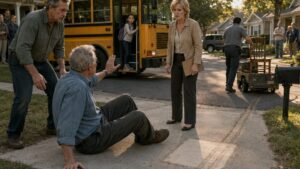
The older man stepped off the sidewalk six houses down from Jack’s driveway and into the street because there was nowhere else to go.
Jack saw it from his front window Thursday morning.
A pickup rounded the bend at the same moment.
The driver slowed, but the old man still moved closer to the curb, shoulders turning sideways as if that could make him smaller.
Then he reached the new sidewalk crossing Jack’s driveway and climbed back onto concrete.
Jack stood motionless behind the glass.
For two days he had thought of the slab as a trespass.
Now, for the first time, he watched someone use it exactly the way the board had intended.
His phone buzzed on the kitchen counter.
Another neighborhood email.
Someone had written that “one homeowner’s dispute” might force the association to remove a safety improvement.
Another replied that the board should refuse to be intimidated.
Jack closed the thread without answering.
Outside, chalk still marked the property line beside the concrete.
He had drawn it to make the dispute visible.
Now the line seemed to divide two things that were both true.
The board had crossed onto land it had no clear right to use.
And pedestrians were safer with a continuous path.
Jack walked outside with his coffee.
Edward was near his own driveway, adjusting a sprinkler head.
“You saw him?” Edward asked.
Jack looked down the street.
“The older man?”
Edward nodded.
“That happens all the time.”
“I thought people crossed earlier.”
“Some do. Some don’t.”
Jack looked at the section beyond his property. The road curved gently, enough to limit how far a driver could see around parked cars.
“How long has it been like this?”
“The sidewalk gap? Years.”
“And nobody fixed it?”
“Boards talked about it.”
“That’s not an answer.”
Edward gave him a tired look.
“You really only know one way to talk about this, don’t you?”
Jack felt the familiar irritation.
“What’s that supposed to mean?”
“Everything has to be a deposition.”
“I ask clear questions.”
“You ask questions like you’ve already decided somebody lied.”
Jack stared at him.
Edward turned the sprinkler off.
“For what it’s worth, I did pressure Ronald.”
Jack said nothing.
“After my wife’s close call. After the bike incident. I emailed him twice. Then I brought it up at a meeting.”
“You told me that.”
“I didn’t tell you I kept pushing.”
Edward wiped his wet hand on his shorts.
“I told him if the board couldn’t finish one stretch of sidewalk after talking about it for years, maybe we needed different people on the board.”
That landed differently.
Jack had pictured Ronald manufacturing urgency.
Instead, residents had created some of it themselves.
“You threatened his position.”
“I wouldn’t call it a threat.”
“What would you call it?”
Edward gave a short, humorless laugh.
“Fine. Pressure.”
“And Ronald promised a deadline.”
“By summer.”
Jack glanced toward his garage.
“So he was under pressure to finish.”
“Yes.”
“That still doesn’t give him my property.”
“I know.”
The answer surprised Jack again.
Edward stepped closer.
“I’m not defending what he did.”
“You were two days ago.”
“I thought you were objecting to the whole route.”
“That’s because nobody asked me.”
Edward looked at him.
“You didn’t exactly volunteer.”
Jack opened his mouth and stopped.
He thought of the Saturday walk-through invitation.
He had treated it like noise.
A meeting where people would blur a property question into compromise and feelings.
But maybe if he had stood on the driveway with the survey in his hand, people would have seen the difference between opposing a sidewalk and opposing its location.
The thought irritated him because it did not excuse Ronald.
It only complicated Jack’s own certainty.
At noon, he drove to the clubhouse.
The board’s regular meeting was not until the following week, but Patricia was there sorting packets.
She looked less surprised to see him this time.
“I’m not here to argue,” Jack said.
“That would be new for both of us.”
He almost smiled.
Almost.
“I need to understand something.”
Patricia closed the folder in front of her.
“The safety complaints.”
Her expression shifted.
“You talked to Edward.”
“Yes.”
“There were more than just his.”
“How many?”
“Enough that the board couldn’t keep postponing the issue.”
“Did Ronald know the driveway ownership was still unresolved?”
Patricia hesitated.
“I told you we discussed your objection.”
“That isn’t the same thing.”
“No.”
Jack waited.
Patricia rubbed one thumb along the edge of the folder.
“The engineer reviewed the alignment before final scheduling.”
Jack’s attention sharpened.
“And?”
“There was a note.”
“What note?”
“I don’t remember the exact wording.”
“But you remember it.”
“Yes.”
“What did it say?”
Patricia glanced toward the hallway.
“That the driveway crossing needed to be addressed separately.”
“Addressed how?”
“I don’t remember.”
Jack leaned forward slightly.
“Consent?”
“I said I don’t remember the wording.”
“Easement?”
“Jack.”
“Patricia, concrete is on my driveway.”
“I know.”
The softness of her answer stopped him.
She was not defending Ronald.
She looked worried.
“When was this?” Jack asked.
“The final planning meeting before the contractor was released.”
“What date?”
Patricia’s eyes narrowed.
“Why?”
“Because dates matter.”
“That is the most Jack Harris answer you could possibly give.”
He did not react.
Patricia sighed.
“I can check.”
She opened her laptop and searched through a calendar.
Jack watched her face, not the screen.
Then she stopped.
“May nineteenth.”
“What happened after that?”
“The project moved forward.”
“Was the note resolved?”
Patricia shut the laptop halfway.
“I assumed it was.”
“Because Ronald said it was?”
She looked at him.
“Yes.”
Jack felt the answer settle heavily.
Not proof yet.
But close enough to change the shape of the problem.
He had spent two days asking whether the board knew there was an objection.
That question was now too small.
The real question was whether someone had been told the crossing required separate action and decided construction could proceed anyway.
Patricia lowered her voice.
“You should request the project file formally.”
“I will.”
“And Jack?”
He paused.
“This isn’t me taking your side.”
“I didn’t ask you to.”
“I should have asked more questions.”
He studied her for a moment.
That was not an apology.
But it was the first admission from anyone inside the board that confidence had replaced verification.
Jack nodded once.
When he returned home, Ronald was standing near the driveway talking to two residents.
They fell quiet when Jack approached.
Ronald turned.
“I hear you’ve been making the rounds.”
“I’ve been asking questions.”
“You’ve also hired a contractor?”
Jack stopped.
“How do you know that?”
“People talk.”
“I requested an estimate.”
“For tearing out the sidewalk.”
“For removing the portion on my property.”
Ronald looked toward the two residents.
“This is exactly what I mean. We finally fix a documented safety issue, and now Jack wants to put people back in the street.”
Jack felt the heat rise again.
This time he did not swallow it completely.
“You knew there was an engineer’s note.”
Ronald’s face changed for less than a second.
Then it closed.
“What note?”
“May nineteenth.”
The two residents looked between them.
Ronald lowered his voice.
“You’re discussing internal project details you don’t understand.”
“Then explain them.”
“This is not the place.”
“You were comfortable explaining my motives here.”
Ronald’s jaw tightened.
Jack pointed toward the chalk line.
“I’m not removing the sidewalk because I hate sidewalks. I’m removing the part you had no permission to put there.”
Ronald shook his head.
“And when someone gets hurt because the route is broken again?”
Jack looked down the street.
He thought of the older man stepping into traffic.
For the first time, Ronald’s question did not feel purely manipulative.
That made it harder, not easier.
“I don’t know yet,” Jack said.
Ronald seemed almost surprised.
Jack was too.
“But I know this,” he continued. “You don’t solve one safety problem by creating a property-rights problem and pretending they’re the same thing.”
Ronald walked away without answering.
That evening Patricia emailed Jack one line.
May 19 executive-session minutes contain the engineer discussion you asked about.
She did not attach the minutes.
She did not explain further.
Jack read the sentence twice.
Then he checked the clock.
The seventy-two-hour deadline was still running.
But now another deadline seemed more important.
What exactly had the engineer told them before anyone poured the concrete?
Chapter 5: One Unresolved Note Had Been Treated as Permission
Patricia read the sentence slowly enough that nobody in the clubhouse could pretend they had not heard it.
“Driveway crossing at Harris parcel requires separate owner authorization before final placement.”
Jack did not move.
The words were plain.
No legal flourish.
No ambiguity.
Separate owner authorization.
Ronald sat at the far end of the folding table with both hands resting on a project binder.
Two other board members avoided looking at Jack.
Patricia had called him late Thursday afternoon and said the board would allow him to review the relevant portion of the project record before the deadline expired.
She had not promised copies.
She had not promised answers.
But now the answer was sitting between them.
Jack looked at Ronald.
“You knew.”
Ronald’s expression remained controlled.
“I knew the engineer flagged the driveway transition.”
“For authorization.”
“He flagged it for resolution.”
Patricia looked down at the minutes.
Jack said, “She just read the words.”
“I heard them.”
“Then why are we changing them?”
Ronald leaned back.
“Because a single note in a planning discussion doesn’t automatically control the association’s authority.”
“Did you get my authorization?”
Ronald said nothing.
Jack waited.
One of the board members shifted in his chair.
Finally Ronald said, “We believed existing community-access provisions were sufficient.”
“We?”
“The board.”
Patricia looked at him.
“Ronald.”
He turned toward her.
“We did not vote on that conclusion.”
Silence.
Jack felt something inside him settle.
For days he had expected a hidden document.
An easement he had missed.
A county rule.
Some technical authority that would turn his confidence into embarrassment.
Instead, the deeper truth was smaller and more ordinary.
Ronald had made a judgment.
And because he was president, everyone else had allowed judgment to harden into fact.
Ronald looked at Patricia.
“I consulted with the contractor and reviewed the governing documents.”
“The contractor doesn’t decide property rights,” Jack said.
“I’m aware of that.”
“Then who told you my authorization wasn’t necessary?”
Ronald’s restraint cracked slightly.
“No one gave me a sentence saying that, Jack.”
The room went still.
Jack leaned forward.
“So you assumed.”
“I made a decision.”
“Based on what?”
“Based on an incomplete project, escalating complaints, budget exposure, scheduling, and an association responsibility to maintain safe pedestrian access.”
Jack stared at him.
Ronald continued, his voice more tired now than defensive.
“If we stopped every project whenever one homeowner raised an objection, nothing would get completed.”
“This wasn’t an objection to paint color.”
“I know that.”
“Do you?”
Ronald’s eyes hardened.
“Yes. I do.”
For a moment neither man spoke.
Then Ronald tapped the binder.
“The contractor was scheduled. The concrete had been ordered. We had already delayed once. Residents were demanding action. Reopening the alignment meant another engineering review and more money.”
“And my consent was inconvenient.”
Ronald looked directly at him.
“Yes.”
The honesty hit harder than another denial would have.
Ronald rubbed his forehead.
“I believed once it was built, you would see that it didn’t meaningfully interfere with your use.”
Jack almost laughed.
“It blocks the path I use to enter and leave my garage.”
“You can drive across a sidewalk.”
“Not while the concrete is curing. And that isn’t the point.”
“I know.”
“No. The point is you decided I would accept it after the fact.”
Ronald did not answer.
That was answer enough.
Jack looked at Patricia.
“You assumed he had resolved it.”
“Yes.”
“And nobody asked to see the resolution.”
Her face tightened.
“No.”
The admission did not feel victorious.
It felt cheap.
Years earlier Jack had paid for someone else’s casual promise because he had failed to demand paperwork.
Now Patricia had done the institutional version of the same thing.
She had trusted confidence.
He wanted to judge her for it.
He could not do so comfortably.
Ronald closed the binder.
“I’m willing to compromise.”
Jack said nothing.
“We cut back the edge. Reduce the encroachment. Adjust the transition so your vehicles have a wider approach.”
“Does the concrete remain across my property?”
“Part of it.”
“Then no.”
“Jack.”
“No.”
Ronald’s chair scraped backward.
“You keep acting as if the only acceptable outcome is total removal.”
“Of the part you weren’t authorized to place? Yes.”
“That creates the same gap we spent months trying to fix.”
“Then redesign it.”
“With what money?”
“The same budget you should have used before pouring.”
Ronald stared at him.
Patricia intervened.
“There may be a narrower alignment.”
Ronald looked at her sharply.
“Based on what?”
“The engineer mentioned a curb-side alternative earlier.”
“That option required additional drainage work.”
“Then maybe we should have priced it.”
Ronald stood.
“You’re all very comfortable solving this after the fact.”
Jack almost said, So were you.
He stopped himself.
Instead he gathered his papers.
“At three-seventeen tomorrow, the deadline expires.”
Ronald’s expression changed.
“You’ve already scheduled removal.”
“I have a licensed contractor available.”
“You remove association property without authorization, and this gets more complicated.”
Jack held Ronald’s gaze.
“You placed association property on disputed private land after being told separate owner authorization was required.”
“That doesn’t give you unlimited rights to destroy community infrastructure.”
“I’m not destroying the sidewalk.”
“You’re cutting it.”
“Only where it crosses the line.”
Ronald shook his head slowly.
“You really believe a line settles everything.”
Jack looked down at the copied minutes.
“No.”
The answer surprised Ronald.
Jack continued.
“I believe the line settles where your authority stops. It doesn’t settle what we do about the safety problem after that.”
For once, Ronald had nothing ready.
Jack left.
At home, he spread the project drawings beside his survey.
The engineer’s note sat at the top.
Separate owner authorization before final placement.
He traced the proposed sidewalk with one finger.
The easiest route crossed his driveway.
A second faint alignment curved closer to the curb.
It was longer.
It would probably cost more.
It might require drainage adjustment.
But it existed.
Jack felt a flicker of anger return.
Not because the board had been trapped.
Because it had chosen the cheaper uncertainty.
His phone rang.
The concrete-cutting contractor.
“We can be there tomorrow morning if you want the slot,” the man said. “But I need one thing from you.”
“What?”
“A precise scope. I’m not coming out there to get in the middle of a neighborhood war.”
Jack looked at the chalk line through the kitchen window.
“Only the concrete inside my property.”
“Nothing else?”
“Nothing else.”
“And you understand we may leave an incomplete pedestrian transition?”
“Yes.”
A pause.
“You sure?”
Jack thought of the older man stepping into traffic.
“No,” he said.
The contractor laughed once.
“That’s usually the honest answer.”
“Can you still do it?”
“If the scope is clear.”
“It will be.”
They scheduled the crew for Friday morning.
At 3:17 that afternoon, exactly seventy-two hours after Jack had signed the certified letter, nothing had been removed.
No crew from the HOA arrived.
No revised plan came.
No authority document appeared.
Jack stood in his driveway and watched the second hand move past the deadline on his phone.
For three days, the clock had felt like leverage.
Now it became a decision.
Tomorrow morning, he would have to act on the line he had spent all week defending.
And once the saw touched the concrete, he would also own whatever problem remained after it was gone.
Chapter 6: The Saw Followed the Line Nobody Wanted to Respect
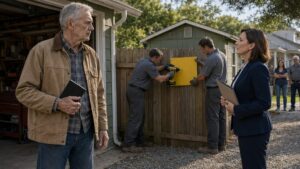
The concrete saw sat directly over Jack’s chalk line at 7:12 Friday morning.
Its blade had not started yet.
That was the only reason the street was quiet.
The contractor crouched beside the machine, comparing Jack’s survey measurements with the marks on the driveway.
“You want this exact edge?”
“Yes.”
“You’re sure the line is good?”
“I measured twice.”
The contractor gave him a look.
Jack added, “And checked the recorded survey.”
“Better answer.”
Two workers set up water hoses and barriers.
The new sidewalk stretched cleanly from one side of Jack’s property to the other, except where the chalk line angled beneath it.
From the curb, the solution looked almost absurdly simple.
Cut here.
Remove this portion.
Restore access.
But Jack knew what the empty space would mean once the concrete came out.
People would reach the end of the sidewalk and face the old problem again.
The contractor stood.
“We can preserve the majority of the slab.”
“How much?”
He pointed.
“We cut along your boundary, then another relief cut here. Lift the interior section. The rest stays.”
“So you don’t have to break the whole crossing?”
“No reason to.”
Jack felt something ease.
Not victory.
Possibility.
A dark SUV stopped at the curb.
Ronald got out.
He did not walk.
He came fast.
“Stop.”
The contractor looked at Jack.
Jack nodded for him to wait.
Ronald pointed toward the saw.
“You cannot authorize demolition of association infrastructure.”
Jack said, “It’s on my property.”
“That is disputed.”
“No. Your authority is disputed. The line is not.”
Ronald looked at the contractor.
“If you proceed, the association may hold your company responsible.”
The contractor folded his arms.
“My contract is with the property owner. I’ve seen the survey and the scope.”
Ronald turned back to Jack.
“We can still work this out.”
“You had seventy-two hours.”
“I offered a modification.”
“You offered to leave concrete on my property.”
“I offered a practical solution.”
Jack looked toward the sidewalk.
“So did your engineer.”
Ronald’s face tightened.
“The curb alignment is not simple.”
“I didn’t say simple.”
“It requires drainage changes.”
“Then price them.”
“That means more association money.”
Jack nodded.
“Yes.”
Ronald stared at him as if the word itself were unreasonable.
A few residents had begun gathering.
No one said much.
Edward stood near his mailbox.
Ronald noticed him.
“You wanted this sidewalk finished.”
Edward crossed the street slowly.
“I did.”
“Then tell him what happens if he cuts it apart.”
Edward looked at the concrete, then at Jack.
Jack expected hesitation.
Instead Edward said, “You shouldn’t have poured it without permission.”
Ronald blinked.
“You were one of the people demanding completion.”
“I demanded a sidewalk.”
“You demanded action.”
“Yes.”
“And now that action has consequences.”
Edward’s voice stayed calm.
“So does ignoring the engineer.”
The street went still.
Jack looked at Edward.
Two days earlier, Edward had told him he was the problem.
Now he was not choosing Jack over the sidewalk.
He was separating the two.
That mattered.
Ronald’s voice dropped.
“You don’t know the full project constraints.”
“Neither did Jack, because nobody explained them.”
Edward looked toward the gathered residents.
“I thought he was trying to block the whole project. He wasn’t.”
No applause followed.
Nobody cheered.
One resident looked uncomfortable.
Another stepped backward toward her yard.
That was enough.
The simplified story had broken.
Ronald looked at Jack.
“If you do this, the safety gap becomes your problem too.”
Jack nodded.
“Yes.”
Ronald seemed almost thrown by the answer.
Jack walked to the contractor.
“Show me exactly what stays.”
The man pointed to the preserved section.
“We remove only the portion inside this boundary. Then we grind the edge clean. Your driveway opens back up. The public side stays intact.”
“And a redesign could connect from there?”
“With the right engineering, sure. Maybe curve it closer to the curb. I’m not your civil engineer.”
Jack looked at Ronald.
“There.”
“There what?”
“A starting point.”
Ronald shook his head.
“You think cutting concrete is negotiation?”
“No. I think this is correction.”
Jack paused.
“The redesign is negotiation.”
For several seconds Ronald said nothing.
Then he stepped away from the saw.
He did not approve.
He did not consent.
He simply stopped trying to block it.
Jack looked at the contractor.
“Proceed.”
The engine roared.
Water sprayed against the blade.
The saw dropped into the concrete exactly where the chalk line had been.
Jack felt the vibration through the soles of his shoes.
Gray water ran toward the curb.
The line that had existed for years only on paper became physical.
Not metaphorical.
Not theoretical.
A cut.
The crew worked slowly.
No smashing.
No reckless demolition.
They made the boundary cut, then relief cuts inside the disputed section.
The contractor stopped once to show Jack that the remaining slab was stable.
“This is the part people mess up,” he said over the machine noise. “They get angry and tell us to rip everything out.”
“I don’t want everything out.”
“Good.”
The worker brought in a compact lifting machine.
The disputed slab rose in sections.
For the first time since Tuesday, Jack could see the original driveway surface beneath it.
He expected satisfaction.
Instead he felt strangely tired.
Edward came to stand near him.
“Well,” Edward said.
“Yeah.”
“Garage is yours again.”
“It always was.”
Edward glanced at him.
“That sounded like the old Jack.”
Jack almost smiled.
Then he looked toward the gap.
“What happens when somebody walks through here tonight?”
Edward followed his gaze.
“We figure it out.”
Jack shook his head.
“That phrase usually means nobody does.”
“Then we actually figure it out.”
By late morning, the crew had finished grinding the edge.
The legitimate sidewalk remained.
Jack’s driveway was open.
The gap looked awkward but manageable.
More importantly, it looked temporary.
Patricia arrived shortly before the contractor packed up.
She stood beside the new edge and studied the preserved section.
“You really only removed what was inside the line.”
“That was the point.”
“I thought you might take the whole crossing.”
“So did Ronald.”
Patricia glanced toward the SUV, now gone.
“He’s angry.”
“I know.”
“He also knows the board is going to have to revisit the design.”
Jack looked at her.
“Then revisit it.”
She hesitated.
“Would you participate?”
Three days earlier, he would have said no.
He would have told her the board had engineers, documents, procedures.
He had already done his part.
Then he remembered the Saturday walk-through he had skipped.
The story Ronald had been allowed to tell in his absence.
The older man stepping into traffic.
Jack nodded toward the property line.
“I’ll participate if this line stops being treated like a suggestion.”
Patricia nodded slowly.
“I think everyone understands that now.”
Jack looked at the new cut.
“I’m not asking them to understand it.”
“What are you asking?”
“To respect it.”
Patricia glanced at the remaining sidewalk.
“And the safety problem?”
Jack looked down the street.
“We solve that too.”
The answer did not feel like surrender.
It felt harder than winning.
The saw had restored the boundary.
Now Jack would have to prove the boundary did not have to become a wall.
Chapter 7: The Invoice Was Easier to Settle Than the Trust
Ronald King placed the invoice on the clubhouse table without looking at Jack.
Nobody reached for it.
The room was fuller than usual, but quieter. Folding chairs lined both walls. Several homeowners stood at the back because every seat was taken. Patricia Lee sat beside Ronald with the meeting packet open in front of her.
Jack took a chair near the aisle.
The concrete-cutting invoice rested beneath Ronald’s hand.
Removal. Hauling. Edge finishing. Equipment.
Costs that would not have existed if the driveway crossing had been handled correctly in the first place.
Ronald cleared his throat.
“The association’s insurer has agreed to cover a portion of the corrective work.”
A resident near the back shifted.
Ronald continued.
“The association will still be responsible for the deductible, along with engineering and construction expenses associated with the revised alignment.”
Someone murmured.
Jack kept his eyes on the table.
Two weeks earlier, he would have imagined this moment differently.
He would have pictured the invoice as proof.
A final number attached to Ronald’s decision.
Instead, it looked like what it was.
Money coming out of a community budget that belonged partly to everyone in the room, including people who had never seen the engineer’s warning and had never authorized Ronald to ignore it.
One of the board members asked, “How much more is the redesign?”
Patricia answered before Ronald could.
“The curb-side option requires a drainage adjustment, but the engineer has revised the scope. It’s less extensive than we initially believed.”
Ronald glanced at her.
That old tension remained between them.
Not hostility.
A new absence of automatic trust.
Patricia turned a page.
“The revised sidewalk will curve toward the curb before it reaches the Harris property line. It will reconnect beyond the driveway without crossing privately owned pavement.”
Jack had spent forty minutes with the engineer on site the previous week.
This time he had attended.
He had brought the survey.
He had also listened.
The drainage issue was real. The sidewalk could not simply be pushed toward the road without changing the slope near a storm inlet.
The first plan had been easier.
Cheaper.
Faster.
That did not make it lawful.
But seeing the revised drawings had made Jack understand why the original route had looked so attractive to anyone focused only on completion.
Ronald tapped the invoice.
“There is also the question of reimbursement.”
Jack looked up.
Ronald met his eyes.
“The association disputes certain portions of the contractor charge but accepts responsibility for the removal associated with the unauthorized crossing.”
The word unauthorized caused a small movement through the room.
Not applause.
Just attention.
Jack looked toward Patricia.
She had insisted that the meeting record use precise language.
Ronald had resisted.
Apparently she had won that part.
One homeowner raised a hand.
“So this could have been avoided?”
Ronald hesitated.
“Yes.”
The answer was barely louder than the room’s ventilation system.
Another homeowner asked, “Then why wasn’t it?”
Ronald looked down at the project binder.
“I believed the board had enough authority to proceed.”
“That’s not what the engineer said,” someone replied.
“No,” Ronald said. “It wasn’t.”
The room went still.
Jack had wanted that admission once.
He had imagined it would feel like balance returning.
It did not.
It sounded like an exhausted man saying publicly what he had already said privately.
After the meeting moved through the financial report, a resident behind Jack leaned forward.
“You should make a motion to remove him.”
Jack turned.
The man nodded toward Ronald.
“You’ve got the room.”
Jack looked toward the front table.
Ronald was reviewing the next agenda item with Patricia.
“What room?”
“Support. People are furious.”
Jack glanced around.
They were.
Some because of the money.
Some because of the board’s mistake.
Some because they had believed Jack was the problem and now felt misled.
The resident lowered his voice.
“If you ask for his resignation tonight, he’s done.”
Jack leaned back.
For a moment, the idea tempted him.
Not because Ronald deserved humiliation.
Because removal would make the ending clean.
Ronald crossed the line.
Ronald lost his position.
Jack was right.
Case closed.
Then Jack remembered his own empty chair at the Saturday design walk.
He had not caused Ronald’s decision.
But he had learned something uncomfortable from the dispute.
People became easier to misrepresent when they refused to enter the room.
“No,” Jack said.
The resident frowned.
“No?”
“I’m not asking for his resignation.”
“Why not?”
“Because I wanted my driveway back, not his chair.”
At the front, Patricia called the meeting back to order.
The next proposal concerned project authorization.
She read it slowly.
Any association construction requiring entry onto or permanent use of separately owned property would require documented owner consent or verified recorded authority before work could be released to a contractor.
No assumption.
No “handled.”
No confidence substituted for paper.
One board member proposed adding mandatory review by someone other than the project lead when ownership was disputed.
Jack raised his hand.
Patricia recognized him.
“I support that.”
Several people turned toward him.
Jack continued.
“And I think the property owner should be invited to the site review before the final design is approved.”
Ronald looked at him.
Jack noticed the irony immediately.
So did Edward, seated near the back.
Edward smiled faintly.
Jack did not.
He had skipped exactly that kind of meeting because he once believed being correct on paper made participation unnecessary.
Patricia wrote the addition down.
The policy passed.
Not unanimously.
But comfortably.
Afterward, people lingered outside the clubhouse.
Edward caught Jack near the parking lot.
“So you didn’t finish him off.”
Jack unlocked his truck.
“That’s a strange way to describe an HOA meeting.”
“You know what I mean.”
“I do.”
Edward leaned against the next vehicle.
“I probably would’ve asked him to resign.”
“Two weeks ago, I might have.”
“What changed?”
Jack looked toward the clubhouse doors.
“I got my answer.”
“That simple?”
“No.”
Edward waited.
Jack said, “He made a bad decision because he convinced himself the result would justify it.”
Edward nodded.
“And?”
“And I’ve done smaller versions of that.”
Edward looked surprised.
Jack opened the truck door.
“Don’t look so pleased.”
“I’m just documenting the moment.”
Jack gave him a flat stare.
Edward laughed.
A week later, the redesign crew arrived.
Jack stood at the edge of his driveway as the new route took shape.
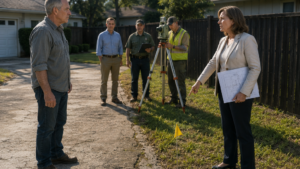
This time there were stakes.
Measurements.
Drainage markings.
The engineer walked the alignment with Jack before anything was poured.
Ronald attended too.
He stayed mostly quiet.
At one point, the engineer pointed to the old survey line.
“The new edge clears it by fourteen inches.”
Jack checked the measurement himself.
Ronald watched him.
“You trust anybody?” he asked.
Jack looked up.
“More than I used to.”
Ronald almost smiled.
“That’s not saying much.”
“No.”
They stood beside each other while the crew adjusted the formwork.
Ronald finally said, “I should have stopped the project.”
Jack did not rescue him from the silence.
Ronald continued.
“I kept thinking one more delay would prove everybody right about the board.”
“Who was saying that?”
“Enough people.”
“Edward?”
Ronald glanced toward Jack.
“Among others.”
Jack nodded.
“I thought if we finished it, the argument would disappear.”
“It didn’t.”
“No.”
Ronald looked at the driveway.
“I’m sorry.”
Jack considered the words.
He had learned not to give verbal assurances more weight than they deserved.
But not every sentence needed to become a contract.
“I know,” he said.
That was as close to forgiveness as he could honestly get.
It was enough.
The new sidewalk opened several days later.
It approached Jack’s property, curved gently toward the curb, passed along the corrected drainage edge, then returned to its original line beyond the driveway.
No concrete crossed the surveyed boundary.
No vehicle access was blocked.
The solution was less straight than the first one.
More expensive too.
But it worked.
One afternoon Jack backed his truck out of the garage.
He paused near the street.
An older resident was walking along the sidewalk.
At the place where the old gap had forced him toward traffic, he followed the new curve instead.
He never stepped into the road.
Jack watched him cross safely beyond the driveway.
Then Jack looked down.
The property line was no longer marked in chalk.
There was no need.
The sidewalk stopped where it was supposed to stop.
The driveway remained open.
Jack backed into the street and drove away while the pedestrian continued in the opposite direction, each of them using the same piece of neighborhood without either one having to surrender his place in it.
The story has ended.