The HOA Used My Driveway for Overflow Parking—Then One Quiet Saturday Changed Every Rule
Chapter 1: The Cars Were Already Across My Line
When I hit the garage-door button that Saturday morning, the first thing I saw was the rear bumper of a white SUV.
For half a second, I thought somebody had turned around in my driveway and stopped too close to the garage.
Then the door rose another foot.
There were six vehicles across the lower half of my driveway.
Beyond them, more cars sat in two neat rows along the narrow strip of grass beside my property, their tires angled toward the clubhouse field at the end of the street. A man in an orange volunteer vest stood near my mailbox, waving another sedan forward with both arms.
I stepped out of the garage.
“Hold up.”
The volunteer glanced at me but kept directing the sedan.
“Right over there,” he told the driver.
The sedan rolled toward the grass.
“That’s my property,” I said.
The driver stopped.
The volunteer lowered one hand. “Overflow parking.”
“I can see that.”
He smiled as if we were agreeing. “Community festival. We’re packed already.”
I walked past him toward the driveway apron.
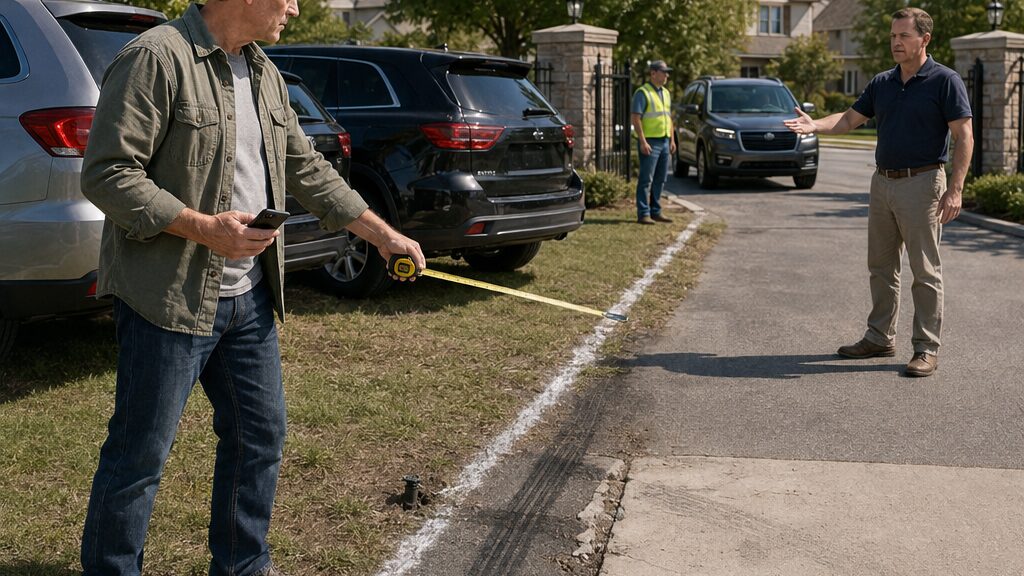
Every spring, before I pressure-washed the concrete, I marked the side boundary with chalk so I could keep my edging and sprinkler work inside my parcel. The line wasn’t official survey paint. It was simply a reference I had used for years, running from a survey pin near the sidewalk toward the rear corner of my lot.
That morning, the chalk line disappeared beneath three tires.
I crouched and looked underneath the nearest car.
The line continued almost two feet beyond the inside edge of the tire.
I pulled out my phone.
The volunteer sighed.
“You don’t need to take pictures. They’ll be gone this afternoon.”
I photographed the tire, the line, the driveway, and the plate.
“I asked who told you this was parking.”
“The HOA.”
“Who at the HOA?”
He pointed toward the clubhouse. “We have a map.”
Behind us, somebody tapped a horn.
A dark SUV had arrived.
The volunteer stepped around me and raised his hand.
“Come on through.”
I moved beside the driveway instead of in front of the vehicle. The last thing I wanted was somebody claiming I had blocked traffic or caused an accident.
The SUV crossed the sidewalk, then turned exactly where the volunteer directed it.
Its front tire rolled over my chalk line while I stood five feet away.
That was when surprise became something harder.
Not anger exactly.
Not yet.
I had lived there almost seventeen years. Long enough to know how quickly a neighborhood disagreement could become a story about personalities instead of facts.
I also knew my own weakness.
I avoided HOA arguments.
When landscaping crews had stacked mulch bags beside my fence for a weekend, I had said nothing. When contractors replacing a common-area sprinkler line had driven across the corner of my grass, I had repaired the rut myself. When temporary signs from the holiday market had ended up on my side of the sidewalk, I had moved them without complaint.
It had always seemed easier.
Now an SUV was sitting where I usually backed my truck.
Anthony Green came walking across the street carrying a paper coffee cup.
He looked from me to the rows of vehicles.
“Quite a turnout.”
“They’re on my lot.”
He took a drink.
“Some of them.”
“All of that strip is mine.”
Anthony studied the grass as if property ownership might change if he stared long enough.
“I thought the HOA had access there.”
“For maintenance. Not public parking.”
He lowered his voice. “Jack, it’s one day.”
Another car entered.
I watched the volunteer point toward the side parcel.
Anthony followed my eyes.
“I’m just saying, don’t become the guy who shuts down the neighborhood festival over parking.”
There it was.
The exact reason I usually kept my mouth shut.
Not because I thought I was wrong.
Because nobody wanted to be the difficult neighbor.
I held my phone out and took another photograph.
“I haven’t shut down anything.”
“No, but you’ve got that look.”
“What look?”
“The contractor look.”
I almost laughed.
Before I semi-retired, crews used to recognize it too—the moment I stopped arguing and started measuring.
I went into the garage and came back with a twenty-five-foot tape.
The volunteer watched me hook it against the concrete edge.
“What are you doing?”
“Checking.”
I measured from the survey-pin location to the driveway seam, then from the seam to the chalk line. I repeated it twice.
Several cars were not barely over.
They were completely inside my parcel.
The nearest one sat more than eight feet beyond the line.
I took photographs of the measurements.
Anthony’s expression changed slightly.
“That far?”
“That far.”
A burst of music came from the clubhouse grounds. Somewhere past the houses, children cheered at something I couldn’t see.
The neighborhood was having exactly the Saturday it had planned.
Only my driveway had been volunteered for it.
The volunteer finally came over carrying a clipboard.
“Look, sir, I’m not trying to cause trouble. We were told this area was approved.”
“By whom?”
“I don’t know. It’s on the parking sheet.”
“Show me.”
He hesitated.
Then he turned the clipboard around.
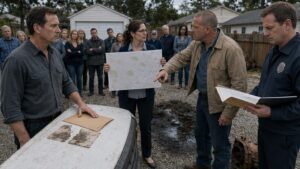
A photocopied map showed the clubhouse, pool, entrance road, and several shaded parking areas. One rectangle extended along the edge of my lot.
A thick arrow directed overflow traffic straight across my driveway apron and onto the side parcel.
My house number appeared beside the shaded area.
I stared at it.
That wasn’t a confused driver.
It wasn’t one volunteer making a bad judgment.
Somebody had drawn my property into the plan.
I took a picture of the sheet.
The volunteer pulled the clipboard back.
“Can I ask you something?” I said.
He looked tired already.
“Sure.”
“Who gave you that map?”
“The president brought the volunteer packets yesterday.”
“Eric Nelson?”
He nodded.
Another horn sounded behind us.
The volunteer looked toward the street.
I looked at the rectangle printed over my property.
Then I looked toward the clubhouse.
“Don’t send another car across that line.”
His face tightened.
“You’ll have to talk to Eric.”
“That’s exactly what I’m going to do.”
Chapter 2: He Called It a Temporary Inconvenience
By the time I reached Eric Nelson, another sedan was turning onto my grass.
He stood near the festival entrance wearing a blue HOA polo and a radio clipped to his belt, answering questions from two volunteers while people streamed past carrying folding chairs and food containers.
“Eric.”
He saw me and looked at the line forming behind me rather than at my face.
“Morning, Jack. Everything okay?”
“No.”
One volunteer stepped away.
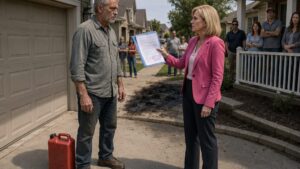
I held up my phone and showed him the photograph of the parking map.
“You’re directing cars onto my parcel.”
Eric barely glanced at the screen.
“That’s overflow.”
“I know what you’re calling it.”
“We had a capacity issue.”
“You didn’t ask me.”
He looked toward the parking area.
“Jack, they’re not building anything there.”
“That isn’t the point.”
“They’ll be gone in a few hours.”
A radio on his belt crackled.
He pressed the button.
“Use the east row first. Keep the fire lane open.”
Then he looked back at me.
“We’re trying to keep traffic off the main street.”
“So you put it on my property.”
“We’re using the access strip.”
“No. You’re using my side parcel.”
Eric exhaled through his nose.
The gesture was small, but I recognized it. I had used it myself when a subcontractor kept arguing after I thought the issue was settled.
Except this wasn’t his decision to settle.
“There’s a maintenance-access notation along that edge,” he said.
“For utility access.”
“Right.”
“That doesn’t make it HOA parking.”
“We’re talking about a temporary community use.”
“I never approved temporary community use.”
Behind me, another volunteer raised a parking wand.
A crossover started toward my driveway.
“Stop that car.”
Eric looked at the volunteer.
Then at me.
“Jack.”
“Stop the car.”
He lifted one hand, but not toward the driver.
Toward me.
“Let’s not make this bigger than it is.”
The crossover rolled over the chalk line.
Something inside me went very quiet.
I took out my phone and photographed it.
Eric’s jaw tightened.
“Are you documenting me now?”
“I’m documenting my property.”
“This is exactly the kind of thing that turns a simple neighborhood event into a mess.”
“You’re right.”
He seemed surprised.
I pointed toward my driveway.
“So stop creating the mess.”
For the first time, irritation showed plainly on his face.
“Do you know what we’ve got invested in today? Vendors, rentals, permits, security, food trucks. Residents paid for this. People have been planning it for three months.”
“Then parking should have been part of the planning.”
“It was.”
“Not with my permission.”
A woman carrying a stroller slowed near us. Eric noticed.
His voice dropped.
“Can we discuss this after the event?”
“No.”
“Why not?”
“Because cars are crossing my property now.”
He glanced toward the rows.
“They’re parked. They’re not hurting anything.”
As if summoned by the sentence, a tire made a sharp grinding sound behind us.
I turned.
A pickup was backing toward the edge of my driveway while a volunteer guided it with one hand.
The rear wheel climbed the concrete lip.
There was a dry crack.
The volunteer shouted for the driver to stop.
I walked back.
A thumbnail-sized piece of concrete had broken from the corner of the driveway apron.
Then I saw water beginning to darken the grass.
The pickup’s tire had crushed one of the low sprinkler heads near the boundary. A thin stream pushed up through the broken housing and ran toward the sidewalk.
Anthony had come over again.
He looked at the water, then at Eric.
“Well,” he said quietly.
I crouched and shut the small irrigation valve inside the ground box.
When I stood, Eric was beside me.
“That can be repaired.”
“I know.”
“We’ll take care of it.”
“Who is ‘we’?”
“The association.”
“Put that in writing.”
He stared at me.
“Seriously?”
“Yes.”
The driver had gotten out of the pickup and looked miserable.
“I’m sorry,” he said. “They told me to park here.”
I believed him.
“That’s fine. Move the truck back onto the street for now.”
Eric stepped in.
“We don’t have street capacity.”
“That isn’t his problem.”
The driver hesitated between us.
I pointed toward the road.
“You were given bad instructions. I’m not blaming you.”
He got back into the truck.
Eric’s voice sharpened.
“You can’t personally redesign event traffic in the middle of the morning.”
“I’m not redesigning anything.”
I pointed to the chalk line.
“I’m telling you where my property starts.”
He folded his arms.
“I’ve seen crews cross that strip for years.”
“Maintenance crews.”
“You never complained.”
That landed harder than I wanted it to.
Because he wasn’t entirely wrong.
I had let small things go.
Not because I had granted permission. Not because ownership changed.
But silence leaves room for people to tell themselves whatever version is convenient.
I stepped closer to the chalk line.
“Listen carefully, Eric. Whatever you think my silence meant before, I’m telling you now. I do not consent to parking on my driveway or my parcel. Stop directing vehicles onto it.”
He looked at me for several seconds.
Then he said, “We have maybe three hours of peak traffic left.”
“That wasn’t my question.”
“This is a temporary inconvenience.”
“A temporary inconvenience you chose for somebody else.”
The radio crackled again.
A volunteer called his name.
Eric rubbed his forehead.
For one brief moment, he looked less like a president and more like a man trying to keep too many things from falling apart at once.
“We lost the church lot yesterday,” he said. “They had another booking. If I close this section, cars back up to the entrance. People start parking on both sides of the road. Emergency access becomes a problem. Then I’ve got residents complaining about that.”
I understood the pressure.
That didn’t change the line.
“You should have called me yesterday.”
“I didn’t have time to renegotiate the whole plan.”
“You had time to print my lot on the map.”
His eyes met mine.
Neither of us said anything.
That silence told me more than his explanations had.
He knew the map.
He knew the strip.
And he had made a choice.
I held up my phone.
“I’m giving you one chance to correct it.”
Eric looked past me at the festival entrance.
More cars were arriving.
“If I stop this now, we lose the event.”
“No. You lose parking you never had.”
He stepped away.
For half a second I thought he might call the volunteers over.
Instead, he lifted his radio.
“East team,” he said, “keep filling the overflow section. Tight rows. Don’t block the Mitchell garage.”
I stared at him.
He released the button.
“There. I’ve kept your garage clear.”
“You think that fixes it?”
“I think it gets us through the morning.”
Another vehicle rolled forward.
I photographed the crushed sprinkler, the chipped concrete, the plate, and the chalk line disappearing beneath another tire.
Then I put my phone in my pocket.
Eric had answered the only question that mattered.
He wasn’t confused.
He had decided my boundary was negotiable.
Chapter 3: The Map Had No Vote Behind It
Sandra Roberts called while I was standing at my kitchen counter with the county parcel map open beside my phone.
“I pulled the approved event packet,” she said. “Your property is not listed as parking.”
I stopped marking measurements.
“Say that again.”
“The board-approved site plan shows clubhouse parking, the pool lot, the visitor spaces on Nelson Court, and the contracted church lot. Nothing on your parcel.”
Through the kitchen window I could see the roofs of cars beyond the hedge.
“So where did the volunteers’ map come from?”
“I don’t know yet.”
Sandra managed the association through a regional property-management company. We had spoken maybe four times in five years, mostly about ordinary things—roof approvals, landscaping notices, one argument about drainage that ended in two emails and a contractor visit.
She was not somebody I would have called an ally.
That morning, I didn’t need one.
I needed records.
“I photographed the volunteer map,” I said.
“Send it.”
I did.
While she opened it, I laid my old closing survey beside the county map. The property line on both ran where I knew it ran: along the side parcel, well beyond the driveway apron.
Outside, a car door slammed.
Sandra went silent.
Then she said, “This isn’t the approved map.”
“I figured.”
“No. I mean it’s been altered.”
I picked up the phone.
“How?”
“The base drawing is ours. Same clubhouse layout, same symbols, same revision date. But this shaded overflow box isn’t on the version attached to the board packet.”
“Can somebody revise it without a vote?”
“Operational details can change.”
“That sounds like yes.”
“It sounds like it depends what changed. Moving a volunteer station is one thing. Designating privately owned land for association parking is not.”
I looked at the cars through the window.
“So there was no vote.”
“Not that I can find.”
“And no consent from me.”
“Do you have any agreement allowing event parking?”
“No.”
“Email? Text? Prior license?”
“No.”
She paused.
“What about past events?”
“People have cut across that strip. A vendor van once parked there for an hour. I never made an issue of it.”
“That’s different from written consent.”
“I know.”
But Eric’s words were still in my head.
You never complained.
Sandra said, “I need to check the distribution records.”
“For the map?”
“Yes.”
“Do that.”
There was a slight pause.
“Jack, don’t do anything impulsive.”
I almost smiled.
“You think that’s my reputation?”
“No. I think you’re angry.”
“That part is true.”
“And I think the association may have created a liability problem. Let me confirm what I can confirm.”
After we hung up, I went back outside with my closing survey folded under one arm.
Anthony was standing beside the broken sprinkler.
Water no longer ran, but the grass around it had turned muddy.
“You shut it off?”
“Zone valve.”
He nodded toward the parked cars.
“You calling a tow company?”
“I’m checking what I can legally do first.”
“That’s probably smart.”
“Five minutes ago you wanted me to ignore it.”
He looked embarrassed.
“I didn’t see this.”
He pointed to the broken sprinkler.
I laid the survey on the hood of my truck.
“Damage shouldn’t be the thing that decides whether a boundary matters.”
“No.”
“But apparently it helps.”
Anthony crouched beside the chalk line while I matched the survey dimensions to the reference points at the sidewalk.
The numbers aligned.
I photographed the survey, the line, and the measurement.
For the first time all morning, I felt something close to relief.
Not because I had won anything.
Because the ground beneath the argument had stopped moving.
My phone rang again.
It was the towing dispatcher I had called after speaking with Sandra.
I explained the layout and the event traffic.
“You’re the titled owner?” the dispatcher asked.
“Yes.”
“Private residential parcel?”
“Yes.”
“Any posted parking restrictions?”
“Not specifically for this event.”
“Then don’t assume we can hook every vehicle just because it’s trespassing. Local notice requirements matter. Police involvement may matter. HOA rules may matter. You need to establish what process applies before we remove anything.”
That was not the answer the angry part of me wanted.
It was the answer I trusted.
“What can you do?”
“We can send someone to assess access and verify we’re not creating another problem. But nobody touches a car until the authority is clear.”
“Fair.”
“You’d be surprised how many people call us wanting revenge.”
“I don’t want revenge.”
Even as I said it, I wondered whether that was completely true.
I wanted Eric to understand what he had done.
That was close enough to revenge that I noticed the difference.
When I ended the call, Sandra called again almost immediately.
“I found the distribution email.”
I straightened.
“And?”
“The revised map went to the volunteer captains last night at 8:14.”
“Who sent it?”
“Eric.”
“That proves he distributed it. Not that he changed it.”
“I know.”
Her voice sounded careful now.
“There’s also a message attached to the file.”
I waited.
“What does it say?”
Sandra read slowly.
“Use east-side overflow if church capacity is unavailable. Existing maintenance access should accommodate temporary parking.”
I looked toward my parcel.
“Existing maintenance access.”
“Yes.”
“That’s what he told me.”
“There’s more.”
I said nothing.
“The file history shows the revised map was uploaded from Eric’s board account.”
My fingers tightened around the phone.
“Can anyone else use that account?”
“Not normally.”
“Did the board approve this?”
“No.”
“Did management approve it?”
“No.”
“Did anybody contact me?”
“I have no record of it.”
Cars continued moving in the distance.
Music from the festival floated over the roofs.
Sandra lowered her voice.
“I’m going to tell you something unofficially until I speak with counsel.”
“All right.”
“This wasn’t a misunderstanding in the parking lot.”
I looked down at the survey lying across my truck hood.
The printed property line matched the chalk mark almost exactly.
“What was it?”
“A decision.”
The word settled between us.
Then Sandra added, “And according to the system log, Eric Nelson made it last night.”
Chapter 4: Clearing the Driveway Made Everyone Angry
The first tow truck stopped at the mouth of my driveway just before noon, and within thirty seconds three neighbors were standing in the street asking who had called it.
I had.
That answer sounded simpler than it felt.
The driver climbed down, looked at the rows of vehicles, then at the chalk line and the survey copy I had brought outside.
“You’re the property owner?”
“Yes.”
“And you’ve already spoken with the association?”
“Twice.”
He nodded toward the street.
“Dispatcher told you we’re not touching anything until the removal process is confirmed?”
“Yes.”
“Good.”
He seemed relieved I understood that.
A county non-emergency officer arrived a few minutes later. He did not come with flashing lights or dramatic instructions. He looked at my closing survey, checked the parcel information I had pulled up, photographed the damaged sprinkler and concrete, and asked the volunteer supervisor whether drivers had been told they could park there.
“Yes,” the volunteer said.
“By whom?”
“The HOA.”
That was when the first vehicle owner appeared.
A woman came hurrying from the festival carrying two canvas bags, her expression changing when she saw the tow truck.
“That’s my car.”
She pointed to a compact SUV sitting well past the chalk line.
“Are you towing it?”
“I don’t want to if you can move it,” I said.
Her eyes went from me to the volunteer.
“You told me to park there.”
The volunteer looked miserable.
“I was following the map.”
She turned back to me.
“I didn’t know this was private.”
“I believe you.”
That surprised her.
“Then why is there a tow truck?”
“Because the parking hasn’t stopped.”
As if to prove the point, another car entered the street.
The volunteer at the corner raised a hand, then froze when he saw the officer.
For the first time all morning, nobody waved the car onto my property.
The woman moved her SUV.
When the tires crossed back over the chalk line, a section of white mark appeared beneath them, dusty but intact.
It felt like a small victory.
Then a man in a festival T-shirt came running toward us.
“You towing everybody?”
“No,” I said. “Anyone we can locate gets a chance to move.”
“My truck’s back there.”
“Move it.”
He frowned.
“I paid for festival parking.”
“That’s between you and the association.”
“They told us where to go.”
“I know.”
His anger lost some direction.
Within twenty minutes, word spread through the event faster than any official announcement could have.
People began returning in clusters.
Some were embarrassed.
Some apologized.
Some were angry at the HOA.
And some were simply angry at me because I was standing beside the tow truck.
One man stopped six feet away and pointed toward the vehicles.
“You really called towing on your own neighbors?”
“Those cars are on my property.”
“We were told to park there.”
“And I’m giving you the chance to move them.”
“That’s not the point.”
“What is?”
He opened his mouth, then stopped.
I knew what he meant even if he didn’t say it cleanly.
From his perspective, he had followed directions, taken his family to the festival, and returned to find the homeowner waiting with a tow company.
The fact that I was legally right did not automatically make the scene feel fair to everyone standing in it.
That bothered me more than I expected.
The officer spoke quietly with the tow driver. The dispatcher called me again. Local requirements meant actual nonconsensual removal would need documented notice and confirmation that the vehicles were clearly on private property, among other steps.
That slowed everything down.
Earlier, I would have called the delay frustrating.
Now I was grateful for it.
The slower process gave owners time to return and move their cars.
By twelve-thirty, almost half the vehicles were gone voluntarily.
The chalk line emerged in pieces.
A few feet beside the mailbox.
Another section near the sprinkler box.
Then ten uninterrupted yards of white line that had been invisible all morning.
Anthony stood beside me watching a family load a stroller into their minivan.
“You’re letting them all leave.”
“If they come back before a tow is authorized, yes.”
“You could’ve made this ugly.”
“It’s already ugly.”
“You know what I mean.”
I did.
There had been a moment, after Eric told the volunteers to keep parking, when I had imagined every car leaving on a flatbed.
Not because every owner deserved it.
Because I wanted the scale of the consequence to match the scale of the disrespect.
Standing there watching people apologize for something they hadn’t knowingly done changed that.
The people parking on my land were the visible problem.
They were not the decision-makers.
A middle-aged couple approached their sedan.
The husband looked at me.
“You Jack?”
“Yes.”
“We’re sorry. They told us the homeowner had approved overflow.”
I went still.
“Who told you that?”
“The volunteer at the entrance.”
The volunteer nearby shook his head quickly.
“That’s what we were told.”
“By Eric?”
“I don’t know. It was in the group instructions.”
The couple moved their car.
I watched the tires leave the grass.
When the space cleared, two dark ruts remained.
Anthony looked down at them.
“That’s going to need work.”
“Yes.”
“Still think I was right this morning?”
He gave me a sideways glance.
“No.”
“That makes one of us.”
He laughed once.
Then his phone buzzed.
He looked at the screen.
His expression changed.
“What?”
Anthony turned the phone toward me.
It was a message from the volunteer group chat.
I read it once.
Then again.
The wording was short.
The east overflow area was approved for event use.
Residents assigned there should be told the adjoining homeowner had agreed to temporary parking.
I looked at Anthony.
“Can you send me that?”
“Yes.”
“Who posted it?”
He scrolled upward.
The message had been forwarded into the volunteer chat from the event-planning thread.
The original sender was not shown in the screenshot.
But somebody had not merely assumed I would tolerate the parking.
Somebody had told people I had said yes.
Chapter 5: Eric Knew I Had Never Said Yes
Eric asked to speak privately Sunday afternoon.
Not at my house.
Not at his.
At the HOA office, before Sandra arrived for the board-preparation meeting.
That choice told me he wanted the conversation on association ground but outside the formal record.
I almost refused.
Then I decided I wanted to hear what he said when there was no crowd to manage.
He was already sitting at the small conference table when I walked in.
No blue polo.
No radio.
Just a gray shirt with the sleeves rolled to his elbows and a legal pad in front of him.
“You want coffee?”
“No.”
He nodded.
I sat across from him.
For several seconds, neither of us spoke.
Then he said, “I heard most of the cars were moved without towing.”
“Most.”
“And the remaining few?”
“Handled after the process was confirmed.”
He rubbed one thumb along the edge of the legal pad.
“I appreciate that you gave people the chance to move.”
“I wasn’t trying to punish them.”
“I know.”
That answer irritated me.
“You know that now.”
Eric looked up.
“I knew it yesterday.”
“Then why did you act like I was trying to wreck the festival?”
“Because yesterday I had three hundred people coming through the gate, vendors calling me, volunteers asking where to put cars, and a parking plan that collapsed twenty-four hours before the event.”
“That still doesn’t explain why my property became yours.”
“No.”
The word came quietly.
I waited.
He looked toward the office window.
“The church canceled our lot Friday morning.”
“They didn’t cancel. They had another booking.”
“Fine. We lost the lot.”
“And?”
“And every backup option was smaller than what we needed. Street parking would have narrowed emergency access. The pool lot was already assigned. The visitor spaces filled during setup.”
“You could have reduced attendance.”
“We had prepaid vendors.”
“You could have told residents parking was limited.”
“After we sold event passes?”
“You could have called me.”
Eric finally looked at me again.
“Yes.”
There was no argument in it.
Just one word.
That did more to unsettle me than another excuse would have.
“Did you change the map?”
“Yes.”
I leaned back.
“And the message that I had agreed?”
His eyes dropped to the table.
“That wasn’t exactly what I wrote.”
“Then what did you write?”
“I told the volunteer captains the east overflow area could be used and that prior access had not been challenged.”
“That isn’t consent.”
“I know that now.”
“You knew it then.”
He pressed his lips together.
I waited.
Finally he said, “I knew you might object.”
“Might?”
“You’ve let crews use that strip before.”
“For maintenance.”
“You let the mulch delivery sit there two days.”
“Because I didn’t want to make a fight over mulch.”
“You never sent the association a written objection.”
I stared at him.
There was the piece I had not wanted to face.
He had converted my silence into a story convenient for himself.
But I had provided the silence.
“I should have complained sooner,” I said.
Eric looked surprised.
I continued before he could misunderstand me.
“That doesn’t mean you had permission.”
“No.”
“But it means I made it easy for you to tell yourself I wouldn’t care.”
He nodded slowly.
“Yeah.”
For a moment, we were not homeowner and HOA president.
We were two men looking at the same bad decision from opposite sides.
Then Eric ruined the moment by reaching for the legal pad.
“I want to settle this before Tuesday.”
“What does that mean?”
“We reimburse the sprinkler, the concrete repair, any landscaping damage. Reasonable amount. Quickly.”
“That’s already part of the claim.”
“I mean directly.”
He slid the pad toward me.
There were numbers written on it.
“You withdraw the governance complaint. We treat Saturday as an event-planning error, compensate you, and move on.”
I did not touch the paper.
“Why?”
“Because dragging this through a public board meeting helps nobody.”
“It helps the board know what happened.”
“They know what happened.”
“Do they know you changed the parking map?”
His jaw tightened.
“They know there was an operational revision.”
“Do they know the revision put private property into the parking plan without consent?”
“Jack.”
“That’s the question.”
Eric leaned back.
“You think I’m trying to hide something.”
“Aren’t you?”
“I’m trying to keep one bad Saturday from becoming three months of neighborhood warfare.”
That sounded more believable than I wanted it to.
He looked tired.
Not defeated.
Not ashamed enough to satisfy the angry part of me.
Just tired.
“We’ve got people already emailing about towing,” he said. “People saying assessments shouldn’t pay your damage. People saying the board should resign. Others saying you overreacted. If this goes public Tuesday, everybody chooses a side.”
“They already are.”
“We can stop it.”
“By calling it a misunderstanding?”
“By fixing your damage.”
“That fixes concrete.”
I pointed toward the wall, though my property was blocks away.
“It doesn’t fix the fact that somebody decided my land could be used because saying no would have been inconvenient.”
Eric folded his hands.
“What do you want?”
It was the first time anyone had asked me that plainly.
Saturday morning, I would have answered instantly.
I wanted every car gone.
Then I wanted Eric proven wrong.
Then I wanted the HOA to pay for the damage.
All those things were real.
None of them were enough anymore.
“I want a rule,” I said.
He frowned.
“What rule?”
“No private parcel gets added to an association event plan without written owner consent.”
“That’s obvious.”
“Apparently not.”
He looked away.
“And if parking changes after board approval,” I continued, “the revision gets documented. Who made it. Why. What authority they had.”
“This is turning one mistake into a policy manual.”
“No. Your mistake proved the policy was missing.”
He shook his head.
“This is exactly how HOAs become impossible. One incident, five new procedures.”
“And this is exactly how people stop trusting them. One shortcut, then another, because the person affected has always been quiet.”
That line landed on me too.
I thought of the mulch bags.
The trucks cutting the grass corner.
The temporary signs.
All the times I had chosen private irritation over one clear sentence.
Eric must have seen something change in my face.
“You know I wasn’t trying to take your property.”
“No.”
“I was trying to keep the event from collapsing.”
“I believe you.”
He looked almost relieved.
Then I added, “And you still chose my property without asking.”
The relief disappeared.
Monday morning, Sandra emailed the board packet.
The agenda described the incident as a “community-event parking dispute.”
I called her.
“Can that be changed?”
“The president sets the preliminary agenda wording.”
“Then I want my written complaint attached.”
“I can do that.”
“And I want the parking-map revision discussed.”
There was a pause.
“That will make the meeting uncomfortable.”
“I know.”
“You sure?”
I looked through the front window toward the side parcel.
Rain overnight had faded the chalk in several places. Older traces remained beneath it—thin white marks from months before, places where I had measured sprinkler heads and edging and never thought anyone else would care.
I had spent years believing that avoiding conflict kept peace.
Sometimes it only postponed the conflict until the stakes were higher.
“Yes,” I said. “Put it on the agenda.”
Sandra confirmed she would.
An hour later Eric called.
I let it ring once before answering.
“You really want to do this publicly?” he asked.
“Yes.”
“I offered to make you whole.”
“This isn’t only about me being made whole.”
There was a long silence.
Then he said, “Tuesday night, then.”
When I hung up, I sent Sandra one final email.
Please attach my full complaint and request a formal vote on future private-property use.
For the first time in seventeen years, I was not waiting for the HOA to guess where my boundary was.
I had put it in writing.
Chapter 6: The Board Finally Had to Draw the Boundary
The first item on Tuesday night’s agenda called Saturday a “parking misunderstanding.”
I knew immediately that the wording mattered.
There were nineteen residents in the clubhouse, more than usually attended a board meeting, and nearly every one of them had heard some version of what happened.
A few nodded at me.
Two people looked away.
One man whose car had been parked on my parcel sat with his arms folded.
Sandra had placed an enlarged parcel diagram on an easel near the board table.
A thick line marked my property boundary.
The chalk line from Saturday, translated into black ink.
Eric called the meeting to order.
Routine items passed quickly.
Then he reached the parking issue.
“As everyone is aware,” he began, “we had a misunderstanding during Saturday’s community event involving overflow parking—”
“I object to that description.”
The room went still.
I had not raised my voice.
Eric looked at me.
“You’ll have your turn, Jack.”
“I’m not asking to speak out of turn. I’m asking that the record not begin with a conclusion that hasn’t been established.”
One board member shifted in her chair.
Sandra looked down at her notes.
Eric’s mouth tightened.
“All right. How would you describe it?”
“Unauthorized use of a private parcel caused by an unapproved parking-plan revision.”
A murmur moved through the room.
That was exactly what I had feared for years.
People looking.
People choosing sides.
I could feel the old instinct telling me to soften it, to make the sentence easier for everyone else.
I didn’t.
Eric glanced at Sandra.
“Can you address the map?”
Sandra stood.
Her tone remained professional.
“The event site plan approved by the board did not designate Mr. Mitchell’s parcel for parking. A revised volunteer map was distributed Friday evening. That revision added the east-side overflow area.”
“Who approved the revision?” a board member asked.
Sandra paused.
“The electronic record shows it was uploaded and distributed through the president’s board account.”
Several heads turned toward Eric.
He did not deny it.
A resident near the back raised his hand.
“We were told Jack had agreed.”
Eric leaned toward his microphone.
“The instruction was based on prior use of the access strip.”
“That’s not what we were told,” the resident said.
Another voice joined in.
“They said it was approved.”
The room started to sharpen.
I did not want that.
Not because Eric deserved protection from the facts.
Because once a room becomes angry, truth becomes ammunition.
I stood.
“Most of the people who parked there followed directions.”
The room quieted again.
“I don’t blame them.”
The man with folded arms looked at me for the first time.
“I called the tow company because cars were still being directed onto my property after I told Eric to stop. When owners came back, I let them move their cars. I’m not asking the board to punish residents.”
A board member asked, “Then what are you asking for?”
I looked at the enlarged diagram.
“The line to mean something before somebody has to get angry.”
Nobody spoke.
I explained the sequence.
The volunteer map.
My first objection.
The maintenance-access argument.
The damaged sprinkler.
My second objection.
Eric’s decision to continue parking.
Sandra’s discovery that no board vote or written consent supported the revised plan.
I kept my phone on the table but never played recordings or showed anything designed to embarrass someone.
Photographs were enough.
The tire over the chalk line.
The chipped concrete.
The broken sprinkler.
The volunteer map.
One image after another.
Facts.
When I finished, Eric leaned back.
“There is context missing.”
I nodded.
“Then give it.”
He looked around the room.
“The church lot became unavailable Friday. We were facing a serious parking shortage. The east strip had been used periodically for maintenance and temporary association access for years without objection.”
He looked at me.
“That history created ambiguity.”
My first reaction was anger.
I could feel it rising before I answered.
Then I looked at the diagram again.
He was wrong about permission.
But not completely wrong about history.
“I should have objected sooner.”
The admission drew more attention than any accusation I had made.
Eric seemed surprised too.
I continued.
“When crews crossed the corner, I fixed the grass myself. When supplies were left there, I moved them. When temporary signs ended up on my side, I didn’t complain.”
Anthony sat near the aisle.
He gave a small nod.
“I thought keeping quiet kept things friendly,” I said. “Maybe it taught people I didn’t care.”
Eric leaned forward.
“That’s what I’m saying.”
“No.”
His expression changed.
“I’m saying my silence helped create an assumption. I’m not saying it gave you authority.”
The distinction hung there.
Sandra turned one page in her folder.
A board member asked Eric, “Did Jack ever give written consent?”
“No.”
“Verbal consent?”
“No.”
“Did you ask him Friday?”
Eric looked at the table.
“No.”
“Why not?”
He hesitated long enough that nobody interrupted.
Finally he said, “Because I believed he would object.”
The room became very quiet.
There it was.
Not a hidden document.
Not a surprise witness.
Just the truth of a choice.
Eric continued.
“And if he objected, we had no workable overflow plan.”
The same board member stared at him.
“So you didn’t ask because you expected the answer to be no.”
“Yes.”
No one applauded.
No one needed to.
The admission was heavy enough by itself.
Sandra outlined the proposed corrective steps: reimbursement through the association’s insurer for documented damage, written owner consent for any future use of private parcels, recorded approval for material event-plan changes, and clearer separation between maintenance easements and event access.
A board member suggested removing the written-consent requirement because emergencies might require temporary access.
“Emergency access is different,” Sandra said. “The language can preserve existing easement rights. Event parking is discretionary.”
The distinction mattered.
For the first time, the discussion stopped being about whether I was difficult and became about what the association actually had authority to do.
Eric spoke less.
When the proposed policy came up for preliminary approval, he did not oppose it.
But before the vote, he looked at me.
“You understand that your past silence did contribute to the confusion.”
I felt the old urge to reject every inch of responsibility.
Instead, I said, “Yes.”
A few residents shifted.
Then I added, “So I’ll ask you one question.”
Eric waited.
I pointed to the diagram.
“Show me where my silence became written permission.”
He looked at the line.
Then at the papers in front of him.
For several seconds, he said nothing.
And this time, the silence belonged to him.
Chapter 7: The New Rule Started at My Driveway
The surveyor drove a steel marker into the ground exactly where the chalk line had disappeared beneath parked tires a week earlier.
The first strike rang across the driveway.
The second seated it flush with the soil.
I stood beside the garage holding the old parcel map while Anthony watched from across the street.
“That little thing caused all this?” he asked.
“No.”
I looked toward the clubhouse.
“Pretending it wasn’t there caused all this.”
The surveyor checked his instrument, recorded the position, then moved toward the rear corner of the parcel.
The HOA had agreed to pay for the survey as part of the corrective work, along with the sprinkler replacement, concrete repair, and restoration of the rutted grass.
The insurance adjuster had approved the documented damage without much argument.
There was no windfall.
No punitive check.
Just the actual cost of putting things back the way they had been before Saturday.
That suited me better than I expected.
A week earlier, I had wanted consequences big enough that nobody could dismiss what happened.
Now I wanted the sprinkler to work, the driveway edge repaired, and nobody to make the same decision again.
Sandra arrived around ten carrying a folder.
“The board approved the final language.”
She handed me a copy.
I read the relevant section standing beside the mailbox.
Private residential parcels could not be added to association event parking, staging, storage, or access plans without written consent from the owner, except where an existing legal easement specifically authorized the use.
Material changes to approved event plans also had to be documented.
Who approved them.
When.
Why.
And under what authority.
It was dry language.
Nobody would frame it on a wall.
That was exactly why I liked it.
“Eric signed?” I asked.
Sandra tapped the last page.
His signature was there.
“So did the rest of the board.”
I looked at the date.
One week after the festival.
“That was fast.”
“Liability tends to improve everyone’s attention span.”
I smiled.
Then she grew more serious.
“Jack, I should tell you something.”
I waited.
“The management company is changing its event-review checklist too.”
“Because of this?”
“Because we relied too much on the assumption that board volunteers understood the difference between common property, easements, and private parcels.”
“That sounds diplomatic.”
“It is.”
“Does it mean yes?”
“It means yes.”
She closed the folder.
“I also should have caught the revised map before the event.”
“You didn’t receive it until after?”
“I received the volunteer packet Friday night. I skimmed it.”
That surprised me.
“You saw the map?”
“I saw a map. I did not compare it against the approved version.”
She looked toward the new survey marker.
“I assumed the president had handled the operational changes correctly.”
There it was again.
Another assumption.
Not malicious.
Not dramatic.
Just convenient.
“I guess everyone had one,” I said.
Sandra nodded.
“Some were more expensive than others.”
At noon, I went to the HOA office to sign the damage settlement.
Eric was there.
We had not spoken since the board meeting.
He stood when I entered, then seemed to reconsider whether a handshake would feel forced.
I saved both of us the decision by sitting down.
Sandra placed the documents between us.
The insurance payment covered the sprinkler repair, concrete patch, soil work, and reseeding. The HOA separately covered the survey and administrative costs associated with the correction.
I read every page.
Old habit.
Eric watched me.
“You always read everything?”
“Now I do.”
That earned the smallest smile from him.
When I finished, I signed.
Sandra turned the event-use procedure toward Eric.
Although the board had already approved it, the final implementation copy required his signature as president.
He picked up the pen.
For a moment he stared at the line above his name.
Then he signed.
No speech.
No dramatic apology.
Just ink.
He set the pen down.
“I handled Saturday badly.”
I looked at him.
It was the closest he had come to saying it plainly.
“Yes.”
He nodded once.
“I thought if I could get through the event, I could deal with the complaints afterward.”
“That was the problem.”
“I know.”
He rubbed one hand over the edge of the folder.
“I still think the event would’ve been a mess without the extra parking.”
“It probably would have.”
His eyes lifted.
I continued.
“But that mess belonged to the people running the event.”
He sat quietly.
“You don’t get to move it onto somebody else’s property because it’s easier.”
“No.”
That one word had changed since Sunday.
Back then, it had sounded reluctant.
Now it sounded settled.
Eric looked toward Sandra, then back at me.
“For what it’s worth, I didn’t think you’d go this far.”
“I know.”
“I thought you’d complain.”
“I did.”
“And then stop.”
“I know.”
He gave a tired half-laugh.
“You’re making that sound worse.”
“I don’t have to.”
The silence that followed was not friendly.
But it wasn’t hostile either.
Something had been stripped out of it.
The assumption.
Sandra gathered the signed copies and handed one to each of us.
As I stood to leave, Eric said, “Next year’s event plan is already going to be smaller.”
I turned.
“Because of parking?”
“Because we should plan for the space we actually have.”
That was probably the best apology I was going to get.
It was also better than the one I had imagined forcing from him.
That afternoon, the concrete contractor repaired the chipped driveway edge.
The irrigation technician replaced the broken head.
By evening, the grass was damp from a test cycle, and a narrow fan of water swept back and forth without leaking into the sidewalk.
Anthony came over while I was cleaning tools from the garage.
“So that’s it?”
“Pretty much.”
“No resignation?”
“No.”
“No special assessment?”
“No.”
“No giant courtroom battle?”
“No.”
He looked disappointed in a way that made me laugh.
“Terrible story,” he said.
“Probably.”
He walked toward the new survey marker.
“You think Eric learned anything?”
“I think the board changed the rule.”
“That wasn’t my question.”
I considered it.
“I think he learned that being responsible for something doesn’t give you ownership of everybody else’s choices.”
Anthony nodded.
“And you?”
That answer took longer.
I looked at the driveway.
There were still faint pieces of chalk visible near the sidewalk.
Most had washed away during the week, but one short section remained beside the marker.
“I learned that keeping quiet isn’t always the same thing as keeping peace.”
Anthony slipped his hands into his pockets.
“You going to start filing complaints about my trash cans?”
“Only if you park them in my garage.”
He laughed and headed home.
I stayed outside.
For seventeen years, I had handled small annoyances by absorbing them.
Move the sign.
Repair the rut.
Pick up the debris.
Say nothing because speaking seemed more troublesome than the problem itself.
I had told myself that made me easy to live beside.
Maybe sometimes it did.
But somewhere along the way, I had also taught people that my boundaries were flexible as long as the inconvenience was temporary.
Eric had taken that assumption farther than anyone had before.
That was his responsibility.
Recognizing how the assumption had grown was mine.
I went into the garage and brought out a stiff push broom.
The last chalk mark sat on the concrete near the newly placed survey marker.
A week earlier, that white line had been the only visible thing saying where my property began.
Cars had rolled over it.
Volunteers had ignored it.
Eric had treated it like a suggestion.
Now the line was recorded in the survey, reflected in the HOA’s maps, protected by a written rule, and marked in the ground with steel.
I poured a little water across the concrete.
Then I pushed the broom over the chalk.
The white mark broke apart immediately.
One pass.
Then another.
The water carried the powder toward the grass until nothing remained.
I leaned the broom against the garage and looked at the small metal marker beside the driveway.
It was less visible than the chalk had been.
But it did not need anyone’s attention to exist.
The story has ended.