They Erased Her Name From the Patent, So She Erased Their Machine
Chapter 1: The Name Missing From the Screen
Stephanie Lee stopped beneath the forty-foot display because the machine turning above her had once existed only as pencil marks in her notebook.
The screen showed a silver assembly line enclosed in glass, robotic arms lifting sealed medical cartridges beneath clean white light. Every motion was familiar—the pause before transfer, the three-point grip, the half-second pressure check she had added after a cracked vial nearly cut through her glove.
Beneath the animation, gold letters appeared.
PATRICK WHITE
CHIEF ARCHITECT, AURORA MEDICAL AUTOMATION PLATFORM
Stephanie stared until the letters blurred.
Her name was nowhere on the screen.
Around her, the summit lobby moved with polished urgency. Executives wore slim badges edged in blue. Assistants carried tablets and whispered into headsets. Beyond the glass wall, reporters gathered beneath a sign announcing the patent-transfer ceremony in twelve minutes.
Stephanie pressed the folder under her arm harder against her ribs. Inside were printed source histories, safety memos, architecture diagrams, and a copy of the refusal she had sent when Patrick demanded permanent ownership of her work.
A security scanner flashed red when she placed her badge against it.
ACCESS REVOKED.
She tried again.
The same red bar swept across the badge.
“Ms. Lee?”
A security officer had stepped away from the entrance desk. His voice was courteous, but his hand rested near the radio clipped to his jacket.
“My access worked yesterday.”
He glanced at the badge. “This credential was deactivated at nine fourteen this morning.”
“They’re signing the transfer at eleven.”
“I’m aware of the event.”
“They’re transferring a patent built from my system.”
The officer’s expression changed only slightly, the way people looked at someone who had brought private trouble into a public place.
“You’ll need to contact legal.”
“Legal scheduled the ceremony.”
Behind him, the glass doors opened for a group of investors. Stephanie caught a glimpse of the summit boardroom: a long black table, suspended lights, the main presentation wall, and the exposed server enclosure behind the demonstration platform.
The mainframe was already live.
A slim green diagnostic symbol pulsed in the lower corner of the central display.
Stephanie knew that symbol. She had buried it three menus below the commercial interface so field engineers could identify her original control architecture even after corporate updates. It should not have survived the migration.
She slipped her phone from her pocket and aimed it through the opening doors.
The symbol flashed once.
Her screen captured it.
“Ms. Lee.” The officer stepped between her and the entrance. “You cannot record inside a restricted corporate area.”
“That icon proves they’re still running my core build.”
“It proves there’s an icon on a screen.”
A technician emerged from a side corridor pushing a hard case marked HIGH-VOLTAGE CONTROL. He saw Stephanie, stopped, then looked quickly toward security.
She recognized him from the integration floor. He had sat two stations away during the final safety review and never spoken unless someone asked him a direct question.
Stephanie moved toward him before the officer could block her.
“What build are they running?”
The technician’s fingers tightened around the handle.
“I can’t discuss that.”
“Is it fourteen-six?”
His eyes flicked to the boardroom doors.
That was answer enough.
“Fourteen-six was rejected,” she said. “The pressure-release response fails if the reserve drive takes over during a voltage spike.”
He lowered his voice. “They patched it.”
“Who signed the patch?”
He did not answer.
“Who signed it?”
“Patrick’s office approved the demonstration build.”
“Patrick doesn’t know the control architecture.”
The technician looked toward the officer, then leaned closer.
“They wanted the version with the fastest cycle time. The current release failed the performance target.”
“The current release failed it because it stops when pressure feedback disagrees with voltage demand.”
“I know.”
“Then shut it down.”
“I don’t have authority.”
Stephanie almost laughed, but nothing about his face invited it.
He pushed the case past her. Before disappearing through the doors, he said, “The transfer has to close before noon. That’s all anyone is talking about.”
The doors sealed behind him.
Nine minutes remained.
Stephanie opened her folder on the nearest marble counter. The documents looked suddenly weak under the lobby lights. Pages. Signatures. Commit histories. She had believed that arranging them in order would make the truth unavoidable.
A second security officer approached.
The first one took her badge and turned it over.
“This says Systems Engineering.”
“That was my department.”
“Was?”
“I was terminated three weeks ago.”
The officer’s courtesy vanished.
“For what reason?”
“For refusing to assign permanent ownership of independent architecture.”
“That isn’t what our note says.”
Stephanie looked at him. “What does your note say?”
He read from the small screen beside her badge.
“Dismissed following unauthorized modification of protected corporate systems. Potential access risk. Escort required if present on-site.”
The folder seemed to grow heavier against the counter.
Patrick had not merely removed her access. He had prepared the building to interpret her arrival.
The first officer reached for the folder. “We need to inspect that.”
Stephanie pulled it back. “These are my records.”
“You brought them into a restricted summit after your credentials were revoked.”
“They prove authorship.”
“They may contain corporate information.”
The boardroom doors opened again. Applause rolled into the lobby.
On the giant display above them, Patrick walked onto the demonstration stage wearing a dark suit and a narrow silver tie. He raised one hand as if greeting people who already belonged to him.
At the long table, Susan Thompson sat before the unsigned transfer agreement. Jonathan Davis stood near the mainframe with a tablet in one hand.
Patrick began speaking about public trust, national medical readiness, and the duty to move innovation beyond the limitations of individual creators.
Stephanie heard the phrase through the lobby speakers.
Individual creators.
He had used the same phrase when he offered her a revised contract and told her she should be grateful the system had attracted attention above her level.
Security closed in on either side of her.
“We’re going to ask you to leave.”
Stephanie gathered the documents into the folder.
“Call Jonathan Davis.”
“You can contact him after the summit.”
“He evaluated my original build.”
“The event is closed.”
“He knows the architecture is mine.”
The officer touched her elbow.
Stephanie looked through the glass.
Onstage, an assistant uncovered the high-voltage trigger device. It sat on a black pedestal beside the control console, no larger than a heavy flashlight, with a guarded switch and a ring of pale blue light around its base.
Patrick placed his hand beside it for the cameras.
He smiled toward the board.
Then his fingers moved toward the trigger.
Chapter 2: The Advisor Who Owned the Microphone
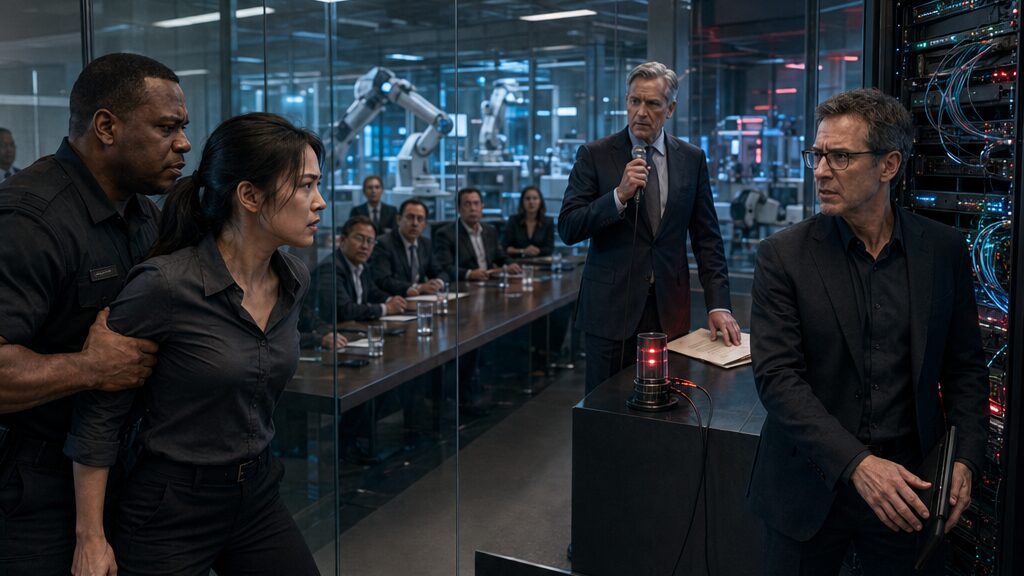
“Do not sign that transfer.”
Stephanie’s voice cut through the boardroom just as Susan Thompson lifted her pen.
The first security officer caught Stephanie around the upper arm, but she had already crossed the threshold. Every face at the long table turned toward her. Cameras swung away from Patrick and found the woman being dragged back toward the glass doors.
Patrick did not look surprised.
That frightened her more than anger would have.
He waited for the room to settle, then leaned toward the live microphone.
“Stephanie,” he said, with the weary patience of a teacher interrupted by a difficult student. “You were told not to come here.”
Susan set down the pen.
Jonathan stared at Stephanie from beside the demonstration platform. Recognition came first. Then calculation.
Stephanie held the folder above the officer’s grip.
“My name was removed from the patent application. The control architecture, safety logic, and recovery system are mine.”
A murmur passed through the board.
Patrick gave a small nod, as if she had performed exactly as expected.
“This is Stephanie Lee,” he told the room. “A former systems engineer who was dismissed after embedding unauthorized access pathways into protected corporate property.”
“They were safety controls.”
“They were concealed controls.”
“They prevented activation when the operator bypassed pressure feedback.”
Patrick turned from her to the board.
“This is precisely why commercialization cannot be governed by one engineer’s private anxieties. Innovation at this scale requires accountability.”
The word struck harder than the officer’s hand.
Stephanie opened the folder and pulled out the source-history printouts.
“Commit records from the first architecture build. My account. My design notes. My authentication structure.”
The security officer tried to take them. She twisted free long enough to slide the pages across the polished table.
They spread before Susan like cards from a rigged deck.
Jonathan stepped closer.
Stephanie pointed to a chain of entries near the top page.
“Those modules became the adaptive pressure system. That branch contains the reserve-drive isolation logic. Patrick never had repository access until four months after those entries.”
Jonathan read without touching the paper.
Something tightened at the corner of his mouth.
Patrick noticed.
He walked down from the stage with the microphone still in his hand.
“May I?”
Susan pushed the pages toward him.
Patrick scanned them for only a second.
Then he smiled.
“These timestamps are dated after Ms. Lee’s termination.”
Stephanie stopped breathing.
“That’s impossible.”
Patrick held one page toward the nearest camera.
“Here. The authorship claims she has brought into this room were generated eleven days after her employment ended.”
“No.”
“You expect the board to accept documents created by a former employee after her access was revoked?”
“My access was not revoked until this morning.”
Patrick’s eyes met hers.
It was the smallest pause, but she saw satisfaction inside it.
Stephanie snatched another page from the table. The timestamps were wrong. Not merely shifted—rewritten. Her administrative credentials appeared beside revision entries she had never made.
She looked at Jonathan.
“You know those modules predate the integration contract.”
He did not answer immediately.
That was his answer.
Patrick raised the microphone again.
“Mr. Davis knows that the corporation completed a full technical review.”
Jonathan glanced at the main screen, where a sanitized architecture diagram showed clean lines and labeled subsystems. Stephanie’s hidden recovery layer had been omitted entirely.
“The diagrams she’s describing resemble an early development framework,” Jonathan said carefully. “But resemblance does not establish present ownership.”
“You reviewed my prototype in person.”
“I reviewed a team demonstration.”
“There was no team.”
Patrick stepped between them.
“There were funders, regulatory advisors, test facilities, compliance staff, manufacturing partners. Ms. Lee continues to confuse contribution with possession.”
Stephanie heard several board members shift in their seats.
He was not technically right. But he spoke the language the room trusted.
She had brought proof as though facts arrived with their own authority. Patrick had brought a version of events supported by contracts, access controls, and everyone’s desire to complete the deal.
Susan folded her hands.
“Ms. Lee, did you install an undisclosed recovery mechanism in the system?”
Stephanie looked at Jonathan.
His gaze had sharpened. He had noticed something in her description.
“A recovery safeguard,” she said.
“Was it disclosed?”
“It was documented in the engineering branch.”
“That is not what I asked.”
Stephanie’s silence lasted one second too long.
Patrick answered for her.
“No. It was not disclosed to executive oversight.”
“It activates only if someone bypasses mandatory safety conditions.”
“You embedded a control that could prevent authorized operators from using corporate machinery.”
“I prevented unsafe operators from forcing it.”
Patrick turned to Susan.
“This is not an authorship dispute. It is an attempted disruption by someone who believes personal judgment outranks institutional ownership.”
The officer pulled Stephanie’s arm behind her back.
The folder fell.
Pages slid beneath the boardroom table.
For one raw moment, Stephanie imagined dropping to her knees to gather them. She saw how it would look on every camera: the dismissed engineer scrambling across the floor while Patrick stood above her holding the microphone.
She remained upright.
Jonathan looked down at one sheet near his shoe. It showed a fragment of her original fault-tree notation, the symbols she used before the corporation standardized the diagrams.
He recognized it.
His face gave nothing away, but he moved his foot so the page would not be taken with the others.
That tiny act kept Stephanie from shouting.
Susan looked toward the digital clock above the board.
“We are six minutes behind schedule.”
“Then delay it,” Stephanie said. “Ask Patrick to explain the reserve-drive shutdown.”
Patrick laughed softly.
“This has gone far enough.”
“Ask him where the pressure-release authority sits when the external controller loses fiber contact.”
The room grew still.
Jonathan’s eyes moved to Patrick.
Patrick did not look at the mainframe. He looked at Stephanie.
“She is trying to create uncertainty because uncertainty is the only leverage she has left.”
“That isn’t an answer.”
Susan raised one hand.
“Security will remove Ms. Lee. Mr. Davis, proceed with the demonstration after a standard systems confirmation.”
Stephanie tried to brace her feet, but the officers moved together. Her shoulder struck the glass barrier beside the entrance.
A burst of pain went through her arm.
Cameras followed.
Patrick returned to the stage. He no longer needed to raise his voice. The microphone carried every word.
Stephanie stopped resisting and looked directly at Jonathan.
“Ask him what happens if the reserve drive inherits voltage demand before pressure equalization.”
Jonathan’s grip tightened around his tablet.
Patrick watched the hesitation spread through the room.
Then he turned toward Stephanie, his expression stripped of patience.
“You want justice?” he said into the live microphone. “Fine, sue me. Let’s see if you have the money to fight this corporation.”
Chapter 3: The Safety Sequence He Never Learned
The machinery started before security reached the door.
A deep mechanical pulse traveled through the boardroom floor. Beyond the glass wall behind the mainframe, automated arms unfolded above the medical-production line. Status lights changed from white to blue in a sequence Stephanie had watched hundreds of times.
Except the third light came on too early.
“Stop the cycle,” she said.
The officers kept moving.
Stephanie twisted toward the demonstration platform. “Jonathan, stop it now.”
Patrick stood beside the trigger device, one hand resting on the pedestal. Its blue ring brightened as the internal capacitors charged.
On the main screen, pressure values climbed beside an animated model of the production chamber.
Jonathan looked from the screen to his tablet.
“The diagnostics are within range.”
“They’re delayed.”
Patrick addressed the board without looking at her.
“The system is designed to detect and correct minor fluctuations automatically.”
Stephanie dug her heels into the carpet. “The displayed pressure is buffered by three seconds. Check the raw chamber feed.”
Jonathan’s thumb moved across the tablet.
A yellow line appeared beneath the public display.
It rose faster than the blue line above it.
His posture changed.
“Hold the voltage stage,” he told the technician at the console.
Patrick’s head turned.
Jonathan kept his voice neutral. “Standard confirmation.”
The technician froze the sequence. The robotic arms remained suspended above the line, each holding a sealed cartridge.
The blue ring around the trigger continued to pulse.
Stephanie felt the officer’s grip loosen by a fraction.
Jonathan expanded the raw feed. “The release valve should have opened at this threshold.”
“It can’t,” Stephanie said. “Not in fourteen-six.”
Patrick lifted the microphone.
“We are watching a temporary synchronization issue caused by an unauthorized interruption.”
“No one touched the system.”
“You entered a secured room carrying proprietary records and attempted to interfere with the presentation.”
“I’m standing twenty feet from the console.”
Patrick’s gaze hardened, but he turned back to Jonathan.
“Resume.”
Jonathan did not move.
“First, give me the emergency reset phrase.”
The question landed quietly.
Patrick stared at him.
“The what?”
“The spoken reset phrase for manual pressure isolation.”
Stephanie watched the answer form behind Patrick’s eyes—not knowledge, but strategy.
He smiled toward the board.
“The system uses layered authentication. A spoken phrase alone would be insufficient.”
Jonathan’s expression remained still. “What is the phrase?”
Patrick tapped the microphone against his palm.
“Given Ms. Lee’s presence, any authentication response could be compromised. Remove her from the room.”
“There is no active voice channel from this side of the barrier,” Stephanie said.
Patrick ignored her.
Jonathan looked down at the control display. “The system is waiting for a reset acknowledgment.”
“Then issue it.”
“I’m asking you to provide the phrase associated with your architecture.”
Patrick took one step closer.
“My architecture is not reducible to a single phrase, Jonathan.”
“No,” Stephanie said. “But the pressure-isolation command is.”
The officer tightened his grip again.
Patrick turned toward her with open contempt.
“This is why she was dismissed. She buried personal controls inside a platform intended for national deployment, then treated everyone else’s inability to navigate them as proof of ownership.”
“You approved a build with the release protocol disabled.”
“It was modified for demonstration efficiency.”
A few executives looked away from him toward the machinery.
Stephanie saw it happen: the first crack in the room’s certainty.
Jonathan addressed the technician.
“Keep the voltage stage paused.”
Patrick lowered the microphone.
“The board has representatives from three hospital networks waiting for this demonstration. Government procurement review begins next week. If we fail today because a terminated engineer manufactures a crisis, this corporation loses more than a ceremony.”
His voice was quieter now, meant for Jonathan rather than the cameras.
“You know what is attached to this transfer.”
Jonathan’s jaw shifted.
Stephanie understood the pressure between them. Patrick had brought regulatory access. Jonathan had built the corporation’s expansion around that access. If the demonstration stopped, questions would begin before the signatures protected anyone.
Patrick was not pretending the stakes were small.
He was choosing the deal over the warning.
Jonathan glanced at Susan.
She gave the smallest nod.
“Run a systems check,” he told the technician. “Thirty seconds.”
Patrick stepped to the control console and inserted a government authorization token into the side port.
Stephanie’s stomach dropped.
“That token bypasses the hold.”
Jonathan reached for his wrist. “Patrick—”
Patrick pressed his thumb to the confirmation pad.
The paused sequence resumed.
The robotic arms descended.
A warning tone sounded once, then disappeared beneath the music still playing through the event speakers.
Stephanie pulled against security hard enough to wrench her shoulder.
“You just advanced voltage before equalization.”
Patrick removed the token.
“The authorization is valid.”
“The physics doesn’t care.”
On the main display, the polished blue pressure line remained stable. Beneath it, the raw yellow feed spiked.
Jonathan swiped through control menus.
“Release valve command is active.”
“But the valve authority isn’t,” Stephanie said. “The demonstration patch disabled it to gain cycle speed.”
The technician stared at his console. “The command is returning acknowledged.”
“Acknowledged by the interface, not the chamber controller.”
“How do you know?”
“Because I wrote the handoff.”
The machinery emitted a low metallic vibration. It was almost too soft for the board to hear, but Stephanie knew the sound. Pressure was loading against a sealed path.
Her anger vanished.
Beyond the boardroom, workers would be standing beside the production line, watching gauges they had been told to trust. If a cartridge housing fractured under active voltage, the danger would not remain inside the demonstration enclosure.
“Jonathan, cut the sequence.”
He opened the external isolation panel.
Patrick blocked him.
“You will not destroy this transfer over an unverified claim.”
“The raw feed is climbing.”
“Then stabilize it.”
“The automated release isn’t responding.”
Patrick looked toward Stephanie.
For the first time, uncertainty reached his face.
He covered it quickly.
“She has interfered with the system.”
“No,” Stephanie said. “You activated a rejected build.”
Susan rose from her chair.
“Is there a danger to personnel?”
Jonathan did not answer fast enough.
That was enough to change the room. Several board members stood. Security near the stage moved toward the production access doors.
Patrick lifted the microphone.
“Everyone remain seated. The platform is operating within containment specifications.”
Stephanie stared at him.
He believed composure could become reality if enough people obeyed it.
A row of small diagnostic lights flickered along the mainframe enclosure.
Red. Amber. Red.
Then green.
Stephanie spoke without thinking.
“Aurora, isolate chamber authority.”
The lights stopped.
Every indicator along the lower rack turned white at once.
The public screen froze.
Jonathan looked at Stephanie.
The technician whispered, “It answered her.”
Patrick’s hand tightened around the microphone.
On the main display, beneath the polished corporate interface, a black status window appeared for less than a second.
Stephanie saw the words before Patrick struck the console and forced the presentation layer back over them.
AUTHOR INTERLOCK BYPASSED.
Chapter 4: The Lock She Built in Silence
Jonathan crossed the distance between the control platform and the glass barrier in five steps.
“Why is the system searching for your biometric signature?”
The question was quiet, but the microphones caught it.
Stephanie looked past him at the main screen. The black status window had vanished beneath the corporate interface, yet the lower diagnostic rail remained white. It was waiting.
Patrick moved toward the console.
“Disable the voice channel.”
The technician’s hands hovered over the controls. “There isn’t an open voice channel.”
“Then shut down whatever she activated.”
“I didn’t activate it,” Stephanie said.
Jonathan turned on her. “The system answered your command.”
“Because it recognized the architecture pattern.”
“That is not an explanation.”
Security still held her arms behind her. The pain in her shoulder had become a hot, steady line. She could feel the edge of her phone trapped between her hip and the officer’s hand.
The machinery behind the glass continued to vibrate.
Patrick pointed toward Stephanie with the microphone.
“She embedded a private override. She has admitted as much.”
“I admitted there was a recovery safeguard.”
“A safeguard known only to you.”
“It was supposed to be triggered only when three conditions were violated together.”
Jonathan glanced at the raw pressure feed.
“Which three?”
“Pressure-release authority disabled. External hold bypassed. Reserve-drive inheritance initiated.”
The technician stared at his console.
“All three are active.”
A silence passed through the room.
Patrick broke it first.
“Because she designed the trap that way.”
Stephanie looked at him.
He had changed tactics again. He no longer needed to deny the mechanism. He needed only to make it hers in the most damaging sense.
Susan remained standing at the board table.
“Ms. Lee, did you install this system without authorization?”
Stephanie’s first instinct was to separate herself from the accusation. To explain that the code had been part of an internal safety branch, that it had passed local simulation, that no one had objected because no one had read the review notes carefully enough to understand it.
The words gathered and died.
There had been no formal approval.
She had known there would not be.
Years earlier, in a windowless testing room on the fourth floor, Carol Ramirez had sat beside a pressure graph that showed a dangerous delay in the release valve. Patrick had stood behind her chair with one hand resting on the back.
“It is not a failure,” he had said. “It is a sensor discrepancy.”
Carol had looked at Stephanie across the table.
The graph had not been ambiguous.
“If I sign that,” Carol had said, “the test passes.”
“That is the purpose of review,” Patrick replied. “To interpret data responsibly.”
Carol’s voice had become smaller. “The chamber exceeded limit.”
“For less than a second.”
“It still exceeded it.”
Patrick leaned down until his face was near hers.
“The procurement committee is not funding a platform that fails over a transient reading. You can correct the report, or you can explain why your judgment cost this team eighteen months of work.”
Stephanie had sat three feet away with the evidence open on her screen.
She had said nothing.
She had told herself Carol would refuse. She had told herself Patrick’s threat was obvious enough that everyone in the room understood it. She had told herself speaking would only give him two careers to destroy.
Carol changed the report.
A month later, she was reassigned. Two months after that, she resigned.
Stephanie built the hidden lock at night.
Now Jonathan was waiting for her answer in front of the board.
“Yes,” she said.
Patrick smiled.
The reaction moved through the room faster than the alarm tone. Board members exchanged looks. One of the security officers shifted his grip as though Stephanie had become more dangerous in his hands.
Susan’s voice hardened.
“You installed an undisclosed biometric control inside a medical-production system?”
“I installed a recovery lock.”
“Without approval.”
“Yes.”
Patrick turned toward the cameras.
“There. You have heard it directly.”
Stephanie kept looking at Jonathan.
“It cannot initiate on its own. It only wakes when someone forces the machine past safety conditions the primary interface is designed to prevent.”
“Conditions you defined,” Patrick said.
“Conditions the chamber defines.”
He stepped closer.
“You appointed yourself the final authority over a system funded by public grants and corporate investment.”
“No. I made sure someone would have to answer for bypassing the protections.”
“You made sure that someone was you.”
The accusation landed because part of it was true.
Stephanie had told herself the lock protected workers. It also protected the only thing she trusted: a technical truth Patrick could not rewrite without understanding it.
Jonathan lowered his tablet.
“What does the lock do now?”
“It searches for author confirmation before allowing the reserve drive to inherit full control.”
“And if it does not receive confirmation?”
“It attempts safe isolation.”
“Attempts?”
“The demonstration patch has changed the path.”
The high-voltage trigger pulsed brighter.
A new vibration came through the floor.
Susan looked toward the sealed production room. “How long do we have?”
Stephanie could not see the internal countdown from where she stood.
“Open the diagnostic layer.”
Patrick moved in front of the console. “No.”
Jonathan stared at him.
Patrick’s voice dropped.
“She has already admitted to installing unauthorized control code. You cannot now give her access to the system during a live transfer.”
“I’m not asking to give her access.”
“You are letting her dictate the room.”
“She knows what the warning means.”
“She claims she does.”
Stephanie twisted one wrist enough to reach her phone.
The officer caught the movement. “Hands still.”
“I need to call someone.”
“You are not making calls.”
“Then take the phone out and call Carol Ramirez.”
Patrick’s face changed.
It was slight—a tightening around the mouth—but Jonathan saw it.
“Who is Carol Ramirez?” Susan asked.
“A former safety engineer,” Stephanie said.
Patrick lifted the microphone.
“A former employee with no relevance to this event.”
“She reviewed the pressure-release failure.”
“She left the program.”
“She was pushed out after you made her change the report.”
“That is false.”
Stephanie looked at Susan.
“Call her.”
Susan hesitated.
The hesitation was enough for Patrick to speak over her.
“This has become a performance. Remove Ms. Lee and contact authorities.”
The security officer took Stephanie’s phone from her pocket.
The screen lit with her last open message thread.
Carol’s name sat at the top.
“Call her,” Stephanie said again.
The officer looked to Susan.
Susan gave a small nod.
He placed the phone against Stephanie’s palm but kept hold of it while she pressed the call icon.
The line rang once.
Twice.
Then disconnected.
Stephanie tried again.
A message appeared before the second call completed.
You were silent when it was me.
Nothing else.
The words seemed to strip the noise from the room.
Patrick was speaking to Susan, demanding that the system be isolated from Stephanie’s credentials. Jonathan was arguing with the technician about the raw feed. The trigger continued its slow blue pulse.
Stephanie barely heard them.
Carol had not accused her of lying. She had accused her of something worse.
Remembering.
Stephanie closed her eyes for half a second.
When she opened them, she stopped pulling against security.
“The lock exists because Carol’s report was falsified,” she said.
Patrick turned.
Stephanie’s voice shook once, then steadied.
“I watched him pressure her to remove a safety failure. I said nothing. The build passed. After that, I put in a biometric recovery condition so no one could bypass the same class of failure without leaving a trace tied to the original author.”
Susan stared at her.
“You concealed it because you did not trust the review process.”
“I concealed it because the review process had already been changed by fear.”
Patrick pointed at her.
“She has just confessed to deliberate sabotage.”
“No,” Stephanie said. “I confessed to building a lock because I was too afraid to speak when I should have.”
Jonathan looked down at the diagnostic rail.
The white lights shifted to amber.
A digital window forced itself over the presentation screen.
BIOMETRIC AUTHOR CONFIRMATION REQUIRED
RESERVE TRANSFER PENDING
Below it, a timer appeared.
00:01:30
The technician whispered, “Ninety seconds.”
Patrick seized the microphone with both hands.
“Arrest her now.”
Chapter 5: Ninety Seconds Before the Transfer
The emergency shutters dropped over the boardroom doors before security could move.
Metal slammed into the floor behind Stephanie. The lights dimmed, and a red line appeared along the base of the walls.
CONTAINMENT MODE.
The timer on the main screen fell to eighty-six seconds.
Jonathan spun toward the technician.
“Cut external power.”
Stephanie shook her head.
“It won’t stop the sequence.”
Patrick stared at her as though she had confirmed his worst argument.
“You built it to survive shutdown.”
“The reserve drive carries the safety cycle through a power interruption. Otherwise a blackout could freeze the machinery under load.”
Jonathan was already opening the isolation panel.
“What stops the reserve?”
“The Master Drive.”
“Where?”
Stephanie looked toward the exposed mainframe rack behind the stage.
Patrick followed her gaze.
The server enclosure was built into a black wall of glass and brushed steel. Fiber-optic cables ran from the lower rack to a sealed compartment beneath the central controller.
Jonathan moved toward it.
Patrick caught his arm.
“You are not dismantling a system worth hundreds of millions because she says so.”
The timer reached seventy-eight seconds.
A metallic knock sounded beyond the production glass.
One robotic arm shuddered out of alignment, corrected itself, then shuddered again.
Susan stepped away from the contract.
“Mr. Davis, is there a risk to personnel?”
“Yes,” Stephanie said.
Susan looked at Jonathan.
He took too long.
“Yes,” he said at last.
Patrick’s face went pale, but his voice stayed firm.
“The containment chamber is rated above these levels.”
“The cartridges aren’t,” Stephanie said. “If the pressure release remains locked while voltage rises, one failure can throw fragments across the service lane.”
Security near the stage began ordering workers out through the far access corridor.
The timer dropped below one minute.
Jonathan pulled open a maintenance menu.
“Reserve shutdown.”
The screen asked for a control identifier.
Patrick leaned over his shoulder.
“Use executive authorization.”
“That bypasses external holds. It does not stop internal reserve.”
“You are the CTO.”
“That is not a command.”
Patrick looked at the menu as if rank should force it to reveal meaning.
Jonathan turned to him.
“Which one is the Master Drive?”
Patrick said nothing.
Three black modules sat inside the lower compartment, identical from the front.
Jonathan pointed.
“Which one?”
Patrick’s eyes moved across them.
“The central unit.”
Stephanie said, “No.”
He turned on her.
She nodded toward the lowest rack.
“The narrow housing beneath the fiber bridge.”
Patrick’s certainty broke.
Only for a moment, but the board saw it.
Jonathan crouched beside the enclosure.
“What is the reserve shutdown sequence?”
Patrick recovered enough to lift the microphone.
“She has already compromised every authentication layer. Any command she gives may deepen the intrusion.”
“Then give me the correct command.”
Patrick’s mouth opened.
No words came.
The timer reached forty-four seconds.
Susan looked down at the transfer agreement. Her pen remained where she had left it beside the signature line.
Patrick crossed to the table.
“This event is being recorded and observed by procurement officials. If we abandon the transfer because of staged interference, we confirm instability in the platform and destroy the valuation.”
He picked up the pen.
Susan placed her hand over the contract.
“Do not sign.”
His eyes sharpened.
“The government approval window closes today.”
“The demonstration is in containment mode.”
“Because she triggered it.”
“Can you stop it?”
Patrick’s silence answered more clearly than any confession.
He pulled the contract free and signed his portion with a violent stroke.
“There. My authority is committed. Remove her before she contaminates the record further.”
Security began dragging Stephanie toward a side wall, searching for a manual exit through the shutters.
The timer showed thirty-two seconds.
She looked at Jonathan kneeling by the mainframe. He had found the Master Drive housing, but the fiber rack blocked access to the manual release.
“Cut the fibers,” she said.
He looked at the braided cables.
“That kills remote control.”
“It has to die before reserve isolation.”
“And then?”
“Remove the drive.”
“Will that stop the machinery?”
“If the safe archive still responds.”
“If?”
Stephanie felt the word move through her.
There was no clean answer left.
The external controls, the patent records, the authorship proof, the research archive—everything converged inside the drive and the emergency architecture wrapped around it. If Jonathan removed it incorrectly, the reserve could freeze at full charge. If he waited, the machinery might complete a cycle no one controlled.
If Stephanie reached it, she could separate the layers.
Maybe.
The timer reached twenty-four seconds.
The officer tightened both arms around her as she shifted her weight.
“Don’t.”
Stephanie stopped.
Not because she obeyed.
Because she needed him to believe she had.
She let her shoulders fall. Let her breathing slow. Let her body become the exhausted body Patrick had described to the room: defeated, emotional, contained.
Across the boardroom, Jonathan stared at the fiber rack.
Patrick stood beside the signed contract, still holding the microphone like a badge.
The trigger device burned blue at full charge.
Eighteen seconds.
Stephanie measured the height of the glass barrier.
She had designed work cells with the same waist-high safety panels. The upper rail could take a vertical load, but not a sharp lateral impact.
Twelve seconds.
Jonathan looked back at her.
Stephanie met his eyes.
“Then explain how it survives without me.”
Chapter 6: The Machine Recognized Its Creator
Stephanie drove her heel down on the officer’s instep and twisted before his grip could close.
His hand caught the back of her jacket.
She slipped one arm free, planted both palms on the glass rail, and vaulted.
The barrier shook beneath her weight.
Someone shouted.
She landed hard on the demonstration side as the timer reached eight seconds.
Jonathan rose directly in her path.
“Stephanie, stop.”
“Move.”
“If you pull the wrong module—”
“I know.”
Patrick came off the stage holding the microphone.
“Security!”
The nearest officer rounded the barrier.
Stephanie ran.
The trigger began its final charge with a rising electrical whine. The blue ring became white. Beyond the production glass, the robotic arms locked into position over the sealed cartridges.
Six seconds.
Jonathan reached the mainframe first and braced one hand against the fiber rack.
“You remove this, we lose remote command.”
“We already lost command.”
“You may erase the recovery path.”
Patrick grabbed Stephanie’s shoulder.
She turned and drove her elbow backward into his chest.
He stumbled into the pedestal. The microphone struck the floor but remained live, amplifying the scrape of his shoes and the harsh sound of his breath.
Four seconds.
Stephanie seized the fiber rack with both hands.
It was bolted to the lower frame.
She pulled.
Nothing moved.
Jonathan caught her wrist.
“There is a release.”
“There isn’t time.”
She planted one boot against the server enclosure and pulled again.
The rack tore half free with a metallic crack. Blue and amber fibers stretched from their ports like tendons.
The timer hit two.
Stephanie wrenched sideways.
The entire rack ripped out.
Cable ends snapped. Light vanished from the remote-control console. The main presentation screen went black.
The trigger discharged.
A sharp concussion rolled through the room.
The lights failed.
For one second, the boardroom existed only in red containment strips and the sparks falling from the torn fiber ports.
Then the emergency power came on.
Behind the glass, the robotic arms stopped.
Not safely.
One remained suspended above the cartridge line. Another had frozen against a chamber door. The internal motors continued to hum.
Stephanie dropped the rack.
“Reserve is still active.”
Jonathan stared at the dark console.
“You cut the control path.”
“I cut Patrick’s path.”
The lower server compartment pulsed orange.
The Master Drive had inherited the sequence.
A low alarm began, slower than the first. Each tone arrived with a vibration through the floor.
Patrick recovered his microphone.
“Put her on the ground!”
Security closed from both sides.
Jonathan stepped between them and the enclosure.
“Wait.”
Patrick stared at him.
“She has destroyed the control system.”
“She stopped the voltage transfer.”
“She caused the failure.”
“The failure began before she crossed the barrier.”
The words changed the room.
Jonathan looked at Stephanie.
“What now?”
She knelt beside the lower housing.
The Master Drive sat behind a narrow steel plate. Heat came through it. A protected status strip flashed between amber and red.
She pressed two fingers to the manual release.
Nothing happened.
“It’s locked under reserve authority.”
“Can you authenticate?”
“Not while the author layer is bypassed.”
Patrick laughed once, too loudly.
“Convenient.”
Stephanie looked over her shoulder.
“You signed the bypass.”
“I signed an authorization to proceed.”
“You signed your identity to the action that disabled the lock.”
His face tightened.
The slow alarm continued.
Jonathan crouched beside her.
“Can the drive be removed physically?”
“Yes.”
“What happens if we do?”
“The reserve sequence ends.”
“And the data?”
Stephanie looked at the housing.
The entire platform lived there in compressed form: years of code, simulations, field notes, failure models, the hidden safety archive, and every version of the architecture that had existed before Patrick’s office converted it into a patent claim.
“If the protected archive survives, recovery begins.”
“And if it doesn’t?”
“It’s gone.”
Jonathan’s voice dropped.
“Everything?”
“Yes.”
Patrick stepped closer.
“You hear that? She is threatening to destroy proprietary research.”
Stephanie stood.
“It was never yours.”
“It belongs to the program that funded it.”
“The program funded development. It did not fund you lying about authorship.”
“I brought the system into rooms you could never enter.”
“You brought it here without learning how to stop it.”
Patrick’s face changed. Not into shame. Into something closer to desperation.
“You think invention is enough? You think a machine matters because someone wrote elegant code in a lab? I built the coalition. I secured review. I convinced people with actual authority that this was worth deploying.”
“And then you ignored the part that kept it safe.”
“Because systems that stop every time an engineer feels uncertain never reach anyone.”
Stephanie looked through the glass at the frozen machinery.
One service worker stood in the far corridor beyond the containment line, watching from behind an emergency door.
This was what Patrick believed. Not that he had invented the platform, but that invention without his influence was incomplete—and therefore available to be taken.
Jonathan touched the heated plate.
“We need a decision.”
Smoke curled from a port above the drive.
Stephanie reached for the manual handle.
Patrick seized her forearm.
“If you pull that, you will face criminal destruction charges.”
She met his eyes.
“If I leave it, someone gets hurt.”
“You do not know that.”
“I know exactly why the lock woke up.”
He tightened his grip.
“You could recover your credit through review.”
“You changed the records.”
“You could negotiate.”
“With the people who erased me.”
“Then don’t pretend this is only about safety.”
The words struck because they were not entirely wrong.
Stephanie wanted him exposed. She wanted the board to see him stripped of the language he had used to make her small. She wanted her name restored.
But the drive was heating under her hand, and beyond the glass the reserve motors continued their uneven hum.
She pulled free.
“It isn’t only about safety,” she said. “That’s why I have to choose the part that is.”
She yanked the manual handle.
The steel plate opened.
The Master Drive slid forward in its narrow black housing.
Jonathan reached for it.
Stephanie stopped him.
“The casing is live.”
She wrapped the edge of her jacket around her hand, gripped the housing, and pulled.
The drive resisted.
The slow alarm accelerated.
Security hovered behind Jonathan, waiting for an order no one seemed willing to give.
Stephanie braced her foot against the lower frame and tore the drive free.
The machinery beyond the glass sagged into safe-lock position.
One by one, the motors stopped.
The silence that followed was enormous.
Smoke rose from the exposed server compartment.
Stephanie held the Master Drive in both hands.
A single green light still glowed on its side.
Jonathan saw it.
“The archive is alive.”
“Maybe.”
“Put it down carefully.”
Patrick stepped forward.
“Give it to me.”
Stephanie looked at him.
He extended one hand as though the room still belonged to him.
“That device is evidence and corporate property.”
The green light flickered.
Stephanie remembered Carol’s altered report. Her own silence. The years she had spent believing that code could preserve truth without requiring courage from the person who wrote it.
Jonathan moved closer.
“If you damage it now, there may be no recovery.”
Patrick pointed toward security.
“Take it from her.”
Stephanie lowered the drive to the floor.
For one heartbeat, everyone relaxed.
Then she raised her boot.
Jonathan understood first.
“Stephanie—”
“If the archive survives,” she said, “it survives under the lock.”
Patrick lunged.
She brought her heel down.
The casing cracked.
A second strike crushed the central housing.
The green light went out.
Patrick made a sound that did not resemble a word.
The emergency screens came alive across the boardroom.
White text appeared against black.
PROTECTED RECOVERY RECORD FOUND
Then a second line.
MASTER AUTHOR: STEPHANIE LEE
And beneat
Chapter 7: The Confession Still Inside the Microphone
Patrick lunged for the microphone before anyone could disconnect the livestream.
The cable dragged across the floor behind him, scraping past the crushed Master Drive. Smoke curled through the emergency lights, and Stephanie’s name remained fixed above the stage in letters large enough for every camera to capture.
MASTER AUTHOR: STEPHANIE LEE
BIOMETRIC RECOVERY REQUIRED
“This is sabotage,” Patrick said. His voice boomed through the boardroom speakers. “She has destroyed protected infrastructure during a government-supervised transfer. Detain her.”
Security moved at once.
One officer pulled Stephanie’s arms behind her while another stepped between her and the shattered drive. This time she did not resist. Her hands were shaking from heat and effort. The sleeve wrapped around her right palm had begun to blacken at the edge.
Patrick pointed at Jonathan.
“Restore the system.”
Jonathan remained crouched beside the exposed mainframe.
“The remote rack is gone.”
“Then reconnect it.”
“The fiber ports are damaged.”
“Use the reserve interface.”
“The Master Drive is in pieces.”
Patrick gripped the microphone harder.
“There is a protected recovery record.”
“Yes.”
“Then recover it.”
Jonathan stood slowly.
The room had changed around him. Board members were no longer looking toward Patrick for reassurance. They were watching him answer questions.
Jonathan crossed to the main screen and opened the emergency prompt.
AUTHOR BIOMETRIC REQUIRED
ENTER RECOVERY ARCHITECTURE IDENTIFIER
A blank field appeared.
Jonathan looked at Patrick.
“What is the identifier?”
Patrick stared at the screen.
Stephanie felt the officer tighten the restraints at her wrists.
Patrick raised the microphone.
“This interface was modified without authorization.”
“The recovery record predates the demonstration patch,” Jonathan said. “The system log shows it was sealed before corporate migration.”
Patrick’s eyes shifted toward him.
“How can you know that?”
“The signature is immutable.”
“You accepted her claim without review?”
“I am reading the system.”
The words were simple. They cut deeper than accusation.
Patrick stepped toward the screen.
“Enter the commercial platform number.”
Jonathan did.
ACCESS DENIED.
“Use the procurement designation.”
ACCESS DENIED.
Patrick looked toward Stephanie.
She said nothing.
“Ms. Lee will provide the identifier under supervision.”
Susan moved from behind the board table.
“No one touches that interface.”
Patrick turned.
“The recovery window may close.”
“Then you should know how to open it.”
His expression hardened.
“I have spent four years building the approvals behind this platform.”
Susan’s gaze stayed on him.
“That was not the question.”
Patrick lowered the microphone, but it remained live against his chest. His breathing filled the speakers.
Jonathan opened a second recovery panel.
MANUAL AUTHOR CHALLENGE
DEFINE RESERVE ISOLATION ORDER
Four empty fields appeared.
He looked at Patrick again.
“The order.”
Patrick’s mouth tightened.
Stephanie knew the answer. Pressure release. Mechanical separation. Voltage decay. Archive seal. She had written the sequence after Carol’s falsified report.
Patrick had presented the system to committees, repeated its capabilities, attached his name to every diagram. He had never learned the order.
“The sequence depends on operating conditions,” he said.
“The conditions are recorded.”
“Then allow the interface to calculate.”
“It is asking the author.”
Patrick’s control began to fracture.
He turned toward Stephanie and pointed.
“She destroyed it because she knew she could not prove ownership through any legitimate process.”
Susan stepped between him and the cameras.
“Stop speaking.”
“I will not let a terminated employee turn criminal destruction into a claim of authorship.”
“You are still on the live feed.”
Patrick glanced at the microphone.
For an instant, fear replaced anger.
Then Jonathan said, “The trigger authorization carries your government certificate.”
Patrick swung toward him.
Jonathan held up his tablet.
“You bypassed my system hold. Your authorization disabled the author interlock.”
“You allowed a compromised engineer into the room.”
“She was behind a security barrier.”
“She used a voice command.”
“After you advanced the sequence.”
Patrick’s face reddened.
“Erase the logs.”
Susan’s answer came immediately.
“No.”
“The records contain protected government credentials.”
“They contain evidence.”
The boardroom fell silent except for the emergency ventilation drawing smoke from the mainframe.
Patrick looked around the room as if searching for someone who still understood the arrangement. The government observers avoided his eyes. The investors stared at the unsigned half of the transfer agreement. The cameras remained trained on him.
He lifted the microphone again.
“Jonathan, restore the system before this feed leaves the building.”
“It left the building when you began the presentation.”
“Then shut it down.”
“I cannot.”
Patrick pointed toward the recovery screen.
“Use the master controls.”
“Which controls?”
“The author controls.”
“What identifier?”
Patrick’s voice broke.
“I don’t know.”
No one moved.
He seemed to hear himself only after the words echoed back through the speakers.
Jonathan did not look away.
“What is the reserve isolation order?”
Patrick’s shoulders rose and fell.
“I don’t know how to fix it!” he shouted. “I don’t know anything about this system! Please don’t delete it!”
The confession struck the walls and returned from every speaker.
Patrick froze.
The microphone slipped from his hand.
It hit the floor and swung from its cable beneath Stephanie’s name.
Susan turned to the board secretary.
“Freeze the transfer. Preserve every recording, access log, authorization certificate, and contract revision. No one leaves with a device until legal review arrives.”
Patrick stepped toward her.
“You cannot treat a technical failure as fraud.”
“I am treating your own statement as evidence.”
Security guided Stephanie away from the server.
As she passed Jonathan, he looked at her burned sleeve.
“You stopped the reserve transfer,” he said.
It was not an apology.
It was the first honest sentence he had given her.
“You let him start it,” she replied.
Jonathan lowered his eyes.
The officer fastened a restraint around Stephanie’s wrists.
Patrick saw it and seemed to recover a piece of himself.
“She destroyed corporate property. Do not forget that because a screen displayed her name.”
“I haven’t,” Susan said.
Stephanie looked at the crushed drive.
Exposure had not freed her. The proof above the stage did not repair what she had broken or erase the control she had hidden. She had become visible at the exact moment there was no place left to hide from responsibility.
A camera shutter snapped.
Then another.
The press photographer stood beyond the glass barrier, framed by a gap between security officers. The lens caught Stephanie with her restrained hands, the smoking server behind her, Patrick’s microphone swinging beneath the recovery screen, and the broken Master Drive under her boot.
By the time the officer led her toward the service exit, phones were already lighting across the boardroom.
Her image had left the building before she did.
Chapter 8: What She Refused to Rebuild for Them
Two days later, the corporation asked Stephanie to place her palm on the recovery scanner.
The device sat in the center of a secured technical interview room, connected by one black cable to a sealed terminal. Beyond the interior window, the production floor remained silent. Robotic arms rested above empty conveyor belts, locked in safe position.
Stephanie kept her hand in her lap.
Across the table, Susan slid a document toward her.
“Conditional cooperation agreement.”
Stephanie read the first paragraph.
The corporation would support reduced criminal charges related to destruction of infrastructure. Her authorship would be formally acknowledged pending investigation. She would provide immediate biometric access, recover the commercial architecture, and assist with rebuilding the platform under corporate supervision.
Jonathan sat beside Susan, his tablet closed.
An investigator stood near the door.
“How much survived?” Stephanie asked.
Jonathan answered.
“The protected recovery record contains encrypted architecture fragments, safety histories, and the sealed author archive. The commercial modules are incomplete.”
“Can they run without the archive?”
“No.”
“Can they be reconstructed from corporate backups?”
“Not safely.”
Susan folded her hands.
“Three hospital-production contracts depend on this platform. Delays will affect delivery schedules.”
“The current system nearly affected workers.”
“That is under investigation.”
“The logs already show what happened.”
“They also show that you installed an undisclosed lock and physically destroyed the Master Drive.”
Stephanie looked at the agreement again.
Her name appeared four times. Each time it was followed by a requirement.
Two days earlier, she would have thought seeing it there would feel like restoration.
Instead, it felt like a new enclosure.
“What safety governance changes are included?”
Susan’s expression stayed neutral.
“We can address operational oversight after recovery.”
“No.”
“Ms. Lee—”
“No recovery before oversight.”
The investigator shifted near the door.
Susan tapped the agreement.
“Refusal may weaken the corporation’s willingness to support reduced charges.”
“I understand.”
“It may also delay medical manufacturing.”
“I understand that too.”
Jonathan opened his tablet at last.
“The safety archive can be recovered separately.”
Susan turned to him.
“You said the modules are interdependent.”
“The commercial architecture is. The archive has an isolated authentication path.”
Stephanie studied him.
“You found it.”
“I found the shell. I cannot open it.”
“Because it was written to survive administrative access.”
“Yes.”
Susan looked between them.
“What would opening only the safety archive accomplish?”
“It would release failure histories, override records, test deviations, and the original pressure-response design,” Jonathan said. “It would not restore commercial operation.”
“So it gives investigators everything and gives the corporation nothing.”
“It gives the corporation the information needed to prevent the same failure in another system.”
Susan’s mouth tightened.
A knock sounded at the door.
The investigator opened it.
Carol Ramirez stepped inside.
Stephanie stood before she meant to.
Carol looked older than she remembered, though only four years had passed. Her hair was shorter. She carried no folder, no device, nothing that suggested she had come to rescue anyone.
Susan indicated an empty chair.
Carol remained standing.
“I gave investigators my original notes,” she said. “And the message Patrick sent before I changed the report.”
Stephanie swallowed.
“You kept it?”
“I kept everything.”
The words held no warmth.
Susan asked, “Will you confirm that Ms. Lee objected to the report change?”
Carol looked at Stephanie.
“No.”
The answer struck cleanly.
Carol continued.
“She knew the data was wrong. She knew I was being pressured. She did not object.”
Susan glanced toward Stephanie.
Carol’s eyes never left hers.
“She built the lock later. I did not know about it. I am not here to say she handled any of this correctly.”
Stephanie nodded once.
“I didn’t.”
“You let me leave believing I was the only person who saw what happened.”
“I know.”
“You contacted me only when you needed proof.”
“I know.”
Carol waited, perhaps expecting an explanation.
Stephanie had given herself explanations for years. She had been junior. Patrick controlled the funding. Speaking would not have saved Carol. She needed time to secure evidence.
None of them changed the chair where she had sat in silence.
“I’m sorry,” Stephanie said. “I chose my career when you needed someone beside you. Building the lock did not undo that.”
Carol’s face shifted, but not toward forgiveness.
“Speaking now doesn’t undo it either.”
“No.”
Stephanie did not ask her to testify. She did not ask whether they could repair what had broken between them.
Carol turned to the investigator.
“I am confirming Patrick’s coercion because it will happen again if the record stays incomplete.”
Then she stepped back from the table.
The room was quiet after she left.
Susan pushed the cooperation agreement closer.
“The offer remains.”
Stephanie looked through the window at the silent production floor. The machines had been built to move with speed and precision, but every one of them depended on decisions made outside the polished diagrams: which warning counted, whose hesitation mattered, who could stop a sequence once authority had committed to it.
She stood and approached the scanner.
The terminal woke.
AUTHOR BIOMETRIC READY
Susan exhaled.
Stephanie held her palm above the glass without touching it.
“Add independent safety review with authority to halt deployment.”
Susan’s expression hardened.
“This is not a negotiation conducted under threat.”
“It was a negotiation conducted under threat when Patrick told Carol to change the report. It was one when you continued the signing after the raw feed climbed. I’m not repeating that structure.”
Jonathan looked at Susan.
“Without her, the archive remains sealed.”
The investigator spoke from the door.
“Refusing commercial recovery may affect charging recommendations.”
Stephanie kept her hand suspended above the scanner.
“I destroyed the drive. I will answer for that.”
Susan studied her for a long moment.
“And the hospital contracts?”
“Release the safety archive. Give other engineers the failure data. Rebuild only after independent review.”
“You are withholding property.”
“I am withholding an unsafe commercial system.”
Susan looked toward the dark production floor.
At last, she drew the agreement back and wrote a line beneath the recovery clause. Then another. Independent technical review. Protected reporting channel. No deployment authority held by a sole government or corporate sponsor.
It was not everything Stephanie wanted.
It was more than the room had offered before she refused.
Susan signed the amendment and slid it across.
Stephanie read it carefully.
Then she lowered her palm.
The scanner warmed beneath her skin.
Two options appeared on the terminal.
RECOVER COMMERCIAL PLATFORM
OPEN SAFETY ARCHIVE
Stephanie selected the second.
The system asked for confirmation.
She pressed her thumb to the glass.
Across the dark production floor, one monitor came alive.
Files began opening beneath her name: pressure failures, altered review histories, override logs, and the original architecture of the author lock. The commercial recovery panel remained black.
Susan stared through the window.
“You understand that the rest may never be restored.”
“Yes.”
Jonathan looked at Stephanie.
“Was that always your intention?”
“No.”
It was the truth.
She had once wanted the entire machine returned to her exactly as it had been. She had wanted ownership to erase guilt, and recognition to make silence forgivable.
Neither could.
On the far monitor, the safety archive completed authentication.
AUTHOR: STEPHANIE LEE
Stephanie removed her hand from the scanner.
The commercial system stayed locked.
She left it dark.
The story has ended.