The Hoop on Alder Circle
The Hoop on Alder Circle
Part I — The Street That Watched
The police cruiser rolled into Alder Circle so slowly that, for one suspended second, it seemed to be circling prey.
Rylan saw the flash of red and blue bounce across the bent street sign before he saw the car itself. One moment he was dribbling a half-deflated basketball over cracked asphalt, hearing the familiar slap of rubber against pavement and the scrape of his worn sneaker sole. The next, the entire cul-de-sac felt colder.
“Jay,” he muttered, not taking his eyes off the cruiser. “Don’t move.”
But his cousin had already frozen under the sign.
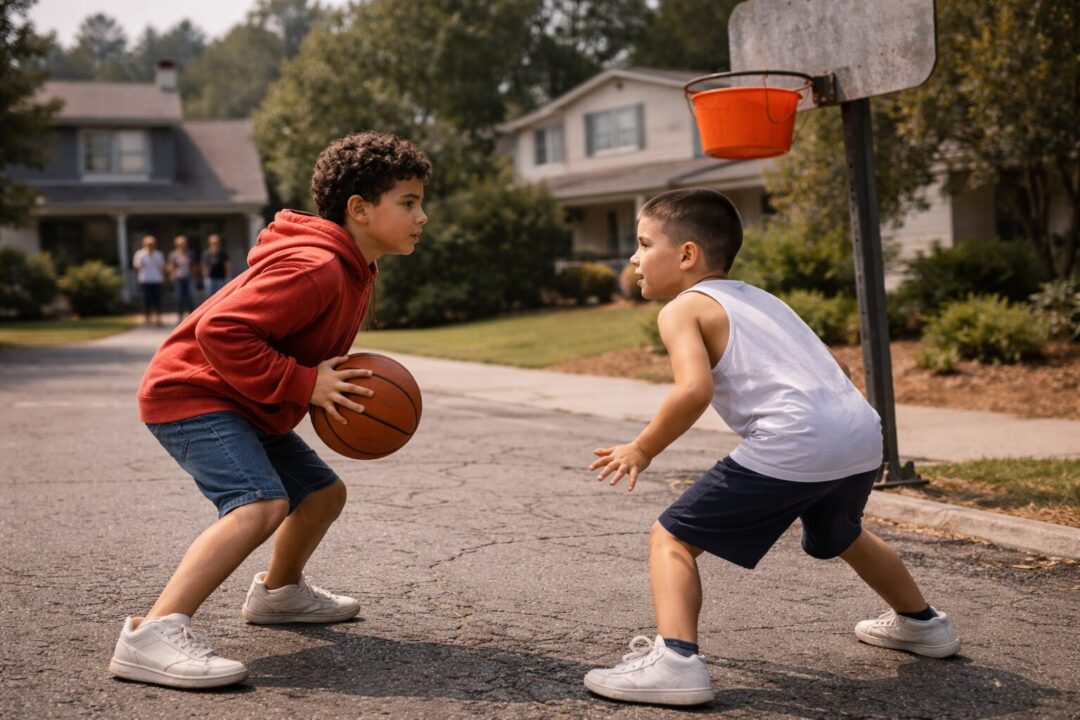
The hoop they’d built hung crooked above him: an old orange bucket with the bottom hacked out, wired to the metal post where the neighborhood watch sign had long ago faded to gray. A torn white rope served as a net. It wasn’t pretty. It leaned too far left. The ball rattled weird when it went in. But it was theirs, and in a neighborhood where good things usually belonged to somebody else, that mattered.
The cruiser stopped so close it cut their little court in half.
Rylan straightened, one hand still on the ball. He was twelve, all elbows and nerves, in a red hoodie that used to belong to his older brother before the cuffs frayed and the sleeves stretched. Beside him, thirteen-year-old Jay stood taller and quieter, his shoulders already folding inward the way they did when trouble arrived wearing a badge, a clipboard, or a landlord’s smile.
On the nearest porch, a screen door squealed open.
Mrs. Ortega, who watered the same geraniums every morning whether they needed it or not, leaned over her railing with a hand shading her eyes. Across the street, Mr. Bell paused halfway to his front door with a grocery bag hooked in each arm. Two younger kids on bicycles slowed to a stop at the mouth of the cul-de-sac. The neighborhood had that gift for sensing a scene before it fully became one.
And then Officer Nolan stepped out.
He was broad through the shoulders, his navy uniform pressed crisp despite the heat. He wore mirrored sunglasses that made his face hard to read and a trimmed mustache that somehow made him look even sterner. Rylan knew him by sight. Everybody did. Nolan wasn’t mean exactly, but he had the kind of voice that made people lower theirs.
He looked first at the boys, then at the sign, then at the bucket.
“Step back,” he said.
Rylan swallowed. “We’re not doing anything.”
“Step back,” Nolan repeated.
Jay touched Rylan’s sleeve, a silent warning. Don’t make it worse.
Worse was always nearby anyway. Worse was the wrong tone with the wrong adult. Worse was giving somebody a reason to say they’d tried to help you and you’d made it impossible.
Rylan took one reluctant step backward. Jay took two.
Officer Nolan walked to the sign and gripped the wire looped around the bucket’s handle. The metal rasped against metal. The bucket rocked once in the sunlight.
It was such a small sound, but it sent something sharp through Rylan’s chest.
“Please don’t,” Jay said, barely above a whisper.
Nolan didn’t answer.
He twisted the wire loose with practiced hands. The bucket came free with the ripped rope net trailing after it like something defeated. For a second the post stood naked, just a dead sign in the middle of the circle, and Rylan felt the humiliation of it hotter than anger. Everyone was watching.
“That’s our hoop,” he said.
Officer Nolan turned and carried the bucket across the street.
Rylan followed a few steps before stopping himself. The officer lifted the lid of a curbside trash bin and dropped the whole thing inside.
There it was. Gone.
Alder Circle went silent in the strange, complete way only a small neighborhood can. No doors slammed. No dogs barked. Even the younger kids on bicycles had gone still.
Rylan’s face burned. He hated that more than anything—being made to feel small where everyone could see it. Not in front of Mrs. Ortega with her pity. Not in front of Mr. Bell, who always nodded like he’d expected as much. Not in front of the little kids who still thought being older meant being powerful.
Jay stared at the empty signpost as if he’d forgotten how to blink.
Officer Nolan came back toward them, calm as ever, as though he had not just thrown away the only basketball hoop they had.
“Come here,” he said.
Rylan laughed once, short and bitter. “Why?”
Jay’s hand closed around his wrist this time.
They walked anyway.
Because when a man in uniform says come here in the middle of your own street, you go.
Part II — Things Boys Learn Early
If you had asked Rylan later when he first started expecting things to be taken away, he would not have known how to answer.
Maybe it started when the playground behind the elementary school lost its chain nets, then its swings, then half the fence, until finally a sign appeared saying CLOSED FOR RENOVATION and stayed there for three years. Maybe it started with the corner rec center, where older boys took over the court every afternoon and laughed if smaller kids tried to join. Maybe it started earlier, with his father moving out, with rent notices, with the way adults in Alder Circle had a habit of telling children to be careful with what little they had because nobody was coming to replace it.
So the bucket hoop had mattered more than it looked like it should.
He and Jay had built it from scraps behind the laundromat: one cracked orange bucket, coil wire found near a dumpster, rope scavenged from a torn clothesline. Jay had cut out the bottom with a dull kitchen knife while Rylan held the plastic steady with both knees pressed to the concrete. They had tied and retied the net until it looked almost real if you squinted. When they mounted it to the sign at the edge of the cul-de-sac, it felt like planting a flag.
It wasn’t just a game after that. It became the place they met after school, after chores, after hard days. When Rylan’s mother worked late, Jay waited there with him. When Jay got too quiet the way he sometimes did after talking to his older brother on the phone from county lockup, Rylan dragged him outside and made him shoot until the silence broke. The hoop was where they pretended the street was a court and the court was theirs.
Everybody in Alder Circle knew it.
Which made the public destruction worse.
Now, standing behind Officer Nolan’s cruiser, Rylan expected a lecture, maybe a warning about city property, maybe a threat to call somebody’s mother.
Instead Nolan opened the rear hatch.
At first Rylan didn’t understand what he was seeing.
A cardboard box sat in the back, too large and too clean to belong in a police vehicle. Beside it rested a new orange basketball, the pebbled surface bright as a traffic cone. Folded against the side was a white nylon net still in plastic. Underneath, angled carefully as if they mattered, were two shoe boxes.
Rylan frowned.
Jay leaned forward the smallest bit, confusion overtaking shame.
Officer Nolan stepped aside.
“Look,” he said.
Rylan looked past him.
Across the cul-de-sac, above the garage of the vacant rental at the corner, something white flashed in the sun. He narrowed his eyes.
A backboard.
A real one.
Mounted over the driveway was a brand-new basketball hoop: square white board, red rim, fresh net hanging straight and untouched. Clean. Centered. The kind of hoop that belonged in neighborhoods where lawns got edged and kids had matching water bottles and fathers who put things together on Saturdays.
Mrs. Ortega made a soft sound from her porch, half laugh and half gasp. Mr. Bell actually set his grocery bags down.
The whole street seemed to exhale at once.
Jay was the first one to find his voice. “That… that’s for here?”
“For you boys to use,” Nolan said.
Rylan stared at the hoop, then at the empty sign, then back at the trunk as his mind tried to catch up. “You threw ours away.”
“It was hanging from a traffic sign with wire sharp enough to slice somebody open if it snapped,” Nolan said. “And that bucket was one hard shot from splitting in half.”
His tone was still firm, but something in it had changed. Or maybe Rylan was finally hearing what had been there all along.
Nolan picked up the two shoe boxes and held one out to Jay first. Then the other to Rylan.
“I asked around,” he said. “Mrs. Ortega guessed your sizes.”
Rylan looked over automatically. The old woman gave a tiny shrug from her porch as if neighborhood miracles were an everyday chore.
His fingers trembled taking the box.
They were basketball shoes. Not expensive-looking in a flashy way, but real—sturdy, new, with thick soles and laces that had never been knotted by someone else first. Jay opened his box and just stared down into it, face gone blank with disbelief. It was the kind of look people wore right before joy if joy had not visited them enough to feel familiar.
Officer Nolan lifted the new ball from the trunk and bounced it once. The sound rang out across Alder Circle, fuller and cleaner than the flat slap of the old one.
“The owner of that house moved out last month,” he said, nodding toward the garage. “Bank’s still sorting papers. Nobody’s living there right now. I got permission from the property manager to put the hoop up for the neighborhood kids. Safer than a traffic sign.”
“Why?” Rylan asked before he could stop himself.
Nolan glanced at him over the tops of his sunglasses. “Because I got tired of seeing you shoot at a bucket.”
That should have sounded almost funny. Instead it landed somewhere deep.
Because what he meant was I saw you.
Not in the way people watched trouble coming. In the way people noticed need.
Part III — The Shot That Changed the Street
After that, the neighborhood seemed to rearrange itself around the truth.
The two kids on bicycles rolled closer. Mrs. Ortega came down off her porch holding a cold pitcher of lemonade no one had seen her carrying. Mr. Bell crossed the street with the slow embarrassment of a man realizing he had judged a scene too quickly and now wanted a role in its better ending.
Jay still hadn’t moved much. He stood with the shoe box open against his chest, staring at the hoop as if it might vanish if he blinked too hard.
Rylan knew that look. Jay had perfected it over years of disappointment—the careful refusal to believe in good things too soon.
Officer Nolan seemed to understand it too.
“Go on,” he said, and tossed the ball lightly toward Rylan.
The boy caught it against his hoodie without thinking.
For a second, everything in him wanted to wait. To ask permission twice. To hold still until the thing felt more real. But another part—the part that had built a hoop from trash and wire because wanting something had to count for something—rose up stronger.
He walked toward the driveway.
The asphalt there was smoother than the street, the painted garage door still glossy despite the empty house behind it. Up close, the hoop looked even more unreal. The backboard was clear enough to reflect the afternoon light. The net smelled faintly of fresh nylon. It hung perfectly vertical, a geometry of order in a place not used to getting much.
Jay came beside him at last.
“Shoot,” he said softly.
“You shoot.”
Jay shook his head.
So Rylan bounced the ball once. Twice. The sound was round and alive and made him grin despite himself. He planted his feet at the edge of the driveway and looked up.
For one strange beat, he thought of the bucket in the trash. Of the whole street watching it disappear. Of the hot rush of humiliation in his face.
Then he let the ball go.
It arced high, touched the backboard, kissed the rim, and dropped through the net with a clean swish that sounded like an answer.
Alder Circle erupted.
Mrs. Ortega clapped a hand over her mouth and laughed. Mr. Bell shouted, “There you go!” The little kids cheered like they had witnessed a championship shot instead of the first basket on a suburban driveway. Even Officer Nolan smiled, and the change in his face made him look younger, less carved from rules.
Rylan turned at once to Jay and shoved the ball at him. “Your turn.”
Jay stepped under the hoop, still moving like somebody inside a dream. He set his shoe box carefully on the curb. Then he took the ball.
He had always played quieter than Rylan, but better. His hands were calmer. His body wasted less motion. On the old bucket hoop, the strange angle and lopsided rim had made it impossible to know whether a shot was good or lucky. Here there was no hiding. Either the ball went in or it didn’t.
Jay lifted the ball, released it, and watched it fall straight through.
This time the sound that came out of him was not laughter exactly. It was the startled, helpless burst of someone who had been bracing for loss and ran headfirst into joy instead.
Rylan had heard his cousin laugh plenty before. This was different. Lighter. Younger.
Something in the street softened.
The adults must have felt it too, because they stayed. Not hovering. Not performing kindness. Just remaining there long enough to let the moment root itself. Mrs. Ortega poured lemonade into paper cups. Mr. Bell offered to bring out an old broom and sweep the driveway. One of the younger boys on the bicycles asked, in the hopeful voice of a child testing a new world, “Can we play later too?”
“Everybody can,” Nolan said before the cousins could answer.
And that, somehow, was the final shift.
Not a gift to two boys under pitying eyes. A court for the block. A little square of dignity nailed into place where people could see it and use it.
Rylan sat on the curb to pull on the new shoes. The padding felt thick around his ankles. The laces slid clean through his fingers. Jay did the same, moving carefully, reverently, as if he were handling something borrowed from a richer life.
Officer Nolan watched them for a moment, then said, quieter now, “Take care of it.”
Rylan glanced up. “We will.”
Nolan nodded once, like that was enough, and closed the hatch.
Part IV — What Stayed
By sunset, there was a line to shoot.
News traveled through Alder Circle faster than internet service ever had. Kids came from the next block and the one after that. Somebody chalked a free-throw line. Somebody else found an old milk crate to sit on at the edge of the driveway. A college kid home for the weekend tightened the mounting bolts “just to be safe.” Mrs. Ortega kept refilling a tray of plastic cups with watered lemonade and acting as if she had not spent the afternoon wiping tears when no one looked directly at her.
Rylan and Jay played until sweat soaked through their shirts.
Not because they had never had a hoop before, though that was true. And not only because the new shoes made them feel faster and steadier, though that was true too.
They played because the thing that had changed was bigger.
By the time the sky turned amber, the story of the afternoon had already split into versions. The little kids told it like a magic trick: a police officer had come and a real hoop had appeared. Mr. Bell told it as if he had expected the surprise all along. Mrs. Ortega told anyone who would listen that she had simply given Nolan the shoe sizes and “the rest was common sense.”
But for Rylan and Jay, the story stayed sharp in a different way.
It would always begin with the cruiser rolling in and the whole street watching.
It would always pass through that burning middle, through the sight of the bucket disappearing into a trash can, through the old familiar certainty that joy was a fragile thing and adults with power could take it whenever they pleased.
And then, because memory is sometimes kind enough to hold both wound and cure together, it would turn.
Toward the open trunk.
Toward the real hoop.
Toward the shoes.
Toward the first clean swish.
Years later, Rylan would still remember not just the gift itself, but the strange violence of being seen correctly for once.
Not as a problem before it happened.
Not as a boy one mistake away from trouble.
Not as a kid from a street where broken things stayed broken.
He had been seen as someone worth planning for.
Jay felt it too, though he said less. That night, after the crowd thinned and the heat finally loosened its grip, the two cousins sat under the new hoop in the darkening driveway, passing the ball back and forth between them. The empty house behind the garage remained vacant and dim. Crickets started up in the grass. Somewhere farther down the block a television laughed through an open window.
Jay spun the ball slowly in his lap.
“You really thought he was taking it for good,” he said.
Rylan snorted. “You didn’t?”
Jay smiled at that, just a little. “Yeah.”
Neither of them needed to say more. They had grown up fluent in expectation. They knew what it meant to prepare your face before bad news arrived. They knew what it meant to lose something before you had finished wanting it.
So this, in its small and stubborn way, became part of them too.
A new expectation.
A dangerous one, maybe.
That sometimes help came in a hard voice.
That sometimes a thing had to be removed because something better was already on its way.
That not every arrival of authority ended in shame.
The next week, Officer Nolan drove by once just after school. He did not stop. He only slowed long enough to see six kids taking turns under the hoop, Rylan in his red hoodie, Jay in his gray shorts, both of them shouting over the bounce of the ball.
Rylan saw the cruiser and instinctively stiffened.
Then Nolan lifted two fingers off the steering wheel in a brief salute and kept going.
That became part of the story too.
Not the grand emotional center of it. Not the reveal anyone would replay in their minds. Just the quiet aftermath that proved the first miracle had been real.
The hoop stayed.
The line of waiting kids stayed.
And on warm evenings, when the sun dipped low enough to turn the backboard gold, Alder Circle no longer looked like a place where boys had to invent a court from scraps and hope nobody noticed.
It looked, for an hour or two at a time, like the kind of place where they had always deserved one.