The Evening She Chose the Front Door Instead of the Kitchen
Part I — Under the Table
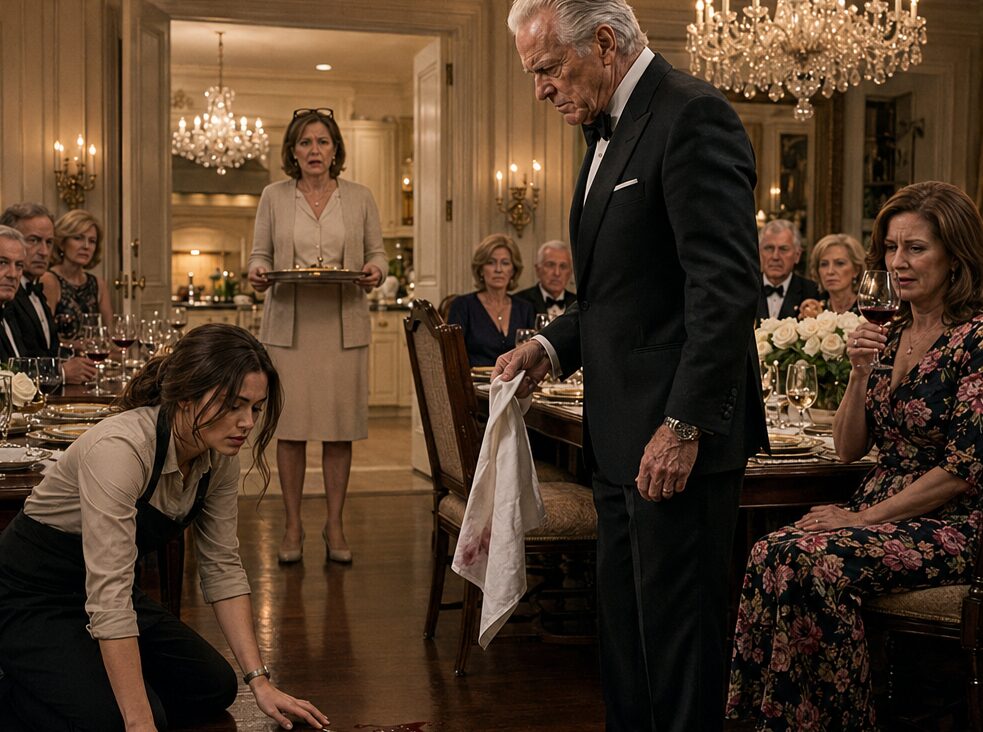
Nicole was on her hands and knees beneath the dining table when the room went quiet enough for her to hear the fork stop spinning.
It had landed near Frank’s polished black shoe, silver against the dark hardwood, bright under the chandelier. Her palm pressed flat to the floor. Her hair had slipped from its low ponytail and hung beside her cheek. Above her, six wineglasses hovered in six careful hands.
Frank stood over her with a white dinner napkin twisted in one fist.
“Well,” he said, his voice warm enough to pass for a joke if someone needed it to, “since you’re already down there.”
A woman in a floral dress gave one sharp laugh, then swallowed the rest of it into her wine.
Nicole looked at the fork. She looked at Frank’s shoe. She looked at the thin red crescent of wine on the floor near the chair leg, where a drop had fallen when he jerked his glass away from her.
No one moved.
Not Carolyn, standing in the kitchen doorway with her reading glasses pushed into her hair and both hands gripping a serving tray.
Not Deborah, the neighbor in the floral dress, whose smile had begun to fold in on itself.
Not the man at the far end of the table who suddenly found something urgent on his phone.
Frank’s hand trembled slightly around the napkin. He saw Nicole notice. His mouth tightened.
“Don’t just stare at it, kiddo,” he said.
The word landed harder than the command.
Nicole had been called worse. In hospitals, in other houses, in hallways where people assumed caregivers came with no ears and no inner life. She had learned to put insult in a pocket and keep working.
But under Frank’s dining table, with the chandelier shining on her back and expensive shoes arranged around her like a fence, the pocket was full.
Carolyn’s whisper came from the kitchen.
“Nicole.”
Just her name. Warning. Plea. Apology. All of it dressed as one small sound.
Nicole reached for the fork.
Frank moved his shoe half an inch closer to it.
The room breathed in.
And Nicole understood, with a clarity so cold it steadied her, that everyone was waiting to see what kind of person she would become while they watched.
Part II — Just Tonight
Three hours earlier, Carolyn had found Nicole in the laundry room folding Frank’s white undershirts into careful squares.
“Please don’t hate me,” Carolyn said.
That was never a good beginning.
Nicole glanced at the clock above the dryer. Frank’s evening pills were due at six. His blood pressure cuff was on the kitchen island. The chicken soup she had made for him sat cooling in glass containers, labeled by day because Frank liked order even when he resented needing it.
“I don’t hate you,” Nicole said. “Yet.”
Carolyn tried to smile. It barely stayed on her face.
She was forty-something, soft cardigan, neat bob, the kind of woman who looked composed from across a room and frayed from three feet away. Since Frank’s stroke eight months ago, she had become the manager of everything he refused to admit needed managing. Appointments. Refills. Groceries. Apologies.
Nicole managed the rest.
“Catering is short two people,” Carolyn said. “One got sick, one just didn’t show. I know this is not your job. I know that.”
Nicole put another undershirt on the stack.
Beyond the laundry room, the house was already turning into a stage. Florist buckets in the hall. Candleholders lined on the sideboard. A printed seating chart on thick cream paper. The annual Laurel Ridge Scholarship Dinner, hosted by Dr. Frank Whitaker, though no one called him doctor inside the house unless guests were listening.
“I’m here until seven,” Nicole said.
“I know.”
“And I’m here for your father. Not dinner service.”
“I know.”
Carolyn said it too quickly, which meant she was about to ask anyway.
Nicole folded the last shirt and set it on top of the pile. Her watch beeped once. Six o’clock warning.
Carolyn lowered her voice. “Could you just help serve? Just tonight. Plates, water, maybe clearing. Nothing complicated.”
Nothing complicated was a phrase rich people used for things that became complicated the second you said yes.
Nicole looked toward the kitchen.
On the counter, beside Frank’s pills, her phone lit up with a message.
Patrick: We’re out of milk but I can use water for mac if you’re late.
Nicole closed her eyes for one second.
Patrick was seventeen and too proud to say he was hungry directly. He had learned to make requests sound like reports. We’re out of milk. The electric bill came. My shoes are fine except the left one.
“How much?” Nicole asked.
Carolyn’s face changed. Relief first. Then guilt chasing it.
“Two hundred. Cash. Tonight.”
Nicole almost laughed. Two hundred dollars was a number with hands. It could reach into the future and move things. Groceries. Gas. Part of the rent. A used calculator Patrick needed for his community college placement test.
Carolyn saw the answer before Nicole gave it.
“I’ll make sure he doesn’t bother you,” Carolyn said.
That was the first lie of the evening, though Nicole did not know it yet.
In the den, Frank called out, “Carolyn? Why is there no one checking the wine?”
Carolyn flinched. A small thing. A daughter’s reflex.
Nicole picked up the pill organizer and the cuff.
“I’ll help,” she said. “But I leave after dessert.”
“Of course.”
“And I’m not wearing a costume.”
Carolyn looked at the black aprons folded on a chair by the back door.
“They’re just aprons.”
“Then you wear one.”
For a moment, Carolyn’s face opened. Not anger. Recognition.
Then Frank called again, louder.
“Carolyn.”
Carolyn picked up one apron and held it out with both hands, as if offering something fragile instead of asking for something.
Nicole took it.
Some decisions do not feel like surrender when you make them.
They feel like math.
Part III — People Who Know How to Work
Frank became charming the moment the guests arrived.
He stood straighter in the dining room than he did in the hallway. His silver hair was combed back. His black dinner jacket hid the slight unevenness in his left shoulder. The expensive watch on his wrist flashed every time he lifted his glass.
“Deborah,” he said, kissing the floral-dressed woman’s cheek. “Still making the rest of us look underdressed.”
Deborah laughed as if he had given her a gift.
Nicole stood near the sideboard with a pitcher of ice water, wearing the black apron over her beige shirt and jeans. Clean sneakers. Hair tied low. Watch set for medication times. She could feel Carolyn’s eyes checking every corner of the room at once.
The dining room was beautiful in the way money made rooms beautiful when no one had to sit in them after bad news. Tall windows gone dark with evening. White roses in low glass bowls. Candles that smelled faintly of fig. Plates edged in gold. Napkins folded into crisp rectangles.
Frank had not wanted the napkins folded that way.
“Too much like a hotel,” he had said.
Carolyn refolded all eight herself.
Now Frank lifted one and shook it open with approval, because guests were there.
“To the Laurel Ridge Fund,” he said when everyone was seated. “And to young people who understand opportunity when it knocks.”
“Hear, hear,” someone said.
Nicole filled water glasses from the left, wine from the right, and kept her face pleasant in the blank way working in someone else’s house required. Not smiling too much. Not looking irritated. Not seeming invisible enough to make people uncomfortable.
Frank watched her pour chardonnay into Deborah’s glass.
“Careful, kiddo. That bottle is older than you are.”
A small laugh traveled around the table.
Nicole kept pouring.
Carolyn, standing near the kitchen, mouthed, Sorry.
Nicole did not look at her.
Frank turned to his guests. “Nicole helps me during the week. Keeps me from being a complete invalid, according to my daughter.”
“Dad,” Carolyn said softly.
“What? It’s true. I suppose we all need help eventually, though some of us resist it with dignity.”
His hand shook when he lifted his glass. Barely. But enough.
Nicole noticed because noticing was part of her job. She knew the difference between fatigue and stubbornness. She knew when Frank’s left foot dragged more than usual, when his speech thickened after too much excitement, when his blood pressure rose because he had performed being fine for too long.
She stepped closer, quiet. “Your medication is in twenty minutes.”
Frank’s smile did not move, but his eyes sharpened.
“Thank you, nurse.”
“I’m not a nurse.”
“Then don’t hover like one.”
Deborah’s laugh came first again, smaller this time. She lifted her wine quickly afterward, as if to hide behind the glass.
Nicole stepped back.
The conversation turned to the scholarship applicants. The committee had narrowed the list to three. One had a perfect GPA. One played violin. One, according to Deborah, had “a very moving essay about overcoming circumstances.”
“What circumstances?” Frank asked.
“Single-parent home,” Deborah said. “Works after school. Helps with younger siblings.”
Nicole’s fingers tightened around the water pitcher.
Patrick’s school had sent an email two weeks ago: Encourage eligible seniors to apply for local scholarship opportunities. He had not wanted to.
“They always know who those things are really for,” he had said.
“For students who need money,” Nicole told him.
“For students who can write about needing money without sounding like they need it too much.”
At the table, Frank nodded gravely.
“That’s what we’re looking for,” he said. “Grit. Not entitlement. Not excuses. Character.”
“Character,” Deborah echoed.
Nicole moved behind Frank’s chair to refill his water. He looked up without turning his head.
“Nicole knows about that. Don’t you, kiddo? Shows up on time. Does what’s asked. Hard to find that now.”
The compliment made her cheeks burn.
It was ownership dressed as praise.
“Thank you,” she said, because the room required it.
Frank smiled at his guests. “See? Manners too.”
Carolyn disappeared into the kitchen.
Nicole followed with empty salad plates stacked along her forearm. In the kitchen, the heat from the oven had fogged the windows. Carolyn stood with her hands flat on the counter, breathing through her nose.
“He’s in a mood,” Carolyn said.
Nicole set the plates down. “He’s showing off.”
“I know.”
“Those are different things.”
Carolyn looked at her. For one moment, employer and employee fell away, and there were only two women standing in a kitchen with a difficult man in the next room.
Then Frank called, “Carolyn, are we eating tonight or admiring the kitchen?”
Carolyn’s face closed again.
“Just get through tonight,” she whispered.
Nicole lifted the entrée platter.
That was the second lie of the evening: that getting through it would leave her unchanged.
Part IV — The Fork
The main course was roasted chicken with lemon and herbs, asparagus tied in neat bundles, small potatoes glossy with butter.
Nicole carried plates two at a time. Carolyn followed with sauce. Frank narrated the meal as if he had cooked it himself.
“Simple food,” he said. “Good food. Nothing fussy.”
Deborah said, “You always do things so beautifully.”
Frank accepted the compliment like a payment.
His left hand was tired now. Nicole could tell by the way he kept it in his lap, curled slightly. When she reached to clear his salad fork, he covered the movement with a larger gesture, knocking his dinner knife against the plate.
“Easy,” he said. “This isn’t a cafeteria.”
The table laughed because he smiled.
Nicole smiled too. Not with her mouth. With the muscles that meant she would not react.
Carolyn stepped in quickly. “More potatoes, anyone?”
Frank ignored her. “You know, when I trained residents, I could tell in five minutes who had discipline. Not talent. Discipline. Talent is common. Discipline is rare.”
“Absolutely,” Deborah said.
“You drop an instrument in my OR, you don’t make excuses. You fix it. You understand the room depends on you.”
Nicole reached for the empty bread basket.
Frank’s voice followed her.
“You hear that, kiddo?”
She paused.
“Yes.”
“Yes, what?”
The room softened around the edges.
Carolyn’s hand stopped above the potatoes.
Nicole turned just enough to face him. “Yes, I heard you.”
Frank’s smile thinned.
It was not defiance. Not really. But it did not have the shape he wanted.
He lifted his wineglass. “Then we’re all learning tonight.”
Nicole moved toward him with the platter, because motion was safer than stillness.
That was when his elbow shifted.
The fork slid.
It hit the edge of his plate, bounced once on the chair rail, and fell to the floor with a bright, ringing spin.
Everyone looked down.
The fork turned once, twice, and settled near Frank’s right shoe.
Nicole knew, before she bent, that the room had changed.
A dropped fork was nothing. In a normal house, someone would pick it up, replace it, forget it. In Frank’s house, with Frank’s hand tired and his pride cornered, nothing stayed nothing.
“I’ve got it,” Nicole said.
She crouched.
The apron pulled tight across her knees. The hardwood was cold under her fingertips. Her watch face flashed under the table: 7:41. Dessert was not out yet. She was supposed to leave after dessert.
Frank’s shoe moved.
Not much. Just enough to become part of the fork’s geography.
“Well,” he said.
Someone made a soft sound that might have been amusement or discomfort.
Nicole reached.
Frank lowered his napkin from his lap and twisted it loosely in his hand.
“Since you’re down there,” he said, “make yourself useful.”
The room waited for the joke to declare itself.
It did not.
“There’s a spot,” Frank said, pointing with the napkin. “There. Wine. Before it sets.”
Nicole looked at the floor. A red drop had landed beneath the table. Smaller than a dime.
Carolyn appeared in the kitchen doorway.
Her face said she saw everything.
Her feet did not move.
Nicole picked up the fork.
She could have stood then. Later, she would return to that second again and again. The fork was in her hand. Her legs still worked. The door was twenty steps away.
But rent was due Monday.
Patrick needed milk and a calculator and a sister who did not come home with stories that made him feel helpless.
Two hundred dollars waited somewhere in Carolyn’s purse.
And six well-dressed people were watching to see if Nicole understood her role.
So she reached for the napkin Frank held out.
He did not hand it to her.
He let it hang.
She had to take it from below.
Deborah laughed.
It was not loud. That made it worse. A loud laugh could be accused of cruelty. This one could hide forever inside the word awkward.
Nicole wiped the spot.
The napkin came away with a faint pink smear.
“There,” she said, and started to rise.
Frank flicked the napkin downward.
It touched her shoulder.
Lightly. Barely.
Enough.
“Careful,” he said. “Don’t track it around.”
Nicole froze with one knee under her.
Carolyn whispered from the doorway, “Nicole.”
Frank turned his head. “What?”
Carolyn’s mouth opened.
Nothing came out.
Frank looked back down at Nicole.
“You embarrassed yourself,” he said, still smiling for the room. “Don’t make it worse.”
That was when Nicole realized he had given everyone a script.
If she stayed down, it was because she was sensible.
If she stood angry, she was making a scene.
If she cried, she was fragile.
If she spoke, she was ungrateful.
The room had an answer ready for every version of her except the one she had not yet tried.
Part V — The Empty Chair
Nicole rose slowly.
Not dramatically. Not with a sweep of anger. She rose the way she helped Frank rise from his recliner when he pretended not to need her hand: carefully, deliberately, refusing to rush because someone else felt exposed.
The fork was in her right hand.
The napkin was in her left.
The pink smear on the white cloth looked brighter in the candlelight than it had on the floor.
Frank’s face changed first. Not fear. Irritation that the scene had not stayed where he placed it.
“Now,” he said, “let’s not be theatrical.”
No one laughed.
Nicole looked at the table.
Deborah stared into her wine. The man at the far end had lowered his phone but kept his thumb on the black screen. Another guest studied the centerpiece as if roses had become complicated.
Carolyn took one step into the room.
“Nicole,” she said again.
This time it did not sound like warning. It sounded like she was asking Nicole to carry one more thing.
Nicole set the fork beside Frank’s plate.
The sound was small.
Silver against porcelain.
Every face lifted.
Frank blinked. “Excuse me?”
Nicole did not answer him.
At the far side of the table was an empty chair. Carolyn had explained it earlier while adjusting the place card.
“The student couldn’t come,” she had said. “Work shift, I think. But Dad wanted the place set anyway. Symbolic.”
The place card still stood there in elegant black script: Laurel Ridge Scholar.
No name. Just the idea of a grateful young person.
Nicole walked to that chair.
Her legs were steady now. That surprised her.
She laid the white napkin across the empty plate. The pink smear faced upward.
Carolyn made a sound behind her, small enough to be mistaken for breath.
Frank’s voice hardened. “What do you think you’re doing?”
Nicole turned.
For the first time that evening, she let herself meet every pair of eyes at the table.
Deborah’s lipstick had faded at the center of her mouth. Her glass was still in her hand. She looked older than she had when she arrived.
Nicole spoke quietly.
“You wanted them to see how grateful people are supposed to look.”
No one moved.
The sentence did not echo. It settled.
Frank stood a little straighter. His left hand trembled at his side, and this time he could not hide it with a glass, a joke, or a napkin.
“You are out of line,” he said.
Nicole untied the black apron.
Carolyn stepped forward. “Dad—”
“Don’t,” Frank snapped, but the word came out too sharp, too naked.
The room heard it.
Nicole folded the apron once. Not perfectly. Just enough.
She placed it on the sideboard beside the untouched dessert plates.
Carolyn’s eyes filled, but she did not reach for her.
That was fair, Nicole thought. Reaching now would be another kind of taking.
Frank pointed toward the kitchen.
“If you need to compose yourself, use the back.”
Nicole looked at the swinging kitchen door.
She had gone in and out of that door for eight months. With grocery bags. Pill bottles. Laundry baskets. Soup containers. She knew which hinge squeaked. She knew where the tile dipped by the pantry. She knew how to pass through without being seen from the dining room.
Then she looked at the front hall.
The guests had entered there under the porch lights, coats taken, names greeted, status confirmed.
Nicole walked toward it.
“Nobody dismissed you,” Frank said.
She paused with her hand on the front doorknob.
“No,” she said. “You just forgot I could leave.”
Then she opened the door and stepped into the cold evening air.
Part VI — What Was Waiting at Home
Nicole made it to her car before she started shaking.
It was an old blue sedan with one hubcap missing and a heater that worked when it wanted to. She sat behind the wheel with both hands in her lap because if she touched the keys too soon, she might drop them.
Through the windshield, Frank’s house glowed behind its perfect shrubs.
The dinner would continue or it would not. Someone would pour more wine. Someone would say, “Well, that was uncomfortable.” Someone might call her unprofessional because that was easier than calling themselves cowardly.
Her phone buzzed.
Patrick: You still coming home tonight or did rich people adopt you?
Nicole laughed once, and it broke halfway through.
She typed: Coming home.
Then deleted it.
Typed: Save me some mac.
Then deleted that too.
The front door opened.
Carolyn stepped out without a coat. The porch light made her cardigan look pale and thin. In one hand she held an envelope.
Nicole closed her eyes.
She did not have room for another request.
Carolyn crossed the driveway slowly, as if sudden movement might make Nicole drive away.
Nicole rolled down the window halfway.
For a moment neither of them spoke.
Inside the house, a burst of muffled voices rose and fell. Frank’s voice cut through once, indistinct but unmistakable.
Carolyn held out the envelope.
“Two hundred,” she said. “What I promised.”
Nicole looked at it.
Carolyn’s hand shook.
“And another hundred,” Carolyn added. “From me.”
There it was. The softest form of the same old thing.
Money reaching across a distance it had helped create.
Nicole took the envelope, opened it, counted two hundred dollars, and placed the extra hundred back in Carolyn’s palm.
Carolyn’s face tightened.
“Please,” she said.
“No.”
“It’s not—”
“It is.”
Carolyn looked down at the bill in her hand.
The porch light shone on the side of her face. Without the dinner room behind her, she looked less polished. More like someone who had been holding a door shut for years and had finally heard what was on the other side.
“I should’ve stopped him,” she said.
Nicole did not answer right away.
A week ago, Carolyn had sat with her at the kitchen island after Frank refused his morning pills. They had drunk coffee gone lukewarm and talked about nothing: grocery prices, Patrick’s graduation, Carolyn’s divorce papers still sitting unsigned in a drawer. There had been kindness there. Unequal kindness, but real.
That was the hard part.
People could be kind in the morning and fail you by evening.
“Yes,” Nicole said.
Carolyn nodded once, as if she deserved no softer answer.
“I’m sorry,” she said.
Nicole folded the envelope and put it in her bag.
“I believe you.”
Carolyn looked up.
Nicole started the car.
Believing an apology was not the same as carrying it home.
Carolyn stepped back from the window. She wrapped both arms around herself and stood in the driveway as Nicole reversed.
No one else came outside.
At the end of the street, Nicole stopped at the sign longer than necessary. Laurel Ridge was quiet around her. Wide lawns. Warm windows. Mailboxes that matched. Houses where people donated to children they did not have to meet.
Her phone buzzed again.
Patrick: I made it fancy. Bowl and everything.
Nicole drove home.
Their apartment smelled like boxed macaroni and the lemon dish soap Patrick used too much of because he thought bubbles meant clean. His backpack was open on the chair. A college brochure lay under the salt shaker. The kitchen table wobbled unless you kept one foot on the lower bar.
Patrick looked up from his bowl.
He was tall now, taller than her, but still had the cautious face of a boy who listened for bad news before asking questions.
“You okay?” he said.
Nicole set her bag down.
Two hundred dollars was inside it. Not enough. More than nothing. The shape of survival, but not the price of silence.
“I’m tired,” she said.
Patrick studied her. He knew the difference.
He pushed the second bowl toward her.
“I saved you the less clumpy one.”
Nicole sat.
The macaroni was too thick because he had used water instead of milk. It stuck to the spoon in soft orange folds. The table was scratched. The overhead light flickered once before settling. Someone upstairs moved a chair across the floor.
It was not beautiful.
No candles. No white roses. No gold-edged plates. No one waiting to see how grateful she could look.
Nicole took a bite.
Patrick watched her, still worried.
After a moment, he said, “Rich people didn’t adopt you, then.”
Nicole swallowed.
“No,” she said. “I left through the front door.”
He did not understand all of it. Not yet.
But he smiled a little, because he understood enough.
Nicole looked down at the bowl he had saved for her, at the small table that held both of them, at the cheap fork in her hand.
Then she kept eating.