The Night She Opened the Door and Let the Kitchen Tell the Truth
Part I — The Chain on the Door
Brenda was on the kitchen floor with red sauce on her cheek when Daniel said, “Mom, get up before she gets scared.”
Ashley was already scared.
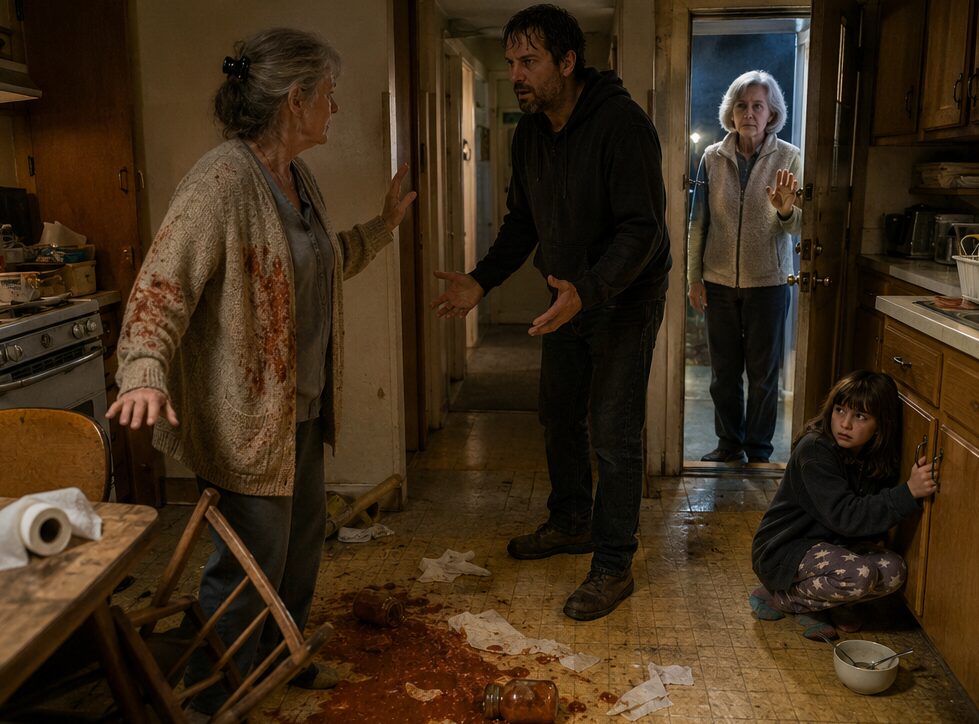
She sat beside the lower cabinets in her mismatched pajamas, knees tucked under her nightgown, cereal bowl balanced in both hands like it was the only solid thing left in the room. One blue plastic spoon lay by her sock. The chair beside Brenda had tipped sideways. A jar of marinara had broken near the baseboard, spilling red across the yellowed linoleum and under the stove.
Daniel stood over Brenda, breathing hard.
Not touching her now.
That was the part he would remember.
That was the part he would make important.
“Mom,” he said again, softer this time, because Ashley was watching. “Come on. You’re making it look worse.”
Brenda pressed one palm to the floor. Her wrist hurt. Her hip hurt. Her pride hurt in a place deeper than bone.
She could not remember if he had pushed her.
She remembered his hand coming up.
She remembered stepping back.
She remembered the chair behind her knees.
She remembered Ashley making no sound at all.
Daniel crouched, grabbed a handful of paper towels from the counter, and started wiping sauce from the floor in frantic circles. “It’s marinara. That’s all it is. See?” He held up the stained towel as if proving something to a judge. “It’s sauce.”
Brenda looked at Ashley.
Ashley did not blink.
The doorbell rang.
All three of them froze.
The sound came again, bright and polite from the front of the duplex, followed by a woman’s voice through the door.
“Brenda? It’s Elizabeth. I heard something.”
Daniel’s face changed before Brenda’s did. Shame came first, then anger, then the quick desperate charm he used when he needed people to believe he was almost all right.
“Don’t,” he whispered.
Brenda pushed herself up onto one elbow. Her cardigan sleeve dragged through the sauce.
“Brenda?” Elizabeth called. “Are you okay in there?”
Daniel stood so fast the paper towels fell from his hand. “Just tell her you dropped something.”
“I did drop something,” Brenda said.
“Exactly.” His voice sharpened. “So tell her.”
Ashley’s spoon rolled under the cabinet with a tiny click.
Brenda got to her knees slowly, one hand on the sticky floor, the other on the seat of the tipped chair. Her body felt heavy and old in front of her son. That embarrassed her almost as much as the sauce on her cheek.
Daniel reached for her arm.
She flinched.
He saw it.
For one second, he looked like a boy again—caught, wounded, furious that someone had noticed what he had done before he had decided what to call it.
“I was helping you up,” he said.
“I know.”
She did not know. She said it anyway.
The doorbell rang a third time.
Brenda made it to her feet. She took one step, then another, past the kitchen table stacked with envelopes, Ashley’s coloring sheets, and Daniel’s work gloves. At the front door, she left the chain on.
Elizabeth stood on the porch in a fleece vest, silver hair tucked behind one ear, holding her phone but not using it. She did not try to see around Brenda. That was Elizabeth’s way. She gave people room even when she was worried.
“I heard a crash,” Elizabeth said.
“I dropped a jar.”
Elizabeth looked at Brenda’s cheek. Then at her cardigan. Then past her, toward the kitchen light.
“A jar?”
“Marinara,” Brenda said. “I’m fine.”
Behind her, Daniel exhaled too loudly.
Brenda hated him for that.
Then she hated herself for hating him.
Elizabeth’s eyes stayed gentle, which made everything worse. “Do you need help cleaning up?”
“No. Thank you.”
“Is Ashley awake?”
Brenda felt Daniel’s attention tighten behind her.
“She’s fine too,” Brenda said.
From the kitchen, Ashley whispered, not loudly enough for Elizabeth to hear, but clearly enough to cut the room in two.
“Grandma fell because Daddy yelled.”
Daniel closed his eyes.
Brenda’s fingers curled around the door edge.
The chain between her and Elizabeth looked suddenly thin, almost silly, a little gold line pretending to be a wall.
“We’re fine,” Brenda said again.
Elizabeth nodded slowly. “Okay.”
She did not believe it. Brenda could see that.
But Elizabeth stepped back.
“All right,” she said. “I’m next door.”
Brenda closed the door and rested her forehead against it.
Behind her, Daniel said, “Why would she say that?”
Brenda did not turn around.
“She’s six,” Brenda said.
“She makes things sound—”
“She’s six.”
The kitchen was quiet except for the refrigerator hum and Daniel’s wet paper towels dragging over the floor.
Ashley still had not moved from the cabinets.
Brenda wanted to pick her up. She wanted to send Daniel outside. She wanted to rewind ten minutes, seven months, thirty years.
Instead she crossed the room, knelt in front of her granddaughter, and said the sentence she knew was wrong before it left her mouth.
“It’s okay, sweetheart. Grandma just slipped.”
Ashley looked at the red on Brenda’s cardigan.
“No,” she said.
One small word.
Brenda had no answer for it.
Part II — Almost Back on His Feet
Daniel and Ashley had been staying with Brenda for seven months.
At first, it was supposed to be two weeks.
Daniel had lost his apartment after the auto shop cut his hours and his roommate moved in with a girlfriend. He arrived with four trash bags of clothes, a toolbox, Ashley’s booster seat, and the careful voice of a man trying not to sound like he was begging.
“Just until I get steady,” he told Brenda. “I’ve got a lead at Rayburn’s. They like me. I just need a little breathing room.”
Brenda gave him the small back bedroom. Ashley took the pullout in the sewing room. Brenda moved her folded fabric bins into the hallway and told everyone at church that it was nice to have noise in the house again.
Sometimes it was.
Ashley liked pancakes shaped like rabbits. She liked lining her crayons by color. She liked sitting on the bathroom counter while Brenda pinned up her blunt little haircut with clips shaped like strawberries.
Daniel could be good in the mornings.
He sang off-key while making coffee. He warmed Ashley’s socks on the radiator. He fixed the porch light without being asked and carried Brenda’s laundry basket when her knees acted up.
Then a bill would come.
Or a job would fall through.
Or someone would ask when he planned to get his own place.
Then his body changed before his words did. His shoulders climbed. His jaw locked. His hands started moving like they needed something to hold, fix, crush, or prove.
Brenda had learned to smooth those moments flat.
She had been smoothing Daniel’s life since he was fourteen and she worked the breakfast shift at the school cafeteria, then the evening shift at the grocery deli, then came home too tired to notice the dent in his bedroom door until months later.
Back then, she had told herself boys got angry.
Now he was thirty-three, tall and unshaven in work boots he wore even when there was no work, and she still caught herself thinking, He’s just tired.
The morning after the kitchen floor, Brenda woke before dawn and scrubbed marinara from the baseboard with an old toothbrush.
The sauce had crept into the seam where the floor met the wall. It came up slowly, rusty and stubborn. Her wrist ached each time she pressed down.
From the hallway, Ashley watched in her oversized school sweatshirt.
“Grandma?”
“Yes, honey?”
“Is Daddy mad today?”
Brenda stopped scrubbing.
“No,” she said. “Daddy’s sleeping.”
That was not an answer, and both of them knew it.
At seven, Daniel came into the kitchen with wet hair and a softer face. He had shaved. He kissed Ashley on top of the head.
“Morning, bug.”
Ashley leaned into Brenda’s leg.
Daniel saw that too.
His smile twitched but stayed. “I’m making eggs tonight,” he said. “Your favorite.”
Ashley liked scrambled eggs with ketchup. Daniel knew that. He always remembered the small tender things. It was the big frightening ones he tried to rename.
Brenda poured cereal into a bowl. The box was almost empty.
“Mom,” Daniel said quietly, “I’m sorry about last night.”
Ashley went very still.
Brenda kept pouring until cereal spilled over the rim.
Daniel lowered his voice further. “I didn’t mean for you to fall.”
There it was.
The sentence built to leave space around himself.
Brenda set the cereal box down. “You scared her.”
“I scared myself.”
He looked so ashamed that Brenda almost reached for him.
Almost.
Then Ashley’s hand slipped into hers under the counter.
At noon, Brenda’s sister called from Ohio, the way she did when the weather changed or when Brenda ignored two messages.
“Electric company called me by mistake again,” Kimberly said. “They still have me as backup contact. Bren, why is your bill late?”
Brenda stood in the church kitchen, hairnet in her purse, plastic gloves powdered on her hands. She looked at the big silver trays waiting to be washed.
“It’s not late. It’s just delayed.”
“That means late.”
“I get my check Friday.”
“You’ve been saying that a lot.”
Brenda looked through the serving window at the fellowship hall, where three elderly men were folding chairs badly and arguing about basketball.
“Daniel’s starting at Rayburn’s soon.”
Kimberly sighed. “Is he?”
Brenda hated the sigh more than the question.
“He’s trying.”
“Trying doesn’t pay utilities.”
“He’s Ashley’s father.”
“And you’re becoming everyone’s cushion.”
Brenda pulled off one glove finger by finger. “I have to go.”
“Brenda.”
“I said I have to go.”
She hung up and felt instantly cruel.
That was the trouble with being angry in private. There was nowhere for it to go except into the next person who loved you.
When Brenda got home that afternoon, a foil-covered casserole sat on the porch with a yellow sticky note pressed to the lid.
No need to explain. Just wanted to make sure the little one ate.
Elizabeth had signed only her first initial.
Brenda stared at it for a long moment.
It was kind.
It felt like pity.
She nearly left it outside.
Then she thought of the empty cereal box, Ashley’s thin wrist in her hand, and the way Daniel had said I scared myself as if that should count for the same thing as not scaring them.
Brenda carried the casserole inside.
She put it in the refrigerator behind the milk so Daniel would not see it first.
That evening, Daniel made scrambled eggs with too much butter and fixed the loose handle on the lower cabinet while Ashley sat at the table coloring. He knelt on the floor with a screwdriver, sleeves pushed to his elbows, murmuring to the stubborn screw like it was a stubborn child.
“There,” he said when the handle tightened. “Good as new.”
Ashley smiled.
Brenda wanted to believe in that smile.
Daniel looked up at her from the floor. “See? I’m not useless.”
“I never said you were.”
“You didn’t have to.”
The words carried no heat, only hurt. That was harder.
Later, after Ashley fell asleep, Daniel stood in the kitchen doorway and said, “I hate when I scare you.”
Brenda folded a dish towel. “Then don’t.”
His face tightened.
For a second, she thought the room would tilt again.
But he only nodded.
“I’m trying,” he said.
Brenda had lived too long on those two words.
Part III — The Drawing
The call from Ashley’s school came the next day at 1:40 p.m., while Brenda was comparing the electric bill to her checking account balance and pretending numbers could become kinder if arranged carefully.
“Mrs. Lewis?” the teacher said.
Brenda’s married name had been Lewis, though her husband had been gone nine years. People still used it when they wanted to sound official.
“This is Ashley’s teacher, Ms. Carter. Do you have a few minutes at pickup today?”
Brenda’s first thought was Daniel.
Her second thought was sauce.
Her third was shame so fast and hot she had to sit down.
“Is Ashley in trouble?”
“No,” Ms. Carter said quickly. “Not at all. I’d just like to show you something she made.”
At pickup, the kindergarten hallway smelled like wet boots, crayons, and cafeteria pizza. Ashley came out wearing her backpack on one shoulder, gripping a folded paper against her chest.
She would not meet Brenda’s eyes.
Ms. Carter was young, with tired kindness and a cardigan covered in tiny embroidered apples. She led Brenda to the side of the hallway, away from the other parents.
“I want to be careful,” she said.
Those words made Brenda want to run.
Ms. Carter unfolded the paper.
The drawing was simple. A square room. A yellow table. A tall stick figure with dark hair and long arms. A smaller gray-haired figure on the floor. A little figure by the cabinets, colored purple.
Above it, in careful kindergarten letters, Ms. Carter had written Ashley’s explanation.
Grandma on the floor.
Brenda felt the hallway shrink.
“It was a jar,” she said immediately.
Ms. Carter did not argue. “Ashley said there was a loud night.”
“A jar broke.”
“That can be scary.”
“It was sauce.” Brenda heard herself getting louder and lowered her voice. “It got everywhere. She misunderstood.”
Ashley stood beside her, eyes on her shoes.
Ms. Carter looked down at the child, then back at Brenda.
“Kids draw what stays with them.”
Brenda wanted to dislike her. It would have been easier if the teacher had sounded accusing. But the young woman’s voice held no triumph, no gossip, no hunger for drama.
Only concern.
That made Brenda feel more exposed.
“We’re fine,” Brenda said.
The words tasted old.
Ms. Carter nodded, but not in agreement. “If you ever need resources—”
“No.”
It came out too sharp.
Ashley flinched.
Brenda saw it and felt something inside her give way.
Not break.
Give way.
Like a shelf finally accepting too much weight.
On the walk home, Ashley held Brenda’s hand and dragged the toes of her sneakers through the May dust on the sidewalk.
“Are you mad about my picture?” she asked.
Brenda swallowed.
“No.”
“Daddy said people get confused if we tell things wrong.”
“When did Daddy say that?”
Ashley shrugged. “When he cleaned the floor.”
Brenda stopped walking.
A pickup truck rolled past. Somewhere down the block, a dog barked behind a fence. Ordinary life went on, rude in its indifference.
Ashley looked up at her. “Did I tell it wrong?”
Brenda’s throat tightened.
She had corrected Ashley the night before. She had put a softer story in the child’s mouth and called it comfort.
“You drew what you remembered,” Brenda said.
“Was that bad?”
“No.”
It was the closest she could get to truth.
At home, Daniel was in a good mood. He had a phone call with a man from Rayburn’s the next morning. He had cleaned the living room, taken the trash out, and lined Ashley’s shoes by the door.
“I told you,” he said, grinning. “Things are turning.”
Brenda looked at his hopeful face and hated how much she wanted it to be true.
Ashley ran to show him a sticker she got at school.
Not the drawing.
The drawing stayed folded in Brenda’s purse like something alive.
That night, Daniel made eggs. Ashley ate them with ketchup and talked about a class hamster named Waffles. Daniel listened like there was nothing in the world more important.
After dinner, he fixed the cabinet handle again because Ashley liked pulling it to make sure it was strong.
“Careful,” he told her, smiling. “That’s professional work.”
Ashley giggled.
Brenda stood at the sink washing plates, watching their reflection in the dark window.
A good father would sit on the floor to fix a cabinet so his daughter could laugh.
A frightening father would make that same child crouch without thinking.
Brenda did not know how to hold both truths.
So she held the plate too tightly until it slipped and clattered into the sink.
Daniel turned fast.
Ashley went quiet.
“Sorry,” Brenda said.
Daniel’s shoulders dropped. “You okay?”
She nodded.
But the drawing in her purse felt heavier than paper.
Part IV — Grocery Money
By Friday morning, Brenda had thirty-eight dollars left after the electric payment.
She wrote the number on the back of an envelope, circled it twice, and made a grocery list that looked more like a negotiation than a plan.
Milk. Bread. Eggs. Apples if cheap. Peanut butter. Pasta.
She left her debit card on the kitchen table while she packed Ashley’s lunch: half a peanut butter sandwich, baby carrots, and the last pudding cup.
Daniel came in wearing his hoodie, hair damp, phone pressed to his ear.
“Yes, sir,” he said into it. “Absolutely. No, I can be there Monday. I just need to keep this number active. Yes, sir. Thank you. Thank you.”
When he hung up, his face was bright with panic and hope.
“That was Rayburn’s,” he said. “They want me Monday for paperwork.”
Brenda felt the old lift in her chest before she could stop it.
“Daniel, that’s good.”
“I told you.” He laughed once, breathless. “I told you something was coming.”
Ashley clapped because Daniel was smiling.
For half a day, the house felt almost normal.
Brenda took Ashley to school. Daniel walked to the bus stop to “handle a few things.” Elizabeth waved from her porch but did not cross the yard.
At the grocery store, Brenda filled the cart carefully. Store-brand milk. Day-old bread. Eggs. A bag of apples with two bruised ones hidden underneath. Peanut butter. Pasta. A small box of crayons because Ashley’s purple was worn to a nub.
At checkout, the card declined.
Brenda smiled at the cashier as if the machine had made a harmless mistake.
“Could you try it again?”
The young cashier did.
Declined.
The woman behind Brenda shifted her basket from one arm to the other.
Brenda opened her banking app with fingers that did not feel attached to her hand.
The thirty-eight dollars was gone.
In its place was a payment to Daniel’s phone carrier.
Thirty-six dollars and seventy-nine cents.
Brenda put back the apples first.
Then the crayons.
Then the peanut butter.
The cashier avoided her eyes while removing each item.
That was mercy, Brenda supposed.
At home, Daniel was at the kitchen table, tapping through forms on his phone.
“You used my card,” Brenda said.
He looked up. Not guilty enough.
“I was going to tell you.”
“That was grocery money.”
“I had to keep my phone on. Rayburn’s needs to reach me.”
“You should have asked.”
“You would’ve said no.”
“Yes,” Brenda said. “I might have.”
“Then what was I supposed to do?”
The question hit the room like a thrown cup, though nothing had moved.
Ashley sat at the table coloring with her new school sticker stuck to one sleeve. Brenda had not bought the crayons. The old purple one lay short and dull in her hand.
Daniel stood.
Brenda did not step back.
“Sit down,” she said.
His eyes flashed. “Don’t talk to me like I’m twelve.”
“Then stop taking money like you’re twelve.”
Silence.
Daniel’s face changed.
There was the boy who had needed her.
There was the man who resented needing her.
There was the father whose child was watching.
All of them stood in the same work boots.
“You want me to fail,” he said.
“No.”
“You do. Because then you get to be right. Poor Brenda. Always cleaning up after Daniel.”
“I want you to ask before you take.”
“I’m trying to get a job.”
“And I’m trying to feed your daughter.”
That landed.
For one second, his anger had nowhere to go.
Ashley’s plastic cup slipped from the table and hit the floor.
It made a small hollow crack.
Daniel flinched toward the sound.
Not toward Ashley, exactly.
Not enough for someone outside the room to understand.
But Ashley understood.
She slid off her chair and crouched beside the lower cabinet, one hand gripping the handle Daniel had fixed, knees tucked under her nightgown even though it was afternoon and she was still in school clothes.
The kitchen went quiet.
Brenda looked at the child’s hand wrapped around the repaired handle.
Good as new, Daniel had said.
Nothing in that room was good as new.
Daniel followed Brenda’s gaze. His mouth opened.
“Ash,” he said softly. “Bug, I wasn’t—”
Ashley stared at the floor.
Brenda felt the last excuse inside her loosen.
Not disappear.
Love does not disappear just because truth arrives.
It only loses the right to be the only thing in the room.
Daniel took one step toward Ashley.
Brenda raised her hand.
“Don’t.”
He stopped.
His face folded, then hardened, because shame never stayed shame in him for long.
A knock came at the front door.
Not the bell this time.
A knock. Firm. Human. Close.
“Brenda?” Elizabeth called. “Everything okay?”
Daniel turned toward the sound as if Elizabeth had walked into the kitchen uninvited.
“No,” he said.
Brenda did not answer.
“No, Mom.” His voice dropped. “Don’t make this a neighborhood thing.”
Elizabeth knocked again.
“Brenda?”
Daniel came closer, lowering his voice the way people do when they want to sound calm but are really trying to control the size of the world.
“If people think I’m dangerous, I’m done,” he said. “Rayburn’s won’t touch me if this gets around. Ashley’s school will look at me funny. Everyone will.”
Brenda looked at Ashley crouched by the cabinet.
Daniel kept talking.
“I paid the phone bill so I could work. So I could get us out of here. So I could stop being a burden.”
“You took grocery money.”
“I was going to replace it.”
“With what?”
He pressed both hands to the sides of his head. “Why do you always do that? Why do you always make it sound like I’m lying?”
Brenda almost said, Because you are.
She did not.
That would have been easy anger, and easy anger had never saved anyone in that kitchen.
Elizabeth’s voice came again, softer now. “Brenda, I’m not leaving until I hear you.”
Daniel laughed once, bitter and afraid.
“Great,” he whispered. “Great. Now she thinks—”
“She heard you.”
“She doesn’t know me.”
“I do.”
The words surprised them both.
Daniel stared at her.
Brenda’s heart beat hard, but her voice stayed low.
“I know you, Daniel.”
His eyes went wet, which made him look younger and more dangerous at the same time.
“Then don’t do this to me.”
There it was.
The old trap.
If you love me, protect me from what I did.
If you are my mother, stand between me and the consequence.
If I am sorry enough, make it not count.
Ashley’s fingers tightened around the cabinet handle.
Brenda looked at the chain on the front door.
For seven months, that chain had kept the world out.
Now it looked like it had been keeping them in.
Part V — What Brenda Said
Brenda walked toward the door.
Daniel moved before she reached the hallway.
He did not grab her. He did not shove. He simply stepped into the narrow space between her and the front room, tall enough to block the light.
“Mom,” he said.
That one word still had power.
It carried fevers, school shoes, late rent, birthday cakes, court forms, and the night he was sixteen and came home with a split lip he would not explain. It carried every version of him she had tried to save by working harder.
Brenda stopped.
Behind her, Ashley made a small sound.
Not a cry.
Worse.
A breath she was trying to hide.
Brenda turned slightly.
Ashley was still on the floor by the cabinet.
“Grandma,” she said.
Daniel closed his eyes.
“Ashley, baby—”
“Grandma, don’t go down.”
The sentence was not dramatic.
It was not loud.
It was a child asking the adult she trusted to stay upright.
Brenda looked at Daniel, and all the years she had called silence mercy rose up in her like dust.
“I’m your mother,” she said.
His face softened with relief too soon.
Then she finished.
“That is why you can’t stay here tonight.”
Daniel stared at her.
The knock came again.
“Brenda?”
Daniel’s voice broke. “Where am I supposed to go?”
“I don’t know.”
“You don’t know?”
“No.”
“You’d put me out?”
“For tonight.”
“It’s my daughter in there.”
“And she’s watching you scare me.”
He stepped back as if she had slapped him.
Maybe that was why she had never said it before. Truth could look like cruelty to the person who had depended on your silence.
Daniel looked past her toward Ashley. “I’m not scaring anybody.”
Ashley did not lift her head.
Brenda raised both hands, palms out, not to fight him.
To hold space.
To show him where he ended and she began.
“Move, Daniel.”
For a moment, she thought he would not.
The hallway held its breath.
Then he moved.
Brenda reached the door. Her hand shook so badly she missed the chain the first time. Metal clicked against metal. Daniel made a wounded sound behind her, something between a curse and a sob.
She opened the door.
Elizabeth stood on the porch with no casserole, no excuse, no polite object to soften her presence.
Just herself.
Brenda saw the question in her eyes and, for once, did not rush to protect anyone from it.
“We’re not fine,” Brenda said.
The words left her body like something heavy being set down.
Elizabeth did not gasp.
She did not look triumphant.
She only nodded once.
“All right,” she said. “Can I come in?”
Brenda looked back at Daniel.
His face was pale with humiliation. His hands opened and closed at his sides.
“Mom,” he said again, but this time the word had lost its command.
Brenda turned to Elizabeth.
“Yes.”
Elizabeth stepped inside.
The kitchen seemed smaller with another witness in it.
Ashley still crouched by the cabinet. The old drawing from school lay folded on the counter where Brenda had placed her purse. The sticky edge of red sauce remained on the baseboard, missed by the morning scrubbing.
Elizabeth took it all in without staring.
Daniel laughed under his breath. “This is insane.”
No one answered.
He looked at Brenda, waiting for her to soften, to translate, to say he was upset, tired, trying, almost there, not himself.
She loved him so much that her chest hurt.
She did not translate.
Daniel grabbed his hoodie from the back of a chair. “I’ll call Mark,” he muttered, then caught himself because Mark was not in the story they were telling anymore. “I’ll call somebody.”
Brenda said nothing.
At the door, he stopped and looked toward Ashley.
“Bug,” he said.
Ashley finally looked up.
Daniel’s face crumpled.
“I’m sorry,” he said.
Ashley nodded once, the way children do when they know an apology is expected to fix the air but does not know how.
Daniel looked at Brenda again.
“You really think I’m dangerous?”
Brenda did not give him the comfort of a fast answer.
“I think you scare us,” she said. “And I think you know when it happens.”
That was the sentence that changed his face.
Not because it was the harshest.
Because it left him nowhere to hide.
He went out onto the porch.
Elizabeth did not move until his footsteps went down the steps and across the shared driveway.
Then she closed the door gently behind him.
No slam.
No scene.
Just the click of a door allowed to close.
Part VI — The Seat at the Table
For a long minute, nobody spoke.
The kitchen was still ugly. The bill envelopes were still on the table. The floor still needed mopping. Daniel’s coffee cup sat by the sink, lipstick-red sauce dried near its base from the night before.
Elizabeth took off her glasses, wiped them on her fleece vest, and put them back on.
“I have that casserole,” she said quietly. “It’s chicken and rice. Nothing fancy.”
Brenda almost laughed.
Instead she cried.
Not loudly. Not the kind of crying that empties a room. Just a few tired tears that slipped down through the dry track of sauce she had missed near her jaw.
Elizabeth did not touch her without asking.
That mattered.
“Ashley,” Brenda said, her voice rough. “Come here, honey.”
Ashley rose from beside the cabinet.
Her hand left the handle slowly, as if she had to convince her fingers it was safe.
Brenda pulled out a chair at the kitchen table.
Not the floor.
The chair.
Ashley climbed into it.
Elizabeth went next door and came back with the casserole warm enough to fog the foil. She also brought applesauce cups and a half gallon of milk.
“I had extra,” she said.
Brenda knew she was lying.
This time, the lie was kind in a way that did not ask Brenda to disappear.
Ashley ate quietly at first. Then faster. Chicken and rice, applesauce, milk. Ordinary food. Ordinary spoon. Ordinary table.
Brenda stood at the sink and filled a bowl with hot water.
The red sauce on the cabinet face had dried into the old wood grain. She scrubbed it with the same dishcloth until her wrist protested.
Elizabeth sat at the table near Ashley, not too close.
“Do you like your teacher?” she asked.
Ashley nodded.
“What’s her name?”
“Ms. Carter.”
“That’s a nice name.”
“She has apple buttons.”
“That sounds right for a teacher.”
Ashley considered this seriously, then said, “She saw my picture.”
Brenda stopped scrubbing.
Elizabeth looked at Brenda, then back at Ashley.
“Was it an important picture?”
Ashley nodded.
Brenda rinsed the cloth.
Her purse was still on the counter. The folded drawing stuck out of the top, one corner bent. She took it out and smoothed it with her palm.
For a moment, she wanted to hide it in a drawer.
Not because she was ashamed of Ashley.
Because she was ashamed of what Ashley had been asked to carry.
Instead Brenda found a magnet shaped like a strawberry from the side of the refrigerator. She placed the drawing on the front, above the grocery list and below an old church calendar.
Grandma on the floor.
The words were still there.
She did not correct them.
She did not add context.
She let them stand.
Ashley looked at the refrigerator, then at Brenda.
“Am I in trouble?”
“No,” Brenda said.
“Is Daddy?”
Brenda sat down slowly. Her knees cracked. Her hands were red from hot water and scrubbing.
“Daddy has to be responsible for Daddy,” she said.
Ashley frowned, working through the sentence.
“Is he coming back?”
Brenda looked at the empty chair Daniel usually took, the one with his hoodie no longer hanging over it.
“I don’t know when.”
Ashley’s lower lip trembled.
Brenda reached across the table and held her hand.
“You can love somebody,” Brenda said, “and still need the room to be safe.”
Elizabeth looked down at her own hands.
Ashley did not answer. She kept eating, slower now.
Outside, a car passed. Somewhere in the duplex wall, pipes knocked. The house made its small evening sounds, no longer trying to cover the larger ones.
Later, Brenda would have to call Kimberly back.
Later, she would have to figure out the electric bill again, and groceries, and what to say if Daniel called from a couch across town sounding sorry and small.
Later, she would miss him.
That was the part no one warned you about. A boundary did not erase love. Sometimes it proved how much love had been asked to carry.
But for that hour, Ashley sat at the table.
Elizabeth stayed.
Brenda scrubbed the last of the sauce from the cabinet, not to pretend it had never been there, but because the kitchen belonged to them too.
When she finished, she hung the dishcloth over the sink and turned back to the room.
Ashley had fallen asleep upright, cheek against her folded arm, one hand still near the empty casserole plate.
Brenda lifted her gently.
The child stirred. “Grandma?”
“I’ve got you.”
Ashley’s eyes opened halfway.
“You’re standing,” she whispered.
Brenda held her closer.
“Yes,” she said. “I am.”
And though the house was still unpaid for in all the ways that mattered, though the future waited outside with Daniel’s name on it, though nothing about tomorrow had become easy, Brenda carried Ashley down the hall without lowering her voice, without looking back at the door, without taking the drawing off the refrigerator.
In the kitchen behind them, the table stayed set for three.
But only two plates needed washing.