The Door She Thought Was Closed
The Door She Thought Was Closed
Part I — The Shape of Rain
By the time the man crouched in front of her, Maren had already decided he wanted something.
People always did.
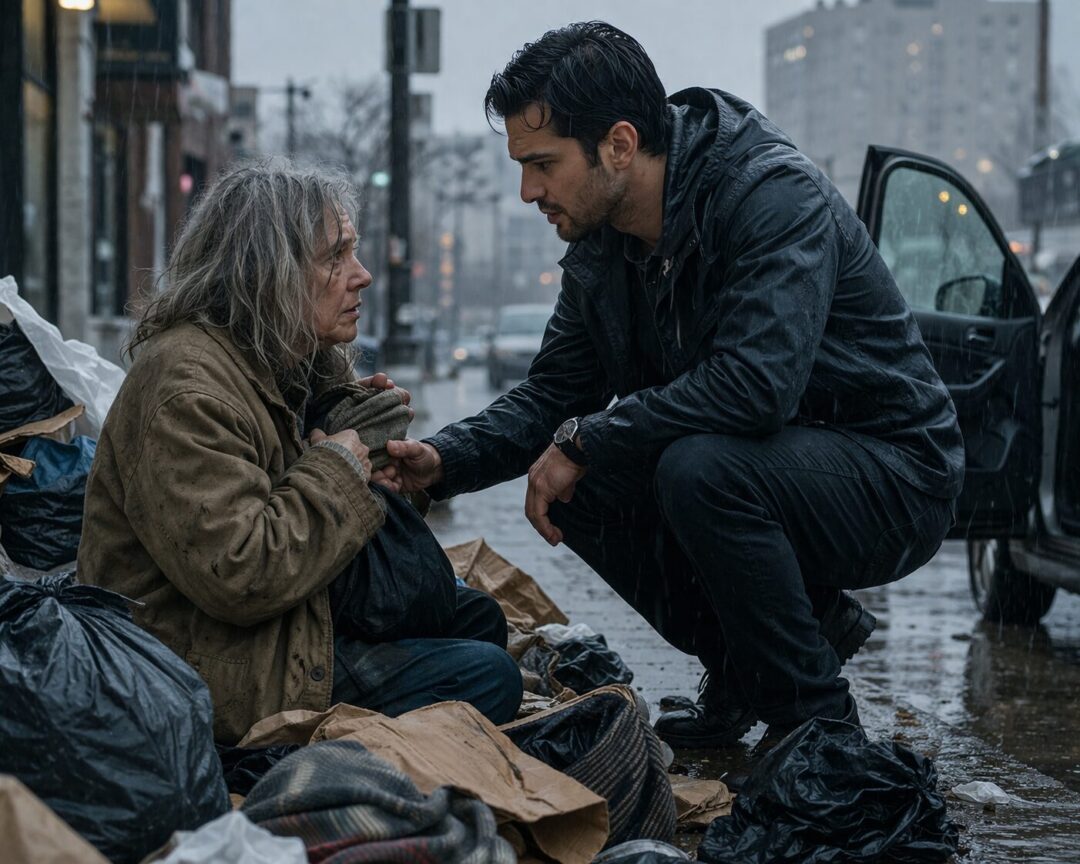
It was raining hard enough to turn the sidewalk into a sheet of black glass. Water ran down the curb in dirty ribbons, carrying cigarette ends, scraps of paper, and the oily shimmer of the street into the gutter. Maren sat with her back against the brick wall of a shuttered storefront, her coat darkened by wet, one hand clamped around the strap of a torn bag, the other pressed over a stack of damp cardboard that had gone soft at the edges.
She saw him before he spoke.
Not because he looked dangerous. Men who were truly dangerous rarely bothered to look at you first. They just took. They kicked your things aside. They told you to move. They stared through you while pretending it was for your own good.
This one paused.
That was what unsettled her.
He stood in the rain in a charcoal jacket that was too clean for this block, too dry to belong to this hour, with the kind of stillness people had when the world usually made room for them. He was younger than her son would have been if her son had made it past thirty. Dark hair plastered neatly to his head by rain. A watch glinting once at his wrist. Eyes fixed on her, not with disgust, not with pity exactly, but with something worse.
Intention.
When he bent toward the cardboard beside her, Maren jerked forward and tightened both hands around her things.
“Don’t touch my things.”
The words came out rough, thinner than she wanted, but sharp enough to cut.
He stopped at once.
Rain collected at the edge of his jaw and fell in slow drops. He lowered himself until he was closer to her height, one knee to the pavement, both hands visible.
“I’m not taking anything.”
People lied gently too. She had learned that years ago.
Maren looked past him at the open car door parked along the curb, then back at him. A dark sedan. Warm light glowing faintly inside. Engine running. She felt the old instinct rise at once, hard and fast: move before you are moved. Get up before someone drags you. Grab what matters. Leave what doesn’t.
But what mattered now?
The bag in her lap held two pairs of socks, a framed photo with the glass cracked out of it, a bottle of pills she could no longer afford to refill, and a house key that opened nothing anymore.
“Then what do you want?” she asked.
He didn’t answer right away.
That, too, made her wary.
The rain drummed on the sidewalk, on the hood of the car, on the metal sign overhead that trembled in the wind. Somewhere down the block a siren passed, then faded. The city kept moving, indifferent and bright around the little island of wet ruin where she had ended up.
The man glanced at her soaked sleeves, the cardboard melting beneath her, the tremor she could not stop in her hands.
Then he held one hand out.
“Stand up.”
Maren laughed once. It came out like a cough.
Why? she wanted to say. Why now? Why me? Why not the woman under the overpass, or the veteran who slept beside the laundromat, or the boy with the infected foot who still tried to joke with strangers?
Instead she asked the smallest version of the question.
“Why?”
He looked at her with an expression so steady it almost made her angry.
Because steady people rarely understood what it cost to trust them.
But he did not offer a speech. He did not say she deserved better. He did not mention God. He did not call her ma’am.
He only kept his hand where she could see it, rain sliding off his knuckles.
And for reasons she would not understand until much later, that frightened her less than kindness usually did.
So Maren let go of the cardboard.
Her hand fit into his like something brittle he was trying not to break.
He pulled her up carefully, as though he knew the body could remember humiliation faster than it remembered balance. Her knees protested. Her back lit with pain. For a second the whole street tilted sideways, and she thought she might fall against him. Instead she caught herself and took one unsteady breath.
The warmth inside the car reached her before she did.
It smelled faintly of coffee and damp wool and whatever clean thing people carried home on their coats after normal days. When she lowered herself into the seat, the leather gave beneath her like a luxury from another life. The door remained open for a moment. Rain hissed outside. Her own reflection stared back at her in the darkened window—gray hair hanging in strings, deep lines around her mouth, coat caked in city filth.
She did not look like a woman someone came back for.
The man leaned down, one hand on the door frame.
“Because you’re coming home,” he said.
Then he shut the door.
For a long moment Maren just sat there, her fingers digging into the seat, the words pressing against her ribs as if they wanted to get inside and could not find a way.
Home.
The cruelest word in the language.
She pressed a hand over her mouth, not because she was crying yet, but because something was moving dangerously inside her, something old and half-buried and wild.
Outside, the rain kept falling.
Inside, for the first time in a very long while, she was warm.
Part II — The Rooms She Carried
Her name had once been spoken in bright kitchens.
It had belonged in grocery lists and voicemail messages and holiday cards. It had been called from the back porch at dusk. It had been written on envelopes and checks and teacher forms and birthday cakes with too much frosting. There had been a house once, not large, not grand, but hers in all the ways that mattered: a narrow blue place with two small bedrooms, creaking floorboards, and a hydrangea bush that refused to die no matter how badly she neglected it.
There had been a husband too.
Not a perfect man. Not even close.
Dale was the sort of person who left cabinet doors open and believed every problem would somehow soften if you ignored it for long enough. He laughed too loudly and forgot anniversaries and once ruined an entire Thanksgiving turkey because he insisted he could deep-fry it without reading instructions.
But when he smiled at her across a cluttered breakfast table, the whole room felt claimed.
When he died of a stroke in the middle of an ordinary Tuesday, she learned that grief did not arrive like a storm.
It arrived like debt.
In forms. In signatures. In late notices. In people speaking slowly to you as if sorrow had made you stupid. In discovering that the mortgage had been refinanced twice without her fully understanding why. In realizing her son, already drowning in his own addictions and shame, had borrowed against promises neither of them could keep. In one winter after another where every bill became a question of which necessity could be postponed.
The house went first in spirit, then on paper.
After that, the rest of life seemed eager to prove how quickly a woman could become unnecessary.
There were couches for a while. A motel room for six nights. A shelter where the lights never fully went off and someone stole her shoes while she slept. Then the long humiliating education of disappearing in public.
No one had pushed her onto that sidewalk in one clean motion. She had arrived there by inches. By paperwork. By silence. By days so exhausting she stopped being able to imagine different ones.
The man driving the car did not ask her to explain any of it.
Maren watched the side of his face as city lights slid across the windshield in broken gold. He drove carefully, as if sharp turns might shatter the silence between them. Once, at a light, he glanced in the rearview mirror and saw she was watching him.
She looked away first.
She did not ask his name. She did not ask where they were going. Part of her was afraid the answers would collapse everything. Another part was afraid to hear herself sound hopeful.
The city thinned around them.
Buildings gave way to darker streets, small lawns, porches with weak yellow lights burning against the weather. The rain eased into a softer fall. Water shivered in the branches of bare trees. For one impossible instant, passing a row of quiet houses, Maren was struck by the old instinct to think in domestic terms: someone forgot to pull in the trash bin, someone left a lamp on in the front room, someone is probably boiling pasta right now.
Someone belongs here.
The car turned once, then again, then slowed.
When it stopped, she did not move.
The man got out first and came around to her side. He opened the door without speaking. Cold air flowed in, but it no longer felt like punishment. He offered his hand again. This time she took it more quickly, though her legs still shook when she stood.
They faced a modest house with a covered porch and pale light glowing behind drawn curtains. Nothing grand. Nothing theatrical. Just a small home standing firm against the weather.
It was almost worse that way.
If he had brought her somewhere extravagant, she might have understood how to distrust it. A stunt. A joke. A spectacle made for other people’s approval.
But this house looked like something much more dangerous.
It looked possible.
He guided her up the path without hurrying. Gravel crunched beneath their feet. Water dripped from the edge of the roof in a thin silver line. Maren could hear her own breathing, ragged and shallow.
At the porch he stopped.
She noticed then that his hand had not once tightened on her arm like ownership. He had only steadied her when she stumbled.
The front door stood inches away.
Maren turned to him at last. “I don’t understand.”
His face changed then—not into triumph, not into pity, but into the strange, quiet vulnerability of someone who had risked more than he was letting show.
He reached past her, not touching the knob yet.
“No one’s throwing you out again.”
The sentence went through her like light through cracked glass.
She stared at him, then at the door, then back at him, as though meaning might shift if she moved too quickly. No one’s. Not tonight. Not later. Not when the paperwork changed. Not when someone more important needed the room. Not when the weather turned. Not when her gratitude expired.
Again.
That was the word that undid her.
Because it meant he understood, or enough of it. It meant he had seen not only where she was, but what had been done to her.
Her hand flew to her mouth before she knew what she was doing.
Something broke loose inside her then—not neatly, not with dignity, but with the force of all the nights she had spent lying awake on cardboard while pretending she was past humiliation, past fear, past the need to be chosen by anyone.
Her knees buckled.
She sank down on the porch, one hand against the wet wood, the other covering her lips as the first sob rose out of her like a wound opening.
The man did not tell her to calm down.
He did not say it was all right.
He only stood beside her in the rain-dim light, close enough that she could feel she was not alone, far enough that her grief remained her own.
And for the first time in years, Maren cried like someone who had been found.
Part III — Crossing the Threshold
His name was Nolan.
She learned it in the kitchen an hour later, after dry clothes, after tea, after the impossible awkwardness of sitting at a table again while her socks warmed near a vent and steam rose from a chipped mug between her hands.
The house had once belonged to his aunt, he told her.
She had died the year before. The place had sat empty through probate and repairs and indecision. Nolan had driven past it every week on his way across town and kept thinking about vacancy—how some places waited in silence while people froze outside within a few miles of them.
A church group had helped with furniture. A neighbor had stocked the pantry. He had spent two weekends painting, one terrible evening trying to install a shelf, and three full days arguing with bureaucracies that found it easier to define need than to answer it.
He spoke plainly, almost shyly, as though embarrassed by any detail that might make him sound noble.
Maren listened with her hands wrapped around the mug.
In the yellow kitchen light, the house did not feel like a miracle. It felt stranger than that. It felt practical. A lamp. A blanket. A loaf of bread on the counter. A bathroom with folded towels. A narrow bed made up with clean sheets in the back room. Dishes in the cabinet. Soap beside the sink.
A life made of ordinary objects.
She had forgotten ordinary could feel holy.
“Why me?” she asked at last.
Nolan looked down at the table for a moment before answering.
That same caution returned to his face, as though the truth might be too simple to survive being said aloud.
“Because I saw you there three times,” he said. “And every time I drove away, I hated myself.”
Maren said nothing.
He rubbed his thumb once against the side of the mug. “I kept telling myself someone else would help. That there were systems for this. Shelters. Programs. Lists. But you were still there.”
The rain tapped softly against the kitchen window.
“And then?” she asked.
“And then I stopped wanting to be the kind of person who drove away.”
There was no speech after that. No declaration about changing the world. No dramatic promise that pain would now move in a straight line toward healing.
Just that.
A man had seen her. He had failed to act. He had hated the shape of that failure. Then, one day, he had done something irreversible.
It was not enough to make the past fair.
But it was enough to make the next morning possible.
Maren slept badly that first night because beds can be as frightening as sidewalks when you have forgotten how to trust them. She woke three times convinced she had overstayed some invisible limit. Once she sat upright in the dark, waiting for a voice to tell her she had misunderstood and needed to leave before dawn.
No voice came.
In the morning, sunlight lay pale across the bedroom floorboards.
Real floorboards.
She sat on the edge of the bed for a long time, staring at the square of light, until she realized she was crying again, but quietly this time, the way one cries when grief and relief become impossible to separate.
The weeks that followed were not easy in the fairy-tale way people prefer.
Maren had to relearn small things that shame had stripped from her: how to stand still in a grocery store without flinching when someone brushed past; how to answer questions without apologizing for taking up time; how to unpack belongings when you no longer believed any place would keep them safe.
There were papers to sign. Appointments to keep. Pills to replace. A doctor who spoke to her kindly and did not rush. A volunteer who brought two potted mums to the porch because “every house deserves something alive out front.” Nolan fixed the back gate. The neighbor from next door dropped off soup and pretended not to notice when Maren cried over that too.
Some afternoons she would sit by the window and watch the street with the old vigilance still sharp in her shoulders, as if at any moment someone might arrive to reverse the decision.
But little by little, the posture left her.
Her coat dried and was washed. Her hair was cut. The framed photograph from her bag was cleaned and set on a side table in the living room. It showed her and Dale twenty-seven years younger, sunburned and laughing beside a cheap grill. The crack in the missing glass still ran across his shoulder, but she decided that was all right. Broken things could remain visible and still be kept.
One evening, maybe a month after the rain, Nolan came by to replace a porch bulb and found her kneeling in the front flower bed with garden gloves on.
He laughed softly. “You planning to take over the whole yard?”
Maren looked up at him, dirt on her wrist, a stubborn little smile pulling at her mouth.
“I’m planning,” she said, “to make it look lived in.”
He stood there for a second, as though the words had hit him harder than he expected.
Then he nodded.
“That,” he said, “it already does.”
When autumn began to turn, the porch became her favorite place. She liked the threshold of it. The view of the street. The simple miracle of sitting outside by choice, not exposure. Sometimes she would rest one hand on the railing and listen to the evening settle over the neighborhood—the bark of a dog, the hiss of tires on distant pavement, the hum of televisions through closed windows.
Home, she learned, was not the absence of sorrow.
It was the place where sorrow could put its coat down.
Months later, on the first hard rain of the season, Maren stood under the porch roof and watched water strike the walkway in silver chains. The sound should have taken her back to that sidewalk, to the cardboard collapsing under her palms, to the old panic of being one more storm away from disappearance.
Instead she thought of a hand held out in the rain.
Not saving her all at once.
Just asking her to stand.
She closed her eyes and listened.
Then she stepped to the door, opened it, and went back inside without fear, as if that simple act still deserved wonder.
Maybe it always would.
Because some people are not changed by grand speeches or impossible luck. Some are changed by a sentence spoken at the exact moment they can no longer carry their own exile.
No one’s throwing you out again.
Long after the rain had dried from the street, long after the cardboard had dissolved and washed away, the words remained.
Not as a rescue.
As a key.