The Engineer They Called Delusional Destroyed His Own Creation Before Letting Them Sell It
Chapter 1: The Auction That Was Never Mine
The first bid came in at twenty-two million dollars.
Alexander Moore watched the number flash across the giant screen above the auction floor and felt his stomach tighten.
The crowd applauded.
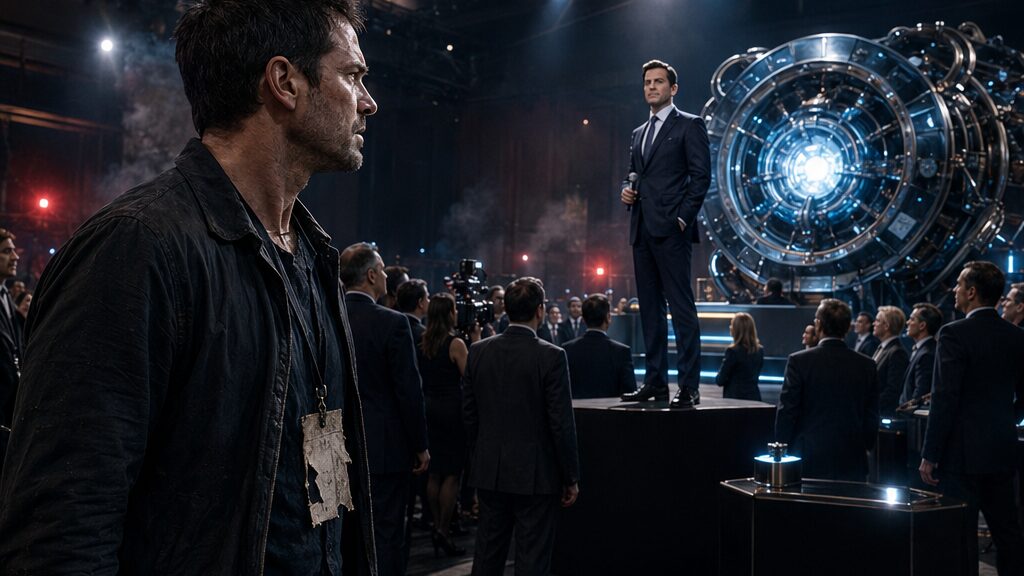
Investors sat at curved glass tables beneath white lights that made everything look cleaner than it was. Camera crews drifted between rows. Reporters whispered into microphones. At the center of the hall, elevated on a rotating platform, stood the quantum engine.
It glowed softly through its transparent casing.
People stared at it the way people stared at monuments.
Nobody looked at Alexander.
A year ago he had still possessed an employee badge that opened every door in the building. Today he wore a temporary visitor pass clipped to his jacket.
Another bid appeared.
Twenty-four million.
The auctioneer smiled.
“Demand remains extremely strong.”
The crowd laughed lightly.
Alexander’s eyes stayed fixed on the machine.
Thousands of nights.
Countless revisions.
Entire weekends spent sleeping beneath a desk.
Every line of core architecture inside that engine had come from him.
Yet his name appeared nowhere.
Instead, a giant image filled the screen behind the stage.
Brandon Campbell stood beside the quantum engine with his arms crossed.
The caption beneath the photo read:
VISIONARY HEAD OF RESEARCH.
Alexander looked away.
Even now part of him wanted to leave.
That instinct had always been the problem.
Avoid conflict.
Work harder.
Wait for truth to matter.
He had spent years believing skill would eventually defeat politics.
Instead politics had promoted Brandon.
A burst of applause interrupted his thoughts.
The live presentation was beginning.
Brandon stepped onto the stage.
Tailored suit.
Confident smile.
The kind of smile Alexander recognized from executive meetings—the smile of a man who had never built anything himself but knew exactly how to take credit for it.
“Good morning, everyone.”
The room quieted immediately.
Brandon spread his hands toward the quantum engine.
“What you’re looking at today is the future.”
Another wave of applause.
Alexander felt his jaw tighten.
Future.
The first prototype had been assembled in a windowless lab while Brandon was on vacation.
The security framework had been written during months Brandon barely visited the project.
The emergency control systems had been designed after a seventy-hour debugging session Alexander completed alone.
Future.
Brandon continued.
“Our team has spent years creating a platform that will transform autonomous infrastructure around the world.”
Our team.
Alexander almost laughed.
Brandon never used names.
Names created ownership.
Ownership created risk.
A giant screen displayed technical diagrams.
Alexander immediately spotted something strange.
Several labels had been modified.
His authorship tags were gone.
Not hidden.
Gone.
Someone had spent time removing them.
The realization hit harder than he expected.
This wasn’t merely credit theft anymore.
Someone was still actively rewriting history.
A bid climbed to twenty-seven million.
Another investor entered the competition.
The auction floor buzzed with excitement.
Brandon soaked it in.
Then he pointed toward a sleek autonomous demonstration vehicle positioned beside the quantum engine.
“The same architecture powering the engine also drives our next-generation autonomous systems.”
Alexander stared at the vehicle.
His vehicle.
Or at least it used his software.
A security guard brushed past him.
Then another.
They were watching the crowd carefully.
Watching for disruption.
Watching for him.
Katherine Rivera appeared beside him.
She kept her eyes on the stage.
“You shouldn’t be here.”
“Neither should Brandon.”
A faint smile crossed her face.
It vanished quickly.
“You received my message?”
Alexander nodded.
“Most of the files were gone.”
“They removed more this morning.”
His pulse quickened.
“How much?”
“I don’t know.”
That answer worried him more than anything.
Katherine was usually precise.
If she sounded uncertain, the situation was worse than she was willing to say.
Brandon’s voice echoed across the room.
“Everything you see today is the result of years of visionary development.”
Visionary.
Alexander took a step toward the stage.
Then another.
Katherine grabbed his sleeve.
“Don’t.”
“He can’t keep saying this.”
“He can.”
Her voice dropped lower.
“For now.”
Alexander looked at her.
“You knew.”
“I knew enough.”
“How long?”
She didn’t answer.
That silence told him everything.
Years.
People had known.
People had seen.
Nobody had spoken.
Because speaking had consequences.
Because careers mattered.
Because mortgages mattered.
Because Brandon happened to be married into the right family.
The auctioneer announced another bid.
Thirty-one million.
The crowd applauded again.
Alexander suddenly realized what everyone was really buying.
Not technology.
Certainty.
A story.
A polished narrative about innovation.
And Brandon owned the stage while Alexander stood among strangers.
The injustice felt almost unreal.
Before he could stop himself, he started moving.
Past one table.
Past another.
Straight toward the platform.
His heartbeat accelerated.
A few heads turned.
Then more.
Brandon noticed him.
For a brief moment uncertainty flickered across Brandon’s face.
Gone almost instantly.
Security reacted faster.
Two guards stepped into Alexander’s path.
“Sir.”
“I need thirty seconds.”
“Sir.”
“I built this system.”
Several nearby investors looked over.
The room became quieter.
Brandon stared down from the stage.
Alexander raised his voice.
“I wrote the architecture.”
Murmurs spread.
One guard reached for his arm.
Alexander pulled away.
“Ask him how the synchronization layer works.”
Brandon’s smile tightened.
“Ask him.”
The room fell silent.
For one second Alexander thought he had finally forced the truth into daylight.
Then Brandon laughed.
Not loudly.
Not cruelly.
Worse.
Confidently.
Like a teacher indulging a child.
“Security.”
The microphone amplified the word across the hall.
The guards immediately closed around Alexander.
Brandon pointed at him.
“Throw this delusional guy out.”
Laughter erupted from several corners of the room.
The humiliation struck harder than Alexander expected.
Not because strangers were laughing.
Because Brandon sounded completely comfortable doing it.
Because nobody on stage hesitated.
Because nobody corrected him.
Brandon looked directly at Alexander.
“He thinks he’s smart enough to write this core system.”
More laughter.
The guards grabbed Alexander’s arms.
The auction resumed almost immediately.
As though nothing had happened.
As though he were a minor inconvenience.
As though the creator himself had become irrelevant.
They escorted him toward the exit.
Alexander twisted once to look back.
The quantum engine continued glowing beneath the lights.
Untouchable.
Perfect.
Stolen.
Then something appeared on one of the investor screens.
A schedule.
A closing notice.
Final ownership transfer.
Tomorrow.
The sale would become official in less than twenty-four hours.
Alexander stopped walking.
For the first time since entering the building, fear gave way to something colder.
Tomorrow.
After tomorrow, the machine would no longer be his in any meaningful way.
Chapter 2: Years Hidden Behind One Signature
The document disappeared from the server while Alexander was reading it.
One second it was open.
The next it was gone.
Access denied.
He stared at the screen.
The file had contained early architecture notes from the first quantum-engine prototype.
His notes.
His comments.
His digital signature.
Now the system claimed it had never existed.
Alexander leaned back in his chair.
The office around him felt strangely empty.
Most employees had gone home hours ago.
The auction occupied everyone’s attention.
Nobody cared about old development records.
Nobody except him.
He opened another archive.
Missing.
Another.
Restricted.
Another.
Modified three months earlier.
His jaw tightened.
Someone had spent enormous effort cleaning the company’s history.
The deeper he searched, the more obvious it became.
This wasn’t negligence.
It was maintenance.
An ongoing operation.
A systematic removal of evidence.
His phone vibrated.
Katherine.
“Third floor records room,” she said.
Then she hung up.
Alexander left immediately.
The records room sat behind a secured corridor rarely used anymore.
Most files had been digitized years earlier.
Dust covered several storage cabinets.
Katherine stood beside a metal shelf.
She looked nervous.
More nervous than usual.
“You weren’t followed?”
“No.”
She handed him a printed report.
Alexander frowned.
Paper.
Actual paper.
“You printed this?”
“Some things are harder to erase that way.”
He looked down.
The report contained development milestones from four years earlier.
His name appeared repeatedly.
Lead architect.
Primary developer.
System author.
Alexander felt something painful twist inside his chest.
Recognition.
Evidence that he hadn’t imagined everything.
Evidence that he had once existed on the record.
“Where did you get this?”
“Old compliance backups.”
“You kept them?”
“I wasn’t supposed to.”
Silence settled between them.
Finally Alexander asked the question that had bothered him for months.
“Why now?”
Katherine looked toward the door.
Making sure nobody was listening.
“Because I thought someone else would stop it.”
Alexander almost laughed.
The answer sounded familiar.
Someone else.
The same excuse he had used himself.
She continued.
“At first Brandon was just taking credit in meetings.”
Alexander remembered.
A presentation here.
An omitted name there.
Small things.
Annoying things.
Nothing worth risking a career over.
Then those small things became larger.
And larger.
Until eventually Brandon became the face of the project.
Katherine folded her arms.
“People noticed.”
“Nobody said anything.”
“Neither did you.”
The words landed harder than accusations.
Because they were true.
Alexander looked down at the report.
Years earlier he could have challenged it.
Could have filed complaints.
Could have forced confrontations.
Instead he kept working.
Because he loved the project.
Because he feared losing access to it.
Because the machine mattered more than his pride.
Katherine sat on the edge of a desk.
“Do you know why Brandon likes presentations?”
Alexander shook his head.
“He understands rooms better than systems.”
That sounded exactly right.
Brandon could read investors.
Read executives.
Read power.
Alexander could read code.
One skill earned promotions.
The other created products.
A memory surfaced unexpectedly.
The first time Brandon joined the project.
Three years ago.
Alexander had been presenting a prototype failure analysis.
Brandon barely understood the technical discussion.
Afterward he pulled Alexander aside.
“You’re brilliant.”
Alexander remembered feeling surprised.
Genuinely appreciated.
Then Brandon had smiled.
“You focus on building. I’ll handle the people.”
At the time it sounded helpful.
Now it sounded like a warning.
Katherine interrupted the memory.
“There are more files.”
Alexander looked up.
“What kind?”
“Authorship reviews.”
His pulse accelerated.
“Where?”
“That’s the problem.”
She hesitated.
“Most disappeared.”
The room grew quiet.
Alexander understood immediately.
If authorship reviews existed, then internal discussions existed.
Which meant people knew exactly who built the system.
Which meant the theft extended beyond Brandon.
The realization changed everything.
This wasn’t one man’s arrogance.
It was institutional.
A choice.
A series of choices.
Made repeatedly.
Katherine handed him a flash drive.
Small. Ordinary.
Suddenly priceless.
“I copied what I could.”
Alexander stared at it.
“Why are you helping me?”
Her answer took several seconds.
“Because tomorrow investors will buy a lie.”
She looked away.
“And because I helped create the conditions for it.”
For the first time Alexander saw something beneath her professionalism.
Guilt.
Not dramatic guilt.
The quieter kind.
The kind carried for years.
He understood that feeling.
Very well.
Back at his apartment, he opened the files.
Thousands of pages.
Meeting transcripts.
Project approvals.
Internal evaluations.
And there it was.
A review panel report from two years earlier.
One sentence highlighted in yellow.
Primary authorship attributable to Alexander Moore.
His hands froze.
The company had known.
Officially.
Explicitly.
Beyond doubt.
Yet every later version had been rewritten.
Reassigned.
Edited.
One signature replacing another.
Near midnight he found something else.
A reference.
Not a file.
Just a reference.
Missing attachment.
Security Framework Ownership Review.
Unavailable.
Deleted.
Alexander sat motionless.
The missing document felt more important than every file he had already found.
Because someone had specifically removed it.
His phone buzzed.
A message from Katherine.
One sentence.
I copied that one too.
Alexander stared at the screen.
Then another message arrived.
You’ll want to see what’s inside.
Chapter 3: Evidence That Changes Nothing
The attorney finished reading the documents and slowly removed his glasses.
For a moment Alexander felt hope.
Real hope.
The kind he had spent years refusing to indulge.
The attorney tapped the stack of evidence.
“This is strong.”
Alexander exhaled.
Finally.
Someone said it aloud.
Across the table, Katherine remained silent.
The attorney continued.
“Very strong.”
Then he paused.
The pause ruined everything.
Alexander recognized it immediately.
The pause that always came before bad news.
“But?”
The attorney folded his hands.
“But strength and timing are different problems.”
The hope vanished.
The office overlooked the financial district where banners advertising tomorrow’s final auction hung from nearby buildings.
Everywhere Alexander looked, the sale already felt inevitable.
The attorney slid one document forward.
“You can prove authorship.”
“Then stop the auction.”
“It doesn’t work that way.”
Alexander stared at him.
“It should.”
“Perhaps.”
The attorney’s voice remained calm.
“But investors have contracts. International bidders are involved. Regulators move slowly.”
Katherine shifted uneasily.
“How slowly?”
The attorney looked at her.
“Not by tomorrow.”
Silence filled the room.
Alexander looked at the evidence.
Years of work.
Records.
Reviews.
Internal acknowledgments.
Enough to prove he built the system.
Not enough to stop it.
The distinction felt absurd.
The attorney pointed to one report.
“Your claim is credible.”
“Credible.”
Alexander almost laughed.
A man could spend years creating something, prove it belonged to him, and still watch it get sold.
Credible.
The word sounded useless.
“We can file emergency actions,” the attorney continued. “We can notify authorities. We can preserve claims.”
“But the auction proceeds.”
“Most likely.”
Alexander looked toward the window.
Far below, workers were already setting up media equipment for tomorrow.
The city itself seemed committed to Brandon’s version of reality.
The meeting ended an hour later.
Nobody left satisfied.
Outside, Katherine walked beside him.
“You heard him.”
Alexander nodded.
“Evidence isn’t enough.”
“No.”
They stopped near a crosswalk.
Traffic moved around them.
For a long moment neither spoke.
Finally Katherine asked, “What are you thinking?”
Alexander didn’t answer immediately.
Because the truth unsettled him.
He was no longer thinking about proving ownership.
He was thinking about preventing the sale.
Those were different goals.
And one of them required much more drastic choices.
A notification appeared on his phone.
Corporate livestream.
Brandon was speaking again.
Alexander opened it.
Brandon stood before reporters.
Confident.
Relaxed.
“The technology is ready for global deployment.”
A reporter asked a technical question.
Brandon answered smoothly.
Incorrectly.
Alexander noticed immediately.
Most viewers wouldn’t.
But the answer was wrong.
Completely wrong.
Yet nobody challenged him.
The interview continued.
The lie continued.
The world continued.
That night Alexander returned to an old development archive he had not opened in years.
Deep inside the original architecture files sat a feature he had designed during the earliest prototype stage.
The kill switch.
A safeguard.
A final protection mechanism.
Not for emergencies.
For ownership.
Back then, investors had pushed for shortcuts.
Alexander had refused.
Every critical system required a controlled shutdown pathway.
A way to prevent unauthorized deployment.
A way to ensure accountability.
A way to stop someone from using the technology without understanding it.
He opened the documentation.
The familiar diagrams appeared.
The same diagrams he had drawn years ago.
His eyes moved slowly across the screen.
The kill switch had never been removed.
Nobody else understood it well enough.
Nobody else had authority to alter it.
For the first time in months, Alexander felt something other than frustration.
A terrible possibility.
And once he saw it, he couldn’t stop thinking about it.
If evidence could not stop the auction…
What could?
Hours later he sat alone in darkness except for the glow of his monitor.
The quantum engine rotated on screen in a simulation model.
Elegant.
Powerful.
His life’s work.
He remembered every sacrifice attached to it.
Missed holidays.
Failed relationships.
Years measured in software revisions.
Destroying it felt unthinkable.
Yet allowing Brandon to sell it felt worse.
Near midnight Alexander opened the final security protocol.
The kill-switch sequence appeared.
Waiting.
Silent.
Like it had been waiting for this exact moment all along.
He stared at it for a long time.
Then he began reading every line.
Chapter 4: The Cost of Pulling the Plug
The kill-switch authorization screen remained open when Alexander arrived at the office before sunrise.
His security credentials should not have worked anymore.
Yet somehow they still did.
Perhaps nobody expected him to return.
Perhaps nobody imagined the quiet engineer they had pushed aside would become a threat.
The building was nearly empty.
Most employees were preparing for the auction’s final day at the convention center.
Alexander sat at his workstation and opened the control architecture.
The quantum engine appeared as a network of interconnected systems.
Elegant.
Complex.
Familiar.
For years this screen had represented progress.
Now it looked like a hostage.
His finger hovered over one section.
Emergency ownership protection.
A feature he had written after a long argument with investors during the earliest prototype phase.
Back then nobody wanted safeguards.
Safeguards slowed commercialization.
Alexander had insisted.
Any system powerful enough to control autonomous infrastructure required a final authority mechanism.
If the architecture was ever compromised, ownership disputes could trigger a controlled shutdown.
Everyone had agreed because they assumed it would never be needed.
Nobody except Alexander truly understood how deeply the protocol was embedded.
A notification flashed across the screen.
Final Auction Session Begins: 18 Hours.
The countdown felt personal.
His phone rang.
Katherine.
“You shouldn’t be in the office.”
“Neither should the people rewriting records.”
A brief silence.
Then she sighed.
“Did you sleep?”
“No.”
“I guessed.”
Alexander leaned back.
“What happened?”
“I checked the internal access logs.”
His attention sharpened immediately.
“What did you find?”
“More than Brandon.”
He closed his eyes.
Part of him had already suspected.
“How many?”
“Enough.”
The answer carried weight.
Katherine continued.
“Legal approved revisions. Executive review approved revisions. Compliance concerns were dismissed.”
Alexander stared at the screen.
Years of manipulation suddenly looked different.
Not because Brandon was innocent.
Because he wasn’t alone.
The company had chosen convenience over truth.
Again and again.
“You were right,” Katherine said quietly.
“About what?”
“They didn’t steal credit.”
“They stole ownership.”
After the call ended, Alexander remained motionless.
The distinction mattered.
Credit theft was vanity.
Ownership theft was infrastructure.
Money.
Contracts.
Power.
An entire system had benefited from pretending Brandon created something he did not understand.
A knock interrupted his thoughts.
Alexander turned.
Thomas Mitchell stood in the doorway.
The chairman looked older than usual.
Tired.
As if the auction had already aged him.
Neither man spoke immediately.
Thomas entered slowly.
“You’ve made this difficult.”
Alexander almost laughed.
That was how Thomas chose to begin.
Not an apology.
Not a question.
An inconvenience.
“Difficult for who?”
Thomas glanced at the monitors.
“The company.”
“The company erased me.”
Thomas sat across from him.
“I know you’re angry.”
Alexander’s expression hardened.
“That’s what you think this is?”
For the first time uncertainty appeared on Thomas’s face.
The chairman removed his glasses.
“We built something important.”
“We?”
Thomas ignored the interruption.
“Sometimes organizations require practical decisions.”
“There it is.”
“What?”
“The excuse.”
Thomas frowned.
“It isn’t an excuse.”
“It is when someone else pays the cost.”
The chairman’s jaw tightened.
For a moment Alexander finally saw the pressure beneath the authority.
Investors.
Board members.
Public expectations.
Years spent promising success.
Thomas wasn’t protecting Brandon because Brandon deserved protection.
He was protecting the story.
The company needed Brandon.
Or at least it needed the version of Brandon investors believed in.
Thomas leaned forward.
“The auction closes tomorrow. After that, everyone benefits.”
Alexander stared at him.
Everyone.
The word settled heavily between them.
Everyone except the person who built it.
Thomas stood.
“This doesn’t have to become ugly.”
Alexander looked at the quantum engine rotating on his screen.
Too late.
Thomas left without another word.
The office felt colder afterward.
By afternoon Alexander had reviewed every critical subsystem.
The truth became impossible to ignore.
The company couldn’t maintain the architecture independently.
Not completely.
Over the years they had copied interfaces.
Copied presentations.
Copied reports.
But they had never mastered the foundation.
The deeper security framework still depended on protocols only Alexander fully understood.
At first the discovery felt satisfying.
Then unsettling.
Because it gave him leverage.
Real leverage.
And leverage demanded decisions.
Near evening Katherine met him in a parking garage beneath the building.
She looked exhausted.
“You found it, didn’t you?”
Alexander nodded.
“They can’t run it.”
Her shoulders sank.
“So it was true.”
“Worse than true.”
She looked at him carefully.
“What are you going to do?”
He didn’t answer.
The silence itself became an answer.
Katherine folded her arms.
“If you activate that protocol—”
“I know.”
“You could lose everything.”
Alexander laughed softly.
The sound surprised even him.
“Everything?”
He gestured toward the building above them.
“They already took everything.”
Katherine’s expression softened.
“No.”
She shook her head.
“They took recognition.”
Alexander said nothing.
“They didn’t take you.”
The words lingered after she stopped speaking.
For years he had measured himself through the project.
Without it, who was he?
The question frightened him more than any legal consequence.
Katherine reached into her bag and handed him a tablet.
A livestream clip began playing automatically.
Brandon stood before reporters inside the convention center.
Smiling.
Confident.
The future face of the company.
A reporter asked whether recent ownership allegations concerned him.
Brandon laughed.
“Every successful innovation attracts attention.”
Another reporter asked if the engineer making those claims had participated in development.
Brandon smiled wider.
“He worked on small support functions.”
Alexander stared at the screen.
Support functions.
His hands clenched.
Brandon continued.
“People sometimes confuse contribution with creation.”
The interview ended.
The damage remained.
Katherine watched Alexander carefully.
“Now what?”
Alexander turned off the video.
Hours earlier he had still been uncertain.
Now he wasn’t.
Not because Brandon insulted him.
Because Brandon truly believed the lie.
He believed ownership could be manufactured through visibility.
Alexander looked at Katherine.
“Authorities still have the evidence package address?”
“Yes.”
“Good.”
That answer made her eyes narrow.
“What are you doing?”
“Something I should have done years ago.”
That night, alone in his apartment, Alexander assembled every document.
Authorship records.
Compliance reviews.
Deleted files.
Internal discussions.
Everything.
The package filled hundreds of pages.
At 2:17 a.m. he submitted it electronically to regulators, copyright authorities, and economic investigators.
The confirmation receipt appeared seconds later.
Evidence received.
Alexander stared at the screen.
A strange calm settled over him.
The legal process was moving now.
Too slowly to stop tomorrow.
But moving.
He closed the laptop.
Then opened the kill-switch documentation one final time.
The countdown showed less than twelve hours until the auction’s conclusion.
Alexander looked at the authorization sequence.
And quietly began preparing for something nobody else in the company believed he would ever do.
Chapter 5: The Delusional Man on the Auction Floor
“Security! Throw this delusional guy out.”
The words exploded through the convention center speakers.
Every head turned.
Alexander stood in the center aisle while cameras swung toward him.
Brandon Campbell remained on stage beside the glowing quantum engine.
Smiling.
Confident.
Certain of victory.
The final auction session had attracted even more investors than the day before.
Rows of media crews surrounded the platform.
International bidders watched from giant screens.
The room felt less like a technology showcase and more like a coronation.
And Brandon was enjoying every second of it.
The guards closed in.
Alexander remained still.
“Ask him one question,” he said.
Brandon laughed.
The audience laughed with him.
Alexander pointed toward the quantum engine.
“Ask him how the synchronization recovery framework works.”
The smile on Brandon’s face flickered.
Only for an instant.
But Alexander saw it.
So did a few investors seated near the stage.
Brandon recovered quickly.
“You don’t interrupt a global auction because you can’t accept reality.”
More applause.
The guards grabbed Alexander’s arms.
But before they could move him, an investor raised a hand.
“What recovery framework?”
The room quieted slightly.
Alexander looked toward the voice.
Brandon immediately answered.
“A routine subsystem.”
The investor frowned.
“Can you explain it?”
A pause.
Brief.
Dangerous.
Brandon smiled.
“Of course.”
Then he began talking.
The explanation sounded polished.
Professional.
And completely wrong.
Alexander felt something unexpected.
Not satisfaction.
Relief.
For the first time the fraud wasn’t hidden.
It was visible.
Small.
But visible.
Several investors exchanged glances.
A reporter typed something rapidly into a tablet.
Brandon noticed.
His confidence tightened.
The room had changed.
Only slightly.
But enough.
A second investor asked another technical question.
Then another.
Brandon answered each one.
The answers grew weaker.
The polished image began showing cracks.
Alexander almost felt sorry for him.
Almost.
Because beneath the arrogance he could finally see the insecurity.
Brandon needed people to believe he belonged on that stage.
Without the applause there was nothing underneath.
Thomas Mitchell suddenly stepped forward.
The chairman took the microphone.
“We’re not here for technical audits.”
The interruption saved Brandon.
At least temporarily.
Thomas smiled toward the audience.
“We’re here because the technology works.”
Applause returned.
The tension eased.
And just like that the room chose certainty over curiosity.
Alexander wasn’t surprised.
People preferred momentum.
Momentum felt safe.
The guards resumed escorting him away.
As they moved him toward the exit, Brandon spoke again.
“This individual believes writing code makes him capable of leading innovation.”
Laughter rippled through the crowd.
Alexander kept walking.
The insult didn’t matter anymore.
Because something more important had happened.
Doubt had entered the room.
Not enough to stop the auction.
Enough to weaken it.
Outside the main hall, security released him near a restricted corridor.
“Stay out.”
Alexander nodded.
The guards returned inside.
The moment they disappeared around the corner, he remained standing motionless.
Listening.
The muffled presentation continued beyond the walls.
Bids climbed higher.
The auction advanced.
Time was running out.
His phone vibrated.
Katherine.
One message.
They’re nervous.
Alexander looked through a narrow window into the convention center.
On stage Brandon continued speaking.
But now he checked notes more often.
Thomas remained nearby.
Watching.
Protecting.
Managing.
The cracks were spreading.
A second message arrived.
Authorities confirmed receipt.
Good.
Alexander slipped the phone back into his pocket.
The evidence was moving through official channels.
But official channels moved slowly.
The auction moved fast.
His gaze shifted toward the autonomous demonstration vehicle parked beside the quantum engine.
The vehicle gleamed beneath exhibition lights.
Most people saw a product.
Alexander saw architecture.
Control systems.
Circuit pathways.
The physical doorway to the kill switch.
A maintenance access panel sat beneath the vehicle body.
Almost invisible.
He had designed that too.
His heartbeat accelerated.
This was the moment he had spent all night trying not to imagine.
Destroying the system meant destroying part of himself.
Years of work.
Years of sacrifice.
Years of identity.
He closed his eyes briefly.
And saw another version of himself.
The younger engineer who stayed silent.
The engineer who believed merit would speak for itself.
The engineer who kept accepting one compromise after another.
The engineer who had made all of this possible.
When Alexander opened his eyes again, the hesitation felt smaller.
Inside the hall, applause erupted.
A giant display showed the latest offer.
Forty-six million dollars.
The final transfer process had begun.
The auction was nearly over.
An announcement echoed through the building.
“Ownership certification will commence shortly.”
That was it.
The point of no return.
Alexander started walking.
Not toward the exit.
Toward the restricted access corridor.
A staff member shouted after him.
He ignored it.
Security noticed.
Too late.
Alexander pushed through a side entrance leading directly into the exhibition floor.
The crowd gasped.
Brandon turned.
Thomas turned.
Cameras turned.
Every eye in the building followed him.
For a single second nobody moved.
Then security surged forward.
Alexander broke into a run.
Straight toward the autonomous vehicle.
And for the first time in years, he stopped trying to protect what had already been stolen.
Chapter 6: Smoke, Sirens, and Ownership
The first security guard reached for him just as Alexander slammed his hand against the vehicle’s maintenance panel.
The latch released.
The compartment swung open.
A collective gasp rolled through the convention center.
“Stop him!” Thomas shouted.
Now panic had replaced authority.
Alexander dropped to one knee and reached inside.
He knew exactly where the board sat.
He had designed its placement himself years ago.
A hand grabbed his shoulder.
He twisted free.
Another guard lunged.
Too late.
Alexander’s fingers closed around the main control circuit.
For one suspended second he saw the entire journey.
The first sketches.
The sleepless nights.
The optimism.
The compromises.
The silence.
Then he pulled.
The board cracked.
A sharp metallic snap echoed through the hall.
Everything changed.
The autonomous vehicle came alive instantly.
Its engine roared.
Warning lights exploded across its surface.
Alarms screamed.
The giant screens surrounding the auction floor flashed red.
People stumbled backward.
Investors jumped from their seats.
The vehicle lurched forward.
Someone shouted.
Someone else screamed.
The machine accelerated.
Not smoothly.
Violently.
Like a wounded animal.
It shot across the demonstration area and slammed into an exhibition wall.
The impact shook the building.
Glass shattered.
Metal twisted.
Smoke erupted from the wreckage.
The crowd scattered.
Cameras continued recording.
Security froze.
For a brief moment nobody understood what had happened.
Then the giant display behind the stage flickered.
The quantum engine lost synchronization.
Error messages appeared.
One after another.
AUTHORIZATION FAILURE.
PRIMARY OWNERSHIP VERIFICATION REQUIRED.
REBOOT ACCESS DENIED.
The messages spread across every screen in the convention center.
Thomas stared upward.
His face had gone pale.
Brandon looked even worse.
The confident executive who had dominated the stage all morning now seemed completely lost.
“What is this?” an investor shouted.
Another pointed at the screens.
“Why won’t it restart?”
Technicians rushed toward control stations.
Their hands moved frantically.
Nothing responded.
Alexander slowly stood.
Smoke drifted through the hall.
Sirens echoed overhead.
The glowing quantum engine remained on display.
But now it looked different.
No longer untouchable.
No longer a monument.
Now it looked vulnerable.
Real.
Brandon grabbed a microphone.
“Shut the system down!”
One technician looked up helplessly.
“We can’t.”
The room became quieter.
“What do you mean you can’t?”
“We don’t have authorization.”
Brandon’s expression collapsed.
“Override it.”
“There is no override.”
Alexander almost laughed.
There had always been an override.
He was standing right there.
An investor rose from his seat.
“You sold us a platform your own company can’t control?”
No answer came.
Another investor spoke.
“Who actually built this system?”
The question hung heavily in the air.
For years nobody had asked it.
Now everyone was asking.
At once.
A reporter approached Brandon.
“What ownership verification is the system requesting?”
Brandon looked toward the technicians.
Toward Thomas.
Toward anyone who might rescue him.
Nobody could.
One of the screens changed again.
A technical diagnostic window appeared automatically.
AUTHORIZATION FRAMEWORK CREATED BY: ALEXANDER MOORE.
The words filled the display.
Silence followed.
Alexander had never programmed the system to reveal his name.
The diagnostic process itself had done it.
Purely functional.
Purely factual.
Yet somehow more powerful than any speech he could have made.
Brandon stared at the screen as if seeing a ghost.
The room erupted.
Questions.
Accusations.
Camera flashes.
Investors demanding explanations.
The carefully constructed story was breaking apart.
And beneath it sat reality.
Thomas pushed through the crowd toward Alexander.
His face was tight with anger.
“What have you done?”
Alexander looked at him.
“The same thing I built years ago.”
“You destroyed the company.”
“No.”
Alexander glanced toward Brandon.
“You did.”
For a moment Thomas seemed ready to say something else.
Then the convention center doors burst open.
Every head turned.
Uniformed officers entered first.
Then investigators.
Then officials carrying folders and electronic tablets.
The room fell silent.
The lead investigator walked directly toward the stage.
“We have emergency warrants.”
Brandon froze.
Thomas did too.
The investigator continued.
“For suspected intellectual property fraud, evidence tampering, and false corporate disclosures.”
Reporters immediately surged forward.
Microphones appeared everywhere.
The lead investigator held up a document.
“The evidence package was submitted prior to today’s auction.”
Alexander recognized the confirmation number.
The package.
His package.
The authorities had moved faster than anyone expected.
An officer stepped toward Thomas.
“Please remain available for questioning.”
Another approached Brandon.
The color drained from his face.
“This is a misunderstanding.”
The words sounded weak.
Even he seemed to know it.
The investigator looked toward the giant screens.
Toward Alexander’s name.
Toward the authorization failures.
Toward the smoking wreckage of the autonomous vehicle.
“It doesn’t appear to be.”
The room exploded into activity.
Camera crews chased officials.
Investors demanded legal counsel.
Executives disappeared into hurried meetings.
Yet Alexander remained where he was.
Still.
Quiet.
The sirens continued.
Smoke drifted across the exhibition floor.
And for the first time in years, nobody could erase his name.
Chapter 7: The Man Behind the Smoking Server
The photograph appeared everywhere before Alexander saw it himself.
Three days after the auction collapsed, Katherine placed a tablet on the table between them.
“There.”
Alexander looked down.
The image showed him standing in front of smoke and shattered equipment.
His jacket was dirty.
His expression was calm.
Behind him, the ruined exhibition floor glowed beneath emergency lights.
Someone had captured the exact moment after the system failed.
The image had already been shared millions of times.
A headline sat beneath it.
THE ENGINEER THEY CALLED DELUSIONAL.
Alexander stared at the screen.
Then looked away.
“It feels strange.”
Katherine smiled faintly.
“That’s because you’re used to being invisible.”
They sat in a small café several blocks from the convention center.
Outside, reporters still lingered near corporate headquarters.
The story had become national news.
Every day brought new revelations.
Internal emails.
Authorship reviews.
Deleted records.
Board communications.
The deeper investigators searched, the more they found.
Brandon had not acted alone.
That truth surprised nobody anymore.
Thomas had stepped down from the company.
Several executives faced formal investigations.
The auction had been canceled permanently.
Yet none of that felt as significant to Alexander as the quiet cup of coffee sitting in front of him.
For years every conversation had revolved around the project.
Now the project was gone.
Or at least the version of it he had once known.
Katherine studied him.
“You’re thinking about rebuilding it.”
Alexander laughed.
The fact that she knew immediately told him how well she understood him.
“Maybe.”
“You promised yourself you’d wait.”
“I know.”
The truth was more complicated.
The quantum engine had consumed so much of his life that imagining a future without it felt unnatural.
For years he had measured his worth through progress reports, code revisions, and system milestones.
Without them, there was empty space.
And empty space made him uncomfortable.
His phone buzzed.
Another message.
Another offer.
A technology company wanted him to lead a new division.
He deleted it.
Katherine raised an eyebrow.
“That looked expensive.”
“It was.”
“And?”
Alexander set the phone down.
“I don’t know.”
A month earlier he would have accepted immediately.
Recognition had been the goal.
Validation had been the goal.
Now he wasn’t so certain.
The attention felt strangely similar to the applause Brandon had chased.
Different direction.
Same trap.
Katherine leaned back.
“Do you know what investigators told me?”
“What?”
“They said the most surprising part wasn’t the fraud.”
Alexander waited.
“It was that you stayed silent for so long.”
The words landed harder than expected.
Because they touched the truth he had avoided.
The deepest truth.
Not Brandon’s choices.
Not Thomas’s choices.
His own.
If he had spoken years earlier, perhaps things would have unfolded differently.
Perhaps not.
But silence had helped build the structure that eventually buried him.
He had spent years believing patience was the same thing as integrity.
It wasn’t.
Sometimes patience became permission.
The realization hurt.
But it also felt freeing.
Katherine stood.
“I should go.”
“Thank you.”
She smiled.
“For what?”
“For eventually choosing a side.”
A shadow crossed her face.
“We both took too long.”
Then she left.
Alexander remained alone.
The café television played a news segment about the investigation.
The photograph appeared again.
The image everyone loved.
The rebel engineer.
The symbol.
The man standing against corruption.
Alexander barely recognized him.
Because the photograph captured only one moment.
Not the years of silence before it.
Not the fear.
Not the mistakes.
Not the compromises.
The image was simpler than reality.
Weeks passed.
The legal process continued.
Evidence accumulated.
Several charges became public.
Investors filed lawsuits.
The company unraveled.
One afternoon Alexander received official confirmation that authorship rights had been restored.
The document arrived electronically.
Simple.
Formal.
Years of conflict reduced to a few pages.
He stared at it for a long time.
Then closed the file.
Not because it didn’t matter.
Because it wasn’t everything.
That realization surprised him most.
The younger version of himself would have treated the document as the ending.
The final victory.
Now it felt more like a beginning.
Later that evening Alexander walked through a small technology museum hosting an exhibit on innovation.
Visitors moved quietly between displays.
Nobody recognized him.
For the first time in weeks he found that comforting.
He stopped before an unfinished prototype displayed behind glass.
The exhibit description focused on experimentation rather than success.
Failures.
Revisions.
Lessons learned.
The parts people usually ignored.
Alexander smiled.
The prototype reminded him of something important.
Creation had always mattered more than ownership.
Ownership mattered.
Truth mattered.
Recognition mattered.
But creation came first.
Always.
His phone buzzed once more.
Another job offer.
Another opportunity.
This time he didn’t delete it.
He didn’t accept it either.
Instead he slipped the phone back into his pocket and continued walking.
Ahead of him waited another exhibit.
Another unfinished machine.
Another possibility.
For the first time in years, Alexander felt no need to prove he belonged in the room.
The story has ended.