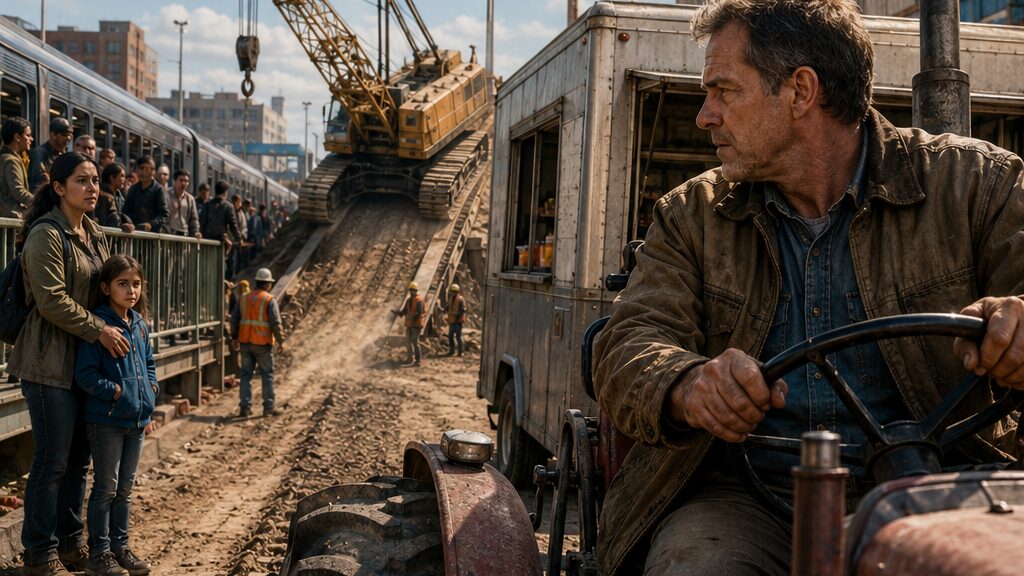
The Day Joseph Destroyed Everything He Owned To Stop The Crane From Killing Hundreds
Chapter 1: The Truck That Built His Life
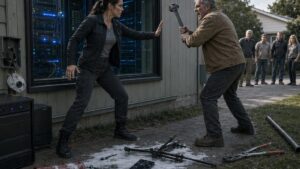
The grinding sound came from beneath the food truck just as Joseph Baker turned the key.
He froze.
The engine caught, but a harsh metallic scrape echoed through the frame before settling into a low vibration he had never heard before.
Joseph closed his eyes.
“Not today.”
He stepped out and crouched beside the rear axle. The truck sat in the same gravel lot where it had sat every morning for nearly twelve years, squeezed between a chain-link fence and the construction zone that had swallowed half the neighborhood over the last year.
The truck looked tired.
The white paint had faded.
The serving window stuck in humid weather.
One corner of the roof carried a patch of mismatched metal he had welded himself after a storm.
But it was his.
Every dent had a story.
Every repair had come from his own hands.
A mechanic’s estimate sat folded in his pocket.
He already knew what it said.
He unfolded it anyway.
Rear differential issue.
Immediate repair recommended.
Estimated cost: $4,800.
Joseph stared at the number.
Then folded the paper again.
Then folded it once more.
As if making it smaller could somehow reduce the amount.
The train station beyond the construction site was already filling with morning commuters.
Workers in reflective vests crossed the lot carrying coffee.
A few spotted him.
“Morning, Joe.”
He forced a smile.
“Morning.”
Nobody needed to know.
Nobody ever needed to know.
That had always been his rule.
If something broke, he fixed it.
If money was short, he worked harder.
If life got heavy, he carried it.
Simple.
At least that was what he kept telling himself.
An hour later, the smell of grilled onions drifted from the truck.
Customers lined up.
Construction workers.
Train commuters.
Delivery drivers.
People who had been buying breakfast from him for years.
One worker pointed at the truck.
“Still running, huh?”
Joseph laughed.
“Barely.”
The man grinned.
“That thing’s immortal.”
Joseph smiled.
But his eyes drifted toward the repair estimate hidden beneath the cash register.
Immortal wasn’t the word he would have chosen.
The lunch rush arrived early.
By noon he was moving nonstop.
Orders.
Payments.
Refills.
Small talk.
The familiar rhythm soothed him.
For a few hours he could pretend nothing was wrong.
A woman approached the counter holding the hand of a young child.
“Best sandwiches in the city,” she said.
Joseph laughed.
“That’s a dangerous accusation.”
“I’m serious.”
The child nodded enthusiastically.
Joseph gave him an extra cookie.
The woman smiled.
“You’ve probably fed half this station.”
Maybe she meant it casually.
But the words stayed with him.
Because she wasn’t entirely wrong.
This truck had become part of people’s routines.
Part of their mornings.
Part of their lives.
And he had built every inch of it himself.
The truck wasn’t just income.
It was proof.
Proof that years of hard work had mattered.
Late in the afternoon a bank notification appeared on his phone.
His smile disappeared instantly.
Past due.
Final notice.
Payment required within seven days.
Joseph stared at the screen.
His chest tightened.
He knew the deadline was coming.
He had simply hoped for more time.
The repair.
The debt.
Fuel costs.
Insurance.
Everything seemed to arrive at once.
He slipped the phone back into his pocket before anyone could see.
No help.
No sympathy.
No charity.
He would figure it out.
He always did.
A shadow passed across the lot.
Joseph looked up.
A massive crane was moving slowly along the construction ramp overlooking the station.
Several workers guided it.
The machine looked enormous against the skyline.
Steel cables swung gently in the wind.
The entire construction project seemed to be expanding every week.
One worker approached the truck.
“Going to be crazy around here tomorrow.”
“What now?”
“They’re moving heavier equipment. Biggest crane on site.”
Joseph glanced toward the machine.
“Hope they know what they’re doing.”
The worker shrugged.
“That’s above my pay grade.”
Joseph laughed.
But as the worker walked away, he noticed something.
Two construction supervisors arguing near the crane.
One held paperwork.
The other pointed toward the machine’s wheel assembly.
The conversation looked tense.
Then it ended.
Both men walked off in different directions.
Joseph returned to work.
The station slowly emptied as evening approached.
The sky darkened.
He closed the serving window.
Counted receipts.
Calculated expenses.
The numbers refused to cooperate.
The repair bill remained impossible.
The debt deadline remained real.
And tomorrow looked no better.
He climbed onto his John Deere tractor parked beside the truck.
The tractor was used for hauling supplies between nearby agricultural fields and storage lots.
It wasn’t glamorous.
But it helped keep his business alive.
The engine rumbled to life.
Joseph glanced one last time at the food truck.
His truck.
His future.
His sacrifice.
Though he didn’t know it yet.
Then a sharp alarm suddenly screamed across the construction site.
Another followed.
Workers began shouting.
A crane horn blasted in the distance.
Joseph lifted his head.
Something was wrong.
Very wrong.
Chapter 2: The Crane Without Brakes
The crane was moving.
At first Joseph couldn’t understand what he was seeing.
The machine sat at the top of a steep construction ramp overlooking the train platform.
Then it rolled backward.
Slowly.
Almost lazily.
Like a vehicle drifting out of a parking space.
Several workers started running.
One of them waved both arms.
The crane continued rolling.
Joseph frowned.
Why wasn’t it stopping?
A second later he had his answer.
The crane accelerated.
The massive machine lurched backward down the incline.
Its horn suddenly erupted.
Long.
Panicked.
Continuous.
The sound froze everyone nearby.
Workers scattered.
People pointed.
Shouts erupted from every direction.
Joseph climbed down from the tractor.
“What happened?”
Nobody answered.
The crane picked up speed.
Fast.
Far too fast.
Then he saw the operator.
A man later identified as Michael Wilson.
The cab door burst open.
Michael jumped.
He hit the dirt shoulder hard.
Rolled twice.
Then staggered to his feet.
Instead of running toward the machine—
he ran away from it.
Away from the crane.
Away from the station.
Away from everyone below.
Someone screamed.
“He jumped!”
Another worker shouted.
“The brakes!”
The crane continued accelerating.
The realization spread through the crowd like electricity.
No brakes.
The machine had no brakes.
Below the construction site sat the passenger platform.
Hundreds of commuters.
Families.
Workers.
Children.
People waiting for evening trains.
Most hadn’t even noticed the danger yet.
Joseph’s stomach dropped.
The crane was headed directly toward them.
A security guard blew a whistle.
Another yelled for evacuation.
But confusion moved faster than instructions.
People looked around.
Unsure which direction to run.
Unsure whether the threat was real.
The crane answered that question for them.
Its horn echoed again.
Closer now.
Louder.
Terrifying.
The crowd finally reacted.
Bodies surged.
Bags dropped.
People pushed toward exits.
Then everything got worse.
One of the platform access routes had already been closed for construction.
Temporary fencing blocked another section.
A train sat motionless beside the platform.
The remaining exits instantly jammed.
Joseph watched panic become gridlock.
People weren’t escaping.
They were trapping each other.
A woman grabbed a child.
An elderly man stumbled.
Someone fell.
Others stopped to help.
Every second mattered.
The crane kept coming.
Joseph pulled out his phone.
Emergency services.
Busy.
Not literally.
But effectively.
Even if help arrived immediately, it wouldn’t matter.
The machine would reach the platform long before any rescue team could intervene.
A construction worker sprinted past him.
“They can’t stop it!”
Joseph grabbed his arm.
“What happened?”
The man looked terrified.
“Brakes failed.”
“Any backup system?”
The worker shook his head.
“I don’t know.”
Then he was gone.
Joseph turned back toward the ramp.
The crane seemed larger now.
Its wheels bounced violently over uneven concrete.
Pieces of debris flew behind it.
The machine looked less like equipment and more like a landslide made of steel.
The station loudspeakers crackled.
Evacuation orders repeated.
Nobody listened.
Or perhaps nobody could.
Fear had swallowed language.
Joseph looked around desperately.
Tow trucks?
Barriers?
Heavy equipment?
Anything.
Nothing.
Not enough weight.
Not enough time.
The realization arrived slowly.
Then all at once.
His eyes landed on the tractor.
Then on the food truck.
Then back on the crane.
His pulse quickened.
“No.”
The word escaped before he realized he had spoken.
Because he already knew.
Somewhere deep inside.
The answer was standing right in front of him.
Chapter 3: The Cost Of One Decision
Joseph calculated the value of his truck in less than three seconds.
Not market value.
Not insurance value.
Life value.
Twelve years.
Thousands of mornings.
Every payment.
Every repair.
Every sleepless night.
Everything he had built sat fifty yards away.
And if he used it the way his mind was suggesting, it would be destroyed.
Completely.
The crane roared closer.
People screamed below.
Joseph gripped the side of the tractor so tightly his knuckles turned white.
He could still walk away.
Nobody expected him to stop a runaway crane.
Nobody would blame him.
Nobody even knew what he was considering.
The easy choice remained available.
Do nothing.
Survive.
Keep the truck.
Keep the business.
Keep the future.
The crane’s horn blasted again.
Joseph looked toward the platform.
And saw faces.
Not a crowd.
People.
A woman trying to pull luggage while dragging a child.
An elderly commuter frozen beside a bench.
A station worker waving helplessly.
Then he saw a little boy standing alone.
The child had become separated from whoever was supposed to be protecting him.
For one terrible moment the boy simply stared at the approaching crane.
Unable to move.
Unable to understand.
Joseph’s chest tightened.
The decision stopped being theoretical.
The truck.
Or them.
The answer arrived instantly.
His body moved before his fear could object.
He climbed into the tractor.
The engine roared.
People nearby turned toward him.
A worker shouted something Joseph couldn’t hear.
The crane was gaining speed.
The distance was disappearing.
Joseph accelerated.
The tractor surged across the lot.
Behind it, connected by a heavy hitch, came the food truck.
The vehicle bounced violently over gravel.
Tools crashed inside.
Pots fell.
Glass shattered.
Years of work rattled behind him.
He ignored it.
The tractor wasn’t fast.
But it didn’t need to be.
It only needed to reach the right place.
Joseph’s mind raced.
The crane was too heavy for a direct stop.
But maybe—
Maybe he didn’t need to stop it outright.
Maybe he only needed to create enough resistance.
Enough entanglement.
Enough chaos.
Enough steel.
A desperate idea formed.
Dangerous.
Probably stupid.
Possibly fatal.
His kind of plan.
The platform crowd had begun noticing him now.
People pointed.
Some shouted warnings.
Others realized what he intended.
Their expressions changed.
Joseph focused on the path ahead.
The truck swayed behind him.
The crane thundered closer.
The distance between them collapsed.
He adjusted his angle.
Calculated timing.
One chance.
Only one.
The food truck bounced over a curb.
The hitch groaned.
Metal screamed.
Joseph fought the steering wheel.
The machine felt alive beneath his hands.
For a brief second doubt struck him.
Maybe he was too late.
Maybe he was about to destroy everything and still fail.
Then he saw the child again.
Still trapped.
Still terrified.
That ended the argument.
Joseph pressed the accelerator to the floor.
The tractor lunged forward.
The food truck swung wider.
The crane barreled toward the platform.
Toward the crowd.
Toward disaster.
Joseph tightened his grip on the wheel.
And aimed directly at the path of the runaway machine.
Chapter 4: Steel Against Steel
The crane was almost on top of the station.
Joseph jerked the wheel.
The tractor veered left.
Behind him, the food truck swung outward in a widening arc.
For one terrifying second, the maneuver looked impossible.
The truck skidded across the pavement.
Its tires screamed.
The hitch connecting it to the tractor stretched to its limit.
Joseph held his breath.
The crane thundered closer.
Steel wheels hammered the concrete ramp.
The machine shook so violently that sparks burst beneath it.
People on the platform screamed and pointed.
Some covered their faces.
Others simply stared.
Joseph yanked the wheel again.
The food truck spun sideways.
Exactly where he needed it.
The truck now stretched across the crane’s path like a steel wall.
A terrible realization hit him.
He was still attached to it.
If the crane struck now, it could drag both vehicles together.
He slammed the tractor brakes and reached for the release lever.
The mechanism stuck.
“No.”
He pulled harder.
Nothing.
The crane roared closer.
The food truck bounced once.
The hitch groaned.
Joseph kicked the release with his boot.
Metal snapped.
The connection broke.
The tractor lurched free.
The food truck remained alone.
Directly in front of the runaway crane.
The next second lasted forever.
Then impact came.
The collision sounded less like a crash and more like a building collapsing.
Glass exploded outward.
The side of the food truck folded inward instantly.
The serving window vanished.
The roof peeled backward.
Equipment, counters, refrigerators, and steel panels erupted into the air.
A cloud of debris swallowed everything.
The crane plowed through the truck.
For one horrible moment it looked as though nothing had changed.
The machine kept moving.
People screamed.
Joseph stared.
Had he failed?
Then he saw it.
The truck’s twisted frame had wrapped itself around the crane’s front wheel assembly.
Steel tangled with steel.
The machine jerked violently.
One wheel locked.
The crane lurched sideways.
Momentum fought against resistance.
The entire machine shuddered.
Another section of the truck wedged beneath the chassis.
More metal twisted.
More sparks erupted.
The crane slowed.
Not enough.
Not yet.
Joseph’s pulse pounded in his ears.
The crowd remained trapped.
The platform remained only yards away.
The crane continued dragging pieces of the truck behind it.
Ten feet.
Eight.
Six.
Then another massive section of wreckage snapped beneath the wheel housing.
The machine jerked so hard that one of its rear tires lifted off the ground.
The crane groaned.
The sound echoed across the station.
Five feet.
Three.
One.
Then it stopped.
Silence followed.
Not complete silence.
The ringing kind.
The kind that comes after something too loud.
Dust drifted through the air.
Twisted steel lay everywhere.
The crane sat frozen only a few feet from the edge of the crowded platform.
Nobody moved.
Nobody seemed to understand what had happened.
Then someone started crying.
A child.
Then another voice.
Then dozens.
The spell broke.
People began helping one another.
Parents grabbed children.
Workers rushed forward.
Several construction employees sprinted toward the wreckage.
Joseph climbed off the tractor.
His legs felt weak.
He stared at the remains of the food truck.
There was almost nothing left.
The vehicle that had carried his entire life was now an unrecognizable mass of mangled steel.
He took a step forward.
Then another.
The crowd suddenly grew quiet again.
Someone pointed.
A worker shouted.
“Wait.”
Joseph looked toward the center of the wreckage.
His stomach dropped.
The tractor had broken free before impact.
But during the collision he had lost sight of where everything went.
No one knew whether anyone had been caught inside.
No one knew whether someone had been trapped.
A woman covered her mouth.
A construction worker climbed onto the wreckage.
Dust continued drifting through the evening air.
The crowd stared.
The twisted remains of the truck sat motionless.
Then something moved.
A bent metal door shifted.
Once.
Then again.
Several people gasped.
The damaged panel slowly pushed outward from inside the wreckage.
Chapter 5: The Man Who Walked Out
The door burst open.
A boot appeared first.
Then a leg.
Then Joseph.
For a moment nobody reacted.
The sight felt impossible.
He emerged from the wreckage covered in dust and streaked with blood from a cut above his eye.
One sleeve had been torn nearly off.
His left arm hung awkwardly.
But he was standing.
The station exploded with noise.
Cheers.
Shouts.
Crying.
Disbelieving laughter.
Joseph blinked against the dust.
The world seemed strangely distant.
His ears still rang.
Someone grabbed him before his knees could give out.
A station worker.
Then another.
The crowd surged toward him.
Questions came from every direction.
“Are you okay?”
“Can you hear me?”
“You’re bleeding.”
Joseph looked past them.
Toward the food truck.
Or what remained of it.
The sight hurt more than the injuries.
The truck was gone.
Not damaged.
Gone.
Years of work had disappeared in seconds.
His chest tightened.
Then he looked at the platform.
Hundreds of people still standing.
Still breathing.
The child he had seen earlier clung to an adult and stared at him.
Joseph managed a small nod.
The child nodded back.
For the first time since the crash, Joseph felt certain he had made the right choice.
Then everything went black.
He woke to the steady beep of hospital equipment.
Pain arrived immediately.
His shoulder.
His ribs.
His head.
Every movement reminded him of the collision.
A nurse noticed his eyes open.
“Welcome back.”
Joseph swallowed.
“The truck.”
The nurse smiled sadly.
“You should probably ask about yourself first.”
He ignored that.
“The truck.”
The expression on her face told him everything.
Joseph stared at the ceiling.
Hours later visitors began arriving.
Workers from the station.
Construction employees.
People he barely knew.
They brought cards.
Food.
Flowers.
Messages from strangers.
Joseph accepted them politely.
The attention made him uncomfortable.
A television mounted in the corner of the room played local news coverage.
Again and again, the footage repeated.
The crane.
The spinning truck.
The collision.
The stop.
Someone had recorded everything.
Within days the video spread far beyond the city.
Then beyond the state.
Then beyond the country.
The clip appeared everywhere.
Joseph tried not to watch.
But it was impossible to avoid.
One afternoon Heather Lopez arrived carrying a tablet.
Her young child stood beside her.
Joseph recognized him immediately.
The boy from the platform.
Heather looked nervous.
“I wanted to thank you.”
Joseph shifted uncomfortably.
“You don’t owe me anything.”
She laughed softly.
“I think that’s backwards.”
The child handed Joseph a drawing.
A tractor.
A truck.
A giant crane.
And a stick figure standing in front of all of them.
Joseph stared at it for several seconds before setting it carefully on the bedside table.
After they left, he looked at the drawing again.
Then at the television.
The news anchor was discussing casualty estimates.
Had the crane reached the platform, dozens could have died.
Possibly more.
The numbers made him uneasy.
They made the sacrifice feel larger than he wanted it to.
Weeks passed.
His injuries improved.
His finances did not.
Insurance representatives called.
Repair specialists examined the wreckage.
Account statements continued arriving.
The truck loan still existed despite the truck’s destruction.
One afternoon a reporter asked him whether he regretted what he had done.
Joseph thought about it.
About the debt.
The lost business.
The uncertainty.
Then he remembered the child on the platform.
“No.”
The answer surprised even him.
“No, I don’t.”
The interview spread quickly.
Public support increased.
Donations appeared online.
Joseph appreciated the kindness but refused most offers.
His old habit remained.
Handle it yourself.
Carry it yourself.
Need nobody.
A week later an investigator arrived.
He carried photographs from the construction site.
Maintenance reports.
Inspection documents.
Joseph expected questions about Michael Wilson.
The crane operator.
Instead the investigator focused on the machine itself.
“There may be more to this accident than we originally thought.”
Joseph frowned.
“What do you mean?”
The investigator opened a folder.
Inside sat copies of maintenance records.
Highlighted sections.
Repeated notes.
Warnings.
Recommendations.
References to brake issues.
Some dated weeks before the crash.
Some older.
Joseph studied the papers.
The investigator tapped one report.
“This shouldn’t have been ignored.”
Joseph looked up.
For the first time since the accident, the question changed.
Not what happened.
Not who ran away.
But who allowed it to happen.
The investigator slid another document across the table.
And Joseph realized the story of the runaway crane was far from over.
Chapter 6: What The Records Reveal
The records contradicted almost everything the public believed.
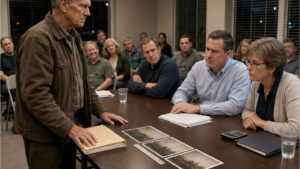
Joseph sat at a conference table inside a temporary investigation office, staring at a stack of documents that seemed far too ordinary to explain something so catastrophic.
Inspection forms.
Maintenance requests.
Internal emails.
Nothing dramatic.
Nothing sensational.
Yet together they painted a troubling picture.
An investigator tapped a highlighted section.
“Read the date.”
Joseph did.
Three weeks before the accident.
Brake response irregular.
Further inspection recommended.
Another report carried similar wording.
Then another.
Then another.
Joseph leaned back.
“So they knew.”
The investigator chose his words carefully.
“They knew there were concerns.”
“That’s not the same thing?”
The investigator remained silent.
Which felt like an answer.
Across town, media coverage still focused heavily on Michael Wilson.
The man who had jumped from the crane.
The public wanted someone to blame.
A face.
A mistake.
A moment of panic.
That story fit neatly into headlines.
These documents did not.
Joseph eventually met Michael in person.
The meeting took place in a quiet room away from reporters.
Michael looked exhausted.
Older than he had on the day of the accident.
Guilt seemed to hang from him like extra weight.
For several seconds neither man spoke.
Finally Michael broke the silence.
“I thought everyone was dead.”
Joseph studied him.
The man looked genuinely haunted.
“I didn’t know what to do,” Michael continued. “The brakes failed. Every warning light came on. I tried everything.”
Joseph remembered the footage.
The jump.
The running.
The fear.
“What happened after you got out?”
Michael looked down.
“I ran.”
The admission came quietly.
“I wish I could tell you something heroic happened. It didn’t. I ran.”
Joseph expected anger.
Instead he felt something closer to sadness.
Michael had made a terrible choice.
But terror had made it.
Not cruelty.
Not malice.
Fear.
A very human thing.
The conversation changed something.
The story became more complicated.
And somehow more painful.
Because now there wasn’t one villain.
Only a chain of failures.
Weeks later additional records surfaced.
Corporate reviews.
Budget discussions.
Deferred maintenance schedules.
Recommendations postponed.
Costs reduced.
None of the documents ordered anyone to ignore safety.
Nothing was that simple.
Yet every decision pointed in the same direction.
Wait.
Delay.
Postpone.
Save money now.
Fix it later.
Joseph found himself unexpectedly angry.
Not because someone had intended disaster.
But because nobody had intended to prevent it urgently enough.
The company released public statements.
Investigations continued.
Lawyers became involved.
Experts reviewed procedures.
Every new report generated more questions.
One afternoon Joseph received a call from his bank.
The conversation lasted less than ten minutes.
When it ended, he sat quietly in his kitchen.
The food truck was gone.
Income had vanished.
Medical expenses continued.
The future felt increasingly uncertain.
For the first time, he wondered whether the accident might ultimately ruin him.
A few days later, news outlets reported that the corporation responsible for the construction project was preparing a formal legal response.
The phrase spread everywhere.
Legal response.
Joseph hated the sound of it.
Friends tried reassuring him.
Investigators offered cautious optimism.
None of it helped.
Legal response sounded dangerously close to legal defense.
Or worse.
Legal attack.
The possibility settled heavily in his mind.
What if they argued he had interfered improperly?
What if insurance companies blamed him?
What if the same act that saved lives destroyed everything afterward?
His pride made it worse.
He refused most financial help.
Refused fundraising campaigns.
Refused interviews that felt performative.
He continued carrying the burden alone.
Exactly as he always had.
Then an official envelope arrived.
No dramatic markings.
No threatening language.
Just a formal request.
A meeting.
Representatives from the corporation wanted to speak with him directly.
The date was listed.
The location.
The names attending.
One stood out immediately.
Ronald Campbell.
Lead legal representative.
Joseph stared at the letter for a long time.
His stomach tightened.
Because whatever happened next would not stay private.
The meeting would change everything.
He folded the letter carefully and placed it back inside the envelope.
Then he looked at the date again.
Only five days away.
Chapter 7: The Check Nobody Expected
The blank check was already on the table when Joseph entered the room.
He stopped walking.
For a moment he thought it had been left there by accident.
The conference room overlooked a downtown street lined with office buildings. Everything about the space felt expensive. Polished wood. Glass walls. Bottled water arranged neatly beside leather chairs.
Joseph suddenly felt very aware of the old jacket he was wearing.
Three people sat waiting.
Two executives.
One attorney.
The attorney stood first.
“Mr. Baker?”
Joseph nodded.
“Joseph.”
The man extended his hand.
“Ronald Campbell.”
Joseph shook it.
Ronald’s grip was firm but not aggressive.
“Thank you for coming.”
Joseph glanced at the check again.
Nobody explained it.
That worried him.
People usually explained things before putting life-changing objects on tables.
He sat.
The executives exchanged a brief look.
One cleared her throat.
“We know this meeting may be uncomfortable.”
Joseph folded his arms.
“Depends on how it goes.”
The attorney nodded.
“Fair enough.”
For several seconds nobody spoke.
Joseph finally broke the silence.
“Let’s get to it.”
Ronald slid a folder across the table.
Inside were photographs.
The station.
The crane.
The wreckage.
The twisted remains of the food truck.
Joseph looked away.
Even now the images hurt.
“We completed our internal review,” Ronald said.
“And?”
The attorney inhaled slowly.
“There were maintenance concerns that should have received greater attention.”
The words sounded carefully chosen.
Not defensive.
Not evasive.
Careful.
Joseph waited.
Ronald continued.
“Those concerns contributed to the chain of events that led to the accident.”
One of the executives nodded.
“We are not here to dispute that.”
Joseph blinked.
That was not what he expected.
Not even close.
He had spent days preparing for arguments.
Lawyers.
Liability.
Excuses.
Instead the room felt strangely honest.
The executive slid another document toward him.
“Our board reviewed the findings personally.”
Joseph read the first page.
Then the second.
Then the third.
Compensation.
Medical coverage.
Replacement value estimates.
Business losses.
Recovery assistance.
The numbers kept growing.
He looked up.
“This is real?”
“Yes.”
“Why?”
The question escaped before he could stop it.
Nobody seemed offended.
Ronald answered.
“Because our equipment failed.”
Joseph shook his head.
“That’s not usually how these things work.”
A faint smile appeared on Ronald’s face.
“No. It isn’t.”
The attorney leaned forward.
“Mr. Baker, hundreds of people walked away from that platform because of a decision you made. We’re not here because of public relations.”
Joseph wasn’t entirely sure he believed that.
The attorney noticed.
“You’re skeptical.”
“A little.”
“Understandable.”
Ronald reached for the check.
Then pushed it toward Joseph.
The amount line remained empty.
A blank check.
Exactly as advertised.
Joseph stared at it.
The room felt suddenly quiet.
“We want you to tell us what it will take to replace what was lost.”
Joseph looked at the empty line.
For years he had worried about every dollar.
Repair bills.
Fuel costs.
Loan payments.
Debt notices.
Now someone was asking him to write any number he needed.
The absurdity almost made him laugh.
Instead he said nothing.
Because he didn’t know what to say.
The attorney finally broke the silence.
“You don’t have to decide today.”
Joseph nodded slowly.
For the first time since the accident, a weight shifted.
Not disappeared.
Shifted.
A small difference.
But a real one.
As the meeting ended, Ronald stopped him near the door.
“There is one more thing.”
Joseph turned.
“What?”
“The video.”
Joseph sighed.
“What about it?”
“It’s bigger than you realize.”
The attorney handed him a tablet.
A compilation played.
News stations.
Online channels.
Interviews.
Millions of views.
Comments from strangers around the country.
People discussing the crash.
The sacrifice.
The decision.
Joseph watched silently.
Then a new clip appeared.
Executives from a major automotive manufacturer discussing him during an industry event.
The footage ended.
Ronald smiled.
“People have been paying attention.”
Joseph handed back the tablet.
“I didn’t do it for attention.”
“I know.”
“Then why does everybody keep acting like I did?”
Ronald studied him for a moment.
Then said something unexpected.
“Because most people spend their lives hoping they would do what you did.”
The words followed Joseph for the rest of the day.
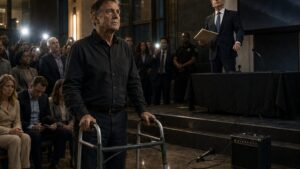
A week later he found himself standing backstage at a public event he never would have attended voluntarily.
Cameras.
Reporters.
Crowds.
Everything he disliked.
Organizers assured him it would be brief.
He didn’t believe them.
A host spoke on stage.
The audience applauded repeatedly.
Joseph stood behind a curtain trying to remain invisible.
Then he noticed something.
A vehicle.
Large.
Covered by a dark fabric sheet.
Positioned at the center of the stage.
Several company representatives stood nearby.
One caught Joseph looking.
Smiled.
Then walked away.
Joseph frowned.
The audience applauded again.
The host’s voice echoed through the venue.
“And now, one final presentation.”
The curtain began moving.
The covered vehicle slowly rolled forward.
Chapter 8: The Strongest Truck They Ever Built
The fabric came off in one motion.
The crowd erupted.
Joseph simply stared.
A brand-new truck sat beneath the stage lights.
Not ordinary.
Not modest.
The kind of truck people stopped to admire.
Heavy-duty frame.
Reinforced body.
Custom finish.
Built for work.
Built to last.
Across the side door, engraved beneath the company emblem, were simple words:
JOSEPH BAKER EDITION
He blinked.
Then looked again.
The words remained.
The audience rose to its feet.
Applause filled the building.
Joseph felt trapped.
Not by fear.
By attention.
He had spent most of his life avoiding exactly this kind of moment.
A company executive stepped forward.
“The strongest truck we’ve ever built belongs to the man who reminded us what strength actually looks like.”
More applause.
Joseph shifted uncomfortably.
The executive gestured toward him.
The crowd turned.
There was no escape now.
He walked onto the stage.
The noise somehow became louder.
Large screens behind him lit up.
Video footage appeared.
The crash.
The station.
The crane.
The spinning truck.
Joseph watched silently.
This time he didn’t focus on the collision.
Or the destruction.
Or the steel tearing apart.
Instead he watched the platform.
The people.
The lives.
Heather Lopez appeared in one clip holding her child.
Another showed commuters being escorted away from danger.
Another showed emergency workers counting survivors.
For months Joseph had measured the event through loss.
The destroyed truck.
The debt.
The recovery.
The uncertainty.
Watching the footage now, he saw something different.
What remained.
The truck had vanished.
But everything it protected was still there.
The realization settled quietly.
No dramatic revelation.
No sudden tears.
Just understanding.
The audience eventually grew quiet.
Someone handed Joseph a microphone.
His least favorite object in the world.
He stared at it.
Then at the crowd.
Thousands of faces.
Waiting.
Expecting.
He considered giving the microphone back.
That would have been easier.
Safer.
The old version of himself might have done exactly that.
Handle everything alone.
Avoid the spotlight.
Keep moving.
But something had changed.
Not because of the attention.
Because of what had happened afterward.
The station workers.
The visitors.
The child with the drawing.
Michael’s honesty.
The investigators.
Ronald.
The strangers who had cared.
For the first time in a long time, Joseph understood he had not carried everything alone.
Maybe he never truly had.
He raised the microphone.
The room became silent.
“I don’t really know how to do this.”
Laughter moved through the audience.
Joseph smiled slightly.
“Most of my life, I thought being responsible meant handling everything yourself.”
He paused.
The words came easier than expected.
“I thought asking for help was weakness.”
A few heads nodded.
“I was wrong.”
The silence deepened.
“The day of the accident, I wasn’t thinking about becoming a hero. I wasn’t thinking about cameras. I wasn’t thinking about any of this.”
He gestured toward the truck.
The audience listened.
“I saw people who needed help.”
Nothing more.
Nothing less.
The simplicity of it seemed to settle over the crowd.
Joseph looked toward the giant screens one final time.
The image frozen there showed the mangled remains of the old food truck.
Twisted steel.
Destroyed metal.
A wreck.
Yet somehow beautiful.
Because everyone behind it was alive.
He smiled.
Then set down the microphone.
The applause returned.
But it sounded different now.
Not louder.
Closer.
More human.
As the ceremony ended, people gathered around the new truck.
Joseph remained where he was for a moment.
Watching.
Thinking.
The old truck had carried his past.
The new one would carry whatever came next.
Not because someone rescued him.
Not because luck intervened.
Because one impossible choice had changed everything.
He walked toward the truck.
Ran a hand across the steel door.
Then climbed inside.
The story has ended.